1 Kings 10:15

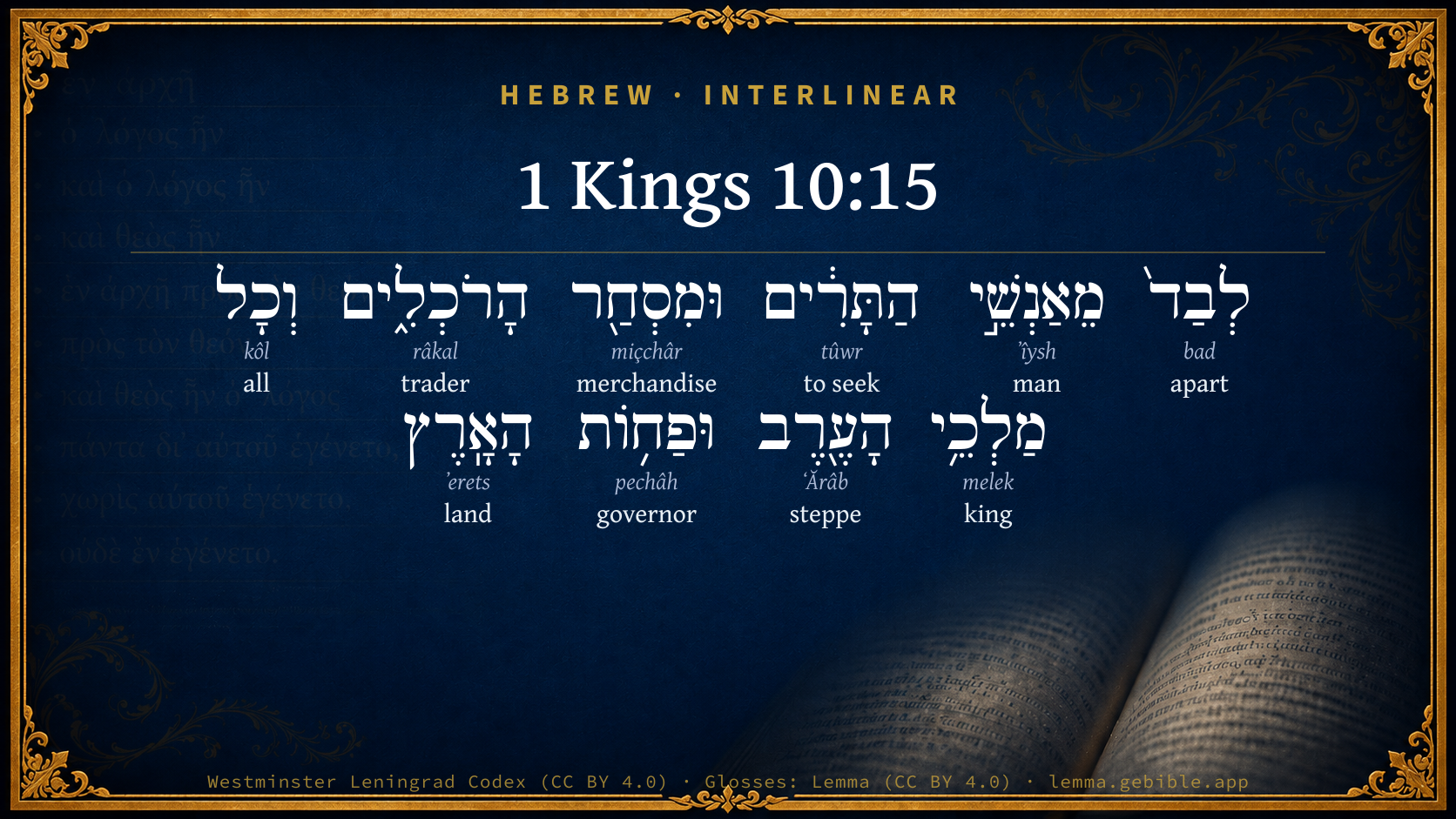
Hebrew (Westminster Leningrad Codex) 1 Kings 10:15 appears in the Hebrew Old Testament. The text above is from the Westminster Leningrad Codex. Each word links to its Strong’s number, a concise gloss, and parsing drawn from the Open Scriptures Hebrew Bible morphology. Click any word for its full Brown-Driver-Briggs (BDB) entry.
Download image
Cite this verse

1 Kings 10:15 (World English Bible). Public Domain. Lemma interlinear Bible study tool, https://lemma.gebible.app/v/1-kings/10/15.

Show BibTeX & RIS
BibTeX
RIS
English Translation
besides [that which] the traders [brought], and the traffic of the merchants, and of all the kings of the mixed people, and of the governors of the country.
World English Bible · Public Domain
Highlights
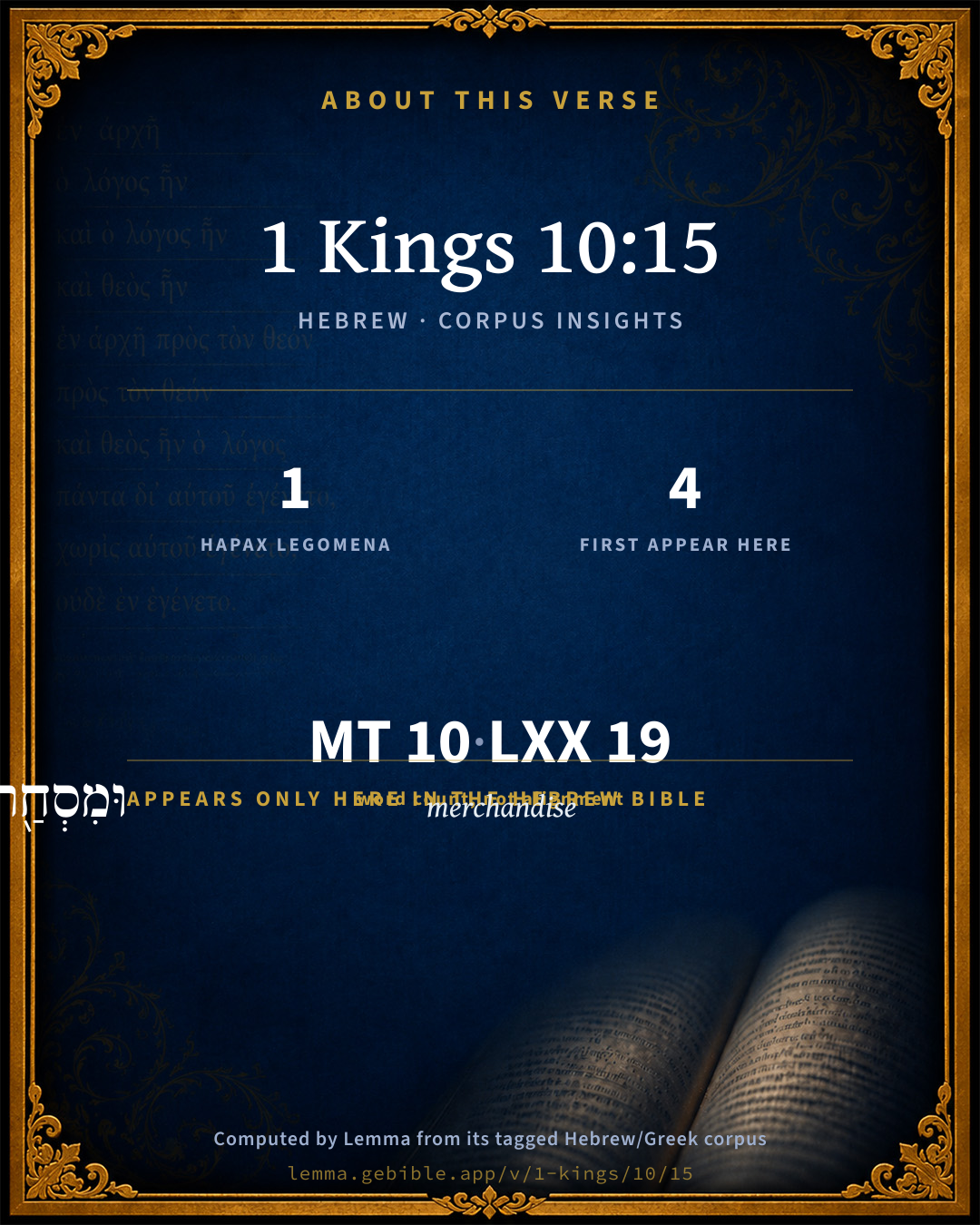
  • 1 hapax legomenon — only here in the Hebrew Bible
  • 4 first appearances in the Hebrew Bible
Full analysis ↓
Download a study sheet

One document with this verse’s original text, its word-by-word gloss line, the meaning frame, cross-references with their text, attributed commentary, and full source and license credits — printable, and it pastes into notes with its structure intact.

This verse Autodidact and up

Study sheet (.html) Plain text (.txt)

A passage Seminary Student

Up to 50 verses in one chapter. A passage sheet keeps up to 6 commentary sources and 12 cross-references per verse, in the order this page ranks them, and says so on the sheet whenever that leaves anything out. Ask for a single verse and you get the Autodidact verse sheet above.

Everything on this page stays free to read, with no account — the sheet is a download of what is already on screen, not access to it.

Want to remove ads? Support Godless Engineer
Compare translations 3

The same verse in 3 English versions, stacked beneath the original-language interlinear above. Click any original word for its lexicon entry.

Each is an independent rendering of the whole verse — the interlinear is not word-aligned to these translations.

Highlighted words mark where these versions differ — a whole-verse word diff, not a word-by-word alignment.

  • World English Bible Public Domain
    besides [that which] the traders [brought], and the traffic of the merchants, and of all the kings of the mixed people, and of the governors of the country.
  • King James Version Public Domain
    Beside that he had of the merchantmen, and of the traffic of the spice merchants, and of all the kings of Arabia, and of the governors of the country.
  • unfoldingWord Literal Text CC BY-SA 4.0
    apart from the men of the searchers and from the merchandise of the traders and all of the kings of the Arab and the governors of the land.

unfoldingWord Literal Text — © unfoldingWord, licensed CC BY-SA 4.0. Word-aligned USFM3 via Door43 (git.door43.org/unfoldingWord/en_ult).

Versions to compare (up to 4)

3 of 4 selected

Show all 18 translations

Every available English version of this verse, each an independent rendering of the whole verse.

  • World English Bible Public Domain
    besides [that which] the traders [brought], and the traffic of the merchants, and of all the kings of the mixed people, and of the governors of the country.
  • Berean Standard Bible Public Domain
    not including the revenue from the merchants, traders, and all the Arabian kings and governors of the land.
  • Majority Standard Bible Public Domain
    not including the revenue from the merchants, traders, and all the Arabian kings and governors of the land.
  • King James Version Public Domain
    Beside that he had of the merchantmen, and of the traffic of the spice merchants, and of all the kings of Arabia, and of the governors of the country.
  • American Standard Version (1901) Public Domain
    besides `that which' the traders `brought', and the traffic of the merchants, and of all the kings of the mingled people, and of the governors of the country.
  • Revised Version (1885) Public Domain
    beside that which the chapmen brought, and the traffic of the merchants, and of all the kings of the mingled people, and of the governors of the country.
  • Geneva Bible (1599) Public Domain
    Besides that he had of marchant men and of the marchandises of them that solde spices, and of all the Kinges of Arabia, and of the princes of the countrey.
  • Douay-Rheims (1899) Public Domain
    Besides that which the men brought him that were over the tributes, and the merchants, and they that sold by retail, and all the kings of Arabia, and the governors of the country.
  • Young's Literal Translation Public Domain
    apart from `that of' the tourists, and of the traffic of the merchants, and of all the kings of Arabia, and of the governors of the land.
  • Literal Standard Version CC BY-SA 4.0
    apart from [that of] the tourists, and of the traffic of the merchants, and of all the kings of Arabia, and of the governors of the land.
  • Unlocked Literal Bible CC BY-SA 4.0
    besides the gold that the traders and merchants brought. All the kings of Arabia and the governors in the country also brought gold and silver to Solomon.
  • unfoldingWord Literal Text CC BY-SA 4.0
    apart from the men of the searchers and from the merchandise of the traders and all of the kings of the Arab and the governors of the land.
  • Darby Bible Public Domain
    besides what [came] by the dealers, and by the traffic of the merchants, and by all the kings of Arabia, and by the governors of the country.
  • World Messianic Bible Public Domain
    in addition to that which the traders brought, and the traffic of the merchants, and of all the kings of the mixed people, and of the governors of the country.
  • Webster's Bible Public Domain
    Besides what he had of the merchants, and of the traffic of the spice-merchants, and of all the kings of Arabia, and of the governors of the country.
  • Free Bible Version CC BY-SA 4.0
    not including that received from traders and merchants, and all the kings of Arabia and governors of the land.
  • Bible in Basic English Public Domain
    In addition to what came to him from the business of the traders, and from all the kings of the Arabians, and from the rulers of the country.
  • JPS Tanakh (1917) Public Domain
    beside that which came of the merchants, and of the traffic of the traders, and of all the kings of the mingled people and of the governors of the country.

Literal Standard Version (2020), Covenant Press — licensed CC BY-SA 4.0. Text via the HelloAO Bible API (eBible.org). Unlocked Literal Bible (unfoldingWord) — licensed CC BY-SA 4.0. Text via the HelloAO Bible API (eBible.org). unfoldingWord Literal Text — © unfoldingWord, licensed CC BY-SA 4.0. Word-aligned USFM3 via Door43 (git.door43.org/unfoldingWord/en_ult). Free Bible Version, Dr. Jonathan Gallagher — licensed CC BY-SA 4.0. Text via the HelloAO Bible API (eBible.org).

Word by word

More ways to search: Search by grammar → Find every occurrence → Compare this word →

Practice this passage: Drill this verse → Learn its vocabulary →

וּמִסְחַ֖ר
miçchâr
H4536
“and · merchandise of”
Conjunction + Noun, Common, Masculine, Singular, Construct
Part of Speech
Conjunction + Noun
Type
Common
Gender
Masculine
Number
Singular
State
Construct
Full BDB Definition

Origin: from H5503

TWOT: 1486d

merchandise - (BDB) merchandise; meaning doubtful
  1. לְבַד֙ bad H905 “to/for · apart” Preposition + Noun, Common, Masculine, Singular, Absolute
  2. מֵאַנְשֵׁ֣י ʼîysh H376 “from · men of” Preposition + Noun, Common, Masculine, Plural, Construct
  3. הַתָּרִ֔ים tûwr H8446 “the · seeking” Particle, Definite Article + Verb, Qal, Participle Active, Masculine, Plural, Absolute
  4. הָרֹכְלִ֑ים râkal H7402 “the · trader” Particle, Definite Article + Verb, Qal, Participle Active, Masculine, Plural, Absolute
  5. וְכָל kôl H3605 “and · all of” Conjunction + Noun, Common, Masculine, Singular, Construct
  6. מַלְכֵ֥י melek H4428 “kings of” Noun, Common, Masculine, Plural, Construct
  7. הָעֶ֖רֶב ʻĂrâb H6152 “the · steppe” Particle, Definite Article + Noun, Common, Masculine, Singular, Absolute
  8. וּפַח֥וֹת pechâh H6346 “and · governors of” Conjunction + Noun, Common, Masculine, Plural, Construct
  9. הָאָֽרֶץ ʼerets H776 “the · land” Particle, Definite Article + Noun, Common, Both, Singular, Absolute

About this verse

These counts appear in no published source. They are computed here, from the morphology-tagged text and Lemma’s own curated glosses. What Lemma adds →

10
words
10
distinct lemmas
Historical
section

Notable vocabulary

1 hapax legomenon — a word that appears only here in the entire Hebrew Bible:

  • וּמִסְחַ֖ר merchandise H4536

First appearance in Scripture

These words make their first canonical appearance in the Hebrew Bible here:

  • וּמִסְחַ֖ר merchandise H4536
  • הָרֹכְלִ֑ים trader H7402
  • הָעֶ֖רֶב steppe H6152
  • וּפַח֥וֹת governor H6346

Shared distinctive vocabulary

הָעֶ֖רֶב steppe H6152 occurs in 5 verses of the Hebrew Bible. Also found in:

Grammatical profile

  • 2 verbs
  • 8 nouns

Verb forms

  • הַתָּרִ֔ים Qal · Participle Active
  • הָרֹכְלִ֑ים Qal · Participle Active

Hebrew & Septuagint length

In English translation the verse runs 28 words from the Hebrew and 27 from the Septuagint (LXX English) — closely comparable.

A rough comparison of the two English renderings, which tokenize alike — not a word-level alignment.

Word counts can differ between the Hebrew and the Greek without any difference in meaning — e.g. the Hebrew direct-object marker אֵת has no separate Greek word, and Greek often adds the article ὁ.

In the original languages it is 10 Hebrew tokens and 19 Greek tokens — but the two are counted differently (Hebrew bundles its prefixes and suffixes into one token; the Greek is in lemma form), so that isn’t a like-for-like length.

Cross-references

5

Topical passages linked to 1 Kings 10:15 in the Treasury of Scripture Knowledge — connected by theme and wording, ordered by reader-vote popularity; previews shown in the World English Bible.

  • 1 Chronicles 9:24 On the four sides were the porters, toward the east, west, north, and south.
  • 2 Chronicles 9:13–14 Now the weight of gold that came to Solomon in one year was six hundred and sixty-six talents of gold,
  • Psalms 72:10 The kings of Tarshish and of the isles will bring tribute. The kings of Sheba and Seba shall offer gifts.
  • Isaiah 21:13 The burden on Arabia. In the forest in Arabia shall you lodge, you caravans of Dedanites.
  • Galatians 4:25 For this Hagar is Mount Sinai in Arabia, and answers to the Jerusalem that exists now, for she is in bondage with her children.

Cross-references courtesy of OpenBible.info (CC BY 4.0).

Hebrew and Greek witnesses Masoretic Hebrew ↔ Greek Septuagint

The same verse in the two great witnesses to the Old Testament, shown verse-for-verse.

These are two independent witnesses, not word-aligned to each other, and the Septuagint is shown in lemma (dictionary) form.

Hebrew 1 Kings 10:15 Masoretic · Westminster Leningrad Codex

לְבַד֙ מֵאַנְשֵׁ֣י הַתָּרִ֔ים וּמִסְחַ֖ר הָרֹכְלִ֑ים וְכָל מַלְכֵ֥י הָעֶ֖רֶב וּפַח֥וֹת הָאָֽרֶץ

besides [that which] the traders [brought], and the traffic of the merchants, and of all the kings of the mixed people, and of the governors of the country.

World English Bible · Public Domain

Greek LXX 1 Kings 10:15 Septuagint · lemma form

χωρίς ὁ φόρος ὁ ὑποτάσσω καί ὁ ἔμπορος καί πᾶς ὁ βασιλεύς ὁ πέραν καί ὁ σατράπης ὁ γῆ

Besides the tributes of them that were subjects, both merchants and all the kings of the country beyond the river, and of the princes of the land.

LXX2012 (modern English Septuagint) · Public Domain

On this verse, The Cambridge Bible for Schools and Colleges discusses the Septuagint’s reading. Read the note in Commentary ↓

Hebrew: Westminster Leningrad Codex (CC BY 4.0). Greek: Septuagint (public domain); English from LXX2012 (modern English Septuagint) (Public Domain). How the Septuagint differs from the Hebrew →

Targum (Aramaic paraphrase)

1

The Targum is the ancient Jewish Aramaic paraphrase of the Hebrew Scriptures — an interpretive translation, not the Hebrew text itself. Onkelos (literal) and Pseudo-Jonathan (expansive) render the Torah, and Jonathan the Prophets. Coverage is partial: where no permissively-licensed English translation exists for a verse, only the Aramaic is shown. This is verse-level text, not a word-by-word alignment to the Hebrew.

  1. Targum Jonathan Prophets (Joshua–Malachi)
    בַּר מַאֲגַר אוּמָנַיָא וּסְחוֹרַת תַּגָרַיָא וְכָל מַלְכֵי סוּמְכְוָתָא וְשִׁלְטוֹנֵי אַרְעָא:

    (no public-domain English translation for this verse)

    Targum Jonathan — Aramaic: “Mikraot Gedolot” (public domain). English: “Sefaria Community Translation” (CC0 1.0 (public-domain dedication)); “London "Chaldee Paraphrase," 1871” (public domain). Text via Sefaria.

Commentary

Notes on 1 Kings 10:15 from classic Christian and Jewish commentators (each source and its license shown beneath its notes). The classic Christian expositions comment on the surrounding passage and are grouped to its opening verse, so a note may address several verses; the Jewish commentaries on the Tanakh (Rashi and others) are per-verse, so they appear only where the commentator wrote on this verse.

Lemma curates 59 commentaries, every one of them public domain or Creative Commons licensed, each selected and text-cleaned for this edition rather than reprinted as found. About our sources →

Trapp's Complete Commentary

John Trapp

1Ki 10:15 Beside [that he had] of the merchantmen, and of the traffick of the spice merchants, and of all the kings of Arabia, and of the governors of the country.

Ver. 15. Besides that he had of the merchantmen] Or, Of the publicans and custom takers; Heb., Men that searched, or spied their opportunities of making the best of their commodities.

And of the traffic of the spice merchants.] Far sweeter matter to make gain of than e lotio, as Vespasian; to whom dulcis erat odor lucri ex re qualibet.

John Trapp, A Commentary or Exposition upon All the Books of the Old and New Testament (1647–1656) — public domain. Text from a community e-Sword module.

Joseph Benson's Commentary

1Ki 10:15. Besides that he had of the merchant-men — Who paid custom for the goods they brought from divers countries. Hebrew, מאנשׁי התרים, meanshee hattarim, from the men, the searchers. Merchants may be so called, because they search for commodities and articles of traffic. Or rather, the gatherers of the king’s revenues are intended, who used to search narrowly into all wares, that the king might not be defrauded of his rights. Of the traffic of the spice-merchants — Or rather, of the merchants in general, as the word רכלים, rochelim, is continually used; for there is no reason why it should be confined to those that traded in spices. Of all the kings of Arabia — Who sent him presents. We must not suppose that these in general were kings of large dominions; most of them were only rulers of cities, and the territories belonging to them, such as were formerly in Canaan, and were anciently called kings. And of the governors of the country — Or, of the land, namely, the land of Arabia; some parts of which were so far conquered, that he had governors of his own placed over them, each of whom was to take care of the king’s revenue in his jurisdiction; and some parts only so far, that they still had kings of their own, but such as were tributaries to him.

Joseph Benson's Commentary on the Old and New Testaments (1811–1818) — public domain. Text from a community e-Sword module.

Geneva Bible (1599)

Geneva Bible translators

To wit, of Arabia, which for the great abundance of all things was called Happy.

Geneva Bible (1599) marginal notes — public domain. Text via Bolls.life.

Ellicott's Commentary for English Readers

(15) The governors of the country.—The word “governor” (pechah) is supposed to be of foreign origin—possibly cognate to the Sanscrit word paksha “friend.” It is used constantly of foreign officers, or satraps: as in 1Ki_20:24, of the Syrian officers; in 2Ki_18:24 and Isa_36:9, of the Assyrians; in Jer_51:23, of the Babylonians; in Est_8:9, Neh_5:14; Neh_5:18; Neh_12:26, &c., of the Persians. Hence it would seem to be used here, not for the officers in the land of Israel described in 1 Kings 4, but for governors (Israelite or foreign) in tributary countries: and it may possibly be a word of later origin than the age of Solomon, introduced by the compiler of the book.

A Bible Commentary for English Readers, edited by Charles John Ellicott (1878–1897) — public domain. Text from a community e-Sword module.

The Cambridge Bible for Schools and Colleges

gen. ed. J. J. S. Perowne

15. beside that he had of the merchantmen] There are two kinds of traders specified in this verse, and the participle here used to describe the first signifies ‘those who go about’ with their goods, hawkers of their wares, which is a general characteristic of Oriental traffickers. Hence in R.V. the word chapmen has been adopted, and the clause a little differently worded. Literally it is, ‘beside (what came) from the men of the hawkers,’ and this is represented by ‘beside that which the chapmen brought,’ though the literal rendering shews that ‘brought’ might fairly have been printed in Roman and not in italics. The LXX. gives, apparently having read some other words in the original, ‘from the tribute of the subject people.’

and of the traffick of the spice merchants] A mistaken identification of the word descriptive of this second class of traders with a Syrian noun which means ‘a dealer in aromatic herbs’ has led to the rendering ‘spice merchants.’ The word merely implies another class of merchants, but whether more or less dignified than the former it is not easy to make out. The LXX. renders by ἒμπορος here and elsewhere, and gives here ‘the taxes on the merchants’. Render (as there is no preposition with this clause) and the traffick of the merchants.

and of all the kings of Arabia] R.V. ‘and of all the kings of the mingled people.’ The word in the original, though it has the same consonants, has not the same vowels as the proper name. In this text we have הָעֶרֶב, while the other word is עֲרַב = Arabia. That the two are distinct designations is proved by Jer_25:24, where both occur in the same verse, ‘all the kings of Arabia and all the kings of the mingled people.’ The word in our text is used very early in the history of Israel (Exo_12:38) of ‘the mixed multitude’ which came up with the Israelites out of Egypt, and afterwards of people who were in a sort of loose attachment to the kingdom. (Cf. Jer_1:3-7.) In the parallel passage (2Ch_9:14) the Hebrew text has the ‘kings of Arabia,’ but the form of the sentence is somewhat altered, and the close connexion of the two sets of persons in the verse already quoted from Jeremiah makes it not unlikely that both were under a sort of tribute to Solomon. The LXX. has τῶν βασιλέων τοῦ πέραν, but the Vulgate ‘reges Arabiæ.’

and of the governors of the country] Most likely those officers are meant whose positions were described 1Ki_4:7-19. After the Oriental fashion such persons would pay for their posts by regular tribute to the king.

The Cambridge Bible for Schools and Colleges (gen. ed. J. J. S. Perowne; Cambridge University Press, 1878–1918) — public domain. Text from a community e-Sword module.

John Gill's Exposition

Besides that he had of the merchantmen, and of the traffic of the spice merchants,.... What they paid him as a duty or custom for the importation of their goods:

and of all the kings of Arabia; who were subject to him, and paid him a yearly tribute, or at least made presents, see Kg1 4:21.

and of the governors of the country; who were viceroys or deputy governors of countries conquered by his father, and who collected tribute from the people, and paid it to him.

John Gill's Exposition of the Whole Bible (1746–1763) — public domain (CC PDM 1.0). Text via the HelloAO Bible API.

Albert Barnes' Notes on the Bible

There is no mention in the original of “spice merchants.” Two classes of traders are spoken of; but both expressions are general.

Kings of Arabia - Rather, “kings of the mingled people” (compare Jer 25:24). These were probably tribes half Jewish, half Arabian, on the borders of the western desert. They are regarded as Arabs by the author of Chronicles (marginal reference).

Governors - The word used here is thought to be of Aryan origin. It appears to have been a title given by the Persians to petty governors, inferior to the great satraps of provinces. We find it borne by, among others, Tatnai Ezr 5:6, Zerubbabel Hag 1:1, and Nehemiah Neh 5:14. It can scarcely have been in use among the Jews so early as Solomon, and we must therefore suppose it to have been substituted by the writer of Kings for some corresponding Semitic title. The empire of Solomon was not a state governed from a single center by an organisation of satrapies or provinces (1Ki 4:21 note). But exceptionally, in some parts of the empire, the kings had been superseded by “governors” (compare 1Ki 20:24).

Albert Barnes' Notes on the Bible (1834–1885) — public domain. Text from a community e-Sword/MySword module.

Haydock's Catholic Bible Commentary

Merchants: wholesale. (Menochius) --- Arabia, the desert, which was peopled by various nations. Arab means, "a mixture, or assemblage," as well as "the night, and a fruitless country." Septuagint seem to have read abor, "all the kings of the other side" the Euphrates, who were also called Arabs. See chap. iv. 24. --- Country around Judea, comprising the Phylarchs of Arabia, (Genesis xvii. 20.) and the Philistine Satraps.

George Leo Haydock (1774–1849), Haydock's Catholic Family Bible and Commentary, 1859 edition — public domain. Excludes Psalms (Douay-Rheims chapter numbering differs from Protestant) and Deuterocanonical books (Catholic canon only).

Matthew Poole's English Annotations

Of the merchantmen, Heb. of the searchers, or spies, i.e. either merchants, who use to inquire and search out commodities, and all advantages of trade; or rather, the publicans or gatherers of the king’s revenues, who used to search narrowly into all wares and dealings, that the king might not be defrauded of his rights.

Of the spice merchants, or rather, of the merchants in general, as that word is oft used in Eze 27, and elsewhere. So this and the former particular contain both the branches of the king’s revenue, what he had from the land and fruits thereof, and what he had from the merchants and traders in other commodities.

Of all the kings of Arabia, to wit, of those parts of Arabia which were next to Canaan, which were either conquered by David, or submitted to pay tribute to Solomon. But we must not think all these to be kings of large dominions, but many of them only governors of cities, and the territories belonging to them, such as were formerly in Canaan, and were anciently called kings. Of the country, or, of the land, or, of that land, for there is an article in the Hebrew; i.e. either of the land of Canaan; or rather, of the land of Arabia; whereof some parts were so far conquered, that he had governors of his own over them, who were each of them to take care of the king’s revenue in his jurisdiction; and part only so far that they still had kings of their own, but such as were tributaries to him.

Matthew Poole's English Annotations on the Holy Bible (1683–1685) — public domain. Text from a community e-Sword/MySword module.

Whedon's Commentary on the Bible

Daniel D. Whedon

15. Merchantmen… spice merchants — The difference between the two is difficult to determine. The rendering, spice merchant is unauthorized by any thing in the original word. But here, perhaps, the two words are used in the general sense of wholesale and retail traffickers.

All the kings of Arabia — Whose provinces bordered upon the south of Palestine, and were tributary to the kingdom of Israel. Compare 2Ch_17:11 and Jer_25:25, where kings of Arabia and kings of the mingled people are associated, and designated by the same word.

Governors — Prefects; another name for the officers described at chap. 1Ki_4:7. On the origin of the word, see note on 2Ki_18:34.

Daniel D. Whedon (gen. ed.), Commentary on the Old and New Testaments (1874–1909) — public domain. Text from a community e-Sword module.

The Pulpit Commentary

Beside that he had of the marchantmen The root rWT signifies to wander or travel about. In Num_13:16, Num_13:17, it is used of spies. It may here be applied to persons who travelled for purposes of trade; but the versions differ very materially in their rendering of the word; the LXX understanding it of tribute (twn forwn twn uJpotetagmenwn); the Chaldee, Syriac, and Arabic of artizans; the Vulgate of ambassadors.

And the word is nowhere else used of traders. For the construction, see Ewald 287 e, and of the traffick it is noteworthy that no such word is used before above of the spice not in Hebrews merchants lkr; is akin to lgr Like the preceding word, the primary meaning is to go about (lgr, foot); hence, to trade. It is probable that Solomon"s great commercial enterprises were conducted for his own benefit, i.e., that the merchants were little more than agents, who bought and sold for the king. Such is the custom of Eastern kings (Kitto)), and of all the kings of Arabia brh is very variously interpreted. According to Gesenius it means foreigners, and he would understand "foreign kings who made an alliance with the Israelites," and so the Chaldee. Keil: "the kings of the mixed population" (mentioned Exo_12:38. Cf. Jer_50:37; Neh_13:3) Perhaps the words are best explained by Jer_25:24: "The kings of Arabia (br) and of the mingled people (br) that dwell in the desert," i.e., the desert of Arabia deserta, bordering on Palestine. The chronicler here gives us br i.e., not the Arabia of the geographers, but the tract of country south and east of Palestine, as far as the Red Sea (Gesenius). No doubt these kings, who were great sheepmasters, paid their tribute in flocks of sheep and goats (2Ch_17:11; 2Ki_3:4) and of the governors of the country. The word twOjp (cf. ch. 20:24) is a foreign word, perhaps Sanskrit, apparently borrowed by the Jews from the Persians. It is used of Tatnai, (Ezr_5:6) of Zerubbabel, (Hag_1:1) and of Nehemiah. (Neh_5:14) Probably our author, in whose day it was a familiar and well understood word, substituted it for some older Hebrew designation. But the office and character of these "governors" is more difficult to define than the name. Rawlinson thinks that, in some parts of the empire, the kings the "empire of Solomon," he observes, "was in the main a congeries of small kingdoms been superseded by governors." But it seems as natural to understand the term of the twelve prefects mentioned in chap. 4., who were "the governors of the land," or of similar officers in the different outposts of the kingdom. We know that the contributions which passed through their hands were furnished in kind; hence, perhaps, it is that this income is distinguished from the gold of ver. 14.

The Pulpit Commentary (1880–1919), ed. H.D.M. Spence-Jones & Joseph S. Exell — public domain. Text from a community e-Sword module.

John Wesley's Explanatory Notes

Merchant-men - Hebrew. of the searchers; either merchants, who use to search out commodities: or, the gatherers of the king's revenues, who used to search narrowly into all wares, that the king might not be defrauded of his rights. Spice-merchants - Or rather, of the merchants in general, as the word is often used. So this and the former particular contain both the branches of the king's revenue, what he had from the land, and what he had from the merchants and traders. Kings - Of those parts of Arabia which were next to Canaan, which were either conquered by David, or submitted to pay tribute to Solomon. But we must not think all these to be kings of large dominions; many of them were only governors of cities, and the territories belonging to them, such as were formerly in Canaan, and were anciently called kings. The country - Or, of the land; the land of Arabia: whereof some parts were so far conquered, that he had governors of his own over them, who were each of them to take care of the king's revenue in his jurisdiction; and part only so far, that they still had kings of their own, but such as were tributaries to him.

John Wesley, Explanatory Notes Upon the Whole Bible (1754–1765) — public domain. Text via the GEBible commentary corpus.

Rashi

Rabbi Shlomo Yitzchaki (Rashi)

This was in addition [to the gold that came from] traveling merchants. Merchants would bring him who visited the land on business.

Spice dealers. Spice dealers who would carry spices from one city to another.

And all the subordinate kings. [Targum] Yonoson rendered, “and all dependent upon his support,” an expression of guarantee, [i.e.,] kings who were allies and were dependent upon his support, garantie, in O.F.

Rashi on the Tanakh — English translations: “The Judaica Press complete Tanach with Rashi, translated by A. J. Rosenberg” (CC BY 4.0); “Pentateuch with Rashi's commentary by M. Rosenbaum and A.M. Silbermann, 1929-1934” (public domain); “The Metsudah Tanach series, Lakewood, N.J” (CC BY 4.0); and “The Book of Joshua, Metsudah Publications, 1997” (CC BY 4.0). Text via Sefaria.

Lesson kit

Teaching starters — assembled from the data on this page, not authored interpretation. Every prompt links to the verse data it draws on. Edit before teaching.

1 Kings, in the Historical, opens this verse with 10 words (10 distinct Hebrew lemmas). Its most distinctive word is miçchâr (“merchandise”). A historical commentator’s framing appears above. Read the whole chapter for the surrounding context.

Discussion questions

  1. How does “merchandise” (miçchâr) shape what this verse is saying?
  2. This verse holds 1 word here found nowhere else in the Hebrew Bible. What might the rare word draw attention to?
  3. 4 words here appear for the first time in Scripture. What is being introduced at this debut?
  4. 2 Chronicles 9:14 shares the word «steppe» with this verse. How do the two illuminate each other?
  5. These translations render this verse differently; the difference is in the English rendering, not the original. What questions does that raise?
  6. The verb «הַתָּרִ֔ים» is Qal Participle Active. How does its form color the action?
  7. Reading how Trapp's Complete Commentary and Joseph Benson's Commentary read this verse, where do the two commentators agree and where do they part?

Things to notice

Reading settings

Reading text

Shown beneath each verse's original-language words.

Old Testament
Old Testament edition

Read the OT as the Masoretic Hebrew (MT) or the Greek Septuagint (LXX).

English shown for the Greek Septuagint (in the Hebrew ↔ Greek comparison).

Comparing translations? Open the Compare panel on any verse page to stack up to four side by side.