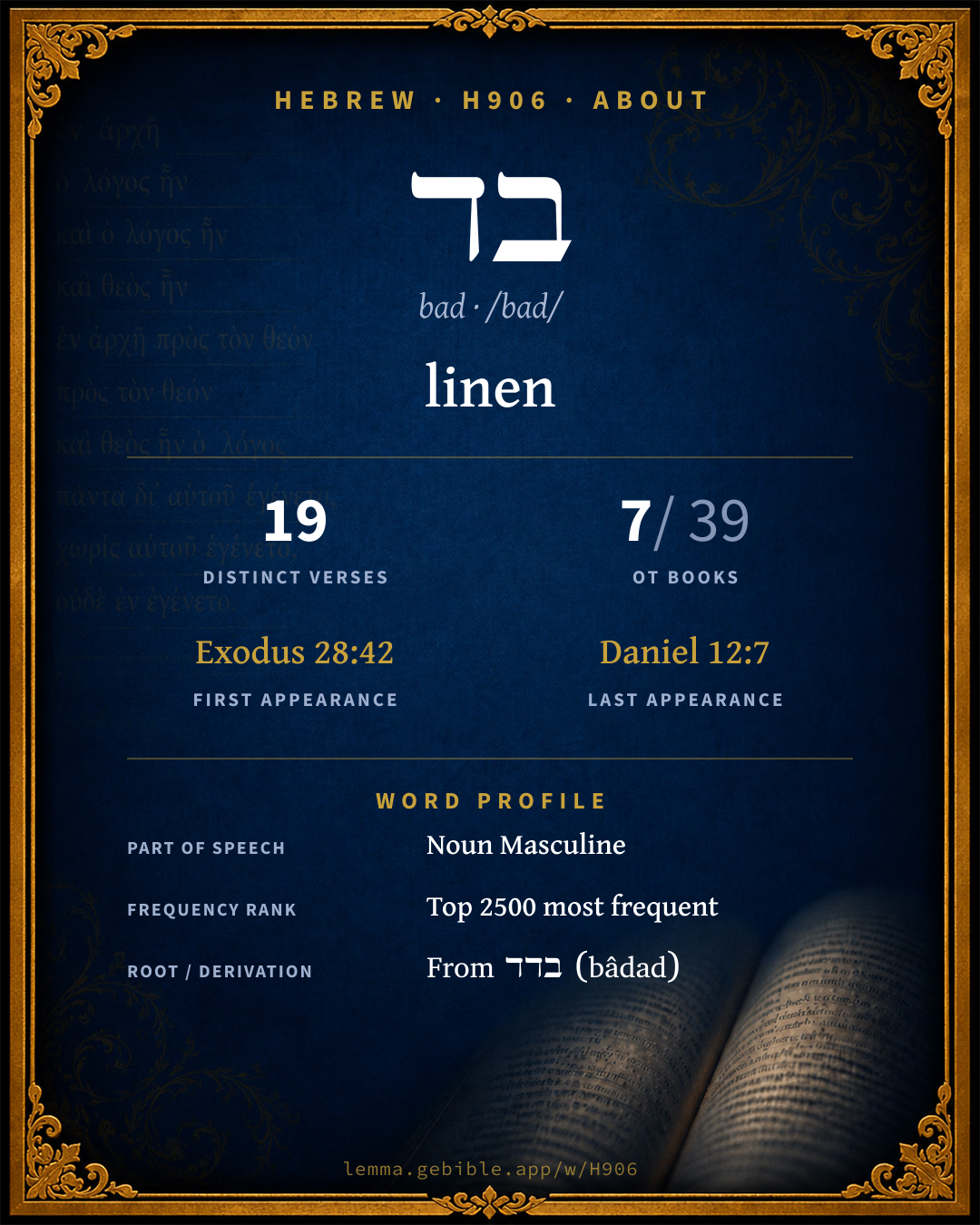
בַּד
linen
Full lexicon entry — Brown-Driver-Briggs (BDB)
From Brown-Driver-Briggs (BDB)
Where this word appears
See every Absolute-state word in the Hebrew Bible →
Grammar key — what these labels mean
Part of speech
- Noun
- A naming word — a person, place, thing, or idea.
Noun type
- Common
- A common noun — a general class of person, place, or thing (“king,” “city,” “water”), not a specific name.
State
- Absolute
- The independent form of a noun, not bound to a following word.
- Construct
- A noun bound to a following noun in a possessive / “of” relationship (the construct chain).
Gender
- Masculine
- Grammatically masculine.
Number
- Singular
- One.
- Plural
- More than one (in Hebrew, generally three or more).
Grammatical forms
- Noun, Common, Masculine, Singular, Absolute 13 times (57%)
- Noun, Common, Masculine, Plural, Absolute 9 times (39%)
- Noun, Common, Masculine, Singular, Construct 1 time (4%)
Parsed forms decoded from the imported morphology (morphhb / Westminster Leningrad Codex — WLC text public domain, morphhb tagging CC BY 4.0), counted across 23 parsed occurrences — not distinct verses.
Every verse where H906 appears — 19 distinct verses across 7 books. Click any verse to open its interlinear word-by-word view. Verse text shown in the World English Bible for context — . Each verse’s Hebrew form is shown with its reference; the English is not keyword-highlighted, since the data carries no word-level English alignment. Use “Compare translations” on any verse to read it across multiple English versions. This concordance covers the Hebrew Bible; Septuagint (Greek Old Testament) occurrences are not indexed here.
Exodus 2 verses
- Exodus 28:42 בָ֔ד n c ms You shall make them linen breeches to cover the flesh of their nakedness; from the loins even to the thighs they shall reach:
- Exodus 39:28 הַ/בָּ֖ד ptcl def.art + n c ms and the turban of fine linen, and the linen headbands of fine linen, and the linen breeches of fine twined linen,
Leviticus 4 verses
- Leviticus 6:10 בַ֗ד בַד֮ n c ms n c ms The priest shall put on his linen garment, and he shall put on his linen breeches upon his body; and he shall remove the ashes from where the fire has consumed the burnt offering on the altar, and he shall put them beside the altar.
- Leviticus 16:4 בַּ֨ד בַד֮ בַּד֙ בַּ֖ד n c ms cs n c ms n c ms n c ms He shall put on the holy linen coat, and he shall have the linen breeches on his body, and shall put on the linen sash, and he shall be dressed with the linen turban. They are the holy garments. He shall bathe his body in water, and put them on.
- Leviticus 16:23 הַ/בָּ֔ד ptcl def.art + n c ms "Aaron shall come into the Tent of Meeting, and shall take off the linen garments, which he put on when he went into the Holy Place, and shall leave them there.
- Leviticus 16:32 הַ/בָּ֖ד ptcl def.art + n c ms The priest, who is anointed and who is consecrated to be priest in his father's place, shall make the atonement, and shall put on the linen garments, even the holy garments.
1 Samuel 2 verses
- 1 Samuel 2:18 בָּֽד n c ms But Samuel ministered before Yahweh, being a child, girded with a linen ephod.
- 1 Samuel 22:18 בָּֽד n c ms The king said to Doeg, Turn you, and fall on the priests. Doeg the Edomite turned, and he fell on the priests, and he killed on that day eighty-five persons who wore a linen ephod.
2 Samuel 1 verse
1 Chronicles 1 verse
Ezekiel 6 verses
- Ezekiel 9:2 בַּדִּ֔ים n c mp Behold, six men came from the way of the upper gate, which lies toward the north, every man with his slaughter weapon in his hand; and one man in the midst of them clothed in linen, with a writer's inkhorn by his side. They went in, and stood beside the brazen altar.
- Ezekiel 9:3 הַ/בַּדִּ֔ים ptcl def.art + n c mp The glory of the God of Israel was gone up from the cherub, whereupon it was, to the threshold of the house: and he called to the man clothed in linen, who had the writer's inkhorn by his side.
- Ezekiel 9:11 הַ/בַּדִּ֗ים ptcl def.art + n c mp Behold, the man clothed in linen, who had the inkhorn by his side, reported the matter, saying, I have done as you have commanded me.
- Ezekiel 10:2 הַ/בַּדִּ֗ים ptcl def.art + n c mp He spoke to the man clothed in linen, and said, Go in between the whirling [wheels], even under the cherub, and fill both your hands with coals of fire from between the cherubim, and scatter them over the city. He went in as I watched.
- Ezekiel 10:6 הַ/בַּדִּים֙ ptcl def.art + n c mp It came to pass, when he commanded the man clothed in linen, saying, Take fire from between the whirling wheels, from between the cherubim, that he went in, and stood beside a wheel.
- Ezekiel 10:7 הַ/בַּדִּ֑ים ptcl def.art + n c mp The cherub stretched forth his hand from between the cherubim to the fire that was between the cherubim, and took [of it], and put it into the hands of him who was clothed in linen, who took it and went out.
Daniel 3 verses
- Daniel 10:5 בַּדִּ֑ים n c mp I lifted up my eyes, and looked, and, behold, a man clothed in linen, whose loins were girded with pure gold of Uphaz:
- Daniel 12:6 הַ/בַּדִּ֔ים ptcl def.art + n c mp One said to the man clothed in linen, who was above the waters of the river, How long shall it be to the end of these wonders?
- Daniel 12:7 הַ/בַּדִּ֗ים ptcl def.art + n c mp I heard the man clothed in linen, who was above the waters of the river, when he held up his right hand and his left hand to heaven, and swore by him who lives forever that it shall be for a time, times, and a half; and when they have made an end of breaking in pieces the power of the holy people, all these things shall be finished.
About this entry
At a glance — auto-summarized from this page’s data, not written by a person. Every figure links to its source below. This summary describes the numbers; it doesn’t interpret them.
בד (bad) is a Hebrew noun most often rendered “linen.” It first appears in Exodus 28:42. It turns up in 19 verses across 7 books, an uncommon footprint. It concentrates in Ezekiel, which alone accounts for 32% of its uses. From the same root come בדד, בד and בדד. The sections below give every sense, occurrence, and version rendering.
Gloss history
Strong's 1890 vs modern scholarship
About this word
Strong's H906 catalogs a Hebrew word from the Hebrew Old Testament.
These counts are not copied from any lexicon or concordance. They are computed here, from the morphology-tagged Hebrew Old Testament. What Lemma adds →
- 19
- distinct verses
- The word appears in 19 distinct verses.
- 7 / 39
- OT books
- The word appears in 7 of 39 Old Testament books.
- #1,368
- by frequency
- Top 2500 most frequent Hebrew words (rank 1,368 of 8,640 Hebrew words by occurrence).
View all 19 occurrences in the concordance →
By section of the Old Testament
By traditional corpus
Conventional, traditional groupings — biblical authorship is debated, so this is a traditional corpus grouping, not an authorship claim. Each share is this word’s portion of its verses in that division of the Hebrew canon. Each figure is a share of the word’s 19 distinct verses.
- Prophets (Nevi'im) 9 verses · 47%
- Torah (Pentateuch) 6 verses · 32%
- Writings (Ketuvim) 4 verses · 21%
How translations render this word
Counts come from each version’s own published word-to-Strong’s tagging or interlinear alignment — an approximate guide to how each version renders this word, not a word-level alignment the data otherwise carries. Because each total is that version’s own tagged count, the per-version totals vary from one another and need not match the appearance or distinct-verse counts above. These counts may also differ from a printed concordance because Lemma counts each distinctly tagged rendering and does not collapse phrase taggings into a single head-word total. This is a fixed set of word-tagged versions (KJV, ASV, BSB, ULT) and does not change with the reading translation you choose elsewhere. Each version’s license is shown beside its name below (and on Sources).
BDB lists this Strong’s number as 4 distinct words (homographs). Each count above pools all of them and is not split by sense — see the Senses section below. A low-frequency rendering may belong to a different one of those words, not the primary meaning.
- King James Version†: Linen 22×
- American Standard Version†: Linen 21×
- Berean Standard Bible†: Linen 20×
- unfoldingWord Literal Text†: Linen 23×
King James Version Public Domain
Renders H906 across 23† tagged occurrences — most commonly:
Plus 1 rendering that appears only once — usually multi-word phrases or single function words the recovered tagging swept in, not distinct renderings.
American Standard Version Public Domain
Renders H906 across 22† tagged occurrences — most commonly:
Plus 1 rendering that appears only once — usually multi-word phrases or single function words the recovered tagging swept in, not distinct renderings.
Berean Standard Bible Public Domain
Renders H906 across 22† tagged occurrences — most commonly:
Plus 2 renderings that appear only once — usually multi-word phrases or single function words the recovered tagging swept in, not distinct renderings. Not rendered by a distinct English word in 1 further occurrence.
unfoldingWord Literal Text CC BY-SA 4.0
Renders H906 across 23† tagged occurrences — most commonly:
10 senses and sub-senses in the full BDB
What do BDB’s symbols mean?
BDB uses these scholarly abbreviations:
| Symbol | Meaning |
|---|---|
| 𝔊 | the Septuagint (the ancient Greek translation, LXX) |
| 𝔙 | the Vulgate (the Latin translation) |
| 𝔖 | the Syriac version (the Peshitta) |
| 𝔗 | the Targum (the Aramaic translation) |
| ψ | the Psalms |
| √ | root (the underlying root or stem) |
| ‖ | parallel passage (a synonymous or contrasted parallel) |
| † | the dagger: every passage where the word occurs is cited |
The 10 senses and sub-senses the full Brown-Driver-Briggs lexicon distinguishes for this word, in lexicon order (not ranked by frequency), with BDB’s own verbatim wording and sub-sense lettering. Shown in Hebrew script with BDB’s own scholarly abbreviations. The condensed entry is in the Lexicon Entry tab. See also the Forms in the corpus table below.
בד I [m.] white linen (deriv. unknown) pl. בַּדִּים
בד II separation concr. part (بِدٌّ, بِدَّةٌ portion)
- 1. with לְ, only in sg., לְבַד proposes in a state of (v sub לְ) separation, alone, by itself (Fr à part).
- a. Ex 26:9 (= 36:16) five curtains לְבַד by themselves, and six curtains לְבַד by themselves, Ju 7:5 him shalt thou set לבד apart, Zc 12:12–14. e.g. Exodus 26:9
- b. with sf. (89 times) to express the idea of by oneself, alone (proposes in his, thy, my separation), Gn 2:18 it is not good for man to be לְבַדּוֹ alone, 21:28 and A. set the seven lambs לְבַדְּהֶן by themselves (lit. in their separation), 32:17; 43:32; 2 S 10:8; Is 5:8; Gn 42:38 הוּא לְבַדּוֹ he alone, Ex 18:14 אַתָּה לְבַדְּךָ thou alone, Nu 11:14 אָנֹכִי לְבַדִּי I alone, 1 K 19:10, 14; Dt 8:3 not upon bread alone, 29:13; 2 S 13:32; 18:24; Is 44:24; 49:21; 63:3 +; after an oblique case, as a dat. Ex 22:19; Ju 3:20 ψ 51:6 לְךָ לְבַדְּךָ against thee alone have I sinned; a genit. 71:16 I will make mention of צִדְקָֽתְךָ לְבַדֶּֽךָ׃ the righteousness of thee alone. e.g. Genesis 2:18
- c. as adv. of limitation, †Is 26:13 only through thee do we celebrate thy name, Ex 7:29. e.g. Isaiah 26:13
- d. followed by מִן it becomes a prep., apart from, besides, Ex 12:37; Nu 29:39; Dt 3:5; 18:8 (read מִמְּכָרָיו with 𝔊 𝔖 𝔗 Aq Ew Di) Ju 8:26; 20:15 al. (15 times); once, Ezr 1:6, with עַל instead of מִן. e.g. Exodus 12:37
- e. מִלְּבַד33 (prob. inverted for לְבַד מִן) besides (chiefly P and late): Gn 26:1; 46:26; Lv 9:17; 23:38 (4 times) Nu 5:8; 6:21; 17:14 + 12 times Nu 28–29; Dt 28:69; Jos 22:29; 1 K 10:13; 1 Ch 3:9; 2 Ch 9:12; 17:19; 31:16; Ezr 2:65 = Ne 7:67; Dn 11:4. With sf. †Dt 4:35 אֵין עוֹד מִלְּבַדּוֹ there is none else besides him (cf. מִבַּלְעָדַי Is 45:21). e.g. Genesis 26:1
- 2. concr. part Ex 30:34 (P) בַּד בְּבַד יִהְיֶה part for (i.e. like; cf. בְּ III. 3 end) part shall it be. e.g. Exodus 30:34
- 3. בַּדִּים parts, spec. extended from something, i.e. (a) of a body, members, limbs Jb 18:13 (of man), 41:4 (of crocodile); (b) of a vine, rods or shoots Ez 17:6; 19:14; (c) of poles or staves used for carrying the ark Ex 25:13, 14, 15; 35:12; 37:4, 5; 39:35; 40:20; Nu 4:6 1 K 8:7, 8(×2) (= 2 Ch 5:8, 9(×2)) or table of shewbread Ex 25:27, 28; 35:13; 37:14, 15; Nu 4:8, or altar of B. O. Ex 27:6(×2), 7(×2); 35:16; 38:5, 6, 7; 39:39 Nu 4:14, or altar of incense Ex 30:4, 5; 35:15; 37:27, 28; Nu 4:11; (d) more gen. bars (of fortress) Ho 11:6, (of a gate) Jb 17:16 fig. בַּדֵּי שְׁאֹל (cf. Is 38:10). read הַעִמָּדִי (for בַּדֵּי) 𝔊 Du Dr, with נֵחָ֑ת in v b (for נָ֫חַת). e.g. Job 18:13
בד III only Pl. בַּדִּים.
- a. empty, idle talk (Ph. CIS 3, 6 listen not to בדנם = Heb. בַּדֵּיהֶם; cf. ܒܶܕܝܳܐ vain talk), especially with collat. idea of imaginary pretensions or claims: Jb 11:3 בַּדֶּיךָ מְתִים יַחֲרִישׁוּ thy idle talk brings men to silence (‖ וַתִּלְעַג), Is 16:6 (of Moab) לֹא כֵן בַּדָּיו his boastings are not right (unfounded), hence Je 48:30. e.g. Job 11:3
- b. concr. empty talkers, praters (cf. NH בַּדָּאָה, Syriac ܒܳܕܽܘܝܳܐ liar), of false prophets, Is 44:25; Je 50:36. e.g. Isaiah 44:25
Senses from the full Brown-Driver-Briggs lexicon (Brown, Driver, Briggs; Oxford 1906 — public domain), digitized via Sefaria, supplemented by the OpenScriptures HebrewLexicon (CC BY 4.0). Full attribution on Sources.
Word origin
I. n.[m.] white linen (deriv. unknown) pl. בַּדִּים—אֵפוֹד בָּ֑ד 1 S 2:18 (Samuel), 1 S 22:18 (priests of Nob), 2 S 6:14 = 1 Ch 15:27 (David): in P as material of diff. priestly vestments Ex 28:42; 39:28 Lv 6:3(×2) 16:4(×4), 23, 32. Pl. (ה)לבושׁ (הַ)בַּדִּים clad in (the) linen garments, of angel Ez 9:2, 3, 11; 10:2, 6, 7; Dn 10:5; 12:6, 7.
II. v. sub I, II. בדד.
III. n.m. separation concr. part (بِدٌّ, بِدَّةٌ portion)—sf. (always with לְ) לְבַדִּי, לְבַדּוֹ etc., 3 f. pl. †Gn 21:28 לְבַדְּהֶן, v 29 לְבַדָּ֫נָה;—
— Brown-Driver-Briggs (Oxford 1906, public domain), digitized via Sefaria, supplemented by the OpenScriptures HebrewLexicon (CC BY 4.0). See Sources.
Derived from בדד (bâdad) (H909) — to separate.
Jastrow Dictionary
A second Hebrew/Aramaic lexicon for comparison, covering Aramaic and post-biblical (Talmudic, Targumic, Midrashic) usage that the biblical-Hebrew BDB does not. Matched by lemma rather than by Strong’s number, so a lemma may carry more than one Jastrow headword (shown separately below), and the entries cover usage well beyond the Bible.
בִּדְּ־
- prefix (comp. of בְּ a. דְּ = h. בְּשֶׁ־, בְּשֶׁל)
- 1. concerning that (those) of; at the time of; treating of what refers to. Sabb. 112ᵃ בדטייעי in the case of those (sandals) of the travelling merchants (Arabs). Yoma 78ᵇ, v. הוּצָא. Ḥull. 20ᵃ ומתני׳ בדלא אהדר our Mishnah treats of a case when he did not turn. Gitt. 49ᵃ בדניזק וכ׳ we go in our assessment by (the property) of the injured; a. v. fr.
- 2. if, when. Targ. Y. Gen. XLIII, 5 בִּדְּלֵית unless. Targ. O. Deut. IX, 4 בִּדְּיִתְּבַר; a. e.
*בַּד I
- = אֲבַד. Targ. Y. II, Num. XXI, 29 ובָדְתוּן (Var. וּבַדְתּוּן = וַאֲ׳). Ithpe. אִתְבִּיד, v. אֲבַד
בַּד II
- (בדד) olive press (cmp. גַּת), tank. Shebi. VIII, 6 אין … בַּבַּד you must not press olives in the tank (in the Sabbath year).—בית הַבַּד the building containing the tank and all implements for pressing olives. Sabb. I, 9 קורת ב׳ הב׳ the beam of the press; a. fr.—Bets. 19ᵃ; Tosef. ib. II, 7, v. גַּב.—Pl. בַּדִּים, בַּדִּין. B. Bath. IV, 7 בית הב׳. Toh. IX, 7 בד אחד או שני ב׳ a quantity of olives for one tank or for two; a. fr.
בַּד III
- 1. single, separate. Ber. 63ᵇ (play on baddim, Jer. L, 36) שיושבין ב׳ ב׳ who study separately (without interchange of ideas). Kerith 5ᵃ expl. Ex. XXX, 34 ב׳ בב׳. e.g. Jeremiah 50:36
- 2. with pref. לְ, לְבַד (b. h.) alone, only. Sot. 8ᵃ אותה לְבַדָּהּ her (Num. V, 19) indicates her alone (each separately); a. fr.—בִּלְבַד (adv.) only. Ber. I, 1 ולא זו ב׳ (usu. with אמרו) and not only in this case did they make such a rule. Meg. I, 5 אין בין … אלא … ב׳ there is no difference between Festivals and the Sabbath (as to forbidden labors) except only as to the preparation of the necessaries of life; a. fr.—וּבִלְבַד but only, provided. Zeb. V, 8; a. fr. e.g. Numbers 5:19
בַּד IV
- chosen, fine linen. Zeb. 18ᵇ ב׳ שיהו של בוץ וכ׳ wherever the Law speaks of garments of bad, it means that they must be of byssus, new &c. Ib. how do we know דהאי ב׳ כיתנא הוא that bad (as material for garments) means linen (and no other fine stuff)? Answ. Something which grows בד בבד in single stalks (v. preced. a. next w.); Yoma 71ᵇ. Ib. 35ᵃ bad is used four times, intimating מובחר בב׳ the choicest of &c. (for diff. vers. v. Rabb. D. S. a. l. note); [cmp. Targ. Jer. XLVIII, 30].
בַּד V
- (בדד) single stalk, twig; also (b. h.) pole, bar. Zeb. 18ᵇ; Yoma 71ᵇ; v. preced. Keth. 17ᵃ ב׳ של הדס myrtle twig. Succ. 44ᵇ even one leaf וב׳ אחד and (on) one twig. B. Mets. 24ᵃ anything on which something is suspended ב׳ קרו ליה is called bad.—Pl. בַּדִּים. Y. Yoma V, 42ᵇ bot., a. e. בין הב׳ between the bars projecting from the Ark (i.e. their corresponding place in the Second Temple). B. Mets. l. c. בַּדֵּי מחטין וכ׳ poles of peddlars for needles &c. Ib. מאי בדי what does baddé mean? Answ. Twigs.—And why do they call them baddé? Answ., v. supra. V. אַנְפּוֹרְיָא.
A Dictionary of the Targumim, the Talmud Babli and Yerushalmi, and the Midrashic Literature (Marcus Jastrow; London, Luzac, 1903) — Public Domain. Digitized via Sefaria. Digitized via Sefaria. Full attribution on Sources.
Forms in the corpus
The 15 distinct written forms H906 takes in the Hebrew Bible, most frequent first — each parse links to that state’s occurrences in the concordance. Hebrew forms include their vowel points and cantillation, so a single lemma takes many written forms.
Same root — word family
Other BDB entries built from the same root as H906, grouped by Strong’s listed origin. These share a root / origin per the lexicon — not necessarily a shared meaning. Each links to that word’s own entry.
Derives from
Shares the same root
Proper names from this root
People and places named from this root — a name, not an additional meaning of the word.
Compare all same-root words → Showing 4 of 5 — not the complete family. 1 of the same-root words is a proper name (a person or place). They share a root, not necessarily a meaning.
Septuagint verse parallels
This word appears in 18 verses that also exist in the Greek Old Testament (Septuagint), out of the 19 Hebrew verses it occurs in. You can read those verses in Greek by switching the Old Testament edition to the Septuagint.
Read these verses in the Septuagint
This is a verse-level parallel only — the same verses exist in both the Hebrew and Greek Old Testaments. No word-level Hebrew↔Greek correspondence is claimed: the data carries no such alignment, so no Greek word is shown as this Hebrew word’s translation. Coverage is not total — the Septuagint omits the deuterocanon and renumbers the Psalms, so some Hebrew verses have no direct Greek parallel.