
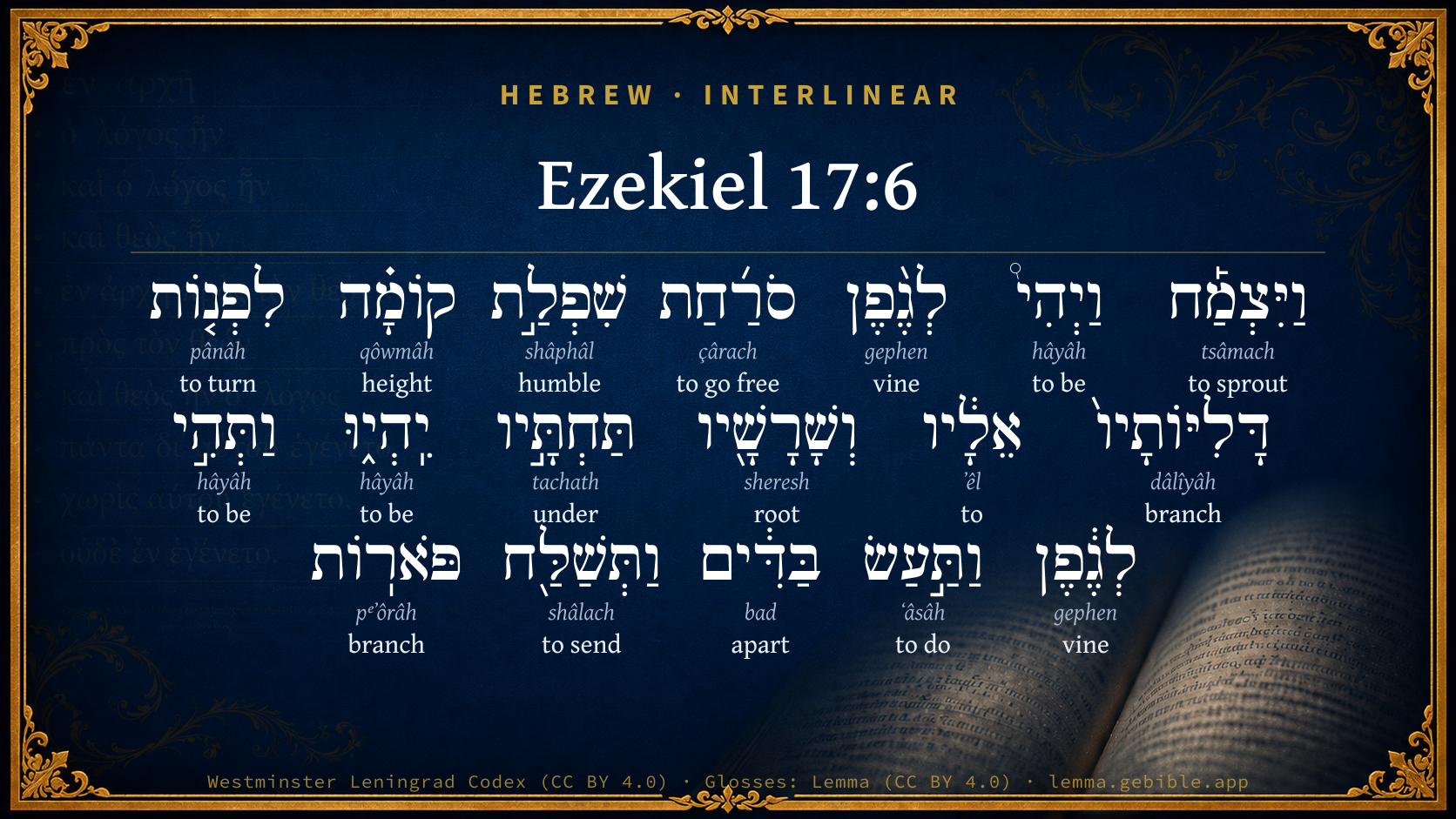
Ezekiel 17:6

Hebrew (Westminster Leningrad Codex) Ezekiel 17:6 appears in the Hebrew Old Testament. The text above is from the Westminster Leningrad Codex. Each word links to its Strong’s number, a concise gloss, and parsing drawn from the Open Scriptures Hebrew Bible morphology. Click any word for its full Brown-Driver-Briggs (BDB) entry.
Download image
Cite this verse

Ezekiel 17:6 (World English Bible). Public Domain. Lemma interlinear Bible study tool, https://lemma.gebible.app/v/ezekiel/17/6.

Show BibTeX & RIS
BibTeX
RIS
English Translation
It grew, and became a spreading vine of low stature, whose branches turned toward him, and the roots of it were under him: so it became a vine, and brought forth branches, and shot forth sprigs.
World English Bible · Public Domain
Download a study sheet

One document with this verse’s original text, its word-by-word gloss line, the meaning frame, cross-references with their text, attributed commentary, and full source and license credits — printable, and it pastes into notes with its structure intact.

This verse Autodidact and up

Study sheet (.html) Plain text (.txt)

A passage Seminary Student

Up to 50 verses in one chapter. A passage sheet keeps up to 6 commentary sources and 12 cross-references per verse, in the order this page ranks them, and says so on the sheet whenever that leaves anything out. Ask for a single verse and you get the Autodidact verse sheet above.

Everything on this page stays free to read, with no account — the sheet is a download of what is already on screen, not access to it.

Want to remove ads? Support Godless Engineer
Compare translations 3

The same verse in 3 English versions, stacked beneath the original-language interlinear above. Click any original word for its lexicon entry.

Each is an independent rendering of the whole verse — the interlinear is not word-aligned to these translations.

Highlighted words mark where these versions differ — a whole-verse word diff, not a word-by-word alignment.

  • World English Bible Public Domain
    It grew, and became a spreading vine of low stature, whose branches turned toward him, and the roots of it were under him: so it became a vine, and brought forth branches, and shot forth sprigs.
  • King James Version Public Domain
    And it grew, and became a spreading vine of low stature, whose branches turned toward him, and the roots thereof were under him: so it became a vine, and brought forth branches, and shot forth sprigs.
  • unfoldingWord Literal Text CC BY-SA 4.0
    Then it sprouted and became a spreading vine low to the ground. Its branches turned toward him, and its roots grew under it. So it became a vine and produced branches and sent out shoots.

unfoldingWord Literal Text — © unfoldingWord, licensed CC BY-SA 4.0. Word-aligned USFM3 via Door43 (git.door43.org/unfoldingWord/en_ult).

Versions to compare (up to 4)

3 of 4 selected

Show all 18 translations

Every available English version of this verse, each an independent rendering of the whole verse.

  • World English Bible Public Domain
    It grew, and became a spreading vine of low stature, whose branches turned toward him, and the roots of it were under him: so it became a vine, and brought forth branches, and shot forth sprigs.
  • Berean Standard Bible Public Domain
    It sprouted and became a spreading vine, low in height, with branches turned toward him; yet its roots remained where it stood. So it became a vine and yielded branches and sent out shoots.
  • Majority Standard Bible Public Domain
    It sprouted and became a spreading vine, low in height, with branches turned toward him; yet its roots remained where it stood. So it became a vine and yielded branches and sent out shoots.
  • King James Version Public Domain
    And it grew, and became a spreading vine of low stature, whose branches turned toward him, and the roots thereof were under him: so it became a vine, and brought forth branches, and shot forth sprigs.
  • American Standard Version (1901) Public Domain
    And it grew, and became a spreading vine of low stature, whose branches turned toward him, and the roots thereof were under him: so it became a vine, and brought forth branches, and shot forth sprigs.
  • Revised Version (1885) Public Domain
    And it grew, and became a spreading vine of low stature, whose branches turned toward him, and the roots thereof were under him: so it became a vine, and brought forth branches, and shot forth sprigs.
  • Geneva Bible (1599) Public Domain
    And it budded vp, and was like a spreading vine of low stature, whose branches turned toward it, and the rootes thereof were vnder it: so it became a vine, and it brought foorth branches, and shot foorth buds.
  • Douay-Rheims (1899) Public Domain
    And it sprung up and grew into a spreading vine of low stature, and the branches thereof looked towards him: and the roots thereof were under him. So it became a vine, and grew into branches, and shot forth sprigs.
  • Young's Literal Translation Public Domain
    And it springeth up, and becometh a spreading vine, humble of stature, To turn its thin shoots toward itself, And its roots are under it, And it becometh a vine, and maketh boughs, And sendeth forth beauteous branches.
  • Literal Standard Version CC BY-SA 4.0
    And it springs up, and becomes a spreading vine, humble of stature, || To turn its thin shoots toward itself, || And its roots are under it, || And it becomes a vine, and makes boughs, || And sends forth beautiful branches.
  • Unlocked Literal Bible CC BY-SA 4.0
    Then it sprouted and became a spreading vine low to the ground. Its branches turned toward him, and its roots grew under it. So it became a vine and produced branches and sent out shoots.
  • unfoldingWord Literal Text CC BY-SA 4.0
    Then it sprouted and became a spreading vine low to the ground. Its branches turned toward him, and its roots grew under it. So it became a vine and produced branches and sent out shoots.
  • Darby Bible Public Domain
    And it grew, and became a spreading vine of low stature, so that its branches should turn toward him, and the roots thereof be under him; and it became a vine, and brought forth branches, and shot forth sprigs.
  • World Messianic Bible Public Domain
    It grew and became a spreading vine of low stature, whose branches turned toward him, and its roots were under him. So it became a vine, produced branches, and shot out sprigs.
  • Webster's Bible Public Domain
    And it grew, and became a spreading vine of low stature, whose branches turned towards him, and its roots were under him: so it became a vine, and brought forth branches, and shot forth sprigs.
  • Free Bible Version CC BY-SA 4.0
    The seed sprouted and grew into a low, spreading vine, with its branches facing toward him, and its roots went down into the ground beneath. So the vine developed, growing leaves and branches.
  • Bible in Basic English Public Domain
    And its growth went on and it became a vine, low and widely stretching, whose branches were turned to him and its roots were under him: so it became a vine, putting out branches and young leaves.
  • JPS Tanakh (1917) Public Domain
    And it grew, and became a spreading vine of low stature, whose tendrils might turn toward him, and the roots thereof be under him; so it became a vine, and brought forth branches, and shot forth sprigs.

Literal Standard Version (2020), Covenant Press — licensed CC BY-SA 4.0. Text via the HelloAO Bible API (eBible.org). Unlocked Literal Bible (unfoldingWord) — licensed CC BY-SA 4.0. Text via the HelloAO Bible API (eBible.org). unfoldingWord Literal Text — © unfoldingWord, licensed CC BY-SA 4.0. Word-aligned USFM3 via Door43 (git.door43.org/unfoldingWord/en_ult). Free Bible Version, Dr. Jonathan Gallagher — licensed CC BY-SA 4.0. Text via the HelloAO Bible API (eBible.org).

Word by word

More ways to search: Search by grammar → Find every occurrence → Compare this word →

Practice this passage: Drill this verse → Learn its vocabulary →

סֹרַ֜חַת
çârach
H5628
“going free”
Verb, Qal, Participle Active, Feminine, Singular, Absolute
Part of Speech
Verb
Stem
Qal
Form
Participle Active
Gender
Feminine
Number
Singular
State
Absolute
Full BDB Definition

Origin: a primitive root

TWOT: 1543

to go free, be unrestrained, be overrun, exceed, overhang, grow luxuriously - (Qal) - to go free, be unrestrained, sprawl - overrunning, spreading (participle) - to overhang - (Niphal) to be let loose or dismissed or gone
  1. וַיִּצְמַ֡ח tsâmach H6779 “and · to sprout” Conjunction + Verb, Qal, Sequential Imperfect, 3rd Person, Masculine, Singular
  2. וַיְהִי֩ hâyâh H1961 “and · to be” Conjunction + Verb, Qal, Sequential Imperfect, 3rd Person, Masculine, Singular
  3. לְגֶ֨פֶן gephen H1612 “to/for · vine” Preposition + Noun, Common, Both, Singular, Absolute
  4. שִׁפְלַ֣ת shâphâl H8217 “humble of” Adjective, Adjective, Feminine, Singular, Construct
  5. קוֹמָ֗ה qôwmâh H6967 “height” Noun, Common, Feminine, Singular, Absolute
  6. לִפְנ֤וֹת pânâh H6437 “to turn” Preposition + Verb, Qal, Infinitive Construct
  7. דָּלִיּוֹתָיו֙ dâlîyâh H1808 “branches · his” Noun, Common, Feminine, Plural, Construct + Suffix, Personal, 3rd Person, Masculine, Singular
  8. אֵלָ֔יו ʼêl H413 “to · him” Preposition + Suffix, Personal, 3rd Person, Masculine, Singular
  9. וְשָׁרָשָׁ֖יו sheresh H8328 “and · roots · his” Conjunction + Noun, Common, Masculine, Plural, Construct + Suffix, Personal, 3rd Person, Masculine, Singular
  10. תַּחְתָּ֣יו tachath H8478 “under · him” Preposition + Suffix, Personal, 3rd Person, Masculine, Singular
  11. יִֽהְי֑וּ hâyâh H1961 “to be” Verb, Qal, Imperfect, 3rd Person, Masculine, Plural
  12. וַתְּהִ֣י hâyâh H1961 “and · to be” Conjunction + Verb, Qal, Sequential Imperfect, 3rd Person, Feminine, Singular
  13. לְגֶ֔פֶן gephen H1612 “to/for · vine” Preposition + Noun, Common, Both, Singular, Absolute
  14. וַתַּ֣עַשׂ ʻâsâh H6213 “and · to do” Conjunction + Verb, Qal, Sequential Imperfect, 3rd Person, Feminine, Singular
  15. בַּדִּ֔ים bad H905 “poles” Noun, Common, Masculine, Plural, Absolute
  16. וַתְּשַׁלַּ֖ח shâlach H7971 “and · to send” Conjunction + Verb, Piel, Sequential Imperfect, 3rd Person, Feminine, Singular
  17. פֹּארֽוֹת pᵉʼôrâh H6288 “branches” Noun, Common, Feminine, Plural, Absolute

About this verse

These counts appear in no published source. They are computed here, from the morphology-tagged text and Lemma’s own curated glosses. What Lemma adds →

18
words
15
distinct lemmas
Prophets
section

Notable vocabulary

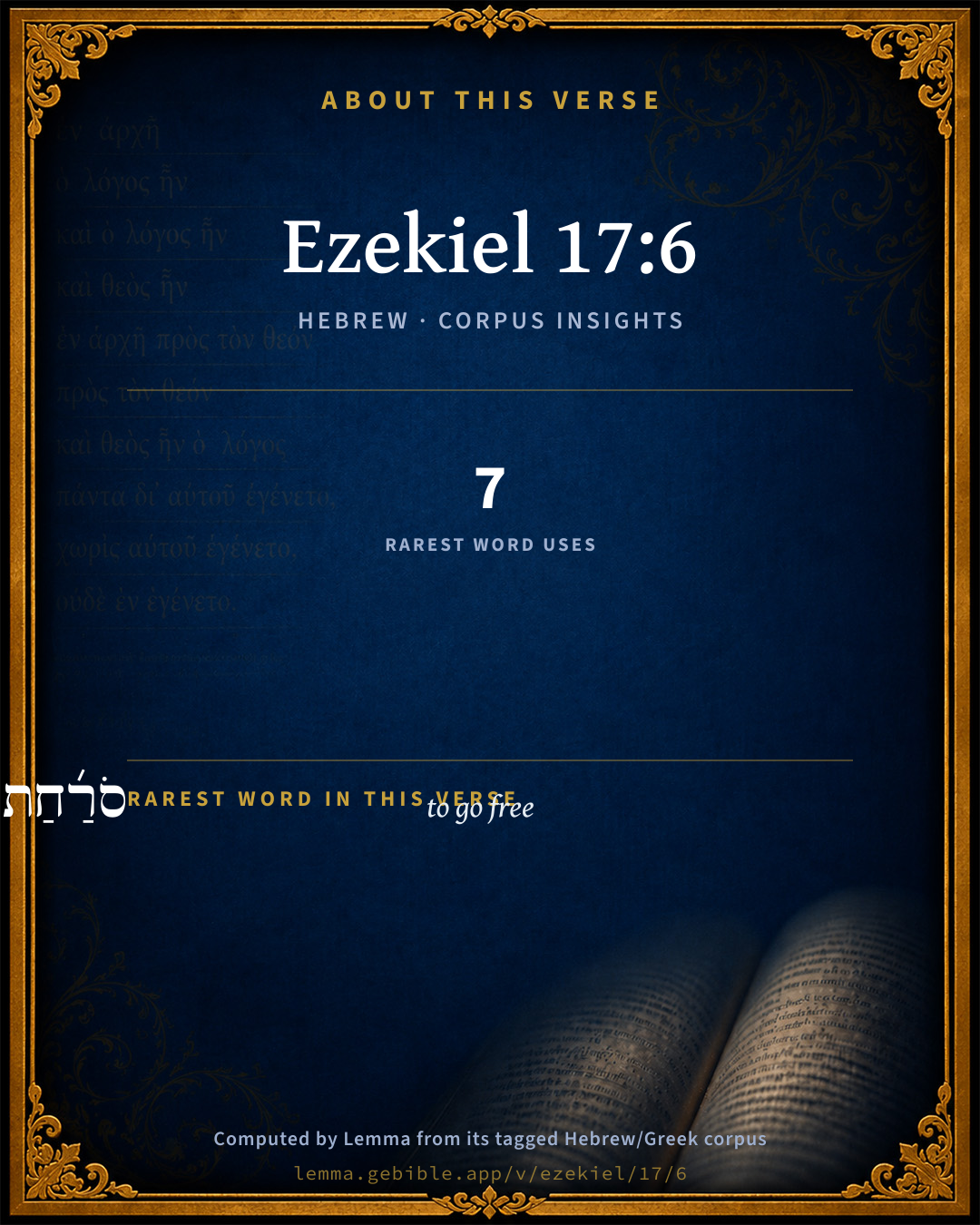
The rarest word here is סֹרַ֜חַת to go free H5628 — appearing just 7 times in the whole Hebrew Bible.

Shared distinctive vocabulary

סֹרַ֜חַת to go free H5628 occurs in 7 verses of the Hebrew Bible. Also found in:

Grammatical profile

  • 8 verbs
  • 7 nouns
  • 1 adjective
  • 2 prepositions

Verb forms

  • וַיִּצְמַ֡ח Qal · Sequential Imperfect
  • וַיְהִי֩ Qal · Sequential Imperfect
  • סֹרַ֜חַת Qal · Participle Active
  • לִפְנ֤וֹת Qal · Infinitive Construct
  • יִֽהְי֑וּ Qal · Imperfect
  • וַתְּהִ֣י Qal · Sequential Imperfect
  • וַתַּ֣עַשׂ Qal · Sequential Imperfect
  • וַתְּשַׁלַּ֖ח Piel · Sequential Imperfect

Repetition

Words recur within this verse — often emphatic in Hebrew:

  • וַיְהִי֩ to be H1961 ×3
  • לְגֶ֨פֶן vine H1612 ×2

Hebrew & Septuagint length

In English translation the verse runs 36 words from the Hebrew and 39 from the Septuagint (LXX English) — closely comparable.

A rough comparison of the two English renderings, which tokenize alike — not a word-level alignment.

Word counts can differ between the Hebrew and the Greek without any difference in meaning — e.g. the Hebrew direct-object marker אֵת has no separate Greek word, and Greek often adds the article ὁ.

Cross-references

2

Topical passages linked to Ezekiel 17:6 in the Treasury of Scripture Knowledge — connected by theme and wording, ordered by reader-vote popularity; previews shown in the World English Bible.

  • Ezekiel 17:14 that the kingdom might be base, that it might not lift itself up, but that by keeping his covenant it might stand.
  • Proverbs 16:18–19 Pride goes before destruction, And a haughty spirit before a fall.

Cross-references courtesy of OpenBible.info (CC BY 4.0).

Hebrew and Greek witnesses Masoretic Hebrew ↔ Greek Septuagint

The same verse in the two great witnesses to the Old Testament, shown verse-for-verse.

These are two independent witnesses, not word-aligned to each other, and the Septuagint is shown in lemma (dictionary) form.

Hebrew Ezekiel 17:6 Masoretic · Westminster Leningrad Codex

וַיִּצְמַ֡ח וַיְהִי֩ לְגֶ֨פֶן סֹרַ֜חַת שִׁפְלַ֣ת קוֹמָ֗ה לִפְנ֤וֹת דָּלִיּוֹתָיו֙ אֵלָ֔יו וְשָׁרָשָׁ֖יו תַּחְתָּ֣יו יִֽהְי֑וּ וַתְּהִ֣י לְגֶ֔פֶן וַתַּ֣עַשׂ בַּדִּ֔ים וַתְּשַׁלַּ֖ח פֹּארֽוֹת

It grew, and became a spreading vine of low stature, whose branches turned toward him, and the roots of it were under him: so it became a vine, and brought forth branches, and shot forth sprigs.

World English Bible · Public Domain

Greek LXX Ezekiel 17:6 Septuagint · lemma form

καί ἀνατέλλω καί γίγνομαι εἰς ἄμπελος ἀσθενέω καί μικρός ὁ μέγεθος ὁ ἐπιφαίνω αὐτός ὁ κλῆμα αὐτός ἐπί αὐτός καί ὁ ῥίζα αὐτός ὑποκάτω αὐτός εἰμί καί γίγνομαι εἰς ἄμπελος καί ποιέω ἀπῶρυξ καί ἐκτείνω ὁ ἀναδενδράς αὐτός

And it sprang up, and became a weak and little vine, so that the branches thereof appeared upon it, and its roots were under it: and it became a vine, and put forth shoots, and sent forth its tendrils.

LXX2012 (modern English Septuagint) · Public Domain

Hebrew: Westminster Leningrad Codex (CC BY 4.0). Greek: Septuagint (public domain); English from LXX2012 (modern English Septuagint) (Public Domain). How the Septuagint differs from the Hebrew →

Targum (Aramaic paraphrase)

1

The Targum is the ancient Jewish Aramaic paraphrase of the Hebrew Scriptures — an interpretive translation, not the Hebrew text itself. Onkelos (literal) and Pseudo-Jonathan (expansive) render the Torah, and Jonathan the Prophets. Coverage is partial: where no permissively-licensed English translation exists for a verse, only the Aramaic is shown. This is verse-level text, not a word-by-word alignment to the Hebrew.

  1. Targum Jonathan Prophets (Joshua–Malachi)
    וּצְמַח וַהֲוָה לְגֶפֶן תַּקִיף מַכִּיךְ בְּקוֹמָא לְכַפָפָא עוֹבַרְתֵּהּ לֵיהּ וְשָׁרָשׁוֹהִי תְּחוֹתוֹהִי יְהוֹן וַהֲוָה לְגֶפֶן וַעֲבַד שַׁבְקִין וּשְׁלַח עוֹבָרָן:

    (no public-domain English translation for this verse)

    Targum Jonathan — Aramaic: “Mikraot Gedolot” (public domain). English: “Sefaria Community Translation” (CC0 1.0 (public-domain dedication)); “London "Chaldee Paraphrase," 1871” (public domain). Text via Sefaria.

Commentary

Notes on Ezekiel 17:6 from classic Christian and Jewish commentators (each source and its license shown beneath its notes). The classic Christian expositions comment on the surrounding passage and are grouped to its opening verse, so a note may address several verses; the Jewish commentaries on the Tanakh (Rashi and others) are per-verse, so they appear only where the commentator wrote on this verse.

Lemma curates 59 commentaries, every one of them public domain or Creative Commons licensed, each selected and text-cleaned for this edition rather than reprinted as found. About our sources →

Trapp's Complete Commentary

John Trapp

Eze 17:6 And it grew, and became a spreading vine of low stature, whose branches turned toward him, and the roots thereof were under him: so it became a vine, and brought forth branches, and shot forth sprigs.

Ver. 6. And it grew.] And yet it had a great fall - viz, from a tall cedar to a low vine. Zedekiah, though he had still the title of a king, and was not left without wealth and dignity, yet it was far inferior to that of his predecessors.

“ Magna repente ruunt, summa cadunt subito. ”

Whose branches turned toward him,] i.e., Toward Nebuchadnezzar, now the chief lord of the land. To him looked and leaned the lords of the land, and so long they did well, for they and the whole kingdom thrived.

John Trapp, A Commentary or Exposition upon All the Books of the Old and New Testament (1647–1656) — public domain. Text from a community e-Sword module.

Geneva Bible (1599)

Geneva Bible translators

This was Zedekiah’s kingdom.

That is, might not have power to rebel against Babylon, as verse 14.

Geneva Bible (1599) marginal notes — public domain. Text via Bolls.life.

Jamieson, Fausset & Brown

Robert Jamieson, A. R. Fausset & David Brown

vine of low stature--not now, as before, a stately "cedar"; the kingdom of Judah was to be prosperous, but not elevated.

branches turned toward him--expressing the fealty of Zedekiah as a vassal looking up to Nebuchadnezzar, to whom Judah owed its peace and very existence as a separate state. The "branches" mean his sons and the other princes and nobles.

The roots . . . under him--The stability of Judah depended on Babylon. The repetition "branches" and "springs" is in order to mark the ingratitude of Zedekiah, who, not content with moderate prosperity, revolted from him to whom he had sworn allegiance.

Jamieson, Fausset & Brown — Commentary Critical and Explanatory on the Whole Bible (1871) — public domain (CC PDM 1.0). Text via the HelloAO Bible API.

Adam Clarke's Commentary

Verse 6. A spreading vine of low stature] The Jewish state having then no height of dominion, it must abide under the wings or branches of the Chaldean king.

Whose branches turned toward him, and the roots - under him] Zedekiah was wholly dependent on Nebuchadnezzar, both for his elevation to the throne, and his support on it.

Adam Clarke's Commentary on the Bible (1810–1826) — public domain. Text from a community e-Sword/MySword module.

Ellicott's Commentary for English Readers

(6) A spreading vine of low stature.—Had Zedekiah been faithful to his oath and allegiance to Nebuchadnezzar and to his higher allegiance to God, Israel might have been fruitful and prosperous as a dependent kingdom.

Whose branches turned towards him.—Better, That its branches might turn towards him, and its roots might be under him. This was Nebuchadnezzar’s object—to make of Israel a flourishing kingdom, which should yet be entirely dependent upon himself and helpful to him in his great struggle with the power of Egypt; and hence his especial rage when his politic arrangements were frustrated by Zedekiah’s treachery and folly.

A Bible Commentary for English Readers, edited by Charles John Ellicott (1878–1897) — public domain. Text from a community e-Sword module.

The Cambridge Bible for Schools and Colleges

gen. ed. J. J. S. Perowne

6. of low stature] This refers to the dependent nature of Zedekiah’s kingdom, as tributary to the lord superior. Cf. Isa_16:8 : Hos_10:1.

whose branches turned] Or, that its branches might turn … and the roots thereof be.

The Cambridge Bible for Schools and Colleges (gen. ed. J. J. S. Perowne; Cambridge University Press, 1878–1918) — public domain. Text from a community e-Sword module.

John Gill's Exposition

There was also another great eagle,.... Hophra king of Egypt, a very powerful prince, whom Herodotus (u) calls Apries; and says he was the most happy and fortunate, after Psammitichus, of all the kings that were before; though not so mighty as the king of Babylon; therefore all the same things are not said of the one as of the other:

with great wings and many feathers: had large dominions, but not go extensive as the former, and therefore is not said to be "longwinged" as he; and had "many feathers", but not "full" of them, nor had it such a variety; he had many people, and much wealth, and a large army, but not equal to the king of Babylon:

and, behold, this vine did bend her roots towards him; Zedekiah, and the people of the Jews under him; inclined to an alliance with the king of Egypt, and gave him some private intimations of it:

and shot forth her branches towards him; sent ambassadors to acquaint him with it, Eze 17:15;

that he might water it by the furrows of her plantation; Nebuchadnezzar had planted this vine, and made furrows for the watering of it, and by his means it was become prosperous and flourishing; but Zedekiah, not content with the greatness and glory he had raised him to, sought to the king of Egypt to help him with horses and people, in order to free himself from subjection to the king of Babylon, and to increase his lustre and glory: the allusion is thought to be to the trenches and canals of the river Nile, by which the land of Egypt was watered: the words may be rendered, "out of the rivulets of her plantation" (w) which best agrees with watering.

(u) L. 2. sive Euterpe, c. 161. (w) "ex rivulis loci in quo plantata est", Gussetius, p. 642. such as run between beds in gardens, of which this word is sometimes used; hence some render it "ex areolis", Vatablus, Junius & Tremellius, Piscator, Polanus, so Ben Melech; or ditches and canals, such as were made out of the river Nile to water the land; "a fossa plantarii sui", Texelius, ut supra, p. 209.

John Gill's Exposition of the Whole Bible (1746–1763) — public domain (CC PDM 1.0). Text via the HelloAO Bible API.

Albert Barnes' Notes on the Bible

Spreading - On the ground, not trained to a pole, that it might have no other prop but Nebuchadnezzar. As a vine it was less majestic than a cedar Eze 17:3; but compare Psa 80:10.

Whose branches ... - Rather, in order that her branches should turn unto him, and that her roots should be under him.

Albert Barnes' Notes on the Bible (1834–1885) — public domain. Text from a community e-Sword/MySword module.

Haydock's Catholic Bible Commentary

Towards him. Nabuchodonosor, to whom Sedecias swore allegiance. (Challoner) --- Literally, "to it," eam, the eagle. (Haydock) --- The dominions of Sedecias were extensive, but weak, and dependant on a foreign king.

George Leo Haydock (1774–1849), Haydock's Catholic Family Bible and Commentary, 1859 edition — public domain. Excludes Psalms (Douay-Rheims chapter numbering differs from Protestant) and Deuterocanonical books (Catholic canon only).

Matthew Poole's English Annotations

It grew; both the king and kingdom.

Became a spreading vine; took root, grew up to a tolerable condition of riches, plenty, and prosperity.

Of low stature; but never reached the height of the cedar. Nebuchadnezzar, though he made Zedekiah king, yet kept him subject and dependent.

Turned; they grew and flourished, while they owned their state tributary to Babylon.

Toward him; Nebuchadnezzar, as their protector, benefactor, and sovereign lord.

The roots thereof; all the firmness, fruitfulness, and life of this state was in a subjection to the king of Babylon.

So; thus, in this order and manner of dependence, both the Jews and their king had life, growth, and verdure. Branches; greater and stronger boughs for present strength, beauty, and fruit.

Sprigs; younger and tenderer springles, as children, the hope of future times.

Matthew Poole's English Annotations on the Holy Bible (1683–1685) — public domain. Text from a community e-Sword/MySword module.

Whedon's Commentary on the Bible

Daniel D. Whedon

6. Vine of low stature — The Hebrew tree grew luxuriantly, but was, after all, more like a vine than like its ancestral cedar, for “its branches turned again to itself and its roots remained under it.” — Kautzsch.

Daniel D. Whedon (gen. ed.), Commentary on the Old and New Testaments (1874–1909) — public domain. Text from a community e-Sword module.

John Wesley's Explanatory Notes

Of low stature - They grew and flourish, while they owned their state tributary to Babylon. Toward him - Nebuchadnezzar as their protector, and sovereign Lord. The roots - All the firmness, fruitfulness, and life of this state, was in subjection to him.

John Wesley, Explanatory Notes Upon the Whole Bible (1754–1765) — public domain. Text via the GEBible commentary corpus.

Rashi

Rabbi Shlomo Yitzchaki (Rashi)

spreading Heb. סוֹרַחַת, like (Exod. 26:12): “And the overhanging length (וְסֶרַח),” large.

of low stature to serve the king of Babylon.

its tendrils Heb. דָּלִיוֹתָיו, its branches.

to him to the king of Babylon.

under him under the king of Babylon

branches Heb. בַּדִים,staves.

and sent forth It grew.

boughs many leaves.

Rashi on the Tanakh — English translations: “The Judaica Press complete Tanach with Rashi, translated by A. J. Rosenberg” (CC BY 4.0); “Pentateuch with Rashi's commentary by M. Rosenbaum and A.M. Silbermann, 1929-1934” (public domain); “The Metsudah Tanach series, Lakewood, N.J” (CC BY 4.0); and “The Book of Joshua, Metsudah Publications, 1997” (CC BY 4.0). Text via Sefaria.

Lesson kit

Teaching starters — assembled from the data on this page, not authored interpretation. Every prompt links to the verse data it draws on. Edit before teaching.

Ezekiel, in the Prophets, opens this verse with 18 words (15 distinct Hebrew lemmas). Its most distinctive word is çârach (“to go free”). A historical commentator’s framing appears above. Read the whole chapter for the surrounding context.

Discussion questions

  1. What does “to go free” (çârach) contribute to the verse as a whole?
  2. How does Exodus 26:12, which shares the word «to go free», read alongside this verse?
  3. What does the repetition of “to be” (3× in this one verse) do in this verse?
  4. The translations on this page render this verse differently — a whole-verse word diff, not a word-by-word alignment. What might account for the different wordings?
  5. «וַיִּצְמַ֡ח» is a Qal Sequential Imperfect verb. How does that grammatical form shape the action described?
  6. Compare how Trapp's Complete Commentary and Geneva Bible (1599) read this verse. Where do they agree or differ?

Things to notice

Reading settings

Reading text

Shown beneath each verse's original-language words.

Old Testament
Old Testament edition

Read the OT as the Masoretic Hebrew (MT) or the Greek Septuagint (LXX).

English shown for the Greek Septuagint (in the Hebrew ↔ Greek comparison).

Comparing translations? Open the Compare panel on any verse page to stack up to four side by side.