
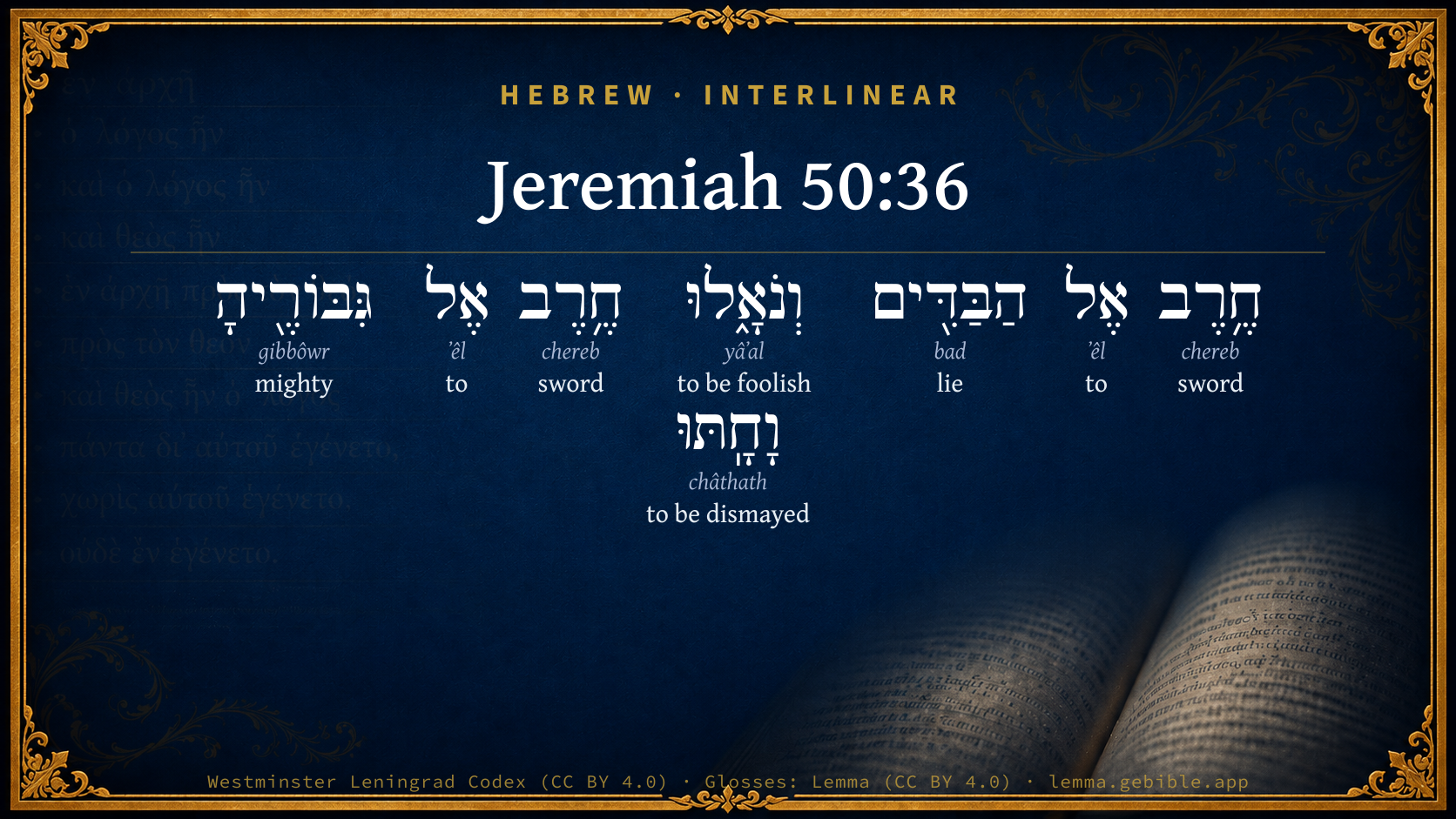
Jeremiah 50:36

Hebrew (Westminster Leningrad Codex) Jeremiah 50:36 appears in the Hebrew Old Testament. The text above is from the Westminster Leningrad Codex. Each word links to its Strong’s number, a concise gloss, and parsing drawn from the Open Scriptures Hebrew Bible morphology. Click any word for its full Brown-Driver-Briggs (BDB) entry.
Download image
Cite this verse

Jeremiah 50:36 (World English Bible). Public Domain. Lemma interlinear Bible study tool, https://lemma.gebible.app/v/jeremiah/50/36.

Show BibTeX & RIS
BibTeX
RIS
English Translation
A sword is on the boasters, and they shall become fools; a sword is on her mighty men, and they shall be dismayed.
World English Bible · Public Domain
Download a study sheet

One document with this verse’s original text, its word-by-word gloss line, the meaning frame, cross-references with their text, attributed commentary, and full source and license credits — printable, and it pastes into notes with its structure intact.

This verse Autodidact and up

Study sheet (.html) Plain text (.txt)

A passage Seminary Student

Up to 50 verses in one chapter. A passage sheet keeps up to 6 commentary sources and 12 cross-references per verse, in the order this page ranks them, and says so on the sheet whenever that leaves anything out. Ask for a single verse and you get the Autodidact verse sheet above.

Everything on this page stays free to read, with no account — the sheet is a download of what is already on screen, not access to it.

Want to remove ads? Support Godless Engineer
Compare translations 3

The same verse in 3 English versions, stacked beneath the original-language interlinear above. Click any original word for its lexicon entry.

Each is an independent rendering of the whole verse — the interlinear is not word-aligned to these translations.

Highlighted words mark where these versions differ — a whole-verse word diff, not a word-by-word alignment.

  • World English Bible Public Domain
    A sword is on the boasters, and they shall become fools; a sword is on her mighty men, and they shall be dismayed.
  • King James Version Public Domain
    A sword is upon the liars; and they shall dote: a sword is upon her mighty men; and they shall be dismayed.
  • unfoldingWord Literal Text CC BY-SA 4.0
    A sword against those who say empty words! They will become fools! A sword against her soldiers! They will be filled with terror.

unfoldingWord Literal Text — © unfoldingWord, licensed CC BY-SA 4.0. Word-aligned USFM3 via Door43 (git.door43.org/unfoldingWord/en_ult).

Versions to compare (up to 4)

3 of 4 selected

Show all 18 translations

Every available English version of this verse, each an independent rendering of the whole verse.

  • World English Bible Public Domain
    A sword is on the boasters, and they shall become fools; a sword is on her mighty men, and they shall be dismayed.
  • Berean Standard Bible Public Domain
    A sword is against her false prophets, and they will become fools. A sword is against her warriors, and they will be filled with terror.
  • Majority Standard Bible Public Domain
    A sword is against her false prophets, and they will become fools. A sword is against her warriors, and they will be filled with terror.
  • King James Version Public Domain
    A sword is upon the liars; and they shall dote: a sword is upon her mighty men; and they shall be dismayed.
  • American Standard Version (1901) Public Domain
    A sword is upon the boasters, and they shall become fools; a sword is upon her mighty men, and they shall be dismayed.
  • Revised Version (1885) Public Domain
    A sword is upon the boasters, and they shall dote: a sword is upon her mighty men, and they shall be dismayed.
  • Geneva Bible (1599) Public Domain
    A sworde is vpon the soothsaiers, and they shall dote: a sword is vpon her strong men, and they shalbe afraide.
  • Douay-Rheims (1899) Public Domain
    A sword upon her diviners, and they shall be foolish: a sword upon her valiant ones, and they shall be dismayed.
  • Young's Literal Translation Public Domain
    A sword `is' on the princes, And they have become foolish; A sword `is' on her mighty ones, And they have been broken down;
  • Literal Standard Version CC BY-SA 4.0
    A sword [is] on the princes, || And they have become foolish; A sword [is] on her mighty ones, || And they have been broken down;
  • Unlocked Literal Bible CC BY-SA 4.0
    A sword against those who say empty words! They will become fools! A sword against her soldiers! They will be filled with terror.
  • unfoldingWord Literal Text CC BY-SA 4.0
    A sword against those who say empty words! They will become fools! A sword against her soldiers! They will be filled with terror.
  • Darby Bible Public Domain
    the sword is upon the liars, and they shall become fools; the sword is upon her mighty men, and they shall be dismayed;
  • World Messianic Bible Public Domain
    A sword is on the boasters, and they will become fools. A sword is on her mighty men, and they will be dismayed.
  • Webster's Bible Public Domain
    A sword is upon the liars; and they shall be sottish: a sword is upon her mighty men; and they shall be dismayed.
  • Free Bible Version CC BY-SA 4.0
    A sword is raised to attack her false prophets, and they will become fools. A sword is raised to attack her soldiers, and they will be terrified.
  • Bible in Basic English Public Domain
    A sword is on the men of pride, and they will become foolish: a sword is on her men of war, and they will be broken.
  • JPS Tanakh (1917) Public Domain
    A sword is upon the boasters, and they shall become fools; a sword is upon her mighty men, and they shall be dismayed.

Literal Standard Version (2020), Covenant Press — licensed CC BY-SA 4.0. Text via the HelloAO Bible API (eBible.org). Unlocked Literal Bible (unfoldingWord) — licensed CC BY-SA 4.0. Text via the HelloAO Bible API (eBible.org). unfoldingWord Literal Text — © unfoldingWord, licensed CC BY-SA 4.0. Word-aligned USFM3 via Door43 (git.door43.org/unfoldingWord/en_ult). Free Bible Version, Dr. Jonathan Gallagher — licensed CC BY-SA 4.0. Text via the HelloAO Bible API (eBible.org).

Word by word

More ways to search: Search by grammar → Find every occurrence → Compare this word →

Practice this passage: Drill this verse → Learn its vocabulary →

וְנֹאָ֑לוּ
yâʼal
H2973
“and · to be foolish”
Conjunction + Verb, Niphal, Sequential Perfect, 3rd Person, Common, Plural
Part of Speech
Conjunction + Verb
Stem
Niphal
Form
Sequential Perfect
Person
3rd Person
Gender
Common
Number
Plural
Full BDB Definition

Origin: a primitive root

TWOT: 830

to be foolish, become fools, act foolishly, show wicked folly - (Niphal) - to show wicked folly - to become fools
  1. חֶ֥רֶב chereb H2719 “sword” Noun, Common, Feminine, Singular, Absolute
  2. אֶל ʼêl H413 “to” Preposition
  3. הַבַּדִּ֖ים bad H907 “the · lies” Particle, Definite Article + Noun, Common, Masculine, Plural, Absolute
  4. חֶ֥רֶב chereb H2719 “sword” Noun, Common, Feminine, Singular, Absolute
  5. אֶל ʼêl H413 “to” Preposition
  6. גִּבּוֹרֶ֖יהָ gibbôwr H1368 “mighty · her” Adjective, Adjective, Masculine, Plural, Construct + Suffix, Personal, 3rd Person, Feminine, Singular
  7. וָחָֽתּוּ châthath H2865 “and · to be dismayed” Conjunction + Verb, Qal, Sequential Perfect, 3rd Person, Common, Plural

About this verse

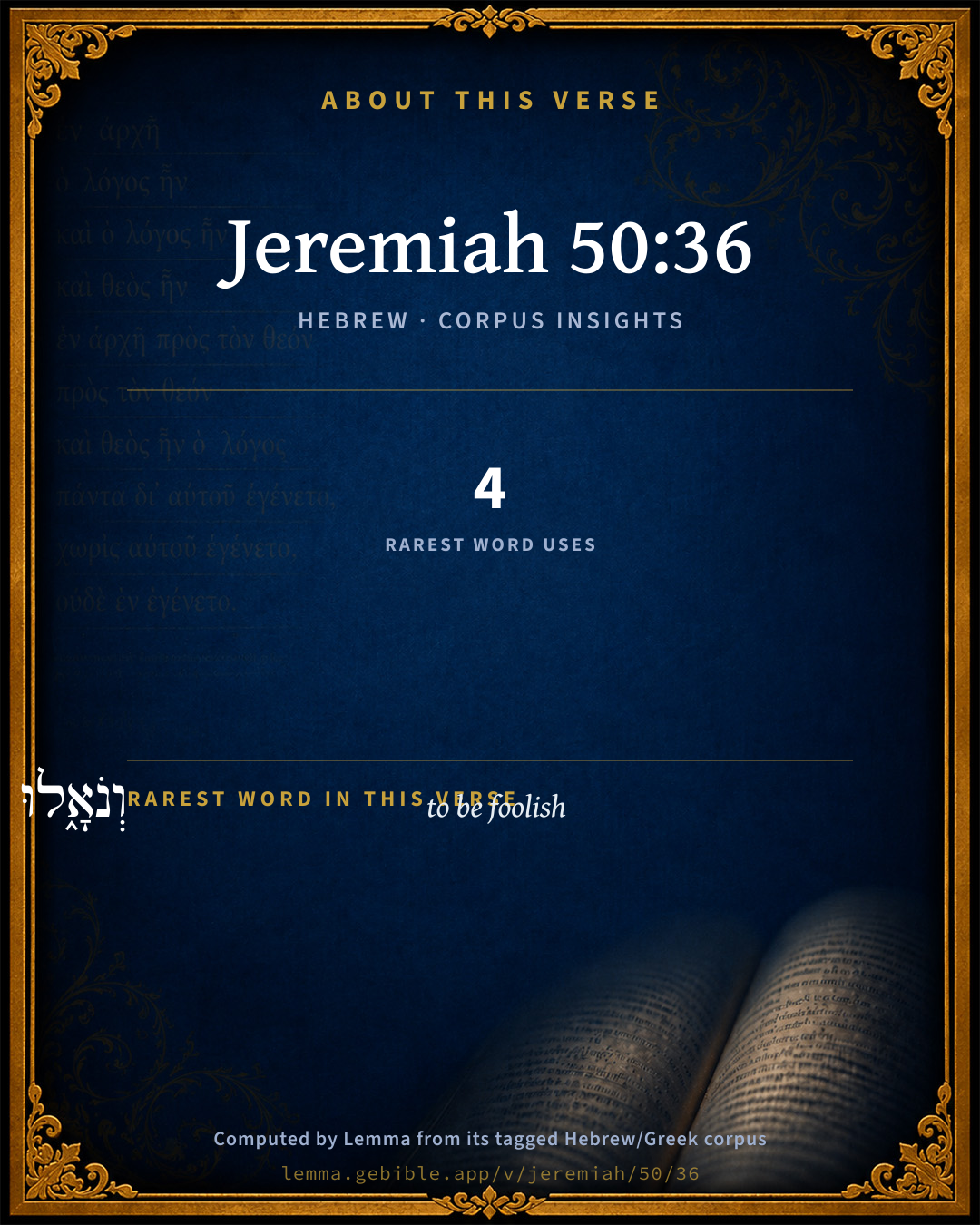
These counts appear in no published source. They are computed here, from the morphology-tagged text and Lemma’s own curated glosses. What Lemma adds →

8
words
6
distinct lemmas
Prophets
section

Notable vocabulary

The rarest word here is וְנֹאָ֑לוּ to be foolish H2973 — appearing just 4 times in the whole Hebrew Bible.

Shared distinctive vocabulary

וְנֹאָ֑לוּ to be foolish H2973 occurs in 4 verses of the Hebrew Bible. Also found in:

Grammatical profile

  • 2 verbs
  • 3 nouns
  • 1 adjective
  • 2 prepositions

Verb forms

  • וְנֹאָ֑לוּ Niphal · Sequential Perfect
  • וָחָֽתּוּ Qal · Sequential Perfect

Repetition

Words recur within this verse — often emphatic in Hebrew:

  • חֶ֥רֶב sword H2719 ×2
  • אֶל to H413 ×2

Cross-references

22

Topical passages linked to Jeremiah 50:36 in the Treasury of Scripture Knowledge — connected by theme and wording, ordered by reader-vote popularity; previews shown in the World English Bible.

  • Jeremiah 49:22 Behold, he shall come up and fly as the eagle, and spread out his wings against Bozrah: and the heart of the mighty men of Edom at that day shall be as the heart of a woman in her pangs.
  • Isaiah 44:25 who frustrates the signs of the liars, and makes diviners mad; who turns wise men backward, and makes their knowledge foolish;
  • Nahum 3:13 Behold, your troops in your midst are women. The gates of your land are set wide open to your enemies. The fire has devoured your bars.
  • 2 Samuel 17:14 Absalom and all the men of Israel said, The counsel of Hushai the Archite is better than the counsel of Ahithophel. For Yahweh had ordained to defeat the good counsel of Ahithophel, to the intent that Yahweh might bring evil on Absalom.
  • 2 Chronicles 25:16 It happened, as he talked with him, that [the king] said to him, Have we made you of the king's counsel? Stop! Why should you be struck down? Then the prophet stopped, and said, I know that God has determined to destroy you, because you have done this, and have not listened to my counsel.
  • Isaiah 43:14 Thus says Yahweh, your Redeemer, the Holy One of Israel: For your sake I have sent to Babylon, and I will bring down all of them as fugitives, even the Chaldeans, in the ships of their rejoicing.
  • Isaiah 47:10–15 For you have trusted in your wickedness; you have said, None sees me; your wisdom and your knowledge, it has perverted you, and you have said in your heart, I am, and there is none else besides me.
  • Jeremiah 48:30 I know his wrath, says Yahweh, that it is nothing; his boastings have worked nothing.
  • Jeremiah 50:30 Therefore shall her young men fall in her streets, and all her men of war shall be brought to silence in that day, says Yahweh.
  • Jeremiah 51:23 and with you will I break in pieces the shepherd and his flock; and with you will I break in pieces the farmer and his yoke [of oxen]; and with you will I break in pieces governors and deputies.
  • Jeremiah 51:30 The mighty men of Babylon have forborne to fight, they remain in their strongholds; their might has failed; they are become as women: her dwelling-places are set on fire; her bars are broken.
  • Jeremiah 51:32 and the passages are seized, and the reeds they have burned with fire, and the men of war are frightened.
  • Nahum 2:8 But Nineveh has been from of old like a pool of water, yet they flee away. "Stop! Stop!" they cry, but no one looks back.
  • Nahum 3:7 It will happen that all those who look at you will flee from you, and say, 'Nineveh is laid waste Who will mourn for her?' Where will I seek comforters for you?"
  • Nahum 3:17–18 Your guards are like the locusts, and your officials like the swarms of locusts, which settle on the walls on a cold day, but when the sun appears, they flee away, and their place is not known where they are.
  • 2 Thessalonians 2:9–11 even he whose coming is according to the working of Satan with all power and signs and lying wonders,
  • 1 Timothy 4:2 through the hypocrisy of men who speak lies, branded in their own conscience as with a hot iron;
  • 1 Timothy 6:4 he is conceited, knowing nothing, but obsessed with arguments, disputes, and word battles, from which come envy, strife, reviling, evil suspicions,
  • Revelation 19:20 The beast was taken, and with him the false prophet who worked the signs in his sight, with which he deceived those who had received the mark of the beast and those who worshiped his image. These two were thrown alive into the lake of fire that burns with sulfur.
  • Revelation 21:8 But for the cowardly, unbelieving, sinners, abominable, murderers, sexually immoral, sorcerers, idolaters, and all liars, their part is in the lake that burns with fire and sulfur, which is the second death."
  • Revelation 22:15 Outside are the dogs, the sorcerers, the sexually immoral, the murderers, the idolaters, and everyone who loves and practices falsehood.
  • 2 Samuel 15:31 One told David, saying, Ahithophel is among the conspirators with Absalom. David said, Yahweh, please turn the counsel of Ahithophel into foolishness.

Cross-references courtesy of OpenBible.info (CC BY 4.0).

Hebrew and Greek witnesses Masoretic Hebrew ↔ Greek Septuagint

The same verse in the two great witnesses to the Old Testament, shown verse-for-verse.

These are two independent witnesses, not word-aligned to each other, and the Septuagint is shown in lemma (dictionary) form.

Hebrew Jeremiah 50:36 Masoretic · Westminster Leningrad Codex

חֶ֥רֶב אֶל הַבַּדִּ֖ים וְנֹאָ֑לוּ חֶ֥רֶב אֶל גִּבּוֹרֶ֖יהָ וָחָֽתּוּ

A sword is on the boasters, and they shall become fools; a sword is on her mighty men, and they shall be dismayed.

World English Bible · Public Domain

Greek LXX Structure differs

In the Septuagint, Jeremiah is about an eighth shorter than the Hebrew and arranges its material differently — the Oracles Against the Nations (Hebrew chapters 46–51) appear in the middle of the Greek book, after 25:13. Because the chapter and verse boundaries do not line up, a verse-for-verse comparison with the Hebrew is not shown.

A verse-for-verse comparison isn’t shown here because the chapters and verses don’t line up. Switch to the LXX edition with the MT / LXX toggle above to read the Greek directly.

Hebrew: Westminster Leningrad Codex (CC BY 4.0). Greek: Septuagint (public domain); English from a public-domain English Septuagint. How the Septuagint differs from the Hebrew →

Targum (Aramaic paraphrase)

1

The Targum is the ancient Jewish Aramaic paraphrase of the Hebrew Scriptures — an interpretive translation, not the Hebrew text itself. Onkelos (literal) and Pseudo-Jonathan (expansive) render the Torah, and Jonathan the Prophets. Coverage is partial: where no permissively-licensed English translation exists for a verse, only the Aramaic is shown. This is verse-level text, not a word-by-word alignment to the Hebrew.

  1. Targum Jonathan Prophets (Joshua–Malachi)
    דְקַטְלִין בְּחַרְבָּא יֵיתוּן עַל קִסְמָהָא וְיִשְׁתַּבְּשׁוּן דְקַטְלִין בְּחַרְבָּא יֵיתוּן עַל גִבָּרָהָא וְיִתַּבְּרוּן:

    (no public-domain English translation for this verse)

    Targum Jonathan — Aramaic: “Mikraot Gedolot” (public domain). English: “Sefaria Community Translation” (CC0 1.0 (public-domain dedication)); “London "Chaldee Paraphrase," 1871” (public domain). Text via Sefaria.

Commentary

Notes on Jeremiah 50:36 from classic Christian and Jewish commentators (each source and its license shown beneath its notes). The classic Christian expositions comment on the surrounding passage and are grouped to its opening verse, so a note may address several verses; the Jewish commentaries on the Tanakh (Rashi and others) are per-verse, so they appear only where the commentator wrote on this verse.

Lemma curates 59 commentaries, every one of them public domain or Creative Commons licensed, each selected and text-cleaned for this edition rather than reprinted as found. About our sources →

Trapp's Complete Commentary

John Trapp

Jer 50:36 A sword [is] upon the liars; and they shall dote: a sword [is] upon her mighty men; and they shall be dismayed.

Ver. 36. A sword is upon the liars,] i.e., The prognosticators and wizards. Mendaces nominat divines, as it was wont here to be said - a friar, a liar.

John Trapp, A Commentary or Exposition upon All the Books of the Old and New Testament (1647–1656) — public domain. Text from a community e-Sword module.

Geneva Bible (1599)

Geneva Bible translators

Hebrew, liars.

Geneva Bible (1599) marginal notes — public domain. Text via Bolls.life.

Jamieson, Fausset & Brown

Robert Jamieson, A. R. Fausset & David Brown

liars--Those whom he before termed "wise men," he here calls "liars" (impostors), namely, the astrologers (compare Isa 44:25; Rom 1:21-25; Co1 1:20).

Jamieson, Fausset & Brown — Commentary Critical and Explanatory on the Whole Bible (1871) — public domain (CC PDM 1.0). Text via the HelloAO Bible API.

John Calvin's Commentaries

He repeats the same thing, but in other words; and in the first clause he mentions diviners whom he before called wise men; and he calls them now by their true and proper name; for בדים, bedim, mean mendacious men as well as falsehoods. He then calls those now impostors to whom he conceded before the name of wise men. But when he called them wise men, he spoke according to the common opinion, and he was unwilling to contend with the Chaldeans as to the character of their wisdom: he, however, at the same time made known the impositions of those who boasted that they had a familiar intercourse with God and angels, whilst they pronounced by the stars what was to be. That art itself is indeed worthy of praise, were men to preserve moderation. But as the curiosity of men is insatiable, so they wandered here and there, and overleaped all limits, and thus perverted the whole order of nature. The Chaldeans, then, were not genuine, but, on the contrary, spurious astrologers.

This is the reason why the Prophet calls them now liars; for we have before seen, that it was a mere imposition, when the Chaldeans held that the whole life of man is subject to the influence of the stars. Hence he exhorted the faithful to fear no dangers from the stars. It is then no wonder that the Prophet now charges all the diviners with falsehoods, who yet proudly arrogated to themselves the name of wise men, they shall be infatuated, he says. The verb יאל, ial, means indeed to begin, but in Niphal it means to become foolish, or to be infatuated.

Then he says, The sword shall be on her valiant men; whom before he called chief men or princes, שרים, sherim, he now calls strong, גברים, geberim, or those who excelled in valor. The amount of the whole is, — that whatever wisdom Babylon arrogated to itself would become folly, and that the valor in which it prided, would vanish away. For he says, that they would be broken in pieces The verb חתת, chetat, means to be broken, but as we have elsewhere seen, it is often applied to the mind, and then it means to dread, or to be terrified. He then says, that the valiant would not be able to stand when the sword was upon them, for they would become, as it were, lifeless, or, at least, they would become so effeminate as to think of nothing but flight.

John Calvin's Commentaries (1540-1563) — public domain. Text from the Calvin Translation Society English edition (1840s-50s) via the Christian Classics Ethereal Library (ccel.org). Calvin's coverage is partial (roughly two-thirds of the Bible); uncommented books and verses are honest gaps, never fabricated. The 19th-century editor's footnotes and remarks are omitted so the notes are faithfully Calvin's own voice.

Ellicott's Commentary for English Readers

(36) A sword is upon the liars; and they shall dote.—The Hebrew word for “liars”—literally, boastings—implies the falsehood of folly rather than of purpose. Better, perhaps, the prating fools. The marginal readings “chief stays” and “bars” rest on no adequate authority. Here the word applies to the diviners and magicians (comp. Isa_44:25).

A Bible Commentary for English Readers, edited by Charles John Ellicott (1878–1897) — public domain. Text from a community e-Sword module.

The Cambridge Bible for Schools and Colleges

gen. ed. J. J. S. Perowne

36. boasters] better than mg. boastings. The reference is to prophets and diviners who promised permanent empire to Babylon.

dote] The same word is rendered are foolish in Jer_5:4.

The Cambridge Bible for Schools and Colleges (gen. ed. J. J. S. Perowne; Cambridge University Press, 1878–1918) — public domain. Text from a community e-Sword module.

John Gill's Exposition

A sword is upon the liars,.... Some render it "bars" (m), as the word sometimes signifies; and interpret it of great men, who are the strength and security of cities and commonwealths; but these are mentioned both before and after. The Targum renders it "diviners"; and so Jarchi and Kimchi interpret it (n); of which there were many among the Chaldeans, who were a lying set of men, who imposed upon and deceived the people; these with their divinations and soothsayings could not save the land, nor themselves, from the devouring sword; nay, their sorceries and divinations were the cause of the ruin of it; see Isa 47:9;

and they shall dote; or, that they may "become foolish" (o); be infatuated, and act a mad part, and be at their wits' end; not knowing what course to take for their own safety, and much less be able to give direction and advice to others:

a sword is upon her mighty men, and they shall be dismayed; the soldiers and their officers, the most valiant and courageous of them; these would be in the utmost fright and consternation at the approach of the enemy; especially when they perceived the city taken, and the carnage made of the king and his nobles.

(m) "vectes"; so some in Gataker. (n) "Divinos", V. L. Vatablus, Tigurine version, Calvin, Pagninus; so R. Sol. Urbin. Ohel Moed, fol. 84. (o) "stultescant", Schmidt; "ut stulte agant", Piscator; "et insanient", Pagninus, Montanus.

John Gill's Exposition of the Whole Bible (1746–1763) — public domain (CC PDM 1.0). Text via the HelloAO Bible API.

Albert Barnes' Notes on the Bible

Liars - Soothsayers, fortune-tellers.

Albert Barnes' Notes on the Bible (1834–1885) — public domain. Text from a community e-Sword/MySword module.

Haydock's Catholic Bible Commentary

Diviners. Hebrew, "impostors." They were nowhere more plentiful, Daniel i. 20. Fortune-tellers were consulted on every occasion. The eastern nations are still much addicted to this superstition.

George Leo Haydock (1774–1849), Haydock's Catholic Family Bible and Commentary, 1859 edition — public domain. Excludes Psalms (Douay-Rheims chapter numbering differs from Protestant) and Deuterocanonical books (Catholic canon only).

Matthew Poole's English Annotations

A sword is upon the liars; and they shall dote: the word here translated liars is by some translated bars, by some liars; and in the Hebrew it hath both significations; which makes some think it is to be understood of the chief men, who are the props, stays, and bars of a place, whose wisdom God threatens should fail them, so as they should dote, and show themselves fools. Others translating it liars as we do, understand it of their soothsayers and wizards, whom he calls liars, because they divined false, and saith they should dote, not foreseeing what should be.

A sword is upon her mighty men; and they shall be dismayed: and though they were full of valiant, mighty men, yet their hearts should fail them when this day came, and all be destroyed amongst the rest.

Matthew Poole's English Annotations on the Holy Bible (1683–1685) — public domain. Text from a community e-Sword/MySword module.

Whedon's Commentary on the Bible

Daniel D. Whedon

36. Liars — The original word means to babble, to talk at random, and here the sense is soothsayers.

Dismayed — Better, confounded.

Daniel D. Whedon (gen. ed.), Commentary on the Old and New Testaments (1874–1909) — public domain. Text from a community e-Sword module.

The Pulpit Commentary

The liars" sword.

I IT IS ONE WHICH THEY WIELD. It cuts asunder:

1. The ties which bind man to man.

2. Those which bind the soul to truth and virtue.

3. Those which bind the heart to God.

4. Those which would lead the man to eternal life.

II IT IS ONE WHICH THEY FEEL. It pierces the soul with shame, with anguish, with a deadly wound.

III IT IS ONE BY WHICH THEY WILL SOONER OR LATER BE DESTROYED.

1. It is often so in this life. Men will league themselves together against a liar as against a wild beast or serpent, to destroy it. In the hearts of all men there is a protest against lies. That protest cannot be stifled universally, or for long, or over wide reaches of the world. It will break forth. It did break forth, and down went the paganism of the Roman empire, the priestly lies of the Church of Rome in the days of the Reformation, the political lies of despots as in the French Revolution, the Jesuitical lies by which that order has been disgraced and on account of which it has once and again been driven forth in shame. And the like of all this is seen in the condemnation and punishment of the convicted liars even now.

2. But yet more will it be so hereafter. See the awful doom that is pronounced against liars in the Word of God: "All liars shall have their part in the lake of fire, which is the second death.

CONCLUSION.

1. Dread this sword.

2. Love and cherish truth, in thought, word, and deed.

3. Give yourself to him who is the Truth. C.

The Pulpit Commentary (1880–1919), ed. H.D.M. Spence-Jones & Joseph S. Exell — public domain. Text from a community e-Sword module.

John Wesley's Explanatory Notes

Dote - Their soothsayers and wizards shall dote, not foreseeing what will be. Dismayed - Their hearts shall fail them when this day comes.

John Wesley, Explanatory Notes Upon the Whole Bible (1754–1765) — public domain. Text via the GEBible commentary corpus.

Rashi

Rabbi Shlomo Yitzchaki (Rashi)

upon the imposters Heb. הבדים, to her diviners.

and they shall become foolish with their divining. Similar to this is: “Who frustrates the signs of imposters” (Isa. 44:25), and so did Jonathan render. They are called בּדים because they fabricate (בּוֹדִים) and say false things.

Rashi on the Tanakh — English translations: “The Judaica Press complete Tanach with Rashi, translated by A. J. Rosenberg” (CC BY 4.0); “Pentateuch with Rashi's commentary by M. Rosenbaum and A.M. Silbermann, 1929-1934” (public domain); “The Metsudah Tanach series, Lakewood, N.J” (CC BY 4.0); and “The Book of Joshua, Metsudah Publications, 1997” (CC BY 4.0). Text via Sefaria.

Lesson kit

Teaching starters — assembled from the data on this page, not authored interpretation. Every prompt links to the verse data it draws on. Edit before teaching.

Jeremiah, in the Prophets, opens this verse with 8 words (6 distinct Hebrew lemmas). Its most distinctive word is yâʼal (“to be foolish”). A historical commentator’s framing appears above. Read the whole chapter for the surrounding context.

Discussion questions

  1. The word yâʼal carries the sense “to be foolish.” How does it shape the verse?
  2. How does Numbers 12:11, which shares the word «to be foolish», read alongside this verse?
  3. What does the repetition of “sword” (2× in this one verse) do in this verse?
  4. These translations render this verse differently. What is at stake in choosing one wording over another?
  5. «וְנֹאָ֑לוּ» is a Niphal Sequential Perfect verb. How does that grammatical form shape the action described?
  6. Compare how Trapp's Complete Commentary and Geneva Bible (1599) read this verse. Where do they agree or differ?

Things to notice

Reading settings

Reading text

Shown beneath each verse's original-language words.

Old Testament
Old Testament edition

Read the OT as the Masoretic Hebrew (MT) or the Greek Septuagint (LXX).

English shown for the Greek Septuagint (in the Hebrew ↔ Greek comparison).

Comparing translations? Open the Compare panel on any verse page to stack up to four side by side.