
2 Kings 19:15

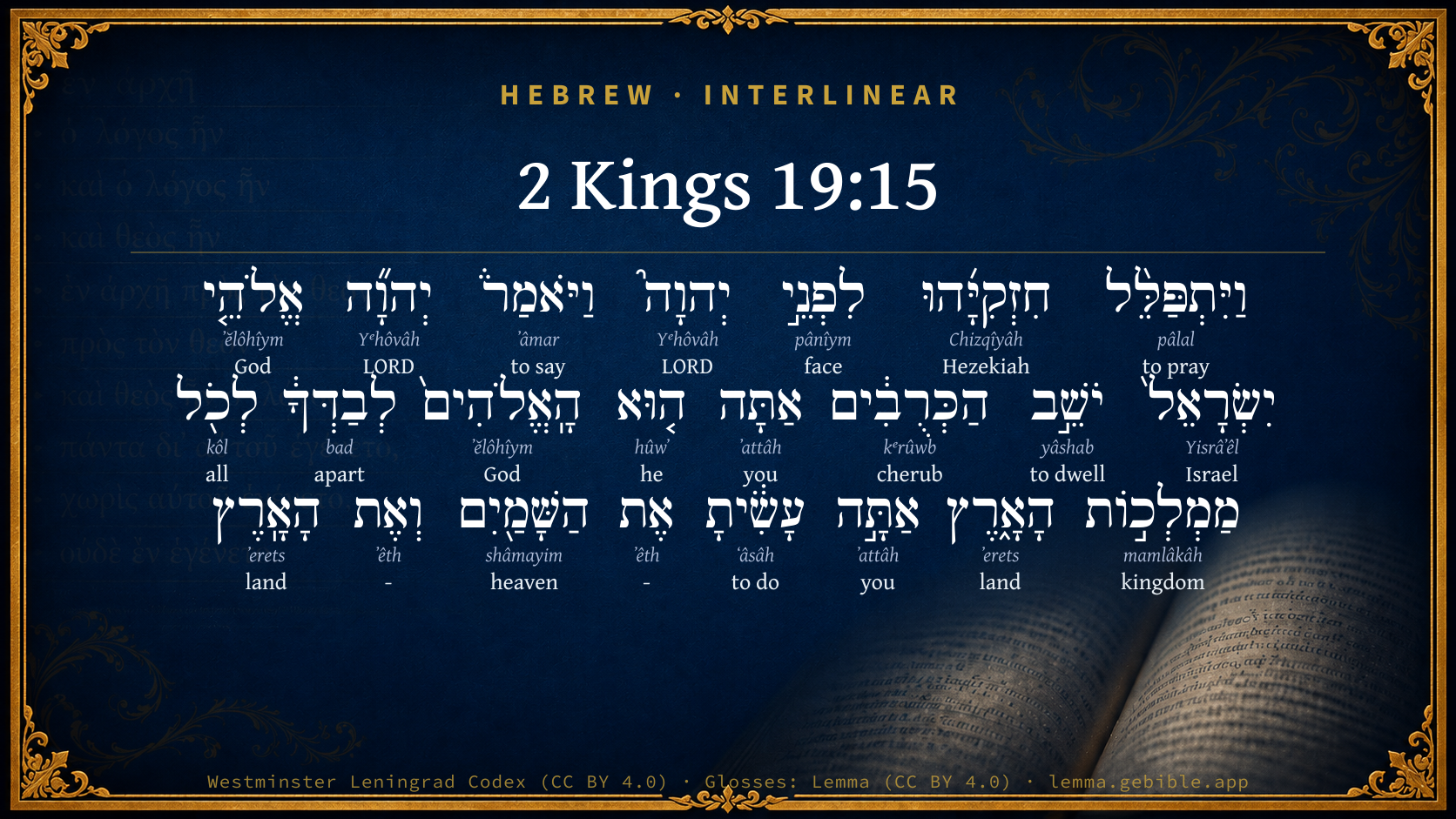
Hebrew (Westminster Leningrad Codex) 2 Kings 19:15 appears in the Hebrew Old Testament. The text above is from the Westminster Leningrad Codex. Each word links to its Strong’s number, a concise gloss, and parsing drawn from the Open Scriptures Hebrew Bible morphology. Click any word for its full Brown-Driver-Briggs (BDB) entry.
Download image
Cite this verse

2 Kings 19:15 (World English Bible). Public Domain. Lemma interlinear Bible study tool, https://lemma.gebible.app/v/2-kings/19/15.

Show BibTeX & RIS
BibTeX
RIS
English Translation
Hezekiah prayed before Yahweh, and said, Yahweh, the God of Israel, who sit [above] the cherubim, you are the God, even you alone, of all the kingdoms of the earth; you have made heaven and earth.
World English Bible · Public Domain
Download a study sheet

One document with this verse’s original text, its word-by-word gloss line, the meaning frame, cross-references with their text, attributed commentary, and full source and license credits — printable, and it pastes into notes with its structure intact.

This verse Autodidact and up

Study sheet (.html) Plain text (.txt)

A passage Seminary Student

Up to 50 verses in one chapter. A passage sheet keeps up to 6 commentary sources and 12 cross-references per verse, in the order this page ranks them, and says so on the sheet whenever that leaves anything out. Ask for a single verse and you get the Autodidact verse sheet above.

Everything on this page stays free to read, with no account — the sheet is a download of what is already on screen, not access to it.

Want to remove ads? Support Godless Engineer
Compare translations 3

The same verse in 3 English versions, stacked beneath the original-language interlinear above. Click any original word for its lexicon entry.

Each is an independent rendering of the whole verse — the interlinear is not word-aligned to these translations.

Highlighted words mark where these versions differ — a whole-verse word diff, not a word-by-word alignment.

  • World English Bible Public Domain
    Hezekiah prayed before Yahweh, and said, Yahweh, the God of Israel, who sit [above] the cherubim, you are the God, even you alone, of all the kingdoms of the earth; you have made heaven and earth.
  • King James Version Public Domain
    And Hezekiah prayed before the LORD, and said, O LORD God of Israel, which dwellest between the cherubim, thou art the God, even thou alone, of all the kingdoms of the earth; thou hast made heaven and earth.
  • unfoldingWord Literal Text CC BY-SA 4.0
    And Hezekiah prayed to the face of Yahweh and said, “Yahweh, the God of Israel, sitting the cherubim, you he, God, you alone, over all of the kingdoms of the earth. You, you made the heavens and the earth.

unfoldingWord Literal Text — © unfoldingWord, licensed CC BY-SA 4.0. Word-aligned USFM3 via Door43 (git.door43.org/unfoldingWord/en_ult).

Versions to compare (up to 4)

3 of 4 selected

Show all 18 translations

Every available English version of this verse, each an independent rendering of the whole verse.

  • World English Bible Public Domain
    Hezekiah prayed before Yahweh, and said, Yahweh, the God of Israel, who sit [above] the cherubim, you are the God, even you alone, of all the kingdoms of the earth; you have made heaven and earth.
  • Berean Standard Bible Public Domain
    And Hezekiah prayed before the LORD: “O LORD, God of Israel, enthroned between the cherubim, You alone are God over all the kingdoms of the earth. You made the heavens and the earth.
  • Majority Standard Bible Public Domain
    And Hezekiah prayed before the LORD: “O LORD, God of Israel, enthroned between the cherubim, You alone are God over all the kingdoms of the earth. You made the heavens and the earth.
  • King James Version Public Domain
    And Hezekiah prayed before the LORD, and said, O LORD God of Israel, which dwellest between the cherubim, thou art the God, even thou alone, of all the kingdoms of the earth; thou hast made heaven and earth.
  • American Standard Version (1901) Public Domain
    And Hezekiah prayed before Jehovah, and said, O Jehovah, the God of Israel, that sittest `above' the cherubim, thou art the God, even thou alone, of all the kingdoms of the earth; thou hast made heaven and earth.
  • Revised Version (1885) Public Domain
    And Hezekiah prayed before the LORD, and said, O LORD, the God of Israel, that sittest upon the cherubim, thou art the God, even thou alone, of all the kingdoms of the earth; thou hast made heaven and earth.
  • Geneva Bible (1599) Public Domain
    And Hezekiah prayed before the Lord, and saide, O Lord God of Israel, which dwellest betweene the Cherubims, thou art very God alone ouer all the kingdomes of the earth: thou hast made the heauen and the earth.
  • Douay-Rheims (1899) Public Domain
    And he prayed in his sight, saying: O Lord God of Israel, who sitteth upon the cherubims, thou alone art the God of all the kings of the earth: thou madest heaven and earth:
  • Young's Literal Translation Public Domain
    And Hezekiah prayeth before Jehovah, and saith, `O Jehovah, God of Israel, inhabiting the cherubs, Thou `art' God Himself -- Thyself alone -- to all the kingdoms of the earth: Thou hast made the heavens and the earth.
  • Literal Standard Version CC BY-SA 4.0
    And Hezekiah prays before YHWH and says, “O YHWH, God of Israel, inhabiting the cherubim, You [are] God Himself—You alone—to all the kingdoms of the earth: You have made the heavens and the earth.
  • Unlocked Literal Bible CC BY-SA 4.0
    Then Hezekiah prayed before Yahweh and said, “Yahweh of hosts, God of Israel, you who sit above the cherubim, you are God alone over all the kingdoms of the earth. You made the heavens and the earth.
  • unfoldingWord Literal Text CC BY-SA 4.0
    And Hezekiah prayed to the face of Yahweh and said, “Yahweh, the God of Israel, sitting the cherubim, you he, God, you alone, over all of the kingdoms of the earth. You, you made the heavens and the earth.
  • Darby Bible Public Domain
    And Hezekiah prayed before Jehovah and said, Jehovah, God of Israel, who sittest [between] the cherubim, thou, the Same, thou alone art the God of all the kingdoms of the earth: thou hast made the heavens and the earth.
  • World Messianic Bible Public Domain
    Hezekiah prayed before the LORD, and said, “LORD, the God of Israel, who are enthroned above the cherubim, you are the God, even you alone, of all the kingdoms of the earth. You have made heaven and earth.
  • Webster's Bible Public Domain
    And Hezekiah prayed before the LORD, and said, O LORD God of Israel, who dwellest between the cherubim, thou art the God, even thou alone, of all the kingdoms of the earth; thou hast made heaven and earth.
  • Free Bible Version CC BY-SA 4.0
    Hezekiah prayed to the Lord, saying, “Lord, God of Israel, you who live above the cherubim, you alone are God over all the kingdoms of the earth, you are Creator of heaven and earth.
  • Bible in Basic English Public Domain
    And Hezekiah made his prayer to the Lord, saying, O Lord, the God of Israel, seated between the winged ones, you only are the God of all the kingdoms of the earth; you have made heaven and earth.
  • JPS Tanakh (1917) Public Domain
    And Hezekiah prayed before the LORD, and said: 'O LORD, the God of Israel, that sittest upon the cherubim, Thou art the God, even Thou alone, of all the kingdoms of the earth; Thou hast made heaven and earth.

Literal Standard Version (2020), Covenant Press — licensed CC BY-SA 4.0. Text via the HelloAO Bible API (eBible.org). Unlocked Literal Bible (unfoldingWord) — licensed CC BY-SA 4.0. Text via the HelloAO Bible API (eBible.org). unfoldingWord Literal Text — © unfoldingWord, licensed CC BY-SA 4.0. Word-aligned USFM3 via Door43 (git.door43.org/unfoldingWord/en_ult). Free Bible Version, Dr. Jonathan Gallagher — licensed CC BY-SA 4.0. Text via the HelloAO Bible API (eBible.org).

Word by word

More ways to search: Search by grammar → Find every occurrence → Compare this word →

Practice this passage: Drill this verse → Learn its vocabulary →

וַיִּתְפַּלֵּ֨ל
pâlal
H6419
“and · to pray”
Conjunction + Verb, Hithpael, Sequential Imperfect, 3rd Person, Masculine, Singular
Part of Speech
Conjunction + Verb
Stem
Hithpael
Form
Sequential Imperfect
Person
3rd Person
Gender
Masculine
Number
Singular
Full BDB Definition

Origin: a primitive root

TWOT: 1776

to intervene, interpose, pray - (Piel) to mediate, judge - (Hithpael) - to intercede - to pray
  1. חִזְקִיָּ֜הוּ Chizqîyâh H2396 “Hezekiah” Noun, Proper
  2. לִפְנֵ֣י pânîym H6440 “to/for · face(s) of” Preposition + Noun, Common, Both, Plural, Construct
  3. יְהוָה֮ Yᵉhôvâh H3068 “LORD” Noun, Proper
  4. וַיֹּאמַר֒ ʼâmar H559 “and · to say” Conjunction + Verb, Qal, Sequential Imperfect, 3rd Person, Masculine, Singular
  5. יְהוָ֞ה Yᵉhôvâh H3068 “LORD” Noun, Proper
  6. אֱלֹהֵ֤י ʼĕlôhîym H430 “God(s) of” Noun, Common, Masculine, Plural, Construct
  7. יִשְׂרָאֵל֙ Yisrâʼêl H3478 “Israel” Noun, Proper
  8. יֹשֵׁ֣ב yâshab H3427 “dwelling” Verb, Qal, Participle Active, Masculine, Singular, Absolute
  9. הַכְּרֻבִ֔ים kᵉrûwb H3742 “the · cherubim” Particle, Definite Article + Noun, Common, Masculine, Plural, Absolute
  10. אַתָּה ʼattâh H859 “you” Pronoun, Personal, 2nd Person, Masculine, Singular
  11. ה֤וּא hûwʼ H1931 “he” Pronoun, Personal, 3rd Person, Masculine, Singular
  12. הָֽאֱלֹהִים֙ ʼĕlôhîym H430 “the · God(s)” Particle, Definite Article + Noun, Common, Masculine, Plural, Absolute
  13. לְבַדְּךָ֔ bad H905 “to/for · apart · your” Preposition + Noun, Common, Masculine, Singular, Construct + Suffix, Personal, 2nd Person, Masculine, Singular
  14. לְכֹ֖ל kôl H3605 “to/for · all of” Preposition + Noun, Common, Masculine, Singular, Construct
  15. מַמְלְכ֣וֹת mamlâkâh H4467 “kingdoms of” Noun, Common, Feminine, Plural, Construct
  16. הָאָ֑רֶץ ʼerets H776 “the · land” Particle, Definite Article + Noun, Common, Both, Singular, Absolute
  17. אַתָּ֣ה ʼattâh H859 “you” Pronoun, Personal, 2nd Person, Masculine, Singular
  18. עָשִׂ֔יתָ ʻâsâh H6213 “to do” Verb, Qal, Perfect, 2nd Person, Masculine, Singular
  19. אֶת ʼêth H853 “-” Particle, Direct Object
  20. הַשָּׁמַ֖יִם shâmayim H8064 “the · heaven(s)” Particle, Definite Article + Noun, Common, Masculine, Plural, Absolute
  21. וְאֶת ʼêth H853 “and · -” Conjunction + Particle, Direct Object
  22. הָאָֽרֶץ ʼerets H776 “the · land” Particle, Definite Article + Noun, Common, Both, Singular, Absolute

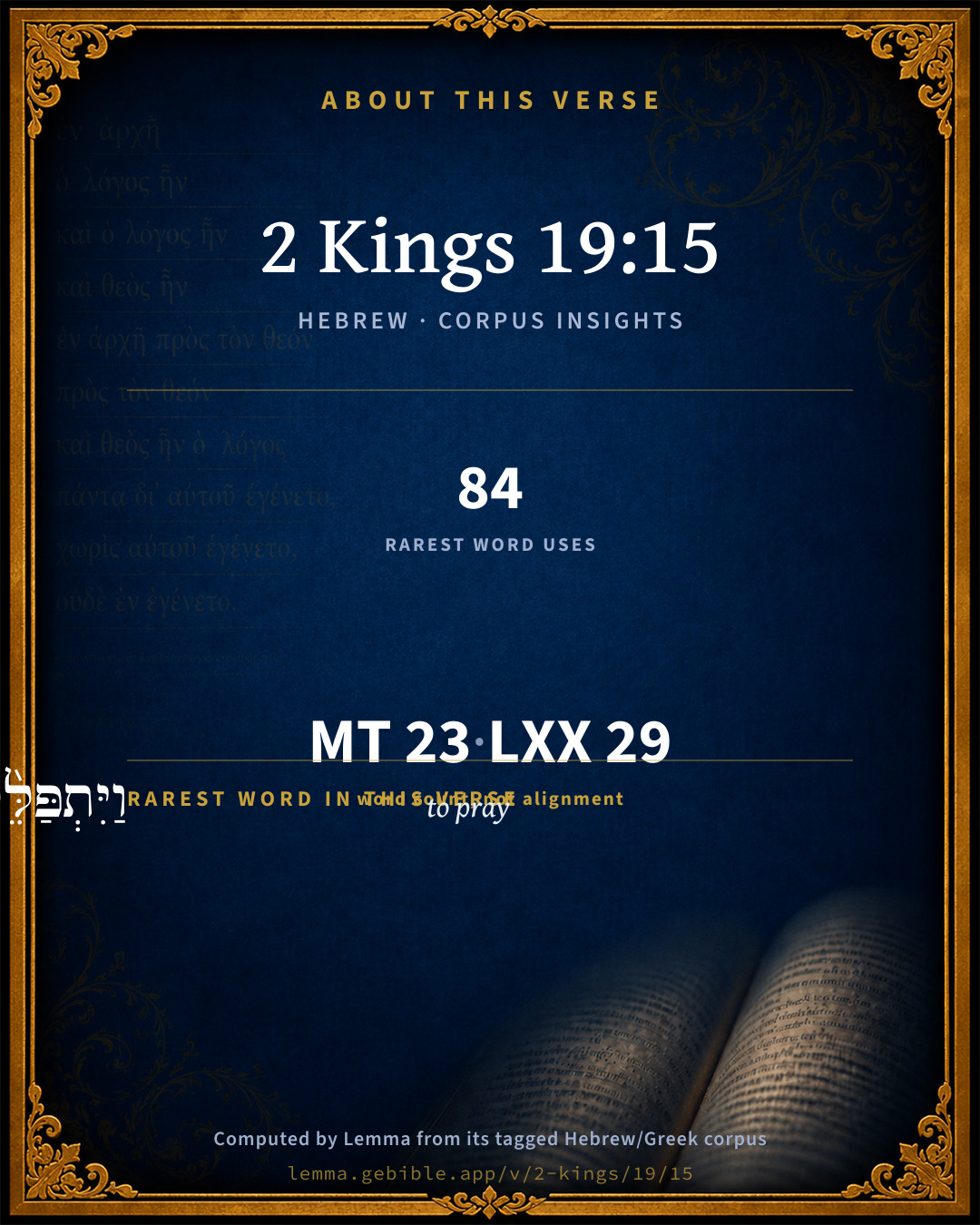
About this verse

These counts appear in no published source. They are computed here, from the morphology-tagged text and Lemma’s own curated glosses. What Lemma adds →

23
words
18
distinct lemmas
Historical
section

Grammatical profile

  • 4 verbs
  • 14 nouns
  • 3 pronouns
  • 2 particles

Verb forms

  • וַיִּתְפַּלֵּ֨ל Hithpael · Sequential Imperfect
  • וַיֹּאמַר֒ Qal · Sequential Imperfect
  • יֹשֵׁ֣ב Qal · Participle Active
  • עָשִׂ֔יתָ Qal · Perfect

Repetition

Words recur within this verse — often emphatic in Hebrew:

  • יְהוָה֮ LORD H3068 ×2
  • אֱלֹהֵ֤י God H430 ×2
  • הָאָ֑רֶץ land H776 ×2
  • אַתָּה you H859 ×2

Hebrew & Septuagint length

In English translation the verse runs 36 words from the Hebrew and 30 from the Septuagint (LXX English) — closely comparable.

A rough comparison of the two English renderings, which tokenize alike — not a word-level alignment.

Word counts can differ between the Hebrew and the Greek without any difference in meaning — e.g. the Hebrew direct-object marker אֵת has no separate Greek word, and Greek often adds the article ὁ.

In the original languages it is 23 Hebrew tokens and 29 Greek tokens — but the two are counted differently (Hebrew bundles its prefixes and suffixes into one token; the Greek is in lemma form), so that isn’t a like-for-like length.

Cross-references

29

Topical passages linked to 2 Kings 19:15 in the Treasury of Scripture Knowledge — connected by theme and wording, ordered by reader-vote popularity; previews shown in the World English Bible.

  • Exodus 25:22 There I will meet with you, and I will tell you from above the mercy seat, from between the two cherubim which are on the ark of the testimony, all that I command you for the children of Israel.
  • 1 Kings 18:39 When all the people saw it, they fell on their faces: and they said, Yahweh, he is God; Yahweh, he is God.
  • 2 Kings 5:15 He returned to the man of God, he and all his company, and came, and stood before him; and he said, See now, I know that there is no God in all the earth, but in Israel: now therefore, please take a present from your servant.
  • Isaiah 44:6 Thus says Yahweh, the King of Israel, and his Redeemer, Yahweh of Hosts: I am the first, and I am the last; and besides me there is no God.
  • Isaiah 44:8 Don't fear, neither be afraid: haven't I declared to you of old, and shown it? You are my witnesses. Is there a God besides me? Indeed, there is not. I don't know any Rock.
  • Jeremiah 10:10–12 But Yahweh is the true God; he is the living God, and an everlasting King: at his wrath the earth trembles, and the nations are not able to abide his indignation.
  • Daniel 4:34–35 At the end of the days I, Nebuchadnezzar, lifted up my eyes to heaven, and my understanding returned to me, and I blessed the Most High, and I praised and honored him who lives forever; for his dominion is an everlasting dominion, and his kingdom from generation to generation.
  • Daniel 9:3–4 I set my face to the Lord God, to seek by prayer and petitions, with fasting and sackcloth and ashes.
  • Genesis 1:1 In the beginning God created the heavens and the earth.
  • Genesis 2:4 This is the history of the generations of the heavens and of the earth when they were created, in the day that Yahweh God made earth and the heavens.
  • 2 Samuel 7:18–28 Then David the king went in, and sat before Yahweh; and he said, Who am I, Lord Yahweh, and what is my house, that you have brought me thus far?
  • 1 Kings 8:23 and he said, Yahweh, the God of Israel, there is no God like you, in heaven above, or on earth beneath; who keep covenant and loving kindness with your servants, who walk before you with all their heart;
  • 2 Chronicles 14:11 Asa cried to Yahweh his God, and said, Yahweh, there is none besides you to help, between the mighty and him who has no strength: help us, Yahweh our God; for we rely on you, and in your name are we come against this multitude. Yahweh, you are our God; don't let man prevail against you.
  • 2 Chronicles 20:6 and he said, Yahweh, the God of our fathers, aren't you God in heaven? and aren't you ruler over all the kingdoms of the nations? and in your hand is power and might, so that none is able to withstand you.
  • Psalms 102:25 Of old, you laid the foundation of the earth. The heavens are the work of your hands.
  • Psalms 146:6 Who made heaven and earth, The sea, and all that is in them; Who keeps truth forever;
  • Isaiah 43:10 You are my witnesses, says Yahweh, and my servant whom I have chosen; that you may know and believe me, and understand that I am he: before me there was no God formed, neither shall there be after me.
  • Isaiah 45:22 Look to me, and be you saved, all the ends of the earth; for I am God, and there is none else.
  • John 1:1–3 In the beginning was the Word, and the Word was with God, and the Word was God.
  • 1 Samuel 4:4 So the people sent to Shiloh; and they brought from there the ark of the covenant of Yahweh of Hosts, who sits [above] the cherubim: and the two sons of Eli, Hophni and Phinehas, were there with the ark of the covenant of God.
  • Genesis 32:28 He said, "Your name will no longer be called 'Jacob,' but, 'Israel,' for you have fought with God and with men, and have prevailed."
  • Genesis 33:20 He erected an altar there, and called it El Elohe Israel.
  • 1 Chronicles 4:10 Jabez called on the God of Israel, saying, Oh that you would bless me indeed, and enlarge my border, and that your hand might be with me, and that you would keep me from evil, that it not be to my sorrow! God granted him that which he requested.
  • 2 Chronicles 5:7–8 The priests brought in the ark of the covenant of Yahweh to its place, into the oracle of the house, to the most holy place, even under the wings of the cherubim.
  • 2 Chronicles 32:20 Hezekiah the king, and Isaiah the prophet the son of Amoz, prayed because of this, and cried to heaven.
  • Psalms 33:9 For he spoke, and it was done. He commanded, and it stood firm.
  • Psalms 80:1 Hear us, Shepherd of Israel, You who lead Joseph like a flock, You who sit above the cherubim, shine forth.
  • Psalms 99:1 Yahweh reigns! Let the peoples tremble. He sits enthroned among the cherubim. Let the earth be moved.
  • Isaiah 41:17 The poor and needy seek water, and there is none, and their tongue fails for thirst; I, Yahweh, will answer them, I, the God of Israel, will not forsake them.

Cross-references courtesy of OpenBible.info (CC BY 4.0).

Hebrew and Greek witnesses Masoretic Hebrew ↔ Greek Septuagint

The same verse in the two great witnesses to the Old Testament, shown verse-for-verse.

These are two independent witnesses, not word-aligned to each other, and the Septuagint is shown in lemma (dictionary) form.

Hebrew 2 Kings 19:15 Masoretic · Westminster Leningrad Codex

וַיִּתְפַּלֵּ֨ל חִזְקִיָּ֜הוּ לִפְנֵ֣י יְהוָה֮ וַיֹּאמַר֒ יְהוָ֞ה אֱלֹהֵ֤י יִשְׂרָאֵל֙ יֹשֵׁ֣ב הַכְּרֻבִ֔ים אַתָּה ה֤וּא הָֽאֱלֹהִים֙ לְבַדְּךָ֔ לְכֹ֖ל מַמְלְכ֣וֹת הָאָ֑רֶץ אַתָּ֣ה עָשִׂ֔יתָ אֶת הַשָּׁמַ֖יִם וְאֶת הָאָֽרֶץ

Hezekiah prayed before Yahweh, and said, Yahweh, the God of Israel, who sit [above] the cherubim, you are the God, even you alone, of all the kingdoms of the earth; you have made heaven and earth.

World English Bible · Public Domain

Greek LXX 2 Kings 19:15 Septuagint · lemma form

καί εἶπον κύριος ὁ θεός ἰσραήλ ὁ καταἧμαι ἐπί ὁ χερουβιν σύ εἰμί ὁ θεός μόνος ἐν πᾶς ὁ βασιλεία ὁ γῆ σύ ποιέω ὁ οὐρανός καί ὁ γῆ

and said, O Lord God of Israel that dwell over the cherubs, you are the only god in all the kingdoms of the earth; you have made heaven and earth.

LXX2012 (modern English Septuagint) · Public Domain

Hebrew: Westminster Leningrad Codex (CC BY 4.0). Greek: Septuagint (public domain); English from LXX2012 (modern English Septuagint) (Public Domain). How the Septuagint differs from the Hebrew →

Targum (Aramaic paraphrase)

1

The Targum is the ancient Jewish Aramaic paraphrase of the Hebrew Scriptures — an interpretive translation, not the Hebrew text itself. Onkelos (literal) and Pseudo-Jonathan (expansive) render the Torah, and Jonathan the Prophets. Coverage is partial: where no permissively-licensed English translation exists for a verse, only the Aramaic is shown. This is verse-level text, not a word-by-word alignment to the Hebrew.

  1. Targum Jonathan Prophets (Joshua–Malachi)
    וְצַלֵי חִזְקִיָהוּ קֳדָם יְיָ וַאֲמַר יְיָ אֱלָהָא דְיִשְׂרָאֵל דִשְׁכִנְתֵּיהּ שַׁרְיָא עֵיל מִן כְּרוּבַיָא אַתְּ הוּא יְיָ וְלֵית בַּר מִנָךְ לְכֹל מַלְכְוַת אַרְעָא אַתְּ עֲבַדְתָּ יַת שְׁמַיָא וְיַת אַרְעָא:

    (no public-domain English translation for this verse)

    Targum Jonathan — Aramaic: “Mikraot Gedolot” (public domain). English: “Sefaria Community Translation” (CC0 1.0 (public-domain dedication)); “London "Chaldee Paraphrase," 1871” (public domain). Text via Sefaria.

Commentary

Notes on 2 Kings 19:15 from classic Christian and Jewish commentators (each source and its license shown beneath its notes). The classic Christian expositions comment on the surrounding passage and are grouped to its opening verse, so a note may address several verses; the Jewish commentaries on the Tanakh (Rashi and others) are per-verse, so they appear only where the commentator wrote on this verse.

Lemma curates 59 commentaries, every one of them public domain or Creative Commons licensed, each selected and text-cleaned for this edition rather than reprinted as found. About our sources →

Trapp's Complete Commentary

John Trapp

2Ki 19:15 And Hezekiah prayed before the LORD, and said, O LORD God of Israel, which dwellest [between] the cherubims, thou art the God, [even] thou alone, of all the kingdoms of the earth; thou hast made heaven and earth.

Ver. 15. And Hezekiah prayed.] He made intercession to God against Sennacherib, as once Elias did against Israel, {Rom 11:2} the Christian Church against Julian the apostate, and against Arius the heretic; whose death was precationis opus, non morbi, saith Socrates Scholasticus; {a} the effect of prayers, not of any disease.

Thou art the God.] "Thou," here, is emphatical and exclusive.

{a} Lib. i. cap. 15.

John Trapp, A Commentary or Exposition upon All the Books of the Old and New Testament (1647–1656) — public domain. Text from a community e-Sword module.

The Biblical Illustrator

Joseph S. Exell

2Ki_19:15-19

And Hezekiah prayed unto the Lord.

What to do when trouble comes

Hezekiah the King of Judah was in very great trouble. For some time the forces of the Assyrian had overcome the land and had taken the fenced cities: Jerusalem had been spared only on payment of a ransom that had greatly impoverished it. But that sufficed for a time only: and now the hosts of the enemy had gathered again and demanded its surrender. The city of Samaria had fallen and all the land was possessed by Assyria. It was an insult to the proud conqueror that Jerusalem alone should defy him. Round about the walls gathered their forces, and Rab-shakeh the commander had come near to the city and Cried aloud in the ears of all the people his threats against them and his summons to surrender. To his blasphemies Hezekiah had given no answer. Leaving forces enough behind him to sustain the siege Rab-shakeh had marched off then to join his royal master elsewhere. But now Egypt was marching up to fight the Assyrian. Of that Jerusalem could know nothing; but Rab-shakeh was anxious to withdraw the army from Jerusalem in order to strengthen his own forces; and he wrote a letter, impudent and blasphemous, thinking to frighten Hezekiah into surrender

1. The first thing for us to look at is this,--A king in trouble. Troubled soul, do not think within yourself that your case is peculiar,--all men have their troubles. Do not go envying any man, for no position will bring escape from trouble. But further, here is a good man in trouble. Turn to the beginning of the previous chapter and read the record of this man. The worst thing that could befall us in this world would be for us to have in anything our own way.

3. Again, here was a very great trouble. Net for himself was it that Hezekiah thought only or even mostly, though this was quite enough to think about. A crown and throne and all the proud position of king is quite enough to lose at one blow. But that was swallowed up in his concern about his people and the perils that beset them.

4. And it was a trouble for which there seemed to be no help. Samaria had fallen, and they looked in vain towards the north. (M. G. Pearse.)

Prayer in emergencies

The Christian believes in a revelation from God. Revelation unfolds many things which we could not discover for ourselves, explains or accounts for many actions or events which are puzzling without it. It takes us beyond second causes to the fountain head of all plans and transactions; it deals with what we see not as merely hard dry facts, but facts with a meaning and purpose; it tells of a higher, nobler, state of being belonging to us; and of spiritual powers which have influence over us; it speaks to us of Him in Whom we live, and move, and have our being. What is prayer? It is the means of holding communication with the unseen world--all worship may be called prayer, for it is the approach of man to God--the setting on foot a line of connection with our great Invisible Ruler. If we at all understand our real complex nature, the union of an invisible spirit with our outward bodies, we must see that our intercourse with the invisible world is all important, and that an acknowledgment of our dependence upon the Supreme Invisible Ruler is indispensable to our true and complete character. Prayer is a sign of weakness, but an instrument of strength; it is a confession of our own inability, burs laying our grasp upon the strong and mighty One, able to do all things. We pray because we feel weak, but by prayer we feel strong. It is not for Gods information, but for our security--not to persuade Him, but to prove our trust in Him--that we pray. It is of use because it thus brings us consciously within the circle of His willing influence. It is of obligation, because it is commanded by Him. Some men object to prayer as if it were useless. They say, God has laid down certain rules for the government of the world--certain clear laws--and it is not to be expected that He should alter these laws for us, when we choose to ask Him to do so. But this surely is to make Almighty God a slave of His own creatures. The Lawgiver has always power and the right to suspend His laws if He will, and in this case the Lawgiver is such that it were an insult to Him to suppose Him unable to suspend the action of His laws in a particular instance without disarranging the whole machinery of the world, and putting it out of gear. Besides, His laws are framed not blindly but with that infinite foresight which would enable Him to foresee all prayers, all claims or entreaties for exemption from the working of His laws. In the case of men we might reasonably think that laws would be inoperative if exemptions were made at every turn, but in the case of Almighty God this conclusion would not hold. He may maintain the principles on which His laws are based, even while He suspends their action in special cases. Infinite Wisdom must needs be allowed elasticity in the observance of His own laws, and He may surely with all justice and consistency make His laws contingent upon mans actions; and after all, the Supreme Lord keeps in His own Hands the continuance of any laws He makes, He gives force to His laws, His will is the motive power; therefore, if He will, the law must become inoperative, if He will to listen to mans prayer, the answer must come. Now, prayer is generally to be regarded as a habit. But there is another kind of prayer--prayer in emergencies. Though our life is on the whole monotonous, i.e., the same things happen day after day, the same needs come, and therefore the same prayers are needed, yet occasional occurrences intervene, requiring special attention and immediate thought and help. Then we must seek instant succour. To delay may be fatal; to wait for our morning or evening prayer must be to wait till the special danger has gone by, or has fallen upon us. It becomes us, the moment the peril is recognised, to fall on our knees and call in the intervention of God Almighty. We have in the case of Hezekiah an admirable instance of the power and efficacy of prayer. But supposing the Assyrians had not been destroyed, but had carried on the siege and triumphed, would Hezekiahs prayer have received no answer? God graciously sent a complete answer for the encouragement of His people, and for the discomfiture of the vaunting Assyrians; but even if so direct an answer had not been given, the prayer of faith would not have been in vain. All that God promises is to answer--not to answer exactly as we wish. Suppose a danger imminent: sickness nigh unto death; a shipwreck; a fire; an invasion of our country; you would fain extricate yourself from the peril. There may be plenty to volunteer advice: first one and then another specific is suggested; various lines of policy, all conflicting, all perhaps hopeless to all appearance. Yet there is another resource: take your anxieties and spread them before the Lord, take them especially into the house of the Lord. Another form of perplexity arises from mental or spiritual difficulties: you fail to see the truth of some Christian doctrine; or you cannot discover what truth is; opposite opinions present themselves, and there is a temptation to cast off all belief because you cannot come to a decision in your own mind as to which is the true doctrine; some minds, for instance, have a difficulty in accepting the doctrine of the Holy Trinity, because it seems to be inconsistent with common sense that three should in any view be one--remember it is only above, not contrary to, reason. Take the matter quietly before your God, kneel before Him in secrecy, and in faith ask His guidance, and then spread out the conflicting passages before the light of His mercy-seat, and be assured that somehow you will find light to direct you, for the meek shall He guide in judgment. (G. F. Prescott, M. A.)

Hezekiah, or prayer in trouble

I. That prayer is the believers privilege. Viewing the children of God as participating in the troubles of life in common with others, it is indeed a most important privilege. Prayer has been called the outlet of trouble, and the inlet of comfort; it serves as the open window to a heated room, to remove what is oppressive, and admit what is refreshing. Prayer is a duty--not a mere duty, however, but a precious privilege; indeed, all duties are privileges and blessings if rightly understood; God never assigns or commands anything which is not for the good of those on whom it is enjoined. Prayer is the choicest privilege of earth; it is the intercourse with heaven--the speaking to God as to a Father and a Friend; it is not only conformity to Christs Spirit, but the joining in very act with Son and Spirit, at the very time and for the very object in which they are engaged. Christ not only prayed on earth, but is gone to pray in heaven, and has sent His Spirit to take His place below. Oh! let us look at Son and Spirit pleading; would they ever have assumed the office, but that they saw the helpless state of man, and volunteered to plead in and for him? They pray for man; it is their pleasure; and if man be permitted to conjoin with them in prayer, is it not a blessed privilege that he may so do?

II. Let us consider Hezekiahs conduct and prayer as a test of the real state of the heart. We are told, in verse 1, what was his great resource. Prayer was his habit; not the mere exclamation, nor sudden feeling when danger threatened, which men have by instinct, no! we are told Hezekiah trusted in the Lord, he clave to the Lord; such expressions imply the habit of prayer; when trouble came he had not to commence an acquaintance with God.

III. Let us consider Hezekiahs prayer as an example of the manner of prayer. But let us take Hezekiah as a model for our imitation. How did he particularise? he spreads the letter before the Lord; he takes each part, and reasons on it; and if we compare the particulars of the letter with what is specified in the prayer, we shall see the meaning of his spreading the letter before the Lord. His was not a general prayer for deliverance, but a specifying of particulars; thus had he abundant matter for his petitions, thus by opening all his case, he disburdened his own heart, thus he put God in remembrance, and involved His glory with His peoples safety. Such should be the manner of prayer, then there will not be wandering or coldness. (B. Jacob, A. M.)

Hezekiah in trouble

I. First, a specimen of threatening communication is alluded to in my text, and recorded in the verses immediately preceding it. In introducing it to your notice, I admonish you, first, that the historical parts of the Scriptures are the records of Cods dealings with His Church mainly, conveying only so much generally of the history of the world, as is needful to illustrate these dealings with the Church; and consequently that every event is to be viewed in accordance with this plan; otherwise we become bewildered and lost in reading the narrative of Holy Scripture, and we lose the object for which that narrative is perpetuated and recorded. If you look into the threatening letter of the haughty Assyrian, you will find it remarkable, as containing three of the topics, which are commonly dwelt upon by persecutors, when they desire to trouble the Church and people of God. The first of these three topics is the mockery of Hezekiahs faith, as mere fancy. A second particular in the letter is this: here is an attempt to work upon Hezekiahs fears. For the world, like faithful servants of the wicked one, will try, and do try, experiment after experiment, for the injury of the Lords people; if ridicule will not prevail, terror will be used. Here is, further and thirdly, an attempt to confound the true religion with the superstitions of men, and the Lord Jehovah with the idols of the heathen: that So the visitations of judgment, with which the enemies of Cod are often permitted to vex and destroy each other, might be held forth as an additional discouragement from the exercise of faith in those who are joined to the Lord.

II. In the second place, my text affords us a specimen of wise demeanour in the people of God, when they are assailed by persecutions or threatenings from the world. No business whatever will detain us from the house and ordinances of God, if we have the fear and love of God in our hearts; because we need His blessing in all our transactions. And if at all other times, then especially we need it in seasons of affliction.

III. In the third place, a specimen of simple faith is also here presented; to which the spiritually-minded among you will do well to take heed, as to that plan whereby we may most effectually remove our anxious cares off our own shoulders, and honour that word of grace and truth, given to every adopted child of God: Cast thy burden upon the Lord, and He shall sustain thee (Psa_55:22). That phraseology is very remarkable, in the superabundance of the promise above the matter involved in the exhortation--Cast thy burden upon the Lord; the answer to that would be--And He shall sustain it, He will bear it for thee; but the answer is more--He shall sustain thee, thee and thy burden too.

1. Simplicity of faith is shown in the act under contemplation. It is left on record for the instruction of those who in after ages would glorify God in a troublesome world.

2. Faith suggests the efficacy of prayer. The Lords people are thereby enabled to judge Him faithful, who hath promised.

3. Finally, this faith may be exercised, and prayer presented, and that with good success, in the most apparently perilous circumstances. (W. Borrows, M. A.)

A king in prayer

Prayers have their histories. Their ancestry is trouble, struggle with circumstances, and helplessness. They mark epochs in our lives, They are born in those hours which leave an indelible impression upon us. The sublimest strains which men have uttered have been towards God in moments of agony,

I. Hezekiah prayed to Jehovah as the god of his nation. O Lord God of Israel.

1. The nation bore the name of one of its progenitors that as a prince had prevailed with God. Names and events around which cluster Divine deliverances may encourage us in prayer. Past manifestations of Gods power may enlarge our faith. What God has been to our forefathers, our churches, our nations in times of trouble, He will be to us amid the perils of our day. History is a handmaid in the service of Faith.

2. His nation was Jehovahs peculiar dwelling-place--which dwellest between the cherubims. The Skekinah, the holy light, as a symbol of the Divine presence, ever shone forth from between those weird and colossal figures which Solomon had carved and placed on either side of the mercy-seat. God will protect where He dwells. While He remains, there is perfect safety. When He departs, there is ruin.

(1) God dwelling in a nation saves it. God now manifests Himself, not by a material brightness, but by righteousness, purity, and truth.

(2) God dwelling in a man saves him. Every Christian is a temple of God. The true cherubim and Shekinah are in the soul.

(3) God dwelling in a Church saves it. No enemies can overthrow a Church that has the Divine glory shining in the midst of it.

(4) We can appeal to the manifestations of the Divine presence to increase our confidence in God in times of danger.

II. Hezekiah recognises, in his prayer, the sole supremacy of Jehovah. Thou art the God, etc.; and have cast their gods into the fire, etc. Each nation had its gods. Polytheistic ideas and customs prevailed in the nations surrounding Jordan. The gods were often destroyed when the nations fell which they were supposed to protect. The Jews alone asserted the existence of one supreme God.

1. Hezekiah asserted that Jehovah was the only true God. Polytheism was a foolish delusion. It probably arose from mens innate propensity to materialise spiritual things, from the worship of natural objects as the manifestation of the Divine power, from the sinful and insatiate imagination of mens hearts, from the deification of departed heroes, or from the attempt to give visible shape to applauded virtues. But there can be but one infinite and eternal God.

2. That He exercised supreme control over all the kingdoms of the earth. He was not only the God of Israel, but of all nations.

III. He appealed to Jehovah as the maker of heaven and earth. Heaven and earth to the Jewish mind included all things. In this sublime idea of God is involved--

1. That He is eternal. He existed before all things; delighting in the glory of His own nature before the worlds were made; no material form nor spiritual existence sharing that eternity with Him.

2. That He is separate from His works. The universe is not He, as the ancient pantheists taught, and as some teach now. He is immanent in all His creations, but independent of them. The maker is not His work. God transcends all beings and worlds.

3. That He is omnipotent. He who made the universe must be Almighty. Its greatness is inconceivable, and the power that produced it must be infinite.

4. That He has an absolute right to control an things. The maker has indefeasible rights in His productions.

5. That He has all things under His direct control. As He has created all forces, an laws, an agencies, all worlds, all angels, all men, He has them under His immediate direction, and can turn them whithersoever He will. This conception of God afforded solid ground for Hezekiahs faith.

IV. Hezekiah prayed with great earnestness. Earnestness is needed, not to lead God to observe our condition, or to create a disposition in Him to help us, but--

1. That the strength of our desires may be revealed.

2. That we may be raised from the low condition of formal devotion.

3. That we may have all the spiritual culture which the outcries of real need may impart.

4. That we may be prepared to receive Divine deliverances thankfully. Hezekiah was stirred with the most powerful emotions as he prayed. His trouble heated his soul as a fire.

V. Hezekiah recognised the greatness of the deliverance which he sought. Of a truth, Lord, etc. To recognise the greatness of the deliverance we need will--

1. Deepen our sense of helplessness in ourselves

2. Stimulate the exercise of great faith.

3. Prepare us for the manifestation of Gods great delivering hand.

VI. Hezekiah associated the glory of Jehovah with the deliverance which he sought. The reproaches which had been cast upon him had been cast upon God. But it was Gods delivering arm put forth in answer to Hezekiahs faith and prayer--

(1) that His people might learn to put their trust in Him, and

(2) that all the earth might know that none could defy His power and prosper. (Homiletic Quarterly.)

Spiritual-mindedness a protection

Much constant communion will surround us with an atmosphere through which none of the many influences which threaten our Christian life and our Christian work can penetrate. As the diver in his bell sits dry at the bottom of the sea, and draws a pure air from the free heavens far above him, and is parted from that murderous waste of green death that clings so closely round the translucent crystal walls which keep him safe; so we, enclosed in God, shall repel from ourselves all that would overflow to destroy us and our work, and may by His grace lay deeper than the waters some courses in the great building that shall one day rise, stately and many-mansioned, from out of the conquered waves. (A. Maclaren, D. D.)

Laying down the burden

Dr. H. Clay Trumbull, the well-known religious leader of America who passed away the other day, related a story about one of his little daughters. She brought to me a while ago, he says, a geography book, having on its cover a picture of fabled Atlas, bearing the globe on his shoulders. Pointing to the overburdened man, with his bowed head, upstrained shoulders, and distended muscles, staggering under the weight that seemed just ready to crush him, she said: Papa! Why dont that man lay that thing down? Well, my dear, I answered, it would be a great deal better if he did. But that man has the idea that he must carry the world on his shoulders. There are a good many men of that sort, as you will find when you are older. That childs question is a pertinent one to any of you who are struggling under oppressive burden of personal anxiety of any nature whatosever. Why dont you lay that thing down? Cast thy burden upon the Lord, and He shall sustain thee.

The Biblical Illustrator, edited by Joseph S. Exell (c. 1880s–1900s) — public domain. Text from a community e-Sword module.

Joseph Benson's Commentary

2Ki 19:15. Hezekiah prayed and said, O Lord God of Israel, &c. — He calls him the God of Israel, because Israel was his peculiar people; and the God that dwelt between the cherubim, because there was the peculiar residence of his glory on earth; but he gives glory to him as the God of the whole earth, and not, as Sennacherib fancied, the God of Israel only. Let them say what they will, thou art sovereign Lord, the God of gods, even thou alone; universal Lord of all the kingdoms of the earth; and rightful Lord; for thou hast made heaven and earth — Being Creator of all, by an incontestable title thou art owner and ruler of all.

Joseph Benson's Commentary on the Old and New Testaments (1811–1818) — public domain. Text from a community e-Sword module.

Geneva Bible (1599)

Geneva Bible translators

He showeth what is the true refuge and succor in all dangers, to wit, to flee to the Lord by earnest prayer.

Geneva Bible (1599) marginal notes — public domain. Text via Bolls.life.

Adam Clarke's Commentary

Verse 15. Thou art the God, &c.] Thou art not only God of Israel, but God also of Assyria, and of all the nations of the world.

Adam Clarke's Commentary on the Bible (1810–1826) — public domain. Text from a community e-Sword/MySword module.

Ellicott's Commentary for English Readers

(15) Which dwellest between the cherubims.—Rather, which sittest above the cherubim, or, the cherub-throned. (Comp. Exo_25:22; 1Sa_4:4; Psa_18:10; Eze_1:26.)

Thou art the God.—With emphasis on Thou. Thou art the true God, thou alone, unto all the kingdoms, &c.

Thou hast made.—Thou it was that madest. The thought is, And therefore Thou art—the only God for all the kingdoms (comp. Isa_40:18 seq.), and “the only ruler of princes.”

A Bible Commentary for English Readers, edited by Charles John Ellicott (1878–1897) — public domain. Text from a community e-Sword module.

The Cambridge Bible for Schools and Colleges

gen. ed. J. J. S. Perowne

15. And Hezekiah prayed before the Lord] The Chronicler says ‘Hezekiah the king, and the prophet Isaiah the son of Amoz, prayed and cried to heaven’.

O Lord God [R.V. the God] of Israel, which dwellest between the cherubims] R.V. which sittest upon the cherubim. On the cherubim and their position above the ark, as the place where the divine presence was manifested and dwelt, see note on 1Ki_6:23.

thou art the God, even thou alone, of all the kingdoms of the earth] Sennacherib’s letter had spoken of ‘the gods of the nations’. Hezekiah contrasts his own faith in Jehovah with the false opinions of the heathen whose lands Sennacherib had overrun, and hence shews at once that he hopes that the fate of himself and his people will also be a contrast to theirs. In the next clause also he shews that the maker of all things must be the disposer of them all.

The Cambridge Bible for Schools and Colleges (gen. ed. J. J. S. Perowne; Cambridge University Press, 1878–1918) — public domain. Text from a community e-Sword module.

Albert Barnes' Notes on the Bible

Which dwellest between the cherubims - The reference is to the shechinah, or miraculous glory, which from time to time appeared above the mercy-seat from between the two cherubims, whose wings overshadowed the ark of the covenant (1Ki 6:23-27; compare Exo 25:22; Lev 16:2, etc.).

Thou art the God, even thou alone - This is the protest of the pure theist against the intense polytheism of Sennacherib’s letter, which assumes that gods are only gods of particular nations, and that Hezekiah’s God is but one out of an indefinite number, no stronger or more formidable than the rest.

Albert Barnes' Notes on the Bible (1834–1885) — public domain. Text from a community e-Sword/MySword module.

Haydock's Catholic Bible Commentary

Earth. He attempts to make some reparation for the blasphemies which had been uttered (Calmet) and written. (Haydock)

George Leo Haydock (1774–1849), Haydock's Catholic Family Bible and Commentary, 1859 edition — public domain. Excludes Psalms (Douay-Rheims chapter numbering differs from Protestant) and Deuterocanonical books (Catholic canon only).

Whedon's Commentary on the Bible

Daniel D. Whedon

15. Between the cherubim — Allusion to the arrangements of the place of communion in the sanctuary. See at Exo_25:22.

Thou alone, of all the kingdoms — The true Hebrew doctrine of the absolute supremacy and ubiquity of God, in distinction from the heathen notion, which the Assyrians held, that each land or kingdom had its god.

Daniel D. Whedon (gen. ed.), Commentary on the Old and New Testaments (1874–1909) — public domain. Text from a community e-Sword module.

The Pulpit Commentary

And Hezekiah prayed before the Lord, and said, O Lord God of Israel. In the parallel passage of Isa_37:16 we find, "O Lord of hosts, Cod of Israel." Our author probably abbreviates. Which dwellest between the cherubims; or, on the cherubim "which hast thy seat," i.e. , behind the veil in the awful holy of holies, consecrated to thee, and where thou dost manifest thyself." Hezekiah, as Keil observes, calls into prominence "the covenant relation into which Jehovah, the Almighty Creator and Ruler of the whole world, had entered towards Israel. As the covenant God, who was enthroned above the cherubim, the Lord was bound to help his people, if they turned to him with faith in the time of their distress and entreated his assistance." Thou art the God, even thou alone, of all the kingdoms of the earth. Thou art not, i.e. , as Sennacherib supposes, a mere local god, presiding over Judaea, and protecting it; but thou art the God of all the earth and of all its kingdoms, including his own, equally. Moreover, thou alone art the God of the kingdoms. Their supposed gods are no gods, have no existence, are the mere fictions of an idle and excited imagination, are mere "breath" and "nothingness." Thou hast made heaven and earth. Whereas they have done nothing, have given no proof of their existence. (see Isa_41:23, Isa_41:24)

The Pulpit Commentary (1880–1919), ed. H.D.M. Spence-Jones & Joseph S. Exell — public domain. Text from a community e-Sword module.

John Wesley's Explanatory Notes

O Lord God of Israel, &c. - He calls him the God of Israel, because Israel was his peculiar people; but yet the God of the whole earth, not as Sennacherib fancied, the God of Israel only. Let them say what they will, thou art sovereign Lord, the God of gods, even thou alone: Universal Lord of all the kingdoms of the earth; and rightful Lord; for thou hast made heaven and earth. Being creator of all, by an incontestable title thou art owner and ruler of all.

John Wesley, Explanatory Notes Upon the Whole Bible (1754–1765) — public domain. Text via the GEBible commentary corpus.

Lesson kit

Teaching starters — assembled from the data on this page, not authored interpretation. Every prompt links to the verse data it draws on. Edit before teaching.

2 Kings, in the Historical, opens this verse with 23 words (18 distinct Hebrew lemmas). Its most distinctive word is pâlal (“to pray”). A historical commentator’s framing appears above. Read the whole chapter for the surrounding context.

Discussion questions

  1. How does “to pray” (pâlal) shape what this verse is saying?
  2. Exodus 25:22 shares this passage’s theme. How do the two illuminate each other?
  3. “LORD” occurs 2× in this one verse. What is the effect of the repetition?
  4. These translations render this verse differently; the difference is in the English rendering, not the original. What questions does that raise?
  5. The verb «וַיִּתְפַּלֵּ֨ל» is Hithpael Sequential Imperfect. How does its form color the action?
  6. Reading how Trapp's Complete Commentary and The Biblical Illustrator read this verse, where do the two commentators agree and where do they part?

Things to notice

Reading settings

Reading text

Shown beneath each verse's original-language words.

Old Testament
Old Testament edition

Read the OT as the Masoretic Hebrew (MT) or the Greek Septuagint (LXX).

English shown for the Greek Septuagint (in the Hebrew ↔ Greek comparison).

Comparing translations? Open the Compare panel on any verse page to stack up to four side by side.