Joshua 11:13

Hebrew (Westminster Leningrad Codex) Joshua 11:13 appears in the Hebrew Old Testament. The text above is from the Westminster Leningrad Codex. Each word links to its Strong’s number, a concise gloss, and parsing drawn from the Open Scriptures Hebrew Bible morphology. Click any word for its full Brown-Driver-Briggs (BDB) entry.
Download image
Cite this verse

Joshua 11:13 (World English Bible). Public Domain. Lemma interlinear Bible study tool, https://lemma.gebible.app/v/joshua/11/13.

Show BibTeX & RIS
BibTeX
RIS
English Translation
But as for the cities that stood on their mounds, Israel burned none of them, save Hazor only; that did Joshua burn.
World English Bible · Public Domain
Download a study sheet

One document with this verse’s original text, its word-by-word gloss line, the meaning frame, cross-references with their text, attributed commentary, and full source and license credits — printable, and it pastes into notes with its structure intact.

This verse Autodidact and up

Study sheet (.html) Plain text (.txt)

A passage Seminary Student

Up to 50 verses in one chapter. A passage sheet keeps up to 6 commentary sources and 12 cross-references per verse, in the order this page ranks them, and says so on the sheet whenever that leaves anything out. Ask for a single verse and you get the Autodidact verse sheet above.

Everything on this page stays free to read, with no account — the sheet is a download of what is already on screen, not access to it.

Want to remove ads? Support Godless Engineer
Compare translations 3

The same verse in 3 English versions, stacked beneath the original-language interlinear above. Click any original word for its lexicon entry.

Each is an independent rendering of the whole verse — the interlinear is not word-aligned to these translations.

Highlighted words mark where these versions differ — a whole-verse word diff, not a word-by-word alignment.

  • World English Bible Public Domain
    But as for the cities that stood on their mounds, Israel burned none of them, save Hazor only; that did Joshua burn.
  • King James Version Public Domain
    But as for the cities that stood still in their strength, Israel burned none of them, save Hazor only; that did Joshua burn.
  • unfoldingWord Literal Text CC BY-SA 4.0
    Only all of the cities standing on their mound, Israel did not burn, except Hazor alone Joshua burned.

unfoldingWord Literal Text — © unfoldingWord, licensed CC BY-SA 4.0. Word-aligned USFM3 via Door43 (git.door43.org/unfoldingWord/en_ult).

Versions to compare (up to 4)

3 of 4 selected

Show all 18 translations

Every available English version of this verse, each an independent rendering of the whole verse.

  • World English Bible Public Domain
    But as for the cities that stood on their mounds, Israel burned none of them, save Hazor only; that did Joshua burn.
  • Berean Standard Bible Public Domain
    Yet Israel did not burn any of the cities built on their mounds, except Hazor, which Joshua burned.
  • Majority Standard Bible Public Domain
    Yet Israel did not burn any of the cities built on their mounds, except Hazor, which Joshua burned.
  • King James Version Public Domain
    But as for the cities that stood still in their strength, Israel burned none of them, save Hazor only; that did Joshua burn.
  • American Standard Version (1901) Public Domain
    But as for the cities that stood on their mounds, Israel burned none of them, save Hazor only; that did Joshua burn.
  • Revised Version (1885) Public Domain
    But as for the cities that stood on their mounds, Israel burned none of them, save Hazor only; that did Joshua burn.
  • Geneva Bible (1599) Public Domain
    But Israel burnt none of the cities that stoode still in their strength, saue Hazor onely, that Ioshua burnt.
  • Douay-Rheims (1899) Public Domain
    Except the cities that were on hills and high places, the rest Israel burned: only Asor that was very strong he consumed with fire.
  • Young's Literal Translation Public Domain
    Only, all the cities which are standing by their hill, Israel hath not burned them, save Hazor only, `it' hath Joshua burnt;
  • Literal Standard Version CC BY-SA 4.0
    Only, all the cities which are standing by their hill, Israel has not burned them—except Joshua has burned Hazor, only;
  • Unlocked Literal Bible CC BY-SA 4.0
    Israel did not burn any of the cities built on mounds, except Hazor. It alone Joshua burned.
  • unfoldingWord Literal Text CC BY-SA 4.0
    Only all of the cities standing on their mound, Israel did not burn, except Hazor alone Joshua burned.
  • Darby Bible Public Domain
    Only, all the cities that stood still upon their hills Israel did not burn, save Hazor alone, [which] Joshua burned.
  • World Messianic Bible Public Domain
    But as for the cities that stood on their mounds, Israel burned none of them, except Hazor only. Joshua burned that.
  • Webster's Bible Public Domain
    But as for the cities that stood still in their strength, Israel burned none of them, save Hazor only; that did Joshua burn.
  • Free Bible Version CC BY-SA 4.0
    However, Israel did not burn any of the towns built on mounds, except Hazor, which Joshua did burn.
  • Bible in Basic English Public Domain
    As for the towns made on hills of earth, not one was burned by Israel but Hazor, which was burned by Joshua.
  • JPS Tanakh (1917) Public Domain
    But as for the cities that stood on their mounds, Israel burned none of them, save Hazor only — that did Joshua burn.

Literal Standard Version (2020), Covenant Press — licensed CC BY-SA 4.0. Text via the HelloAO Bible API (eBible.org). Unlocked Literal Bible (unfoldingWord) — licensed CC BY-SA 4.0. Text via the HelloAO Bible API (eBible.org). unfoldingWord Literal Text — © unfoldingWord, licensed CC BY-SA 4.0. Word-aligned USFM3 via Door43 (git.door43.org/unfoldingWord/en_ult). Free Bible Version, Dr. Jonathan Gallagher — licensed CC BY-SA 4.0. Text via the HelloAO Bible API (eBible.org).

Word by word

More ways to search: Search by grammar → Find every occurrence → Compare this word →

Practice this passage: Drill this verse → Learn its vocabulary →

תִּלָּ֔ם
têl
H8510
“mound · their”
Noun, Common, Masculine, Singular, Construct + Suffix, Personal, 3rd Person, Masculine, Plural
Part of Speech
Noun
Type
Common
Gender
Masculine
Number
Singular
State
Construct
Full BDB Definition

Origin: by contraction from H8524

TWOT: 2513a

mound, heap, heap of ruins - mound (of ruin-heap of city) - mound, hill (of elevation on which city stood)
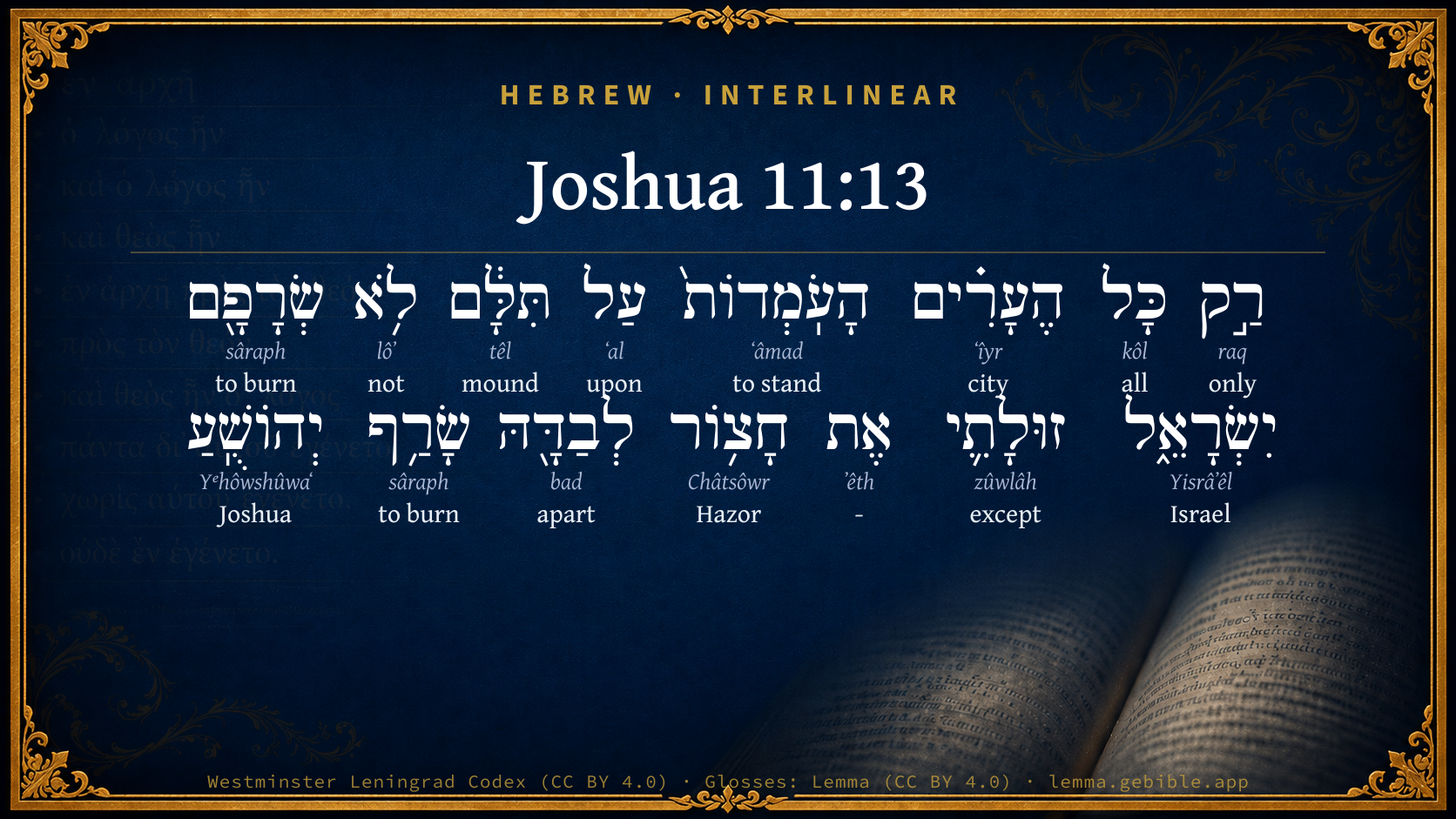
  1. רַ֣ק raq H7535 “only” Particle, Accusative
  2. כָּל kôl H3605 “all of” Noun, Common, Masculine, Singular, Construct
  3. הֶעָרִ֗ים ʻîyr H5892 “the · cities” Particle, Definite Article + Noun, Common, Feminine, Plural, Absolute
  4. הָעֹֽמְדוֹת֙ ʻâmad H5975 “the · standing” Particle, Definite Article + Verb, Qal, Participle Active, Feminine, Plural, Absolute
  5. עַל ʻal H5921 “upon” Preposition
  6. לֹ֥א lôʼ H3808 “not” Particle, Negative
  7. שְׂרָפָ֖ם sâraph H8313 “to burn · them” Verb, Qal, Perfect, 3rd Person, Masculine, Singular + Suffix, Personal, 3rd Person, Masculine, Plural
  8. יִשְׂרָאֵ֑ל Yisrâʼêl H3478 “Israel” Noun, Proper
  9. זוּלָתִ֛י zûwlâh H2108 “except” Conjunction
  10. אֶת ʼêth H853 “-” Particle, Direct Object
  11. חָצ֥וֹר Châtsôwr H2674 “Hazor” Noun, Proper
  12. לְבַדָּ֖הּ bad H905 “to/for · apart · her” Preposition + Noun, Common, Masculine, Singular, Construct + Suffix, Personal, 3rd Person, Feminine, Singular
  13. שָׂרַ֥ף sâraph H8313 “to burn” Verb, Qal, Perfect, 3rd Person, Masculine, Singular
  14. יְהוֹשֻֽׁעַ Yᵉhôwshûwaʻ H3091 “Joshua” Noun, Proper

About this verse

These counts appear in no published source. They are computed here, from the morphology-tagged text and Lemma’s own curated glosses. What Lemma adds →

15
words
14
distinct lemmas
Historical
section

Notable vocabulary

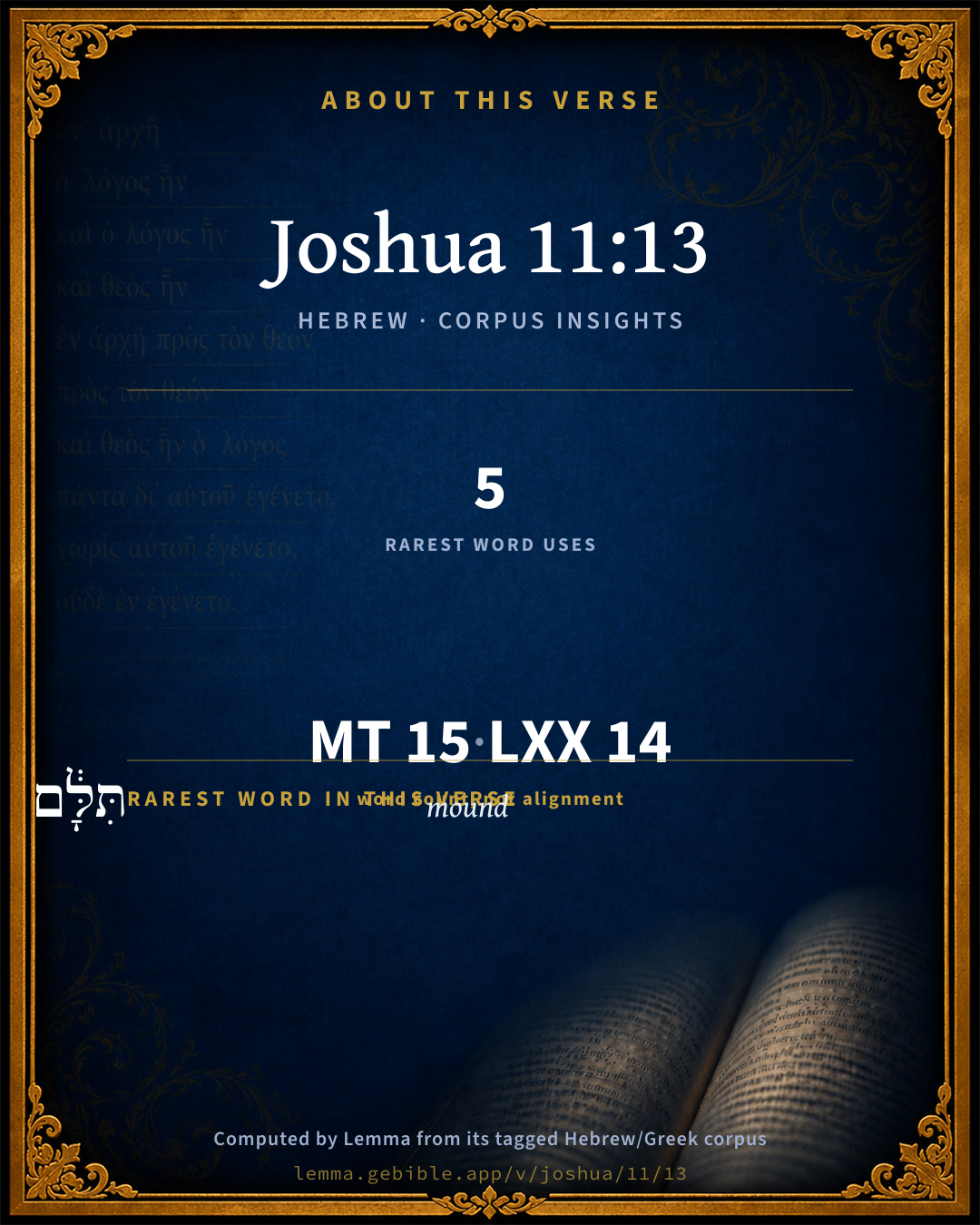
The rarest word here is תִּלָּ֔ם mound H8510 — appearing just 5 times in the whole Hebrew Bible.

Shared distinctive vocabulary

תִּלָּ֔ם mound H8510 occurs in 5 verses of the Hebrew Bible. Also found in:

Grammatical profile

  • 3 verbs
  • 7 nouns
  • 1 preposition
  • 1 conjunction
  • 3 particles

Verb forms

  • הָעֹֽמְדוֹת֙ Qal · Participle Active
  • שְׂרָפָ֖ם Qal · Perfect
  • שָׂרַ֥ף Qal · Perfect

Repetition

A word recurs within this verse — often emphatic in Hebrew:

  • שְׂרָפָ֖ם to burn H8313 ×2

Hebrew & Septuagint length

In English translation the verse runs 22 words from the Hebrew and 13 from the Septuagint (LXX English) — the Septuagint runs noticeably shorter here. See the side-by-side →

A rough comparison of the two English renderings, which tokenize alike — not a word-level alignment.

Word counts can differ between the Hebrew and the Greek without any difference in meaning — e.g. the Hebrew direct-object marker אֵת has no separate Greek word, and Greek often adds the article ὁ.

In the original languages it is 15 Hebrew tokens and 14 Greek tokens — but the two are counted differently (Hebrew bundles its prefixes and suffixes into one token; the Greek is in lemma form), so that isn’t a like-for-like length.

Cross-references

1

Topical passages linked to Joshua 11:13 in the Treasury of Scripture Knowledge — connected by theme and wording, ordered by reader-vote popularity; previews shown in the World English Bible.

  • Jeremiah 30:18 Thus says Yahweh: Behold, I will turn again the captivity of Jacob's tents, and have compassion on his dwelling-places; and the city shall be built on its own hill, and the palace shall be inhabited after its own manner.

Cross-references courtesy of OpenBible.info (CC BY 4.0).

Hebrew and Greek witnesses Masoretic Hebrew ↔ Greek Septuagint

The same verse in the two great witnesses to the Old Testament, shown verse-for-verse.

Here the Septuagint runs noticeably shorter than the Hebrew — LXX2012 (modern English Septuagint) 13 words vs World English Bible 22. A rough length comparison of the two English translations, not a word-level alignment — read both below.

These are two independent witnesses, not word-aligned to each other, and the Septuagint is shown in lemma (dictionary) form.

Hebrew Joshua 11:13 Masoretic · Westminster Leningrad Codex

רַ֣ק כָּל הֶעָרִ֗ים הָעֹֽמְדוֹת֙ עַל תִּלָּ֔ם לֹ֥א שְׂרָפָ֖ם יִשְׂרָאֵ֑ל זוּלָתִ֛י אֶת חָצ֥וֹר לְבַדָּ֖הּ שָׂרַ֥ף יְהוֹשֻֽׁעַ

But as for the cities that stood on their mounds, Israel burned none of them, save Hazor only; that did Joshua burn.

World English Bible · Public Domain

Greek LXX Joshua 11:13 Septuagint · lemma form

ἀλλά πᾶς ὁ πόλις ὁ χωματίζω οὐ ἐνπίμπρημι ἰσραήλ πλήν ασωρ μόνος ἐνπίμπρημι ἰησοῦς

But all the walled cities Israel burnt not; but Israel burnt Asor only.

LXX2012 (modern English Septuagint) · Public Domain

On this verse, Haydock's Catholic Bible Commentary discusses the Septuagint’s reading. Read the note in Commentary ↓

Hebrew: Westminster Leningrad Codex (CC BY 4.0). Greek: Septuagint (public domain); English from LXX2012 (modern English Septuagint) (Public Domain). How the Septuagint differs from the Hebrew →

Targum (Aramaic paraphrase)

1

The Targum is the ancient Jewish Aramaic paraphrase of the Hebrew Scriptures — an interpretive translation, not the Hebrew text itself. Onkelos (literal) and Pseudo-Jonathan (expansive) render the Torah, and Jonathan the Prophets. Coverage is partial: where no permissively-licensed English translation exists for a verse, only the Aramaic is shown. This is verse-level text, not a word-by-word alignment to the Hebrew.

  1. Targum Jonathan Prophets (Joshua–Malachi)
    לְחוֹד כָּל קִרְוַיָא דְקַיְמִין עַל תּוּקְפֵיהוֹן לָא אוֹקְדִינוּן יִשְׂרָאֵל אֱלָהֵין יַת חָצוֹר בִּלְחוֹדָהּ אוֹקֵיד יְהוֹשֻׁעַ:

    (no public-domain English translation for this verse)

    Targum Jonathan — Aramaic: “Mikraot Gedolot” (public domain). English: “Sefaria Community Translation” (CC0 1.0 (public-domain dedication)); “London "Chaldee Paraphrase," 1871” (public domain). Text via Sefaria.

Commentary

Notes on Joshua 11:13 from classic Christian and Jewish commentators (each source and its license shown beneath its notes). The classic Christian expositions comment on the surrounding passage and are grouped to its opening verse, so a note may address several verses; the Jewish commentaries on the Tanakh (Rashi and others) are per-verse, so they appear only where the commentator wrote on this verse.

Lemma curates 59 commentaries, every one of them public domain or Creative Commons licensed, each selected and text-cleaned for this edition rather than reprinted as found. About our sources →

Trapp's Complete Commentary

John Trapp

Jos 11:13 But [as for] the cities that stood still in their strength, Israel burned none of them, save Hazor only; [that] did Joshua burn.

Ver. 13. That stood still in their strength.] Heb., On their heap: i.e., that prepared to have stood out a siege, but yet repented and did not; or that had not their walls and bulwarks yet rased and dismantled in the fury of war.

That did Joshua burn.] For example’s sake to the rest; and for that the king thereof was the author of that war. {Jos 11:1}

John Trapp, A Commentary or Exposition upon All the Books of the Old and New Testament (1647–1656) — public domain. Text from a community e-Sword module.

Joseph Benson's Commentary

Jos 11:13. In their strength — Hebrew, with their fence, walls, or bulwarks, that is, which were not ruined with their walls in taking them. Save Hazor — Because this city began the war, and, being the chief and royal city, might renew the war, if the Canaanites should ever seize upon it: which in fact they did, and settled there, under a king of the same name, Jdg 4:2.

Joseph Benson's Commentary on the Old and New Testaments (1811–1818) — public domain. Text from a community e-Sword module.

Tyndale Open Study Notes

Tyndale Open Resources

11:13 the towns built on mounds: In the ancient Near East it was common practice to rebuild cities on the same sites after they had been destroyed. All the elements that made a city site advantageous remained after a city’s destruction. Many cities were rebuilt numerous times, slowly rising in height as more debris accumulated after each destruction. • Joshua burned only Hazor in the north, just as he had destroyed Jericho (6:24) and Ai (8:28) in the center of the land.

Tyndale Open Study Notes — © Tyndale Open Resources, licensed CC BY-SA 4.0. Text via the HelloAO Bible API.

Geneva Bible (1599)

Geneva Bible translators

Which were strong by situation and not hurt by war.

Geneva Bible (1599) marginal notes — public domain. Text via Bolls.life.

Jamieson, Fausset & Brown

Robert Jamieson, A. R. Fausset & David Brown

as for the cities that stood still in their strength--literally, "on their heaps." It was a Phœnician custom to build cities on heights, natural or artificial [HENGSTENBERG].

Jamieson, Fausset & Brown — Commentary Critical and Explanatory on the Whole Bible (1871) — public domain (CC PDM 1.0). Text via the HelloAO Bible API.

Adam Clarke's Commentary

Verse 13. The cities that stood still in their strength] The word תלם tillam, which we translate their strength, and the margin, their heap, has been understood two ways.

1. As signifying those cities which had made peace with the Israelites, when conditions of peace were offered according to the command of the law; and consequently were not destroyed. Such as the cities of the Hivites; see Jos 11:19.

2. The cities which were situated upon hills and mountains, which, when taken, might be retained with little difficulty. In this sense the place is understood by the Vulgate, as pointing out the cities quae erant in collibus et tumulis sitae, "which were situated on hills and eminences." As the cities of the plain might be easily attacked and carried, Joshua destroyed them; but as those on mountains, hills, or other eminences, might be retained with little trouble, prudence would dictate their preservation, as places of refuge in any insurrection of the people, or invasion of their adversaries. The passage in Jeremiah, Jer 30:18, Jerusalem shall be builded on her own heap, תלה tillah, if understood as above, conveys an easy and clear sense: Jerusalem shall be re-established on her OWN HILL.

Adam Clarke's Commentary on the Bible (1810–1826) — public domain. Text from a community e-Sword/MySword module.

Ellicott's Commentary for English Readers

(13) The cities that stood still in their strength.—Literally, that stood on their mounds (“quæerant in collibus et in tumulis sitæ.”—Vulg.). Comp. Jos_11:20. We may fairly suppose that Jericho and Ai committed themselves to hostile measures against Israel, though they were not able to send forth armies against Joshua before they were attacked. Those who “stood still in their strength” are those who remained absolutely neutral in the war. “The men of Jericho fought against you” (Jos_24:11).

A Bible Commentary for English Readers, edited by Charles John Ellicott (1878–1897) — public domain. Text from a community e-Sword module.

The Cambridge Bible for Schools and Colleges

gen. ed. J. J. S. Perowne

13. the cities that stood still in their strength] Rather, the cities which stood each on its own hill, or mound, “the citees that weren in the hillis, and in the hillockis set,” Wyclif. Comp. Jer_30:18, “and the city shall be builded upon her own heap” (“little hill” margin). With the exception of Hazor, Joshua did not burn the cities, but left them standing, each on its own hill, the ordinary site for cities in Canaan. Comp. Mat_5:14.

The Cambridge Bible for Schools and Colleges (gen. ed. J. J. S. Perowne; Cambridge University Press, 1878–1918) — public domain. Text from a community e-Sword module.

John Gill's Exposition

But as for the cities that stood still in their strength,.... Whose walls were not demolished when taken, as Kimchi and Jarchi interpret it, or that "stood upon their heaps" (y); upon an eminence, being built on hills and mountains:

Israel burned none of them; but reserved them for their own habitations, being well fortified, and having no need of new walls being built to them, or being in a very agreeable situation:

save Hazor only, that did Joshua burn; because it was the chief city where the scheme was formed, and the combination against Israel was made, and was the rendezvous of the confederate forces against them: the Jews have a tradition (z), that God said to Moses, and Moses said to Joshua, that he should burn it, and that only.

(y) "super tumulum eorum", Montanus; "quae erant in collibus et in tamulis sitae", V. L. (z) Bereshit Rabba, sect. 81. fol. 71. 1.

John Gill's Exposition of the Whole Bible (1746–1763) — public domain (CC PDM 1.0). Text via the HelloAO Bible API.

Albert Barnes' Notes on the Bible

Render: “But the cities standing each on its own hill” (compare Jer 30:18). The meaning is simply that, with the exception of Hazor, Joshua did not burn the cities, but left them standing, each on its former site. This site is spoken of as a hill, because such was the ordinary site chosen for cities in Canaan (compare Mat 5:14).

Albert Barnes' Notes on the Bible (1834–1885) — public domain. Text from a community e-Sword/MySword module.

Haydock's Catholic Bible Commentary

Fire. Several towns built on eminences, were reserved to keep the country in subjection. But it was thought proper to destroy Asor. Hebrew may be, "He burnt not the towns which remained standing, with their fortifications," &c., or such as had opened their gates to the Israelites. (Chaldean; Septuagint; &c.)

George Leo Haydock (1774–1849), Haydock's Catholic Family Bible and Commentary, 1859 edition — public domain. Excludes Psalms (Douay-Rheims chapter numbering differs from Protestant) and Deuterocanonical books (Catholic canon only).

Matthew Poole's English Annotations

In their strength, Heb. with (for so this preposition is oft used, as Exo 35:12; Lev 2:2; Eze 16:37, &c.) their fence or fences, walls or bulwarks, i.e. which were not utterly ruined together with their walls in the taking of them.

Save Hazor only; which though taken by the Israelites, was not so much destroyed as other places were.

That did Joshua burn, because this city began the war; and being the chief and royal city, might renew the war, if the Canaanites should ever seize upon it.

Matthew Poole's English Annotations on the Holy Bible (1683–1685) — public domain. Text from a community e-Sword/MySword module.

Whedon's Commentary on the Bible

Daniel D. Whedon

13. The cities that stood still in their strength, that is, on mounds or eminences, (Hebrews על תלם, on their hill,) were retained, since they could be easily defended, while the cities on the plains were razed. But Hazor, the head of the confederacy, though in a strong position, must fall, as a penalty for the past and a security for the future.

Daniel D. Whedon (gen. ed.), Commentary on the Old and New Testaments (1874–1909) — public domain. Text from a community e-Sword module.

The Pulpit Commentary

The cities that stood still in their strength. This is the rendering of the Chaldee version. The LXX has kecwmatismenav , heaped up, i.e., defended with mounds. Rather, on their hill ("in collibus et in tumulis sitae," Vulg.). As many of the towns in Italy, and the castles in Germany in the middle ages, so these Phoenician cities were placed upon hills, that they might be more easily defended. The various tribes of Palestine were no doubt continually at war, and, as regards these northern tribes at least, were not accustomed to subsist by commerce. Therefore each of these cities stood (the Hebrew dm surely implies situation here) on its own hill, a detail possibly obtained from an eyewitness, who was probably struck by this feature of the district, a feature he had not observed before. The expression is used, however, as Masius observes, by Jeremiah. (Jer_30:1-8) Knobel observes that all the early versions have no suffix here. What he calls the "free translation," however, of the LXX (which has autwn ) requires the suffix, though the Vulgate requires none. We must not adopt the very plausible explanation of Knobel and others that Joshua burnt the cities in the valleys, but spared the cities on the hills, because they could be more easily defended, (see Jos_17:16 Jud_1:19, 34) since we read that Hazor alone was burnt. The word here translated hill (Tell, Arabic) is one with which we are familiar in the modern name of places in Palestine. (see note on Jos_8:28)

The Pulpit Commentary (1880–1919), ed. H.D.M. Spence-Jones & Joseph S. Exell — public domain. Text from a community e-Sword module.

John Wesley's Explanatory Notes

In their strength - Hebrew. with their fence, walls or bulwarks, that is, which were not ruined with their walls in taking them. Save Hazor - Because this city began the war, and being the chief and royal city, might renew the war. If the Canaanites should ever seize upon it: which in fact they did, and settled there, under a king of the same name, Judg. iv, 2.

John Wesley, Explanatory Notes Upon the Whole Bible (1754–1765) — public domain. Text via the GEBible commentary corpus.

Rashi

Rabbi Shlomo Yitzchaki (Rashi)

Remained with their walls intact. Their walls were not destroyed like Yericho, whose walls fell, and similarly Ai, as it is said, “[And Yehoshua burned Ai] and made it into a mound forever, a ruin.”

The only exception was Chatzor. He burned it because of a traditional command. Moshe so commanded and transmitted it to him. This is found in Bereishis Rabba on the Sidrah of “And Yaakov sent.”

Rashi on the Tanakh — English translations: “The Judaica Press complete Tanach with Rashi, translated by A. J. Rosenberg” (CC BY 4.0); “Pentateuch with Rashi's commentary by M. Rosenbaum and A.M. Silbermann, 1929-1934” (public domain); “The Metsudah Tanach series, Lakewood, N.J” (CC BY 4.0); and “The Book of Joshua, Metsudah Publications, 1997” (CC BY 4.0). Text via Sefaria.

Lesson kit

Teaching starters — assembled from the data on this page, not authored interpretation. Every prompt links to the verse data it draws on. Edit before teaching.

Joshua, in the Historical, opens this verse with 15 words (14 distinct Hebrew lemmas). Its most distinctive word is têl (“mound”). The Greek Septuagint runs shorter here. A historical commentator’s framing appears above. Read the whole chapter for the surrounding context.

Discussion questions

  1. How does “mound” (têl) shape what this verse is saying?
  2. Deuteronomy 13:16 shares the word «mound» with this verse. How do the two illuminate each other?
  3. “to burn” occurs 2× in this one verse. What is the effect of the repetition?
  4. Compared with the Hebrew, the Septuagint runs shorter here. What questions does that raise?
  5. The translations on this page render this verse differently — a whole-verse word diff, not a word-by-word alignment. What might account for the different wordings?
  6. The verb «הָעֹֽמְדוֹת֙» is Qal Participle Active. How does its form color the action?
  7. Reading how Trapp's Complete Commentary and Joseph Benson's Commentary read this verse, where do the two commentators agree and where do they part?

Things to notice

Reading settings

Reading text

Shown beneath each verse's original-language words.

Old Testament
Old Testament edition

Read the OT as the Masoretic Hebrew (MT) or the Greek Septuagint (LXX).

English shown for the Greek Septuagint (in the Hebrew ↔ Greek comparison).

Comparing translations? Open the Compare panel on any verse page to stack up to four side by side.