
Numbers 29:39

Hebrew (Westminster Leningrad Codex) Numbers 29:39 appears in the Hebrew Old Testament. The text above is from the Westminster Leningrad Codex. Each word links to its Strong’s number, a concise gloss, and parsing drawn from the Open Scriptures Hebrew Bible morphology. Click any word for its full Brown-Driver-Briggs (BDB) entry.
Download image
Cite this verse

Numbers 29:39 (World English Bible). Public Domain. Lemma interlinear Bible study tool, https://lemma.gebible.app/v/numbers/29/39.

Show BibTeX & RIS
BibTeX
RIS
English Translation
These you shall offer to Yahweh in your set feasts, besides your vows, and your freewill-offerings, for your burnt offerings, and for your meal-offerings, and for your drink-offerings, and for your peace-offerings.
World English Bible · Public Domain
Download a study sheet

One document with this verse’s original text, its word-by-word gloss line, the meaning frame, cross-references with their text, attributed commentary, and full source and license credits — printable, and it pastes into notes with its structure intact.

This verse Autodidact and up

Study sheet (.html) Plain text (.txt)

A passage Seminary Student

Up to 50 verses in one chapter. A passage sheet keeps up to 6 commentary sources and 12 cross-references per verse, in the order this page ranks them, and says so on the sheet whenever that leaves anything out. Ask for a single verse and you get the Autodidact verse sheet above.

Everything on this page stays free to read, with no account — the sheet is a download of what is already on screen, not access to it.

Want to remove ads? Support Godless Engineer
Compare translations 3

The same verse in 3 English versions, stacked beneath the original-language interlinear above. Click any original word for its lexicon entry.

Each is an independent rendering of the whole verse — the interlinear is not word-aligned to these translations.

Highlighted words mark where these versions differ — a whole-verse word diff, not a word-by-word alignment.

  • World English Bible Public Domain
    These you shall offer to Yahweh in your set feasts, besides your vows, and your freewill-offerings, for your burnt offerings, and for your meal-offerings, and for your drink-offerings, and for your peace-offerings.
  • King James Version Public Domain
    These things ye shall do unto the LORD in your set feasts, beside your vows, and your freewill offerings, for your burnt offerings, and for your meat offerings, and for your drink offerings, and for your peace offerings.
  • unfoldingWord Literal Text CC BY-SA 4.0
    You shall do these for Yahweh at your appointed times, apart from your vows and your voluntary offerings, for your burnt offerings, and for your grain offerings, and for your drink offerings, and for your peace offerings.”

unfoldingWord Literal Text — © unfoldingWord, licensed CC BY-SA 4.0. Word-aligned USFM3 via Door43 (git.door43.org/unfoldingWord/en_ult).

Versions to compare (up to 4)

3 of 4 selected

Show all 18 translations

Every available English version of this verse, each an independent rendering of the whole verse.

  • World English Bible Public Domain
    These you shall offer to Yahweh in your set feasts, besides your vows, and your freewill-offerings, for your burnt offerings, and for your meal-offerings, and for your drink-offerings, and for your peace-offerings.
  • Berean Standard Bible Public Domain
    You are to present these offerings to the LORD at your appointed times, in addition to your vow and freewill offerings, whether burnt offerings, grain offerings, drink offerings, or peace offerings.”
  • Majority Standard Bible Public Domain
    You are to present these offerings to the LORD at your appointed times, in addition to your vow and freewill offerings, whether burnt offerings, grain offerings, drink offerings, or peace offerings.”
  • King James Version Public Domain
    These things ye shall do unto the LORD in your set feasts, beside your vows, and your freewill offerings, for your burnt offerings, and for your meat offerings, and for your drink offerings, and for your peace offerings.
  • American Standard Version (1901) Public Domain
    These ye shall offer unto Jehovah in your set feasts, besides your vows, and your freewill-offerings, for your burnt-offerings, and for your meal-offerings, and for your drink-offerings, and for your peace-offerings.
  • Revised Version (1885) Public Domain
    These ye shall offer unto the LORD in your set feasts, beside your vows, and your freewill offerings, for your burnt offerings, and for your meal offerings, and for your drink offerings, and for your peace offerings.
  • Geneva Bible (1599) Public Domain
    These things ye shall do vnto the Lord in your feastes, beside your vowes, and your free offrings, for your burnt offrings, and for your meate offrings, and for your drinke offrings and for your peace offrings.
  • Douay-Rheims (1899) Public Domain
    These things shall you offer to the Lord in your solemnities: besides your vows and voluntary oblations for holocaust, for sacrifice, for libation, and for victims of peace offerings.
  • Young's Literal Translation Public Domain
    `These ye prepare to Jehovah in your appointed seasons, apart from your vows, and your free-will offerings, for your burnt-offerings, and for your presents, and for your libations, and for your peace-offerings.'
  • Literal Standard Version CC BY-SA 4.0
    You prepare these to YHWH in your appointed times—apart from your vows and your free-will offerings—for your burnt-offerings, and for your presents, and for your drink-offerings, and for your peace-offerings.”
  • Unlocked Literal Bible CC BY-SA 4.0
    These are what you must offer to Yahweh at your fixed festivals. These must be in addition to your vows and freewill offerings. You must offer these as your burnt offerings, grain offerings, drink offerings, and fellowship offerings.”
  • unfoldingWord Literal Text CC BY-SA 4.0
    You shall do these for Yahweh at your appointed times, apart from your vows and your voluntary offerings, for your burnt offerings, and for your grain offerings, and for your drink offerings, and for your peace offerings.”
  • Darby Bible Public Domain
    These shall ye offer to Jehovah in your set feasts, besides your vows, and your voluntary-offerings, for your burnt-offerings, and for your oblations, and for your drink-offerings, and for your peace-offerings.
  • World Messianic Bible Public Domain
    “‘You shall offer these to the LORD in your set feasts—in addition to your vows and your free will offerings—for your burnt offerings, your meal offerings, your drink offerings, and your peace offerings.’”
  • Webster's Bible Public Domain
    These things ye shall do to the LORD in your set feasts, besides your vows, and your free-will-offerings, for your burnt-offerings, and for your meat-offerings, and for your drink-offerings, and for your peace-offerings.
  • Free Bible Version CC BY-SA 4.0
    Present these offerings to the Lord at the times you are required to do so, in addition to your offerings to fulfill a promise and freewill offerings, whether they are burnt offerings, grain offerings, drink offerings, or peace offerings.”
  • Bible in Basic English Public Domain
    These are the offerings which you are to give to the Lord at your regular feasts, in addition to the offerings for an oath, and the free offerings you give, for your burned offerings and your drink offerings and your peace-offerings.
  • JPS Tanakh (1917) Public Domain
    These ye shall offer unto the LORD in your appointed seasons, beside your vows, and your freewill-offerings, whether they be your burnt-offerings, or your meal-offerings, or your drink-offerings, or your peace-offerings.

Literal Standard Version (2020), Covenant Press — licensed CC BY-SA 4.0. Text via the HelloAO Bible API (eBible.org). Unlocked Literal Bible (unfoldingWord) — licensed CC BY-SA 4.0. Text via the HelloAO Bible API (eBible.org). unfoldingWord Literal Text — © unfoldingWord, licensed CC BY-SA 4.0. Word-aligned USFM3 via Door43 (git.door43.org/unfoldingWord/en_ult). Free Bible Version, Dr. Jonathan Gallagher — licensed CC BY-SA 4.0. Text via the HelloAO Bible API (eBible.org).

Word by word

More ways to search: Search by grammar → Find every occurrence → Compare this word →

Practice this passage: Drill this verse → Learn its vocabulary →

וְנִדְבֹתֵיכֶ֗ם
nᵉdâbâh
H5071
“and · freewill offerings · your”
Conjunction + Noun, Common, Feminine, Plural, Construct + Suffix, Personal, 2nd Person, Masculine, Plural
Part of Speech
Conjunction + Noun
Type
Common
Gender
Feminine
Number
Plural
State
Construct
Full BDB Definition

Origin: from H5068

TWOT: 1299a

voluntariness, free-will offering - voluntariness - freewill, voluntary, offering
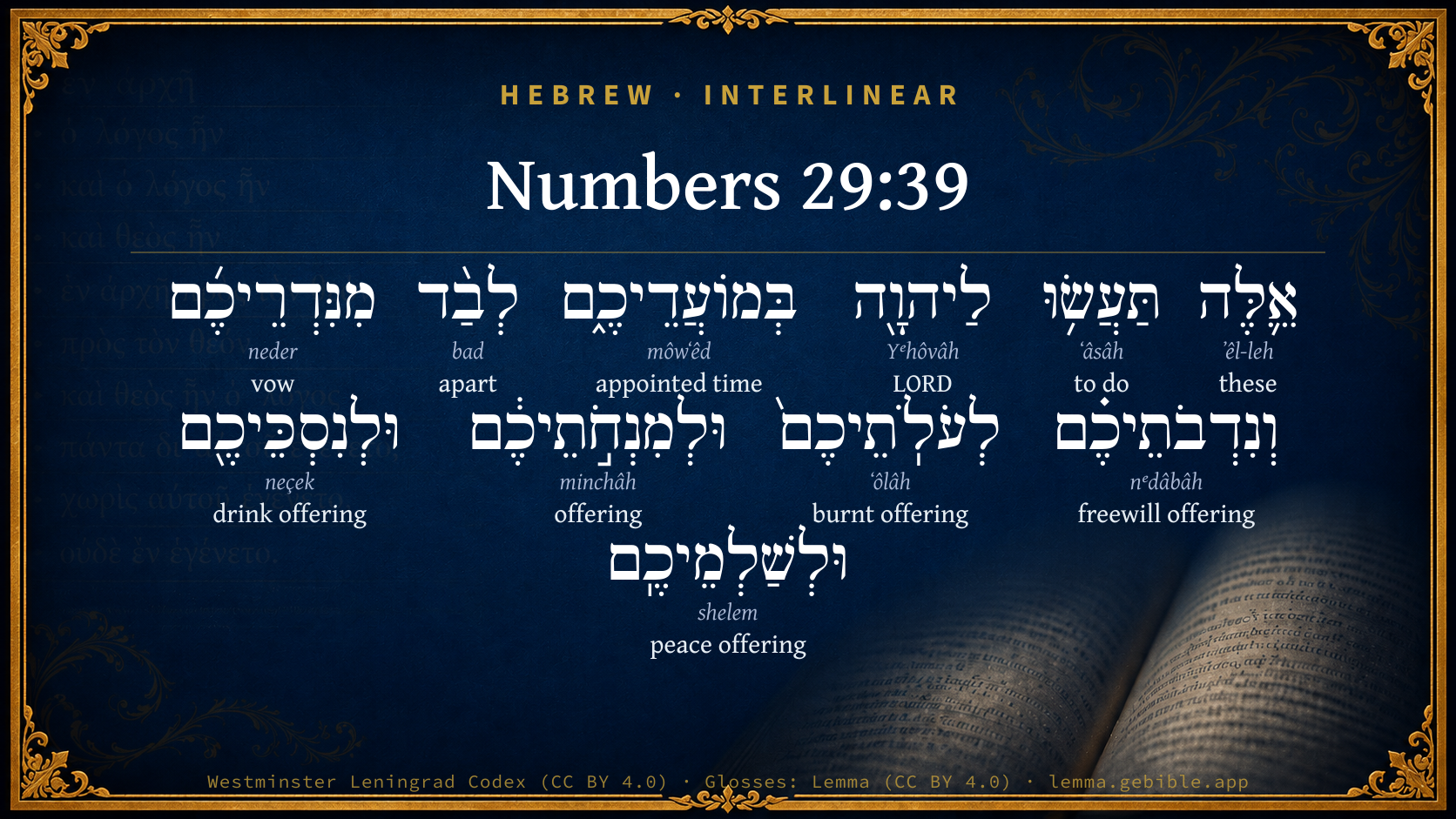
  1. אֵ֛לֶּה ʼêl-leh H428 “these” Pronoun, Demonstrative, Common, Plural
  2. תַּעֲשׂ֥וּ ʻâsâh H6213 “to do” Verb, Qal, Imperfect, 2nd Person, Masculine, Plural
  3. לַיהוָ֖ה Yᵉhôvâh H3068 “to/for · LORD” Preposition + Noun, Proper
  4. בְּמוֹעֲדֵיכֶ֑ם môwʻêd H4150 “in/at · appointed times · your” Preposition + Noun, Common, Masculine, Plural, Construct + Suffix, Personal, 2nd Person, Masculine, Plural
  5. לְבַ֨ד bad H905 “to/for · apart” Preposition + Noun, Common, Masculine, Singular, Absolute
  6. מִנִּדְרֵיכֶ֜ם neder H5088 “from · vows · your” Preposition + Noun, Common, Masculine, Plural, Construct + Suffix, Personal, 2nd Person, Masculine, Plural
  7. לְעֹלֹֽתֵיכֶם֙ ʻôlâh H5930 “to/for · burnt offerings · your” Preposition + Noun, Common, Feminine, Plural, Construct + Suffix, Personal, 2nd Person, Masculine, Plural
  8. וּלְמִנְחֹ֣תֵיכֶ֔ם minchâh H4503 “and · to/for · offerings · your” Conjunction + Preposition + Noun, Common, Feminine, Plural, Construct + Suffix, Personal, 2nd Person, Masculine, Plural
  9. וּלְנִסְכֵּיכֶ֖ם neçek H5262 “and · to/for · drink offerings · your” Conjunction + Preposition + Noun, Common, Masculine, Plural, Construct + Suffix, Personal, 2nd Person, Masculine, Plural
  10. וּלְשַׁלְמֵיכֶֽם shelem H8002 “and · to/for · peace offerings · your” Conjunction + Preposition + Noun, Common, Masculine, Plural, Construct + Suffix, Personal, 2nd Person, Masculine, Plural

About this verse

These counts appear in no published source. They are computed here, from the morphology-tagged text and Lemma’s own curated glosses. What Lemma adds →

11
words
11
distinct lemmas
Pentateuch
section

Shared distinctive vocabulary

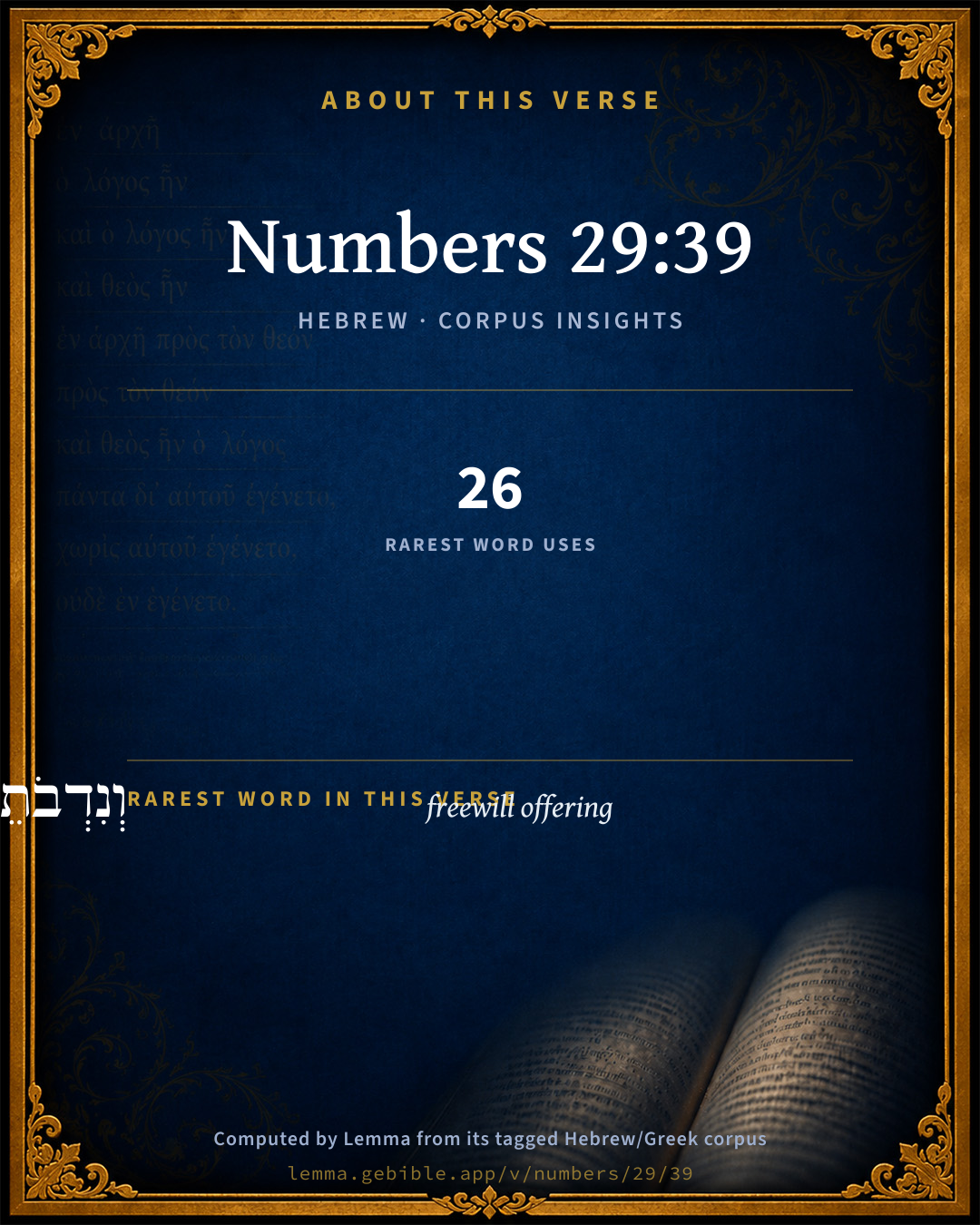
וְנִדְבֹתֵיכֶ֗ם freewill offering H5071 occurs in 25 verses of the Hebrew Bible. Also found in:

Grammatical profile

  • 1 verb
  • 9 nouns
  • 1 pronoun

Verb forms

  • תַּעֲשׂ֥וּ Qal · Imperfect

Hebrew & Septuagint length

In English translation the verse runs 32 words from the Hebrew and 36 from the Septuagint (LXX English) — closely comparable.

A rough comparison of the two English renderings, which tokenize alike — not a word-level alignment.

Word counts can differ between the Hebrew and the Greek without any difference in meaning — e.g. the Hebrew direct-object marker אֵת has no separate Greek word, and Greek often adds the article ὁ.

Cross-references

13

Topical passages linked to Numbers 29:39 in the Treasury of Scripture Knowledge — connected by theme and wording, ordered by reader-vote popularity; previews shown in the World English Bible.

  • Leviticus 23:2 "Speak to the children of Israel, and tell them, 'The set feasts of Yahweh, which you shall proclaim to be holy convocations, even these are my set feasts.
  • 2 Chronicles 31:3 [He appointed] also the king's portion of his substance for the burnt-offerings, [to wit], for the morning and evening burnt offerings, and the burnt offerings for the Sabbaths, and for the new moons, and for the set feasts, as it is written in the law of Yahweh.
  • 1 Chronicles 23:31 and to offer all burnt offerings to Yahweh, on the Sabbaths, on the new moons, and on the set feasts, in number according to the ordinance concerning them, continually before Yahweh;
  • Leviticus 7:11 "'This is the law of the sacrifice of peace offerings, which one shall offer to Yahweh.
  • Ezra 3:5 and afterward the continual burnt-offering, and [the offerings] of the new moons, and of all the set feasts of Yahweh that were consecrated, and of everyone who willingly offered a freewill-offering to Yahweh.
  • Nehemiah 10:33 for the show bread, and for the continual meal-offering, and for the continual burnt-offering, for the Sabbaths, for the new moons, for the set feasts, and for the holy things, and for the sin-offerings to make atonement for Israel, and for all the work of the house of our God.
  • Isaiah 1:14 My soul hates your New Moons and your appointed feasts; They are a burden to me. I am weary of bearing them.
  • Leviticus 7:16–38 "'But if the sacrifice of his offering is a vow, or a freewill offering, it shall be eaten on the day that he offers his sacrifice; and on the next day what remains of it shall be eaten:
  • Leviticus 22:21–23 Whoever offers a sacrifice of peace offerings to Yahweh to accomplish a vow, or for a freewill offering, of the herd or of the flock, it shall be perfect to be accepted; there shall be no blemish therein.
  • Leviticus 23:28 You shall do no manner of work in that same day; for it is a day of atonement, to make atonement for you before Yahweh your God.
  • Numbers 6:21 "This is the law of the Nazirite who vows, and of his offering to Yahweh for his separation, besides that which he is able to get. According to his vow which he vows, so he must do after the law of his separation."
  • Deuteronomy 12:6 and there you shall bring your burnt offerings, and your sacrifices, and your tithes, and the heave-offering of your hand, and your vows, and your freewill-offerings, and the firstborn of your herd and of your flock:
  • 1 Corinthians 10:31 Whether therefore you eat, or drink, or whatever you do, do all to the glory of God.

Cross-references courtesy of OpenBible.info (CC BY 4.0).

Hebrew and Greek witnesses Masoretic Hebrew ↔ Greek Septuagint

The same verse in the two great witnesses to the Old Testament, shown verse-for-verse.

These are two independent witnesses, not word-aligned to each other, and the Septuagint is shown in lemma (dictionary) form.

Hebrew Numbers 29:39 Masoretic · Westminster Leningrad Codex

אֵ֛לֶּה תַּעֲשׂ֥וּ לַיהוָ֖ה בְּמוֹעֲדֵיכֶ֑ם לְבַ֨ד מִנִּדְרֵיכֶ֜ם וְנִדְבֹתֵיכֶ֗ם לְעֹלֹֽתֵיכֶם֙ וּלְמִנְחֹ֣תֵיכֶ֔ם וּלְנִסְכֵּיכֶ֖ם וּלְשַׁלְמֵיכֶֽם

These you shall offer to Yahweh in your set feasts, besides your vows, and your freewill-offerings, for your burnt offerings, and for your meal-offerings, and for your drink-offerings, and for your peace-offerings.

World English Bible · Public Domain

Greek LXX Numbers 29:39 Septuagint · lemma form

οὗτος ποιέω κύριος ἐν ὁ ἑορτή σύ πλήν ὁ εὐχή σύ καί ὁ ἑκούσιος σύ καί ὁ ὁλοκαύτωμα σύ καί ὁ θυσία σύ καί ὁ σπονδή σύ καί ὁ σωτήριον σύ

These sacrifices shall you⌃ offer to the Lord in your feasts, besides your vows; and you⌃ shall offer your free will offerings and your whole burnt offerings, and your meat-offerings and your drink-offerings, and your peace-offerings.

LXX2012 (modern English Septuagint) · Public Domain

On this verse, The Pulpit Commentary discusses the Septuagint’s reading. Read the note in Commentary ↓

Hebrew: Westminster Leningrad Codex (CC BY 4.0). Greek: Septuagint (public domain); English from LXX2012 (modern English Septuagint) (Public Domain). How the Septuagint differs from the Hebrew →

Targum (Aramaic paraphrase)

2

The Targum is the ancient Jewish Aramaic paraphrase of the Hebrew Scriptures — an interpretive translation, not the Hebrew text itself. Onkelos (literal) and Pseudo-Jonathan (expansive) render the Torah, and Jonathan the Prophets. Coverage is partial: where no permissively-licensed English translation exists for a verse, only the Aramaic is shown. This is verse-level text, not a word-by-word alignment to the Hebrew.

  1. Targum Onkelos Torah (Genesis–Deuteronomy)
    אִלֵין תַּעְבְדוּן קֳדָם יְיָ בְּמוֹעֲדֵיכוֹן בַּר מִנִדְרֵיכוֹן וְנִדְבוֹתֵיכוֹן לְעֲלְוַתְכוֹן וּלְמִנְחַתְכוֹן וּלְנִסְכֵּיכוֹן וּלְנִכְסַת קוּדְשֵׁיכוֹן

    (no public-domain English translation for this verse)

    Targum Onkelos — Aramaic: “Onkelos Genesis” (public domain); “Onkelos Exodus” (public domain); “Onkelos Leviticus” (public domain); “Onkelos Numbers” (public domain); “Onkelos Deuteronomy” (public domain). English: “Sefaria Community Translation” (CC0 1.0 (public-domain dedication)); “J.W. Etheridge. The Targums of Onkelos and Jonathan Ben Uzziel on the Pentateuch. London: Longmans, Green, 1862” (public domain). Text via Sefaria.

  2. Targum Pseudo-Jonathan Torah (Genesis–Deuteronomy)
    אִלֵין תְּקַרְבוּן קֳדָם יְיָ בִּזְמַן מוֹעֲדֵיכוֹן בַּר מִנִדְרֵיכוֹן דִנְדַרְתּוּן בְּחַגָא דְתַיְיתוּן בְּחַגָא וּנְסִיכַתְכוֹן לַעֲלָוַותְכוֹן וּלְמִנְחָתֵיכוֹן וּלְנִיסוּכֵיכוֹן וּלְנִכְסַת קוּדְשֵׁיכוֹן

    These you shall offer before the Lord in the time of your festivals, beside your vows which you vow at the festival, and which you shall bring on the day of the feast, with your free-will oblation for your burnt sacrifice, your mincha, libations, and consecrated victims.

    Targum Pseudo-Jonathan — Aramaic: “Targum Jonathan on Genesis” (public domain); “Targum Jonathan on Exodus” (public domain); “Targum Jonathan on Leviticus” (public domain); “Targum Jonathan on Numbers” (public domain); “Targum Jonathan on Deuteronomy” (public domain). English: “The Targum of Jonathan ben Uzziel, trans. J. W. Etheridge, London, 1862” (public domain). Text via Sefaria.

Commentary

Notes on Numbers 29:39 from classic Christian and Jewish commentators (each source and its license shown beneath its notes). The classic Christian expositions comment on the surrounding passage and are grouped to its opening verse, so a note may address several verses; the Jewish commentaries on the Tanakh (Rashi and others) are per-verse, so they appear only where the commentator wrote on this verse.

Lemma curates 59 commentaries, every one of them public domain or Creative Commons licensed, each selected and text-cleaned for this edition rather than reprinted as found. About our sources →

Joseph Benson's Commentary

Num 29:39. Besides your vows and free-will-offerings — Your ordinary sacrifices shall not be omitted because of the extraordinary, which ye offer on special occasions. It appears by this account that there were every year sacrificed at the tabernacle and temple, at the stated national charge, the following number of beasts, namely; lambs, one thousand one hundred and one; bullocks, one hundred and thirty-two; rams, seventy-two; kids, twenty-one; goats, two; in all, one thousand three hundred and twenty- eight. Besides which, there was a vast number of voluntary, vow, and trespass-offerings, which, could they be computed, would swell the account to a much greater degree. We may learn from all this, three important lessons: 1st, That the expiation of sin, and reconciliation with God, for which this multitude of sacrifices was appointed, are not such trivial things as many would make them, but matters of infinite moment. 2d, That the sacrifice of Christ, which these sacrifices were intended to prefigure and typify, is of unspeakable worth and importance, and should never be thought of without reverence and gratitude. 3d, That we ought to be very thankful that by the coming of the Messiah, and the oblation of his blessed body for the expiation of sin, the necessity and use of these legal and typical sacrifices have been superseded, and the church of God freed from the intolerable yoke and burden of such numerous, expensive, and continually repeated offerings.

Joseph Benson's Commentary on the Old and New Testaments (1811–1818) — public domain. Text from a community e-Sword module.

Tyndale Open Study Notes

Tyndale Open Resources

29:39 Public offerings were supplemented by a variety of voluntary individual gifts (cp. Lev 23:38).

Tyndale Open Study Notes — © Tyndale Open Resources, licensed CC BY-SA 4.0. Text via the HelloAO Bible API.

Geneva Bible (1599)

Geneva Bible translators

Beside the sacrifices that you shall vow or offer of your own minds.

Geneva Bible (1599) marginal notes — public domain. Text via Bolls.life.

Jamieson, Fausset & Brown

Robert Jamieson, A. R. Fausset & David Brown

These things ye shall do unto the Lord in your set feasts--From the statements made in this and the preceding chapter, it appears that the yearly offerings made to the altar at the public expense, without taking into account a vast number of voluntary vow and trespass offerings, were calculated at the following amount:--goats, fifteen; kids, twenty-one; rams, seventy-two; bullocks, one hundred thirty-two; lambs, 1,101; sum-total of animals sacrificed at public cost, 1,241. This, of course, is exclusive of the prodigious addition of lambs slain at the passover, which in later times, according to JOSEPHUS, amounted in a single year to the immense number of 255,600.

Next: Numbers Chapter 30

Jamieson, Fausset & Brown — Commentary Critical and Explanatory on the Whole Bible (1871) — public domain (CC PDM 1.0). Text via the HelloAO Bible API.

Ellicott's Commentary for English Readers

(39) These things ye shall do unto the Lord in your set feasts.—Better, These sacrifices shall ye offer unto the Lord at your set seasons.

For your burnt offerings . . . —The sacrifices prescribed in this chapter were appointed to be offered independently of all the burnt offerings, meal offerings, drink offerings, and peace offerings, which were made in performance of special vows, or as freewill offerings. (See Lev_22:18-21; Num_15:1-13.)

A Bible Commentary for English Readers, edited by Charles John Ellicott (1878–1897) — public domain. Text from a community e-Sword module.

Haydock's Catholic Bible Commentary

Vows. The general regulations did not hinder any private ones from being fulfilled. (Calmet) --- Sacrifice. Mincha, or offering of flour, &c. (Haydock)

George Leo Haydock (1774–1849), Haydock's Catholic Family Bible and Commentary, 1859 edition — public domain. Excludes Psalms (Douay-Rheims chapter numbering differs from Protestant) and Deuterocanonical books (Catholic canon only).

Matthew Poole's English Annotations

Your free-will offerings; your ordinary sacrifices shall not be omitted because of the extraordinary, which ye offer on special occasions.

Matthew Poole's English Annotations on the Holy Bible (1683–1685) — public domain. Text from a community e-Sword/MySword module.

Whedon's Commentary on the Bible

Daniel D. Whedon

39. Beside your vows — The sacrifices in this chapter and the last were set feasts for the entire nation, and were exclusive of the countless individual and family offerings. For burnt offerings and peace offerings vowed, see Num_15:3; Num_15:8; Lev_22:18; Lev_22:21, notes. Num_29:40 shows that this whole system of sacrifices rests on the basis of divine authority.

Daniel D. Whedon (gen. ed.), Commentary on the Old and New Testaments (1874–1909) — public domain. Text from a community e-Sword module.

The Pulpit Commentary

These things shall ye do, or "sacrifice." WcT. Septuagint, tauta poihsete . (cf. Luk_22:19) Beside your vows, and your freewill offerings. These are treated of in Lev_22:18 sq.; Num_15:3 sq. The words which follow are dependent upon this clause. All the offerings commanded in these chapters amounted to 1071 lambs, 113 bullocks, 37 rams, 30 goats, in the lunar year, together with 112 bushels of flour, more than 370 gallons of oil, and about 340 gallons of wine, supposing that the drink offering was proportionate throughout.

The Pulpit Commentary (1880–1919), ed. H.D.M. Spence-Jones & Joseph S. Exell — public domain. Text from a community e-Sword module.

Keil & Delitzsch

C. F. Keil & F. Delitzsch

The sacrifices already mentioned were to be presented to the Lord on the part of the congregation, in addition to the burnt-offerings, meat-offerings, drink-offerings, and peace-offerings which individuals or families might desire to offer either spontaneously or in consequence of vows. On the vowing of burnt-offerings and peace-offerings, see Num 15:3, Num 15:8; Lev 22:18, Lev 22:21.

Keil & Delitzsch — Biblical Commentary on the Old Testament (1861–1891) — public domain (CC PDM 1.0). Text via the HelloAO Bible API. (Old Testament only.)

unfoldingWord translationNotes

Door43 World Missions Community

These are what you must offer

"These offerings are what you must offer"

fixed festivals

"planned festivals." These are festivals that occurred at regularly scheduled times. The word "fixed" means "set" or "predetermined."

translationWords

Yahweh

festival

vow

freewill offering

fellowship offering

Moses

Israel

command

unfoldingWord translationNotes — © Distant Shores Media and the Door43 World Missions Community, licensed CC BY-SA 4.0. Source: git.door43.org/Door43/en_tn.

Rashi

Rabbi Shlomo Yitzchaki (Rashi)

אלה תעשו לה׳ במועדיכם THESE YE SHALL OFFER TO THE LORD ON YOUR APPOINTED FESTIVALS — as something that is laid down as a duty,

לבד מנדריכם BESIDES YOUR VOWS [AND YOUR FREEWILL OFFERINGS] — If on the Festival you wish to make a vow to bring a sacrifice, you have a duty ready at hand to your credit and you should bring it on that Festival; or in the case of vow-offerings and freewill offerings which you have vowed all the year, bring them on the Festival. — Perhaps it will be difficult for one to go up again to Jerusalem to bring his vow-offerings, and consequently he will transgress the command, (Deuteronomy 23:22) “Thou shalt not delay to pay it (thy vow)”.

Rashi on the Tanakh — English translations: “The Judaica Press complete Tanach with Rashi, translated by A. J. Rosenberg” (CC BY 4.0); “Pentateuch with Rashi's commentary by M. Rosenbaum and A.M. Silbermann, 1929-1934” (public domain); “The Metsudah Tanach series, Lakewood, N.J” (CC BY 4.0); and “The Book of Joshua, Metsudah Publications, 1997” (CC BY 4.0). Text via Sefaria.

Lesson kit

Teaching starters — assembled from the data on this page, not authored interpretation. Every prompt links to the verse data it draws on. Edit before teaching.

Numbers, in the Pentateuch, opens this verse with 11 words (11 distinct Hebrew lemmas). Its most distinctive word is nᵉdâbâh (“freewill offering”). A historical commentator’s framing appears above. Read the whole chapter for the surrounding context.

Discussion questions

  1. What does “freewill offering” (nᵉdâbâh) contribute to the verse as a whole?
  2. How does Exodus 35:29, which shares the word «freewill offering», read alongside this verse?
  3. These translations render this verse differently. What is at stake in choosing one wording over another?
  4. «תַּעֲשׂ֥וּ» is a Qal Imperfect verb. How does that grammatical form shape the action described?
  5. Compare how Joseph Benson's Commentary and Tyndale Open Study Notes read this verse. Where do they agree or differ?

Things to notice

Reading settings

Reading text

Shown beneath each verse's original-language words.

Old Testament
Old Testament edition

Read the OT as the Masoretic Hebrew (MT) or the Greek Septuagint (LXX).

English shown for the Greek Septuagint (in the Hebrew ↔ Greek comparison).

Comparing translations? Open the Compare panel on any verse page to stack up to four side by side.