2 Chronicles 17:19

Hebrew (Westminster Leningrad Codex) 2 Chronicles 17:19 appears in the Hebrew Old Testament. The text above is from the Westminster Leningrad Codex. Each word links to its Strong’s number, a concise gloss, and parsing drawn from the Open Scriptures Hebrew Bible morphology. Click any word for its full Brown-Driver-Briggs (BDB) entry.
Download image
Cite this verse

2 Chronicles 17:19 (World English Bible). Public Domain. Lemma interlinear Bible study tool, https://lemma.gebible.app/v/2-chronicles/17/19.

Show BibTeX & RIS
BibTeX
RIS
English Translation
These were those who waited on the king, besides those whom the king put in the fortified cities throughout all Judah.
World English Bible · Public Domain
Download a study sheet

One document with this verse’s original text, its word-by-word gloss line, the meaning frame, cross-references with their text, attributed commentary, and full source and license credits — printable, and it pastes into notes with its structure intact.

This verse Autodidact and up

Study sheet (.html) Plain text (.txt)

A passage Seminary Student

Up to 50 verses in one chapter. A passage sheet keeps up to 6 commentary sources and 12 cross-references per verse, in the order this page ranks them, and says so on the sheet whenever that leaves anything out. Ask for a single verse and you get the Autodidact verse sheet above.

Everything on this page stays free to read, with no account — the sheet is a download of what is already on screen, not access to it.

Want to remove ads? Support Godless Engineer
Compare translations 3

The same verse in 3 English versions, stacked beneath the original-language interlinear above. Click any original word for its lexicon entry.

Each is an independent rendering of the whole verse — the interlinear is not word-aligned to these translations.

Highlighted words mark where these versions differ — a whole-verse word diff, not a word-by-word alignment.

  • World English Bible Public Domain
    These were those who waited on the king, besides those whom the king put in the fortified cities throughout all Judah.
  • King James Version Public Domain
    These waited on the king, beside those whom the king put in the fenced cities throughout all Judah.
  • unfoldingWord Literal Text CC BY-SA 4.0
    These ministered to the king, besides those whom the king placed in the cities of fortification in all Judah.

unfoldingWord Literal Text — © unfoldingWord, licensed CC BY-SA 4.0. Word-aligned USFM3 via Door43 (git.door43.org/unfoldingWord/en_ult).

Versions to compare (up to 4)

3 of 4 selected

Show all 18 translations

Every available English version of this verse, each an independent rendering of the whole verse.

  • World English Bible Public Domain
    These were those who waited on the king, besides those whom the king put in the fortified cities throughout all Judah.
  • Berean Standard Bible Public Domain
    These were the men who served the king, besides those he stationed in the fortified cities throughout Judah.
  • Majority Standard Bible Public Domain
    These were the men who served the king, besides those he stationed in the fortified cities throughout Judah.
  • King James Version Public Domain
    These waited on the king, beside those whom the king put in the fenced cities throughout all Judah.
  • American Standard Version (1901) Public Domain
    These were they that waited on the king, besides those whom the king put in the fortified cities throughout all Judah.
  • Revised Version (1885) Public Domain
    These were they that waited on the king, beside those whom the king put in the fenced cities throughout all Judah.
  • Geneva Bible (1599) Public Domain
    These waited on the King, besides those which the King put in the strong cities thoroughout all Iudah.
  • Douay-Rheims (1899) Public Domain
    All these were at the hand of the king, beside others, whom he had put in the walled cities, in all Juda.
  • Young's Literal Translation Public Domain
    These `are' those serving the king, apart from those whom the king put in the cities of fortress, in all Judah.
  • Literal Standard Version CC BY-SA 4.0
    These [are] those serving the king, apart from those whom the king put in the fortress cities in all of Judah.
  • Unlocked Literal Bible CC BY-SA 4.0
    These were those who served the king, besides those whom the king put in the fortified cities throughout all Judah.
  • unfoldingWord Literal Text CC BY-SA 4.0
    These ministered to the king, besides those whom the king placed in the cities of fortification in all Judah.
  • Darby Bible Public Domain
    These were they that waited on the king, besides those that the king had put in the fortified cities throughout Judah.
  • World Messianic Bible Public Domain
    These were those who waited on the king, in addition to those whom the king put in the fortified cities throughout all Judah.
  • Webster's Bible Public Domain
    These waited on the king, besides those whom the king put in the fortified cities throughout all Judah.
  • Free Bible Version CC BY-SA 4.0
    These were the men who served the king, in addition to those he assigned to the fortified towns throughout Judah.
  • Bible in Basic English Public Domain
    These were the men who were waiting on the king, in addition to those placed by the king in the walled towns through all Judah.
  • JPS Tanakh (1917) Public Domain
    These were they that waited on the king beside those whom the king put in the fortified cities throughout all Judah.

Literal Standard Version (2020), Covenant Press — licensed CC BY-SA 4.0. Text via the HelloAO Bible API (eBible.org). Unlocked Literal Bible (unfoldingWord) — licensed CC BY-SA 4.0. Text via the HelloAO Bible API (eBible.org). unfoldingWord Literal Text — © unfoldingWord, licensed CC BY-SA 4.0. Word-aligned USFM3 via Door43 (git.door43.org/unfoldingWord/en_ult). Free Bible Version, Dr. Jonathan Gallagher — licensed CC BY-SA 4.0. Text via the HelloAO Bible API (eBible.org).

Word by word

More ways to search: Search by grammar → Find every occurrence → Compare this word →

Practice this passage: Drill this verse → Learn its vocabulary →

הַמִּבְצָ֖ר
mibtsâr
H4013
“the · fortress”
Particle, Definite Article + Noun, Common, Masculine, Singular, Absolute
Part of Speech
Particle + Noun
Type
Common
Gender
Masculine
Number
Singular
State
Absolute
Full BDB Definition

Origin: from H1219

TWOT: 270g

fortification, fortress, fortified city, stronghold
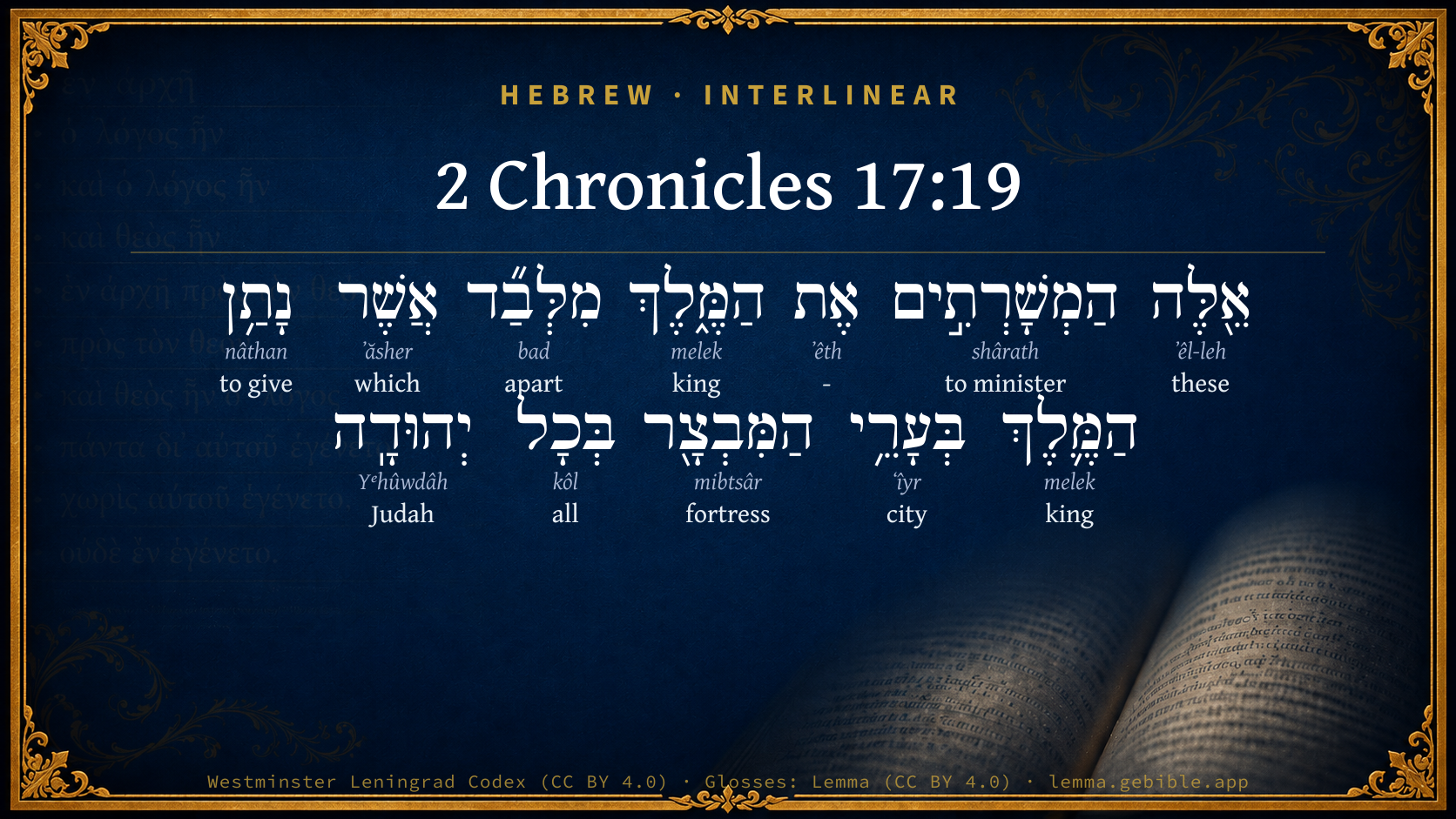
  1. אֵ֖לֶּה ʼêl-leh H428 “these” Pronoun, Demonstrative, Common, Plural
  2. הַמְשָׁרְתִ֣ים shârath H8334 “the · ministering” Particle, Definite Article + Verb, Piel, Participle Active, Masculine, Plural, Absolute
  3. אֶת ʼêth H853 “-” Particle, Direct Object
  4. הַמֶּ֑לֶךְ melek H4428 “the · king” Particle, Definite Article + Noun, Common, Masculine, Singular, Absolute
  5. מִלְּבַ֞ד bad H905 “from · to/for · apart of” Preposition + Preposition + Noun, Common, Masculine, Singular, Construct
  6. אֲשֶׁר ʼăsher H834 “which” Particle, Relative
  7. נָתַ֥ן nâthan H5414 “to give” Verb, Qal, Perfect, 3rd Person, Masculine, Singular
  8. הַמֶּ֛לֶךְ melek H4428 “the · king” Particle, Definite Article + Noun, Common, Masculine, Singular, Absolute
  9. בְּעָרֵ֥י ʻîyr H5892 “in/at · cities of” Preposition + Noun, Common, Feminine, Plural, Construct
  10. בְּכָל kôl H3605 “in/at · all of” Preposition + Noun, Common, Masculine, Singular, Construct
  11. יְהוּדָֽה Yᵉhûwdâh H3063 “Judah” Noun, Proper

About this verse

These counts appear in no published source. They are computed here, from the morphology-tagged text and Lemma’s own curated glosses. What Lemma adds →

12
words
11
distinct lemmas
Historical
section

Shared distinctive vocabulary

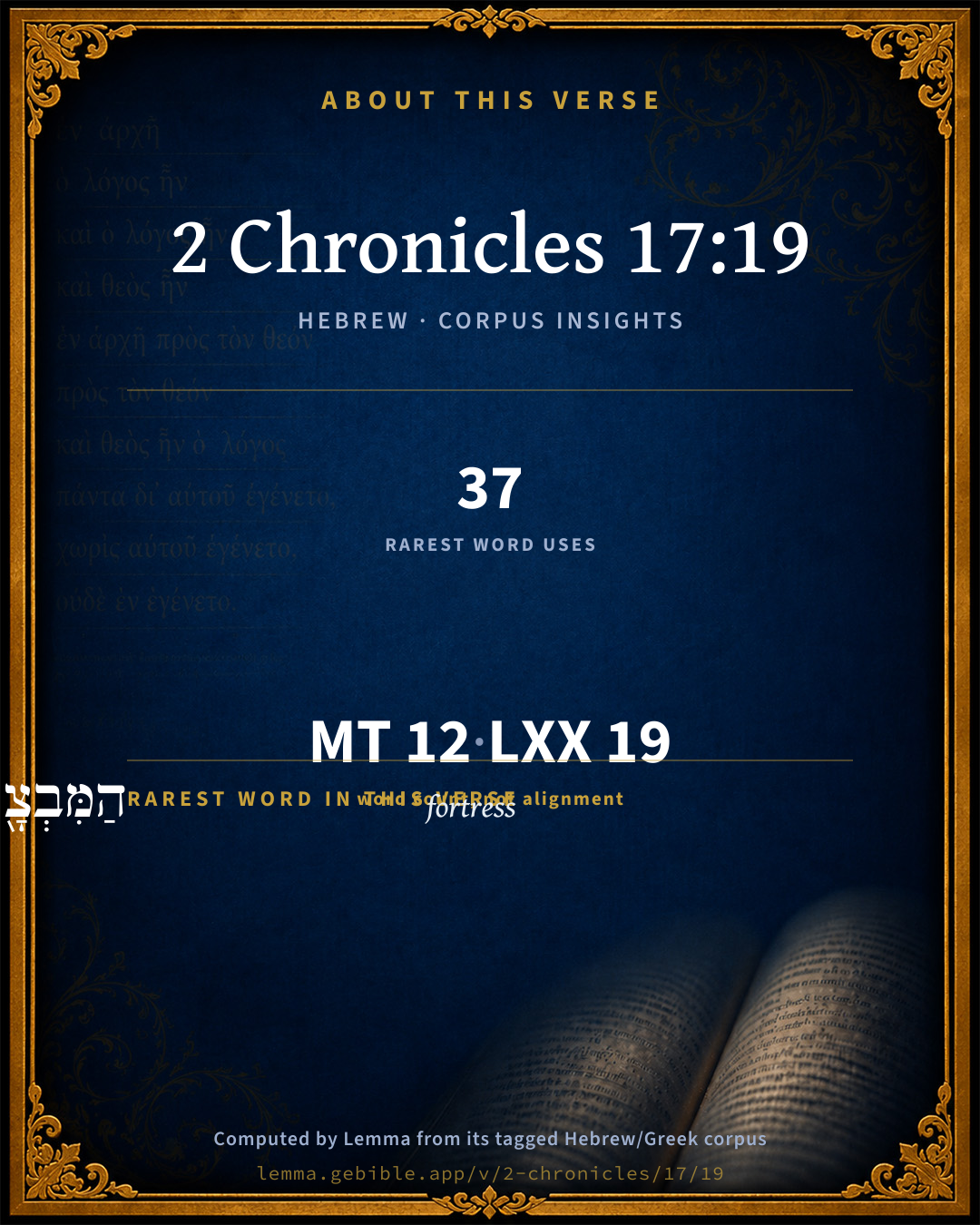
הַמִּבְצָ֖ר fortress H4013 occurs in 37 verses of the Hebrew Bible. Also found in:

Grammatical profile

  • 2 verbs
  • 7 nouns
  • 1 pronoun
  • 2 particles

Verb forms

  • הַמְשָׁרְתִ֣ים Piel · Participle Active
  • נָתַ֥ן Qal · Perfect

Repetition

A word recurs within this verse — often emphatic in Hebrew:

  • הַמֶּ֑לֶךְ king H4428 ×2

Hebrew & Septuagint length

In English translation the verse runs 21 words from the Hebrew and 18 from the Septuagint (LXX English) — closely comparable.

A rough comparison of the two English renderings, which tokenize alike — not a word-level alignment.

Word counts can differ between the Hebrew and the Greek without any difference in meaning — e.g. the Hebrew direct-object marker אֵת has no separate Greek word, and Greek often adds the article ὁ.

In the original languages it is 12 Hebrew tokens and 19 Greek tokens — but the two are counted differently (Hebrew bundles its prefixes and suffixes into one token; the Greek is in lemma form), so that isn’t a like-for-like length.

Cross-references

4

Topical passages linked to 2 Chronicles 17:19 in the Treasury of Scripture Knowledge — connected by theme and wording, ordered by reader-vote popularity; previews shown in the World English Bible.

  • 2 Chronicles 17:2 He placed forces in all the fortified cities of Judah, and set garrisons in the land of Judah, and in the cities of Ephraim, which Asa his father had taken.
  • 2 Chronicles 11:12 In every city [he put] shields and spears, and made them exceeding strong. Judah and Benjamin belonged to him.
  • 2 Chronicles 11:23 He dealt wisely, and dispersed of all his sons throughout all the lands of Judah and Benjamin, to every fortified city: and he gave them food in abundance. He sought [for them] many wives.
  • 2 Chronicles 17:12 Jehoshaphat grew great exceedingly; and he built in Judah castles and cities of store.

Cross-references courtesy of OpenBible.info (CC BY 4.0).

Hebrew and Greek witnesses Masoretic Hebrew ↔ Greek Septuagint

The same verse in the two great witnesses to the Old Testament, shown verse-for-verse.

These are two independent witnesses, not word-aligned to each other, and the Septuagint is shown in lemma (dictionary) form.

Hebrew 2 Chronicles 17:19 Masoretic · Westminster Leningrad Codex

אֵ֖לֶּה הַמְשָׁרְתִ֣ים אֶת הַמֶּ֑לֶךְ מִלְּבַ֞ד אֲשֶׁר נָתַ֥ן הַמֶּ֛לֶךְ בְּעָרֵ֥י הַמִּבְצָ֖ר בְּכָל יְהוּדָֽה

These were those who waited on the king, besides those whom the king put in the fortified cities throughout all Judah.

World English Bible · Public Domain

Greek LXX 2 Chronicles 17:19 Septuagint · lemma form

οὗτος ὁ λειτουργέω ὁ βασιλεύς ἐκτός ὅς δίδωμι ὁ βασιλεύς ἐν ὁ πόλις ὁ ὀχυρός ἐν πᾶς ὁ ἰουδαία

These were the king's servants besides those whom the king put in the strong cities in all Judea.

LXX2012 (modern English Septuagint) · Public Domain

Hebrew: Westminster Leningrad Codex (CC BY 4.0). Greek: Septuagint (public domain); English from LXX2012 (modern English Septuagint) (Public Domain). How the Septuagint differs from the Hebrew →

Commentary

Notes on 2 Chronicles 17:19 from classic Christian and Jewish commentators (each source and its license shown beneath its notes). The classic Christian expositions comment on the surrounding passage and are grouped to its opening verse, so a note may address several verses; the Jewish commentaries on the Tanakh (Rashi and others) are per-verse, so they appear only where the commentator wrote on this verse.

Lemma curates 59 commentaries, every one of them public domain or Creative Commons licensed, each selected and text-cleaned for this edition rather than reprinted as found. About our sources →

Trapp's Complete Commentary

John Trapp

2Ch 17:19 These waited on the king, beside [those] whom the king put in the fenced cities throughout all Judah.

Ver. 19. These waited on the king,] i.e., In their turns, and by course.

John Trapp, A Commentary or Exposition upon All the Books of the Old and New Testament (1647–1656) — public domain. Text from a community e-Sword module.

Joseph Benson's Commentary

2Ch 17:19. These waited on the king — These above-mentioned were the trained bands, or auxiliaries; whose chief officers waited on the king to receive his commands, and to raise and bring in all, or part of their forces, to the service of the king, as need required. A vast number for so small a compass of ground to furnish out and maintain. But we may consider, that God had promised to make the seed of Abraham like the sand of the sea for number; that there had now been a long peace; that many were come to them from the kingdom of Israel; and that Jehoshaphat was under a special blessing of God. They were doubtless dispersed all the country over, every one residing on his own land; only they were ready at call, whenever there was occasion.

Joseph Benson's Commentary on the Old and New Testaments (1811–1818) — public domain. Text from a community e-Sword module.

Geneva Bible (1599)

Geneva Bible translators

That is, they were as his ordinary guard.

Geneva Bible (1599) marginal notes — public domain. Text via Bolls.life.

Adam Clarke's Commentary

Verse 19. These waited on the king] They were disposable forces, always at the king's command; and were independent of those by which the cities of Judah were garrisoned.

THERE is not a sovereign in Europe or in the world but might read this chapter with advantage.

1. It shows most forcibly that true religion is the basis of the state, and that, wherever it prospers, there the state prospers.

2. It shows also that it is the wisdom of kings to encourage religion with all their power and influence; for if the hearts of the subjects be not bound and influenced by true religion, vain is the application of laws, fines, imprisonments, or corporal punishment of any kind.

3. A religious nation is ever a great nation; it is loved by its friends, it is dreaded by its enemies.

4. It is ever a peaceable and united nation: the blessings of religion, and a wholesome and paternal government, are so fully felt and prized, that all find it their interest to preserve and defend them. Harmony, peace, piety, and strength, are the stability of such times. May Britain know and value them!

Adam Clarke's Commentary on the Bible (1810–1826) — public domain. Text from a community e-Sword/MySword module.

Ellicott's Commentary for English Readers

(19) These waited on the king.—Rather, these are they that ministered unto the king, viz., the five generals above named.

Beside those whom the king put in the fenced cities—i.e., the commandants of the fortresses of the kingdom (2Ch_11:11; 2Ch_11:23). These latter, as well as the generals of the forces, are called the king’s “ministers” (mĕshârĕthîm)—a word which is not used of service in the field, but implies their presence at court (“in Jerusalem,” 2Ch_17:13, as the royal staff).

According to the above list, the army of Jehoshaphat was organised in five grand divisions, corresponding perhaps to five territorial divisions of the southern kingdom. The totals are the largest assigned to the two tribes anywhere in the Old Testament; viz., Judah 780,000, and Benjamin 380,000; in all, 1,160,000. At David’s census Judah had 500,000 warriors (2Sa_24:9); and Israel 800,000. Again, in 2Ch_14:8, Asa’s army consists of 300,000 men of Judah and 280,000 Benjaminites: clearly such an increase as our text indicates is unaccountable. At the same time, it is equally clear that the present numbers are not fortuitous results of clerical errors, for they follow each other in the order of relative strength: Judah, 300,000, 280,000, 200,000; Benjamin, 200,000, 180,000; and they are evidently not independent of the estimates of 2Ch_14:8 above quoted.

In the absence of adequate data for modifying these certainly startling figures, it is well to bear in mind that we need not understand by them an army which ever actually mustered in the field or on parade, but simply an estimate of the total male population liable to be called out for the national defence; although, even upon that understanding, the total appears to be at least three times too great, considering the small extent of the country.

A Bible Commentary for English Readers, edited by Charles John Ellicott (1878–1897) — public domain. Text from a community e-Sword module.

The Cambridge Bible for Schools and Colleges

gen. ed. J. J. S. Perowne

19. These waited] R.V. These were they that waited. Cp. 1Ch_27:1, that served the king (the same Heb. verb is used).

The Cambridge Bible for Schools and Colleges (gen. ed. J. J. S. Perowne; Cambridge University Press, 1878–1918) — public domain. Text from a community e-Sword module.

John Gill's Exposition

These waited on the king,.... Not this vast number of men at one time, but in course, as David's military men waited on him, Ch1 27:1 or each of these captains, with a proper number of men under them detached from the body; and they were all ready to obey the king's orders whenever he should have occasion for them:

besides those whom the king put into the fenced cities throughout Judah; and all together, the militia of the kingdom was very numerous and formidable.

Next: 2 Chronicles Chapter 18

John Gill's Exposition of the Whole Bible (1746–1763) — public domain (CC PDM 1.0). Text via the HelloAO Bible API.

Haydock's Catholic Bible Commentary

King, at different times. Sept. "waiting upon" him, (H.) like the companies which David had appointed, (C.) but far more numerous. H. --- The dominions of Juda were now pretty extensive, and well cultivated. The population must have amounted to near six millions, for whose support recourse must have been had to commerce. Rome had once almost four million inhabitants, and Cairo is said to contain seven millions, while China has two hundred millions. C. --- We must reflect that many from the other tribes had taken refuge in the kingdom of Juda. T. --- It would be too bold to suppose, with Kennicott, that so many numbers have been corrupted. H. C. xiii. 3.

George Leo Haydock (1774–1849), Haydock's Catholic Family Bible and Commentary, 1859 edition — public domain. Excludes Psalms (Douay-Rheims chapter numbering differs from Protestant) and Deuterocanonical books (Catholic canon only).

Matthew Poole's English Annotations

These above mentioned were the trained bands or auxiliaries; whose chief officers waited upon the king to receive his commands, and to raise and bring in all or part of their forces to the service of the king and kingdom, as need required.

Matthew Poole's English Annotations on the Holy Bible (1683–1685) — public domain. Text from a community e-Sword/MySword module.

The Pulpit Commentary

These waited; Hebrew, mh,plur. piel part. of trv; The verse states that this enormous fivefold army, with its five princes (counting, in our corrupt text, one million one hundred and sixty thousand), was the king"s Jerusalem standing army, while other separate regiments or bands of troops were spread through all Judah, where they might be most needed for defence.

The Pulpit Commentary (1880–1919), ed. H.D.M. Spence-Jones & Joseph S. Exell — public domain. Text from a community e-Sword module.

John Wesley's Explanatory Notes

Waited - These above-mentioned were the trained bands or auxiliaries: whose chief officers waited on the king to receive his commands, and to raise, and bring in all, or part of their forces, to the service of the king as need required. A vast number for so small a compass of ground, to furnish out and maintain. But we may consider, that God had promised to make the seed of Abraham like the sand of the sea for number; that there had now been a long peace; that many were come to them from the kingdom of Israel and that Jehoshaphat was under a special blessing of God. They were doubtless dispersed all the country over, every one residing on his own land: only they were ready at call, whenever there was occasion.

John Wesley, Explanatory Notes Upon the Whole Bible (1754–1765) — public domain. Text via the GEBible commentary corpus.

Lesson kit

Teaching starters — assembled from the data on this page, not authored interpretation. Every prompt links to the verse data it draws on. Edit before teaching.

2 Chronicles, in the Historical, opens this verse with 12 words (11 distinct Hebrew lemmas). Its most distinctive word is mibtsâr (“fortress”). A historical commentator’s framing appears above. Read the whole chapter for the surrounding context.

Discussion questions

  1. How does “fortress” (mibtsâr) shape what this verse is saying?
  2. Numbers 13:19 shares the word «fortress» with this verse. How do the two illuminate each other?
  3. “king” occurs 2× in this one verse. What is the effect of the repetition?
  4. These translations render this verse differently; the difference is in the English rendering, not the original. What questions does that raise?
  5. The verb «הַמְשָׁרְתִ֣ים» is Piel Participle Active. How does its form color the action?
  6. Reading how Trapp's Complete Commentary and Joseph Benson's Commentary read this verse, where do the two commentators agree and where do they part?

Things to notice

Reading settings

Reading text

Shown beneath each verse's original-language words.

Old Testament
Old Testament edition

Read the OT as the Masoretic Hebrew (MT) or the Greek Septuagint (LXX).

English shown for the Greek Septuagint (in the Hebrew ↔ Greek comparison).

Comparing translations? Open the Compare panel on any verse page to stack up to four side by side.