
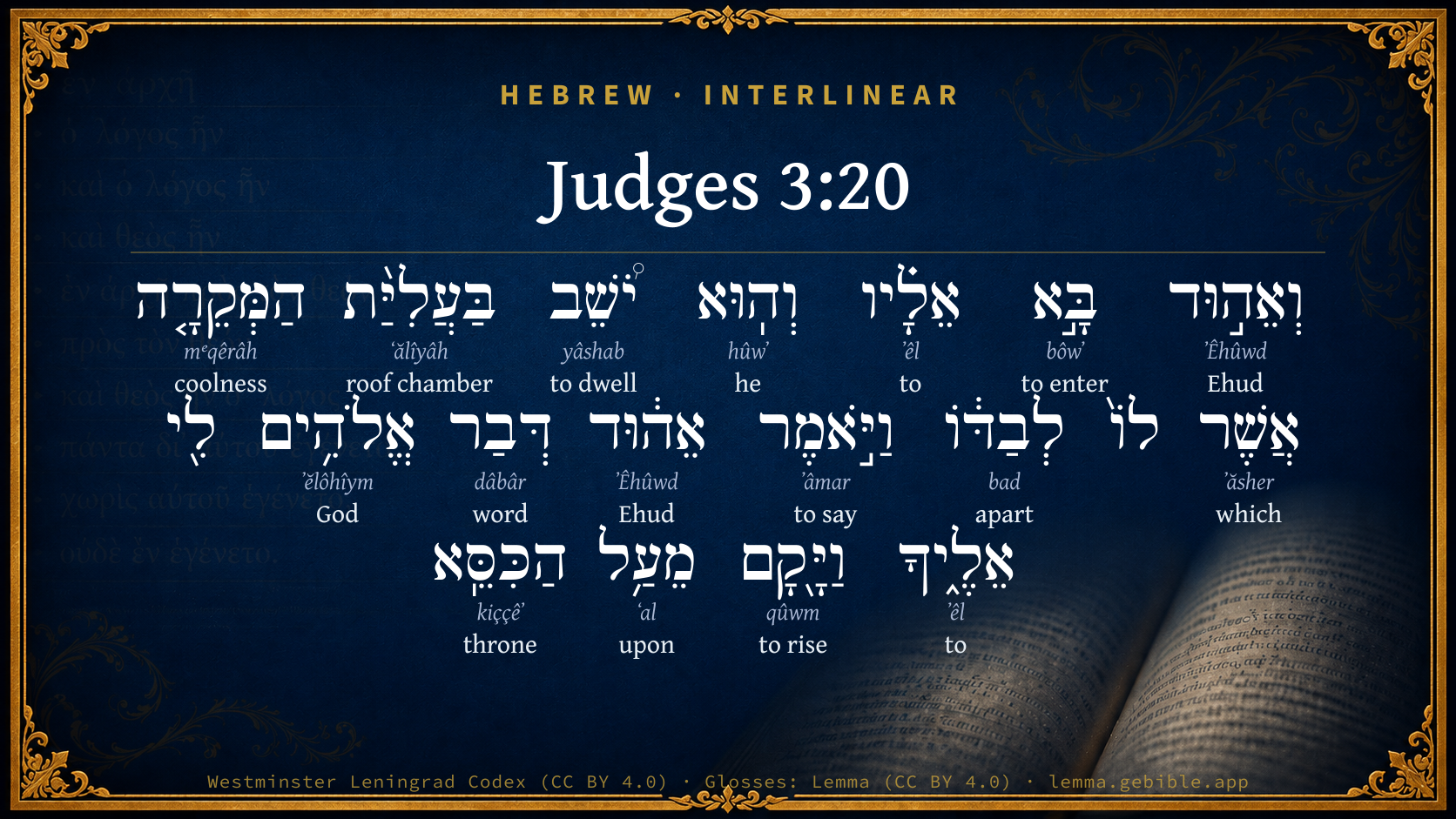
Judges 3:20

Hebrew (Westminster Leningrad Codex) Judges 3:20 appears in the Hebrew Old Testament. The text above is from the Westminster Leningrad Codex. Each word links to its Strong’s number, a concise gloss, and parsing drawn from the Open Scriptures Hebrew Bible morphology. Click any word for its full Brown-Driver-Briggs (BDB) entry.
Download image
Cite this verse

Judges 3:20 (World English Bible). Public Domain. Lemma interlinear Bible study tool, https://lemma.gebible.app/v/judges/3/20.

Show BibTeX & RIS
BibTeX
RIS
English Translation
Ehud came to him; and he was sitting by himself alone in the cool upper room. Ehud said, I have a message from God to you. He arose out of his seat.
World English Bible · Public Domain
Highlights
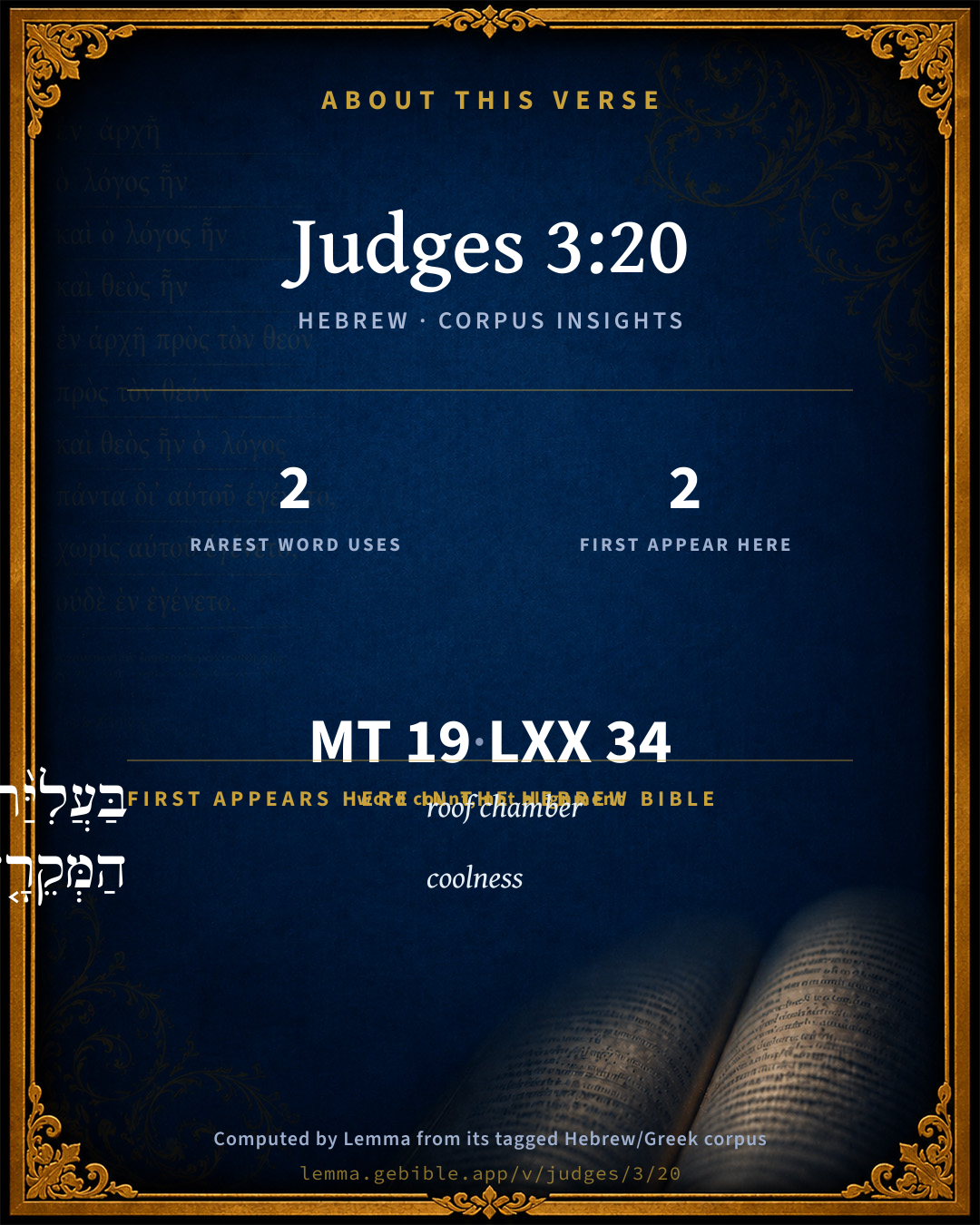
  • 2 first appearances in the Hebrew Bible
Full analysis ↓
Download a study sheet

One document with this verse’s original text, its word-by-word gloss line, the meaning frame, cross-references with their text, attributed commentary, and full source and license credits — printable, and it pastes into notes with its structure intact.

This verse Autodidact and up

Study sheet (.html) Plain text (.txt)

A passage Seminary Student

Up to 50 verses in one chapter. A passage sheet keeps up to 6 commentary sources and 12 cross-references per verse, in the order this page ranks them, and says so on the sheet whenever that leaves anything out. Ask for a single verse and you get the Autodidact verse sheet above.

Everything on this page stays free to read, with no account — the sheet is a download of what is already on screen, not access to it.

Want to remove ads? Support Godless Engineer
Compare translations 3

The same verse in 3 English versions, stacked beneath the original-language interlinear above. Click any original word for its lexicon entry.

Each is an independent rendering of the whole verse — the interlinear is not word-aligned to these translations.

Highlighted words mark where these versions differ — a whole-verse word diff, not a word-by-word alignment.

  • World English Bible Public Domain
    Ehud came to him; and he was sitting by himself alone in the cool upper room. Ehud said, I have a message from God to you. He arose out of his seat.
  • King James Version Public Domain
    And Ehud came unto him; and he was sitting in a summer parlor, which he had for himself alone. And Ehud said, I have a message from God unto thee. And he arose out of his seat.
  • unfoldingWord Literal Text CC BY-SA 4.0
    Then Ehud came to him. Now he was sitting in the upper room of coolness that to him, alone. And Ehud said, “A word from God to me for you.” And he arose from upon the throne.

unfoldingWord Literal Text — © unfoldingWord, licensed CC BY-SA 4.0. Word-aligned USFM3 via Door43 (git.door43.org/unfoldingWord/en_ult).

Versions to compare (up to 4)

3 of 4 selected

Show all 18 translations

Every available English version of this verse, each an independent rendering of the whole verse.

  • World English Bible Public Domain
    Ehud came to him; and he was sitting by himself alone in the cool upper room. Ehud said, I have a message from God to you. He arose out of his seat.
  • Berean Standard Bible Public Domain
    Then Ehud approached him while he was sitting alone in the coolness of his upper room. “I have a word from God for you,” Ehud said, and the king rose from his seat.
  • Majority Standard Bible Public Domain
    Then Ehud approached him while he was sitting alone in the coolness of his upper room. “I have a word from God for you,” Ehud said, and the king rose from his seat.
  • King James Version Public Domain
    And Ehud came unto him; and he was sitting in a summer parlor, which he had for himself alone. And Ehud said, I have a message from God unto thee. And he arose out of his seat.
  • American Standard Version (1901) Public Domain
    And Ehud came unto him; and he was sitting by himself alone in the cool upper room. And Ehud said, I have a message from God unto thee. And he arose out of his seat.
  • Revised Version (1885) Public Domain
    And Ehud came unto him; and he was sitting by himself alone in his summer parlour. And Ehud said, I have a message from God unto thee. And he arose out of his seat.
  • Geneva Bible (1599) Public Domain
    Then Ehud came vnto him. (and he sate alone in a sommer parler, which he had) and Ehud said, I haue a message vnto thee from God. Then he arose out of his throne,
  • Douay-Rheims (1899) Public Domain
    Aod went in to him: now he was sitting in a summer parlour alone, and he said: I have a word from God to thee. And he forthwith rose up from his throne,
  • Young's Literal Translation Public Domain
    And Ehud hath come unto him, and he is sitting in the upper chamber of the wall which he hath for himself, and Ehud saith, `A word of God I have unto thee;' and he riseth from off the throne;
  • Literal Standard Version CC BY-SA 4.0
    And Ehud has come to him, and he is sitting in the cool upper chamber which he has for himself, and Ehud says, “I have a word of God for you”; and he rises from off the throne;
  • Unlocked Literal Bible CC BY-SA 4.0
    Ehud came to him. The king was sitting by himself, alone in the coolness of the upper room. Ehud said, “I have a message from God for you.” The king got up out of his seat.
  • unfoldingWord Literal Text CC BY-SA 4.0
    Then Ehud came to him. Now he was sitting in the upper room of coolness that to him, alone. And Ehud said, “A word from God to me for you.” And he arose from upon the throne.
  • Darby Bible Public Domain
    And Ehud came to him, as he was sitting alone in his cool roof chamber. And Ehud said, "I have a message from God for you." And he arose from his seat.
  • World Messianic Bible Public Domain
    Ehud came to him; and he was sitting by himself alone in the cool upper room. Ehud said, “I have a message from God to you.” He arose out of his seat.
  • Webster's Bible Public Domain
    And Ehud came to him; and he was sitting in a summer-parlor, which he had for himself alone: and Ehud said, I have a message from God to thee. And he arose from his seat.
  • Free Bible Version CC BY-SA 4.0
    Ehud then went over to where Eglon was sitting alone in his cool upstairs room, and told him, “I have a message from God for you.” As the king got up from his seat,
  • Bible in Basic English Public Domain
    Then Ehud came in to him while he was seated by himself in his summer-house. And Ehud said, I have a word from God for you. And he got up from his seat.
  • JPS Tanakh (1917) Public Domain
    And Ehud came unto him; and he was sitting by himself alone in his cool upper chamber. And Ehud said: 'I have a message from God unto thee.' And he arose out of his seat.

Literal Standard Version (2020), Covenant Press — licensed CC BY-SA 4.0. Text via the HelloAO Bible API (eBible.org). Unlocked Literal Bible (unfoldingWord) — licensed CC BY-SA 4.0. Text via the HelloAO Bible API (eBible.org). unfoldingWord Literal Text — © unfoldingWord, licensed CC BY-SA 4.0. Word-aligned USFM3 via Door43 (git.door43.org/unfoldingWord/en_ult). Free Bible Version, Dr. Jonathan Gallagher — licensed CC BY-SA 4.0. Text via the HelloAO Bible API (eBible.org).

Word by word

More ways to search: Search by grammar → Find every occurrence → Compare this word →

Practice this passage: Drill this verse → Learn its vocabulary →

הַמְּקֵרָ֤ה
mᵉqêrâh
H4747
“the · coolness”
Particle, Definite Article + Noun, Common, Feminine, Singular, Absolute
Part of Speech
Particle + Noun
Type
Common
Gender
Feminine
Number
Singular
State
Absolute
Full BDB Definition

Origin: from the same as H7119

TWOT: 2077d

coolness, cooling
  1. וְאֵה֣וּד ʼÊhûwd H164 “and · Ehud” Conjunction + Noun, Proper
  2. בָּ֣א bôwʼ H935 “to enter” Verb, Qal, Perfect, 3rd Person, Masculine, Singular
  3. אֵלָ֗יו ʼêl H413 “to · him” Preposition + Suffix, Personal, 3rd Person, Masculine, Singular
  4. וְהֽוּא hûwʼ H1931 “and · he” Conjunction + Pronoun, Personal, 3rd Person, Masculine, Singular
  5. יֹ֠שֵׁב yâshab H3427 “dwelling” Verb, Qal, Participle Active, Masculine, Singular, Absolute
  6. בַּעֲלִיַּ֨ת ʻălîyâh H5944 “in/at · roof chamber of” Preposition + Noun, Common, Feminine, Singular, Construct
  7. אֲשֶׁר ʼăsher H834 “which” Particle, Relative
  8. לְבַדּ֔וֹ bad H905 “to/for · apart · his” Preposition + Noun, Common, Masculine, Singular, Construct + Suffix, Personal, 3rd Person, Masculine, Singular
  9. וַיֹּ֣אמֶר ʼâmar H559 “and · to say” Conjunction + Verb, Qal, Sequential Imperfect, 3rd Person, Masculine, Singular
  10. אֵה֔וּד ʼÊhûwd H164 “Ehud” Noun, Proper
  11. דְּבַר dâbâr H1697 “word of” Noun, Common, Masculine, Singular, Construct
  12. אֱלֹהִ֥ים ʼĕlôhîym H430 “God(s)” Noun, Common, Masculine, Plural, Absolute
  13. אֵלֶ֑יךָ ʼêl H413 “to · you” Preposition + Suffix, Personal, 2nd Person, Masculine, Singular
  14. וַיָּ֖קָם qûwm H6965 “and · to rise” Conjunction + Verb, Qal, Sequential Imperfect, 3rd Person, Masculine, Singular
  15. מֵעַ֥ל ʻal H5921 “from · upon” Preposition + Preposition
  16. הַכִּסֵּֽא kiççêʼ H3678 “the · throne” Particle, Definite Article + Noun, Common, Masculine, Singular, Absolute

About this verse

These counts appear in no published source. They are computed here, from the morphology-tagged text and Lemma’s own curated glosses. What Lemma adds →

19
words
15
distinct lemmas
Historical
section

Notable vocabulary

The rarest word here is הַמְּקֵרָ֤ה coolness H4747 — appearing just 2 times in the whole Hebrew Bible.

First appearance in Scripture

These words make their first canonical appearance in the Hebrew Bible here:

  • בַּעֲלִיַּ֨ת roof chamber H5944
  • הַמְּקֵרָ֤ה coolness H4747

Shared distinctive vocabulary

הַמְּקֵרָ֤ה coolness H4747 occurs in 2 verses of the Hebrew Bible. Also found in:

Grammatical profile

  • 4 verbs
  • 8 nouns
  • 1 pronoun
  • 5 prepositions
  • 1 particle

Verb forms

  • בָּ֣א Qal · Perfect
  • יֹ֠שֵׁב Qal · Participle Active
  • וַיֹּ֣אמֶר Qal · Sequential Imperfect
  • וַיָּ֖קָם Qal · Sequential Imperfect

Repetition

Words recur within this verse — often emphatic in Hebrew:

  • וְאֵה֣וּד Ehud H164 ×2
  • אֵלָ֗יו to H413 ×2

Hebrew & Septuagint length

In English translation the verse runs 32 words from the Hebrew and 39 from the Septuagint (LXX English) — closely comparable.

A rough comparison of the two English renderings, which tokenize alike — not a word-level alignment.

Word counts can differ between the Hebrew and the Greek without any difference in meaning — e.g. the Hebrew direct-object marker אֵת has no separate Greek word, and Greek often adds the article ὁ.

In the original languages it is 19 Hebrew tokens and 34 Greek tokens — but the two are counted differently (Hebrew bundles its prefixes and suffixes into one token; the Greek is in lemma form), so that isn’t a like-for-like length.

Cross-references

7

Topical passages linked to Judges 3:20 in the Treasury of Scripture Knowledge — connected by theme and wording, ordered by reader-vote popularity; previews shown in the World English Bible.

  • Jeremiah 10:7 Who should not fear you, King of the nations? for to you does it appertain; because among all the wise men of the nations, and in all their royal estate, there is none like you.
  • Amos 3:15 I will strike the winter house with the summer house; And the houses of ivory will perish, And the great houses will have an end," says Yahweh.
  • Judges 3:19 But he himself turned back from the quarries that were by Gilgal, and said, I have a secret errand to you, king. He said, Keep silence. All who stood by him went out from him.
  • 2 Samuel 12:1–15 Yahweh sent Nathan to David. He came to him, and said to him, "There were two men in one city; the one rich, and the other poor.
  • 2 Samuel 24:12 Go and speak to David, Thus says Yahweh, I offer you three things: choose you one of them, that I may do it to you.
  • Psalms 29:1 Ascribe to Yahweh, you sons of the mighty, Ascribe to Yahweh glory and strength.
  • Micah 6:9 Yahweh's voice calls to the city, And wisdom sees your name: "Listen to the rod, And he who appointed it.

Cross-references courtesy of OpenBible.info (CC BY 4.0).

Hebrew and Greek witnesses Masoretic Hebrew ↔ Greek Septuagint

The same verse in the two great witnesses to the Old Testament, shown verse-for-verse.

These are two independent witnesses, not word-aligned to each other, and the Septuagint is shown in lemma (dictionary) form.

Hebrew Judges 3:20 Masoretic · Westminster Leningrad Codex

וְאֵה֣וּד בָּ֣א אֵלָ֗יו וְהֽוּא יֹ֠שֵׁב בַּעֲלִיַּ֨ת הַמְּקֵרָ֤ה אֲשֶׁר לוֹ֙ לְבַדּ֔וֹ וַיֹּ֣אמֶר אֵה֔וּד דְּבַר אֱלֹהִ֥ים לִ֖י אֵלֶ֑יךָ וַיָּ֖קָם מֵעַ֥ל הַכִּסֵּֽא

Ehud came to him; and he was sitting by himself alone in the cool upper room. Ehud said, I have a message from God to you. He arose out of his seat.

World English Bible · Public Domain

Greek LXX Judges 3:20 Septuagint · lemma form

καί αωδ εἰςἔρχομαι πρός αὐτός καί αὐτός καταἧμαι ἐν ὁ ὑπερῷον ὁ θερινός ὁ ἑαυτοῦ μόνος καί εἶπον αωδ λόγος θεός ἐγώ πρός σύ βασιλεύς καί ἐκ ἀναἵστημι ἀπό ὁ θρόνος εγλωμ ἐγγύς αὐτός

And Aod went in to him; and he sat in his own upper summer chamber quite alone; and Aod said, I have a message from God to you, O king: and Eglom rose up from his throne near him.

LXX2012 (modern English Septuagint) · Public Domain

On this verse, Ellicott's Commentary for English Readers discusses the Septuagint’s reading. Read the note in Commentary ↓

Hebrew: Westminster Leningrad Codex (CC BY 4.0). Greek: Septuagint (public domain); English from LXX2012 (modern English Septuagint) (Public Domain). How the Septuagint differs from the Hebrew →

Targum (Aramaic paraphrase)

1

The Targum is the ancient Jewish Aramaic paraphrase of the Hebrew Scriptures — an interpretive translation, not the Hebrew text itself. Onkelos (literal) and Pseudo-Jonathan (expansive) render the Torah, and Jonathan the Prophets. Coverage is partial: where no permissively-licensed English translation exists for a verse, only the Aramaic is shown. This is verse-level text, not a word-by-word alignment to the Hebrew.

  1. Targum Jonathan Prophets (Joshua–Malachi)
    וְאֵהוּד עָאל לְוָתֵיהּ וְהוּא יָתֵיב בַּעֲלִיַת בֵּית קַיְטָא דִילֵיהּ בִּלְחוֹדוֹהִי וַאֲמַר אֵהוּד פִּתְגָמָא דַייָ לִי לְמַלָלָא עִמָךְ וְקָם מֵעַל כּוּרְסֵיהּ:

    (no public-domain English translation for this verse)

    Targum Jonathan — Aramaic: “Mikraot Gedolot” (public domain). English: “Sefaria Community Translation” (CC0 1.0 (public-domain dedication)); “London "Chaldee Paraphrase," 1871” (public domain). Text via Sefaria.

Commentary

Notes on Judges 3:20 from classic Christian and Jewish commentators (each source and its license shown beneath its notes). The classic Christian expositions comment on the surrounding passage and are grouped to its opening verse, so a note may address several verses; the Jewish commentaries on the Tanakh (Rashi and others) are per-verse, so they appear only where the commentator wrote on this verse.

Lemma curates 59 commentaries, every one of them public domain or Creative Commons licensed, each selected and text-cleaned for this edition rather than reprinted as found. About our sources →

Trapp's Complete Commentary

John Trapp

Jdg 3:20 And Ehud came unto him; and he was sitting in a summer parlour, which he had for himself alone. And Ehud said, I have a message from God unto thee. And he arose out of [his] seat.

Ver. 20. I have a message from God unto thee.] Or, From the gods, for the word is plural; thy gods at Gilgal: but Elohim is commonly used for the true God. This message was his dagger. Not only the vocal admonitions of God, but also the real judgments are his errands to the world.

And he arose out of his seat.] To show his respect to the divine majesty: this he did though a heathen, a king, a fat and unwieldy man. It is a witty note that one {a} here maketh: Eglon that had risen up in arms against God’s people, now riseth up in reverence to his name. God would have liked well to have had less of his courtesy and more of his obedience.

{a} Bishop Hall.

John Trapp, A Commentary or Exposition upon All the Books of the Old and New Testament (1647–1656) — public domain. Text from a community e-Sword module.

Joseph Benson's Commentary

Jdg 3:20. He was sitting in a summer parlour — Into which, it is probable, he used to retire from company; which is mentioned as the reason why his servants waited so long ere they went in to him, Jdg 3:25. I have a message from God unto thee — To be delivered, not in words, but by actions. This was true if Ehud was stirred up to this, as it appears he was, by a divine influence. Ehud, however, expressed himself in this manner to remove from the king any apprehensions of danger; and likewise to oblige him to rise from his seat, which Ehud knew he would do, since such was the common practice of the heathen, when receiving, or expecting to receive, messages from the gods they worshipped. He designedly made use of the word Elohim, which was common both to the true God and the pagan deities; and not the Word Jehovah, which was peculiar to the true God; because thus Eglon, not knowing whether the message came not from his own false god, would have the greater inclination to rise, whereby Ehud would have an opportunity of directing his blow in the most advantageous manner: whereas he would possibly have shown his contempt of the God of Israel, by sitting still to hear his message. And he arose out of his seat — In token of reverence to God. This is a remarkable instance of the ancient veneration men paid to whatsoever carried the name and authority of God in it, and it reproaches those who can now presume to behave themselves irreverently, even in the time and place of divine worship.

Joseph Benson's Commentary on the Old and New Testaments (1811–1818) — public domain. Text from a community e-Sword module.

Jamieson, Fausset & Brown

Robert Jamieson, A. R. Fausset & David Brown

a summer parlour--Hebrew, "chamber of cooling"--one of those retired edifices which Oriental grandees usually have in their gardens, and in which they repose during the heat of the day.

Jamieson, Fausset & Brown — Commentary Critical and Explanatory on the Whole Bible (1871) — public domain (CC PDM 1.0). Text via the HelloAO Bible API.

Adam Clarke's Commentary

Verse 20. He was sitting in a summer parlour] Besides the platforms, says Dr. Shaw, which were upon the ancient houses of the East, and which are found there to this day, it is probable that heretofore, as well as at present, most of the great houses had a smaller one annexed, which seldom consisted of more than one or two rooms and a terrace. Others, built as they frequently are above the porch or gateway, have, if we except the ground-floor, all the conveniences belonging to the house, properly so called. There is a door of communication from them into the gallery of the house, kept open or shut at the discretion of the master of the house, besides another door which opens immediately from a privy stairs down into the porch or street, without giving the least disturbance to the house. In these back houses strangers are usually lodged and entertained; hither the men are wont to retire from the hurry and noise of their families, to be more at leisure for meditation or diversions; and they are often used for wardrobes and magazines. These the Arabs call oleah, which exactly answers to the Hebrew word עלית aliyath found in this place; and without doubt such was the apartment in which Eglon received Ehud, by the privy stairs belonging to which he escaped, after having killed Eglon. The doors of the Eastern buildings are large, and their chambers spacious, conveniences well adapted to those hotter climates; but in the present passage something more seems to be meant; at least there are now other conveniences in the East to give coolness to particular rooms, which are very common. In Egypt the cooling their rooms is effected by openings at the top, which let in the fresh air. Mons. Maillet informs us that their halls are made very large and lofty, with a dome at the top, which towards the north has several open windows, so constructed as to throw the north wind down into the rooms; and by this means, though the country is excessively hot, they can make the coolness of those apartments so great, as often not to be borne without being wrapped in furs. Eglon's was a chamber; and some contrivance to mitigate the heat of it was the more necessary, as he appears to have kept his court at Jericho, Jdg 3:13; Jdg 3:28, where the heat is so excessive as sometimes to prove fatal. See Harmer's Observations.

I have a message from God unto thee] דבר אלהים לי אליך debar elohim li aleycha, a word of the gods to me, unto thee. It is very likely that the word elohim is used here to signify idols, or the pesilim mentioned above, Jdg 3:19. Ehud, having gone so far as this place of idolatry, might feign he had there been worshipping, and that the pesilim had inspired him with a message for the king; and this was the reason why the king commanded silence, why every man went out, and why he rose from his seat or throne, that he might receive it with the greater respect. This, being an idolater, he would not have done to any message coming from the God of Israel. I have a message from God unto thee is a popular text: many are fond of preaching from it. Now as no man should ever depart from the literal meaning of Scripture in his preaching, we may at once see the absurdity of taking such a text as this; for such preachers, to be consistent, should carry a two-edged dagger of a cubit length on their right thigh, and be ready to thrust it into the bowels of all those they address! This is certainly the literal meaning of the passage, and that it has no other meaning is an incontrovertible truth.

Adam Clarke's Commentary on the Bible (1810–1826) — public domain. Text from a community e-Sword/MySword module.

Ellicott's Commentary for English Readers

(20) Ehud came unto him.—The previous message had either been spoken at some distance, in a loud voice, or had been merely a message sent to the king by the attendants.

In a summer parlour.—Literally, a parlour of cooling (comp. Amo_3:15). The room is one of the kind known in the East as alijah (Greek, huperôon; Mar_14:15), the coolest part of an Eastern house. Obergemache der Kühlung (De Wette). Sommer-laube (Luther). The expression reminds us that the scene of the incident is placed in the Ghôr—the Jordan valley, which lies nearly a thousand feet below the level of the Mediterranean, and is probably the hottest district in the world. Eglon had retired into this room after the public reception of the present, and Ehud had anticipated this as part of his deeply-laid design.

Which he had for himself alone.—Rather, “in his solitude.” The words merely mean (as in the LXX. and Vulg.) that he was sitting alone.

I have a message from God unto thee.—Josephus makes him say that he had a dream to impart to Eglon, by command of God. The whole narrative implies that Ehud was, to some extent, an honoured person even among the Moabites. Probably he was reckoned as a prophet. In the East sacred claims are readily conceded, even to enemies. The Mohammedans received St. Francis of Assisi with entire respect.

He arose out of his seat.—Probably out of reverence, to receive the Divine message, which would naturally be delivered in low and reverent tones. “He rose from his throne (and came) near him” (LXX.). Josephus says that he “leaped out of his throne for joy of the dream.” Thus Cimber pressed close upon Cæsar (Plut. Cœs. 86), and Cleander upon Parmenio (Curt. 72, 27) (Cassel).

A Bible Commentary for English Readers, edited by Charles John Ellicott (1878–1897) — public domain. Text from a community e-Sword module.

John Gill's Exposition

And Ehud put forth his left hand, and took the dagger from his right thigh,.... Being, as before observed, a lefthanded man; Jdg 3:15, and this he could the better do, without being taken notice of by the king, who, if he saw him move his left hand, would have no suspicion of his going to draw a dagger with it, and which also was hidden under his raiment, Jdg 3:16,

and thrust it into his belly; Josephus (d) says into his heart; it is certain the wound was mortal, and must have been in a part on which, life depended.

(d) Antiqu. l. 5. c. 4. sect. 2.

John Gill's Exposition of the Whole Bible (1746–1763) — public domain (CC PDM 1.0). Text via the HelloAO Bible API.

Albert Barnes' Notes on the Bible

Probably Ehud’s first message Jdg 3:19 had been delivered to the attendants, and by them carried to the king. Now Ehud is admitted to the king’s presence, into the cool upper chamber.

I have a message from God unto thee - Ehud believed himself to be accomplishing the divine mandate, and so his words were true in a certain sense. But it was also a stratagem to cause the king to rise, that the thrust might be sure. (The king rose at once, in true Oriental respect for a divine message, or from fear, compare Jos 9:24.)

Albert Barnes' Notes on the Bible (1834–1885) — public domain. Text from a community e-Sword/MySword module.

Haydock's Catholic Bible Commentary

Alone. Hebrew, "Aod approached unto him, and he was sitting in a summer parlour, which he had for himself, alone." It seems to have been a private closet, to which he retired for greater secrecy, as his officers concluded that he was there only to ease nature. (Haydock) --- It might be rendered, "a hall of audience." (Calmet) --- But the place where Aod presented the tribute, was more probably of this description, and Eglon retired thence into a back parlour, and was followed by Aod, alone, ver. 24. (Haydock) --- A word. What Aod, who was judge and chief magistrate of Israel, did on this occasion, was by a special inspiration of God: but such things are not to be imitated by private men. (Challoner; St. Augustine, q. 20.; Numbers xxv.) Worthington) --- Hebrew, "a thing (message, &c.) from God, (Aleim) or the gods." Probably the king would imagine that he was speaking of the idols at Galgal, and being full of awe for them, would be off his guard, and rise up out of respect. See Numbers xxiii. 18., and Exodus iii. 5. (Calmet) --- But as the word Elohim was only abusively applied to idols and to great men, Aod might say with truth, that he had a word or an errand from Elohim to the king, without minding in what sense Eglon would take the expression. See St. Augustine, q. 20., and Origen, hom. 4. Though God permitted this king to attack his people, and to scourge them for a time, he did not approve of his injustice, and now authorized the chief magistrate of Israel to revenge their wrongs. (Haydock) --- God is the arbiter of our lives, and may order whatsoever he pleases to put us to death. But the doctrine of J. Huss, who preached, "It is lawful for every subject to kill any tyrant," was condemned in the Council of Constance. David severely punished the man wo pretended that he had slain Saul. The first Christians never entered into any revolt against those cruel and impious emperors who oppressed them, and whose title to the throne was evidently unjust. See Romans xiii. 1. Under what government are all satisfied, or of the same religion with the sovereign? Even if any should pretend that they have an order from God to kill a tyrant, they must give proof of their commission to the lawful superiors, or them must expect to be treated as fanatical impostors. (Calmet) --- Throne; or Hebrew, "seat." The throne of state would not probably be placed in a retired chamber. (Haydock) --- The king rose up out of respect to the deity; (Menochius) and at the same moment, Aod plunged the dagger into his bowels. (Haydock)

George Leo Haydock (1774–1849), Haydock's Catholic Family Bible and Commentary, 1859 edition — public domain. Excludes Psalms (Douay-Rheims chapter numbering differs from Protestant) and Deuterocanonical books (Catholic canon only).

Matthew Poole's English Annotations

They had divers houses and chambers, some for winter, others for summer. See Jer 36:22; Amo 3:15.

Which he had for himself alone; into which he used to retire himself from company; which is mentioned as the reason why his servants waited so long ere they went in to him, Jdg 3:25.

I have a message, to be delivered not in words, but by actions; Heb. a word, or thing, or business. So that there is no need to charge Ehud with a lie, as some do.

From God: this he saith to amuse him, by raising his expectation and wonder, to divert him from any apprehension of his danger, and to oblige him to rise out of his seat, which he knew he would do from the common practice of the heathens in their intercourses with God. And he designedly useth the name Elohim, which was common to the true God and false ones, and not Jehovah, which was peculiar to the true God, because Ehud not knowing whether the message came not from his own false god, he would more certainly rise, and thereby give Ehud more advantage for his blow; whereas he would possibly show his contempt of the God of Israel by sitting still to hear his message.

He arose out of his seat, in token of humble subjection and reverence to God; see Num 23:18; 2Ki 23:3; which condemns those Christians that behave themselves irreverently in the presence and service of the true God.

Matthew Poole's English Annotations on the Holy Bible (1683–1685) — public domain. Text from a community e-Sword/MySword module.

Whedon's Commentary on the Bible

Daniel D. Whedon

20. Summer parlour — Literally, a loft for cooling; an alijah, or upper chamber, which served both for retirement and coolness. “The alijah,” says Thomson, “is the most desirable part of the establishment, and is best fitted up, and is still given to guests who are to be treated with honour.” See note on 2Ki_4:10; 1Ki_17:19.

For himself alone — For his own private comfort and refreshment. Eglon’s private room opened into a hall, and the hall had a porch. See on Jdg_3:22.

A message from God — Literally, a word of God; a bitter irony to designate the deadly dagger. Every act and word of Ehud seems to have disarmed the king of all suspicion of danger.

He arose — Out of reverence for God, whose ambassador he supposed stood before him. The upright posture of his victim was more favourable to the purpose of Ehud.

Daniel D. Whedon (gen. ed.), Commentary on the Old and New Testaments (1874–1909) — public domain. Text from a community e-Sword module.

The Pulpit Commentary

For himself alone. It seems to have been Eglon"s habit to sit quite alone in this summer parlour for coolness sake, his attendants waiting in the adjoining antechamber. On this occasion he appears to have dismissed them from the antechamber, for greater privacy, while Ehud spake to him.

The Pulpit Commentary (1880–1919), ed. H.D.M. Spence-Jones & Joseph S. Exell — public domain. Text from a community e-Sword module.

John Wesley's Explanatory Notes

A summer parlor - Into which he used to retire from company: which is mentioned as the reason why his servants waited so long ere they went in to him, ver. 25. A message - To be delivered not in words, but by actions. He designedly uses the name Elohim, which was common to the true God, and false ones; and not Jehovah, which was peculiar to the true God; because Ehud not knowing whether the message came; not from his own false God, he would more certainly rise, and thereby give Ehud more advantage for his blow; whereas he would possibly shew his contempt of the God of Israel by sitting still to hear his message. He arose - In token of reverence to God.

John Wesley, Explanatory Notes Upon the Whole Bible (1754–1765) — public domain. Text via the GEBible commentary corpus.

Rashi

Rabbi Shlomo Yitzchaki (Rashi)

In his penthouse veranda. In the summer penthouse which was airy and cool.

I have a Divine message for you! Thus, you are required to rise.

He rose from the throne. He therefore merited that Rus was descended from him.

Rashi on the Tanakh — English translations: “The Judaica Press complete Tanach with Rashi, translated by A. J. Rosenberg” (CC BY 4.0); “Pentateuch with Rashi's commentary by M. Rosenbaum and A.M. Silbermann, 1929-1934” (public domain); “The Metsudah Tanach series, Lakewood, N.J” (CC BY 4.0); and “The Book of Joshua, Metsudah Publications, 1997” (CC BY 4.0). Text via Sefaria.

Lesson kit

Teaching starters — assembled from the data on this page, not authored interpretation. Every prompt links to the verse data it draws on. Edit before teaching.

Judges, in the Historical, opens this verse with 19 words (15 distinct Hebrew lemmas). Its most distinctive word is mᵉqêrâh (“coolness”). A historical commentator’s framing appears above. Read the whole chapter for the surrounding context.

Discussion questions

  1. What does “coolness” (mᵉqêrâh) contribute to the verse as a whole?
  2. 2 words make their first appearance in Scripture here. What does this debut establish?
  3. How does Judges 3:24, which shares the word «coolness», read alongside this verse?
  4. What does the repetition of “Ehud” (2× in this one verse) do in this verse?
  5. These translations render this verse differently; the difference is in the English rendering, not the original. What questions does that raise?
  6. «בָּ֣א» is a Qal Perfect verb. How does that grammatical form shape the action described?
  7. Compare how Trapp's Complete Commentary and Joseph Benson's Commentary read this verse. Where do they agree or differ?

Things to notice

Reading settings

Reading text

Shown beneath each verse's original-language words.

Old Testament
Old Testament edition

Read the OT as the Masoretic Hebrew (MT) or the Greek Septuagint (LXX).

English shown for the Greek Septuagint (in the Hebrew ↔ Greek comparison).

Comparing translations? Open the Compare panel on any verse page to stack up to four side by side.