Psalms 148:13

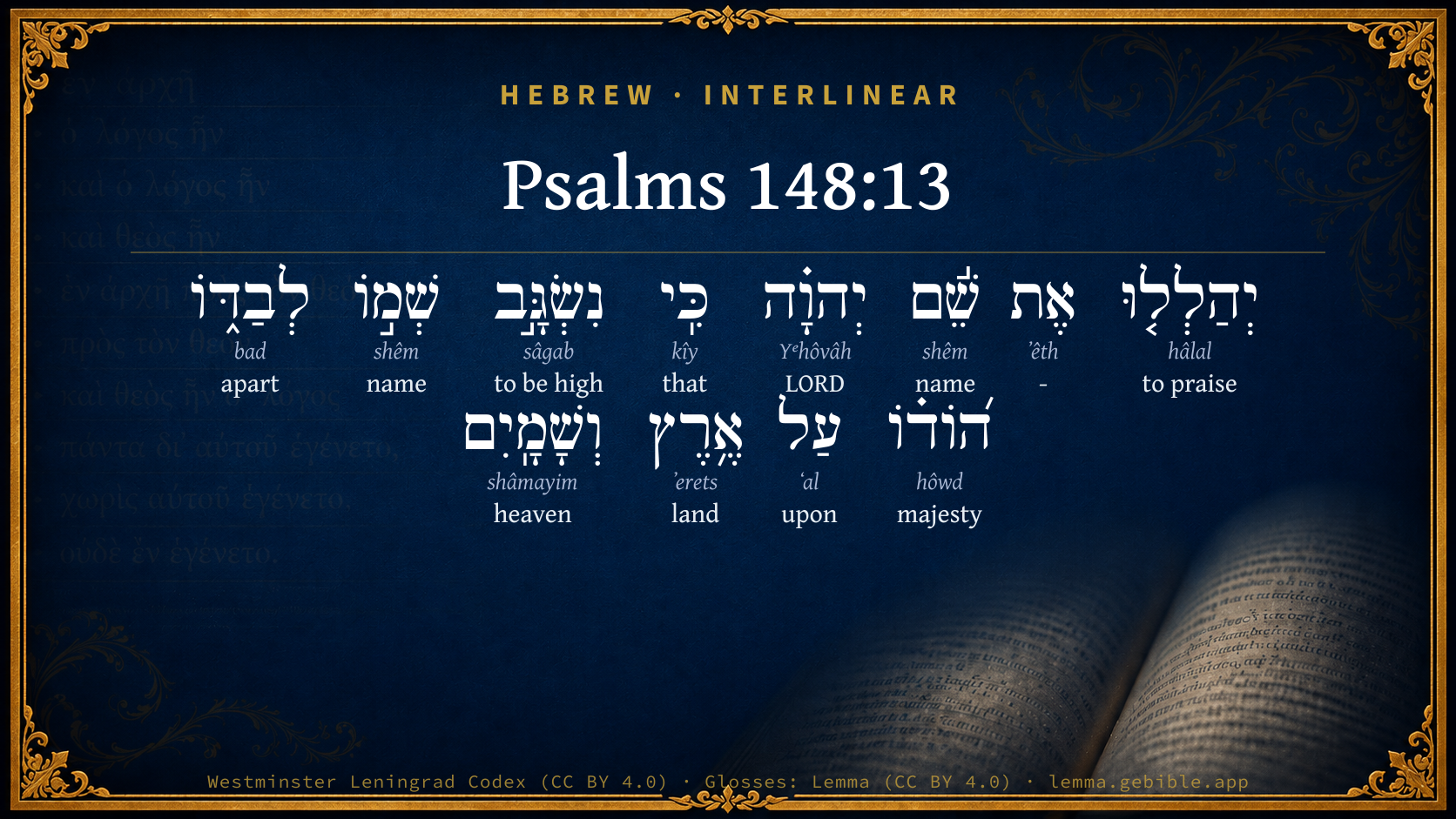
Hebrew (Westminster Leningrad Codex) Psalms 148:13 appears in the Hebrew Old Testament. The text above is from the Westminster Leningrad Codex. Each word links to its Strong’s number, a concise gloss, and parsing drawn from the Open Scriptures Hebrew Bible morphology. Click any word for its full Brown-Driver-Briggs (BDB) entry.
Download image
Cite this verse

Psalms 148:13 (World English Bible). Public Domain. Lemma interlinear Bible study tool, https://lemma.gebible.app/v/psalms/148/13.

Show BibTeX & RIS
BibTeX
RIS
English Translation
Let them praise the name of Yahweh, For his name alone is exalted. His glory is above the earth and the heavens.
World English Bible · Public Domain
Download a study sheet

One document with this verse’s original text, its word-by-word gloss line, the meaning frame, cross-references with their text, attributed commentary, and full source and license credits — printable, and it pastes into notes with its structure intact.

This verse Autodidact and up

Study sheet (.html) Plain text (.txt)

A passage Seminary Student

Up to 50 verses in one chapter. A passage sheet keeps up to 6 commentary sources and 12 cross-references per verse, in the order this page ranks them, and says so on the sheet whenever that leaves anything out. Ask for a single verse and you get the Autodidact verse sheet above.

Everything on this page stays free to read, with no account — the sheet is a download of what is already on screen, not access to it.

Want to remove ads? Support Godless Engineer
Compare translations 3

The same verse in 3 English versions, stacked beneath the original-language interlinear above. Click any original word for its lexicon entry.

Each is an independent rendering of the whole verse — the interlinear is not word-aligned to these translations.

Highlighted words mark where these versions differ — a whole-verse word diff, not a word-by-word alignment.

  • World English Bible Public Domain
    Let them praise the name of Yahweh, For his name alone is exalted. His glory is above the earth and the heavens.
  • King James Version Public Domain
    Let them praise the name of the LORD: for his name alone is excellent; his glory is above the earth and heaven.
  • unfoldingWord Literal Text CC BY-SA 4.0
    Let them praise the name of Yahweh, for his name alone is exalted; his splendor over the earth and the heavens.

unfoldingWord Literal Text — © unfoldingWord, licensed CC BY-SA 4.0. Word-aligned USFM3 via Door43 (git.door43.org/unfoldingWord/en_ult).

Versions to compare (up to 4)

3 of 4 selected

Show all 17 translations

Every available English version of this verse, each an independent rendering of the whole verse.

  • World English Bible Public Domain
    Let them praise the name of Yahweh, For his name alone is exalted. His glory is above the earth and the heavens.
  • Berean Standard Bible Public Domain
    Let them praise the name of the LORD, for His name alone is exalted; His splendor is above the earth and the heavens.
  • Majority Standard Bible Public Domain
    Let them praise the name of the LORD, for His name alone is exalted; His splendor is above the earth and the heavens.
  • King James Version Public Domain
    Let them praise the name of the LORD: for his name alone is excellent; his glory is above the earth and heaven.
  • American Standard Version (1901) Public Domain
    Let them praise the name of Jehovah; For his name alone is exalted; His glory is above the earth and the heavens.
  • Revised Version (1885) Public Domain
    Let them praise the name of the LORD; for his name alone is exalted: his glory is above the earth and heaven.
  • Geneva Bible (1599) Public Domain
    Let them prayse the Name of the Lord: for his Name onely is to be exalted, and his prayse aboue the earth and the heauens.
  • Young's Literal Translation Public Domain
    They praise the name of Jehovah, For His name alone hath been set on high, His honour `is' above earth and heavens.
  • Literal Standard Version CC BY-SA 4.0
    They praise the Name of YHWH, || For His Name alone has been set on high, || His splendor [is] above earth and heavens.
  • Unlocked Literal Bible CC BY-SA 4.0
    Let them all praise the name of Yahweh, for his name alone is exalted and his glory extends over the earth and the heavens.
  • unfoldingWord Literal Text CC BY-SA 4.0
    Let them praise the name of Yahweh, for his name alone is exalted; his splendor over the earth and the heavens.
  • Darby Bible Public Domain
    Let them praise the name of Jehovah: for his name alone is exalted; his majesty is above the earth and the heavens.
  • World Messianic Bible Public Domain
    Let them praise the LORD’s name, for his name alone is exalted. His glory is above the earth and the heavens.
  • Webster's Bible Public Domain
    Let them praise the name of the LORD: for his name alone is excellent; his glory is above the earth and heaven.
  • Free Bible Version CC BY-SA 4.0
    Let them all praise the Lord, for his reputation is unequalled; his glory is above anything on earth or in heaven.
  • Bible in Basic English Public Domain
    Let them give glory to the name of the Lord: for his name only is to be praised: his kingdom is over the earth and the heaven.
  • JPS Tanakh (1917) Public Domain
    Let them praise the name of the LORD, for His name alone is exalted; His glory is above the earth and heaven.

Literal Standard Version (2020), Covenant Press — licensed CC BY-SA 4.0. Text via the HelloAO Bible API (eBible.org). Unlocked Literal Bible (unfoldingWord) — licensed CC BY-SA 4.0. Text via the HelloAO Bible API (eBible.org). unfoldingWord Literal Text — © unfoldingWord, licensed CC BY-SA 4.0. Word-aligned USFM3 via Door43 (git.door43.org/unfoldingWord/en_ult). Free Bible Version, Dr. Jonathan Gallagher — licensed CC BY-SA 4.0. Text via the HelloAO Bible API (eBible.org).

Word by word

More ways to search: Search by grammar → Find every occurrence → Compare this word →

Practice this passage: Drill this verse → Learn its vocabulary →

נִשְׂגָּ֣ב
sâgab
H7682
“being high”
Verb, Niphal, Participle Active, Masculine, Singular, Absolute
Part of Speech
Verb
Stem
Niphal
Form
Participle Active
Gender
Masculine
Number
Singular
State
Absolute
Full BDB Definition

Origin: a primitive root

TWOT: 2234

to be high, be inaccessibly high - (Qal) - to be (too) high (for capture) - to be high (of prosperity) - (Niphal) - to be high - to be set on high, be (safely) set on high - to be exalted (of God) - (Piel) - to set on high, set (securely) on high - to exalt, exalt (in effective hostility) - (Pual) to be set (securely) on high - (Hiphil) to act exaltedly
  1. יְהַלְל֤וּ hâlal H1984 “to praise” Verb, Piel, Jussive, 3rd Person, Masculine, Plural
  2. אֶת ʼêth H853 “-” Particle, Direct Object
  3. שֵׁ֬ם shêm H8034 “name of” Noun, Common, Masculine, Singular, Construct
  4. יְהוָ֗ה Yᵉhôvâh H3068 “LORD” Noun, Proper
  5. כִּֽי kîy H3588 “that” Conjunction
  6. שְׁמ֣וֹ shêm H8034 “name · his” Noun, Common, Masculine, Singular, Construct + Suffix, Personal, 3rd Person, Masculine, Singular
  7. לְבַדּ֑וֹ bad H905 “to/for · apart · his” Preposition + Noun, Common, Masculine, Singular, Construct + Suffix, Personal, 3rd Person, Masculine, Singular
  8. ה֝וֹד֗וֹ hôwd H1935 “majesty · his” Noun, Common, Masculine, Singular, Construct + Suffix, Personal, 3rd Person, Masculine, Singular
  9. עַל ʻal H5921 “upon” Preposition
  10. אֶ֥רֶץ ʼerets H776 “land” Noun, Common, Both, Singular, Absolute
  11. וְשָׁמָֽיִם shâmayim H8064 “and · heaven(s)” Conjunction + Noun, Common, Masculine, Plural, Absolute

About this verse

These counts appear in no published source. They are computed here, from the morphology-tagged text and Lemma’s own curated glosses. What Lemma adds →

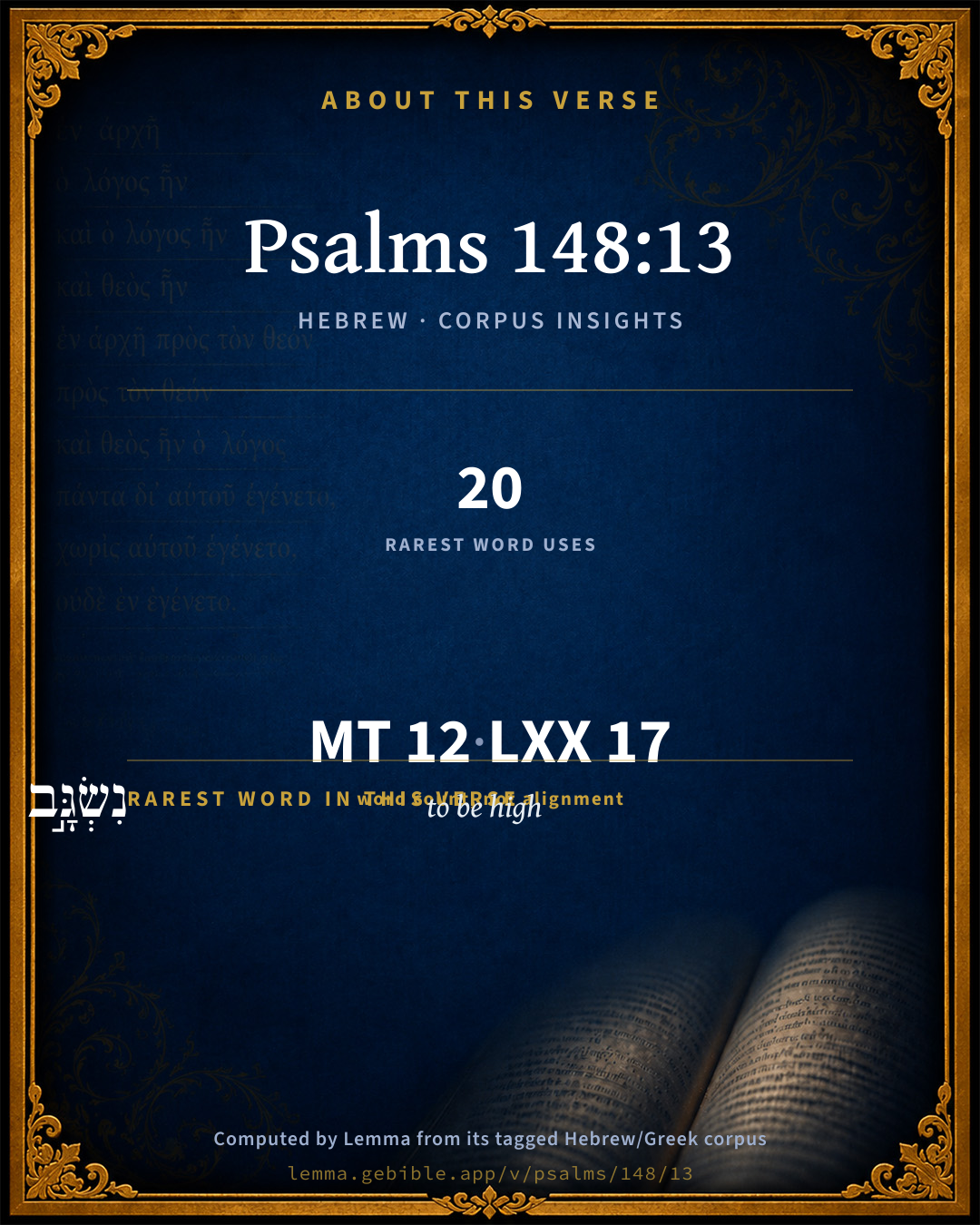
12
words
11
distinct lemmas
Wisdom
section

Notable vocabulary

The rarest word here is נִשְׂגָּ֣ב to be high H7682 — appearing just 20 times in the whole Hebrew Bible.

Shared distinctive vocabulary

נִשְׂגָּ֣ב to be high H7682 occurs in 20 verses of the Hebrew Bible. Also found in:

Grammatical profile

  • 2 verbs
  • 7 nouns
  • 1 preposition
  • 1 conjunction
  • 1 particle

Verb forms

  • יְהַלְל֤וּ Piel · Jussive
  • נִשְׂגָּ֣ב Niphal · Participle Active

Repetition

A word recurs within this verse — often emphatic in Hebrew:

  • שֵׁ֬ם name H8034 ×2

Hebrew & Septuagint length

In English translation the verse runs 22 words from the Hebrew and 22 from the Septuagint (LXX English) — the same length.

A rough comparison of the two English renderings, which tokenize alike — not a word-level alignment.

Word counts can differ between the Hebrew and the Greek without any difference in meaning — e.g. the Hebrew direct-object marker אֵת has no separate Greek word, and Greek often adds the article ὁ.

In the original languages it is 12 Hebrew tokens and 17 Greek tokens — but the two are counted differently (Hebrew bundles its prefixes and suffixes into one token; the Greek is in lemma form), so that isn’t a like-for-like length.

Cross-references

18

Topical passages linked to Psalms 148:13 in the Treasury of Scripture Knowledge — connected by theme and wording, ordered by reader-vote popularity; previews shown in the World English Bible.

  • Psalms 8:1 Yahweh, our Lord, how majestic is your name in all the earth, Who has set your glory above the heavens!
  • Psalms 113:4 Yahweh is high above all nations, His glory above the heavens.
  • Psalms 8:9 Yahweh, our Lord, How majestic is your name in all the earth!
  • Isaiah 12:4 In that day you will say, "Give thanks to Yahweh! Call on his name. Declare his doings among the peoples. Proclaim that his name is exalted!
  • Psalms 99:3–4 Let them praise your great and awesome name. He is Holy!
  • Psalms 99:9 Exalt Yahweh, our God. Worship at his holy hill, For Yahweh, our God, is holy!
  • Song of Solomon 5:16 His mouth is sweetness; Yes, he is altogether lovely. This is my beloved, and this is my friend, Daughters of Jerusalem. Friends
  • Isaiah 6:3 One called to another, and said, "Holy, holy, holy, is Yahweh of Hosts! The whole earth is full of his glory!"
  • Isaiah 33:5 Yahweh is exalted; for he dwells on high: he has filled Zion with justice and righteousness.
  • Philippians 3:8 Yes most assuredly, and I count all things to be loss for the excellency of the knowledge of Christ Jesus, my Lord, for whom I suffered the loss of all things, and count them nothing but refuse, that I may gain Christ
  • 1 Peter 3:22 who is at the right hand of God, having gone into heaven, angels and authorities and powers being made subject to him.
  • 1 Chronicles 29:11 Yours, Yahweh, is the greatness, the power, the glory, the victory, and the majesty: for all that is in the heavens and in the earth is yours. Yours is the kingdom, Yahweh, and you are exalted as head above all.
  • Psalms 72:19 Blessed be his glorious name forever! Let the whole earth be filled with his glory! Amen and amen.
  • Psalms 108:4 For your loving kindness is great above the heavens. Your faithfulness reaches to the skies.
  • Song of Solomon 5:9 How is your beloved better than another beloved, You fairest among women? How is your beloved better than another beloved, That you do so adjure us? Beloved
  • Zechariah 9:17 For how great is his goodness, And how great is his beauty! Grain will make the young men flourish, And new wine the virgins.
  • Ephesians 4:10 He who descended is the one who also ascended far above all the heavens, that he might fill all things.
  • Matthew 6:13 Bring us not into temptation, but deliver us from the evil one. For yours is the Kingdom, the power, and the glory forever. Amen.'

Cross-references courtesy of OpenBible.info (CC BY 4.0).

Hebrew and Greek witnesses Masoretic Hebrew ↔ Greek Septuagint

The same verse in the two great witnesses to the Old Testament, shown verse-for-verse.

You’re reading Greek Psalm 148 (Hebrew Psalm 148). The Septuagint counts the superscription, so verse numbers can differ from the Hebrew — chapter-level alignment, not verse-by-verse. Numbering follows Rahlfs.

These are two independent witnesses, not word-aligned to each other, and the Septuagint is shown in lemma (dictionary) form.

Hebrew Psalms 148:13 Masoretic · Westminster Leningrad Codex

יְהַלְל֤וּ אֶת שֵׁ֬ם יְהוָ֗ה כִּֽי נִשְׂגָּ֣ב שְׁמ֣וֹ לְבַדּ֑וֹ ה֝וֹד֗וֹ עַל אֶ֥רֶץ וְשָׁמָֽיִם

Let them praise the name of Yahweh, For his name alone is exalted. His glory is above the earth and the heavens.

World English Bible · Public Domain

Greek LXX Greek Psalm 148:13 Septuagint · lemma form

αἰνέω ὁ ὄνομα κύριος ὅτι ὑψόω ὁ ὄνομα αὐτός μόνος ὁ ἐξομολόγησις αὐτός ἐπί γῆ καί οὐρανός

let them praise the name of the Lord: for his name only is exalted; his praise is above the earth and heaven,

LXX2012 (modern English Septuagint) · Public Domain

On this verse, Ellicott's Commentary for English Readers discusses the Septuagint’s reading. Read the note in Commentary ↓

Hebrew: Westminster Leningrad Codex (CC BY 4.0). Greek: Septuagint (public domain); English from LXX2012 (modern English Septuagint) (Public Domain). How the Septuagint differs from the Hebrew →

Commentary

Notes on Psalms 148:13 from classic Christian and Jewish commentators (each source and its license shown beneath its notes). The classic Christian expositions comment on the surrounding passage and are grouped to its opening verse, so a note may address several verses; the Jewish commentaries on the Tanakh (Rashi and others) are per-verse, so they appear only where the commentator wrote on this verse.

Lemma curates 59 commentaries, every one of them public domain or Creative Commons licensed, each selected and text-cleaned for this edition rather than reprinted as found. About our sources →

Trapp's Complete Commentary

John Trapp

Psa 148:13 Let them praise the name of the LORD: for his name alone is excellent; his glory [is] above the earth and heaven.

Ver. 13. Let them praise the name of the Lord] Join in this harmony of hallelujah.

His glory is above] Being deeper than earth, higher than heaven.

John Trapp, A Commentary or Exposition upon All the Books of the Old and New Testament (1647–1656) — public domain. Text from a community e-Sword module.

The Biblical Illustrator

Joseph S. Exell

Psa_148:13

Let them praise the name of the Lord.

Universal praise due to God

I. The goodness of God to the irrational creatures. Although Nature is out of joint, yet even in its disruption I am surprised to find the almost universal happiness of the animal creation. On a summer day, when the air and the grass are most populous with life, you will not hear a sound of distress unless, perchance, a heartless schoolboy has robbed a birds nest, or a hunter has broken a birds wing, or a pasture has been robbed of a lamb, and there goes up a bleating from the flocks. The whole earth is filled with animal delight--joy feathered, and scaled, and horned, and hoofed. The bee hums it; the frog croaks it; the squirrel chatters it; the quail whistles it; the lark carols it; the whale spouts it. The snail, the rhinoceros, the grizzly bear, the toad, the wasp, the spider, the shell-fish have their homely delights--joy as great to them as our joy is to us. Goat climbing the rocks; anaconda crawling through the jungle; buffalo plunging across the prairie; crocodile basking in tropical sun; seal puffing on the ice, ostrich striding across the desert, are so many bundles of joy; they do not go moping or melancholy; they are not only half supplied; God says they are filled with good. The worms squirming through the sod upturned of ploughshare, and the ants racing up and down the hillock, are happy by day and happy by night. Take up a drop of water under the microscope, and you find that within it there are millions of creatures that swim in a hallelujah of gladness. The sounds in Nature that are repulsive to our ears are often only utterances of joy--the growl, the croak, the bark, the howl. The good God made these creatures, thinks of them ever, and will not let a ploughshare turn up a moles nest, or fishermans hooks transfix a worm, until, by Eternal decree, its time has come. Gods hand feeds all these broods, and shepherds all these flocks, and tends all these herds. The sea anemone, half animal, half flower, clinging to the rock in mid-ocean, with its tentacles spread to catch its food, has the Owner of the universe to provide for it. We are repulsed at the hideousness of the elephant, but God, for the comfort and convenience of the monster, puts forty thousand distinct muscles in its proboscis. I go down on the barren seashore and say, No animal can live in this place of desolation, but all through the sands are myriads of little insects that leap with happy life. I go down by the marsh and say, In this damp place, and in these loathsome pools of stagnant water there will be the quietness of death; but lo! I see the turtles on the rotten log sunning themselves, and hear the bogs quake with multitudinous life. When the unfledged robins are hungry, God shows the old robin where she can get food to put into their open mouths. Winter is not allowed to come until the ants have granaried their harvest and the squirrels have filled their cellar with nuts. God shows the hungry ichneumon where it may find the crocodiles eggs; and in Arctic climes there are animals that God so lavishly clothes that they can afford to walk through snowstorms in the finest sable, and ermine, and chinchilla, and no sooner is one set of furs worn out than God gives them a new one. He helps the spider in its architecture of its gossamer bridge, and takes care of the colour of the butterflys wing, and tinges the cochineal, and helps the moth out of the chrysalis. The animal creation also has its army and navy. The most insignificant has its means of defence--the wasp its sting, the reptile its tooth, the bear its paw, the dog its muzzle, the elephant its tusk, the fish its scale, the bird its swift wing, the reindeer its antlers, the roe its fleet foot. We are repelled at the thought of sting, and tusk, and hoof, but Gods goodness provides them for the defence of the animals rights.

II. The adaptation of the world to the comfort and happiness of man. The sixth day of creation had arrived. The palace of the world was made, but there was no king to live in it. Leviathan ruled the deep; the eagle, the air; the lion, the field; but where was the sceptre which should rule all? A new style of being was created. Heaven and earth were represented in his nature. His body from the earth beneath; his soul from the heaven above. The one reminding him of his origin, the other speaking of his destiny--himself the connecting link between the animal creation and angelic intelligence. In him a strange commingling of the temporal and eternal, the finite and the infinite, dust and glory. The earth for his floor, and heaven for his roof; God for his Father; eternity for his lifetime.

1. The Christian anatomist, gazing upon the conformation of the human body, exclaims: Fearfully and wonderfully made. No embroidery so elaborate, no gauze so delicate, no colour so exquisite, no mechanism so graceful, no handiwork so divine. So quietly and mysteriously does the human body perform its functions that it was not until five thousand years after the creation of the race that the circulation of the blood was discovered; and though anatomists of all countries and ages have been so long exploring this castle of life they have only begun to understand it. Volumes have been written of the hand. Wondrous instrument! Behold the eye, which, in its photographic gallery, in an instant catches the mountain and the sea.

2. I take a step higher, and look at mans mental constitution. Behold the benevolence of God in powers of perception, or the faculty of transporting this outside world into your own mind--gathering into your brain the majesty of the storm, and the splendours of the day-dawn, and lifting into your mind the ocean as easily as you might put a glass of water to your lips. Watch the law of association, or the mysterious linking together of all you ever thought, or knew, or felt, and then giving you the power to take hold of the clue-line, and draw through your mind the long train with indescribable velocity--one thought starting up a hundred, and this again a thou-sand--as the chirp of one bird sometimes wakes a whole forest of voices, or the thrum of one string will rouse an orchestra. Watch your memory--that sheaf-binder, that goes forth to gather the harvest of the past, and bring it into the present. Your power and velocity of thought--thought of the swift wing and the lightning foot; thought that outspeeds the star, and circles through the heavens, and weighs worlds, and, from poising amid wheeling constellations, comes down to count the blossoms in a tuft of mignonette, then starts again to try the fathom-hag of the bottomless, and the sealing of the insurmountable, to be swallowed up in the incomprehensible, and lost in God!

3. I take a step higher, and look at mans moral nature. Made in the image of God. Vast capacity for enjoyment; capable at first of eternal joy, and, though now disordered, still, through the recuperative force of heavenly grace, able to mount up to more than its original felicity; faculties that may blossom and bear fruit inexhaustibly. Immortality written upon every capacity; a soul destined to range in unlimited spheres of activity long after the world has put on ashes, and the solar system shall have snapped its axle, and the stars that, in their courses, fought against Sisera, shall have been slain, and buried amid the tolling thunders of the last day. (T. De Witt Talmage.)

The Biblical Illustrator, edited by Joseph S. Exell (c. 1880s–1900s) — public domain. Text from a community e-Sword module.

Joseph Benson's Commentary

Psa 148:13-14. Let them praise, &c. — Let them acknowledge and celebrate the wisdom, goodness, and power of the Lord; for his name alone is excellent — For how great soever any other beings may be, there is none equal to him, whose most excellent majesty infinitely surpasses that of all other beings; and whose glory is above the earth and heaven — Above all that the earth or heaven can utter of him. He also exalteth the horn of his people — And so great is God’s condescension unto us, the children of Israel, that he takes a peculiar care of us, hath bestowed upon us many peculiar benefits, and raised us to the highest pitch of honour, especially to this, that he hath brought us more near to himself than any other people upon the earth, and hath placed among us a visible token of his presence: we therefore are under peculiar obligations to praise him for his singular kindness.

Joseph Benson's Commentary on the Old and New Testaments (1811–1818) — public domain. Text from a community e-Sword module.

J. A. Alexander on Psalms

Joseph Addison Alexander

13. (Psa 148:13) Let (all these) praise the name of Jehovah, for exalted is his name alone, his glory is above earth and heaven. The mention of earth and heaven shews that the first verb relates not merely to that which immediately precedes, but to the whole enumeration of God's creatures with which the psalm is occupied. See above, on Psa 104:27. Exalted is his name, as in Isa 12:4. His glory or majesty, a Hebrew word especially applied to royal dignity. See above, on Psa 21:5; Psa 45:3; Psa 96:6; Psa 104:1; Psa 111:3. Above earth and heaven, i.e. superior to their mere material splendour, or on earth and heaven, i.e. placed upon them as a crown. See above, on Psa 8:1; Psa 57:5.

Joseph Addison Alexander, The Psalms Translated and Explained (1850) — public domain. Text from a community e-Sword module.

Tyndale Open Study Notes

Tyndale Open Resources

148:13-14 Universal praise of the Lord is fitting because he is glorious, and he has blessed his people (see 147:13; Isa 46:13; Eph 3:10). • His faithful ones are his trusting and devoted servants (Ps 86:2).

Tyndale Open Study Notes — © Tyndale Open Resources, licensed CC BY-SA 4.0. Text via the HelloAO Bible API.

Jamieson, Fausset & Brown

Robert Jamieson, A. R. Fausset & David Brown

Let them--all mentioned.

excellent--or, exalted (Isa 12:4).

his glory--majesty (Psa 45:3).

above the earth and heaven--Their united splendors fail to match His.

Jamieson, Fausset & Brown — Commentary Critical and Explanatory on the Whole Bible (1871) — public domain (CC PDM 1.0). Text via the HelloAO Bible API.

Adam Clarke's Commentary

Verse 13. Let them] All already specified, praise the name of Jehovah, because he excels all beings: and his glory, as seen in creating, preserving, and governing all things, is על al, upon or over, the earth and heaven. All space and place, as well as the beings found in them, show forth the manifold wisdom and goodness of God.

Adam Clarke's Commentary on the Bible (1810–1826) — public domain. Text from a community e-Sword/MySword module.

Ellicott's Commentary for English Readers

(13) Excellent.—Rather, exalted. As in Isa_12:4. So LXX. and Vulg.

Above the earth and heaven.—There is a fine artistic touch in the order of the words in this. All heaven and earth have been summoned to the chorus of praise, of Him who is now declared to be above earth and heaven.

A Bible Commentary for English Readers, edited by Charles John Ellicott (1878–1897) — public domain. Text from a community e-Sword module.

The Cambridge Bible for Schools and Colleges

gen. ed. J. J. S. Perowne

13. is excellent] Is exalted, as in Isa_12:4. On excellent, excellency, in A.V. and P.B.V., see note in Driver’s Daniel, p. 32.

his glory] His majesty. Cp. Psa_8:1; Psa_104:1; Psa_145:5; Hab_3:3.

The Cambridge Bible for Schools and Colleges (gen. ed. J. J. S. Perowne; Cambridge University Press, 1878–1918) — public domain. Text from a community e-Sword module.

John Gill's Exposition

Let them praise the name of the Lord, His nature and perfections, and celebrate the glory of them; and his wonderful works, and the blessings of his goodness, both of providence and grace; even all the above creatures and things, celestial and terrestrial, for the following reasons;

for his name alone is excellent; the name of the Lord is himself, who is excellent in power, wisdom, goodness, truth, and faithfulness, and in all other perfections of his nature; his works, by which he is known, are excellent, both of nature and of grace, and proclaim his glory; his Son, in whom his name is, and by whom he has manifested himself, is excellent as the cedars; and so are all his precious names by which he is called; and such is the Gospel, by which he is notified to the world: nay, the Lord's name is alone excellent; all creature excellencies are nothing in comparison of him, in heaven or in earth, those of angels and men; and therefore should be praised by all, and above all;

his glory is above the earth and heaven; there is the glory of celestial and terrestrial bodies, which differ; the glory of the sun, moon, and stars, and of one star from another; but the glory of the divine Being, the Creator of them, infinitely exceeds the glory of them all: his glorious Majesty resides above heaven and earth; the heaven is the throne be sits upon, and the earth the footstool he stands on; and Christ, who is sometimes called his glory, and is the brightness of it, Psa 63:2; is exalted above every name on earth, and is made higher than the heavens, and so is exalted above all blessing and praise; see Psa 8:1.

John Gill's Exposition of the Whole Bible (1746–1763) — public domain (CC PDM 1.0). Text via the HelloAO Bible API.

Albert Barnes' Notes on the Bible

Let them praise the name of the Lord - Let them praise Yahweh - the name being often put for the person.

For his name alone is excellent - Margin, as in Hebrew, exalted. He only is exalted as God. See the notes at Psa 8:1 : “O Lord, our Lord, how excellent is thy name in all the earth!”

His glory is above the earth and heaven - Compare the notes at Psa 113:4 : “The Lord is high above all nations, and his glory above the heavens.” See also the notes at Psa 8:1 : “Who hast set thy glory above the heavens.”

Albert Barnes' Notes on the Bible (1834–1885) — public domain. Text from a community e-Sword/MySword module.

Matthew Poole's English Annotations

Not so much in place as in excellency, above all the glories which are in earth and in heaven.

Matthew Poole's English Annotations on the Holy Bible (1683–1685) — public domain. Text from a community e-Sword/MySword module.

The Treasury of David

Charles H. Spurgeon

Ver. 13. Let them praise the name of the LORD. All that is contained in the name or character of Jehovah is worthy of praise, and all the objects of his creating care will be too few to set it forth in its completeness.

For his name alone is excellent. It alone deserves to be exalted in praise, for alone it is exalted in worth. There is none like unto the Lord, none that for a moment can be compared unto him. His unique name should have a monopoly of praise.

His glory is above the earth and heaven: it is therefore alone because it surpasses all others. His royal splendour exceeds all that earth and heaven can express. He is himself the crown of all things, the excellency of the creation. There is more glory in him personally than in all his works united. It is not possible for us to exceed and become extravagant in the Lord's praise: his own natural glory is infinitely greater than any glory which we can render to him.

Ver. 13. Let them praise. Exactly as at the close of the first great division of the anthem (Ps 148:5), and, in the same way as there, the reason for the exhortation follows in the next clause. But it is a different reason. It is no longer because he has given them a decree, bound them as passive, unconscious creatures by a law which they cannot transgress. (It is the fearful mystery of the reasonable will that it can transgress the law.) It is because his name is exalted, so that the eyes of men can see, and the hearts and tongues of men confess it; it is because he has graciously revealed himself to, and mightily succoured, the people whom he loves, the nation who are near to him. If it be said that what was designed to be a Universal Anthem is thus narrowed at its close, it must be remembered that, however largely the glory of God was written on the visible creation, it was only to the Jew that any direct revelation of his character had been made. J.J. Stewart Perowne.

Ver. 13. The name of Jehovah. Jehovah is a name of great power and efficacy, a name that hath in it five vowels, without which no language can be expressed; a name that hath in it also three syllables, to signify the Trinity of Persons, the eternity of God, One in Three, and Three in One; a name of such dread and reverence amongst the Jews, that they tremble to name it, and therefore they use the name Adonai (Lord) in all their devotions. And thus ought every one to stand in awe, and sin not by taking the name of God in vain; but to sing praises, to honour, to remember, to declare, to exalt, and bless it; for holy and reverend, only worthy and excellent is his name. Rayment, 1630.

Psalms 148:14*

Charles H. Spurgeon's The Treasury of David (1869–1885) — public domain. Psalms only. Text from a community e-Sword/MySword module.

The Pulpit Commentary

Let them praise the Name of the Lord. This is the burden of the entire psalm (see especially ver. 5, and comp. vers. 1-4, 7, and 14). For his Name alone is excellent; or, "exalted". (comp. Psa_8:1 Isa_12:4) The exaltation of God"s Name is effected mainly by the praises which his rational creatures render to him. His glory is above the earth and heaven. (On God"s "glory," see Psa_8:1 Psa_19:1 Psa_57:5, 11 63:2 89:17, etc.) "Earth and heaven" is an unusual phrase; the terms are commonly inverted. Here, perhaps, the order may be accounted for by the law of climax. "His glory is not only above the earth, but even above the heavens."

The Pulpit Commentary (1880–1919), ed. H.D.M. Spence-Jones & Joseph S. Exell — public domain. Text from a community e-Sword module.

John Wesley's Explanatory Notes

Above - Above all the glories which are in earth and in heaven.

John Wesley, Explanatory Notes Upon the Whole Bible (1754–1765) — public domain. Text via the GEBible commentary corpus.

unfoldingWord translationNotes

Door43 World Missions Community

the name of Yahweh, for his name alone

Here the word "name" represents Yahweh himself. AT: "Yahweh, for he alone" (See: Metonymy)

his glory extends over the earth and the heavens

The writer speaks of Yahweh's greatness as his glory being high above earth and heaven. (See: Metaphor)

He has lifted up the horn of his people

The writer speaks of strength as if it were the horn of an animal. Lifting up an animal horn was a symbolic action that represented military victory. AT: "He has made his people strong" or "He has given his people victory" (See: Metaphor and Symbolic Action)

for praise from all his faithful ones

"so that all his faithful ones praise him"

the people near to him

The writer speaks of Yahweh loving his people as if his people were physically close to him. AT: "the people he loves" (See: Metaphor)

translationWords

name

exalt

glory

horn

faithful

Israel

unfoldingWord translationNotes — © Distant Shores Media and the Door43 World Missions Community, licensed CC BY-SA 4.0. Source: git.door43.org/Door43/en_tn.

Lesson kit

Teaching starters — assembled from the data on this page, not authored interpretation. Every prompt links to the verse data it draws on. Edit before teaching.

Psalms, in the Wisdom, opens this verse with 12 words (11 distinct Hebrew lemmas). Its most distinctive word is sâgab (“to be high”). A historical commentator’s framing appears above. Read the whole chapter for the surrounding context.

Discussion questions

  1. What does “to be high” (sâgab) contribute to the verse as a whole?
  2. How does Deuteronomy 2:36, which shares the word «to be high», read alongside this verse?
  3. What does the repetition of “name” (2× in this one verse) do in this verse?
  4. These translations render this verse differently; the difference is in the English rendering, not the original. What questions does that raise?
  5. «יְהַלְל֤וּ» is a Piel Jussive verb. How does that grammatical form shape the action described?
  6. Compare how Trapp's Complete Commentary and The Biblical Illustrator read this verse. Where do they agree or differ?

Things to notice

Reading settings

Reading text

Shown beneath each verse's original-language words.

Old Testament
Old Testament edition

Read the OT as the Masoretic Hebrew (MT) or the Greek Septuagint (LXX).

English shown for the Greek Septuagint (in the Hebrew ↔ Greek comparison).

Comparing translations? Open the Compare panel on any verse page to stack up to four side by side.