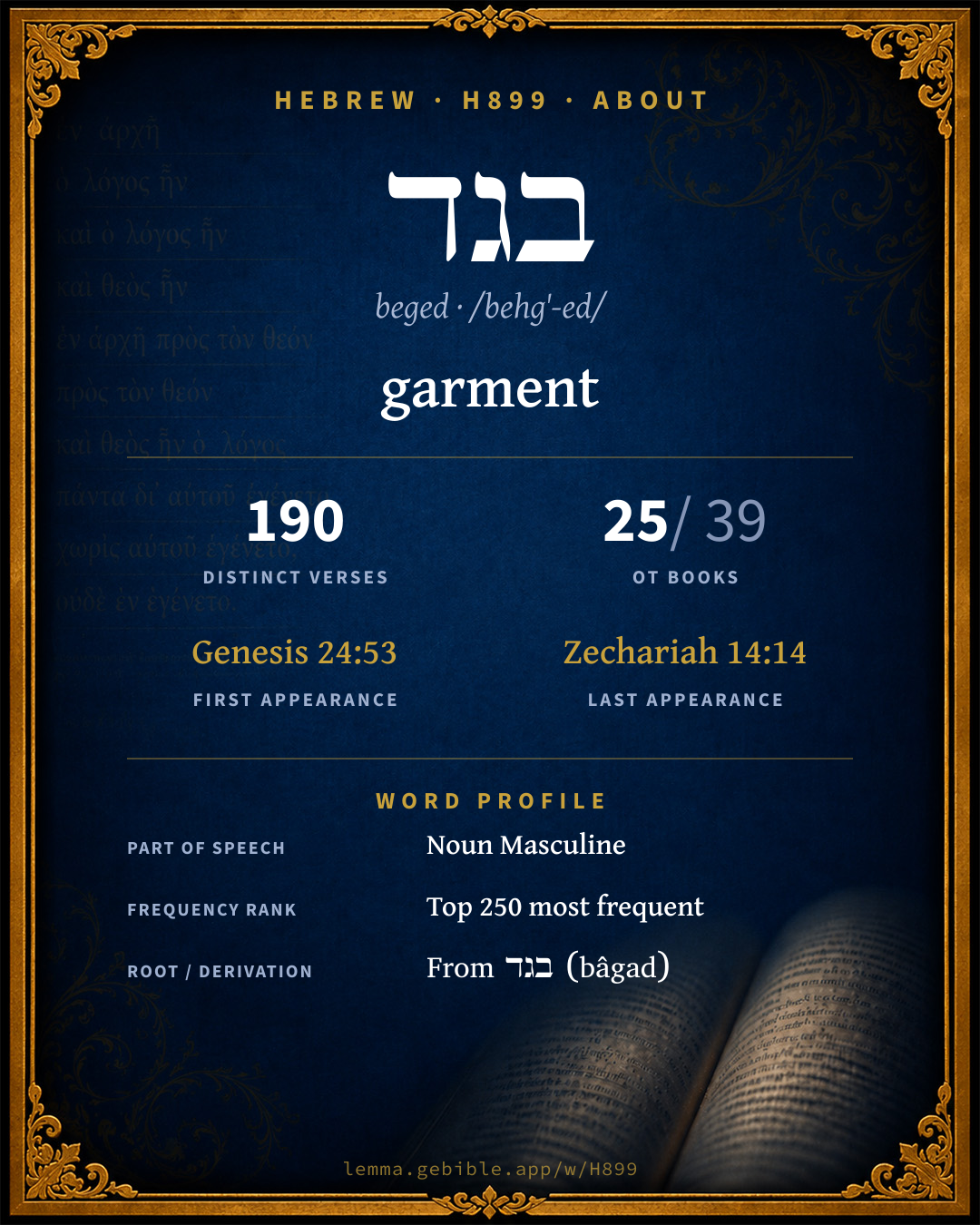
בֶּ֫גֶד
garment
‘garment’ is one of 2 main senses fuller range ↓
Full lexicon entry — Brown-Driver-Briggs (BDB)
From Brown-Driver-Briggs (BDB)
Where this word appears
See every Construct-state word in the Hebrew Bible →
Grammar key — what these labels mean
Part of speech
- Noun
- A naming word — a person, place, thing, or idea.
Noun type
- Common
- A common noun — a general class of person, place, or thing (“king,” “city,” “water”), not a specific name.
State
- Construct
- A noun bound to a following noun in a possessive / “of” relationship (the construct chain).
- Absolute
- The independent form of a noun, not bound to a following word.
Gender
- Masculine
- Grammatically masculine.
Number
- Plural
- More than one (in Hebrew, generally three or more).
- Singular
- One.
Grammatical forms
- Noun, Common, Masculine, Plural, Construct 127 times (58%)
- Noun, Common, Masculine, Plural, Absolute 35 times (16%)
- Noun, Common, Masculine, Singular, Construct 28 times (13%)
- Noun, Common, Masculine, Singular, Absolute 28 times (13%)
Parsed forms decoded from the imported morphology (morphhb / Westminster Leningrad Codex — WLC text public domain, morphhb tagging CC BY 4.0), counted across 218 parsed occurrences — not distinct verses.
Every verse where H899 appears — 190 distinct verses across 25 books. Click any verse to open its interlinear word-by-word view. Verse text shown in the World English Bible for context — . Each verse’s Hebrew form is shown with its reference; the English is not keyword-highlighted, since the data carries no word-level English alignment. Use “Compare translations” on any verse to read it across multiple English versions. This concordance covers the Hebrew Bible; Septuagint (Greek Old Testament) occurrences are not indexed here.
Genesis 13 verses
- Genesis 24:53 וּ/בְגָדִ֔ים conj + n c mp The servant brought forth jewels of silver, and jewels of gold, and clothing, and gave them to Rebekah. He gave also to her brother and to her mother precious things.
- Genesis 27:15 בִּגְדֵ֨י n c mp cs Rebekah took the good clothes of Esau, her elder son, which were with her in the house, and put them on Jacob, her younger son.
- Genesis 27:27 בְּגָדָ֖י/ו n c mp cs + sfx pers 3ms He came near, and kissed him. He smelled the smell of his clothing, and blessed him, and said, "Behold, the smell of my son Is as the smell of a field which Yahweh has blessed.
- Genesis 28:20 וּ/בֶ֥גֶד conj + n c ms Jacob vowed a vow, saying, "If God will be with me, and will keep me in this way that I go, and will give me bread to eat, and clothing to put on,
- Genesis 37:29 בְּגָדָֽי/ו n c mp cs + sfx pers 3ms Reuben returned to the pit; and saw that Joseph wasn't in the pit; and he tore his clothes.
- Genesis 38:14 בִּגְדֵ֨י n c mp cs She took off of her the garments of her widowhood, and covered herself with her veil, and wrapped herself, and sat in the gate of Enaim, which is by the way to Timnah; for she saw that Shelah was grown up, and she wasn't given to him as a wife.
- Genesis 38:19 בִּגְדֵ֥י n c mp cs She arose, and went away, and put off her veil from her, and put on the garments of her widowhood.
- Genesis 39:12 בְּ/בִגְד֛/וֹ בִּגְד/וֹ֙ prep + n c ms cs + sfx pers 3ms n c ms cs + sfx pers 3ms She caught him by his garment, saying, "Lie with me!" He left his garment in her hand, and ran outside.
- Genesis 39:13 בִּגְד֖/וֹ n c ms cs + sfx pers 3ms It happened, when she saw that he had left his garment in her hand, and had run outside,
- Genesis 39:15 בִּגְד/וֹ֙ n c ms cs + sfx pers 3ms It happened, when he heard that I lifted up my voice and cried, that he left his garment by me, and ran outside."
- Genesis 39:16 בִּגְד֖/וֹ n c ms cs + sfx pers 3ms She laid up his garment by her, until his master came home.
- Genesis 39:18 בִּגְד֛/וֹ n c ms cs + sfx pers 3ms and it happened, as I lifted up my voice and cried, that he left his garment by me, and ran outside."
- Genesis 41:42 בִּגְדֵי n c mp cs Pharaoh took off his signet ring from his hand, and put it on Joseph's hand, and arrayed him in robes of fine linen, and put a gold chain about his neck,
Exodus 12 verses
- Exodus 28:2 בִגְדֵי n c mp cs You shall make holy garments for Aaron your brother, for glory and for beauty.
- Exodus 28:3 בִּגְדֵ֧י n c mp cs You shall speak to all who are wise-hearted, whom I have filled with the spirit of wisdom, that they make Aaron's garments to sanctify him, that he may minister to me in the priest's office.
- Exodus 28:4 הַ/בְּגָדִ֜ים בִגְדֵי ptcl def.art + n c mp n c mp cs These are the garments which they shall make: a breastplate, and an ephod, and a robe, and a coat of checker work, a turban, and a sash: and they shall make holy garments for Aaron your brother, and his sons, that he may minister to me in the priest's office.
- Exodus 29:5 הַ/בְּגָדִ֗ים ptcl def.art + n c mp You shall take the garments, and put on Aaron the coat, the robe of the ephod, the ephod, and the breastplate, and dress him with the skillfully woven band of the ephod;
- Exodus 29:21 בְּגָדָ֔י/ו בִּגְדֵ֥י וּ/בְגָדָ֔י/ו וּ/בִגְדֵ֥י n c mp cs + sfx pers 3ms n c mp cs conj + n c mp cs + sfx pers 3ms conj + n c mp cs You shall take of the blood that is on the altar, and of the anointing oil, and sprinkle it on Aaron, and on his garments, and on his sons, and on the garments of his sons with him: and he shall be made holy, and his garments, and his sons, and his sons' garments with him.
- Exodus 29:29 וּ/בִגְדֵ֤י conj + n c mp cs "The holy garments of Aaron shall be for his sons after him, to be anointed in them, and to be consecrated in them.
- Exodus 31:10 בִּגְדֵ֣י בִּגְדֵ֤י בִּגְדֵ֥י n c mp cs n c mp cs n c mp cs the finely worked garments--the holy garments for Aaron the priest--the garments of his sons to minister in the priest's office,
- Exodus 35:19 בִּגְדֵ֥י בִּגְדֵ֤י בִּגְדֵ֥י n c mp cs n c mp cs n c mp cs the finely worked garments, for ministering in the holy place, the holy garments for Aaron the priest, and the garments of his sons, to minister in the priest's office.'"
- Exodus 35:21 וּ/לְ/בִגְדֵ֖י conj + prep + n c mp cs They came, everyone whose heart stirred him up, and everyone whom his spirit made willing, and brought Yahweh's offering, for the work of the tent of meeting, and for all of its service, and for the holy garments.
- Exodus 39:1 בִגְדֵי בִּגְדֵ֤י n c mp cs n c mp cs Of the blue, purple, and scarlet, they made finely worked garments, for ministering in the holy place, and made the holy garments for Aaron; as Yahweh commanded Moses.
- Exodus 39:41 בִּגְדֵ֥י בִּגְדֵ֤י בִּגְדֵ֥י n c mp cs n c mp cs n c mp cs the finely worked garments for ministering in the holy place, the holy garments for Aaron the priest, and the garments of his sons, to minister in the priest's office.
- Exodus 40:13 בִּגְדֵ֣י n c mp cs You shall put on Aaron the holy garments; and you shall anoint him, and sanctify him, that he may minister to me in the priest's office.
Leviticus 45 verses
- Leviticus 6:11 בְּגָדָ֔י/ו בְּגָדִ֣ים n c mp cs + sfx pers 3ms n c mp He shall take off his garments, and put on other garments, and carry the ashes outside the camp to a clean place.
- Leviticus 6:27 הַ/בֶּ֔גֶד ptcl def.art + n c ms Whatever shall touch its flesh shall be holy. When there is any of its blood sprinkled on a garment, you shall wash that on which it was sprinkled in a holy place.
- Leviticus 8:2 הַ/בְּגָדִ֔ים ptcl def.art + n c mp "Take Aaron and his sons with him, and the garments, and the anointing oil, and the bull of the sin offering, and the two rams, and the basket of unleavened bread;
- Leviticus 8:30 בְּגָדָ֔י/ו בִּגְדֵ֥י בְּגָדָ֔י/ו בִּגְדֵ֥י n c mp cs + sfx pers 3ms n c mp cs n c mp cs + sfx pers 3ms n c mp cs Moses took some of the anointing oil, and some of the blood which was on the altar, and sprinkled it on Aaron, on his garments, and on his sons, and on his sons' garments with him, and sanctified Aaron, his garments, and his sons, and his sons' garments with him.
- Leviticus 10:6 וּ/בִגְדֵי/כֶ֤ם conj + n c mp cs + sfx pers 2mp Moses said to Aaron, and to Eleazar and to Ithamar, his sons, "Don't let the hair of your heads go loose, neither tear your clothes; that you don't die, and that he not be angry with all the congregation: but let your brothers, the whole house of Israel, bewail the burning which Yahweh has kindled.
- Leviticus 11:25 בְּגָדָ֖י/ו n c mp cs + sfx pers 3ms Whoever carries any part of their carcass shall wash his clothes, and be unclean until the evening.
- Leviticus 11:28 בְּגָדָ֖י/ו n c mp cs + sfx pers 3ms He who carries their carcass shall wash his clothes, and be unclean until the evening. They are unclean to you.
- Leviticus 11:32 בֶ֤גֶד n c ms On whatever any of them falls when they are dead, it shall be unclean; whether it is any vessel of wood, or clothing, or skin, or sack, whatever vessel it is, with which any work is done, it must be put into water, and it shall be unclean until the evening; then it will be clean.
- Leviticus 11:40 בְּגָדָ֖י/ו בְּגָדָ֖י/ו n c mp cs + sfx pers 3ms n c mp cs + sfx pers 3ms He who eats of its carcass shall wash his clothes, and be unclean until the evening. He also who carries its carcass shall wash his clothes, and be unclean until the evening.
- Leviticus 13:6 בְּגָדָ֖י/ו n c mp cs + sfx pers 3ms The priest shall examine him again on the seventh day; and, behold, if the plague has faded, and the plague hasn't spread in the skin, then the priest shall pronounce him clean. It is a scab. He shall wash his clothes, and be clean.
- Leviticus 13:34 בְּגָדָ֖י/ו n c mp cs + sfx pers 3ms On the seventh day, the priest shall examine the itch; and, behold, if the itch hasn't spread in the skin, and its appearance isn't deeper than the skin, then the priest shall pronounce him clean. He shall wash his clothes, and be clean.
- Leviticus 13:45 בְּגָדָ֞י/ו n c mp cs + sfx pers 3ms "The leper in whom the plague is shall wear torn clothes, and the hair of his head shall hang loose. He shall cover his upper lip, and shall cry, 'Unclean! Unclean!'
- Leviticus 13:47 וְ/הַ/בֶּ֕גֶד בְּ/בֶ֣גֶד בְּ/בֶ֥גֶד conj + ptcl def.art + n c ms prep + n c ms cs prep + n c ms cs "The garment also that the plague of leprosy is in, whether it is a woolen garment, or a linen garment;
- Leviticus 13:49 בַּ/בֶּגֶד֩ prep det + n c ms if the plague is greenish or reddish in the garment, or in the skin, or in the warp, or in the woof, or in anything made of skin; it is the plague of leprosy, and shall be shown to the priest.
- Leviticus 13:51 בַּ֠/בֶּגֶד prep det + n c ms He shall examine the plague on the seventh day. If the plague has spread in the garment, either in the warp, or in the woof, or in the skin, whatever use the skin is used for, the plague is a destructive mildew. It is unclean.
- Leviticus 13:52 הַ/בֶּ֜גֶד ptcl def.art + n c ms He shall burn the garment, whether the warp or the woof, in wool or in linen, or anything of skin, in which the plague is: for it is a destructive mildew. It shall be burned in the fire.
- Leviticus 13:53 בַּ/בֶּ֕גֶד prep det + n c ms "If the priest examines it, and, behold, the plague hasn't spread in the garment, either in the warp, or in the woof, or in anything of skin;
- Leviticus 13:56 הַ/בֶּ֨גֶד֙ ptcl def.art + n c ms If the priest looks, and, behold, the plague has faded after it is washed, then he shall tear it out of the garment, or out of the skin, or out of the warp, or out of the woof:
- Leviticus 13:57 בַּ֠/בֶּגֶד prep det + n c ms and if it appears again in the garment, either in the warp, or in the woof, or in anything of skin, it is spreading. You shall burn with fire that in which the plague is.
- Leviticus 13:58 וְ/הַ/בֶּ֡גֶד conj + ptcl def.art + n c ms The garment, either the warp, or the woof, or whatever thing of skin it is, which you shall wash, if the plague has departed from them, then it shall be washed the second time, and it will be clean."
- Leviticus 13:59 בֶּ֥גֶד n c ms cs This is the law of the plague of mildew in a garment of wool or linen, either in the warp, or the woof, or in anything of skin, to pronounce it clean, or to pronounce it unclean.
- Leviticus 14:8 בְּגָדָ֜י/ו n c mp cs + sfx pers 3ms "He who is to be cleansed shall wash his clothes, and shave off all his hair, and bathe himself in water; and he shall be clean. After that he shall come into the camp, but shall dwell outside his tent seven days.
- Leviticus 14:9 בְּגָדָ֗י/ו n c mp cs + sfx pers 3ms It shall be on the seventh day, that he shall shave all his hair off his head and his beard and his eyebrows, even all his hair he shall shave off. He shall wash his clothes, and he shall bathe his body in water, then he shall be clean.
- Leviticus 14:47 בְּגָדָ֑י/ו בְּגָדָֽי/ו n c mp cs + sfx pers 3ms n c mp cs + sfx pers 3ms He who lies down in the house shall wash his clothes; and he who eats in the house shall wash his clothes.
- Leviticus 14:55 הַ/בֶּ֖גֶד ptcl def.art + n c ms and for the destructive mildew of a garment, and for a house,
- Leviticus 15:5 בְּגָדָ֛י/ו n c mp cs + sfx pers 3ms Whoever touches his bed shall wash his clothes, and bathe himself in water, and be unclean until the evening.
- Leviticus 15:6 בְּגָדָ֛י/ו n c mp cs + sfx pers 3ms He who sits on anything whereon the man who has the discharge sat shall wash his clothes, and bathe himself in water, and be unclean until the evening.
- Leviticus 15:7 בְּגָדָ֛י/ו n c mp cs + sfx pers 3ms "'He who touches the body of him who has the discharge shall wash his clothes, and bathe himself in water, and be unclean until the evening.
- Leviticus 15:8 בְּגָדָ֛י/ו n c mp cs + sfx pers 3ms "'If he who has the discharge spits on him who is clean, then he shall wash his clothes, and bathe himself in water, and be unclean until the evening.
- Leviticus 15:10 בְּגָדָ֛י/ו n c mp cs + sfx pers 3ms Whoever touches anything that was under him shall be unclean until the evening. He who carries those things shall wash his clothes, and bathe himself in water, and be unclean until the evening.
- Leviticus 15:11 בְּגָדָ֛י/ו n c mp cs + sfx pers 3ms "'Whoever he who has the discharge touches, without having rinsed his hands in water, he shall wash his clothes, and bathe himself in water, and be unclean until the evening.
- Leviticus 15:13 בְּגָדָ֑י/ו n c mp cs + sfx pers 3ms "'When he who has a discharge is cleansed of his discharge, then he shall count to himself seven days for his cleansing, and wash his clothes; and he shall bathe his flesh in running water, and shall be clean.
- Leviticus 15:17 בֶּ֣גֶד n c ms Every garment, and every skin, whereon the semen is, shall be washed with water, and be unclean until the evening.
- Leviticus 15:21 בְּגָדָ֛י/ו n c mp cs + sfx pers 3ms Whoever touches her bed shall wash his clothes, and bathe himself in water, and be unclean until the evening.
- Leviticus 15:22 בְּגָדָ֛י/ו n c mp cs + sfx pers 3ms Whoever touches anything that she sits on shall wash his clothes, and bathe himself in water, and be unclean until the evening.
- Leviticus 15:27 בְּגָדָ֛י/ו n c mp cs + sfx pers 3ms Whoever touches these things shall be unclean, and shall wash his clothes, and bathe himself in water, and be unclean until the evening.
- Leviticus 16:4 בִּגְדֵי n c mp cs He shall put on the holy linen coat, and he shall have the linen breeches on his body, and shall put on the linen sash, and he shall be dressed with the linen turban. They are the holy garments. He shall bathe his body in water, and put them on.
- Leviticus 16:23 בִּגְדֵ֣י n c mp cs "Aaron shall come into the Tent of Meeting, and shall take off the linen garments, which he put on when he went into the Holy Place, and shall leave them there.
- Leviticus 16:24 בְּגָדָ֑י/ו n c mp cs + sfx pers 3ms Then he shall bathe himself in water in a holy place, and put on his garments, and come out and offer his burnt offering and the burnt offering of the people, and make atonement for himself and for the people.
- Leviticus 16:26 בְּגָדָ֔י/ו n c mp cs + sfx pers 3ms "He who lets the goat go for the scapegoat shall wash his clothes, and bathe his flesh in water, and afterward he shall come into the camp.
- Leviticus 16:28 בְּגָדָ֔י/ו n c mp cs + sfx pers 3ms He who burns them shall wash his clothes, and bathe his flesh in water, and afterward he shall come into the camp.
- Leviticus 16:32 בִּגְדֵ֥י בִּגְדֵ֥י n c mp cs n c mp cs The priest, who is anointed and who is consecrated to be priest in his father's place, shall make the atonement, and shall put on the linen garments, even the holy garments.
- Leviticus 17:15 בְּגָדָ֜י/ו n c mp cs + sfx pers 3ms "'Every person that eats what dies of itself, or that which is torn by animals, whether he is native-born or a foreigner, he shall wash his clothes, and bathe himself in water, and be unclean until the evening: then he shall be clean.
- Leviticus 19:19 וּ/בֶ֤גֶד conj + n c ms cs "'You shall keep my statutes. "'You shall not crossbreed different kinds of animals. "'you shall not sow your field with two kinds of seed; "'neither shall there come upon on you a garment made of two kinds of material.
- Leviticus 21:10 הַ/בְּגָדִ֑ים וּ/בְגָדָ֖י/ו ptcl def.art + n c mp conj + n c mp cs + sfx pers 3ms "'He who is the high priest among his brothers, upon whose head the anointing oil is poured, and that is consecrated to put on the garments, shall not let the hair of his head hang loose, nor tear his clothes;
Numbers 20 verses
- Numbers 4:6 בֶֽגֶד n c ms cs and shall put a covering of sealskin on it, and shall spread over it a cloth all of blue, and shall put in its poles.
- Numbers 4:7 בֶּ֣גֶד n c ms cs On the table of show bread they shall spread a blue cloth, and put on it the dishes, the spoons, the bowls, and the cups with which to pour out; and the continual bread shall be on it.
- Numbers 4:8 בֶּ֚גֶד n c ms cs They shall spread on them a scarlet cloth, and cover the same with a covering of sealskin, and shall put in its poles.
- Numbers 4:9 בֶּ֣גֶד n c ms cs They shall take a blue cloth, and cover the lampstand of the light, and its lamps, and its snuffers, and its snuff dishes, and all its oil vessels, with which they minister to it.
- Numbers 4:11 בֶּ֣גֶד n c ms cs On the golden altar they shall spread a blue cloth, and cover it with a covering of sealskin, and shall put in its poles.
- Numbers 4:12 בֶּ֣גֶד n c ms cs They shall take all the vessels of ministry, with which they minister in the sanctuary, and put them in a blue cloth, and cover them with a covering of sealskin, and shall put them on the frame.
- Numbers 4:13 בֶּ֖גֶד n c ms cs They shall take away the ashes from the altar, and spread a purple cloth on it.
- Numbers 8:7 בִגְדֵי/הֶ֖ם n c mp cs + sfx pers 3mp Thus shall you do to them, to cleanse them: sprinkle the water of cleansing on them, let them shave their whole bodies with a razor, and let them wash their clothes, and cleanse themselves.
- Numbers 8:21 בִּגְדֵי/הֶ֔ם n c mp cs + sfx pers 3mp The Levites purified themselves from sin, and they washed their clothes; and Aaron offered them for a wave offering before Yahweh; and Aaron made atonement for them to cleanse them.
- Numbers 14:6 בִּגְדֵי/הֶֽם n c mp cs + sfx pers 3mp Joshua the son of Nun and Caleb the son of Jephunneh, who were of those who spied out the land, tore their clothes:
- Numbers 15:38 בִגְדֵי/הֶ֖ם n c mp cs + sfx pers 3mp Speak to the children of Israel, and bid those who they make them fringes in the borders of their garments throughout their generations, and that they put on the fringe of each border a cord of blue:
- Numbers 19:7 בְּגָדָ֜י/ו n c mp cs + sfx pers 3ms Then the priest shall wash his clothes, and he shall bathe his flesh in water, and afterward he shall come into the camp, and the priest shall be unclean until the even.
- Numbers 19:8 בְּגָדָי/ו֙ n c mp cs + sfx pers 3ms He who burns her shall wash his clothes in water, and bathe his flesh in water, and shall be unclean until the even.
- Numbers 19:10 בְּגָדָ֔י/ו n c mp cs + sfx pers 3ms He who gathers the ashes of the heifer shall wash his clothes, and be unclean until the even: and it shall be to the children of Israel, and to the stranger who lives as a foreigner among them, for a statute forever.
- Numbers 19:19 בְּגָדָ֛י/ו n c mp cs + sfx pers 3ms and the clean person shall sprinkle on the unclean on the third day, and on the seventh day: and on the seventh day he shall purify him; and he shall wash his clothes, and bathe himself in water, and shall be clean at even.
- Numbers 19:21 בְּגָדָ֔י/ו n c mp cs + sfx pers 3ms It shall be a perpetual statute to them: and he who sprinkles the water for impurity shall wash his clothes, and he who touches the water for impurity shall be unclean until even.
- Numbers 20:26 בְּגָדָ֔י/ו n c mp cs + sfx pers 3ms and strip Aaron of his garments, and put them on Eleazar his son: and Aaron shall be gathered [to his people], and shall die there.
- Numbers 20:28 בְּגָדָ֗י/ו n c mp cs + sfx pers 3ms Moses stripped Aaron of his garments, and put them on Eleazar his son; and Aaron died there on the top of the mountain: and Moses and Eleazar came down from the mountain.
- Numbers 31:20 בֶּ֧גֶד n c ms As to every garment, and all that is made of skin, and all work of goats' [hair], and all things made of wood, you shall purify yourselves.
- Numbers 31:24 בִּגְדֵי/כֶ֛ם n c mp cs + sfx pers 2mp You shall wash your clothes on the seventh day, and you shall be clean; and afterward you shall come into the camp.
Deuteronomy 1 verse
Judges 5 verses
- Judges 8:26 וּ/בִגְדֵ֣י conj + n c mp cs The weight of the golden ear-rings that he requested was one thousand and seven hundred [shekels] of gold, besides the crescents, and the pendants, and the purple clothing that was on the kings of Midian, and besides the chains that were about their camels' necks.
- Judges 11:35 בְּגָדָ֗י/ו n c mp cs + sfx pers 3ms It happened, when he saw her, that he tore his clothes, and said, Alas, my daughter! you have brought me very low, and you are one of those who trouble me; for I have opened my mouth to Yahweh, and I can't go back.
- Judges 14:12 בְּגָדִֽים n c mp Samson said to them, Let me now put forth a riddle to you: if you can declare it to me within the seven days of the feast, and find it out, then I will give you thirty linen garments and thirty changes of clothing;
- Judges 14:13 בְּגָדִ֑ים n c mp but if you can't declare it to me, then shall you give me thirty linen garments and thirty changes of clothing. They said to him, Put forth your riddle, that we may hear it.
- Judges 17:10 בְּגָדִ֖ים n c mp Micah said to him, Dwell with me, and be to me a father and a priest, and I will give you ten [pieces] of silver by the year, and a suit of clothing, and your food. So the Levite went in.
1 Samuel 4 verses
- 1 Samuel 19:13 בַּ/בָּֽגֶד prep det + n c ms Michal took the teraphim, and laid it in the bed, and put a pillow of goats' [hair] at the head of it, and covered it with the clothes.
- 1 Samuel 19:24 בְּגָדָ֗י/ו n c mp cs + sfx pers 3ms He also stripped off his clothes, and he also prophesied before Samuel, and lay down naked all that day and all that night. Therefore they say, "Is Saul also among the prophets?"
- 1 Samuel 27:9 וּ/בְגָדִ֔ים conj + n c mp David struck the land, and saved neither man nor woman alive, and took away the sheep, and the oxen, and the donkeys, and the camels, and the clothing; and he returned, and came to Achish.
- 1 Samuel 28:8 בְּגָדִ֣ים n c mp Saul disguised himself, and put on other clothing, and went, he and two men with him, and they came to the woman by night: and he said, Please divine to me by the familiar spirit, and bring me up whoever I shall name to you.
2 Samuel 7 verses
- 2 Samuel 1:2 וּ/בְגָדָ֣י/ו conj + n c mp cs + sfx pers 3ms it happened on the third day, that behold, a man came out of the camp from Saul, with his clothes torn, and earth on his head: and so it was, when he came to David, that he fell to the earth, and did obeisance.
- 2 Samuel 1:11 ב/בגד/ו בִּ/בְגָדָ֖י/ו prep + n c ms cs + sfx pers 3ms prep + n c mp cs + sfx pers 3ms Then David took hold on his clothes, and tore them; and likewise all the men who were with him:
- 2 Samuel 3:31 בִגְדֵי/כֶם֙ n c mp cs + sfx pers 2mp David said to Joab, and to all the people who were with him, Tear your clothes, and gird you with sackcloth, and mourn before Abner. King David followed the bier.
- 2 Samuel 13:31 בְּגָדָ֖י/ו בְגָדִֽים n c mp cs + sfx pers 3ms n c mp Then the king arose, and tore his garments, and lay on the earth; and all his servants stood by with their clothes torn.
- 2 Samuel 14:2 בִגְדֵי n c mp cs Joab sent to Tekoa, and fetched there a wise woman, and said to her, please act like a mourner, and put on mourning clothing, Please, and don't anoint yourself with oil, but be as a woman who has a long time mourned for the dead:
- 2 Samuel 19:24 בְּגָדָי/ו֙ n c mp cs + sfx pers 3ms Mephibosheth the son of Saul came down to meet the king; and he had neither dressed his feet, nor trimmed his beard, nor washed his clothes, from the day the king departed until the day he came home in peace.
- 2 Samuel 20:12 בֶּ֔גֶד n c ms Amasa lay wallowing in his blood in the midst of the highway. When the man saw that all the people stood still, he carried Amasa out of the highway into the field, and cast a garment over him, when he saw that everyone who came by him stood still.
1 Kings 4 verses
- 1 Kings 1:1 בַּ/בְּגָדִ֔ים prep det + n c mp Now king David was old and stricken in years; and they covered him with clothes, but he got no heat.
- 1 Kings 21:27 בְּגָדָ֔י/ו n c mp cs + sfx pers 3ms It happened, when Ahab heard those words, that he tore his clothes, and put sackcloth on his flesh, and fasted, and lay in sackcloth, and went softly.
- 1 Kings 22:10 בְּגָדִים֙ n c mp Now the king of Israel and Jehoshaphat the king of Judah were sitting each on his throne, arrayed in their robes, in an open place at the entrance of the gate of Samaria; and all the prophets were prophesying before them.
- 1 Kings 22:30 בְּגָדֶ֑י/ךָ n c mp cs + sfx pers 2ms The king of Israel said to Jehoshaphat, I will disguise myself, and go into the battle; but put you on your robes. The king of Israel disguised himself, and went into the battle.
2 Kings 19 verses
- 2 Kings 2:12 בִּ/בְגָדָ֔י/ו prep + n c mp cs + sfx pers 3ms Elisha saw it, and he cried, My father, my father, the chariots of Israel and the horsemen of it! He saw him no more: and he took hold of his own clothes, and tore them in two pieces.
- 2 Kings 4:39 בִגְד֑/וֹ n c ms cs + sfx pers 3ms One went out into the field to gather herbs, and found a wild vine, and gathered of it wild gourds his lap full, and came and shred them into the pot of stew; for they didn't recognize them.
- 2 Kings 5:5 בְּגָדִֽים n c mp The king of Syria said, Go now, and I will send a letter to the king of Israel. He departed, and took with him ten talents of silver, and six thousand [pieces] of gold, and ten changes of clothing.
- 2 Kings 5:7 בְּגָדָ֗י/ו n c mp cs + sfx pers 3ms It happened, when the king of Israel had read the letter, that he tore his clothes, and said, Am I God, to kill and to make alive, that this man does send to me to recover a man of his leprosy? but consider, I pray you, and see how he seeks a quarrel against me.
- 2 Kings 5:8 בְּגָדָ֔י/ו בְּגָדֶ֑י/ךָ n c mp cs + sfx pers 3ms n c mp cs + sfx pers 2ms It was so, when Elisha the man of God heard that the king of Israel had torn his clothes, that he sent to the king, saying, Why have you torn your clothes? let him come now to me, and he shall know that there is a prophet in Israel.
- 2 Kings 5:22 בְּגָדִֽים n c mp He said, All is well. My master has sent me, saying, Behold, even now there are come to me from the hill-country of Ephraim two young men of the sons of the prophets; please give them a talent of silver, and two changes of clothing.
- 2 Kings 5:23 בְּגָדִ֔ים n c mp Naaman said, Be pleased to take two talents. He urged him, and bound two talents of silver in two bags, with two changes of clothing, and laid them on two of his servants; and they bore them before him.
- 2 Kings 5:26 בְּגָדִ֔ים n c mp He said to him, Didn't my heart go with you, when the man turned from his chariot to meet you? Is it a time to receive money, and to receive garments, and olive groves and vineyards, and sheep and oxen, and men-servants and maid-servants?
- 2 Kings 6:30 בְּגָדָ֔י/ו n c mp cs + sfx pers 3ms It happened, when the king heard the words of the woman, that he tore his clothes (now he was passing by on the wall); and the people looked, and, behold, he had sackcloth within on his flesh.
- 2 Kings 7:8 וּ/בְגָדִ֔ים conj + n c mp When these lepers came to the outermost part of the camp, they went into one tent, and ate and drink, and carried there silver, and gold, and clothing, and went and hid it; and they came back, and entered into another tent, and carried there also, and went and hid it.
- 2 Kings 7:15 בְגָדִים֙ n c mp They went after them to the Jordan: and, behold, all the way was full of garments and vessels, which the Syrians had cast away in their haste. The messengers returned, and told the king.
- 2 Kings 9:13 בִּגְד֔/וֹ n c ms cs + sfx pers 3ms Then they hurried, and took every man his garment, and put it under him on the top of the stairs, and blew the trumpet, saying, Jehu is king.
- 2 Kings 11:14 בְּגָדֶ֔י/הָ n c mp cs + sfx pers 3fs and she looked, and, behold, the king stood by the pillar, as the manner was, and the captains and the trumpets by the king; and all the people of the land rejoiced, and blew trumpets. Then Athaliah tore her clothes, and cried, Treason! treason!
- 2 Kings 18:37 בְגָדִ֑ים n c mp Then came Eliakim the son of Hilkiah, who was over the household, and Shebna the scribe, and Joah the son of Asaph the recorder, to Hezekiah with their clothes torn, and told him the words of Rabshakeh.
- 2 Kings 19:1 בְּגָדָ֑י/ו n c mp cs + sfx pers 3ms It happened, when king Hezekiah heard it, that he tore his clothes, and covered himself with sackcloth, and went into the house of Yahweh.
- 2 Kings 22:11 בְּגָדָֽי/ו n c mp cs + sfx pers 3ms It happened, when the king had heard the words of the book of the law, that he tore his clothes.
- 2 Kings 22:14 הַ/בְּגָדִ֔ים ptcl def.art + n c mp So Hilkiah the priest, and Ahikam, and Achbor, and Shaphan, and Asaiah, went to Huldah the prophetess, the wife of Shallum the son of Tikvah, the son of Harhas, keeper of the wardrobe (now she lived in Jerusalem in the second quarter); and they talked with her.
- 2 Kings 22:19 בְּגָדֶ֔י/ךָ n c mp cs + sfx pers 2ms because your heart was tender, and you did humble yourself before Yahweh, when you heard what I spoke against this place, and against the inhabitants of it, that they should become a desolation and a curse, and have torn your clothes, and wept before me; I also have heard you, says Yahweh.
- 2 Kings 25:29 בִּגְדֵ֣י n c mp cs and changed his prison garments. [Jehoiachin] ate bread before him continually all the days of his life:
2 Chronicles 6 verses
- 2 Chronicles 18:9 בְּגָדִים֙ n c mp Now the king of Israel and Jehoshaphat the king of Judah sat each on his throne, arrayed in their robes, and they were sitting in an open place at the entrance of the gate of Samaria; and all the prophets were prophesying before them.
- 2 Chronicles 18:29 בְּגָדֶ֑י/ךָ n c mp cs + sfx pers 2ms The king of Israel said to Jehoshaphat, I will disguise myself, and go into the battle; but put you on your robes. So the king of Israel disguised himself; and they went into the battle.
- 2 Chronicles 23:13 בְּגָדֶ֔י/הָ n c mp cs + sfx pers 3fs and she looked, and, behold, the king stood by his pillar at the entrance, and the captains and the trumpets by the king; and all the people of the land rejoiced, and blew trumpets; the singers also [played] on instruments of music, and led the singing of praise. Then Athaliah tore her clothes, and said, Treason! treason!
- 2 Chronicles 34:19 בְּגָדָֽי/ו n c mp cs + sfx pers 3ms It happened, when the king had heard the words of the law, that he tore his clothes.
- 2 Chronicles 34:22 הַ/בְּגָדִ֔ים ptcl def.art + n c mp So Hilkiah, and they whom the king [had commanded], went to Huldah the prophetess, the wife of Shallum the son of Tokhath, the son of Hasrah, keeper of the wardrobe; (now she lived in Jerusalem in the second quarter;) and they spoke to her to that effect.
- 2 Chronicles 34:27 בְּגָדֶ֖י/ךָ n c mp cs + sfx pers 2ms because your heart was tender, and you did humble yourself before God, when you heard his words against this place, and against the inhabitants of it, and have humbled yourself before me, and have torn your clothes, and wept before me; I also have heard you, says Yahweh.
Ezra 2 verses
- Ezra 9:3 בִּגְדִ֖/י n c ms cs + sfx pers 1cs When I heard this thing, I tore my garment and my robe, and plucked off the hair of my head and of my beard, and sat down confounded.
- Ezra 9:5 בִגְדִ֖/י n c ms cs + sfx pers 1cs At the evening offering I arose up from my humiliation, even with my garment and my robe torn; and I fell on my knees, and spread out my hands to Yahweh my God;
Nehemiah 1 verse
Esther 2 verses
- Esther 4:1 בְּגָדָ֔י/ו n c mp cs + sfx pers 3ms Now when Mordecai knew all that was done, Mordecai tore his clothes, and put on sackcloth with ashes, and went out into the midst of the city, and cried with a loud and a bitter cry;
- Esther 4:4 בְּגָדִ֜ים n c mp Esther's maidens and her chamberlains came and told it her; and the queen was exceedingly grieved: and she sent clothing to clothe Mordecai, and to take his sackcloth from off him; but he didn't receive it.
Job 3 verses
- Job 13:28 כְּ֝/בֶ֗גֶד prep + n c ms Though I am decaying like a rotten thing, Like a garment that is moth-eaten.
- Job 22:6 וּ/בִגְדֵ֖י conj + n c mp cs For you have taken pledges from your brother for nothing, And stripped the naked of their clothing.
- Job 37:17 בְּגָדֶ֥י/ךָ n c mp cs + sfx pers 2ms You whose clothing is warm, When the earth is still by reason of the south wind?
Psalms 4 verses
- Psalms 22:18 בְגָדַ֣/י n c mp cs + sfx pers 1cs They divide my garments among them. They cast lots for my clothing.
- Psalms 45:8 בִּגְדֹתֶ֑י/ךָ n c mp cs + sfx pers 2ms All your garments smell like myrrh, aloes, and cassia. Out of ivory palaces stringed instruments have made you glad.
- Psalms 102:26 כַּ/בֶּ֣גֶד prep det + n c ms They will perish, but you will endure. Yes, all of them will wear out like a garment. You will change them like a cloak, and they will be changed.
- Psalms 109:19 כְּ/בֶ֣גֶד prep + n c ms Let it be to him as the clothing with which he covers himself, For the belt that is always around him.
Proverbs 4 verses
- Proverbs 6:27 וּ֝/בְגָדָ֗י/ו conj + n c mp cs + sfx pers 3ms Can a man scoop fire into his lap, And his clothes not be burned?
- Proverbs 20:16 בִּ֭גְד/וֹ n c ms cs + sfx pers 3ms Take the garment of one who puts up collateral for a stranger; And hold him in pledge for a wayward woman.
- Proverbs 25:20 בֶּ֨גֶד n c ms As one who takes away a garment in cold weather, Or vinegar on soda, So is one who sings songs to a heavy heart.
- Proverbs 27:13 בִּ֭גְד/וֹ n c ms cs + sfx pers 3ms Take his garment when he puts up collateral for a stranger; Hold it for a wayward woman!
Ecclesiastes 1 verse
Isaiah 14 verses
- Isaiah 24:16 וּ/בֶ֥גֶד conj + n c ms From the uttermost part of the earth have we heard songs: Glory to the righteous. But I said, I pine away, I pine away, woe is me! the treacherous have dealt treacherously; yes, the treacherous have dealt very treacherously.
- Isaiah 36:22 בְגָדִ֑ים n c mp Then came Eliakim the son of Hilkiah, who was over the household, and Shebna the scribe, and Joah, the son of Asaph, the recorder, to Hezekiah with their clothes torn, and told him the words of Rabshakeh.
- Isaiah 37:1 בְּגָדָ֑י/ו n c mp cs + sfx pers 3ms It happened, when king Hezekiah heard it, that he tore his clothes, and covered himself with sackcloth, and went into the house of Yahweh.
- Isaiah 50:9 כַּ/בֶּ֣גֶד prep det + n c ms Behold, the Lord Yahweh will help me; who is he who shall condemn me? Behold, all they shall wax old as a garment, the moth shall eat them up.
- Isaiah 51:6 כַּ/בֶּ֣גֶד prep det + n c ms Lift up your eyes to the heavens, and look on the earth beneath; for the heavens shall vanish away like smoke, and the earth shall wax old like a garment; and those who dwell therein shall die in like manner: but my salvation shall be forever, and my righteousness shall not be abolished.
- Isaiah 51:8 כַ/בֶּ֨גֶד֙ prep det + n c ms For the moth shall eat them up like a garment, and the worm shall eat them like wool; but my righteousness shall be forever, and my salvation to all generations.
- Isaiah 52:1 בִּגְדֵ֣י n c mp cs Awake, awake, put on your strength, Zion; put on your beautiful garments, Jerusalem, the holy city: for henceforth there shall no more come into you the uncircumcised and the unclean.
- Isaiah 59:6 לְ/בֶ֔גֶד prep + n c ms Their webs shall not become garments, neither shall they cover themselves with their works: their works are works of iniquity, and the act of violence is in their hands.
- Isaiah 59:17 בִּגְדֵ֤י n c mp cs He put on righteousness as a breastplate, and a helmet of salvation on his head; and he put on garments of vengeance for clothing, and was clad with zeal as a mantle.
- Isaiah 61:10 בִּגְדֵי n c mp cs I will greatly rejoice in Yahweh, my soul shall be joyful in my God; for he has clothed me with the garments of salvation, he has covered me with the robe of righteousness, as a bridegroom decks himself with a garland, and as a bride adorns herself with her jewels.
- Isaiah 63:1 בְּגָדִים֙ n c mp Who is this who comes from Edom, with dyed garments from Bozrah? this who is glorious in his clothing, marching in the greatness of his strength? I who speak in righteousness, mighty to save.
- Isaiah 63:2 וּ/בְגָדֶ֖י/ךָ conj + n c mp cs + sfx pers 2ms Why are you red in your clothing, and your garments like him who treads in the wine vat?
- Isaiah 63:3 בְּגָדַ֔/י n c mp cs + sfx pers 1cs I have trodden the winepress alone; and of the peoples there was no man with me: yes, I trod them in my anger, and trampled them in my wrath; and their lifeblood is sprinkled on my garments, and I have stained all my clothing.
- Isaiah 64:6 וּ/כְ/בֶ֥גֶד conj + prep + n c ms cs For we are all become as one who is unclean, and all our righteousness are as a polluted garment: and we all do fade as a leaf; and our iniquities, like the wind, take us away.
Jeremiah 5 verses
- Jeremiah 12:1 בָֽגֶד n c ms Righteous are you, Yahweh, when I contend with you; yet would I reason the cause with you: why does the way of the wicked prosper? why are all they at ease who deal very treacherously?
- Jeremiah 36:24 בִּגְדֵי/הֶ֑ם n c mp cs + sfx pers 3mp They were not afraid, nor tore their garments, neither the king, nor any of his servants who heard all these words.
- Jeremiah 41:5 בְגָדִ֖ים n c mp that there came men from Shechem, from Shiloh, and from Samaria, even eighty men, having their beards shaved and their clothes torn, and having cut themselves, with meal-offerings and frankincense in their hand, to bring them to the house of Yahweh.
- Jeremiah 43:12 בִּגְד֔/וֹ n c ms cs + sfx pers 3ms I will kindle a fire in the houses of the gods of Egypt; and he shall burn them, and carry them away captive: and he shall array himself with the land of Egypt, as a shepherd puts on his garment; and he shall go forth from there in peace.
- Jeremiah 52:33 בִּגְדֵ֣י n c mp cs and changed his prison garments. [Jehoiachin] ate bread before him continually all the days of his life:
Ezekiel 11 verses
- Ezekiel 16:16 מִ/בְּגָדַ֗יִ/ךְ prep + n c mp cs + sfx pers 2fs You took of your garments, and made for yourselves high places decked with various colors, and played the prostitute on them: [the like things] shall not come, neither shall it be [so].
- Ezekiel 16:18 בִּגְדֵ֥י n c mp cs and you took your embroidered garments, and covered them, and did set my oil and my incense before them.
- Ezekiel 16:39 בְּגָדַ֔יִ/ךְ n c mp cs + sfx pers 2fs I will also give you into their hand, and they shall throw down your vaulted place, and break down your lofty places; and they shall strip you of your clothes, and take your beautiful jewels; and they shall leave you naked and bare.
- Ezekiel 18:7 בָּֽגֶד n c ms and has not wronged any, but has restored to the debtor his pledge, has taken nothing by robbery, has given his bread to the hungry, and has covered the naked with a garment;
- Ezekiel 18:16 בָֽגֶד n c ms neither has wronged any, has not taken anything to pledge, neither has taken by robbery, but has given his bread to the hungry, and has covered the naked with a garment;
- Ezekiel 23:26 בְּגָדָ֑יִ/ךְ n c mp cs + sfx pers 2fs They shall also strip you of your clothes, and take away your beautiful jewels.
- Ezekiel 26:16 בִּגְדֵ֥י n c mp cs Then all the princes of the sea shall come down from their thrones, and lay aside their robes, and strip off their embroidered garments: they shall clothe themselves with trembling; they shall sit on the ground, and shall tremble every moment, and be astonished at you.
- Ezekiel 27:20 בְ/בִגְדֵי prep + n c mp cs Dedan was your trafficker in precious cloths for riding.
- Ezekiel 42:14 בִגְדֵי/הֶ֛ם בְּגָדִ֣ים n c mp cs + sfx pers 3mp n c mp When the priests enter in, then shall they not go out of the holy place into the outer court, but there they shall lay their garments in which they minister; for they are holy: and they shall put on other garments, and shall approach to that which pertains to the people.
- Ezekiel 44:17 בִּגְדֵ֥י n c mp cs It shall be that, when they enter in at the gates of the inner court, they shall be clothed with linen garments; and no wool shall come on them, while they minister in the gates of the inner court, and within.
- Ezekiel 44:19 בִּגְדֵי/הֶ֗ם בְּגָדִ֣ים בְּ/בִגְדֵי/הֶֽם n c mp cs + sfx pers 3mp n c mp prep + n c mp cs + sfx pers 3mp When they go forth into the outer court, even into the outer court to the people, they shall put off their garments in which they minister, and lay them in the holy chambers; and they shall put on other garments, that they not sanctify the people with their garments.
Joel 1 verse
Amos 1 verse
Haggai 1 verse
Zechariah 4 verses
- Zechariah 3:3 בְּגָדִ֣ים n c mp Now Joshua was clothed with filthy garments, and was standing before the angel.
- Zechariah 3:4 הַ/בְּגָדִ֥ים ptcl def.art + n c mp He answered and spoke to those who stood before him, saying, "Take the filthy garments off of him." To him he said, "Behold, I have caused your iniquity to pass from you, and I will clothe you with rich clothing."
- Zechariah 3:5 בְּגָדִ֔ים n c mp I said, "Let them set a clean turban on his head." So they set a clean turban on his head, and clothed him; and the angel of Yahweh was standing by.
- Zechariah 14:14 וּ/בְגָדִ֖ים conj + n c mp Judah also will fight at Jerusalem; and the wealth of all the surrounding nations will be gathered together: gold, and silver, and clothing, in great abundance.
About this entry
At a glance — auto-summarized from this page’s data, not written by a person. Every figure links to its source below. This summary describes the numbers; it doesn’t interpret them.
At its core, בגד (beged) means “garment.” It first appears in Genesis 24:53. It turns up in 190 verses across 25 books, a common footprint. Not a single-sense word: explore its full sense range. It clusters with בגד, בגדות and בגוד under a shared root. Each statement above links to its evidence; the full detail follows below.
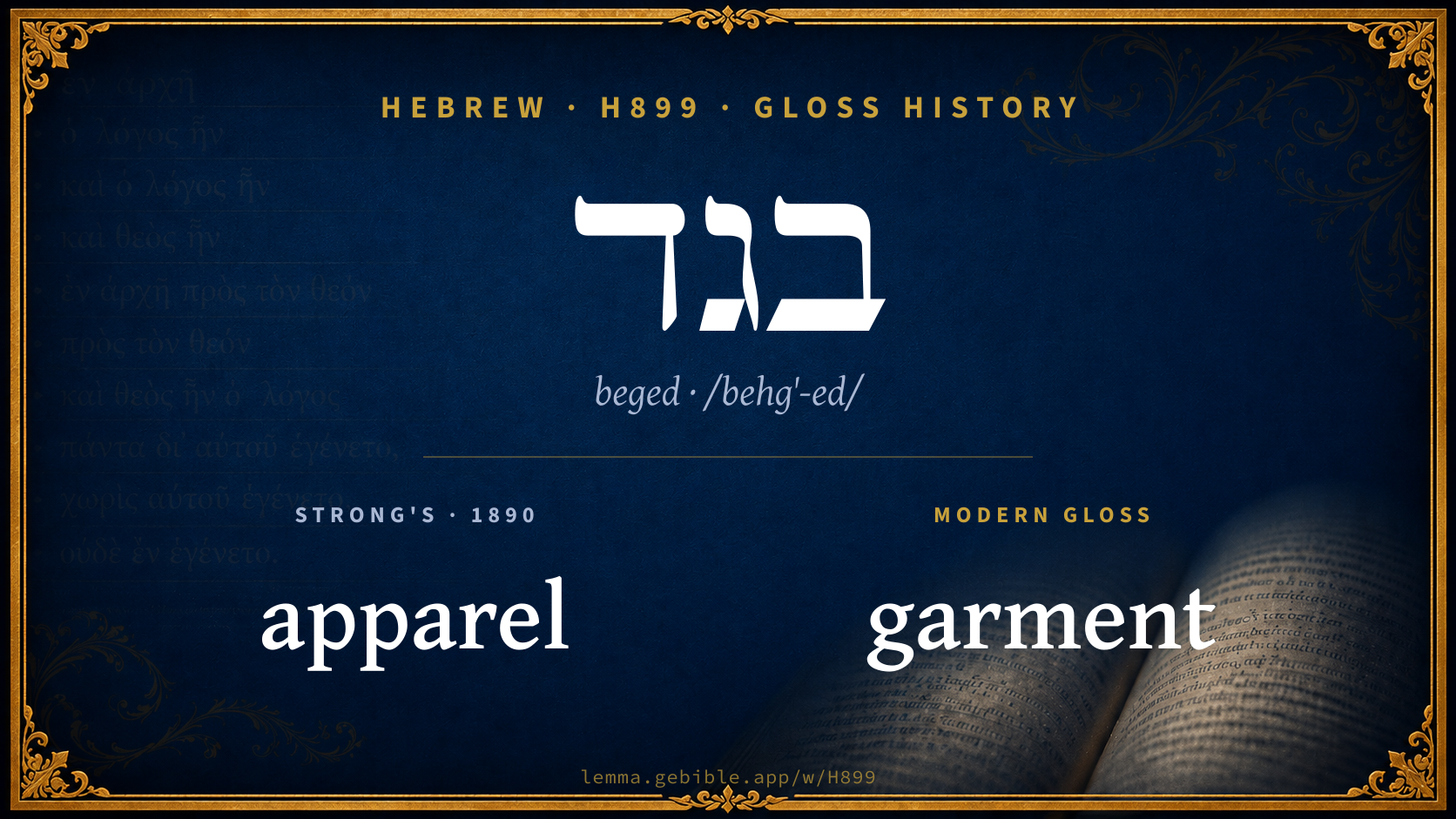
Gloss history
Strong's 1890 vs modern scholarship
About this word
Strong's H899 catalogs a Hebrew word from the Hebrew Old Testament.
These counts are not copied from any lexicon or concordance. They are computed here, from the morphology-tagged Hebrew Old Testament. What Lemma adds →
- 190
- distinct verses
- The word appears in 190 distinct verses.
- 25 / 39
- OT books
- The word appears in 25 of 39 Old Testament books.
- #217
- by frequency
- Top 250 most frequent Hebrew words (rank 217 of 8,640 Hebrew words by occurrence).
View all 190 occurrences in the concordance →
By section of the Old Testament
By traditional corpus
Conventional, traditional groupings — biblical authorship is debated, so this is a traditional corpus grouping, not an authorship claim. Each share is this word’s portion of its verses in that division of the Hebrew canon. Each figure is a share of the word’s 190 distinct verses.
- Torah (Pentateuch) 91 verses · 48%
- Prophets (Nevi'im) 76 verses · 40%
- Writings (Ketuvim) 23 verses · 12%
How translations render this word
Counts come from each version’s own published word-to-Strong’s tagging or interlinear alignment — an approximate guide to how each version renders this word, not a word-level alignment the data otherwise carries. Because each total is that version’s own tagged count, the per-version totals vary from one another and need not match the appearance or distinct-verse counts above. These counts may also differ from a printed concordance because Lemma counts each distinctly tagged rendering and does not collapse phrase taggings into a single head-word total. This is a fixed set of word-tagged versions (KJV, ASV, BSB, ULT) and does not change with the reading translation you choose elsewhere. Each version’s license is shown beside its name below (and on Sources).
BDB lists this Strong’s number as 2 distinct words (homographs). Each count above pools all of them and is not split by sense — see the Senses section below. A low-frequency rendering may belong to a different one of those words, not the primary meaning.
- King James Version†: Clothes 65×, Garments 65×, Garment 30×
- American Standard Version†: Garments 56×, Clothes 55×, Garment 27×
- Berean Standard Bible†: Clothes 73×, Garments 58×, Clothing 16×
- unfoldingWord Literal Text†: Clothes 86×, Garments 30×, Clothing 21×
King James Version Public Domain
Renders H899 across 217† tagged occurrences — most commonly:
Plus 22 renderings that appear only once — usually multi-word phrases or single function words the recovered tagging swept in, not distinct renderings.
American Standard Version Public Domain
Renders H899 across 218† tagged occurrences — most commonly:
Plus other, less common renderings. Plus 36 renderings that appear only once — usually multi-word phrases or single function words the recovered tagging swept in, not distinct renderings.
Berean Standard Bible Public Domain
Renders H899 across 213† tagged occurrences — most commonly:
Plus other, less common renderings. Plus 15 renderings that appear only once — usually multi-word phrases or single function words the recovered tagging swept in, not distinct renderings. Not rendered by a distinct English word in 4 further occurrences.
unfoldingWord Literal Text CC BY-SA 4.0
Renders H899 across 223† tagged occurrences — most commonly:
Plus other, less common renderings. Plus 14 renderings that appear only once — usually multi-word phrases or single function words the recovered tagging swept in, not distinct renderings.
Senses in the full BDB
What do BDB’s symbols mean?
BDB uses these scholarly abbreviations:
| Symbol | Meaning |
|---|---|
| 𝔊 | the Septuagint (the ancient Greek translation, LXX) |
| 𝔙 | the Vulgate (the Latin translation) |
| 𝔖 | the Syriac version (the Peshitta) |
| 𝔗 | the Targum (the Aramaic translation) |
| ψ | the Psalms |
| √ | root (the underlying root or stem) |
| ‖ | parallel passage (a synonymous or contrasted parallel) |
| † | the dagger: every passage where the word occurs is cited |
The 2 senses and sub-senses the full Brown-Driver-Briggs lexicon distinguishes for this word, in lexicon order (not ranked by frequency), with BDB’s own verbatim wording and sub-sense lettering. Shown in Hebrew script with BDB’s own scholarly abbreviations. The condensed entry is in the Lexicon Entry tab. See also the Forms in the corpus table below.
בגד I [m.] treachery, Is 24
בגד II (except Lv 6
- 1. garment, clothing, raiment, robe of any kind, from the filthy clothing of the leper to the holy robes of the high priest, the simplest covering of the poor as well as the costly raiment of the rich and noble, used throughout Heb. Lit.: Gn 24:53 (J), 28:20 (E; 14 times JE), Ex 28:2 + (P 90 times), Dt 24:17 Ju 8:26 + 4 times 1 S 19:13 + 10 times, 1 K 1:1 + 23 times, 2 Ch 18:9 + (Chr 9 times), Est 4:1, 4; Jb 13:28; 22:6; 37:17 ψ 22:19; 45:9; 102:27; 109:19; Pr 6:27; 20:16; 25:20; 27:13 Ec 9:8 Is 2; 24:16; 36:22; 37:1; Is 3; 50:9 + 10 times, Je 12:1 + 3 times, Ez 16:16 + 13 times, Jo 2:13; Am 2:8; Hg 2:12; Zc 3:3, 4, 5; 14:14; מְלֹא בִגְדוֹ his lap-ful 2 K 4:39. e.g. Genesis 24:53
- 2. covering, wrapping, of furniture of tabernacle Nu 4:6–13 (6 times); coverlet of a bed 1 S 19:13. e.g. Numbers 4:6
Senses from the full Brown-Driver-Briggs lexicon (Brown, Driver, Briggs; Oxford 1906 — public domain), digitized via Sefaria, supplemented by the OpenScriptures HebrewLexicon (CC BY 4.0). Full attribution on Sources.
Word origin
I. n.[m.] treachery, Is 24:16; Je 12:1.
II. n.m. (except Lv 6:20 עָלֶיהָ, but Sam. עליו, Ez 42:14; Pr 6:27, cf. Köi, 482) garment, covering—Gn 28:2 + 36 times; sf. בִּגְדוֹ Ez 9:3 + (14 times without dag. lene GesLbg 94); pl. בְּגָדִים Lv 6:4 + 32 times; cstr. בִּגְדֵי Gn 27:15 + 39 times; sf. בְּגָדֶיךָ 1 K 22:20 + 81 times בִּגְדֹתֶיךָ ψ 45:9;—
— Brown-Driver-Briggs (Oxford 1906, public domain), digitized via Sefaria, supplemented by the OpenScriptures HebrewLexicon (CC BY 4.0). See Sources.
Derived from בגד (bâgad) (H898) — to betray.
Jastrow Dictionary
A second Hebrew/Aramaic lexicon for comparison, covering Aramaic and post-biblical (Talmudic, Targumic, Midrashic) usage that the biblical-Hebrew BDB does not. Matched by lemma rather than by Strong’s number, so a lemma may carry more than one Jastrow headword (shown separately below), and the entries cover usage well beyond the Bible.
בָּגַד
- v. infra) to act violently, to rebel, be faithless. Snh. 37ᵃ (allud. to Gen. XXVII, 27) א"ת בְּגָדָיו אלא בּוֹגְדָיו do not read b’gadav (his garments), but bog’dav (his faithless ones). Y. Peah I, 16ᵇ top; Num. R. s. 10, beg.; Cant. R. to V, 16, v. בְּגִידָה.—Mekh. Mishp., N’zikin 3 מאחר שב׳ בה וכ׳ (b’bigdo bah, Ex. XXI, 8) since he &c., treated her contemptuously (opp. to the interpretation of בגדו as his garment, שפירש בגדו עליה he spread his bed-cloth over her). [From Targ. renderings as well as from Agadic interpretations it appears that the primitive meaning of בגד (√בג) is, to tear; also to despise, corresp. to the meanings of √בז; v. Targ. Job VI, 5; Is. XXXIII, 1; Prov. XXI, 18; Snh. 94ᵃ, cit. s. v. בזוזא; Esth. R. to I, 10, cit. s. v. בּוּז; Mekh. l. c.; cmp. also K’thib בג for K’ri בַּז Ezek. XXV, 7.—בֶּגֶד seems to be a piece, web, corresp. in meaning and use to φᾶρος.] e.g. Genesis 27:27
בֶּגֶד
- preced.) web, garment. Men. 40ᵇ היא של ב׳ וכ׳ if (the garment) itself is a web, but its borders are of leather. Ib. the principal element ב׳ בעינן must be a web (in order to require Tsitsith). Mekh. Mishp., N’zikin 3, v. preced. Sabb. 26ᵇ; a. fr.—Pl. בְּגָדִים, constr. בִּגְדֵי. Gen. R. s. 20 ב׳ א"הר Adam’s garments, v. אוֹר II, 3. Yoma 60ᵇ ב׳ לבן the Highpriest’s white garments (for the Day of Atone, Lev. XVI, 4), contrad. to ב׳ זהב gold-embroidered &c. Ib. 68ᵇ; a. fr. e.g. Leviticus 16:4
A Dictionary of the Targumim, the Talmud Babli and Yerushalmi, and the Midrashic Literature (Marcus Jastrow; London, Luzac, 1903) — Public Domain. Digitized via Sefaria. Digitized via Sefaria. Full attribution on Sources.
Forms in the corpus
The 115 distinct written forms H899 takes in the Hebrew Bible, most frequent first — each parse links to that state’s occurrences in the concordance. Hebrew forms include their vowel points and cantillation, so a single lemma takes many written forms.
The 60 most common forms are shown; 55 rarer forms follow in the full concordance.
Same root — word family
Other BDB entries built from the same root as H899, grouped by Strong’s listed origin. These share a root / origin per the lexicon — not necessarily a shared meaning. Each links to that word’s own entry.
Derives from
Shares the same root
Compare all same-root words → They share a root, not necessarily a meaning.
Septuagint verse parallels
This word appears in 184 verses that also exist in the Greek Old Testament (Septuagint), out of the 190 Hebrew verses it occurs in. You can read those verses in Greek by switching the Old Testament edition to the Septuagint.
Read these verses in the Septuagint
- Genesis 24:53
- Exodus 28:2
- Leviticus 6:11
- Numbers 4:6
- Deuteronomy 24:17
- Judges 8:26
- 1 Samuel 19:13
- 2 Samuel 1:2
- 1 Kings 1:1
- 2 Kings 2:12
- 2 Chronicles 18:9
- Ezra 9:3
This is a verse-level parallel only — the same verses exist in both the Hebrew and Greek Old Testaments. No word-level Hebrew↔Greek correspondence is claimed: the data carries no such alignment, so no Greek word is shown as this Hebrew word’s translation. Coverage is not total — the Septuagint omits the deuterocanon and renumbers the Psalms, so some Hebrew verses have no direct Greek parallel.