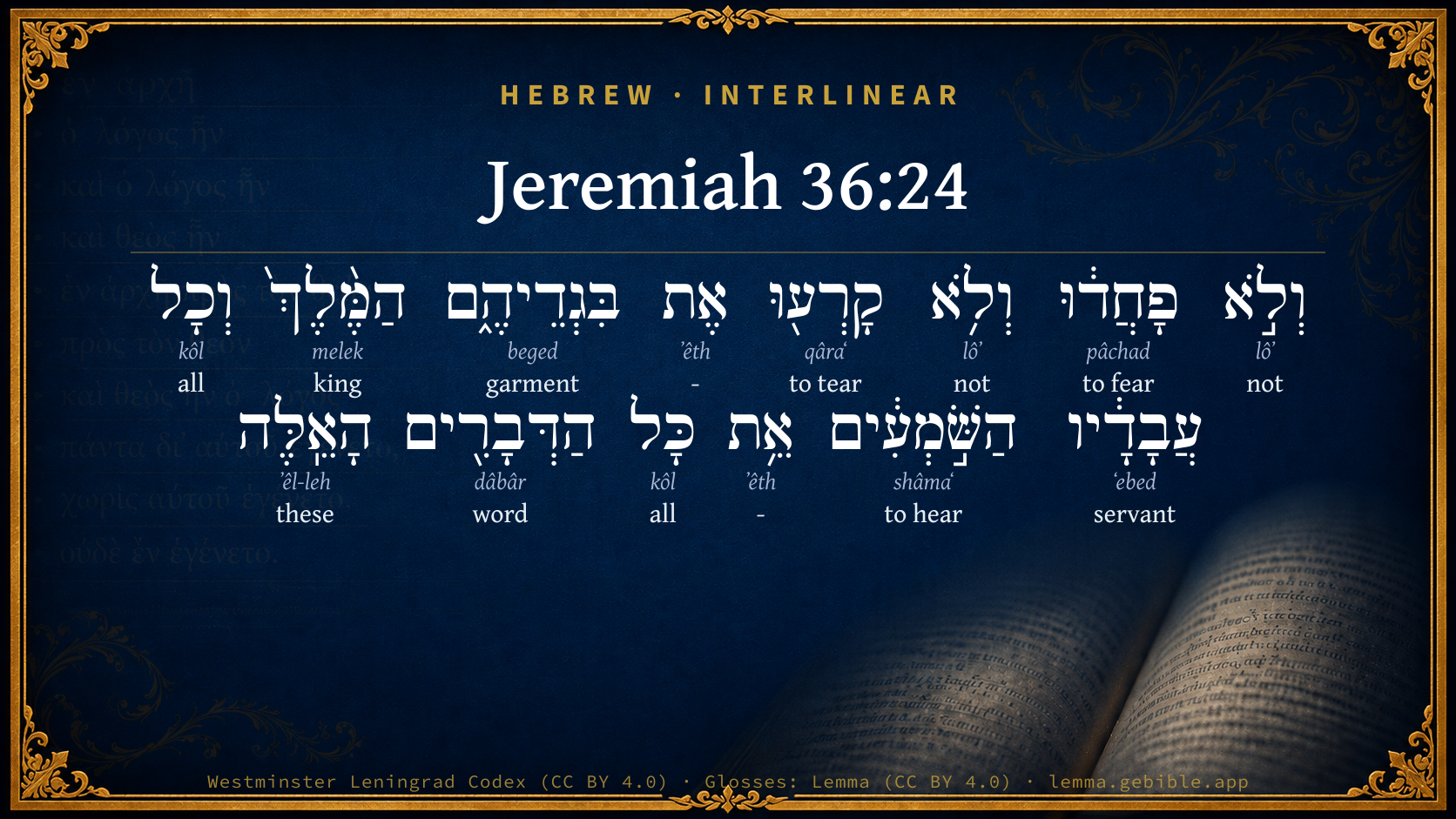
Jeremiah 36:24

Hebrew (Westminster Leningrad Codex) Jeremiah 36:24 appears in the Hebrew Old Testament. The text above is from the Westminster Leningrad Codex. Each word links to its Strong’s number, a concise gloss, and parsing drawn from the Open Scriptures Hebrew Bible morphology. Click any word for its full Brown-Driver-Briggs (BDB) entry.
Download image
Cite this verse

Jeremiah 36:24 (World English Bible). Public Domain. Lemma interlinear Bible study tool, https://lemma.gebible.app/v/jeremiah/36/24.

Show BibTeX & RIS
BibTeX
RIS
English Translation
They were not afraid, nor tore their garments, neither the king, nor any of his servants who heard all these words.
World English Bible · Public Domain
Download a study sheet

One document with this verse’s original text, its word-by-word gloss line, the meaning frame, cross-references with their text, attributed commentary, and full source and license credits — printable, and it pastes into notes with its structure intact.

This verse Autodidact and up

Study sheet (.html) Plain text (.txt)

A passage Seminary Student

Up to 50 verses in one chapter. A passage sheet keeps up to 6 commentary sources and 12 cross-references per verse, in the order this page ranks them, and says so on the sheet whenever that leaves anything out. Ask for a single verse and you get the Autodidact verse sheet above.

Everything on this page stays free to read, with no account — the sheet is a download of what is already on screen, not access to it.

Want to remove ads? Support Godless Engineer
Compare translations 3

The same verse in 3 English versions, stacked beneath the original-language interlinear above. Click any original word for its lexicon entry.

Each is an independent rendering of the whole verse — the interlinear is not word-aligned to these translations.

Highlighted words mark where these versions differ — a whole-verse word diff, not a word-by-word alignment.

  • World English Bible Public Domain
    They were not afraid, nor tore their garments, neither the king, nor any of his servants who heard all these words.
  • King James Version Public Domain
    Yet they were not afraid, nor rent their garments, neither the king, nor any of his servants that heard all these words.
  • unfoldingWord Literal Text CC BY-SA 4.0
    But neither the king nor any of his servants who heard all these words were frightened, nor did they tear their clothes.

unfoldingWord Literal Text — © unfoldingWord, licensed CC BY-SA 4.0. Word-aligned USFM3 via Door43 (git.door43.org/unfoldingWord/en_ult).

Versions to compare (up to 4)

3 of 4 selected

Show all 18 translations

Every available English version of this verse, each an independent rendering of the whole verse.

  • World English Bible Public Domain
    They were not afraid, nor tore their garments, neither the king, nor any of his servants who heard all these words.
  • Berean Standard Bible Public Domain
    Yet in hearing all these words, the king and his servants did not become frightened or tear their garments.
  • Majority Standard Bible Public Domain
    Yet in hearing all these words, the king and his servants did not become frightened or tear their garments.
  • King James Version Public Domain
    Yet they were not afraid, nor rent their garments, neither the king, nor any of his servants that heard all these words.
  • American Standard Version (1901) Public Domain
    And they were not afraid, nor rent their garments, neither the king, nor any of his servants that heard all these words.
  • Revised Version (1885) Public Domain
    And they were not afraid, nor rent their garments, neither the king, nor any of his servants that heard all these words.
  • Geneva Bible (1599) Public Domain
    Yet they were not afraide, nor rent their garmets, neither the King, nor any of his seruants, that heard all these wordes.
  • Douay-Rheims (1899) Public Domain
    And the king and all his servants that heard all these words were not afraid, nor did they rend their garments.
  • Young's Literal Translation Public Domain
    And the king and all his servants who are hearing all these words have not been afraid, nor rent their garments.
  • Literal Standard Version CC BY-SA 4.0
    And the king and all his servants who are hearing all these words have not been afraid, nor torn their garments.
  • Unlocked Literal Bible CC BY-SA 4.0
    But neither the king nor any of his servants who heard all these words were frightened, nor did they tear their clothes.
  • unfoldingWord Literal Text CC BY-SA 4.0
    But neither the king nor any of his servants who heard all these words were frightened, nor did they tear their clothes.
  • Darby Bible Public Domain
    And they were not afraid, nor rent their garments, [neither] the king nor any of his servants that heard all these words.
  • World Messianic Bible Public Domain
    The king and his servants who heard all these words were not afraid, and didn’t tear their garments.
  • Webster's Bible Public Domain
    Yet they were not afraid, nor rent their garments, neither the king, nor any of his servants that heard all these words.
  • Free Bible Version CC BY-SA 4.0
    Despite hearing all these messages, the king and his attendants weren't frightened and didn't tear their clothes in remorse.
  • Bible in Basic English Public Domain
    But they had no fear and gave no signs of grief, not the king or any of his servants, after hearing all these words.
  • JPS Tanakh (1917) Public Domain
    Yet they were not afraid, nor rent their garments, neither the king, nor any of his servants that heard all these words.

Literal Standard Version (2020), Covenant Press — licensed CC BY-SA 4.0. Text via the HelloAO Bible API (eBible.org). Unlocked Literal Bible (unfoldingWord) — licensed CC BY-SA 4.0. Text via the HelloAO Bible API (eBible.org). unfoldingWord Literal Text — © unfoldingWord, licensed CC BY-SA 4.0. Word-aligned USFM3 via Door43 (git.door43.org/unfoldingWord/en_ult). Free Bible Version, Dr. Jonathan Gallagher — licensed CC BY-SA 4.0. Text via the HelloAO Bible API (eBible.org).

Word by word

More ways to search: Search by grammar → Find every occurrence → Compare this word →

Practice this passage: Drill this verse → Learn its vocabulary →

פָחֲד֔וּ
pâchad
H6342
“to fear”
Verb, Qal, Perfect, 3rd Person, Common, Plural
Part of Speech
Verb
Stem
Qal
Form
Perfect
Person
3rd Person
Gender
Common
Number
Plural
Full BDB Definition

Origin: a primitive root

TWOT: 1756

to fear, tremble, revere, dread, be in awe or dread - (Qal) - to be in dread - to be in awe - (Piel) to be in great dread - (Hiphil) to cause to dread
  1. וְלֹ֣א lôʼ H3808 “and · not” Conjunction + Particle, Negative
  2. וְלֹ֥א lôʼ H3808 “and · not” Conjunction + Particle, Negative
  3. קָרְע֖וּ qâraʻ H7167 “to tear” Verb, Qal, Perfect, 3rd Person, Common, Plural
  4. אֶת ʼêth H853 “-” Particle, Direct Object
  5. בִּגְדֵיהֶ֑ם beged H899 “garments · their” Noun, Common, Masculine, Plural, Construct + Suffix, Personal, 3rd Person, Masculine, Plural
  6. הַמֶּ֨לֶךְ֙ melek H4428 “the · king” Particle, Definite Article + Noun, Common, Masculine, Singular, Absolute
  7. וְכָל kôl H3605 “and · all of” Conjunction + Noun, Common, Masculine, Singular, Construct
  8. עֲבָדָ֔יו ʻebed H5650 “servants · his” Noun, Common, Masculine, Plural, Construct + Suffix, Personal, 3rd Person, Masculine, Singular
  9. הַשֹּׁ֣מְעִ֔ים shâmaʻ H8085 “the · hearing” Particle, Definite Article + Verb, Qal, Participle Active, Masculine, Plural, Absolute
  10. אֵ֥ת ʼêth H853 “-” Particle, Direct Object
  11. כָּל kôl H3605 “all of” Noun, Common, Masculine, Singular, Construct
  12. הַדְּבָרִ֖ים dâbâr H1697 “the · words” Particle, Definite Article + Noun, Common, Masculine, Plural, Absolute
  13. הָאֵֽלֶּה ʼêl-leh H428 “the · these” Particle, Definite Article + Pronoun, Demonstrative, Common, Plural

About this verse

These counts appear in no published source. They are computed here, from the morphology-tagged text and Lemma’s own curated glosses. What Lemma adds →

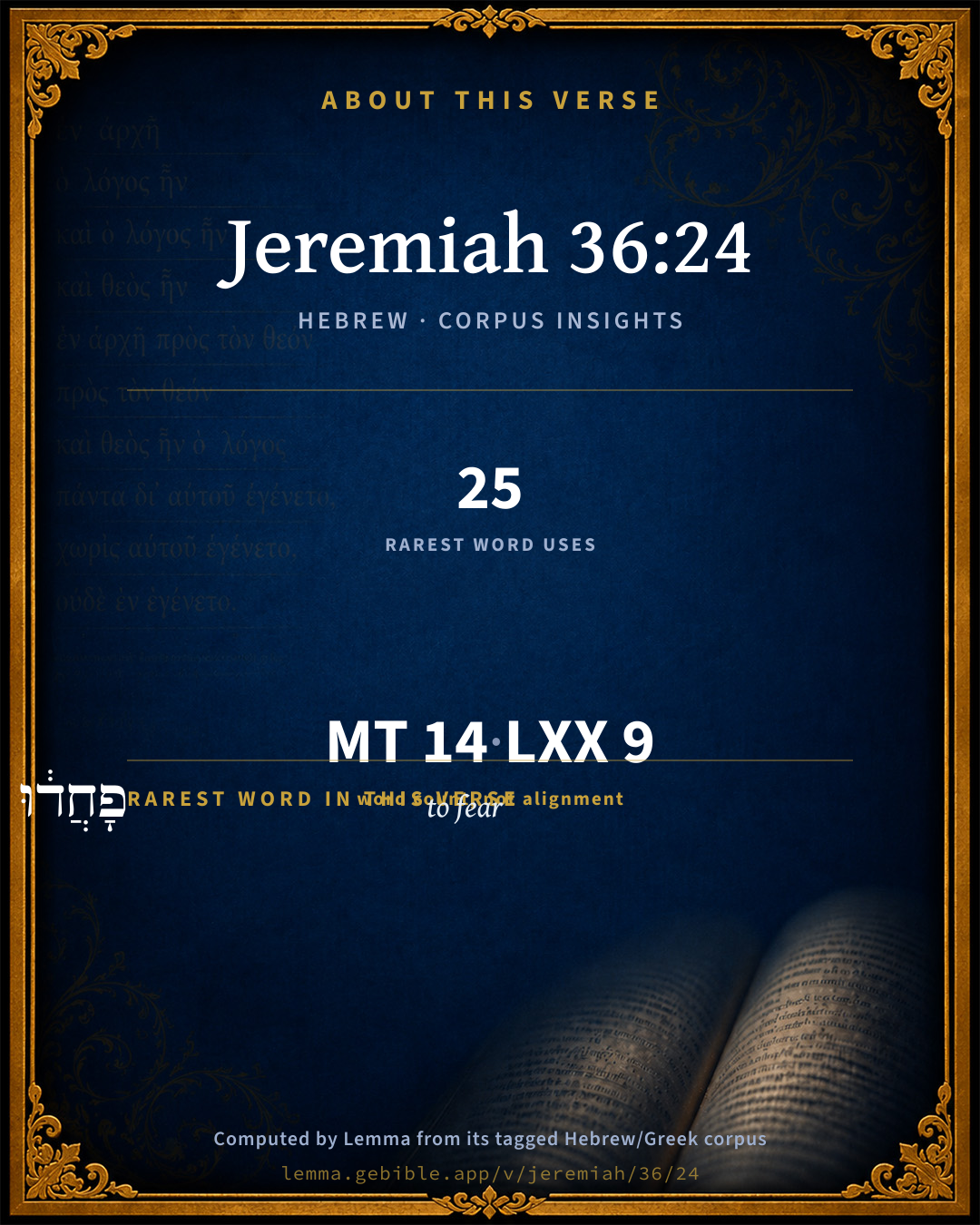
14
words
11
distinct lemmas
Prophets
section

Notable vocabulary

The rarest word here is פָחֲד֔וּ to fear H6342 — appearing just 25 times in the whole Hebrew Bible.

Shared distinctive vocabulary

פָחֲד֔וּ to fear H6342 occurs in 25 verses of the Hebrew Bible. Also found in:

Grammatical profile

  • 3 verbs
  • 6 nouns
  • 1 pronoun
  • 4 particles

Verb forms

  • פָחֲד֔וּ Qal · Perfect
  • קָרְע֖וּ Qal · Perfect
  • הַשֹּׁ֣מְעִ֔ים Qal · Participle Active

Repetition

Words recur within this verse — often emphatic in Hebrew:

  • וְכָל all H3605 ×2
  • וְלֹ֣א not H3808 ×2

Hebrew & Septuagint length

In the original languages it is 14 Hebrew tokens and 9 Greek tokens — but the two are counted differently (Hebrew bundles its prefixes and suffixes into one token; the Greek is in lemma form), so that isn’t a like-for-like length.

Cross-references

15

Topical passages linked to Jeremiah 36:24 in the Treasury of Scripture Knowledge — connected by theme and wording, ordered by reader-vote popularity; previews shown in the World English Bible.

  • Jeremiah 36:16 Now it happened, when they had heard all the words, they turned in fear one toward another, and said to Baruch, We will surely tell the king of all these words.
  • Psalms 36:1 An oracle is within my heart about the disobedience of the wicked: "There is no fear of God before his eyes."
  • 1 Kings 21:27 It happened, when Ahab heard those words, that he tore his clothes, and put sackcloth on his flesh, and fasted, and lay in sackcloth, and went softly.
  • 2 Kings 19:1–2 It happened, when king Hezekiah heard it, that he tore his clothes, and covered himself with sackcloth, and went into the house of Yahweh.
  • Psalms 64:5 They encourage themselves in evil plans. They talk about laying snares secretly. They say, "Who will see them?"
  • Isaiah 36:22–37:1 Then came Eliakim the son of Hilkiah, who was over the household, and Shebna the scribe, and Joah, the son of Asaph, the recorder, to Hezekiah with their clothes torn, and told him the words of Rabshakeh.
  • Jonah 3:6 The news reached the king of Nineveh, and he arose from his throne, and took off his royal robe, covered himself with sackcloth, and sat in ashes.
  • Genesis 37:29 Reuben returned to the pit; and saw that Joseph wasn't in the pit; and he tore his clothes.
  • 2 Kings 22:11–19 It happened, when the king had heard the words of the book of the law, that he tore his clothes.
  • 2 Chronicles 34:19–31 It happened, when the king had heard the words of the law, that he tore his clothes.
  • Job 15:4 Yes, you do away with fear, And hinder devotion before God.
  • Isaiah 26:11 Yahweh, your hand is lifted up, yet they don't see: but they shall see [your] zeal for the people, and be disappointed; yes, fire shall devour your adversaries.
  • Jeremiah 5:3 O Yahweh, don't your eyes look on truth? you have stricken them, but they were not grieved; you have consumed them, but they have refused to receive correction: they have made their faces harder than a rock; they have refused to return.
  • Matthew 12:41 The men of Nineveh will stand up in the judgment with this generation, and will condemn it, for they repented at the preaching of Jonah; and behold, someone greater than Jonah is here.
  • Romans 3:18 "There is no fear of God before their eyes."

Cross-references courtesy of OpenBible.info (CC BY 4.0).

Hebrew and Greek witnesses Masoretic Hebrew ↔ Greek Septuagint

The same verse in the two great witnesses to the Old Testament, shown verse-for-verse.

These are two independent witnesses, not word-aligned to each other, and the Septuagint is shown in lemma (dictionary) form.

Hebrew Jeremiah 36:24 Masoretic · Westminster Leningrad Codex

וְלֹ֣א פָחֲד֔וּ וְלֹ֥א קָרְע֖וּ אֶת בִּגְדֵיהֶ֑ם הַמֶּ֨לֶךְ֙ וְכָל עֲבָדָ֔יו הַשֹּׁ֣מְעִ֔ים אֵ֥ת כָּל הַדְּבָרִ֖ים הָאֵֽלֶּה

They were not afraid, nor tore their garments, neither the king, nor any of his servants who heard all these words.

World English Bible · Public Domain

Greek LXX Structure differs

In the Septuagint, Jeremiah is about an eighth shorter than the Hebrew and arranges its material differently — the Oracles Against the Nations (Hebrew chapters 46–51) appear in the middle of the Greek book, after 25:13. Because the chapter and verse boundaries do not line up, a verse-for-verse comparison with the Hebrew is not shown.

A verse-for-verse comparison isn’t shown here because the chapters and verses don’t line up. Switch to the LXX edition with the MT / LXX toggle above to read the Greek directly.

Hebrew: Westminster Leningrad Codex (CC BY 4.0). Greek: Septuagint (public domain); English from a public-domain English Septuagint. How the Septuagint differs from the Hebrew →

Targum (Aramaic paraphrase)

1

The Targum is the ancient Jewish Aramaic paraphrase of the Hebrew Scriptures — an interpretive translation, not the Hebrew text itself. Onkelos (literal) and Pseudo-Jonathan (expansive) render the Torah, and Jonathan the Prophets. Coverage is partial: where no permissively-licensed English translation exists for a verse, only the Aramaic is shown. This is verse-level text, not a word-by-word alignment to the Hebrew.

  1. Targum Jonathan Prophets (Joshua–Malachi)
    וְלָא תְוָהוּ וְלָא בְזָעוּ יַת לְבוּשֵׁיהוֹן מַלְכָּא וְכָל עַבְדוֹהִי דְשָׁמְעִין יַת כָּל פִּתְגָמַיָא הָאִלֵין:

    (no public-domain English translation for this verse)

    Targum Jonathan — Aramaic: “Mikraot Gedolot” (public domain). English: “Sefaria Community Translation” (CC0 1.0 (public-domain dedication)); “London "Chaldee Paraphrase," 1871” (public domain). Text via Sefaria.

Commentary

Notes on Jeremiah 36:24 from classic Christian and Jewish commentators (each source and its license shown beneath its notes). The classic Christian expositions comment on the surrounding passage and are grouped to its opening verse, so a note may address several verses; the Jewish commentaries on the Tanakh (Rashi and others) are per-verse, so they appear only where the commentator wrote on this verse.

Lemma curates 59 commentaries, every one of them public domain or Creative Commons licensed, each selected and text-cleaned for this edition rather than reprinted as found. About our sources →

Trapp's Complete Commentary

John Trapp

Jer 36:24 Yet they were not afraid, nor rent their garments, [neither] the king, nor any of his servants that heard all these words.

Ver. 24. Yet they were not afraid.] Ne paulum quidem perculsi sunt. The king and his servants, those court parasites, were not stirred at all at such a Bible bonfire, but jeered when they should have feared, &c.

Nor rent their garments.] Such was their stupor seu non-curantia, their security and insensibleness of that high offence, for which their posterity keep a yearly fast. See on Jer 36:6. Rending of garments in token of grief was in use also among the heathens. Homer saith Priamus rent his clothes when he heard of the death of his son Hector. The like hath Virgil of his Aeneas:

“ Tum pater Aeneas humeris abseindere vestem

Auxilioque vocare deos. ”

Suetonius {a} saith the like of Julius Caesar, &c.

{a} Pro concione fidem militum flens et veste a pectore discissa imploravit. - Suet., cap. 55.

John Trapp, A Commentary or Exposition upon All the Books of the Old and New Testament (1647–1656) — public domain. Text from a community e-Sword module.

The Biblical Illustrator

Joseph S. Exell

Jer_36:24

Yet they were not afraid.

The hardening power of sin

Is it conceivable that men who believed Jeremiah to be a prophet of God should despise his words? Is it credible that, after preaching for twenty years, those who listened to him should think him a prophet, and yet throw his sermons in the fire? I am afraid this is very conceivable and very credible: I see nothing in it a whir more incredible than in this, that men who dare not deny the Bible to be the Word of God, should know what is right and not do it, that they should have warning of a far more fearful captivity than that which was coming on the Jews, and yet should never tremble. The king of Judah and his people were not in the condition of men who had been sinning in ignorance, and to whom a sudden message had come from God to warn them to repent; they had no excuse of this kind, they had been deliberately disobeying God in spite of the warnings of Jeremiah, they had sinned against light, as we say, and so they had become blinded and hardened. At first probably, when they heard the prophet, they felt that they were living wickedly and made resolutions to amend, but by and by temptation came again and they gave way; then once more they would hear the warning voice, but somehow it would not this time be so terrible. Is it difficult to find examples of the like thing now? of men who by little and little fall from one sin to another, who have been taught as children the way of God and have been told of heaven and hell, and so are scared at first when they think that the wages of sin is death; but by and by this truth seems to lose its edge, sin has gained more hold, and Satan has said as he did to Eve, Ye shall not surely die; one sin leads to another, and each seems easier than the one before it; things which once appeared frightful now seem simple and familiar, and thus after a time the man becomes hardened. This is what the confession of many criminals confirms, they trace their wretchedness hack to some much smaller sin committed when young: a boy disobeys his parents, and perhaps would not believe you if you told him that he had taken one step towards the gallows; and let this may be true. This I understand by the deceitfulness of sin, to which the apostle refers its hardening power (Heb_3:13); it is deceitful, because what we call a small sin appears trifling, because we judge of sins merely in themselves, without considering to what they lead. If in a war a general were to see a few of the enemys soldiers straggling over the hills, he might say that they were so few that they were not worth considering, but would he say so? or would he not rather look upon them as the forerunners of a great army, would he not prepare at once to resist the host of enemies which he must know lurked behind? In like manner the sins of childhood are the forerunners of the great army of the world, the flesh, and the devil, which comes up in maturer years, and the only safe course is to look upon no sin as trifling, but to root out every enemy whether small or great, lest perhaps we allow our enemy to gain such strength as shall end in our overthrow. We will consider first the ease of a man who seldom or never goes to church. Now I suppose the reason such a man would give is, that he does not see the use of it. Did he always think so? Most probably he had been taught differently when a child, he had been taught that God is with His people gathered together in His Name, that our Lord Jesus Christ is there; he was taught this, and he once believed it, but now he thinks he is as well at home: how has this change come about? has he reasoned about it? probably not at all: has any one for whom he has any respect told him so? certainly not: then what has changed him? it is the effect of habit; he has been hardened by the deceitfulness of sin. What I have just said will apply almost without change to the case of a man who never prays. He was taught to pray as a child, and perhaps he continues the practice, till at length, because he does not act up to his prayers, he finds the practice tiresome, and so he finds an excuse to omit prayer occasionally; then he grows more careless and more irregular, and yet the omission costs him less and less pain, till at last the time comes when he forgets God altogether, and so starves his soul to death. Or again, what shall we say of those who continually hear of their duty, and do not do it, or at all events do it in a very stinted degree? One man is just and kind and liberal, being scarcely aware of it himself, and another is niggardly and churlish, not because he thinks it right to be so, but because he has become hardened. It is a thing for every one of us to think over and pray over, whether we are in all things following God without reserve, and whether there may not be some point in which we are falling very grievously short, but to which habit has hardened us. (Bishop Harvey Goodwin.)

Afraid of the Bible

A celebrated infidel once said, There is one thing which mars all the pleasure of my life. Indeed, replied his friend; what is that? I am afraid the Bible is true, was the answer. If I could know for certain that death is an eternal sleep, I should be happy--my joy would be complete. But here is the thorn that stings me--this is the sword that pierces my very soul: if the Bible is true, I am lost for ever. This is the Bible upon the truths of which many have lived, and in the belief of which many have died. Oh, how terribly afraid would they have been if anyone had been able to show that it was untrue! For upon its truths all their hopes are built. An untrue Bible would mean an untrue Christ; and a Christless death would be a death of doom to them. (Quiver.)

A foolish bravery

I. It is a foolish bravery to ignore facts. Just that did Jehoiakim. It was a fact that he had sinned. It was a fact that Jeremiah was Gods prophet. It was a fact that God, by the mouth of Jeremiah, had spoken doom for the sin of Jehoiakim unless he should repent. But Jehoiakim would have nothing of these facts. He cut the roll to pieces and threw it in the fire, &c. This did not change the facts.

1. It is a fact that good is what ought to be.

2. It is a fact that God is the good.

3. It is a fact that evil is what ought not to be.

4. It is a fact that the good which ought to be must be against the evil which ought not to be.

5. It is therefore a fact that God, who is the good which ought to be, must be Himself against the evil which ought not to be.

6. It is, therefore, a further fact that if I choose the evil which ought not to be, the good God, who must be against the evil which ought not to be, must be against me.

II. It is a foolish bravery to imagine yourself an exception from the working of the Divine law. Have you never been subdued into a vast awe, as the absolute irreversibleness of natural law has been pressed upon you? It is because natural law is so unchanging that we may build our cities, and send our ships, and plough our fields, and reap our harvests. But there is another and a fearful side to this irreversibleness of natural law. When, for any reason, man stands athwart one of these great natural laws, the penalty for violation is sure to smite. And this is as true in the moral realm. It is a foolish bravery to think yourself an exception to Gods law. He said it--there am many who think it who do not so plainly say it--that young man, whom I was seeking to dissuade from courses of dissipation. Oh, he answered, it may hurt other fellows, but it wont me; I am an exception. How crammed with folly such temerity!

III. It is a foolish bravery to refuse truth which you dislike.

IV. It is a foolish bravery to go on heedlessly, saying, i dont care.

V. It is a foolish bravery to refuse repentance. (W. Hoyt, D. D.)

The guilt of indifference to Divine threatenings

1. The man who hears Gods threatenings without being afraid, and His kind invitations and promises without being melted, does in effect say to His face, I consider nothing which Thou canst utter as of sufficient importance to excite the smallest emotion; neither Thy favour nor Thy displeasure is of the least consequence to me; I dread not Thy threatenings, I regard not Thy promises; after Thou hast said all that Thou canst say, I remain perfectly unmoved, and prepared to execute, not Thy pleasure, but my own. And if this does not express the utmost contempt of God, what can express it?

2. This sin also involves and indicates the highest degree of unbelief, of that unbelief which makes God a liar. When a man brings us intelligence of most important events, of events in which, if true, we are deeply interested, we cannot tell him more plainly that we disbelieve everything which he has said, than by remaining perfectly unaffected. He then who is but in a small degree affected by Gods Word, has but little faith in it, and he who is not at all affected by it has no faith in it at all. He is as completely an infidel as anyone who ever gloried in the name.

3. Those who hear or read the Word of God without being affected, display extreme hardness of heart. They show that their hearts are absolutely unimpressible by any motives or considerations which infinite wisdom itself can suggest; that they are of so much more than flinty hardness, as to resist that Word which God Himself declares to be like a fire, and a hammer, that breaketh the rock in pieces. (E. Payson, D. D.)

The Biblical Illustrator, edited by Joseph S. Exell (c. 1880s–1900s) — public domain. Text from a community e-Sword module.

Joseph Benson's Commentary

Jer 36:24. Yet they were not afraid — No, not those princes that trembled at the word when they heard it the first time, Jer 36:16. The fear with which they were then seized quickly wore off, or else they durst not discover it in the king’s presence, who showed no concern himself. Nor rent their garments — A custom observed among the Jews at the hearing of any dreadful news; neither the king nor any of his servants that heard all these words — How different was the spirit of this king and his courtiers from that of his father Josiah, who, when he heard the words of the law read to him by Shaphan the scribe, both rent his clothes and wept before the Lord in the deepest humiliation and distress, persuaded that great was the wrath about to be poured upon the nation; and yet the parts of the law read to him were certainly neither so particular, nor so immediately adapted to the present state of affairs in the country as the contents of this roll were.

Joseph Benson's Commentary on the Old and New Testaments (1811–1818) — public domain. Text from a community e-Sword module.

Geneva Bible (1599)

Geneva Bible translators

Showing that the wicked instead of repenting when they hear God’s judgments, grow into further malice against him and his word.

Geneva Bible (1599) marginal notes — public domain. Text via Bolls.life.

Jamieson, Fausset & Brown

Robert Jamieson, A. R. Fausset & David Brown

The king and his "servants" were more hardened than the "princes" and councillors (see on Jer 36:12; Jer 36:14; Jer 36:16). Contrast the humble fear exhibited by Josiah at the reading of the law (Kg2 22:11).

Jamieson, Fausset & Brown — Commentary Critical and Explanatory on the Whole Bible (1871) — public domain (CC PDM 1.0). Text via the HelloAO Bible API.

John Calvin's Commentaries

The Prophet now connects doctrine with the narrative, for what we have hitherto seen would be frigid were no instruction added. The Prophet then shews why he had related what we have read of the king’s impious obstinacy. But there is more force in a simple statement than if the Prophet in high-sounding words inveighed against the king and his counsellors; for he speaks here as one astonished; They rent not, he says, their garments, nor feared when they heard threatenings so dreadful. And doubtless it may be justly deemed as the most monstrous of things, that miserable men should with such contempt disregard the threatenings of God, which yet they ought to have dreaded no less than instant destruction. That mortals then should not be moved when God fulminates by his threatenings against them, but on the contrary become more hardened — this is an evidence of a diabolical madness. It is hence not without reason that the Prophet says, as one astonished, that neither the king nor his counsellors feared nor rent their garments.

Now, we are taught in this passage that it is a sign of reprobation when we are not terrified when God threatens and declares that he will become our judge, and when he brings forward our sins, and also shews what we deserve. When, therefore, all those things produce no effect on us, it is a sure sign of hopeless madness. This is what the Prophet means when he says, they feared not, for his object was to shew that all, as well as himself, ought to stand amazed, that the king and his counsellors could thus fearlessly withstand the threatenings of God.

As to the garments, the sign is put for the thing itself; and then a statement of a part is made for the whole: in the first place, to rend the garments is of no great moment, unless the heart be first rent, as Joel says in the second chapter; but though hypocrites make a shew of repentance by fallacious signs, yet when true and sincere repentance is treated of, the sign is put in the place of the thing signified, as in this passage, they rent not their garments, that is, they manifested no fear. And as the rending of garments was usually done, he says that they rent not their garments, when God by the mouth of Jeremiah and by the hand of Baruch fulminated against them. There is, in the second place, a part stated for the whole, because they were wont to put on sackcloth, and to sprinkle ashes on their heads. There is here a mention made only of garments; but other signs were also included.

He says, When they heard all these words; not that the king heard the whole volume, but three or four chapters were sufficient to condenm him; for there is no doubt but that he was abundantly convicted, and that he threw himself into such a rage as to cut the roll and not to rend his garments, because he dreaded God’s judgment. And there is a striking alliteration in the words קרע koro, to cut, and קרא kora, to read, the first ending with ע, oin, and the other with א, aleph,. He had previously said, that when Jehudah read a part of the roll, the king cut it; the one read and the other cut; and he says here, that the king did not cut (it is the same word) or rend his garments. The king had before cut the roll and torn it in pieces, when, on the contrary, he and the rest ought to have cut or torn their garments, and were it lawful, even themselves, when God terrified them with such dreadful threatenings. It follows —

John Calvin's Commentaries (1540-1563) — public domain. Text from the Calvin Translation Society English edition (1840s-50s) via the Christian Classics Ethereal Library (ccel.org). Calvin's coverage is partial (roughly two-thirds of the Bible); uncommented books and verses are honest gaps, never fabricated. The 19th-century editor's footnotes and remarks are omitted so the notes are faithfully Calvin's own voice.

Ellicott's Commentary for English Readers

(24-25) Yet they were not afraid, nor rent their garments . . .—If we suppose that the “servants” are identical with the princes, these were the very men who, when they first heard the words, had been afraid, “both one and other.” Now the king’s presence restrains them, and they dare not show their alarm at the contents of the scroll, nor “rend their clothes” (comp. Mat_26:65; Act_14:14) at what must have seemed to them the sacrilege of burning a scroll that contained a message from Jehovah. Three only had the courage, though they did not show their abhorrence, to entreat the king to refrain from his impiety. (See Note on Jer_36:12.) Possibly, however, the “servants” or “courtiers” are distinguished from the princes, and are specially named in the next verse.

A Bible Commentary for English Readers, edited by Charles John Ellicott (1878–1897) — public domain. Text from a community e-Sword module.

The Cambridge Bible for Schools and Colleges

gen. ed. J. J. S. Perowne

24. And they were not afraid … neither the king] Contrast the conduct of the king’s father (2Ki_22:11).

The Cambridge Bible for Schools and Colleges (gen. ed. J. J. S. Perowne; Cambridge University Press, 1878–1918) — public domain. Text from a community e-Sword module.

John Gill's Exposition

Yet they were not afraid, nor rent their garments,.... They were not struck with horror at such an impious action as the burning of the roll; nor afraid of the judgments and wrath of God threatened in it; nor did they rend their garments in token of sorrow and mourning on account of either, as used to be when anything blasphemous was said or done, or any bad news were brought. The Jews from hence conclude, that whenever a man sees the book of the law torn of cut to pieces, he should rend his garments (t). The persons here meant are not the princes that first heard the roll read in the secretary's office, for they were afraid, Jer 36:16; unless they now dissembled in the king's presence, or had shook off their fears; however, if they are included, three must be excepted, whose names are mentioned in Jer 36:25; and those who are more especially designed are expressed in the next clause:

neither the king, nor any of his servants that heard all these words; not all that were in the roll, for they only heard a part; but all that were in that part, which was enough to make them fear and tremble; but they were hardened in their sins; and by the hardness and impenitence of their hearts treasured up wrath against the day of wrath. These servants of the king seem to be those in waiting, and not the princes that came to him; however, they were not all of this complexion and character, since it follows:

(t) T. Bab. Moed Katon, fol. 26. 1.

John Gill's Exposition of the Whole Bible (1746–1763) — public domain (CC PDM 1.0). Text via the HelloAO Bible API.

Haydock's Catholic Bible Commentary

Afraid. They saw all without any concern, not believing that God spoke to them. They did not imitate Josias, 2 Paralipomenon xxxiv. 19.

George Leo Haydock (1774–1849), Haydock's Catholic Family Bible and Commentary, 1859 edition — public domain. Excludes Psalms (Douay-Rheims chapter numbering differs from Protestant) and Deuterocanonical books (Catholic canon only).

Matthew Poole's English Annotations

So hardened were this people’s hearts, that though they knew that Jeremiah was a prophet of the Lord, upon the experience now of more than twenty years, and the whole scope of his prophecies had been to denounce the just judgments of God that now were coming upon this people, and they could not but understand that God must be greatly assistant to Jeremiah in writing this roll, all the matter of which he could not otherwise have kept in mind so many years, yet they had no serious fear of God upon their hearts, working upon the hearing the dreadful matter of these prophecies, nor showed any sign of remorse, or sense of their sins, or God’s judgments coming upon them as indications of his wrath.

Matthew Poole's English Annotations on the Holy Bible (1683–1685) — public domain. Text from a community e-Sword/MySword module.

Whedon's Commentary on the Bible

Daniel D. Whedon

24. Were not afraid — A contrast with the emotion of the princes, Jer_36:16.

Daniel D. Whedon (gen. ed.), Commentary on the Old and New Testaments (1874–1909) — public domain. Text from a community e-Sword module.

The Pulpit Commentary

Yet they were not afraid. Unlike Josiah, (2Ki_22:11) and even Ahab. (1Ki_21:27) Nor any of his servants; i.e. the courtiers, as opposed to the "princes."

The Pulpit Commentary (1880–1919), ed. H.D.M. Spence-Jones & Joseph S. Exell — public domain. Text from a community e-Sword module.

Lesson kit

Teaching starters — assembled from the data on this page, not authored interpretation. Every prompt links to the verse data it draws on. Edit before teaching.

Jeremiah, in the Prophets, opens this verse with 14 words (11 distinct Hebrew lemmas). Its most distinctive word is pâchad (“to fear”). A historical commentator’s framing appears above. Read the whole chapter for the surrounding context.

Discussion questions

  1. What does “to fear” (pâchad) contribute to the verse as a whole?
  2. Deuteronomy 28:66 shares the word «to fear» with this verse. How do the two illuminate each other?
  3. “all” occurs 2× in this one verse. What is the effect of the repetition?
  4. The translations on this page render this verse differently — a whole-verse word diff, not a word-by-word alignment. What might account for the different wordings?
  5. The verb «פָחֲד֔וּ» is Qal Perfect. How does its form color the action?
  6. Reading how Trapp's Complete Commentary and The Biblical Illustrator read this verse, where do the two commentators agree and where do they part?

Things to notice

Reading settings

Reading text

Shown beneath each verse's original-language words.

Old Testament
Old Testament edition

Read the OT as the Masoretic Hebrew (MT) or the Greek Septuagint (LXX).

English shown for the Greek Septuagint (in the Hebrew ↔ Greek comparison).

Comparing translations? Open the Compare panel on any verse page to stack up to four side by side.