
Leviticus 17:15

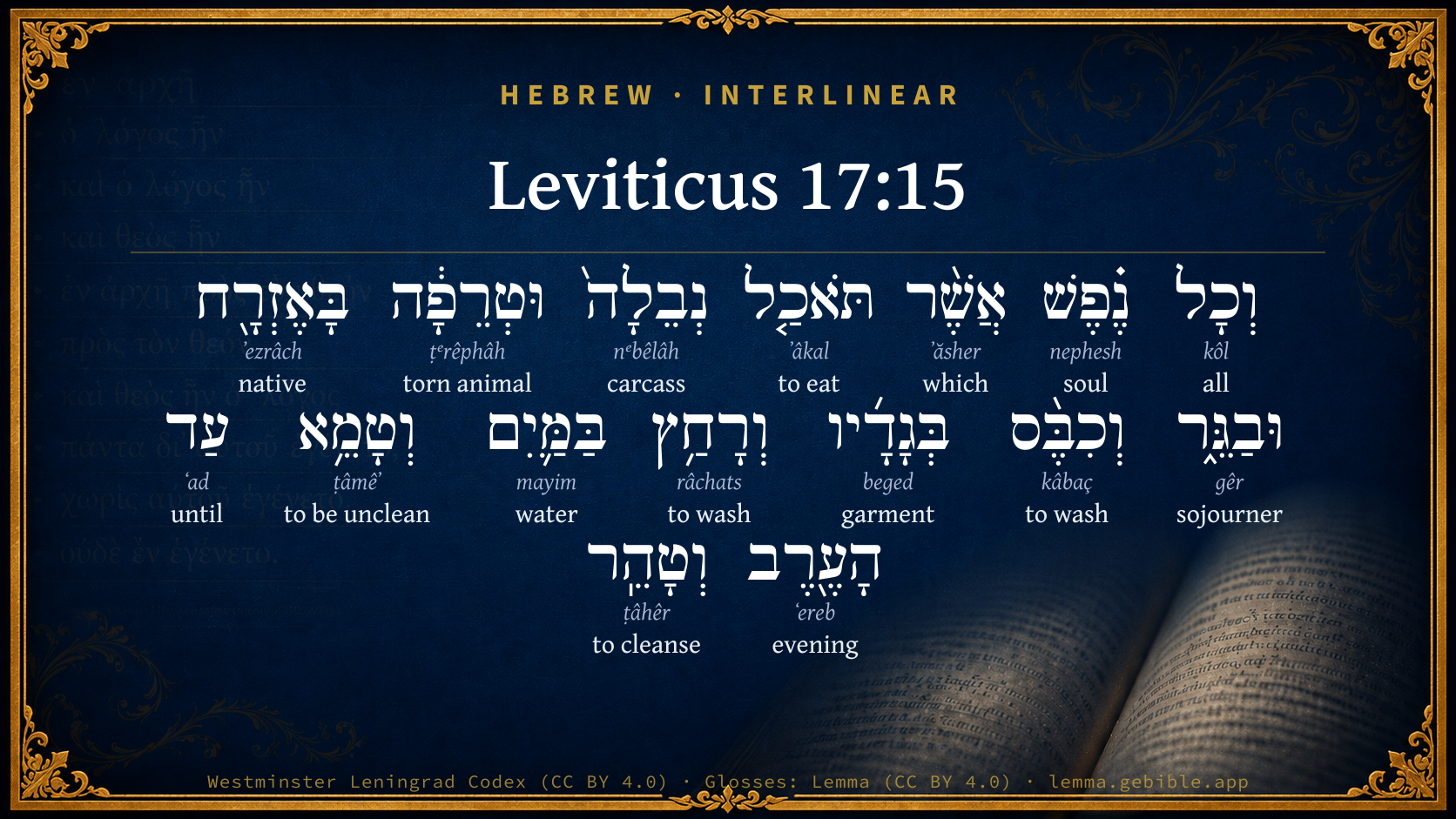
Hebrew (Westminster Leningrad Codex) Leviticus 17:15 appears in the Hebrew Old Testament. The text above is from the Westminster Leningrad Codex. Each word links to its Strong’s number, a concise gloss, and parsing drawn from the Open Scriptures Hebrew Bible morphology. Click any word for its full Brown-Driver-Briggs (BDB) entry.
Download image
Cite this verse

Leviticus 17:15 (World English Bible). Public Domain. Lemma interlinear Bible study tool, https://lemma.gebible.app/v/leviticus/17/15.

Show BibTeX & RIS
BibTeX
RIS
English Translation
"'Every person that eats what dies of itself, or that which is torn by animals, whether he is native-born or a foreigner, he shall wash his clothes, and bathe himself in water, and be unclean until the evening: then he shall be clean.
World English Bible · Public Domain
Download a study sheet

One document with this verse’s original text, its word-by-word gloss line, the meaning frame, cross-references with their text, attributed commentary, and full source and license credits — printable, and it pastes into notes with its structure intact.

This verse Autodidact and up

Study sheet (.html) Plain text (.txt)

A passage Seminary Student

Up to 50 verses in one chapter. A passage sheet keeps up to 6 commentary sources and 12 cross-references per verse, in the order this page ranks them, and says so on the sheet whenever that leaves anything out. Ask for a single verse and you get the Autodidact verse sheet above.

Everything on this page stays free to read, with no account — the sheet is a download of what is already on screen, not access to it.

Want to remove ads? Support Godless Engineer
Compare translations 3

The same verse in 3 English versions, stacked beneath the original-language interlinear above. Click any original word for its lexicon entry.

Each is an independent rendering of the whole verse — the interlinear is not word-aligned to these translations.

Highlighted words mark where these versions differ — a whole-verse word diff, not a word-by-word alignment.

  • World English Bible Public Domain
    "'Every person that eats what dies of itself, or that which is torn by animals, whether he is native-born or a foreigner, he shall wash his clothes, and bathe himself in water, and be unclean until the evening: then he shall be clean.
  • King James Version Public Domain
    And every soul that eateth that which died of itself, or that which was torn with beasts, whether it be one of your own country, or a stranger, he shall both wash his clothes, and bathe himself in water, and be unclean until the even: then shall he be clean.
  • unfoldingWord Literal Text CC BY-SA 4.0
    And any person who eats an carcass or a torn animal among the native-born or among the sojourner, then he shall wash his clothes, and he shall bathe in the water, and he will be unclean until the evening. Then he will be clean.

unfoldingWord Literal Text — © unfoldingWord, licensed CC BY-SA 4.0. Word-aligned USFM3 via Door43 (git.door43.org/unfoldingWord/en_ult).

Versions to compare (up to 4)

3 of 4 selected

Show all 18 translations

Every available English version of this verse, each an independent rendering of the whole verse.

  • World English Bible Public Domain
    "'Every person that eats what dies of itself, or that which is torn by animals, whether he is native-born or a foreigner, he shall wash his clothes, and bathe himself in water, and be unclean until the evening: then he shall be clean.
  • Berean Standard Bible Public Domain
    And any person, whether native or foreigner, who eats anything found dead or mauled by wild beasts must wash his clothes and bathe with water, and he will be unclean until evening; then he will be clean.
  • Majority Standard Bible Public Domain
    And any person, whether native or foreigner, who eats anything found dead or mauled by wild beasts must wash his clothes and bathe with water, and he will be unclean until evening; then he will be clean.
  • King James Version Public Domain
    And every soul that eateth that which died of itself, or that which was torn with beasts, whether it be one of your own country, or a stranger, he shall both wash his clothes, and bathe himself in water, and be unclean until the even: then shall he be clean.
  • American Standard Version (1901) Public Domain
    And every soul that eateth that which dieth of itself, or that which is torn of beasts, whether he be home-born or a sojourner, he shall wash his clothes, and bathe himself in water, and be unclean until the even: then shall he be clean.
  • Revised Version (1885) Public Domain
    And every soul that eateth that which dieth of itself, or that which is torn of beasts, whether he be homeborn or a stranger, he shall wash his clothes, and bathe himself in water, and be unclean until the even: then shall he be clean.
  • Geneva Bible (1599) Public Domain
    And euery person that eateth it which dyeth alone, or that which is torne with beastes, whether it be one of the same countrey or a stranger, he shall both wash his clothes, and wash himselfe in water, and be vncleane vnto the euen: after he shalbe cleane.
  • Douay-Rheims (1899) Public Domain
    The soul that eateth that which died of itself, or has been caught by a beast, whether he be one of your own country or a stranger, shall wash his clothes and himself with water, and shall be defiled until the evening: and in this manner he shall be made clean.
  • Young's Literal Translation Public Domain
    `And any person who eateth a carcase or torn thing, among natives or among sojourners -- hath both washed his garments, and hath bathed with water, and hath been unclean until the evening -- then he hath been clean;
  • Literal Standard Version CC BY-SA 4.0
    And any person who eats a carcass or torn thing, among natives or among sojourners, has washed his garments and bathed with water, and been unclean until the evening—then he has been clean;
  • Unlocked Literal Bible CC BY-SA 4.0
    Every person who eats an animal that has died or that has been torn by wild animals, whether that person is native born or a foreigner living among you, he must wash his clothes and bathe himself in water, and he will be unclean until the evening. Then he will be clean.
  • unfoldingWord Literal Text CC BY-SA 4.0
    And any person who eats an carcass or a torn animal among the native-born or among the sojourner, then he shall wash his clothes, and he shall bathe in the water, and he will be unclean until the evening. Then he will be clean.
  • Darby Bible Public Domain
    And every soul that eateth of a dead carcase, or of that which was torn, be it one home-born, or a stranger, he shall wash his clothes, and bathe in water, and be unclean until the even: then he shall be clean.
  • World Messianic Bible Public Domain
    “‘Every person that eats what dies of itself, or that which is torn by animals, whether he is native-born or a foreigner, shall wash his clothes, and bathe himself in water, and be unclean until the evening. Then he shall be clean.
  • Webster's Bible Public Domain
    And every soul that eateth that which died of itself, or that which was torn with beasts, (whether it is one of your own country, or a stranger) he shall both wash his clothes, and bathe himself in water, and be unclean until the evening; then shall he be clean.
  • Free Bible Version CC BY-SA 4.0
    Anyone, Israelite or foreigner, who eats anything found dead or killed by wild animals must wash their clothes and wash with water, and they will be unclean until the evening. Then they will be clean.
  • Bible in Basic English Public Domain
    And anyone who takes as food anything which has come to a natural end, or anything which has been put to death by beasts, if he is one of you by birth, or of another nation, will have to have his clothing washed and his body bathed in water and be unclean till evening, and then he will be clean.
  • JPS Tanakh (1917) Public Domain
    And every soul that eateth that which dieth of itself, or that which is torn of beasts, whether he be home-born or a stranger, he shall wash his clothes, and bathe himself in water, and be unclean until the even; then shall he be clean.

Literal Standard Version (2020), Covenant Press — licensed CC BY-SA 4.0. Text via the HelloAO Bible API (eBible.org). Unlocked Literal Bible (unfoldingWord) — licensed CC BY-SA 4.0. Text via the HelloAO Bible API (eBible.org). unfoldingWord Literal Text — © unfoldingWord, licensed CC BY-SA 4.0. Word-aligned USFM3 via Door43 (git.door43.org/unfoldingWord/en_ult). Free Bible Version, Dr. Jonathan Gallagher — licensed CC BY-SA 4.0. Text via the HelloAO Bible API (eBible.org).

Word by word

More ways to search: Search by grammar → Find every occurrence → Compare this word →

Practice this passage: Drill this verse → Learn its vocabulary →

וּטְרֵפָ֔ה
ṭᵉrêphâh
H2966
“and · torn animal”
Conjunction + Noun, Common, Feminine, Singular, Absolute
Part of Speech
Conjunction + Noun
Type
Common
Gender
Feminine
Number
Singular
State
Absolute
Full BDB Definition

Origin: from (collectively) H2964

TWOT: 827c

that which is torn, animal torn (by beasts)
  1. וְכָל kôl H3605 “and · all of” Conjunction + Noun, Common, Masculine, Singular, Construct
  2. נֶ֗פֶשׁ nephesh H5315 “soul” Noun, Common, Both, Singular, Absolute
  3. אֲשֶׁ֨ר ʼăsher H834 “which” Particle, Relative
  4. תֹּאכַ֤ל ʼâkal H398 “to eat” Verb, Qal, Imperfect, 3rd Person, Feminine, Singular
  5. נְבֵלָה֙ nᵉbêlâh H5038 “carcass” Noun, Common, Feminine, Singular, Absolute
  6. בָּאֶזְרָ֖ח ʼezrâch H249 “in/at the · native” Preposition, Determined + Noun, Common, Masculine, Singular, Absolute
  7. וּבַגֵּ֑ר gêr H1616 “and · in/at the · sojourner” Conjunction + Preposition, Determined + Noun, Common, Masculine, Singular, Absolute
  8. וְכִבֶּ֨ס kâbaç H3526 “and · to wash” Conjunction + Verb, Piel, Sequential Perfect, 3rd Person, Masculine, Singular
  9. בְּגָדָ֜יו beged H899 “garments · his” Noun, Common, Masculine, Plural, Construct + Suffix, Personal, 3rd Person, Masculine, Singular
  10. וְרָחַ֥ץ râchats H7364 “and · to wash” Conjunction + Verb, Qal, Sequential Perfect, 3rd Person, Masculine, Singular
  11. בַּמַּ֛יִם mayim H4325 “in/at the · water(s)” Preposition, Determined + Noun, Common, Masculine, Plural, Absolute
  12. וְטָמֵ֥א ṭâmêʼ H2930 “and · to be unclean” Conjunction + Verb, Qal, Sequential Perfect, 3rd Person, Masculine, Singular
  13. עַד ʻad H5704 “until” Preposition
  14. הָעֶ֖רֶב ʻereb H6153 “the · evening” Particle, Definite Article + Noun, Common, Masculine, Singular, Absolute
  15. וְטָהֵֽר ṭâhêr H2891 “and · to cleanse” Conjunction + Verb, Qal, Sequential Perfect, 3rd Person, Masculine, Singular

About this verse

These counts appear in no published source. They are computed here, from the morphology-tagged text and Lemma’s own curated glosses. What Lemma adds →

16
words
16
distinct lemmas
Pentateuch
section

Notable vocabulary

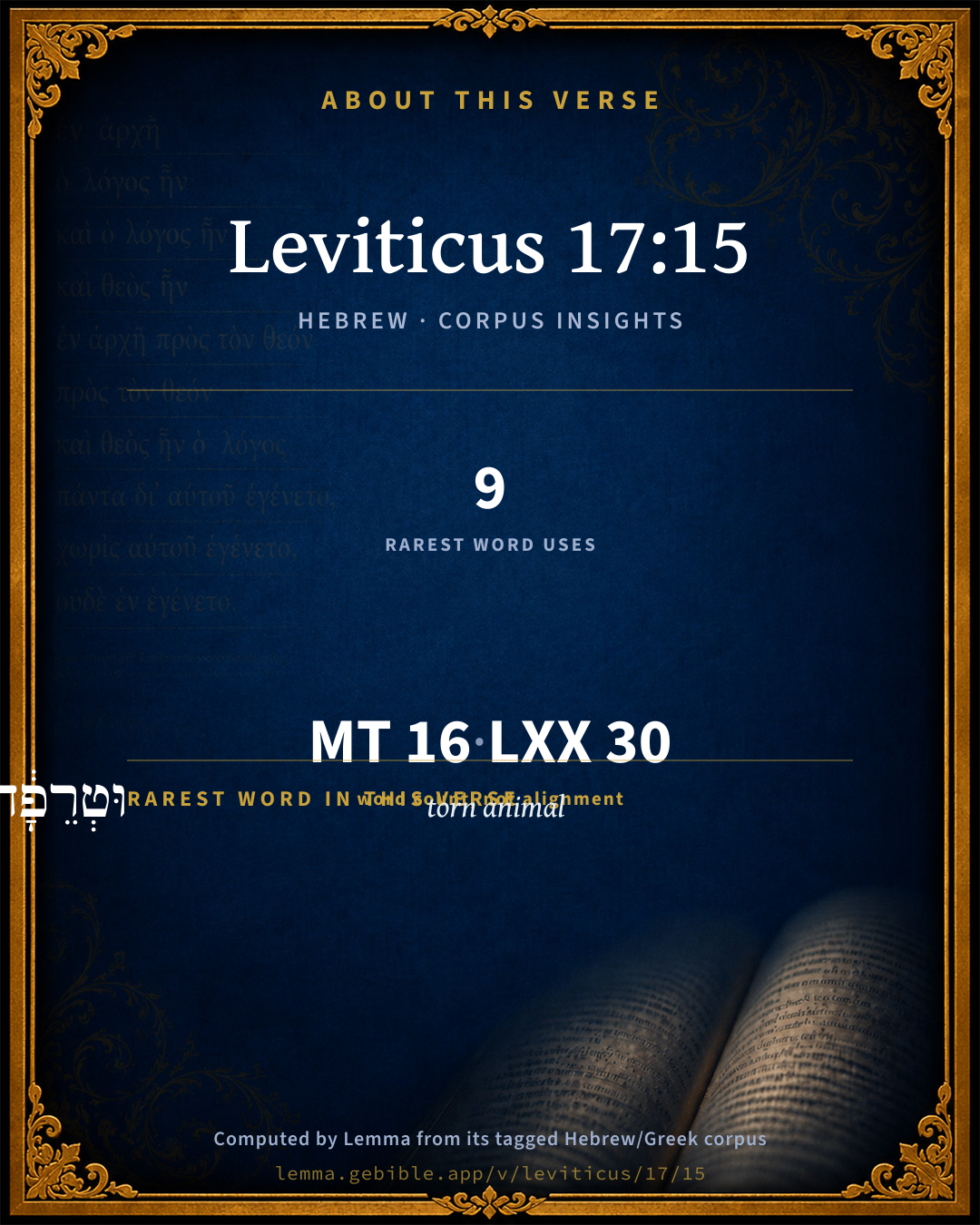
The rarest word here is וּטְרֵפָ֔ה torn animal H2966 — appearing just 9 times in the whole Hebrew Bible.

Shared distinctive vocabulary

וּטְרֵפָ֔ה torn animal H2966 occurs in 9 verses of the Hebrew Bible. Also found in:

Grammatical profile

  • 5 verbs
  • 9 nouns
  • 1 preposition
  • 1 particle

Verb forms

  • תֹּאכַ֤ל Qal · Imperfect
  • וְכִבֶּ֨ס Piel · Sequential Perfect
  • וְרָחַ֥ץ Qal · Sequential Perfect
  • וְטָמֵ֥א Qal · Sequential Perfect
  • וְטָהֵֽר Qal · Sequential Perfect

Hebrew & Septuagint length

In English translation the verse runs 43 words from the Hebrew and 44 from the Septuagint (LXX English) — closely comparable.

A rough comparison of the two English renderings, which tokenize alike — not a word-level alignment.

Word counts can differ between the Hebrew and the Greek without any difference in meaning — e.g. the Hebrew direct-object marker אֵת has no separate Greek word, and Greek often adds the article ὁ.

In the original languages it is 16 Hebrew tokens and 30 Greek tokens — but the two are counted differently (Hebrew bundles its prefixes and suffixes into one token; the Greek is in lemma form), so that isn’t a like-for-like length.

Cross-references

13

Topical passages linked to Leviticus 17:15 in the Treasury of Scripture Knowledge — connected by theme and wording, ordered by reader-vote popularity; previews shown in the World English Bible.

  • Exodus 22:31 "You shall be holy men to me, therefore you shall not eat any flesh that is torn by animals in the field. You shall cast it to the dogs.
  • Leviticus 22:8 That which dies of itself, or is torn by animals, he shall not eat, defiling himself by it. I am Yahweh.
  • Deuteronomy 14:21 You shall not eat of anything that dies of itself: you may give it to the foreigner living among you who is within your gates, that he may eat it; or you may sell it to a foreigner: for you are a holy people to Yahweh your God. You shall not boil a kid in its mother's milk.
  • Leviticus 11:25 Whoever carries any part of their carcass shall wash his clothes, and be unclean until the evening.
  • Leviticus 15:5 Whoever touches his bed shall wash his clothes, and bathe himself in water, and be unclean until the evening.
  • Ezekiel 4:14 Then said I, Ah Lord Yahweh! behold, my soul has not been polluted; for from my youth up even until now have I not eaten of that which dies of itself, or is torn of animals; neither came there abominable flesh into my mouth.
  • Ezekiel 44:31 The priests shall not eat of anything that dies of itself, or is torn, whether it be bird or animal.
  • Revelation 7:14 I told him, "My lord, you know." He said to me, "These are those who came out of the great tribulation. They washed their robes, and made them white in the Lamb's blood.
  • Leviticus 15:10 Whoever touches anything that was under him shall be unclean until the evening. He who carries those things shall wash his clothes, and bathe himself in water, and be unclean until the evening.
  • Leviticus 15:21 Whoever touches her bed shall wash his clothes, and bathe himself in water, and be unclean until the evening.
  • Numbers 19:8 He who burns her shall wash his clothes in water, and bathe his flesh in water, and shall be unclean until the even.
  • Numbers 19:19 and the clean person shall sprinkle on the unclean on the third day, and on the seventh day: and on the seventh day he shall purify him; and he shall wash his clothes, and bathe himself in water, and shall be clean at even.
  • Numbers 19:21 It shall be a perpetual statute to them: and he who sprinkles the water for impurity shall wash his clothes, and he who touches the water for impurity shall be unclean until even.

Cross-references courtesy of OpenBible.info (CC BY 4.0).

Hebrew and Greek witnesses Masoretic Hebrew ↔ Greek Septuagint

The same verse in the two great witnesses to the Old Testament, shown verse-for-verse.

These are two independent witnesses, not word-aligned to each other, and the Septuagint is shown in lemma (dictionary) form.

Hebrew Leviticus 17:15 Masoretic · Westminster Leningrad Codex

וְכָל נֶ֗פֶשׁ אֲשֶׁ֨ר תֹּאכַ֤ל נְבֵלָה֙ וּטְרֵפָ֔ה בָּאֶזְרָ֖ח וּבַגֵּ֑ר וְכִבֶּ֨ס בְּגָדָ֜יו וְרָחַ֥ץ בַּמַּ֛יִם וְטָמֵ֥א עַד הָעֶ֖רֶב וְטָהֵֽר

"'Every person that eats what dies of itself, or that which is torn by animals, whether he is native-born or a foreigner, he shall wash his clothes, and bathe himself in water, and be unclean until the evening: then he shall be clean.

World English Bible · Public Domain

Greek LXX Leviticus 17:15 Septuagint · lemma form

καί πᾶς ψυχή ὅστις ἐσθίω θνησιμαῖος ἤ θηριάλωτος ἐν ὁ αὐτόχθων ἤ ἐν ὁ προσήλυτος πλύνω ὁ ἱμάτιον αὐτός καί λούω ὕδωρ καί ἀκάθαρτος εἰμί ἕως ἑσπέρα καί καθαρός εἰμί

And every soul which eats that which has died of itself, or is taken of beasts, either among the natives or among the strangers, shall wash his garments, and bathe himself in water, and shall be unclean until evening: then shall he be clean.

LXX2012 (modern English Septuagint) · Public Domain

Hebrew: Westminster Leningrad Codex (CC BY 4.0). Greek: Septuagint (public domain); English from LXX2012 (modern English Septuagint) (Public Domain). How the Septuagint differs from the Hebrew →

Targum (Aramaic paraphrase)

2

The Targum is the ancient Jewish Aramaic paraphrase of the Hebrew Scriptures — an interpretive translation, not the Hebrew text itself. Onkelos (literal) and Pseudo-Jonathan (expansive) render the Torah, and Jonathan the Prophets. Coverage is partial: where no permissively-licensed English translation exists for a verse, only the Aramaic is shown. This is verse-level text, not a word-by-word alignment to the Hebrew.

  1. Targum Onkelos Torah (Genesis–Deuteronomy)
    וְכָל אֱנַשׁ דִי יֵיכוּל נְבִילָא וּתְבִירָא בְּיַצִיבָא וּבְגִיוֹרָא וִיצַבַּע לְבוּשׁוֹהִי וְיַסְחֵי בְמַיָא וִיהֵי מְסָאָב עַד רַמְשָׁא וְיִדְכֵּי

    (no public-domain English translation for this verse)

    Targum Onkelos — Aramaic: “Onkelos Genesis” (public domain); “Onkelos Exodus” (public domain); “Onkelos Leviticus” (public domain); “Onkelos Numbers” (public domain); “Onkelos Deuteronomy” (public domain). English: “Sefaria Community Translation” (CC0 1.0 (public-domain dedication)); “J.W. Etheridge. The Targums of Onkelos and Jonathan Ben Uzziel on the Pentateuch. London: Longmans, Green, 1862” (public domain). Text via Sefaria.

  2. Targum Pseudo-Jonathan Torah (Genesis–Deuteronomy)
    וְכָל בַּר נַשׁ דְיֵיכוֹל בִּיסְרָא דִמְטַלֵק בְּקִילְקוּל נִיכְסֵתָא וּבְשַר תְּבִירָא בְּיַצִיבָא וּבְגִיוֹרָא וִיצַבַּע לְבוּשׁוֹי וְיַסְחֵי בְּאַרְבְּעִין סָאוִוין דְמוֹי סָאוִוין וִיהֵי מְסָאָב עַד רַמְשָׁא וְיִדְכֵּי

    And any man who shall eat flesh which hath been thrown away on account of having been strangled (or corrupted), or the flesh of that which hath been torn, (any man,) whether native or sojourner, shall wash his clothes, and bathe in forty seahs of water, and be unclean until evening when he shall be clean;

    Targum Pseudo-Jonathan — Aramaic: “Targum Jonathan on Genesis” (public domain); “Targum Jonathan on Exodus” (public domain); “Targum Jonathan on Leviticus” (public domain); “Targum Jonathan on Numbers” (public domain); “Targum Jonathan on Deuteronomy” (public domain). English: “The Targum of Jonathan ben Uzziel, trans. J. W. Etheridge, London, 1862” (public domain). Text via Sefaria.

Commentary

Notes on Leviticus 17:15 from classic Christian and Jewish commentators (each source and its license shown beneath its notes). The classic Christian expositions comment on the surrounding passage and are grouped to its opening verse, so a note may address several verses; the Jewish commentaries on the Tanakh (Rashi and others) are per-verse, so they appear only where the commentator wrote on this verse.

Lemma curates 59 commentaries, every one of them public domain or Creative Commons licensed, each selected and text-cleaned for this edition rather than reprinted as found. About our sources →

Trapp's Complete Commentary

John Trapp

Lev 17:15 And every soul that eateth that which died [of itself], or that which was torn [with beasts, whether it be] one of your own country, or a stranger, he shall both wash his clothes, and bathe [himself] in water, and be unclean until the even: then shall he be clean.

Ver. 15. And every soul that eateth.] Ignorantly eateth.

John Trapp, A Commentary or Exposition upon All the Books of the Old and New Testament (1647–1656) — public domain. Text from a community e-Sword module.

Joseph Benson's Commentary

Lev 17:15. That eateth — Through ignorance or inadvertency; for if it was done knowingly, it was more severely punished. A stranger — Who is a proselyte to the Jewish religion: other strangers were allowed to eat such things, (Deu 14:21,) out of which the blood was either not drawn at all, or not regularly.

Joseph Benson's Commentary on the Old and New Testaments (1811–1818) — public domain. Text from a community e-Sword module.

Tyndale Open Study Notes

Tyndale Open Resources

17:15-16 An animal killed by a predator or which died of natural causes still had undrained blood in its tissues. This rendered it ceremonially unclean and a potential source of defilement (22:8). Israelites were to throw such an animal to the dogs (Exod 22:31) or give or sell it to a non-Israelite (Deut 14:21). If an Israelite happened to eat an animal with undrained blood, he or she became ceremonially unclean and had to wash in water. The uncleanness itself was not a sin, but neglect of the unclean state brought punishment.

Tyndale Open Study Notes — © Tyndale Open Resources, licensed CC BY-SA 4.0. Text via the HelloAO Bible API.

Geneva Bible (1599)

Geneva Bible translators

Or, counted clean.

Geneva Bible (1599) marginal notes — public domain. Text via Bolls.life.

Jamieson, Fausset & Brown

Robert Jamieson, A. R. Fausset & David Brown

every soul that eateth that which died of itself (Exo 22:31; Lev 7:24; Act 15:20),

be unclean until the even--that is, from the moment of his discovering his fault until the evening. This law, however, was binding only on an Israelite. (See Deu 14:21).

Next: Leviticus Chapter 18

Jamieson, Fausset & Brown — Commentary Critical and Explanatory on the Whole Bible (1871) — public domain (CC PDM 1.0). Text via the HelloAO Bible API.

Adam Clarke's Commentary

Verse 15. That which died of itself, or that which was torn] Because, in both cases, the blood was retained in the body; hence the council at Jerusalem forbade things strangled as well as blood, because in such beasts the blood was coagulated in the veins and arteries. See Ac 15:28-29.

Every thing considered, surely there is as little propriety in eating of blood as there is necessity to do it. They who will do otherwise must bear their iniquity. If blood eating be no offence, then they have no sin to answer for. The principal subjects of this chapter have been already so amply handled in the notes, that there is no need to add any thing by way of reflection or improvement.

Adam Clarke's Commentary on the Bible (1810–1826) — public domain. Text from a community e-Sword/MySword module.

Ellicott's Commentary for English Readers

(15) That which died of itself.—The law enacted here is a natural sequel to the one immediately preceding, since it is still based upon the sacredness of blood. As the body of the animal which either died a natural death, or has been torn by a wild beast, retains a great portion of its blood, it is forbidden to be eaten. The carcases, in which the blood has thus been coagulated in the veins and arteries, were given to the dogs (Exo_22:31). The rigour with which this law was enforced may be seen from 1Sa_14:32-35; Eze_4:14, Ezek. 46:36. According to the canonical law which obtained during the second Temple, the carcase was forbidden when the animal died a natural death, or met with an accident, or was strangled to death, or was torn by a wild beast. This explains the apostolic decision, in the council at Jerusalem, about “things strangled” (Act_15:20).

Whether it be one of your own country.—The law was not only binding upon the native Israelite, but upon the proselyte. The mere stranger, in the strict sense of the word, who had not joined the Jewish community, was allowed to eat such carcases. (See Deu_14:21.)

He shall both wash his clothes.—If he ate any of it unwittingly, he had not only to wash his garments, but immerse his whole body in water, and be excluded from the sanctuary till sundown. The sin offering prescribed in Lev_5:2 was not for inadvertently touching the carcase, but for neglecting the prescribed purification. (See Lev_5:2.)

A Bible Commentary for English Readers, edited by Charles John Ellicott (1878–1897) — public domain. Text from a community e-Sword module.

The Cambridge Bible for Schools and Colleges

gen. ed. J. J. S. Perowne

15. Cp. Lev_7:24, Lev_22:8; Deu_14:21 allowed the ‘stranger’ to eat that which ‘dieth of itself.’

The Cambridge Bible for Schools and Colleges (gen. ed. J. J. S. Perowne; Cambridge University Press, 1878–1918) — public domain. Text from a community e-Sword module.

John Gill's Exposition

And every soul that eateth that which died of itself,.... Through any disease upon it, or by means of any other creature seizing upon it and worrying it, or was not lawfully killed; if a man ate ever so little of it, even but the quantity of an olive, it was a breach of this law; which is connected with the preceding, there being a similarity between them, because such creatures must have their blood in them, not being regularly let out, and so eating of them would offend against the above law. It is very probable, as Grotius thinks, that Pythagoras took his notion from hence, and strictly enjoined his followers to abstain from all animals that died of themselves, as Laertius (n) and Aelianus (o) relate, and which Porphyry (p) suggests, was what universally obtained among men:

or that which was torn with beasts; though not dead, yet ready to die, and so unfit for food; See Gill on Exo 22:31,

whether it be one of your own country, or a stranger; a native of Israel, or a proselyte of righteousness; for as for any other stranger he might eat of it, Deu 14:22,

he shall both wash his clothes, and bathe himself in water; in forty seahs of water, as the Targum of Jonathan, dip himself all over:

and be unclean until the even; and so have no conversation with men in civil or religious things:

then shall he be clean; when he has washed his garments, and bathed himself, and the evening is come, and then shall be admitted to society as before: this is to be understood of one who ignorantly eats of the above things, not knowing them to be such; otherwise, if he did it presumptuously, he was to be punished.

(n) In Vit. Pythagor. l. 8. p. 588. (o) Var. Hist. l. 4. c. 17. (p) De Abstiuentia, l. 3. sect. 18.

John Gill's Exposition of the Whole Bible (1746–1763) — public domain (CC PDM 1.0). Text via the HelloAO Bible API.

Albert Barnes' Notes on the Bible

This law appears to be grounded on the fact that the body of an animal killed by a wild beast, or which has died of itself, still retains a great portion of its blood. The importance ascribed to this law in later times may be seen in 1Sa 14:32-35; Eze 4:14; Eze 44:31, and still more in the apostolic decision regarding “things strangled,” which are pointedly connected with blood Act 15:20.

Albert Barnes' Notes on the Bible (1834–1885) — public domain. Text from a community e-Sword/MySword module.

Haydock's Catholic Bible Commentary

Stranger. Perhaps the proselyte of justice, not simply of the gate, for the latter were allowed to eat and purchase what had died of itself, Deuteronomy xiv. 21. --- Clean, having offered the sacrifice, chap. iv. 27. But if he eat such things knowingly, or neglected these regulations, he was more severely punished. (Haydock)

George Leo Haydock (1774–1849), Haydock's Catholic Family Bible and Commentary, 1859 edition — public domain. Excludes Psalms (Douay-Rheims chapter numbering differs from Protestant) and Deuterocanonical books (Catholic canon only).

Matthew Poole's English Annotations

Every soul that eateth, to wit, through ignorance or inadvertency, as appears by the slightness of the punishment; for if it was done knowingly, it was a presumptuous sin against an express law here, and Deu 14:21, and therefore more severely punished. Or a stranger; understand of the proselytes; either of the proselytes of the gate, who were obliged to observe the precepts of Noah, whereof this was one; or of the proselytes of righteousness, or converts to the Jewish religion; for other strangers were allowed to eat such things, Deu 14:21.

Matthew Poole's English Annotations on the Holy Bible (1683–1685) — public domain. Text from a community e-Sword/MySword module.

Whedon's Commentary on the Bible

Daniel D. Whedon

15. Died of itself — Hebrew, carcass. The ground of this requirement, that one ignorantly eating such flesh should ceremonially cleanse himself, is that he has eaten blood corrupting in the flesh. The wilful eater of carrion would probably be cut off with the blood-eater.

Bathe himself in water — Hebrew, wash with water; the Seventy, υδατι, with water, as in Luk_3:16, “I baptize you υδατι;” also Act_1:5; Act_11:16. A heavy burden, indeed, and one utterly impossible in many instances to be borne, would be the requirement to bathe or immerse the entire person in water; but in any desert where men can live they can find sufficient water with which ceremonially to wash themselves. The same words are correctly translated “wash with water” in Lev_22:6.

Daniel D. Whedon (gen. ed.), Commentary on the Old and New Testaments (1874–1909) — public domain. Text from a community e-Sword module.

The Pulpit Commentary

Vers. 15, 16. There is still another possible case. The blood of an animal may not have been shed, or not shed in such a way as to make it flow abundantly, as when the animal has died a natural death, or been killed by wild beasts. In this case, as the blood still remains in the body, the flesh may not be eaten without defilement. The defilement may be cleansed by the unclean man washing his clothes and bathing, but if he neglect to do this, he shall bear his iniquity, that is, undergo the consequence of his transgression, which he would not have undergone had he been ceremonially cleansed. (cf. Exo_22:30 Lev_11:39 Deu_14:21) The prohibition of the eating of blood was continued by the Council of Jerusalem, but the observance of the regulation was no longer commanded as a duty binding on all men, but as a concession to Jewish feelings, enabling Jewish and Gentile converts to live together in comfort. (see 1Sa_14:32 Eze 33:35 Act_15:20)

The Pulpit Commentary (1880–1919), ed. H.D.M. Spence-Jones & Joseph S. Exell — public domain. Text from a community e-Sword module.

John Wesley's Explanatory Notes

That eateth - Through ignorance or inadvertency; for if it was done knowingly, it was more severely punished. A stranger - Who is a proselyte to the Jewish religion: other strangers were allowed to eat such things, Deut. xiv, 21, out of which the blood was either not drawn at all, or not regularly.

John Wesley, Explanatory Notes Upon the Whole Bible (1754–1765) — public domain. Text via the GEBible commentary corpus.

unfoldingWord translationNotes

Door43 World Missions Community

General Information:

Yahweh continues speaking.

that has been torn by wild animals

An animal being killed by wild animals is spoken of as if the wild animals tore the animal to pieces. This can be translated in active form. AT: "that wild animals have killed" (See: Metaphor and Active or Passive)

is native born

"is an Israelite"

he will be unclean ... Then he will be clean

The person whom other people may not touch is spoken of as if he were physically unclean and the person whom other people may touch is spoken of as if he were physically clean. (See: Metaphor)

until the evening

"until sunset"

then he must carry his guilt

A person's guilt is spoken of as if it were a physical object that the person carries. Here the word "guilt" represents the punishment for that guilt. AT: "then he is responsible for his own guilt" or "then I will punish him for his sin" (See: Metaphor and Metonymy)

translationWords

die

clean

clean

unfoldingWord translationNotes — © Distant Shores Media and the Door43 World Missions Community, licensed CC BY-SA 4.0. Source: git.door43.org/Door43/en_tn.

Rashi

Rabbi Shlomo Yitzchaki (Rashi)

אשר תאכל נבלה וטרפה [AND EVERY SOUL] THAT EATETH CARRION, OR THAT WHICH WAS TORN … [HE SHALL BOTH WASH HIS GARMENTS AND LAVE HIMSELF IN WATER] — Scripture is here speaking of the carrion of a clean bird which causes uncleanness only during the time it passes through the gullet (lit., it is being swallowed in the gullet) and what Scripture teaches you here is that it makes one unclean by eating of it [but it does not defile one by touching it]. The טרפה mentioned here (though being superfluous since a טרפה which died) is of course also a נבלה and thus causes uncleanness just as any other נבלה is mentioned only for the sake of the correct interpretation of the word נבלה. For thus we learn (in Sifra): One might think that the carrion of an unclean bird causes uncleanness in the moment it passes through the gullet! Scripture therefore adds the word טרפה to intimate that this law of נבלה applies only to that class of birds among which טרפה is possible, thus excluding unclean birds for in their class a רפה‎ט can never occur (Sifra, Acharei Mot, Chapter 12 7; Zevachim 69b).

Rashi on the Tanakh — English translations: “The Judaica Press complete Tanach with Rashi, translated by A. J. Rosenberg” (CC BY 4.0); “Pentateuch with Rashi's commentary by M. Rosenbaum and A.M. Silbermann, 1929-1934” (public domain); “The Metsudah Tanach series, Lakewood, N.J” (CC BY 4.0); and “The Book of Joshua, Metsudah Publications, 1997” (CC BY 4.0). Text via Sefaria.

Lesson kit

Teaching starters — assembled from the data on this page, not authored interpretation. Every prompt links to the verse data it draws on. Edit before teaching.

Leviticus, in the Pentateuch, opens this verse with 16 words (16 distinct Hebrew lemmas). Its most distinctive word is ṭᵉrêphâh (“torn animal”). A historical commentator’s framing appears above. Read the whole chapter for the surrounding context.

Discussion questions

  1. How does “torn animal” (ṭᵉrêphâh) shape what this verse is saying?
  2. Genesis 31:39 shares the word «torn animal» with this verse. How do the two illuminate each other?
  3. These translations render this verse differently. What is at stake in choosing one wording over another?
  4. The verb «תֹּאכַ֤ל» is Qal Imperfect. How does its form color the action?
  5. Reading how Trapp's Complete Commentary and Joseph Benson's Commentary read this verse, where do the two commentators agree and where do they part?

Things to notice

Reading settings

Reading text

Shown beneath each verse's original-language words.

Old Testament
Old Testament edition

Read the OT as the Masoretic Hebrew (MT) or the Greek Septuagint (LXX).

English shown for the Greek Septuagint (in the Hebrew ↔ Greek comparison).

Comparing translations? Open the Compare panel on any verse page to stack up to four side by side.