
Leviticus 13:6

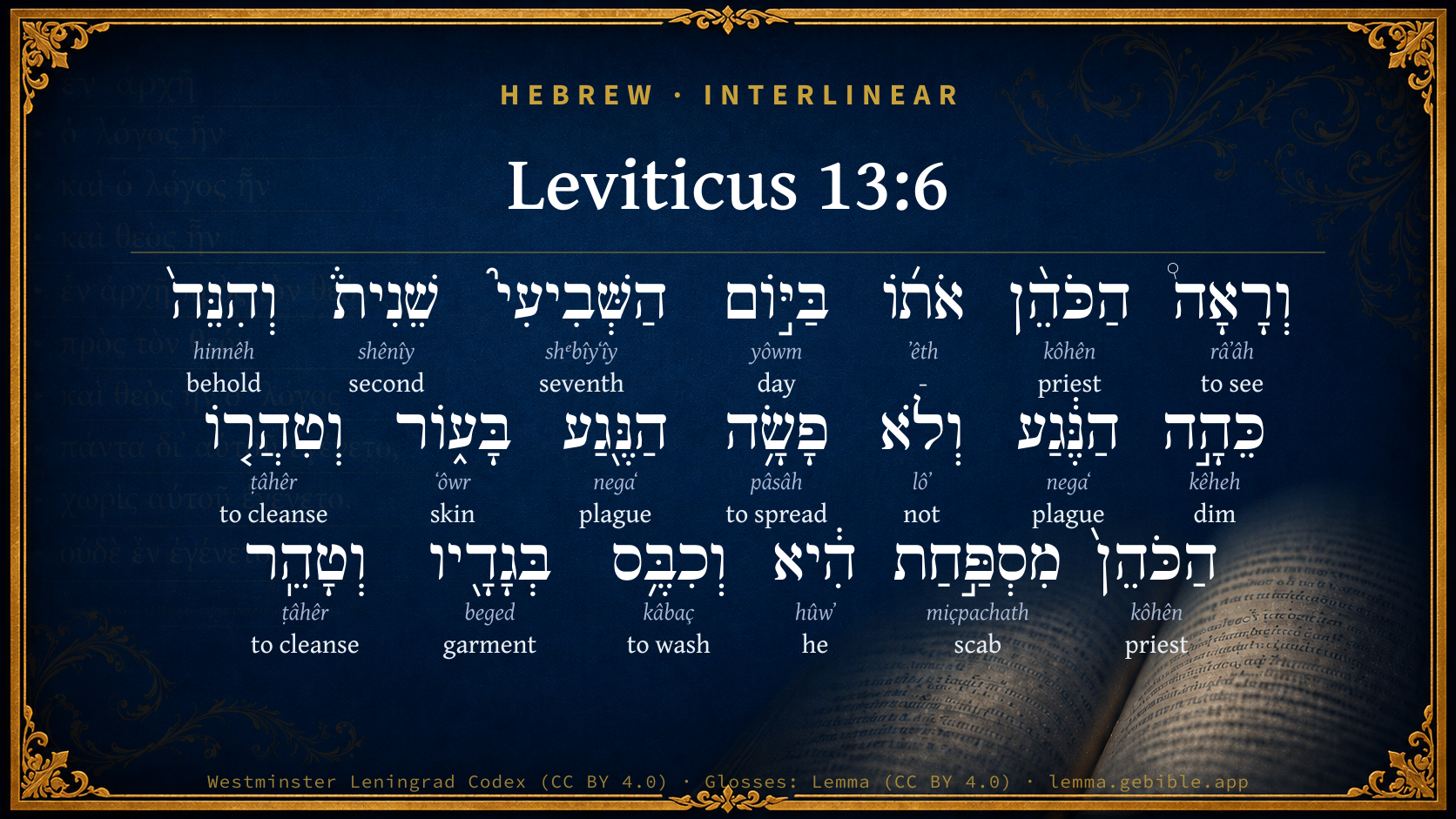
Hebrew (Westminster Leningrad Codex) Leviticus 13:6 appears in the Hebrew Old Testament. The text above is from the Westminster Leningrad Codex. Each word links to its Strong’s number, a concise gloss, and parsing drawn from the Open Scriptures Hebrew Bible morphology. Click any word for its full Brown-Driver-Briggs (BDB) entry.
Download image
Cite this verse

Leviticus 13:6 (World English Bible). Public Domain. Lemma interlinear Bible study tool, https://lemma.gebible.app/v/leviticus/13/6.

Show BibTeX & RIS
BibTeX
RIS
English Translation
The priest shall examine him again on the seventh day; and, behold, if the plague has faded, and the plague hasn't spread in the skin, then the priest shall pronounce him clean. It is a scab. He shall wash his clothes, and be clean.
World English Bible · Public Domain
Highlights
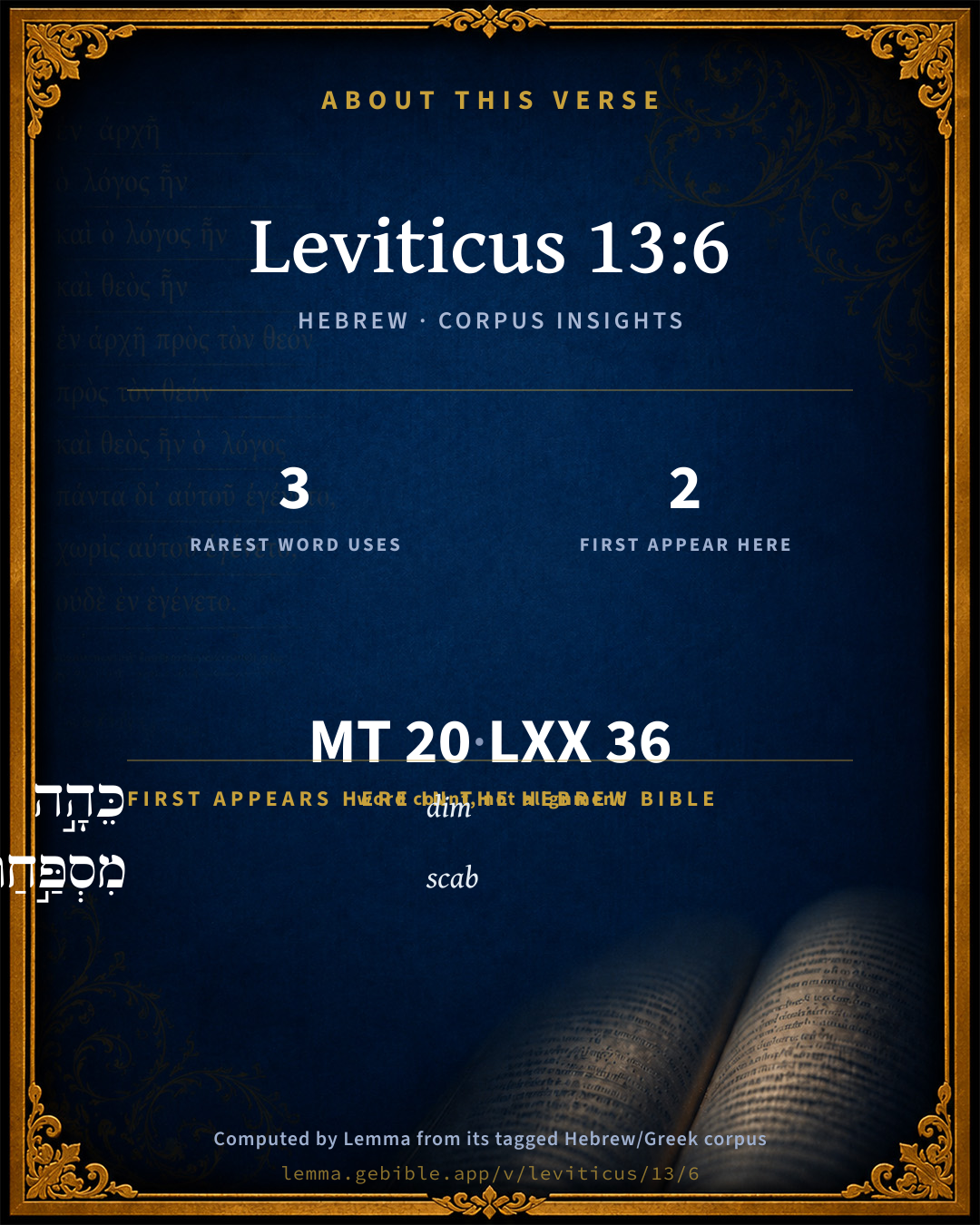
  • 2 first appearances in the Hebrew Bible
Full analysis ↓
Download a study sheet

One document with this verse’s original text, its word-by-word gloss line, the meaning frame, cross-references with their text, attributed commentary, and full source and license credits — printable, and it pastes into notes with its structure intact.

This verse Autodidact and up

Study sheet (.html) Plain text (.txt)

A passage Seminary Student

Up to 50 verses in one chapter. A passage sheet keeps up to 6 commentary sources and 12 cross-references per verse, in the order this page ranks them, and says so on the sheet whenever that leaves anything out. Ask for a single verse and you get the Autodidact verse sheet above.

Everything on this page stays free to read, with no account — the sheet is a download of what is already on screen, not access to it.

Want to remove ads? Support Godless Engineer
Compare translations 3

The same verse in 3 English versions, stacked beneath the original-language interlinear above. Click any original word for its lexicon entry.

Each is an independent rendering of the whole verse — the interlinear is not word-aligned to these translations.

Highlighted words mark where these versions differ — a whole-verse word diff, not a word-by-word alignment.

  • World English Bible Public Domain
    The priest shall examine him again on the seventh day; and, behold, if the plague has faded, and the plague hasn't spread in the skin, then the priest shall pronounce him clean. It is a scab. He shall wash his clothes, and be clean.
  • King James Version Public Domain
    And the priest shall look on him again the seventh day: and, behold, if the plague be somewhat dark, and the plague spread not in the skin, the priest shall pronounce him clean: it is but a scab: and he shall wash his clothes, and be clean.
  • unfoldingWord Literal Text CC BY-SA 4.0
    And the priest shall see him on the second seventh day, and behold, the infection has faded, and the infection has not spread on the skin. Then the priest shall pronounce him clean. It a scab, and he shall wash his clothes, and he will be clean.

unfoldingWord Literal Text — © unfoldingWord, licensed CC BY-SA 4.0. Word-aligned USFM3 via Door43 (git.door43.org/unfoldingWord/en_ult).

Versions to compare (up to 4)

3 of 4 selected

Show all 18 translations

Every available English version of this verse, each an independent rendering of the whole verse.

  • World English Bible Public Domain
    The priest shall examine him again on the seventh day; and, behold, if the plague has faded, and the plague hasn't spread in the skin, then the priest shall pronounce him clean. It is a scab. He shall wash his clothes, and be clean.
  • Berean Standard Bible Public Domain
    The priest will examine him again on the seventh day, and if the sore has faded and has not spread on the skin, the priest shall pronounce him clean; it is a rash. The person must wash his clothes and be clean.
  • Majority Standard Bible Public Domain
    The priest will examine him again on the seventh day, and if the sore has faded and has not spread on the skin, the priest shall pronounce him clean; it is a rash. The person must wash his clothes and be clean.
  • King James Version Public Domain
    And the priest shall look on him again the seventh day: and, behold, if the plague be somewhat dark, and the plague spread not in the skin, the priest shall pronounce him clean: it is but a scab: and he shall wash his clothes, and be clean.
  • American Standard Version (1901) Public Domain
    and the priest shall look on him again the seventh day; and, behold, if the plague be dim, and the plague be not spread in the skin, then the priest shall pronounce him clean: it is a scab: and he shall wash his clothes, and be clean.
  • Revised Version (1885) Public Domain
    and the priest shall look on him again the seventh day: and, behold, if the plague be dim, and the plague be not spread in the skin, then the priest shall pronounce him clean: it is a scab: and he shall wash his clothes, and be clean.
  • Geneva Bible (1599) Public Domain
    Then the Priest shall looke on him againe the seuenth day, and if the plague be darke, and the sore grow not in the skinne, then the Priest shall pronounce him cleane, for it is a skab: therefore he shall washe his clothes and be cleane.
  • Douay-Rheims (1899) Public Domain
    And on the seventh day, he shall look on him: if the leprosy be somewhat obscure, and not spread in the skin, he shall declare him clean, because it is but a scab: and the man shall wash his clothes, and shall be clean.
  • Young's Literal Translation Public Domain
    `And the priest hath seen him on the second seventh day, and lo, the plague is become weak, and the plague hath not spread in the skin -- and the priest hath pronounced him clean, it `is' a scab, and he hath washed his garments, and hath been clean.
  • Literal Standard Version CC BY-SA 4.0
    And the priest has seen him on the second seventh day, and behold, the plague has faded, and the plague has not spread in the skin, and the priest has pronounced him clean; it [is] a scab, and he has washed his garments, and has been clean.
  • Unlocked Literal Bible CC BY-SA 4.0
    The priest will examine him again on the seventh day to see if the disease is better and has not spread farther in the skin. If it has not, then the priest will pronounce him clean. It is a rash. He must wash his clothes, and then he is clean.
  • unfoldingWord Literal Text CC BY-SA 4.0
    And the priest shall see him on the second seventh day, and behold, the infection has faded, and the infection has not spread on the skin. Then the priest shall pronounce him clean. It a scab, and he shall wash his clothes, and he will be clean.
  • Darby Bible Public Domain
    And the priest shall look on him again the seventh day, and behold, the sore is become pale and the sore hath not spread in the skin, then the priest shall pronounce him clean; it is a scab; and he shall wash his garments and be clean.
  • World Messianic Bible Public Domain
    The priest shall examine him again on the seventh day. Behold, if the plague has faded and the plague hasn’t spread in the skin, then the priest shall pronounce him clean. It is a scab. He shall wash his clothes, and be clean.
  • Webster's Bible Public Domain
    And the priest shall look on him again the seventh day: and behold, if the plague is somewhat dark, and the plague spreadeth not in the skin, the priest shall pronounce him clean: it is but a scab: and he shall wash his clothes, and be clean.
  • Free Bible Version CC BY-SA 4.0
    On the seventh day after this the priest will inspect it again. If the spot has faded and has not spread on the skin, the priest will declare the person clean since it was a rash. They must wash their clothes and will be clean.
  • Bible in Basic English Public Domain
    And the priest is to see him again on the seventh day; and if the mark is less bright and is not increased on his skin, then let the priest say that he is clean: it is only a skin-mark, and after his clothing has been washed he will be clean.
  • JPS Tanakh (1917) Public Domain
    And the priest shall look on him again the seventh day; and, behold, if the plague be dim, and the plague be not spread in the skin, then the priest shall pronounce him clean: it is a scab; and he shall wash his clothes, and be clean.

Literal Standard Version (2020), Covenant Press — licensed CC BY-SA 4.0. Text via the HelloAO Bible API (eBible.org). Unlocked Literal Bible (unfoldingWord) — licensed CC BY-SA 4.0. Text via the HelloAO Bible API (eBible.org). unfoldingWord Literal Text — © unfoldingWord, licensed CC BY-SA 4.0. Word-aligned USFM3 via Door43 (git.door43.org/unfoldingWord/en_ult). Free Bible Version, Dr. Jonathan Gallagher — licensed CC BY-SA 4.0. Text via the HelloAO Bible API (eBible.org).

Word by word

More ways to search: Search by grammar → Find every occurrence → Compare this word →

Practice this passage: Drill this verse → Learn its vocabulary →

מִסְפַּ֣חַת
miçpachath
H4556
“scab”
Noun, Common, Feminine, Singular, Absolute
Part of Speech
Noun
Type
Common
Gender
Feminine
Number
Singular
State
Absolute
Full BDB Definition

Origin: from H5596

TWOT: 1534b

eruption, scab
  1. וְרָאָה֩ râʼâh H7200 “and · to see” Conjunction + Verb, Qal, Sequential Perfect, 3rd Person, Masculine, Singular
  2. הַכֹּהֵ֨ן kôhên H3548 “the · priest” Particle, Definite Article + Noun, Common, Masculine, Singular, Absolute
  3. אֹת֜וֹ ʼêth H853 “- · him” Particle, Direct Object + Suffix, Personal, 3rd Person, Masculine, Singular
  4. בַּיּ֣וֹם yôwm H3117 “in/at the · day” Preposition, Determined + Noun, Common, Masculine, Singular, Absolute
  5. הַשְּׁבִיעִי֮ shᵉbîyʻîy H7637 “the · seventh” Particle, Definite Article + Adjective, Ordinal number, Masculine, Singular, Absolute
  6. שֵׁנִית֒ shênîy H8145 “second” Adjective, Ordinal number, Feminine, Singular, Absolute
  7. וְהִנֵּה֙ hinnêh H2009 “and · behold” Conjunction + Particle, Demonstrative
  8. כֵּהָ֣ה kêheh H3544 “dim” Verb, Piel, Perfect, 3rd Person, Masculine, Singular
  9. הַנֶּ֔גַע negaʻ H5061 “the · plague” Particle, Definite Article + Noun, Common, Masculine, Singular, Absolute
  10. וְלֹא lôʼ H3808 “and · not” Conjunction + Particle, Negative
  11. פָשָׂ֥ה pâsâh H6581 “to spread” Verb, Qal, Perfect, 3rd Person, Masculine, Singular
  12. הַנֶּ֖גַע negaʻ H5061 “the · plague” Particle, Definite Article + Noun, Common, Masculine, Singular, Absolute
  13. בָּע֑וֹר ʻôwr H5785 “in/at the · skin” Preposition, Determined + Noun, Common, Masculine, Singular, Absolute
  14. וְטִהֲר֤וֹ ṭâhêr H2891 “and · to cleanse · him” Conjunction + Verb, Piel, Sequential Perfect, 3rd Person, Masculine, Singular + Suffix, Personal, 3rd Person, Masculine, Singular
  15. הַכֹּהֵן֙ kôhên H3548 “the · priest” Particle, Definite Article + Noun, Common, Masculine, Singular, Absolute
  16. הִ֔יא hûwʼ H1931 “he” Pronoun, Personal, 3rd Person, Feminine, Singular
  17. וְכִבֶּ֥ס kâbaç H3526 “and · to wash” Conjunction + Verb, Piel, Sequential Perfect, 3rd Person, Masculine, Singular
  18. בְּגָדָ֖יו beged H899 “garments · his” Noun, Common, Masculine, Plural, Construct + Suffix, Personal, 3rd Person, Masculine, Singular
  19. וְטָהֵֽר ṭâhêr H2891 “and · to cleanse” Conjunction + Verb, Qal, Sequential Perfect, 3rd Person, Masculine, Singular

About this verse

These counts appear in no published source. They are computed here, from the morphology-tagged text and Lemma’s own curated glosses. What Lemma adds →

20
words
17
distinct lemmas
Pentateuch
section

Notable vocabulary

The rarest word here is מִסְפַּ֣חַת scab H4556 — appearing just 3 times in the whole Hebrew Bible.

First appearance in Scripture

These words make their first canonical appearance in the Hebrew Bible here:

  • כֵּהָ֣ה dim H3544
  • מִסְפַּ֣חַת scab H4556

Shared distinctive vocabulary

מִסְפַּ֣חַת scab H4556 occurs in 3 verses of the Hebrew Bible. Also found in:

Grammatical profile

  • 6 verbs
  • 8 nouns
  • 2 adjectives
  • 1 pronoun
  • 3 particles

Verb forms

  • וְרָאָה֩ Qal · Sequential Perfect
  • כֵּהָ֣ה Piel · Perfect
  • פָשָׂ֥ה Qal · Perfect
  • וְטִהֲר֤וֹ Piel · Sequential Perfect
  • וְכִבֶּ֥ס Piel · Sequential Perfect
  • וְטָהֵֽר Qal · Sequential Perfect

Repetition

Words recur within this verse — often emphatic in Hebrew:

  • הַכֹּהֵ֨ן priest H3548 ×2
  • הַנֶּ֔גַע plague H5061 ×2
  • וְטִהֲר֤וֹ to cleanse H2891 ×2

Hebrew & Septuagint length

In English translation the verse runs 44 words from the Hebrew and 53 from the Septuagint (LXX English) — closely comparable.

A rough comparison of the two English renderings, which tokenize alike — not a word-level alignment.

Word counts can differ between the Hebrew and the Greek without any difference in meaning — e.g. the Hebrew direct-object marker אֵת has no separate Greek word, and Greek often adds the article ὁ.

In the original languages it is 20 Hebrew tokens and 36 Greek tokens — but the two are counted differently (Hebrew bundles its prefixes and suffixes into one token; the Greek is in lemma form), so that isn’t a like-for-like length.

Cross-references

21

Topical passages linked to Leviticus 13:6 in the Treasury of Scripture Knowledge — connected by theme and wording, ordered by reader-vote popularity; previews shown in the World English Bible.

  • Leviticus 11:25 Whoever carries any part of their carcass shall wash his clothes, and be unclean until the evening.
  • Leviticus 14:8 "He who is to be cleansed shall wash his clothes, and shave off all his hair, and bathe himself in water; and he shall be clean. After that he shall come into the camp, but shall dwell outside his tent seven days.
  • Leviticus 11:28 He who carries their carcass shall wash his clothes, and be unclean until the evening. They are unclean to you.
  • Leviticus 11:40 He who eats of its carcass shall wash his clothes, and be unclean until the evening. He also who carries its carcass shall wash his clothes, and be unclean until the evening.
  • Leviticus 13:2 "When a man shall have a rising in his body's skin, or a scab, or a bright spot, and it becomes in the skin of his body the plague of leprosy, then he shall be brought to Aaron the priest, or to one of his sons the priests:
  • Deuteronomy 32:5 They have dealt corruptly with him, [they are] not his children, [it is] their blemish; [They are] a perverse and crooked generation.
  • 1 Kings 8:38 whatever prayer and supplication be made by any man, [or] by all your people Israel, who shall know every man the plague of his own heart, and spread forth his hands toward this house:
  • 1 Kings 8:45 then hear in heaven their prayer and their supplication, and maintain their cause.
  • Psalms 19:12 Who can discern his errors? Forgive me from hidden errors.
  • Proverbs 20:9 Who can say, "I have made my heart pure. I am clean and without sin?"
  • Ecclesiastes 7:20 Surely there is not a righteous man on earth, who does good and doesn't sin.
  • Isaiah 11:3–4 His delight shall be in the fear of Yahweh; and he shall not judge after the sight of his eyes, neither decide after the hearing of his ears;
  • Isaiah 42:3 A bruised reed will he not break, and a dimly burning wick will he not quench: he will bring forth justice in truth.
  • John 13:8–10 Peter said to him, "You will never wash my feet!" Jesus answered him, "If I don't wash you, you have no part with me."
  • Romans 14:1 Now receive one who is weak in faith, but not for disputes over opinions.
  • 2 Corinthians 7:1 Having therefore these promises, beloved, let us cleanse ourselves from all defilement of flesh and spirit, perfecting holiness in the fear of God.
  • Hebrews 9:10 being only (with meats and drinks and various washings) fleshly ordinances, imposed until a time of reformation.
  • Hebrews 10:22 let's draw near with a true heart in fullness of faith, having our hearts sprinkled from an evil conscience, and having our body washed with pure water,
  • James 3:2 For in many things we all stumble. If anyone doesn't stumble in word, the same is a perfect man, able to bridle the whole body also.
  • 1 John 1:7–9 But if we walk in the light, as he is in the light, we have fellowship with one another, and the blood of Jesus Christ, his Son, cleanses us from all sin.
  • Jude 1:22–23 On some have compassion, making a distinction,

Cross-references courtesy of OpenBible.info (CC BY 4.0).

Hebrew and Greek witnesses Masoretic Hebrew ↔ Greek Septuagint

The same verse in the two great witnesses to the Old Testament, shown verse-for-verse.

These are two independent witnesses, not word-aligned to each other, and the Septuagint is shown in lemma (dictionary) form.

Hebrew Leviticus 13:6 Masoretic · Westminster Leningrad Codex

וְרָאָה֩ הַכֹּהֵ֨ן אֹת֜וֹ בַּיּ֣וֹם הַשְּׁבִיעִי֮ שֵׁנִית֒ וְהִנֵּה֙ כֵּהָ֣ה הַנֶּ֔גַע וְלֹא פָשָׂ֥ה הַנֶּ֖גַע בָּע֑וֹר וְטִהֲר֤וֹ הַכֹּהֵן֙ מִסְפַּ֣חַת הִ֔יא וְכִבֶּ֥ס בְּגָדָ֖יו וְטָהֵֽר

The priest shall examine him again on the seventh day; and, behold, if the plague has faded, and the plague hasn't spread in the skin, then the priest shall pronounce him clean. It is a scab. He shall wash his clothes, and be clean.

World English Bible · Public Domain

Greek LXX Leviticus 13:6 Septuagint · lemma form

καί ὁράω αὐτός ὁ ἱερεύς ὁ ἡμέρα ὁ ἕβδομος ὁ δεύτερος καί ἰδού ἀμαυρός ὁ ἁφή οὐ μεταπίπτω ὁ ἁφή ἐν ὁ δέρμα καθαρίζω αὐτός ὁ ἱερεύς σημασία γάρ εἰμί καί πλύνω ὁ ἱμάτιον καθαρός εἰμί

And the priest shall look upon him the second time on the seventh day; and, behold, if the spot be dark, and the spot have not spread in the skin, then the priest shall pronounce him clean; for it is a mere mark, and the man shall wash his garments and be clean.

LXX2012 (modern English Septuagint) · Public Domain

Hebrew: Westminster Leningrad Codex (CC BY 4.0). Greek: Septuagint (public domain); English from LXX2012 (modern English Septuagint) (Public Domain). How the Septuagint differs from the Hebrew →

Targum (Aramaic paraphrase)

2

The Targum is the ancient Jewish Aramaic paraphrase of the Hebrew Scriptures — an interpretive translation, not the Hebrew text itself. Onkelos (literal) and Pseudo-Jonathan (expansive) render the Torah, and Jonathan the Prophets. Coverage is partial: where no permissively-licensed English translation exists for a verse, only the Aramaic is shown. This is verse-level text, not a word-by-word alignment to the Hebrew.

  1. Targum Onkelos Torah (Genesis–Deuteronomy)
    וְיֶחֱזֵי כַהֲנָא יָתֵהּ בְּיוֹמָא שְׁבִיעָאָה תִּנְיָנוּת וְהָא עַמְיָא מַכְתָּשָׁא וְלָא אוֹסֵף מַכְתָּשָׁא בְּמַשְׁכָּא וִידַכִּנֵהּ כַּהֲנָא עֲדִיתָא הִיא וִיצַבַּע לְבוּשׁוֹהִי וְיִדְכֵּי

    (no public-domain English translation for this verse)

    Targum Onkelos — Aramaic: “Onkelos Genesis” (public domain); “Onkelos Exodus” (public domain); “Onkelos Leviticus” (public domain); “Onkelos Numbers” (public domain); “Onkelos Deuteronomy” (public domain). English: “Sefaria Community Translation” (CC0 1.0 (public-domain dedication)); “J.W. Etheridge. The Targums of Onkelos and Jonathan Ben Uzziel on the Pentateuch. London: Longmans, Green, 1862” (public domain). Text via Sefaria.

  2. Targum Pseudo-Jonathan Torah (Genesis–Deuteronomy)
    וְיֶחֱמֵי כַּהֲנָא יָתֵיהּ בְּיוֹמָא שְׁבִיעָאָה תִּנְיָנוּת וְהָא עַמְיָא מַכְתָּשָׁא לָא הֲלִיךְ פִּסְיוֹנָא דְמַכְתָּשָׁא בְּמַשְׁכָא וִידַכִּינֵיהּ כַּהֲנָא קְלוּפֵי מִטַפְלָא הוּא וְיִצְבַּע לְבוּשׁוֹי וְיִדְכֵּי

    And the priest shall inspect him the second seventh day; and, behold, if the plague hath become darker, and hath not gone wider in the skin, the priest shall make him to be clean; it is an obstinate sore, and he shall wash his clothes and be clean.

    Targum Pseudo-Jonathan — Aramaic: “Targum Jonathan on Genesis” (public domain); “Targum Jonathan on Exodus” (public domain); “Targum Jonathan on Leviticus” (public domain); “Targum Jonathan on Numbers” (public domain); “Targum Jonathan on Deuteronomy” (public domain). English: “The Targum of Jonathan ben Uzziel, trans. J. W. Etheridge, London, 1862” (public domain). Text via Sefaria.

Commentary

Notes on Leviticus 13:6 from classic Christian and Jewish commentators (each source and its license shown beneath its notes). The classic Christian expositions comment on the surrounding passage and are grouped to its opening verse, so a note may address several verses; the Jewish commentaries on the Tanakh (Rashi and others) are per-verse, so they appear only where the commentator wrote on this verse.

Lemma curates 59 commentaries, every one of them public domain or Creative Commons licensed, each selected and text-cleaned for this edition rather than reprinted as found. About our sources →

Trapp's Complete Commentary

John Trapp

Lev 13:6 And the priest shall look on him again the seventh day: and, behold, [if] the plague [be] somewhat dark, [and] the plague spread not in the skin, the priest shall pronounce him clean: it [is but] a scab: and he shall wash his clothes, and be clean.

Ver. 6. It is but a scab.] Such as may be "the spot of God’s children." {Deu 32:5} Sin makes wicked men the object of God’s hatred, the saints of his pity; as we hate poison in a toad, but we pity it in a man.

And he shall wash his clothes.] The best cannot wash in innocency; he must therefore wash in tears. {Isa 1:16} God also will set in and wash such with the blood of his Son.

John Trapp, A Commentary or Exposition upon All the Books of the Old and New Testament (1647–1656) — public domain. Text from a community e-Sword module.

Joseph Benson's Commentary

Lev 13:6. Dark — Contrary to the white colour of the leprosy. But the word may be rendered, have contracted itself, and thus the opposition seems to be most clear to the spreading of itself. He shall wash his clothes — Though it was no leprosy, to teach us, that no sin is so small as not to need to be washed by the blood of Christ, which was the thing designed by all these washings.

Joseph Benson's Commentary on the Old and New Testaments (1811–1818) — public domain. Text from a community e-Sword module.

Geneva Bible (1599)

Geneva Bible translators

Hebrew, shall cleanse him.

As having the skin drawn together, or blackish.

Geneva Bible (1599) marginal notes — public domain. Text via Bolls.life.

Ellicott's Commentary for English Readers

(6) And the priest shall look on him again.—If, on further examination at the end of another week, the priest finds that the bright spot looks darker, and that it has not spread, he is to pronounce the patient clean, and set him at liberty, since it was simply an ordinary scurf; but though not leprous, the eruption indicated some impurity in his blood, and he had therefore to wash his garments.

A Bible Commentary for English Readers, edited by Charles John Ellicott (1878–1897) — public domain. Text from a community e-Sword module.

John Gill's Exposition

And the priest shall look on him again the seventh day,.... On the second seventh day, at the end of a fortnight from his being first presented to him, and shut up:

and, behold, if the plague be somewhat dark; the spot be not so bright, or so white as it was at first; though Aben Ezra observes, that indeed many wise men say, that is as signifying dark, and the testimony or proof they bring is Gen 27:1 but according to my opinion, adds he, the word is the reverse of to spread; and the sense is, if the plague does not spread itself in another place; and so some translators render it "contracted", or "contracts itself" (h): and this seems best to agree with what follows:

and the plague spread not in the skin; but is as it was when first viewed, after waiting fourteen days, and making observations on it:

the priest shall pronounce him clean; that is, from leprosy, otherwise there was an impure disorder on him, a scabious one:

it is but a scab; which is the name, Jarchi says, of a clean plague or stroke, that is, in comparison of the leprosy, otherwise such cannot be said with any propriety to be clean. Ben Gersom better explains it, it is a white scab, but not of the kind of leprosy, although it is found as the whiteness of the bright spot; but there are not seen in it the signs of leprosy, the hair is not turned white, nor has the plague increased:

and he shall wash his clothes, and be clean; for seeing he was obliged to be shut up, as Jarchi observes, he is called unclean, and stood in need of dipping, that is, his body and his clothes into water; so the people of God, though they are justified by the righteousness of Christ, and are pronounced clean through it, yet since they have their spots and scabs, they have need to have their conversation garments continually washed in the blood of the Lamb.

(h) "contracta est", Junius & Tremellius, Piscator; "contraxerit sese", some in Vatablus.

John Gill's Exposition of the Whole Bible (1746–1763) — public domain (CC PDM 1.0). Text via the HelloAO Bible API.

Albert Barnes' Notes on the Bible

Somewhat dark - Rather, somewhat dim: that is, if the spot is dying away.

Albert Barnes' Notes on the Bible (1834–1885) — public domain. Text from a community e-Sword/MySword module.

Haydock's Catholic Bible Commentary

Obscure. Some translate the Hebrew "retired," with the Syriac and Arabic versions. --- Scab, "an ebullition," or pustule. (Theodoret; St. Jerome in Nah. ii.) --- Clothes, and himself. See Chap. xi. 40.

George Leo Haydock (1774–1849), Haydock's Catholic Family Bible and Commentary, 1859 edition — public domain. Excludes Psalms (Douay-Rheims chapter numbering differs from Protestant) and Deuterocanonical books (Catholic canon only).

Matthew Poole's English Annotations

If the plague be somewhat dark; which is opposed to the white colour of the leprosy. But the word may be rendered, have contracted itself, or, be restrained or confined to its former place and bigness; and thus the opposition seems to be most clear to the spreading of itself, mentioned both in the foregoing verse, and in the following clause.

He shall wash his clothes, though it was no leprosy, but a scab only; to teach us, that no sin was so small which did not need to be washed by the blood of Christ, which was the thing designed by all these washings.

Matthew Poole's English Annotations on the Holy Bible (1683–1685) — public domain. Text from a community e-Sword/MySword module.

Whedon's Commentary on the Bible

Daniel D. Whedon

6. Pronounce him clean — Ceremonially pure, though he may have other loathsome diseases, and be morally vile. The action of the priest, literally translated, is, to make him clean, as in the third verse he is to make the leper unclean. In both cases the action is declarative and not causative or judicial. This suggests the proper meaning of the apostolic binding and loosing in Mat_16:19, and the remitting and retaining of sins in Joh_20:23.

He shall wash his clothes — “As the very cause that had led to his being suspected showed that there was some impurity in his blood, a slight purification was prescribed, the moral effect of which would naturally be to teach that the very appearance of evil is an adequate ground of humiliation to any one that fears God.” — Bush.

Daniel D. Whedon (gen. ed.), Commentary on the Old and New Testaments (1874–1909) — public domain. Text from a community e-Sword module.

John Wesley's Explanatory Notes

Dark - Contrary to the white colour of the leprosy. But the word may be rendered, have contracted itself, and thus the opposition seems to be most clear as the spreading of itself. He shall wash his clothes - Though it was no leprosy, to teach us, that no sin is so small as not to need to be washed by the blood of Christ, which was the thing designed by all these washings.

John Wesley, Explanatory Notes Upon the Whole Bible (1754–1765) — public domain. Text via the GEBible commentary corpus.

Rashi

Rabbi Shlomo Yitzchaki (Rashi)

כֵּהֶה means it has become paler than its former color — consequently if it remains in its color or if it has spread he is unclean.

מספחת — This is the name of a clean leprous disease.

וכבס את בגדיו וטהר AND HE SHALL WASH HIS GARMENTS AND BE CLEAN — Since he required shutting up he was termed (was regarded as coming under the term) “unclean” (although it now transpires that he was clean), and he must undergo immersion in a ritual bath.

Rashi on the Tanakh — English translations: “The Judaica Press complete Tanach with Rashi, translated by A. J. Rosenberg” (CC BY 4.0); “Pentateuch with Rashi's commentary by M. Rosenbaum and A.M. Silbermann, 1929-1934” (public domain); “The Metsudah Tanach series, Lakewood, N.J” (CC BY 4.0); and “The Book of Joshua, Metsudah Publications, 1997” (CC BY 4.0). Text via Sefaria.

Ramban (Nachmanides)

Rabbi Moshe ben Nachman (Ramban / Nachmanides)

AND THE PRIEST SHALL SEE HIM A SECOND TIME THE SEVENTH DAY, AND BEHOLD, IF THE PLAGUE BE ‘KEIHAH’ (DIM), AND THE PLAGUE BE NOT SPREAD IN THE SKIN, THE PRIEST SHALL PRONOUNCE HIM CLEAN. Rashi commented: “Keihah means it has become paler (plague) is masculine, and keihah (pale) is in the feminine, the word keihah cannot be an adjective to nega [meaning: “if the plague is pale”]. Instead, it must mean, as Rashi points out, “if the plague has become pale,” serving as a verb. than its [former] color. [This allows the inference] that if the plague remains in its former color and has not extended in the skin, he is impure.”This indeed is the sense of the verse. But the interpretation of our Rabbis is not so, for we have been taught in the Mishnah: “To cause to be put in quarantine [for a second week] such a plague which continues unchanged at the end of the first week; to pronounce pure such a plague which continues unchanged by the end of the second week.” And in the Torath Kohanim the Rabbis have expressly said that in the case of garments, if the plague is at a stay at the end of the first week, they are to be put in quarantine [for a second week], and if it be at a stay at the end of the second week, they are to be burnt; but in the case of a person, if the plague be at a stay at the end of the first week the priest is to put him in quarantine for another week, but if at the end of the second week it is still at a stay he is to pronounce him pure. And in Tractate Megillah the Rabbis have further said: “This excludes a leper who has been put in quarantine for a week, whose state of leprosy is determined not by his bodily condition, but merely by days.” ). Now if it were necessary that the plague should become dim, then his purity would be dependent upon his bodily condition! Rashi himself explained it there in such language, saying that the leper’s purity is not dependent on the physical state of the plague, for if at the end of seven days a symptom of impurity — white hair or extension of the plague — is not found, the priest is to pronounce him pure although the plague has stayed in its appearance, that is at the end of the second week.. The discussion here relates only to the end of the second week.Rather, this is what the Sages said: at the end of the second week, whether the plague has paled from the color of snow to [the shade of white of] the lime used in the Sanctuary, or like the white of an egg’s membrane, or even if it has become stronger, namely, that it was at first like the lime [used in the Sanctuary] and then [at the end of the second week] it had become bright-white like snow, and all the more so if it remained in its original color — as long as it did not spread in the skin, the priest pronounces it pure. If so, the interpretation of this verse is as follows: “if the plague be ‘keihah,’ meaning that it has turned into the color of another plague, such as from that of snow to that of lime, since it has not spread in the skin, the priest shall pronounce him clean; it is but a scab.” For in order that one should not say, “since the plague has changed into the color of another plague it must be inspected from anew,” Scripture therefore expressly taught that he is deemed pure. The same law applies if the color became stronger, since Scripture has already taught you that a change from color to color is not a symptom of impurity, but rather is considered as if it is at a stay, and as long as it did not spread in the skin [the afflicted person] is pure. Should you ask: “But why did Scripture not mention expressly the case of a change to a stronger color [as being pure], and we would know that this is all the more so if it became paler?” [The answer is that Scripture] came to teach you that although it became paler, if it spread in the skin he is nevertheless impure. Now the meaning of the word keihah is that the plague has become paler, changing to one of the colors of leprosy-signs, such as from that of snow to that of an egg’s membrane, which can still be a leprosy-sign. But if it has become paler than the colors of leprosy-signs, in that case the person is already healed, and there is no longer a plague; thus even a spreading thereof no longer renders him impure at all. In a similar manner to this presentation has it been explained in the Torath Kohanim.

Ramban (Nachmanides) on the Tanakh — English translation: “Commentary on the Torah by Ramban (Nachmanides). Translated and annotated by Charles B. Chavel. New York, Shilo Pub. House, 1971-1976” (CC BY 4.0). Text via Sefaria.

Lesson kit

Teaching starters — assembled from the data on this page, not authored interpretation. Every prompt links to the verse data it draws on. Edit before teaching.

Leviticus, in the Pentateuch, opens this verse with 20 words (17 distinct Hebrew lemmas). Its most distinctive word is miçpachath (“scab”). A historical commentator’s framing appears above. Read the whole chapter for the surrounding context.

Discussion questions

  1. How does “scab” (miçpachath) shape what this verse is saying?
  2. 2 words here appear for the first time in Scripture. What is being introduced at this debut?
  3. Leviticus 13:7 shares the word «scab» with this verse. How do the two illuminate each other?
  4. “priest” occurs 2× in this one verse. What is the effect of the repetition?
  5. These translations render this verse differently. What is at stake in choosing one wording over another?
  6. The verb «וְרָאָה֩» is Qal Sequential Perfect. How does its form color the action?
  7. Reading how Trapp's Complete Commentary and Joseph Benson's Commentary read this verse, where do the two commentators agree and where do they part?

Things to notice

Reading settings

Reading text

Shown beneath each verse's original-language words.

Old Testament
Old Testament edition

Read the OT as the Masoretic Hebrew (MT) or the Greek Septuagint (LXX).

English shown for the Greek Septuagint (in the Hebrew ↔ Greek comparison).

Comparing translations? Open the Compare panel on any verse page to stack up to four side by side.