
Leviticus 15:11

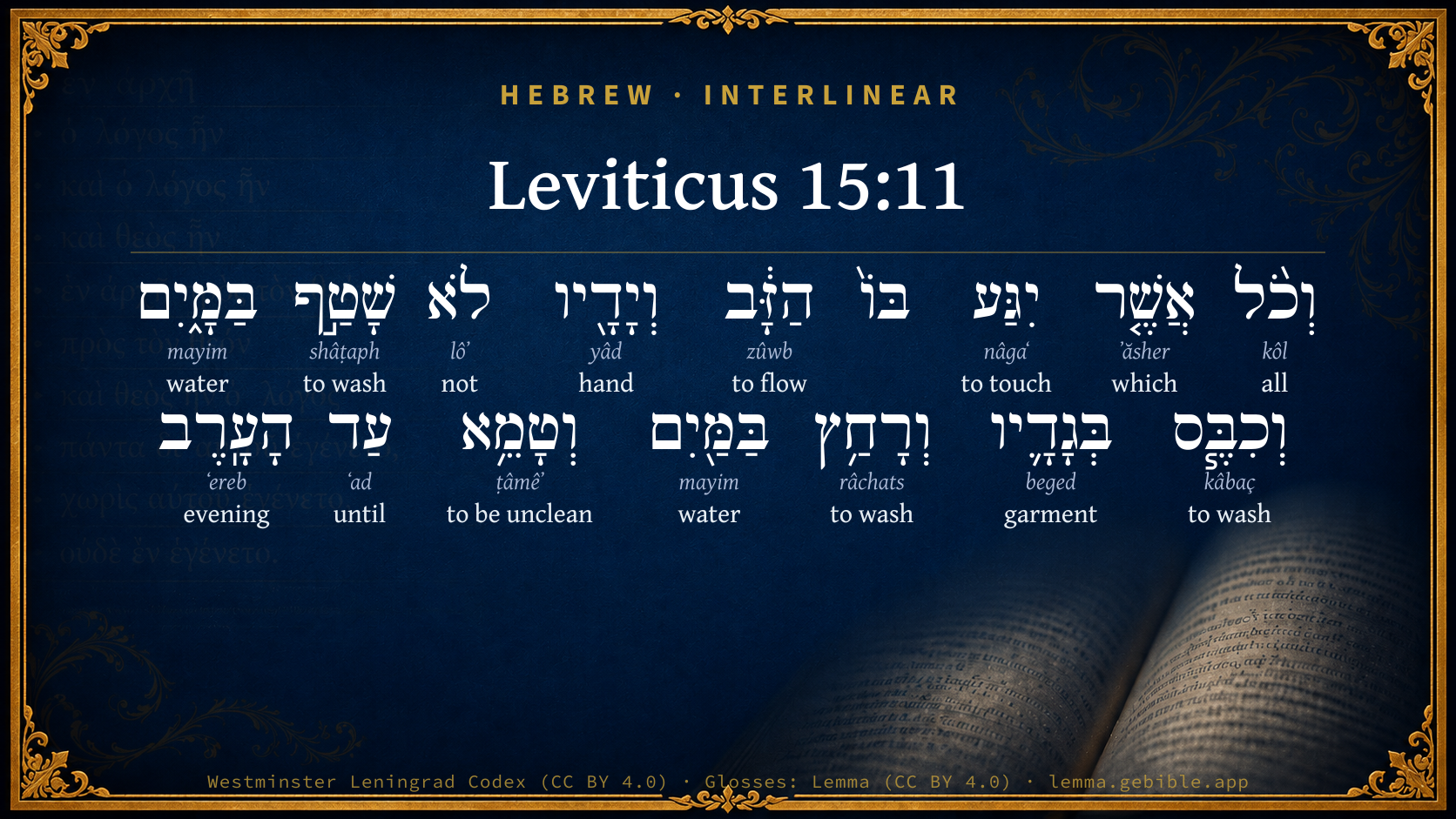
Hebrew (Westminster Leningrad Codex) Leviticus 15:11 appears in the Hebrew Old Testament. The text above is from the Westminster Leningrad Codex. Each word links to its Strong’s number, a concise gloss, and parsing drawn from the Open Scriptures Hebrew Bible morphology. Click any word for its full Brown-Driver-Briggs (BDB) entry.
Download image
Cite this verse

Leviticus 15:11 (World English Bible). Public Domain. Lemma interlinear Bible study tool, https://lemma.gebible.app/v/leviticus/15/11.

Show BibTeX & RIS
BibTeX
RIS
English Translation
"'Whoever he who has the discharge touches, without having rinsed his hands in water, he shall wash his clothes, and bathe himself in water, and be unclean until the evening.
World English Bible · Public Domain
Download a study sheet

One document with this verse’s original text, its word-by-word gloss line, the meaning frame, cross-references with their text, attributed commentary, and full source and license credits — printable, and it pastes into notes with its structure intact.

This verse Autodidact and up

Study sheet (.html) Plain text (.txt)

A passage Seminary Student

Up to 50 verses in one chapter. A passage sheet keeps up to 6 commentary sources and 12 cross-references per verse, in the order this page ranks them, and says so on the sheet whenever that leaves anything out. Ask for a single verse and you get the Autodidact verse sheet above.

Everything on this page stays free to read, with no account — the sheet is a download of what is already on screen, not access to it.

Want to remove ads? Support Godless Engineer
Compare translations 3

The same verse in 3 English versions, stacked beneath the original-language interlinear above. Click any original word for its lexicon entry.

Each is an independent rendering of the whole verse — the interlinear is not word-aligned to these translations.

Highlighted words mark where these versions differ — a whole-verse word diff, not a word-by-word alignment.

  • World English Bible Public Domain
    "'Whoever he who has the discharge touches, without having rinsed his hands in water, he shall wash his clothes, and bathe himself in water, and be unclean until the evening.
  • King James Version Public Domain
    And whomsoever he toucheth that hath the issue, and hath not rinsed his hands in water, he shall wash his clothes, and bathe himself in water, and be unclean until the even.
  • unfoldingWord Literal Text CC BY-SA 4.0
    And anyone whom the flowing touches and he does not rinse his hands in water, then he shall wash his clothes, and he shall bathe in water, and he shall be unclean until the evening.

unfoldingWord Literal Text — © unfoldingWord, licensed CC BY-SA 4.0. Word-aligned USFM3 via Door43 (git.door43.org/unfoldingWord/en_ult).

Versions to compare (up to 4)

3 of 4 selected

Show all 18 translations

Every available English version of this verse, each an independent rendering of the whole verse.

  • World English Bible Public Domain
    "'Whoever he who has the discharge touches, without having rinsed his hands in water, he shall wash his clothes, and bathe himself in water, and be unclean until the evening.
  • Berean Standard Bible Public Domain
    If the man with the discharge touches anyone without first rinsing his hands with water, the one who was touched must wash his clothes and bathe with water, and he will be unclean until evening.
  • Majority Standard Bible Public Domain
    If the man with the discharge touches anyone without first rinsing his hands with water, the one who was touched must wash his clothes and bathe with water, and he will be unclean until evening.
  • King James Version Public Domain
    And whomsoever he toucheth that hath the issue, and hath not rinsed his hands in water, he shall wash his clothes, and bathe himself in water, and be unclean until the even.
  • American Standard Version (1901) Public Domain
    And whomsoever he that hath the issue toucheth, without having rinsed his hands in water, he shall wash his clothes, and bathe himself in water, and be unclean until the even.
  • Revised Version (1885) Public Domain
    And whomsoever he that hath the issue toucheth, without having rinsed his hands in water, he shall wash his clothes, and bathe himself in water, and be unclean until the even.
  • Geneva Bible (1599) Public Domain
    Likewise whomesoeuer hee toucheth that hath the issue (and hath not washed his handes in water) shall wash his clothes and wash himselfe in water, and shalbe vncleane vntill the euen.
  • Douay-Rheims (1899) Public Domain
    Every person whom such a one shall touch, not having washed his hands before, shall wash his clothes: and being washed with water, shall be unclean until the evening.
  • Young's Literal Translation Public Domain
    `And anyone against whom he cometh who hath the issue (and his hands hath not rinsed with water) hath even washed his garments, and bathed with water, and been unclean till the evening.
  • Literal Standard Version CC BY-SA 4.0
    And anyone against whom he who has the discharging comes (and has not rinsed his hands with water) has even washed his garments, and bathed with water, and been unclean until the evening.
  • Unlocked Literal Bible CC BY-SA 4.0
    Whomever he who has such a flow touches without first having rinsed his hands in water, the person who was touched must wash his clothes and bathe himself in water, and he will be unclean until evening.
  • unfoldingWord Literal Text CC BY-SA 4.0
    And anyone whom the flowing touches and he does not rinse his hands in water, then he shall wash his clothes, and he shall bathe in water, and he shall be unclean until the evening.
  • Darby Bible Public Domain
    And whomsoever he toucheth who hath the flux and hath not rinsed his hands in water -- he shall wash his garments, and bathe in water, and be unclean until the even.
  • World Messianic Bible Public Domain
    “‘Whomever he who has the discharge touches, without having rinsed his hands in water, he shall wash his clothes, and bathe himself in water, and be unclean until the evening.
  • Webster's Bible Public Domain
    And whomsoever he toucheth that hath the issue (and hath not rinsed his hands in water) he shall wash his clothes, and bathe himself in water, and be unclean until the evening.
  • Free Bible Version CC BY-SA 4.0
    If the man with the discharge touches anyone without washing his hands with water first, the person who was touched has to wash their clothes, and wash themselves with water, and they will be unclean until the evening.
  • Bible in Basic English Public Domain
    And anyone on whom the unclean man puts his hands, without washing them in water, is to have his clothing washed and his body bathed in water and be unclean till evening.
  • JPS Tanakh (1917) Public Domain
    And whomsoever he that hath the issue toucheth, without having rinsed his hands in water, he shall wash his clothes, and bathe himself in water, and be unclean until the even.

Literal Standard Version (2020), Covenant Press — licensed CC BY-SA 4.0. Text via the HelloAO Bible API (eBible.org). Unlocked Literal Bible (unfoldingWord) — licensed CC BY-SA 4.0. Text via the HelloAO Bible API (eBible.org). unfoldingWord Literal Text — © unfoldingWord, licensed CC BY-SA 4.0. Word-aligned USFM3 via Door43 (git.door43.org/unfoldingWord/en_ult). Free Bible Version, Dr. Jonathan Gallagher — licensed CC BY-SA 4.0. Text via the HelloAO Bible API (eBible.org).

Word by word

More ways to search: Search by grammar → Find every occurrence → Compare this word →

Practice this passage: Drill this verse → Learn its vocabulary →

שָׁטַ֣ף
shâṭaph
H7857
“to wash”
Verb, Qal, Perfect, 3rd Person, Masculine, Singular
Part of Speech
Verb
Stem
Qal
Form
Perfect
Person
3rd Person
Gender
Masculine
Number
Singular
Full BDB Definition

Origin: a primitive root

TWOT: 2373

to wash, rinse, overflow, engulf, rinse or wash off - (Qal) - to overflow - to flow, run - to rinse or wash off - (Niphal) to be swept away, be rinsed out - (Pual) to be rinsed, be scoured and rinsed
  1. וְכֹ֨ל kôl H3605 “and · all” Conjunction + Noun, Common, Masculine, Singular, Absolute
  2. אֲשֶׁ֤ר ʼăsher H834 “which” Particle, Relative
  3. יִגַּע nâgaʻ H5060 “to touch” Verb, Qal, Imperfect, 3rd Person, Masculine, Singular
  4. הַזָּ֔ב zûwb H2100 “the · flowing” Particle, Definite Article + Verb, Qal, Participle Active, Masculine, Singular, Absolute
  5. וְיָדָ֖יו yâd H3027 “and · hands · his” Conjunction + Noun, Common, Both, Dual, Construct + Suffix, Personal, 3rd Person, Masculine, Singular
  6. לֹא lôʼ H3808 “not” Particle, Negative
  7. בַּמָּ֑יִם mayim H4325 “in/at the · water(s)” Preposition, Determined + Noun, Common, Masculine, Plural, Absolute
  8. וְכִבֶּ֧ס kâbaç H3526 “and · to wash” Conjunction + Verb, Piel, Sequential Perfect, 3rd Person, Masculine, Singular
  9. בְּגָדָ֛יו beged H899 “garments · his” Noun, Common, Masculine, Plural, Construct + Suffix, Personal, 3rd Person, Masculine, Singular
  10. וְרָחַ֥ץ râchats H7364 “and · to wash” Conjunction + Verb, Qal, Sequential Perfect, 3rd Person, Masculine, Singular
  11. בַּמַּ֖יִם mayim H4325 “in/at the · water(s)” Preposition, Determined + Noun, Common, Masculine, Plural, Absolute
  12. וְטָמֵ֥א ṭâmêʼ H2930 “and · to be unclean” Conjunction + Verb, Qal, Sequential Perfect, 3rd Person, Masculine, Singular
  13. עַד ʻad H5704 “until” Preposition
  14. הָעָֽרֶב ʻereb H6153 “the · evening” Particle, Definite Article + Noun, Common, Masculine, Singular, Absolute

About this verse

These counts appear in no published source. They are computed here, from the morphology-tagged text and Lemma’s own curated glosses. What Lemma adds →

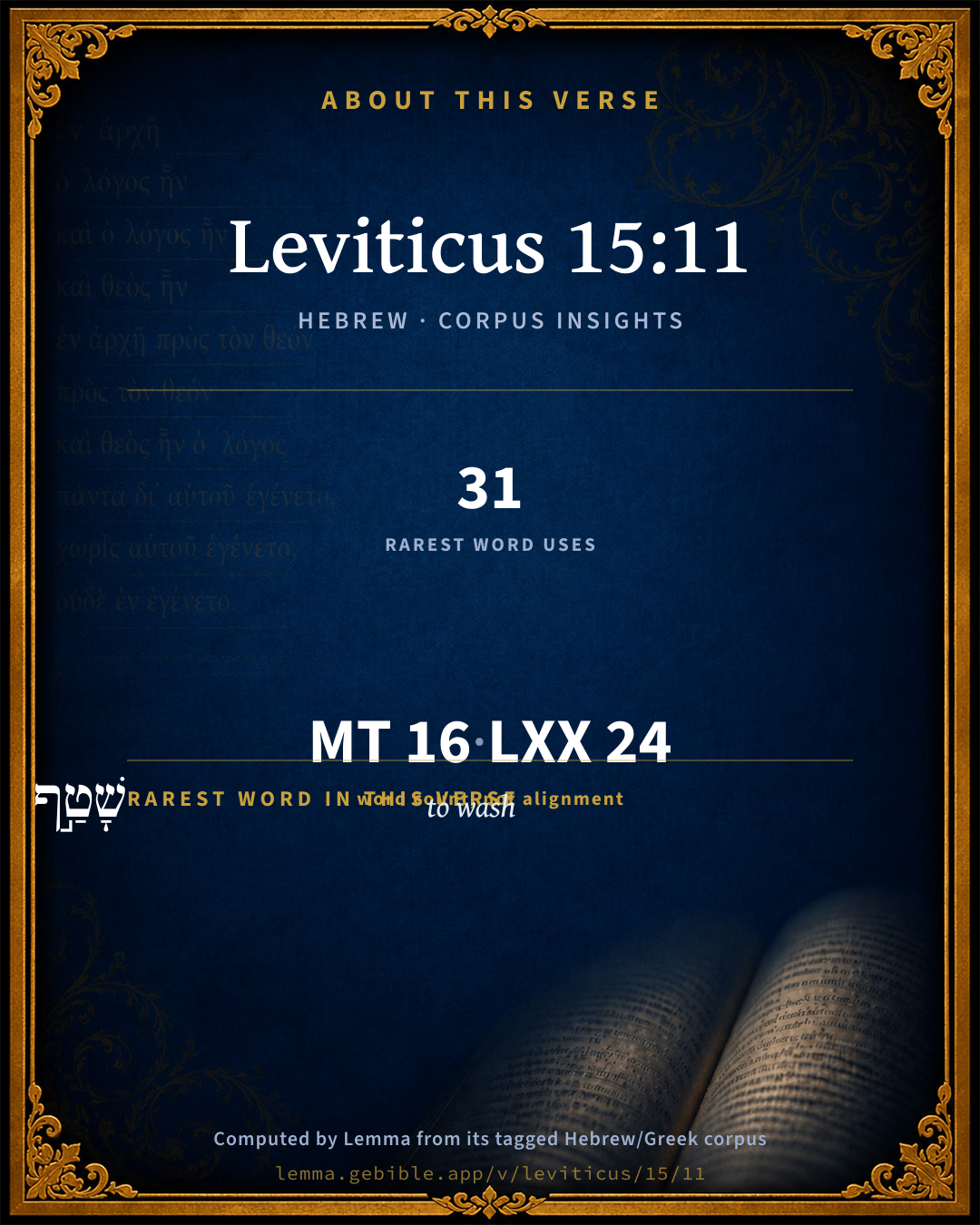
16
words
14
distinct lemmas
Pentateuch
section

Shared distinctive vocabulary

שָׁטַ֣ף to wash H7857 occurs in 30 verses of the Hebrew Bible. Also found in:

Grammatical profile

  • 6 verbs
  • 6 nouns
  • 2 prepositions
  • 2 particles

Verb forms

  • יִגַּע Qal · Imperfect
  • הַזָּ֔ב Qal · Participle Active
  • שָׁטַ֣ף Qal · Perfect
  • וְכִבֶּ֧ס Piel · Sequential Perfect
  • וְרָחַ֥ץ Qal · Sequential Perfect
  • וְטָמֵ֥א Qal · Sequential Perfect

Repetition

A word recurs within this verse — often emphatic in Hebrew:

  • בַּמָּ֑יִם water H4325 ×2

Hebrew & Septuagint length

In English translation the verse runs 30 words from the Hebrew and 35 from the Septuagint (LXX English) — closely comparable.

A rough comparison of the two English renderings, which tokenize alike — not a word-level alignment.

Word counts can differ between the Hebrew and the Greek without any difference in meaning — e.g. the Hebrew direct-object marker אֵת has no separate Greek word, and Greek often adds the article ὁ.

In the original languages it is 16 Hebrew tokens and 24 Greek tokens — but the two are counted differently (Hebrew bundles its prefixes and suffixes into one token; the Greek is in lemma form), so that isn’t a like-for-like length.

Hebrew and Greek witnesses Masoretic Hebrew ↔ Greek Septuagint

The same verse in the two great witnesses to the Old Testament, shown verse-for-verse.

These are two independent witnesses, not word-aligned to each other, and the Septuagint is shown in lemma (dictionary) form.

Hebrew Leviticus 15:11 Masoretic · Westminster Leningrad Codex

וְכֹ֨ל אֲשֶׁ֤ר יִגַּע בּוֹ֙ הַזָּ֔ב וְיָדָ֖יו לֹא שָׁטַ֣ף בַּמָּ֑יִם וְכִבֶּ֧ס בְּגָדָ֛יו וְרָחַ֥ץ בַּמַּ֖יִם וְטָמֵ֥א עַד הָעָֽרֶב

"'Whoever he who has the discharge touches, without having rinsed his hands in water, he shall wash his clothes, and bathe himself in water, and be unclean until the evening.

World English Bible · Public Domain

Greek LXX Leviticus 15:11 Septuagint · lemma form

καί ὅσος ἐάν ἅπτομαι ὁ γονορρυής καί ὁ χείρ οὐ νίπτω πλύνω ὁ ἱμάτιον καί λούω ὁ σῶμα ὕδωρ καί ἀκάθαρτος εἰμί ἕως ἑσπέρα

And whoever he that has the issue shall touch, if he have not rinsed his hands in water, he shall wash his garments, and bathe his body in water, and shall be unclean until evening.

LXX2012 (modern English Septuagint) · Public Domain

On this verse, John Gill's Exposition discusses the Septuagint’s reading. Read the note in Commentary ↓

Hebrew: Westminster Leningrad Codex (CC BY 4.0). Greek: Septuagint (public domain); English from LXX2012 (modern English Septuagint) (Public Domain). How the Septuagint differs from the Hebrew →

Targum (Aramaic paraphrase)

2

The Targum is the ancient Jewish Aramaic paraphrase of the Hebrew Scriptures — an interpretive translation, not the Hebrew text itself. Onkelos (literal) and Pseudo-Jonathan (expansive) render the Torah, and Jonathan the Prophets. Coverage is partial: where no permissively-licensed English translation exists for a verse, only the Aramaic is shown. This is verse-level text, not a word-by-word alignment to the Hebrew.

  1. Targum Onkelos Torah (Genesis–Deuteronomy)
    וְכֹל דִי יִקְרַב בֵּהּ דוֹבָנָא וִידוֹהִי לָא שְׁטַף בְּמַיָא וִיצַבַּע לְבוּשׁוֹהִי וְיַסְחֵי בְמַיָא וִיהֵי מְסָאָב עַד רַמְשָׁא

    (no public-domain English translation for this verse)

    Targum Onkelos — Aramaic: “Onkelos Genesis” (public domain); “Onkelos Exodus” (public domain); “Onkelos Leviticus” (public domain); “Onkelos Numbers” (public domain); “Onkelos Deuteronomy” (public domain). English: “Sefaria Community Translation” (CC0 1.0 (public-domain dedication)); “J.W. Etheridge. The Targums of Onkelos and Jonathan Ben Uzziel on the Pentateuch. London: Longmans, Green, 1862” (public domain). Text via Sefaria.

  2. Targum Pseudo-Jonathan Torah (Genesis–Deuteronomy)
    וְכָל מִדַעַם דְיִקְרַב בֵּיהּ דוֹבָנָא וִידוֹי לָא שְׁטַף בְּמַיָא יְהֵי מְסָאָב וְאִין גַבְרָא הוּא יְצַבַּע לְבוּשׁוֹי וְיַסְחֵי בְּאַרְבְּעִין סָאוִין דְמוֹי וִיהֵי מְסָאָב עַד רַמְשָׁא

    And whoever toucheth him who hath the issue, and washeth not his hands in water, shall be unclean; if he be a man, he shall wash his clothes, and bathe in forty seahs of water, and be unclean until the evening.

    Targum Pseudo-Jonathan — Aramaic: “Targum Jonathan on Genesis” (public domain); “Targum Jonathan on Exodus” (public domain); “Targum Jonathan on Leviticus” (public domain); “Targum Jonathan on Numbers” (public domain); “Targum Jonathan on Deuteronomy” (public domain). English: “The Targum of Jonathan ben Uzziel, trans. J. W. Etheridge, London, 1862” (public domain). Text via Sefaria.

Commentary

Notes on Leviticus 15:11 from classic Christian and Jewish commentators (each source and its license shown beneath its notes). The classic Christian expositions comment on the surrounding passage and are grouped to its opening verse, so a note may address several verses; the Jewish commentaries on the Tanakh (Rashi and others) are per-verse, so they appear only where the commentator wrote on this verse.

Lemma curates 59 commentaries, every one of them public domain or Creative Commons licensed, each selected and text-cleaned for this edition rather than reprinted as found. About our sources →

Adam Clarke's Commentary

Verse 11. And whomsoever he toucheth] Here we find that the saliva, sitting on the same seat, lying on the same bed, riding on the same saddle, or simple contact, was sufficient to render the person unclean, meaning, possibly, in certain cases, to communicate the disorder; and it is well known that in all these ways the contagion of this disorder may be communicated. Is it not even possible that the effluvia from the body of an infected person may be the means of communicating the disease? Sydenham expressly says that it may be communicated by lactation, handling, the saliva, sweat, and by the breath itself, as well as by those grosser means of which there is no question. But the term unclean, in this and the following cases, is generally understood in a mere legal sense, the rendering a person unfit for sacred ordinances. And as there was a mild kind of gonorrhoea that was brought on by excessive fatigue and the like, it may be that kind only which the law has in view in the above ordinances.

Adam Clarke's Commentary on the Bible (1810–1826) — public domain. Text from a community e-Sword/MySword module.

Ellicott's Commentary for English Readers

(11) And hath not rinsed his hands in water.—If the patient happens to touch any one with his hands without having first washed his hands, the man who has thus been touched by the unwashen hands of the defiled invalid contracts pollution till sundown of the day on which he has been touched. He has to wash his clothes and immerse his whole body in water before he can partake of the privileges of the sanctuary. This is the only instance where the touch of the hand as imparting defilement is expressly mentioned, and where the washing of the hands alone is ordered in the Mosaic-Law to prevent the communication of pollution. The washing of the hands over the heifer, ordered in Deu_21:6, is of a different kind. It is meant to renounce any share in the guilt of the murder, or rather, to protest their innocence.

A Bible Commentary for English Readers, edited by Charles John Ellicott (1878–1897) — public domain. Text from a community e-Sword module.

The Cambridge Bible for Schools and Colleges

gen. ed. J. J. S. Perowne

11. without having rinsed his hands in water] This is the only case mentioned in the law where a person who is unclean can, by washing his hands, avoid communicating uncleanness to another.

The Cambridge Bible for Schools and Colleges (gen. ed. J. J. S. Perowne; Cambridge University Press, 1878–1918) — public domain. Text from a community e-Sword module.

John Gill's Exposition

And whomsoever he toucheth that hath the issue,.... Not only he that touched him that had the issue, but whomsoever, and indeed whatsoever he touched, as the Targum of Jonathan, the Septuagint, and Arabic versions, were unclean; See Gill on Lev 15:4,

and hath not rinsed his hands in water; which is to be understood, not of the man that is touched, but of him that toucheth; and is interpreted by the Jewish writers, generally, of bathing the whole body; according to Aben Ezra, the simple sense is, every clean person, whom he that hath an issue touches and hath rinsed his hands, he is indeed unclean, but not his garments; and if his hands are not rinsed his garments are unclean, and this is as he that touches all that is under him; wherefore it follows:

he shall wash his clothes, &c. that is, if a man is touched, as the Targum of Jonathan, and not a thing, as directed and prescribed in the above cases instanced in; all which are designed to instruct men to abstain from conservation with impure persons in doctrine and practice.

John Gill's Exposition of the Whole Bible (1746–1763) — public domain (CC PDM 1.0). Text via the HelloAO Bible API.

Haydock's Catholic Bible Commentary

Such a one; the person under the disorder, unless he have washed his hands.

George Leo Haydock (1774–1849), Haydock's Catholic Family Bible and Commentary, 1859 edition — public domain. Excludes Psalms (Douay-Rheims chapter numbering differs from Protestant) and Deuterocanonical books (Catholic canon only).

Matthew Poole's English Annotations

This may be understood, either,

1. Of the person touching, if he that hath an issue toucheth another with unwashen hands. Thus most take it. But why then should it be limited to his hands? for if he had touched him by any other part, as suppose by kissing him, he had defiled him, though his hands had been washed. Or rather,

2. Of the person touched, to whom the washing of his hands is prescribed as an easier way of cleansing himself, if speedily used; but if that was neglected or delayed, a more laborious course was enjoined him. And thus the Syriac interpreter understands it.

Matthew Poole's English Annotations on the Holy Bible (1683–1685) — public domain. Text from a community e-Sword/MySword module.

Whedon's Commentary on the Bible

Daniel D. Whedon

11. Rinsed his hands — It is generally understood that this act refers to the diseased man. The Greek and Latin versions convey this meaning. The Hebrew is doubtful. The Syriac refers the hand rinsing to the person touched, though it is strange that he should be cleansed by washing his hands when some other part was touched.

Daniel D. Whedon (gen. ed.), Commentary on the Old and New Testaments (1874–1909) — public domain. Text from a community e-Sword module.

John Wesley's Explanatory Notes

And hath not rinsed - That is, the person touched, to whom the washing of his hands is prescribed, if speedily done; but if that was neglected, a more labourious course was enjoined.

John Wesley, Explanatory Notes Upon the Whole Bible (1754–1765) — public domain. Text via the GEBible commentary corpus.

Keil & Delitzsch

C. F. Keil & F. Delitzsch

This also applied to every one whom the man with an issue might touch, without first rinsing his hands in water.

Keil & Delitzsch — Biblical Commentary on the Old Testament (1861–1891) — public domain (CC PDM 1.0). Text via the HelloAO Bible API. (Old Testament only.)

Rashi

Rabbi Shlomo Yitzchaki (Rashi)

וידיו לא שטף כמים [AND WHOMSOEVER HE THAT HATH THE ISSUE] TOUCHETH AND HE HATH NOT RINSED HIS HANDS IN WATER [… SHALL BE UNCLEAN UNTIL THE EVEN] — "and has not rinsed his hands” means: so long as he (the זב) has not immersed himself to cleanse himself from his uncleanness: even if he has ceased from his issue and has counted seven clean days (v. 13) but still lacks immersion he communicates uncleanness in all forms of defilment peculiar to him. And the reason why Scripture expresses the immersion of the whole body of the זב by the term “rinsing his hands” is to teach you that the hidden parts of the body (בית הסתרים, the inside of the mouth, ear, nose, etc., and the folds between adjoining portions of the body, קמטים) do not require “the coming of water” upon them (i. e. need not become wet when he immerses himself), but only such a limb which is visible, such as the hands (Sifra, Metzora Parashat Zavim, Chapter 4 5).

Rashi on the Tanakh — English translations: “The Judaica Press complete Tanach with Rashi, translated by A. J. Rosenberg” (CC BY 4.0); “Pentateuch with Rashi's commentary by M. Rosenbaum and A.M. Silbermann, 1929-1934” (public domain); “The Metsudah Tanach series, Lakewood, N.J” (CC BY 4.0); and “The Book of Joshua, Metsudah Publications, 1997” (CC BY 4.0). Text via Sefaria.

Ramban (Nachmanides)

Rabbi Moshe ben Nachman (Ramban / Nachmanides)

AND WHOMSOEVER ‘HAZAV’ (HE THAT HATH THE ISSUE) TOUCHETH, WITHOUT HAVING RINSED HIS HANDS IN WATER, HE SHALL WASH HIS CLOTHES, AND BATHE HIMSELF IN WATER, AND BE UNCLEAN UNTIL THE EVEN. Scripture calls the immersion [of the whole body of the impure object] “rinsing in water,” become pure, he must immerse himself completely in water, this being implied in the term shataph (rinsing), as the following verse indicates. And the reason why Scripture uses the term “rinsing,” and why also it speaks here only of the hands having been rinsed, will be explained further on in the text. as is indicated by the verse here stating, and every vessel of wood [touched by a zav] shall be ‘rinsed’ in water [which means completely “immersed” in water], and similarly it calls the immersion of an [impure] garment “washing,” thus saying, then it shall be ‘washed’ the second time, and shall be clean. The reason for these expressions is that it is necessary that there should be nothing interposing during the immersion [between the water and the utensil or the person], but he is to rinse his whole body in the water, even as the verse states, it shall be scoured, and rinsed in water, similar to the expression, ‘nachal shoteiph’ (an overflowing stream). And the meaning of the verse [here which specifies the hands] is because touching is done with the hands; therefore the verse states that when the zav touches anyone with his hands, and he has not “rinsed” them yet [i.e., “immersed” them, as explained above] by “rinsing” his whole body in water, that other person is impure. This is as if the verse had said, “and whomsoever he that hath the issue toucheth with his hands, and he hath not yet bathed himself in water on the day of his purification, he shall wash his clothes, [and be impure until the even].” Scripture had to use the term “rinsing,” in order to teach that the “bathing” it mentioned in the verse, and he shall bathe his flesh in running water, should be by means of rinsing and rubbing, so as to remove anything interposing [between the water and his body], as I have explained. It would not have been correct for Scripture to say that “whomsoever he that has an issue touches, after having rinsed his hands in water, will not be rendered impure,” [from which we would deduce that if he has not rinsed his hands in water, he shall be impure, thus indicating that his impurity is conveyed through his fingers], for He has already said, that whoever toucheth the flesh of him that hath the issue, meaning any part of the zav, is impure, the same law applying to objects that he lies on, Verse 4. and rides on, Verse 9. and anything on which he sat, Verse 6. until he is purified of his issue, and he shall bathe his flesh in running water, and shall be clean. Rather, Scripture [in using the term “rinsing”] alludes to his purification by means of complete immersion, as I have explained. And our Rabbis have said 4:5. that Scripture expresses the immersion of the [whole] body of the zav by the term “rinsing of hands,” in order to teach you that the hidden parts of the body [such as the inside of the mouth, etc.] do not require “the coming of water” upon them, but only limbs which are visible, such as the hands.The reason for the impurity of a man that suffers a flux is because it is a serious illness, and one of the contagious diseases. Therefore he requires an offering when healed in order to give thanks to G-d Who healed him and purified him [which is accomplished through the bird brought as a burnt-offering], and [in addition] he needs a sin-offering to effect atonement for his sin, so that it should not cause him any more sickness.The reason for the impurity of semen, Verses 16-18. even though it is the nature of procreation, is analogous to the impurity of the dead, since the womb can be malfunctioning; thus the man does not know if his seed will be destroyed or a child will be born of it. When I will mention the reason for the impurity of the dead, with the help of Him Who takes life and gives life, the reason for the impurity of semen will be explained to you. I will also mention certain main principles when discussing the law of the menstruant. Now Scripture was lenient in the case of a woman having an issue in her regular period, by not requiring her to bring an offering [as the zavah, the woman who sees blood outside her regular period, must do], because it is natural for her [to see blood at her period], and she is not healed of any sickness; rather, it declared her impure for seven days whether she saw [blood] for only one day or on all seven days.. However, women do not by nature experience [the menstrual flow] for more than seven days, except when they have an extra flow on account of sickness. Thus when a woman has an issue of her blood many days out of the time known to her, or if she adds to the time of those seven [menstrual] days, and has an issue of her blood for many more days, it is a form of sickness comparable to the flux of a man, and Scripture required her to bring an offering when she is healed, just as the zav has to bring. Now Scripture has not mentioned immersion in the case of the woman. This is because after stating the law of the man that suffers a flux and his impurity, and then mentioning at the end, and he shall bathe his flesh in running water, and shall be clean, it then went back and stated with reference to a woman, and if a woman have an issue, meaning just like a man that suffers a flux, her issue in her flesh be blood, not the white fluid as in a man; it then mentioned the impurity of the menstruant and the zavah, followed by the statement concerning the zavah, and if she be cleansed of her issue, just as the zav is purified of his flux, then she shall number to herself seven days, just as the zav counts, and after that she shall be clean, [meaning] in the same way as the purity of the zav is effected [i.e., through immersion].By way of the simple meaning of Scripture, a zavah would thus be required to have immersion in running water just like a zav [since the verse implies that her purity is attained in the same way as that of a zav], but the Sages have been lenient with regard to the impurity of a zavah, stating that she can become purified in the same way as all others who are purified of their impurity, namely, in the waters of a ritual pool [which do not have to be running water]. The reason [for their being lenient in the case of the impurity of a zavah] is because it was not necessary for Scripture to mention at all the expression, and after that she shall be clean, since the woman is included in the law of the man, and the verses were only necessary to mention the difference between a zav and zavah, that her flux must be of blood [and not white], and to distinguish between a flux in her regular period and outside the regular period. Therefore the Rabbis were of the opinion that [in the above phrase, and after that she shall be clean] Scripture intended to include an additional form of purification for her, saying, and after that she shall be clean like all those mentioned in the Torah, who are purified even without running water.Acharei Moth

Ramban (Nachmanides) on the Tanakh — English translation: “Commentary on the Torah by Ramban (Nachmanides). Translated and annotated by Charles B. Chavel. New York, Shilo Pub. House, 1971-1976” (CC BY 4.0). Text via Sefaria.

Lesson kit

Teaching starters — assembled from the data on this page, not authored interpretation. Every prompt links to the verse data it draws on. Edit before teaching.

Leviticus, in the Pentateuch, opens this verse with 16 words (14 distinct Hebrew lemmas). Its most distinctive word is shâṭaph (“to wash”). A historical commentator’s framing appears above. Read the whole chapter for the surrounding context.

Discussion questions

  1. How does “to wash” (shâṭaph) shape what this verse is saying?
  2. Leviticus 6:28 shares the word «to wash» with this verse. How do the two illuminate each other?
  3. “water” occurs 2× in this one verse. What is the effect of the repetition?
  4. The translations on this page render this verse differently — a whole-verse word diff, not a word-by-word alignment. What might account for the different wordings?
  5. The verb «יִגַּע» is Qal Imperfect. How does its form color the action?
  6. Reading how Adam Clarke's Commentary and Ellicott's Commentary for English Readers read this verse, where do the two commentators agree and where do they part?

Things to notice

Reading settings

Reading text

Shown beneath each verse's original-language words.

Old Testament
Old Testament edition

Read the OT as the Masoretic Hebrew (MT) or the Greek Septuagint (LXX).

English shown for the Greek Septuagint (in the Hebrew ↔ Greek comparison).

Comparing translations? Open the Compare panel on any verse page to stack up to four side by side.