
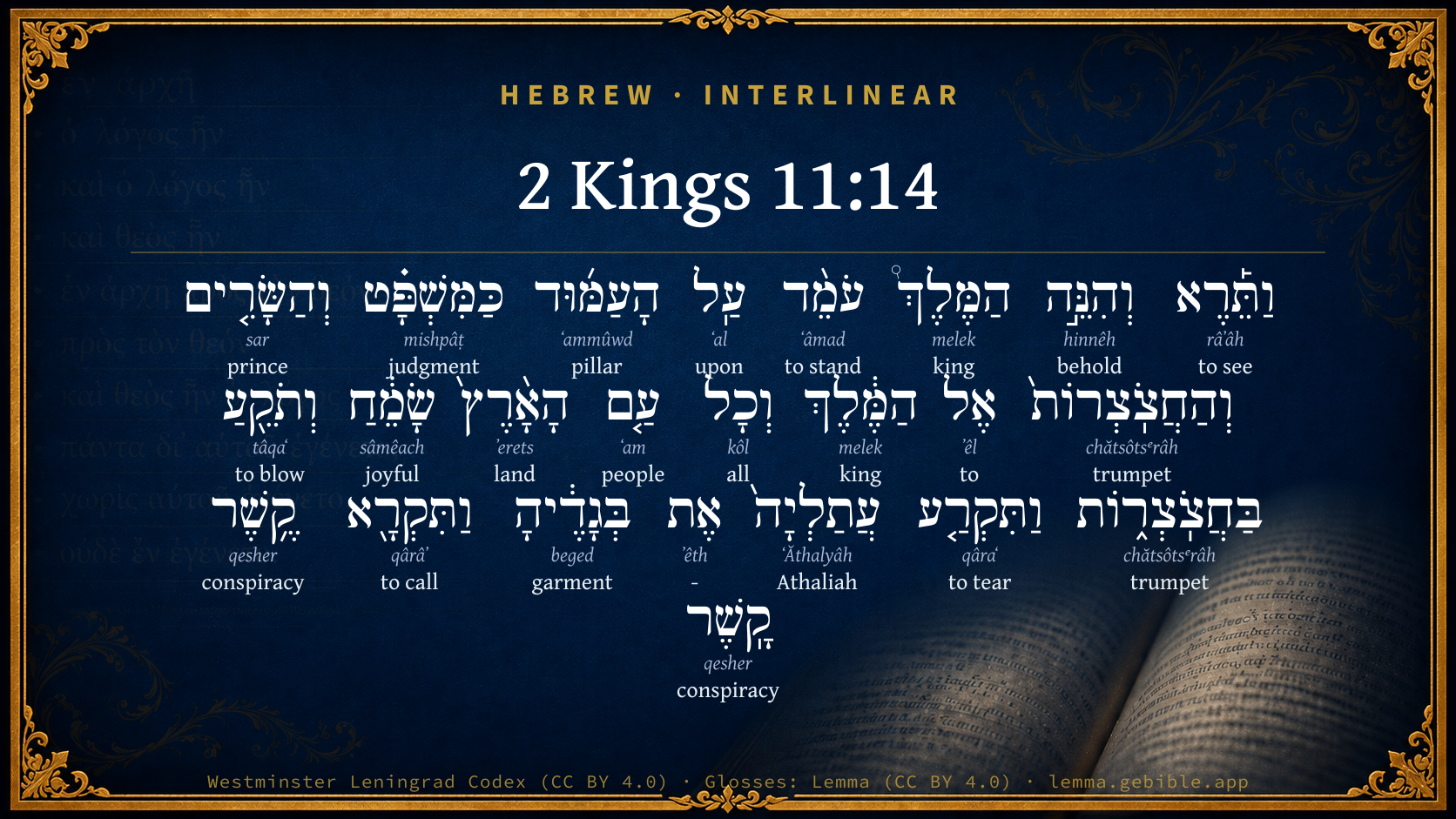
2 Kings 11:14

Hebrew (Westminster Leningrad Codex) 2 Kings 11:14 appears in the Hebrew Old Testament. The text above is from the Westminster Leningrad Codex. Each word links to its Strong’s number, a concise gloss, and parsing drawn from the Open Scriptures Hebrew Bible morphology. Click any word for its full Brown-Driver-Briggs (BDB) entry.
Download image
Cite this verse

2 Kings 11:14 (World English Bible). Public Domain. Lemma interlinear Bible study tool, https://lemma.gebible.app/v/2-kings/11/14.

Show BibTeX & RIS
BibTeX
RIS
English Translation
and she looked, and, behold, the king stood by the pillar, as the manner was, and the captains and the trumpets by the king; and all the people of the land rejoiced, and blew trumpets. Then Athaliah tore her clothes, and cried, Treason! treason!
World English Bible · Public Domain
Download a study sheet

One document with this verse’s original text, its word-by-word gloss line, the meaning frame, cross-references with their text, attributed commentary, and full source and license credits — printable, and it pastes into notes with its structure intact.

This verse Autodidact and up

Study sheet (.html) Plain text (.txt)

A passage Seminary Student

Up to 50 verses in one chapter. A passage sheet keeps up to 6 commentary sources and 12 cross-references per verse, in the order this page ranks them, and says so on the sheet whenever that leaves anything out. Ask for a single verse and you get the Autodidact verse sheet above.

Everything on this page stays free to read, with no account — the sheet is a download of what is already on screen, not access to it.

Want to remove ads? Support Godless Engineer
Compare translations 3

The same verse in 3 English versions, stacked beneath the original-language interlinear above. Click any original word for its lexicon entry.

Each is an independent rendering of the whole verse — the interlinear is not word-aligned to these translations.

Highlighted words mark where these versions differ — a whole-verse word diff, not a word-by-word alignment.

  • World English Bible Public Domain
    and she looked, and, behold, the king stood by the pillar, as the manner was, and the captains and the trumpets by the king; and all the people of the land rejoiced, and blew trumpets. Then Athaliah tore her clothes, and cried, Treason! treason!
  • King James Version Public Domain
    And when she looked, behold, the king stood by a pillar, as the manner was, and the princes and the trumpeters by the king, and all the people of the land rejoiced, and blew with trumpets: and Athaliah rent her clothes, and cried, Treason, Treason.
  • unfoldingWord Literal Text CC BY-SA 4.0
    And she looked, and behold, the king was standing by the pillar, according to the custom, and the commanders and the trumpeters near the king, and all of the people of the land were rejoicing and blasting on trumpets. And Athaliah tore her clothes, and she called out, “Conspiracy! Conspiracy!”

unfoldingWord Literal Text — © unfoldingWord, licensed CC BY-SA 4.0. Word-aligned USFM3 via Door43 (git.door43.org/unfoldingWord/en_ult).

Versions to compare (up to 4)

3 of 4 selected

Show all 18 translations

Every available English version of this verse, each an independent rendering of the whole verse.

  • World English Bible Public Domain
    and she looked, and, behold, the king stood by the pillar, as the manner was, and the captains and the trumpets by the king; and all the people of the land rejoiced, and blew trumpets. Then Athaliah tore her clothes, and cried, Treason! treason!
  • Berean Standard Bible Public Domain
    And she looked out and saw the king standing by the pillar, according to the custom. The officers and trumpeters were beside the king, and all the people of the land were rejoicing and blowing trumpets. Then Athaliah tore her clothes and screamed, “Treason! Treason!”
  • Majority Standard Bible Public Domain
    And she looked out and saw the king standing by the pillar, according to the custom. The officers and trumpeters were beside the king, and all the people of the land were rejoicing and blowing trumpets. Then Athaliah tore her clothes and screamed, “Treason! Treason!”
  • King James Version Public Domain
    And when she looked, behold, the king stood by a pillar, as the manner was, and the princes and the trumpeters by the king, and all the people of the land rejoiced, and blew with trumpets: and Athaliah rent her clothes, and cried, Treason, Treason.
  • American Standard Version (1901) Public Domain
    and she looked, and, behold, the king stood by the pillar, as the manner was, and the captains and the trumpets by the king; and all the people of the land rejoiced, and blew trumpets. Then Athaliah rent her clothes, and cried, Treason! treason!
  • Revised Version (1885) Public Domain
    and she looked, and, behold, the king stood by the pillar, as the manner was, and the captains and the trumpets by the king; and all the people of the land rejoiced, and blew with trumpets. Then Athaliah rent her clothes, and cried, Treason, treason.
  • Geneva Bible (1599) Public Domain
    And when shee looked, beholde, the King stoode by a pillar, as the maner was, and the princes and the trumpetters by the King, and al the people of the land reioyced, and blew with trumpets. Then Athaliah rent her clothes, and cryed, Treason, treason.
  • Douay-Rheims (1899) Public Domain
    She saw the king standing upon a tribunal, as the manner was, and the singers, and the trumpets near him, and all the people of the land rejoicing, and sounding the trumpets: and she rent her garments, and cried: A conspiracy, a conspiracy.
  • Young's Literal Translation Public Domain
    and looketh, and lo, the king is standing by the pillar, according to the ordinance, and the heads, and the trumpets, `are' by the king, and all the people of the land are rejoicing, and blowing with trumpets, and Athaliah rendeth her garments, and calleth, `Conspiracy! conspiracy!'
  • Literal Standard Version CC BY-SA 4.0
    and looks, and behold, the king is standing by the pillar, according to the ordinance, and the heads and the trumpets [are] by the king, and all the people of the land are rejoicing and blowing with trumpets, and Athaliah tears her garments, and calls, “Conspiracy! Conspiracy!”
  • Unlocked Literal Bible CC BY-SA 4.0
    She looked, and, behold, the king was standing by the pillar, as the custom was, and the captains and the trumpeters were by the king. All the people of the land were rejoicing and blowing trumpets. Then Athaliah tore her clothes and shouted, “Treason! Treason!”
  • unfoldingWord Literal Text CC BY-SA 4.0
    And she looked, and behold, the king was standing by the pillar, according to the custom, and the commanders and the trumpeters near the king, and all of the people of the land were rejoicing and blasting on trumpets. And Athaliah tore her clothes, and she called out, “Conspiracy! Conspiracy!”
  • Darby Bible Public Domain
    And she looked, and behold, the king stood on the dais, according to the custom, and the princes and the trumpeters were by the king; and all the people of the land rejoiced, and blew with trumpets. And Athaliah rent her garments and cried, Conspiracy! Conspiracy!
  • World Messianic Bible Public Domain
    and she looked, and behold, the king stood by the pillar, as the tradition was, with the captains and the shofars by the king; and all the people of the land rejoiced, and blew shofars. Then Athaliah tore her clothes and cried, “Treason! Treason!”
  • Webster's Bible Public Domain
    And when she looked, behold, the king stood by a pillar, as the manner was, and the princes and the trumpeters by the king, and all the people of the land rejoiced, and blew with trumpets. And Athaliah rent her clothes, and cried, Treason, treason.
  • Free Bible Version CC BY-SA 4.0
    She saw the king standing by his pillar as the custom was. The commanders and trumpeters were with the king, and everyone was celebrating and blowing trumpets. Athaliah ripped her clothes and screamed out, “Treason! Treason!”
  • Bible in Basic English Public Domain
    And looking, she saw the king in his regular place by the pillar, and the captains and the horns near him; and all the people of the land giving signs of joy and sounding the horns. Then Athaliah, violently parting her robes, gave a cry, saying, Broken faith, broken faith!
  • JPS Tanakh (1917) Public Domain
    And she looked, and, behold, the king stood on the platform, as the manner was, and the captains and the trumpets by the king; and all the people of the land rejoiced, and blew with trumpets. Then Athaliah rent her clothes, and cried: 'Treason, treason.'

Literal Standard Version (2020), Covenant Press — licensed CC BY-SA 4.0. Text via the HelloAO Bible API (eBible.org). Unlocked Literal Bible (unfoldingWord) — licensed CC BY-SA 4.0. Text via the HelloAO Bible API (eBible.org). unfoldingWord Literal Text — © unfoldingWord, licensed CC BY-SA 4.0. Word-aligned USFM3 via Door43 (git.door43.org/unfoldingWord/en_ult). Free Bible Version, Dr. Jonathan Gallagher — licensed CC BY-SA 4.0. Text via the HelloAO Bible API (eBible.org).

Word by word

More ways to search: Search by grammar → Find every occurrence → Compare this word →

Practice this passage: Drill this verse → Learn its vocabulary →

קֶ֥שֶׁר
qesher
H7195
“conspiracy”
Noun, Common, Masculine, Singular, Absolute
Part of Speech
Noun
Type
Common
Gender
Masculine
Number
Singular
State
Absolute
Full BDB Definition

Origin: from H7194

TWOT: 2090a

conspiracy, treason, (unlawful) alliance
  1. וַתֵּ֡רֶא râʼâh H7200 “and · to see” Conjunction + Verb, Qal, Sequential Imperfect, 3rd Person, Feminine, Singular
  2. וְהִנֵּ֣ה hinnêh H2009 “and · behold” Conjunction + Particle, Demonstrative
  3. הַמֶּלֶךְ֩ melek H4428 “the · king” Particle, Definite Article + Noun, Common, Masculine, Singular, Absolute
  4. עֹמֵ֨ד ʻâmad H5975 “standing” Verb, Qal, Participle Active, Masculine, Singular, Absolute
  5. עַֽל ʻal H5921 “upon” Preposition
  6. הָעַמּ֜וּד ʻammûwd H5982 “the · pillar” Particle, Definite Article + Noun, Common, Masculine, Singular, Absolute
  7. כַּמִּשְׁפָּ֗ט mishpâṭ H4941 “like/as the · judgment” Preposition, Determined + Noun, Common, Masculine, Singular, Absolute
  8. וְהַשָּׂרִ֤ים sar H8269 “and · the · princes” Conjunction + Particle, Definite Article + Noun, Common, Masculine, Plural, Absolute
  9. וְהַחֲצֹֽצְרוֹת֙ chătsôtsᵉrâh H2689 “and · the · trumpets” Conjunction + Particle, Definite Article + Noun, Common, Feminine, Plural, Absolute
  10. אֶל ʼêl H413 “to” Preposition
  11. הַמֶּ֔לֶךְ melek H4428 “the · king” Particle, Definite Article + Noun, Common, Masculine, Singular, Absolute
  12. וְכָל kôl H3605 “and · all of” Conjunction + Noun, Common, Masculine, Singular, Construct
  13. עַ֤ם ʻam H5971 “people of” Noun, Common, Masculine, Singular, Construct
  14. הָאָ֨רֶץ֙ ʼerets H776 “the · land” Particle, Definite Article + Noun, Common, Both, Singular, Absolute
  15. שָׂמֵ֔חַ sâmêach H8056 “joyful” Adjective, Adjective, Masculine, Singular, Absolute
  16. וְתֹקֵ֖עַ tâqaʻ H8628 “and · blowing” Conjunction + Verb, Qal, Participle Active, Masculine, Singular, Absolute
  17. בַּחֲצֹֽצְר֑וֹת chătsôtsᵉrâh H2689 “in/at · trumpets” Preposition + Noun, Common, Feminine, Plural, Absolute
  18. וַתִּקְרַ֤ע qâraʻ H7167 “and · to tear” Conjunction + Verb, Qal, Sequential Imperfect, 3rd Person, Feminine, Singular
  19. עֲתַלְיָה֙ ʻĂthalyâh H6271 “Athaliah” Noun, Proper
  20. אֶת ʼêth H853 “-” Particle, Direct Object
  21. בְּגָדֶ֔יהָ beged H899 “garments · her” Noun, Common, Masculine, Plural, Construct + Suffix, Personal, 3rd Person, Feminine, Singular
  22. וַתִּקְרָ֖א qârâʼ H7121 “and · to call” Conjunction + Verb, Qal, Sequential Imperfect, 3rd Person, Feminine, Singular
  23. קָֽשֶׁר qesher H7195 “conspiracy” Noun, Common, Masculine, Singular, Absolute

About this verse

These counts appear in no published source. They are computed here, from the morphology-tagged text and Lemma’s own curated glosses. What Lemma adds →

24
words
21
distinct lemmas
Historical
section

Notable vocabulary

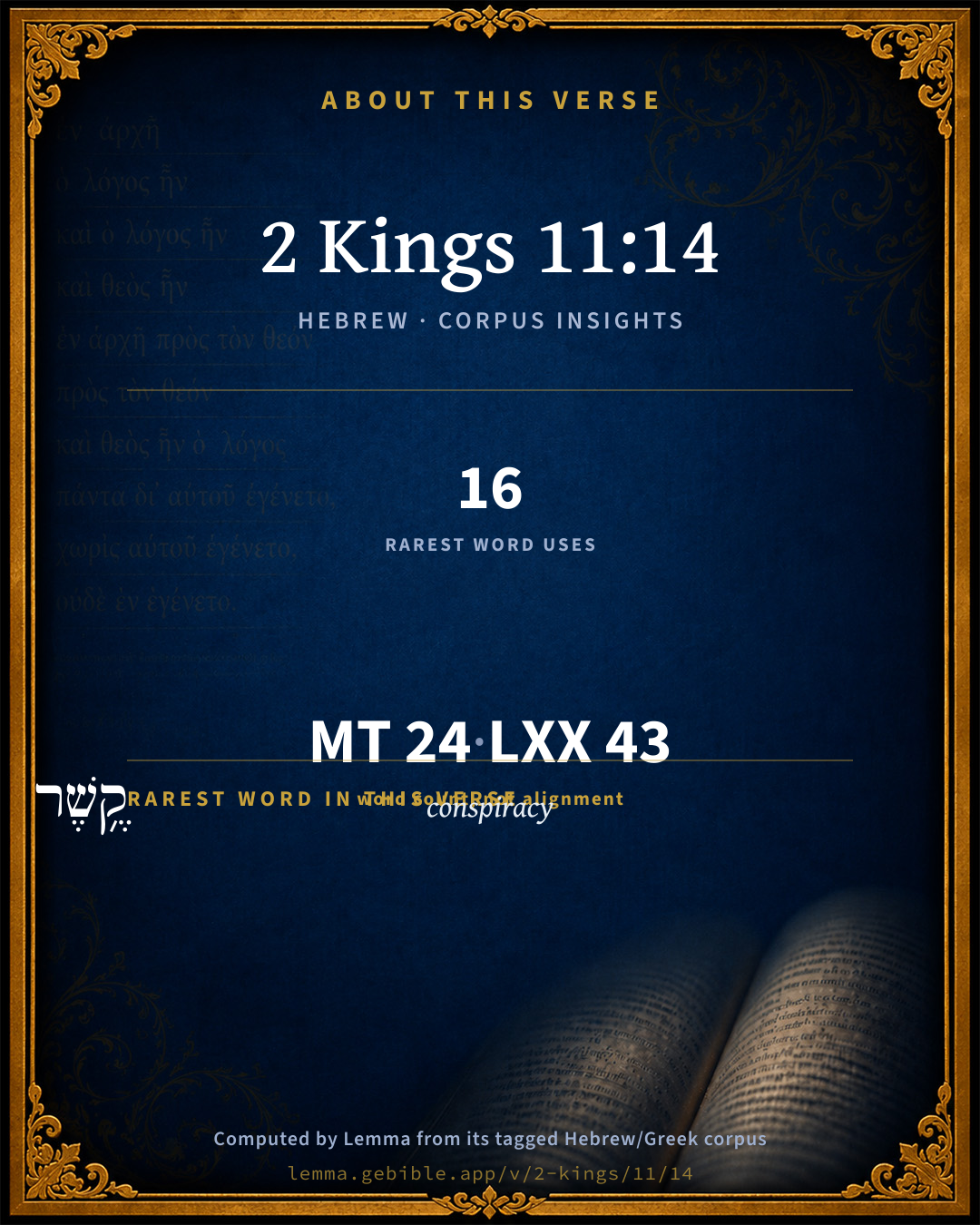
The rarest word here is קֶ֥שֶׁר conspiracy H7195 — appearing just 16 times in the whole Hebrew Bible.

Shared distinctive vocabulary

קֶ֥שֶׁר conspiracy H7195 occurs in 13 verses of the Hebrew Bible. Also found in:

Grammatical profile

  • 5 verbs
  • 14 nouns
  • 1 adjective
  • 2 prepositions
  • 2 particles

Verb forms

  • וַתֵּ֡רֶא Qal · Sequential Imperfect
  • עֹמֵ֨ד Qal · Participle Active
  • וְתֹקֵ֖עַ Qal · Participle Active
  • וַתִּקְרַ֤ע Qal · Sequential Imperfect
  • וַתִּקְרָ֖א Qal · Sequential Imperfect

Repetition

Words recur within this verse — often emphatic in Hebrew:

  • הַמֶּלֶךְ֩ king H4428 ×2
  • וְהַחֲצֹֽצְרוֹת֙ trumpet H2689 ×2
  • קֶ֥שֶׁר conspiracy H7195 ×2

Hebrew & Septuagint length

In English translation the verse runs 44 words from the Hebrew and 49 from the Septuagint (LXX English) — closely comparable.

A rough comparison of the two English renderings, which tokenize alike — not a word-level alignment.

Word counts can differ between the Hebrew and the Greek without any difference in meaning — e.g. the Hebrew direct-object marker אֵת has no separate Greek word, and Greek often adds the article ὁ.

In the original languages it is 24 Hebrew tokens and 43 Greek tokens — but the two are counted differently (Hebrew bundles its prefixes and suffixes into one token; the Greek is in lemma form), so that isn’t a like-for-like length.

Cross-references

14

Topical passages linked to 2 Kings 11:14 in the Treasury of Scripture Knowledge — connected by theme and wording, ordered by reader-vote popularity; previews shown in the World English Bible.

  • 2 Chronicles 34:31 The king stood in his place, and made a covenant before Yahweh, to walk after Yahweh, and to keep his commandments, and his testimonies, and his statutes, with all his heart, and with all his soul, to perform the words of the covenant that were written in this book.
  • 2 Kings 23:3 The king stood by the pillar, and made a covenant before Yahweh, to walk after Yahweh, and to keep his commandments, and his testimonies, and his statutes, with all [his] heart, and all [his] soul, to confirm the words of this covenant that were written in this book: and all the people stood to the covenant.
  • 2 Kings 9:23 Joram turned his hands, and fled, and said to Ahaziah, There is treachery, Ahaziah.
  • 1 Kings 1:39–40 Zadok the priest took the horn of oil out of the Tent, and anointed Solomon. They blew the trumpet; and all the people said, [Long] live king Solomon.
  • Luke 19:37 As he was now getting near, at the descent of the Mount of Olives, the whole multitude of the disciples began to rejoice and praise God with a loud voice for all the mighty works which they had seen,
  • Revelation 19:1–7 After these things I heard something like a loud voice of a great multitude in heaven, saying, "Hallelujah! Salvation, power, and glory belong to our God:
  • Genesis 37:29 Reuben returned to the pit; and saw that Joseph wasn't in the pit; and he tore his clothes.
  • Genesis 44:13 Then they tore their clothes, and loaded every man his donkey, and returned to the city.
  • Numbers 10:1–10 Yahweh spoke to Moses, saying,
  • 1 Kings 18:17–18 It happened, when Ahab saw Elijah, that Ahab said to him, Is it you, you troubler of Israel?
  • 2 Kings 11:1–2 Now when Athaliah the mother of Ahaziah saw that her son was dead, she arose and destroyed all the seed royal.
  • 2 Kings 11:10–11 The priest delivered to the captains over hundreds the spears and shields that had been king David's, which were in the house of Yahweh.
  • 1 Chronicles 12:40 Moreover those who were near to them, [even] as far as Issachar and Zebulun and Naphtali, brought bread on donkeys, and on camels, and on mules, and on oxen, food of meal, cakes of figs, and clusters of raisins, and wine, and oil, and oxen, and sheep in abundance: for there was joy in Israel.
  • Proverbs 29:2 When the righteous thrive, the people rejoice; But when the wicked rule, the people groan.

Cross-references courtesy of OpenBible.info (CC BY 4.0).

Hebrew and Greek witnesses Masoretic Hebrew ↔ Greek Septuagint

The same verse in the two great witnesses to the Old Testament, shown verse-for-verse.

These are two independent witnesses, not word-aligned to each other, and the Septuagint is shown in lemma (dictionary) form.

Hebrew 2 Kings 11:14 Masoretic · Westminster Leningrad Codex

וַתֵּ֡רֶא וְהִנֵּ֣ה הַמֶּלֶךְ֩ עֹמֵ֨ד עַֽל הָעַמּ֜וּד כַּמִּשְׁפָּ֗ט וְהַשָּׂרִ֤ים וְהַחֲצֹֽצְרוֹת֙ אֶל הַמֶּ֔לֶךְ וְכָל עַ֤ם הָאָ֨רֶץ֙ שָׂמֵ֔חַ וְתֹקֵ֖עַ בַּחֲצֹֽצְר֑וֹת וַתִּקְרַ֤ע עֲתַלְיָה֙ אֶת בְּגָדֶ֔יהָ וַתִּקְרָ֖א קֶ֥שֶׁר קָֽשֶׁר

and she looked, and, behold, the king stood by the pillar, as the manner was, and the captains and the trumpets by the king; and all the people of the land rejoiced, and blew trumpets. Then Athaliah tore her clothes, and cried, Treason! treason!

World English Bible · Public Domain

Greek LXX 2 Kings 11:14 Septuagint · lemma form

καί ὁράω καί ἰδού ὁ βασιλεύς ἵστημι ἐπί ὁ στῦλος κατά ὁ κρίμα καί ὁ ᾠδός καί ὁ σάλπιγξ πρός ὁ βασιλεύς καί πᾶς ὁ λαός ὁ γῆ χαίρω καί σαλπίζω ἐν σάλπιγξ καί διαῥήγνυμι γοθολια ὁ ἱμάτιον ἑαυτοῦ καί βοάω σύνδεσμος σύνδεσμος

And she looked, and, behold, the king stood near a pillar according to the manner; and the singers and the trumpeters were before the king and all the people of the land even rejoicing and sounding with trumpets: and Gotholia tore her garments, and cried, A conspiracy, a conspiracy.

LXX2012 (modern English Septuagint) · Public Domain

On this verse, Ellicott's Commentary for English Readers discusses the Septuagint’s reading. Read the note in Commentary ↓

Hebrew: Westminster Leningrad Codex (CC BY 4.0). Greek: Septuagint (public domain); English from LXX2012 (modern English Septuagint) (Public Domain). How the Septuagint differs from the Hebrew →

Targum (Aramaic paraphrase)

1

The Targum is the ancient Jewish Aramaic paraphrase of the Hebrew Scriptures — an interpretive translation, not the Hebrew text itself. Onkelos (literal) and Pseudo-Jonathan (expansive) render the Torah, and Jonathan the Prophets. Coverage is partial: where no permissively-licensed English translation exists for a verse, only the Aramaic is shown. This is verse-level text, not a word-by-word alignment to the Hebrew.

  1. Targum Jonathan Prophets (Joshua–Malachi)
    וַחֲזַת וְהָא מַלְכָּא קָאִים עַל אִסְטְוָנָא כְּהִלְכָתָא וְרַבְרְבַיָא עִמֵיהּ וַחֲצוֹצְרָתָא קָדָם מַלְכָּא וְכָל עַמָא דְאַרְעָא חָדָן וְתָקְעִין בַּחְצוֹצְרָתָא וּבְזָעַת עֲתַלְיָה יַת לְבוּשָׁהָא וּקְרַת מֵירְדָא מֵירְדָא:

    (no public-domain English translation for this verse)

    Targum Jonathan — Aramaic: “Mikraot Gedolot” (public domain). English: “Sefaria Community Translation” (CC0 1.0 (public-domain dedication)); “London "Chaldee Paraphrase," 1871” (public domain). Text via Sefaria.

Commentary

Notes on 2 Kings 11:14 from classic Christian and Jewish commentators (each source and its license shown beneath its notes). The classic Christian expositions comment on the surrounding passage and are grouped to its opening verse, so a note may address several verses; the Jewish commentaries on the Tanakh (Rashi and others) are per-verse, so they appear only where the commentator wrote on this verse.

Lemma curates 59 commentaries, every one of them public domain or Creative Commons licensed, each selected and text-cleaned for this edition rather than reprinted as found. About our sources →

Trapp's Complete Commentary

John Trapp

2Ki 11:14 And when she looked, behold, the king stood by a pillar, as the manner [was], and the princes and the trumpeters by the king, and all the people of the land rejoiced, and blew with trumpets: and Athaliah rent her clothes, and cried, Treason, Treason.

Ver. 14. And cried, Treason, treason!] Though herself were a usurper and a traitor, yet she thus crieth out; so do some sectaries, "Persecution, persecution," with as good pretence.

John Trapp, A Commentary or Exposition upon All the Books of the Old and New Testament (1647–1656) — public domain. Text from a community e-Sword module.

Joseph Benson's Commentary

2Ki 11:14. Behold, the king stood by a pillar, as the manner was — It is generally supposed that the royal throne was erected near one of the pillars, described 1Ki 7:15; 1Ki 7:21, unless we may suppose that what is here called a pillar was that brazen scaffold five cubits long, &c., which Solomon made at first on his dedicating the temple, (2Ch 6:13,) and which was afterward continued for the king to appear upon on solemn occasions, and where, doubtless, there was a throne of state. See Calmet.

Joseph Benson's Commentary on the Old and New Testaments (1811–1818) — public domain. Text from a community e-Sword module.

Geneva Bible (1599)

Geneva Bible translators

Where the king’s place was in the Temple.

Geneva Bible (1599) marginal notes — public domain. Text via Bolls.life.

Jamieson, Fausset & Brown

Robert Jamieson, A. R. Fausset & David Brown

the king stood by a pillar--or on a platform, erected for that purpose (see on Ch2 6:13).

Jamieson, Fausset & Brown — Commentary Critical and Explanatory on the Whole Bible (1871) — public domain (CC PDM 1.0). Text via the HelloAO Bible API.

Adam Clarke's Commentary

Verse 14. The king stood by a pillar] Stood ON a pillar or tribunal; the place or throne on which they were accustomed to put the kings when they proclaimed them.

Treason, Treason.] קשר קשר kesher, kasher; A conspiracy, A conspiracy! from kashar, to bind, unite together.

Adam Clarke's Commentary on the Bible (1810–1826) — public domain. Text from a community e-Sword/MySword module.

Ellicott's Commentary for English Readers

(14) And when she looked.—Having entered the court, the whole scene met her astonished gaze.

The king stood by a pillar.—Rather, the king was standing on the stand. (Comp. 2Ki_23:3.) The stand (Vulg., “tribunal”) was apparently a dais reserved for the king only, which stood before the great altar, at the entrance to the inner court (2Ch_23:13; 2Ch_6:13). Thenius maintains that the king stood on the top of the flight of steps leading into the sanctuary. Why, then, does not the text express this meaning more exactly? (Comp. 2Ki_9:13.)

As the manner was—i.e., according to the custom on such occasions.

The princes.—The chiefs of the people, not the centurions of the royal guard, who have their full designation throughout the chapter. (See 2Ki_11:4; 2Ki_11:9-10; 2Ki_11:15; 2Ki_11:19.) The present account has nowhere stated that the nobles were present in the Temple; but this sudden mention of them, as if they had been present throughout the proceedings, is in striking harmony with the chronicler’s express assertion that, after their conference with Jehoiada, the centurions of the guard assembled the Levites and the heads of the clans in the Temple (2Ch_23:3). (The LXX. and Vulg. render “singers,” because they read shârîm, “singers,” instead of sârîm, “princes.”)

The trumpeters.—Literally, the trumpets; as we speak of “the violins,” meaning the players on them. The sacred trumpets or clarions blown on solemn occasions by the priests are intended. (Comp. 2Ki_12:14; Num_10:2; 1Ch_15:24.) This is an indication that the priests and Levites were present as the chronicle so conspicuously represents, and as, indeed, was to be expected on an occasion when the high priest took the lead, and when the scene of action was the Temple. The acting classes of priests and Levitical musicians, warders, and priestly attendants must certainly have participated in the proceedings.

All the people of the land.—Secrecy was no longer necessary, as Thenius supposes, when once the centurions of the guard had heartily taken up with the plot.

Rejoiced . . . blew.—Rejoicing . . . blowing.

Treason.—Literally, Conspiracy.

A Bible Commentary for English Readers, edited by Charles John Ellicott (1878–1897) — public domain. Text from a community e-Sword module.

The Cambridge Bible for Schools and Colleges

gen. ed. J. J. S. Perowne

14. And when she looked, behold, the king] R.V. And she looked and behold the king. This, the literal translation of the Hebrew, is the form adopted in 2 Chron. The original is the same in both places.

stood by a [R.V. the] pillar] By this word is clearly designated some spot which was the special position of the king on such occasions. We see that Athaliah took in the whole scene at a glance and knew without telling what was going on. The word ‘pillar’ is the same which is used for the two, Jachin and Boaz (1Ki_7:21), which stood as ornamental pillars in the porch of the temple, and which being ornamental could doubtless be seen by all in the court. If we suppose one of these set apart as the station of the king at his coronation, the position would be admirably suited for the purpose. Otherwise we must understand some special erection in the court of the temple, of which there is no mention till this passage, and afterwards in chap. 2Ki_23:3. The situation of the pillar is described in 2Ch_23:13 as ‘at the entering in’, words which would not unfitly describe the position of the two pillars erected in the temple porch.

as the manner was] Hence it was a well-known spot appropriated to such occasions.

and the princes and the trumpeters] R.V. the captains and the trumpets. The ‘captains’ were those ‘over hundreds’ mentioned before. ‘Trumpets’ of course implies ‘trumpeters’ but the word is literally translated in 2 Chron., and the two places should agree. The persons who blew with the trumpets were probably the Levites, for in chap. 2Ki_12:13, ‘trumpets’ are recounted as among the furniture of the temple, and these would be used only by priests or Levites. In 2Ch_7:6; 2Ch_13:14 we have the priests sounding trumpets.

and all the people of the land rejoiced] Shewing that there was a numerous convocation. The gathering would be larger than usual because the Sabbath had been chosen for these operations.

and [R.V. Then] Athaliah rent her clothes] Seeing with horror that priests and soldiery and the assembled people were all of one mind, and against her.

The Cambridge Bible for Schools and Colleges (gen. ed. J. J. S. Perowne; Cambridge University Press, 1878–1918) — public domain. Text from a community e-Sword module.

John Gill's Exposition

But Jehoiada the priest commanded the captains of the hundreds, the officers of the host,.... Of the priests and Levites:

and said unto them, have her forth without the ranges; the ranks of the guards, which were at the gate leading to the palace, or rather "within" them (g); the meaning is, that he ordered her to be had out of the court of the temple, and be put within their ranks, and enclosed by them, that her blood might not be shed in the temple, and yet not escape them:

and him that followeth her, kill with the sword: that takes her part, and offers to help and assist her, passing through the ranks after her, dispatch him at once:

for the priest had said, let her not be slain in the house of the Lord: that it might not be defiled with her blood; by which it appears that the guards had orders concerning her before, should she come to the temple, see Kg2 11:13.

(g) "intra ordines", Munster, Junius, Tremellius, Piscator, Noldius, p. 79. No. 365. So Jarchi, Kimchi, Ben Gersom, & Ben Melech.

John Gill's Exposition of the Whole Bible (1746–1763) — public domain (CC PDM 1.0). Text via the HelloAO Bible API.

Albert Barnes' Notes on the Bible

By a pillar - Rather, “upon the pillar” probably a sort of stand, or pulpit, raised on a pillar. Under the later monarchy the Jewish king seems to have had a special place assigned him in the temple-court, from which on occasions he addressed the people (marginal references).

Albert Barnes' Notes on the Bible (1834–1885) — public domain. Text from a community e-Sword/MySword module.

Haydock's Catholic Bible Commentary

A tribunal. A tribune, or place elevated above the rest. (Challoner) --- Hebrew, "on a pillar." Solomon had stood upon one of brass, three cubits high and five broad. See chap. xxiii. 3., and 2 Paralipomenon vi. 13.

George Leo Haydock (1774–1849), Haydock's Catholic Family Bible and Commentary, 1859 edition — public domain. Excludes Psalms (Douay-Rheims chapter numbering differs from Protestant) and Deuterocanonical books (Catholic canon only).

Matthew Poole's English Annotations

By a pillar; possibly by one of the two famous pillars of the temple; of which see 1Ki 7:21; nigh unto which the throne was erected. If it be said, that none but priests might come thither; I answer, ordinarily they might not; but the king being a sacred person, especially upon such extraordinary occasions, might be there. Or, upon a scaffold; possibly that brazen scaffold which Solomon erected, 2Ch 6:13, and left there for such purposes. See 2Ki 23:3.

Matthew Poole's English Annotations on the Holy Bible (1683–1685) — public domain. Text from a community e-Sword/MySword module.

Whedon's Commentary on the Bible

Daniel D. Whedon

14. The king stood by a pillar — Probably, as we have suggested above, (note on 2Ki_11:11,) by one of the great pillars, Jachin and Boaz, which supported the front of the temple. By the side of one of these pillars Jehoiada had erected a platform something like that on which Solomon stood when he dedicated the temple; (2Ch_6:13;) and upon such platform the young king would stand in full view of all the people in the court. Gesenius and others take עמוד, pillar, in the sense of platform, but this is unnecessary, and the word, though of frequent occurrence, has nowhere else such a meaning.

Daniel D. Whedon (gen. ed.), Commentary on the Old and New Testaments (1874–1909) — public domain. Text from a community e-Sword module.

The Pulpit Commentary

And when she looked, behold, the king stood by a pillar; rather, on the pillar, or on the raised platform. The king"s proper place in the temple seems to have been a raised standing-place (dWMh from dmo to stand) in front of the entrance to the sanctuary, which made him very conspicuous. (comp. 2Ki_23:3; 2Ch_23:13 2Ch_34:31) As the manner wasi.e. as was the usual practice when kings visited the templeand the princesi.e. the centurions or captains of the guardand the trumpeters by the king the officials whose business it was to blow the trumpet at a coronation (see 2Sa_15:10; 1Ki_1:39 1Ki_9:13) and all the people of the land rejoiced, and blew with trumpets; i.e. the people who had been admitted into the great court to witness the coronation. Some rumor of what was about to occur had got abroad, and many of the people had provided themselves with trumpets. As Dean Stanley puts it, "The temple court was crowded with spectators, and they too took part in the celebration, and themselves prolonged the trumpet-blast, blended with the musical instruments of the temple service." And Athaliah rent her clothes. Athaliah took in all with a single glance. She "saw that the fatal hour was come" (Stanley). With a strong hand she rent her royal robes, partly in horror, partly in despair; for the single glance which she had cast around was sufficient to show her that all was lost. And cried, Treason! Treason! or, conspiracy! conspiracy! The cry was scarcely an appeal for help, as Josephus makes it ("Ant. Jud:," 9:7. but rather an instinctive utterance, without distinct aim or object, wrung from her under the circumstances. It fell dead on the assembly.

The Pulpit Commentary (1880–1919), ed. H.D.M. Spence-Jones & Joseph S. Exell — public domain. Text from a community e-Sword module.

Rashi

Rabbi Shlomo Yitzchaki (Rashi)

On the pedestal. That is the king’s platform in the Beis [Hamikdosh] of Adonoy.

“A revolt! A revolt!” Revolt. There is a revolt here.

Rashi on the Tanakh — English translations: “The Judaica Press complete Tanach with Rashi, translated by A. J. Rosenberg” (CC BY 4.0); “Pentateuch with Rashi's commentary by M. Rosenbaum and A.M. Silbermann, 1929-1934” (public domain); “The Metsudah Tanach series, Lakewood, N.J” (CC BY 4.0); and “The Book of Joshua, Metsudah Publications, 1997” (CC BY 4.0). Text via Sefaria.

Lesson kit

Teaching starters — assembled from the data on this page, not authored interpretation. Every prompt links to the verse data it draws on. Edit before teaching.

2 Kings, in the Historical, opens this verse with 24 words (21 distinct Hebrew lemmas). Its most distinctive word is qesher (“conspiracy”). A historical commentator’s framing appears above. Read the whole chapter for the surrounding context.

Discussion questions

  1. What does “conspiracy” (qesher) contribute to the verse as a whole?
  2. How does 2 Samuel 15:12, which shares the word «conspiracy», read alongside this verse?
  3. What does the repetition of “king” (2× in this one verse) do in this verse?
  4. These translations render this verse differently. What is at stake in choosing one wording over another?
  5. «וַתֵּ֡רֶא» is a Qal Sequential Imperfect verb. How does that grammatical form shape the action described?
  6. Compare how Trapp's Complete Commentary and Joseph Benson's Commentary read this verse. Where do they agree or differ?

Things to notice

Reading settings

Reading text

Shown beneath each verse's original-language words.

Old Testament
Old Testament edition

Read the OT as the Masoretic Hebrew (MT) or the Greek Septuagint (LXX).

English shown for the Greek Septuagint (in the Hebrew ↔ Greek comparison).

Comparing translations? Open the Compare panel on any verse page to stack up to four side by side.