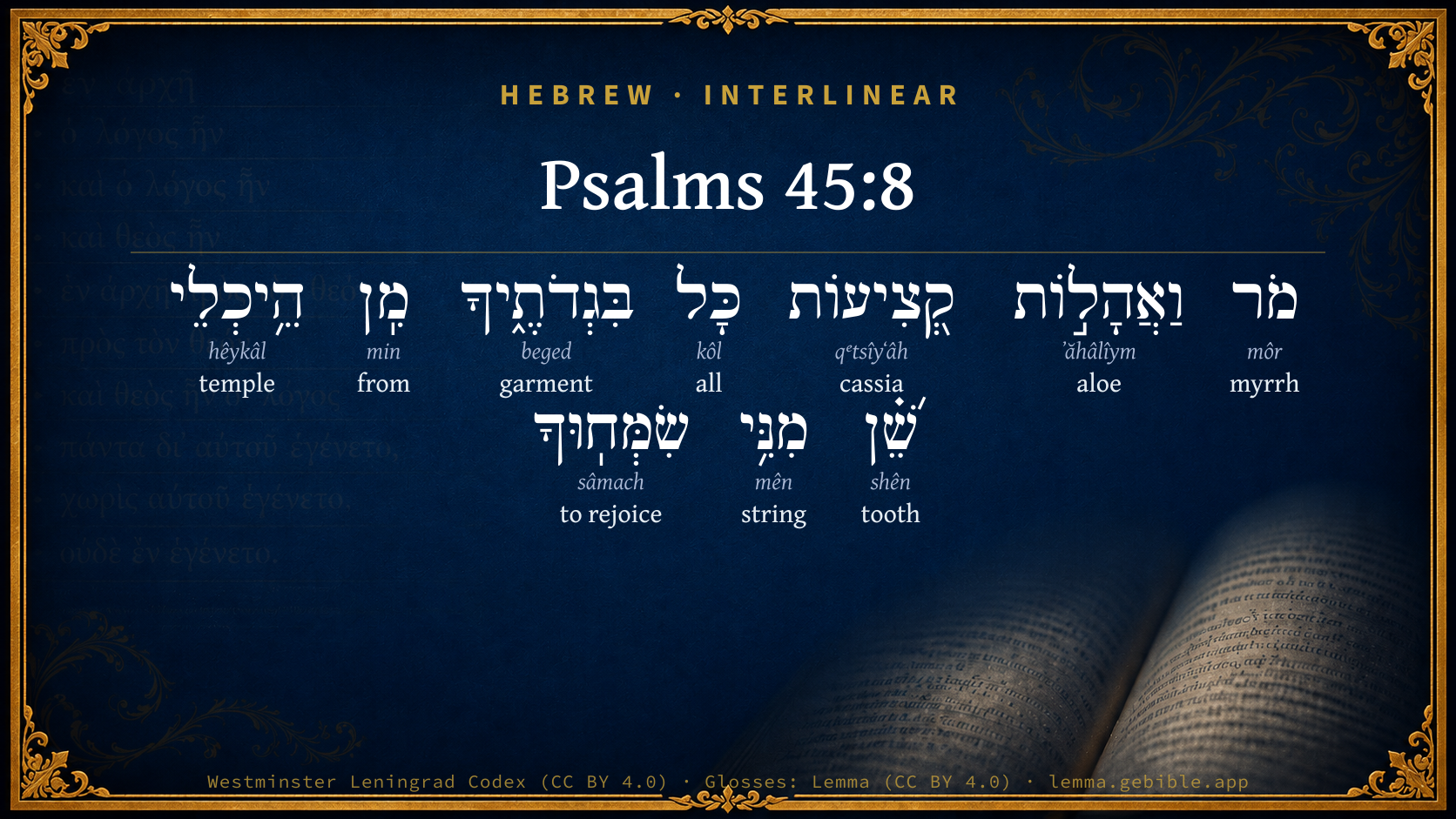
Psalms 45:8

Hebrew (Westminster Leningrad Codex) Psalms 45:8 appears in the Hebrew Old Testament. The text above is from the Westminster Leningrad Codex. Each word links to its Strong’s number, a concise gloss, and parsing drawn from the Open Scriptures Hebrew Bible morphology. Click any word for its full Brown-Driver-Briggs (BDB) entry.
Download image
Cite this verse

Psalms 45:8 (World English Bible). Public Domain. Lemma interlinear Bible study tool, https://lemma.gebible.app/v/psalms/45/8.

Show BibTeX & RIS
BibTeX
RIS
English Translation
All your garments smell like myrrh, aloes, and cassia. Out of ivory palaces stringed instruments have made you glad.
World English Bible · Public Domain
Highlights
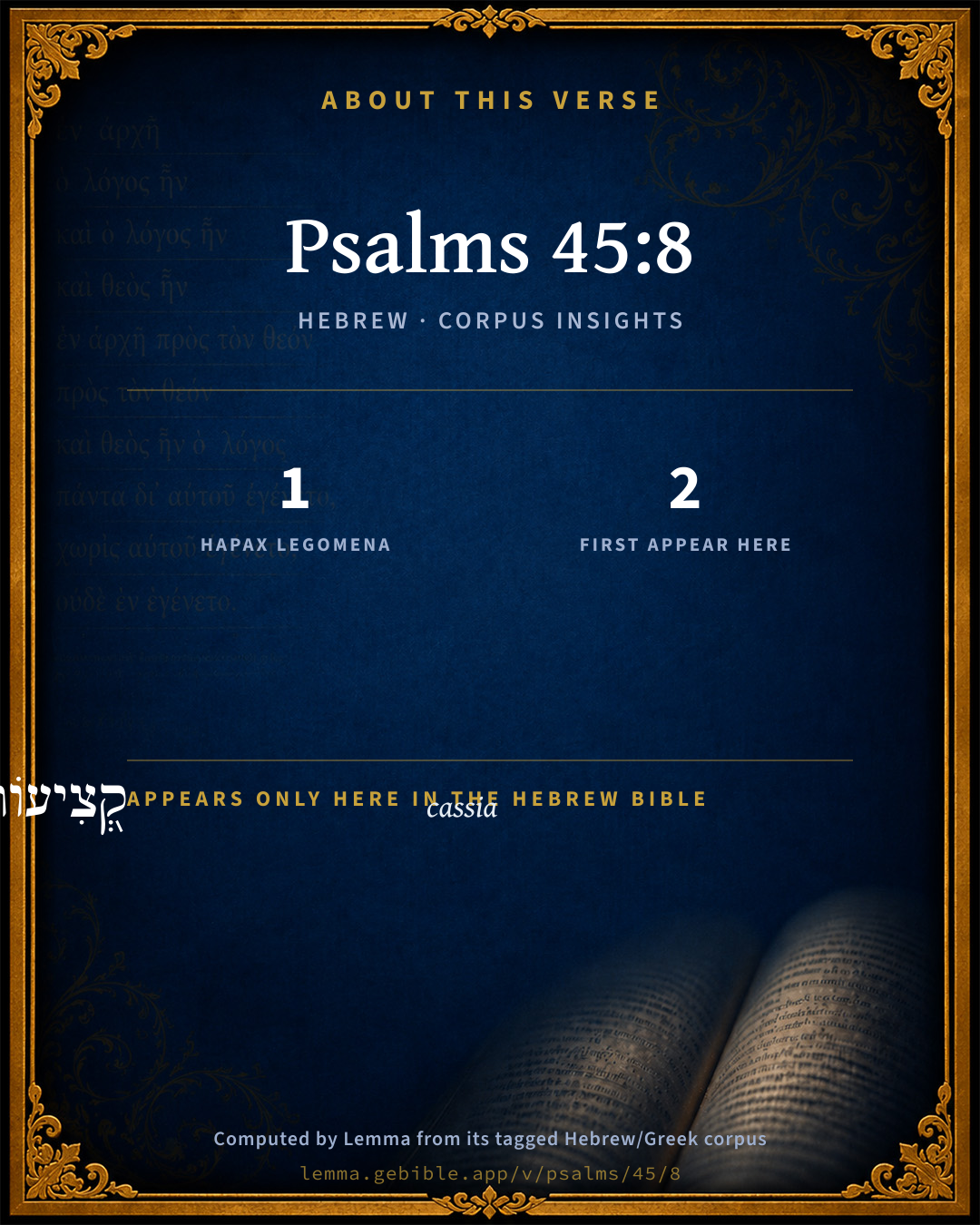
  • 1 hapax legomenon — only here in the Hebrew Bible
  • 2 first appearances in the Hebrew Bible
Full analysis ↓
Download a study sheet

One document with this verse’s original text, its word-by-word gloss line, the meaning frame, cross-references with their text, attributed commentary, and full source and license credits — printable, and it pastes into notes with its structure intact.

This verse Autodidact and up

Study sheet (.html) Plain text (.txt)

A passage Seminary Student

Up to 50 verses in one chapter. A passage sheet keeps up to 6 commentary sources and 12 cross-references per verse, in the order this page ranks them, and says so on the sheet whenever that leaves anything out. Ask for a single verse and you get the Autodidact verse sheet above.

Everything on this page stays free to read, with no account — the sheet is a download of what is already on screen, not access to it.

Want to remove ads? Support Godless Engineer
Compare translations 3

The same verse in 3 English versions, stacked beneath the original-language interlinear above. Click any original word for its lexicon entry.

Each is an independent rendering of the whole verse — the interlinear is not word-aligned to these translations.

Highlighted words mark where these versions differ — a whole-verse word diff, not a word-by-word alignment.

  • World English Bible Public Domain
    All your garments smell like myrrh, aloes, and cassia. Out of ivory palaces stringed instruments have made you glad.
  • King James Version Public Domain
    All thy garments smell of myrrh, and aloes, and cassia, out of the ivory palaces, whereby they have made thee glad.
  • unfoldingWord Literal Text CC BY-SA 4.0
    Myrrh and aloes, cassia, all of your garments. From palaces of ivory, stringed instruments make you rejoice. q2

unfoldingWord Literal Text — © unfoldingWord, licensed CC BY-SA 4.0. Word-aligned USFM3 via Door43 (git.door43.org/unfoldingWord/en_ult).

Versions to compare (up to 4)

3 of 4 selected

Show all 18 translations

Every available English version of this verse, each an independent rendering of the whole verse.

  • World English Bible Public Domain
    All your garments smell like myrrh, aloes, and cassia. Out of ivory palaces stringed instruments have made you glad.
  • Berean Standard Bible Public Domain
    All your garments are fragrant with myrrh and aloes and cassia; from palaces of ivory the harps make you glad.
  • Majority Standard Bible Public Domain
    All your garments are fragrant with myrrh and aloes and cassia; from palaces of ivory the harps make you glad.
  • King James Version Public Domain
    All thy garments smell of myrrh, and aloes, and cassia, out of the ivory palaces, whereby they have made thee glad.
  • American Standard Version (1901) Public Domain
    All thy garments `smell of' myrrh, and aloes, `and' cassia; Out of ivory palaces stringed instruments have made thee glad.
  • Revised Version (1885) Public Domain
    All thy garments smell of myrrh, and aloes, and cassia; out of ivory palaces stringed instruments have made thee glad.
  • Geneva Bible (1599) Public Domain
    All thy garments smelll of myrrhe and aloes, and cassia, when thou commest out of the yuorie palaces, where they haue made thee glad.
  • Douay-Rheims (1899) Public Domain
    Thou hast loved justice, and hated iniquity: therefore God, thy God, hath anointed thee with the oil of gladness above thy fellows.
  • Young's Literal Translation Public Domain
    Myrrh and aloes, cassia! all thy garments, Out of palaces of ivory Stringed instruments have made thee glad.
  • Literal Standard Version CC BY-SA 4.0
    Myrrh, and aloes, [and] cassia || [Cover] all Your garments; Out of palaces of ivory, || Stringed instruments have made You glad.
  • Unlocked Literal Bible CC BY-SA 4.0
    All your garments smell of myrrh, aloes, and cassia; out of ivory palaces stringed instruments have made you glad.
  • unfoldingWord Literal Text CC BY-SA 4.0
    Myrrh and aloes, cassia, all of your garments. From palaces of ivory, stringed instruments make you rejoice. q2
  • Darby Bible Public Domain
    Myrrh and aloes, cassia, are all thy garments; out of ivory palaces stringed instruments have made thee glad.
  • World Messianic Bible Public Domain
    All your garments smell like myrrh, aloes, and cassia. Out of ivory palaces stringed instruments have made you glad.
  • Webster's Bible Public Domain
    \\45:7\\Thou lovest righteousness, and hatest wickedness: therefore God, thy God, hath anointed thee with the oil of gladness above thy fellows.
  • Free Bible Version CC BY-SA 4.0
    Your robes are perfumed with aloes, myrrh, and cassia; music played on stringed instruments in palaces decorated with ivory makes you happy.
  • Bible in Basic English Public Domain
    Your robes are full of the smell of all sorts of perfumes and spices; music from the king's ivory houses has made you glad.
  • JPS Tanakh (1917) Public Domain
    (45-9) Myrrh, and aloes, and cassia are all thy garments; out of ivory palaces stringed instruments have made thee glad.

Literal Standard Version (2020), Covenant Press — licensed CC BY-SA 4.0. Text via the HelloAO Bible API (eBible.org). Unlocked Literal Bible (unfoldingWord) — licensed CC BY-SA 4.0. Text via the HelloAO Bible API (eBible.org). unfoldingWord Literal Text — © unfoldingWord, licensed CC BY-SA 4.0. Word-aligned USFM3 via Door43 (git.door43.org/unfoldingWord/en_ult). Free Bible Version, Dr. Jonathan Gallagher — licensed CC BY-SA 4.0. Text via the HelloAO Bible API (eBible.org).

Word by word

More ways to search: Search by grammar → Find every occurrence → Compare this word →

Practice this passage: Drill this verse → Learn its vocabulary →

About this verse

These counts appear in no published source. They are computed here, from the morphology-tagged text and Lemma’s own curated glosses. What Lemma adds →

10
words
10
distinct lemmas
Wisdom
section

Notable vocabulary

1 hapax legomenon — a word that appears only here in the entire Hebrew Bible:

  • קְ֭צִיעוֹת cassia H7102

First appearance in Scripture

These words make their first canonical appearance in the Hebrew Bible here:

  • קְ֭צִיעוֹת cassia H7102
  • מִנִּ֥י string H4482

Shared distinctive vocabulary

מִנִּ֥י string H4482 occurs in 2 verses of the Hebrew Bible. Also found in:

Grammatical profile

  • 1 verb
  • 7 nouns
  • 2 prepositions

Verb forms

  • שִׂמְּחֽוּךָ Piel · Perfect

Hebrew & Septuagint length

In English translation the verse runs 19 words from the Hebrew and 16 from the Septuagint (LXX English) — closely comparable.

A rough comparison of the two English renderings, which tokenize alike — not a word-level alignment.

Word counts can differ between the Hebrew and the Greek without any difference in meaning — e.g. the Hebrew direct-object marker אֵת has no separate Greek word, and Greek often adds the article ὁ.

Cross-references

18

Topical passages linked to Psalms 45:8 in the Treasury of Scripture Knowledge — connected by theme and wording, ordered by reader-vote popularity; previews shown in the World English Bible.

  • Song of Solomon 1:3 Your oils have a pleasing fragrance. Your name is oil poured forth, Therefore the virgins love you.
  • John 19:39 Nicodemus, who at first came to Jesus by night, also came bringing a mixture of myrrh and aloes, about a hundred pounds.
  • 2 Corinthians 2:14–16 Now thanks be to God, who always leads us in triumph in Christ, and reveals through us the sweet aroma of his knowledge in every place.
  • Song of Solomon 4:6 Until the day is cool, and the shadows flee away, I will go to the mountain of myrrh, To the hill of frankincense.
  • Matthew 2:11 They came into the house and saw the young child with Mary, his mother, and they fell down and worshiped him. Opening their treasures, they offered to him gifts: gold, frankincense, and myrrh.
  • Exodus 30:23–24 "Also take fine spices: of liquid myrrh, five hundred shekels; and of fragrant cinnamon half as much, even two hundred and fifty; and of fragrant cane, two hundred and fifty;
  • Psalms 16:11 You will show me the path of life. In your presence is fullness of joy. In your right hand there are pleasures forevermore.
  • Song of Solomon 5:1 I have come into my garden, my sister, my bride. I have gathered my myrrh with my spice; I have eaten my honeycomb with my honey; I have drunk my wine with my milk. Friends Eat, friends! Drink, yes, drink abundantly, beloved. Beloved
  • 1 Kings 22:39 Now the rest of the acts of Ahab, and all that he did, and the ivory house which he built, and all the cities that he built, aren't they written in the book of the chronicles of the kings of Israel?
  • Psalms 150:4 Praise him with tambourine and dancing! Praise him with stringed instruments and flute!
  • Song of Solomon 1:13 My beloved is to me a sachet of myrrh, That lies between my breasts.
  • Song of Solomon 3:6 Who is this who comes up from the wilderness like pillars of smoke, Perfumed with myrrh and frankincense, With all spices of the merchant?
  • Song of Solomon 4:13–14 Your shoots are an orchard of pomegranates, with precious fruits: Henna with spikenard plants,
  • Song of Solomon 5:5 I rose up to open for my beloved. My hands dripped with myrrh, My fingers with liquid myrrh, On the handles of the lock.
  • Song of Solomon 5:13 His cheeks are like a bed of spices with towers of perfumes. His lips are like lilies, dropping liquid myrrh.
  • Amos 3:15 I will strike the winter house with the summer house; And the houses of ivory will perish, And the great houses will have an end," says Yahweh.
  • John 14:2 In my Father's house are many mansions. If it weren't so, I would have told you. I am going to prepare a place for you.
  • Hebrews 12:2 looking to Jesus, the author and perfecter of faith, who for the joy that was set before him endured the cross, despising shame, and has sat down at the right hand of the throne of God.

Cross-references courtesy of OpenBible.info (CC BY 4.0).

Hebrew and Greek witnesses Masoretic Hebrew ↔ Greek Septuagint

The same verse in the two great witnesses to the Old Testament, shown verse-for-verse.

You’re reading Greek Psalm 44 (Hebrew Psalm 45). The Septuagint counts the superscription, so verse numbers can differ from the Hebrew — chapter-level alignment, not verse-by-verse. Numbering follows Rahlfs.

These are two independent witnesses, not word-aligned to each other, and the Septuagint is shown in lemma (dictionary) form.

Hebrew Psalms 45:8 Masoretic · Westminster Leningrad Codex

מֹר וַאֲהָל֣וֹת קְ֭צִיעוֹת כָּל בִּגְדֹתֶ֑יךָ מִֽן הֵ֥יכְלֵי שֵׁ֝֗ן מִנִּ֥י שִׂמְּחֽוּךָ

All your garments smell like myrrh, aloes, and cassia. Out of ivory palaces stringed instruments have made you glad.

World English Bible · Public Domain

Greek LXX Greek Psalm 44:8 Septuagint · lemma form

ἀγαπάω δικαιοσύνη καί μισέω ἀνομία διά οὗτος χρίω σύ ὁ θεός ὁ θεός σύ ἔλαιον ἀγαλλίασις παρά ὁ μέτοχος σύ

Myrrh, and stacte, and cassia are exhaled from your garments, and out of the ivory palaces,

LXX2012 (modern English Septuagint) · Public Domain

Hebrew: Westminster Leningrad Codex (CC BY 4.0). Greek: Septuagint (public domain); English from LXX2012 (modern English Septuagint) (Public Domain). How the Septuagint differs from the Hebrew →

Commentary

Notes on Psalms 45:8 from classic Christian and Jewish commentators (each source and its license shown beneath its notes). The classic Christian expositions comment on the surrounding passage and are grouped to its opening verse, so a note may address several verses; the Jewish commentaries on the Tanakh (Rashi and others) are per-verse, so they appear only where the commentator wrote on this verse.

Lemma curates 59 commentaries, every one of them public domain or Creative Commons licensed, each selected and text-cleaned for this edition rather than reprinted as found. About our sources →

Trapp's Complete Commentary

John Trapp

Psa 45:8 All thy garments [smell] of myrrh, and aloes, [and] cassia, out of the ivory palaces, whereby they have made thee glad.

Ver. 8. All thy garments smell of myrrh, aloes, and cassia] Things not only of good savour, but of great price. Myrrh some take to be musk, aloes amber, cassia a kind of cinnamon, which in Galen’s time was very rare and hard to be found, except in the storehouses of great princes. And Pliny reporteth that a pound of cinnamon was worth a thousand denarii, that is, a hundred and fifty crowns of our money. This description, then, of Christ’s clothing doth allegorically set forth the sweetness and pleasure that the Father findeth in him (εν ω ευδοκησα, Mat 3:17), and that we also find, while he is made unto us of God, wisdom, righteousness, sanctification, and redemption, 1Co 1:30, {confer 2Co 2:15} and that out of his ivory palaces, i.e. his heavenly habitation, from which he beholdeth us, and raineth down righteousness upon us.

Whereby they have made thee glad] i.e. Servi et sodales tui, thy fellow friends and servants, who stand and hear the bridegroom, and rejoice greatly by reason of his voice, Joh 3:29, yea, make him glad by their ready obedience, setting the crown upon his head, and adorning him, as it were, with all his bravery in the day of his espousals, Son 3:11, and making him say, How fair, how pleasant art thou, O love, for delights! Son 7:6.

John Trapp, A Commentary or Exposition upon All the Books of the Old and New Testament (1647–1656) — public domain. Text from a community e-Sword module.

The Biblical Illustrator

Joseph S. Exell

Psa_45:8

All Thy garments smell of myrrh, and aloes, and cassia, out of the ivory palaces.

Out of the ivory palaces

I look upon the kingly robes of Christ; and as I lift them, flashing with eternal jewels, the whole house is filled with the aroma of these garments, which smell of myrrh, and aloes, and cassia, out of the ivory palaces.

I. Why the robes of Christ are odorous with myrrh. The first present that was ever given to Christ was a sprig of myrrh, thrown on His infantile bed in Bethlehem; and the last gift that Christ ever had was myrrh pressed into the cup of His crucifixion. The natives would take a stone and bruise the tree, and then there would exude a gum that would saturate all the ground beneath. This gum was used for purposes of merchandise. One piece of it, no longer than a chestnut, would whelm a whole room with odours. It was put in closets, in chests, in drawers, in rooms, and its perfume adhered almost interminably to anything that was anywhere near it. So, when I read that Christs garments smell of myrrh, I immediately conclude the exquisite sweetness of Jesus. I know that to many He is only like any historical person. But to those who know Him in all His grace He is music, and light, and warmth, and thrill, and eternal fragrance. Oh that you all knew His sweetness! How soon you would turn from your revels.

II. Why the robes of Jesus are odorous with aloes. There is some difference of opinion about where these aloes grew, what is the colour of the flower, what is the particular appearance of the herb. Suffice it to know that aloes mean bitterness all the world over; and when Christ comes with garments bearing that particular odour, they suggest to me the bitterness of a Saviours suffering. Were there ever such nights as Jesus lived through--nights on the mountain, nights on the sea, nights in the desert? John leaned his head on Christ; but who did Christ lean on? Five thousand men fed by the Saviour; who fed Jesus? Oh, was it not all aloes; nothing else? And this not to win fame as a martyr, but because He wanted to pluck you and me from hell, and to raise us to heaven. Ye whose lot is bright and fair, ye who have had bright and sparkling beverages, how do you feel towards Him who for you took the bitter aloes?

III. Why these garments are odorous with cassia. Cassia was regarded as having great healing and curative power. But had not our Lord Jesus this? All the leaves of this Bible are only so many prescriptions from the Divine Physician, written, not in Latin, like the prescriptions of earthly physicians, but written in plain English, so that a man, though a fool, need not err therein. Thank God that the Saviours garments smell of cassia. Christ made every house where he stopped a dispensary. I do not believe that in the nineteen centuries that have gone by since then His heart has got hard. I feel that we can come tonight, with all our wounds of soul, and get His benediction. He comes out of the ivory palaces. Some of the palaces of the olden time were adorned with ivory. Ahab and Solomon had their houses furnished with it. These palaces are types of heaven. What a place heaven must be. Not so many castles on either side of the Rhine as are ivory palaces on either side of the river of God. We need to be washed, we need to be rehabilitated before we go into the ivory palaces. Eternal God, let the surges of Thy pardoning mercy roll over us! (T. De Witt Talmage.)

The garments of Christ, our New Testament High Priest, sending forth a sweet savour from His ivory palaces

I. Mention some things implied.

1. That it is most pleasant and delightful exercise and employment for the people of God to contemplate the glory and excellency of Christ; the glory of His person, and the unsearchable riches of grace, and gracious influences of the Spirit which are treasured up in Him.

2. That the more closely and particularly that we consider Christ, the Apostle and High Priest of our profession, the more will we find in Him to draw out our affections to Him, and heighten our esteem and commendations of Him, and of everything belonging to Him, even as to His garments.

3. That as believers have spiritual senses, whereby they savour the things that be of God, so it is their privilege at some seasons to be admitted to such special nearness to Christ as that they can smell His garments.

4. That faith sees not only a fulness in Christ that is inexhaustible, but also a pleasant variety of spiritual blessings every way suited to the various wants and necessities of the soul.

5. That Christ is not only suited to the case of believers, but also to their very wish and desire. He perfectly fills the hand and heart of faith, and no other object can do it (Psa_73:25).

II. Give some account of the garments of our exalted high priest, which are here commended for their savoury smell.

1. The embroidered coat of the high priest (Exo_28:39) seems evidently to have signified the righteousness of Christ, consisting in the holiness of His human nature, the perfect conformity of His life to the law-precept, and His satisfactory sufferings and death.

2. We may consider the girdle of the High Priest as shadowing forth the truth and faithfulness of Christ; concerning Him it is said (Isa_11:5). It might also denote His strength (Pro_31:17), and His readiness for service (1Ki_18:46).

3. The sacred bells, which hung upon the hem of the high priests robe, were a lively representation of Christs voice in the Gospel, and of His intercession at the Fathers right hand.

4. The high priests bearing the names of the children of Israel in the shoulder-pieces of the ephod, represented our great Gospel High Priest supporting His Church and people, bearing them and all their burdens, as it were, upon His shoulders (Isa_9:6).

5. There was much of the Gospel represented by the breastplate of the high priest and the things belonging thereto. The precious stones, with the names of the twelve tribes of Israel, did signify all the saints; the whole Church of the first-born whose names are written in heaven; and these stones being set in the breastplate, intimates that our New Testament High Priest has all the spiritual Israel near His heart; they rest on the bosom of His warmest love and affection, being set as a seal upon His heart, and as a seal upon His arm, as the Spouse speaks (Son_8:6). And whereas the breastplate was fastened to the shoulder-pieces of the ephod, it was to intimate that the love and power of Christ are inseparably engaged in the business of our salvation; they go hand in hand therein. The use of the Urim and Thummim was for consultation in dark and difficult cases (Num_27:21; 1Ki_23:9). They were evidently intended as a shadow of that fulness of Divine light and perfection that dwells in Jesus Christ, in whom are hid all the treasures of wisdom and knowledge. He is the Messenger of the Covenant, and the unerring Interpreter of its secrets.

6. The high priest had a fair mitre for his head made of fine linen (Exo_28:39). This mitre, or crown, points us to the princely dignity and kingly power of our Lord (Zec_6:13).

7. The high priest had a golden plate above the mitre with this inscription upon it, Holiness to the Lord, or, the holiness of the Lord. Hence the Lord saith to Moses (Exo_28:36). When we consult the two following verses, we see this piece of priestly attire directing us to behold the absolute perfection and spotless holiness of our Gospel High Priest, and His bearing away the iniquity of our holy things, and procuring our access to, and acceptance with God, notwithstanding our daily failings and shortcomings.

8. Our Lord Jesus is set forth in Scripture as clothed in a suitableness to the various branches of the work He is employed in, whether of mercy to His people, or of judgment towards His enemies. Accordingly, being about to reform His Church, comfort His people, and chastise His enemies (Isa_59:17). He is said to have put on righteousness as a breastplate, etc. He appeared to the prophet Isaiah red in His apparel (Isa_63:2). And to John in the vision he had of Him, spreading death and destruction among the enemies of His Church and people (Rev_19:15), He appeared in a vesture dipt in blood as being expressive of the nature of the work He was engaged in.

III. Our now exalted saviour is incomparably sweet and savoury to all spiritual discerners.

1. He is sweet and savoury to God the Father; He is His well beloved Son, His elect, in whom His soul delighteth (Isa_42:1).

2. He is savoury to all true believers (1Pe_2:7). There is an unspeakable sweetness to them in all His saving offices, and in all His names, characters and relations.

IV. Use.

1. Of information.

(1) Hence, see that our Lord Jesus Christ is a lovely object, in Himself considered, however few should be taken up with His person and righteousness and the saving blessings of His purchase.

(2) Hence see, that believers are men of another taste and smell than the rest of the world. The natural man sees no beauty and excellency in Christ why he should desire Him (Isa_53:2). But the believer has the spiritual faculty, whereby he savours the things that be of God.

(3) We may see whence it is that the garments of believers are said to smell as Lebanon (Son_4:11). The reason is, they have been brought to smell Christs garments, and the smell of them has gone about their hearts. They are savingly united to His person, and the precious anointing oil that was poured upon His head has been made to drop upon them.

(4) Is Christ so sweet and savoury? Is there everything in Him to attract and draw sinners to believe in Him, love and esteem Him above all other persons and things? then we may see matter of lamentation that so few are disposed to adopt the language of the text.

2. Of trial and examination.

(1) Have you experienced the truth contained in the text? If so, you have been endowed with the spiritual smell.

(2) Have you seen our glorious High Priest in His person, righteousness, offices and fulness, as suited, not only to your case, but also to your wish and desire? If so, sin has a bad savour in your nostrils.

3. Of exhortation.

(1) We exhort you who have been brought by grace to adopt the language of the text, to bless the Lord that He has been graciously pleased to give you the spiritual faculty to discern and take up the sweetness and excellency of Christ. Be concerned to have your spiritual senses more and more exercised to savour the things of Christ; and to this end meditate much upon the glory of His person and His amazing love to you, which had no cause without Himself; His savoury life, which was never stained with the smallest blot; the sacrifice He offered to God in your stead for a sweet-smelling savour; and His prevalent intercession within the vail for you. Do not fail, as you have occasion, to commend Christ and His savoury garments to all about you, both with your mouth, and in your walk and conversation; tell them, as Providence gives you an opportunity, that your Beloved is more than another beloved.

(2) As for you who are yet strangers to Christ, and to whom all that soul-satisfying, heart-cheering and beautifying sweetness that is in Him is but a hearsay, and will continue to be so until the Spirit be poured out upon you from on high: we exhort you to believe the misery, sinfulness and danger of your present condition, and to betake yourselves by faith to our exalted High Priest, who sits at Gods right hand. Come and see Him as set forth in the word of grace and promise as Gods prepared goodness for the poor, and for you among the rest (1Ti_1:15). One glance at Him by the eye of faith will remove all the prejudices you have of Him, constrain you be love Him, and lay you under the pleasant necessity of adopting the language of the text. (T. Bennet.)

The Biblical Illustrator, edited by Joseph S. Exell (c. 1880s–1900s) — public domain. Text from a community e-Sword module.

Joseph Benson's Commentary

Psa 45:8. All thy garments smell of myrrh, &c. — Wherewith they used to perfume their garments, Gen 27:27. This may denote those glorious and sweet-smelling virtues, which, as they were treasured up inwardly in Christ’s heart, so did they manifest themselves outwardly, and give forth a grateful smell in the whole course of his life and actions; his doctrine also was a sweet savour unto God and men, 2Co 2:14-15. Out of the ivory palaces — The king is here supposed to reside in his ivory palaces, and his garments are so fragrant that they not only perfume the whole palace in which he is, but the sweet savour is perceived by those that pass by them; all which is poetically said, and with allusion to Solomon’s glorious garments and palaces. The heavenly mansions may not unfitly be called ivory palaces, as elsewhere, in the same figurative manner, they are said to be adorned with gold and precious stones; from which mansions Christ came into the world; into which Christ went, and where he settled his abode after he went out of the world; and from whence he poured forth all the fragrant gifts and graces of his Spirit. Although there is no necessity to strain every particular circumstance in such poetical descriptions; for some expressions may be used only as ornaments, as they are in parables; and it may suffice to know, that the excellences of the King Christ are described by things in which earthly potentates place their glory. Whereby they have made thee glad — Or, thou art made glad by the sweet smell of thy garments out of those ivory palaces, or the effusion of the gifts and graces of thy Spirit from heaven; which, as it is a great blessing to those who receive them, so doth it rejoice the heart of Christ, both as it is a demonstration of his own power and glory, and as it is the instrument of bringing souls to God.

Joseph Benson's Commentary on the Old and New Testaments (1811–1818) — public domain. Text from a community e-Sword module.

J. A. Alexander on Psalms

Joseph Addison Alexander

9. (Psa 45:8). Myrrh and aloes (and) cassia (are) all thy garments, from palaces of ivory, from (thence) have they gladdened thee. The figure of unction in the close of the preceding verse suggests the idea of perfumes and aromatic substances, several of which are specified, as samples of the whole class, which makes it comparatively unimportant, though by no means difficult, to identify the species. His dress is described as so impregnated with these odours, that it may be poetically said to be composed of them. By another natural association, these perfumed garments, which were not usually worn, suggest the idea of some rare festivity, and especially of that which is most joyous in all countries. It is from marriage feasts in splendid palaces that these sweet odours and these joyful feelings have been brought away. Why more than one such celebration is referred to, will appear below. Palaces of ivory, i.e. adorned with it, like that of Ahab in 1Ki 22:39, and that of Menelaus in the Odyssey. That this kind of luxury was not unknown in real life, may also be inferred from Amos in Amo 6:4, Son 7:5 (4). The next word is by some explained as a contraction of a word meaning strings, and then stringed instruments (Psa 150:4). From palaces of ivory stringed instruments have gladdened thee. But as this breaks the connection between verses 8 and 10 (7 and 9), others stress the poetical form of the preposition, as it is in Psa 44:11; Psa 44:19 (10, 18). See also, Jdg 5:14, and Isa 46:3. The repetition of the particle without the noun is similar to that in Isa 59:18, according to their deeds, according to (them) will he repay. So here, from palaces of ivory, from them (or thence) have they gladdened thee. The plural verb may be construed indefinitely, as tantamount to saying, thou hast been gladdened, or referred to a more definite subject, namely, that presented in the next verse.

Joseph Addison Alexander, The Psalms Translated and Explained (1850) — public domain. Text from a community e-Sword module.

Tyndale Open Study Notes

Tyndale Open Resources

45:8 Fine spices mixed with oil create distinctive perfumes. • The king’s palaces were wood paneled with ivory inlays (cp. 6:4; Amos 3:15).

Tyndale Open Study Notes — © Tyndale Open Resources, licensed CC BY-SA 4.0. Text via the HelloAO Bible API.

Geneva Bible (1599)

Geneva Bible translators

In the which palace the people made thee joyful to see them give thanks and rejoice for thee.

Geneva Bible (1599) marginal notes — public domain. Text via Bolls.life.

Jamieson, Fausset & Brown

Robert Jamieson, A. R. Fausset & David Brown

The king thus inaugurated is now presented as a bridegroom, who appears in garments richly perfumed, brought out from

ivory palaces--His royal residence; by which, as indications of the happy bridal occasion, He has been gladdened.

Jamieson, Fausset & Brown — Commentary Critical and Explanatory on the Whole Bible (1871) — public domain (CC PDM 1.0). Text via the HelloAO Bible API.

Adam Clarke's Commentary

Verse 8. All thy garments smell of myrrh] The Asiatics are very partial to perfumes; every thing with them is perfumed, and especially their garments. And the ivory palaces mentioned are the wardrobes inlaid with ivory, in which their numerous changes of raiment were deposited. Myrrh and aloes are well known; cassia is probably the bark or wood of the cinnamon tree. These with frankincense, galbanum and other odoriferous drugs, were and are frequently used in the perfumes of the Asiatic nations.

Whereby they have made thee glad.] Referring to the effect of strong perfumes refreshing and exhilarating the spirits.

Adam Clarke's Commentary on the Bible (1810–1826) — public domain. Text from a community e-Sword/MySword module.

John Calvin's Commentaries

8. All thy garments smell of myrrh As to the signification of the words I am not disposed to contend much, for I find that even the Jews are not agreed among themselves as to the meaning of the third word, except that from the similarity of pronunciation it may be conjectured to denote cassia. It is sufficient that we understand the prophet as meaning that the garments of the king are perfumed with precious and sweet-smelling odours. He describes Solomon coming forth from his ivory palace amidst shoutings of universal applause and joy. I explain not the word מני, minni, Out of me, because no tolerable meaning can be drawn from this. I translate it whence, and refer it to the ivory palaces Superfluity and excess in pleasures cannot be justified, not only in the common people, but not even in kings; yet, on the other hand, it is necessary to guard against too much austerity, that we may not condemn the moderate display of grandeur which is suitable to their dignity, even as, a little after, the prophet describes the queen sumptuously and royally apparelled. We must, however, at the same time, consider that all that is here commended in Solomon was not approved of by God. Not to speak of other things, it is well known that from the very first the sin of polygamy was a thing displeasing to God, and yet concubines are here spoken of as included among the blessings of God, for there is no reason to doubt that by the honorable women, or maids of honor, the prophet means Solomon’s wives, of whom mention is made in another place. The daughter of the king of Egypt, whom Solomon had married, was his principal wife, and the first in rank but it appears that the others, whom sacred history describes as occupying an inferior rank, were provided for in a liberal and honorable manner. These the prophet calls the daughters of kings, because some of them were descended of the royal blood. In what sense, then, it might be asked, does the prophet account it among the praises of Solomon that he had many wives, — a thing which God condemns in all private persons, but expressly in kings? (Deuteronomy 17:17.) Doubtless it may easily be inferred that in commending, according to a common practice, the wealth and glory of the king, as the prophet here does, he did not mean to approve of the abuse of them. It was not his design to set forth the example of a man in opposition to the law of God. It is true, indeed, that the power, dignity, and glory, which Solomon enjoyed, were granted to him as singular blessings from God; but as generally happens, he defiled them greatly by not exercising self-control, and in abusing the great abundance with which he was blessed, by the excessive indulgence of the flesh. In short, it is here recorded what great liberality God manifested towards Solomon in giving him every thing in abundance. As to the fact that he took to him so many wives, and did not exercise a due moderation in his pomp, this is not to be included in the liberality of God, but is a thing as it were accidental.

John Calvin's Commentaries (1540-1563) — public domain. Text from the Calvin Translation Society English edition (1840s-50s) via the Christian Classics Ethereal Library (ccel.org). Calvin's coverage is partial (roughly two-thirds of the Bible); uncommented books and verses are honest gaps, never fabricated. The 19th-century editor's footnotes and remarks are omitted so the notes are faithfully Calvin's own voice.

Ellicott's Commentary for English Readers

(8) All thy garments smell of . . .—Or, perhaps, from the last verse (and comparing Psa_133:2, and the customs there referred to), are anointed with. The spices mentioned may have been ingredients of the “oil of gladness.”

Myrrh . . . cassia.—These spices formed part of the sacred oil described Exo_30:23-24. On the other hand, for the custom of perfuming clothes, beds, &c, comp. Son_5:5; Pro_7:17.

For myrrh see Gen_37:25.

Aloes.—Heb. ahâlôth (sometimes ahâlîm), a word formed from the native name aghil (Cochin China and Siam are its homes), which also appears in eagle-wood (Aquilaria agallochum). The lign aloes of Num_24:6, was most probably a different tree from that whose resin forms the precious perfume here mentioned. (See Bib. Ed. i. 243.)

Cassia.—See Note Exo_30:24.

The Oriental’s love for these mixtures of many fragrant spices has been finely caught in some modern lines.

“Heap cassia, sandal-buds, and stripes

Of labdanum, and aloe-balls,

Smeared with dull nard an Indian wipes

From out her hair, such balsam falls

From seaside mountain pedestals,

From tree-tops where tired winds are fain—

Spent with the vast and howling main—

To treasure half their island gain.”

R. BROWNING: Paracelsus.

Out of the ivory palaces, whereby they have made thee glad.—Rather, out of the ivory palaces music (literally, strings) has made thee glad.

Of the many conjectured explanations this, though somewhat grammatically doubtful, is in all other respects preferable. Indeed, it would have been strange if a nuptial ode, giving a picture of the splendour and pomp accompanying the marriage, had missed the mention of music, and at this verse we may imagine the doors of the palace thrown open for the issue of the bridal train (comp. the procession immediately after the bath in the weddings in the Arabian Nights), not only allowing the strains of music to float out, but also giving a glimpse into the interior, where, surrounded by her train of ladies, the queen-bride stands.

The word rendered “palace” (generally “temple,”) may from its derivation be only a spacious place, and so a receptacle. On the other hand, Amo_3:15 shows that ivory was frequently used as an ornament of the houses of the rich, and Ahab’s “ivory house” (1Ki_22:39) is familiar.

A Bible Commentary for English Readers, edited by Charles John Ellicott (1878–1897) — public domain. Text from a community e-Sword module.

The Cambridge Bible for Schools and Colleges

gen. ed. J. J. S. Perowne

8. The bridegroom appears, arrayed for the marriage, his garments saturated with costly perfumes, brought from distant lands. Myrrh was a product of Arabia: aloes here denotes the perfumed wood of an Indian tree: cassia (a different word from that so translated in Exo_30:24; Eze_27:19, and found here only) was either a species of cinnamon, or the koost of India, Indian orris or costus. Myrrh and aloes are mentioned together in Son_4:14 among chief spices.

Prof. Earle notes that “these English spice-names are all identical with the words in the Hebrew; for with these oriental spices their oriental names travelled westward, and they became through Greek and Latin the common property of the European languages.” Psalter of 1539, p. 285.

out of the ivory palaces, whereby they have made thee glad] An impossible rendering. Translate with R.V., out of ivory palaces stringed instruments have made thee glad. Music greets the bridegroom as he enters the palace. Palaces ornamented with ivory, probably inlaid in panels, are mentioned in 1Ki_22:39; Amo_3:15. Cp. 1Ki_10:18; 1Ki_10:22; Son_5:14; Son_7:4; Amo_6:4; Eze_27:6; Eze_27:15. Homer (Od. IV. 72) speaks of

Echoing halls

Of gold, electron, silver, ivory,

in the palace of Menelaus. Vergil (Aen. x. 135 ff.) and Horace (Odes ii. 18. 2) mention the use of ivory for inlaying.

The Cambridge Bible for Schools and Colleges (gen. ed. J. J. S. Perowne; Cambridge University Press, 1878–1918) — public domain. Text from a community e-Sword module.

John Gill's Exposition

All thy garments smell of myrrh, and aloes, and cassia,.... Either his human nature, as anointed with the oil of gladness, and filled with the graces of the Spirit, signified by the holy anointing oil in the tabernacle, of which the things mentioned were ingredients, Exo 30:23; or the garments of salvation and robe of righteousness, wrought out by him for his people, which are well pleasing and acceptable to his Father, and of a sweet smelling savour, being agreeable to his law and justice; and also to himself, as they are put upon his people; see Sol 4:11. And likewise to them who rejoice at being clothed with them, and desire to be found in them: or else his people themselves, who are sometimes compared to a clothing and to garments, Isa 49:18; whose persons are to God as the smell of a field, whom the Lord has blessed; and whose sacrifices of prayer and praise are sweet odours to him, through the mediation of his Son;

out of the ivory palaces; see Sol 7:4; meaning the places from whence these garments were taken, the wardrobe; or from whence Christ came, and where he appears; as heaven, the palace of the great King, from whence he came down, whither he is gone, and from whence he is expected again; and the human nature of Christ, in which he tabernacled on earth, and was pure and clear from sin; and his churches, which are his temples and palaces, where he grants his presence. Or it may be rendered, "more than the ivory palaces" (i), and so be expressive of the excellency of Christ's garments above them; and denote the purity of his human nature, the spotlessness of his righteousness, and the comeliness of his people;

whereby they have made thee glad; or, "wherein" or "from whence" (k); in which palaces, the churches, the saints make Christ glad, by speaking of his glory; by ascribing glory to him; and by the exercise of grace upon him, with which his heart is ravished, Sol 4:9. Or "for which" (l); garments of salvation, and robe of righteousness; they being clothed with them, and rejoicing in them, cause joy and gladness in Christ: or "more than they", or "theirs that make thee glad" (m); meaning his fellows and their garments, his being more odorous than theirs.

(i) "prae palatiis eburneis", Cocceius, Gejerus. (k) "unde", Montanus, Musculus, Muis, Noldius, p. 629, No. 1664. (l) "Propter quod", Muis. (m) "Prae iis", Junius & Tremellius; "magis quam eorum", Piscator; so Ainsworth.

John Gill's Exposition of the Whole Bible (1746–1763) — public domain (CC PDM 1.0). Text via the HelloAO Bible API.

Albert Barnes' Notes on the Bible

All thy garments smell of myrrh - The word “smell” is not in the original. The literal translation would be, “Myrrh, and aloes - cassia - all thy garments;” that is, they were so impregnated with perfumes that these seemed to constitute his very clothing. The mention of the “anointing” in the previous verse may have suggested the idea of these perfumes, as the anointing with a richly perfumed unguent seemed to have spread over, and to have pervaded all his raiment. Compare Psa 133:2. It was common, however, for Orientals to use much perfumery, particularly on festive occasions. Myrrh - מר môr or מוּר mur - is an article which exudes from a tree found in Arabia, and still more extensively in Abyssinia. It is obtained by making an incision in the bark. It constituted one of the earliest articles of commerce Gen 43:11, and was highly esteemed by the Egyptians and Jews, as well as by the Greeks and the Romans. It is mentioned in Est 2:12 as an article used in the purification of women; and as a perfume, Son 4:6; Son 5:5. It was used among the ancients, not only as a perfume, but as a fumigator, and as an article of medicine, and was employed in embalming the bodies of the dead. Herodotus, speaking of the practice of embalming among the Egyptians, says, “They then fill the body with powder of pure myrrh, cassia, and other perfumes, except frankincense,” ii. 86. Compare Exo 30:23; Mat 2:11; Mar 15:23; Joh 19:39. Of the tree which produces the myrrh, however, we have as yet no very accurate accounts. See Kitto’s Encyc., art. “Mor.”

And aloes - The word rendered “aloes” - אהלות 'ăhâlôth - occurs four times in the Old Testament: Num 24:6, where it is rendered “lign-aloes;” and here, as in Pro 7:17; Son 4:14, where it is rendered “aloes.” The reference is, undoubtedly, to some odoriferous substance, well known in ancient times. Why the word “aloe” has been used as a translation of the original word, in the English and in the older versions, it is not easy to ascertain, but it is certain that the substance referred to is not to be confounded with the bitter and nauseous aloes known as a medicine. It is now generally understood that the reference in the word as used in the Scriptures, is to a species of odoriferous tree growing in India, and which anciently doubtless constituted part of the valuable commerce of the East. It is not a “fruit” or a “gum,” but the tree itself. It is a species of sweet-smelling “wood,” and was valued on account of its fragrance. It is produced still in India. The tree is believed to be a native of the mountainous tracts east and southeast of Silhet, in about 24 degrees of north latitude. See Kitto’s Encyc., art. “Ahalim.”

And cassia. - Cassia - קציעות qetsiy‛ôth - is better known. It is a bark resembling cinnamon, but less aromatic. It is mentioned in two other places in the Scriptures, Exo 30:24; Eze 27:19. This, as well as “aloes,” is a production of India and its islands. See Kitto’s Encyc., art. “Ketzioth.”

Out of the ivory palaces - That is, As thou comest out of the ivory palaces. The representation is that of the king as coming out of the palace where he dwelt, and as clad in apparel appropriate to his station, and surrounded by his attendants, diffusing joy all around them. The imagery has “chanqed” from what it was in Psa 45:3-5, where he goes forth as a conqueror, with his sword on his “thigh,” and ascending his war-chariot. Here he appears clothed, indeed, in regal splendor, in the magnificence of state, but as the husband of the bride, and as encircled with the attendants of an Oriental court. Ivory palaces are palaces adorned with ivory, or where ivory constituted a prominent and striking part of the ornaments. It cannot be supposed that the palace was constructed entirely of ivory. Kitto supposes that this refers to the interior decorations, or that the walls were “inlaid” with ivory, gold, etc., as constituting a part of the decorations of the building. “Ivory,” it would seem, was so abundant and conspicu ous that the name might be given to the whole structure. Such a palace was that built by Ahab: 1Ki 22:39.

Whereby they have made thee glad - Hebrew, “from them (or thence) they have gladdened thee.” That is, They, the attendants referred to more particularly in the following verses, have gladdened thee; have diffused around a general joy; have contributed to make thee happy. He was clad in robes that became his station, and was accompanied and surrounded by attendants who diffused around a general joy, and who made his own heart glad. The “idea” may be, that the Redeemer, the Messiah, is made happy by the affection and the companionship of the redeemed, his people.

Albert Barnes' Notes on the Bible (1834–1885) — public domain. Text from a community e-Sword/MySword module.

Matthew Poole's English Annotations

With myrrh, and aloes, and cassia they used to perfume their garments: see Gen 27:27. This may denote those glorious and sweet-smelling virtues, which as they were treasured up inwardly in Christ’s heart, so did they manifest themselves outwardly and visibly, and give forth a grateful smell in the whole course of his life and actions; his doctrine also was a sweet savour unto God and men, 2Co 2:14,15.

Out of the ivory palaces; which may be referred, either,

1. To the garments, which were usually kept in, and now upon this extraordinary solemnity were brought out of, palaces, or houses, or wardrobes of ivory; so called here, as also Amo 3:15, not because they were wholly made of ivory, but because they were adorned or covered here and there with it. Or rather,

2. To the king himself, who is here supposed to reside in his ivory palaces; and his garments are so fragrant, that they do not only perfume the whole palaces in which he is, but the sweet savour thereof is perceived by those that pass by them, or are at some distance from them; all which is poetically said, and with a manifest allusion to Solomon’s glorious garments and palaces. By these ivory palaces he may mean either,

1. His human nature, in which Christ dwelt, as in a tabernacle, as the Greek word signifies, Joh 1:14; in which all these fragrant virtues were, and from whence they were diffused every where. Indeed the body is called a temple, Joh 2:19, and a house or tabernacle, 2Co 5:1,2, and so it might be called a palace. But why it should be called palaces, and that of ivory, seems not so plain. Or rather,

2. Those glorious and heavenly mansions, Joh 14:2, which may not unfitly be called ivory palaces, as elsewhere in the same figurative manner they are said to be made of or adorned with gold and precious stones, Rev 21:1 8,19; from which mansions Christ came into the world, Joh 3:13, and into which Christ went, and where he settled his abode, after he went out of the world, Joh 13:1; Act 1:11, and from whence Christ poured forth all the fragrant gifts and graces of his Spirit into the world and church, Act 2:33. Although there is no necessity to strain every particular circumstance in such poetical descriptions, nor to find out some particular thing in Christ to which it agrees; for some expressions may be used only as ornaments in such cases, as they are in parables; and it may suffice to know and say, that the glories and excellencies of the King Christ are described by such things in which earthly potentates do place their glory.

Whereby; or, from which; either,

1. From which place or palaces. Or rather,

2. From which thing, i.e. from the sweet smell of thy garments out of those ivory palaces, or from the effusion of the gifts and graces of thy Spirit from thy Father’s right hand in heaven; which as it is a great blessing and comfort to those who receive them, so doth it rejoice the heart of Christ, both as it is a demonstration of his own power and glory, and as it is the happy instrument of doing much good in the world, and of bringing souls to God, which is Christ’s great work and delight.

They have made thee glad, i.e. thou art made glad; such phrases being oft used indefinitely and impersonally, as Luk 15:32, and in many other places.

Matthew Poole's English Annotations on the Holy Bible (1683–1685) — public domain. Text from a community e-Sword/MySword module.

The Treasury of David

Charles H. Spurgeon

Ver. 8. All thy garments smell of myrrh, and aloes, and cassia. The divine anointing causes fragrance to distil from the robes of the Mighty Hero. He is delightful to every sense, to the eyes most fair, to the ear most gracious, to the spiritual nostril most sweet. The excellences of Jesus are all most precious, comparable to the rarest spices; they are most varied, and to be likened not to myrrh alone, but to all the perfumes blended in due proportion. The Father always finds a pleasure in him, in him he is well pleased; and all regenerated spirits rejoice in him, for he is made of God unto us, "wisdom, righteousness, sanctification, and redemption." Note that not only is Jesus most sweet, but even his garments are so; everything that he has to do with is perfumed by his person. All his garments are thus fragrant; not some of them, but all; we delight as much in his purple of dominion as in the white of his priesthood, his mantle as our prophet is as dear to us as his seamless coat as our friend. All his dress is fragrant with all sweetness. To attempt to spiritualise each spice here mentioned would be unprofitable, the evident sense is that all sweetnesses meet in Jesus, and are poured forth wherever he is present. Out of the ivory palaces, whereby they have made thee glad. The abode of Jesus now is imperial in splendour, ivory and gold but faintly image his royal seat; there is he made glad in the presence of the Father, and in the company of his saints. Oh, to behold him with his perfumed garments on! The very smell of him from afar ravishes our spirit, what must it be to be on the other side of the pearl gate, within the palace of ivory, amid those halls of Zion, "conjubilant with song, "where is the throne of David, and the abiding presence of the Prince! To think of his gladness, to know that he is full of joy, gives gladness at this moment to our souls. We poor exiles can sing in our banishment since our King, our Wellbeloved, has come to his throne.

Ver. 8. All thy garments smell of myrrh, and aloes, and cassia, out of the ivory palaces, whereby they have made thee glad. Although there is considerable obscurity overhanging these words, still the general idea of a supereminent fulness of anointing is quite apparent, combined, however, with the other idea that the anointing oil or ointment os of the most exquisite quality. Myrrh, and aloes, and cassia were celebrated for their peculiar fragrance, on which account they were used in compounding the choicest unguents. Myrrh and cassia are mentioned in Ex 30:23-24, as two of the spices of which the holy anointing oil was made up. All its ingredients were considered sacred. The Israelites were forbidden to pour it upon man's flesh, or to attempt any imitation of it in their own perfumes. Ivory was in early times, as it still is, rare and costly, and it was highly esteemed as a material for household decoration, on which the finest workmanship and the most princely expenditures were displayed. In palaces of ivory, therefore, it was to be expected that, in correspondence with the magnificence of their structure and the costliness of their furniture, the ointment employed for anointing would be of the richest perfume, and in the greatest profusion. According to our version of the Psalm, the divine Saviour is thus represented as being anointed with oil of the very best kind, even oil taken from the ivory palaces; and also as receiving it in no ordinary measure. His anointing was not confined to a few ceremonial drops poured upon the head, but so abundant is it said to have been, that all his garments smelled of myrrh, and aloes, and cassia. Bishop Horsley has proposed a change in the translation, by which means the idea of abundance is connected, not with the fragrance arising from the anointing, but with the anointing itself, which is a different and far more important thing. "Thy garments are all myrrh, aloes, and cassia, excelling the palaces of ivory, excelling those which delight thee." This translation, which is strictly literal as well as poetical, is at the same time comparatively free from obscurity, and it visibly sets forth, under the most expressive imagery, the surpassing measure of that anointing which was conferred on our Lord above all his fellows. His garments are supposed not merely to have been all richly perfumed, or even thoroughly saturated with the oil of gladness, but to have consisted of the very articles which entered into the composition of the most precious and odoriferous unguent: Thy garments are all myrrh, aloes, and cassia. This is figurative language, but nothing could more emphatically exhibit how truly "the Spirit rested on Jesus, and abode with him" in all the plenitude of his heavenly gifts. That heavenly anointing constituted, as it were, his very dress, "excelling" in the quantity or measure of the anointing "the palaces of ivory; "because their furniture, however highly scented, were not made of aromatic materials. The strength of the perfumes would evaporate, the fragrance would soon diminish; but permanent as well as plentiful fragrance is secured to him whose "garments are all myrrh, aloes, and cassia." It is added, in the way of parallelism, "excelling those which delight in thee, "or those which make thee glad. To say that the persons here alluded to are the occupiers of the ivory palaces, might perhaps be objected to as fanciful; but palaces are the abodes of kings; and anointed kings wither literally, or typically, or spiritually, are the fellows of the Lord's Anointed One; and it does seem manifest that, as his anointing causes joy and gladness to all the parties concerned in it, so likewise there is an anointing of those who are honoured to be his fellows which causes joy and gladness to him. The persons who are in the one verse spoken of as giving delight to Christ, there is no reason to regard as any other than the persons spoken of in the former verse as his "fellows." And if this is the case, then we have a comparison drawn betwixt the one and the other in the matter of their anointing, and to that of Christ a decided superiority is ascribed. David Pitcairn, in "The Anointed Saviour, "1846.

Ver. 8. All thy garments smell of myrrh, etc. These things are true in Jesus; by his garments in meant his righteousness; for it is written, He clothed himself with righteousness and zeal. And here the translator hath put in smell, which rather should have been are, for "his garments are of myrrh, and aloes, and cassia, " that is, truly purging, cleansing, and making sound; for his righteousness, which is the righteousness of faith, maketh sound hearted Christians; whereas, man's righteousness, which is the righteousness of works, maketh filthy hypocrites. And by "ivory palaces, "is meant the true faith and fear of God; for ivory is solid and white, and palaces are king's houses; and by Christ we are made kings, and our dwelling is in faith and fear of God; and this is the gladness and joy of our Lord Jesus, that he brings many sons and daughters unto God. Richard Coore, 1683.

Ver. 8. Out of the ivory palaces, whereby they have made thee glad. Commentators have been more perplexed in explaining these words than any other part of the Psalm. Not to detain you with the various expositions that have been proposed, I will give you what I conceive to be the meaning of the passage. The word rendered whereby, is also the name of a region in Arabia Felix, namely, Minnaea, which, according to the geographer Strabo, "abounded in myrrh and frankincense." Now, it is singular that, according to the historian, Diodorus Siculus, "the inhabitants of Arabia Felix had sumptuous houses, adorned with ivory and precious stones." Putting these two things together, therefore, namely, that this region abounded in myrrh and frankincense, and that its inhabitants adorned their houses with ivory, we may, I conceive, find a clue to the psalmist's meaning. If we substitute "Minnaea" for "whereby, "the passage will run thus

"Myrrh, aloes, and cassia, are all thy garments.

From ivory palaces of Minnaea they have made thee glad."

You recollect in the verse just going before, the oil with which Christ was said to be anointed, is called the oil of "gladness." Accordingly, he is here said to be made glad (it is the same word in both places in the Hebrew), by the spices of which that oil is composed. This spices are said to have been brought out of the most spicy region of the land of spices, and it is implied that they are the best spices of that spicy region. Out of the ivory palaces, says the psalmist; not only houses, but palacesthe mansions of the great, where the best spices would naturally be keptout of these have come the myrrh, aloes, and cassia, that have composed the oil of gladness whereby thou art made glad. God anointed Christ, when he set him on his everlasting throne, with the oil of gladness; and this anointing was so profuse, his garments were so overspread with it, that they seemed to be nothing but myrrh, aloes, and cassia. The spices, moreover, of which the anointing oil was composed, were the best of their kind, brought, as they were, from the ivory palaces of Minnaea. Such appears to be the psalmist's meaning; and when thus understood, the passage becomes most beautifully expressive of the excellency and unmeasured supply of the gifts and graces of that Spirit with which Christ was anointed by his Father. George Harpur.

Ver. 8. The ivory palaces. The ivory courts. Probably so called from the great quantity of ivory used in ornamenting and inlaying them; as the emperor Nero's palace, mentioned by Suetonius, was named, "aurea, "or "golden, "because "lita auro, ""overlaid with gold." This method of ornamenting or inlaying rooms was very ancient among the Greeks. Homer in the fourth book of the Odyssey, seems to mention it, as employed in Menelaus's palace at Lacedaemon; and that the Romans sometimes ornamented their apartments in like manner, seems evident from Horace and Ovid. So in modern times, the winter apartment of the fair Fatima at Constantinople, has been described by an eye witness as "wainscotted with inlaid work of mother of pearl, ivory of different colours, and olive wood." Ivory is likewise employed at Aleppo, as Dr. Russell informs us, in the decoration of some of the more expensive apartments. Richard Mant.

Ver. 8. Ivory palaces. Either edifices 1Ki 22:39 So 7:14, or ivory coffers, and wardrobes, whence those garments were taken, and are kept. Westminster Assembly's Annotations.

Ver. 8. Whereby they have made thee glad. The best sense of the phrasefrom which they rejoice thee is had by making they refer to the king's daughters mentioned in the next verse. William S. Plumer.

Ver. 8. Gesenius and Delitzsch consider (ynm) an abbreviated form of the plural (Mynm) Ps 105:4, "strings, "or "stringed instruments, "and would render thus: "Thee glad out of the ivory palaces stringed instruments have made." Dalman Hapstone. (With this rendering Ewald and Lange agree.) J. L. K.

Ver. 8. Christ's garmentshis offices, his two natures, his ordinances, his honours, all are full of fragrance.

Ver. 8. Whereby they have made thee glad. We make Jesus glad by our love, our praise, our service, our gifts, our holiness, our fellowship with him.

Ver. 8.

1. The odour of his garments, not of blood and battle, but of sweet perfume.

2. The splendour of his palacesivory for rareness, purity, durability, etc.

3. The source of his delight.

1. Himself, the sweet odour of his own graces.

2. His people, the savour of those who are saved.

3. His enemies, "even in them that perish."

4. All holy happy creatures who unite to make him glad. G.R.

Psalms 45:9*

Charles H. Spurgeon's The Treasury of David (1869–1885) — public domain. Psalms only. Text from a community e-Sword/MySword module.

Whedon's Commentary on the Bible

Daniel D. Whedon

8, 9. The description of the king culminates in these verses. He has been praised as a man, as a warrior, as a ruler, and now as bridegroom. The scene supposes the bridegroom issuing from the palace attended by musical bands to welcome and escort him to the queen.

Thy garments smell of myrrh—Literally, All thy garments myrrh, aloes, and cassia, as if the substance of his garments was of costly aromatics. The Orientals are lavish of perfumery, especially on festive occasions, upon their persons, clothes, beds, and apartments. Son_1:3; Son_4:11; Son_4:16. The Hebrews obtained it mostly from Southern Arabia.

Ivory palaces—Palaces inlaid with ivory, or adorned with ivory furniture. 1Ki_22:39; Amo_3:15. Such seems to have been the “tower of David, builded for an armory,” (Solomon’s Son_4:4; Son_7:4,) situated at the northeast corner of Zion, “at the turning of the wall.” (Neh_3:19.) The same is probably the edifice called, 1Ki_7:2, “the house of the forest of Lebanon.” which was built by Solomon. See also Isa_22:8. The reader must not confound this with the so-called “tower, or castle, of David,” on the northwest corner of Zion, near the Jaffa gate. See note on Psa_48:12.

Whereby they have made thee glad—The Hebrew is somewhat obscure from the doubtful meaning of מני, (minnee,) translated “whereby.” Some take it as they do מנ, (min,) with paragogic yod, (י) and read from the ivory palaces, therefrom they rejoice thee. Others take it as a proper noun for Minni, a province of Armenia, (Jer_51:27,) but in Jeremiah’s time subject to Media. and read, from palaces adorned with Armenian ivory they make thee glad. Others still regard it as an apocopated form of the plural מנים, (minneem,) which word in Psa_150:4 is translated stringed instruments, and read, Out of the ivory palaces with stringed instruments they delight thee, which is the more common and probable interpretation.

Daniel D. Whedon (gen. ed.), Commentary on the Old and New Testaments (1874–1909) — public domain. Text from a community e-Sword module.

The Pulpit Commentary

All thy garments smell of myrrh, and aloes, and cassia; literally, myrrh and aloes and cassia are thy garments. The "and" before "cassia" appears in four manuscripts, and in all the ancient versions. The garments are so impregnated with spices as to seem made of them. Out of the ivory palaces. "Ivory palaces" are mentioned in 1Ki_22:39 and Amo_3:15. We must understand "palaces adorned with ivory." Whereby they have made thee glad. So Hengstenberg, Kay, Professor Alexander, and others. But most moderns render, "Out of the ivory palaces stringed instruments have made thee glad."

The Pulpit Commentary (1880–1919), ed. H.D.M. Spence-Jones & Joseph S. Exell — public domain. Text from a community e-Sword module.

John Wesley's Explanatory Notes

Myrrh - Wherewith they used to perfume their garments: this may denote those glorious and sweet smelling virtues, which, as they were treasured up in Christ's heart, so did they manifest themselves outwardly, and give forth a grateful smell, in the whole course of his life and actions. Palaces - The king is here supposed to reside in his ivory palaces, and his garments are so fragrant, that they not only perfume the whole palace in which he is; but the sweet favour is perceived by those that pass by them, all which is poetically said, and with allusion to Solomon's glorious garments and palaces. The heavenly mansions, may not unfitly be called ivory palaces, as elsewhere in the same figurative manner they are said to be adorned with gold and precious stones, from which mansions Christ came into the world, into which Christ went, and where he settled his abode after he went out of the world, and from whence he poured forth all the fragrant gifts and graces of his spirit, although there is no necessity to strain every particular circumstance in such poetical descriptions; for some expressions may be used, only as ornaments, as they are in parables; and it may suffice to know, that the excellencies of the king Christ are described by things which earthly potentates place their glory. Whereby - By the sweet smell of thy garments out of those ivory palaces, or the effusion of the gifts and graces of thy spirit from heaven; which as it is a great blessing to those who receive them, so doth it rejoice the heart of Christ, both as it is a demonstration of his own power and glory, and as it is the instrument of bringing souls to God. Made thee - Thou art made glad.

John Wesley, Explanatory Notes Upon the Whole Bible (1754–1765) — public domain. Text via the GEBible commentary corpus.

Keil & Delitzsch

C. F. Keil & F. Delitzsch

(Heb.: 45:9-10) The song of that which is lovely here reaches the height towards which it aspires from the beginning. It has portrayed the lovely king as a man, as a hero, and as a divine ruler; now it describes him as a bridegroom on the day of his nuptials. The sequence of the thoughts and of the figures corresponds to the history of the future. When Babylon is fallen, and the hero riding upon a white horse, upon whom is inscribed the name "King of kings and Lord of lords," shall have smitten the hostile nations with the sword that goeth out of His mouth, there then follows the marriage of the Lamb, for which the way has been prepared by these avenging victories (Rev 19:7.). It is this final ga'mos which the Psalm, as a song of the congregation, when the light was dawning upon the Old Testament church, sees by anticipation, and as it were goes forth to meet it, rejoicing to behold it afar off. The king's garments are so thoroughly scented with costly spices that they seem to be altogether woven out of them. And מנּי out of the ivory palaces enchant him. This מנּי has been taken mostly, according to Isa 59:18 (cf. also Isa 52:6), as a repetition of the מן: "out of ivory palaces, whence they enchant thee." But this repetition serves no special purpose. Although the apocopated plural in ı̂, instead of ı̂m, is controvertible in Biblical Hebrew (vid., on Psa 22:17; Sa2 22:44), still there is the venture that in this instance מנּי is equivalent to מנּים, the music of stringed instruments (Psa 150:4); and if in connection with any Psalm at all, surely we may venture in connection with this Psalm, which in other respects has such an Aramaic or North-Palestinian colouring, to acknowledge this apocope, here perhaps chosen on account of the rhythm. In accordance with our historical rendering of the Psalm, by the ivory palaces are meant the magnificent residences of the king, who is the father of the bride. Out of the inner recesses of these halls, inlaid within with ivory and consequently resplendent with the most dazzling whiteness, the bridegroom going to fetch his bride, as he approaches and enters them, is met by the sounds of festive music: viewed in the light of the New Testament, it is that music of citherns or harps which the seer (Rev 14:2) heard like the voice of many waters and of mighty thunder resounding from heaven. The Old Testament poet imagines to himself a royal citadel that in its earthly splendour far surpasses that of David and of Solomon. Thence issues forth the sound of festive music zealous, as it were, to bid its welcome to the exalted king.

Even the daughters of kings are among his precious ones. יקר is the name for that which is costly, and is highly prized and loved for its costliness (Pro 6:26). The form בּיקּרותיך resembles the form ליקּהת, Pro 30:17, in the appearance of the i and supplanting the Sheba mobile, and also in the Dag. dirimens in the ק (cf. עקּבי, Gen 49:17; מקּדשׁ, Exo 15:17).

(Note: It is the reading of Ben-Naphtali that has here, as an exception, become the receptus; whereas Ben-Asher reads בּיקּרותיך. Saadia, Rashi, Simson ha-Nakdan and others, who derive the word from בּקּר (to visit, wait on), follow the receptus, comparing משׁיסּה, Isa 42:24, in support of the form of writing. Also in ליקּהת, Pro 30:17; ויללת, Jer 25:36; כּיתרון, Ecc 2:13, the otherwise rejected orthography of Ben-Naphtali (who pointed ויחלּוּ, Job 29:21, לישׂראל, ויתּן, and the like) is retained, as quite an exception, in the textus receptus. Vide S. D. Luzzatto, Prolegomeni, cxcix., and Grammatica della Lingua Ebraica, 193.)

Now, however, he has chosen for himself his own proper wife, who is here called by a name commonly used of Chaldaean and Persian queens, and, as it seems (cf. on Jdg 5:30), a North-Palestinian name, שׁגל,

(Note: Bar-Ali says that in Babylonia Venus is called ודלפת שגל, vid., Lagarde, Gesammelte Abhandl. S. 17. Windischmann (Zoroastrische Studien, S. 161) erroneously compares ćagar (pronounced tshagar) as a name of one of the two wives of Zarathustra; but it happens that this is not the name of the wife who holds the first rank (Neo-Persic padishāh-zen), but of the second (ćakir-zen, bond-woman).)

instead of גּבירה. From the fact that, glittering with gold of Ophir, she has taken the place of honour at the right hand of the king (נצּבה, 3rd praet., not part.), it is evident that her relationship to the king is at this time just in the act of being completed. Who are those daughters of kings and who is this queen standing in closest relationship to the king? The former are the heathen nations converted to Christ, and the latter is the Israel which is remarried to God in Christ, after the fulness of the heathen is come in. It is only when Israel is won to Him, after the fulness of the heathen is come in (Rom 11:25), that the morning of the great day will dawn, which this Psalm as a song of the church celebrates. בּנות מלכים cannot certainly, like בּת־צר, be a personificative designation of heathen kingdoms, although שׁגל is the believing Israel conceived of as one person. It is actually kings' daughters as the representatives of their nations that are intended; and the relation of things is just the same here as in Isa 49:23, where, of the Israelitish church of the future, it is predicted that kings shall be its foster-fathers and their princesses its nursing-mothers.

Keil & Delitzsch — Biblical Commentary on the Old Testament (1861–1891) — public domain (CC PDM 1.0). Text via the HelloAO Bible API. (Old Testament only.)

unfoldingWord translationNotes

Door43 World Missions Community

General Information:

Here the writer begins to describe what appears to be the wedding ceremony of the king and his bride.

myrrh, aloes, and cassia

These are aromatic plant substances that people used to make perfumes. (See: Translate Unknowns)

ivory palaces

Ivory is a hard white substance that forms animal's tusks. This phrase describes a palace with walls and furniture that people have decorated with ivory.

stringed instruments have made you glad

The words "stringed instruments" refers to the music that people make by playing the stringed instruments. AT: "the music of stringed instruments has made you glad" (See: Metonymy)

honorable women

These women are wives of the king who receive his approval.

the queen

This is a reference to the woman who will become queen. AT: "your bride, the queen" or "your bride, who will be the queen" (See: Assumed Knowledge and Implicit Information)

Ophir

This is the name of a place that had a reputation for its fine gold. The location is unknown. (See: How to Translate Names)

translationWords

myrrh

palace

honor

right hand

queen

clothe

gold

unfoldingWord translationNotes — © Distant Shores Media and the Door43 World Missions Community, licensed CC BY-SA 4.0. Source: git.door43.org/Door43/en_tn.

Rashi

Rabbi Shlomo Yitzchaki (Rashi)

anointed you...with oil of joy Every expression of greatness is depicted by the anointment of oil, as is the custom of the kings.

Rashi on the Tanakh — English translations: “The Judaica Press complete Tanach with Rashi, translated by A. J. Rosenberg” (CC BY 4.0); “Pentateuch with Rashi's commentary by M. Rosenbaum and A.M. Silbermann, 1929-1934” (public domain); “The Metsudah Tanach series, Lakewood, N.J” (CC BY 4.0); and “The Book of Joshua, Metsudah Publications, 1997” (CC BY 4.0). Text via Sefaria.

Lesson kit

Teaching starters — assembled from the data on this page, not authored interpretation. Every prompt links to the verse data it draws on. Edit before teaching.

Psalms, in the Wisdom, opens this verse with 10 words (10 distinct Hebrew lemmas). Its most distinctive word is qᵉtsîyʻâh (“cassia”). A historical commentator’s framing appears above. Read the whole chapter for the surrounding context.

Discussion questions

  1. What does “cassia” (qᵉtsîyʻâh) contribute to the verse as a whole?
  2. 1 word here appears nowhere else in the Hebrew Bible. Why might the author reach for such rare wording?
  3. 2 words make their first appearance in Scripture here. What does this debut establish?
  4. How does Psalms 150:4, which shares the word «string», read alongside this verse?
  5. These translations render this verse differently. What is at stake in choosing one wording over another?
  6. «שִׂמְּחֽוּךָ» is a Piel Perfect verb. How does that grammatical form shape the action described?
  7. Compare how Trapp's Complete Commentary and The Biblical Illustrator read this verse. Where do they agree or differ?

Things to notice

  • 1 word in this verse appears nowhere else in the Hebrew Bible.
  • 2 words make their first canonical appearance in Scripture here.
  • These translations choose different wording for 13 words in this verse.
  • 10 distinct Hebrew lemmas span 10 words in this verse.

Reading settings

Reading text

Shown beneath each verse's original-language words.

Old Testament
Old Testament edition

Read the OT as the Masoretic Hebrew (MT) or the Greek Septuagint (LXX).

English shown for the Greek Septuagint (in the Hebrew ↔ Greek comparison).

Comparing translations? Open the Compare panel on any verse page to stack up to four side by side.