
1 Samuel 28:8

Hebrew (Westminster Leningrad Codex) 1 Samuel 28:8 appears in the Hebrew Old Testament. The text above is from the Westminster Leningrad Codex. Each word links to its Strong’s number, a concise gloss, and parsing drawn from the Open Scriptures Hebrew Bible morphology. Click any word for its full Brown-Driver-Briggs (BDB) entry.
Download image
Cite this verse

1 Samuel 28:8 (World English Bible). Public Domain. Lemma interlinear Bible study tool, https://lemma.gebible.app/v/1-samuel/28/8.

Show BibTeX & RIS
BibTeX
RIS
English Translation
Saul disguised himself, and put on other clothing, and went, he and two men with him, and they came to the woman by night: and he said, Please divine to me by the familiar spirit, and bring me up whoever I shall name to you.
World English Bible · Public Domain
Download a study sheet

One document with this verse’s original text, its word-by-word gloss line, the meaning frame, cross-references with their text, attributed commentary, and full source and license credits — printable, and it pastes into notes with its structure intact.

This verse Autodidact and up

Study sheet (.html) Plain text (.txt)

A passage Seminary Student

Up to 50 verses in one chapter. A passage sheet keeps up to 6 commentary sources and 12 cross-references per verse, in the order this page ranks them, and says so on the sheet whenever that leaves anything out. Ask for a single verse and you get the Autodidact verse sheet above.

Everything on this page stays free to read, with no account — the sheet is a download of what is already on screen, not access to it.

Want to remove ads? Support Godless Engineer
Compare translations 3

The same verse in 3 English versions, stacked beneath the original-language interlinear above. Click any original word for its lexicon entry.

Each is an independent rendering of the whole verse — the interlinear is not word-aligned to these translations.

Highlighted words mark where these versions differ — a whole-verse word diff, not a word-by-word alignment.

  • World English Bible Public Domain
    Saul disguised himself, and put on other clothing, and went, he and two men with him, and they came to the woman by night: and he said, Please divine to me by the familiar spirit, and bring me up whoever I shall name to you.
  • King James Version Public Domain
    And Saul disguised himself, and put on other raiment, and he went, and two men with him, and they came to the woman by night: and he said, I pray thee, divine unto me by the familiar spirit, and bring me him up, whom I shall name unto thee.
  • unfoldingWord Literal Text CC BY-SA 4.0
    And Saul disguised himself and put on other garments, and he went, he and two of the men with him. And they came to the woman night. And he said, “Please divine for me with the ritual pit and bring up for me whom I say to you.”

unfoldingWord Literal Text — © unfoldingWord, licensed CC BY-SA 4.0. Word-aligned USFM3 via Door43 (git.door43.org/unfoldingWord/en_ult).

Versions to compare (up to 4)

3 of 4 selected

Show all 18 translations

Every available English version of this verse, each an independent rendering of the whole verse.

  • World English Bible Public Domain
    Saul disguised himself, and put on other clothing, and went, he and two men with him, and they came to the woman by night: and he said, Please divine to me by the familiar spirit, and bring me up whoever I shall name to you.
  • Berean Standard Bible Public Domain
    So Saul disguised himself by putting on different clothes, and he set out with two of his men. They came to the woman at night, and Saul said, “Consult a spirit for me. Bring up for me the one I name.”
  • Majority Standard Bible Public Domain
    So Saul disguised himself by putting on different clothes, and he set out with two of his men. They came to the woman at night, and Saul said, “Consult a spirit for me. Bring up for me the one I name.”
  • King James Version Public Domain
    And Saul disguised himself, and put on other raiment, and he went, and two men with him, and they came to the woman by night: and he said, I pray thee, divine unto me by the familiar spirit, and bring me him up, whom I shall name unto thee.
  • American Standard Version (1901) Public Domain
    And Saul disguised himself, and put on other raiment, and went, he and two men with him, and they came to the woman by night: and he said, Divine unto me, I pray thee, by the familiar spirit, and bring me up whomsoever I shall name unto thee.
  • Revised Version (1885) Public Domain
    And Saul disguised himself, and put on other raiment, and went, he and two men with him, and they came to the woman by night: and he said, Divine unto me, I pray thee, by the familiar spirit, and bring me up whomsoever I shall name unto thee.
  • Geneva Bible (1599) Public Domain
    Then Saul changed him selfe, and put on other raiment, and he went, and two men with him, and they came to the woman by night: and he saide, I pray thee, coniecture vnto me by the familiar spirite, and bring me him vp whome I shall name vnto thee.
  • Douay-Rheims (1899) Public Domain
    Then he disguised himself: and put on other clothes, and he went, and two men with him, and they came to the woman by night, and he said to her: Divine to me by thy divining spirit, and bring me up him whom I shall tell thee.
  • Young's Literal Translation Public Domain
    And Saul disguiseth himself and putteth on other garments, and goeth, he and two of the men with him, and they come in unto the woman by night, and he saith, `Divine, I pray thee, to me by the familiar spirit, and cause to come up to me him whom I say unto thee.'
  • Literal Standard Version CC BY-SA 4.0
    And Saul disguises himself and puts on other garments, and goes, he and two of the men with him, and they come to the woman by night, and he says, “Please divine to me by the familiar spirit, and cause him whom I say to you to come up to me.”
  • Unlocked Literal Bible CC BY-SA 4.0
    Saul disguised himself, put on other clothing, and went, he and two men with him; they went to the woman by night. He said, “Divine for me, I beg you, with a spirit, and bring me up whomever I name to you.”
  • unfoldingWord Literal Text CC BY-SA 4.0
    And Saul disguised himself and put on other garments, and he went, he and two of the men with him. And they came to the woman night. And he said, “Please divine for me with the ritual pit and bring up for me whom I say to you.”
  • Darby Bible Public Domain
    And Saul disguised himself, and put on other garments, and he went, and two men with him, and they came to the woman by night; and he said, I pray thee, divine to me by the spirit of Python, and bring me [him] up whom I shall name to thee.
  • World Messianic Bible Public Domain
    Saul disguised himself and put on other clothing, and went, he and two men with him, and they came to the woman by night. Then he said, “Please consult for me by the familiar spirit, and bring me up whomever I shall name to you.”
  • Webster's Bible Public Domain
    And Saul disguised himself, and put on other raiment, and he went, and two men with him, and they came to the woman by night: and he said, I pray thee, divine to me by the familiar spirit, and bring up for me whom I shall name to thee.
  • Free Bible Version CC BY-SA 4.0
    Saul disguised himself by wearing different clothes. He went with two of his men to the woman at night. Saul told her, “Bring up a spirit for me so I can ask some questions. I'll give you the name.”
  • Bible in Basic English Public Domain
    So Saul, putting on other clothing, so that he might not be seen to be the king, took two men with him and went to the woman by night; and he said, Now, with the help of the spirit which you have, make the person whose name I will give you come up.
  • JPS Tanakh (1917) Public Domain
    And Saul disguised himself, and put on other raiment, and went, he and two men with him, and they came to the woman by night; and he said: 'Divine unto me, I pray thee, by a ghost, and bring me up whomsoever I shall name unto thee.'

Literal Standard Version (2020), Covenant Press — licensed CC BY-SA 4.0. Text via the HelloAO Bible API (eBible.org). Unlocked Literal Bible (unfoldingWord) — licensed CC BY-SA 4.0. Text via the HelloAO Bible API (eBible.org). unfoldingWord Literal Text — © unfoldingWord, licensed CC BY-SA 4.0. Word-aligned USFM3 via Door43 (git.door43.org/unfoldingWord/en_ult). Free Bible Version, Dr. Jonathan Gallagher — licensed CC BY-SA 4.0. Text via the HelloAO Bible API (eBible.org).

Word by word

More ways to search: Search by grammar → Find every occurrence → Compare this word →

Practice this passage: Drill this verse → Learn its vocabulary →

בָּא֔וֹב
ʼôwb
H178
“in/at the · water skin bottle”
Preposition, Determined + Noun, Common, Masculine, Singular, Absolute
Part of Speech
Preposition + Noun
Type
Common
Gender
Masculine
Number
Singular
State
Absolute
Full BDB Definition

Origin: from the same as H1 (apparently through the idea of prattling a father's name)

TWOT: 37a

water skin bottle - necromancer - necromancer, one who evokes the dead - ghost, spirit of a dead one - practice of necromancy - one that has a familiar spirit
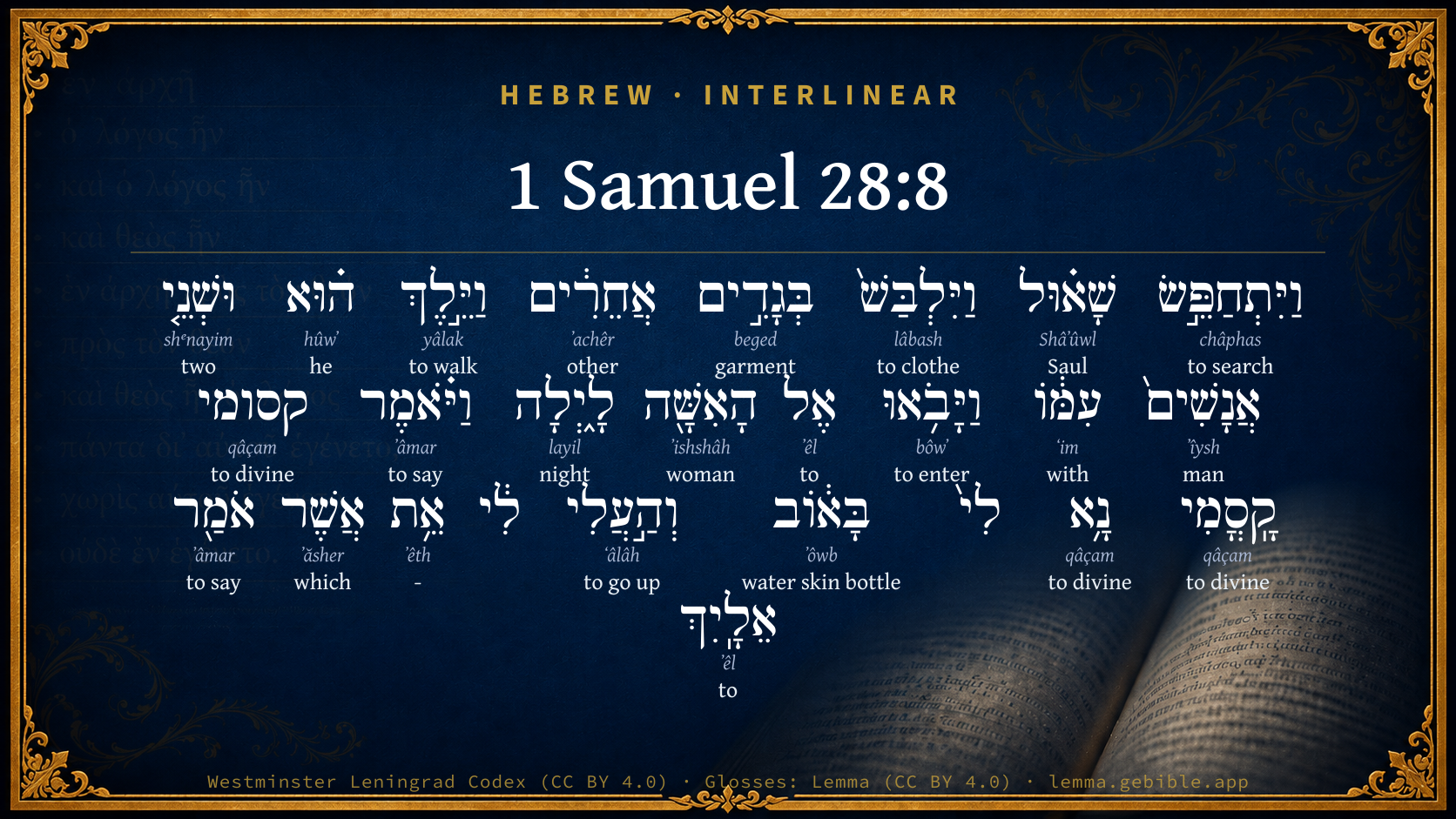
  1. וַיִּתְחַפֵּ֣שׂ châphas H2664 “and · to search” Conjunction + Verb, Hithpael, Sequential Imperfect, 3rd Person, Masculine, Singular
  2. שָׁא֗וּל Shâʼûwl H7586 “Saul” Noun, Proper
  3. וַיִּלְבַּשׁ֙ lâbash H3847 “and · to clothe” Conjunction + Verb, Qal, Sequential Imperfect, 3rd Person, Masculine, Singular
  4. בְּגָדִ֣ים beged H899 “garments” Noun, Common, Masculine, Plural, Absolute
  5. אֲחֵרִ֔ים ʼachêr H312 “other” Adjective, Adjective, Masculine, Plural, Absolute
  6. וַיֵּ֣לֶךְ yâlak H3212 “and · to walk” Conjunction + Verb, Qal, Sequential Imperfect, 3rd Person, Masculine, Singular
  7. ה֗וּא hûwʼ H1931 “he” Pronoun, Personal, 3rd Person, Masculine, Singular
  8. וּשְׁנֵ֤י shᵉnayim H8147 “and · two” Conjunction + Adjective, Cardinal number, Masculine, Dual, Construct
  9. אֲנָשִׁים֙ ʼîysh H376 “men” Noun, Common, Masculine, Plural, Absolute
  10. עִמּ֔וֹ ʻim H5973 “with · him” Preposition + Suffix, Personal, 3rd Person, Masculine, Singular
  11. וַיָּבֹ֥אוּ bôwʼ H935 “and · to enter” Conjunction + Verb, Qal, Sequential Imperfect, 3rd Person, Masculine, Plural
  12. אֶל ʼêl H413 “to” Preposition
  13. הָאִשָּׁ֖ה ʼishshâh H802 “the · woman” Particle, Definite Article + Noun, Common, Feminine, Singular, Absolute
  14. לָ֑יְלָה layil H3915 “night” Noun, Common, Masculine, Singular, Absolute
  15. וַיֹּ֗אמֶר ʼâmar H559 “and · to say” Conjunction + Verb, Qal, Sequential Imperfect, 3rd Person, Masculine, Singular
  16. קסומי qâçam H7080 “divine” Verb, Qal, Imperative, 2nd Person, Feminine, Singular
  17. קָֽסֳמִי qâçam H7080 “divine” Verb, Qal, Imperative, 2nd Person, Feminine, Singular
  18. נָ֥א qâçam H7080 “to divine” Particle, Exhortation
  19. וְהַ֣עֲלִי ʻâlâh H5927 “and · go up” Conjunction + Verb, Hiphil, Imperative, 2nd Person, Feminine, Singular
  20. אֵ֥ת ʼêth H853 “-” Particle, Direct Object
  21. אֲשֶׁר ʼăsher H834 “which” Particle, Relative
  22. אֹמַ֖ר ʼâmar H559 “to say” Verb, Qal, Imperfect, 1st Person, Common, Singular
  23. אֵלָֽיִךְ ʼêl H413 “to · you” Preposition + Suffix, Personal, 2nd Person, Feminine, Singular

About this verse

These counts appear in no published source. They are computed here, from the morphology-tagged text and Lemma’s own curated glosses. What Lemma adds →

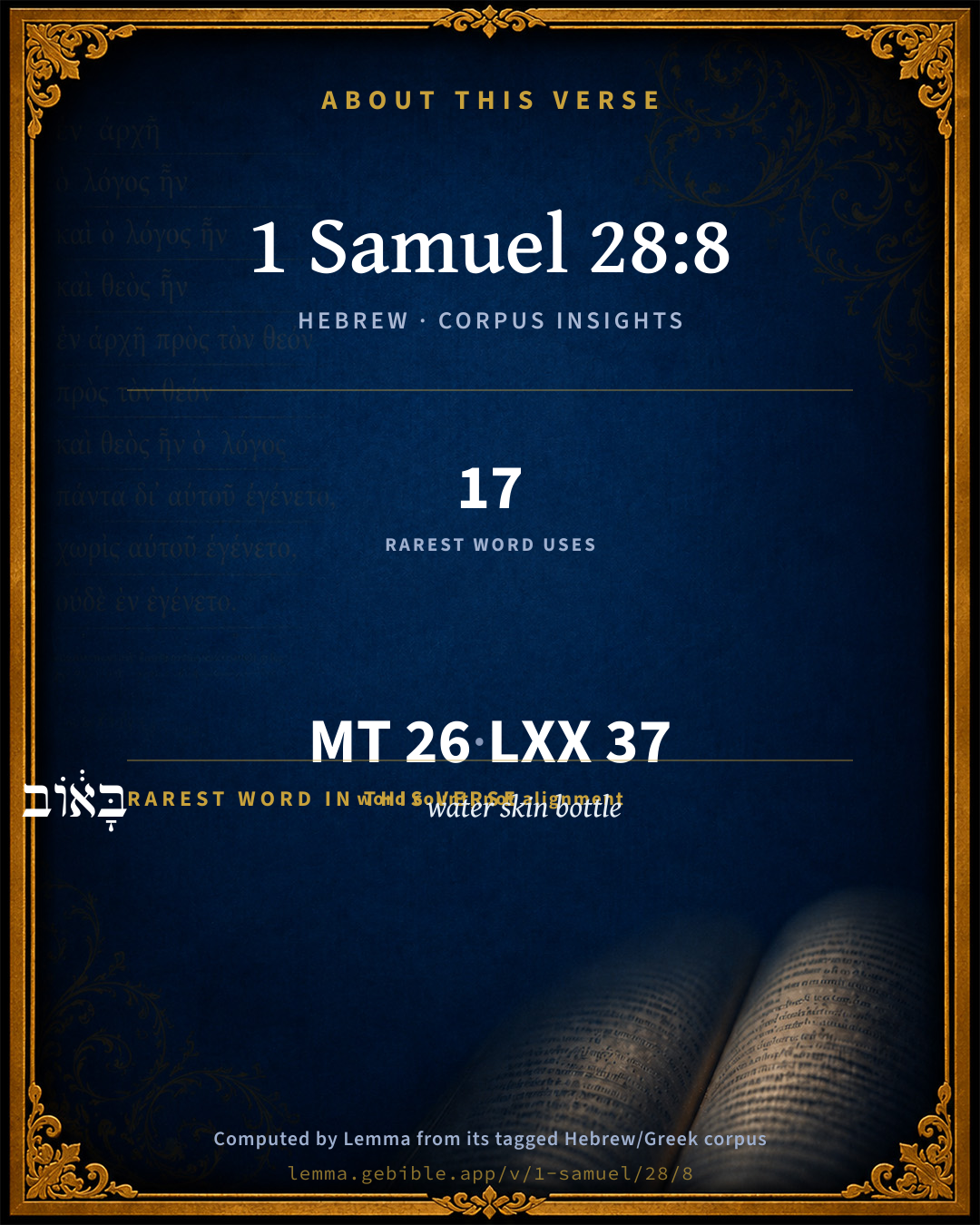
26
words
20
distinct lemmas
Historical
section

Notable vocabulary

The rarest word here is בָּא֔וֹב water skin bottle H178 — appearing just 17 times in the whole Hebrew Bible.

Shared distinctive vocabulary

בָּא֔וֹב water skin bottle H178 occurs in 16 verses of the Hebrew Bible. Also found in:

Grammatical profile

  • 9 verbs
  • 6 nouns
  • 2 adjectives
  • 1 pronoun
  • 5 prepositions
  • 3 particles

Verb forms

  • וַיִּתְחַפֵּ֣שׂ Hithpael · Sequential Imperfect
  • וַיִּלְבַּשׁ֙ Qal · Sequential Imperfect
  • וַיֵּ֣לֶךְ Qal · Sequential Imperfect
  • וַיָּבֹ֥אוּ Qal · Sequential Imperfect
  • וַיֹּ֗אמֶר Qal · Sequential Imperfect
  • קסומי Qal · Imperative
  • קָֽסֳמִי Qal · Imperative
  • וְהַ֣עֲלִי Hiphil · Imperative
  • אֹמַ֖ר Qal · Imperfect

Repetition

Words recur within this verse — often emphatic in Hebrew:

  • קסומי to divine H7080 ×3
  • וַיֹּ֗אמֶר to say H559 ×2
  • אֶל to H413 ×2

Hebrew & Septuagint length

In English translation the verse runs 45 words from the Hebrew and 54 from the Septuagint (LXX English) — closely comparable.

A rough comparison of the two English renderings, which tokenize alike — not a word-level alignment.

Word counts can differ between the Hebrew and the Greek without any difference in meaning — e.g. the Hebrew direct-object marker אֵת has no separate Greek word, and Greek often adds the article ὁ.

In the original languages it is 26 Hebrew tokens and 37 Greek tokens — but the two are counted differently (Hebrew bundles its prefixes and suffixes into one token; the Greek is in lemma form), so that isn’t a like-for-like length.

Cross-references

11

Topical passages linked to 1 Samuel 28:8 in the Treasury of Scripture Knowledge — connected by theme and wording, ordered by reader-vote popularity; previews shown in the World English Bible.

  • 1 Chronicles 10:13 So Saul died for his trespass which he committed against Yahweh, because of the word of Yahweh, which he didn't keep; and also because he asked counsel of one who had a familiar spirit, to inquire [thereby],
  • Isaiah 8:19 When they shall tell you, "Consult with those who have familiar spirits and with the wizards, who chirp and who mutter:" shouldn't a people consult with their God? on behalf of the living [should they consult] with the dead?
  • Deuteronomy 18:10–11 There shall not be found with you anyone who makes his son or his daughter to pass through the fire, one who uses divination, one who practices sorcery, or an enchanter, or a sorcerer,
  • 1 Kings 22:30 The king of Israel said to Jehoshaphat, I will disguise myself, and go into the battle; but put you on your robes. The king of Israel disguised himself, and went into the battle.
  • 2 Chronicles 18:29 The king of Israel said to Jehoshaphat, I will disguise myself, and go into the battle; but put you on your robes. So the king of Israel disguised himself; and they went into the battle.
  • 2 Chronicles 35:22 Nevertheless Josiah would not turn his face from him, but disguised himself, that he might fight with him, and didn't listen to the words of Neco from the mouth of God, and came to fight in the valley of Megiddo.
  • 1 Kings 14:2–3 Jeroboam said to his wife, Please get up and disguise yourself, that you not be known to be the wife of Jeroboam; and get you to Shiloh: behold, there is Ahijah the prophet, who spoke concerning me that I should be king over this people.
  • Job 24:13–15 "These are of those who rebel against the light; They don't know the ways of it, Nor abide in the paths of it.
  • Jeremiah 23:24 Can any hide himself in secret places so that I shall not see him? says Yahweh. Don't I fill heaven and earth? says Yahweh.
  • John 3:19 This is the judgment, that the light has come into the world, and men loved the darkness rather than the light; for their works were evil.
  • 1 Kings 22:34 A certain man drew his bow at a venture, and struck the king of Israel between the joints of the armor: therefore he said to the driver of his chariot, Turn your hand, and carry me out of the host; for I am severely wounded.

Cross-references courtesy of OpenBible.info (CC BY 4.0).

Hebrew and Greek witnesses Masoretic Hebrew ↔ Greek Septuagint

The same verse in the two great witnesses to the Old Testament, shown verse-for-verse.

These are two independent witnesses, not word-aligned to each other, and the Septuagint is shown in lemma (dictionary) form.

Hebrew 1 Samuel 28:8 Masoretic · Westminster Leningrad Codex

וַיִּתְחַפֵּ֣שׂ שָׁא֗וּל וַיִּלְבַּשׁ֙ בְּגָדִ֣ים אֲחֵרִ֔ים וַיֵּ֣לֶךְ ה֗וּא וּשְׁנֵ֤י אֲנָשִׁים֙ עִמּ֔וֹ וַיָּבֹ֥אוּ אֶל הָאִשָּׁ֖ה לָ֑יְלָה וַיֹּ֗אמֶר קסומי קָֽסֳמִי נָ֥א לִי֙ בָּא֔וֹב וְהַ֣עֲלִי לִ֔י אֵ֥ת אֲשֶׁר אֹמַ֖ר אֵלָֽיִךְ

Saul disguised himself, and put on other clothing, and went, he and two men with him, and they came to the woman by night: and he said, Please divine to me by the familiar spirit, and bring me up whoever I shall name to you.

World English Bible · Public Domain

Greek LXX 1 Samuel 28:8 Septuagint · lemma form

καί συνκαλύπτω σαούλ καί περιβάλλω ἱμάτιον ἕτερος καί πορεύομαι αὐτός καί δύο ἀνήρ μετά αὐτός καί ἔρχομαι πρός ὁ γυνή νύξ καί εἶπον αὐτός μαντεύομαι δή ἐγώ ἐν ὁ ἐγγαστρίμυθος καί ἀναἄγω ἐγώ ὅς ἐάν εἶπον σύ

And Saul disguised himself, and put on other raiment, and he goes, and two men with him, and they come to the woman by night; and he said to her, Divine to me, I pray you, by the divining spirit within you, and bring up to me him whom I shall name to you.

LXX2012 (modern English Septuagint) · Public Domain

Hebrew: Westminster Leningrad Codex (CC BY 4.0). Greek: Septuagint (public domain); English from LXX2012 (modern English Septuagint) (Public Domain). How the Septuagint differs from the Hebrew →

Targum (Aramaic paraphrase)

1

The Targum is the ancient Jewish Aramaic paraphrase of the Hebrew Scriptures — an interpretive translation, not the Hebrew text itself. Onkelos (literal) and Pseudo-Jonathan (expansive) render the Torah, and Jonathan the Prophets. Coverage is partial: where no permissively-licensed English translation exists for a verse, only the Aramaic is shown. This is verse-level text, not a word-by-word alignment to the Hebrew.

  1. Targum Jonathan Prophets (Joshua–Malachi)
    וְאִשְׁתַּנֵי שָׁאוּל וּלְבַשׁ לְבוּשִׁין אוֹחֲרָנִין וַאֲזַל הוּא וּתְרֵין גַבְרָא עִמֵיהּ וַאֲתוֹ לְוַת אִתְּתָא בְּלֵילְיָא וַאֲמַר קָסְמִי כְעַן לִי בְּבִידִין וְאַסְקֵי לִי יַת דְאֵימַר לָךְ:

    (no public-domain English translation for this verse)

    Targum Jonathan — Aramaic: “Mikraot Gedolot” (public domain). English: “Sefaria Community Translation” (CC0 1.0 (public-domain dedication)); “London "Chaldee Paraphrase," 1871” (public domain). Text via Sefaria.

Commentary

Notes on 1 Samuel 28:8 from classic Christian and Jewish commentators (each source and its license shown beneath its notes). The classic Christian expositions comment on the surrounding passage and are grouped to its opening verse, so a note may address several verses; the Jewish commentaries on the Tanakh (Rashi and others) are per-verse, so they appear only where the commentator wrote on this verse.

Lemma curates 59 commentaries, every one of them public domain or Creative Commons licensed, each selected and text-cleaned for this edition rather than reprinted as found. About our sources →

Trapp's Complete Commentary

John Trapp

1Sa 28:8 And Saul disguised himself, and put on other raiment, and he went, and two men with him, and they came to the woman by night: and he said, I pray thee, divine unto me by the familiar spirit, and bring me [him] up, whom I shall name unto thee.

Ver. 8. And Saul disguised himself.] As well he might with shame enough, thus to return to his vomit, and make use of those whom he had formerly suppressed. A hypocrite will at length be detected, that he may be detested.

John Trapp, A Commentary or Exposition upon All the Books of the Old and New Testament (1647–1656) — public domain. Text from a community e-Sword module.

Joseph Benson's Commentary

1Sa 28:8. Saul disguised himself — Both because he was ashamed to be known, or thought guilty of this practice, and because he suspected the woman, if she knew him, would not practise her art before him. And he went — In all haste that very night, stripped of his regal apparel, and attended only by two companions. How nearly allied are infidelity and impiety to superstition; and what will not they do who will not confide in and obey God! But a few hours before he was too haughty to profess himself the servant of the living God, and to observe his laws, and now he is the slave of his fears and follies! “The most infidel man,” says Delaney, “that I ever conversed with, was, by the accounts of those who best knew him, the most superstitious.”

Joseph Benson's Commentary on the Old and New Testaments (1811–1818) — public domain. Text from a community e-Sword module.

Geneva Bible (1599)

Geneva Bible translators

He seeketh not to God in his misery, but is let by Satan to unlawful means, which in his conscience he condemneth.

Geneva Bible (1599) marginal notes — public domain. Text via Bolls.life.

Jamieson, Fausset & Brown

Robert Jamieson, A. R. Fausset & David Brown

bring me him up, whom I shall name unto thee--This pythoness united to the arts of divination a claim to be a necromancer (Deu 18:11); and it was her supposed power in calling back the dead of which Saul was desirous to avail himself. Though she at first refused to listen to his request, she accepted his pledge that no risk would be incurred by her compliance. It is probable that his extraordinary stature, the deference paid him by his attendants, the easy distance of his camp from En-dor, and the proposal to call up the great prophet and first magistrate in Israel (a proposal which no private individual would venture to make), had awakened her suspicions as to the true character and rank of her visitor. The story has led to much discussion whether there was a real appearance of Samuel or not. On the one hand, the woman's profession, which was forbidden by the divine law, the refusal of God to answer Saul by any divinely constituted means, the well-known age, figure, and dress of Samuel, which she could easily represent herself, or by an accomplice--his apparition being evidently at some distance, being muffled, and not actually seen by Saul, whose attitude of prostrate homage, moreover, must have prevented him distinguishing the person though he had been near, and the voice seemingly issuing out of the ground, and coming along to Saul--and the vagueness of the information, imparted much which might have been reached by natural conjecture as to the probable result of the approaching conflict--the woman's representation--all of this has led many to think that this was a mere deception. On the other hand, many eminent writers (considering that the apparition came before her arts were put in practice; that she herself was surprised and alarmed; that the prediction of Saul's own death and the defeat of his forces was confidently made), are of opinion that Samuel really appeared.

Jamieson, Fausset & Brown — Commentary Critical and Explanatory on the Whole Bible (1871) — public domain (CC PDM 1.0). Text via the HelloAO Bible API.

Adam Clarke's Commentary

Verse 8. Saul disguised himself] That he might not be known by the woman, lest she, being terrified, should refuse to use her art.

Adam Clarke's Commentary on the Bible (1810–1826) — public domain. Text from a community e-Sword/MySword module.

Ellicott's Commentary for English Readers

(8) And Saul disguised himself.—The disguise and the time chosen for the expedition served a double purpose. The king would, he thought, be unknown in the darkness and disguise when he came to the witch’s dwelling, and there was, too, a far greater probability of his escaping his Philistine foes, whose army lay between him and the village of En-dor.

Divine unto me by the familiar spirit.—Literally, divine unto me by the ôb. Keil’s remark is interesting: “Prophesying by the ôb was probably performed by calling up a departed spirit from Sheol, and obtaining prophecies—i.e., disclosures—concerning one’s own fate through the medium of such a spirit.” No other commentator touches on the ôb here, and Keil leaves it in doubt as to whether he considered the ôb was some special spirit devoted to the service of the mistress of the ôb, or the spirit or soul of one already dead, who, through some occult power, was to be brought back again for a season to this earth. As far as we can judge of these old mysteries, the sorcerer or sorceress possessed, or was supposed to possess, a “familiar.” Through the aid of this “familiar,” the departed spirit was compelled or induced to re-visit this world, and to submit to certain questioning. The Hebrew rendered “divine unto me” is of Syriac origin, like most of those words describing illicit vaticinations.—Speaker’s Commentary. This miserable power, if it did exist, was one of the things the Israelites learned from the original inhabitants of Canaan. These “black” arts, as they have been called, have, in all ages, in every degree of civilisation, always had an extraordinary fascination for men. It is well known that even in our own “cultured age” similar pretensions are put forth, and the dead are still invoked, summoned, and questioned, as they were in the half-barbarous age when Saul and his companions, in their desperate strait, sought the witch of En-dor.

And bring me him up.—The popular idea has always been that Sheol, the place of departed spirits, is somewhere beneath the ground or earth on which we live, just as heaven, the abode of God and His holy angels, is in a region above the earth. St. Paul speaks in this popular language (Eph_4:9), where he refers to the lower parts of the earth as the abode of departed spirits. Hence we have here, “bring me him up.” The Christian Church, Bishop Wordsworth reminds us, has adopted this language into her creeds, where she says that Christ in His human soul descended into hell (Hades). Keil well remarks on this human idea of what is “above” and “below”: “With our modes of thought, which are so bound up with time and space, it is impossible to represent to ourselves in any other way the difference and contrast between blessedness with God and shade-life in death.”

A Bible Commentary for English Readers, edited by Charles John Ellicott (1878–1897) — public domain. Text from a community e-Sword module.

The Cambridge Bible for Schools and Colleges

gen. ed. J. J. S. Perowne

8. they came to the woman by night] It was an adventurous journey. They had to pass over the shoulder of the hill on which the Philistines were encamped, and traverse a distance of not less than ten or twelve miles. The darkness around was a fit emblem of the darkness in Saul’s soul. Cp. Joh_13:30, and Augustine’s comment “Nox erat, et ipse qui exivit erat nox,” (It was night, and he who went forth was night).

bring me him up, &c.] A more precise definition of the method of divination “by Ob.” Cp. Deu_18:10-11. Probably Saul expected to hear a voice, but not to see a form. Necromancy was practised among the Greeks and other heathen nations. There was a famous oracle of this kind on the River Acheron in Epirus (νεκυομαντεῖον).

The Cambridge Bible for Schools and Colleges (gen. ed. J. J. S. Perowne; Cambridge University Press, 1878–1918) — public domain. Text from a community e-Sword module.

John Gill's Exposition

And Saul disguised himself, and put on other raiment,.... Stripped himself of his royal robes, or military apparel, as supreme commander, and clothed himself in the habit of a peasant or a common soldier; and this not only that he might not be known by the woman, but that he might pass from his army incognito, and it might not be known that he was gone, and especially whither he was gone:

and he went, and two men with him: these, according to the tradition of the Jews (e), were Abner and Amasa; but it is not probable that Saul should leave his army destitute of their general at such a time as this:

and they came to the woman by night; not only that they might not be seen, but because it was a work of darkness they were going about, and it was only in the night season that such persons exercised their black art; though the Jews (f) say it was day, only because of their distress it was like tonight with them; but the literal sense is best:

and he said, I pray thee divine unto me by the familiar spirit; exercise her art of divination, by the assistance of the familiar spirit she conversed with:

and bring me up whom I shall name unto thee: that is, from the dead; for necromancy was the kind of divination she professed; and such persons pretended to have a power to bring up a deceased person, and consult with him about secret and future things.

(e) Vajikra Rabba, sect. 26. fol. 167. 1. Shalshalet ib. (f) Tanchuma apud Jarchiura in loc.

John Gill's Exposition of the Whole Bible (1746–1763) — public domain (CC PDM 1.0). Text via the HelloAO Bible API.

Albert Barnes' Notes on the Bible

Divine - Compare to 1Sa 6:2, note; Num 23:23, note.

Bring me him up - The art of the ventriloquist seems to have been always connected with necromancy. The Greeks had necromancers who called up departed spirits to give answers to those who consulted them.

Albert Barnes' Notes on the Bible (1834–1885) — public domain. Text from a community e-Sword/MySword module.

Haydock's Catholic Bible Commentary

Clothes, that he might not fill the woman or his army with dismay. (Calmet)

George Leo Haydock (1774–1849), Haydock's Catholic Family Bible and Commentary, 1859 edition — public domain. Excludes Psalms (Douay-Rheims chapter numbering differs from Protestant) and Deuterocanonical books (Catholic canon only).

Matthew Poole's English Annotations

Saul disguised himself; both because he was ashamed to be known, or thought guilty of this practice; and because he suspected that the woman, had she known him, would not practise her art before him.

Matthew Poole's English Annotations on the Holy Bible (1683–1685) — public domain. Text from a community e-Sword/MySword module.

Whedon's Commentary on the Bible

Daniel D. Whedon

8. Disguised himself — So as not to be recognised by the woman.

By night — The only time when it would be at all safe for him to venture so far in the rear of his enemy, and perhaps the only time when he could go at all, for the morrow might require his presence with his army, and the battle might drive him far from Endor.

Divine unto me — Saul made known his errand in language such as any one who inquired of a necromancer would naturally use.

Daniel D. Whedon (gen. ed.), Commentary on the Old and New Testaments (1874–1909) — public domain. Text from a community e-Sword module.

John Wesley's Explanatory Notes

Disguised - Both because he was ashamed to be known, or thought guilty of this practice; and because he suspected, the woman, had she known him, would not practice her art before him.

John Wesley, Explanatory Notes Upon the Whole Bible (1754–1765) — public domain. Text via the GEBible commentary corpus.

unfoldingWord translationNotes

Door43 World Missions Community

Saul disguised himself ... and went ... to the woman by night

Saul disguised himself because the way from Gilboa (1 Samuel 28:4) to Endor (1 Samuel 28:7) was through land that the Philistines were living in. He traveled all day and reached the woman after the sun had gone down.

disguised

changed his usual appearance no one would know who he was

Divine for me ... with a spirit

"Talk to the dead for me"

those who talk with the dead or with spirits

The words "those who talk with the dead" translate as one word in the original language, and the words "those who ... talk with spirits" also translate as one word in the original language. If your language has one word for those who talk with the dead and one word for those who talk with spirits, or if your language has only one word for those who talk with the dead and with spirits, you should use those words here. See how you translated similar words in 1 Samuel 28:3.

my life

The word "life" represents the person. AT: "me" (See: Synecdoche)

translationWords

Saul (OT)

divination

name

life

oath

Yahweh

punish

unfoldingWord translationNotes — © Distant Shores Media and the Door43 World Missions Community, licensed CC BY-SA 4.0. Source: git.door43.org/Door43/en_tn.

Rashi

Rabbi Shlomo Yitzchaki (Rashi)

Shaul disguised himself. He changed his clothes, and similarly, 'disguise yourself [הִתְחַפֵּשׂ] and come into battle,' and similarly, 'its intensity makes me change [יׅתְחַפֵּשׂ] my clothing.' And so did Targum Yonoson render, 'and Shaul changed.'

They came to the woman at night. [They actually came] during the daytime, but because of their distress, it seemed to them as night. So did R. Tanchuma expound.

Rashi on the Tanakh — English translations: “The Judaica Press complete Tanach with Rashi, translated by A. J. Rosenberg” (CC BY 4.0); “Pentateuch with Rashi's commentary by M. Rosenbaum and A.M. Silbermann, 1929-1934” (public domain); “The Metsudah Tanach series, Lakewood, N.J” (CC BY 4.0); and “The Book of Joshua, Metsudah Publications, 1997” (CC BY 4.0). Text via Sefaria.

Lesson kit

Teaching starters — assembled from the data on this page, not authored interpretation. Every prompt links to the verse data it draws on. Edit before teaching.

1 Samuel, in the Historical, opens this verse with 26 words (20 distinct Hebrew lemmas). Its most distinctive word is ʼôwb (“water skin bottle”). A historical commentator’s framing appears above. Read the whole chapter for the surrounding context.

Discussion questions

  1. The word ʼôwb carries the sense “water skin bottle.” How does it shape the verse?
  2. Leviticus 19:31 shares the word «water skin bottle» with this verse. How do the two illuminate each other?
  3. “to divine” occurs 3× in this one verse. What is the effect of the repetition?
  4. These translations render this verse differently; the difference is in the English rendering, not the original. What questions does that raise?
  5. The verb «וַיִּתְחַפֵּ֣שׂ» is Hithpael Sequential Imperfect. How does its form color the action?
  6. Reading how Trapp's Complete Commentary and Joseph Benson's Commentary read this verse, where do the two commentators agree and where do they part?

Things to notice

Reading settings

Reading text

Shown beneath each verse's original-language words.

Old Testament
Old Testament edition

Read the OT as the Masoretic Hebrew (MT) or the Greek Septuagint (LXX).

English shown for the Greek Septuagint (in the Hebrew ↔ Greek comparison).

Comparing translations? Open the Compare panel on any verse page to stack up to four side by side.