
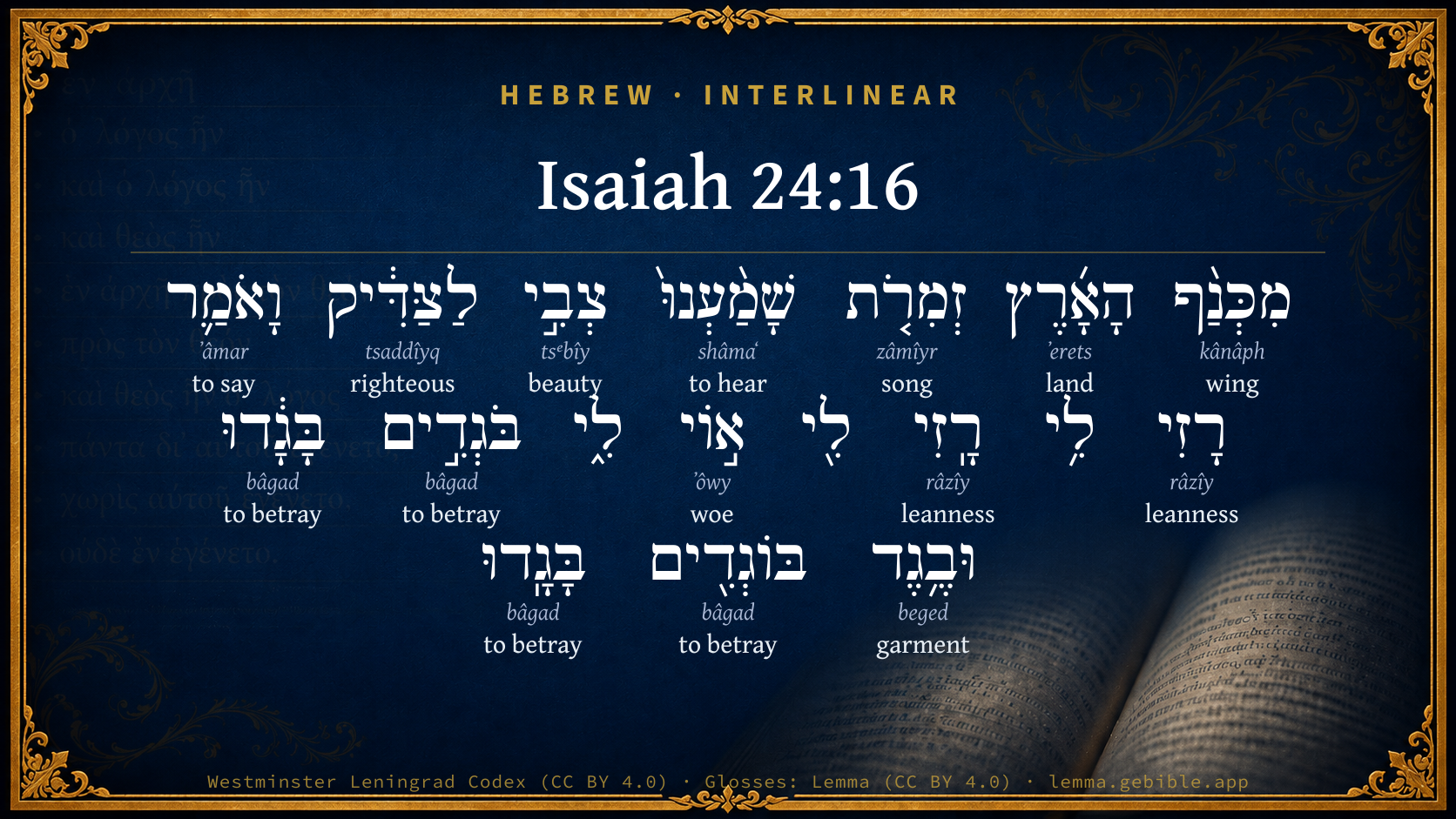
Isaiah 24:16

Hebrew (Westminster Leningrad Codex) Isaiah 24:16 appears in the Hebrew Old Testament. The text above is from the Westminster Leningrad Codex. Each word links to its Strong’s number, a concise gloss, and parsing drawn from the Open Scriptures Hebrew Bible morphology. Click any word for its full Brown-Driver-Briggs (BDB) entry.
Download image
Cite this verse

Isaiah 24:16 (World English Bible). Public Domain. Lemma interlinear Bible study tool, https://lemma.gebible.app/v/isaiah/24/16.

Show BibTeX & RIS
BibTeX
RIS
English Translation
From the uttermost part of the earth have we heard songs: Glory to the righteous. But I said, I pine away, I pine away, woe is me! the treacherous have dealt treacherously; yes, the treacherous have dealt very treacherously.
World English Bible · Public Domain
Highlights
  • 1 first appearance in the Hebrew Bible
Full analysis ↓
Download a study sheet

One document with this verse’s original text, its word-by-word gloss line, the meaning frame, cross-references with their text, attributed commentary, and full source and license credits — printable, and it pastes into notes with its structure intact.

This verse Autodidact and up

Study sheet (.html) Plain text (.txt)

A passage Seminary Student

Up to 50 verses in one chapter. A passage sheet keeps up to 6 commentary sources and 12 cross-references per verse, in the order this page ranks them, and says so on the sheet whenever that leaves anything out. Ask for a single verse and you get the Autodidact verse sheet above.

Everything on this page stays free to read, with no account — the sheet is a download of what is already on screen, not access to it.

Want to remove ads? Support Godless Engineer
Compare translations 3

The same verse in 3 English versions, stacked beneath the original-language interlinear above. Click any original word for its lexicon entry.

Each is an independent rendering of the whole verse — the interlinear is not word-aligned to these translations.

Highlighted words mark where these versions differ — a whole-verse word diff, not a word-by-word alignment.

  • World English Bible Public Domain
    From the uttermost part of the earth have we heard songs: Glory to the righteous. But I said, I pine away, I pine away, woe is me! the treacherous have dealt treacherously; yes, the treacherous have dealt very treacherously.
  • King James Version Public Domain
    From the uttermost part of the earth have we heard songs, even glory to the righteous. But I said, My leanness, my leanness, woe unto me! the treacherous dealers have dealt treacherously; yea, the treacherous dealers have dealt very treacherously.
  • unfoldingWord Literal Text CC BY-SA 4.0
    From the edge of the earth we have heard songs, “Splendor to the Righteous One!” But I say, “Leanness to me! Leanness to me! Woe to me!” The ones acting treacherously have acted treacherously, yes, the ones acting treacherously have acted treacherously treachery.

unfoldingWord Literal Text — © unfoldingWord, licensed CC BY-SA 4.0. Word-aligned USFM3 via Door43 (git.door43.org/unfoldingWord/en_ult).

Versions to compare (up to 4)

3 of 4 selected

Show all 18 translations

Every available English version of this verse, each an independent rendering of the whole verse.

  • World English Bible Public Domain
    From the uttermost part of the earth have we heard songs: Glory to the righteous. But I said, I pine away, I pine away, woe is me! the treacherous have dealt treacherously; yes, the treacherous have dealt very treacherously.
  • Berean Standard Bible Public Domain
    From the ends of the earth we hear singing: “Glory to the Righteous One.” But I said, “I am wasting away! I am wasting away! Woe is me.” The treacherous betray; the treacherous deal in treachery.
  • Majority Standard Bible Public Domain
    From the ends of the earth we hear singing: “Glory to the Righteous One.” But I said, “I am wasting away! I am wasting away! Woe is me.” The treacherous betray; the treacherous deal in treachery.
  • King James Version Public Domain
    From the uttermost part of the earth have we heard songs, even glory to the righteous. But I said, My leanness, my leanness, woe unto me! the treacherous dealers have dealt treacherously; yea, the treacherous dealers have dealt very treacherously.
  • American Standard Version (1901) Public Domain
    From the uttermost part of the earth have we heard songs: Glory to the righteous. But I said, I pine away, I pine away, woe is me! the treacherous have dealt treacherously; yea, the treacherous have dealt very treacherously.
  • Revised Version (1885) Public Domain
    From the uttermost part of the earth have we heard songs, glory to the righteous. But I said, I pine away, I pine away, woe is me! the treacherous dealers have dealt treacherously; yea, the treacherous dealers have dealt very treacherously.
  • Geneva Bible (1599) Public Domain
    From the vttermost part of the earth wee haue heard praises, euen glory to the iust, and I sayd, My leanesse, my leanesse, woe is mee: the transgressours haue offended: yea, the transgressours haue grieuously offended.
  • Douay-Rheims (1899) Public Domain
    From the ends of the earth we have heard praises, the glory of the just one. And I said: My secret to myself, my secret to myself, woe is me: the prevaricators have prevaricated, and with the prevarication of transgressors they have prevaricated.
  • Young's Literal Translation Public Domain
    From the skirt of the earth we heard songs, The desire of the righteous. And I say, `Leanness `is' to me, Leanness `is' to me, wo `is' to me.' Treacherous dealers dealt treacherously, Yea, treachery, treacherous dealers dealt treacherously.
  • Literal Standard Version CC BY-SA 4.0
    From the skirt of the earth we heard songs, || The desire of the righteous. And I say, “Leanness [is] to me, || Leanness [is] to me, woe [is] to me.” Treacherous dealers dealt treacherously, || Indeed, treachery, treacherous dealers dealt treacherously.
  • Unlocked Literal Bible CC BY-SA 4.0
    From the farthest part of the earth we have heard songs, “Glory to the righteous one!” But I said, “I have wasted away, I have wasted away, woe is me! The treacherous have dealt treacherously; yes, the treacherous have dealt very treacherously.”
  • unfoldingWord Literal Text CC BY-SA 4.0
    From the edge of the earth we have heard songs, “Splendor to the Righteous One!” But I say, “Leanness to me! Leanness to me! Woe to me!” The ones acting treacherously have acted treacherously, yes, the ones acting treacherously have acted treacherously treachery.
  • Darby Bible Public Domain
    From the end of the earth have we heard songs: Glory to the righteous! And I said, My leanness, my leanness, woe unto me! The treacherous have dealt treacherously; yea, the treacherous have dealt very treacherously.
  • World Messianic Bible Public Domain
    From the uttermost part of the earth have we heard songs. Glory to the righteous! But I said, “I pine away! I pine away! woe is me!” The treacherous have dealt treacherously. Yes, the treacherous have dealt very treacherously.
  • Webster's Bible Public Domain
    From the uttermost part of the earth have we heard songs, even glory to the righteous. But I said, My leanness, my leanness, woe to me! the treacherous dealers have dealt treacherously; yes, the treacherous dealers have dealt very treacherously.
  • Free Bible Version CC BY-SA 4.0
    We hear songs coming from the ends of the earth, singing, “Glory to the God who does right.” But I'm miserable, miserable. Pity me! Deceitful people go on betraying, again and again.
  • Bible in Basic English Public Domain
    From the farthest part of the earth comes the sound of songs, glory to the upright. But I said, I am wasting away, wasting away, the curse is on me! The false ones go on in their false way, yes, they go on acting falsely.
  • JPS Tanakh (1917) Public Domain
    From the uttermost part of the earth have we heard songs: 'Glory to the righteous.' But I say: I waste away, I waste away, woe is me! The treacherous deal treacherously; yea, the treacherous deal very treacherously.

Literal Standard Version (2020), Covenant Press — licensed CC BY-SA 4.0. Text via the HelloAO Bible API (eBible.org). Unlocked Literal Bible (unfoldingWord) — licensed CC BY-SA 4.0. Text via the HelloAO Bible API (eBible.org). unfoldingWord Literal Text — © unfoldingWord, licensed CC BY-SA 4.0. Word-aligned USFM3 via Door43 (git.door43.org/unfoldingWord/en_ult). Free Bible Version, Dr. Jonathan Gallagher — licensed CC BY-SA 4.0. Text via the HelloAO Bible API (eBible.org).

Word by word

More ways to search: Search by grammar → Find every occurrence → Compare this word →

Practice this passage: Drill this verse → Learn its vocabulary →

רָזִי
râzîy
H7334
“leanness”
Noun, Common, Masculine, Singular, Absolute
Part of Speech
Noun
Type
Common
Gender
Masculine
Number
Singular
State
Absolute
Full BDB Definition

Origin: from H7329

TWOT: 2139b

leanness, wasting
  1. מִכְּנַ֨ף kânâph H3671 “from · wing of” Preposition + Noun, Common, Feminine, Singular, Construct
  2. הָאָ֜רֶץ ʼerets H776 “the · land” Particle, Definite Article + Noun, Common, Both, Singular, Absolute
  3. זְמִרֹ֤ת zâmîyr H2158 “songs” Noun, Common, Masculine, Plural, Absolute
  4. שָׁמַ֨עְנוּ֙ shâmaʻ H8085 “to hear” Verb, Qal, Perfect, 1st Person, Common, Plural
  5. צְבִ֣י tsᵉbîy H6643 “beauty” Noun, Common, Masculine, Singular, Absolute
  6. לַצַּדִּ֔יק tsaddîyq H6662 “to/for the · righteous” Preposition, Determined + Adjective, Adjective, Masculine, Singular, Absolute
  7. וָאֹמַ֛ר ʼâmar H559 “and · to say” Conjunction + Verb, Qal, Sequential Imperfect, 1st Person, Common, Singular
  8. רָֽזִי râzîy H7334 “leanness” Noun, Common, Masculine, Singular, Absolute
  9. א֣וֹי ʼôwy H188 “woe” Particle, Interjection
  10. בֹּגְדִ֣ים bâgad H898 “betraying” Verb, Qal, Participle Active, Masculine, Plural, Absolute
  11. בָּגָ֔דוּ bâgad H898 “to betray” Verb, Qal, Perfect, 3rd Person, Common, Plural
  12. וּבֶ֥גֶד beged H899 “and · garment” Conjunction + Noun, Common, Masculine, Singular, Absolute
  13. בּוֹגְדִ֖ים bâgad H898 “betraying” Verb, Qal, Participle Active, Masculine, Plural, Absolute
  14. בָּגָֽדוּ bâgad H898 “to betray” Verb, Qal, Perfect, 3rd Person, Common, Plural

About this verse

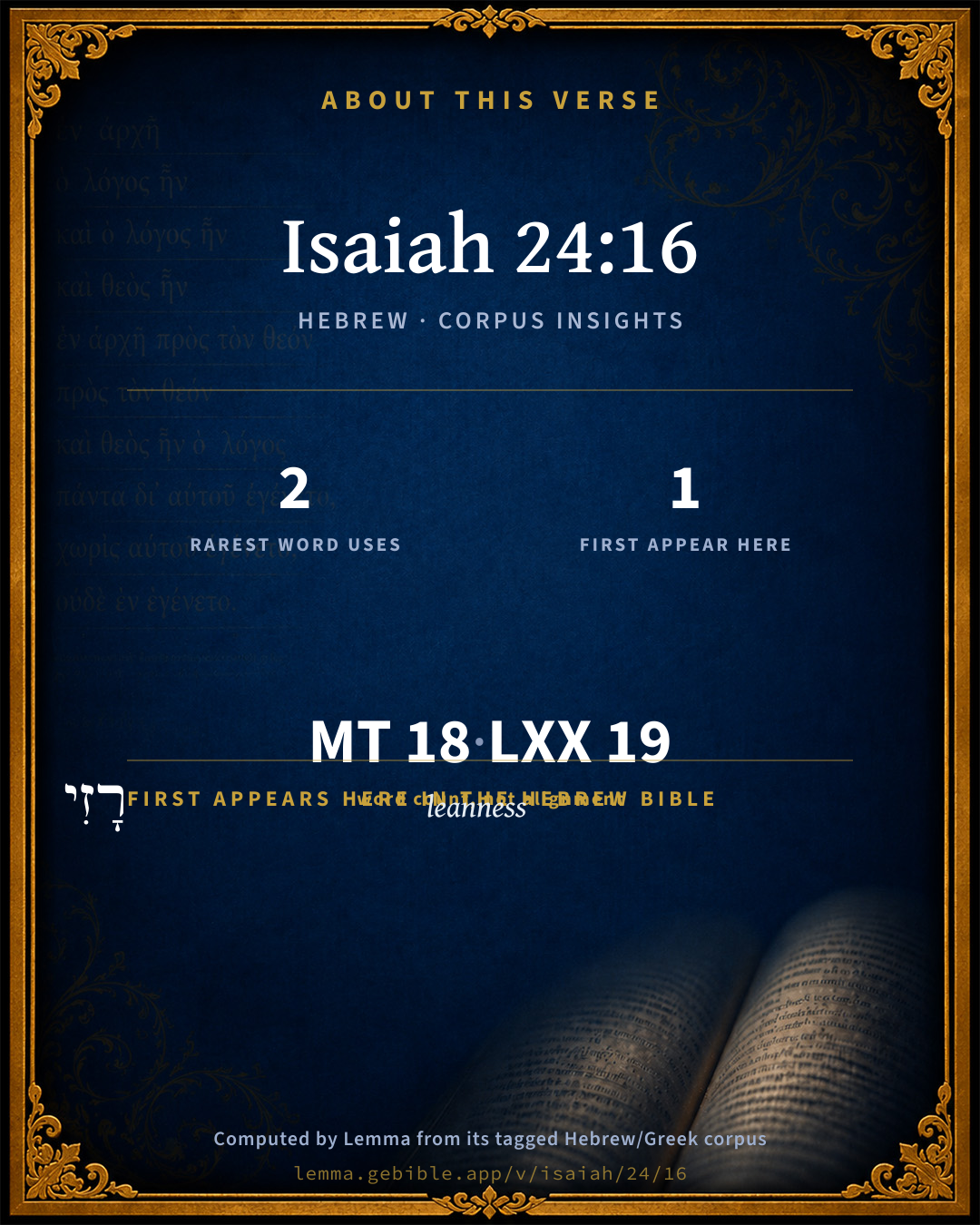
These counts appear in no published source. They are computed here, from the morphology-tagged text and Lemma’s own curated glosses. What Lemma adds →

18
words
11
distinct lemmas
Prophets
section

Notable vocabulary

The rarest word here is רָזִי leanness H7334 — appearing just 2 times in the whole Hebrew Bible.

First appearance in Scripture

This word makes its first canonical appearance in the Hebrew Bible here:

  • רָזִי leanness H7334

Grammatical profile

  • 6 verbs
  • 7 nouns
  • 1 adjective
  • 3 prepositions
  • 1 particle

Verb forms

  • שָׁמַ֨עְנוּ֙ Qal · Perfect
  • וָאֹמַ֛ר Qal · Sequential Imperfect
  • בֹּגְדִ֣ים Qal · Participle Active
  • בָּגָ֔דוּ Qal · Perfect
  • בּוֹגְדִ֖ים Qal · Participle Active
  • בָּגָֽדוּ Qal · Perfect

Repetition

Words recur within this verse — often emphatic in Hebrew:

  • בֹּגְדִ֣ים to betray H898 ×4
  • רָזִי leanness H7334 ×2

Hebrew & Septuagint length

In English translation the verse runs 39 words from the Hebrew and 35 from the Septuagint (LXX English) — closely comparable.

A rough comparison of the two English renderings, which tokenize alike — not a word-level alignment.

Word counts can differ between the Hebrew and the Greek without any difference in meaning — e.g. the Hebrew direct-object marker אֵת has no separate Greek word, and Greek often adds the article ὁ.

In the original languages it is 18 Hebrew tokens and 19 Greek tokens — but the two are counted differently (Hebrew bundles its prefixes and suffixes into one token; the Greek is in lemma form), so that isn’t a like-for-like length.

Cross-references

34

Topical passages linked to Isaiah 24:16 in the Treasury of Scripture Knowledge — connected by theme and wording, ordered by reader-vote popularity; previews shown in the World English Bible.

  • Isaiah 21:2 A grievous vision is declared to me; the treacherous man deals treacherously, and the destroyer destroys. Go up, Elam; besiege, Media; all the sighing of it have I made to cease.
  • Isaiah 33:1 Woe to you who destroy, and you weren't destroyed; and deal treacherously, and they didn't deal treacherously with you! When you have ceased to destroy, you shall be destroyed; and when you have made an end of dealing treacherously, they shall deal treacherously with you.
  • Jeremiah 3:20 Surely as a wife treacherously departs from her husband, so have you dealt treacherously with me, house of Israel, says Yahweh.
  • Jeremiah 5:11 For the house of Israel and the house of Judah have dealt very treacherously against me, says Yahweh.
  • Exodus 15:11 Who is like you, Yahweh, among the gods? Who is like you, glorious in holiness, Fearful in praises, doing wonders?
  • Psalms 2:8 Ask of me, and I will give the nations for your inheritance, The uttermost parts of the earth for your possession.
  • Psalms 22:27–31 All the ends of the earth shall remember and turn to Yahweh. All the relatives of the nations shall worship before you.
  • Psalms 58:10 The righteous shall rejoice when he sees the vengeance. He shall wash his feet in the blood of the wicked;
  • Psalms 67:7 God will bless us. All the ends of the earth shall fear him.
  • Psalms 72:8–11 He shall have dominion also from sea to sea, From the River to the ends of the earth.
  • Psalms 98:3 He has remembered his loving kindness and his faithfulness toward the house of Israel. All the ends of the earth have seen the salvation of our God.
  • Psalms 106:15 He gave them their request, But sent leanness into their soul.
  • Psalms 107:1–43 Give thanks to Yahweh, For he is good, For his loving kindness endures forever.
  • Isaiah 10:16 Therefore will the Lord, Yahweh of Hosts, send among his fat ones leanness; and under his glory there shall be kindled a burning like the burning of fire.
  • Isaiah 17:4 It shall happen in that day, that the glory of Jacob shall be made thin, and the fatness of his flesh shall wax lean.
  • Isaiah 26:15 You have increased the nation, O Yahweh, you have increased the nation; you are glorified; you have enlarged all the borders of the land.
  • Isaiah 28:5 In that day will Yahweh of Hosts become a crown of glory, and a diadem of beauty, to the residue of his people;
  • Isaiah 45:22–25 Look to me, and be you saved, all the ends of the earth; for I am God, and there is none else.
  • Isaiah 48:8 Yes, you didn't hear; yes, you didn't know; yes, from of old your ear was not opened: for I knew that you did deal very treacherously, and was called a transgressor from the womb.
  • Isaiah 52:10 Yahweh has made bare his holy arm in the eyes of all the nations; and all the ends of the earth have seen the salvation of our God.
  • Isaiah 60:21 Your people also shall be all righteous; they shall inherit the land forever, the branch of my planting, the work of my hands, that I may be glorified.
  • Isaiah 66:19–20 I will set a sign among them, and I will send such as escape of them to the nations, to Tarshish, Pul, and Lud, who draw the bow, to Tubal and Javan, to the isles afar off, who have not heard my fame, neither have seen my glory; and they shall declare my glory among the nations.
  • Jeremiah 12:6 For even your brothers, and the house of your father, even they have dealt treacherously with you; even they have cried aloud after you: don't believe them, though they speak beautiful words to you.
  • Lamentations 1:2 She weeps sore in the night, and her tears are on her cheeks; Among all her lovers she has none to comfort her: All her friends have dealt treacherously with her; they are become her enemies.
  • Hosea 5:7 They are unfaithful to Yahweh; For they have borne illegitimate children. Now the new moon will devour them with their fields.
  • Hosea 6:7 But they, like Adam, have broken the covenant. They were unfaithful to me, there.
  • Micah 5:4 He shall stand, and shall shepherd in the strength of Yahweh, In the majesty of the name of Yahweh his God: And they will live, for then he will be great to the ends of the earth.
  • Habakkuk 1:3 Why do you show me iniquity, and look at perversity? For destruction and violence are before me. There is strife, and contention rises up.
  • Mark 13:27 Then he will send out his angels, and will gather together his chosen ones from the four winds, from the ends of the earth to the ends of the sky.
  • Acts 13:47 For so has the Lord commanded us, saying, 'I have set you as a light for the Gentiles, That you should bring salvation to the uttermost parts of the earth.'"
  • Revelation 15:3 They sang the song of Moses, the servant of God, and the song of the Lamb, saying, "Great and marvelous are your works, Lord God, the Almighty; Righteous and true are your ways, you King of the nations.
  • Revelation 16:5–7 I heard the angel of the waters saying, "You are righteous, who are and who were, you Holy One, because you have judged these things.
  • Revelation 19:1–6 After these things I heard something like a loud voice of a great multitude in heaven, saying, "Hallelujah! Salvation, power, and glory belong to our God:
  • Jeremiah 12:1 Righteous are you, Yahweh, when I contend with you; yet would I reason the cause with you: why does the way of the wicked prosper? why are all they at ease who deal very treacherously?

Cross-references courtesy of OpenBible.info (CC BY 4.0).

Hebrew and Greek witnesses Masoretic Hebrew ↔ Greek Septuagint

The same verse in the two great witnesses to the Old Testament, shown verse-for-verse.

These are two independent witnesses, not word-aligned to each other, and the Septuagint is shown in lemma (dictionary) form.

Hebrew Isaiah 24:16 Masoretic · Westminster Leningrad Codex

מִכְּנַ֨ף הָאָ֜רֶץ זְמִרֹ֤ת שָׁמַ֨עְנוּ֙ צְבִ֣י לַצַּדִּ֔יק וָאֹמַ֛ר רָזִי לִ֥י רָֽזִי לִ֖י א֣וֹי לִ֑י בֹּגְדִ֣ים בָּגָ֔דוּ וּבֶ֥גֶד בּוֹגְדִ֖ים בָּגָֽדוּ

From the uttermost part of the earth have we heard songs: Glory to the righteous. But I said, I pine away, I pine away, woe is me! the treacherous have dealt treacherously; yes, the treacherous have dealt very treacherously.

World English Bible · Public Domain

Greek LXX Isaiah 24:16 Septuagint · lemma form

ἀπό ὁ πτέρυξ ὁ γῆ τέρας ἀκούω ἐλπίς ὁ εὐσεβέω καί εἶπον οὐαί ὁ ἀθετέω ὁ ἀθετέω ὁ νόμος

O Lord God of Israel, from the ends of the earth we have heard wonderful things, and there is hope to the godly: but they shall say, Woe to the despisers, that despise the law.

LXX2012 (modern English Septuagint) · Public Domain

On this verse, Whedon's Commentary on the Bible discusses the Septuagint’s reading. Read the note in Commentary ↓

Hebrew: Westminster Leningrad Codex (CC BY 4.0). Greek: Septuagint (public domain); English from LXX2012 (modern English Septuagint) (Public Domain). How the Septuagint differs from the Hebrew →

Targum (Aramaic paraphrase)

1

The Targum is the ancient Jewish Aramaic paraphrase of the Hebrew Scriptures — an interpretive translation, not the Hebrew text itself. Onkelos (literal) and Pseudo-Jonathan (expansive) render the Torah, and Jonathan the Prophets. Coverage is partial: where no permissively-licensed English translation exists for a verse, only the Aramaic is shown. This is verse-level text, not a word-by-word alignment to the Hebrew.

  1. Targum Jonathan Prophets (Joshua–Malachi)
    מִבֵּית מַקְדְשָׁא דְמִתַּמָן עֲתִיד לְמִפַּק חֶדְוָא לְכָל יַתְבֵי אַרְעָא תּוּשְׁבְּחָא שְׁמַעְנָא לְצַדִיקַיָא אָמַר נְבִיָא רָב אֲגַר לְצַדִיקַיָא לְרַשִׁיעַיָא אִתְגְלֵי לִי וַי לַאֲנוּסַיָא דְמִתְאַנְסִין וּלְבִזוּז בָּזְזִין דְהָא מִתְבָּזִין:

    From the house of the sanctuary, yea, from thence joy shall go forth to all the inhabitants of the earth, for we have heard the praise of the righteous! The prophet said, a secret! A reward to the righteous is shown to me, a secret! A punishment for the wicked is revealed to me. Woe to the oppressors, for they shall be oppressed; and to those who spoil, for, behold, they shall be spoiled.

    Targum Jonathan — Aramaic: “Mikraot Gedolot” (public domain). English: “Sefaria Community Translation” (CC0 1.0 (public-domain dedication)); “London "Chaldee Paraphrase," 1871” (public domain). Text via Sefaria.

Commentary

Notes on Isaiah 24:16 from classic Christian and Jewish commentators (each source and its license shown beneath its notes). The classic Christian expositions comment on the surrounding passage and are grouped to its opening verse, so a note may address several verses; the Jewish commentaries on the Tanakh (Rashi and others) are per-verse, so they appear only where the commentator wrote on this verse.

Lemma curates 59 commentaries, every one of them public domain or Creative Commons licensed, each selected and text-cleaned for this edition rather than reprinted as found. About our sources →

Matthew Henry's Commentary

These verses, as those before, plainly speak,

I. Comfort to saints. They may be driven, by the common calamities of the places where they live, into the uttermost parts of the earth, or perhaps they are forced thither for their religion; but there they are singing, not sighing. Thence have we heard songs, and it is a comfort to us to hear them, to hear that good people carry their religion along with them even to the most distant regions, to hear that God visits them there and gives encouragement to hope that he will gather them thence, Deu 30:4. And this is their song, even glory to the righteous: the word is singular, and may refer to the righteous God, who is just in all he has brought upon us. This is glorifying the Lord in the fires. Or the meaning may be, "These songs redound to the glory or beauty of the righteous that sing them." We do the greatest honour imaginable to ourselves when we employ ourselves in honouring and glorifying God. This may have reference to the sending of the gospel to the uttermost parts of the earth, as far as this island of ours, in the days of the Messiah, the glad tidings of which are echoed back in songs heard thence, from churches planted there, even glory to the righteous God, agreeing with the angels' song, Glory be to God in the highest, and glory to all righteous men; for the work of redemption was ordained before the world for our glory.

II. Terror to sinners. The prophet, having comforted himself and others with the prospect of a saved remnant, returns to lament the miseries he saw breaking in like a mighty torrent upon the earth: "But I said, My leanness! my leanness! woe unto me! The very thought of it frets me, and makes me lean," Isa 24:16. He foresees,

1. The prevalency of sin, that iniquity should abound (Isa 24:16): The treacherous dealers have dealt treacherously; this is itself a judgment, and that which provokes God to bring other judgments. (1.) Men are false to one another; there is no faith in man, but a universal dishonesty. Truth, that sacred bond of society, has departed, and there is nothing but treachery in men's dealings. See Jer 9:1, Jer 9:2. (2.) They are all false to their God; as to him, and their covenant with him, the children of men are all treacherous dealers, and have dealt very treacherously with their God, in departing from their allegiance to him. This is the original, and this the aggravation, of the sin of the world; and, when men have been false to their God, how should they be true to any other?

2. The prevalency of wrath and judgment for that sin. (2.) The inhabitants of the earth will be pursued from time to time, from place to place, by one mischief or other (Isa 24:17, Isa 24:18): Fear, and the pit, and the snare (fear of the pit and the snare) are upon them wherever they are; for the sons of men know not what evil they may suddenly be snared in, Ecc 9:12. These three words seem to be chosen for the sake of an elegant paranomasia, or, as we now scornfully call it, a jungle of words: Pachad, and Pachath, and Pach; but the meaning is plain (Isa 24:18), that evil pursues sinners (Pro 13:21), that the curse shall overtake the disobedient (Deu 28:15), that those who are secure because they have escaped one judgment know not how soon another may arrest them. What this prophet threatens all the inhabitants of the earth with another makes part of the judgment of Moab, Jer 48:43, Jer 48:44. But it is a common instance of the calamitous state of human life that when we seek to avoid one mischief we fall into a worse, and that the end of one trouble is often the beginning of another; so that we are least safe when we are most secure. (2.) The earth itself will be shaken to pieces. It will be literally so at last, when all the works therein shall be burnt up; and it is often figuratively so before that period. The windows from on high are open to pour down wrath, as in the universal deluge. Upon the wicked God shall rain snares (Psa 11:6); and, the fountains of the great deep being broken up, the foundations of the earth do shake of course, the frame of nature is unhinged, and all is in confusion. See how elegantly this is expressed (Isa 24:19, Isa 24:20): The earth is utterly broken down; it is clean dissolved; it is moved exceedingly, moved out of its place. God shakes heaven and earth, Hag 2:6. See the misery of those who lay up their treasure in the things of the earth and mind those things; they place their confidence in that which will shortly be utterly broken down and dissolved. The earth shall reel to and fro like a drunkard; so unsteady, so uncertain, are all the motions of these things. Worldly men dwell in it as in a palace, as in a castle, as in an impregnable tower; but it shall be removed like a cottage, so easily, so suddenly, and with so little loss to the great landlord. The pulling down of the earth will be but like the pulling down of a cottage, which the country is willing to be rid of, because it does but harbour beggars; and therefore no care is taken to rebuild it: It shall fall, and not rise again; but there shall be new heavens and a new earth, in which shall dwell nothing but righteousness. But what is it that shakes the earth thus and sinks it? It is the transgression thereof that shall be heavy upon it. Note, Sin is a burden to the whole creation; it is a heavy burden, a burden under which it groans now and will sink at last. Sin is the ruin of states, and kingdoms, and families; they fall under the weight of that talent of lead, Zac 5:7, Zac 5:8. (3.) God will have a particular controversy with the kings and great men of the earth (Isa 24:21): He will punish the host of the high ones. Hosts of princes are no more before God than hosts of common men; what can a host of high ones do with their combined force when the Most High, the Lord of hosts, contends with them to abase their height, and scatter their hosts, and break all their confederacies? The high ones, that are on high, that are puffed up with their height and grandeur, that think themselves so high that they are out of the reach of any danger, God will visit upon them all their pride and cruelty, with which they have oppressed and injured their neighbours and subjects, and it shall now return upon their own heads. The kings of the earth shall now be reckoned with upon the earth, to show that verily there is a God that judges in the earth and will render to the proudest of kings according to the fruit of their doings. Let those that are trampled upon by the high ones of the earth comfort themselves with this, that though they cannot, dare not, must not, resist them, yet there is a God that will call them to an account, that will triumph over them upon their own dunghill: for the earth they are kings of is in the eye of God no better. This is general only. It is particularly foretold (Isa 24:22) that they shall be gathered together as prisoners, convicted condemned prisoners, are gathered in the pit, or dungeon, and there they shall be shut up under close confinement. The kings and high ones, who took all possible liberty themselves, and took a pride and pleasure in shutting up others, shall now be themselves shut up. Let not the free man glory in his freedom, any more than the strong man in his strength, for he knows not what restraints he is reserved for. But after many days they shall be visited, either, [1.] They shall be visited in wrath; it is the same word, in another form, that is used (Isa 24:21), the Lord shall punish them; they shall be reserved to the day of execution, as condemned prisoners are, and as fallen angels are reserved in chains of darkness to the judgment of the great day, Jde 1:6. Let this account for the delays of divine vengeance; sentence is not executed speedily, because execution-day has not yet come, and perhaps will not come till after many days; but it is certain that the wicked is reserved for the day of destruction, and is therefore preserved in the mean time, but shall be brought forth to the day of wrath, Job 21:30. Let us therefore judge nothing before the time. [2.] They shall be visited in mercy, and be discharged from their imprisonment, and shall again obtain, if not their dignity, yet their liberty. Nebuchadnezzar, in his conquests, made many kings and princes his captives, and kept them in the dungeon in Babylon, and, among the rest, Jehoiachin King of Judah; but after many days, when Nebuchadnezzar's head was laid, his son visited them, and granted (as should seem) some reviving to them all in their bondage; for it is made an instance of his particular kindness to Jehoiachin that he set his throne above the throne of the rest of the kings that were with him, Jer 52:32. If we apply this to the general state of mankind, it imports a revolution of conditions; those that were high are punished, those that were punished are relieved, after many days, that none in this world may be secure though their condition be ever so prosperous, nor any despair though their condition be ever so deplorable.

3. Glory to God in all this, Isa 24:23. When all this comes to pass, when the proud enemies of God's church are humbled and brought down, (1.) Then it shall appear, beyond contradiction, that the Lord reigns, which is always true, but not always alike evident. When the kings of the earth are punished for their tyranny and oppression, then it is proclaimed and proved to all the world that God is King of kings - King above them, by whom they are accountable - that he reigns as Lord of hosts, of all hosts, of their hosts, - that he reigns in Mount Zion, and in Jerusalem, in his church, for the honour and welfare of that, pursuant to the promises on which that is founded, reigns in his word and ordinances, - that he reigns before his ancients, before all his saints, especially before his ministers, the elders of his church, who have their eye upon all the out-goings of his power and providence, and, in all these events, observe his hand. God's ancients, the old disciples, the experienced Christians, that have often, when they have been perplexed, gone into the sanctuary of God in Zion and Jerusalem, and acquainted themselves with his manifestations of himself there, shall see more than others of God's dominion and sovereignty in these operations of his providence. (2.) Then it shall appear, beyond comparison, that he reigns gloriously, in such brightness and lustre that the moon shall be confounded and the sun ashamed, as the smaller lights are eclipsed and extinguished by the greater. Great men, who thought themselves to have as bright a lustre and as vast a dominion as the sun and moon, shall be ashamed when God appears above them, much more when he appears against them. Then shall their faces be filled with shame, that they may seek God's name. The eastern nations worshipped the sun and moon; but, when God shall appear so gloriously for his people against his and their enemies, all these pretended deities shall be ashamed that ever they received the homage of their deluded worshippers. The glory of the Creator infinitely outshines the glory of the brightest creatures. In the great day, when the Judge of heaven and earth shall shine forth in his glory, the sun shall by his transcendent lustre be turned into darkness and the moon into blood.

Matthew Henry's Commentary on the Whole Bible (1708–1710) — public domain (CC PDM 1.0). Text via the HelloAO Bible API.

Trapp's Complete Commentary

John Trapp

Isa 24:16 From the uttermost part of the earth have we heard songs, [even] glory to the righteous. But I said, My leanness, my leanness, woe unto me! the treacherous dealers have dealt treacherously; yea, the treacherous dealers have dealt very treacherously.

Ver. 16. From the uttermost part of the land have we heard songs.] Or, Psalms, aliquid Davidicam. The martyrs sang in the fire. Luther in deep distress called for the 46th Psalm to be sung in contemptum diaboli, in despite of the devil.

Even glory to the righteous.] To Jesus the Just One. {1Jn 2:2}

But I said, My leanness, my leanness.] The prophet’s flesh was wasted and consumed with care and grief {a} for his graceless countrymen. See the like in David {Psa 119:158} and Paul. {Rom 9:1-2}

Woe unto me.] Or, Alas for me.

The treacherous dealers have dealt treacherously.] They have crucified the Lord of glory upon a desperate and deep malice, out of most notorious contumacy and ingratitude. This was with most treacherous treachery to deal treacherously; this was to "do evil as they could."

{a} Merore ac macie conficior.

John Trapp, A Commentary or Exposition upon All the Books of the Old and New Testament (1647–1656) — public domain. Text from a community e-Sword module.

Joseph Benson's Commentary

Isa 24:16. From the uttermost part, &c. — From all parts of the earth, or land, where the Jews are, or shall be, have we heard songs — Songs of joy and praise; even glory to the righteous — By the righteous, may be here understood, either, 1st, righteous and holy men, who formerly were despised, but now shall be honoured; or, 2d, the Lord, the righteous one, as the Hebrew לצדיק, being singular, properly means; or, 3d, the Messiah, to whom this title of the just, or righteous one, is frequently given. But I said — But in the midst of these joyous tidings, I discern something which interrupts my joys, and gives me cause of bitter complaint and lamentation; My leanness! my leanness! — I faint and pine away for grief; for the following reason: The treacherous dealers have dealt treacherously — The Jews, who have been frequently guilty of great perfidiousness toward God, are now acting the same part. This he speaks of those who should live when the Messiah should be upon earth, fore- seeing, by the Holy Spirit, that they would forsake God and reject their Messiah, and thereby bring utter destruction upon themselves. For even the Hebrew doctors expound this place of the perfidiousness of some Jews in the times of the Messiah. And it is not strange that so sad a sight made the prophet cry out, My leanness, &c., the treacherous dealers, &c. This he repeats, to show the horridness of the crime, and how deeply he was affected with it.

Joseph Benson's Commentary on the Old and New Testaments (1811–1818) — public domain. Text from a community e-Sword module.

Keil & Delitzsch

C. F. Keil & F. Delitzsch

This appeal is not made in vain. Isa 24:16. "From the border of the earth we hear songs: Praise to the Righteous One!" It no doubt seems natural enough to understand the term tzaddı̄k (righteous) as referring to Jehovah; but, as Hitzig observes, Jehovah is never called "the Righteous One" in so absolute a manner as this (compare, however, Psa 112:4, where it occurs in connection with other attributes, and Exo 9:27, where it stands in an antithetical relation); and in addition to this, Jehovah gives צבי (Isa 4:2; Isa 28:5), whilst כבוד, and not צבי, is ascribed to Him. Hence we must take the word in the same sense as in Isa 3:10 (cf., Hab 2:4). The reference is to the church of righteous men, whose faith has endured the fire of the judgment of wrath. In response to its summons to the praise of Jehovah, they answer it in songs from the border of the earth. The earth is here thought of as a garment spread out; cenaph is the point or edge of the garment, the extreme eastern and western ends (compare Isa 11:12). Thence the church of the future catches the sound of this grateful song as it is echoed from one to the other.

The prophet feels himself, "in spirit," to be a member of this church; but all at once he becomes aware of the sufferings which will have first of all to be overcome, and which he cannot look upon without sharing the suffering himself. "Then I said, Ruin to me! ruin to me! Woe to me! Robbers rob, and robbing, they rob as robbers. Horror, and pit, and snare, are over thee, O inhabitant of the earth! And it cometh to pass, whoever fleeth from the tidings of horror falleth into the pit; and whoever escapeth out of the pit is caught in the snare: for the trap-doors on high are opened, and the firm foundations of the earth shake. The earth rending, is rent asunder; the earth bursting, is burst in pieces; the earth shaking, tottereth. The earth reeling, reeleth like a drunken man, and swingeth like a hammock; and its burden of sin presseth upon it; and it falleth, and riseth not again." The expression "Then I said" (cf., Isa 6:5) stands here in the same apocalyptic connection as in Rev 7:14, for example. He said it at that time in a state of ecstasy; so that when he committed to writing what he had seen, the saying was a thing of the past. The final salvation follows a final judgment; and looking back upon the latter, he bursts out into the exclamation of pain: râzı̄-lı̄, consumption, passing away, to me (see Isa 10:16; Isa 17:4), i.e., I must perish (râzi is a word of the same form as kâli, shâni, ‛âni; literally, it is a neuter adjective signifying emaciatum = macies; Ewald, 749, g). He sees a dreadful, bloodthirsty people preying among both men and stores (compare Isa 21:2; Isa 33:1, for the play upon the word with בגד, root גד, cf., κεύθειν τινά τι, tecte agere, i.e., from behind, treacherously, like assassins). The exclamation, "Horror, and pit," etc. (which Jeremiah applies in Jer 48:43-44, to the destruction of Moab by the Chaldeans), is not an invocation, but simply a deeply agitated utterance of what is inevitable. In the pit and snare there is a comparison implied of men to game, and of the enemy to sportsmen (cf., Jer 15:16; Lam 4:19; yillâcēr, as in Isa 8:15; Isa 28:13). The על in עליך is exactly the same as in Jdg 16:9 (cf., Isa 16:9). They who should flee as soon as the horrible news arrived (min, as in Isa 33:3) would not escape destruction, but would become victims to one form if not to another (the same thought which we find expressed twice in Amo 5:19, and still more fully in Isa 9:1-4, as well as in a more dreadfully exalted tone). Observe, however, in how mysterious a background those human instruments of punishment remain, who are suggested by the word bōgdim (robbers). The idea that the judgment is a direct act of Jehovah, stands in the foreground and governs the whole. For this reason it is described as a repetition of the flood (for the opened windows or trap-doors of the firmament, which let the great bodies of water above them come down from on high upon the earth, point back to Gen 7:11 and Gen 8:2, cf., Psa 78:23); and this indirectly implies its universality. It is also described as an earthquake. "The foundations of the earth" are the internal supports upon which the visible crust of the earth rests. The way in which the earth in its quaking first breaks, then bursts, and then falls, is painted for the ear by the three reflective forms in Isa 24:19, together with their gerundives, which keep each stage in the process of the catastrophe vividly before the mind. רעה is apparently an error of the pen for רע, if it is not indeed a n. actionis instead of the inf. absol. as in Hab 3:9. The accentuation, however, regards the ah as a toneless addition, and the form therefore as a gerundive (like kob in Num 23:25). The reflective form התרעע is not the hithpalel of רוּע, vociferari, but the hithpoel of רעע (רצץ), frangere. The threefold play upon the words would be tame, if the words themselves formed an anti-climax; but it is really a climax ascendens. The earth first of all receives rents; then gaping wide, it bursts asunder; and finally sways to and fro once more, and falls. It is no longer possible for it to keep upright. Its wickedness presses it down like a burden (Isa 1:4; Psa 38:5), so that it now reels for the last time like a drunken man (Isa 28:7; Isa 29:9), or a hammock (Isa 1:8), until it falls never to rise again.

Keil & Delitzsch — Biblical Commentary on the Old Testament (1861–1891) — public domain (CC PDM 1.0). Text via the HelloAO Bible API. (Old Testament only.)

Tyndale Open Study Notes

Tyndale Open Resources

24:16 But my heart is heavy with grief: The prophets were well acquainted with the emotional pain brought on by the sin of their people and its consequences (see 15:5; 21:4; Jer 15:10; Mic 1:8). • Although aspects of the new world are present, the deceit of the old world still prevails for a time.

Tyndale Open Study Notes — © Tyndale Open Resources, licensed CC BY-SA 4.0. Text via the HelloAO Bible API.

Geneva Bible (1599)

Geneva Bible translators

Meaning, to God, who will publish his Gospel through all the world.

I am consumed with care, considering the affliction of the Church, both by foreign enemies and domestic. Some read, my secret, my secret: that is, it was revealed to the Prophet, that the good should be preserved, and the wicked destroyed.

Geneva Bible (1599) marginal notes — public domain. Text via Bolls.life.

Jamieson, Fausset & Brown

Robert Jamieson, A. R. Fausset & David Brown

Songs to God come in together to Palestine from distant lands, as a grand chorus.

glory to the righteous--the burden of the songs (Isa 26:2, Isa 26:7). Amidst exile, the loss of their temple, and all that is dear to man, their confidence in God is unshaken. These songs recall the joy of other times and draw from Jerusalem in her present calamities, the cry, "My leanness." HORSLEY translates, "glory to the Just One"; then My leanness expresses his sense of man's corruption, which led the Jews, "the treacherous dealers" (Jer 5:11), to crucify the Just One; and his deficiency of righteousness which made him need to be clothed with the righteousness of the Just One (Psa 106:15).

treacherous dealers--the foreign nations that oppress Jerusalem, and overcome it by stratagem (so in Isa 21:2) [BARNES].

Jamieson, Fausset & Brown — Commentary Critical and Explanatory on the Whole Bible (1871) — public domain (CC PDM 1.0). Text via the HelloAO Bible API.

Adam Clarke's Commentary

Verse 16. But I said] The prophet speaks in the person of the inhabitants of the land still remaining there, who should be pursued by Divine vengeance, and suffer repeated distresses from the inroads and depredations of their powerful enemies. Agreeably to what he said before in a general denunciation of these calamities: -

"Though there be a tenth part remaining in it;

Even this shall undergo a repeated destruction."

Isa 6:13. See the note there. - L.

My leanness, my leanness - Or, my secret; so the Vulgate, Montanus, and my old MS; רזן razan has this meaning in Chaldee; but in Hebrew it signifies to make lean, to waste. This sentence in the Hebrew has a strange connexion of uncouth sounds: ואמר רזי לי רזי לי אוי לי בוגדים בגדו ובגד בגדים בגרו Vaomer, razi li razi li, oi li, bogedim bagadu, ubeged bogedim bagadu. This may be equalled by the translation in my Old MS. Bible: And I seide, my priveye thinge to me: my priveye thinge to me: woo to me: The lawe breykynge thei breken: and in lawe brekynge of the overdon thingis, they breken the lawe.

The treacherous dealers have dealt treacherously - "The plunderers plunder"] See Clarke on Isa 21:2.

Adam Clarke's Commentary on the Bible (1810–1826) — public domain. Text from a community e-Sword/MySword module.

Ellicott's Commentary for English Readers

(16) From the uttermost part of the earth . . .—The words “glory to the righteous” sound at first like a doxology addressed to Jehovah as essentially the Righteous One. Two facts militate, however, against this view. The word translated “glory” is not that commonly used in doxologies, but rather “honour” or “praise,” such as is applied to men (Isa_4:2; Isa_23:9; Isa_28:1; Isa_28:4-5; 2Sa_1:19). (2) The term “the Righteous One “is never used absolutely as a name of ‘God. On these grounds, therefore, it seems better to render “honour to the righteous” (comp. Rom_2:7), to the true Israel of God as a righteous people. The “uttermost part” is, literally, the wing or skirt of the earth.

But I said, My leanness, my leanness . . .—The prophet is recalled from the ideal to the actual, from the glory of the future to the shame and misery of the present. “Leanness,” as in Psa_22:17; Psa_109:24, was the natural symbol of extremest sorrow. In the “treacherous dealers,” literally, robbers, or barbarians, we may find primarily the Assyrian invaders, who were making the country desolate, or the unjust rulers of Judah, who oppressed the people.

A Bible Commentary for English Readers, edited by Charles John Ellicott (1878–1897) — public domain. Text from a community e-Sword module.

The Cambridge Bible for Schools and Colleges

gen. ed. J. J. S. Perowne

16. Other voices from the uttermost part (strictly, “the skirt”) of the earth are heard singing “Glory to the righteous,” i.e. the righteous people, Israel. But these jubilant utterances of his more fortunately situated fellow-believers only extort from the prophet a cry of despair.

My leanness] Lit. “emaciation to me,” hence R.V. “I pine away.”

the treacherous dealers …] Cf. ch. Isa_21:2, Isa_33:1. Assonance is here carried to an extreme: “deceivers deceive, yea with deceit do deceivers deceive.”

The Cambridge Bible for Schools and Colleges (gen. ed. J. J. S. Perowne; Cambridge University Press, 1878–1918) — public domain. Text from a community e-Sword module.

John Gill's Exposition

From the uttermost part of the earth have we heard songs,.... Of praise and thanksgivings, on account of the judgments of God on antichrist; for the glorious appearance of Christ's kingdom; for the spread of his Gospel throughout the world; for the conversion of the Jews, and the bringing in of the fulness of the Gentiles everywhere; wherefore these songs are heard from all parts of the world, and the uttermost parts of them; these are the voices said to be heard in heaven, or in the church, everywhere, Rev 11:15 so some Jewish writers (x) interpret the words of the days of the Messiah, and of the songs then to be sung:

even glory to the righteous; to the righteous One; meaning either the righteous God, who is essentially righteous in himself, and declaratively in his works of providence and grace, and in the judgments he executes on his enemies; on account of which, particularly, glory is here ascribed unto him, even for his judgments on the great whore, they being just and true, Rev 16:6 or to Christ the righteous One, who is so as God, and as Mediator, and is the author of righteousness to his people; who ascribe the glory of deity, of salvation, and of righteousness to him, who is crowned with glory and honour now, and will be glorified on earth at this time; for then he, and he alone, will be exalted, and will reign before his ancients gloriously: or to righteous men, such who are made righteous by the righteousness of Christ imputed to them: it is a glory to have on the righteousness of Christ; and such as have it are all glorious within, and will be remarkably glorious in the latter day, a crown of glory in the hands of the Lord; and especially in the New Jerusalem church state, when they will have the glory of God upon them, as well as in the ultimate state. Ben Melech observes, that signifies desire and good will; and so may suggest, that the righteous at this time will have all that their hearts can wish for and desire, as well as visibly appear to be the objects of God's light and pleasure. Some think that the word "tzebi", translated "glory", signifies the land of Judea, called "the glory of all lands", Eze 20:6 which will at this time be restored to the Jews, who will now be converted, and be all righteous:

but I said, my leanness, my leanness, woe unto me: the treacherous dealers have dealt treacherously, yea, the treacherous dealers have dealt very treacherously: this the prophet said, which brought leanness upon him; he either pining and fretting at the present state of his people, so very unlike to that which he now had a view of; they being a set of treacherous men, there being no faith in them, with respect to God or one another; no religion or truth, no honour nor honesty among them: or having in view the future state of this people when the Messiah should come; whom they would reject, and treacherously betray into the hands of the Gentiles, and crucify: or else, rather foreseeing, by a spirit of prophecy, the sad times that would be previous to those glorious ones before mentioned; as great declensions among professors; great coldness and lukewarmness in religious affairs, the consequence of which is leanness of soul; the interest of Christ brought very low, his witnesses being slain, and prophesying at an end; and all this through the treachery of false teachers that lie in wait to deceive: unless, rather, it can be thought that this refers to the Laodicean state, when there will be great lukewarmness and indifference in the professors of religion; great carnality and security, and much spiritual leanness, though great boasts of riches and fulness; and which will issue in the dissolution of the world, and the personal appearance of Christ, to which the following part of the chapter seems to relate. The Targum interprets the word "razi", which is repeated, and rendered "leanness", by a "secret" or mystery, thus,

"the prophet said, a secret, a reward for the righteous is shown unto me; a secret punishment for the wicked is revealed unto me;''

and so Jarchi explains it of two secrets, the secret of punishment, and the secret of salvation; but of the latter especially the prophet would not say woe unto me, nor indeed of the former; for as the one is desirable, so the other is but just and righteous, and neither of them secrets, or mysteries: rather, if the idea of a mystery or secret is to be retained, the prophet may be thought to be thrown into distress, in the foreview of the blindness that should happen to Israel, and continue till the fulness of the Gentiles came in, which the apostle calls a mystery, Rom 11:25 and of their rejection, because of their disbelief of the Messiah, and their perfidious usage of him and his followers, dealing very treacherously with them, and betraying them into the hands of wicked men.

(x) Midrash Kohelet, fol. 62. 3.

John Gill's Exposition of the Whole Bible (1746–1763) — public domain (CC PDM 1.0). Text via the HelloAO Bible API.

Albert Barnes' Notes on the Bible

From the uttermost part of the earth - The word ‘earth’ here seems to be taken in its usual sense, and to denote countries without the bounds of Palestine, and the phrase is equivalent to remote regions or distant countries (see the note at Isa 11:12). The prophet here represents himself as hearing those songs from distant lands as a grand chorus, the sound of which came in upon and pervaded Palestine. The worship of God would be still continued, though the temple should be destroyed, the inhabitants of the land dispersed, and the land of Judea be a widespread desolation. Amidst the general wreck and woe, it was some consolation that the worship of Yahweh was celebrated anywhere.

Have we heard songs - Or, we do hear songs. The distant celebrations of the goodness of God break on the ear, and amidst the general calamity these songs of the scattered people of God comfort the heart.

Glory to the righteous - This is the burden and substance of those songs. Their general import and design is, to show that there shall be honor to the people of God. They are now afflicted and scattered. Their temple is destroyed, their land waste, and ruin spreads over the graves of their fathers. Yet amidst these desolations, their confidence in God is unshaken; their reliance on him is firm. They still believe that there shall be honor and glory to the just, and that God will be their protector and avenger. These assurances served to sustain them in their afflictions, and to shed a mild and cheering influence on their saddened hearts.

But I said - But I, the prophet, am constrained to say. This the prophet says respecting himself, viewing himself as left in the land of Canaan; or more probably he personifies, in this declaration, Jerusalem, and the inhabitants of the land that still remained there. The songs that came in from distant lands; the echoing praises from the exiles in the east and the west seeming to meet and mingle over Judea, only served to render the abounding desolation more manifest and distressing. Those distant praises recalled the solemn services of the temple, and the happiness of other times, and led each one of those remaining, who witnessed the desolations, to exclaim, ‘my leanness.’

My leanness, my leanness - The language of Jerusalem, and the land of Judea. This language expresses calamity. The loss of flesh is emblematic of a condition of poverty, want, and wretchedness - as sickness and affliction waste away the flesh, and take away the strength; Psa 109:24 :

My knees are weak through fasting,

And my flesh faileth of fatness.

Psa 102:5 :

By reason of the voice of my groaning

My bones cleave to my flesh.

See also Job 6:12; Job 19:20; Lam 3:4. Leanness is also put to denote the displeasure of God, in Psa 106:15 :

And he gave them their request;

But sent leanness into their soul.

Compare Isa 10:16.

The treacherous dealers - The foreign nations that disregard covenants and laws; that pursue their object by deceit, and stratagem, and fraud. Most conquests are made by what are called the stratagems of war; that is, by a course of perfidy and deception. There can be no doubt that the usual mode of conquest was pursued in regard to Jerusalem. This whole clause is exceedingly emphatic. The word implying treachery (בגד bâgad) is repeated no less than five times in various forms in this single clause, and shows how strongly the idea had taken possession of the mind of the prophet. The passage furnishes one of the most remarkable examples of the “paronomasia” occurring in the Bible. בגדוּ בגדים בגדוּ וּבגד בוגדים bâgâdû bogidiym bâgâdû ûbeged bôgediym. In fact, this figure abounds so much in this chapter that Gesenius contends that it is not the production of Isaiah, but a composition belonging to a later and less elegant period of Hebrew literature.

Albert Barnes' Notes on the Bible (1834–1885) — public domain. Text from a community e-Sword/MySword module.

Haydock's Catholic Bible Commentary

I said. The prophet, or any other, may speak thus in the latter days. (Calmet) --- Myself. I cannot recount what horrid pains I beheld. (St. Jerome) (Menochius) (2 Corinthians xii. 4.)

George Leo Haydock (1774–1849), Haydock's Catholic Family Bible and Commentary, 1859 edition — public domain. Excludes Psalms (Douay-Rheims chapter numbering differs from Protestant) and Deuterocanonical books (Catholic canon only).

Matthew Poole's English Annotations

From the uttermost part of the earth, from all the parts of the earth or land in which the Jews are or shall be,

have we heard songs, songs of joy and praise.

Even glory to the righteous; or, glory be

to the righteous; which may seem to be the matter of the song. By the righteous may be understood either,

1. The generation of righteous and holy men, who formerly were despised, but now upon this eminent deliverance shall be highly honoured; or,

2. The Lord, whom they were exhorted to glorify in the foregoing verse, and who may well be called the righteous one, as he is frequently styled the Holy One, as Hos 11:9; Hab 3:3, &c.; or,

3. The Messiah, to whom this title of just or righteous is frequently given, as Isa 53:11; Jer 23:5; Zec 9:9, &c. And the believing Jews call him righteous emphatically, partly to intimate that he is the author and procurer of all true righteousness, and partly in opposition to their unbelieving brethren, who rejected and condemned him as a malefactor; all which the prophet foresaw by the Spirit of prophecy. But I said; but in the midst of these joyful tidings I discern something which interrupts my joys, and gives me cause of bitter complaint and lamentation. My leanness, my leanness; I faint and pine away for grief, for the following reason. The treacherous dealers have dealt treacherously; the Jews, who have been frequently guilty of great perfidiousness towards God, are now acting the same part; which he speaks either,

1. Of those who lived in his time; or rather,

2. Of those who should live when the Messias was upon earth, of whom he foresaw by the Spirit that they would forsake God, and reject their Messiah, and thereby bring utter destruction upon themselves. For even the Hebrew doctors expound this place of the perfidiousness of some Jews in the times of the Messiah. And it is not strange that so sad a sight made the prophet cry out, My leanness, &c. The treacherous dealers have dealt very treacherously; he repeats it to show the horridness of the crime, and how deeply he was affected with it.

Matthew Poole's English Annotations on the Holy Bible (1683–1685) — public domain. Text from a community e-Sword/MySword module.

Whedon's Commentary on the Bible

Daniel D. Whedon

16. From… uttermost part of the earth — From every point of the compass, far and near, the shouts of praise are heard. The same strain continues.

But I said — The dark side now looms up to the prophet. In the same instant that he sees glory covering the delivered ones, a new view comes to him of impending calamity on the rejected inhabitants of earth.

My leanness — This is another rejected rendering. It should be, Destruction to me; that is, Woe to me! The Septuagint and Vulgate most unsuitably have it, A secret to me; mistaking the true original word.

Isaiah’s mind suddenly takes in a view of destruction to oppressing nations, Babylon especially, as the phrase treacherous dealers unerringly suggests.

Daniel D. Whedon (gen. ed.), Commentary on the Old and New Testaments (1874–1909) — public domain. Text from a community e-Sword module.

The Pulpit Commentary

Glory to the righteous. The righteous remnant perceive that the calamities which have come upon the earth are ushering in a time of honor and glory for themselves; and they console themselves by making this fact the burden of some of their songs. Their honor, it must be remembered, is bound up with God"s glory; which will not shine forth fully till their salvation is complete, and they "reign with him" in glory. (2Ti_2:12) But I said, My leanness. The thought of this joyful time, when the saints shall reign with their Lord in a new heaven and a new earth, recalls the prophet (contrast being one of the laws of the association of ideas) to the misery of the present, and his own participation therein. A time of suffering, of wasting, and pining away must be endured for how long he knows not before the joyous consummation, towards which he stretches in hope and confident expectancy, can be reached. This is the period of his "leanness." The treacherous dealers, or ungodly of the earth, will bear sway during this period, and will deal treacherously and cruelly with God"s saints, persecuting them incessantly in a thousand ways. Have dealt. The perfect of prophetic certainty.

HOMILIES BY W.M. STATHAM Ver. 16. Songs from afar.

"From the uttermost part of the earth have we heard songs, even glory to the righteous." Beautiful music that! For music has often been set to unworthy ends to the praise of pride and power, to war and wrong. It has been said of one, "I care not who makes a nation"s laws, if I may make their songs." A strong antithetical way of putting, in an exaggerated way, a great truth. The songs of a people are always with them in the field and at home, in toil and in rest.

I THE SUBJECT OF THE SONGS. "Glory to the righteous." How could this otherwise end, than in glory to God? For he is the righteous God, and there is no word by which the Psalms oftener describe him. Thus in praising the righteous we are led onward to praise the righteous God, as the God who inspires righteousness in the hearts of others. Thus we read that "in every nation he that worketh righteousness is accepted of God." No word reaches deeper. We may sing songs to the valiant, and the heroic, and the patriotic, and the brave; but righteousness speaks, not only of courage, but of conscience too.

II THE DISTANCE FROM WHICH THEY COME. "From the uttermost parts of the earth." Prophecy of the time when all nations shall call Christ blessed, and when his praise shall be heard from the rising of the sun to the going down thereof. We have this sound from the distant places, because in the end all true lovers of righteousness will hail Christ, when he is revealed to them, as containing all the fullness of God.

III THE GLORY OF WHICH THEY BREATHE. There are divers kinds of glory. But God"s glory is the glory of the cross! There is an empty glory of self-righteousness, but that is not the glory of the righteous. Far from it. The glory of strength is to help the weak. The glory of wisdom is to enlighten the, ignorant. The glory of righteousness is to shape into order that which is wrong or wrung," from which idea of being twisted and bent from the straight course the word "wrung" comes. Yes. Glory to the righteous! For they are the salt of the earth, the safety of the nation. The Lord our Righteousness is revealed in Christ, whose holy life was not for our admiration only, or for our honor and worship, but was "lived" for us and "laid down" for us, that we might be filled with his strength, and become holy as God is holy. W.M.S.

Vers. 16-22. Five fruits of transgression.

The key-note of this passage is found in the twentieth verse: "The transgression thereof shall be heavy upon it." All these dire evils are the consequences of national transgression. They are fivefold.

I IT IMPOVERISHES. The prophet, speaking not only for himself, but for his country, exclaims, "My leanness, my leanness, woe unto me!" (ver. 16). The violation of Divine Law not only

(1) reduces a man"s bodily strength, causing him to waste away, and bringing the pale cheek and the trembling nerve; but it

(2) outs down a man"s resources, changing the princely revenue into a beggar"s dole; moreover, it

(3) impoverishes the mind, causing it to starve on empty folly while it might be nourished with heavenly truth; and

(4) it despoils the soul, making it barren of those noble virtues and those exquisite graces which elevate and beautify human character.

II IT DELUDES. It is full of treachery (ver. 16); its victims delude themselves with the notion that they are escaping, but they only flee from the noise to fall into the pit, or escape from the pit to be entangled in the net (vers. 17, 18). This is "the deceitfulness of sin." Men think they will shake themselves free from their iniquity a little further on, but they find that temptation awaits them at every point, that one sin paves the way for another: indulgence leads down to dishonesty, and dishonesty conducts to falsehood; superstition ends in skepticism, and skepticism in utter unbelief. There is no escape from the consequences of folly but by entering the path of wisdom, from the penalty of sin but by penitence and purity. They who look to time and chance for deliverance are only deluding themselves with a hope which will certainly "make ashamed" those that cherish it.

III IT AGITATES. "The foundations of the earth do shake... the earth is moved exceedingly... (it) shall reel to and fro"(vers. 18-20). There often comes a time in the history of folly, or of crime, or of transgression, when the subject of it individual or collective finds everything unsettled, shaking beneath his (its) feet; it is to him as if the very ground were rocking; friends fall away, kindred disown, confidence is lost, obligations are pressed against him, the last measures are taken, liberty itself is threatened, the blackest clouds overhang; behind is folly and before is ruin, while within are agitation and alarm.

IV IT OPPRESSES AND EVEN CRUSHES. "The transgression thereof shall be heavy upon it; and it shall fall, and not rise again" (ver. 20). Sin lies with a heavy weight upon the soul. The sense of guilt, the Wearing weight of wrong-doing, oppresses the spirit, takes away its elasticity, its freshness, its vigor. Sometimes it does much more than that it crushes the soul; it makes it incapable of attempting anything better; it gives way to a fatal despondency, and pursues the evil path even to the bitter end. One of the very worst penalties of sin is the dead weight which it lays on the spirit of the sinner, killing his hope and dooming him to despair and death.

V IT IMPRISONS. The "high ones" were to be "shut up in the prison" (vers. 21, 22). There is no dungeon, however dark and strong, in which the bodies of men have been confined that is so dark and so deplorable as "the pit" or prison" in which sin shuts up its victims. The children of iniquity are slaves; they wear bends which are more firmly riveted than the closest iron fetters on human limbs; they are bondmen indeed; their pitiable thraldom is slavery itself, of which the imprisonment of the body is only the type and picture. In Jesus Christ and in his service is:

1. Enlargement.

2. Truth and disillusion.

3. The calm of conscientiousness and a well-grounded hope.

4. Expectation founded on a wise and holy trustfulness.

5. Spiritual freedom. "Whom the Son makes free, they are free indeed;" "Where the Spirit of the Lord is, there is liberty. C.

The Pulpit Commentary (1880–1919), ed. H.D.M. Spence-Jones & Joseph S. Exell — public domain. Text from a community e-Sword module.

John Wesley's Explanatory Notes

From - From all the parts of the earth in which the Jews are or shall be. Songs - Of joy and praise. Glory - Or, glory be to the righteous. The Lord, the righteous one. But - In the midst of these joyful tidings, I discern something which gives me cause of lamentation. My leanness - I faint and pine away for grief, for the following reason. Treacherously - The Jews, who have been frequently guilty of great perfidiousness towards God, are now acting the same part. Even the Hebrew doctors expound this place of the perfidiousness of some Jews in the times of the Messiah. And it is not strange that so sad a sight made the prophet cry out, My leanness, &c. He repeats it to shew the horridness of the crime.

John Wesley, Explanatory Notes Upon the Whole Bible (1754–1765) — public domain. Text via the GEBible commentary corpus.

J. A. Alexander on Isaiah

Joseph Addison Alexander

“From the wing (skirt or edge) of the earth we have heard songs, praise to the righteous, and I said, woe to me, woe to me, alas for me! The deceivers deceive, with deceit the deceivers deceive.” We hear promises and praise to the righteous, but our experience is that of misery.

Joseph Addison Alexander, The Prophecies of Isaiah (1846–1847; New York: Scribner, 1870–1878) — public domain. Text from a community e-Sword module.

unfoldingWord translationNotes

Door43 World Missions Community

we have heard

Here "we" refers to Isaiah and the people of Israel. Isaiah is describing something in the future as if it has already happened. AT: "we will hear" (See: Inclusive "We" and Predictive Past)

I have wasted away, I have wasted away

Isaiah repeats this phrase to emphasize his anguish. He was very concerned because he saw people who deceived others and did not do what they promised to do. AT: "I have become very weak" (See: Parallelism)

The treacherous have dealt treacherously; yes, the treacherous have dealt very treacherously

Isaiah repeats this phrase to emphasize his anguish. AT: "Indeed, those who deceive are now deceiving others" or "Indeed, the deceivers have acted deceitfully" (See: Parallelism)

translationWords

glory

righteous

woe

unfoldingWord translationNotes — © Distant Shores Media and the Door43 World Missions Community, licensed CC BY-SA 4.0. Source: git.door43.org/Door43/en_tn.

Rashi

Rabbi Shlomo Yitzchaki (Rashi)

From the end of the earth Jonathan paraphrases: From the Temple, which is at the edge of the land of Israel in the east, as we learned: (Maaser Sheni 5:2) [According to Lev. 19:23 25, the produce of the vineyards produced during the first three years of its growth may neither be eaten nor may any benefit be derived therefrom. The produce of the fourth year must be taken to Jerusalem and eaten there. If this is inconvenient, the owner may redeem the produce and take the redemption money to Jerusalem, where he must buy food to eat with the sanctity of כֶּרֶם רְבָעִי, the fourth year vineyard. The Rabbis decreed, however, that within a day’s journey from Jerusalem, all produce must be brought to Jerusalem, and the owner has no option to redeem it. The following Mishnah delineates the boundaries of this area.] Lod from the west, and the Jordan from the east. It is found that from Jerusalem to the Jordan is a day’s journey. But I say according to the simple meaning, that we heard from behind the heavenly Curtain that they are destined to raise their voices in song from the edge of the earth. Now what are the songs? “The righteous shall be upraised.” There shall be a position and an upraising for the righteous.

And I said, I have my secret; I have my secret; woe is to me! Woe is to me that these two secrets have been revealed to me, the secret of retribution and the secret of salvation, for the salvation will be far off until enemies come, plunderers after plunderers, and marauders after marauders (San. 94a). Five instances of treachery are stated here, corresponding to Babylon, Media, Persia, Greece, and Edom, who will enslave Israel before their redemption, and after these plunderings.

Rashi on the Tanakh — English translations: “The Judaica Press complete Tanach with Rashi, translated by A. J. Rosenberg” (CC BY 4.0); “Pentateuch with Rashi's commentary by M. Rosenbaum and A.M. Silbermann, 1929-1934” (public domain); “The Metsudah Tanach series, Lakewood, N.J” (CC BY 4.0); and “The Book of Joshua, Metsudah Publications, 1997” (CC BY 4.0). Text via Sefaria.

Ibn Ezra

Rabbi Abraham ibn Ezra

מכנף From the uttermost part. The word כנף corner, is used here to signify a great distance, because the earth is round.

צבי Glory. The word is derived from a Chaldaic root. And I said. Each nation will say so. Have we heard, etc. The same.

רז׳ Leanness. Comp. רזון leanness (Ps. 106:15). The repetition indicates that these words are said every moment.

בגדים בגדו וגו׳ Treacherous dealers have dealt treacherously, etc. For all people deal treacherously again and again.

Ibn Ezra on the Tanakh — English translations: “Sefaria Community Translation” (CC0 1.0 (public-domain dedication)); “Yalkut, Sifsei Chachomim Chumash, Metsudah Publications, 2009” (CC BY 4.0); and “Commentary of Ibn Ezra on Isaiah - trans. by M. Friedlander, 1873” (public domain). Text via Sefaria.

Lesson kit

Teaching starters — assembled from the data on this page, not authored interpretation. Every prompt links to the verse data it draws on. Edit before teaching.

Isaiah, in the Prophets, opens this verse with 18 words (11 distinct Hebrew lemmas). Its most distinctive word is râzîy (“leanness”). A historical commentator’s framing appears above. Read the whole chapter for the surrounding context.

Discussion questions

  1. How does “leanness” (râzîy) shape what this verse is saying?
  2. The word “leanness” first appears here in Scripture. What is being introduced at this debut?
  3. Isaiah 21:2 shares this passage’s theme. How do the two illuminate each other?
  4. “to betray” occurs 4× in this one verse. What is the effect of the repetition?
  5. The translations on this page render this verse differently — a whole-verse word diff, not a word-by-word alignment. What might account for the different wordings?
  6. The verb «שָׁמַ֨עְנוּ֙» is Qal Perfect. How does its form color the action?
  7. Reading how Matthew Henry's Commentary and Trapp's Complete Commentary read this verse, where do the two commentators agree and where do they part?

Things to notice

Reading settings

Reading text

Shown beneath each verse's original-language words.

Old Testament
Old Testament edition

Read the OT as the Masoretic Hebrew (MT) or the Greek Septuagint (LXX).

English shown for the Greek Septuagint (in the Hebrew ↔ Greek comparison).

Comparing translations? Open the Compare panel on any verse page to stack up to four side by side.