
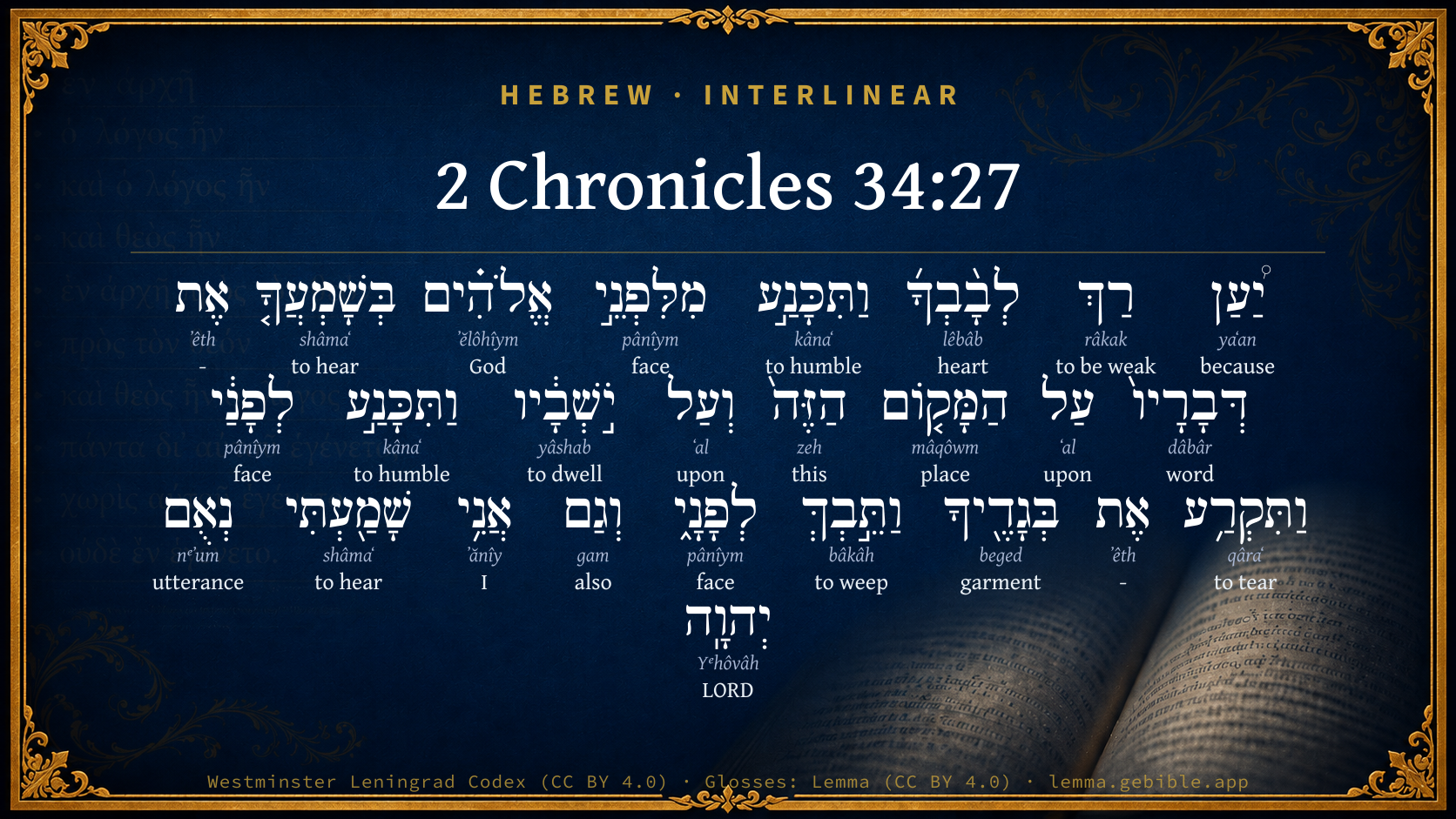
2 Chronicles 34:27

Hebrew (Westminster Leningrad Codex) 2 Chronicles 34:27 appears in the Hebrew Old Testament. The text above is from the Westminster Leningrad Codex. Each word links to its Strong’s number, a concise gloss, and parsing drawn from the Open Scriptures Hebrew Bible morphology. Click any word for its full Brown-Driver-Briggs (BDB) entry.
Download image
Cite this verse

2 Chronicles 34:27 (World English Bible). Public Domain. Lemma interlinear Bible study tool, https://lemma.gebible.app/v/2-chronicles/34/27.

Show BibTeX & RIS
BibTeX
RIS
English Translation
because your heart was tender, and you did humble yourself before God, when you heard his words against this place, and against the inhabitants of it, and have humbled yourself before me, and have torn your clothes, and wept before me; I also have heard you, says Yahweh.
World English Bible · Public Domain
Download a study sheet

One document with this verse’s original text, its word-by-word gloss line, the meaning frame, cross-references with their text, attributed commentary, and full source and license credits — printable, and it pastes into notes with its structure intact.

This verse Autodidact and up

Study sheet (.html) Plain text (.txt)

A passage Seminary Student

Up to 50 verses in one chapter. A passage sheet keeps up to 6 commentary sources and 12 cross-references per verse, in the order this page ranks them, and says so on the sheet whenever that leaves anything out. Ask for a single verse and you get the Autodidact verse sheet above.

Everything on this page stays free to read, with no account — the sheet is a download of what is already on screen, not access to it.

Want to remove ads? Support Godless Engineer
Compare translations 3

The same verse in 3 English versions, stacked beneath the original-language interlinear above. Click any original word for its lexicon entry.

Each is an independent rendering of the whole verse — the interlinear is not word-aligned to these translations.

Highlighted words mark where these versions differ — a whole-verse word diff, not a word-by-word alignment.

  • World English Bible Public Domain
    because your heart was tender, and you did humble yourself before God, when you heard his words against this place, and against the inhabitants of it, and have humbled yourself before me, and have torn your clothes, and wept before me; I also have heard you, says Yahweh.
  • King James Version Public Domain
    Because thine heart was tender, and thou didst humble thyself before God, when thou heardest his words against this place, and against the inhabitants thereof, and humbledst thyself before me, and didst rend thy clothes, and weep before me; I have even heard thee also, saith the LORD.
  • unfoldingWord Literal Text CC BY-SA 4.0
    because your heart was tender, and you humbled yourself before God when you heard his words concerning this place and concerning its inhabitants, and you have humbled yourself before me, and you have torn your clothes, and you wept before me, and also I myself have heard—declares Yahweh—

unfoldingWord Literal Text — © unfoldingWord, licensed CC BY-SA 4.0. Word-aligned USFM3 via Door43 (git.door43.org/unfoldingWord/en_ult).

Versions to compare (up to 4)

3 of 4 selected

Show all 18 translations

Every available English version of this verse, each an independent rendering of the whole verse.

  • World English Bible Public Domain
    because your heart was tender, and you did humble yourself before God, when you heard his words against this place, and against the inhabitants of it, and have humbled yourself before me, and have torn your clothes, and wept before me; I also have heard you, says Yahweh.
  • Berean Standard Bible Public Domain
    because your heart was tender and you humbled yourself before God when you heard His words against this place and against its people, and because you have humbled yourself before Me and you have torn your clothes and wept before Me, I have heard you,’ declares the LORD.
  • Majority Standard Bible Public Domain
    because your heart was tender and you humbled yourself before God when you heard His words against this place and against its people, and because you have humbled yourself before Me and have torn your clothes and wept before Me, I have heard you,’ declares the LORD.
  • King James Version Public Domain
    Because thine heart was tender, and thou didst humble thyself before God, when thou heardest his words against this place, and against the inhabitants thereof, and humbledst thyself before me, and didst rend thy clothes, and weep before me; I have even heard thee also, saith the LORD.
  • American Standard Version (1901) Public Domain
    because thy heart was tender, and thou didst humble thyself before God, when thou heardest his words against this place, and against the inhabitants thereof, and hast humbled thyself before me, and hast rent thy clothes, and wept before me; I also have heard thee, saith Jehovah.
  • Revised Version (1885) Public Domain
    because thine heart was tender, and thou didst humble thyself before God, when thou heardest his words against this place, and against the inhabitants thereof, and hast humbled thyself before me, and hast rent thy clothes, and wept before me; I also have heard thee, saith the LORD.
  • Geneva Bible (1599) Public Domain
    But because thine heart did melt, and thou didest humble thy selfe before God, when thou heardest his wordes against this place and against the inhabitantes thereof, and humbledst thy selfe before mee and tarest thy clothes, and weptest before mee, I haue also heard it, sayth the Lord.
  • Douay-Rheims (1899) Public Domain
    And thy heart was softened. and thou hast humbled thyself in the sight of God for the things that are spoken against this place, and the inhabitants of Jerusalem, and reverencing my face, hast rent thy garments, and wept before me: I also have heard thee, saith the Lord.
  • Young's Literal Translation Public Domain
    Because thy heart `is' tender, and thou art humbled before God in thy hearing His words concerning this place, and concerning its inhabitants, and art humbled before Me, and dost rend thy garments, and weep before Me: even I also have heard -- the affirmation of Jehovah.
  • Literal Standard Version CC BY-SA 4.0
    Because your heart [is] tender, and you are humbled before God in your hearing His words concerning this place and concerning its inhabitants, and are humbled before Me, and tear your garments, and weep before Me, indeed, I have also heard [you]—a declaration of YHWH.
  • Unlocked Literal Bible CC BY-SA 4.0
    because your heart was tender, and you humbled yourself before God when you heard his words against this place and its inhabitants, and because you have humbled yourself before me and have torn your clothes and wept before me, I also have listened to you—this is Yahweh's declaration—
  • unfoldingWord Literal Text CC BY-SA 4.0
    because your heart was tender, and you humbled yourself before God when you heard his words concerning this place and concerning its inhabitants, and you have humbled yourself before me, and you have torn your clothes, and you wept before me, and also I myself have heard—declares Yahweh—
  • Darby Bible Public Domain
    Because thy heart was tender, and thou didst humble thyself before God, when thou heardest his words against this place and against the inhabitants thereof, and humbledst thyself before me, and didst rend thy garments and weep before me, I also have heard [thee], saith Jehovah.
  • World Messianic Bible Public Domain
    because your heart was tender, and you humbled yourself before God when you heard his words against this place and against its inhabitants, and have humbled yourself before me, and have torn your clothes and wept before me, I also have heard you,” says the LORD.
  • Webster's Bible Public Domain
    Because thy heart was tender, and thou didst humble thyself before God, when thou didst hear his words against this place, and against its inhabitants, and didst humble thyself before me, and didst rend thy clothes, and weep before me; I have even heard thee also, saith the LORD.
  • Free Bible Version CC BY-SA 4.0
    because you were receptive and repentant before God when you heard his warnings against this place and against its people, and because you have repented, tearing your clothes and weeping before me, I have also heard you, declares the Lord.
  • Bible in Basic English Public Domain
    And your heart was soft, and you made yourself low before God, on hearing his words about this place and its people, and with weeping and signs of grief have made yourself low before me, I have given ear to you, says the Lord God.
  • JPS Tanakh (1917) Public Domain
    because thy heart was tender, and thou didst humble thyself before God, when thou heardest His words against this place, and against the inhabitants thereof, and hast humbled thyself before Me, and hast rent thy clothes, and wept before Me; I also have heard thee, saith the LORD.

Literal Standard Version (2020), Covenant Press — licensed CC BY-SA 4.0. Text via the HelloAO Bible API (eBible.org). Unlocked Literal Bible (unfoldingWord) — licensed CC BY-SA 4.0. Text via the HelloAO Bible API (eBible.org). unfoldingWord Literal Text — © unfoldingWord, licensed CC BY-SA 4.0. Word-aligned USFM3 via Door43 (git.door43.org/unfoldingWord/en_ult). Free Bible Version, Dr. Jonathan Gallagher — licensed CC BY-SA 4.0. Text via the HelloAO Bible API (eBible.org).

Word by word

More ways to search: Search by grammar → Find every occurrence → Compare this word →

Practice this passage: Drill this verse → Learn its vocabulary →

רַךְ
râkak
H7401
“to be weak”
Verb, Qal, Perfect, 3rd Person, Masculine, Singular
Part of Speech
Verb
Stem
Qal
Form
Perfect
Person
3rd Person
Gender
Masculine
Number
Singular
Full BDB Definition

Origin: a primitive root

TWOT: 2164

to be tender, be soft, be weak - (Qal) - to be tender, be weak (of heart) - to be timid, be fearful - to be softened, be penitent - to be soft (of treacherous words) - (Pual) to be softened - (Hiphil) to cause to be weak - (Niphal) tender
  1. יַ֠עַן yaʻan H3282 “because” Conjunction
  2. לְבָ֨בְךָ֜ lêbâb H3824 “heart · your” Noun, Common, Masculine, Singular, Construct + Suffix, Personal, 2nd Person, Masculine, Singular
  3. וַתִּכָּנַ֣ע kânaʻ H3665 “and · to humble” Conjunction + Verb, Niphal, Sequential Imperfect, 2nd Person, Masculine, Singular
  4. מִלִּפְנֵ֣י pânîym H6440 “from · to/for · face(s) of” Preposition + Preposition + Noun, Common, Both, Plural, Construct
  5. אֱלֹהִ֗ים ʼĕlôhîym H430 “God(s)” Noun, Common, Masculine, Plural, Absolute
  6. בְּשָׁמְעֲךָ֤ shâmaʻ H8085 “in/at · to hear · you” Preposition + Verb, Qal, Infinitive Construct + Suffix, Personal, 2nd Person, Masculine, Singular
  7. אֶת ʼêth H853 “-” Particle, Direct Object
  8. דְּבָרָיו֙ dâbâr H1697 “words · his” Noun, Common, Masculine, Plural, Construct + Suffix, Personal, 3rd Person, Masculine, Singular
  9. עַל ʻal H5921 “upon” Preposition
  10. הַמָּק֤וֹם mâqôwm H4725 “the · place” Particle, Definite Article + Noun, Common, Masculine, Singular, Absolute
  11. הַזֶּה֙ zeh H2088 “the · this” Particle, Definite Article + Pronoun, Demonstrative, Masculine, Singular
  12. וְעַל ʻal H5921 “and · upon” Conjunction + Preposition
  13. יֹ֣שְׁבָ֔יו yâshab H3427 “dwelling · him” Verb, Qal, Participle Active, Masculine, Plural, Construct + Suffix, Personal, 3rd Person, Masculine, Singular
  14. וַתִּכָּנַ֣ע kânaʻ H3665 “and · to humble” Conjunction + Verb, Niphal, Sequential Imperfect, 2nd Person, Masculine, Singular
  15. לְפָנַ֔י pânîym H6440 “to/for · face(s) · my” Preposition + Noun, Common, Both, Plural, Construct + Suffix, Personal, 1st Person, Common, Singular
  16. וַתִּקְרַ֥ע qâraʻ H7167 “and · to tear” Conjunction + Verb, Qal, Sequential Imperfect, 2nd Person, Masculine, Singular
  17. אֶת ʼêth H853 “-” Particle, Direct Object
  18. בְּגָדֶ֖יךָ beged H899 “garments · your” Noun, Common, Masculine, Plural, Construct + Suffix, Personal, 2nd Person, Masculine, Singular
  19. וַתֵּ֣בְךְּ bâkâh H1058 “and · to weep” Conjunction + Verb, Qal, Sequential Imperfect, 2nd Person, Masculine, Singular
  20. לְפָנָ֑י pânîym H6440 “to/for · face(s) · my” Preposition + Noun, Common, Both, Plural, Construct + Suffix, Personal, 1st Person, Common, Singular
  21. וְגַם gam H1571 “and · also” Conjunction + Particle, Accusative
  22. אֲנִ֥י ʼănîy H589 “I” Pronoun, Personal, 1st Person, Common, Singular
  23. שָׁמַ֖עְתִּי shâmaʻ H8085 “to hear” Verb, Qal, Perfect, 1st Person, Common, Singular
  24. נְאֻם nᵉʼum H5002 “utterance of” Noun, Common, Masculine, Singular, Construct
  25. יְהוָֽה Yᵉhôvâh H3068 “LORD” Noun, Proper

About this verse

These counts appear in no published source. They are computed here, from the morphology-tagged text and Lemma’s own curated glosses. What Lemma adds →

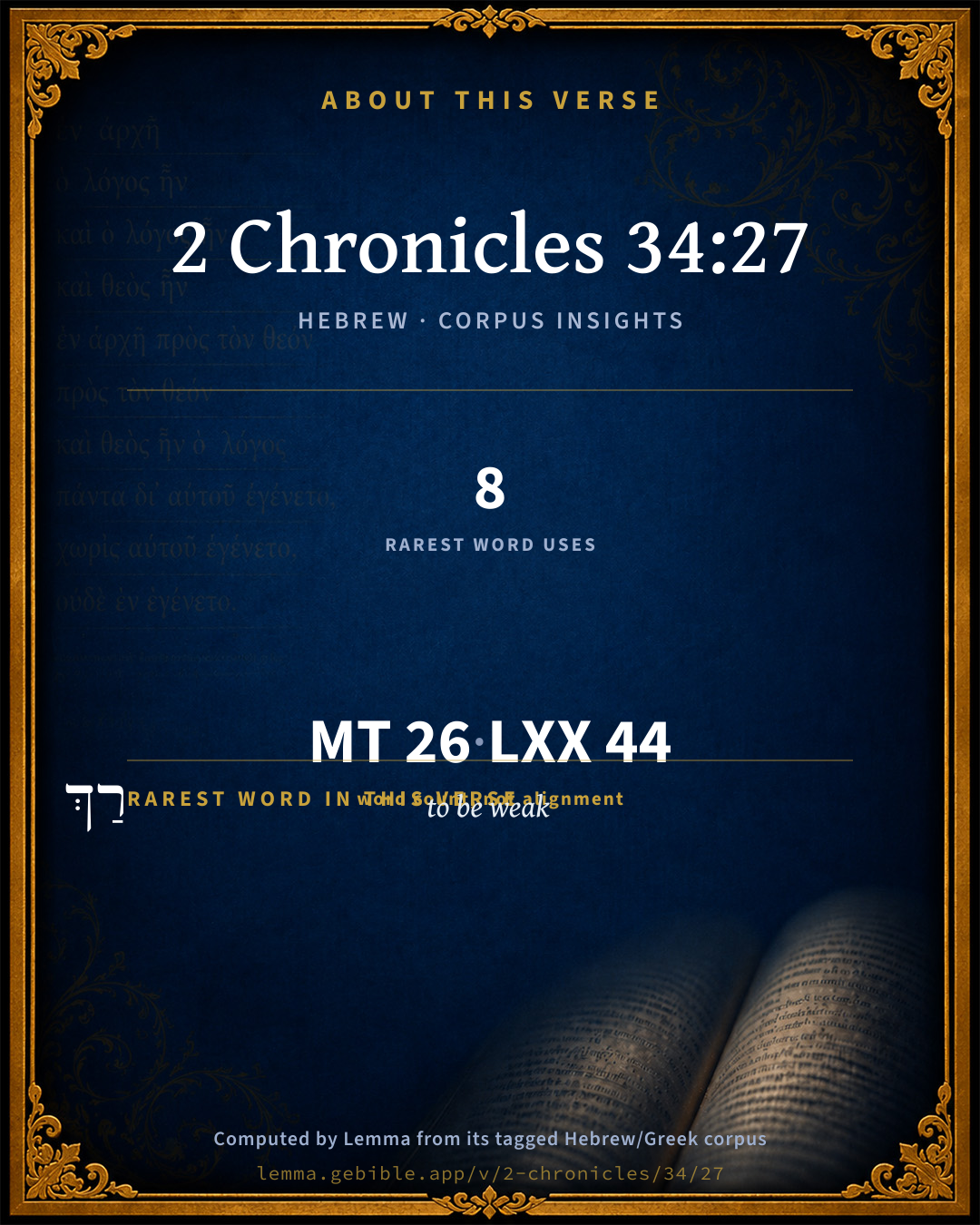
26
words
20
distinct lemmas
Historical
section

Notable vocabulary

The rarest word here is רַךְ to be weak H7401 — appearing just 8 times in the whole Hebrew Bible.

Shared distinctive vocabulary

רַךְ to be weak H7401 occurs in 8 verses of the Hebrew Bible. Also found in:

Grammatical profile

  • 8 verbs
  • 10 nouns
  • 2 pronouns
  • 2 prepositions
  • 1 conjunction
  • 3 particles

Verb forms

  • רַךְ Qal · Perfect
  • וַתִּכָּנַ֣ע Niphal · Sequential Imperfect
  • בְּשָׁמְעֲךָ֤ Qal · Infinitive Construct
  • יֹ֣שְׁבָ֔יו Qal · Participle Active
  • וַתִּכָּנַ֣ע Niphal · Sequential Imperfect
  • וַתִּקְרַ֥ע Qal · Sequential Imperfect
  • וַתֵּ֣בְךְּ Qal · Sequential Imperfect
  • שָׁמַ֖עְתִּי Qal · Perfect

Repetition

Words recur within this verse — often emphatic in Hebrew:

  • מִלִּפְנֵ֣י face H6440 ×3
  • וַתִּכָּנַ֣ע to humble H3665 ×2
  • בְּשָׁמְעֲךָ֤ to hear H8085 ×2
  • עַל upon H5921 ×2

Hebrew & Septuagint length

In English translation the verse runs 48 words from the Hebrew and 49 from the Septuagint (LXX English) — closely comparable.

A rough comparison of the two English renderings, which tokenize alike — not a word-level alignment.

Word counts can differ between the Hebrew and the Greek without any difference in meaning — e.g. the Hebrew direct-object marker אֵת has no separate Greek word, and Greek often adds the article ὁ.

In the original languages it is 26 Hebrew tokens and 44 Greek tokens — but the two are counted differently (Hebrew bundles its prefixes and suffixes into one token; the Greek is in lemma form), so that isn’t a like-for-like length.

Cross-references

17

Topical passages linked to 2 Chronicles 34:27 in the Treasury of Scripture Knowledge — connected by theme and wording, ordered by reader-vote popularity; previews shown in the World English Bible.

  • 2 Chronicles 32:26 Notwithstanding Hezekiah humbled himself for the pride of his heart, both he and the inhabitants of Jerusalem, so that the wrath of Yahweh didn't come on them in the days of Hezekiah.
  • Psalms 34:18 Yahweh is near to those who have a broken heart, And saves those who have a crushed spirit.
  • Ezekiel 9:4 Yahweh said to him, Go through the midst of the city, through the midst of Jerusalem, and set a mark on the foreheads of the men that sigh and that cry over all the abominations that are done in the midst of it.
  • 2 Chronicles 33:12 When he was in distress, he begged Yahweh his God, and humbled himself greatly before the God of his fathers.
  • 2 Chronicles 34:19 It happened, when the king had heard the words of the law, that he tore his clothes.
  • Isaiah 65:24 It shall happen that, before they call, I will answer; and while they are yet speaking, I will hear.
  • 2 Kings 22:18–19 But to the king of Judah, who sent you to inquire of Yahweh, thus shall you tell him, Thus says Yahweh, the God of Israel: As touching the words which you have heard,
  • 2 Chronicles 12:7 When Yahweh saw that they humbled themselves, the word of Yahweh came to Shemaiah, saying, They have humbled themselves: I will not destroy them; but I will grant them some deliverance, and my wrath shall not be poured out on Jerusalem by the hand of Shishak.
  • 2 Chronicles 32:12–13 Has not the same Hezekiah taken away his high places and his altars, and commanded Judah and Jerusalem, saying, You shall worship before one altar, and on it shall you burn incense?
  • Psalms 10:17 Yahweh, you have heard the desire of the humble. You will prepare their heart. You will cause your ear to hear,
  • Psalms 51:17 The sacrifices of God are a broken spirit. A broken and contrite heart, O God, you will not despise.
  • Isaiah 57:15 For thus says the high and lofty One who inhabits eternity, whose name is Holy: I dwell in the high and holy place, with him also who is of a contrite and humble spirit, to revive the spirit of the humble, and to revive the heart of the contrite.
  • Isaiah 66:2 For all these things has my hand made, and [so] all these things came to be, says Yahweh: but to this man will I look, even to him who is poor and of a contrite spirit, and who trembles at my word.
  • Jeremiah 36:23–24 It happened, when Jehudi had read three or four leaves, that [the king] cut it with the penknife, and cast it into the fire that was in the brazier, until all the scroll was consumed in the fire that was in the brazier.
  • 2 Chronicles 33:19 His prayer also, and how [God] was entreated of him, and all his sin and his trespass, and the places in which he built high places, and set up the Asherim and the engraved images, before he humbled himself: behold, they are written in the history of Hozai.
  • James 4:6–10 But he gives more grace. Therefore it says, "God resists the proud, but gives grace to the humble."
  • Ezekiel 36:26 A new heart also will I give you, and a new spirit will I put within you; and I will take away the stony heart out of your flesh, and I will give you a heart of flesh.

Cross-references courtesy of OpenBible.info (CC BY 4.0).

Hebrew and Greek witnesses Masoretic Hebrew ↔ Greek Septuagint

The same verse in the two great witnesses to the Old Testament, shown verse-for-verse.

These are two independent witnesses, not word-aligned to each other, and the Septuagint is shown in lemma (dictionary) form.

Hebrew 2 Chronicles 34:27 Masoretic · Westminster Leningrad Codex

יַ֠עַן רַךְ לְבָ֨בְךָ֜ וַתִּכָּנַ֣ע מִלִּפְנֵ֣י אֱלֹהִ֗ים בְּשָׁמְעֲךָ֤ אֶת דְּבָרָיו֙ עַל הַמָּק֤וֹם הַזֶּה֙ וְעַל יֹ֣שְׁבָ֔יו וַתִּכָּנַ֣ע לְפָנַ֔י וַתִּקְרַ֥ע אֶת בְּגָדֶ֖יךָ וַתֵּ֣בְךְּ לְפָנָ֑י וְגַם אֲנִ֥י שָׁמַ֖עְתִּי נְאֻם יְהוָֽה

because your heart was tender, and you did humble yourself before God, when you heard his words against this place, and against the inhabitants of it, and have humbled yourself before me, and have torn your clothes, and wept before me; I also have heard you, says Yahweh.

World English Bible · Public Domain

Greek LXX 2 Chronicles 34:27 Septuagint · lemma form

καί ἐντρέπω ὁ καρδία σύ καί ταπεινόω ἀπό πρόσωπον ἐγώ ἐν ὁ ἀκούω σύ ὁ λόγος ἐγώ ἐπί ὁ τόπος οὗτος καί ἐπί ὁ καταοἰκέω αὐτός καί ταπεινόω ἐναντίον ἐγώ καί διαῥήγνυμι ὁ ἱμάτιον σύ καί κλαίω κατεναντίον ἐγώ καί ἐγώ ἀκούω φημί κύριος

forasmuch as your heart was ashamed, and you were humbled before me when you heard my words against this place, and against the inhabitants of it, and you were humbled before me, and did rend your garments, and did weep before me; I also have heard, says the Lord.

LXX2012 (modern English Septuagint) · Public Domain

Hebrew: Westminster Leningrad Codex (CC BY 4.0). Greek: Septuagint (public domain); English from LXX2012 (modern English Septuagint) (Public Domain). How the Septuagint differs from the Hebrew →

Commentary

Notes on 2 Chronicles 34:27 from classic Christian and Jewish commentators (each source and its license shown beneath its notes). The classic Christian expositions comment on the surrounding passage and are grouped to its opening verse, so a note may address several verses; the Jewish commentaries on the Tanakh (Rashi and others) are per-verse, so they appear only where the commentator wrote on this verse.

Lemma curates 59 commentaries, every one of them public domain or Creative Commons licensed, each selected and text-cleaned for this edition rather than reprinted as found. About our sources →

Trapp's Complete Commentary

John Trapp

2Ch 34:27 Because thine heart was tender, and thou didst humble thyself before God, when thou heardest his words against this place, and against the inhabitants thereof, and humbledst thyself before me, and didst rend thy clothes, and weep before me; I have even heard [thee] also, saith the LORD.

Ver. 27. Because thine heart was tender.] So was King Edward VI when he heard Ridley or Latimer; whose sermons he did usually excerpt and note with his own hand.

John Trapp, A Commentary or Exposition upon All the Books of the Old and New Testament (1647–1656) — public domain. Text from a community e-Sword module.

The Biblical Illustrator

Joseph S. Exell

2Ch_34:27

Because thine heart was tender.

The tender heart

We see that waters of the same colour have not the same nature and effect, for hot waters are of the same colour with plain ordinary waters, yet more effectual; so the words of man coming from a man may seem at first to be the same with others, yet notwithstanding, the words of God coming from the Spirit of God carry a more wonderful excellency in them even to hearts of kings. Therefore Huldah speaks to the king, Thus saith the Lord, etc. Josiah in uprightness sends to inquire, and the Lord returns him a full and upright answer. Whence we may learn--

I. That God doth graciously fit prophets for persons, and His word to a people that are upright in their hearts. Where there is a true desire to know the will of God, there God will give men sincere prophets that shall answer them exactly. But those that are false-hearted shall have suitable teachers, who shall instruct them according to their lusts. If they be like Ahab, they shall have four hundred false prophets to teach falsehood to please their lusts (1Ki_22:6); but if they be Davids they shall have Nathans. If they be Josiahs they shall have Huldahs and Jeremiahs. God commended Josiah because his heart was tender. A tender heart is--

1. Sensitive.

2. Pliable.

3. Yielding.

II. That it is a supernatural disposition of a true child of God to have a tender, soft, and a melting heart. All by nature have stony hearts in respect of spiritual goodness. Say what you will to a hard heart, it will never yield. A hammer will do no good to a stone. It may break it in pieces, but not draw it to any form. So to a stony heart all the threatenings in the world will do no good. You may break it in pieces but never work upon it. It must be the Almighty power of God. All that are gracious must of necessity have soft hearts.

III. Therefore i will show--

1. How a tender heart is wrought. It is made tender by Him who made it (Eze_11:19).

1. God through the use of means softens it by His Word, in producing apprehension of judgment.

2. It is wrought by an apprehension of tenderness and love in Christ. Many say that an adamant cannot be melted with fire, but by blood. I cannot tell whether this be true or no; but I am sure nothing will melt the hard heart of man but the blood of Christ.

3. When the heart is made tender by the Spirit, many things will work tenderness.

(1) The works of God.

(2) His judgments.

(3) The Word and sacraments.

(4) Gods promises.

2. How it may be preserved and maintained.

(1) Keep under the means whereby Gods Spirit will work.

(2) Seek to realise the forlorn state of the Church abroad.

(3) Labour for a legal and evangelical faith.

(4) Associate with those who are tender-hearted.

(5) Take heed of the least sin against conscience. As water, when it begins to freeze, will not endure anything, not so much as the weight of a pin upon it, but after a while will bear the weight of a cart; even so at the beginning, the heart being tender, trembles at the least sin, and will not bear with any one; but when it once gives way to sins against conscience, it becomes so frozen that it can endure any sin, and so becomes more and more hard.

(6) Take heed of spiritual drunkenness; that is, be not drunk with an immoderate use of the creatures (Hos_4:11).

(7) Take heed of hypocrisy.

(8) Take heed of great sins.

(9) Consider the miserable estate of hardness of heart.

8. How it may be discerned from the contrary. By applying of the soul unto objects--

(1) To God. As it is tender from God, so it is tender for God. He that hath a tender heart cannot endure to dishonour God himself, or to hear others dishonour Him.

(2) To His Word. A tender heart is sensitive to--

(a) Its threatening (Isa_66:2; 2Co_5:11; 2Pe_3:11); its promises, its directions (Isa_6:8; Psa_27:8).

(3) To the works of God. A tender heart quakes when it sees the judgments of God upon others.

(4) To our regard of the estate of others, whether they be good or bad (Psa_119:136; Php_3:18; Mat_23:37; Mat_11:25).

Conclusion:

1. What an excellent thing a tender heart is (Isa_57:15).

2. It fits a man for the end for which he was created. The service of God.

3. It is fit for any blessedness. It is capable of any beatitude.

4. Consider the wretched state of a heart that is not tender, and will not yield. (R. Sibbes.)

A tender heart

I. Give a general account of a tender heart. It implies--

1. A quick and ready sense and feeling in spiritual things.

(1) Quickness of apprehension.

(2) Ready reflections of conscience.

(3) A disposition to be easily affected.

2. A pliable disposition to yield to Divine influences.

II. Describe the way in which such a temper should express itself.

1. In relation to the Word of God. A man of religious tenderness of spirit will--

(1) Make it his business to acquaint himself with the mind of God.

(2) Pay ready subjection to the authority of God in His Word.

(3) Be afraid to do anything which he doubts to be disagreeable to Gods Word.

(4) Will frequently compare his heart and life with Gods Word.

2. In relation to sin.

3. In relation to providential events.

4. In relation to the honour of God.

III. What foundation is laid for such a temper in Christianity.

1. The rule of our faith and practice is more complete.

2. The recompenses of the life to come are more fully revealed to us.

3. Richer discoveries of grace are made to us.

4. Ceremonials have given way to substantials of religion.

5. The softening spirit is more plentifully communicated.

IV. Inferences.

1. Discern the differences between a truly Christian temper and some things mistaken for it. It is not--

(1) Natural easiness of disposition--

(2) Occasional.

2. Let us all seek after and cultivate this tenderness of spirit.

3. If conscious of its possession, take the comfort of it as good evidence of a renewed and Christian state. (J. Evans, D.D.)

And thou didst humble thyself.

Self-humbling

I. The acceptable act.

1. It was a real and personal act.

2. It was voluntary. Thou didst humble thyself.

3. It was a sincerely devout act.

4. It was a very deep and thorough one.

II. Reasons for imitating it.

1. A deep sense of sin, its heinousness and the punishment it deserves.

2. Our origin and our end.

3. The sovereign grace which has made us to differ.

4. The greatness of God.

5. The life and death of Christ.

III. The encouraging results which followed.

1. Humiliation will often avert judgment.

2. It always brings a positive blessing with it.

3. It will improve our spiritual health.

4. It promotes our usefulness. (C. H. Spurgeon.)

The art of self-humbling

I. That it is a disposition not unbefitting kings to humble themselves before God.

II. That the actions of grace are reflected actions. They begin from a mans self, and end in a mans self. Yet we must not exclude the Spirit. For the further expression of this humbling of ourselves before God, we will consider--

1. The kinds and degrees of it.

(1) Inward.

(a) Humiliation in the mind in regard of judgment and knowledge, when our understandings are convinced, that we are as we are.

(b) Affections of humiliation, shame, sorrow, fear.

(2) Outward. As manifested in words and in outward behaviour and carriage.

2. Some directions how we may humble ourselves,

(1) Get poor spirits, that is spirits to see the wants in ourselves and in the creature; the emptiness of all earthly things without Gods favour; the insufficiency of ourselves and of the creature at the day of judgment.

(2) Let us bring ourselves into the presence of the Great God and consider His attributes, His works of justice abroad in the world, and upon ourselves in particular (Job_42:6; Joh_1:27; 1Co_15:9; Mat_8:8; Gen_32:10).

(3) Let us be content to hear of our sins and baseness by others.

(4) Look to the time to come, what we shall be ere long, earth and dust; and at the day of judgment we must be stripped of all.

(5) Let us set before us the example of our blessed Saviour.

(6) Let us work upon our own souls by reasoning, discoursing, and speaking to our own hearts.

3. The motives to move us to get this humiliation.

(1) Consider the promises that are made to this disposition (Isa_57:15; Jam_4:10). As examples we have Peter, David, Manasseh, Josiah. Every branch of humiliation hath a promise. A humble heart is a vessel of all graces. Humility emptieth the heart for God to fill it. God hath but two heavens to dwell in; the heaven of heavens and the heart of a poor humble man. When a man is humbled he is fit for all good. As all the water that is upon the hills runs into the valleys, so all grace goes to the humble.

(2) All outward actions benefit other men; but this inward action of humbling a mans self makes the soul itself good.

(3) A humble soul is a secure and safe soul.

4. The notes whereby it may be known.

(1) Holy humiliation is voluntary.

(2) It is ever joined with reformation.

(3) Sin must appear bitter to the soul. There is in every renewed soul a secret loathing and hatred of evil, and is expressed--

(a) In a serious purpose and resolution not to offend God in the least kind.

(b) There must be a constant endeavour to avoid the occasions and allurements of sin.

(c) There must be a hatred and loathing of sin in our confessions (Psa_51:4).

(4) True humiliation proceeds from faith. It quakes, at the foresight of judgment, but the wicked never humble themselves but when judgment is upon them.

(5) With true humiliation is joined hope.

(6) Hypocrites are sorrowful for the judgment that is upon them, but not for that which is the cause of judgment, but the child of God is humbled for sin.

(7) True humiliation is a thorough humiliation. It is not like Ephraims morning dew, quickly gone. (R. Sibbes.)

The art of mourning

Rending of clothes was a thing frequently used in old times, and it was a visible representation of the inward sorrow of the heart (Job_1:20; Job_2:12; Act_14:14; Mar_14:63; Isa_37:1). It was frequently used among the heathen also. Observe--

I. That the body and soul must join together in the action of humiliation.

II. That when God will afflict or humble a man, it is not a kingdom that will save him.

III. That tears and mourning for sin, when it comes from inward grief, is a temper well befitting any man.

IV. That it concerns magistrates above all others, to take to heart any danger whatsoever that is upon their people.

V. That it is the duty of every Christian to take to heart the threatening of God against the place and people where he doth live.

VI. That God takes a particular notice and understands the prayers we make unto Him. God hears our prayers, because--

1. He is gracious and merciful.

2. He is our Father.

3. He has promised to do so (Psa_50:15).

4. They are the motions of His own Spirit (Rom_8:26-27).

5. They are offered up in the name of a Mediator.

6. They are made according to His will.

Conclusion: If we would have God hear us, then--

1. Let us hear God as Josiah did.

2. Our prayers must proceed from a broken heart.

3. We must add to them the wings of love, faith, hope and earnestness, as Josiah did here.

4. Let us have such a resolution and purpose of reformation like Josiahs. (R. Sibbes.)

The Biblical Illustrator, edited by Joseph S. Exell (c. 1880s–1900s) — public domain. Text from a community e-Sword module.

Tyndale Open Study Notes

Tyndale Open Resources

34:27-28 King Josiah did not die in peace; he was killed by Pharaoh Neco II of Egypt (35:20-25). However, Josiah was buried in peace, meaning that the city of Jerusalem was at peace and exile did not come during Josiah’s reign. His repentant spirit averted immediate disaster.

Tyndale Open Study Notes — © Tyndale Open Resources, licensed CC BY-SA 4.0. Text via the HelloAO Bible API.

Geneva Bible (1599)

Geneva Bible translators

This declareth what is the end of God’s threatenings, to call his to repentance, and to assure the unrepentant of their destruction.

Geneva Bible (1599) marginal notes — public domain. Text via Bolls.life.

Adam Clarke's Commentary

Verse 27. Because thine heart was tender] "Because thy heart was melted, and thou hast humbled thyself in the sight of the WORD of the Lord, מימרא דיי meymera daya, when thou didst hear his words, ית פתגמוי yath pithgamoi, against this place," &c. Here the Targum most evidently distinguishes between מימרא meymera, the PERSONAL WORD, and פתגם pithgam, a word spoken or expressed.

Adam Clarke's Commentary on the Bible (1810–1826) — public domain. Text from a community e-Sword/MySword module.

The Cambridge Bible for Schools and Colleges

gen. ed. J. J. S. Perowne

27. humbledst … and didst rend … and weep] R.V. hast humbled … and hast rent … and wept.

I have men heard thee also] R.V. I also have heard thee.

The Cambridge Bible for Schools and Colleges (gen. ed. J. J. S. Perowne; Cambridge University Press, 1878–1918) — public domain. Text from a community e-Sword module.

Lesson kit

Teaching starters — assembled from the data on this page, not authored interpretation. Every prompt links to the verse data it draws on. Edit before teaching.

2 Chronicles, in the Historical, opens this verse with 26 words (20 distinct Hebrew lemmas). Its most distinctive word is râkak (“to be weak”). A historical commentator’s framing appears above. Read the whole chapter for the surrounding context.

Discussion questions

  1. What does “to be weak” (râkak) contribute to the verse as a whole?
  2. Deuteronomy 20:3 shares the word «to be weak» with this verse. How do the two illuminate each other?
  3. “face” occurs 3× in this one verse. What is the effect of the repetition?
  4. These translations render this verse differently. What is at stake in choosing one wording over another?
  5. The verb «רַךְ» is Qal Perfect. How does its form color the action?
  6. Reading how Trapp's Complete Commentary and The Biblical Illustrator read this verse, where do the two commentators agree and where do they part?

Things to notice

Reading settings

Reading text

Shown beneath each verse's original-language words.

Old Testament
Old Testament edition

Read the OT as the Masoretic Hebrew (MT) or the Greek Septuagint (LXX).

English shown for the Greek Septuagint (in the Hebrew ↔ Greek comparison).

Comparing translations? Open the Compare panel on any verse page to stack up to four side by side.