Isaiah 51:8

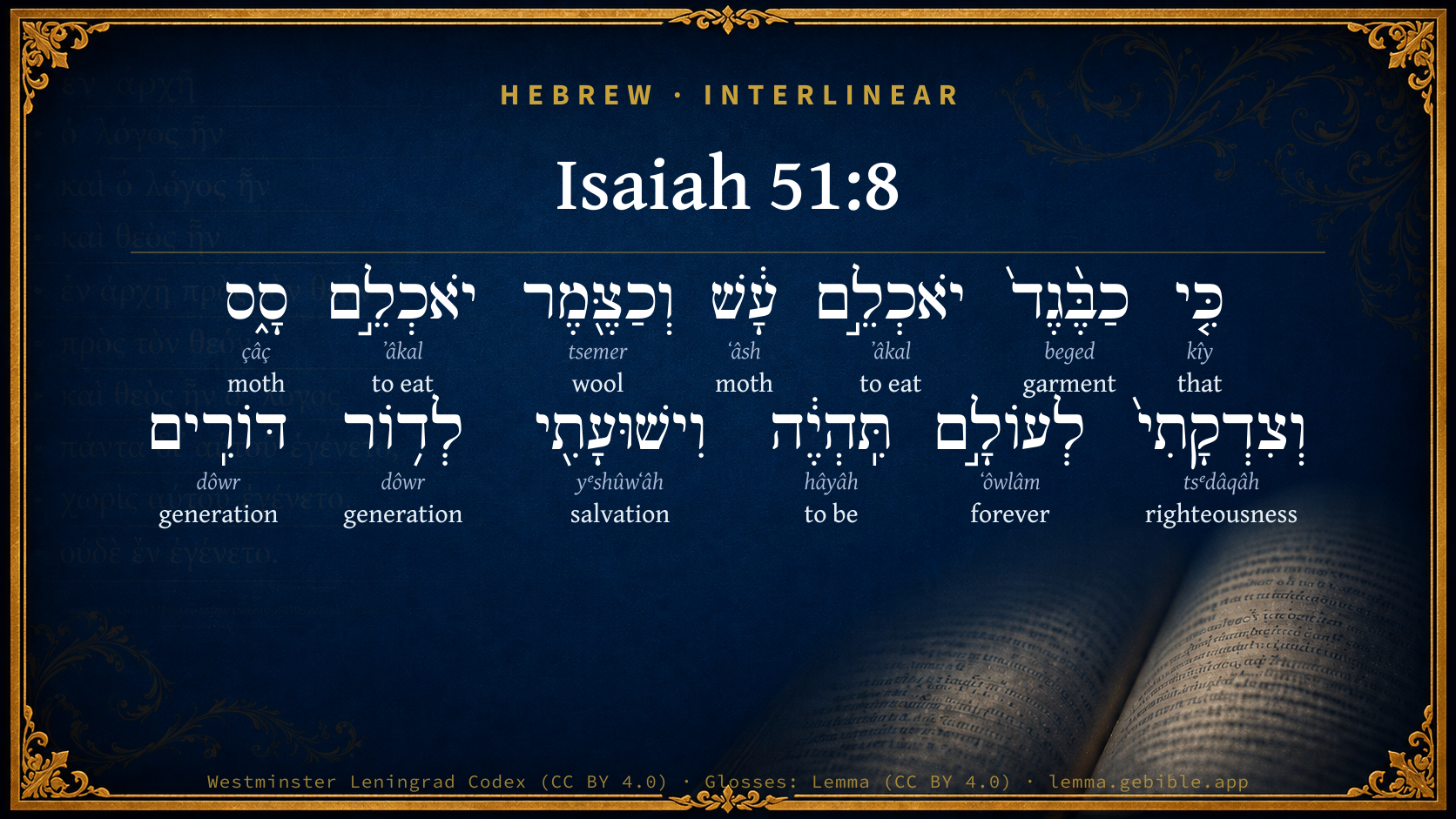
Hebrew (Westminster Leningrad Codex) Isaiah 51:8 appears in the Hebrew Old Testament. The text above is from the Westminster Leningrad Codex. Each word links to its Strong’s number, a concise gloss, and parsing drawn from the Open Scriptures Hebrew Bible morphology. Click any word for its full Brown-Driver-Briggs (BDB) entry.
Download image
Cite this verse

Isaiah 51:8 (World English Bible). Public Domain. Lemma interlinear Bible study tool, https://lemma.gebible.app/v/isaiah/51/8.

Show BibTeX & RIS
BibTeX
RIS
English Translation
For the moth shall eat them up like a garment, and the worm shall eat them like wool; but my righteousness shall be forever, and my salvation to all generations.
World English Bible · Public Domain
Highlights
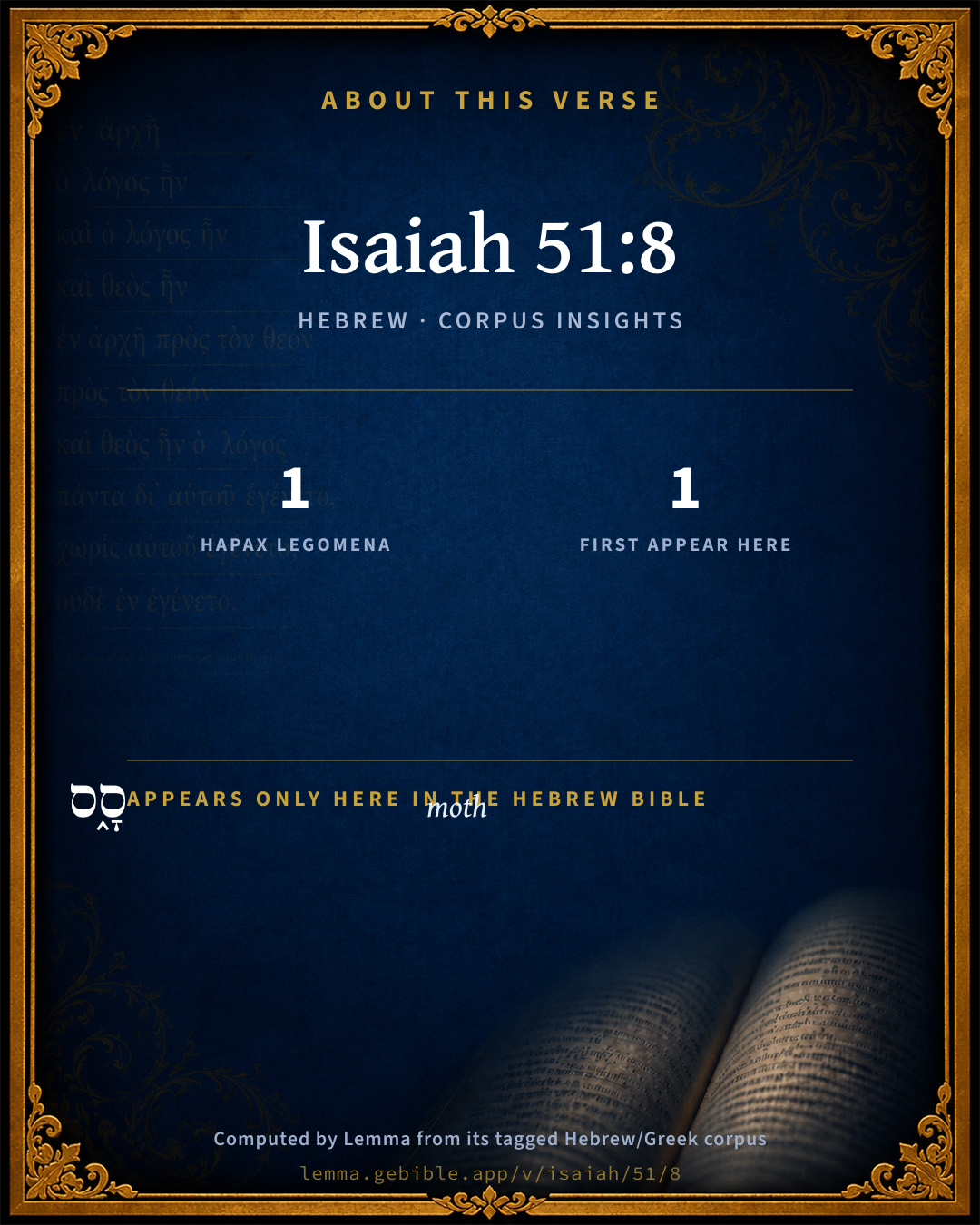
  • 1 hapax legomenon — only here in the Hebrew Bible
  • 1 first appearance in the Hebrew Bible
Full analysis ↓
Download a study sheet

One document with this verse’s original text, its word-by-word gloss line, the meaning frame, cross-references with their text, attributed commentary, and full source and license credits — printable, and it pastes into notes with its structure intact.

This verse Autodidact and up

Study sheet (.html) Plain text (.txt)

A passage Seminary Student

Up to 50 verses in one chapter. A passage sheet keeps up to 6 commentary sources and 12 cross-references per verse, in the order this page ranks them, and says so on the sheet whenever that leaves anything out. Ask for a single verse and you get the Autodidact verse sheet above.

Everything on this page stays free to read, with no account — the sheet is a download of what is already on screen, not access to it.

Want to remove ads? Support Godless Engineer
Compare translations 3

The same verse in 3 English versions, stacked beneath the original-language interlinear above. Click any original word for its lexicon entry.

Each is an independent rendering of the whole verse — the interlinear is not word-aligned to these translations.

Highlighted words mark where these versions differ — a whole-verse word diff, not a word-by-word alignment.

  • World English Bible Public Domain
    For the moth shall eat them up like a garment, and the worm shall eat them like wool; but my righteousness shall be forever, and my salvation to all generations.
  • King James Version Public Domain
    For the moth shall eat them up like a garment, and the worm shall eat them like wool: but my righteousness shall be for ever, and my salvation from generation to generation.
  • unfoldingWord Literal Text CC BY-SA 4.0
    For the moth will devour them like a garment, and the grub will devour them like wool; but my righteousness will be forever, and my salvation to the generation of generations.” q1

unfoldingWord Literal Text — © unfoldingWord, licensed CC BY-SA 4.0. Word-aligned USFM3 via Door43 (git.door43.org/unfoldingWord/en_ult).

Versions to compare (up to 4)

3 of 4 selected

Show all 18 translations

Every available English version of this verse, each an independent rendering of the whole verse.

  • World English Bible Public Domain
    For the moth shall eat them up like a garment, and the worm shall eat them like wool; but my righteousness shall be forever, and my salvation to all generations.
  • Berean Standard Bible Public Domain
    For the moth will devour them like a garment, and the worm will eat them like wool. But My righteousness will last forever, My salvation through all generations.”
  • Majority Standard Bible Public Domain
    For the moth will devour them like a garment, and the worm will eat them like wool. But My righteousness will last forever, My salvation through all generations.”
  • King James Version Public Domain
    For the moth shall eat them up like a garment, and the worm shall eat them like wool: but my righteousness shall be for ever, and my salvation from generation to generation.
  • American Standard Version (1901) Public Domain
    For the moth shall eat them up like a garment, and the worm shall eat them like wool; but my righteousness shall be for ever, and my salvation unto all generations.
  • Revised Version (1885) Public Domain
    For the moth shall eat them up like a garment, and the worm shall eat them like wool: but my righteousness shall be for ever, and my salvation unto all generations.
  • Geneva Bible (1599) Public Domain
    For the mothe shall eate them vp like a garment, and the worme shall eate them like wool: but my righteousnesse shalbe for euer, and my saluation from generation to generation.
  • Douay-Rheims (1899) Public Domain
    For the worm shall eat them up as a garment: and the moth shall consume them as wool: but my salvation shall be for ever, and my justice from generation to generation,
  • Young's Literal Translation Public Domain
    For as a garment eat them doth a moth, And as wool eat them doth a worm, And My righteousness is to the age, And My salvation to all generations.
  • Literal Standard Version CC BY-SA 4.0
    For a moth eats them as a garment, || And a worm eats them as wool, || And My righteousness is for all time, || And My salvation from generation to generation.”
  • Unlocked Literal Bible CC BY-SA 4.0
    For the moth will eat them up like a garment, and the worm will eat them like wool; but my righteousness will be forever, and my salvation to all generations.”
  • unfoldingWord Literal Text CC BY-SA 4.0
    For the moth will devour them like a garment, and the grub will devour them like wool; but my righteousness will be forever, and my salvation to the generation of generations.” q1
  • Darby Bible Public Domain
    For the moth shall eat them up like a garment, and the worm shall eat them like wool; but my righteousness shall be for ever, and my salvation from generation to generation.
  • World Messianic Bible Public Domain
    For the moth will eat them up like a garment, and the worm will eat them like wool; but my righteousness will be forever, and my salvation to all generations.”
  • Webster's Bible Public Domain
    For the moth shall eat them like a garment, and the worm shall eat them like wool: but my righteousness shall be for ever, and my salvation from generation to generation.
  • Free Bible Version CC BY-SA 4.0
    Moths will eat them up like clothing; bugs will chew through them like wool. But my goodness will last forever, my salvation will endure for all generations.
  • Bible in Basic English Public Domain
    For like a coat they will be food for the insect, the worm will make a meal of them like wool: but my righteousness will be for ever, and my salvation to all generations.
  • JPS Tanakh (1917) Public Domain
    For the moth shall eat them up like a garment, and the worm shall eat them like wool; but My favour shall be for ever, and My salvation unto all generations.

Literal Standard Version (2020), Covenant Press — licensed CC BY-SA 4.0. Text via the HelloAO Bible API (eBible.org). Unlocked Literal Bible (unfoldingWord) — licensed CC BY-SA 4.0. Text via the HelloAO Bible API (eBible.org). unfoldingWord Literal Text — © unfoldingWord, licensed CC BY-SA 4.0. Word-aligned USFM3 via Door43 (git.door43.org/unfoldingWord/en_ult). Free Bible Version, Dr. Jonathan Gallagher — licensed CC BY-SA 4.0. Text via the HelloAO Bible API (eBible.org).

Word by word

More ways to search: Search by grammar → Find every occurrence → Compare this word →

Practice this passage: Drill this verse → Learn its vocabulary →

סָ֑ס
çâç
H5580
“moth”
Noun, Common, Masculine, Singular, Absolute
Part of Speech
Noun
Type
Common
Gender
Masculine
Number
Singular
State
Absolute
Full BDB Definition

Origin: from the same as H5483

TWOT: 1524

moth
  1. כִּ֤י kîy H3588 “that” Conjunction
  2. כַבֶּ֨גֶד֙ beged H899 “like/as the · garment” Preposition, Determined + Noun, Common, Masculine, Singular, Absolute
  3. יֹאכְלֵ֣ם ʼâkal H398 “to eat · them” Verb, Qal, Imperfect, 3rd Person, Masculine, Singular + Suffix, Personal, 3rd Person, Masculine, Plural
  4. עָ֔שׁ ʻâsh H6211 “moth” Noun, Common, Masculine, Singular, Absolute
  5. וְכַצֶּ֖מֶר tsemer H6785 “and · like/as the · wool” Conjunction + Preposition, Determined + Noun, Common, Masculine, Singular, Absolute
  6. יֹאכְלֵ֣ם ʼâkal H398 “to eat · them” Verb, Qal, Imperfect, 3rd Person, Masculine, Singular + Suffix, Personal, 3rd Person, Masculine, Plural
  7. וְצִדְקָתִי֙ tsᵉdâqâh H6666 “and · righteousness · my” Conjunction + Noun, Common, Feminine, Singular, Construct + Suffix, Personal, 1st Person, Common, Singular
  8. לְעוֹלָ֣ם ʻôwlâm H5769 “to/for · forever” Preposition + Noun, Common, Masculine, Singular, Absolute
  9. תִּֽהְיֶ֔ה hâyâh H1961 “to be” Verb, Qal, Imperfect, 3rd Person, Feminine, Singular
  10. וִישׁוּעָתִ֖י yᵉshûwʻâh H3444 “and · salvation · my” Conjunction + Noun, Common, Feminine, Singular, Construct + Suffix, Personal, 1st Person, Common, Singular
  11. לְד֥וֹר dôwr H1755 “to/for · generation of” Preposition + Noun, Common, Masculine, Singular, Construct
  12. דּוֹרִֽים dôwr H1755 “generations” Noun, Common, Masculine, Plural, Absolute

About this verse

These counts appear in no published source. They are computed here, from the morphology-tagged text and Lemma’s own curated glosses. What Lemma adds →

13
words
11
distinct lemmas
Prophets
section

Notable vocabulary

1 hapax legomenon — a word that appears only here in the entire Hebrew Bible:

First appearance in Scripture

This word makes its first canonical appearance in the Hebrew Bible here:

Shared distinctive vocabulary

עָ֔שׁ moth H6211 occurs in 12 verses of the Hebrew Bible. Also found in:

Grammatical profile

  • 3 verbs
  • 9 nouns
  • 1 conjunction

Verb forms

  • יֹאכְלֵ֣ם Qal · Imperfect
  • יֹאכְלֵ֣ם Qal · Imperfect
  • תִּֽהְיֶ֔ה Qal · Imperfect

Repetition

Words recur within this verse — often emphatic in Hebrew:

  • יֹאכְלֵ֣ם to eat H398 ×2
  • לְד֥וֹר generation H1755 ×2

Hebrew & Septuagint length

In English translation the verse runs 30 words from the Hebrew and 36 from the Septuagint (LXX English) — closely comparable.

A rough comparison of the two English renderings, which tokenize alike — not a word-level alignment.

Word counts can differ between the Hebrew and the Greek without any difference in meaning — e.g. the Hebrew direct-object marker אֵת has no separate Greek word, and Greek often adds the article ὁ.

Cross-references

9

Topical passages linked to Isaiah 51:8 in the Treasury of Scripture Knowledge — connected by theme and wording, ordered by reader-vote popularity; previews shown in the World English Bible.

  • Isaiah 51:6 Lift up your eyes to the heavens, and look on the earth beneath; for the heavens shall vanish away like smoke, and the earth shall wax old like a garment; and those who dwell therein shall die in like manner: but my salvation shall be forever, and my righteousness shall not be abolished.
  • Isaiah 50:9 Behold, the Lord Yahweh will help me; who is he who shall condemn me? Behold, all they shall wax old as a garment, the moth shall eat them up.
  • Isaiah 66:24 They shall go forth, and look on the dead bodies of the men who have transgressed against me: for their worm shall not die, neither shall their fire be quenched; and they shall be an abhorring to all flesh.
  • Job 4:19 How much more, those who dwell in houses of clay, Whose foundation is in the dust, Who are crushed before the moth!
  • Hosea 5:12 Therefore I am to Ephraim like a moth, And to the house of Judah like rottenness.
  • Luke 1:50 His mercy is for generations of generations on those who fear him.
  • Job 13:28 Though I am decaying like a rotten thing, Like a garment that is moth-eaten.
  • Isaiah 45:17 [But] Israel shall be saved by Yahweh with an everlasting salvation: you shall not be disappointed nor confounded world without end.
  • Isaiah 46:13 I bring near my righteousness, it shall not be far off, and my salvation shall not wait; and I will place salvation in Zion for Israel my glory.

Cross-references courtesy of OpenBible.info (CC BY 4.0).

Hebrew and Greek witnesses Masoretic Hebrew ↔ Greek Septuagint

The same verse in the two great witnesses to the Old Testament, shown verse-for-verse.

These are two independent witnesses, not word-aligned to each other, and the Septuagint is shown in lemma (dictionary) form.

Hebrew Isaiah 51:8 Masoretic · Westminster Leningrad Codex

כִּ֤י כַבֶּ֨גֶד֙ יֹאכְלֵ֣ם עָ֔שׁ וְכַצֶּ֖מֶר יֹאכְלֵ֣ם סָ֑ס וְצִדְקָתִי֙ לְעוֹלָ֣ם תִּֽהְיֶ֔ה וִישׁוּעָתִ֖י לְד֥וֹר דּוֹרִֽים

For the moth shall eat them up like a garment, and the worm shall eat them like wool; but my righteousness shall be forever, and my salvation to all generations.

World English Bible · Public Domain

Greek LXX Isaiah 51:8 Septuagint · lemma form

ὥσπερ γάρ ἱμάτιον βιβρώσκω ὑπό χρόνος καί ὡς ἔριον βιβρώσκω ὑπό σής ὁ δέ δικαιοσύνη ἐγώ εἰς ὁ αἰών εἰμί ὁ δέ σωτήριον ἐγώ εἰς γενεά γενεά

For as a garment will be devoured by time, and as wool will be devoured by a moth, so shall they be consumed; but my righteousness shall be for ever, and my salvation for all generations.

LXX2012 (modern English Septuagint) · Public Domain

On this verse, John Gill's Exposition discusses the Septuagint’s reading. Read the note in Commentary ↓

Hebrew: Westminster Leningrad Codex (CC BY 4.0). Greek: Septuagint (public domain); English from LXX2012 (modern English Septuagint) (Public Domain). How the Septuagint differs from the Hebrew →

Targum (Aramaic paraphrase)

1

The Targum is the ancient Jewish Aramaic paraphrase of the Hebrew Scriptures — an interpretive translation, not the Hebrew text itself. Onkelos (literal) and Pseudo-Jonathan (expansive) render the Torah, and Jonathan the Prophets. Coverage is partial: where no permissively-licensed English translation exists for a verse, only the Aramaic is shown. This is verse-level text, not a word-by-word alignment to the Hebrew.

  1. Targum Jonathan Prophets (Joshua–Malachi)
    אֲרֵי בִלְבוּשָׁא דְאָכִיל לֵהּ עָשָׁא וּכְעִמְרָא דְאָחֵיד בֵהּ רוּקְבָא וְזָכוּתִי לַעֲלַם תְהֵי וּפוּרְקָנִי לְדָר דָרִין:

    For they vanish like a garment, which the moth eateth, and like wool, which rottenness seizeth; but my righteousness shall be for ever, and my salvation from generation to generation.

    Targum Jonathan — Aramaic: “Mikraot Gedolot” (public domain). English: “Sefaria Community Translation” (CC0 1.0 (public-domain dedication)); “London "Chaldee Paraphrase," 1871” (public domain). Text via Sefaria.

Commentary

Notes on Isaiah 51:8 from classic Christian and Jewish commentators (each source and its license shown beneath its notes). The classic Christian expositions comment on the surrounding passage and are grouped to its opening verse, so a note may address several verses; the Jewish commentaries on the Tanakh (Rashi and others) are per-verse, so they appear only where the commentator wrote on this verse.

Lemma curates 59 commentaries, every one of them public domain or Creative Commons licensed, each selected and text-cleaned for this edition rather than reprinted as found. About our sources →

Trapp's Complete Commentary

John Trapp

Isa 51:8 For the moth shall eat them up like a garment, and the worm shall eat them like wool: but my righteousness shall be for ever, and my salvation from generation to generation.

Ver. 8. For the moth shall eat them up.] They shall be crushed before the moth, {Job 4:19} that is, easily be destroyed, and their own consciences shall grub upon them too throughout all eternity.

But my righteousness shall be for ever.] Bear therefore bravely all contumelies and contempts of men.

John Trapp, A Commentary or Exposition upon All the Books of the Old and New Testament (1647–1656) — public domain. Text from a community e-Sword module.

Jamieson, Fausset & Brown

Robert Jamieson, A. R. Fausset & David Brown

(See on Isa 50:9; Job 4:18-20). Not that the moth eats men up, but they shall be destroyed by as insignificant instrumentality as the moth that eats a garment.

Jamieson, Fausset & Brown — Commentary Critical and Explanatory on the Whole Bible (1871) — public domain (CC PDM 1.0). Text via the HelloAO Bible API.

Ellicott's Commentary for English Readers

(8) The moth . . . the worm.—The two words in Hebrew have the force of an emphatic assonance—ash and sâsh.

A Bible Commentary for English Readers, edited by Charles John Ellicott (1878–1897) — public domain. Text from a community e-Sword module.

The Cambridge Bible for Schools and Colleges

gen. ed. J. J. S. Perowne

8. For the moth &c.] See again ch. Isa_50:9; another indication that the Servant is the type of the true Israel, and hence an example to individual Israelites.

The word rendered “worm” (ṣâṣ, cf. the Greek σής) means strictly “moth.” Although common in Semitic, it is found only here in Hebr.

The Cambridge Bible for Schools and Colleges (gen. ed. J. J. S. Perowne; Cambridge University Press, 1878–1918) — public domain. Text from a community e-Sword module.

John Gill's Exposition

For the moth shall eat them up like a garment,.... Either these reproaches, or the persons that reproach; as a garment is eaten by the moth, secretly, slowly, surely, and at last completely, so that it becomes utterly good for nothing; so secret, gradual, sure and certain, complete and perfect, will be the ruin and destruction of the enemies of Christ and his people:

and the worm shall eat them like wool; or as a woollen garment, which is most liable to be motheaten; for the moth and worm are much the same, as Kimchi and Ben Melech observe; who say, that in the Arabic tongue the moth is called by a name much of the same sound with this word in the text; and the sense is, that as a woollen garment is eaten and consumed by vermin, so wicked men will be destroyed by the vengeance of the Lord upon them; for the moth and worm design both the judgments of God upon them in this world, and his wrath in the other, where the worm dieth not, and the fire is not quenched:

but my righteousness shall be for ever; to justify his people and secure them from wrath and ruin:

and my salvation from generation to generation; it will abide through the endless ages of eternity, and be the portion of the saints for ever, of which they are now heirs; is nearer than when they first believed, and is ready to be revealed, and will be everlastingly enjoyed by them, firm against all the accusations and charges of men and devils: or, "shall not fail" (o), as the Septuagint; its virtue to justify will always continue; it will answer for the saints in a time to come, even at the last judgment. The Targum is, it

"shall not tarry;''

being near to be wrought out and revealed, Isa 51:5.

(o) , Sept. "non deficiet", V. L.

John Gill's Exposition of the Whole Bible (1746–1763) — public domain (CC PDM 1.0). Text via the HelloAO Bible API.

Albert Barnes' Notes on the Bible

For the moth - (see Isa 50:9). The idea is, that they shall be consumed as the moth eats up a garment; or rather, that the moth itself shall consume them as it does a garment: that is, that they were so weak when compared with Yahweh that even the moth, one of the smallest, and most contemptible of insects, would consume them. An expression remarkably similar to this occurs in Job 4:18-20 :

Behold in his servants he putteth no confidence,

And his angels he chargeth with frailty;

How much more true is this of those who dwell in houses of clay,

Whose foundation is in the dust!

They are crashed before the moth-worm!

Between morning and evening they are destroyed;

Without anyone regarding it, they perish forever.

Perhaps the following extract from Niebuhr may throw some light on the passage, as showing that man may be crushed by so feeble a thing as a worm ‘A disease very common an Yemen is the attack of the Guiney-worm, or the ‘Verea-Medinensis,’ as it is called by the physicians of Europe. This disease is supposed to be occasioned by the use of the putrid waters, which people are obliged to drink in various parts of Yemen; and for this reason the Arabians always pass water, with the nature of which they are unacquainted, through a linen cloth before using it. When one unfortunately swallows the eggs of this insect, no immediate consequence follows; but after a considerable time the worm begins to show itself through the skin. Our physician, Mr. Cramer, was within a few days of his death attacked by five of these worms at once, although this was more than five months after we left Arabia. In the isle of Karek I saw a French officer named Le Page, who, after a long and difficult journey, performed on foot, and in an Indian dress, between Pondicherry and Surat, through the heat of India, was busy extracting a worm out of his body. He supposed he had got it by drinking bad water in the country of the Mahrattas. This disorder is not dangerous if the person who is affected can extract the worm without breaking it. With this view it is rolled on a small bit of wood as it comes out of the skin. It is slender as a thread, and two or three feet long. If unluckily it be broken, it then returns into the body, and the most disagreeable consequences ensue - palsy, a gangrene, and sometimes death.’ A thought similar to that of Isaiah respecting man, has been beautifully expressed by Gray:

To contemplation’s sober eye,

Such is the race of man;

And they that creep, and they that fly,

Shall end where they began.

Alike the busy and the gay,

But flutter through life’s little day,

In fortune’s varying colors drest;

Brush’d by the hand of rough mischance,

Or chill’d by age, their airy dance

They leave, in dust to rest.

And the worm shall eat them like wool - The word rendered ‘worm’ (סס sās), probably means the same as the moth. The Arabic renders it by moth, weevil. The Septuagint, σής sēs. It is of unfrequent occurrence in the Scriptures.

Albert Barnes' Notes on the Bible (1834–1885) — public domain. Text from a community e-Sword/MySword module.

Matthew Poole's English Annotations

The moth shall eat them up; your reproachers shall be easily destroyed, and so God will revenge your cause upon them, and deliver you from their reproaches.

Like wool; like a woollen garment, which is sooner corrupted by moths or such creatures than linen.

Matthew Poole's English Annotations on the Holy Bible (1683–1685) — public domain. Text from a community e-Sword/MySword module.

The Pulpit Commentary

The moth shall eat them. (comp. Isa_50:9) If men themselves never wholly pass away (see the comment on ver. 6), yet it is otherwise with their judgments. These perish absolutely, disappear, and are utterly forgotten.

The Pulpit Commentary (1880–1919), ed. H.D.M. Spence-Jones & Joseph S. Exell — public domain. Text from a community e-Sword module.

John Wesley's Explanatory Notes

Like wool - Like a woollen garment, which is sooner corrupted by moths or such creatures, than linen.

John Wesley, Explanatory Notes Upon the Whole Bible (1754–1765) — public domain. Text via the GEBible commentary corpus.

J. A. Alexander on Isaiah

Joseph Addison Alexander

“For like the (moth-eaten) garment shall the moth devour them, and like the (worm-eaten) wool shall the worm devour them; and my righteousness to eternity shall be, and my salvation to an age of ages.” The same contrast between God’s immutability and the brief duration of His enemies, is presented in Isa 50:9, and in v. 6 above.

Joseph Addison Alexander, The Prophecies of Isaiah (1846–1847; New York: Scribner, 1870–1878) — public domain. Text from a community e-Sword module.

Rashi

Rabbi Shlomo Yitzchaki (Rashi)

the moth...the worm They are species of worms.

Rashi on the Tanakh — English translations: “The Judaica Press complete Tanach with Rashi, translated by A. J. Rosenberg” (CC BY 4.0); “Pentateuch with Rashi's commentary by M. Rosenbaum and A.M. Silbermann, 1929-1934” (public domain); “The Metsudah Tanach series, Lakewood, N.J” (CC BY 4.0); and “The Book of Joshua, Metsudah Publications, 1997” (CC BY 4.0). Text via Sefaria.

Ibn Ezra

Rabbi Abraham ibn Ezra

סס The worm. It is hap. leg. But my righteousness shall be for ever. Comp. And His righteousness endureth for ever (Ps. 112:8).

Ibn Ezra on the Tanakh — English translations: “Sefaria Community Translation” (CC0 1.0 (public-domain dedication)); “Yalkut, Sifsei Chachomim Chumash, Metsudah Publications, 2009” (CC BY 4.0); and “Commentary of Ibn Ezra on Isaiah - trans. by M. Friedlander, 1873” (public domain). Text via Sefaria.

Lesson kit

Teaching starters — assembled from the data on this page, not authored interpretation. Every prompt links to the verse data it draws on. Edit before teaching.

Isaiah, in the Prophets, opens this verse with 13 words (11 distinct Hebrew lemmas). Its most distinctive word is çâç (“moth”). A historical commentator’s framing appears above. Read the whole chapter for the surrounding context.

Discussion questions

  1. The word çâç carries the sense “moth.” How does it shape the verse?
  2. 1 word here appears nowhere else in the Hebrew Bible. Why might the author reach for such rare wording?
  3. This is the first place “moth” appears in Scripture (first appears here). What does its debut here establish?
  4. How does Job 4:19, which shares the word «moth», read alongside this verse?
  5. What does the repetition of “to eat” (2× in this one verse) do in this verse?
  6. These translations render this verse differently; the difference is in the English rendering, not the original. What questions does that raise?
  7. «יֹאכְלֵ֣ם» is a Qal Imperfect verb. How does that grammatical form shape the action described?
  8. Compare how Trapp's Complete Commentary and Jamieson, Fausset & Brown read this verse. Where do they agree or differ?

Things to notice

  • 1 word in this verse appears nowhere else in the Hebrew Bible.
  • 1 word makes its first canonical appearance in Scripture here.
  • These translations choose different wording for 13 words in this verse.
  • “to eat” occurs 2× in this single verse.
  • 11 distinct Hebrew lemmas span 13 words in this verse.

Reading settings

Reading text

Shown beneath each verse's original-language words.

Old Testament
Old Testament edition

Read the OT as the Masoretic Hebrew (MT) or the Greek Septuagint (LXX).

English shown for the Greek Septuagint (in the Hebrew ↔ Greek comparison).

Comparing translations? Open the Compare panel on any verse page to stack up to four side by side.