
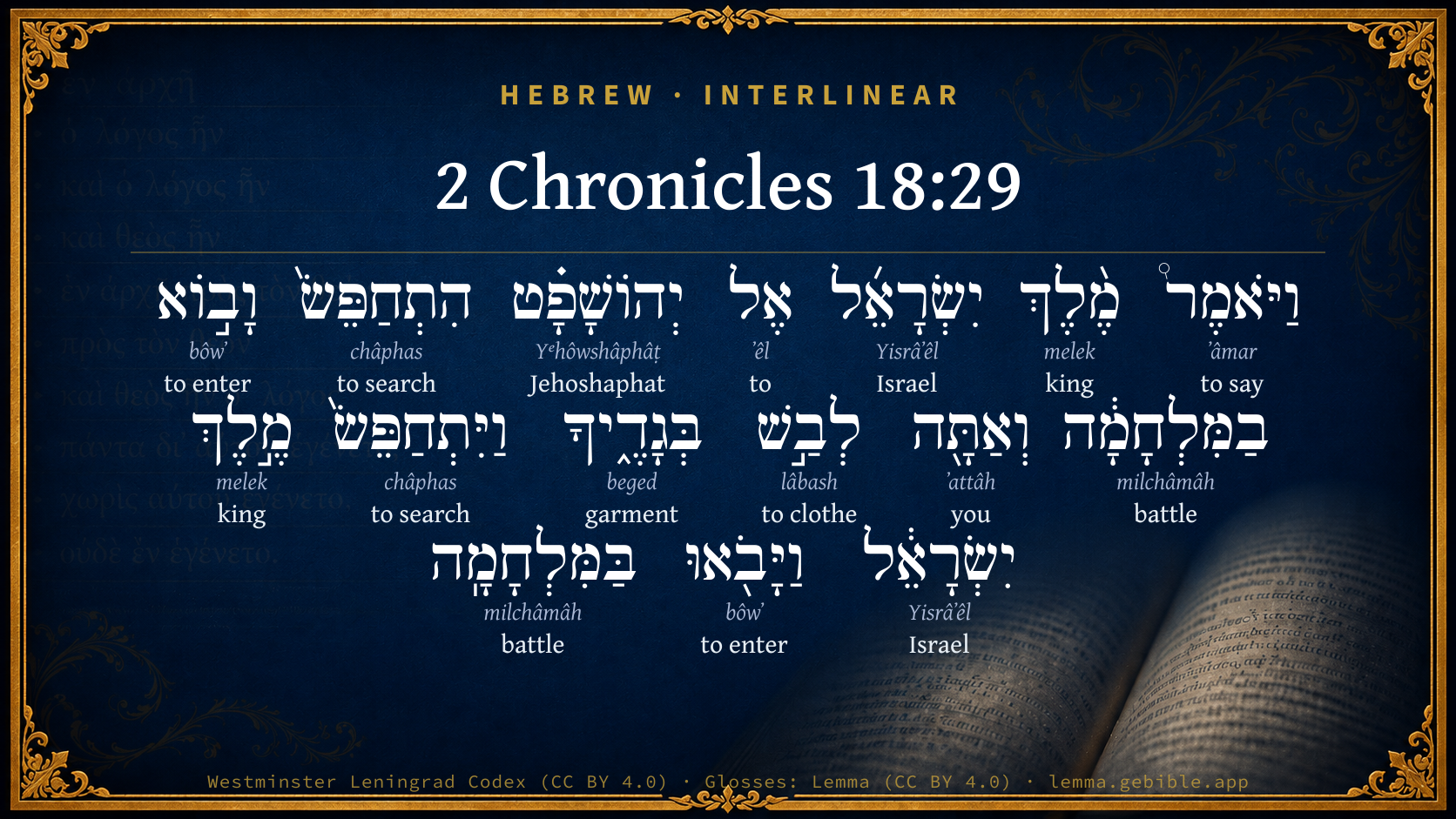
2 Chronicles 18:29

Hebrew (Westminster Leningrad Codex) 2 Chronicles 18:29 appears in the Hebrew Old Testament. The text above is from the Westminster Leningrad Codex. Each word links to its Strong’s number, a concise gloss, and parsing drawn from the Open Scriptures Hebrew Bible morphology. Click any word for its full Brown-Driver-Briggs (BDB) entry.
Download image
Cite this verse

2 Chronicles 18:29 (World English Bible). Public Domain. Lemma interlinear Bible study tool, https://lemma.gebible.app/v/2-chronicles/18/29.

Show BibTeX & RIS
BibTeX
RIS
English Translation
The king of Israel said to Jehoshaphat, I will disguise myself, and go into the battle; but put you on your robes. So the king of Israel disguised himself; and they went into the battle.
World English Bible · Public Domain
Download a study sheet

One document with this verse’s original text, its word-by-word gloss line, the meaning frame, cross-references with their text, attributed commentary, and full source and license credits — printable, and it pastes into notes with its structure intact.

This verse Autodidact and up

Study sheet (.html) Plain text (.txt)

A passage Seminary Student

Up to 50 verses in one chapter. A passage sheet keeps up to 6 commentary sources and 12 cross-references per verse, in the order this page ranks them, and says so on the sheet whenever that leaves anything out. Ask for a single verse and you get the Autodidact verse sheet above.

Everything on this page stays free to read, with no account — the sheet is a download of what is already on screen, not access to it.

Want to remove ads? Support Godless Engineer
Compare translations 3

The same verse in 3 English versions, stacked beneath the original-language interlinear above. Click any original word for its lexicon entry.

Each is an independent rendering of the whole verse — the interlinear is not word-aligned to these translations.

Highlighted words mark where these versions differ — a whole-verse word diff, not a word-by-word alignment.

  • World English Bible Public Domain
    The king of Israel said to Jehoshaphat, I will disguise myself, and go into the battle; but put you on your robes. So the king of Israel disguised himself; and they went into the battle.
  • King James Version Public Domain
    And the king of Israel said unto Jehoshaphat, I will disguise myself, and I will go to the battle; but put thou on thy robes. So the king of Israel disguised himself; and they went to the battle.
  • unfoldingWord Literal Text CC BY-SA 4.0
    And the king of Israel said to Jehoshaphat, “I will disguise myself and go into the battle, and now put on your garments.” And the king of Israel disguised himself, and they went into the battle.

unfoldingWord Literal Text — © unfoldingWord, licensed CC BY-SA 4.0. Word-aligned USFM3 via Door43 (git.door43.org/unfoldingWord/en_ult).

Versions to compare (up to 4)

3 of 4 selected

Show all 18 translations

Every available English version of this verse, each an independent rendering of the whole verse.

  • World English Bible Public Domain
    The king of Israel said to Jehoshaphat, I will disguise myself, and go into the battle; but put you on your robes. So the king of Israel disguised himself; and they went into the battle.
  • Berean Standard Bible Public Domain
    And the king of Israel said to Jehoshaphat, “I will disguise myself and go into battle, but you wear your royal robes.” So the king of Israel disguised himself and went into battle.
  • Majority Standard Bible Public Domain
    And the king of Israel said to Jehoshaphat, “I will disguise myself and go into battle, but you wear your royal robes.” So the king of Israel disguised himself and went into battle.
  • King James Version Public Domain
    And the king of Israel said unto Jehoshaphat, I will disguise myself, and I will go to the battle; but put thou on thy robes. So the king of Israel disguised himself; and they went to the battle.
  • American Standard Version (1901) Public Domain
    And the king of Israel said unto Jehoshaphat, I will disguise myself, and go into the battle; but put thou on thy robes. So the king of Israel disguised himself; and they went into the battle.
  • Revised Version (1885) Public Domain
    And the king of Israel said unto Jehoshaphat, I will disguise myself, and go into the battle; but put thou on thy robes. So the king of Israel disguised himself; and they went into the battle.
  • Geneva Bible (1599) Public Domain
    And the King of Israel said vnto Iehoshaphat, I will change my selfe, and enter into the battel: but put thou on thine apparel. So the King of Israel changed himselfe, and they went into the battel.
  • Douay-Rheims (1899) Public Domain
    And the king of Israel said to Josaphat: I will change my dress, and so I will go to the battle, but put thou on thy own garments. And the king of Israel having changed his dress, went to the battle.
  • Young's Literal Translation Public Domain
    and the king of Israel saith unto Jehoshaphat to disguise himself, and to go into battle, `And thou, put on thy garments.' And the king of Israel disguiseth himself, and they go into battle.
  • Literal Standard Version CC BY-SA 4.0
    and the king of Israel says to Jehoshaphat to disguise himself, and to go into battle, “And you, put on your garments.” And the king of Israel disguises himself, and they go into battle.
  • Unlocked Literal Bible CC BY-SA 4.0
    The king of Israel said to Jehoshaphat, “I will disguise myself and go into the battle, but you put on your royal robes.” So the king of Israel disguised himself, and they went into the battle.
  • unfoldingWord Literal Text CC BY-SA 4.0
    And the king of Israel said to Jehoshaphat, “I will disguise myself and go into the battle, and now put on your garments.” And the king of Israel disguised himself, and they went into the battle.
  • Darby Bible Public Domain
    And the king of Israel said to Jehoshaphat, I will disguise myself, and will enter into the battle; but put thou on thy robes. And the king of Israel disguised himself; and they went into the battle.
  • World Messianic Bible Public Domain
    The king of Israel said to Jehoshaphat, “I will disguise myself, and go into the battle; but you put on your robes.” So the king of Israel disguised himself; and they went into the battle.
  • Webster's Bible Public Domain
    And the king of Israel said to Jehoshaphat, I will disguise myself, and will go to the battle; but put thou on thy robes. So the king of Israel disguised himself; and they went to the battle.
  • Free Bible Version CC BY-SA 4.0
    The king of Israel told Jehoshaphat, “When I go into battle I will be in disguise, but you should wear your royal robes.” So the king of Israel disguised himself and went into battle.
  • Bible in Basic English Public Domain
    And the king of Israel said to Jehoshaphat, I will make a change in my clothing, so that I do not seem to be the king, and will go into the fight; but do you put on your robes. So the king of Israel made a change in his dress, and they went to the fight.
  • JPS Tanakh (1917) Public Domain
    And the king of Israel said unto Jehoshaphat: 'I will disguise myself, and go into the battle; but put thou on thy robes.' So the king of Israel disguised himself; and they went into the battle.

Literal Standard Version (2020), Covenant Press — licensed CC BY-SA 4.0. Text via the HelloAO Bible API (eBible.org). Unlocked Literal Bible (unfoldingWord) — licensed CC BY-SA 4.0. Text via the HelloAO Bible API (eBible.org). unfoldingWord Literal Text — © unfoldingWord, licensed CC BY-SA 4.0. Word-aligned USFM3 via Door43 (git.door43.org/unfoldingWord/en_ult). Free Bible Version, Dr. Jonathan Gallagher — licensed CC BY-SA 4.0. Text via the HelloAO Bible API (eBible.org).

Word by word

More ways to search: Search by grammar → Find every occurrence → Compare this word →

Practice this passage: Drill this verse → Learn its vocabulary →

הִתְחַפֵּשׂ֙
châphas
H2664
“to search”
Verb, Hithpael, Infinitive Absolute
Part of Speech
Verb
Stem
Hithpael
Form
Infinitive Absolute
Full BDB Definition

Origin: a primitive root

TWOT: 716

to search, search for, to search out, disguise oneself - (Qal) - to search for - to think out, devise - to search, test - (Niphal) to be searched out, be exposed - (Piel) to search, search through, search for - (Pual) to be searched for, be sought out - (Hithpael) - to disguise oneself - to let oneself be searched for
  1. וַיֹּאמֶר֩ ʼâmar H559 “and · to say” Conjunction + Verb, Qal, Sequential Imperfect, 3rd Person, Masculine, Singular
  2. מֶ֨לֶךְ melek H4428 “king of” Noun, Common, Masculine, Singular, Construct
  3. יִשְׂרָאֵ֜ל Yisrâʼêl H3478 “Israel” Noun, Proper
  4. אֶל ʼêl H413 “to” Preposition
  5. יְהוֹשָׁפָ֗ט Yᵉhôwshâphâṭ H3092 “Jehoshaphat” Noun, Proper
  6. וָב֣וֹא bôwʼ H935 “and · to enter” Conjunction + Verb, Qal, Infinitive Absolute
  7. בַמִּלְחָמָ֔ה milchâmâh H4421 “in/at the · battle” Preposition, Determined + Noun, Common, Feminine, Singular, Absolute
  8. וְאַתָּ֖ה ʼattâh H859 “and · you” Conjunction + Pronoun, Personal, 2nd Person, Masculine, Singular
  9. לְבַ֣שׁ lâbash H3847 “clothe” Verb, Qal, Imperative, 2nd Person, Masculine, Singular
  10. בְּגָדֶ֑יךָ beged H899 “garments · your” Noun, Common, Masculine, Plural, Construct + Suffix, Personal, 2nd Person, Masculine, Singular
  11. וַיִּתְחַפֵּשׂ֙ châphas H2664 “and · to search” Conjunction + Verb, Hithpael, Sequential Imperfect, 3rd Person, Masculine, Singular
  12. מֶ֣לֶךְ melek H4428 “king of” Noun, Common, Masculine, Singular, Construct
  13. יִשְׂרָאֵ֔ל Yisrâʼêl H3478 “Israel” Noun, Proper
  14. וַיָּבֹ֖אוּ bôwʼ H935 “and · to enter” Conjunction + Verb, Qal, Sequential Imperfect, 3rd Person, Masculine, Plural
  15. בַּמִּלְחָמָֽה milchâmâh H4421 “in/at the · battle” Preposition, Determined + Noun, Common, Feminine, Singular, Absolute

About this verse

These counts appear in no published source. They are computed here, from the morphology-tagged text and Lemma’s own curated glosses. What Lemma adds →

16
words
11
distinct lemmas
Historical
section

Notable vocabulary

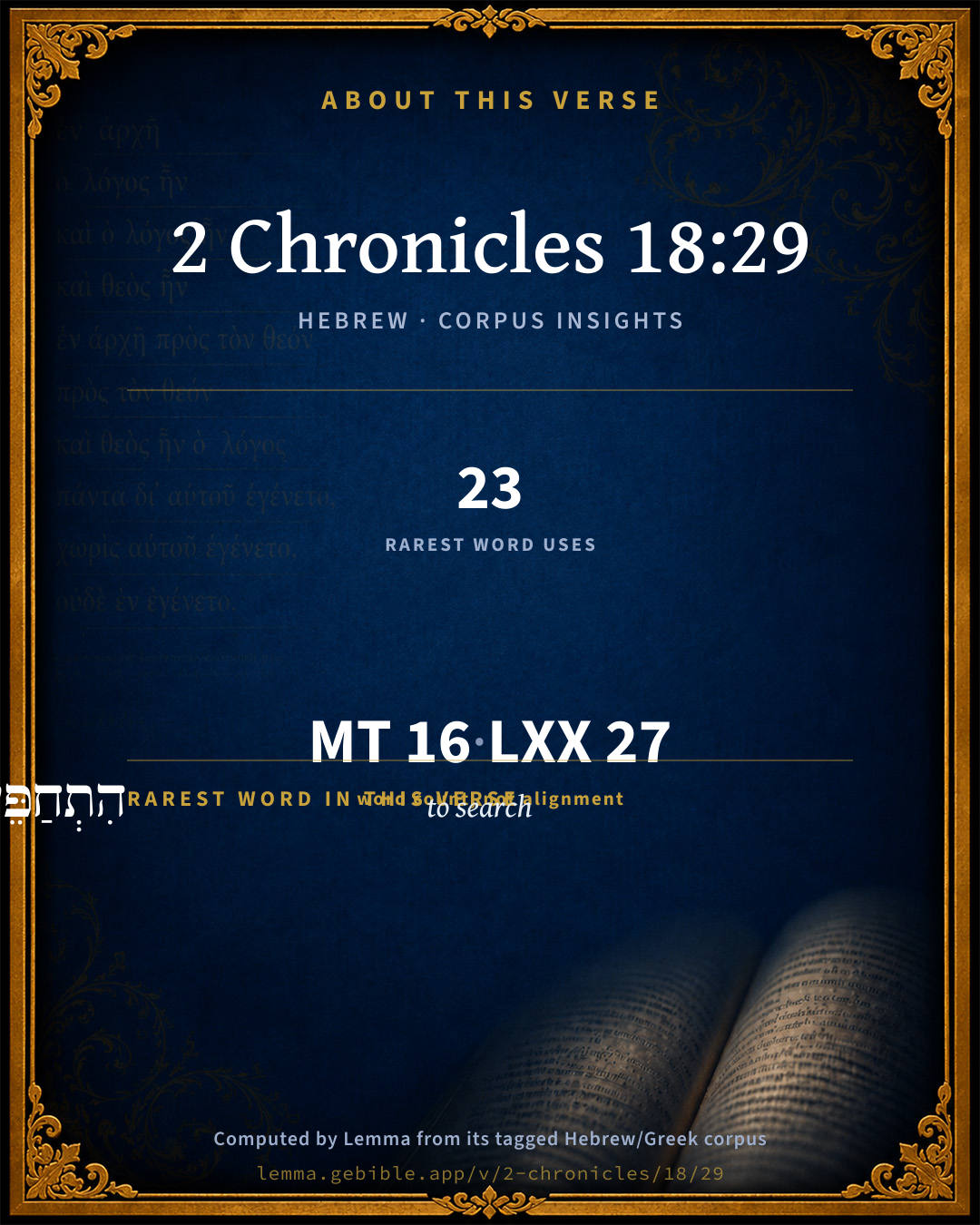
The rarest word here is הִתְחַפֵּשׂ֙ to search H2664 — appearing just 23 times in the whole Hebrew Bible.

Shared distinctive vocabulary

הִתְחַפֵּשׂ֙ to search H2664 occurs in 20 verses of the Hebrew Bible. Also found in:

Grammatical profile

  • 6 verbs
  • 8 nouns
  • 1 pronoun
  • 1 preposition

Verb forms

  • וַיֹּאמֶר֩ Qal · Sequential Imperfect
  • הִתְחַפֵּשׂ֙ Hithpael · Infinitive Absolute
  • וָב֣וֹא Qal · Infinitive Absolute
  • לְבַ֣שׁ Qal · Imperative
  • וַיִּתְחַפֵּשׂ֙ Hithpael · Sequential Imperfect
  • וַיָּבֹ֖אוּ Qal · Sequential Imperfect

Repetition

Words recur within this verse — often emphatic in Hebrew:

  • מֶ֨לֶךְ king H4428 ×2
  • יִשְׂרָאֵ֜ל Israel H3478 ×2
  • הִתְחַפֵּשׂ֙ to search H2664 ×2
  • וָב֣וֹא to enter H935 ×2
  • בַמִּלְחָמָ֔ה battle H4421 ×2

Hebrew & Septuagint length

In English translation the verse runs 35 words from the Hebrew and 36 from the Septuagint (LXX English) — closely comparable.

A rough comparison of the two English renderings, which tokenize alike — not a word-level alignment.

Word counts can differ between the Hebrew and the Greek without any difference in meaning — e.g. the Hebrew direct-object marker אֵת has no separate Greek word, and Greek often adds the article ὁ.

In the original languages it is 16 Hebrew tokens and 27 Greek tokens — but the two are counted differently (Hebrew bundles its prefixes and suffixes into one token; the Greek is in lemma form), so that isn’t a like-for-like length.

Cross-references

8

Topical passages linked to 2 Chronicles 18:29 in the Treasury of Scripture Knowledge — connected by theme and wording, ordered by reader-vote popularity; previews shown in the World English Bible.

  • 1 Samuel 28:8 Saul disguised himself, and put on other clothing, and went, he and two men with him, and they came to the woman by night: and he said, Please divine to me by the familiar spirit, and bring me up whoever I shall name to you.
  • 1 Kings 14:2–6 Jeroboam said to his wife, Please get up and disguise yourself, that you not be known to be the wife of Jeroboam; and get you to Shiloh: behold, there is Ahijah the prophet, who spoke concerning me that I should be king over this people.
  • 1 Kings 20:38 So the prophet departed, and waited for the king by the way, and disguised himself with his headband over his eyes.
  • 2 Chronicles 35:22–23 Nevertheless Josiah would not turn his face from him, but disguised himself, that he might fight with him, and didn't listen to the words of Neco from the mouth of God, and came to fight in the valley of Megiddo.
  • Job 24:15 The eye also of the adulterer waits for the twilight, Saying, 'No eye shall see me.' He disguises his face.
  • Psalms 12:2 Everyone lies to his neighbor. They speak with flattering lips, and with a double heart.
  • Proverbs 26:25 When his speech is charming, don't believe him; For there are seven abominations in his heart:
  • Jeremiah 23:24 Can any hide himself in secret places so that I shall not see him? says Yahweh. Don't I fill heaven and earth? says Yahweh.

Cross-references courtesy of OpenBible.info (CC BY 4.0).

Hebrew and Greek witnesses Masoretic Hebrew ↔ Greek Septuagint

The same verse in the two great witnesses to the Old Testament, shown verse-for-verse.

These are two independent witnesses, not word-aligned to each other, and the Septuagint is shown in lemma (dictionary) form.

Hebrew 2 Chronicles 18:29 Masoretic · Westminster Leningrad Codex

וַיֹּאמֶר֩ מֶ֨לֶךְ יִשְׂרָאֵ֜ל אֶל יְהוֹשָׁפָ֗ט הִתְחַפֵּשׂ֙ וָב֣וֹא בַמִּלְחָמָ֔ה וְאַתָּ֖ה לְבַ֣שׁ בְּגָדֶ֑יךָ וַיִּתְחַפֵּשׂ֙ מֶ֣לֶךְ יִשְׂרָאֵ֔ל וַיָּבֹ֖אוּ בַּמִּלְחָמָֽה

The king of Israel said to Jehoshaphat, I will disguise myself, and go into the battle; but put you on your robes. So the king of Israel disguised himself; and they went into the battle.

World English Bible · Public Domain

Greek LXX 2 Chronicles 18:29 Septuagint · lemma form

καί εἶπον βασιλεύς ἰσραήλ πρός ιωσαφατ κατακαλύπτω καί εἰςἔρχομαι εἰς ὁ πόλεμος καί σύ ἐνδύω ὁ ἱματισμός ἐγώ καί συνκαλύπτω βασιλεύς ἰσραήλ καί εἰςἔρχομαι εἰς ὁ πόλεμος

And the king of Israel said to Josaphat, Disguise me, and I will enter into the battle: and do you put on my raiment. so the king of Israel disguised himself, and entered into the battle.

LXX2012 (modern English Septuagint) · Public Domain

On this verse, Ellicott's Commentary for English Readers discusses the Septuagint’s reading. Read the note in Commentary ↓

Hebrew: Westminster Leningrad Codex (CC BY 4.0). Greek: Septuagint (public domain); English from LXX2012 (modern English Septuagint) (Public Domain). How the Septuagint differs from the Hebrew →

Commentary

Notes on 2 Chronicles 18:29 from classic Christian and Jewish commentators (each source and its license shown beneath its notes). The classic Christian expositions comment on the surrounding passage and are grouped to its opening verse, so a note may address several verses; the Jewish commentaries on the Tanakh (Rashi and others) are per-verse, so they appear only where the commentator wrote on this verse.

Lemma curates 59 commentaries, every one of them public domain or Creative Commons licensed, each selected and text-cleaned for this edition rather than reprinted as found. About our sources →

Trapp's Complete Commentary

John Trapp

2Ch 18:29 And the king of Israel said unto Jehoshaphat, I will disguise myself, and will go to the battle; but put thou on thy robes. So the king of Israel disguised himself; and they went to the battle.

Ver. 29. But put thou on thy robes.] As if you were the general of both armies. Ahab pretended herein to honour Jehoshaphat, but intended to save himself, and to elude Micaiah’s prophecy.

John Trapp, A Commentary or Exposition upon All the Books of the Old and New Testament (1647–1656) — public domain. Text from a community e-Sword module.

Geneva Bible (1599)

Geneva Bible translators

Thus the wicked think by their own subtlety to escape God’s judgments which he threateneth by his word.

Geneva Bible (1599) marginal notes — public domain. Text via Bolls.life.

Adam Clarke's Commentary

Verse 29. I will disguise myself] 1Kg 22:30.

Adam Clarke's Commentary on the Bible (1810–1826) — public domain. Text from a community e-Sword/MySword module.

Ellicott's Commentary for English Readers

(29) I will disguise myself, and will go.—Literally, disguising myself and entering! A hurried exclamatory mode of speaking.

They went.—Kings, he (Ahab) went into the battle. So some Hebrew MSS., LXX., Syriac, Vulg., Arabic, and Targum.

A Bible Commentary for English Readers, edited by Charles John Ellicott (1878–1897) — public domain. Text from a community e-Sword module.

The Cambridge Bible for Schools and Colleges

gen. ed. J. J. S. Perowne

28–34 (= 1Ki_22:29-37). The Death of Ahab at Ramoth-Gilead

29. I will disguise myself] Ahab’s proposal is that he himself (disguised) should take part in the fighting, and that Jehoshaphat in royal robes should remain in the rear. Thus Ahab would be doubly protected, i.e. by his disguise and by the chance that Jehoshaphat would be mistaken for him, while Jehoshaphat In the rear would run no risk.

put thou on thy robes] Render, be clothed in thy robes, i.e. do not put on thy armour, but keep out of the fighting.

and they went to the battle] 1 Kin. (more correctly) and he (Ahab) went into the battle (so LXX. here).

The Cambridge Bible for Schools and Colleges (gen. ed. J. J. S. Perowne; Cambridge University Press, 1878–1918) — public domain. Text from a community e-Sword module.

Haydock's Catholic Bible Commentary

Dress. Prot. "disguised himself, and they went." See 3 K. xxii. 30.

George Leo Haydock (1774–1849), Haydock's Catholic Family Bible and Commentary, 1859 edition — public domain. Excludes Psalms (Douay-Rheims chapter numbering differs from Protestant) and Deuterocanonical books (Catholic canon only).

The Pulpit Commentary

Ahab does not seem disposed to lose anything again for want of asking, and even vouchsafing apparently (but it is exceedingly likely that this arises from our failing to appreciate exactly the force of the Hebrew forms in the text) to use the tone of directing, to his brother-king of the better part and kingdom. It must be presumed that there was something to relieve Ahab"s language of the barefaced disregard for the safety of Jehoshaphat and regard for his own, which lie on the surface of the words he uses. Quite possibly, for instance, both knew that Ahab was to be the mark of the shooters. Also Ahab"s disguise may have meant a heavy price to pay to his pride, while Jehoshaphat"s dignity was saved intact. So, too, Ahab may have merely purported to say, "You can, without any special risk, wear your royal apparel; but I," etc,

The Pulpit Commentary (1880–1919), ed. H.D.M. Spence-Jones & Joseph S. Exell — public domain. Text from a community e-Sword module.

Rashi

Rabbi Shlomo Yitzchaki (Rashi)

disguise myself and go The meaning is: “I must make myself like a stranger and disguise myself in other clothes, so that they do not recognize that I am the king of Israel,” for he was wary of Micaiah’s words, saying, “If you return in peace, etc.” And he said to Jehoshaphat, “I wish to disguise myself and go to war, for I fear that the Arameans heard that Micaiah said, ‘If you return in peace,’ and they will attack only me.”

but you may wear your garb The royal costume and the coat of mail and the royal weapons, for there is no need for anyone to be wary of the prophet’s words except the king of Israel, for his [the king of Aram’s] spies told [him] the words of Micaiah.

Rashi on the Tanakh — English translations: “The Judaica Press complete Tanach with Rashi, translated by A. J. Rosenberg” (CC BY 4.0); “Pentateuch with Rashi's commentary by M. Rosenbaum and A.M. Silbermann, 1929-1934” (public domain); “The Metsudah Tanach series, Lakewood, N.J” (CC BY 4.0); and “The Book of Joshua, Metsudah Publications, 1997” (CC BY 4.0). Text via Sefaria.

Lesson kit

Teaching starters — assembled from the data on this page, not authored interpretation. Every prompt links to the verse data it draws on. Edit before teaching.

2 Chronicles, in the Historical, opens this verse with 16 words (11 distinct Hebrew lemmas). Its most distinctive word is châphas (“to search”). A historical commentator’s framing appears above. Read the whole chapter for the surrounding context.

Discussion questions

  1. What does “to search” (châphas) contribute to the verse as a whole?
  2. Genesis 31:35 shares the word «to search» with this verse. How do the two illuminate each other?
  3. “king” occurs 2× in this one verse. What is the effect of the repetition?
  4. The translations on this page render this verse differently — a whole-verse word diff, not a word-by-word alignment. What might account for the different wordings?
  5. The verb «וַיֹּאמֶר֩» is Qal Sequential Imperfect. How does its form color the action?
  6. Reading how Trapp's Complete Commentary and Geneva Bible (1599) read this verse, where do the two commentators agree and where do they part?

Things to notice

Reading settings

Reading text

Shown beneath each verse's original-language words.

Old Testament
Old Testament edition

Read the OT as the Masoretic Hebrew (MT) or the Greek Septuagint (LXX).

English shown for the Greek Septuagint (in the Hebrew ↔ Greek comparison).

Comparing translations? Open the Compare panel on any verse page to stack up to four side by side.