1 Samuel 19:13

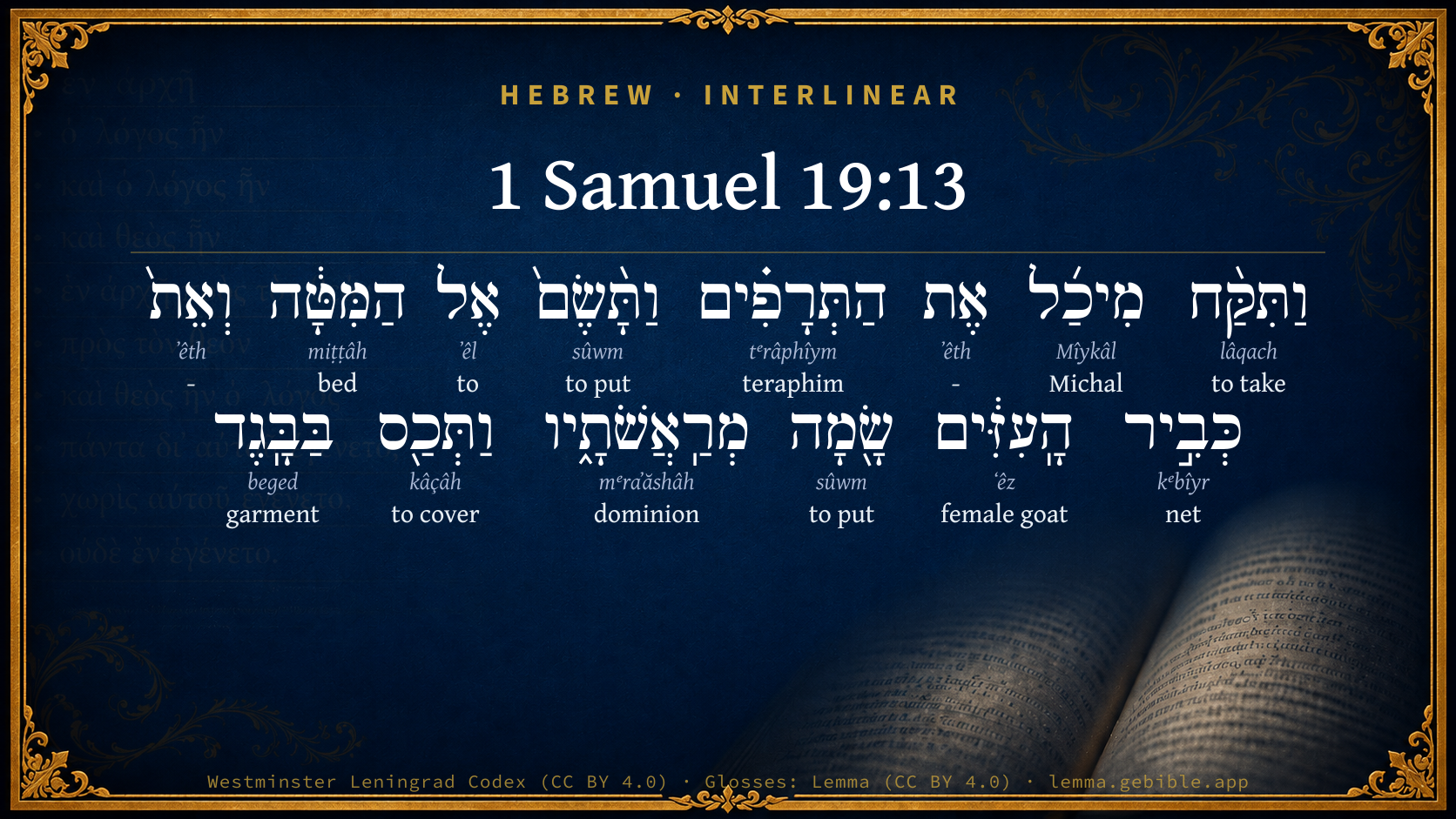
Hebrew (Westminster Leningrad Codex) 1 Samuel 19:13 appears in the Hebrew Old Testament. The text above is from the Westminster Leningrad Codex. Each word links to its Strong’s number, a concise gloss, and parsing drawn from the Open Scriptures Hebrew Bible morphology. Click any word for its full Brown-Driver-Briggs (BDB) entry.
Download image
Cite this verse

1 Samuel 19:13 (World English Bible). Public Domain. Lemma interlinear Bible study tool, https://lemma.gebible.app/v/1-samuel/19/13.

Show BibTeX & RIS
BibTeX
RIS
English Translation
Michal took the teraphim, and laid it in the bed, and put a pillow of goats' [hair] at the head of it, and covered it with the clothes.
World English Bible · Public Domain
Highlights
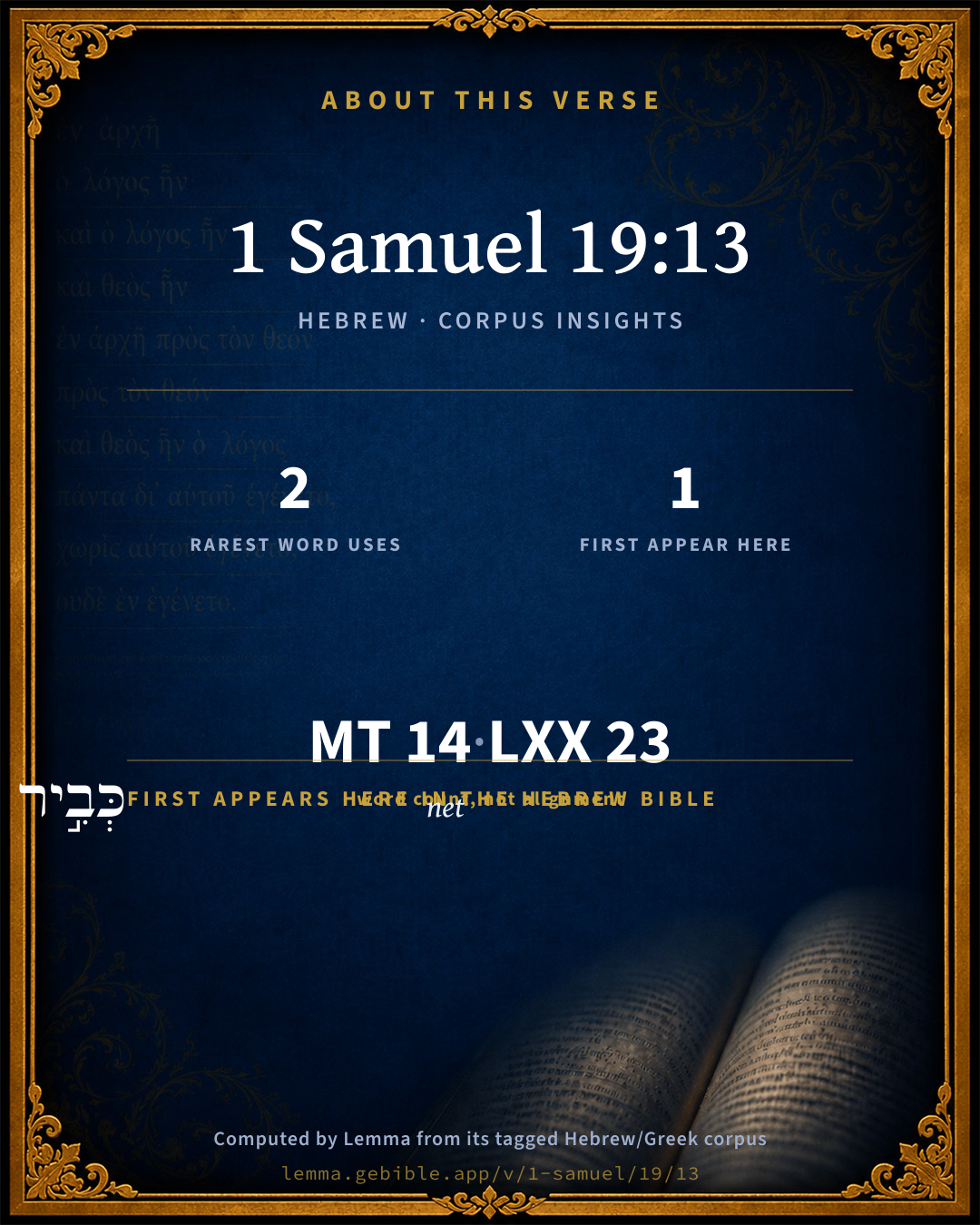
  • 1 first appearance in the Hebrew Bible
Full analysis ↓
Download a study sheet

One document with this verse’s original text, its word-by-word gloss line, the meaning frame, cross-references with their text, attributed commentary, and full source and license credits — printable, and it pastes into notes with its structure intact.

This verse Autodidact and up

Study sheet (.html) Plain text (.txt)

A passage Seminary Student

Up to 50 verses in one chapter. A passage sheet keeps up to 6 commentary sources and 12 cross-references per verse, in the order this page ranks them, and says so on the sheet whenever that leaves anything out. Ask for a single verse and you get the Autodidact verse sheet above.

Everything on this page stays free to read, with no account — the sheet is a download of what is already on screen, not access to it.

Want to remove ads? Support Godless Engineer
Compare translations 3

The same verse in 3 English versions, stacked beneath the original-language interlinear above. Click any original word for its lexicon entry.

Each is an independent rendering of the whole verse — the interlinear is not word-aligned to these translations.

Highlighted words mark where these versions differ — a whole-verse word diff, not a word-by-word alignment.

  • World English Bible Public Domain
    Michal took the teraphim, and laid it in the bed, and put a pillow of goats' [hair] at the head of it, and covered it with the clothes.
  • King James Version Public Domain
    And Michal took an image, and laid it in the bed, and put a pillow of goats' hair for his bolster, and covered it with a cloth.
  • unfoldingWord Literal Text CC BY-SA 4.0
    And Michal took the teraphim and put on the bed. And she put a weaving of goats at its head, and she covered with clothing.

unfoldingWord Literal Text — © unfoldingWord, licensed CC BY-SA 4.0. Word-aligned USFM3 via Door43 (git.door43.org/unfoldingWord/en_ult).

Versions to compare (up to 4)

3 of 4 selected

Show all 18 translations

Every available English version of this verse, each an independent rendering of the whole verse.

  • World English Bible Public Domain
    Michal took the teraphim, and laid it in the bed, and put a pillow of goats' [hair] at the head of it, and covered it with the clothes.
  • Berean Standard Bible Public Domain
    Then Michal took a household idol and laid it in the bed, placed some goat hair on its head, and covered it with a garment.
  • Majority Standard Bible Public Domain
    Then Michal took a household idol and laid it in the bed, placed some goat hair on its head, and covered it with a garment.
  • King James Version Public Domain
    And Michal took an image, and laid it in the bed, and put a pillow of goats' hair for his bolster, and covered it with a cloth.
  • American Standard Version (1901) Public Domain
    And Michal took the teraphim, and laid it in the bed, and put a pillow of goats' `hair' at the head thereof, and covered it with the clothes.
  • Revised Version (1885) Public Domain
    And Michal took the teraphim, and laid it in the bed, and put a pillow of goats’ hair at the head thereof, and covered it with the clothes.
  • Geneva Bible (1599) Public Domain
    Then Michal tooke an image, and layde it in the bed, and put a pillow stuffed with goates heare vnder the head of it, and couered it with a cloth.
  • Douay-Rheims (1899) Public Domain
    And Michol took an image and laid it on the bed, and put a goat's skin with the hair at the head of it, and covered it with clothes.
  • Young's Literal Translation Public Domain
    and Michal taketh the teraphim, and layeth on the bed, and the mattress of goats' `hair' she hath put `for' his pillows, and covereth with a garment.
  • Literal Standard Version CC BY-SA 4.0
    and Michal takes the teraphim, and lays [it] on the bed, and she has put the mattress of goats’ [hair for] his pillows, and covers [it] with a garment.
  • Unlocked Literal Bible CC BY-SA 4.0
    Michal took a household idol and laid it in the bed. Then she put a pillow of goats' hair at its head, and covered it with the clothes.
  • unfoldingWord Literal Text CC BY-SA 4.0
    And Michal took the teraphim and put on the bed. And she put a weaving of goats at its head, and she covered with clothing.
  • Darby Bible Public Domain
    And Michal took the image, and laid it in the bed, and put the net of goats' [hair] at its head, and covered it with the coverlet.
  • World Messianic Bible Public Domain
    Michal took the teraphim and laid it in the bed, and put a pillow of goats’ hair at its head and covered it with clothes.
  • Webster's Bible Public Domain
    And Michal took an image, and laid it in the bed, and put a pillow of goat's hair for his bolster, and covered it with a cloth.
  • Free Bible Version CC BY-SA 4.0
    Then she took a home idol and laid it in the bed, put a goat hair wig on its head, and covered it with bedclothes.
  • Bible in Basic English Public Domain
    Then Michal took the image and put it in the bed, with a cushion of goat's hair at its head, and she put clothing over it.
  • JPS Tanakh (1917) Public Domain
    And Michal took the teraphim, and laid it in the bed, and put a quilt of goats' hair at the head thereof, and covered it with a cloth.

Literal Standard Version (2020), Covenant Press — licensed CC BY-SA 4.0. Text via the HelloAO Bible API (eBible.org). Unlocked Literal Bible (unfoldingWord) — licensed CC BY-SA 4.0. Text via the HelloAO Bible API (eBible.org). unfoldingWord Literal Text — © unfoldingWord, licensed CC BY-SA 4.0. Word-aligned USFM3 via Door43 (git.door43.org/unfoldingWord/en_ult). Free Bible Version, Dr. Jonathan Gallagher — licensed CC BY-SA 4.0. Text via the HelloAO Bible API (eBible.org).

Word by word

More ways to search: Search by grammar → Find every occurrence → Compare this word →

Practice this passage: Drill this verse → Learn its vocabulary →

כְּבִ֣יר
kᵉbîyr
H3523
“net of”
Noun, Common, Masculine, Singular, Construct
Part of Speech
Noun
Type
Common
Gender
Masculine
Number
Singular
State
Construct
Full BDB Definition

Origin: from H3527 in the original sense of plaiting

TWOT: 948a

(something) netted, a quilt, fly net, pillow
  1. וַתִּקַּ֨ח lâqach H3947 “and · to take” Conjunction + Verb, Qal, Sequential Imperfect, 3rd Person, Feminine, Singular
  2. מִיכַ֜ל Mîykâl H4324 “Michal” Noun, Proper
  3. אֶת ʼêth H853 “-” Particle, Direct Object
  4. הַתְּרָפִ֗ים tᵉrâphîym H8655 “the · teraphim” Particle, Definite Article + Noun, Common, Masculine, Plural, Absolute
  5. וַתָּ֨שֶׂם֙ sûwm H7760 “and · to put” Conjunction + Verb, Qal, Sequential Imperfect, 3rd Person, Feminine, Singular
  6. אֶל ʼêl H413 “to” Preposition
  7. הַמִּטָּ֔ה miṭṭâh H4296 “the · bed” Particle, Definite Article + Noun, Common, Feminine, Singular, Absolute
  8. וְאֵת֙ ʼêth H853 “and · -” Conjunction + Particle, Direct Object
  9. הָֽעִזִּ֔ים ʻêz H5795 “the · female goats” Particle, Definite Article + Noun, Common, Feminine, Plural, Absolute
  10. שָׂ֖מָה sûwm H7760 “to put” Verb, Qal, Perfect, 3rd Person, Feminine, Singular
  11. מְרַֽאֲשֹׁתָ֑יו mᵉraʼăshâh H4763 “head place · his” Noun, Common, Feminine, Plural, Construct + Suffix, Personal, 3rd Person, Masculine, Singular
  12. וַתְּכַ֖ס kâçâh H3680 “and · to cover” Conjunction + Verb, Piel, Sequential Imperfect, 3rd Person, Feminine, Singular
  13. בַּבָּֽגֶד beged H899 “in/at the · garment” Preposition, Determined + Noun, Common, Masculine, Singular, Absolute

About this verse

These counts appear in no published source. They are computed here, from the morphology-tagged text and Lemma’s own curated glosses. What Lemma adds →

14
words
12
distinct lemmas
Historical
section

Notable vocabulary

The rarest word here is כְּבִ֣יר net H3523 — appearing just 2 times in the whole Hebrew Bible.

First appearance in Scripture

This word makes its first canonical appearance in the Hebrew Bible here:

  • כְּבִ֣יר net H3523

Shared distinctive vocabulary

כְּבִ֣יר net H3523 occurs in 2 verses of the Hebrew Bible. Also found in:

Grammatical profile

  • 4 verbs
  • 7 nouns
  • 1 preposition
  • 2 particles

Verb forms

  • וַתִּקַּ֨ח Qal · Sequential Imperfect
  • וַתָּ֨שֶׂם֙ Qal · Sequential Imperfect
  • שָׂ֖מָה Qal · Perfect
  • וַתְּכַ֖ס Piel · Sequential Imperfect

Repetition

A word recurs within this verse — often emphatic in Hebrew:

  • וַתָּ֨שֶׂם֙ to put H7760 ×2

Hebrew & Septuagint length

In English translation the verse runs 28 words from the Hebrew and 26 from the Septuagint (LXX English) — closely comparable.

A rough comparison of the two English renderings, which tokenize alike — not a word-level alignment.

Word counts can differ between the Hebrew and the Greek without any difference in meaning — e.g. the Hebrew direct-object marker אֵת has no separate Greek word, and Greek often adds the article ὁ.

In the original languages it is 14 Hebrew tokens and 23 Greek tokens — but the two are counted differently (Hebrew bundles its prefixes and suffixes into one token; the Greek is in lemma form), so that isn’t a like-for-like length.

Cross-references

5

Topical passages linked to 1 Samuel 19:13 in the Treasury of Scripture Knowledge — connected by theme and wording, ordered by reader-vote popularity; previews shown in the World English Bible.

  • Genesis 31:19 Now Laban had gone to shear his sheep: and Rachel stole the teraphim that were her father's.
  • Judges 18:14 Then the five men who went to spy out the country of Laish answered, and said to their brothers, Do you know that there is in these houses an ephod, and teraphim, and an engraved image, and a molten image? now therefore consider what you have to do.
  • Judges 18:17 The five men who went to spy out the land went up, and came in there, and took the engraved image, and the ephod, and the teraphim, and the molten image: and the priest stood by the entrance of the gate with the six hundred men girt with weapons of war.
  • Judges 17:5 The man Micah had a house of gods, and he made an ephod, and teraphim, and consecrated one of his sons, who became his priest.
  • Hosea 3:4 For the children of Israel shall abide many days without king, and without prince, and without sacrifice, and without sacred stone, and without ephod or idols.

Cross-references courtesy of OpenBible.info (CC BY 4.0).

Hebrew and Greek witnesses Masoretic Hebrew ↔ Greek Septuagint

The same verse in the two great witnesses to the Old Testament, shown verse-for-verse.

These are two independent witnesses, not word-aligned to each other, and the Septuagint is shown in lemma (dictionary) form.

Hebrew 1 Samuel 19:13 Masoretic · Westminster Leningrad Codex

וַתִּקַּ֨ח מִיכַ֜ל אֶת הַתְּרָפִ֗ים וַתָּ֨שֶׂם֙ אֶל הַמִּטָּ֔ה וְאֵת֙ כְּבִ֣יר הָֽעִזִּ֔ים שָׂ֖מָה מְרַֽאֲשֹׁתָ֑יו וַתְּכַ֖ס בַּבָּֽגֶד

Michal took the teraphim, and laid it in the bed, and put a pillow of goats' [hair] at the head of it, and covered it with the clothes.

World English Bible · Public Domain

Greek LXX 1 Samuel 19:13 Septuagint · lemma form

καί λαμβάνω ὁ μελχολ ὁ κενοτάφιον καί τίθημι ἐπί ὁ κλίνη καί ἧπαρ ὁ αἴξ τίθημι πρός κεφαλή αὐτός καί καλύπτω αὐτός ἱμάτιον

And Melchol took images, and laid them on the bed, and she put the liver of a goat by his head, and covered them with clothes.

LXX2012 (modern English Septuagint) · Public Domain

On this verse, Ellicott's Commentary for English Readers discusses the Septuagint’s reading. Read the note in Commentary ↓

Hebrew: Westminster Leningrad Codex (CC BY 4.0). Greek: Septuagint (public domain); English from LXX2012 (modern English Septuagint) (Public Domain). How the Septuagint differs from the Hebrew →

Targum (Aramaic paraphrase)

1

The Targum is the ancient Jewish Aramaic paraphrase of the Hebrew Scriptures — an interpretive translation, not the Hebrew text itself. Onkelos (literal) and Pseudo-Jonathan (expansive) render the Torah, and Jonathan the Prophets. Coverage is partial: where no permissively-licensed English translation exists for a verse, only the Aramaic is shown. This is verse-level text, not a word-by-word alignment to the Hebrew.

  1. Targum Jonathan Prophets (Joshua–Malachi)
    וּנְסִיבַת מִיכַל יַת צַלְמָנַיָא וְשַׁוִיאַת עַל עַרְסָא וְיַת נוֹדָא דְעִזָא שַׁוִיאַת אִסָדוֹהִי וְכַסִיאַת בִּלְבוּשָׁא:

    (no public-domain English translation for this verse)

    Targum Jonathan — Aramaic: “Mikraot Gedolot” (public domain). English: “Sefaria Community Translation” (CC0 1.0 (public-domain dedication)); “London "Chaldee Paraphrase," 1871” (public domain). Text via Sefaria.

Commentary

Notes on 1 Samuel 19:13 from classic Christian and Jewish commentators (each source and its license shown beneath its notes). The classic Christian expositions comment on the surrounding passage and are grouped to its opening verse, so a note may address several verses; the Jewish commentaries on the Tanakh (Rashi and others) are per-verse, so they appear only where the commentator wrote on this verse.

Lemma curates 59 commentaries, every one of them public domain or Creative Commons licensed, each selected and text-cleaned for this edition rather than reprinted as found. About our sources →

Trapp's Complete Commentary

John Trapp

1Sa 19:13 And Michal took an image, and laid [it] in the bed, and put a pillow of goats’ [hair] for his bolster, and covered [it] with a cloth.

Ver. 13. And Michal took an image.] Either a statue, David’s own statue, or else some superstitious image (the Hebrew is teraphim) which she kept secretly, as Rachel had done, David knowing nothing of it. Some have probably gathered that Michal, though a good wife, yet was no good woman: both because she had an image in the house, and afterward she mocked David for his devotion.

And put a pillow of goats’ hair.] Which might make the messengers believe it was the hair of David’s head. This she did that she might gain more time for her fleeing husband. Or such a pillow, as for ease and warmth.

John Trapp, A Commentary or Exposition upon All the Books of the Old and New Testament (1647–1656) — public domain. Text from a community e-Sword module.

Joseph Benson's Commentary

1Sa 19:13. Michal took an image — In the Hebrew it is teraphim; which teraphim, as Dr. Dodd observes, it plainly appears from hence, must have been figures of the human form; for the design of Michal was manifestly to deceive the messengers of Saul, by showing them something in a bed so far resembling a man as to make them believe it was David himself asleep. Her intention was to procure David the longer time for escaping. And to render it still more like him, she covered the back part of the head of the image, which appeared in sight, with goats’ hair of the same colour as David’s was, so that any one might take it, at a slight view, especially in a sick man’s room, where only a glimmering light is wont to be kept, for the back part of David’s head. This is plainly the meaning of the next clause, not very properly interpreted in our translation, but which in the Vulgate is rendered, et pellem pilosam caprarum possuit ad caput ejus; and she put the hairy skin of goats to, or upon, his head. And covered it with a cloth — Upon pretence of his being sick, and needing some such covering. If we may believe Abarbinel and Abendana, “women in those times were accustomed to have figures made in the likeness of their husbands, that when they were absent from them they might have their image to look upon.” If this really be a fact, it is probable that Michal’s image was one of this kind; or it was merely a statue for ornament. For we cannot suppose that any images, whether called teraphim or by any other name, were kept for the purposes of idolatry in David’s family.

Joseph Benson's Commentary on the Old and New Testaments (1811–1818) — public domain. Text from a community e-Sword module.

Tyndale Open Study Notes

Tyndale Open Resources

19:13 an idol: Hebrew teraphim, which were household idols (see Gen 31:30; Judg 17:5; 2 Kgs 23:24). The presence of an idol in the home of David and Michal might show the pervasive influence of pagan idol worship among the Israelites; perhaps the idol belonged to Michal. Apparently David did not object to its presence. (Cp. Rachel’s theft of her father’s household idols in Gen 31:19.) • Siblings Jonathan (1 Sam 19:1-7) and Michal (19:11-18) saved David from their father and undermined their father’s plans to eliminate him. Members of Saul’s royal family played a significant role in David’s rise, though David did not usurp Saul’s throne.

Tyndale Open Study Notes — © Tyndale Open Resources, licensed CC BY-SA 4.0. Text via the HelloAO Bible API.

Jamieson, Fausset & Brown

Robert Jamieson, A. R. Fausset & David Brown

And Michal took an image, and laid it in the bed--"an image," literally, "the teraphim," and laid, not in the bed, but literally on the "divan"; and "the pillows," that is, the cushion, which usually lay at the back of the divan and was stuffed with "goat's hair," she took from its bolster or heading at the upper part of the divan. This she placed lower down, and covered with a mantle, as if to foster a proper warmth in a patient; at the same time spreading the goat's hair skin, so as to resemble human hair in a dishevelled state. The pretext was that David lay there sick. The first messengers of Saul, keeping at a respectable distance, were deceived; but the imposition was detected on a closer inspection.

Jamieson, Fausset & Brown — Commentary Critical and Explanatory on the Whole Bible (1871) — public domain (CC PDM 1.0). Text via the HelloAO Bible API.

Adam Clarke's Commentary

Verse 13. Michal took an image] את התרפים eth hatteraphim, the teraphim. The Hebrew word appears to mean any kind of image, in any kind of form, as a representative of some reality. Here it must have been something in the human form; because it was intended to represent a man lying in bed indisposed.

A pillow of goats' hair] Perhaps she formed the appearance of a sick man's head muffled up by this pillow or bag of goats' hair. So I think the original might be understood. The goats' hair was merely accidental; unless we could suppose that it was designed to represent the hair of David's head, which is not improbable.

Adam Clarke's Commentary on the Bible (1810–1826) — public domain. Text from a community e-Sword/MySword module.

Ellicott's Commentary for English Readers

(13) An image.—An image in the Hebrew is teraphim—a plural form, but used as a singular. We have no instance of the singular. The Latin equivalent, “penates,” singularly enough, is also only found in the plural form. In this case, probably, it was a life-size figure or bust. The word has been discussed above (1Sa_15:23). It is singular how, in spite of the stern command to avoid idolatry, the children of Israel seemed to love to possess these lifeless images. The teraphim were probably a remnant of the idolatry originally brought by some of Abraham’s family from their Chaldaean home. These idols, we know, varied in size, from the diminutive image which Rachel (Gen_31:34) was able to conceal under the camel saddle to the life-size figure which the Princess Michal here used to make her father’s guards believe that her sick husband, David, was in bed. They appear to have been looked on as tutelary deities, the dispensers of domestic and family good fortune. It has been suggested, with some probability, that Michal, like Rachel, kept this teraphim in secret, because of her barrenness.

A pillow of goats’ hair.—More accurately, a goat’s skin about its head. So render the Syriac and Vulgate Versions. The reason of this act apparently was to imitate the effect of a man’s hair round the teraphim’s head. Its body, we read in the next clause, was covered “with a cloth.” Some scholars have suggested that this goat’s skin was a net-work of goat’s hair to keep off the flies from the supposed sleeper. The LXX., instead of k’vir (skin), read in their Hebrew copies keaved (liver). As the vowel points were introduced much later, such a confusion (especially as the difference between d and r in Hebrew is very slight) would be likely enough to occur in the MSS.

Josephus, adopting the LXX. reading, explains Michal’s conduct thus—“Michal put a palpitating goat’s liver into the bed, to represent a breathing sick man.”

With a cloth.—Heb., beged. This was David’s every-day garment, which he was in the habit of wearing. This, loosely thrown over the image, would materially assist the deception. The fifty-ninth Psalm bears the following title—“A michtam(or song of deep import) of David, when Saul sent, and they watched the house to kill him.” The internal evidence, however, is scarcely confirmatory of the accuracy of the title. The sacred song in question is very probably one of David’s own composition, and it is likely enough that the danger he incurred on this occasion was in his mind when he wrote the solemn words; but there are references in this psalm which must apply to other events in his troubled, anxious life.

A Bible Commentary for English Readers, edited by Charles John Ellicott (1878–1897) — public domain. Text from a community e-Sword module.

The Cambridge Bible for Schools and Colleges

gen. ed. J. J. S. Perowne

13. an image] The teraphim. These were the penates or house-hold images of the Israelites, brought originally from their Chaldean home (Gen_31:19). In spite of the strict prohibition of idols, they were used by those who professed to worship Jehovah in the time of the Judges (Jdg_17:5; Jdg_18:14 ff.), and even down to the later days of the Kings (2Ki_23:24). They seem to have been a kind of fetish or household charm for good luck, rather than an object of worship, and were used in divination (Zec_10:2; Eze_21:19-22). It is surprising to find teraphim in David’s house. It has been conjectured that Michal, like Rachel, kept them secretly on account of her barrenness. The plural teraphim here denotes a single image, in human form, apparently of life-size.

put a pillow, &c.] Put the quilt of goat’s hair at its head, and covered it with the coverlet. Michal wrapped the head of the image in a rough rug, either to hide it, or to imitate a man’s hair, and covered up the whole with the beged, a square piece of woollen cloth, which was used for an upper garment, or for a bed-covering. Cp. Deu_24:12-13.

The Cambridge Bible for Schools and Colleges (gen. ed. J. J. S. Perowne; Cambridge University Press, 1878–1918) — public domain. Text from a community e-Sword module.

John Gill's Exposition

And Michal took an image,.... Or "teraphim", as the word is; which, if the same with those that Rachel stole from her father, they seem to be of the same sort with the penates or household gods of the Heathens, which were privately kept by Michal; for, had David known of them, he would not have suffered them to have been in his house. Aben Ezra supposes they were images made in the form of men under such a constellation, a sort of talismans, to receive the heavenly influences, and which being consulted, foretold things to come; and R. Isaiah is of opinion, that Michal chose and placed these in the bed, that her father might conclude, when he should hear of them, that David had found them; and by thus means know that his intention was to kill him, and therefore fled; but to consult such images was very far from David, and without it he knew Saul's intention. Abarbinel makes mention of several sorts of teraphim, some for idolatry, some to draw down the heavenly influences, some to know the time of the day, a sort of dials; some were made after the form of a man known, and like him in his form and features; and women, he says, used to have the forms or statues of their husbands, that they might have them continually before them, because of the great love they had to them; and of this sort he supposes were the teraphim of Michal, and which is approved of by Abendana; and that this image had the likeness of an human face is very probable, or it could not have so well answered her purpose:

and laid it in the bed; where David used to lie, that it might seem to be he himself:

and put a pillow of goats' hair for his bolster; she took the finest of the goats' hair, which she had in the house, women being used to spin in those days, even great personages, and put it into a pillow, and made a bolster of it, and put it under the head or block of the image, which would sink it, being soft, and so look like a sick man, whose face could not easily be discerned; though some think this goats' hair was put about the head of the image, to make it look the more like an human head; goats' hair being very much like human hair (e), and of different colours, and such a colour might be chosen as was most like David's, see Sol 4:1; the Targum interprets it, a bottle of goats skins, that is, a leathern bottle or bag made of goats skins, such as they used to put wine into; hence the conceit in the Midrash (f), that a bottle of wine was put instead of David: but the pillow or bolster had the form of a leathern bag or bottle; the Septuagint version is very odd,"and put the liver of goats at his head;''and so Josephus says (g); and it is observed (h), that the liver of a goat will move a long time after it is taken out, and so make a show of the palpitation of the heart: but then this was put, not within the bed, but at the head of the image:

and covered it with a cloth; to keep her sick husband warm, as she would have it understood.

(e) Vid. Stockium, p. 509. (f) Apud Kimchium & Abarbinel. in loc. (g) Ut supra. (Antiqu. l. 6. c. 11. sect. 4.) (h) Vid. Hudson. not. in ib.

John Gill's Exposition of the Whole Bible (1746–1763) — public domain (CC PDM 1.0). Text via the HelloAO Bible API.

Albert Barnes' Notes on the Bible

An image - “Teraphim” (see the margin), an image, or bust in human form, and as large as life, of a kind of household god, to the worship of which the Israelites, and especially women, were much addicted.

A pillow - It was probably a quilt or blanket of goats’ hair and of common use as a bed-covering. Whether Michal drew it over the head of the teraphim, as if for warmth, and so covered it, or whether she disposed it about the head so as to look like hair, is not clear.

Albert Barnes' Notes on the Bible (1834–1885) — public domain. Text from a community e-Sword/MySword module.

Haydock's Catholic Bible Commentary

Image. Hebrew Teraphim. Aquila, "figures." Symmachus, "idols." Some believe that David had idols in his house, as ornaments, or to treat them with ignominy. (Mercer.) --- But others cannot persuade themselves that he would keep such dangerous things. What Michol took, might therefore be some sacred representation, or a statue of some great man. (Genebrard) (Kimchi; Maimonides) Or it might be some piece of wood, or clothes folded up, so as to make the guards believe that David was in bed. (Bochart, Anim. i. 2. 51.) See Genesis xxxi. 19. (Calmet) --- They would not examine very narrowly. (Haydock) --- The Taraphim denote both idolatrous and sacred things, Osee iii. 4. (Menochius) --- Skin. Vatican and Alexandrian Septuagint, "liver," still warm and in motion. (Tirinus) --- But they have followed a false reading, as well as Josephus and Aquila. (Calmet) --- Some have inferred that the hair of goats in that country is reddish, because it was designed to resemble David’s hair, of the same colour. (Tirinus) --- This is, however, uncertain. The skin might form his pillow or coverlet. (Calmet)

George Leo Haydock (1774–1849), Haydock's Catholic Family Bible and Commentary, 1859 edition — public domain. Excludes Psalms (Douay-Rheims chapter numbering differs from Protestant) and Deuterocanonical books (Catholic canon only).

Matthew Poole's English Annotations

An image, Heb. teraphim, which was an image made in human shape; which she might keep secretly, either out of a superstitious regard to it, or out of mere curiosity. This stratagem she used, because knowing her father’s unquiet, and jealous, and furious temper, she suspected he might come or send to see whether David was there or no.

Put a pillow of goats’ hair for his bolster, or, put great goats’ hair upon his bolster, i.e. upon the head and face of the image, which lay upon his bolster, that it might have some kind of resemblance of David’s head and hair, at least in a sick man’s bed, where there useth to be but a glimmering light. Goats is here put for goats’ hair, as it manifestly is Exo 25:4; 26:7; 35:26. It is acknowledged by learned writers, that in those eastern countries goats had much longer hair than ours have, and were shorn like sheep, and that their hair was not unlike to a man’s or woman’s hair; as may also be gathered from Son 4:1, Thy hair is as a flock of goats, i.e. as the hair of a flock of goats. And as there was goats’ hair of several colours, (as the wool of sheep in divers parts is of very differing colours, as white, or black, or yellow, &c.) so it is most probable she took that colour which was likest the colour of David’s hair. And she took this rather than the hair of another man, because the procuring and ordering of that would have taken up some time; whereas she had goats’ hair of all sorts at hand, as being used in spinning or weaving, &c. Or the sense may be this, according to our translation, that she put a pillow of the softest part of goats’ hair under the head of the image, as they used to put under the heads of sick men; whereby also the head of the image sinking into the pillow might be less discerned, especially when it was either wholly or in part covered with a cloth. And all this art was used, that David being supposed, and, some persons who were sent to inquire, perceived, as thought, to be in the bed, Saul might be hindered from pursuing and overtaking him before he had got into some place.

Covered it with a cloth, upon pretence of being sick, and needing some such covering, but really to prevent the discovery of her deceit.

Matthew Poole's English Annotations on the Holy Bible (1683–1685) — public domain. Text from a community e-Sword/MySword module.

Whedon's Commentary on the Bible

Daniel D. Whedon

13. An image — Margin, teraphim. See on Gen_31:17, and Jos_24:14. These images were common in Israel, as we may readily infer from the fact that they were tolerated in the house of the pious David. They were a relic of the old Aramaic idolatry. They seem to have been of human form, and were, perhaps, images of deceased ancestors.

A pillow of goats’ hair for his bolster — A better rendering of the Hebrew is, a texture of goats’ hair at its head, so as to make it resemble the head of a sleeping person with disheveled hair. Or the meaning may be, that she covered the face with a fly net woven of goats’ hair, a custom common in hot countries. Josephus, following the Septuagint, supposes that Michal placed under the bed cover a goat’s liver, yet quivering with life, to make the messengers believe that a living person was breathing there. But how long could she expect the liver of a slain goat to palpitate?

Daniel D. Whedon (gen. ed.), Commentary on the Old and New Testaments (1874–1909) — public domain. Text from a community e-Sword module.

The Pulpit Commentary

Michal took an image. Literally, "the teraphim," a plural word, but used here as a singular. Probably, like the corresponding Latin word penates, it had no singular in common use. It was a wooden block with head and shoulders roughly shaped to represent a human figure. Laban"s tera-phim were so small that Rachel could hide them under the camel"s furniture, (Gen_31:34) but Michal"s seems to have been large enough to pass in the bed for a man. Though the worship of them is described as iniquity, (1Sa_15:23) yet the superstitious belief that they brought good luck to the house over which they presided, in return for kind treatment, seems to have been proof against the teaching of the prophets; and Hosea describes the absence of them as on the same level as the absence of the ephod. (Hos_3:4) A pillow of goats" hair for his bolster. More correctly, "a goat"s skin about its head." So the Syriac and Vulgate. The object of it, would be to look at a distance like a man s hair. The Septuagint has a goat"s liver, because this was supposed to palpitate long after the animal"s death, and so would produce the appearance of a person"s breathing. But this involves a different reading, for which there is no authority; nor was Michal"s deception intended for close observation. She would of course not let any one disturb David, and all she wanted was just enough likeness to a man to make a person at a distance suppose that David was there. Soon or later her artifice would be found out, but her husband would have had the intervening time for effecting his escape. As the word rendered pillow, and which is found only here, comes from a root signifying "to knot together," "to intertwine," some commentators think that it means a network of goats" hair, perhaps to keep off flies. But this is a mere guess, and not to be set against the combined authority of the two versions. With a cloth. Hebrew, beged. This beged was David"s every day dress, and would greatly aid Michal in her pious artifice. It was a loose mantle, worn over the close-fitting meil. (see 1Sa_2:19) Thus Ezr_9:3, 5 says, "I rent my beged and my meil," which the A.V with characteristic inexactness translates "my garment and my mantle." In Gen_28:20, where it is rendered raiment, Jacob speaks of it as the most indispensable article of dress; and in Gen_39:12, where it is rendered garment, we find that it was a loose plaid or wrapper. In those simple days it was used for warmth by night as well as for protection by day, and it is interesting to find David in his old age still covered up for warmth in bed by his beged, (1Ki_1:1) where it is translated clothes.

The Pulpit Commentary (1880–1919), ed. H.D.M. Spence-Jones & Joseph S. Exell — public domain. Text from a community e-Sword module.

John Wesley's Explanatory Notes

Goats hair - Or, put great goats hair upon his bolster; upon the head and face of the image, which lay upon his bolster, that it might have some kind of resemblance of David's head and hair, at least in a sick man's bed, where there useth to be but a glimmering light. Covered it - Upon pretense of his being sick, and needing some such covering.

John Wesley, Explanatory Notes Upon the Whole Bible (1754–1765) — public domain. Text via the GEBible commentary corpus.

Keil & Delitzsch

C. F. Keil & F. Delitzsch

Michal then took the teraphim, - i.e., in all probability an image of the household gods of the size of life, and, judging from what follows, in human form, - laid it in the bed, and put a piece of woven goats' hair at his head, i.e., either round or over the head of the image, and covered it with the garment (beged, the upper garment, which was generally only a square piece of cloth for wrapping round), and told the messengers whom Saul had sent to fetch him that he was ill. Michal probably kept teraphim in secret, like Rachel, because of her barrenness (see at Gen 31:19). The meaning of העזּים כּביר is doubtful. The earlier translators took it to mean goat-skin, with the exception of the Seventy, who confounded כּביר with כּבד, liver, upon which Josephus founds his account of Michal having placed a still moving goat's liver in the bed, to make the messengers believe that there was a breathing invalid beneath. כּביר, from כּבר, signifies something woven, and עזּים goats' hair, as in Exo 25:4. But it is impossible to decide with certainty what purpose the cloth of goats' hair was to serve; whether it was merely to cover the head of the teraphim with hair, and so make it like a human head, or to cover the head and face as if of a person sleeping. The definite article not only before תּרפים and בּגד, but also with העזּים כּביר, suggests the idea that all these things belonged to Michal's house furniture, and that עזּים כּביר was probably a counterpane made of goats' hair, with which persons in the East are in the habit of covering the head and face when sleeping.

Keil & Delitzsch — Biblical Commentary on the Old Testament (1861–1891) — public domain (CC PDM 1.0). Text via the HelloAO Bible API. (Old Testament only.)

Rashi

Rabbi Shlomo Yitzchaki (Rashi)

Michal took. So that they would not realize that he fled, and pursue him.

A manlike figure. Made in the likeness of a human body.

A goatskin. A hide skinned in one piece, like a skin bottle. Flocele in O.F.

She put…at its head. Because the manlike figure has no hair, and this resembles human hair.

Rashi on the Tanakh — English translations: “The Judaica Press complete Tanach with Rashi, translated by A. J. Rosenberg” (CC BY 4.0); “Pentateuch with Rashi's commentary by M. Rosenbaum and A.M. Silbermann, 1929-1934” (public domain); “The Metsudah Tanach series, Lakewood, N.J” (CC BY 4.0); and “The Book of Joshua, Metsudah Publications, 1997” (CC BY 4.0). Text via Sefaria.

Lesson kit

Teaching starters — assembled from the data on this page, not authored interpretation. Every prompt links to the verse data it draws on. Edit before teaching.

1 Samuel, in the Historical, opens this verse with 14 words (12 distinct Hebrew lemmas). Its most distinctive word is kᵉbîyr (“net”). A historical commentator’s framing appears above. Read the whole chapter for the surrounding context.

Discussion questions

  1. The word kᵉbîyr carries the sense “net.” How does it shape the verse?
  2. The word “net” first appears here in Scripture. What is being introduced at this debut?
  3. 1 Samuel 19:16 shares the word «net» with this verse. How do the two illuminate each other?
  4. “to put” occurs 2× in this one verse. What is the effect of the repetition?
  5. These translations render this verse differently. What is at stake in choosing one wording over another?
  6. The verb «וַתִּקַּ֨ח» is Qal Sequential Imperfect. How does its form color the action?
  7. Reading how Trapp's Complete Commentary and Joseph Benson's Commentary read this verse, where do the two commentators agree and where do they part?

Things to notice

Reading settings

Reading text

Shown beneath each verse's original-language words.

Old Testament
Old Testament edition

Read the OT as the Masoretic Hebrew (MT) or the Greek Septuagint (LXX).

English shown for the Greek Septuagint (in the Hebrew ↔ Greek comparison).

Comparing translations? Open the Compare panel on any verse page to stack up to four side by side.