
Numbers 8:7

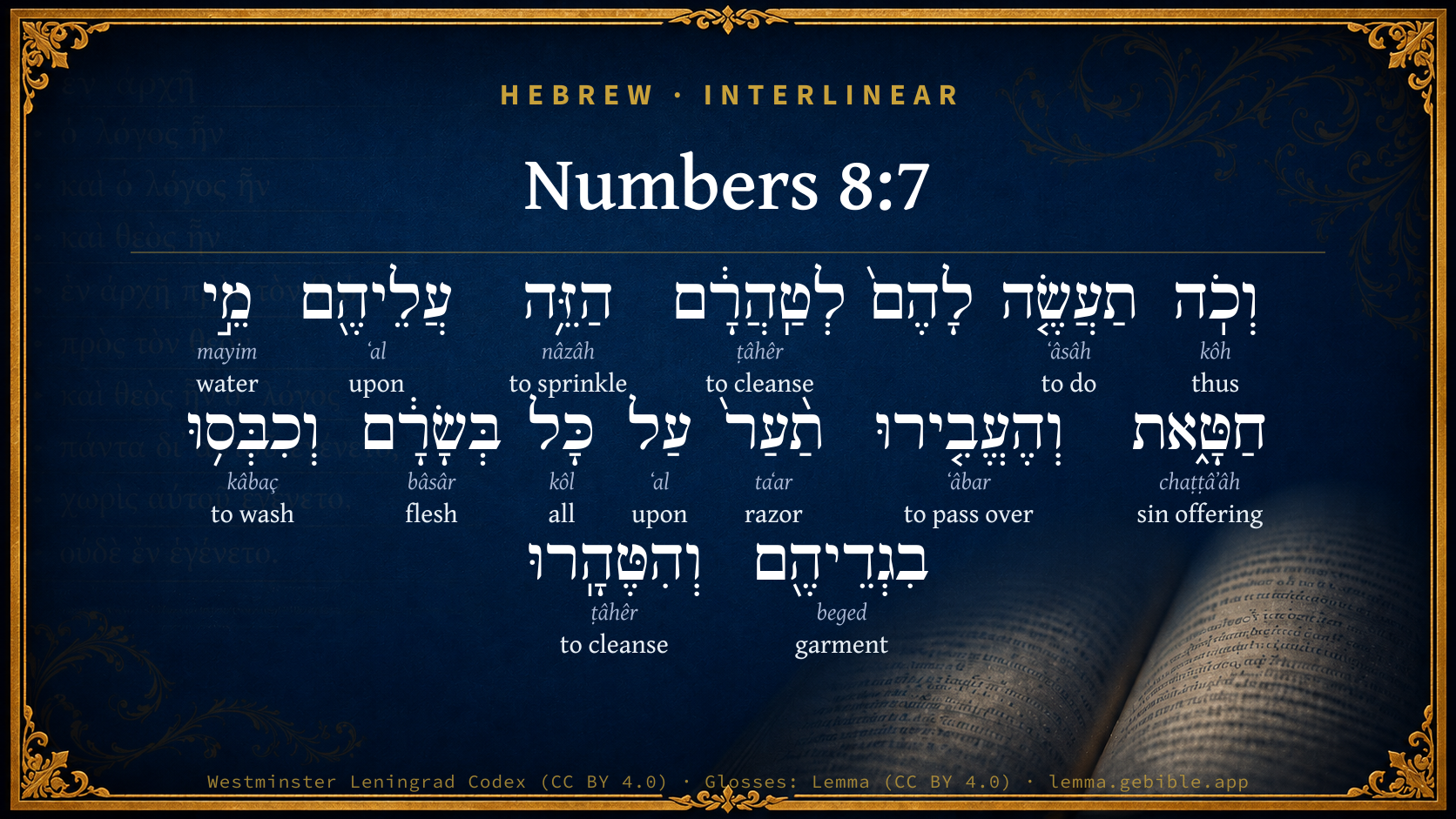
Hebrew (Westminster Leningrad Codex) Numbers 8:7 appears in the Hebrew Old Testament. The text above is from the Westminster Leningrad Codex. Each word links to its Strong’s number, a concise gloss, and parsing drawn from the Open Scriptures Hebrew Bible morphology. Click any word for its full Brown-Driver-Briggs (BDB) entry.
Download image
Cite this verse

Numbers 8:7 (World English Bible). Public Domain. Lemma interlinear Bible study tool, https://lemma.gebible.app/v/numbers/8/7.

Show BibTeX & RIS
BibTeX
RIS
English Translation
Thus shall you do to them, to cleanse them: sprinkle the water of cleansing on them, let them shave their whole bodies with a razor, and let them wash their clothes, and cleanse themselves.
World English Bible · Public Domain
Download a study sheet

One document with this verse’s original text, its word-by-word gloss line, the meaning frame, cross-references with their text, attributed commentary, and full source and license credits — printable, and it pastes into notes with its structure intact.

This verse Autodidact and up

Study sheet (.html) Plain text (.txt)

A passage Seminary Student

Up to 50 verses in one chapter. A passage sheet keeps up to 6 commentary sources and 12 cross-references per verse, in the order this page ranks them, and says so on the sheet whenever that leaves anything out. Ask for a single verse and you get the Autodidact verse sheet above.

Everything on this page stays free to read, with no account — the sheet is a download of what is already on screen, not access to it.

Want to remove ads? Support Godless Engineer
Compare translations 3

The same verse in 3 English versions, stacked beneath the original-language interlinear above. Click any original word for its lexicon entry.

Each is an independent rendering of the whole verse — the interlinear is not word-aligned to these translations.

Highlighted words mark where these versions differ — a whole-verse word diff, not a word-by-word alignment.

  • World English Bible Public Domain
    Thus shall you do to them, to cleanse them: sprinkle the water of cleansing on them, let them shave their whole bodies with a razor, and let them wash their clothes, and cleanse themselves.
  • King James Version Public Domain
    And thus shalt thou do unto them, to cleanse them: Sprinkle water of purifying upon them, and let them shave all their flesh, and let them wash their clothes, and so make themselves clean.
  • unfoldingWord Literal Text CC BY-SA 4.0
    And thus you shall do to them to cleanse them: Sprinkle on them the water of the sin offering. And they shall pass a razor over all their flesh, and they shall wash their clothes, and they shall cleanse themselves.

unfoldingWord Literal Text — © unfoldingWord, licensed CC BY-SA 4.0. Word-aligned USFM3 via Door43 (git.door43.org/unfoldingWord/en_ult).

Versions to compare (up to 4)

3 of 4 selected

Show all 18 translations

Every available English version of this verse, each an independent rendering of the whole verse.

  • World English Bible Public Domain
    Thus shall you do to them, to cleanse them: sprinkle the water of cleansing on them, let them shave their whole bodies with a razor, and let them wash their clothes, and cleanse themselves.
  • Berean Standard Bible Public Domain
    This is what you must do to cleanse them: Sprinkle them with the water of purification. Have them shave their whole bodies and wash their clothes, and so purify themselves.
  • Majority Standard Bible Public Domain
    This is what you must do to cleanse them: Sprinkle them with the water of purification. Have them shave their whole bodies and wash their clothes, and so purify themselves.
  • King James Version Public Domain
    And thus shalt thou do unto them, to cleanse them: Sprinkle water of purifying upon them, and let them shave all their flesh, and let them wash their clothes, and so make themselves clean.
  • American Standard Version (1901) Public Domain
    And thus shalt thou do unto them, to cleanse them: sprinkle the water of expiation upon them, and let them cause a razor to pass over all their flesh, and let them wash their clothes, and cleanse themselves.
  • Revised Version (1885) Public Domain
    And thus shalt thou do unto them, to cleanse them: sprinkle the water of expiation upon them, and let them cause a razor to pass over all their flesh, and let them wash their clothes, and cleanse themselves.
  • Geneva Bible (1599) Public Domain
    And thus shalt thou doe vnto them, when thou purifiest them, Sprinckle water of purification vpon them, and let them shaue all their flesh, and wash their clothes: so they shalbe cleane.
  • Douay-Rheims (1899) Public Domain
    According to this rite: Let them be sprinkled with the water of purification, and let them shave all the hairs of their flesh. And when they shall have washed their garments, and are cleansed,
  • Young's Literal Translation Public Domain
    `And thus thou dost to them to cleanse them: sprinkle upon them waters of atonement, and they have caused a razor to pass over all their flesh, and have washed their garments, and cleansed themselves,
  • Literal Standard Version CC BY-SA 4.0
    And thus you do to them to cleanse them: sprinkle waters of atonement on them, and they have caused a razor to pass over all their flesh, and have washed their garments, and cleansed themselves,
  • Unlocked Literal Bible CC BY-SA 4.0
    Do this to them to purify them: Sprinkle the water of atonement on them. Make them shave their entire body, wash their clothes, and in this way purify themselves.
  • unfoldingWord Literal Text CC BY-SA 4.0
    And thus you shall do to them to cleanse them: Sprinkle on them the water of the sin offering. And they shall pass a razor over all their flesh, and they shall wash their clothes, and they shall cleanse themselves.
  • Darby Bible Public Domain
    And thus shalt thou do unto them, to cleanse them: sprinkle upon them water of purification from sin; and they shall pass the razor over all their flesh, and shall wash their garments, and make themselves clean.
  • World Messianic Bible Public Domain
    You shall do this to them to cleanse them: sprinkle the water of cleansing on them, let them shave their whole bodies with a razor, let them wash their clothes, and cleanse themselves.
  • Webster's Bible Public Domain
    And thus shalt thou do to them, to cleanse them: Sprinkle water of purifying upon them, and let them shave all their flesh, and let them wash their clothes, and so make themselves clean.
  • Free Bible Version CC BY-SA 4.0
    This is how you will purify them. Sprinkle on them the water of purification. They are to shave off all the hair from their bodies and wash their clothes so they will be clean.
  • Bible in Basic English Public Domain
    And this is how you are to make them clean: let the holy water which takes away sin be put on them, and let the hair all over their bodies be cut off with a sharp blade, and let their clothing be washed and their bodies made clean.
  • JPS Tanakh (1917) Public Domain
    And thus shalt thou do unto them, to cleanse them: sprinkle the water of purification upon them, and let them cause a razor to pass over all their flesh, and let them wash their clothes, and cleanse themselves.

Literal Standard Version (2020), Covenant Press — licensed CC BY-SA 4.0. Text via the HelloAO Bible API (eBible.org). Unlocked Literal Bible (unfoldingWord) — licensed CC BY-SA 4.0. Text via the HelloAO Bible API (eBible.org). unfoldingWord Literal Text — © unfoldingWord, licensed CC BY-SA 4.0. Word-aligned USFM3 via Door43 (git.door43.org/unfoldingWord/en_ult). Free Bible Version, Dr. Jonathan Gallagher — licensed CC BY-SA 4.0. Text via the HelloAO Bible API (eBible.org).

Word by word

More ways to search: Search by grammar → Find every occurrence → Compare this word →

Practice this passage: Drill this verse → Learn its vocabulary →

תַ֨עַר֙
taʻar
H8593
“razor”
Noun, Common, Both, Singular, Absolute
Part of Speech
Noun
Type
Common
Gender
Both
Number
Singular
State
Absolute
Full BDB Definition

Origin: from H6168

TWOT: 1692e

razor, sheath (making naked) - razor - sheath (of sword)
  1. וְכֹֽה kôh H3541 “and · thus” Conjunction + Adverb
  2. תַעֲשֶׂ֤ה ʻâsâh H6213 “to do” Verb, Qal, Imperfect, 2nd Person, Masculine, Singular
  3. לְטַֽהֲרָ֔ם ṭâhêr H2891 “to cleanse · them” Preposition + Verb, Piel, Infinitive Construct + Suffix, Personal, 3rd Person, Masculine, Plural
  4. הַזֵּ֥ה nâzâh H5137 “sprinkle” Verb, Hiphil, Imperative, 2nd Person, Masculine, Singular
  5. עֲלֵיהֶ֖ם ʻal H5921 “upon · them” Preposition + Suffix, Personal, 3rd Person, Masculine, Plural
  6. מֵ֣י mayim H4325 “water(s) of” Noun, Common, Masculine, Plural, Construct
  7. חַטָּ֑את chaṭṭâʼâh H2403 “sin offering” Noun, Common, Feminine, Singular, Absolute
  8. וְהֶעֱבִ֤ירוּ ʻâbar H5674 “and · to pass over” Conjunction + Verb, Hiphil, Sequential Perfect, 3rd Person, Common, Plural
  9. עַל ʻal H5921 “upon” Preposition
  10. כָּל kôl H3605 “all of” Noun, Common, Masculine, Singular, Construct
  11. בְּשָׂרָ֔ם bâsâr H1320 “flesh · their” Noun, Common, Masculine, Singular, Construct + Suffix, Personal, 3rd Person, Masculine, Plural
  12. וְכִבְּס֥וּ kâbaç H3526 “and · to wash” Conjunction + Verb, Piel, Sequential Perfect, 3rd Person, Common, Plural
  13. בִגְדֵיהֶ֖ם beged H899 “garments · their” Noun, Common, Masculine, Plural, Construct + Suffix, Personal, 3rd Person, Masculine, Plural
  14. וְהִטֶּהָֽרוּ ṭâhêr H2891 “and · to cleanse” Conjunction + Verb, Hithpael, Sequential Perfect, 3rd Person, Common, Plural

About this verse

These counts appear in no published source. They are computed here, from the morphology-tagged text and Lemma’s own curated glosses. What Lemma adds →

16
words
13
distinct lemmas
Pentateuch
section

Notable vocabulary

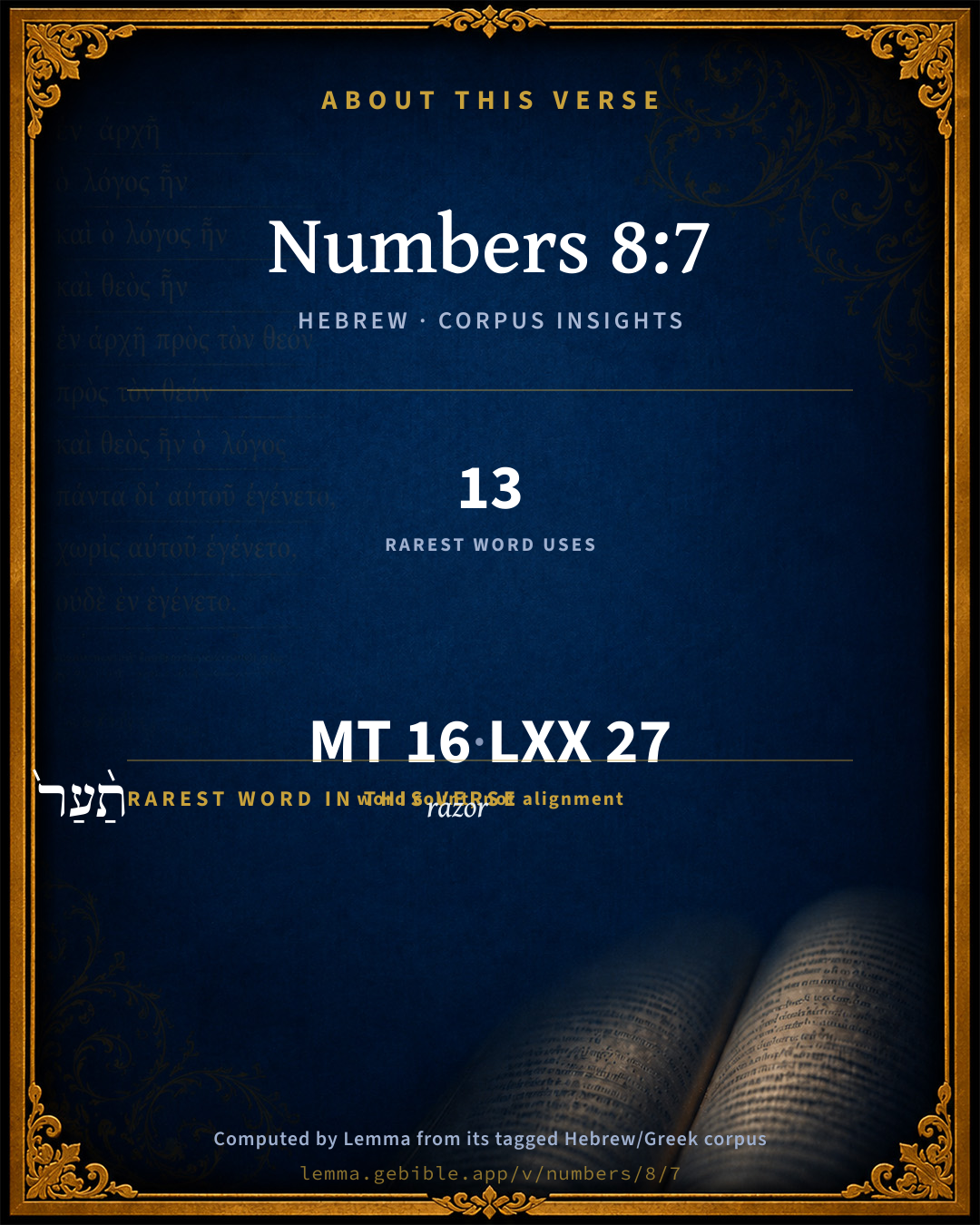
The rarest word here is תַ֨עַר֙ razor H8593 — appearing just 13 times in the whole Hebrew Bible.

Shared distinctive vocabulary

תַ֨עַר֙ razor H8593 occurs in 13 verses of the Hebrew Bible. Also found in:

Grammatical profile

  • 6 verbs
  • 6 nouns
  • 3 prepositions
  • 1 adverb

Verb forms

  • תַעֲשֶׂ֤ה Qal · Imperfect
  • לְטַֽהֲרָ֔ם Piel · Infinitive Construct
  • הַזֵּ֥ה Hiphil · Imperative
  • וְהֶעֱבִ֤ירוּ Hiphil · Sequential Perfect
  • וְכִבְּס֥וּ Piel · Sequential Perfect
  • וְהִטֶּהָֽרוּ Hithpael · Sequential Perfect

Repetition

Words recur within this verse — often emphatic in Hebrew:

  • לְטַֽהֲרָ֔ם to cleanse H2891 ×2
  • עֲלֵיהֶ֖ם upon H5921 ×2

Hebrew & Septuagint length

In English translation the verse runs 34 words from the Hebrew and 36 from the Septuagint (LXX English) — closely comparable.

A rough comparison of the two English renderings, which tokenize alike — not a word-level alignment.

Word counts can differ between the Hebrew and the Greek without any difference in meaning — e.g. the Hebrew direct-object marker אֵת has no separate Greek word, and Greek often adds the article ὁ.

In the original languages it is 16 Hebrew tokens and 27 Greek tokens — but the two are counted differently (Hebrew bundles its prefixes and suffixes into one token; the Greek is in lemma form), so that isn’t a like-for-like length.

Cross-references

23

Topical passages linked to Numbers 8:7 in the Treasury of Scripture Knowledge — connected by theme and wording, ordered by reader-vote popularity; previews shown in the World English Bible.

  • Leviticus 8:6 Moses brought Aaron and his sons, and washed them with water.
  • Numbers 19:7–10 Then the priest shall wash his clothes, and he shall bathe his flesh in water, and afterward he shall come into the camp, and the priest shall be unclean until the even.
  • Numbers 19:13 Whoever touches a dead person, the body of a man who has died, and doesn't purifies himself, defiles the tent of Yahweh; and that soul shall be cut off from Israel: because the water for impurity was not sprinkled on him, he shall be unclean; his uncleanness is yet on him.
  • Genesis 35:2 Then Jacob said to his household, and to all who were with him, "Put away the foreign gods that are among you, purify yourselves, change your garments.
  • Exodus 19:10 Yahweh said to Moses, "Go to the people, and sanctify them today and tomorrow, and let them wash their garments,
  • Leviticus 14:7–9 He shall sprinkle on him who is to be cleansed from the leprosy seven times, and shall pronounce him clean, and shall let the living bird go into the open field.
  • Leviticus 15:6 He who sits on anything whereon the man who has the discharge sat shall wash his clothes, and bathe himself in water, and be unclean until the evening.
  • Leviticus 15:10–11 Whoever touches anything that was under him shall be unclean until the evening. He who carries those things shall wash his clothes, and bathe himself in water, and be unclean until the evening.
  • Leviticus 15:27 Whoever touches these things shall be unclean, and shall wash his clothes, and bathe himself in water, and be unclean until the evening.
  • Leviticus 16:28 He who burns them shall wash his clothes, and bathe his flesh in water, and afterward he shall come into the camp.
  • Numbers 19:17–19 For the unclean they shall take of the ashes of the burning of the sin-offering; and running water shall be put thereto in a vessel:
  • Numbers 31:20 As to every garment, and all that is made of skin, and all work of goats' [hair], and all things made of wood, you shall purify yourselves.
  • Psalms 51:2 Wash me thoroughly from my iniquity. Cleanse me from my sin.
  • Psalms 51:7 Purify me with hyssop, and I will be clean. Wash me, and I will be whiter than snow.
  • Isaiah 52:15 so shall he sprinkle many nations; kings shall shut their mouths at him: for that which had not been told them shall they see; and that which they had not heard shall they understand.
  • Jeremiah 4:14 Jerusalem, wash your heart from wickedness, that you may be saved. How long shall your evil thoughts lodge within you?
  • Matthew 23:25–26 "Woe to you, scribes and Pharisees, hypocrites! For you clean the outside of the cup and of the platter, but within they are full of extortion and unrighteousness.
  • Hebrews 9:10 being only (with meats and drinks and various washings) fleshly ordinances, imposed until a time of reformation.
  • Hebrews 9:13 For if the blood of goats and bulls, and the ashes of a heifer sprinkling those who have been defiled, sanctify to the cleanness of the flesh:
  • James 4:8 Draw near to God, and he will draw near to you. Cleanse your hands, you sinners; and purify your hearts, you double-minded.
  • 1 Peter 3:21 This is a symbol of baptism, which now saves you-- not the putting away of the filth of the flesh, but the answer of a good conscience toward God, through the resurrection of Jesus Christ,
  • Revelation 7:14 I told him, "My lord, you know." He said to me, "These are those who came out of the great tribulation. They washed their robes, and made them white in the Lamb's blood.
  • Ezekiel 36:25 I will sprinkle clean water on you, and you shall be clean: from all your filthiness, and from all your idols, will I cleanse you.

Cross-references courtesy of OpenBible.info (CC BY 4.0).

Hebrew and Greek witnesses Masoretic Hebrew ↔ Greek Septuagint

The same verse in the two great witnesses to the Old Testament, shown verse-for-verse.

These are two independent witnesses, not word-aligned to each other, and the Septuagint is shown in lemma (dictionary) form.

Hebrew Numbers 8:7 Masoretic · Westminster Leningrad Codex

וְכֹֽה תַעֲשֶׂ֤ה לָהֶם֙ לְטַֽהֲרָ֔ם הַזֵּ֥ה עֲלֵיהֶ֖ם מֵ֣י חַטָּ֑את וְהֶעֱבִ֤ירוּ תַ֨עַר֙ עַל כָּל בְּשָׂרָ֔ם וְכִבְּס֥וּ בִגְדֵיהֶ֖ם וְהִטֶּהָֽרוּ

Thus shall you do to them, to cleanse them: sprinkle the water of cleansing on them, let them shave their whole bodies with a razor, and let them wash their clothes, and cleanse themselves.

World English Bible · Public Domain

Greek LXX Numbers 8:7 Septuagint · lemma form

καί οὕτως ποιέω αὐτός ὁ ἁγνισμός αὐτός περιῥαίνω αὐτός ὕδωρ ἁγνισμός καί ἐπιἔρχομαι ξυρόν ἐπί πᾶς ὁ σῶμα αὐτός καί πλύνω ὁ ἱμάτιον αὐτός καί καθαρός εἰμί

And thus shall you perform their purification: you shall sprinkle them with water of purification, and a razor shall come upon the whole of their body, and they shall wash their garments, and shall be clean.

LXX2012 (modern English Septuagint) · Public Domain

Hebrew: Westminster Leningrad Codex (CC BY 4.0). Greek: Septuagint (public domain); English from LXX2012 (modern English Septuagint) (Public Domain). How the Septuagint differs from the Hebrew →

Targum (Aramaic paraphrase)

2

The Targum is the ancient Jewish Aramaic paraphrase of the Hebrew Scriptures — an interpretive translation, not the Hebrew text itself. Onkelos (literal) and Pseudo-Jonathan (expansive) render the Torah, and Jonathan the Prophets. Coverage is partial: where no permissively-licensed English translation exists for a verse, only the Aramaic is shown. This is verse-level text, not a word-by-word alignment to the Hebrew.

  1. Targum Onkelos Torah (Genesis–Deuteronomy)
    וּכְדֵין תַּעְבֵּד לְהוֹן לְדַכּוֹאֵיהוֹן אֲדֵי עֲלֵיהוֹן מַיָא דְחַטָאתָא וְיַעְבְּרוּן מַסְפַּר עַל כָּל בִּשְׂרְהוֹן וִיחַוְרוּן לְבוּשֵׁיהוֹן וְיִדְכּוּן

    (no public-domain English translation for this verse)

    Targum Onkelos — Aramaic: “Onkelos Genesis” (public domain); “Onkelos Exodus” (public domain); “Onkelos Leviticus” (public domain); “Onkelos Numbers” (public domain); “Onkelos Deuteronomy” (public domain). English: “Sefaria Community Translation” (CC0 1.0 (public-domain dedication)); “J.W. Etheridge. The Targums of Onkelos and Jonathan Ben Uzziel on the Pentateuch. London: Longmans, Green, 1862” (public domain). Text via Sefaria.

  2. Targum Pseudo-Jonathan Torah (Genesis–Deuteronomy)
    וּכְדֵין תַּעֲבֵיד לְהוֹן לְדַכּוֹאֵיהוֹן אֲדֵי עֲלֵיהוֹן מַיָא דְחַטָאתָא וְיַעַבְרוּן גְלַב עַל כָּל בִּשְרֵיהוֹן וִיחַוְורוּן לְבוּשֵׁיהוֹן וְיִדְכּוּן בְּאַרְבְּעִין סָוִוין דְמַיָא

    And this shalt thou do to purify them. Sprinkle upon them the water for uncleanness through sin (chattatha), and let the razor pass over all their flesh, and let them wash their raiment, and wash themselves in forty savan of water.

    Targum Pseudo-Jonathan — Aramaic: “Targum Jonathan on Genesis” (public domain); “Targum Jonathan on Exodus” (public domain); “Targum Jonathan on Leviticus” (public domain); “Targum Jonathan on Numbers” (public domain); “Targum Jonathan on Deuteronomy” (public domain). English: “The Targum of Jonathan ben Uzziel, trans. J. W. Etheridge, London, 1862” (public domain). Text via Sefaria.

Commentary

Notes on Numbers 8:7 from classic Christian and Jewish commentators (each source and its license shown beneath its notes). The classic Christian expositions comment on the surrounding passage and are grouped to its opening verse, so a note may address several verses; the Jewish commentaries on the Tanakh (Rashi and others) are per-verse, so they appear only where the commentator wrote on this verse.

Lemma curates 59 commentaries, every one of them public domain or Creative Commons licensed, each selected and text-cleaned for this edition rather than reprinted as found. About our sources →

Trapp's Complete Commentary

John Trapp

Num 8:7 And thus shalt thou do unto them, to cleanse them: Sprinkle water of purifying upon them, and let them shave all their flesh, and let them wash their clothes, and [so] make themselves clean.

Ver. 7. Sprinkle water of purifying, &c.] This taught that none were meet for the holy ministry, but by the free favour of Christ, and by the sanctification of his Spirit. {2Co 2:16 Gal 1:15} Ministers are fullones animarum, their office is to whiten others; themselves therefore should be as those Nazarites {Lam 4:7} "whiter than snow."

Shave all their flesh.] As the lepers did; Levites are by nature no better than lepers: ministers, men subject to like passions as others, and liable to more temptations.

John Trapp, A Commentary or Exposition upon All the Books of the Old and New Testament (1647–1656) — public domain. Text from a community e-Sword module.

Joseph Benson's Commentary

Num 8:7. Sprinkle water of purifying — Hebrew, water of sin, or sin-water; that is, water of purification from sin. Thus the sacrifice of atonement from sin is termed the sin-offering. This water was prepared with the ashes of a red heifer which had been offered for a burnt-offering, Num 19:17. Shave all their flesh — This external rite signified the cutting off their inordinate desire of earthly things, and that singular purity of heart and life which is required in the ministers of God. And wash their clothes — Another rite expressive of moral purity.

Joseph Benson's Commentary on the Old and New Testaments (1811–1818) — public domain. Text from a community e-Sword module.

Tyndale Open Study Notes

Tyndale Open Resources

8:7 The ceremony to make the Levites ceremonially clean consisted of sprinkling with water, shaving all hair, and donning clean clothes; this resembled the ceremonies of cleansing from ritual defilement. • water of purification: This expression appears only here. This sprinkling symbolized the washing of sin from their lives and thus contained some of the symbolic significance of later Jewish washings and even of Christian baptism. Perhaps this water was the same as the sin-removing mixture that included ashes from the red heifer mentioned in 19:9 (see Heb 9:13). • The requirement to shave their entire body was also part of the process of being declared clean from the ritual impurity of defiling diseases (Lev 14:8). • The washing of clothing accompanied all instances of cleansing from ritual defilement (e.g., Lev 15:5-27).

Tyndale Open Study Notes — © Tyndale Open Resources, licensed CC BY-SA 4.0. Text via the HelloAO Bible API.

Geneva Bible (1599)

Geneva Bible translators

In Hebrew it is called the water of sin, because it is made to purge sin, as Num. 19:9.

Geneva Bible (1599) marginal notes — public domain. Text via Bolls.life.

Adam Clarke's Commentary

Verse 7. Sprinkle water of purifying] מי חטאת mey chattath, water of sin, or water of the sin-offering. As this purifying water was made by the ashes of the red heifer, cedar-wood, hyssop, and scarlet; and the heifer herself was sacrificed, and her blood sprinkled seven times before the tabernacle, Nu 19:3-6; she may be considered as a proper sacrifice for sin, and consequently the water thus prepared be termed the water of the sin-offering. As the ashes were kept ready at hand for purifying from all legal pollutions, the preparation might be considered as a concentration of the essential properties of the sin-offering, and might be resorted to at all times with comparatively little expense or trouble, and no loss of time. As there were so many things by which legal pollution might be contracted, it was necessary to have always at hand, in all their dwellings, a mode of purifying at once convenient and inexpensive.

As the water by which the Levites were here purified must have been the water prepared from the ashes of the red heifer, this ordinance was undoubtedly instituted before this time, though not described till Nu 19:1-10 of this book; but that chapter might be in connection with any of the preceding ordinances, as well as where it is now found.

We see from Heb 9:13-14, that these ashes mingled with water, and sprinkled on the unclean, and which sanctified to the purification of the flesh, were intended to typify the blood of Christ, which purges the conscience from dead works to serve the living God, Heb 9:15; for as without this sprinkling with the water of the sin-offering the Levites were not fit to serve God in the wilderness, so without this sprinkling of the blood of Christ no conscience can be purged from dead works to serve the living God. See the notes on Nu 19:1-10.

Adam Clarke's Commentary on the Bible (1810–1826) — public domain. Text from a community e-Sword/MySword module.

Ellicott's Commentary for English Readers

(7) Water of purifying.—Literally, water of sin, or, of sin-offering (Hebrew, hattath). As in the case of the holy water, to which reference is made in Num_6:17, so here also there is no explanation given of the particular water which was to be used in cleansing the Levites. The bullock which was appointed to be offered as a sin-offering at the consecration of Aaron and his sons (Exo_29:14; Lev_8:14) is described by the same word which is here employed (in the Authorised Version, sin-offering); and in Lev_4:14, the sacrifice which was appointed to be offered for the expiation of sin (in the Authorised Version, the sin) is also spoken of under the same name; so also is the sin-offering of the Levites in Num_8:8 of this chapter. The sin-water evidently denotes the water appointed to be used in the purification of sin; and the reference is probably (as in Num_6:17) to the water which was kept in the brazen laver in front of the Tabernacle. It is possible, however, that some direction which is not here recorded may have been given respecting putting the ashes of the sin-offering into water. (Comp. Num_19:9, where the water of purification is described under the same name: “it is a purification for sin.” Literally, it is hattath.) In this case, however, the sin-offering, which is not mentioned until Num_8:8, must have been sacrificed previously to the sprinkling.

Let them shave all their flesh.—Literally, cause the razor to pass over all their flesh. A different word is used in Lev_14:8-9 to denote the more complete removal of the hair which was enjoined at the cleansing of the leper.

And let them wash their clothes.—The bodies of the priests were washed at their consecration (Lev_14:8-9), and those of the lepers at their cleansing (Lev_8:6); but the Levites, who were not brought into such immediate contact with the holy things as the priests, were only required to wash their clothes, which was an ordinary preparation for Divine worship (Exo_19:10; comp. Gen_35:2).

A Bible Commentary for English Readers, edited by Charles John Ellicott (1878–1897) — public domain. Text from a community e-Sword module.

The Cambridge Bible for Schools and Colleges

gen. ed. J. J. S. Perowne

7. water of expiation] lit. water of sin, a unique expression denoting ‘water that washes away sin.’ Cf. the ‘waters of bitterness’ (Num_5:17 f.), ‘water of impurity’ (Num_19:9). Notice that the Levites are only sprinkled, while the priests (Exo_29:4, Lev_8:6) are completely bathed. This comparison suggests that the water here, as there, is intended to be simple pure water.

cause a razor &c.] for the purpose of cleanliness. In Herod. ii. 37 the Egyptian priests are said to ‘shave themselves all over their body every other day.’

wash their clothes] as ordinary laymen would do (Exo_19:14) for ceremonial cleansing. The priests, on the other hand, were vested in entirely new robes of office (Exo_29:8 f., Lev_8:13).

The Cambridge Bible for Schools and Colleges (gen. ed. J. J. S. Perowne; Cambridge University Press, 1878–1918) — public domain. Text from a community e-Sword module.

John Gill's Exposition

And thus shall thou do unto them, to cleanse them,.... Or order Aaron to do unto them; the cleansing of the Levites was the work of Aaron, either by himself or by his order; in which he was a type of Christ, who is the refiner and purifier of the sons of Levi, Mal 3:3,

sprinkle water of purifying upon them; or "water of sin" (n); water which purifies from sin, in a ceremonial sense; and this was water mixed with the ashes of the red heifer, which was the purification of persons deified by the dead, as Jarchi observes; and though the law concerning the red heifer, and of making the water of purification, is not made mention of till afterwards, Num 19:1, yet it was very probably given before; and the Jews say (o), it was on the second of Nisan, or the first month, which was the day after the tabernacle was erected, that Eleazar the priest burnt the red heifer and sprinkled all Israel; this only "sanctified to the purifying of the flesh", Heb 9:13, in a ceremonial sense, but was typical of the blood of Christ, which "purges the conscience from dead works"; that so men may be fitted and qualified, as the Levites were, "to serve the living God", Heb 9:14,

and let them shave all their flesh; the hair of their bodies, in all parts thereof; even the beard, as Aben Ezra notes, some say; yet not the corners of it; but the whole hair of the body, everywhere, was to be shaved off; to denote the most perfect purity, and a removal of all superfluity of haughtiness and excrescences of the flesh from them: so the Egyptian priests used to shave their whole body every third day, lest there should be anything filthy in those that served the gods (p): this cleansing of the Levites was after the same manner as lepers were cleansed: and Jarchi observes, from one of their writers, that because the Levites gave an atonement for the firstborn, who committed idolatry, which is called the sacrifices of the dead, and the leper is called a dead man, they were obliged to shaving as the lepers; but Ben Gersom gives a better reason for the shaving of them; that it was to put them in mind that they should forsake material (or corporeal) things, and employ themselves in the service of God; see Act 6:2 Ti2 2:4,

and let them wash their clothes; and much more their bodies, as Chaskuni, after the manner of those who were polluted by touching a dead body; typical of the saints having their bodies washed with pure water, and their garments washed and made white in the blood of the Lamb, Heb 10:22,

and so make themselves clean; the Targum of Jonathan adds, in forty seahs of water; and according to the sense of that paraphrase, both the bodies and clothes of the Levites were dipped in water.

(n) "aquas peccati", Montanus; "aquam peccati", Piscator, Drusius; "the sin water", Ainsworth. (o) Seder Olam Rabba, c. 7. p. 22. (p) Herodot. Enterpe, sive, l. 2. c. 37.

John Gill's Exposition of the Whole Bible (1746–1763) — public domain (CC PDM 1.0). Text via the HelloAO Bible API.

Haydock's Catholic Bible Commentary

Let them be sprinkled with the water of purification. This was the holy water, mixed with the ashes of the red cow, (Numbers xix.) appointed for purifying all that were unclean. It was a figure of the blood of Christ, applied to our souls by his holy sacraments. (Challoner) --- Purification, (lustrationis) or "expiation." The water, mixed with ashes, was taken and sprinkled round about the houses, and upon those persons who wished either to be cleansed from some defilement, or to advance in virtue and purity. We use salt instead of ashes. Theocritus (Idyl. xxiv. 100,) puts these words in the mouth of Tiresias, "then mixt with salt, according to the law, with a green branch sprinkle the honoured and pure water, and sacrifice to the supreme Jupiter a hog, if you wish to gain the victory over your adversaries." --- Flesh, to remind them that they must cut off all superfluous thoughts, the roots of which they will however never be able to destroy entirely, as St. Gregory (Mor. v. 3,) says, "The flesh always produces superfluities, which the spirit must always cut away with the sword of solicitude." See Leviticus xiv. 8., and xxi. 5, 10. (Haydock) --- The priests serving in the temple were obliged to cut their hair every month; and the Levites probably observed the same regulation, to acknowledge, that they who approach God must be pure and detached from earthly cares, (Calmet) and particularly from the works of sin; to remind them of which, they were to be sprinkled with water, their garments washed, and they were to offer two oxen by the hands of Aaron, and to be lifted up or offered to God, to serve in his court. (Tirinus)

George Leo Haydock (1774–1849), Haydock's Catholic Family Bible and Commentary, 1859 edition — public domain. Excludes Psalms (Douay-Rheims chapter numbering differs from Protestant) and Deuterocanonical books (Catholic canon only).

Matthew Poole's English Annotations

Of purifying, Heb. of sin, i.e. for the expiation of sin. This water was mixed with the ashes of a red heifer, Num 19:9, which therefore may seem to have been prescribed before, though it be mentioned after; such kind of transplacings of passages being frequent in Scripture.

Shave all their flesh; which external rite signified the cutting off their inordinate concupiscences of earthly things, and that singular purity of heart and life which is required in the ministers of God. See Isa 52:11; 2Ti 2:21.

Matthew Poole's English Annotations on the Holy Bible (1683–1685) — public domain. Text from a community e-Sword/MySword module.

Whedon's Commentary on the Bible

Daniel D. Whedon

7. Water of purifying — Literally, sin-water, or water sin-purging. The Hebrew word for sin or sin offering is involved in this term. This water is nowhere explained. It must not be confounded with the water prescribed for the cleansing of the leper, (Lev_14:5;) and, also, it must be distinguished from the water of separation for purifying both persons and houses defiled by a corpse. Num_19:9. It cannot be simply clean water that is denominated “sin-water,” but water specially provided in the tabernacle for the cleansing of the priests for their duties.

Shave all their flesh — Literally, cause a razor to pass over all their flesh. Cutting the hair in the regular way of adorning the body is all that is enjoined. A different word is used for shaving to baldness.

Wash their clothes — This was generally enjoined as a preparation for worship, (Gen_35:2; Exo_19:10,) but was not required of the priests, because they received holy vestments. The Levites were not commanded to wash their bodies, because they were not leprous nor corpse-defiled. The priests washed themselves often because they handled the most holy things. Since robes symbolize character, (Jud_1:23,) their cleansing is emblematic of heart-purification. See Rev_6:11; Rev_7:14.

Daniel D. Whedon (gen. ed.), Commentary on the Old and New Testaments (1874–1909) — public domain. Text from a community e-Sword module.

The Pulpit Commentary

Sprinkle water of purifying upon them. Rather, "water of sin," so called because it had to do with the removal of sin, just as "water of separation" (Num_19:9, Num_19:13) was that which delivered from the legal state of separation. It is not likely to have been prepared in the same manner as this latter, (Num_19:9) both because of the great difference between the two cases, and because the ordinance of the red heifer belonged to a later period. Nor is it likely to have resembled that used for cleansing the leper, or the water of jealousy. But it is rash to conclude that, because we do not read any special directions for its preparation, it must, therefore, have been nothing trot water from the laver which stood in the outer court. That water appears, indeed, to be called "holy water" in Num_5:17, which is intelligible enough; but no probable reason can be shown why it should be called "sin water;" it would seem as reasonable to call the water which our Lord turned into wine "sill water," because it stood there "for the purifying of the Jews." It is better to say that we do not know, because it is not recorded, how this water was prepared, or how it corresponded to its name. The Levites who were to be sprinkled would seem to have included all the males, some twenty thousand in number; because it was all the males, and not only those between thirty and fifty, who were to be dedicated in place of the firstborn. In any case it was, of course, impossible that Moses could have sprinkled them individually (see below on verse 11). Let them shave all their flesh. Literally, "let them cause the razor to pass over their whole body." Some distinguish between rT rb here and hLgi in Lev_14:8, Lev_14:9, as though the latter meant a much more complete shaving off of the hair than the former; but this difference is doubtful; the fact that the whole body as well as the head was to be shaved implies that it was more than a mere cutting short of the hair. Let them wash their clothes. This was constantly enjoined on all the faithful as a preparation for any special religious service. (see on Exo_19:10) And so make themselves clean. The shaving and washing had, no doubt, a symbolic significance, but their primary object was simply and obviously personal cleanliness; it is the hair and the clothes that chiefly harbour impurities, especially in a hot climate.

The Pulpit Commentary (1880–1919), ed. H.D.M. Spence-Jones & Joseph S. Exell — public domain. Text from a community e-Sword module.

John Wesley's Explanatory Notes

Of purifying - Hebrew. of sin, that is, for the expiation of sin. This water was mixed with the ashes of a red heifer, chap. xix, 9, which therefore may seem to have been prescribed before, though it be mentioned after; such kind of transplacings of passages being frequent in scripture. Shave all their flesh - This external rite signified the cutting off their inordinate desire of earthly things and that singular purity of heart and life which is required in the ministers of God.

John Wesley, Explanatory Notes Upon the Whole Bible (1754–1765) — public domain. Text via the GEBible commentary corpus.

unfoldingWord translationNotes

Door43 World Missions Community

to purify them

Here "them" refers to the Levites.

Sprinkle the water of atonement on them

Moses sprinkling water on them was symbolic of their atonement. AT: "Sprinkle on their the water that symbolizes atonement" (See: Symbolic Action)

wash their clothes

The Levites are supposed to wash their own clothes. You can make clear the understood information. AT: "then make them wash their clothes" (See: Ellipsis)

a young bull and its grain offering

When offering a young bull, a grain offering was usually required to accompany it.

of fine flour mingled with oil

This can be stated in active form. AT: "of fine flour that they have mingled with oil" (See: Active or Passive)

translationWords

atonement

cow

grain offering

oil

sin offering

unfoldingWord translationNotes — © Distant Shores Media and the Door43 World Missions Community, licensed CC BY-SA 4.0. Source: git.door43.org/Door43/en_tn.

Rashi

Rabbi Shlomo Yitzchaki (Rashi)

הזה עליהם מי חטאת SPRINKLE UPON THEM WATER OF PURIFYING — water in which the ashes of the Red Heifer are mingled; on account of those among them who might have become unclean through contact with dead persons.

והעבירו תער AND LET THEM SHAVE [ALL THEIR FLESH] — I have found in the work of R. Moses the Preacher the following: Because they were made propitiatory substitutes for the firstborn who had worshipped the idol (the Golden Calf), and it (idolatry) is called (Psalms 106:28) “offerings to the dead”, and the leper is also called dead (cf. Numbers 12:12), it (Scripture) requires them to shave their body like lepers.

Rashi on the Tanakh — English translations: “The Judaica Press complete Tanach with Rashi, translated by A. J. Rosenberg” (CC BY 4.0); “Pentateuch with Rashi's commentary by M. Rosenbaum and A.M. Silbermann, 1929-1934” (public domain); “The Metsudah Tanach series, Lakewood, N.J” (CC BY 4.0); and “The Book of Joshua, Metsudah Publications, 1997” (CC BY 4.0). Text via Sefaria.

Lesson kit

Teaching starters — assembled from the data on this page, not authored interpretation. Every prompt links to the verse data it draws on. Edit before teaching.

Numbers, in the Pentateuch, opens this verse with 16 words (13 distinct Hebrew lemmas). Its most distinctive word is taʻar (“razor”). A historical commentator’s framing appears above. Read the whole chapter for the surrounding context.

Discussion questions

  1. What does “razor” (taʻar) contribute to the verse as a whole?
  2. How does Numbers 6:5, which shares the word «razor», read alongside this verse?
  3. What does the repetition of “to cleanse” (2× in this one verse) do in this verse?
  4. The translations on this page render this verse differently — a whole-verse word diff, not a word-by-word alignment. What might account for the different wordings?
  5. «תַעֲשֶׂ֤ה» is a Qal Imperfect verb. How does that grammatical form shape the action described?
  6. Compare how Trapp's Complete Commentary and Joseph Benson's Commentary read this verse. Where do they agree or differ?

Things to notice

Reading settings

Reading text

Shown beneath each verse's original-language words.

Old Testament
Old Testament edition

Read the OT as the Masoretic Hebrew (MT) or the Greek Septuagint (LXX).

English shown for the Greek Septuagint (in the Hebrew ↔ Greek comparison).

Comparing translations? Open the Compare panel on any verse page to stack up to four side by side.