
Leviticus 14:9

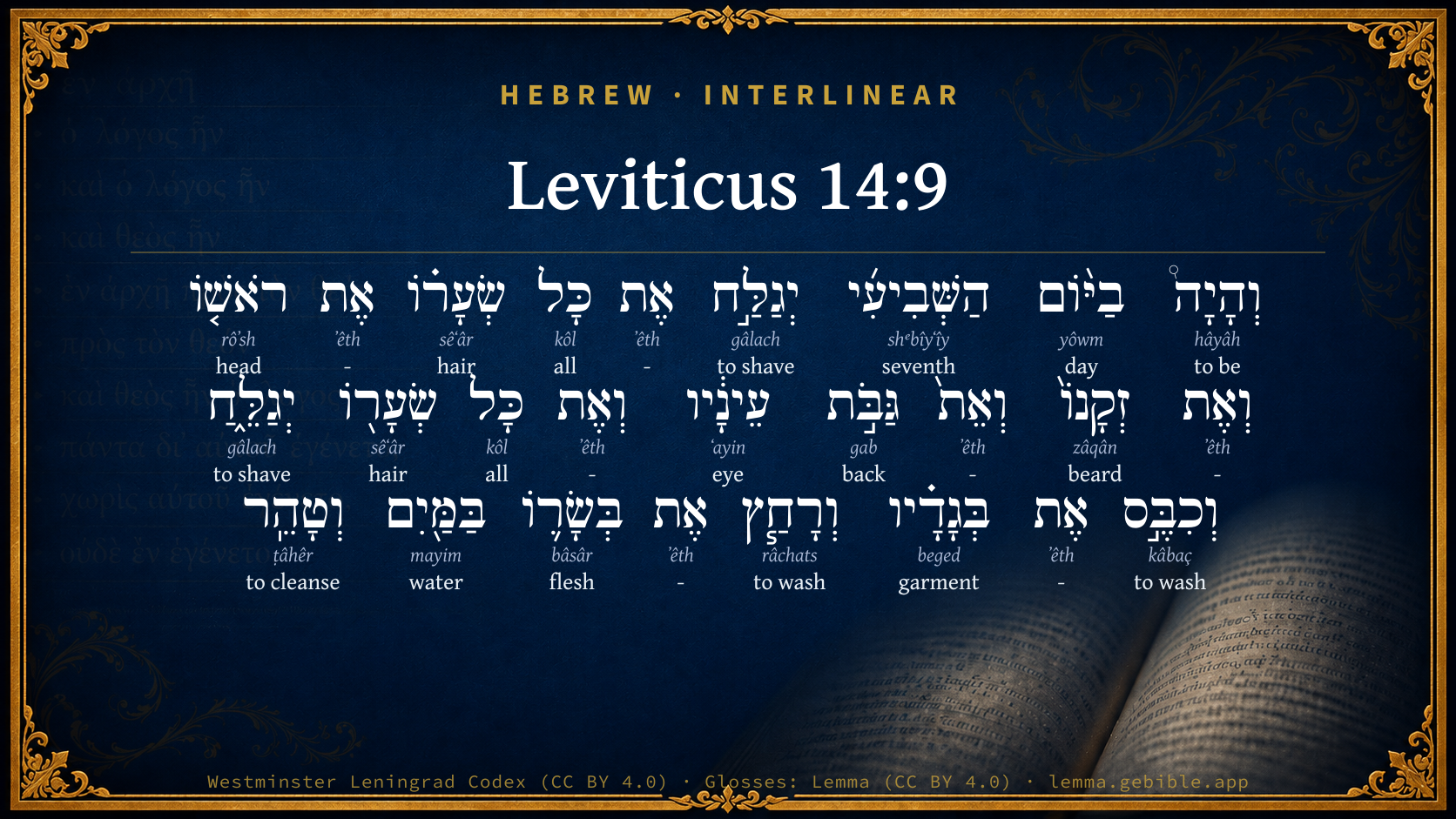
Hebrew (Westminster Leningrad Codex) Leviticus 14:9 appears in the Hebrew Old Testament. The text above is from the Westminster Leningrad Codex. Each word links to its Strong’s number, a concise gloss, and parsing drawn from the Open Scriptures Hebrew Bible morphology. Click any word for its full Brown-Driver-Briggs (BDB) entry.
Download image
Cite this verse

Leviticus 14:9 (World English Bible). Public Domain. Lemma interlinear Bible study tool, https://lemma.gebible.app/v/leviticus/14/9.

Show BibTeX & RIS
BibTeX
RIS
English Translation
It shall be on the seventh day, that he shall shave all his hair off his head and his beard and his eyebrows, even all his hair he shall shave off. He shall wash his clothes, and he shall bathe his body in water, then he shall be clean.
World English Bible · Public Domain
Highlights
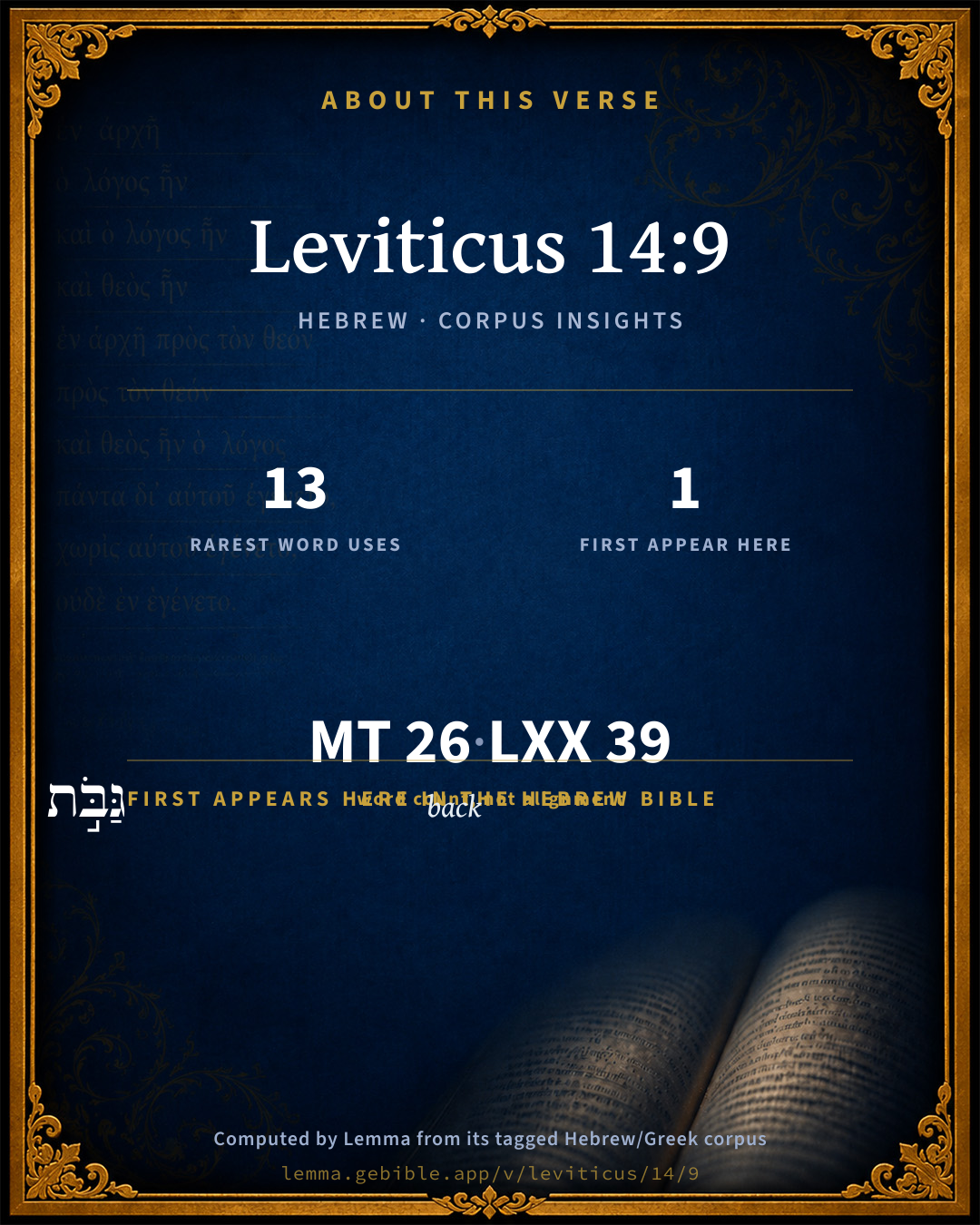
  • 1 first appearance in the Hebrew Bible
Full analysis ↓
Download a study sheet

One document with this verse’s original text, its word-by-word gloss line, the meaning frame, cross-references with their text, attributed commentary, and full source and license credits — printable, and it pastes into notes with its structure intact.

This verse Autodidact and up

Study sheet (.html) Plain text (.txt)

A passage Seminary Student

Up to 50 verses in one chapter. A passage sheet keeps up to 6 commentary sources and 12 cross-references per verse, in the order this page ranks them, and says so on the sheet whenever that leaves anything out. Ask for a single verse and you get the Autodidact verse sheet above.

Everything on this page stays free to read, with no account — the sheet is a download of what is already on screen, not access to it.

Want to remove ads? Support Godless Engineer
Compare translations 3

The same verse in 3 English versions, stacked beneath the original-language interlinear above. Click any original word for its lexicon entry.

Each is an independent rendering of the whole verse — the interlinear is not word-aligned to these translations.

Highlighted words mark where these versions differ — a whole-verse word diff, not a word-by-word alignment.

  • World English Bible Public Domain
    It shall be on the seventh day, that he shall shave all his hair off his head and his beard and his eyebrows, even all his hair he shall shave off. He shall wash his clothes, and he shall bathe his body in water, then he shall be clean.
  • King James Version Public Domain
    But it shall be on the seventh day, that he shall shave all his hair off his head and his beard and his eyebrows, even all his hair he shall shave off: and he shall wash his clothes, also he shall wash his flesh in water, and he shall be clean.
  • unfoldingWord Literal Text CC BY-SA 4.0
    And it will be, on the seventh day, he shall shave all his hair. His head and his beard and the brows of his eyes, and all his hair he shall shave. And he shall wash his clothes, and he shall bathe his flesh in the water. And he will be clean.

unfoldingWord Literal Text — © unfoldingWord, licensed CC BY-SA 4.0. Word-aligned USFM3 via Door43 (git.door43.org/unfoldingWord/en_ult).

Versions to compare (up to 4)

3 of 4 selected

Show all 18 translations

Every available English version of this verse, each an independent rendering of the whole verse.

  • World English Bible Public Domain
    It shall be on the seventh day, that he shall shave all his hair off his head and his beard and his eyebrows, even all his hair he shall shave off. He shall wash his clothes, and he shall bathe his body in water, then he shall be clean.
  • Berean Standard Bible Public Domain
    On the seventh day he must shave off all his hair—his head, his beard, his eyebrows, and the rest of his hair. He must wash his clothes and bathe himself with water, and he will be clean.
  • Majority Standard Bible Public Domain
    On the seventh day he must shave off all his hair—his head, his beard, his eyebrows, and the rest of his hair. He must wash his clothes and bathe himself with water, and he will be clean.
  • King James Version Public Domain
    But it shall be on the seventh day, that he shall shave all his hair off his head and his beard and his eyebrows, even all his hair he shall shave off: and he shall wash his clothes, also he shall wash his flesh in water, and he shall be clean.
  • American Standard Version (1901) Public Domain
    And it shall be on the seventh day, that he shall shave all his hair off his head and his beard and his eyebrows, even all his hair he shall shave off: and he shall wash his clothes, and he shall bathe his flesh in water, and he shall be clean.
  • Revised Version (1885) Public Domain
    And it shall be on the seventh day, that he shall shave all his hair off his head and his beard and his eyebrows, even all his hair he shall shave off: and he shall wash his clothes, and he shall bathe his flesh in water, and he shall be clean.
  • Geneva Bible (1599) Public Domain
    So in the seuenth day hee shall shaue off all his heare, both his head, and his beard, and his eye browes: euen all his heare shall he shaue, and shall wash his clothes and shall wash his flesh in water: so he shalbe cleane.
  • Douay-Rheims (1899) Public Domain
    And on the seventh day he shall shave the hair of his head, and his beard and his eyebrows, and the hair of all his body. And having washed again his clothes, and his body,
  • Young's Literal Translation Public Domain
    `And it hath been, on the seventh day -- he shaveth all his hair, his head, and his beard, and his eyebrows, even all his hair he doth shave, and he hath washed his garments, and hath bathed his flesh with water, and hath been clean.
  • Literal Standard Version CC BY-SA 4.0
    And it has been, on the seventh day—he shaves all his hair, his head, and his beard, and his eyebrows, even all his hair he shaves, and he has washed his garments, and has bathed his flesh with water, and has been clean.
  • Unlocked Literal Bible CC BY-SA 4.0
    On the seventh day he must shave all his hair off his head, and he must also shave off his beard and eyebrows. He must shave off all his hair, and he must wash his clothes and bathe himself in water; then he will be clean.
  • unfoldingWord Literal Text CC BY-SA 4.0
    And it will be, on the seventh day, he shall shave all his hair. His head and his beard and the brows of his eyes, and all his hair he shall shave. And he shall wash his clothes, and he shall bathe his flesh in the water. And he will be clean.
  • Darby Bible Public Domain
    And it shall come to pass on the seventh day, that he shall shave all his hair, his head, and his beard, and his eyebrows, even all his hair shall he shave, and he shall wash his garments, and shall bathe his flesh in water, and he is clean.
  • World Messianic Bible Public Domain
    It shall be on the seventh day, that he shall shave all his hair off his head and his beard and his eyebrows. He shall shave off all his hair. He shall wash his clothes, and he shall bathe his body in water. Then he shall be clean.
  • Webster's Bible Public Domain
    But it shall be on the seventh day, that he shall shave all his hair off his head, and his beard, and his eye-brows, even all his hair he shall shave off; and he shall wash his clothes, also he shall wash his flesh in water, and he shall be clean.
  • Free Bible Version CC BY-SA 4.0
    On the seventh day they must shave off all their hair: their head, beard, eyebrows, and the rest of their hair. They must wash their clothes and wash themselves with water, and they will be clean.
  • Bible in Basic English Public Domain
    And on the seventh day he is to have all the hair cut off his head and his chin and over his eyes--all his hair is to be cut off--and he will have his clothing washed and his body bathed in water and he will be clean.
  • JPS Tanakh (1917) Public Domain
    And it shall be on the seventh day, that he shall shave all his hair off his head and his beard and his eyebrows, even all his hair he shall shave off; and he shall wash his clothes, and he shall bathe his flesh in water, and he shall be clean.

Literal Standard Version (2020), Covenant Press — licensed CC BY-SA 4.0. Text via the HelloAO Bible API (eBible.org). Unlocked Literal Bible (unfoldingWord) — licensed CC BY-SA 4.0. Text via the HelloAO Bible API (eBible.org). unfoldingWord Literal Text — © unfoldingWord, licensed CC BY-SA 4.0. Word-aligned USFM3 via Door43 (git.door43.org/unfoldingWord/en_ult). Free Bible Version, Dr. Jonathan Gallagher — licensed CC BY-SA 4.0. Text via the HelloAO Bible API (eBible.org).

Word by word

More ways to search: Search by grammar → Find every occurrence → Compare this word →

Practice this passage: Drill this verse → Learn its vocabulary →

גַּבֹּ֣ת
gab
H1354
“backs of”
Noun, Common, Both, Plural, Construct
Part of Speech
Noun
Type
Common
Gender
Both
Number
Plural
State
Construct
Full BDB Definition

Origin: from an unused root

TWOT: 303a

convex surface, back - back (of man) - mound (for illicit worship) - boss (convex projection of shield) - bulwarks, breastworks (of arguments - figuratively) - brow, eyebrow - rim (of wheel)
  1. וְהָיָה֩ hâyâh H1961 “and · to be” Conjunction + Verb, Qal, Sequential Perfect, 3rd Person, Masculine, Singular
  2. בַיּ֨וֹם yôwm H3117 “in/at the · day” Preposition, Determined + Noun, Common, Masculine, Singular, Absolute
  3. הַשְּׁבִיעִ֜י shᵉbîyʻîy H7637 “the · seventh” Particle, Definite Article + Adjective, Ordinal number, Masculine, Singular, Absolute
  4. יְגַלַּ֣ח gâlach H1548 “to shave” Verb, Piel, Imperfect, 3rd Person, Masculine, Singular
  5. אֶת ʼêth H853 “-” Particle, Direct Object
  6. כָּל kôl H3605 “all of” Noun, Common, Masculine, Singular, Construct
  7. שְׂעָר֗וֹ sêʻâr H8181 “hair · his” Noun, Common, Masculine, Singular, Construct + Suffix, Personal, 3rd Person, Masculine, Singular
  8. אֶת ʼêth H853 “-” Particle, Direct Object
  9. רֹאשׁ֤וֹ rôʼsh H7218 “head · his” Noun, Common, Masculine, Singular, Construct + Suffix, Personal, 3rd Person, Masculine, Singular
  10. וְאֶת ʼêth H853 “and · -” Conjunction + Particle, Direct Object
  11. זְקָנוֹ֙ zâqân H2206 “beard · his” Noun, Common, Both, Singular, Construct + Suffix, Personal, 3rd Person, Masculine, Singular
  12. וְאֵת֙ ʼêth H853 “and · -” Conjunction + Particle, Direct Object
  13. עֵינָ֔יו ʻayin H5869 “eyes · his” Noun, Common, Both, Dual, Construct + Suffix, Personal, 3rd Person, Masculine, Singular
  14. וְאֶת ʼêth H853 “and · -” Conjunction + Particle, Direct Object
  15. כָּל kôl H3605 “all of” Noun, Common, Masculine, Singular, Construct
  16. שְׂעָר֖וֹ sêʻâr H8181 “hair · his” Noun, Common, Masculine, Singular, Construct + Suffix, Personal, 3rd Person, Masculine, Singular
  17. יְגַלֵּ֑חַ gâlach H1548 “to shave” Verb, Piel, Imperfect, 3rd Person, Masculine, Singular
  18. וְכִבֶּ֣ס kâbaç H3526 “and · to wash” Conjunction + Verb, Piel, Sequential Perfect, 3rd Person, Masculine, Singular
  19. אֶת ʼêth H853 “-” Particle, Direct Object
  20. בְּגָדָ֗יו beged H899 “garments · his” Noun, Common, Masculine, Plural, Construct + Suffix, Personal, 3rd Person, Masculine, Singular
  21. וְרָחַ֧ץ râchats H7364 “and · to wash” Conjunction + Verb, Qal, Sequential Perfect, 3rd Person, Masculine, Singular
  22. אֶת ʼêth H853 “-” Particle, Direct Object
  23. בְּשָׂר֛וֹ bâsâr H1320 “flesh · his” Noun, Common, Masculine, Singular, Construct + Suffix, Personal, 3rd Person, Masculine, Singular
  24. בַּמַּ֖יִם mayim H4325 “in/at the · water(s)” Preposition, Determined + Noun, Common, Masculine, Plural, Absolute
  25. וְטָהֵֽר ṭâhêr H2891 “and · to cleanse” Conjunction + Verb, Qal, Sequential Perfect, 3rd Person, Masculine, Singular

About this verse

These counts appear in no published source. They are computed here, from the morphology-tagged text and Lemma’s own curated glosses. What Lemma adds →

26
words
17
distinct lemmas
Pentateuch
section

Notable vocabulary

The rarest word here is גַּבֹּ֣ת back H1354 — appearing just 13 times in the whole Hebrew Bible.

First appearance in Scripture

This word makes its first canonical appearance in the Hebrew Bible here:

  • גַּבֹּ֣ת back H1354

Shared distinctive vocabulary

גַּבֹּ֣ת back H1354 occurs in 11 verses of the Hebrew Bible. Also found in:

Grammatical profile

  • 6 verbs
  • 12 nouns
  • 1 adjective
  • 7 particles

Verb forms

  • וְהָיָה֩ Qal · Sequential Perfect
  • יְגַלַּ֣ח Piel · Imperfect
  • יְגַלֵּ֑חַ Piel · Imperfect
  • וְכִבֶּ֣ס Piel · Sequential Perfect
  • וְרָחַ֧ץ Qal · Sequential Perfect
  • וְטָהֵֽר Qal · Sequential Perfect

Repetition

Words recur within this verse — often emphatic in Hebrew:

  • יְגַלַּ֣ח to shave H1548 ×2
  • כָּל all H3605 ×2
  • שְׂעָר֗וֹ hair H8181 ×2

Hebrew & Septuagint length

In English translation the verse runs 49 words from the Hebrew and 48 from the Septuagint (LXX English) — closely comparable.

A rough comparison of the two English renderings, which tokenize alike — not a word-level alignment.

Word counts can differ between the Hebrew and the Greek without any difference in meaning — e.g. the Hebrew direct-object marker אֵת has no separate Greek word, and Greek often adds the article ὁ.

In the original languages it is 26 Hebrew tokens and 39 Greek tokens — but the two are counted differently (Hebrew bundles its prefixes and suffixes into one token; the Greek is in lemma form), so that isn’t a like-for-like length.

Cross-references

3

Topical passages linked to Leviticus 14:9 in the Treasury of Scripture Knowledge — connected by theme and wording, ordered by reader-vote popularity; previews shown in the World English Bible.

  • Numbers 6:9 "If any man dies very suddenly beside him, and he defiles the head of his separation; then he shall shave his head in the day of his cleansing. On the seventh day he shall shave it.
  • Leviticus 14:8 "He who is to be cleansed shall wash his clothes, and shave off all his hair, and bathe himself in water; and he shall be clean. After that he shall come into the camp, but shall dwell outside his tent seven days.
  • Numbers 8:7 Thus shall you do to them, to cleanse them: sprinkle the water of cleansing on them, let them shave their whole bodies with a razor, and let them wash their clothes, and cleanse themselves.

Cross-references courtesy of OpenBible.info (CC BY 4.0).

Hebrew and Greek witnesses Masoretic Hebrew ↔ Greek Septuagint

The same verse in the two great witnesses to the Old Testament, shown verse-for-verse.

These are two independent witnesses, not word-aligned to each other, and the Septuagint is shown in lemma (dictionary) form.

Hebrew Leviticus 14:9 Masoretic · Westminster Leningrad Codex

וְהָיָה֩ בַיּ֨וֹם הַשְּׁבִיעִ֜י יְגַלַּ֣ח אֶת כָּל שְׂעָר֗וֹ אֶת רֹאשׁ֤וֹ וְאֶת זְקָנוֹ֙ וְאֵת֙ גַּבֹּ֣ת עֵינָ֔יו וְאֶת כָּל שְׂעָר֖וֹ יְגַלֵּ֑חַ וְכִבֶּ֣ס אֶת בְּגָדָ֗יו וְרָחַ֧ץ אֶת בְּשָׂר֛וֹ בַּמַּ֖יִם וְטָהֵֽר

It shall be on the seventh day, that he shall shave all his hair off his head and his beard and his eyebrows, even all his hair he shall shave off. He shall wash his clothes, and he shall bathe his body in water, then he shall be clean.

World English Bible · Public Domain

Greek LXX Leviticus 14:9 Septuagint · lemma form

καί εἰμί ὁ ἡμέρα ὁ ἕβδομος ξυράω πᾶς ὁ θρίξ αὐτός ὁ κεφαλή αὐτός καί ὁ πώγων καί ὁ ὀφρύς καί πᾶς ὁ θρίξ αὐτός ξυράω καί πλύνω ὁ ἱμάτιον καί λούω ὁ σῶμα αὐτός ὕδωρ καί καθαρός εἰμί

And it shall come to pass on the seventh day, he shall shave off all his hair, his head and his beard, and his eye-brows, even all his hair shall he shave; and he shall wash his garments, and wash his body with water, and shall be clean.

LXX2012 (modern English Septuagint) · Public Domain

Hebrew: Westminster Leningrad Codex (CC BY 4.0). Greek: Septuagint (public domain); English from LXX2012 (modern English Septuagint) (Public Domain). How the Septuagint differs from the Hebrew →

Targum (Aramaic paraphrase)

2

The Targum is the ancient Jewish Aramaic paraphrase of the Hebrew Scriptures — an interpretive translation, not the Hebrew text itself. Onkelos (literal) and Pseudo-Jonathan (expansive) render the Torah, and Jonathan the Prophets. Coverage is partial: where no permissively-licensed English translation exists for a verse, only the Aramaic is shown. This is verse-level text, not a word-by-word alignment to the Hebrew.

  1. Targum Onkelos Torah (Genesis–Deuteronomy)
    וִיהֵי בְיוֹמָא שְׁבִיעָאָה יְגַלַח יָת כָּל שַׂעֲרֵהּ יָת רֵישֵׁהּ וְיָת דִקְנֵהּ וְיָת גְבִינֵי עֵינוֹהִי וְיָת כָּל שַׂעֲרֵהּ יְגַלָח וִיצַבַּע יָת לְבוּשׁוֹהִי וְיַסְחֵי יָת בִּסְרֵהּ בְּמַיָא וְיִדְכֵּי

    (no public-domain English translation for this verse)

    Targum Onkelos — Aramaic: “Onkelos Genesis” (public domain); “Onkelos Exodus” (public domain); “Onkelos Leviticus” (public domain); “Onkelos Numbers” (public domain); “Onkelos Deuteronomy” (public domain). English: “Sefaria Community Translation” (CC0 1.0 (public-domain dedication)); “J.W. Etheridge. The Targums of Onkelos and Jonathan Ben Uzziel on the Pentateuch. London: Longmans, Green, 1862” (public domain). Text via Sefaria.

  2. Targum Pseudo-Jonathan Torah (Genesis–Deuteronomy)
    וִיהֵי בְּיוֹמָא שְׁבִיעָאָה יְסַפֵּר יַת כָּל שְעָרֵיהּ יַת רֵישֵׁיהּ וְיַת דִיקְנֵיהּ וְיַת גְבִינֵי עֵינוֹי וְיַת כָּל שְעָרֵיהּ יְסַפֵּר וְיִצְבַּע יַת לְבוּשׁוֹי וְיַסְחֵי יַת בִּישְרֵיהּ בְּמוֹי וְיִדְכֵּי

    And on the seventh day he shall again shave off all the hair of his head, of the beard, and of the eyebrows, even all his hair shall he shave, and dip his clothes, and wash his flesh in water, and he is clean.

    Targum Pseudo-Jonathan — Aramaic: “Targum Jonathan on Genesis” (public domain); “Targum Jonathan on Exodus” (public domain); “Targum Jonathan on Leviticus” (public domain); “Targum Jonathan on Numbers” (public domain); “Targum Jonathan on Deuteronomy” (public domain). English: “The Targum of Jonathan ben Uzziel, trans. J. W. Etheridge, London, 1862” (public domain). Text via Sefaria.

Commentary

Notes on Leviticus 14:9 from classic Christian and Jewish commentators (each source and its license shown beneath its notes). The classic Christian expositions comment on the surrounding passage and are grouped to its opening verse, so a note may address several verses; the Jewish commentaries on the Tanakh (Rashi and others) are per-verse, so they appear only where the commentator wrote on this verse.

Lemma curates 59 commentaries, every one of them public domain or Creative Commons licensed, each selected and text-cleaned for this edition rather than reprinted as found. About our sources →

Ellicott's Commentary for English Readers

(9) But it shall be . . . —Better, And it shall be. The second stage of purification, which restored the convalescent to the communion of the sanctuary, began on the seventh day, when, as a first act, he had again to shave off the hair of the whole of his body.

Also he shall wash his flesh.—Better, and he shall bathe himself, or his body. The expression “flesh” simply means self, or body, as the Authorised Version rightly translates it in Ecc_2:3; Isa_10:8; Eze_10:12. Besides Num_19:7, the full phrase, “to wash the flesh in water,” occurs eight times, and always in Leviticus (Lev_14:9; Lev_15:13; Lev_15:16; Lev_16:4; Lev_16:24; Lev_16:26; Lev_16:28; Lev_22:6), and is rendered in three different ways in the Authorised Version: by (1) “wash his flesh in water” (Lev_14:9; Lev_15:16; Lev_16:4); by (2) “wash his flesh with water” (Lev_16:24); by (3) “bathe his flesh in water” (Lev_15:13; Lev_16:24; Lev_16:26; Lev_16:28; Num_19:7). When a peculiar ritual phrase designedly deviates in a single section in the original from another phrase which is used to express the same idea (comp, Lev_14:8; Lev_15:5-8; Lev_15:10; Lev_15:12; Lev_15:16; Lev_15:18; Lev_15:21-22; Lev_15:27; Lev_17:15), it is essential that it should be translated by the identical phrase in English. During the second Temple, restored lepers bathed in a chamber at the north-western corner of the Court of the Women, called the “chamber of the lepers.”

A Bible Commentary for English Readers, edited by Charles John Ellicott (1878–1897) — public domain. Text from a community e-Sword module.

Trapp's Complete Commentary

John Trapp

Lev 14:9 But it shall be on the seventh day, that he shall shave all his hair off his head and his beard and his eyebrows, even all his hair he shall shave off: and he shall wash his clothes, also he shall wash his flesh in water, and he shall be clean.

Ver. 9. Even all his hair he shall shave off.] To show that repentance and mortification is not the work of a day, as he said in another case, {Ezr 10:13} but of a man’s whole life. There must be a daily shaving and paring of lusts and superfluities; which are to the soul as excrements are to the body. Yea, the more a sinner is exercised in mortification, the more he searcheth out his corruptions. Now he shaveth off the hair not of his head only, but of his beard and eyebrows.

John Trapp, A Commentary or Exposition upon All the Books of the Old and New Testament (1647–1656) — public domain. Text from a community e-Sword module.

Albert Barnes' Notes on the Bible

The best of all types of the healing of the Spirit, was the healing of the leper. In his formal cleansing, consecration, and atonement by sacrifice (see the notes at Lev 14:9-20), the ministers of the sanctuary bore public witness that he was restored to the blessing of communion with his brethren and with Yahweh. Hence, when the Son of God proved His divine mission by healing the lepers Mat 11:5, He did not excuse them from going to the priest to “offer for the cleansing those things which Moses commanded” Mar 1:44; Luk 5:14 “for a testimony to the people” Mat 8:4.

Albert Barnes' Notes on the Bible (1834–1885) — public domain. Text from a community e-Sword/MySword module.

Joseph Benson's Commentary

Lev 14:9. He shall shave all his hair — Which began to grow again, and now, for more caution, is again shaved off. He shall be clean — Legally declared so to be, so as to be readmitted both to his family and the public worship.

Joseph Benson's Commentary on the Old and New Testaments (1811–1818) — public domain. Text from a community e-Sword module.

The Cambridge Bible for Schools and Colleges

gen. ed. J. J. S. Perowne

9. On the seventh day, after repeating the cleansing processes of the first, he was fit to take part in the service of the sanctuary.

The Cambridge Bible for Schools and Colleges (gen. ed. J. J. S. Perowne; Cambridge University Press, 1878–1918) — public domain. Text from a community e-Sword module.

John Gill's Exposition

But it shall be on the seventh day,.... After he was first brought to the priest, and cleansed by the two birds, taken and used for him as directed, and he had been shaved and washed:

that he shall shave all his hair; a second time, whatsoever was grown in those seven days:

all off his head, and his beard, and his eyebrows; even all his hair he shall shave off; not only the hair of the parts mentioned, but all other, the hair of his feet also, as Aben Ezra notes, who observes, that some say, the hair of his arms, and thighs, and breast; and so according to the Misnah (m), this was a second shaving, for it is said,"in the seventh day he shaves a second time, according to the first shaving:"

he shall wash his clothes, also he shall wash his flesh in water, and he shall be clean; this was also repeated on the seventh, both the washing of his clothes, and the dipping of him in water; after which he was accounted clean, and was neither defiled nor defiling, and might go into his own tent or house, and into the tabernacle, and offer his offerings, and partake of the privileges of it, at least some of them, even the same day; according to the tradition he may eat of the tithes, and after sunset he may eat of the heave offerings, and when he has brought his atonement he may eat of the holy things (n).

(m) Ut supra, (Misn. Negaim, c. 11.) sect. 3. (n) Ibid.

John Gill's Exposition of the Whole Bible (1746–1763) — public domain (CC PDM 1.0). Text via the HelloAO Bible API.

Matthew Poole's English Annotations

He shall shave all his hair, which began to grow again since it was first shaved, and now for more caution is shaved again.

Matthew Poole's English Annotations on the Holy Bible (1683–1685) — public domain. Text from a community e-Sword/MySword module.

Whedon's Commentary on the Bible

Daniel D. Whedon

9. He shall wash… and be clean — Although he has been pronounced clean there remains the completion of the process begun seven days before. God’s works are as perfect as the human conditions and limitations will allow. The soul is as perfectly cleansed when born again as the faith of that soul will admit. Subsequent discovery of inward impurity, and stronger apprehension of the power of the blood of Christ, constitute the perfect conditions of the completed work of sanctification. Yet nothing is more common than the superficial remark that perfect cleansing takes place in regeneration. All the good works of the cleansed leper, after God in the person of the priest took him in hand, are steps of progress toward the final and complete purification.

Daniel D. Whedon (gen. ed.), Commentary on the Old and New Testaments (1874–1909) — public domain. Text from a community e-Sword module.

The Pulpit Commentary

Vers. 9-32. The ceremonies in the second stage of cleansing, which restored the late outcast to his home and to his covenant-right, were the following;

1. At the end of seven days he repeated the process of washing, shaving, and bathing.

2. On the eighth day he brought a lamb for a trespass offering, a leg of oil, a meat offering, a sin offering, and a burnt offering.

3. The priest that officiated at the cleansing presented him and his offerings at the door of the tabernacle.

4. He offered the trespass offering and the log of oil for him.

5. He slew the trespass offering and put some of the blood of it on different parts of the man"s body.

6. He poured some of the oil into his left hand, and having sprinkled some of it seven times before the Lord, he placed some of it on those parts of the man"s body on which the blood had been placed, and poured the rest upon his head.

7. He offered the sin offering, the burnt offering, and the meat offering.

But it shall be on the seventh day. The pause for seven days, followed by placing the blood on the tip of the right ear, and on the thumb of the right hand, and on the great toe of the right foot, and the subsequent anointing with off, irresistibly call to mind the ceremonies of the consecration of priests, (Lev_8:35, Lev_8:23, Lev_8:24, Lev_8:12, Lev_8:30) and no doubt they are intended to do so. The whole nation was in a sense a priestly nation, and the restoration of the lapsed member to his rights was therefore a quasi-consecration.

The Pulpit Commentary (1880–1919), ed. H.D.M. Spence-Jones & Joseph S. Exell — public domain. Text from a community e-Sword module.

John Wesley's Explanatory Notes

All his hair - Which began to grow again, and now for more caution is shaved again.

John Wesley, Explanatory Notes Upon the Whole Bible (1754–1765) — public domain. Text via the GEBible commentary corpus.

Rashi

Rabbi Shlomo Yitzchaki (Rashi)

את כל שערו [HE SHALL CUT OFF] ALL HIS HAIR etc. — We have a generalisation (“all his hair”), a particularisation (“his head and his beard and his eyebrows”), and again a generalisation (“and all his hair”). According to the rule of interpretation (מדה ו' י״ג מדות) the purpose of this is to include in the generalisation only such things as are similar to those contained in the particularisation; here it intends to include every spot of the body where there is a collection of hair, it (the hair) being visible (these being the characteristics of the head, beard and eyebrows) (Sotah 16a).

Rashi on the Tanakh — English translations: “The Judaica Press complete Tanach with Rashi, translated by A. J. Rosenberg” (CC BY 4.0); “Pentateuch with Rashi's commentary by M. Rosenbaum and A.M. Silbermann, 1929-1934” (public domain); “The Metsudah Tanach series, Lakewood, N.J” (CC BY 4.0); and “The Book of Joshua, Metsudah Publications, 1997” (CC BY 4.0). Text via Sefaria.

Ramban (Nachmanides)

Rabbi Moshe ben Nachman (Ramban / Nachmanides)

AND IT SHALL BE ON THE SEVENTH DAY, THAT HE SHALL SHAVE ALL HIS HAIR, HIS HEAD AND HIS BEARD AND HIS EYEBROWS, EVEN ALL HIS HAIR HE SHALL SHAVE OFF. “This is a general principle [he shall shave all his head] followed by an enumeration of particulars [already comprehended in the general proposition, i.e., his head etc.] and [this again is followed by] a generalization [all his hair he shall shave off]. This is to include every spot of the body where there is a visible collection of hair” [just like the head, beard and eyebrows]. This is Rashi’s language.But in the Torath Kohanim it is stated: 2:2-3. Ramban’s meaning is to point out that Rashi here follows Rabbi Yishmael’s method of exposition, while the accepted rule is that of Rabbi Akiba, who had a different method of exegesis which allowed in such cases for a wider inclusion of particulars not specified, as indicated in the following text of the Torath Kohanim. See my Hebrew commentary, p. 80. “And he shall shave off all his hair. I might think this includes the hidden parts of the body; Scripture therefore states, his eyebrows. Just as the eyebrows are visible, so also [the expression] all his hair refers only to visible parts of the body, thus excluding hair which is in the hidden parts of the body. If so I might think, just as the eyebrows are in a place where there is a visible collection of hair, so we are to include [only] those places where there is a visible collection of hair. Whence do I know to include [in the commandment of shaving his hair] an invisible collection of hair [such as under the armpits, and between the legs], or a visible scattering of hair [such as on the stomach or ribs] or an invisible scattering of hair [such as the hair in the folds of the body]? Scripture therefore says, even all his hair he shall shave off.” However, the Rabbi [Rashi] followed the interpretation of Rabbi Yishmael, who included only the hair between the legs, and excluded the hair under the armpits and on the whole body [since they are not “visible collections of hair].” But here the accepted law is that he shaves his body as smooth as a gourd, either because this is one [of the three instances] where the practice goes beyond the Biblical text, or because the accepted law is like the opinion of Rabbi Akiba, who [as a consequence of his wider method of exegesis] included the hair of the whole body [in the requirement of being shaved], and excluded only the hair within the nose [or ears]. So also have we been taught in a Mishnah [like Rabbi Akiba]: “He passed the razor over the whole of his body,” and it is further explained in the second chapter of Tractate Sotah.

Ramban (Nachmanides) on the Tanakh — English translation: “Commentary on the Torah by Ramban (Nachmanides). Translated and annotated by Charles B. Chavel. New York, Shilo Pub. House, 1971-1976” (CC BY 4.0). Text via Sefaria.

Ibn Ezra

Rabbi Abraham ibn Ezra

All of his hair. The hair of the legs, and some say even of his arms, thighs, and chest.

Ibn Ezra on the Tanakh — English translations: “Sefaria Community Translation” (CC0 1.0 (public-domain dedication)); “Yalkut, Sifsei Chachomim Chumash, Metsudah Publications, 2009” (CC BY 4.0); and “Commentary of Ibn Ezra on Isaiah - trans. by M. Friedlander, 1873” (public domain). Text via Sefaria.

Lesson kit

Teaching starters — assembled from the data on this page, not authored interpretation. Every prompt links to the verse data it draws on. Edit before teaching.

Leviticus, in the Pentateuch, opens this verse with 26 words (17 distinct Hebrew lemmas). Its most distinctive word is gab (“back”). A historical commentator’s framing appears above. Read the whole chapter for the surrounding context.

Discussion questions

  1. What does “back” (gab) contribute to the verse as a whole?
  2. The word “back” first appears here in Scripture. What is being introduced at this debut?
  3. 1 Kings 7:33 shares the word «back» with this verse. How do the two illuminate each other?
  4. “to shave” occurs 2× in this one verse. What is the effect of the repetition?
  5. These translations render this verse differently. What is at stake in choosing one wording over another?
  6. The verb «וְהָיָה֩» is Qal Sequential Perfect. How does its form color the action?
  7. Reading how Ellicott's Commentary for English Readers and Trapp's Complete Commentary read this verse, where do the two commentators agree and where do they part?

Things to notice

Reading settings

Reading text

Shown beneath each verse's original-language words.

Old Testament
Old Testament edition

Read the OT as the Masoretic Hebrew (MT) or the Greek Septuagint (LXX).

English shown for the Greek Septuagint (in the Hebrew ↔ Greek comparison).

Comparing translations? Open the Compare panel on any verse page to stack up to four side by side.