
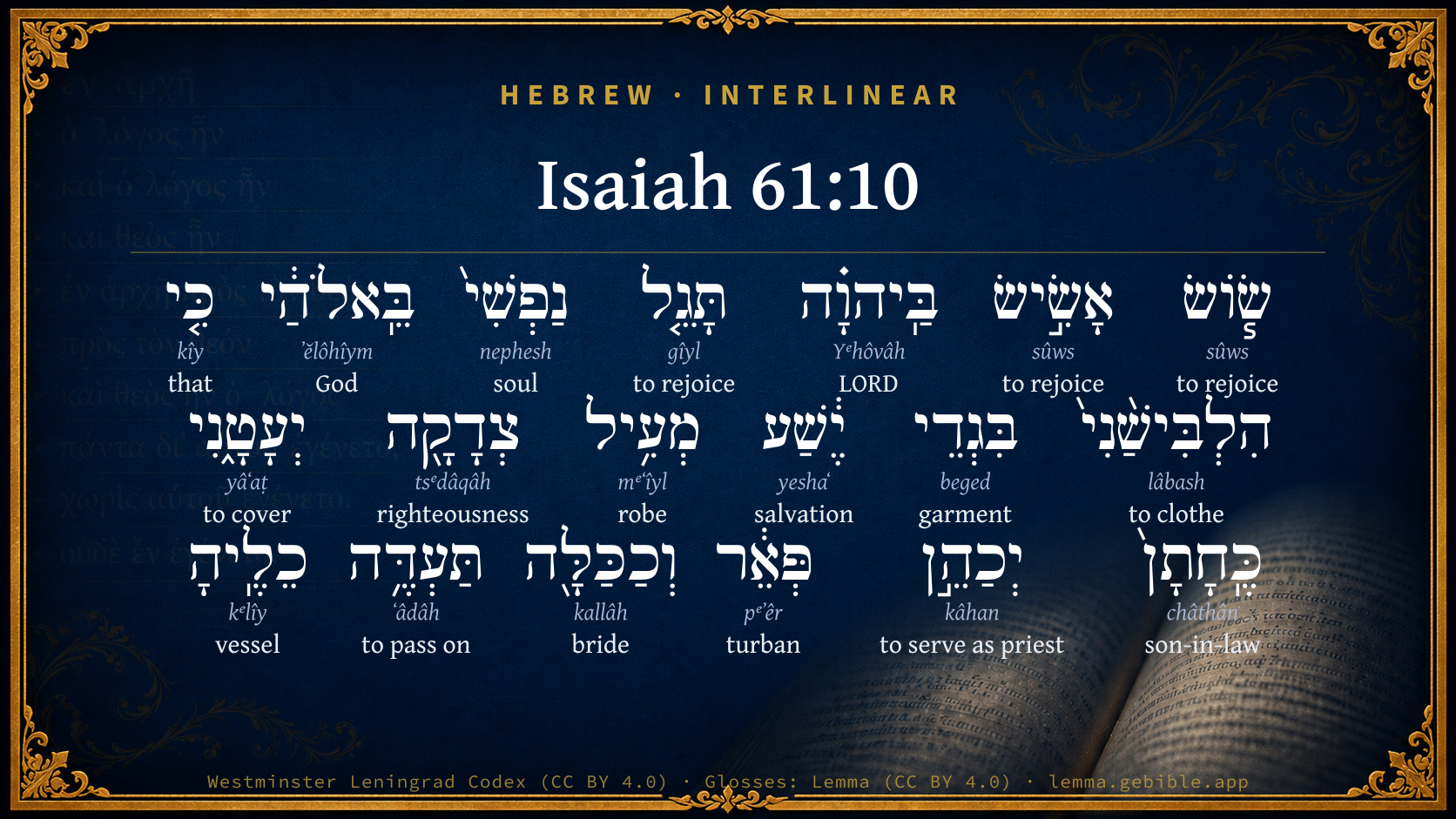
Isaiah 61:10

Hebrew (Westminster Leningrad Codex) Isaiah 61:10 appears in the Hebrew Old Testament. The text above is from the Westminster Leningrad Codex. Each word links to its Strong’s number, a concise gloss, and parsing drawn from the Open Scriptures Hebrew Bible morphology. Click any word for its full Brown-Driver-Briggs (BDB) entry.
Download image
Cite this verse

Isaiah 61:10 (World English Bible). Public Domain. Lemma interlinear Bible study tool, https://lemma.gebible.app/v/isaiah/61/10.

Show BibTeX & RIS
BibTeX
RIS
English Translation
I will greatly rejoice in Yahweh, my soul shall be joyful in my God; for he has clothed me with the garments of salvation, he has covered me with the robe of righteousness, as a bridegroom decks himself with a garland, and as a bride adorns herself with her jewels.
World English Bible · Public Domain
Highlights
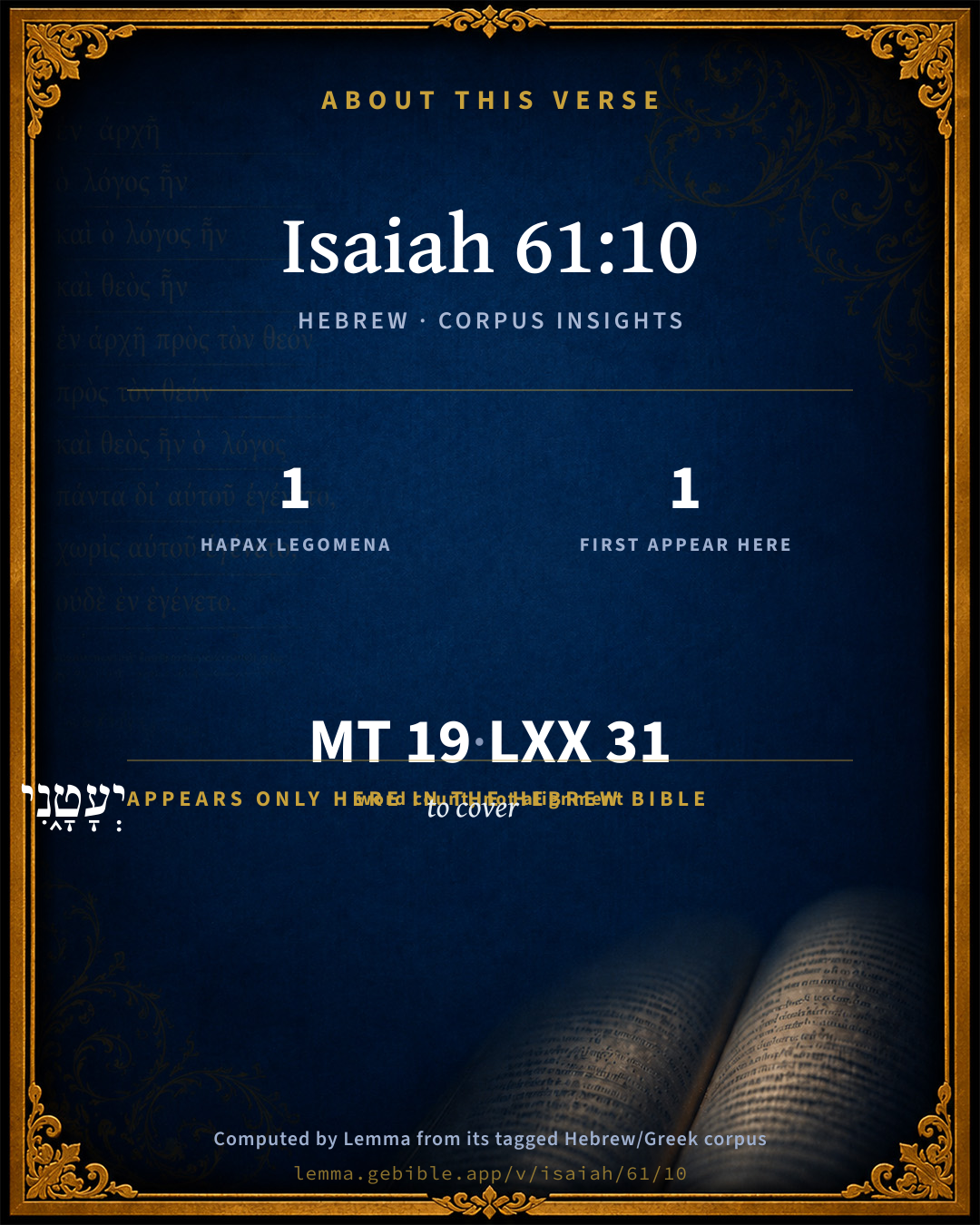
  • 1 hapax legomenon — only here in the Hebrew Bible
  • 1 first appearance in the Hebrew Bible
Full analysis ↓
Download a study sheet

One document with this verse’s original text, its word-by-word gloss line, the meaning frame, cross-references with their text, attributed commentary, and full source and license credits — printable, and it pastes into notes with its structure intact.

This verse Autodidact and up

Study sheet (.html) Plain text (.txt)

A passage Seminary Student

Up to 50 verses in one chapter. A passage sheet keeps up to 6 commentary sources and 12 cross-references per verse, in the order this page ranks them, and says so on the sheet whenever that leaves anything out. Ask for a single verse and you get the Autodidact verse sheet above.

Everything on this page stays free to read, with no account — the sheet is a download of what is already on screen, not access to it.

Want to remove ads? Support Godless Engineer
Compare translations 3

The same verse in 3 English versions, stacked beneath the original-language interlinear above. Click any original word for its lexicon entry.

Each is an independent rendering of the whole verse — the interlinear is not word-aligned to these translations.

Highlighted words mark where these versions differ — a whole-verse word diff, not a word-by-word alignment.

  • World English Bible Public Domain
    I will greatly rejoice in Yahweh, my soul shall be joyful in my God; for he has clothed me with the garments of salvation, he has covered me with the robe of righteousness, as a bridegroom decks himself with a garland, and as a bride adorns herself with her jewels.
  • King James Version Public Domain
    I will greatly rejoice in the LORD, my soul shall be joyful in my God; for he hath clothed me with the garments of salvation, he hath covered me with the robe of righteousness, as a bridegroom decketh himself with ornaments, and as a bride adorneth herself with her jewels.
  • unfoldingWord Literal Text CC BY-SA 4.0
    Rejoicing, I will rejoice in Yahweh; my soul will be glad in my God. For he has clothed me garments of salvation; he has wrapped me a robe of righteousness, as a bridegroom decks a headdress, and as a bride adorns with her jewels.

unfoldingWord Literal Text — © unfoldingWord, licensed CC BY-SA 4.0. Word-aligned USFM3 via Door43 (git.door43.org/unfoldingWord/en_ult).

Versions to compare (up to 4)

3 of 4 selected

Show all 18 translations

Every available English version of this verse, each an independent rendering of the whole verse.

  • World English Bible Public Domain
    I will greatly rejoice in Yahweh, my soul shall be joyful in my God; for he has clothed me with the garments of salvation, he has covered me with the robe of righteousness, as a bridegroom decks himself with a garland, and as a bride adorns herself with her jewels.
  • Berean Standard Bible Public Domain
    I will rejoice greatly in the LORD, my soul will exult in my God; for He has clothed me with garments of salvation and wrapped me in a robe of righteousness, as a bridegroom wears a priestly headdress, as a bride adorns herself with her jewels.
  • Majority Standard Bible Public Domain
    I will rejoice greatly in the LORD, my soul will exult in my God; for He has clothed me with garments of salvation and wrapped me in a robe of righteousness, as a bridegroom wears a priestly headdress, as a bride adorns herself with her jewels.
  • King James Version Public Domain
    I will greatly rejoice in the LORD, my soul shall be joyful in my God; for he hath clothed me with the garments of salvation, he hath covered me with the robe of righteousness, as a bridegroom decketh himself with ornaments, and as a bride adorneth herself with her jewels.
  • American Standard Version (1901) Public Domain
    I will greatly rejoice in Jehovah, my soul shall be joyful in my God; for he hath clothed me with the garments of salvation, he hath covered me with the robe of righteousness, as a bridegroom decketh himself with a garland, and as a bride adorneth herself with her jewels.
  • Revised Version (1885) Public Domain
    I will greatly rejoice in the LORD, my soul shall be joyful in my God; for he hath clothed me with the garments of salvation, he hath covered me with the robe of righteousness, as a bridegroom decketh himself with a garland, and as a bride adorneth herself with her jewels.
  • Geneva Bible (1599) Public Domain
    I will greatly reioyce in the Lord, and my soule shall be ioyfull in my God: for he hath clothed mee with the garments of saluation, and couered me with the robe of righteousnes: hee hath decked me like a bridegrome, and as a bride tireth herselfe with her iewels.
  • Douay-Rheims (1899) Public Domain
    I will greatly rejoice in the Lord, and my soul shall be joyful in my God: for he hath clothed me with the garments of salvation: and with the robe of justice he hath covered me, as a bridegroom decked with a crown, and as a bride adorned with her jewels.
  • Young's Literal Translation Public Domain
    I greatly rejoice in Jehovah, Joy doth my soul in my God, For He clothed me with garments of salvation, With a robe of righteousness covereth Me, As a bridegroom prepareth ornaments, And as a bride putteth on her jewels.
  • Literal Standard Version CC BY-SA 4.0
    I greatly rejoice in YHWH, || My soul rejoices in my God, || For He clothed me with garments of salvation, || [And] covered me with a robe of righteousness, || As a bridegroom prepares ornaments, || And as a bride puts on her jewels.
  • Unlocked Literal Bible CC BY-SA 4.0
    I will greatly rejoice in Yahweh; in my God I will be very glad. For he has clothed me with the garments of salvation; he has clothed me with the robe of righteousness, as a bridegroom adorns himself with a turban, and as a bride adorns herself with her jewels.
  • unfoldingWord Literal Text CC BY-SA 4.0
    Rejoicing, I will rejoice in Yahweh; my soul will be glad in my God. For he has clothed me garments of salvation; he has wrapped me a robe of righteousness, as a bridegroom decks a headdress, and as a bride adorns with her jewels.
  • Darby Bible Public Domain
    I will greatly rejoice in Jehovah, my soul shall be joyful in my God; for he hath clothed me with the garments of salvation, he hath covered me with the robe of righteousness, as a bridegroom decketh himself with the priestly turban, and as a bride adorneth herself with her jewels.
  • World Messianic Bible Public Domain
    I will greatly rejoice in the LORD! My soul will be joyful in my God, for he has clothed me with the garments of salvation. He has covered me with the robe of righteousness, as a bridegroom decks himself with a garland and as a bride adorns herself with her jewels.
  • Webster's Bible Public Domain
    I will greatly rejoice in the LORD, my soul shall be joyful in my God; for he hath clothed me with the garments of salvation, he hath covered me with the robe of righteousness, as a bridegroom decketh himself with ornaments, and as a bride adorneth herself with her jewels.
  • Free Bible Version CC BY-SA 4.0
    I will happily celebrate in the Lord! My whole being will shout praises to my God. For he has dressed me with the clothing of salvation, and has wrapped around me a robe of goodness. I am like a bridegroom dressed for the wedding, like a bride wearing her jewels.
  • Bible in Basic English Public Domain
    I will be full of joy in the Lord, my soul will be glad in my God; for he has put on me the clothing of salvation, covering me with the robe of righteousness, as the husband puts on a fair head-dress, and the bride makes herself beautiful with jewels.
  • JPS Tanakh (1917) Public Domain
    I will greatly rejoice in the LORD, my soul shall be joyful in my God; for He hath clothed me with the garments of salvation, He hath covered me with the robe of victory, as a bridegroom putteth on a priestly diadem, and as a bride adorneth herself with her jewels.

Literal Standard Version (2020), Covenant Press — licensed CC BY-SA 4.0. Text via the HelloAO Bible API (eBible.org). Unlocked Literal Bible (unfoldingWord) — licensed CC BY-SA 4.0. Text via the HelloAO Bible API (eBible.org). unfoldingWord Literal Text — © unfoldingWord, licensed CC BY-SA 4.0. Word-aligned USFM3 via Door43 (git.door43.org/unfoldingWord/en_ult). Free Bible Version, Dr. Jonathan Gallagher — licensed CC BY-SA 4.0. Text via the HelloAO Bible API (eBible.org).

Word by word

More ways to search: Search by grammar → Find every occurrence → Compare this word →

Practice this passage: Drill this verse → Learn its vocabulary →

יְעָטָ֑נִי
yâʻaṭ
H3271
“to cover · me”
Verb, Qal, Imperfect, 3rd Person, Masculine, Singular + Suffix, Personal, 1st Person, Common, Singular
Part of Speech
Verb
Stem
Qal
Form
Imperfect
Person
3rd Person
Gender
Masculine
Number
Singular
Full BDB Definition

Origin: a primitive root

TWOT: 881

(Qal) to cover
  1. שׂ֧וֹשׂ sûws H7797 “to rejoice” Verb, Qal, Infinitive Absolute
  2. אָשִׂ֣ישׂ sûws H7797 “to rejoice” Verb, Qal, Imperfect, 1st Person, Common, Singular
  3. בַּֽיהוָ֗ה Yᵉhôvâh H3068 “in/at · LORD” Preposition + Noun, Proper
  4. תָּגֵ֤ל gîyl H1523 “to rejoice” Verb, Qal, Imperfect, 3rd Person, Feminine, Singular
  5. נַפְשִׁי֙ nephesh H5315 “soul · my” Noun, Common, Both, Singular, Construct + Suffix, Personal, 1st Person, Common, Singular
  6. בֵּֽאלֹהַ֔י ʼĕlôhîym H430 “in/at · God(s) · my” Preposition + Noun, Common, Masculine, Plural, Construct + Suffix, Personal, 1st Person, Common, Singular
  7. כִּ֤י kîy H3588 “that” Conjunction
  8. הִלְבִּישַׁ֨נִי֙ lâbash H3847 “to clothe · me” Verb, Hiphil, Perfect, 3rd Person, Masculine, Singular + Suffix, Personal, 1st Person, Common, Singular
  9. בִּגְדֵי beged H899 “garments of” Noun, Common, Masculine, Plural, Construct
  10. יֶ֔שַׁע yeshaʻ H3468 “salvation” Noun, Common, Masculine, Singular, Absolute
  11. מְעִ֥יל mᵉʻîyl H4598 “robe of” Noun, Common, Masculine, Singular, Construct
  12. צְדָקָ֖ה tsᵉdâqâh H6666 “righteousness” Noun, Common, Feminine, Singular, Absolute
  13. כֶּֽחָתָן֙ châthân H2860 “like/as · son-in-law” Preposition + Noun, Common, Masculine, Singular, Absolute
  14. יְכַהֵ֣ן kâhan H3547 “to serve as priest” Verb, Piel, Imperfect, 3rd Person, Masculine, Singular
  15. פְּאֵ֔ר pᵉʼêr H6287 “turban” Noun, Common, Masculine, Singular, Absolute
  16. וְכַכַּלָּ֖ה kallâh H3618 “and · like/as the · bride” Conjunction + Preposition, Determined + Noun, Common, Feminine, Singular, Absolute
  17. תַּעְדֶּ֥ה ʻâdâh H5710 “to pass on” Verb, Qal, Imperfect, 3rd Person, Feminine, Singular
  18. כֵלֶֽיהָ kᵉlîy H3627 “vessels · her” Noun, Common, Masculine, Plural, Construct + Suffix, Personal, 3rd Person, Feminine, Singular

About this verse

These counts appear in no published source. They are computed here, from the morphology-tagged text and Lemma’s own curated glosses. What Lemma adds →

19
words
18
distinct lemmas
Prophets
section

Notable vocabulary

1 hapax legomenon — a word that appears only here in the entire Hebrew Bible:

  • יְעָטָ֑נִי to cover H3271

First appearance in Scripture

This word makes its first canonical appearance in the Hebrew Bible here:

  • יְעָטָ֑נִי to cover H3271

Shared distinctive vocabulary

פְּאֵ֔ר turban H6287 occurs in 7 verses of the Hebrew Bible. Also found in:

Grammatical profile

  • 7 verbs
  • 11 nouns
  • 1 conjunction

Verb forms

  • שׂ֧וֹשׂ Qal · Infinitive Absolute
  • אָשִׂ֣ישׂ Qal · Imperfect
  • תָּגֵ֤ל Qal · Imperfect
  • הִלְבִּישַׁ֨נִי֙ Hiphil · Perfect
  • יְעָטָ֑נִי Qal · Imperfect
  • יְכַהֵ֣ן Piel · Imperfect
  • תַּעְדֶּ֥ה Qal · Imperfect

Repetition

A word recurs within this verse — often emphatic in Hebrew:

  • שׂ֧וֹשׂ to rejoice H7797 ×2

Hebrew & Septuagint length

In English translation the verse runs 50 words from the Hebrew and 49 from the Septuagint (LXX English) — closely comparable.

A rough comparison of the two English renderings, which tokenize alike — not a word-level alignment.

Word counts can differ between the Hebrew and the Greek without any difference in meaning — e.g. the Hebrew direct-object marker אֵת has no separate Greek word, and Greek often adds the article ὁ.

In the original languages it is 19 Hebrew tokens and 31 Greek tokens — but the two are counted differently (Hebrew bundles its prefixes and suffixes into one token; the Greek is in lemma form), so that isn’t a like-for-like length.

Cross-references

35

Topical passages linked to Isaiah 61:10 in the Treasury of Scripture Knowledge — connected by theme and wording, ordered by reader-vote popularity; previews shown in the World English Bible.

  • Revelation 19:7–8 Let us rejoice and be exceedingly glad, and let us give the glory to him. For the marriage of the Lamb has come, and his wife has made herself ready."
  • Psalms 132:9 Let your priest be clothed with righteousness. Let your saints shout for joy!"
  • Philippians 3:9 and be found in him, not having a righteousness of my own, that which is of the law, but that which is through faith in Christ, the righteousness which is from God by faith;
  • Psalms 132:16 Her priests I will also clothe with salvation. Her saints will shout aloud for joy.
  • Revelation 21:2 I saw the holy city, New Jerusalem, coming down out of heaven from God, made ready like a bride adorned for her husband.
  • Isaiah 49:18 Lift up your eyes round about, and see: all these gather themselves together, and come to you. As I live, says Yahweh, you shall surely clothe you with them all as with an ornament, and gird yourself with them, like a bride.
  • Romans 5:11 Not only so, but we also rejoice in God through our Lord Jesus Christ, through whom we have now received the reconciliation.
  • Romans 14:17 for the Kingdom of God is not eating and drinking, but righteousness, peace, and joy in the Holy Spirit.
  • Revelation 7:9–14 After these things I looked, and behold, a great multitude, which no man could number, out of every nation and of all tribes, peoples, and languages, standing before the throne and before the Lamb, dressed in white robes, with palm branches in their hands.
  • Isaiah 52:1 Awake, awake, put on your strength, Zion; put on your beautiful garments, Jerusalem, the holy city: for henceforth there shall no more come into you the uncircumcised and the unclean.
  • 1 Samuel 2:1 Hannah prayed, and said: My heart exults in Yahweh; My horn is exalted in Yahweh; My mouth is enlarged over my enemies; Because I rejoice in your salvation.
  • Isaiah 51:11 The ransomed of Yahweh shall return, and come with singing to Zion; and everlasting joy shall be on their heads: they shall obtain gladness and joy; [and] sorrow and sighing shall flee away.
  • Isaiah 61:3 to appoint to those who mourn in Zion, to give to them a garland for ashes, the oil of joy for mourning, the garment of praise for the spirit of heaviness; that they may be called trees of righteousness, the planting of Yahweh, that he may be glorified.
  • Luke 15:22 "But the father said to his servants, 'Bring out the best robe, and put it on him. Put a ring on his hand, and shoes on his feet.
  • Romans 13:14 But put on the Lord Jesus Christ, and make no provision for the flesh, for its lusts.
  • Galatians 3:27 For as many of you as were baptized into Christ have put on Christ.
  • 2 Chronicles 6:41 Now therefore arise, Yahweh God, into your resting-place, you, and the ark of your strength: let your priests, Yahweh God, be clothed with salvation, and let your saints rejoice in goodness.
  • Habakkuk 3:18 Yet I will rejoice in Yahweh. I will be joyful in the God of my salvation!
  • Romans 3:22 even the righteousness of God through faith in Jesus Christ to all and on all those who believe. For there is no distinction,
  • 1 Peter 1:8 whom not having known you love; in whom, though now you don't see him, yet believing, you rejoice greatly with joy unspeakable and full of glory--
  • Isaiah 25:9 It shall be said in that day, Behold, this is our God; we have waited for him, and he will save us: this is Yahweh; we have waited for him, we will be glad and rejoice in his salvation.
  • Ezekiel 16:8–16 Now when I passed by you, and looked at you, behold, your time was the time of love; and I spread my skirt over you, and covered your nakedness: yes, I swore to you, and entered into a covenant with you, says the Lord Yahweh, and you became mine.
  • Isaiah 35:10 and the ransomed of Yahweh shall return, and come with singing to Zion; and everlasting joy shall be on their heads: they shall obtain gladness and joy, and sorrow and sighing shall flee away.
  • Philippians 4:4 Rejoice in the Lord always! Again I will say, Rejoice!
  • Revelation 21:9 One of the seven angels who had the seven bowls, who were loaded with the seven last plagues came, and he spoke with me, saying, "Come here. I will show you the wife, the Lamb's bride."
  • Exodus 28:2–43 You shall make holy garments for Aaron your brother, for glory and for beauty.
  • Nehemiah 8:10 Then he said to them, Go your way, eat the fat, and drink the sweet, and send portions to him for whom nothing is prepared; for this day is holy to our Lord: neither be you grieved; for the joy of Yahweh is your strength.
  • Psalms 28:7 Yahweh is my strength and my shield. My heart has trusted in him, and I am helped. Therefore my heart greatly rejoices. With my song I will thank him.
  • Psalms 45:13–14 The princess inside is all glorious. Her clothing is interwoven with gold.
  • Jeremiah 2:32 Can a virgin forget her ornaments, or a bride her attire? yet my people have forgotten me days without number.
  • Zechariah 10:7 Ephraim will be like a mighty man, And their heart will rejoice as through wine; Yes, their children will see it, and rejoice. Their heart will be glad in Yahweh.
  • Luke 1:46–47 Mary said, "My soul magnifies the Lord.
  • Philippians 3:1–3 Finally, my brothers, rejoice in the Lord. To write the same things to you, to me indeed is not tiresome, but for you it is safe.
  • Genesis 24:53 The servant brought forth jewels of silver, and jewels of gold, and clothing, and gave them to Rebekah. He gave also to her brother and to her mother precious things.
  • Psalms 45:8–9 All your garments smell like myrrh, aloes, and cassia. Out of ivory palaces stringed instruments have made you glad.

Cross-references courtesy of OpenBible.info (CC BY 4.0).

Hebrew and Greek witnesses Masoretic Hebrew ↔ Greek Septuagint

The same verse in the two great witnesses to the Old Testament, shown verse-for-verse.

These are two independent witnesses, not word-aligned to each other, and the Septuagint is shown in lemma (dictionary) form.

Hebrew Isaiah 61:10 Masoretic · Westminster Leningrad Codex

שׂ֧וֹשׂ אָשִׂ֣ישׂ בַּֽיהוָ֗ה תָּגֵ֤ל נַפְשִׁי֙ בֵּֽאלֹהַ֔י כִּ֤י הִלְבִּישַׁ֨נִי֙ בִּגְדֵי יֶ֔שַׁע מְעִ֥יל צְדָקָ֖ה יְעָטָ֑נִי כֶּֽחָתָן֙ יְכַהֵ֣ן פְּאֵ֔ר וְכַכַּלָּ֖ה תַּעְדֶּ֥ה כֵלֶֽיהָ

I will greatly rejoice in Yahweh, my soul shall be joyful in my God; for he has clothed me with the garments of salvation, he has covered me with the robe of righteousness, as a bridegroom decks himself with a garland, and as a bride adorns herself with her jewels.

World English Bible · Public Domain

Greek LXX Isaiah 61:10 Septuagint · lemma form

καί εὐφροσύνη εὐφραίνω ἐπί κύριος ἀγαλλιάομαι ὁ ψυχή ἐγώ ἐπί ὁ κύριος ἐνδύω γάρ ἐγώ ἱμάτιον σωτήριον καί χιτών εὐφροσύνη ὡς νυμφίος περιτίθημι ἐγώ μίτρα καί ὡς νύμφη κατακοσμέω ἐγώ κόσμος

and they shall greatly rejoice in the Lord. Let my soul rejoice in the Lord; for he has clothed me with the robe of salvation, and the garment of joy: he has put a mitre on me as on a bridegroom, and adorned me with ornaments as a bride.

LXX2012 (modern English Septuagint) · Public Domain

On this verse, Albert Barnes' Notes on the Bible discusses the Septuagint’s reading. Read the note in Commentary ↓

Hebrew: Westminster Leningrad Codex (CC BY 4.0). Greek: Septuagint (public domain); English from LXX2012 (modern English Septuagint) (Public Domain). How the Septuagint differs from the Hebrew →

Targum (Aramaic paraphrase)

1

The Targum is the ancient Jewish Aramaic paraphrase of the Hebrew Scriptures — an interpretive translation, not the Hebrew text itself. Onkelos (literal) and Pseudo-Jonathan (expansive) render the Torah, and Jonathan the Prophets. Coverage is partial: where no permissively-licensed English translation exists for a verse, only the Aramaic is shown. This is verse-level text, not a word-by-word alignment to the Hebrew.

  1. Targum Jonathan Prophets (Joshua–Malachi)
    אֲמָרַת יְרוּשְׁלֵם מֶחְדָא אֶחְדֵי בְּמֵימְרָא דַייָ תְּבוּעַ נַפְשִׁי בְּפוּרְקָנָא דֶאֱלָהִי אֲרֵי אַלְבְּשַׁנִי לְבוּשִׁין דְפוּרְקַן מְעִין דִזְכוּ עִטְפַנִי כַּחֲתָנָא דְמִצְלַח בִּגְנוּנֵהּ וּכְכַהֲנָא רַבָּא דְמַתְקַן בִּלְבוּשׁוֹהִי וּכְכַלְתָא דְמִתְקַשְׁטָא בְתִיקוּנָהָא:

    Jerusalem shall say, I will greatly rejoice in the Word of the Lord, my soul shall be joyful in the salvation of my God; for He hath clothed me with the garments of salvation, He hath covered me with the upper garments of righteousness, like a bridegroom who is happy in his bridechamber, and like the high priest who decketh himself with his robes, and like a bride who is adorned with her jewels.

    Targum Jonathan — Aramaic: “Mikraot Gedolot” (public domain). English: “Sefaria Community Translation” (CC0 1.0 (public-domain dedication)); “London "Chaldee Paraphrase," 1871” (public domain). Text via Sefaria.

Commentary

Notes on Isaiah 61:10 from classic Christian and Jewish commentators (each source and its license shown beneath its notes). The classic Christian expositions comment on the surrounding passage and are grouped to its opening verse, so a note may address several verses; the Jewish commentaries on the Tanakh (Rashi and others) are per-verse, so they appear only where the commentator wrote on this verse.

Lemma curates 59 commentaries, every one of them public domain or Creative Commons licensed, each selected and text-cleaned for this edition rather than reprinted as found. About our sources →

Matthew Henry's Commentary

Some make this the song of joy and praise to be sung by the prophet in the name of Jerusalem, congratulating her on the happy change of her circumstances in the accomplishment of the foregoing promises; others make it to be spoken by Christ in the name of the New Testament church triumphing in gospel grace. We may take in both, the former as a type of the latter. We are here taught to rejoice with holy joy, to God's honour, 1. In the beginning of this good work, the clothing of the church with righteousness and salvation, Isa 61:10. Upon this account I will greatly rejoice in the Lord. Those that rejoice in God have cause to rejoice greatly, and we need not fear running into an extreme in the greatness of our joy when we make God the gladness of our joy. The first gospel song begins like this, My soul doth magnify the Lord, and my spirit hath rejoiced in God my Saviour, Luk 1:46, Luk 1:47. There is just matter for this joy, and all the reason in the world why it should terminate in God; for salvation and righteousness are wrought out and brought in, and the church is clothed with them. The salvation God wrought for the Jews, and that righteousness of his in which he appeared for them, and that reformation which appeared among them, made them look as glorious in the eyes of all wise men as if they had been clothed in robes of state or nuptial garments. Christ has clothed his church with an eternal salvation (and that is truly great) by clothing it with the righteousness both of justification and sanctification. The clean linen is the righteousness of saints, Rev 19:8. Observe how these tow are put together; those, and those only, shall be clothed with the garments of salvation hereafter that are covered with the robe of righteousness now: and those garments are rich and splendid clothing, like the priestly garments (for so the word signifies) with which the bridegroom decks himself. The brightness of the sun itself is compared to them. Psa 19:5, He is as a bridegroom coming out of his chamber, completely dressed. Such is the beauty of God's grace in those that are clothed with the robe of righteousness, that by the righteousness of Christ are recommended to God's favour and by the sanctification of the Spirit have God's image renewed upon them; they are decked as a bride to be espoused to God, and taken into covenant with him; they are decked as a priest to be employed for God, and taken into communion with him. 2. In the progress and continuance of this good work, Isa 61:11. It is not like a day of triumph, which is glorious for the present, but is soon over. No; the righteousness and salvation with which the church is clothed are durable clothing; so they are said to be, Isa 23:18. The church, when she is pleasing herself with the righteousness and salvation that Jesus Christ has clothed her with, rejoices to think that these inestimable blessings shall both spring for future ages and spread to distant regions. (1.) They shall spring forth for ages to come, as the fruits of the earth which are produced very year, from generation to generation. As the earth, even that which lies common, brings forth her bud, the tender grass at the return of the year, and as the garden enclosed causes the things that are sown in it to spring forth in their season, so duly, so constantly, so powerfully, and with such advantage to mankind will the Lord God cause righteousness and praise to spring forth, by virtue of the covenant of grace, as, in the former case, by virtue of the covenant of providence. See what the promised blessings are - righteousness and praise (for those that are clothed with righteousness show forth the praises of him that clothed them); these shall spring forth under the influence of the dew of divine grace. Though it may sometimes be winter with the church, when those blessings seem to wither and do not appear, yet the root of them is fixed, a spring-time will come, when through the reviving beams of the approaching Sun of righteousness they shall flourish again. (2.) They shall spread far, and spring forth before all the nations; the great salvation shall be published and proclaimed to all the world and the ends of the earth shall see it.

Matthew Henry's Commentary on the Whole Bible (1708–1710) — public domain (CC PDM 1.0). Text via the HelloAO Bible API.

Trapp's Complete Commentary

John Trapp

Isa 61:10 I will greatly rejoice in the LORD, my soul shall be joyful in my God; for he hath clothed me with the garments of salvation, he hath covered me with the robe of righteousness, as a bridegroom decketh [himself] with ornaments, and as a bride adorneth [herself] with her jewels.

Ver. 10. I will greatly rejoice in the Lord.] Me beatam! quare dolerem? Oh happy am I, said the Church; why should I be troubled at ought: why should not I over abounding exceedingly with joy who have such rich and precious promises? gaudium in re, gaudium in spe; gaudium de possessione, gaudium de promissione, &c. - i.e., Joy in hope and joy in hand, joy in possession and joy in reversion, &c., as Bernard sweetly. When once a soul enjoyeth God, it is quiet, as a bee that is got into her hive, or a bird got into her nest, or the dove into the ark; nay, it is triumphant, as "more than a conqueror."

For he hath clothed me with the garments of salvation.] By salvation and righteousness, Jerome here understandeth Christ our Saviour and Justifier, whom we are bidden also to put on. {Rom 13:14 Gal 3:27 Rev 12:1}

As a bridegroom decketh himself with ornaments.] Tanquam sponsum qui sacerdotem refert ornatu, so Piscator rendereth it: as a bridegroom bravely arrayed; like a priest, os humerosque Deo similis. {a}

And as a bride adorneth herself with jewels.] Mundo suo, With her ornaments, habiliments. Heb., Implements. The Church is here compared to a bridegroom for her strength and constancy, saith Cyril; and again, to a bride for her fruitfulness, beauty, and glory, here begun, and hereafter to be perfected. There is in this verse a double elegance in the Hebrew that cannot be translated.

{a} Iερατευμενος στεφανω. - Aquila.

John Trapp, A Commentary or Exposition upon All the Books of the Old and New Testament (1647–1656) — public domain. Text from a community e-Sword module.

The Biblical Illustrator

Joseph S. Exell

Isa_61:10

I will greatly rejoice in the Lord

The garments of salvation

I.

Here is a GLAD RESOLVE. I will greatly rejoice in the Lord, my soul shall be joyful in my God.

1. Where there is a will there is generally a way, and sad though you be, something is gained if you will resolve to rejoice.

2. It is always in the Lord that we must rejoice. Friends are dying, helps are failing, hopes are being blasted. Rejoice in the Lord.

3. I further admire this resolve because we are by it determining to rejoice greatly in the Lord. If He is worth rejoicing in at all, He is worth rejoicing in greatly.

4. We are bidden to rejoice as to our inmost souls. My soul shall be joyful in my God. Soul-joy is the soul of joy, and there is no other joy worth the having.

5. The joy is in a personal God. My soul shall be joyful in my God. I think the secret lies just there. It is one thing to rejoice in God, the God of nature, the God of providence, or, for that matter, the God of grace; but it is quite another thing to rejoice in my God.

II. There are RIGHT GOOD REASONS, the best of reasons, for this glad resolve. He hath clothed me with the garments of salvation, He hath covered me with the robe of righteousness.

1. He hath done it. We may well say I will, if we can already say He hath. It is because He hath that we will.

2. He hath clothed me.

3. He hath clothed me with the garments of salvation. This is an effectual way of saying, He hath saved me.

(1) He has made us holy.

(2) We ought also to wear the garment of humility.

(3) Nor are Christians properly attired till they are clad with zeal as with a cloak.

(4) May we not reckon also among the garments of salvatin that garment of praise of which we have read in the third verse?

(5) But chief of all the garments of salvation is the one that is here specially named, He hath covered me with the robe of righteousness. But for this we could not know the others; this is both first and last of all. Whose righteousness? Not our own, but HIS. How, then, does it become ours? Just as a garment becomes ours. We put it on, we wear it, we bear it; it envelopes us. Believers are accepted in the Beloved.

(6) These garments of salvation are in our text associated with wedding robes. As a bridegroom decketh himself with ornaments, and as a bride adorneth herself with jewels, just so the Lord has clothed us with garments of salvation, i.e. He has married us. The Church is His spouse.

(7) There is a reference here also, though it does not appear in our version, to the decking of the priest. The margin reads, As a bridegroom decketh as a priest, and I believe the Revised Version refers to the garland or tiara that the priest wears when sacrificing. It is gloriously true that we are made both kings and priests unto God. If these robes are festal and bridal, they are sacerdotal too.

(8) The closing verse of the chapter, though it seems to introduce another metaphor, is very closely allied to our text, As the earth bringeth forth her bud, etc. It looks as if what the Lord did for His people is comparable not merely to the arraying of the bride, or the decking of the priest, but to the arraying of this our earth, which at time of spring puts on its beautiful array, its garments of salvation, from whose new-sprung flowers the fresh incense rises, as if a garlanded priest were offering sacrifice to God. (T. Spurgeon.)

He hath clothed me with the garments of salvation

Dressed for eternity

I. THE SACRED DRESS. The garments of salvation.

1. Garments are used as a covering. Is a garment for the body more needed than one for the soul? Which of us could stand in the presence of an angel without sinking to the ground in very shame? I draw your attention to the glory of Gods garments of salvation--they completely cover all your iniquity and blot out all your sin.

2. A garment is used to beautify, to adorn. The garment of salvation is an adornment, for it reveals God in you to your neighbours. What can be more beautiful than a man or woman or child who tries to bless another! That is the life of the angels; the life of God--ministering unto others.

3. Garments are used also as a sign ones condition or occupation. Monarchs, priests, judges, and officers of state wear robes to indicate their real or implied superiority. Shakespere says, the apparel oft proclaims the man. You can generally tell something about a mans character and calling from his clothing. The world judges of Christian people by the garments of their conduct.

II. THE GIVER OF THE GARMENTS.

III. THE PERSONAL APPROPRIATING. He hath clothed me. Where is salvation? In Christ, and Christ is in and for us. (W. Birch.)

The Biblical Illustrator, edited by Joseph S. Exell (c. 1880s–1900s) — public domain. Text from a community e-Sword module.

Joseph Benson's Commentary

Isa 61:10. I will greatly rejoice in the Lord — This is spoken in the person of the church, wherein she thankfully acknowledges God’s kindness to her in the fore-mentioned promises. My soul shall be joyful in my God — The expression here is varied, but the sense is the same with that in the former clause. He hath clothed me with the garments of salvation, &c. — With salvation as with a garment, and with righteousness as with a robe: the salvation that God will work for me will render me as beautiful and considerable as they are that are clothed with the richest garments. As the bridegroom decketh himself with ornaments — Hebrew, יכהן פאר

כחתן, as the bridegroom decketh himself with a priestly crown; so Bishop Lowth translates it, observing that it is “an allusion to the magnificent dress of the high-priest when performing his functions, and particularly to the mitre, and crown, or plate of gold on the front of it, Exo 29:6. The bonnet or mitre of the priests also was made, as Moses expresses it, ‘for glory and for beauty,’ Exo 28:40. It is difficult to give its full force to the prophet’s metaphor in another language: the version of Aquila and Symmachus comes nearest to it: ως νυμφιον ιερατευομενον

στεφανω,” as a bridegroom exercising the priest’s office in a crown.

Joseph Benson's Commentary on the Old and New Testaments (1811–1818) — public domain. Text from a community e-Sword module.

Tyndale Open Study Notes

Tyndale Open Resources

61:10 clothing of salvation . . . robe of righteousness: With great joy God will clothe his people with the benefits of his salvation and righteousness (see 51:5; 56:1), like a bridegroom . . . or a bride (see 49:18; 62:5; Jer 2:32; 7:34; 16:9; 25:10; 33:11).

Tyndale Open Study Notes — © Tyndale Open Resources, licensed CC BY-SA 4.0. Text via the HelloAO Bible API.

Geneva Bible (1599)

Geneva Bible translators

He showeth what shall be the affection, when they feel this their deliverance.

Geneva Bible (1599) marginal notes — public domain. Text via Bolls.life.

Jamieson, Fausset & Brown

Robert Jamieson, A. R. Fausset & David Brown

Zion (Isa 61:3) gives thanks for God's returning favor (compare Luk 1:46-47; Hab 3:18).

salvation . . . righteousness--inseparably connected together. The "robe" is a loose mantle thrown over the other parts of the dress (Psa 132:9, Psa 132:16; Psa 149:4; Rev 21:2; Rev 19:8).

decketh himself with ornaments--rather "maketh himself a priestly headdress," that is, a magnificent headdress, such as was worn by the high priest, namely, a miter and a plate, or crown of gold worn in front of it [AQUILA, &c.]; appropriate to the "kingdom of priests," dedicated to the offering of spiritual sacrifices to God continually (Exo 19:6; Rev 5:10; Rev 20:6).

jewels--rather, "ornaments" in general [BARNES].

Jamieson, Fausset & Brown — Commentary Critical and Explanatory on the Whole Bible (1871) — public domain (CC PDM 1.0). Text via the HelloAO Bible API.

Adam Clarke's Commentary

Verse 10. I will greatly rejoice in the Lord] These may be the words of the Jews now converted, and brought into the Church of Christ, and with the Gentiles made fellow heirs of the blessings of the new covenant.

As a bridegroom decketh himself with ornaments - "As the bridegroom decketh himself with a priestly crown"] An allusion to the magnificent dress of the high priest, when performing his functions; and particularly to the mitre, and crown or plate of gold on the front of it, Ex 29:6. The bonnet or mitre of the priests also was made, as Moses expresses it, "for glory and for beauty," Ex 28:40. It is difficult to give its full force to the prophet's metaphor in another language. The version of Aquila and Symmachus comes nearest to it: ὡς νυμφιον ἱερατευομενον στεφανῳ· "as a bridegroom decked with a priestly crown." - L.

Adam Clarke's Commentary on the Bible (1810–1826) — public domain. Text from a community e-Sword/MySword module.

Ellicott's Commentary for English Readers

(10) I will greatly rejoice . . .—The speaker is again, as in Isa_61:1, the ideal Servant of Jehovah, who identifies himself with the people and slaves. The Targum, it may be noted, makes Jerusalem the speaker.

The garments of salvation . . .—The imagery is the same as that of Isa_59:17 and Isa_61:3, its entirely spiritual significance being, perhaps, still more strongly accentuated.

As a bridegroom decketh himself with ornaments.—Literally, wears a turban (or mitre), as a priest. It would appear from Song Son_3:11 that bridegrooms wore a special head-dress on the day of their espousal, and this is here compared to the priestly “bonnet,” or “mitre” (Exo_28:4; Exo_39:28; Eze_44:18). On the special occasion which may have suggested the image, see Note on Isa_62:4.

A Bible Commentary for English Readers, edited by Charles John Ellicott (1878–1897) — public domain. Text from a community e-Sword module.

The Cambridge Bible for Schools and Colleges

gen. ed. J. J. S. Perowne

10. According to the Targum and some critics the speaker here is the Zion of the future; while Delitzsch and others, who assign the preceding words to the Servant of Jehovah, suppose that he is still the speaker. If the prophet is the speaker he transports himself to a future standpoint, and there is no reason why he should not at the same time become the mouthpiece of the redeemed community. Duhm and Cheyne agree in thinking that the verse stands out of its proper position and interrupts the connexion of Isa_61:9 with Isa_61:11.

garments of salvation &c.] Cf. ch. Isa_59:17; Psa_132:9; Psa_132:16.

salvation and righteousness are, as often, synonymous.

as a bridegroom decketh himself with ornaments] R.V. “with a garland” (as Isa_61:3). The last word denotes a headdress worn by priests (Exo_39:28; Eze_24:17; Eze_44:18), by fashionable ladies (ch. Isa_3:20), and (according to this passage) by a bridegroom. The verb for “decketh himself” means to officiate as a priest (Hos_4:6, &c.), and its use here, (“maketh his headdress priestly,”) is so peculiar as to be-suspicious.

and as a bride &c.] Better, and like a bride that putteth on her jewels (as Gen_24:53) or her attire (as Deu_22:5).

The Cambridge Bible for Schools and Colleges (gen. ed. J. J. S. Perowne; Cambridge University Press, 1878–1918) — public domain. Text from a community e-Sword module.

John Gill's Exposition

I will greatly rejoice in the Lord,.... These are not the words of the prophet spoken in his own person, rejoicing in the goodness of the Lord to his people and countrymen; nor of Christ; but of the church, especially the Jewish church, expressing her joy for benefits received, as declared in the preceding verses. The Targum is,

"Jerusalem said, rejoicing I will rejoice in the Word of the Lord;''

not in his word of promise, but in his essential Word, his Son the Messiah; in his person, offices, fulness, righteousness, and salvation:

my soul shall be joyful in my God; in Christ, in that he is God, and so able to save to the uttermost, and keep from a final and total falling, and to preserve safe to his kingdom and glory: hence his person is excellent; his blood precious; his righteousness valuable; and his sacrifice efficacious; and all matter of joy to the believer: and who also rejoices in that he is his God, "my God"; God in our nature; Immanuel, God with us; the God-man and Mediator, through whom there is access to God and acceptance with him; and who stands in near relation to his people, and has all fullness to supply their wants, and makes all he has theirs; so that, they have great reason to rejoice in him indeed. The Targum is,

"my soul shall rejoice in the salvation of my God;''

the nature of this joy may be collected from the text itself: it is not a carnal one, or the joy of a carnal man in carnal things, it is spiritual; nor a pharisaical joy, a rejoicing in a man's self, in his own works of righteousness, for this "is in the Lord"; nor is it a hypocritical one, or only externally, for it is the soul that rejoices; and it is the joy of faith, or in the Lord, as "my God"; and a very great one it is, joy unspeakable, and full of glory; and is what continues, as the matter and ground of it always does, as follows: "for he hath clothed me with the garments of salvation"; with salvation as garments; the salvation of Christ, which, like garments, is without men, being wrought out by Christ; and is brought near, and applied by the spirit of Christ; and is all around, and encompasses the saints as such, and like them beautifies and adorns them, and keeps them warm and comfortable, when they have the joys of it; and which secures them from the storms of divine wrath and vengeance; and the plural number being used may denote the fulness and completeness of this salvation, from all sin, from wrath, hell, and damnation, and from every enemy: and this is matter of joy to the believer interested in it, and clothed with it; since it is a salvation so great; a garment so fitting and suitable, and had at free cost; and in which the glory of all the divine perfections is so conspicuous, as well as it being so full, complete, and perfect, and an everlasting one:

he hath covered me with the robe of righteousness: not with her own, that is a rag, and not a robe, and a filthy one too, Isa 64:6 and no covering, and is indeed no righteousness, properly speaking; but the righteousness of Christ, the best robe, the wedding garment, and change of raiment, which, like a robe, is upon believers, but not in them; it in Christ, and imputed to them; it covers their persons and their nakedness, and all their sins, so as not to be seen with the eye of avenging justice: to clothe and cover with it is God's act of imputation, and Christ's application of it by his Spirit, Zac 3:4, which, perceived by the believer, causes great joy; it being all of a piece, like Christ's seamless robe, and so pure and spotless, so perfect and complete, and so rich and glorious:

as a bridegroom decketh himself with ornaments; or, "adorns" himself

in a princely or priestly manner (d); for the word used signifies both. The sense is, as a bridegroom puts on the best clothes he has on his wedding day, and makes the appearance of a prince in his richest robes, or as the high priest when he had on all his sacerdotal garments; so the Targum,

"as a bridegroom that flourishes in his bridechamber, and as the high priest who is adorned with his garments:''

and as a bride adorneth herself with her jewels; or "implements" (e); and makes herself as fine as she can, to recommend herself to her spouse and her friends: thus richly and magnificently arrayed is the church of Christ, and every believer, being clothed with his righteousness; he and they are in the same relation; he is the bridegroom, they the bride; and they are clothed alike with the garment down to the foot; and are righteous as he is righteous; and are herewith as a bride adorned and made ready for her husband; and the joy at such a solemnity fitly expresses the mutual joy of Christ and his church; see Rev 19:7 so Christ's righteousness is compared to a wedding garment, Mat 22:12.

(d) "sacerdotali more ornabit", Tigurine version; "qui sacerdotem refert ornatu", Piscator. (e) "vasis suis", Vatablus, Montanus; "instrumentis"; Junius & Tremellius, De Dieu.

John Gill's Exposition of the Whole Bible (1746–1763) — public domain (CC PDM 1.0). Text via the HelloAO Bible API.

Albert Barnes' Notes on the Bible

I wilt greatly rejoice in the Lord - This is the language of the prophet in the name of the church; or, as Vitringa supposes, the language of a chorus introduced here by the prophet. The Chaldee regards it as the language of Jerusalem, and renders it, ‘Jerusalem said, I will surely rejoice in the Lord.’ The sentiment is, that the prosperity and enlargement of Zion is an occasion of joy, and should lead to thanksgiving and praise. The phrase, ‘I will rejoice in the Lord,’ means that the joy would arise from the view of the faithfulness and perfections of Yahweh manifested in the redemption of his people. See similar expressions of joy in the song of Mary Luk 1:46-47.

For he hath clothed me with the garments of salvation - That is, Jerusalem or the church.

He hath covered me with the robe of righteousness - The word rendered ‘robe’ here means mantle, or a large and loose garment thrown over the other parts of the dress. Such garments are for protection and for ornament, and the image is that of the church defended and ornamented by God (see the notes at Isa 49:18).

As a bridegroom decketh himself - Margin, ‘As a priest.’ The Hebrew is, ‘As a bridegroom adorns himself as a priest’ (יכהן yekahēn); that is, as he makes splendid his head-dress in the manner of a priest.

With ornaments - (פאי pe'ēr). With a tiara, head-dress, diadem. See the word explained in Isa 61:3. The Septuagint renders it, Μίτραν Mitran - ‘Mitre.’ The allusion is to the dress of the Jewish high - priest when he discharged the functions of his office, and particularly to the mitre and the plate or crown of gold which he wore in front of it Exo 29:6. It is not easy to give full force to the metaphor of the prophet in another language. The Hebrew, as near as we can express it, is, ‘As a bridegroom attires himself as a priest with a crown or mitre.’ The version by Aquila and Symmachus comes nearest to it - Ὡς νυμφιον ἱερατευομενον στεφανῳ Hōs numphion hierateuomenon stephanō. The sense is, that the church should be adorned with the highest ornament and beauty; not for the mere purpose of decoration, but as if it were a priest engaged in offering continually the sacrifice of prayer and praise.

And as a bride - See this explained in the notes at Isa 49:18. The word rendered ‘jewels’ here (כלי kelı̂y) does not of necessity mean merely jewels. It properly means an apparatus, implement, utensil, vessel; and then dress, ornament of any kind; and would be better rendered here, in a more general sense, bridal ornaments.

Albert Barnes' Notes on the Bible (1834–1885) — public domain. Text from a community e-Sword/MySword module.

Haydock's Catholic Bible Commentary

Jewels. Apocalypse xxi. 2. Jerusalem, or rather the Church, praises God.

George Leo Haydock (1774–1849), Haydock's Catholic Family Bible and Commentary, 1859 edition — public domain. Excludes Psalms (Douay-Rheims chapter numbering differs from Protestant) and Deuterocanonical books (Catholic canon only).

Matthew Poole's English Annotations

I will greatly rejoice: this by a prosopopoeia is spoken in the person of the church, wherein she doth thankfully acknowledge God’s kindness to her in the forementioned promise, expressed here in the greatness of her affection, with reference both to her present deliverance from Babylon, and to the happiness of her gospel state.

In the Lord; or, because of the Lord, or of the goodness of the Lord towards me; a usual form of gratulation, 1Sa 2:1; Hab 3:18; Luk 1:47; or thus, I will not rejoice so much in my deliverance as in the Lord.

My soul shall be joyful in my God: this clause is to the same purpose, save only she varies the expression: q.d. Yea, I do it with my whole soul.

With the garments of salvation; with salvation as with a garment; so in the next with righteousness as with a robe. The meaning is, The salvation that God will work for me will render me as beautiful and considerable as they are that are clothed with the richest garments, as bridegrooms usually are, and brides with their jewels, or as venerable as kings in their princely robes; my sackcloth will now be turned into robes; or, I shall be compassed about with glory, as garments do compass the body.

With the robe of righteousness, i.e. either with the fruits and effects of his love and many favours to the church, in which sense righteousness is taken, Psa 112:3,4,9, compared with 2Co 9:9; Isa 51:6,8; she should see the righteousness of God in fulfilling all these promises. Or that righteousness of Christ imputed to us, which we are said to put on, Rom 13:14; or those graces imparted to us, and acted in a holy life.

Matthew Poole's English Annotations on the Holy Bible (1683–1685) — public domain. Text from a community e-Sword/MySword module.

Whedon's Commentary on the Bible

Daniel D. Whedon

10. I will greatly rejoice — The Servant of Jehovah, or Messiah, is again the speaker. To him the calling — that of bringing messages of salvation to Jehovah’s people — is a joyful one. In preparatory adornment for this, Jehovah invests him with garments of salvation… the robe of righteousness — Do not these symbolize, respectively, the estate of Messiah at his resurrection and at his ascension, as our risen Redeemer? It so seems. He, the Messiah, is thus bedecked as with a priestly coronet — a tiara or costly turban. This painstaking adornment is like to that of a bridegroom in grand array; and to that of a bride when she appears in her jewels. Conceptions are here intermixed: namely, Christ and his Church, the Saviour and the saved; the Intercessor and those for whom prayer is made. The Servant of Jehovah’s priestly office avails to accomplish an orderly renown to his Church, once, and even recently, in humiliation. (See Isa_61:5; Isa_61:8; Isa_61:11.)

Daniel D. Whedon (gen. ed.), Commentary on the Old and New Testaments (1874–1909) — public domain. Text from a community e-Sword module.

The Pulpit Commentary

Vers. 10, 11. JERUSALEM ACCEPTS THE PROMISES, AND GLORIES IN JEHOVAH. So the Targum and Rosenmuller. Others think that "the Servant" is still speaking, or that Isaiah speaks in the name of the people. To us the exposition of the Targum appears the most satisfactory. It is in the manner of Isaiah suddenly to introduce a new speaker.

I will greatly rejoice in the Lord. (comp. Hab_3:18) The promises made were such as naturally to call forth on the part of Israel the most heartfelt joy and rejoicing including, as they did, restoration, rule over the Gentiles, a universal priesthood, a wide territory, "everlasting joy," a high renown, and an "everlasting covenant. He hath clothed me with the garments of salvation. (comp. Isa_59:17 and Isa_61:3) The metaphor occurs also in the Psalms. (Psa_71:6 Psa_109:18) God clothes Israel with "righteousness" derived from himself, (Isa_54:17, ad fin. ) and then with its natural consequence The result is to make Israel as a bridegroom who decketh himself with a priestly crown, and as a bride who adornoth herself with her jewels. That bridegrooms ordinarily wore crowns appears from the Mishna.

Vers. 10, 11. Rejoicing in the Lord.

"Rejoice in the Lord alway," says the apostle: "and again I say, Rejoice". (Php_4:4) It reflects shame on Christians that their religion should appear, so much as it does, to those without as a religion of gloom and melancholy. In Scripture true religion wears a wholly different aspect. Faithful Israel rejoices constantly in the Lord, is perpetually joyful in its God. The Book of Psalms is one almost continuous jubilation. The worship of David, of Solomon, of Hezekiah, of the Old Testament saints generally, is a glad worship. (2Sa_6:12 1Ch_29:9-22 2Ch_5:2-13 2Ch_29:20-36 2Ch_30:21-26, etc.) In the Gospels we find Christ"s coming on earth the immediate occasion of canticles of praise. (Luk_1:46-55, 68-79 2:14, 29-32) The apostolic practice is delivered to us in the following words: "They, continuing daily with one accord in the temple, and breaking bread from house to house, did eat their meat with gladness and singleness of heart, praising God, and having favour with all the people". (Act_2:46, Act_2:47) And such gladness and rejoicing will certainly appear to be reasonable, if we consider

I THE CAUSES THAT CHRISTIANS HAVE FOR SUCH REJOICING.

1. In the past. The whole scheme of redemption is a thing to be joyful and thankful for, including as it does atonement, forgiveness, reconciliation, renewal of the Divine image in man, revelation of saving truth, assisting grace, etc. The bringing them within the scheme, so as to make its blessings theirs, is a ground for special thankfulness and joy, since the privilege has been granted to them without being deserved by any merit of their own, and has not been taken from them despite their subsequent demerits. The granting of a written revelation, and the preservation of that precious deposit in purity, is another special ground for rejoicing; as also is the institution and continuation of the Church to the present day as an organized corporate body.

2. In the present. Christians have abundant ground for rejoicing in God"s goodness to them individually in his providential care of them, in the patience and long-suffering which he has shown towards their shortcomings, in their enjoyment of Christian privileges, and in the many other temporal and spiritual blessings vouchsafed to them.

3. In the future. They have an imperishable hope, a confident expectation of eternal life through the merits of Christ, an assurance of an inheritance that is "incorruptible, and undefiled, and that fadeth not away, reserved in heaven for them". (1Pe_1:4)

II THE RESULTS THAT NATURALLY FLOW FROM SUCH REJOICING.

1. Such rejoicing is good for Christians themselves. It makes them realize their blessings and their privileges, and take as it were a firmer hold on them. It helps them to make light of the small trials and hindrances that more or less beset every one, and that, if dwelt upon exclusively, may be magnified until they assume very undue proportions. It actually increases the feeling of joy, and so the feeling of happiness, for every active principle within us is strengthened by being exercised.

2. Such rejoicing has a beneficial effect on others. It attracts them to Christianity in the same degree that a gloomy presentation of the Christian religion repels them. It wakes responsive echoes in their hearts. It stirs up latent and undefined longings in their souls. It leads sometimes to inquiry and conversion.

3. Such rejoicing is, further, for the glory of God. God wills that his saints should praise him and rejoice in him. Such rejoicing sets forth his power and his goodness. It is a proclamation to angels and to men that "the Lord is good, and that his mercy endureth for ever". (Psa_136:1) It is borne through the empyrean, and enters into the courts of heaven, and wakes angelic sympathies and intensifies angelic devotions. It is an offering of a sweet savour to God.

Vers. 10, 11. Spiritual joy in the Eternal.

We may regard the city as the speaker, and the city may typify the Church.

I HER CLOTHING. As garments are for protection and ornament, so it may stand as a figure of a community arrayed in the strength and righteousness of Jehovah. And so the Church still sings"Jesus, thy robe of righteousness My beauty is, my glorious dress.

There is an allusion to the dress of the bridegroom and of the priest; for at one time the bridegroom wore a crown, and the priest wore a mitre, with the plate or crown of gold in front of it. (Exo_29:6) Such portions of the dress mark out the wearer in his sacred character and in his solemn functions. They are not for mere ornament. The Church, the saints in general, are designated as a" royal priesthood," to offer praise and prayer continually.

II NATURE"S PARABLE OF SPIRITUAL JOY. (cf. Isa_42:9 Isa_43:19 Isa_45:8 Isa_55:10, 11 58:11) The joy with which we see the earth becoming all "one emerald" with the new verdure of spring; the burgeoning of the trees, the disclosure of the rudiments of future leaves and flowers, is in a sense prophetic of some analogous process in the spiritual world. For self-fulfilling is the power of the Divine Word. And even when the aspect of Church and state is most dark and depressing, life is stirring, seeds of better development are germinating, and events are being set in motion which shall stir men up to praise Israel and the God of Israel. J.

Fulness of joy.

"I will greatly rejoice in the Lord, my soul shall be joyful in my God." This does not certainly seem like the ease with the anchorite and the ascetic and the hermit. A religion that fails in the direction of felicity would seem to lose claim, at all events, to be considered a true ideal of the gospel. Mediaevalism rejoiced in pictures of the saints, who could not fairly be said to have an aureole, of gladness about their heads.

I THERE ARE GREAT REASONS FOR REJOICING.

1. God has forgiven and forgotten our sin. He has blotted it out of his book of remembrance. "He hath clothed me with the garments of salvation.

2. God has made us one with himself. The highest pleasures are those of fellowship with mind. To know the author is more than to read the book; to know the heart of a beautiful nature is to discover a greater world than Columbus did. What, then, is it to walk as Enoch did with God, and to know him whom to know is life eternal! Here we have introduced the relation of bride and bridegroom so condescending is the love of Christ.

II THERE ARE GREAT DEPTHS OF REJOICING. "My soul." Joy may be superficial. It is idle to deny the fact that there are pleasures which have their root in the passions, or in the imagination, or in the accumulative faculty. But all these joys have their reactions, their limitations, their exhaustions. But spiritual joy is connected with the soul, and as such it is

(1) ever capable of increase;

(2) never liable to exhaustion;

(3) and immortal in its sphere of development.

At God"s right hand there are pleasures for evermore. W.M.S.

Vers. 10, 11. Wise exultation.

I OUR CAPACITY OF EXULTATION. Our human spirit is capable of great emotion. Our feeling may sink to great depths of sorrow, or may rise to great heights of joy. We have no language which will express the degrees of spiritual distress and agony which are possible to the stricken and despairing, or which will measure the degrees of joy and ecstasy possible to the blessed and the victorious.

II OUR TEMPTATION in this matter. The warning of the prophet of the Jer_9:24 proves that in other lands and other times than ours the wise (learned) man has been tempted to glory in his wisdom, the rich man in his wealth, the mighty man in his power and prowess. But such glorification is our weakness and our folly; it is not built on truth; it conducts to complacency; it ends in disappointment, if not in shame.

III OUR WISDOM. This is to rejoice in God, to "; glory in this, that we understand and know him," and are ranked among his people. We cannot go too far in our delight in him.

1. His character provides a source of spiritual satisfaction absolutely inexhaustible. We say everything in one word as to his sufficiency when we say that he is "our God." He has done greatest things for us. He has wrought for us the greatest of all deliverances salvation; and bestowed on us the greatest of all blessings righteousness, inward and spiritual rectitude.

2. He stands pledged to accomplish that in which we shall greatly triumph (ver. 11). As the well-cultivated garden has in it living forces which will show themselves in fairest flowers and richest fruits, so has the Lord our God in himself all the wisdom, grace, and power which will be manifest in righteousness and praise, springing forth in the sight of all the nations. C.

Joy in the Divine adornings.

Richard Weaver gives an effective and pleasing illustration. "A lady once took me into her garden, and I found there beds filled with all kinds of beautiful flowers; but at the end of the garden I came to the edge of a steep precipice, and as I stood looking down at the great black rock beneath, I thought what a dreadful place that would be to fall down. " Come with me," said the lady, "and I will show you something beautiful." She led me round to the foot of the rock and desired me to look up, and when I did I could see no rock, it was completely covered with beautiful white roses. Oh, thought I, that is just a picture of a poor sinner; he is a black, unsightly thing like that rock, but the "Rose of Sharon" comes and covers him; and when God looks, he cannot see the sinner, for between is Christ, and he covers him with the spotless robe of his own righteousness.

I CHRIST"S GIFT OF ADORNMENTS. Urge that a sinner, even a saved sinner, cannot be called beautiful, and cannot be fit for a place at the feast. Fetch the poor beggar in from the street, give him free invitation, and let him respond to it with all his heart; and still he will want something before he can sit down with the guests. It is something he cannot win, something he cannot buy, something of the king"s own, which the king himself must give. It is a royal robe from the king"s treasure. It is robe and ornaments and jewels, as the bridegroom"s gift. So in the New Testament we are bidden to "put on the Lord Jesus Christ," and the graces of Christian character are treated as a Divine investiture. They who have such adornings will be sure to try and be worthy of them, and so graces given and graces sought for will graciously blend.

II CHRIST"S JOY IN THOSE WHOM HE HAS ADORNED. Figured in the joy of a bride-groom over the bride when beautiful with garments and jewels which he has himself provided, and every one of which is an expression of personal affection. The joy of every faithful pastor is found in those whom he has led to rest in God. "Ye are our glory and our joy." The joy of Jesus, the Saviour and Bridegroom, is found in the multitude whom no man can number, arrayed in white garments, his gift, because they are white-souled at last, through his grace. R.T.

The Pulpit Commentary (1880–1919), ed. H.D.M. Spence-Jones & Joseph S. Exell — public domain. Text from a community e-Sword module.

John Wesley's Explanatory Notes

I will - This is spoken in the person of the church. Garments, &c. - With salvation as with a garment, and with righteousness as with a robe.

John Wesley, Explanatory Notes Upon the Whole Bible (1754–1765) — public domain. Text via the GEBible commentary corpus.

Keil & Delitzsch

C. F. Keil & F. Delitzsch

This is the joyful calling of the Servant of Jehovah to be the messenger of such promises of God to His people. "Joyfully I rejoice in Jehovah; my soul shall be joyful in my God, that He hath given me garments of salvation to put on, hath wrapped me in the robe of righteousness, as a bridegroom who wears the turban like a priest, and as a bride who puts on her jewellery. For like the land which brings forth its sprouts, and as a garde which causes the things sown in it to sprout up; so the Lord Jehovah bringeth righteousness to sprouting, and renown before all nations." The Targum precedes this last turn with "Thus saith Jerusalem." But as Isa 61:4-9 are a development of the glorious prospects, the realization of which has to be effected through the instrumentality of the person speaking in Isa 61:1-3 both in word and deed, the speaker here is certainly the same as there. Nor is it even the fact that he is here supposed to commence speaking again; but he is simply continuing his address by expressing at the close, as he did at the beginning, the relation in which he stands in his own person to the approaching elevation of His people. Exalted joy, which impels him to exult, is what he experiences in Jehovah his God (בּ denoting the ground and orbit of his experience): for the future, which so abounds in grace, and which he has to proclaim as a prophet and as the evangelist of Israel, and of which he has to lay the foundation as the mediator of Israel, and in which he is destined to participate as being himself an Israelite, consists entirely of salvation and righteousness; so that he, the bearer and messenger of the divine counsels of grace, appears to himself as one to whom Jehovah has given clothes of salvation to put on, and whom He has wrapped in the robe of righteousness. Tsedâqâh (righteousness), looked at from the evangelical side of the idea which it expresses, is here the parallel word to yeshū‛âh (salvation). The figurative representation of both by different articles of dress is similar to Isa 59:17 : yâ‛at, which only occurs here, is synonymous with ‛âtâh, from which comes ma‛ăteh, a wrapper or cloak (Isa 61:3). He appears to himself, as he stands there hoping such things for his people, and preaching such things to his people, to resemble a bridegroom, who makes his turban in priestly style, i.e., who winds it round his head after the fashion of the priestly migbâ‛ōth (Exo 29:9), which are called פּארים in Exo 39:28 (cf., Eze 44:18). Rashi and others think of the mitsnepheth of the high priest, which was of purple-blue; but יכהן does not imply anything beyond the migba‛âh, a tall mitra, which was formed by twisting a long linen band round the head so as to make it stand up in a point. כּהן is by no means equivalent to kōnēn, or hēkhı̄n, as Hitzig and Hahn suppose, since the verb kâhan = kūn only survives in kōhēn. Kı̄hēn is a denom., and signifies to act or play the priest; it is construed here with the accusative פּאר, which is either the accusative of more precise definition ("who play the priest in a turban;" A. ὡς νύμφιον ἱερατευόμενον στεφάνῳ), or what would answer better to the parallel member, "who makes the turban like a priest." As often as he receives the word of promise into his heart and takes it into his mouth, it is to him like the turban of a bridegroom, or like the jewellery which a bride puts on (ta‛deh, kal, as in Hos 2:15). For the substance of the promise is nothing but salvation and renown, which Jehovah causes to sprout up before all nations, just as the earth causes its vegetation to sprout, or a garden its seed (כ as a preposition in both instances, instar followed by attributive clauses; see Isa 8:22). The word in the mouth of the servant of Jehovah is the seed, out of which great things are developed before all the world. The ground and soil ('erets) of this development is mankind; the enclosed garden therein (gannâh) is the church; and the great things themselves are tsedâqâh, as the true inward nature of His church, and tehillâh as its outward manifestation. The force which causes the seed to germinate is Jehovah; but the bearer of the seed is the servant of Jehovah, and the ground of his festive rejoicing is the fact that he is able to scatter the seed of so gracious and glorious a future.

Keil & Delitzsch — Biblical Commentary on the Old Testament (1861–1891) — public domain (CC PDM 1.0). Text via the HelloAO Bible API. (Old Testament only.)

J. A. Alexander on Isaiah

Joseph Addison Alexander

“(I will) joy, I will joy in Jehovah, let my soul exult in my God; for He hath clothed me with garments of salvation, a mantle of righteousness has He put on me, as the bridegroom adjusts his priestly crown, and as the bride arrays her jewels.” These are the words of the same speaker who appears at the beginning of this chapter and the next. The reference in the last clause is no doubt to the sacerdotal mitre, which was probably regarded as a model of ornamental head-dress, and to which the Hebrew word is explicitly applied (Exo 39:28; Eze 44:18). Salvation and righteousness are here combined, as often elsewhere, to denote the cause and the effect, the justice of God as displayed in the salvation of His people. (See v. 8, above.) Or righteousness may be referred to the people, as denoting the practical justification afforded by their signal deliverance from suffering.

Joseph Addison Alexander, The Prophecies of Isaiah (1846–1847; New York: Scribner, 1870–1878) — public domain. Text from a community e-Sword module.

unfoldingWord translationNotes

Door43 World Missions Community

I will greatly rejoice in Yahweh

"I" refers to the people of God speaking as one person whom Yahweh has restored.

clothed me with the garments of salvation; he has clothed me with the robe of righteousness

The people of God speaking as one person now have salvation and righteousness as their distinct appearance visible to all. "Garments" and "robe" are clothing that everyone can see. (See: Metaphor)

as a bridegroom adorns himself with a turban, and as a bride adorns herself with her jewels

This comparison emphasizes that the speaker is extremely happy, joyful, celebrating. (See: Simile)

turban

See how you translated this in Isaiah 61:3.

For as the earth produces its sprouting plants, and as the garden makes its planting grow

This is saying the same thing in two ways. The fact that whatever God says he will do is certainly going to happen is compared to the fact that seeds sprout after planting. AT: "Just as seeds sown in a garden sprout from the soil and grow" (See: Parallelism and Simile)

righteousness and praise to sprout up

This expression describes these virtues as growing from seed like plants do. (See: Metaphor)

translationWords

joy

clothe

save

robe

righteous

bridegroom

bride

Lord Yahweh

praise

nation

unfoldingWord translationNotes — © Distant Shores Media and the Door43 World Missions Community, licensed CC BY-SA 4.0. Source: git.door43.org/Door43/en_tn.

Rashi

Rabbi Shlomo Yitzchaki (Rashi)

like a bridegroom who dons garments of glory like a high priest.

and like a bride, who adorns herself with her jewelry Heb. כֵלֶיהָ, [lit. her utensils, in this case,] her jewelry.

Rashi on the Tanakh — English translations: “The Judaica Press complete Tanach with Rashi, translated by A. J. Rosenberg” (CC BY 4.0); “Pentateuch with Rashi's commentary by M. Rosenbaum and A.M. Silbermann, 1929-1934” (public domain); “The Metsudah Tanach series, Lakewood, N.J” (CC BY 4.0); and “The Book of Joshua, Metsudah Publications, 1997” (CC BY 4.0). Text via Sefaria.

Ibn Ezra

Rabbi Abraham ibn Ezra

I will greatly rejoice. These are the words which Israel will then proclaim.

יעטני He hath covered me. It is past of עוטה; יעט covering (Ps. 104:2) is of the same root, though of a different form.

יכהן Serveth. It is a transitive verb, and פאר ornament is the object; it is attended to by the bridegroom; compare my remark on ישרתונך shall minister unto thee (60:7).

And as a bride adorneth herself with her jewels, with the chain round her neck.

Ibn Ezra on the Tanakh — English translations: “Sefaria Community Translation” (CC0 1.0 (public-domain dedication)); “Yalkut, Sifsei Chachomim Chumash, Metsudah Publications, 2009” (CC BY 4.0); and “Commentary of Ibn Ezra on Isaiah - trans. by M. Friedlander, 1873” (public domain). Text via Sefaria.

Lesson kit

Teaching starters — assembled from the data on this page, not authored interpretation. Every prompt links to the verse data it draws on. Edit before teaching.

Isaiah, in the Prophets, opens this verse with 19 words (18 distinct Hebrew lemmas). Its most distinctive word is yâʻaṭ (“to cover”). A historical commentator’s framing appears above. Read the whole chapter for the surrounding context.

Discussion questions

  1. The word yâʻaṭ carries the sense “to cover.” How does it shape the verse?
  2. 1 word here appears nowhere else in the Hebrew Bible. Why might the author reach for such rare wording?
  3. This is the first place “to cover” appears in Scripture (first appears here). What does its debut here establish?
  4. How does Exodus 39:28, which shares the word «turban», read alongside this verse?
  5. What does the repetition of “to rejoice” (2× in this one verse) do in this verse?
  6. These translations render this verse differently. What is at stake in choosing one wording over another?
  7. «שׂ֧וֹשׂ» is a Qal Infinitive Absolute verb. How does that grammatical form shape the action described?
  8. Compare how Matthew Henry's Commentary and Trapp's Complete Commentary read this verse. Where do they agree or differ?

Things to notice

  • 1 word in this verse appears nowhere else in the Hebrew Bible.
  • 1 word makes its first canonical appearance in Scripture here.
  • This verse counts 19 Hebrew ↔ 31 Greek words.
  • These translations choose different wording for 19 words in this verse.
  • “to rejoice” occurs 2× in this single verse.

Reading settings

Reading text

Shown beneath each verse's original-language words.

Old Testament
Old Testament edition

Read the OT as the Masoretic Hebrew (MT) or the Greek Septuagint (LXX).

English shown for the Greek Septuagint (in the Hebrew ↔ Greek comparison).

Comparing translations? Open the Compare panel on any verse page to stack up to four side by side.