
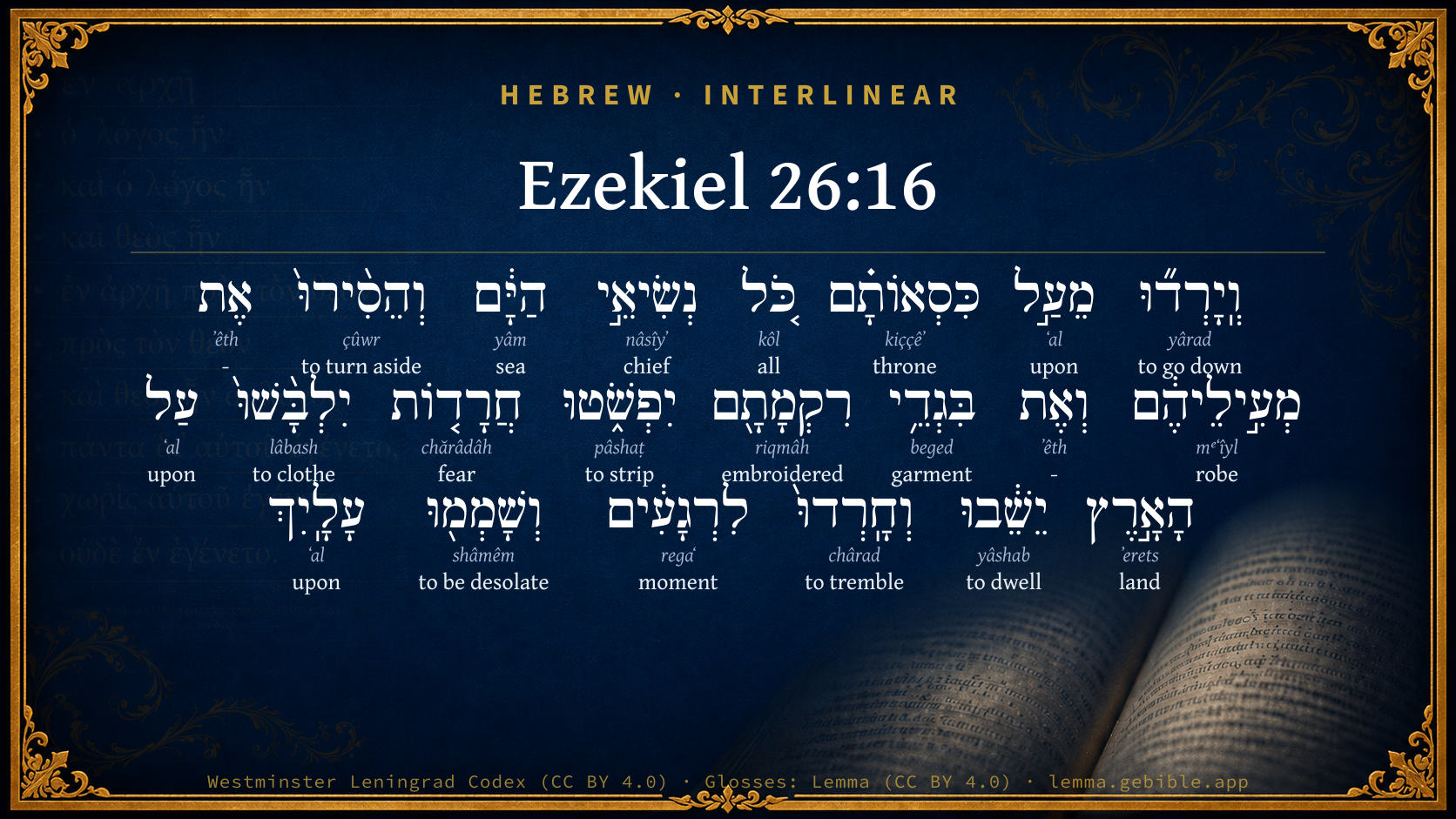
Ezekiel 26:16

Hebrew (Westminster Leningrad Codex) Ezekiel 26:16 appears in the Hebrew Old Testament. The text above is from the Westminster Leningrad Codex. Each word links to its Strong’s number, a concise gloss, and parsing drawn from the Open Scriptures Hebrew Bible morphology. Click any word for its full Brown-Driver-Briggs (BDB) entry.
Download image
Cite this verse

Ezekiel 26:16 (World English Bible). Public Domain. Lemma interlinear Bible study tool, https://lemma.gebible.app/v/ezekiel/26/16.

Show BibTeX & RIS
BibTeX
RIS
English Translation
Then all the princes of the sea shall come down from their thrones, and lay aside their robes, and strip off their embroidered garments: they shall clothe themselves with trembling; they shall sit on the ground, and shall tremble every moment, and be astonished at you.
World English Bible · Public Domain
Download a study sheet

One document with this verse’s original text, its word-by-word gloss line, the meaning frame, cross-references with their text, attributed commentary, and full source and license credits — printable, and it pastes into notes with its structure intact.

This verse Autodidact and up

Study sheet (.html) Plain text (.txt)

A passage Seminary Student

Up to 50 verses in one chapter. A passage sheet keeps up to 6 commentary sources and 12 cross-references per verse, in the order this page ranks them, and says so on the sheet whenever that leaves anything out. Ask for a single verse and you get the Autodidact verse sheet above.

Everything on this page stays free to read, with no account — the sheet is a download of what is already on screen, not access to it.

Want to remove ads? Support Godless Engineer
Compare translations 3

The same verse in 3 English versions, stacked beneath the original-language interlinear above. Click any original word for its lexicon entry.

Each is an independent rendering of the whole verse — the interlinear is not word-aligned to these translations.

Highlighted words mark where these versions differ — a whole-verse word diff, not a word-by-word alignment.

  • World English Bible Public Domain
    Then all the princes of the sea shall come down from their thrones, and lay aside their robes, and strip off their embroidered garments: they shall clothe themselves with trembling; they shall sit on the ground, and shall tremble every moment, and be astonished at you.
  • King James Version Public Domain
    Then all the princes of the sea shall come down from their thrones, and lay away their robes, and put off their broidered garments: they shall clothe themselves with trembling; they shall sit upon the ground, and shall tremble at every moment, and be astonished at thee.
  • unfoldingWord Literal Text CC BY-SA 4.0
    Then all the princes of the sea will step down from their thrones and remove their robes and cast off their embroidered garments. They will clothe themselves with trembling, they will sit on the ground and tremble every moment, and they will be appalled because of you.

unfoldingWord Literal Text — © unfoldingWord, licensed CC BY-SA 4.0. Word-aligned USFM3 via Door43 (git.door43.org/unfoldingWord/en_ult).

Versions to compare (up to 4)

3 of 4 selected

Show all 18 translations

Every available English version of this verse, each an independent rendering of the whole verse.

  • World English Bible Public Domain
    Then all the princes of the sea shall come down from their thrones, and lay aside their robes, and strip off their embroidered garments: they shall clothe themselves with trembling; they shall sit on the ground, and shall tremble every moment, and be astonished at you.
  • Berean Standard Bible Public Domain
    All the princes of the sea will descend from their thrones, remove their robes, and strip off their embroidered garments. Clothed with terror, they will sit on the ground, trembling every moment, appalled over you.
  • Majority Standard Bible Public Domain
    All the princes of the sea will descend from their thrones, remove their robes, and strip off their embroidered garments. Clothed with terror, they will sit on the ground, trembling every moment, appalled over you.
  • King James Version Public Domain
    Then all the princes of the sea shall come down from their thrones, and lay away their robes, and put off their broidered garments: they shall clothe themselves with trembling; they shall sit upon the ground, and shall tremble at every moment, and be astonished at thee.
  • American Standard Version (1901) Public Domain
    Then all the princes of the sea shall come down from their thrones, and lay aside their robes, and strip off their broidered garments: they shall clothe themselves with trembling; they shall sit upon the ground, and shall tremble every moment, and be astonished at thee.
  • Revised Version (1885) Public Domain
    Then all the princes of the sea shall come down from their thrones, and lay aside their robes, and strip off their broidered garments: they shall clothe themselves with trembling; they shall sit upon the ground, and shall tremble every moment, and be astonished at thee.
  • Geneva Bible (1599) Public Domain
    Then all the princes of the sea shall come downe from their thrones: they shall lay away their robes, and put off their broydered garments, and shall clothe themselues with astonishment: they shall sitte vpon the ground, and be astonished at euery moment, and be amased at thee.
  • Douay-Rheims (1899) Public Domain
    Then all the princes of the sea shall come down from their thrones: and take off their robes, and cast away their broidered garments, and be clothed with astonishment: they shall sit on the ground, and with amazement shall wonder at thy sudden fall.
  • Young's Literal Translation Public Domain
    And come down from off their thrones have all princes of the sea, And they have turned aside their robes, And their embroidered garments strip off, Trembling they put on, on the earth they sit, And they have trembled every moment, And they have been astonished at thee,
  • Literal Standard Version CC BY-SA 4.0
    And all princes of the sea have come down from off their thrones, || And they have turned their robes aside, || And strip off their embroidered garments, || They put on trembling, || They sit on the earth, || And they have trembled every moment, || And they have been astonished at you,
  • Unlocked Literal Bible CC BY-SA 4.0
    Then all the princes of the sea will step down from their thrones and remove their robes and cast off their embroidered garments. They will clothe themselves with trembling, they will sit on the ground and tremble every moment, and they will be appalled because of you.
  • unfoldingWord Literal Text CC BY-SA 4.0
    Then all the princes of the sea will step down from their thrones and remove their robes and cast off their embroidered garments. They will clothe themselves with trembling, they will sit on the ground and tremble every moment, and they will be appalled because of you.
  • Darby Bible Public Domain
    And all the princes of the sea shall come down from their thrones, and lay aside their robes, and put off their broidered garments: they shall clothe themselves with trembling, they shall sit upon the ground, and shall tremble [every] moment, and be astonied because of thee.
  • World Messianic Bible Public Domain
    Then all the princes of the sea will come down from their thrones, and lay aside their robes, and strip off their embroidered garments. They will clothe themselves with trembling. They will sit on the ground, and will tremble every moment, and be astonished at you.
  • Webster's Bible Public Domain
    Then all the princes of the sea shall come down from their thrones, and lay away their robes, and put off their broidered garments: they shall clothe themselves with trembling; they shall sit upon the ground, and shall tremble at every moment, and be astonished at thee.
  • Free Bible Version CC BY-SA 4.0
    All the rulers of the coastlands will come down from their thrones, remove their royal robes, and take off their embroidered clothes. Instead they will be clothed with terror and sit on the ground, trembling the whole time, shocked at what's happened to you.
  • Bible in Basic English Public Domain
    Then all the rulers of the sea will come down from their high seats, and put away their robes and take off their clothing of needlework: they will put on the clothing of grief, they will take their seats on the earth, shaking with fear every minute and overcome with wonder at you.
  • JPS Tanakh (1917) Public Domain
    Then all the princes of the sea shall come down from their thrones, and lay away their robes, and strip off their richly woven garments; they shall clothe themselves with trembling; they shall sit upon the ground, and shall tremble every moment, and be appalled at thee.

Literal Standard Version (2020), Covenant Press — licensed CC BY-SA 4.0. Text via the HelloAO Bible API (eBible.org). Unlocked Literal Bible (unfoldingWord) — licensed CC BY-SA 4.0. Text via the HelloAO Bible API (eBible.org). unfoldingWord Literal Text — © unfoldingWord, licensed CC BY-SA 4.0. Word-aligned USFM3 via Door43 (git.door43.org/unfoldingWord/en_ult). Free Bible Version, Dr. Jonathan Gallagher — licensed CC BY-SA 4.0. Text via the HelloAO Bible API (eBible.org).

Word by word

More ways to search: Search by grammar → Find every occurrence → Compare this word →

Practice this passage: Drill this verse → Learn its vocabulary →

חֲרָד֤וֹת
chărâdâh
H2731
“fears”
Noun, Common, Feminine, Plural, Absolute
Part of Speech
Noun
Type
Common
Gender
Feminine
Number
Plural
State
Absolute
Full BDB Definition

Origin: from H2730

TWOT: 735b

fear, anxiety, quaking, trembling, (extreme) anxiety, anxious care - trembling, quaking - anxious care
  1. וְֽיָרְד֞וּ yârad H3381 “and · to go down” Conjunction + Verb, Qal, Sequential Perfect, 3rd Person, Common, Plural
  2. מֵעַ֣ל ʻal H5921 “from · upon” Preposition + Preposition
  3. כִּסְאוֹתָ֗ם kiççêʼ H3678 “thrones · their” Noun, Common, Masculine, Plural, Construct + Suffix, Personal, 3rd Person, Masculine, Plural
  4. כֹּ֚ל kôl H3605 “all of” Noun, Common, Masculine, Singular, Construct
  5. נְשִׂיאֵ֣י nâsîyʼ H5387 “chiefs of” Noun, Common, Masculine, Plural, Construct
  6. הַיָּ֔ם yâm H3220 “the · sea” Particle, Definite Article + Noun, Common, Masculine, Singular, Absolute
  7. וְהֵסִ֨ירוּ֙ çûwr H5493 “and · to turn aside” Conjunction + Verb, Hiphil, Sequential Perfect, 3rd Person, Common, Plural
  8. אֶת ʼêth H853 “-” Particle, Direct Object
  9. מְעִ֣ילֵיהֶ֔ם mᵉʻîyl H4598 “robes · their” Noun, Common, Masculine, Plural, Construct + Suffix, Personal, 3rd Person, Masculine, Plural
  10. וְאֶת ʼêth H853 “and · -” Conjunction + Particle, Direct Object
  11. בִּגְדֵ֥י beged H899 “garments of” Noun, Common, Masculine, Plural, Construct
  12. רִקְמָתָ֖ם riqmâh H7553 “embroidered · their” Noun, Common, Feminine, Singular, Construct + Suffix, Personal, 3rd Person, Masculine, Plural
  13. יִפְשֹׁ֑טוּ pâshaṭ H6584 “to strip” Verb, Qal, Imperfect, 3rd Person, Masculine, Plural
  14. יִלְבָּ֨שׁוּ֙ lâbash H3847 “to clothe” Verb, Qal, Imperfect, 3rd Person, Masculine, Plural
  15. עַל ʻal H5921 “upon” Preposition
  16. הָאָ֣רֶץ ʼerets H776 “the · land” Particle, Definite Article + Noun, Common, Both, Singular, Absolute
  17. יֵשֵׁ֔בוּ yâshab H3427 “to dwell” Verb, Qal, Imperfect, 3rd Person, Masculine, Plural
  18. וְחָֽרְדוּ֙ chârad H2729 “and · to tremble” Conjunction + Verb, Qal, Sequential Perfect, 3rd Person, Common, Plural
  19. לִרְגָעִ֔ים regaʻ H7281 “to/for · moments” Preposition + Noun, Common, Masculine, Plural, Absolute
  20. וְשָׁמְמ֖וּ shâmêm H8074 “and · to be desolate” Conjunction + Verb, Qal, Sequential Perfect, 3rd Person, Common, Plural
  21. עָלָֽיִךְ ʻal H5921 “upon · you” Preposition + Suffix, Personal, 2nd Person, Feminine, Singular

About this verse

These counts appear in no published source. They are computed here, from the morphology-tagged text and Lemma’s own curated glosses. What Lemma adds →

22
words
19
distinct lemmas
Prophets
section

Notable vocabulary

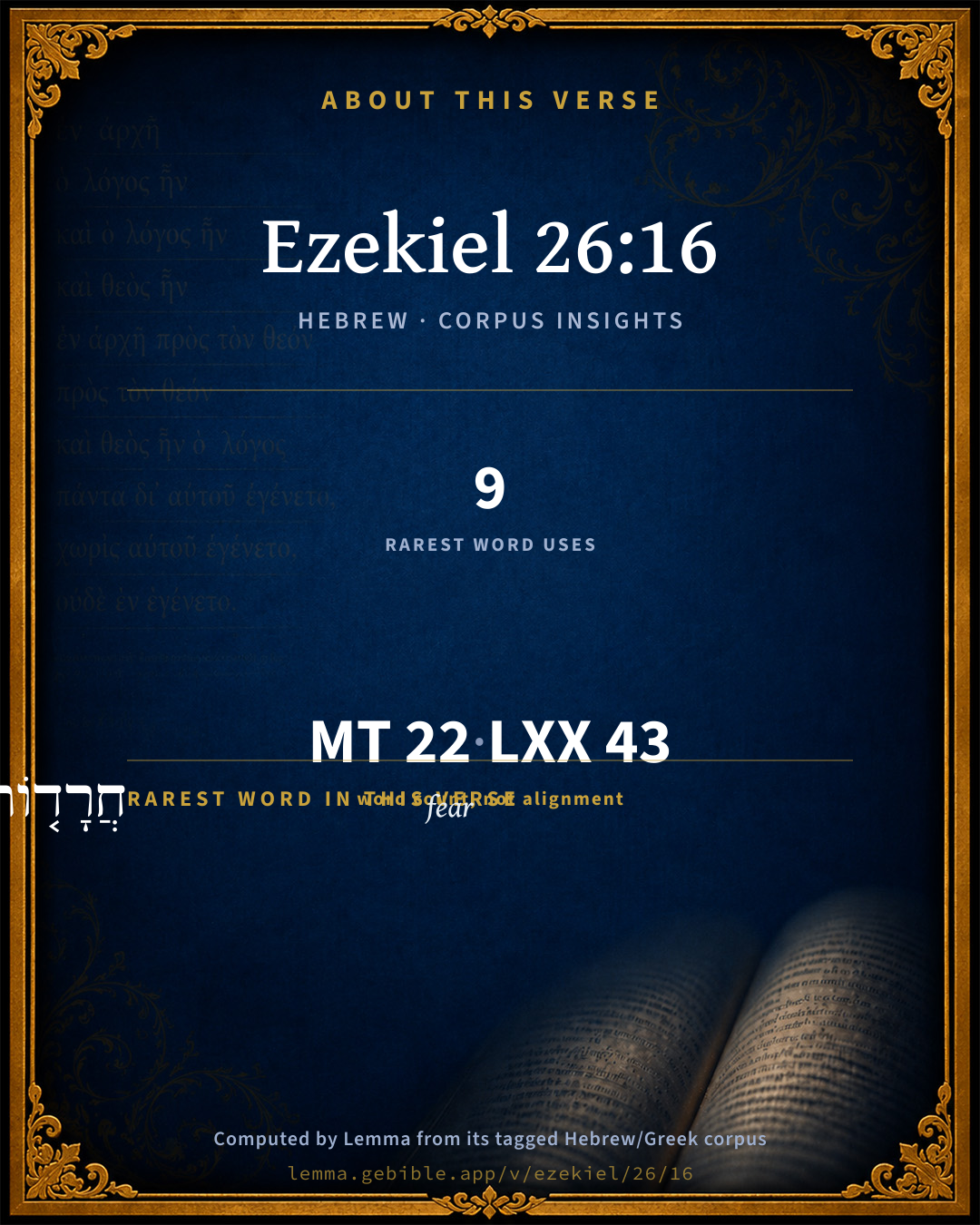
The rarest word here is חֲרָד֤וֹת fear H2731 — appearing just 9 times in the whole Hebrew Bible.

Shared distinctive vocabulary

חֲרָד֤וֹת fear H2731 occurs in 8 verses of the Hebrew Bible. Also found in:

Grammatical profile

  • 7 verbs
  • 10 nouns
  • 3 prepositions
  • 2 particles

Verb forms

  • וְֽיָרְד֞וּ Qal · Sequential Perfect
  • וְהֵסִ֨ירוּ֙ Hiphil · Sequential Perfect
  • יִפְשֹׁ֑טוּ Qal · Imperfect
  • יִלְבָּ֨שׁוּ֙ Qal · Imperfect
  • יֵשֵׁ֔בוּ Qal · Imperfect
  • וְחָֽרְדוּ֙ Qal · Sequential Perfect
  • וְשָׁמְמ֖וּ Qal · Sequential Perfect

Repetition

A word recurs within this verse — often emphatic in Hebrew:

  • מֵעַ֣ל upon H5921 ×3

Hebrew & Septuagint length

In English translation the verse runs 46 words from the Hebrew and 53 from the Septuagint (LXX English) — closely comparable.

A rough comparison of the two English renderings, which tokenize alike — not a word-level alignment.

Word counts can differ between the Hebrew and the Greek without any difference in meaning — e.g. the Hebrew direct-object marker אֵת has no separate Greek word, and Greek often adds the article ὁ.

In the original languages it is 22 Hebrew tokens and 43 Greek tokens — but the two are counted differently (Hebrew bundles its prefixes and suffixes into one token; the Greek is in lemma form), so that isn’t a like-for-like length.

Cross-references

23

Topical passages linked to Ezekiel 26:16 in the Treasury of Scripture Knowledge — connected by theme and wording, ordered by reader-vote popularity; previews shown in the World English Bible.

  • Ezekiel 32:10 Yes, I will make many peoples amazed at you, and their kings shall be horribly afraid for you, when I shall brandish my sword before them; and they shall tremble at every moment, every man for his own life, in the day of your fall.
  • Job 8:22 Those who hate you shall be clothed with shame. The tent of the wicked shall be no more."
  • Hosea 11:10 They will walk after Yahweh, Who will roar like a lion; For he will roar, and the children will come trembling from the west.
  • Jonah 3:6 The news reached the king of Nineveh, and he arose from his throne, and took off his royal robe, covered himself with sackcloth, and sat in ashes.
  • Psalms 35:26 Let them be disappointed and confounded together who rejoice at my calamity. Let them be clothed with shame and dishonor who magnify themselves against me.
  • Isaiah 3:26 Her gates shall lament and mourn; And she shall be desolate and sit on the ground.
  • 1 Peter 5:5 Likewise, you younger ones, be subject to the elder. Yes, all of you gird yourselves with humility, to subject yourselves to one another; for "God resists the proud, but gives grace to the humble."
  • Exodus 15:15 Then the chiefs of Edom were dismayed. Trembling takes hold of the mighty men of Moab. All the inhabitants of Canaan are melted away.
  • Exodus 33:4–5 When the people heard this evil news, they mourned: and no one put on his jewelry.
  • Job 2:12–13 When they lifted up their eyes from a distance, and didn't recognize him, they raised their voices, and wept; and they each tore his robe, and sprinkled dust on their heads toward the sky.
  • Psalms 109:18 He clothed himself also with cursing as with his garment. It came into his inward parts like water, Like oil into his bones.
  • Psalms 109:29 Let my adversaries be clothed with dishonor. Let them cover themselves with their own shame as with a robe.
  • Psalms 132:18 I will clothe his enemies with shame, But on himself, his crown will be resplendant."
  • Isaiah 14:9–13 Sheol from beneath is moved for you to meet you at your coming; it stirs up the dead for you, even all the chief ones of the earth; it has raised up from their thrones all the kings of the nations.
  • Isaiah 23:1–8 The burden of Tyre. Howl, you ships of Tarshish; for it is laid waste, so that there is no house, no entering in: from the land of Kittim it is revealed to them.
  • Isaiah 47:1 Come down, and sit in the dust, virgin daughter of Babylon; sit on the ground without a throne, daughter of the Chaldeans: for you shall no more be called tender and delicate.
  • Isaiah 52:2 Shake yourself from the dust; arise, sit [on your throne], Jerusalem: loose yourself from the bonds of your neck, captive daughter of Zion.
  • Lamentations 2:10 The elders of the daughter of Zion sit on the ground, they keep silence; They have cast up dust on their heads; they have girded themselves with sackcloth: The virgins of Jerusalem hang down their heads to the ground.
  • Ezekiel 7:8 Now will I shortly pour out my wrath on you, and accomplish my anger against you, and will judge you according to your ways; and I will bring on you all your abominations.
  • Ezekiel 27:29–36 All who handled the oar, the mariners, [and] all the pilots of the sea, shall come down from their ships; they shall stand on the land,
  • Ezekiel 32:21–32 The strong among the mighty shall speak to him out of the midst of Sheol with those who help him: they are gone down, they lie still, even the uncircumcised, slain by the sword.
  • Daniel 5:6 Then the king's face was changed in him, and his thoughts troubled him; and the joints of his loins were loosened, and his knees struck one against another.
  • Revelation 18:11–19 The merchants of the earth weep and mourn over her, for no one buys their merchandise any more;

Cross-references courtesy of OpenBible.info (CC BY 4.0).

Hebrew and Greek witnesses Masoretic Hebrew ↔ Greek Septuagint

The same verse in the two great witnesses to the Old Testament, shown verse-for-verse.

These are two independent witnesses, not word-aligned to each other, and the Septuagint is shown in lemma (dictionary) form.

Hebrew Ezekiel 26:16 Masoretic · Westminster Leningrad Codex

וְֽיָרְד֞וּ מֵעַ֣ל כִּסְאוֹתָ֗ם כֹּ֚ל נְשִׂיאֵ֣י הַיָּ֔ם וְהֵסִ֨ירוּ֙ אֶת מְעִ֣ילֵיהֶ֔ם וְאֶת בִּגְדֵ֥י רִקְמָתָ֖ם יִפְשֹׁ֑טוּ חֲרָד֤וֹת יִלְבָּ֨שׁוּ֙ עַל הָאָ֣רֶץ יֵשֵׁ֔בוּ וְחָֽרְדוּ֙ לִרְגָעִ֔ים וְשָׁמְמ֖וּ עָלָֽיִךְ

Then all the princes of the sea shall come down from their thrones, and lay aside their robes, and strip off their embroidered garments: they shall clothe themselves with trembling; they shall sit on the ground, and shall tremble every moment, and be astonished at you.

World English Bible · Public Domain

Greek LXX Ezekiel 26:16 Septuagint · lemma form

καί καταβαίνω ἀπό ὁ θρόνος αὐτός πᾶς ὁ ἄρχων ἐκ ὁ ἔθνος ὁ θάλασσα καί ἀποαἱρέω ὁ μίτρα ἀπό ὁ κεφαλή αὐτός καί ὁ ἱματισμός ὁ ποικίλος αὐτός ἐκδύω ἔκστασις ἐκἵστημι ἐπί γῆ καταἕζομαι καί φοβέω ὁ ἀπώλεια αὐτός καί στενάζω ἐπί σύ

And all the princes of the nations of the sea shall come down from their thrones, and shall take off their crowns from their heads, and shall take off their embroidered raiment: they shall be utterly amazed; they shall sit upon the ground, and fear their own destruction, and shall groan over you.

LXX2012 (modern English Septuagint) · Public Domain

On this verse, John Gill's Exposition discusses the Septuagint’s reading. Read the note in Commentary ↓

Hebrew: Westminster Leningrad Codex (CC BY 4.0). Greek: Septuagint (public domain); English from LXX2012 (modern English Septuagint) (Public Domain). How the Septuagint differs from the Hebrew →

Targum (Aramaic paraphrase)

1

The Targum is the ancient Jewish Aramaic paraphrase of the Hebrew Scriptures — an interpretive translation, not the Hebrew text itself. Onkelos (literal) and Pseudo-Jonathan (expansive) render the Torah, and Jonathan the Prophets. Coverage is partial: where no permissively-licensed English translation exists for a verse, only the Aramaic is shown. This is verse-level text, not a word-by-word alignment to the Hebrew.

  1. Targum Jonathan Prophets (Joshua–Malachi)
    וְיֶחֱתוּן מֵעַל כּוּרְסְוָתֵיהוֹן כָּל רַבְרְבֵי יַמָא וְיַעְדוּן יַת מְעִילֵיהוֹן וְיַת לְבוּשֵׁי צִיוּרֵיהוֹן יַשְׁלְחוּן זְיַע יִלְבְּשׁוּן עַל אַרְעָא יַתְבוּן וִיזוּעוּן מִן קֳדָם תְּבִירֵיהוֹן וְיִצְדוּן עֲלָךְ:

    (no public-domain English translation for this verse)

    Targum Jonathan — Aramaic: “Mikraot Gedolot” (public domain). English: “Sefaria Community Translation” (CC0 1.0 (public-domain dedication)); “London "Chaldee Paraphrase," 1871” (public domain). Text via Sefaria.

Commentary

Notes on Ezekiel 26:16 from classic Christian and Jewish commentators (each source and its license shown beneath its notes). The classic Christian expositions comment on the surrounding passage and are grouped to its opening verse, so a note may address several verses; the Jewish commentaries on the Tanakh (Rashi and others) are per-verse, so they appear only where the commentator wrote on this verse.

Lemma curates 59 commentaries, every one of them public domain or Creative Commons licensed, each selected and text-cleaned for this edition rather than reprinted as found. About our sources →

Trapp's Complete Commentary

John Trapp

Eze 26:16 Then all the princes of the sea shall come down from their thrones, and lay away their robes, and put off their broidered garments: they shall clothe themselves with trembling; they shall sit upon the ground, and shall tremble at [every] moment, and be astonished at thee.

Ver. 16. All the princes of the sea,] i.e., Of the neighbouring islands.

Clothe themselves with trembling.] Luth., With mourning.

John Trapp, A Commentary or Exposition upon All the Books of the Old and New Testament (1647–1656) — public domain. Text from a community e-Sword module.

Geneva Bible (1599)

Geneva Bible translators

The governors and rulers of other countries that dwell by the sea: whereby he signifieth that her destruction should be so horrible, that all the world should hear thereof and be afraid.

Geneva Bible (1599) marginal notes — public domain. Text via Bolls.life.

Jamieson, Fausset & Brown

Robert Jamieson, A. R. Fausset & David Brown

come down from their thrones . . . upon the ground--"the throne of the mourners" (Job 2:13; Jon 3:6).

princes of the sea--are the merchant rulers of Carthage and other colonies of Tyre, who had made themselves rich and powerful by trading on the sea (Isa 23:8).

clothe . . . with trembling--Hebrew, "tremblings." Compare Eze 7:27, "clothed with desolation"; Psa 132:18. In a public calamity the garment was changed for a mourning garb.

Jamieson, Fausset & Brown — Commentary Critical and Explanatory on the Whole Bible (1871) — public domain (CC PDM 1.0). Text via the HelloAO Bible API.

Adam Clarke's Commentary

Verse 16. The princes of the sea] The chief maritime states, such as Leptis, Utica, Carthage, Gades, &c. See Calmet.

Adam Clarke's Commentary on the Bible (1810–1826) — public domain. Text from a community e-Sword/MySword module.

Ellicott's Commentary for English Readers

(16) Princes of the sea.—Or, as we should say, merchant princes. (Comp. Isa_23:8.) Actual sovereigns are not meant, but those raised by commerce to wealth and power. Their astonishment and grief is poetically described under the figure of the customs of Oriental mourning. (Comp. Jon_3:6.) “Thrones” should rather be translated seats, as in Jdg_3:20; 1Sa_1:9; 1Sa_4:13; 1Sa_4:18.

A Bible Commentary for English Readers, edited by Charles John Ellicott (1878–1897) — public domain. Text from a community e-Sword module.

The Cambridge Bible for Schools and Colleges

gen. ed. J. J. S. Perowne

16. In token of mourning the princes of the sea, the rulers of the principalities and cities on all sea, coasts, shall descend from their thrones, lay aside their royal robes and sit on the ground (Lam_2:10).

clothe themselves] Or, be clothed, i.e. be enveloped in, be wholly tremblings; cf. Eze_7:27.

The Cambridge Bible for Schools and Colleges (gen. ed. J. J. S. Perowne; Cambridge University Press, 1878–1918) — public domain. Text from a community e-Sword module.

John Gill's Exposition

Then all the princes of the sea shall come down from their thrones,.... The kings of the islands of the sea shall lay aside their regalia, all their royal grandeur, and the ensigns of it; leave their thrones of state, and sit in an humble posture:

and lay away their robes, and put off their broidered garments; their royal robes and raiment of needlework curiously embroidered, and richly wrought, such as princes wear; so did the king of Nineveh in token of humiliation, Jon 3:6. The Septuagint and Arabic versions understand the first clause of their taking their mitres, or diadems, from their heads:

they shall clothe themselves with trembling; they shall tremble from head to foot in every joint, as if they were covered with it, as with a garment; or, being clothed with sackcloth, as mourners used to be, shall shake and tremble, being used to other and better clothing:

they shall sit upon the ground; as Job did, and his friends, with dust and ashes on their heads, as persons in distress were wont to do, Job 2:8,

and shall tremble at every moment; continually, every hour, minute, and moment of the day: or, "at the breaches" (o); so Jarchi; that is, those made upon Tyre; fearing lest the same should be made upon them; so the Targum, "because of their breaches"; or at the ruin and destruction they fear will be their case also:

and be astonished at thee; that a city so wealthy and mighty should be brought so low; see Rev 18:9.

(o) "super repentino casu suo", V. L.

John Gill's Exposition of the Whole Bible (1746–1763) — public domain (CC PDM 1.0). Text via the HelloAO Bible API.

Haydock's Catholic Bible Commentary

CHAPTER XXVI.

Sea: colonies, or tributary to Tyre, ver. 8. (Haydock) --- Leptis, Utica, Carthage,and Cadiz, were founded by Tyrians. (Pliny, [Natural History?] v. 19.) --- Some pretend that these cities were attacked by the conquerors, for manifesting their grief. See Josephus, Antiquities x.; Pineda, &c. --- But we shall not here follow conjectures. --- Astonishment. Hebrew, "troubles," or mourning. (Calmet)

George Leo Haydock (1774–1849), Haydock's Catholic Family Bible and Commentary, 1859 edition — public domain. Excludes Psalms (Douay-Rheims chapter numbering differs from Protestant) and Deuterocanonical books (Catholic canon only).

Matthew Poole's English Annotations

The princes of the sea; who were lords of the islands in that sea, and who traded with Tyrus, and there were many such; or sea commanders, who, in their wooden world, are so many petty princes; but rather the former, the crowned heads whose kingdoms were so many islands.

Come down from their thrones, in token of sadness and condolence.

Lay away their robes, as further sign of grief.

Put off their broidered garments: this is added also to show how greatly they were affected with sorrow at this sad fall of their ally and friend.

Clothe themselves with trembling: this laying aside of their gallantry shall not be in compliment, as now in such cases of condolence, but they shall be heartily afraid of their own concerns, and astonished in the midst of their fears.

Matthew Poole's English Annotations on the Holy Bible (1683–1685) — public domain. Text from a community e-Sword/MySword module.

The Pulpit Commentary

The princes of the sea are not the kings of the isles, but the merchant-princes of the city. (Isa_23:8) They shall lay aside their robes of state Tyrian purple embroidered with gold and silver and shall put on the garments of mourners. Jon_3:6 presents an interesting parallel. The word thrones is used, as in 1Sa_4:13, for any chair of state, as that of priest or judge (Pro_9:14; Est_3:1) as well as for the specifically kingly throne. For the, most part, however, the later meaning is dominant.

The princes of the sea.

The Tyrians were a seafaring people on a large scale. Unlike the poor Philistines, who did not go beyond the fisherman"s simple toil, those adventurers swept the Mediterranean with their fleets, and even ventured to distant shores of the Atlantic. They had the advantages and the evils of a great maritime nation.

I THE PRINCES OF THE SEA GATHERED RICHES, The merchants of Tyre were princes. Wealth was got by industry, daring, and enterprise. Thus the Tyrians anticipated the good fortune of the English. Prosperity is not often won except by means of energy and adventure. When the spirit that urges on daring attempts is enervated by luxury, the success that it once achieved is surely doomed. It is happy when that spirit is transformed into a higher character, and seeks for better returns than bales of merchandise. We cannot but feel that the voyages of the Beagle and the Challenger are nobler in this respect, as their aim was to gather treasures of knowledge. But better still is it when the command of the waters is used for the promotion of peace, the extension of liberty, and the check of the slave trade, and above all, the propagation of Christianity.

II THE PRINCES OF THE SEA UNITED RACES. In ancient times the Tyrians were the great link of connection between the East and the West. Through them the venerable civilization of Asia woke up the genius of Europe, as yet slumbering in unconscious barbarism. Tyre gave the alphabet to Europe. Thus she laid the foundation of Greek culture and started European literature on its wonderful course. She gave more than she took. Immense and untold good comes from the peaceful inter-communication of races.

III THE PRINCES OF THE SEA RAN GREAT RISKS. They trusted their wealth to the treacherous waves. The Merchant of Venice finds himself beggared by unexpected calamities. The greatest wealth is usually won by the most uncertain means, i.e. by foreign trade and home speculation. This is a warning to the prosperous not to put their trust in riches which so easily take wings and fly away. The fate of Tyre should drive us further to seek those better riches in the heavenly treasury, where neither moth nor rust corrupt, nor thieves break through and steal. (Mat_6:20) If even the princes of the sea were ruined, who can be satisfied to rest in the greatest earthly success?

IV THE PRINCES OF THE SEA LIVED LOW LIVES. Princes they were, but not saints. Their mercenary character was not hidden by all the splendor of their surroundings. In their gorgeous palaces, among their well-stocked bazaars, with their heavy-laden ships on many waters, they were the cynosure of every eye. Yet in God"s sight they were "miserable, and blind, and naked," for they were but mammon-worshippers. More enlightened than the Tyrian merchants, Englishmen will be guilty of greater sin and folly if they fall down and worship the same image of gold.

The Pulpit Commentary (1880–1919), ed. H.D.M. Spence-Jones & Joseph S. Exell — public domain. Text from a community e-Sword module.

John Wesley's Explanatory Notes

The princes - Who were lords of the islands of that sea. Come down - In token of condolence. Trembling - They shall be afraid of their own concerns, and astonished in the midst of their fears.

John Wesley, Explanatory Notes Upon the Whole Bible (1754–1765) — public domain. Text via the GEBible commentary corpus.

Rashi

Rabbi Shlomo Yitzchaki (Rashi)

and they will tremble for [fear of] destruction [Heb. לִרְגָעִים,] for fear of destruction, lest it befall them like your destruction.

לִרְגָעִים as is an expression of breaking, like (Isa. 51:15): “Who splits (ַרוֹגַע) the sea;” (Job 7:5), “my skin split (רָגַע);” (Ps. 35:20), “and against the crushed people of (רִגְעֵי) the earth,” [synonymous with] דִכְּאֵי “the crushed people of the earth.” Menachem, however, explained it (p. 162) in the sense of רֶגַע, a moment, as in (Ps. 30:6): “For His wrath lasts but a moment (רֶגַע).”

and will be appalled [Heb. וְשָּׁמְמוּ,] an expression of bewilderment.

Rashi on the Tanakh — English translations: “The Judaica Press complete Tanach with Rashi, translated by A. J. Rosenberg” (CC BY 4.0); “Pentateuch with Rashi's commentary by M. Rosenbaum and A.M. Silbermann, 1929-1934” (public domain); “The Metsudah Tanach series, Lakewood, N.J” (CC BY 4.0); and “The Book of Joshua, Metsudah Publications, 1997” (CC BY 4.0). Text via Sefaria.

Lesson kit

Teaching starters — assembled from the data on this page, not authored interpretation. Every prompt links to the verse data it draws on. Edit before teaching.

Ezekiel, in the Prophets, opens this verse with 22 words (19 distinct Hebrew lemmas). Its most distinctive word is chărâdâh (“fear”). A historical commentator’s framing appears above. Read the whole chapter for the surrounding context.

Discussion questions

  1. What does “fear” (chărâdâh) contribute to the verse as a whole?
  2. Genesis 27:33 shares the word «fear» with this verse. How do the two illuminate each other?
  3. “upon” occurs 3× in this one verse. What is the effect of the repetition?
  4. These translations render this verse differently. What is at stake in choosing one wording over another?
  5. The verb «וְֽיָרְד֞וּ» is Qal Sequential Perfect. How does its form color the action?
  6. Reading how Trapp's Complete Commentary and Geneva Bible (1599) read this verse, where do the two commentators agree and where do they part?

Things to notice

Reading settings

Reading text

Shown beneath each verse's original-language words.

Old Testament
Old Testament edition

Read the OT as the Masoretic Hebrew (MT) or the Greek Septuagint (LXX).

English shown for the Greek Septuagint (in the Hebrew ↔ Greek comparison).

Comparing translations? Open the Compare panel on any verse page to stack up to four side by side.