
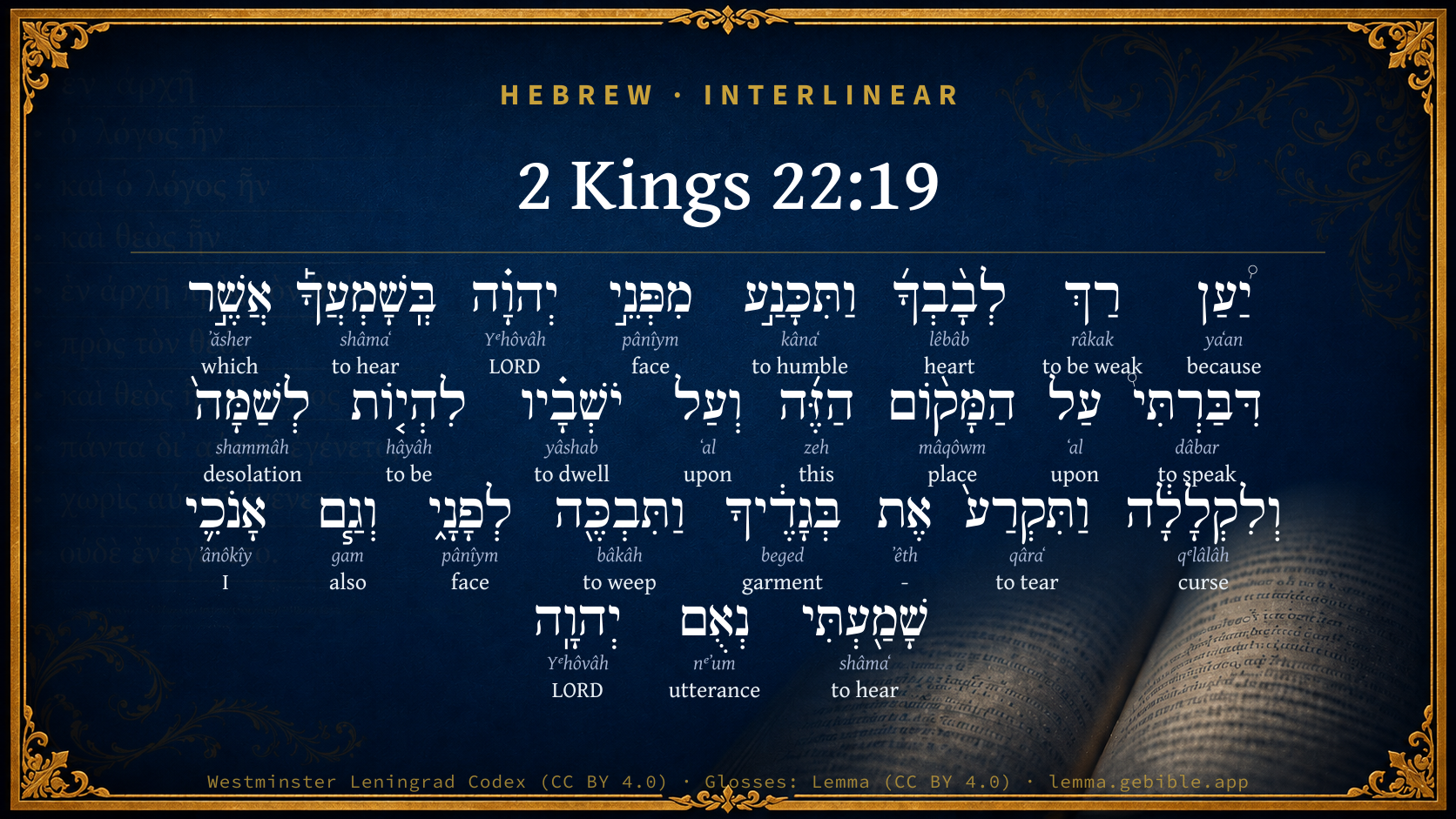
2 Kings 22:19

Hebrew (Westminster Leningrad Codex) 2 Kings 22:19 appears in the Hebrew Old Testament. The text above is from the Westminster Leningrad Codex. Each word links to its Strong’s number, a concise gloss, and parsing drawn from the Open Scriptures Hebrew Bible morphology. Click any word for its full Brown-Driver-Briggs (BDB) entry.
Download image
Cite this verse

2 Kings 22:19 (World English Bible). Public Domain. Lemma interlinear Bible study tool, https://lemma.gebible.app/v/2-kings/22/19.

Show BibTeX & RIS
BibTeX
RIS
English Translation
because your heart was tender, and you did humble yourself before Yahweh, when you heard what I spoke against this place, and against the inhabitants of it, that they should become a desolation and a curse, and have torn your clothes, and wept before me; I also have heard you, says Yahweh.
World English Bible · Public Domain
Download a study sheet

One document with this verse’s original text, its word-by-word gloss line, the meaning frame, cross-references with their text, attributed commentary, and full source and license credits — printable, and it pastes into notes with its structure intact.

This verse Autodidact and up

Study sheet (.html) Plain text (.txt)

A passage Seminary Student

Up to 50 verses in one chapter. A passage sheet keeps up to 6 commentary sources and 12 cross-references per verse, in the order this page ranks them, and says so on the sheet whenever that leaves anything out. Ask for a single verse and you get the Autodidact verse sheet above.

Everything on this page stays free to read, with no account — the sheet is a download of what is already on screen, not access to it.

Want to remove ads? Support Godless Engineer
Compare translations 3

The same verse in 3 English versions, stacked beneath the original-language interlinear above. Click any original word for its lexicon entry.

Each is an independent rendering of the whole verse — the interlinear is not word-aligned to these translations.

Highlighted words mark where these versions differ — a whole-verse word diff, not a word-by-word alignment.

  • World English Bible Public Domain
    because your heart was tender, and you did humble yourself before Yahweh, when you heard what I spoke against this place, and against the inhabitants of it, that they should become a desolation and a curse, and have torn your clothes, and wept before me; I also have heard you, says Yahweh.
  • King James Version Public Domain
    Because thine heart was tender, and thou hast humbled thyself before the LORD, when thou heardest what I spake against this place, and against the inhabitants thereof, that they should become a desolation and a curse, and hast rent thy clothes, and wept before me; I also have heard thee, saith the LORD.
  • unfoldingWord Literal Text CC BY-SA 4.0
    “Because your heart is tender and you humbled yourself from the face of Yahweh when you heard what I spoke against this place and against its dwellers, that they would become a horror and a curse, and you tore your clothes and wept to my face, now I, I have also heard.” The declaration of Yahweh.

unfoldingWord Literal Text — © unfoldingWord, licensed CC BY-SA 4.0. Word-aligned USFM3 via Door43 (git.door43.org/unfoldingWord/en_ult).

Versions to compare (up to 4)

3 of 4 selected

Show all 18 translations

Every available English version of this verse, each an independent rendering of the whole verse.

  • World English Bible Public Domain
    because your heart was tender, and you did humble yourself before Yahweh, when you heard what I spoke against this place, and against the inhabitants of it, that they should become a desolation and a curse, and have torn your clothes, and wept before me; I also have heard you, says Yahweh.
  • Berean Standard Bible Public Domain
    because your heart was tender and you humbled yourself before the LORD when you heard what I spoke against this place and against its people, that they would become a desolation and a curse, and because you have torn your clothes and wept before Me, I have heard you,’ declares the LORD.
  • Majority Standard Bible Public Domain
    because your heart was tender and you humbled yourself before the LORD when you heard what I spoke against this place and against its people, that they would become a desolation and a curse, and because you have torn your clothes and wept before Me, I have heard you,’ declares the LORD.
  • King James Version Public Domain
    Because thine heart was tender, and thou hast humbled thyself before the LORD, when thou heardest what I spake against this place, and against the inhabitants thereof, that they should become a desolation and a curse, and hast rent thy clothes, and wept before me; I also have heard thee, saith the LORD.
  • American Standard Version (1901) Public Domain
    because thy heart was tender, and thou didst humble thyself before Jehovah, when thou heardest what I spake against this place, and against the inhabitants thereof, that they should become a desolation and a curse, and hast rent thy clothes, and wept before me; I also have heard thee, saith Jehovah.
  • Revised Version (1885) Public Domain
    because thine heart was tender, and thou didst humble thyself before the LORD, when thou heardest what I spake against this place, and against the inhabitants thereof, that they should become a desolation and a curse, and hast rent thy clothes, and wept before me; I also have heard thee, saith the LORD.
  • Geneva Bible (1599) Public Domain
    But because thine heart did melt, and thou hast humbled thy selfe before the Lord, when thou heardest what I spake against this place, and against the inhabitants of the same, to wit, that it should be destroyed and accursed, and hast rent thy clothes, and wept before me, I haue also heard it, saith the Lord.
  • Douay-Rheims (1899) Public Domain
    And thy heart hath been moved to fear, and thou hast humbled thyself before the Lord, hearing the words against this place, and the inhabitants thereof, to wit, that they should become a wonder and a curse: and thou hast rent thy garments, and wept before me, I also have heard thee, saith the Lord:
  • Young's Literal Translation Public Domain
    because thy heart `is' tender, and thou art humbled because of Jehovah, in thy hearing that which I have spoken against this place, and against its inhabitants, to be for a desolation, and for a reviling, and dost rend thy garments, and weep before Me -- I also have heard -- the affirmation of Jehovah --
  • Literal Standard Version CC BY-SA 4.0
    because your heart [is] tender, and you are humbled because of YHWH, in your hearing that which I have spoken against this place, and against its inhabitants, to be for a desolation, and for a reviling, and you tear your garments and weep before Me—I also have heard—a declaration of YHWH—
  • Unlocked Literal Bible CC BY-SA 4.0
    because your heart was tender, and because you have humbled yourself before Yahweh, when you heard what I said against this place and its inhabitants, that they would become a desolation and a curse, and because you have torn your clothes and wept before me, I also have listened to you—this is Yahweh's declaration.
  • unfoldingWord Literal Text CC BY-SA 4.0
    “Because your heart is tender and you humbled yourself from the face of Yahweh when you heard what I spoke against this place and against its dwellers, that they would become a horror and a curse, and you tore your clothes and wept to my face, now I, I have also heard.” The declaration of Yahweh.
  • Darby Bible Public Domain
    Because thy heart was tender, and thou didst humble thyself before Jehovah, when thou heardest what I spoke against this place and against the inhabitants thereof, that they should become a desolation and a curse, and didst rend thy garments and weep before me, I also have heard [thee], saith Jehovah.
  • World Messianic Bible Public Domain
    because your heart was tender, and you humbled yourself before the LORD when you heard what I spoke against this place and against its inhabitants, that they should become a desolation and a curse, and have torn your clothes and wept before me, I also have heard you,’ says the LORD.
  • Webster's Bible Public Domain
    Because thy heart was tender, and thou hast humbled thyself before the LORD, when thou heardest what I spoke against this place, and against its inhabitants, that they should become a desolation and a curse, and hast rent thy clothes, and wept before me; I also have heard thee, saith the LORD.
  • Free Bible Version CC BY-SA 4.0
    because you were receptive and repentant before God when you heard his warnings against this place and against its people—that would become desolate and a curse—and because you have torn your clothes and wept before me, I have also heard you, declares the Lord.
  • Bible in Basic English Public Domain
    Because your heart was soft, and you made yourself low before me, when you had word of what I said against this place and its people, that they would become a waste and a curse, and you gave signs of grief, weeping before me: truly, I have given ear to you, says the Lord.
  • JPS Tanakh (1917) Public Domain
    because thy heart was tender, and thou didst humble thyself before the LORD, when thou heardest what I spoke against this place, and against the inhabitants thereof, that they should become an astonishment and a curse, and hast rent thy clothes, and wept before Me, I also have heard thee, saith the LORD.

Literal Standard Version (2020), Covenant Press — licensed CC BY-SA 4.0. Text via the HelloAO Bible API (eBible.org). Unlocked Literal Bible (unfoldingWord) — licensed CC BY-SA 4.0. Text via the HelloAO Bible API (eBible.org). unfoldingWord Literal Text — © unfoldingWord, licensed CC BY-SA 4.0. Word-aligned USFM3 via Door43 (git.door43.org/unfoldingWord/en_ult). Free Bible Version, Dr. Jonathan Gallagher — licensed CC BY-SA 4.0. Text via the HelloAO Bible API (eBible.org).

Word by word

More ways to search: Search by grammar → Find every occurrence → Compare this word →

Practice this passage: Drill this verse → Learn its vocabulary →

רַךְ
râkak
H7401
“to be weak”
Verb, Qal, Perfect, 3rd Person, Masculine, Singular
Part of Speech
Verb
Stem
Qal
Form
Perfect
Person
3rd Person
Gender
Masculine
Number
Singular
Full BDB Definition

Origin: a primitive root

TWOT: 2164

to be tender, be soft, be weak - (Qal) - to be tender, be weak (of heart) - to be timid, be fearful - to be softened, be penitent - to be soft (of treacherous words) - (Pual) to be softened - (Hiphil) to cause to be weak - (Niphal) tender
  1. יַ֠עַן yaʻan H3282 “because” Conjunction
  2. לְבָ֨בְךָ֜ lêbâb H3824 “heart · your” Noun, Common, Masculine, Singular, Construct + Suffix, Personal, 2nd Person, Masculine, Singular
  3. וַתִּכָּנַ֣ע kânaʻ H3665 “and · to humble” Conjunction + Verb, Niphal, Sequential Imperfect, 2nd Person, Masculine, Singular
  4. מִפְּנֵ֣י pânîym H6440 “from · face(s) of” Preposition + Noun, Common, Both, Plural, Construct
  5. יְהוָ֗ה Yᵉhôvâh H3068 “LORD” Noun, Proper
  6. בְּֽשָׁמְעֲךָ֡ shâmaʻ H8085 “in/at · to hear · you” Preposition + Verb, Qal, Infinitive Construct + Suffix, Personal, 2nd Person, Masculine, Singular
  7. אֲשֶׁ֣ר ʼăsher H834 “which” Particle, Relative
  8. דִּבַּרְתִּי֩ dâbar H1696 “to speak” Verb, Piel, Perfect, 1st Person, Common, Singular
  9. עַל ʻal H5921 “upon” Preposition
  10. הַמָּק֨וֹם mâqôwm H4725 “the · place” Particle, Definite Article + Noun, Common, Masculine, Singular, Absolute
  11. הַזֶּ֜ה zeh H2088 “the · this” Particle, Definite Article + Pronoun, Demonstrative, Masculine, Singular
  12. וְעַל ʻal H5921 “and · upon” Conjunction + Preposition
  13. יֹשְׁבָ֗יו yâshab H3427 “dwelling · him” Verb, Qal, Participle Active, Masculine, Plural, Construct + Suffix, Personal, 3rd Person, Masculine, Singular
  14. לִהְי֤וֹת hâyâh H1961 “to be” Preposition + Verb, Qal, Infinitive Construct
  15. לְשַׁמָּה֙ shammâh H8047 “to/for · desolation” Preposition + Noun, Common, Feminine, Singular, Absolute
  16. וְלִקְלָלָ֔ה qᵉlâlâh H7045 “and · to/for · curse” Conjunction + Preposition + Noun, Common, Feminine, Singular, Absolute
  17. וַתִּקְרַע֙ qâraʻ H7167 “and · to tear” Conjunction + Verb, Qal, Sequential Imperfect, 2nd Person, Masculine, Singular
  18. אֶת ʼêth H853 “-” Particle, Direct Object
  19. בְּגָדֶ֔יךָ beged H899 “garments · your” Noun, Common, Masculine, Plural, Construct + Suffix, Personal, 2nd Person, Masculine, Singular
  20. וַתִּבְכֶּ֖ה bâkâh H1058 “and · to weep” Conjunction + Verb, Qal, Sequential Imperfect, 2nd Person, Masculine, Singular
  21. לְפָנָ֑י pânîym H6440 “to/for · face(s) · my” Preposition + Noun, Common, Both, Plural, Construct + Suffix, Personal, 1st Person, Common, Singular
  22. וְגַ֧ם gam H1571 “and · also” Conjunction + Particle, Accusative
  23. אָנֹכִ֛י ʼânôkîy H595 “I” Pronoun, Personal, 1st Person, Common, Singular
  24. שָׁמַ֖עְתִּי shâmaʻ H8085 “to hear” Verb, Qal, Perfect, 1st Person, Common, Singular
  25. נְאֻם nᵉʼum H5002 “utterance of” Noun, Common, Masculine, Singular, Construct
  26. יְהוָֽה Yᵉhôvâh H3068 “LORD” Noun, Proper

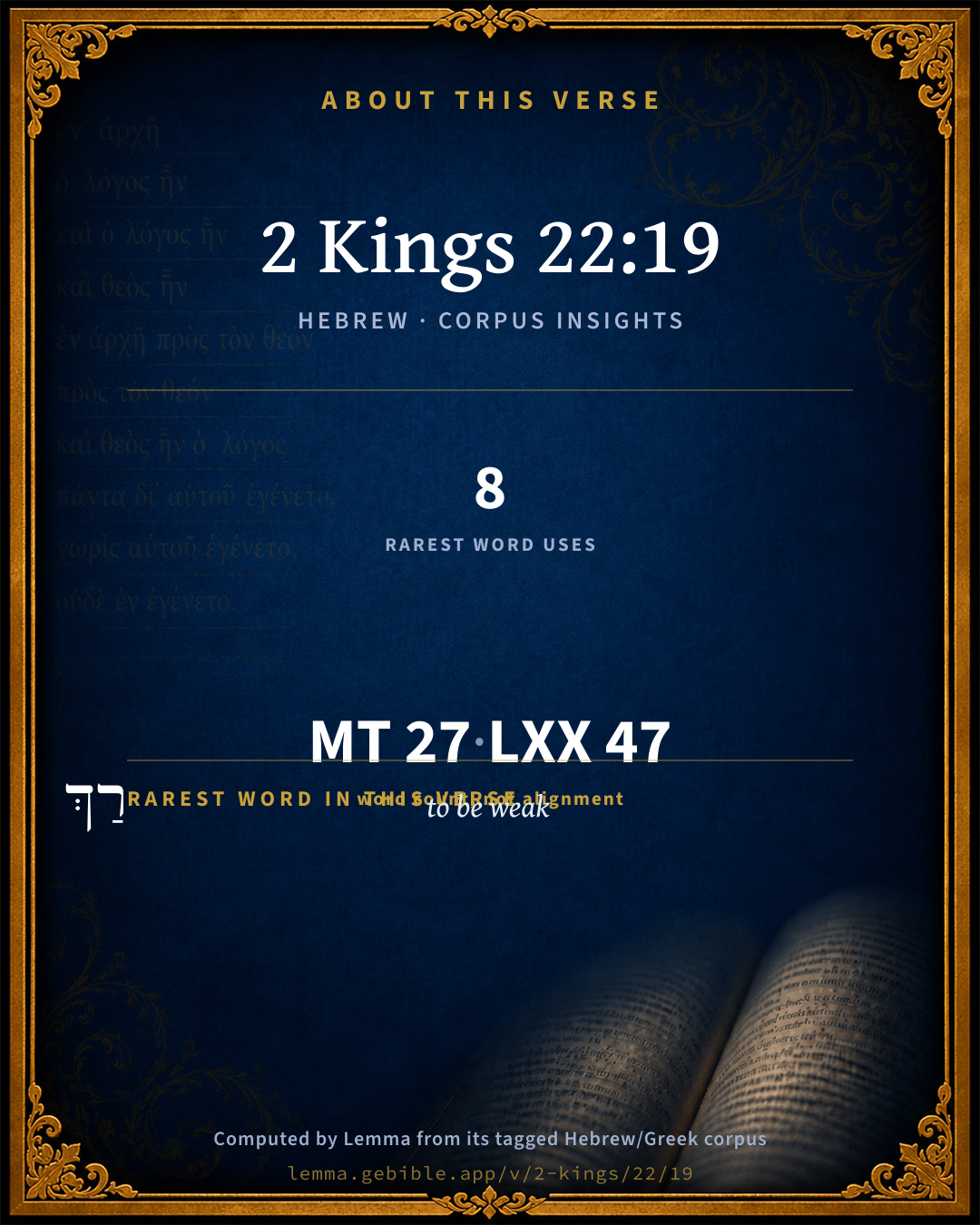
About this verse

These counts appear in no published source. They are computed here, from the morphology-tagged text and Lemma’s own curated glosses. What Lemma adds →

27
words
23
distinct lemmas
Historical
section

Notable vocabulary

The rarest word here is רַךְ to be weak H7401 — appearing just 8 times in the whole Hebrew Bible.

Shared distinctive vocabulary

רַךְ to be weak H7401 occurs in 8 verses of the Hebrew Bible. Also found in:

Grammatical profile

  • 9 verbs
  • 10 nouns
  • 2 pronouns
  • 2 prepositions
  • 1 conjunction
  • 3 particles

Verb forms

  • רַךְ Qal · Perfect
  • וַתִּכָּנַ֣ע Niphal · Sequential Imperfect
  • בְּֽשָׁמְעֲךָ֡ Qal · Infinitive Construct
  • דִּבַּרְתִּי֩ Piel · Perfect
  • יֹשְׁבָ֗יו Qal · Participle Active
  • לִהְי֤וֹת Qal · Infinitive Construct
  • וַתִּקְרַע֙ Qal · Sequential Imperfect
  • וַתִּבְכֶּ֖ה Qal · Sequential Imperfect
  • שָׁמַ֖עְתִּי Qal · Perfect

Repetition

Words recur within this verse — often emphatic in Hebrew:

  • מִפְּנֵ֣י face H6440 ×2
  • יְהוָ֗ה LORD H3068 ×2
  • בְּֽשָׁמְעֲךָ֡ to hear H8085 ×2
  • עַל upon H5921 ×2

Hebrew & Septuagint length

In English translation the verse runs 52 words from the Hebrew and 52 from the Septuagint (LXX English) — the same length.

A rough comparison of the two English renderings, which tokenize alike — not a word-level alignment.

Word counts can differ between the Hebrew and the Greek without any difference in meaning — e.g. the Hebrew direct-object marker אֵת has no separate Greek word, and Greek often adds the article ὁ.

In the original languages it is 27 Hebrew tokens and 47 Greek tokens — but the two are counted differently (Hebrew bundles its prefixes and suffixes into one token; the Greek is in lemma form), so that isn’t a like-for-like length.

Cross-references

40

Topical passages linked to 2 Kings 22:19 in the Treasury of Scripture Knowledge — connected by theme and wording, ordered by reader-vote popularity; previews shown in the World English Bible.

  • Psalms 51:17 The sacrifices of God are a broken spirit. A broken and contrite heart, O God, you will not despise.
  • 1 Kings 21:29 See you how Ahab humbles himself before me? because he humbles himself before me, I will not bring the evil in his days; but in his son's days will I bring the evil on his house.
  • Exodus 10:3 Moses and Aaron went in to Pharaoh, and said to him, "This is what Yahweh, the God of the Hebrews, says: 'How long will you refuse to humble yourself before me? Let my people go, that they may serve me.
  • Isaiah 57:15 For thus says the high and lofty One who inhabits eternity, whose name is Holy: I dwell in the high and holy place, with him also who is of a contrite and humble spirit, to revive the spirit of the humble, and to revive the heart of the contrite.
  • 1 Samuel 24:5 It happened afterward, that David's heart struck him, because he had cut off Saul's skirt.
  • Micah 6:8 He has shown you, O man, what is good. What does Yahweh require of you, but to act justly, To love mercy, and to walk humbly with your God?
  • 1 Peter 5:5–6 Likewise, you younger ones, be subject to the elder. Yes, all of you gird yourselves with humility, to subject yourselves to one another; for "God resists the proud, but gives grace to the humble."
  • Isaiah 66:5 Hear the word of Yahweh, you who tremble at his word: Your brothers who hate you, who cast you out for my name's sake, have said, Let Yahweh be glorified, that we may see your joy; but it is those who shall be disappointed.
  • Jeremiah 44:22 so that Yahweh could no longer bear, because of the evil of your doings, and because of the abominations which you have committed; therefore is your land become a desolation, and an astonishment, and a curse, without inhabitant, as it is this day.
  • Luke 19:41 When he drew near, he saw the city and wept over it,
  • James 4:6–10 But he gives more grace. Therefore it says, "God resists the proud, but gives grace to the humble."
  • 2 Chronicles 33:12 When he was in distress, he begged Yahweh his God, and humbled himself greatly before the God of his fathers.
  • Isaiah 66:2 For all these things has my hand made, and [so] all these things came to be, says Yahweh: but to this man will I look, even to him who is poor and of a contrite spirit, and who trembles at my word.
  • Jeremiah 26:6 then will I make this house like Shiloh, and will make this city a curse to all the nations of the earth.
  • Leviticus 26:31–32 I will lay your cities waste, and will bring your sanctuaries to desolation, and I will not take delight in the sweet fragrence of your offerings.
  • 2 Kings 20:5 Turn back, and tell Hezekiah the prince of my people, Thus says Yahweh, the God of David your father, I have heard your prayer, I have seen your tears: behold, I will heal you; on the third day you shall go up to the house of Yahweh.
  • 2 Chronicles 33:19 His prayer also, and how [God] was entreated of him, and all his sin and his trespass, and the places in which he built high places, and set up the Asherim and the engraved images, before he humbled himself: behold, they are written in the history of Hozai.
  • Deuteronomy 29:23 [and that] the whole land of it is sulfur, and salt, [and] a burning, [that] it is not sown, nor bears, nor any grass grows therein, like the overthrow of Sodom and Gomorrah, Admah and Zeboiim, which Yahweh overthrew in his anger, and in his wrath:
  • Judges 2:4–5 It happened, when the angel of Yahweh spoke these words to all the children of Israel, that the people lifted up their voice, and wept.
  • Judges 20:26 Then all the children of Israel, and all the people, went up, and came to Bethel, and wept, and sat there before Yahweh, and fasted that day until even; and they offered burnt-offerings and peace-offerings before Yahweh.
  • 2 Kings 19:20 Then Isaiah the son of Amoz sent to Hezekiah, saying, Thus says Yahweh, the God of Israel, Whereas you have prayed to me against Sennacherib king of Assyria, I have heard [you].
  • 2 Kings 22:11 It happened, when the king had heard the words of the book of the law, that he tore his clothes.
  • 2 Chronicles 33:23 He didn't humble himself before Yahweh, as Manasseh his father had humbled himself; but this same Amon trespassed more and more.
  • Ezra 10:1 Now while Ezra prayed and made confession, weeping and casting himself down before the house of God, there was gathered together to him out of Israel a very great assembly of men and women and children; for the people wept very sore.
  • Nehemiah 1:4 It happened, when I heard these words, that I sat down and wept, and mourned certain days; and I fasted and prayed before the God of heaven,
  • Leviticus 26:40–41 "'If they confess their iniquity, and the iniquity of their fathers, in their trespass which they trespassed against me, and also that, because they walked contrary to me,
  • Numbers 25:6 Behold, one of the children of Israel came and brought to his brothers a Midianite woman in the sight of Moses, and in the sight of all the congregation of the children of Israel, while they were weeping at the door of the tent of meeting.
  • Ezra 9:3–4 When I heard this thing, I tore my garment and my robe, and plucked off the hair of my head and of my beard, and sat down confounded.
  • Nehemiah 8:9 Nehemiah, who was the governor, and Ezra the priest the scribe, and the Levites who taught the people, said to all the people, This day is holy to Yahweh your God; don't mourn, nor weep. For all the people wept, when they heard the words of the law.
  • Psalms 119:120 My flesh trembles for fear of you. I am afraid of your judgments.
  • Psalms 119:136 Streams of tears run down my eyes, Because they don't observe your law.
  • Isaiah 46:12 Listen to me, you stout-hearted, who are far from righteousness:
  • Jeremiah 9:1 Oh that my head were waters, and my eyes a spring of tears, that I might weep day and night for the slain of the daughter of my people!
  • Jeremiah 13:17 But if you will not hear it, my soul shall weep in secret for [your] pride; and my eye shall weep sore, and run down with tears, because Yahweh's flock is taken captive.
  • Jeremiah 14:17 You shall say this word to them, Let my eyes run down with tears night and day, and let them not cease; for the virgin daughter of my people is broken with a great breach, with a very grievous wound.
  • Jeremiah 36:24 They were not afraid, nor tore their garments, neither the king, nor any of his servants who heard all these words.
  • Jeremiah 36:29–32 Concerning Jehoiakim king of Judah you shall say, Thus says Yahweh: You have burned this scroll, saying, Why have you written therein, saying, The king of Babylon shall certainly come and destroy this land, and shall cause to cease from there man and animal?
  • Ezekiel 9:4 Yahweh said to him, Go through the midst of the city, through the midst of Jerusalem, and set a mark on the foreheads of the men that sigh and that cry over all the abominations that are done in the midst of it.
  • Romans 2:4–5 Or do you despise the riches of his goodness, forbearance, and patience, not knowing that the goodness of God leads you to repentance?
  • Romans 9:2–3 that I have great sorrow and unceasing pain in my heart.

Cross-references courtesy of OpenBible.info (CC BY 4.0).

Hebrew and Greek witnesses Masoretic Hebrew ↔ Greek Septuagint

The same verse in the two great witnesses to the Old Testament, shown verse-for-verse.

These are two independent witnesses, not word-aligned to each other, and the Septuagint is shown in lemma (dictionary) form.

Hebrew 2 Kings 22:19 Masoretic · Westminster Leningrad Codex

יַ֠עַן רַךְ לְבָ֨בְךָ֜ וַתִּכָּנַ֣ע מִפְּנֵ֣י יְהוָ֗ה בְּֽשָׁמְעֲךָ֡ אֲשֶׁ֣ר דִּבַּרְתִּי֩ עַל הַמָּק֨וֹם הַזֶּ֜ה וְעַל יֹשְׁבָ֗יו לִהְי֤וֹת לְשַׁמָּה֙ וְלִקְלָלָ֔ה וַתִּקְרַע֙ אֶת בְּגָדֶ֔יךָ וַתִּבְכֶּ֖ה לְפָנָ֑י וְגַ֧ם אָנֹכִ֛י שָׁמַ֖עְתִּי נְאֻם יְהוָֽה

because your heart was tender, and you did humble yourself before Yahweh, when you heard what I spoke against this place, and against the inhabitants of it, that they should become a desolation and a curse, and have torn your clothes, and wept before me; I also have heard you, says Yahweh.

World English Bible · Public Domain

Greek LXX 2 Kings 22:19 Septuagint · lemma form

ἀντί ὅς ὅτι ἁπαλύνω ὁ καρδία σύ καί ἐντρέπω ἀπό πρόσωπον κύριος ὡς ἀκούω ὅσος λαλέω ἐπί ὁ τόπος οὗτος καί ἐπί ὁ ἐνοἰκέω αὐτός ὁ εἰμί εἰς ἀφανισμός καί εἰς κατάρα καί διαῥήγνυμι ὁ ἱμάτιον σύ καί κλαίω ἐνώπιον ἐγώ καί γέ ἐγώ ἀκούω λέγω κύριος

because your heart was softened, and you were humbled before me, when you heard all that I spoke against this place, and against the inhabitants of it, that it should be utterly destroyed and accursed, and you did rend your garments, and weep before me; I also have heard, says the Lord.

LXX2012 (modern English Septuagint) · Public Domain

Hebrew: Westminster Leningrad Codex (CC BY 4.0). Greek: Septuagint (public domain); English from LXX2012 (modern English Septuagint) (Public Domain). How the Septuagint differs from the Hebrew →

Targum (Aramaic paraphrase)

1

The Targum is the ancient Jewish Aramaic paraphrase of the Hebrew Scriptures — an interpretive translation, not the Hebrew text itself. Onkelos (literal) and Pseudo-Jonathan (expansive) render the Torah, and Jonathan the Prophets. Coverage is partial: where no permissively-licensed English translation exists for a verse, only the Aramaic is shown. This is verse-level text, not a word-by-word alignment to the Hebrew.

  1. Targum Jonathan Prophets (Joshua–Malachi)
    חֲלַף דְזַע לִבָּךְ וְאִתְכְּנַעְתָּא מִן קֳדָם יְיָ בְּמִשְׁמְעָךְ דִגְזָרִית עַל אַתְרָא הָדֵין וְעַל יַתְבוֹהִי לְמֶהֱוֵי לְצָדוּ וּלְלוּטָא וּבְזַעְתָּא יַת לְבוּשָׁךְ וּבְכֵיתָא קֳדָמַי וְאַף קֳדָמַי שְׁמִיעַ אֲמַר יְיָ:

    (no public-domain English translation for this verse)

    Targum Jonathan — Aramaic: “Mikraot Gedolot” (public domain). English: “Sefaria Community Translation” (CC0 1.0 (public-domain dedication)); “London "Chaldee Paraphrase," 1871” (public domain). Text via Sefaria.

Commentary

Notes on 2 Kings 22:19 from classic Christian and Jewish commentators (each source and its license shown beneath its notes). The classic Christian expositions comment on the surrounding passage and are grouped to its opening verse, so a note may address several verses; the Jewish commentaries on the Tanakh (Rashi and others) are per-verse, so they appear only where the commentator wrote on this verse.

Lemma curates 59 commentaries, every one of them public domain or Creative Commons licensed, each selected and text-cleaned for this edition rather than reprinted as found. About our sources →

Trapp's Complete Commentary

John Trapp

2Ki 22:19 Because thine heart was tender, and thou hast humbled thyself before the LORD, when thou heardest what I spake against this place, and against the inhabitants thereof, that they should become a desolation and a curse, and hast rent thy clothes, and wept before me; I also have heard [thee], saith the LORD.

Ver. 19. Because thine heart was tender.] How happy a thing is it, saith a reverend man, to be a reed unto God’s judgments, rather than an oak! The meek and gentle reed stoops, and therefore stands. The oak stands stiffly out against the strongest gust, and therefore is turned up by the roots.

John Trapp, A Commentary or Exposition upon All the Books of the Old and New Testament (1647–1656) — public domain. Text from a community e-Sword module.

The Biblical Illustrator

Joseph S. Exell

2Ki_22:19

Because thine heart was tender, and thou hast humbled thyself before the Lord.

The tender heart

I. The circumstances in which such a character may be placed and tried.

1. It may often have to contend with great difficulties. Observe the illustration of this in the history before us.

2. It may sometimes be surrounded by external difficulties.

3. A tender heart may sometimes misunderstand, and therefore misinterpret, the follies and frailties of other Christians. There must be the knowledge of evil as well as of good in the Christian as in the common life. Stumbling-blocks will be found, though deeply to be deplored, in every section of the Christian Church.

II. Some of the indications of a tender heart. All life reveals itself. The tiniest herb or flower that drinks the morning dew reveals itself. Life cannot be hid, and that because it is life. Not always in the same manner, but always in some manner; for as external life is full of variety, from the cedar of Lebanon to the hyssop that groweth on the wall, so inward religious life has its manifold phases, full of variety, full of beauty, and all significant of their Divine origin. Let us notice some--

1. There will be thoughtful interest in religious truth. We cannot conceive of the commencement, much less of the continuation, of a religious life in connection with thoughtlessness.

2. There will be practical co-operation in works of religious activity. Religious life has ever holy work to do, as holy words to say. The commencement of this new life starts with the question, Lord, what wilt thou have me to do?

3. There will be devout interest in religious assemblies. The object of Christian assemblies is one--the worship of God and the edification of the Church. In proportion as our heart is penetrated with the ideas proper to, and regulated by the principles of, the Christian life, there will not only be the desire but the determination to avail ourselves of seasons of religious worship for purposes of spiritual improvement.

4. There will be also personal determination to secure religious progress. First the blade, but afterwards, if the blade is healthy, there will be the ear: lovely is the blade in all its tenderness and vigour, so in its season is the maturing ear, that gives promise of the fully ripened and perfectly developed corn in the ear.

III. The blessedness of having a tender heart. Because,

1. It is the disposition produced by the influences of Gods Spirit. It is God who worketh in us both to will and to do. Every good and perfect gift cometh down from above

2. Because it will prevent great irregularity if not sinfulness of life. Religion subtracts nothing from the real enjoyment of life. The happiest transaction of life is the hour of consecration to God.

3. Because a tender heart is the sure sign of a regenerate one. And whom He did, etc. (Rom_8:29.) (W. G. Barrett.)

Humility the grace of graces

I was always exceedingly pleased with that saying of Chrysostom, says Calvin, The foundation of our philosophy is humility. And yet more pleased with that of Augustine. As, says he, the rhetorican being asked was what the first thing in the rules of eloquence, he answered, Pronunciation. What was the second, Pronunciation. What was the third, still he answered, Pronunciation So if you ask me concerning the graces of the Christian character, I would answer, firstly, secondly, and thirdly, and for ever, humility. And thus it is that God sets open His school for teaching us humility every day. Humility is the grace of graces for us sinners to learn. There is nothing again like it, and we must have a continual training and exercise in it. You learn to pronounce by your clients complaining that they cannot hear you, and that they must carry their cases to another advocate unless you learn to speak better. And, as you must either please your patrons or die of starvation, you put pebbles in your month and you go out to recite by yourself by the riverside till your rhetoric is fit for a Greek judge and jury to sit and hear. And so with humility, which is harder to learn than the best Greek accent. You must go to all the schools, and put yourself under all the disciplines that the great experts practise, if you would put on this humility. And the schools of God to which He puts His great saints are such as these. You will be set second to other men every day. Other men will be put over your head everyday. Rude men will ride roughshod over your head every day. God will set His rudest men, of whom He has whole armies, upon you every day to judge you, and to find fault with you, and to correct you, and to blame you, and to take their business away from you to a better--to a better than you can ever be with all the pebbles that ever river rolled. Ay, He will take you in hand Himself, and He will set you and will keep you in a low place. (Alex. Whyte, D. D.)

Humbleness the work of true Christian

John Newton wrote a book about grace in the blade, and grace in the ear, and grace in the full corn in the ear. A very talkative body said to him, I have been reading your valuable book, Mr. Newton; it is a splendid work; and when I came to that part, the full corn in the ear I thought how wonderfully you had described me. Oh, replied Mr. Newton, but you could not have read the book rightly, for it is one of the marks of the full corn in the ear, that it hangs its head very low. (C. H. Spurgeon.)

The Biblical Illustrator, edited by Joseph S. Exell (c. 1880s–1900s) — public domain. Text from a community e-Sword module.

Joseph Benson's Commentary

2Ki 22:19. Because thy heart was tender — Here are four tokens of true repentance and conversion to God in Josiah: 1st, Tenderness, or softness of heart, in opposition to that hardness which arises from unbelief of God’s declarations and threatenings: he trembled at God’s word: he was grieved for the dishonour done to God by the sins of the people: and he was afraid of the judgments of God, which he saw coming on Jerusalem. This is tenderness of heart; and proceeded in Josiah from his faith in God’s word. 2d, Great humility: he abased himself before the divine majesty, conscious of his own sinfulness and guilt before God, and unworthiness of the goodness God had shown him. These two qualities were internal. The two others were outward tokens of this inward sense of things; namely, rending his clothes, and weeping before God, for his own and the public offences, followed by all possible endeavours to effect a reformation in the people.

Joseph Benson's Commentary on the Old and New Testaments (1811–1818) — public domain. Text from a community e-Sword module.

Geneva Bible (1599)

Geneva Bible translators

Meaning, that he did repent, as they that do not repent, are said to harden their heart, Ps. 95:8.

Geneva Bible (1599) marginal notes — public domain. Text via Bolls.life.

Adam Clarke's Commentary

Verse 19. Because thine heart was tender] Because thou hast feared the Lord, and trembled at his word and hast wept before me, l have heard thee, so far that these evils shall not come upon the land in thy lifetime.

Adam Clarke's Commentary on the Bible (1810–1826) — public domain. Text from a community e-Sword/MySword module.

Ellicott's Commentary for English Readers

(19) Tender.—See 1Ch_29:1; 1Ch_13:7; Deu_20:8.

Hast humbled thyself.—Comp. the behaviour of Ahab (1Ki_21:27 seq.).

Become a desolation and a curse.—See Jer_44:22. “A curse” is not so much an instance of causa pro effectu (Thenius), as a specification of the type such as would be made in blessing and cursing. (Comp. Jer_29:22; Gen_48:20; Rth_4:11-12.)

A Bible Commentary for English Readers, edited by Charles John Ellicott (1878–1897) — public domain. Text from a community e-Sword module.

The Cambridge Bible for Schools and Colleges

gen. ed. J. J. S. Perowne

19. thine heart was tender] The adjective is often used of those that are fainthearted and feeble. Here it has a good sense and means ‘easily touched’, ‘susceptible’.

and thou hast humbled [R.V. didst humble] thyself] For grace shewn to such humiliation even in a worse case cf. 1Ki_21:29.

I also have heard thee] The sentence implies ‘Because thou didst hear me’.

The Cambridge Bible for Schools and Colleges (gen. ed. J. J. S. Perowne; Cambridge University Press, 1878–1918) — public domain. Text from a community e-Sword module.

John Gill's Exposition

Because thine heart was tender,.... Soft like wax, and susceptible of impressions; or was "moved", or "trembled", as the Targum; for God has respect to such as are of contrite hearts, and tremble at his word, Isa 66:2,

and thou hast humbled thyself before the Lord; external humiliation, such as in Ahab, was regarded by the Lord, much more internal and cordial humiliation is regarded by him, see Kg1 21:29,

when thou heardest what I spake against this place, and against the inhabitants thereof, that they should become a desolation and a curse; as in Lev 26:1.

and hast rent thy clothes, and wept before me; as expressive of the inward contrition, sorrow, and grief of his heart:

I also have heard thee, saith the Lord: his cries and prayers.

John Gill's Exposition of the Whole Bible (1746–1763) — public domain (CC PDM 1.0). Text via the HelloAO Bible API.

Albert Barnes' Notes on the Bible

See the marginal references.

Albert Barnes' Notes on the Bible (1834–1885) — public domain. Text from a community e-Sword/MySword module.

Whedon's Commentary on the Bible

Daniel D. Whedon

19. Thine heart was tender — Yielding and impressible.

A desolation and a curse — These words indicate that Leviticus 26 (compare especially Lev_22:31-32) had also been read before the king.

Daniel D. Whedon (gen. ed.), Commentary on the Old and New Testaments (1874–1909) — public domain. Text from a community e-Sword module.

The Pulpit Commentary

Because thine heart was tender or, faint, timid. (comp. Deu_20:3; Isa_7:4) and thou hast humbled thyself before the Lord. Rending the garments (ver. 11) was an outward act of humiliation. Josiah had accompanied it by inward repentance and self-abasement. He had even been moved to tears (see the last clause but one of this verse). When thou heartiest what I spake against this place. The book was, therefore, a record of what God had really spoken, not a fraud imposed on the king by the high priest, or on the high priest (Ewald, "History of Israel," vol. 4. p.235) by an unknown Egyptian exile. And against the inhabitants thereof; that they should become a desolation and a curse. This is not a direct quotation from the Law, but a summary, in pregnant language, of the general effect of such passages as Lev_26:31-35 and Deu_28:15-20. The language is like that of Jer_26:6 Jer_41:18 Jer_44:22. And hast rent thy clothes (see ver. 11), and wept before me. This had not been previously stated, but might have been gathered from Josiah"s evident sincerity, and from the ordinary habits of Orientals. (comp. 2Ki_8:11 2Ki_13:14 2Ki_20:3) I also have heard thee, saith the Lord. The general sense of vers. 18, 19, is, as Bahr notes, "Because thou hast heard me and taken heed to my threats, I also have heard thee, and will delay their fulfillment."

The Pulpit Commentary (1880–1919), ed. H.D.M. Spence-Jones & Joseph S. Exell — public domain. Text from a community e-Sword module.

John Wesley's Explanatory Notes

Tender - He trembled at God's word. He was grieved for the dishonour done to God by the sins of his people. He was afraid of the judgments of God, which he saw coming on Jerusalem. This is tenderness of heart.

John Wesley, Explanatory Notes Upon the Whole Bible (1754–1765) — public domain. Text via the GEBible commentary corpus.

Lesson kit

Teaching starters — assembled from the data on this page, not authored interpretation. Every prompt links to the verse data it draws on. Edit before teaching.

2 Kings, in the Historical, opens this verse with 27 words (23 distinct Hebrew lemmas). Its most distinctive word is râkak (“to be weak”). A historical commentator’s framing appears above. Read the whole chapter for the surrounding context.

Discussion questions

  1. What does “to be weak” (râkak) contribute to the verse as a whole?
  2. Deuteronomy 20:3 shares the word «to be weak» with this verse. How do the two illuminate each other?
  3. “face” occurs 2× in this one verse. What is the effect of the repetition?
  4. These translations render this verse differently. What is at stake in choosing one wording over another?
  5. The verb «רַךְ» is Qal Perfect. How does its form color the action?
  6. Reading how Trapp's Complete Commentary and The Biblical Illustrator read this verse, where do the two commentators agree and where do they part?

Things to notice

Reading settings

Reading text

Shown beneath each verse's original-language words.

Old Testament
Old Testament edition

Read the OT as the Masoretic Hebrew (MT) or the Greek Septuagint (LXX).

English shown for the Greek Septuagint (in the Hebrew ↔ Greek comparison).

Comparing translations? Open the Compare panel on any verse page to stack up to four side by side.