
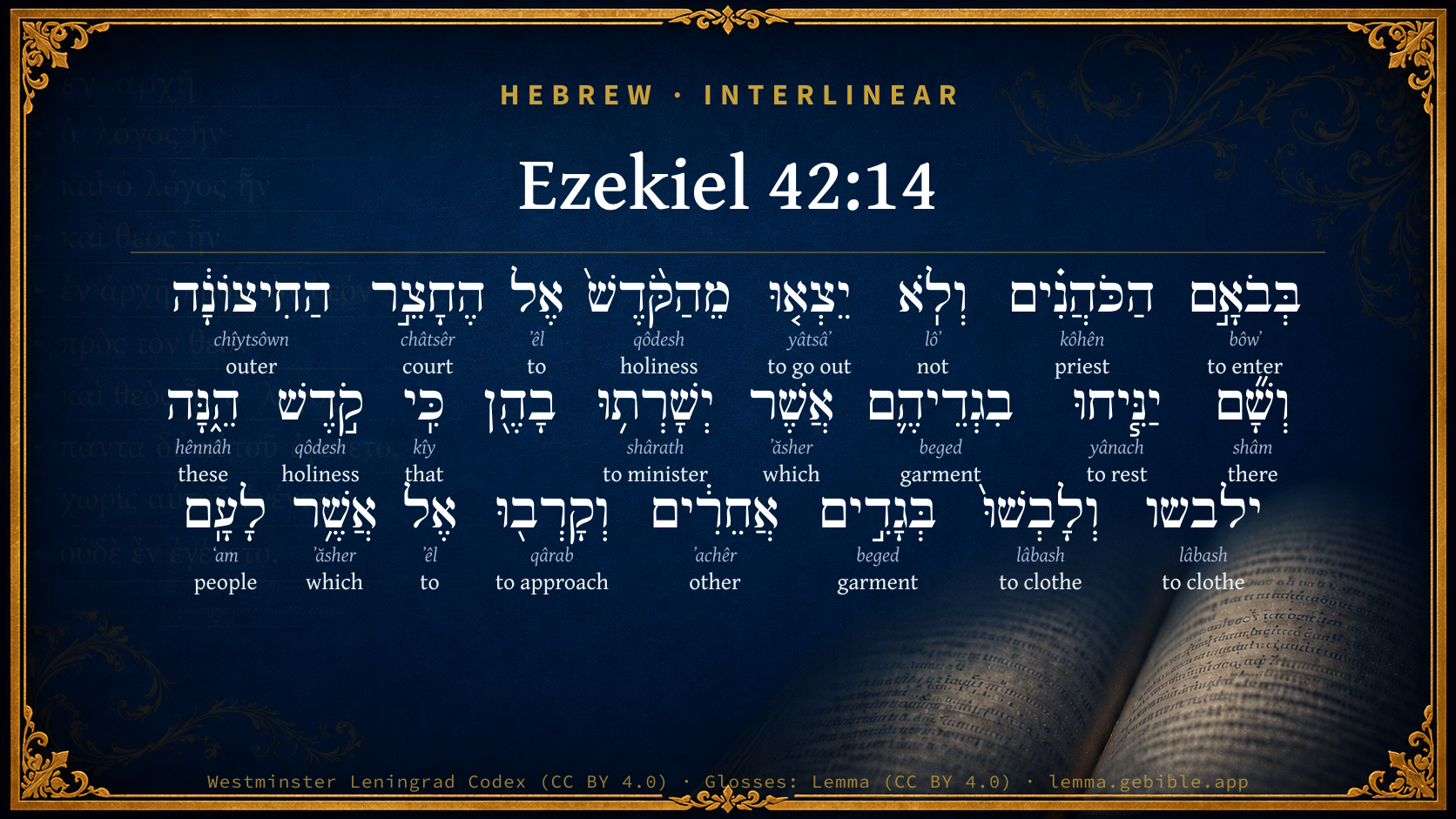
Ezekiel 42:14

Hebrew (Westminster Leningrad Codex) Ezekiel 42:14 appears in the Hebrew Old Testament. The text above is from the Westminster Leningrad Codex. Each word links to its Strong’s number, a concise gloss, and parsing drawn from the Open Scriptures Hebrew Bible morphology. Click any word for its full Brown-Driver-Briggs (BDB) entry.
Download image
Cite this verse

Ezekiel 42:14 (World English Bible). Public Domain. Lemma interlinear Bible study tool, https://lemma.gebible.app/v/ezekiel/42/14.

Show BibTeX & RIS
BibTeX
RIS
English Translation
When the priests enter in, then shall they not go out of the holy place into the outer court, but there they shall lay their garments in which they minister; for they are holy: and they shall put on other garments, and shall approach to that which pertains to the people.
World English Bible · Public Domain
Download a study sheet

One document with this verse’s original text, its word-by-word gloss line, the meaning frame, cross-references with their text, attributed commentary, and full source and license credits — printable, and it pastes into notes with its structure intact.

This verse Autodidact and up

Study sheet (.html) Plain text (.txt)

A passage Seminary Student

Up to 50 verses in one chapter. A passage sheet keeps up to 6 commentary sources and 12 cross-references per verse, in the order this page ranks them, and says so on the sheet whenever that leaves anything out. Ask for a single verse and you get the Autodidact verse sheet above.

Everything on this page stays free to read, with no account — the sheet is a download of what is already on screen, not access to it.

Want to remove ads? Support Godless Engineer
Compare translations 3

The same verse in 3 English versions, stacked beneath the original-language interlinear above. Click any original word for its lexicon entry.

Each is an independent rendering of the whole verse — the interlinear is not word-aligned to these translations.

Highlighted words mark where these versions differ — a whole-verse word diff, not a word-by-word alignment.

  • World English Bible Public Domain
    When the priests enter in, then shall they not go out of the holy place into the outer court, but there they shall lay their garments in which they minister; for they are holy: and they shall put on other garments, and shall approach to that which pertains to the people.
  • King James Version Public Domain
    When the priests enter therein, then shall they not go out of the holy place into the utter court, but there they shall lay their garments wherein they minister; for they are holy; and shall put on other garments, and shall approach to those things which are for the people.
  • unfoldingWord Literal Text CC BY-SA 4.0
    When the priests enter there, they must not go out of the holy place to the outer court, without laying aside the clothes in which they served, since these are holy. So they must dress in other clothes before going near the people.”

unfoldingWord Literal Text — © unfoldingWord, licensed CC BY-SA 4.0. Word-aligned USFM3 via Door43 (git.door43.org/unfoldingWord/en_ult).

Versions to compare (up to 4)

3 of 4 selected

Show all 18 translations

Every available English version of this verse, each an independent rendering of the whole verse.

  • World English Bible Public Domain
    When the priests enter in, then shall they not go out of the holy place into the outer court, but there they shall lay their garments in which they minister; for they are holy: and they shall put on other garments, and shall approach to that which pertains to the people.
  • Berean Standard Bible Public Domain
    Once the priests have entered the holy area, they must not go out into the outer court until they have left behind the garments in which they minister, for these are holy. They are to put on other clothes before they approach the places that are for the people.”
  • Majority Standard Bible Public Domain
    Once the priests have entered the holy area, they must not go out into the outer court until they have left behind the garments in which they minister, for these are holy. They are to put on other clothes before they approach the places that are for the people.”
  • King James Version Public Domain
    When the priests enter therein, then shall they not go out of the holy place into the utter court, but there they shall lay their garments wherein they minister; for they are holy; and shall put on other garments, and shall approach to those things which are for the people.
  • American Standard Version (1901) Public Domain
    When the priests enter in, then shall they not go out of the holy place into the outer court, but there they shall lay their garments wherein they minister; for they are holy: and they shall put on other garments, and shall approach to that which pertaineth to the people.
  • Revised Version (1885) Public Domain
    When the priests enter in, then shall they not go out of the holy place into the outer court, but there they shall lay their garments wherein they minister; for they are holy: and they shall put on other garments, and shall approach to that which pertaineth to the people.
  • Geneva Bible (1599) Public Domain
    When the Priestes enter therein, they shall not go out of the holy place into the vtter court, but there they shall lay their garmentes wherein they minister: for they are holy, and shall put on other garmentes, and so shall approch to those things, which are for the people.
  • Douay-Rheims (1899) Public Domain
    And when the priests shall have entered in, they shall not go out of the holy places into the outward court: but there they shall lay their vestments, wherein they minister, for they are holy: and they shall put on other garments, and so they shall go forth to the people.
  • Young's Literal Translation Public Domain
    In the priests' going in, they come not out from the sanctuary unto the outer court, and there they place their garments with which they minister, for they `are' holy, and have put on other garments, and have drawn near unto that which `is' for the people.'
  • Literal Standard Version CC BY-SA 4.0
    In the priests’ going in, they do not come out from the sanctuary to the outer court, and there they place their garments with which they minister, for they [are] holy, and have put on other garments, and have drawn near to that which [is] for the people.”
  • Unlocked Literal Bible CC BY-SA 4.0
    When the priests enter there, they must not go out of the holy place to the outer court, without laying aside the clothes in which they served, since these are holy. So they must dress in other clothes before going near the people.”
  • unfoldingWord Literal Text CC BY-SA 4.0
    When the priests enter there, they must not go out of the holy place to the outer court, without laying aside the clothes in which they served, since these are holy. So they must dress in other clothes before going near the people.”
  • Darby Bible Public Domain
    When the priests enter in, they shall not go forth from the sanctuary into the outer court, but there they shall lay their garments wherein they minister, for they are holy; and they shall put on other garments, and shall approach to that which is for the people.
  • World Messianic Bible Public Domain
    When the priests enter in, then they shall not go out of the holy place into the outer court until they lay their garments in which they minister there; for they are holy. Then they shall put on other garments, and shall approach that which is for the people.”
  • Webster's Bible Public Domain
    When the priests enter therein, then shall they not go out of the holy place into the outer court, but there they shall lay their garments in which they minister; for they are holy; and shall put on other garments, and shall approach to those things which are for the people.
  • Free Bible Version CC BY-SA 4.0
    Once the priests have entered these rooms, they are not to go to the outer courtyard before leaving their priestly clothes, because these are holy. They must change into other clothes before they go where the ordinary people are.”
  • Bible in Basic English Public Domain
    When the priests go in, they may not go out of the holy place into the outer square, and there they are to put the robes in which they do the work of the Lord's house, for they are holy: and they have to put on other clothing before they come near that which has to do with the people.
  • JPS Tanakh (1917) Public Domain
    When the priests enter in, then shall they not go out of the holy place into the outer court, but there they shall lay their garments wherein they minister, for they are holy; and they shall put on other garments, and shall approach to that which pertaineth to the people.'

Literal Standard Version (2020), Covenant Press — licensed CC BY-SA 4.0. Text via the HelloAO Bible API (eBible.org). Unlocked Literal Bible (unfoldingWord) — licensed CC BY-SA 4.0. Text via the HelloAO Bible API (eBible.org). unfoldingWord Literal Text — © unfoldingWord, licensed CC BY-SA 4.0. Word-aligned USFM3 via Door43 (git.door43.org/unfoldingWord/en_ult). Free Bible Version, Dr. Jonathan Gallagher — licensed CC BY-SA 4.0. Text via the HelloAO Bible API (eBible.org).

Word by word

More ways to search: Search by grammar → Find every occurrence → Compare this word →

Practice this passage: Drill this verse → Learn its vocabulary →

הַחִיצוֹנָ֔ה
chîytsôwn
H2435
“the · outer”
Particle, Definite Article + Adjective, Adjective, Feminine, Singular, Absolute
Part of Speech
Particle + Adjective
Type
Adjective
Gender
Feminine
Number
Singular
State
Absolute
Full BDB Definition

Origin: from H2434

TWOT: 627b

outer, external, outward
  1. בְּבֹאָ֣ם bôwʼ H935 “in/at · to enter · them” Preposition + Verb, Qal, Infinitive Construct + Suffix, Personal, 3rd Person, Masculine, Plural
  2. הַכֹּהֲנִ֗ים kôhên H3548 “the · priests” Particle, Definite Article + Noun, Common, Masculine, Plural, Absolute
  3. וְלֹֽא lôʼ H3808 “and · not” Conjunction + Particle, Negative
  4. יֵצְא֤וּ yâtsâʼ H3318 “to go out” Verb, Qal, Imperfect, 3rd Person, Masculine, Plural
  5. מֵהַקֹּ֨דֶשׁ֙ qôdesh H6944 “from · the · holiness” Preposition + Particle, Definite Article + Noun, Common, Masculine, Singular, Absolute
  6. אֶל ʼêl H413 “to” Preposition
  7. הֶחָצֵ֣ר châtsêr H2691 “the · court” Particle, Definite Article + Noun, Common, Both, Singular, Absolute
  8. וְשָׁ֞ם shâm H8033 “and · there” Conjunction + Adverb
  9. יַנִּ֧יחוּ yânach H3240 “to rest” Verb, Hiphil, Imperfect, 3rd Person, Masculine, Plural
  10. בִגְדֵיהֶ֛ם beged H899 “garments · their” Noun, Common, Masculine, Plural, Construct + Suffix, Personal, 3rd Person, Masculine, Plural
  11. אֲשֶׁר ʼăsher H834 “which” Particle, Relative
  12. יְשָׁרְת֥וּ shârath H8334 “to minister” Verb, Piel, Imperfect, 3rd Person, Masculine, Plural
  13. כִּֽי kîy H3588 “that” Conjunction
  14. קֹ֣דֶשׁ qôdesh H6944 “holiness” Noun, Common, Masculine, Singular, Absolute
  15. הֵ֑נָּה hênnâh H2007 “these” Pronoun, Personal, 3rd Person, Feminine, Plural
  16. ילבשו lâbash H3847 “to clothe” Verb, Qal, Imperfect, 3rd Person, Masculine, Plural
  17. וְלָבְשׁוּ֙ lâbash H3847 “and · to clothe” Conjunction + Verb, Qal, Sequential Perfect, 3rd Person, Common, Plural
  18. בְּגָדִ֣ים beged H899 “garments” Noun, Common, Masculine, Plural, Absolute
  19. אֲחֵרִ֔ים ʼachêr H312 “other” Adjective, Adjective, Masculine, Plural, Absolute
  20. וְקָרְב֖וּ qârab H7126 “and · to approach” Conjunction + Verb, Qal, Sequential Perfect, 3rd Person, Common, Plural
  21. אֶל ʼêl H413 “to” Preposition
  22. אֲשֶׁ֥ר ʼăsher H834 “which” Particle, Relative
  23. לָעָֽם ʻam H5971 “to/for the · people” Preposition, Determined + Noun, Common, Masculine, Singular, Absolute

About this verse

These counts appear in no published source. They are computed here, from the morphology-tagged text and Lemma’s own curated glosses. What Lemma adds →

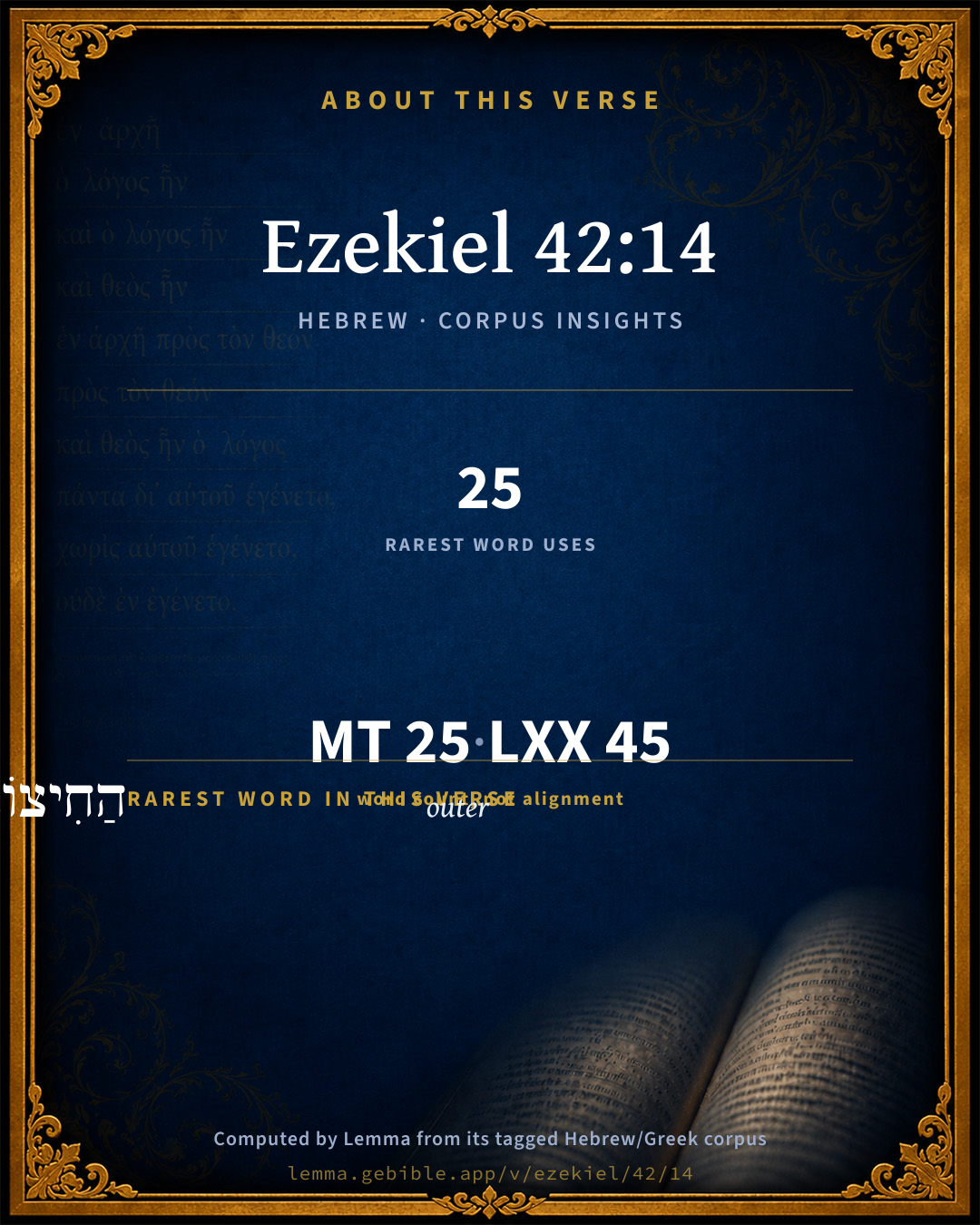
25
words
19
distinct lemmas
Prophets
section

Notable vocabulary

The rarest word here is הַחִיצוֹנָ֔ה outer H2435 — appearing just 25 times in the whole Hebrew Bible.

Shared distinctive vocabulary

הַחִיצוֹנָ֔ה outer H2435 occurs in 24 verses of the Hebrew Bible. Also found in:

Grammatical profile

  • 7 verbs
  • 7 nouns
  • 2 adjectives
  • 1 pronoun
  • 3 prepositions
  • 1 conjunction
  • 1 adverb
  • 3 particles

Verb forms

  • בְּבֹאָ֣ם Qal · Infinitive Construct
  • יֵצְא֤וּ Qal · Imperfect
  • יַנִּ֧יחוּ Hiphil · Imperfect
  • יְשָׁרְת֥וּ Piel · Imperfect
  • ילבשו Qal · Imperfect
  • וְלָבְשׁוּ֙ Qal · Sequential Perfect
  • וְקָרְב֖וּ Qal · Sequential Perfect

Repetition

Words recur within this verse — often emphatic in Hebrew:

  • מֵהַקֹּ֨דֶשׁ֙ holiness H6944 ×2
  • בִגְדֵיהֶ֛ם garment H899 ×2
  • ילבשו to clothe H3847 ×2
  • אֶל to H413 ×2
  • אֲשֶׁר which H834 ×2

Hebrew & Septuagint length

In English translation the verse runs 51 words from the Hebrew and 64 from the Septuagint (LXX English) — closely comparable.

A rough comparison of the two English renderings, which tokenize alike — not a word-level alignment.

Word counts can differ between the Hebrew and the Greek without any difference in meaning — e.g. the Hebrew direct-object marker אֵת has no separate Greek word, and Greek often adds the article ὁ.

In the original languages it is 25 Hebrew tokens and 45 Greek tokens — but the two are counted differently (Hebrew bundles its prefixes and suffixes into one token; the Greek is in lemma form), so that isn’t a like-for-like length.

Cross-references

13

Topical passages linked to Ezekiel 42:14 in the Treasury of Scripture Knowledge — connected by theme and wording, ordered by reader-vote popularity; previews shown in the World English Bible.

  • Ezekiel 44:19 When they go forth into the outer court, even into the outer court to the people, they shall put off their garments in which they minister, and lay them in the holy chambers; and they shall put on other garments, that they not sanctify the people with their garments.
  • Leviticus 8:7 He put the coat on him, tied the sash on him, clothed him with the robe, put the ephod on him, and he tied the skillfully woven band of the ephod on him, and fastened it to him with it.
  • Exodus 29:4–9 You shall bring Aaron and his sons to the door of the tent of meeting, and shall wash them with water.
  • Leviticus 8:13 Moses brought Aaron's sons, and clothed them with coats, and tied sashes on them, and put headbands on them; as Yahweh commanded Moses.
  • Isaiah 61:10 I will greatly rejoice in Yahweh, my soul shall be joyful in my God; for he has clothed me with the garments of salvation, he has covered me with the robe of righteousness, as a bridegroom decks himself with a garland, and as a bride adorns herself with her jewels.
  • Zechariah 3:4–5 He answered and spoke to those who stood before him, saying, "Take the filthy garments off of him." To him he said, "Behold, I have caused your iniquity to pass from you, and I will clothe you with rich clothing."
  • Exodus 28:40–43 "You shall make coats for Aaron's sons, and you shall make sashes for them and headbands shall you make for them, for glory and for beauty.
  • Leviticus 8:33–35 You shall not go out from the door of the Tent of Meeting seven days, until the days of your consecration are fulfilled: for he shall consecrate you seven days.
  • Luke 9:62 But Jesus said to him, "No one, having put his hand to the plow, and looking back, is fit for the Kingdom of God."
  • Romans 3:22 even the righteousness of God through faith in Jesus Christ to all and on all those who believe. For there is no distinction,
  • Romans 13:14 But put on the Lord Jesus Christ, and make no provision for the flesh, for its lusts.
  • Galatians 3:27 For as many of you as were baptized into Christ have put on Christ.
  • 1 Peter 5:5 Likewise, you younger ones, be subject to the elder. Yes, all of you gird yourselves with humility, to subject yourselves to one another; for "God resists the proud, but gives grace to the humble."

Cross-references courtesy of OpenBible.info (CC BY 4.0).

Hebrew and Greek witnesses Masoretic Hebrew ↔ Greek Septuagint

The same verse in the two great witnesses to the Old Testament, shown verse-for-verse.

These are two independent witnesses, not word-aligned to each other, and the Septuagint is shown in lemma (dictionary) form.

Hebrew Ezekiel 42:14 Masoretic · Westminster Leningrad Codex

בְּבֹאָ֣ם הַכֹּהֲנִ֗ים וְלֹֽא יֵצְא֤וּ מֵהַקֹּ֨דֶשׁ֙ אֶל הֶחָצֵ֣ר הַחִיצוֹנָ֔ה וְשָׁ֞ם יַנִּ֧יחוּ בִגְדֵיהֶ֛ם אֲשֶׁר יְשָׁרְת֥וּ בָהֶ֖ן כִּֽי קֹ֣דֶשׁ הֵ֑נָּה ילבשו וְלָבְשׁוּ֙ בְּגָדִ֣ים אֲחֵרִ֔ים וְקָרְב֖וּ אֶל אֲשֶׁ֥ר לָעָֽם

When the priests enter in, then shall they not go out of the holy place into the outer court, but there they shall lay their garments in which they minister; for they are holy: and they shall put on other garments, and shall approach to that which pertains to the people.

World English Bible · Public Domain

Greek LXX Ezekiel 42:14 Septuagint · lemma form

οὐ εἰςἔρχομαι ἐκεῖ πάρεξ ὁ ἱερεύς οὐ ἐκἔρχομαι ἐκ ὁ ἅγιος εἰς ὁ αὐλή ὁ ἐξώτερος ὅπως διά πᾶς ἅγιος εἰμί ὁ προςἄγω καί μή ἅπτομαι ὁ στολισμός αὐτός ἐν ὅς λειτουργέω ἐν αὐτός διότι ἅγιος εἰμί καί ἐνδύω ἱμάτιον ἕτερος ὅταν ἅπτομαι ὁ λαός

None shall go in there except the priests, and they shall not go forth of the holy place into the outer court, that they that draw near to me may be continually holy, and may not touch their garments in which they minister, with defilement, for they are holy; and they shall put on other garments whenever they come in contact with the people.

LXX2012 (modern English Septuagint) · Public Domain

Hebrew: Westminster Leningrad Codex (CC BY 4.0). Greek: Septuagint (public domain); English from LXX2012 (modern English Septuagint) (Public Domain). How the Septuagint differs from the Hebrew →

Targum (Aramaic paraphrase)

1

The Targum is the ancient Jewish Aramaic paraphrase of the Hebrew Scriptures — an interpretive translation, not the Hebrew text itself. Onkelos (literal) and Pseudo-Jonathan (expansive) render the Torah, and Jonathan the Prophets. Coverage is partial: where no permissively-licensed English translation exists for a verse, only the Aramaic is shown. This is verse-level text, not a word-by-word alignment to the Hebrew.

  1. Targum Jonathan Prophets (Joshua–Malachi)
    בְּמֵיעַלְהוֹן כַּהֲנַיָא וְלָא יִפְקוּן מִקוּדְשָׁא לְדַרְתָּא בְרַיְתָא וְתַמָן יֵיחֲתוּן לְבוּשֵׁיהוֹן דִישַׁמְשׁוּן בְּהוֹן אֲרֵי קוּדְשָׁא אִינוּן וְיִלְבְּשׁוּן לְבוּשִׁין אוֹחֲרָנִין וְיִתְעַרְבוּן עִם עַמָא:

    (no public-domain English translation for this verse)

    Targum Jonathan — Aramaic: “Mikraot Gedolot” (public domain). English: “Sefaria Community Translation” (CC0 1.0 (public-domain dedication)); “London "Chaldee Paraphrase," 1871” (public domain). Text via Sefaria.

Commentary

Notes on Ezekiel 42:14 from classic Christian and Jewish commentators (each source and its license shown beneath its notes). The classic Christian expositions comment on the surrounding passage and are grouped to its opening verse, so a note may address several verses; the Jewish commentaries on the Tanakh (Rashi and others) are per-verse, so they appear only where the commentator wrote on this verse.

Lemma curates 59 commentaries, every one of them public domain or Creative Commons licensed, each selected and text-cleaned for this edition rather than reprinted as found. About our sources →

Trapp's Complete Commentary

John Trapp

Eze 42:14 When the priests enter therein, then shall they not go out of the holy [place] into the utter court, but there they shall lay their garments wherein they minister; for they [are] holy; and shall put on other garments, and shall approach to [those things] which [are] for the people.

Ver. 14. Then shall they not go out of the holy place.] Ministers may not leave their station, lay aside their holy calling, entangle themselves with worldly cares and businesses; but hoc agere, make their ministry their business, giving themselves wholly to it. Verbi minister es, hoc age; this was Mr Perkins’s motto. And "say to Archippus, Take heed to the ministry which thou hast received in the Lord, that thou fulfil it." {Col 4:17}

But there they shall lay their garments.] And not go among the people in them, lest they make themselves overly cheap, or the people superstitious, by placing holiness in their seeing or touching those holy vestments.

And shall put on other garments.] Ministers, as in doing their office, they must use all becoming gravity and authority, as the ambassadors of Christ; {a} so, at other times, they must familiarise themselves with their people, becoming all things to all men, in Paul’s sense, that they may win some.

{a} Oecolamp.

John Trapp, A Commentary or Exposition upon All the Books of the Old and New Testament (1647–1656) — public domain. Text from a community e-Sword module.

Adam Clarke's Commentary

Verse 14. They shall lay their garments wherein they minister] The priests were not permitted to wear their robes in the outer court. These vestments were to be used only when they ministered; and when they had done, they were to deposit them in one of the chambers mentioned in the thirteenth verse.

Adam Clarke's Commentary on the Bible (1810–1826) — public domain. Text from a community e-Sword/MySword module.

Ellicott's Commentary for English Readers

(14) There they shall lay their garments.—It was apparently the requirement of the law that the priests should wear their official garments only when engaged in priestly duties within the tabernacle; this is not expressly stated in general terms, but it is said that they were to wear them when engaged in such duty (Exo_28:43), and in some particular cases that they were to put them off when they went out of the tabernacle (Lev_6:10-11; Lev_16:23). It seems probable, therefore, that Ezekiel here recognises the ancient custom.

A Bible Commentary for English Readers, edited by Charles John Ellicott (1878–1897) — public domain. Text from a community e-Sword module.

The Cambridge Bible for Schools and Colleges

gen. ed. J. J. S. Perowne

14. the priests enter therein] Omit therein. The ref. is not to the holy cells, but to the house or more probably the inner court, in which the altar stood.

go out of the holy place] probably the whole inner court is meant, with its contents, house and chambers, seeing it is contrasted with the outer court.

things … for the people] Or, that which is for the people—the outer court.

The Cambridge Bible for Schools and Colleges (gen. ed. J. J. S. Perowne; Cambridge University Press, 1878–1918) — public domain. Text from a community e-Sword module.

John Gill's Exposition

When the priests enter therein,.... Into the holy place, these holy chambers, and approach unto God, and eat of the most holy things, and minister therein to the Lord:

then shall they not go out of the holy place into the utter court; denoting, not that the ministers of the word should not concern themselves in secular employments, but give themselves up to the word and prayer, though so to do is right; but the perseverance of the saints in the house and worship of God, in grace and holiness, and in all the duties of religion; these should not relinquish their profession, desert their station and the service of God, and return to the world; but continue as pillars in the temple of God, and go no more out, but abide by the truths and ordinances of the Gospel:

but there they shall lay their garments wherein they minister, for they are holy; these signify Christ's robe of righteousness and garments of salvation, that fine linen, clean and white, which is the righteousness of the saints; and fitly represented by the linen garments of the priests, in which they ministered in their office, and were like them holy, pure, and spotless; in these only saints appear before God, and present their supplications to him, not for their own, but for Christ's righteousness sake, making mention of that only; and herein they have acceptance with God now, and shall be introduced into his presence hereafter, and behold his face, clothed with these garments, and serve him for ever:

and shall put on other garments, and shall approach to those things which are for the people; these are the conversation garments of the saints, which are not fit to appear in before God, being attended with imperfection and sin; but very proper to appear in before men, among whom their lights should shine, and their good works be seen, for the adorning of the doctrine of Christ, the recommending of the Christian religion, and the stopping of the mouths of gainsayers: for this respects not the different habits of ministers, when they are in their ministrations, and out of them; though the allusion is to the priests under the law, who wore their priestly garments only in the temple, and while ministering there, and never elsewhere, or when among the common people on civil accounts: so Josephus says (c), the priests only wore their holy garments when they ministered; at other times they appeared in the habit of private persons; with which agrees what Maimonides (d) says, their garments are not upon them when they are not ministering in the priestly office, but then they are clothed as laymen; or when, as the Targum here has it,

"they were mingled with the people.''

There were places in the temple where they put on and off their clothes, and where they were laid up. So Adrichomius (e) says, speaking of the temple,

"there were rooms, otherwise called treasuries, and priests' apartments, which were houses on the side of it, like towers, long, broad, and high; in which the priests, when they went into the sanctuary, put off their common woollen garments, and put on their holy linen ones; and, when they had performed their holy services, laid them up there again.''

And another writer, quoted by Solomon Ben Virga (f), observes, that

"here (that is, the temple) was a house for the priest whose office it was to clothe the rest of the priests at the time of service; and he gave to everyone of them four sorts of garments, as were commanded, and fetched them out of the chests of the wardrobe; and on every chest, which were at the walls of this house, that is, above everyone of them, was the name of the garment, that there might be no mistake nor confusion when they were wanted.''

And this agrees with what is said in the Misnah (g), that there was one that was appointed over the priests' garments, and who might be properly enough called the master of the wardrobe; on which one of the commentators says (h), his business was

"to clothe the priests at the time of service, and to unclothe them after service was done, and to keep the garments of the priesthood in the chambers made for that purpose.''

Very wrongly, therefore, is the learned Selden (i) charged by Mr. Shoringham (k), with a mistake, in denying that the priests wore their holy garments at any other time but when they were at divine service.

(c) De Bello Jud. l. 5. c. 5. sect. 7. (d) Cele Hamikdash, c. 10. sect. 4. (e) Theatrum Terrae Sanct. Jerusalem, No. 92. p. 161. (f) Shebet Judah, fol. 43. 2. Ed. Gentii, p. 464. (g) Shekalim, c. 5. sect. 1. (h) Bartenora in ib. (i) De Success. in Pontif. Heb. l. 2. c. 7. Vid. ib. de Synedriis, l. 3. c. 11. sect. 6. & Braunium, de Vestitu Sacerdot. Hebr. l. 2. c. 25. (k) Ad Codicem Joma, c. 7. sect. 1. p. 78, 79.

John Gill's Exposition of the Whole Bible (1746–1763) — public domain (CC PDM 1.0). Text via the HelloAO Bible API.

Albert Barnes' Notes on the Bible

Compare Lev 16:23.

Those things which are for the people - namely, the outer court.

Albert Barnes' Notes on the Bible (1834–1885) — public domain. Text from a community e-Sword/MySword module.

Haydock's Catholic Bible Commentary

People. Chap. xliv. 17., and Exodus xxxiii. 42. Christian priests use their vestments only when they are officiating. (Durand and Durant Rit. ii. 9.) (Calmet)

George Leo Haydock (1774–1849), Haydock's Catholic Family Bible and Commentary, 1859 edition — public domain. Excludes Psalms (Douay-Rheims chapter numbering differs from Protestant) and Deuterocanonical books (Catholic canon only).

Matthew Poole's English Annotations

When, at the time of their service, the priests, and Levites also, who assisted, enter therein, come into the court of the temple or inmost court in their priestly garments to offer sacrifice, or to do any other part of their office,

then, when they have done their office,

shall they not go out, in their priestly garments, of the holy place, the court of the priests, not of the temple, into the utter court, the court of the people.

There; in some one of the chambers of south or north buildings, which is a wardrobe for them. Lay their garments; lay up, either for other priests, whose course came next, or for themselves against the next return of their course.

Wherein they minister; expressly directed by God, Exo 28:40-43.

They are holy; consecrated, ceremonially and relatively holy, for they are not capable of inherent holiness.

Shall put on other garments when they go out of this court into the outer, or outmost, they must put on common garments.

Shall approach to those things, and so they may, as they have occasion, and see good,

which are for the people; which common people may meddle with, which the priests may in their ordinary garments intermeddle with, and not be guilty, but may not touch while in the garments of their ministration..

Matthew Poole's English Annotations on the Holy Bible (1683–1685) — public domain. Text from a community e-Sword/MySword module.

The Pulpit Commentary

Holy garments.

The priests were to keep their holy garments in their holy chambers, wearing them in the sacred offices of the temple, and exchanging them for their common clothing before mixing with the people. This regulation was a necessary part of the Old Testament ceremonial, with its suggestions of separateness and external holiness. But it was susceptible of abuse, and some of the modern reproductions of it are certainly far from being commendable.

I THE ANCIENT SIGNIFICANCE OF HOLY GARMENTS.

1. The necessity of holiness in all worship. God must be worshipped with clean hands and a pure heart in the beauty of holiness". (Psa_96:9) The old heathenish divorce of religion from morality could not be permitted under the Jewish economy. All that was most formal and external was intended to keep before the minds of the worshippers a clear perception of God"s horror of sin, and a vivid presentation of his supreme love for righteousness.

2. The experience of holiness by individual men. Not only were the chambers in which the priests ate the sacrificial meals to be holy, but even the garments worn by the priests were also to be sacred. The sanctity attaches to the person. The very bodies of Christian people are temples of the Holy Ghost. (1Co_6:19)

3. The renewal of holiness in every act of worship. It is necessary to see that we are in a fit condition to approach God. It is not sufficient that we were once pardoned and cleansed. Unhappily, fresh defilement is repeatedly contracted. It is therefore necessary that renewed cleansing should be received. This was suggested by Christ"s washing his disciples". (Joh_13:4) By Christ we can be fitted for entering the presence of God.

II THE COMMON ABUSE OF HOLY GARMENTS.

1. In distinction of persons. The priest in his robes appeared as a more holy man than the common worshipper in his every-day dress. This was inevitable under the old Jewish system, but it should not be permitted in the present day. Yet what is called "the cloth" is often supposed to carry a certain sanctity, and clerical attire is thought by the superstitious to mark a spiritual separateness. But no such separateness exists in the Christian Church, all the members of which constitute "an holy priesthood". (1Pe_2:5)

2. By observing seasons. The priests wore their holy garments for a time, and then laid them aside and assumed their ordinary apparel. Some people put on their religion as they put on their Sunday clothes. They are saints at church, and sinners in the world; holy on Sunday, and profane on the weekdays. This is all delusive. No man can live two honest lives. Religion claims our whole being and time. For the true Christian all days are sacred to Christ"s service.

3. With mere external profession. The holiness resides only in the garment; the religion is nothing better than a clothing it is no inspiration. Such religion, like that of the Pharisees who cleansed the outside of the cup and platter, is hypocrisy.

The Pulpit Commentary (1880–1919), ed. H.D.M. Spence-Jones & Joseph S. Exell — public domain. Text from a community e-Sword module.

John Wesley's Explanatory Notes

Which are - Which common people may meddle with.

John Wesley, Explanatory Notes Upon the Whole Bible (1754–1765) — public domain. Text via the GEBible commentary corpus.

Rashi

Rabbi Shlomo Yitzchaki (Rashi)

When the priests arrive, etc. Once they enter those chambers to eat.

they shall not go out of them, which are holy.

into the Outer Court with the holy raiment that is upon them.

but shall there leave their garments, etc., and they will approach those of the people And they may approach to touch the peoples’ garments if they wish, but they must not touch the [garments of] people with the priestly raiment, for they have higher degrees of ritual purity, and ordinary garments have midras contamination on them.

Rashi on the Tanakh — English translations: “The Judaica Press complete Tanach with Rashi, translated by A. J. Rosenberg” (CC BY 4.0); “Pentateuch with Rashi's commentary by M. Rosenbaum and A.M. Silbermann, 1929-1934” (public domain); “The Metsudah Tanach series, Lakewood, N.J” (CC BY 4.0); and “The Book of Joshua, Metsudah Publications, 1997” (CC BY 4.0). Text via Sefaria.

Lesson kit

Teaching starters — assembled from the data on this page, not authored interpretation. Every prompt links to the verse data it draws on. Edit before teaching.

Ezekiel, in the Prophets, opens this verse with 25 words (19 distinct Hebrew lemmas). Its most distinctive word is chîytsôwn (“outer”). A historical commentator’s framing appears above. Read the whole chapter for the surrounding context.

Discussion questions

  1. How does “outer” (chîytsôwn) shape what this verse is saying?
  2. 1 Kings 6:29 shares the word «outer» with this verse. How do the two illuminate each other?
  3. “holiness” occurs 2× in this one verse. What is the effect of the repetition?
  4. These translations render this verse differently. What is at stake in choosing one wording over another?
  5. The verb «בְּבֹאָ֣ם» is Qal Infinitive Construct. How does its form color the action?
  6. Reading how Trapp's Complete Commentary and Adam Clarke's Commentary read this verse, where do the two commentators agree and where do they part?

Things to notice

Reading settings

Reading text

Shown beneath each verse's original-language words.

Old Testament
Old Testament edition

Read the OT as the Masoretic Hebrew (MT) or the Greek Septuagint (LXX).

English shown for the Greek Septuagint (in the Hebrew ↔ Greek comparison).

Comparing translations? Open the Compare panel on any verse page to stack up to four side by side.