
Jeremiah 41:5

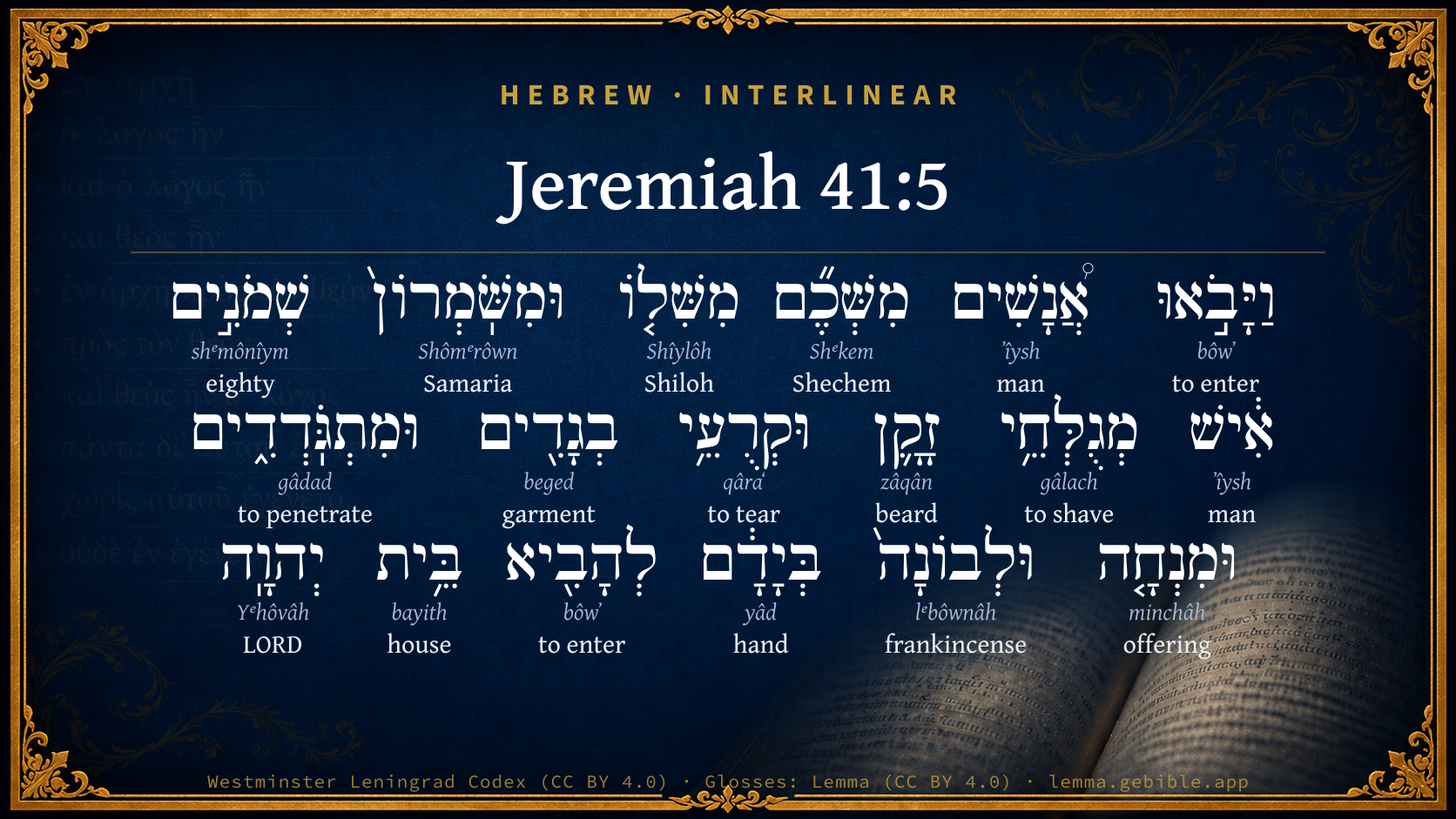
Hebrew (Westminster Leningrad Codex) Jeremiah 41:5 appears in the Hebrew Old Testament. The text above is from the Westminster Leningrad Codex. Each word links to its Strong’s number, a concise gloss, and parsing drawn from the Open Scriptures Hebrew Bible morphology. Click any word for its full Brown-Driver-Briggs (BDB) entry.
Download image
Cite this verse

Jeremiah 41:5 (World English Bible). Public Domain. Lemma interlinear Bible study tool, https://lemma.gebible.app/v/jeremiah/41/5.

Show BibTeX & RIS
BibTeX
RIS
English Translation
that there came men from Shechem, from Shiloh, and from Samaria, even eighty men, having their beards shaved and their clothes torn, and having cut themselves, with meal-offerings and frankincense in their hand, to bring them to the house of Yahweh.
World English Bible · Public Domain
Download a study sheet

One document with this verse’s original text, its word-by-word gloss line, the meaning frame, cross-references with their text, attributed commentary, and full source and license credits — printable, and it pastes into notes with its structure intact.

This verse Autodidact and up

Study sheet (.html) Plain text (.txt)

A passage Seminary Student

Up to 50 verses in one chapter. A passage sheet keeps up to 6 commentary sources and 12 cross-references per verse, in the order this page ranks them, and says so on the sheet whenever that leaves anything out. Ask for a single verse and you get the Autodidact verse sheet above.

Everything on this page stays free to read, with no account — the sheet is a download of what is already on screen, not access to it.

Want to remove ads? Support Godless Engineer
Compare translations 3

The same verse in 3 English versions, stacked beneath the original-language interlinear above. Click any original word for its lexicon entry.

Each is an independent rendering of the whole verse — the interlinear is not word-aligned to these translations.

Highlighted words mark where these versions differ — a whole-verse word diff, not a word-by-word alignment.

  • World English Bible Public Domain
    that there came men from Shechem, from Shiloh, and from Samaria, even eighty men, having their beards shaved and their clothes torn, and having cut themselves, with meal-offerings and frankincense in their hand, to bring them to the house of Yahweh.
  • King James Version Public Domain
    That there came certain from Shechem, from Shiloh, and from Samaria, even fourscore men, having their beards shaven, and their clothes rent, and having cut themselves, with offerings and incense in their hand, to bring them to the house of the LORD.
  • unfoldingWord Literal Text CC BY-SA 4.0
    Some men came from Shechem, from Shiloh, and from Samaria—eighty men who had shaved their beard, torn their clothes, and cut themselves—with food offerings and frankincense in their hands to go to Yahweh’s house.

unfoldingWord Literal Text — © unfoldingWord, licensed CC BY-SA 4.0. Word-aligned USFM3 via Door43 (git.door43.org/unfoldingWord/en_ult).

Versions to compare (up to 4)

3 of 4 selected

Show all 18 translations

Every available English version of this verse, each an independent rendering of the whole verse.

  • World English Bible Public Domain
    that there came men from Shechem, from Shiloh, and from Samaria, even eighty men, having their beards shaved and their clothes torn, and having cut themselves, with meal-offerings and frankincense in their hand, to bring them to the house of Yahweh.
  • Berean Standard Bible Public Domain
    eighty men who had shaved off their beards, torn their garments, and cut themselves came from Shechem, Shiloh, and Samaria, carrying grain offerings and frankincense for the house of the LORD.
  • Majority Standard Bible Public Domain
    eighty men who had shaved off their beards, torn their garments, and cut themselves came from Shechem, Shiloh, and Samaria, carrying grain offerings and frankincense for the house of the LORD.
  • King James Version Public Domain
    That there came certain from Shechem, from Shiloh, and from Samaria, even fourscore men, having their beards shaven, and their clothes rent, and having cut themselves, with offerings and incense in their hand, to bring them to the house of the LORD.
  • American Standard Version (1901) Public Domain
    that there came men from Shechem, from Shiloh, and from Samaria, even fourscore men, having their beards shaven and their clothes rent, and having cut themselves, with meal-offerings and frankincense in their hand, to bring them to the house of Jehovah.
  • Revised Version (1885) Public Domain
    that there came certain from Shechem, from Shiloh, and from Samaria, even fourscore men, having their beards shaven and their clothes rent, and having cut themselves, with oblations and frankincense in their hand, to bring them to the house of the LORD.
  • Geneva Bible (1599) Public Domain
    There came men from Shechem, from Shiloh, and from Samaria, euen fourescore men, hauing their beardes shauen, and their clothes rent and cut, with offerings and incense in their hands to offer in the house of the Lord.
  • Douay-Rheims (1899) Public Domain
    There came some from Sichem, and from Silo, and from Samaria, fourscore men, with their beards shaven, and their clothes rent, and mourning: and they had offerings and incense in their hand, to offer in the house of the Lord.
  • Young's Literal Translation Public Domain
    that men come in from Shechem, from Shiloh, and from Samaria -- eighty men -- with shaven beards, and rent garments, and cutting themselves, and an offering and frankincense in their hand, to bring in to the house of Jehovah.
  • Literal Standard Version CC BY-SA 4.0
    that men come in from Shechem, from Shiloh, and from Samaria—eighty men—with shaven beards, and torn garments, and cutting themselves, and [with] an offering and frankincense in their hand, to bring [them] to the house of YHWH.
  • Unlocked Literal Bible CC BY-SA 4.0
    Some men came from Shechem, from Shiloh, and from Samaria—eighty men who had shaved their beard, torn their clothes, and cut themselves—with food offerings and frankincense in their hands to go to Yahweh's house.
  • unfoldingWord Literal Text CC BY-SA 4.0
    Some men came from Shechem, from Shiloh, and from Samaria—eighty men who had shaved their beard, torn their clothes, and cut themselves—with food offerings and frankincense in their hands to go to Yahweh’s house.
  • Darby Bible Public Domain
    that there came men from Shechem, from Shiloh, and from Samaria, eighty men, having their beards shaven and their clothes rent, and having cut themselves; with oblations and incense in their hand, to bring them to the house of Jehovah.
  • World Messianic Bible Public Domain
    men came from Shechem, from Shiloh, and from Samaria, even eighty men, having their beards shaved and their clothes torn, and having cut themselves, with meal offerings and frankincense in their hand, to bring them to the LORD’s house.
  • Webster's Bible Public Domain
    That there came men from Shechem, from Shiloh, and from Samaria, even eighty men, having their beards shaven, and their clothes rent, and having cut themselves, with offerings and incense in their hand, to bring them to the house of the LORD.
  • Free Bible Version CC BY-SA 4.0
    a group of eighty men arrived from Shechem, Shiloh, and Samaria. They had shaved off their beards, torn their clothes, and cut themselves. They were carrying grain offerings and frankincense for the Lord's Temple.
  • Bible in Basic English Public Domain
    Some people came from Shechem, from Shiloh and Samaria, eighty men, with the hair of their faces cut off and their clothing out of order, and with cuts on their bodies, and in their hands meal offerings and perfumes which they were taking to the house of the Lord.
  • JPS Tanakh (1917) Public Domain
    that there came certain men from Shechem, from Shiloh, and from Samaria, even fourscore men, having their beards shaven and their clothes rent, and having cut themselves, with meal-offerings and frankincense in their hand to bring them to the house of the LORD.

Literal Standard Version (2020), Covenant Press — licensed CC BY-SA 4.0. Text via the HelloAO Bible API (eBible.org). Unlocked Literal Bible (unfoldingWord) — licensed CC BY-SA 4.0. Text via the HelloAO Bible API (eBible.org). unfoldingWord Literal Text — © unfoldingWord, licensed CC BY-SA 4.0. Word-aligned USFM3 via Door43 (git.door43.org/unfoldingWord/en_ult). Free Bible Version, Dr. Jonathan Gallagher — licensed CC BY-SA 4.0. Text via the HelloAO Bible API (eBible.org).

Word by word

More ways to search: Search by grammar → Find every occurrence → Compare this word →

Practice this passage: Drill this verse → Learn its vocabulary →

וּמִתְגֹּֽדְדִ֑ים
gâdad
H1413
“and · penetrating”
Conjunction + Verb, Hithpoel, Participle Active, Masculine, Plural, Absolute
Part of Speech
Conjunction + Verb
Stem
Hithpoel
Form
Participle Active
Gender
Masculine
Number
Plural
State
Absolute
Full BDB Definition

Origin: a primitive root [compare H1464 ]

TWOT: 313

to penetrate, cut, attack, invade - (Qal) to penetrate, cut into - (Hithpoel) - to cut oneself - to gather in troops or crowds
  1. וַיָּבֹ֣אוּ bôwʼ H935 “and · to enter” Conjunction + Verb, Qal, Sequential Imperfect, 3rd Person, Masculine, Plural
  2. אֲ֠נָשִׁים ʼîysh H376 “men” Noun, Common, Masculine, Plural, Absolute
  3. מִשְּׁכֶ֞ם Shᵉkem H7927 “from · Shechem” Preposition + Noun, Proper
  4. מִשִּׁל֤וֹ Shîylôh H7887 “from · Shiloh” Preposition + Noun, Proper
  5. וּמִשֹּֽׁמְרוֹן֙ Shômᵉrôwn H8111 “and · from · Samaria” Conjunction + Preposition + Noun, Proper
  6. שְׁמֹנִ֣ים shᵉmônîym H8084 “eighty” Adjective, Cardinal number, Both, Plural, Absolute
  7. אִ֔ישׁ ʼîysh H376 “man” Noun, Common, Masculine, Singular, Absolute
  8. מְגֻלְּחֵ֥י gâlach H1548 “shaved” Verb, Pual, Participle Passive, Masculine, Plural, Construct
  9. זָקָ֛ן zâqân H2206 “beard” Noun, Common, Both, Singular, Absolute
  10. וּקְרֻעֵ֥י qâraʻ H7167 “and · torn” Conjunction + Verb, Qal, Participle Passive, Masculine, Plural, Construct
  11. בְגָדִ֖ים beged H899 “garments” Noun, Common, Masculine, Plural, Absolute
  12. וּמִנְחָ֤ה minchâh H4503 “and · offering” Conjunction + Noun, Common, Feminine, Singular, Absolute
  13. וּלְבוֹנָה֙ lᵉbôwnâh H3828 “and · frankincense” Conjunction + Noun, Common, Feminine, Singular, Absolute
  14. בְּיָדָ֔ם yâd H3027 “in/at · hand · their” Preposition + Noun, Common, Both, Singular, Construct + Suffix, Personal, 3rd Person, Masculine, Plural
  15. לְהָבִ֖יא bôwʼ H935 “to enter” Preposition + Verb, Hiphil, Infinitive Construct
  16. בֵּ֥ית bayith H1004 “house of” Noun, Common, Masculine, Singular, Construct
  17. יְהוָֽה Yᵉhôvâh H3068 “LORD” Noun, Proper

About this verse

These counts appear in no published source. They are computed here, from the morphology-tagged text and Lemma’s own curated glosses. What Lemma adds →

18
words
16
distinct lemmas
Prophets
section

Notable vocabulary

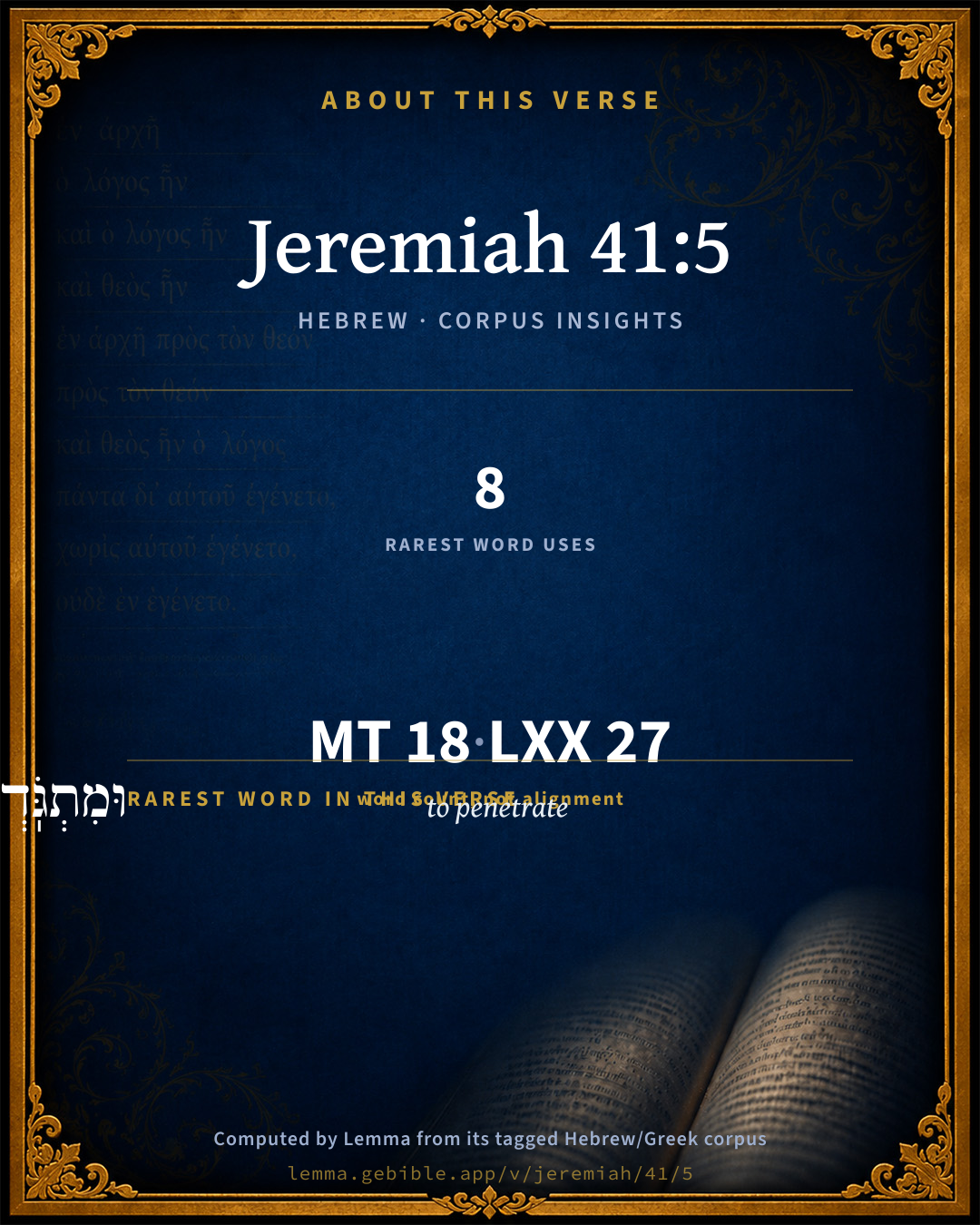
The rarest word here is וּמִתְגֹּֽדְדִ֑ים to penetrate H1413 — appearing just 8 times in the whole Hebrew Bible.

Shared distinctive vocabulary

וּמִתְגֹּֽדְדִ֑ים to penetrate H1413 occurs in 8 verses of the Hebrew Bible. Also found in:

Grammatical profile

  • 5 verbs
  • 12 nouns
  • 1 adjective

Verb forms

  • וַיָּבֹ֣אוּ Qal · Sequential Imperfect
  • מְגֻלְּחֵ֥י Pual · Participle Passive
  • וּקְרֻעֵ֥י Qal · Participle Passive
  • וּמִתְגֹּֽדְדִ֑ים Hithpoel · Participle Active
  • לְהָבִ֖יא Hiphil · Infinitive Construct

Repetition

Words recur within this verse — often emphatic in Hebrew:

  • וַיָּבֹ֣אוּ to enter H935 ×2
  • אֲ֠נָשִׁים man H376 ×2

Hebrew & Septuagint length

In the original languages it is 18 Hebrew tokens and 27 Greek tokens — but the two are counted differently (Hebrew bundles its prefixes and suffixes into one token; the Greek is in lemma form), so that isn’t a like-for-like length.

Cross-references

19

Topical passages linked to Jeremiah 41:5 in the Treasury of Scripture Knowledge — connected by theme and wording, ordered by reader-vote popularity; previews shown in the World English Bible.

  • 1 Kings 16:24 He bought the hill Samaria of Shemer for two talents of silver; and he built on the hill, and called the name of the city which he built, after the name of Shemer, the owner of the hill, Samaria.
  • Deuteronomy 14:1 You are the children of Yahweh your God: you shall not cut yourselves, nor make any baldness between your eyes for the dead.
  • Joshua 18:1 The whole congregation of the children of Israel assembled themselves together at Shiloh, and set up the tent of meeting there: and the land was subdued before them.
  • 2 Kings 25:9 He burnt the house of Yahweh, and the king's house; and all the houses of Jerusalem, even every great house, burnt he with fire.
  • Genesis 33:18 Jacob came in peace to the city of Shechem, which is in the land of Canaan, when he came from Paddan Aram; and encamped before the city.
  • Judges 9:1 Abimelech the son of Jerubbaal went to Shechem to his mother's brothers, and spoke with them, and with all the family of the house of his mother's father, saying,
  • 1 Kings 12:1 Rehoboam went to Shechem: for all Israel were come to Shechem to make him king.
  • 1 Samuel 1:7 [as] he did so year by year, when she went up to the house of Yahweh, so she provoked her; therefore she wept, and did not eat.
  • 1 Kings 12:25 Then Jeroboam built Shechem in the hill-country of Ephraim, and lived therein; and he went out from there, and built Penuel.
  • 1 Kings 16:29 In the thirty-eighth year of Asa king of Judah began Ahab the son of Omri to reign over Israel: and Ahab the son of Omri reigned over Israel in Samaria twenty-two years.
  • 2 Kings 10:13–14 Jehu met with the brothers of Ahaziah king of Judah, and said, Who are you? They answered, We are the brothers of Ahaziah: and we go down to Greet the children of the king and the children of the queen.
  • Isaiah 15:2 They are gone up to Bayith, and to Dibon, to the high places, to weep: Moab wails over Nebo, and over Medeba; on all their heads is baldness, every beard is cut off.
  • Genesis 34:2 Shechem the son of Hamor the Hivite, the prince of the land, saw her. He took her, lay with her, and humbled her.
  • Leviticus 19:27–28 You shall not cut the hair on the sides of your heads, neither shall you clip off the edge of your beard.
  • Joshua 24:32 The bones of Joseph, which the children of Israel brought up out of Egypt, buried they in Shechem, in the parcel of ground which Jacob bought of the sons of Hamor the father of Shechem for a hundred pieces of money: and they became the inheritance of the children of Joseph.
  • 2 Samuel 10:4 So Hanun took David's servants, and shaved off the one half of their beards, and cut off their garments in the middle, even to their buttocks, and sent them away.
  • Psalms 102:14 For your servants take pleasure in her stones, And have pity on her dust.
  • Jeremiah 7:12 But go you now to my place which was in Shiloh, where I caused my name to dwell at the first, and see what I did to it for the wickedness of my people Israel.
  • Jeremiah 7:14 therefore will I do to the house which is called by my name, in which you trust, and to the place which I gave to you and to your fathers, as I did to Shiloh.

Cross-references courtesy of OpenBible.info (CC BY 4.0).

Hebrew and Greek witnesses Masoretic Hebrew ↔ Greek Septuagint

The same verse in the two great witnesses to the Old Testament, shown verse-for-verse.

These are two independent witnesses, not word-aligned to each other, and the Septuagint is shown in lemma (dictionary) form.

Hebrew Jeremiah 41:5 Masoretic · Westminster Leningrad Codex

וַיָּבֹ֣אוּ אֲ֠נָשִׁים מִשְּׁכֶ֞ם מִשִּׁל֤וֹ וּמִשֹּֽׁמְרוֹן֙ שְׁמֹנִ֣ים אִ֔ישׁ מְגֻלְּחֵ֥י זָקָ֛ן וּקְרֻעֵ֥י בְגָדִ֖ים וּמִתְגֹּֽדְדִ֑ים וּמִנְחָ֤ה וּלְבוֹנָה֙ בְּיָדָ֔ם לְהָבִ֖יא בֵּ֥ית יְהוָֽה

that there came men from Shechem, from Shiloh, and from Samaria, even eighty men, having their beards shaved and their clothes torn, and having cut themselves, with meal-offerings and frankincense in their hand, to bring them to the house of Yahweh.

World English Bible · Public Domain

Greek LXX Structure differs

In the Septuagint, Jeremiah is about an eighth shorter than the Hebrew and arranges its material differently — the Oracles Against the Nations (Hebrew chapters 46–51) appear in the middle of the Greek book, after 25:13. Because the chapter and verse boundaries do not line up, a verse-for-verse comparison with the Hebrew is not shown.

A verse-for-verse comparison isn’t shown here because the chapters and verses don’t line up. Switch to the LXX edition with the MT / LXX toggle above to read the Greek directly.

On this verse, Ellicott's Commentary for English Readers discusses the Septuagint’s reading. Read the note in Commentary ↓

Hebrew: Westminster Leningrad Codex (CC BY 4.0). Greek: Septuagint (public domain); English from a public-domain English Septuagint. How the Septuagint differs from the Hebrew →

Targum (Aramaic paraphrase)

1

The Targum is the ancient Jewish Aramaic paraphrase of the Hebrew Scriptures — an interpretive translation, not the Hebrew text itself. Onkelos (literal) and Pseudo-Jonathan (expansive) render the Torah, and Jonathan the Prophets. Coverage is partial: where no permissively-licensed English translation exists for a verse, only the Aramaic is shown. This is verse-level text, not a word-by-word alignment to the Hebrew.

  1. Targum Jonathan Prophets (Joshua–Malachi)
    וַאֲתוֹ גַבְרַיָא מִשְׁכֶם וּמִשִׁילוֹ וּמִשֹׁמְרוֹן תְּמַנָן גַבְרִין כַּד מְגַלְחִין דִקְנֵיהוֹן וּמְבַזְעִין לְבוּשֵׁיהוֹן וּמִתְחַמְמִין וְקוּרְבָּנָא וּלְבוֹנָתָא בִידֵיהוֹן לְאַיְתָאָה לְבֵית מַקְדְשָׁא דַיָי:

    (no public-domain English translation for this verse)

    Targum Jonathan — Aramaic: “Mikraot Gedolot” (public domain). English: “Sefaria Community Translation” (CC0 1.0 (public-domain dedication)); “London "Chaldee Paraphrase," 1871” (public domain). Text via Sefaria.

Commentary

Notes on Jeremiah 41:5 from classic Christian and Jewish commentators (each source and its license shown beneath its notes). The classic Christian expositions comment on the surrounding passage and are grouped to its opening verse, so a note may address several verses; the Jewish commentaries on the Tanakh (Rashi and others) are per-verse, so they appear only where the commentator wrote on this verse.

Lemma curates 59 commentaries, every one of them public domain or Creative Commons licensed, each selected and text-cleaned for this edition rather than reprinted as found. About our sources →

Trapp's Complete Commentary

John Trapp

Jer 41:5 That there came certain from Shechem, from Shiloh, and from Samaria, [even] fourscore men, having their beards shaven, and their clothes rent, and having cut themselves, with offerings and incense in their hand, to bring [them] to the house of the LORD.

Ver. 5. That there came certain from Shechem and from Shiloh.] Innocent men, qui ne verbulo quidem immanem bestiam offenderant, who had not so much as by the least word offended this brutish, butcherly man; but came in the simplicity of their hearts to worship God, and to wait upon Gedaliah by the way, which last seemeth to be Ishmael’s main quarrel against them. See here Ecc 9:12. {See Trapp on "Ecc 9:12"}

Having their beards shaven, and their clothes rent, and having cut themselves.] These might be well minded men, though partly through ignorance of the law in those blind times, and partly through excess of passion, they went too far, heathen-like, in their outward expressions of sorrow {Lev 19:27 Deu 14:1} for the public calamity of their country.

To bring them to the house of the Lord,] i.e., To the place where God’s house lately had been, though now razed and ruined, that there they might worship as they could, and bewail the desolation of the city and temple, as Jerome saith the Jews did yearly the destruction of the second temple, bribing the Roman soldiers that kept it to let them come to the place and weep over it.

John Trapp, A Commentary or Exposition upon All the Books of the Old and New Testament (1647–1656) — public domain. Text from a community e-Sword module.

Joseph Benson's Commentary

Jer 41:5. There came fourscore men, having their beards shaven, &c. — “These were tokens of great mourning, by which these persons expressed their grief for the destruction of Jerusalem and the temple. Such expressions of sorrow were forbidden to be used at funeral obsequies, Lev 19:27-28; but might be lawfully used upon other mournful occasions. With offerings and incense to bring them to the house of the Lord — Some understand this as if devout persons brought their oblations to the place where the altar formerly stood, which they looked upon as consecrated ground; a custom, they think, countenanced by the words of Baruch, chap. Jer 1:10, where the exiles at Babylon are supposed to send money to buy offerings for the altar of the Lord, after that Jerusalem was taken and burned. Others by the house of the Lord understand an altar or place of worship erected by Gedaliah at Mizpah; in imitation of that which was formerly set up there by Samuel, which place continued to be a proseucha, or place of worship, in after times, as appears from 1Ma 3:46. There were many such sanctuaries or places of worship, both in Judea and elsewhere, among the Jewish dispersions.” — Lowth.

Joseph Benson's Commentary on the Old and New Testaments (1811–1818) — public domain. Text from a community e-Sword module.

Geneva Bible (1599)

Geneva Bible translators

For they thought that the Temple had not been destroyed and therefore came up to the feast of Tabernacles: but hearing of the burning thereof in the way, they showed these signs of sorrow.

Geneva Bible (1599) marginal notes — public domain. Text via Bolls.life.

Jamieson, Fausset & Brown

Robert Jamieson, A. R. Fausset & David Brown

beards shaven, &c.--indicating their deep sorrow at the destruction of the temple and city.

cut themselves--a heathen custom, forbidden (Lev 19:27-28; Deu 14:1). These men were mostly from Samaria, where the ten tribes, previous to their deportation, had fallen into heathen practices.

offerings--unbloody. They do not bring sacrificial victims, but "incense," &c., to testify their piety.

house of . . . Lord--that is, the place where the house of the Lord had stood (Kg2 25:9). The place in which a temple had stood, even when it had been destroyed, was held sacred [PAPINIAN]. Those "from Shiloh" would naturally seek the house of the Lord, since it was at Shiloh it originally was set up (Jos 18:1).

Jamieson, Fausset & Brown — Commentary Critical and Explanatory on the Whole Bible (1871) — public domain (CC PDM 1.0). Text via the HelloAO Bible API.

Adam Clarke's Commentary

Verse 5. Having their beards shaven] All these were signs of deep mourning, probably on account of the destruction of the city.

Adam Clarke's Commentary on the Bible (1810–1826) — public domain. Text from a community e-Sword/MySword module.

John Calvin's Commentaries

The Prophet skews here, that after Ishmael had polluted his hands, he made no end of his barbarity. And thus wicked men become hardened; for even if they dread at first to murder innocent men, when once they begin the work, they rush on to the commission of numberless murders. This is what the Prophet now tells us had happened; for after Gedaliah was killed, he says, that eighty men came from Shechem, from Shiloh, and from Samaria, who brought incense and offering, to present them in the Temple, and that these were led by treachery to Mizpah, there killed and cast into a pit, as we shall hereafter see.

It is not known by what cause Ishmael was induced to commit this cruel and barbarous act, for there was no war declared, nor could he have pretended any excuse for thus slaying unhappy men, who apprehended no such thing. They were of the seed of Abraham, they were worshippers of God, and then they had committed no offense, and plotted nothing against him. Why then he was seized with such rage is uncertain, except that wicked men, as we have said, never set any bounds to their crimes; for God gives theta the spirit of giddiness, so that they are carried away by blind madness. It is, indeed, probable, that they were killed, because Ishmael thought that they carne to Gedaliah, that they might live under his protection, and that he could not have gained anything by the murder of one man, except he obtained authority over the whole land. It was then suspicion alone, and that indeed slight, which led him to such a cruelty. And the atrocity of the deed was enhanced by what the Prophet says, that they came to offer to God incense and offering, מנחה, meneche: and he says also, that they had their beards shaven, and their garments torn Such an appearance ought to have roused pity even in the most inveterate enemies; for we know, that there is an innate feeling which leads us to pity wretchedness and tears, and every mournful appearance. The fury then of Ishmael, even if he had before determined to do some grievous thing to these men, ought to have been allayed by their very sight, so as not to be even angry with them. According then to every view of the case, we see that he must have been divested of every sense of equity, and that he was more cruel than any wild beast.

But it may be asked, How did these men come for the purpose mentioned, since the report respecting the destruction of the Temple must have spread everywhere? for they are not said to have come from Persia, or from countries beyond the sea; but that they came from places not afar off. They who answer that the report of the Temple being destroyed had not reached them, only seek to escape, but the answer is not credible, and it is only an evasion. The Temple was burnt in the fifth month; could that calamity be unknown in Judea? And then we know that Shiloh was not far from Jerusalem, nor was Samaria very distant. Since then the distance of these places cannot account for their ignorance, it seems not to me probable, that these came, because they thought that the Temple was still standing, nor did they bring victims, but only incense and oblation. I then think that they came, not to offer the ordinary sacrifice, but only that they might testify their piety in that place where they had before offered their sacrifices. This conjecture has nothing inconsistent in it; nor is there a doubt, but that before they left their homes, they had put on their mean and torn garments. These were signs, as we have elsewhere seen, of sorrow and mourning among the Orientals.

But here another question is raised, for the Prophet says, that they were torn or cut; and this has been deemed as referring to the skin or body: but this was forbidden by the Law. Some answer that they forgot the Law in their extreme grief, so that they undesignedly tore or lacerated their bodies. But the prohibition of the Law seems to me to have had something special in it, even that God designed by it to distinguish his people from heathens. And we may gather from sacred history, that some artifice was practiced by idolaters, when they cut their bodies; for it is said, that the priests of Baal cut their bodies according to their usual manner or practice. God then, wishing to keep his people from every corruption, forbade them to imitate the rites of the heathens. And then there is no doubt but that God designed to correct excess in grief and mourning. I therefore do not think that anything contrary to the Law was done by these men, when they came to the ruins of the Temple with torn garments and lacerated skin, for there was in them nothing affected, for so lamentable a calamity drew forth such grief, that they spared neither themselves nor their garments.

Jeremiah says, in the first of these verses, that the death of Gedaliah was concealed, so that no one knew it; yet such a deed could have been hardly buried; for many of the Jews were killed together with Gedaliah, and also the guarding soldiers, whom Nebuchadnezzar had given to Gedaliah. But the Prophet means that it was hid, because the report had not yet gone forth. He then speaks comparatively, when he says that it was known to none. We have already stated the purpose for which the eighty men came from Samaria and other places; it was not that they might offer sacrifices, as when the Temple was standing, but only lament the destruction of the Temple and of the city; and that as they had brought from home the greatest sorrow, they might, on their return, humble themselves, after having seen so grievous a punishment inflicted on the people for their sins.

John Calvin's Commentaries (1540-1563) — public domain. Text from the Calvin Translation Society English edition (1840s-50s) via the Christian Classics Ethereal Library (ccel.org). Calvin's coverage is partial (roughly two-thirds of the Bible); uncommented books and verses are honest gaps, never fabricated. The 19th-century editor's footnotes and remarks are omitted so the notes are faithfully Calvin's own voice.

Ellicott's Commentary for English Readers

(5) There came certain from Shechem, from Shiloh, and from Samaria.—The LXX. gives Salem instead of Shiloh, and this agrees better with the order of the names, Salem being a tower or fortress near Shechem (Gen_33:18), while Shiloh lay further off. The eighty travellers were coming apparently on a pilgrimage of mourning to the ruins of the Temple, perhaps to keep the Feast of Tabernacles in the hope of finding at least an altar there on which they might present their oblations. Mizpah lay directly on their road from all three places. It is significant that they bring with them not burnt offerings but the mincha, or meat offering, the cakes of flour with incense. The outward signs of mourning were, perhaps, connected either with the approaching Day of Atonement, which fell in the seventh month; or with some special fast day belonging to the same season (Zec_7:5); or in token of their sorrow for the destruction of the Temple. In the signs themselves we note a relapse into a half-heathen custom which the Law had forbidden (Lev_19:27; Deu_14:1; Jer_48:37).

A Bible Commentary for English Readers, edited by Charles John Ellicott (1878–1897) — public domain. Text from a community e-Sword module.

The Cambridge Bible for Schools and Colleges

gen. ed. J. J. S. Perowne

5. from Shechem, from Shiloh, and from Samaria] These three towns were in Ephraim, and thus the pilgrims were descendants of members of the Northern kingdom. Cp. the contributions given by Manassites, etc., in Josiah’s time for the repairs of the Temple (2Ch_34:9). Shechem, now Nâblus, is beautifully situated in a valley between the mountains Gerizim and Ebal. For Shiloh see on ch. Jer_7:12.

having their beards shaven and their clothes rent] in sign of mourning for the destruction of the Temple.

having cut themselves] though prohibited by the Deuteronomic law. See on ch. Jer_16:6.

oblations] For reading in mg. see on Jer_17:26. Animal sacrifices could no longer be offered at the ruined Temple (Deu_12:13-18), but it was still open to them to bring other offerings to the site, and this they were about to do.

The Cambridge Bible for Schools and Colleges (gen. ed. J. J. S. Perowne; Cambridge University Press, 1878–1918) — public domain. Text from a community e-Sword module.

John Gill's Exposition

That there came certain from Shechem, from Shiloh, and from Samaria,.... Places in the ten tribes, and which belonged to the kingdom of Israel; so that it seems even at this distance of time, though the body of the ten tribes had been many years ago carried captive, yet there were still some religious persons sons remaining, and who had a great regard to the temple worship at Jerusalem:

even fourscore men, having their beards shaven, and their clothes rent, and having cut themselves; as mourners for the destruction of Jerusalem, and the captivity of the people. The two first of these rites, shaving the beard, and rending of clothes, were agreeably to the law; but that of cutting themselves, their flesh with their nails, or knives, was forbidden by it, Lev 19:28; so that these people seemed to have retained some of the Heathenish customs of the places where they lived; for the king of Assyria had placed colonies of Heathens in Samaria, and the cities of it, Kg2 17:24; these came

with offerings and incense in their hands: a meat offering made of fine flour, as the word signifies; and incense, or frankincense, which used to be put upon such an offering, Lev 2:1;

to bring them to the house of the Lord; but the temple was now destroyed; wherefore either they thought there was a tabernacle or sanctuary erected at Mizpah for divine service and sacrifice; or they intended to offer these offerings on the spot where the temple of Jerusalem stood; and where they hoped to find an altar, if only of earth, and priests to sacrifice; though the Jewish commentators, Jarchi and Kimchi, observe, that when they first set out, they had not heard of the destruction of the temple, but heard of it in the way; and therefore came in a mourning habit; but before knew nothing of it; and therefore brought offerings with them, according to the former; but, according to the latter, they had heard before they set out of the destruction of Jerusalem, and the captivity of the people; but not of the burning of the temple, until they were on their journey.

John Gill's Exposition of the Whole Bible (1746–1763) — public domain (CC PDM 1.0). Text via the HelloAO Bible API.

Albert Barnes' Notes on the Bible

These three towns all lay in the tribe of Ephraim, and in the district planted by Salmaneser with Cuthites; but through the fact of these men having cut themselves (see Jer 16:6 note), is suspicious, yet they were probably pious Israelites, going up to Jerusalem, carrying the meat offering usual at the feast of tabernacles, of which this was the season, and mourning over the destruction, not of the city, but of the temple, to the repairs of which we find the members of this tribe contributing in Josiah’s time 2Ch 34:9.

Albert Barnes' Notes on the Bible (1834–1885) — public domain. Text from a community e-Sword/MySword module.

Haydock's Catholic Bible Commentary

Rent, as people mourning. Literally, "dirty." Hebrew and Septuagint, "cut." (Haydock) (Chap. xvi. 6., and Leviticus xix. 28.) --- Lord, Masphath, were people performed their devotions, as well as they could, Judges xx. 1., and 1 Machabees iii. 46.) Jeremias had probably ordered an altar to be erected, as Samuel had done, 1 Kings vii. 6. (Calmet) --- Others think that these people went thither for a priest, to offer what they had brought on the altar of Jerusalem, Baruch i. 10. (Tirinus) --- Masphath lay to the south. (Calmet) --- It seems many of the people about Samaria were true believers, and even more affected at the destruction of the temple. (Haydock) --- Their city had been demolished by Salmanasar (Calmet) long before, and many fresh inhabitants introduced, who adhered to idols. (Haydock)

George Leo Haydock (1774–1849), Haydock's Catholic Family Bible and Commentary, 1859 edition — public domain. Excludes Psalms (Douay-Rheims chapter numbering differs from Protestant) and Deuterocanonical books (Catholic canon only).

Matthew Poole's English Annotations

Samaria was the name both of a city and a province; Shechem was a city within that province, within the limits of the tribe of Ephraim, Jos 20:7. These places were now inhabited by a mixed people, partly Jews, partly such as the king of Assyria had upon his conquest of the ten tribes brought to inhabit there. From thence came eighty men, who possibly had not heard of the temple being burnt, at least when they came out; or if they had heard of it, yet thought, hearing some Jews were left, that they might have erected some altar for sacrifices; or it may be they brought no beasts, for the text speaks only of incense and offerings; they came with all indications of mourning used in those countries, shaven beards, clothes rent, and having cut themselves in a barbarous fashion used by the heathens, and forbidden the Jews, but yet practised by many of them.

Matthew Poole's English Annotations on the Holy Bible (1683–1685) — public domain. Text from a community e-Sword/MySword module.

Whedon's Commentary on the Bible

Daniel D. Whedon

5. Shechem,… Shiloh,… and Samaria — These places are not named in topographical order. The reason does not appear. It may be on account of rhythm, or it may be that most of the men came from Shechem, and that the other two places are simply mentioned as incidentally connected with the affair.

Cut themselves — This practice was strictly forbidden by the law, (Lev_19:28; Lev_21:5; Deu_14:1,) and yet seems to have remained in common use. (Jer_7:29; Isa_22:12; Eze_7:18, etc.) These signs of grief had reference to the calamity which had befallen Jerusalem.

Offerings and incense — Notwithstanding their violating Jewish law as above, there can be little doubt that they were Jews. Possibly in the region of Samaria. from which they came, heathen practices had been fallen into to an unusual extent.

Daniel D. Whedon (gen. ed.), Commentary on the Old and New Testaments (1874–1909) — public domain. Text from a community e-Sword module.

The Pulpit Commentary

There came certain from Shechem, etc. A number of pious pilgrims, descend. ants of the old ten tribes, passed by on their way to the holy site of the temple at Jerusalem(?). (comp. 2Ch_34:9 2Ch_30:11) From Shiloh. The Vatican Codex of the Septuagint has a plausible reading, "from Salem," which is apparently supported by Gen_33:18, "And Jacob cares to Shalem, a city of Shechem," and by its improvement thus introduced into the geographical order (Shiloh is, in fact, nearer to Mizpah than Shechem, and ought to be mentioned first). But though there is now a village called Salim, to the east of Nablus (Shechem), we have no sufficient ground for assuming a city of that name in the Old Testament, The rendering of Genesis, i.e. needs correction ("came in peace to the city," etc.) Their beards shaven, etc. They had, then, all the outward signs of mourning (for the public calamities); comp, Jer_16:6 Jer_48:37. To bring them to the house of the Lord. Yet the temple at Jerusalem was destroyed. Hence Thenius and Gratz have conjectured that Gedaliah had erected a provisional temple at Mizpah, which was already hallowed by its association with the Prophet Samuel. This is confirmed by RAPC 1Ma 3:46, where it is said of the pious Jews in the Maccabean rising, that they "assembled themselves... and came to Maspha, over against Jerusalem; for in Maspha was the place where they prayed aforetime in Israel."

The Pulpit Commentary (1880–1919), ed. H.D.M. Spence-Jones & Joseph S. Exell — public domain. Text from a community e-Sword module.

John Wesley's Explanatory Notes

There came men - Who possibly had not heard of the temple being burnt. Cut themselves - With all indications of mourning used in those countries.

John Wesley, Explanatory Notes Upon the Whole Bible (1754–1765) — public domain. Text via the GEBible commentary corpus.

Rashi

Rabbi Shlomo Yitzchaki (Rashi)

to bring to the house of the Lord When they left home, they were unaware of the destruction of the Temple, and en route, they heard of it, and rent their clothing and shaved their beards.

and having cut themselves An expression [denoting] laceration.

Rashi on the Tanakh — English translations: “The Judaica Press complete Tanach with Rashi, translated by A. J. Rosenberg” (CC BY 4.0); “Pentateuch with Rashi's commentary by M. Rosenbaum and A.M. Silbermann, 1929-1934” (public domain); “The Metsudah Tanach series, Lakewood, N.J” (CC BY 4.0); and “The Book of Joshua, Metsudah Publications, 1997” (CC BY 4.0). Text via Sefaria.

Lesson kit

Teaching starters — assembled from the data on this page, not authored interpretation. Every prompt links to the verse data it draws on. Edit before teaching.

Jeremiah, in the Prophets, opens this verse with 18 words (16 distinct Hebrew lemmas). Its most distinctive word is gâdad (“to penetrate”). A historical commentator’s framing appears above. Read the whole chapter for the surrounding context.

Discussion questions

  1. The word gâdad carries the sense “to penetrate.” How does it shape the verse?
  2. How does Deuteronomy 14:1, which shares the word «to penetrate», read alongside this verse?
  3. What does the repetition of “to enter” (2× in this one verse) do in this verse?
  4. These translations render this verse differently; the difference is in the English rendering, not the original. What questions does that raise?
  5. «וַיָּבֹ֣אוּ» is a Qal Sequential Imperfect verb. How does that grammatical form shape the action described?
  6. Compare how Trapp's Complete Commentary and Joseph Benson's Commentary read this verse. Where do they agree or differ?

Things to notice

Reading settings

Reading text

Shown beneath each verse's original-language words.

Old Testament
Old Testament edition

Read the OT as the Masoretic Hebrew (MT) or the Greek Septuagint (LXX).

English shown for the Greek Septuagint (in the Hebrew ↔ Greek comparison).

Comparing translations? Open the Compare panel on any verse page to stack up to four side by side.