
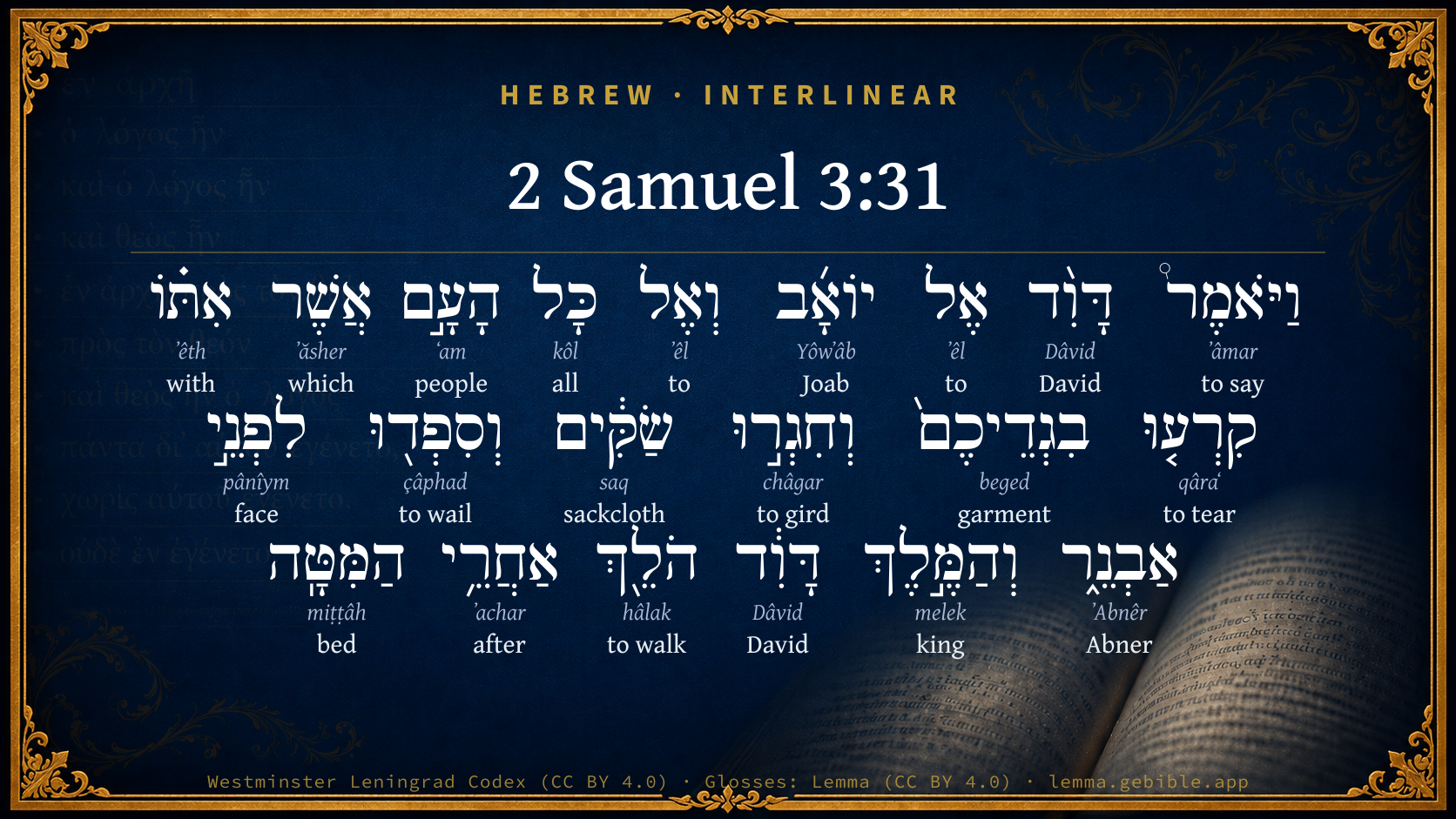
2 Samuel 3:31

Hebrew (Westminster Leningrad Codex) 2 Samuel 3:31 appears in the Hebrew Old Testament. The text above is from the Westminster Leningrad Codex. Each word links to its Strong’s number, a concise gloss, and parsing drawn from the Open Scriptures Hebrew Bible morphology. Click any word for its full Brown-Driver-Briggs (BDB) entry.
Download image
Cite this verse

2 Samuel 3:31 (World English Bible). Public Domain. Lemma interlinear Bible study tool, https://lemma.gebible.app/v/2-samuel/3/31.

Show BibTeX & RIS
BibTeX
RIS
English Translation
David said to Joab, and to all the people who were with him, Tear your clothes, and gird you with sackcloth, and mourn before Abner. King David followed the bier.
World English Bible · Public Domain
Download a study sheet

One document with this verse’s original text, its word-by-word gloss line, the meaning frame, cross-references with their text, attributed commentary, and full source and license credits — printable, and it pastes into notes with its structure intact.

This verse Autodidact and up

Study sheet (.html) Plain text (.txt)

A passage Seminary Student

Up to 50 verses in one chapter. A passage sheet keeps up to 6 commentary sources and 12 cross-references per verse, in the order this page ranks them, and says so on the sheet whenever that leaves anything out. Ask for a single verse and you get the Autodidact verse sheet above.

Everything on this page stays free to read, with no account — the sheet is a download of what is already on screen, not access to it.

Want to remove ads? Support Godless Engineer
Compare translations 3

The same verse in 3 English versions, stacked beneath the original-language interlinear above. Click any original word for its lexicon entry.

Each is an independent rendering of the whole verse — the interlinear is not word-aligned to these translations.

Highlighted words mark where these versions differ — a whole-verse word diff, not a word-by-word alignment.

  • World English Bible Public Domain
    David said to Joab, and to all the people who were with him, Tear your clothes, and gird you with sackcloth, and mourn before Abner. King David followed the bier.
  • King James Version Public Domain
    And David said to Joab, and to all the people that were with him, Rend your clothes, and gird you with sackcloth, and mourn before Abner. And king David himself followed the bier.
  • unfoldingWord Literal Text CC BY-SA 4.0
    And David said to Joab and to all of the people who with him, “Tear your clothes and put on sackcloth and mourn to the face of Abner.” And King David was walking behind the bier.

unfoldingWord Literal Text — © unfoldingWord, licensed CC BY-SA 4.0. Word-aligned USFM3 via Door43 (git.door43.org/unfoldingWord/en_ult).

Versions to compare (up to 4)

3 of 4 selected

Show all 18 translations

Every available English version of this verse, each an independent rendering of the whole verse.

  • World English Bible Public Domain
    David said to Joab, and to all the people who were with him, Tear your clothes, and gird you with sackcloth, and mourn before Abner. King David followed the bier.
  • Berean Standard Bible Public Domain
    Then David ordered Joab and all the people with him, “Tear your clothes, put on sackcloth, and mourn before Abner.” And King David himself walked behind the funeral bier.
  • Majority Standard Bible Public Domain
    Then David ordered Joab and all the people with him, “Tear your clothes, put on sackcloth, and mourn before Abner.” And King David himself walked behind the funeral bier.
  • King James Version Public Domain
    And David said to Joab, and to all the people that were with him, Rend your clothes, and gird you with sackcloth, and mourn before Abner. And king David himself followed the bier.
  • American Standard Version (1901) Public Domain
    And David said to Joab, and to all the people that were with him, Rend your clothes, and gird you with sackcloth, and mourn before Abner. And king David followed the bier.
  • Revised Version (1885) Public Domain
    And David said to Joab, and to all the people that were with him, Rend your clothes, and gird you with sackcloth, and mourn before Abner. And king David followed the bier.
  • Geneva Bible (1599) Public Domain
    And Dauid said to Ioab, and to al the people that were with him, Rent your clothes, and put on sackecloth, and mourne before Abner: and King Dauid him selfe followed the beare.
  • Douay-Rheims (1899) Public Domain
    And David said to Joab, and to all the people that were with him: Rend your garments, and gird yourselves with sackcloths, and mourn before the funeral of Abner. And king David himself followed the bier.
  • Young's Literal Translation Public Domain
    And David saith unto Joab, and unto all the people who `are' with him, `Rend your garments, and gird on sackcloth, and mourn before Abner;' and king David is going after the bier.
  • Literal Standard Version CC BY-SA 4.0
    And David says to Joab, and to all the people who [are] with him, “Tear your garments, and gird on sackcloth, and mourn before Abner”; and King David is going after the bier.
  • Unlocked Literal Bible CC BY-SA 4.0
    David said to Joab and to all the people who were with him, “Tear your clothes, put on sackcloth, and mourn before Abner's body.” Now King David walked behind the body in the funeral procession.
  • unfoldingWord Literal Text CC BY-SA 4.0
    And David said to Joab and to all of the people who with him, “Tear your clothes and put on sackcloth and mourn to the face of Abner.” And King David was walking behind the bier.
  • Darby Bible Public Domain
    And David said to Joab, and to all the people that were with him, Rend your garments, and gird yourselves with sackcloth, and mourn before Abner. And king David followed the bier.
  • World Messianic Bible Public Domain
    David said to Joab and to all the people who were with him, “Tear your clothes, and clothe yourselves with sackcloth, and mourn in front of Abner.” King David followed the bier.
  • Webster's Bible Public Domain
    And David said to Joab, and to all the people that were with him, Rend your clothes, and gird you with sackcloth, and mourn before Abner. And king David himself followed the bier.
  • Free Bible Version CC BY-SA 4.0
    Then David ordered Joab and everyone who was there, “Tear your clothes, put on sackcloth, and mourn for Abner.” King David himself followed the body as it was carried to the grave.
  • Bible in Basic English Public Domain
    And David said to Joab and all the people who were with him, Go in grief and put haircloth about you, in sorrow for Abner. And King David went after the dead body.
  • JPS Tanakh (1917) Public Domain
    And David said to Joab, and to all the people that were with him: 'Rend your clothes, and gird you with sackcloth, and wail before Abner.' And king David followed the bier.

Literal Standard Version (2020), Covenant Press — licensed CC BY-SA 4.0. Text via the HelloAO Bible API (eBible.org). Unlocked Literal Bible (unfoldingWord) — licensed CC BY-SA 4.0. Text via the HelloAO Bible API (eBible.org). unfoldingWord Literal Text — © unfoldingWord, licensed CC BY-SA 4.0. Word-aligned USFM3 via Door43 (git.door43.org/unfoldingWord/en_ult). Free Bible Version, Dr. Jonathan Gallagher — licensed CC BY-SA 4.0. Text via the HelloAO Bible API (eBible.org).

Word by word

More ways to search: Search by grammar → Find every occurrence → Compare this word →

Practice this passage: Drill this verse → Learn its vocabulary →

הַמִּטָּֽה
miṭṭâh
H4296
“the · bed”
Particle, Definite Article + Noun, Common, Feminine, Singular, Absolute
Part of Speech
Particle + Noun
Type
Common
Gender
Feminine
Number
Singular
State
Absolute
Full BDB Definition

Origin: from H5186

TWOT: 1352c

couch, bed, bier
  1. וַיֹּאמֶר֩ ʼâmar H559 “and · to say” Conjunction + Verb, Qal, Sequential Imperfect, 3rd Person, Masculine, Singular
  2. דָּוִ֨ד Dâvid H1732 “David” Noun, Proper
  3. אֶל ʼêl H413 “to” Preposition
  4. יוֹאָ֜ב Yôwʼâb H3097 “Joab” Noun, Proper
  5. וְאֶל ʼêl H413 “and · to” Conjunction + Preposition
  6. כָּל kôl H3605 “all of” Noun, Common, Masculine, Singular, Construct
  7. הָעָ֣ם ʻam H5971 “the · people” Particle, Definite Article + Noun, Common, Masculine, Singular, Absolute
  8. אֲשֶׁר ʼăsher H834 “which” Particle, Relative
  9. אִתּ֗וֹ ʼêth H854 “with · him” Preposition + Suffix, Personal, 3rd Person, Masculine, Singular
  10. קִרְע֤וּ qâraʻ H7167 “tear” Verb, Qal, Imperative, 2nd Person, Masculine, Plural
  11. בִגְדֵיכֶם֙ beged H899 “garments · your” Noun, Common, Masculine, Plural, Construct + Suffix, Personal, 2nd Person, Masculine, Plural
  12. וְחִגְר֣וּ châgar H2296 “and · gird” Conjunction + Verb, Qal, Imperative, 2nd Person, Masculine, Plural
  13. שַׂקִּ֔ים saq H8242 “sacks” Noun, Common, Masculine, Plural, Absolute
  14. וְסִפְד֖וּ çâphad H5594 “and · wail” Conjunction + Verb, Qal, Imperative, 2nd Person, Masculine, Plural
  15. לִפְנֵ֣י pânîym H6440 “to/for · face(s) of” Preposition + Noun, Common, Both, Plural, Construct
  16. אַבְנֵ֑ר ʼAbnêr H74 “Abner” Noun, Proper
  17. וְהַמֶּ֣לֶךְ melek H4428 “and · the · king” Conjunction + Particle, Definite Article + Noun, Common, Masculine, Singular, Absolute
  18. דָּוִ֔ד Dâvid H1732 “David” Noun, Proper
  19. הֹלֵ֖ךְ hâlak H1980 “walking” Verb, Qal, Participle Active, Masculine, Singular, Absolute
  20. אַחֲרֵ֥י ʼachar H310 “after” Preposition

About this verse

These counts appear in no published source. They are computed here, from the morphology-tagged text and Lemma’s own curated glosses. What Lemma adds →

21
words
19
distinct lemmas
Historical
section

Shared distinctive vocabulary

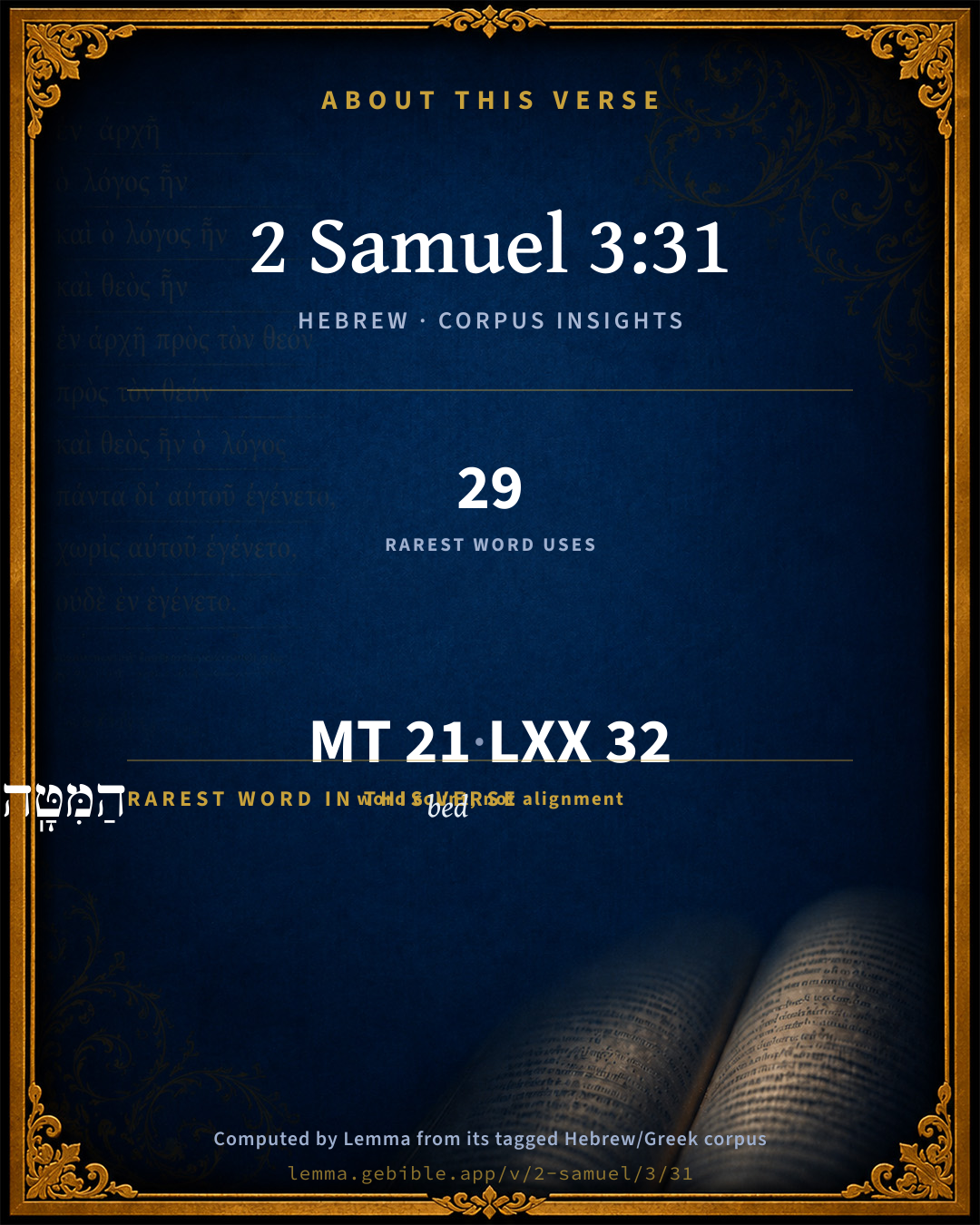
הַמִּטָּֽה bed H4296 occurs in 29 verses of the Hebrew Bible. Also found in:

Grammatical profile

  • 5 verbs
  • 11 nouns
  • 4 prepositions
  • 1 particle

Verb forms

  • וַיֹּאמֶר֩ Qal · Sequential Imperfect
  • קִרְע֤וּ Qal · Imperative
  • וְחִגְר֣וּ Qal · Imperative
  • וְסִפְד֖וּ Qal · Imperative
  • הֹלֵ֖ךְ Qal · Participle Active

Repetition

Words recur within this verse — often emphatic in Hebrew:

  • דָּוִ֨ד David H1732 ×2
  • אֶל to H413 ×2

Hebrew & Septuagint length

In English translation the verse runs 30 words from the Hebrew and 30 from the Septuagint (LXX English) — the same length.

A rough comparison of the two English renderings, which tokenize alike — not a word-level alignment.

Word counts can differ between the Hebrew and the Greek without any difference in meaning — e.g. the Hebrew direct-object marker אֵת has no separate Greek word, and Greek often adds the article ὁ.

In the original languages it is 21 Hebrew tokens and 32 Greek tokens — but the two are counted differently (Hebrew bundles its prefixes and suffixes into one token; the Greek is in lemma form), so that isn’t a like-for-like length.

Cross-references

8

Topical passages linked to 2 Samuel 3:31 in the Treasury of Scripture Knowledge — connected by theme and wording, ordered by reader-vote popularity; previews shown in the World English Bible.

  • Genesis 37:34 Jacob tore his clothes, and put sackcloth on his loins, and mourned for his son many days.
  • Joshua 7:6 Joshua tore his clothes, and fell to the earth on his face before the ark of Yahweh until the evening, he and the elders of Israel; and they put dust on their heads.
  • Judges 11:35 It happened, when he saw her, that he tore his clothes, and said, Alas, my daughter! you have brought me very low, and you are one of those who trouble me; for I have opened my mouth to Yahweh, and I can't go back.
  • 2 Samuel 1:2 it happened on the third day, that behold, a man came out of the camp from Saul, with his clothes torn, and earth on his head: and so it was, when he came to David, that he fell to the earth, and did obeisance.
  • 2 Samuel 1:11 Then David took hold on his clothes, and tore them; and likewise all the men who were with him:
  • Genesis 37:29 Reuben returned to the pit; and saw that Joseph wasn't in the pit; and he tore his clothes.
  • 2 Kings 19:1 It happened, when king Hezekiah heard it, that he tore his clothes, and covered himself with sackcloth, and went into the house of Yahweh.
  • Luke 7:14 He came near and touched the coffin, and the bearers stood still. He said, "Young man, I tell you, arise!"

Cross-references courtesy of OpenBible.info (CC BY 4.0).

Hebrew and Greek witnesses Masoretic Hebrew ↔ Greek Septuagint

The same verse in the two great witnesses to the Old Testament, shown verse-for-verse.

These are two independent witnesses, not word-aligned to each other, and the Septuagint is shown in lemma (dictionary) form.

Hebrew 2 Samuel 3:31 Masoretic · Westminster Leningrad Codex

וַיֹּאמֶר֩ דָּוִ֨ד אֶל יוֹאָ֜ב וְאֶל כָּל הָעָ֣ם אֲשֶׁר אִתּ֗וֹ קִרְע֤וּ בִגְדֵיכֶם֙ וְחִגְר֣וּ שַׂקִּ֔ים וְסִפְד֖וּ לִפְנֵ֣י אַבְנֵ֑ר וְהַמֶּ֣לֶךְ דָּוִ֔ד הֹלֵ֖ךְ אַחֲרֵ֥י הַמִּטָּֽה

David said to Joab, and to all the people who were with him, Tear your clothes, and gird you with sackcloth, and mourn before Abner. King David followed the bier.

World English Bible · Public Domain

Greek LXX 2 Samuel 3:31 Septuagint · lemma form

καί εἶπον δαυίδ πρός ιωαβ καί πρός πᾶς ὁ λαός ὁ μετά αὐτός διαῥήγνυμι ὁ ἱμάτιον σύ καί περιζώννυμι σάκκος καί κόπτω ἔμπροσθεν αβεννηρ καί ὁ βασιλεύς δαυίδ πορεύομαι ὀπίσω ὁ κλίνη

And David said to Joab and to all the people with him, Rend your garments, and gird yourselves with sackcloth, and lament before Abenner. And king David followed the bier.

LXX2012 (modern English Septuagint) · Public Domain

On this verse, Haydock's Catholic Bible Commentary discusses the Septuagint’s reading. Read the note in Commentary ↓

Hebrew: Westminster Leningrad Codex (CC BY 4.0). Greek: Septuagint (public domain); English from LXX2012 (modern English Septuagint) (Public Domain). How the Septuagint differs from the Hebrew →

Targum (Aramaic paraphrase)

1

The Targum is the ancient Jewish Aramaic paraphrase of the Hebrew Scriptures — an interpretive translation, not the Hebrew text itself. Onkelos (literal) and Pseudo-Jonathan (expansive) render the Torah, and Jonathan the Prophets. Coverage is partial: where no permissively-licensed English translation exists for a verse, only the Aramaic is shown. This is verse-level text, not a word-by-word alignment to the Hebrew.

  1. Targum Jonathan Prophets (Joshua–Malachi)
    וַאֲמַר דָוִד לְיוֹאָב וּלְכָל עַמָא דְעִמֵיהּ בְּזָעוּ לְבוּשֵׁיכוֹן וַאֲסָרוּ סַקִין וְסַפְדוּ קֳדָם אַבְנֵר וּמַלְכָּא דָוִד אָזֵיל בָּתַר עַרְסָא:

    (no public-domain English translation for this verse)

    Targum Jonathan — Aramaic: “Mikraot Gedolot” (public domain). English: “Sefaria Community Translation” (CC0 1.0 (public-domain dedication)); “London "Chaldee Paraphrase," 1871” (public domain). Text via Sefaria.

Commentary

Notes on 2 Samuel 3:31 from classic Christian and Jewish commentators (each source and its license shown beneath its notes). The classic Christian expositions comment on the surrounding passage and are grouped to its opening verse, so a note may address several verses; the Jewish commentaries on the Tanakh (Rashi and others) are per-verse, so they appear only where the commentator wrote on this verse.

Lemma curates 59 commentaries, every one of them public domain or Creative Commons licensed, each selected and text-cleaned for this edition rather than reprinted as found. About our sources →

Trapp's Complete Commentary

John Trapp

2Sa 3:31 And David said to Joab, and to all the people that [were] with him, Rend your clothes, and gird you with sackcloth, and mourn before Abner. And king David [himself] followed the bier.

Ver. 31. And David said to Joab.] As a part of his punishment. So the Pope forced our Henry II to kneel and pray to Becket’s shrine, yea, to go barefoot a great way in pilgrinmge thereunto for a penance. Joab might hereby be possibly brought to some sight of his foul sin. So could Henry hardly, for one Roger, a Norman doctor, maintained publicly that Becket had justly deserved death, for rebelling against his sovereign: and though the Pope sainted him, yet it was disputed among the doctors of Paris whether he were damned or saved, saith the French chronicler. {a}

And king David himself followed the bier.] Heb., The bed. So the grave is called a bed, {Isa 57:2} and the burying place, κοιυητηριον, a sleeping place. It was not usual for princes to attend upon funerals; - there was a veil laid between Tiberius, who counterfeited grief at the funeral of Drusus, and the dead corps, for state’s sake; - but David would do it in honour of Abner, and to clear his own innocency.

{a} Dan., Hist., fol. 99.

John Trapp, A Commentary or Exposition upon All the Books of the Old and New Testament (1647–1656) — public domain. Text from a community e-Sword module.

Joseph Benson's Commentary

2Sa 3:31. David said to Joab and all the people, &c. — The command was especially given to Joab, to bring him to repentance for his sin, and to expose him to public shame. Rend your clothes and gird you with sackcloth, &c. — These were all outward expressions of very great sorrow, which Joab himself was forced, however reluctant, to make a show of. And King David himself followed the bier — Was the chief mourner, attending upon the corpse, and paying Abner that respect which was due to his quality. Though this was contrary to the usage of kings, and might seem below David’s dignity; yet it was now expedient to vindicate himself from all suspicion of concurrence in this action. The word המשׂה, hammittah, here rendered the bier, properly means the bed. It was that on which persons of quality were wont to be carried forth to their graves, as ordinary people were upon what we call a bier.

Joseph Benson's Commentary on the Old and New Testaments (1811–1818) — public domain. Text from a community e-Sword module.

Tyndale Open Study Notes

Tyndale Open Resources

3:31 David himself walked: David’s public presence in the mourning procession, his open weeping at the gravesite (3:32), and his dramatic fast (3:35) made evident to the public that he had not ordered Abner’s killing (3:37).

Tyndale Open Study Notes — © Tyndale Open Resources, licensed CC BY-SA 4.0. Text via the HelloAO Bible API.

Geneva Bible (1599)

Geneva Bible translators

Meaning before the corpse.

Geneva Bible (1599) marginal notes — public domain. Text via Bolls.life.

Jamieson, Fausset & Brown

Robert Jamieson, A. R. Fausset & David Brown

David said to Joab, and to all the people that were with him, Rend your clothes, and gird you with sackcloth--David's sorrow was sincere and profound, and he took occasion to give it public expression by the funeral honors he appointed for Abner.

King David himself followed the bier--a sort of wooden frame, partly resembling a coffin, and partly a hand-barrow.

Jamieson, Fausset & Brown — Commentary Critical and Explanatory on the Whole Bible (1871) — public domain (CC PDM 1.0). Text via the HelloAO Bible API.

Adam Clarke's Commentary

Verse 31. David said to Joab] He commanded him to take on him the part of a principal mourner.

Adam Clarke's Commentary on the Bible (1810–1826) — public domain. Text from a community e-Sword/MySword module.

Ellicott's Commentary for English Readers

(31) Rend your clothes.—David commands a public mourning with the usual signs of rent clothes and sackcloth, and lays this command especially upon Joab, who is thus required, as it were, to do public penance for his act. David himself followed the bier as chief mourner.

A Bible Commentary for English Readers, edited by Charles John Ellicott (1878–1897) — public domain. Text from a community e-Sword module.

The Cambridge Bible for Schools and Colleges

gen. ed. J. J. S. Perowne

31–39. David’s lamentation for Abner

31. gird you with sackcloth] The practice of wearing garments of the coarse dark hair-cloth used for making sacks as a sign of mourning was very ancient (Gen_37:34). In cases of extreme grief or humiliation they were worn next the skin, but ordinarily outside the usual tunic.

mourn before Abner] Preceding the bier in the funeral procession.

The Cambridge Bible for Schools and Colleges (gen. ed. J. J. S. Perowne; Cambridge University Press, 1878–1918) — public domain. Text from a community e-Sword module.

John Gill's Exposition

And David said to Joab, and to all the people that were with him,.... To his whole court, Joab being present: for he did not flee, nor was he laid hold on in order to be brought to justice; which shows how great his power was, and that he was too hard for David, as in Sa2 3:39; however this he did, he enjoined his whole court, and Joab also, to express public mourning on this account:

rend your clothes and gird you with sackcloth; which were expressions of mourning used on various occasions, and on account of the dead, and which with the Heathens were carried to a greater excess, even to the tearing of their flesh:

and mourn before Abner; before his corpse, as carried to the grave, when it was usual to make great lamentations: see Act 8:2,

and King David himself followed the bier; or "bed" (l) on which his body was laid, and carried to the grave. On these the rich and noble among the Greeks and Romans were carried, and those of the meaner sort on biers (n); and so with the Jews; See Gill on Luk 7:14; some of which were gilded with gold, and were made of ivory, and had ivory feet (o); that of Herod's was all of gold, inlaid with precious stones, and the body covered with purple, and followed by his sons and kindred, the soldiers going before armed, and their leaders following (p); the bier or bed with the Romans was sometimes carried by six persons, sometimes by eight or more (q). It was not usual for kings, as the Jews say (r), to attend a funeral, to go out of the doors of their palace after their own dead, and much less others; but David did this to satisfy the people, and to root out of their mind all suspicion of his having any hand in Abner's death; and to show that he was not slain by his will, and with his consent.

(l) , Sept. "lectum", Piscator. (n) Salmuth. ad Pancirol. par. 1. tit. 62. p. 343. Kirchman. de Funer. Roman. l. 2. c. 9. p. 375. (o) Alstorph. de lect. vet. c. 19. p. 149. (p) Joseph. de Bello Jud. l. 1. c. 33. sect. 9. (q) Kirchman. ut supra. (de Funer. Roman. l. 2. c. 9. p. 375.) (r) Misn. Sanhedrin, c. 2. sect. 3. Maimon in Hilchot Ebel. c. 7. sect. 7. David de Pomis, Lexic. fol. 119. 4.

John Gill's Exposition of the Whole Bible (1746–1763) — public domain (CC PDM 1.0). Text via the HelloAO Bible API.

Haydock's Catholic Bible Commentary

Joab. Requiring him to make some reparation, at least, for the offence, and to render the funeral pomp more solemn. All were obliged to rend their garments, and to put on sackcloth, on such occasions. It was very rough, and consisted chiefly of goat and camel’s hair. --- Bier, contrary to the custom of kings. Some copies of the Septuagint say, he "went before the bier," (Calmet) where women commonly were placed. (Grotius)

George Leo Haydock (1774–1849), Haydock's Catholic Family Bible and Commentary, 1859 edition — public domain. Excludes Psalms (Douay-Rheims chapter numbering differs from Protestant) and Deuterocanonical books (Catholic canon only).

Matthew Poole's English Annotations

David said to Joab; him he especially obliged to it; partly to bring him to repentance for his sin; partly to expose him to public shame, and to the contempt and hatred of all the people, with whom he had too great an interest, which hereby David designed to diminish.

Mourn before Abner, i.e. attending upon his corpse, and paying him that respect and honour which was due to his quality.

King David himself followed the bier; which was against the usage of kings, and might seem below David’s dignity; but it was now expedient, to vindicate himself from all suspicion and contrivance or concurrence in this action.

Matthew Poole's English Annotations on the Holy Bible (1683–1685) — public domain. Text from a community e-Sword/MySword module.

The Pulpit Commentary

David said to Joab. The excuse of the blood feud made it impossible for David to punish Joab further than by depriving him of his command; but he made him condemn his own deed by taking part in the public mourning for the man he had murdered. This mourning consisted in going in solemn procession, clad in sackcloth, before Abner"s body, carried on a bier to the grave, while David followed as chief mourner; and the emphatic way in which he is called King David suggests the thought that he went in royal state, so as to give all possible dignity to the funeral. His tears and lamentations with uplifted voice were so genuine and hearty as to move the people to a similar outburst of grief. But while all those at Hebron had proof that David was innocent, the people generally would know only that, when Abner was escorting the king"s wife back to him, and arranging for his election to rule over all Israel, he was treacherously murdered at the gate of Hebron by one who was chief over David"s army and also his nephew.

Vers. 31-35. (HEBRON.) David"s lament over Abner.

As a fool dies should Abner die? Thy bands unbound, Thy feet not set in fetters: As one falls before the wicked, thou didst fall!

On hearing of the death of Abner, David exhibited the same generous spirit as formerly at the death of Saul. (2Sa_1:11, 2Sa_1:12)

1. He disclaimed (before his trusted servants, as afterwards, ver. 38) against having had any part therein; declaring, "I and my kingdom are guiltless before the Lord," etc. Malicious persons, judging others by themselves, might accuse him of it; and if it had been instigated by him, he would have brought guilt upon his people as well as himself. (2Sa_21:1 2Sa_24:1, 2Sa_24:17)

2. He invoked a curse on the head of the author of the deed; not from a feeling of personal hatred and vindictiveness, but of righteous indignation. (1Sa_26:19)

3. He ordered a public mourning in honour of the deceased. "And David said to Joab," etc. (ver. 38). Although he durst not arrest him, he clearly indicated what he thought of his conduct, and sought to remove the odium which it cast on his own good name.

4. He followed in the procession as chief mourner, wept at the grave, (Joh_11:35) and fasted until sunset. "There is no more beautiful picture in his life than that of his following the bier where lay the bloody corpse of the man who had been his enemy ever since he had known him, and sealing the reconciliation which death ever makes in noble souls by the pathetic dirge he chanted over Abner"s grave" (A. Maclaren). "This short poem is not only a dirge; it is also an apology for David and for Abner himself" (Wordsworth). It expresses

I ADMIRATION OF EMINENT WORTH. Abner was not a villain (fool) or murderer, deserving of being put in fetters and dying a felon"s death; but brave, capable, noble-minded, "great in council, great in war," and worthy of respect and honour. A generous man sees and appreciates what is best in other men. "The generous spirit of David kept down all base and selfish feeling, and added another to those glorious conquests over his own heart which were far higher distinctions than his other victories, and in which he has left us an example which all, from the least to the greatest, should try to emulate" (Blaikie).

II AFFLICTION FOR A PUBLIC LOSS. A light was quenched in Israel (ver, 38). His presence and influence would have contributed to the reconciliation of the tribes and the welfare of the nation (ver. 21). David"s sorrow was sincere; his tears (in confirmation of his words) evinced the tenderness and sympathy of his heart, moved the people also to tears, and (in contrast with the bearing of Joab) convinced them of his innocence and uprightness.

III ASTONISHMENT AT AN EXTRAORDINARY FATE. "The point of this indignant, more than sorrowful, lament lies in the mode in which Abner was slain" (Kitto, "Cyc."). How strange that Abner should have fallen in the full possession of strength to defend himself and liberty to flee from danger; neither as a prisoner taken in battle nor (in allusion to the right of blood-revenge which Joab claimed) as a murderer delivered up in bonds to the avenger by lawful authority, as he would have been if he were guilty! His fall so different from what might have been expected and from what he merited could be accounted for only by its having been caused by the treacherous malice and murderous violence of "sons of wickedness.

IV ABHORRENCE OF A WICKED DEED. (Vers. 29, 39.) The death of Abner was, even more than his life would have been, conducive to David"s interests. "It must have seemed to him, from a prudential point of view, that it was a piece of good fortune.

But the strength of his moral indignation does not suffer itself to be assuaged by worldly considerations" (Delitzsch). Hatred of wrong is a sign and measure of the love of right. "Ye that love the Lord, hate evil". (Psa_97:10) David was as severe toward evil doers as he was tender and pitiful toward the victims of their wickedness. "He was a man extreme in all his excellences a man of the highest strain, whether for counsel, for expression, or for action, in peace and in war, in exile and on the throne" (E. Irving). D.

The Pulpit Commentary (1880–1919), ed. H.D.M. Spence-Jones & Joseph S. Exell — public domain. Text from a community e-Sword module.

John Wesley's Explanatory Notes

Joab - Him he especially obliged to it, to bring him to repentance for his sin, and to expose him to public shame. Followed - That is, attending upon his corps, and paying him that respect which was due to his quality. Though this was against the usage of kings, and might seem below David's dignity; yet it was now expedient to vindicate himself from all suspicion of concurrence in this action.

John Wesley, Explanatory Notes Upon the Whole Bible (1754–1765) — public domain. Text via the GEBible commentary corpus.

unfoldingWord translationNotes

Door43 World Missions Community

Tear your clothes, put on sackcloth

These were symbolic actions to demonstrate their grief and sadness. (See: Symbolic Action)

The king wept and cried loudly

The words "wept" and "cried loudly" mean basically the same thing and emphasize how much David mourned for Abner. (See: Doublet)

translationWords

sackcloth

mourn

body

king

bury

grave

people group

unfoldingWord translationNotes — © Distant Shores Media and the Door43 World Missions Community, licensed CC BY-SA 4.0. Source: git.door43.org/Door43/en_tn.

Lesson kit

Teaching starters — assembled from the data on this page, not authored interpretation. Every prompt links to the verse data it draws on. Edit before teaching.

2 Samuel, in the Historical, opens this verse with 21 words (19 distinct Hebrew lemmas). Its most distinctive word is miṭṭâh (“bed”). A historical commentator’s framing appears above. Read the whole chapter for the surrounding context.

Discussion questions

  1. How does “bed” (miṭṭâh) shape what this verse is saying?
  2. Genesis 47:31 shares the word «bed» with this verse. How do the two illuminate each other?
  3. “David” occurs 2× in this one verse. What is the effect of the repetition?
  4. The translations on this page render this verse differently — a whole-verse word diff, not a word-by-word alignment. What might account for the different wordings?
  5. The verb «וַיֹּאמֶר֩» is Qal Sequential Imperfect. How does its form color the action?
  6. Reading how Trapp's Complete Commentary and Joseph Benson's Commentary read this verse, where do the two commentators agree and where do they part?

Things to notice

Reading settings

Reading text

Shown beneath each verse's original-language words.

Old Testament
Old Testament edition

Read the OT as the Masoretic Hebrew (MT) or the Greek Septuagint (LXX).

English shown for the Greek Septuagint (in the Hebrew ↔ Greek comparison).

Comparing translations? Open the Compare panel on any verse page to stack up to four side by side.