Psalms 102:26

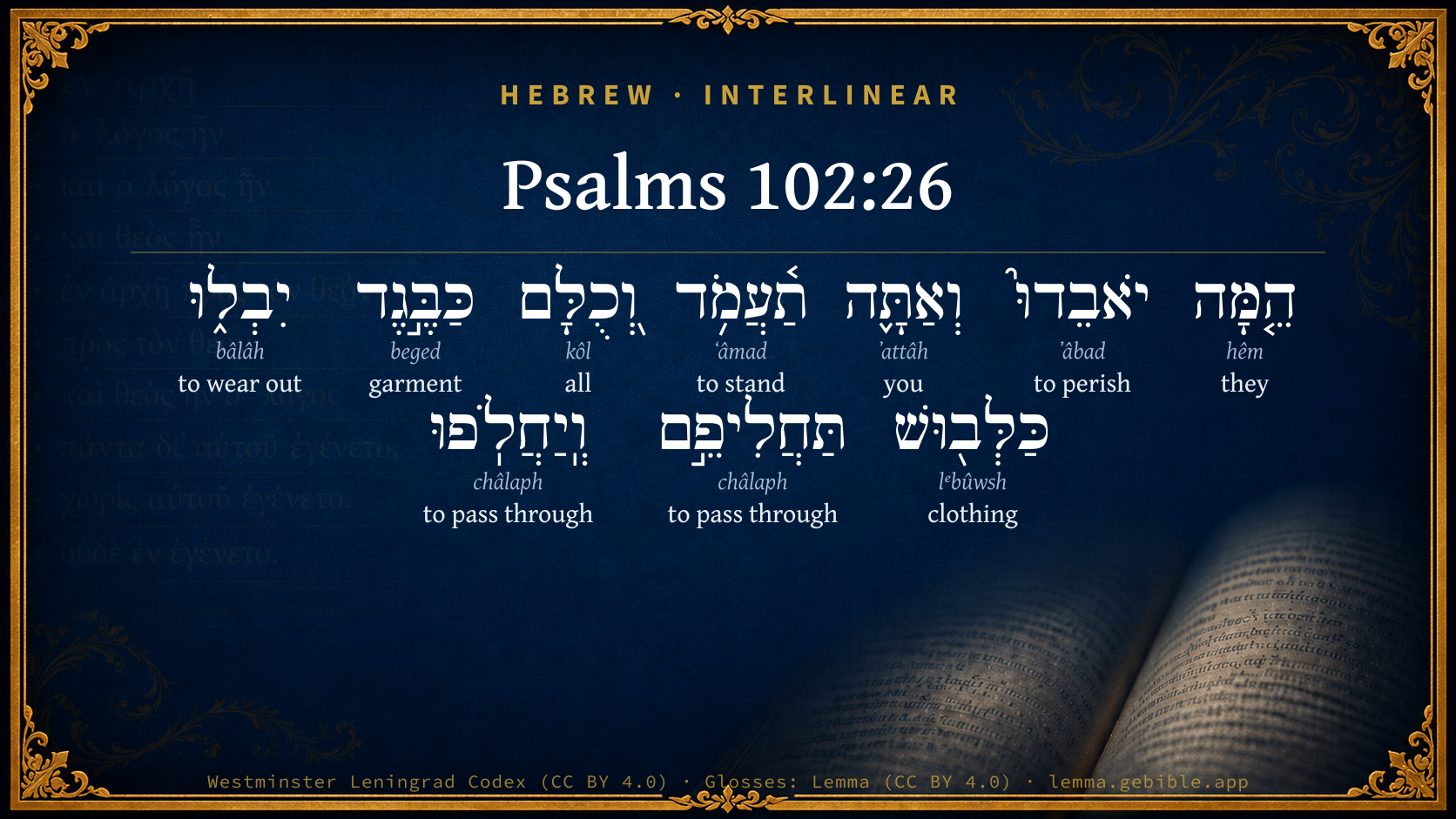
Hebrew (Westminster Leningrad Codex) Psalms 102:26 appears in the Hebrew Old Testament. The text above is from the Westminster Leningrad Codex. Each word links to its Strong’s number, a concise gloss, and parsing drawn from the Open Scriptures Hebrew Bible morphology. Click any word for its full Brown-Driver-Briggs (BDB) entry.
Download image
Cite this verse

Psalms 102:26 (World English Bible). Public Domain. Lemma interlinear Bible study tool, https://lemma.gebible.app/v/psalms/102/26.

Show BibTeX & RIS
BibTeX
RIS
English Translation
They will perish, but you will endure. Yes, all of them will wear out like a garment. You will change them like a cloak, and they will be changed.
World English Bible · Public Domain
Download a study sheet

One document with this verse’s original text, its word-by-word gloss line, the meaning frame, cross-references with their text, attributed commentary, and full source and license credits — printable, and it pastes into notes with its structure intact.

This verse Autodidact and up

Study sheet (.html) Plain text (.txt)

A passage Seminary Student

Up to 50 verses in one chapter. A passage sheet keeps up to 6 commentary sources and 12 cross-references per verse, in the order this page ranks them, and says so on the sheet whenever that leaves anything out. Ask for a single verse and you get the Autodidact verse sheet above.

Everything on this page stays free to read, with no account — the sheet is a download of what is already on screen, not access to it.

Want to remove ads? Support Godless Engineer
Compare translations 3

The same verse in 3 English versions, stacked beneath the original-language interlinear above. Click any original word for its lexicon entry.

Each is an independent rendering of the whole verse — the interlinear is not word-aligned to these translations.

Highlighted words mark where these versions differ — a whole-verse word diff, not a word-by-word alignment.

  • World English Bible Public Domain
    They will perish, but you will endure. Yes, all of them will wear out like a garment. You will change them like a cloak, and they will be changed.
  • King James Version Public Domain
    They shall perish, but thou shalt endure: yea, all of them shall wax old like a garment; as a vesture shalt thou change them, and they shall be changed:
  • unfoldingWord Literal Text CC BY-SA 4.0
    They, they will perish, but you, you will stand, and all of them will wear out like a garment; like clothing, you will pass them off, and they will pass away.

unfoldingWord Literal Text — © unfoldingWord, licensed CC BY-SA 4.0. Word-aligned USFM3 via Door43 (git.door43.org/unfoldingWord/en_ult).

Versions to compare (up to 4)

3 of 4 selected

Show all 18 translations

Every available English version of this verse, each an independent rendering of the whole verse.

  • World English Bible Public Domain
    They will perish, but you will endure. Yes, all of them will wear out like a garment. You will change them like a cloak, and they will be changed.
  • Berean Standard Bible Public Domain
    They will perish, but You remain; they will all wear out like a garment. Like clothing You will change them, and they will be passed on.
  • Majority Standard Bible Public Domain
    They will perish, but You remain; they will all wear out like a garment. Like clothing You will change them, and they will be passed on.
  • King James Version Public Domain
    They shall perish, but thou shalt endure: yea, all of them shall wax old like a garment; as a vesture shalt thou change them, and they shall be changed:
  • American Standard Version (1901) Public Domain
    They shall perish, but thou shalt endure; Yea, all of them shall wax old like a garment; As a vesture shalt thou change them, and they shall be changed:
  • Revised Version (1885) Public Domain
    They shall perish, but thou shalt endure: yea, all of them shall wax old like a garment; as a vesture shalt thou change them, and they shall be changed:
  • Geneva Bible (1599) Public Domain
    They shall perish, but thou shalt endure: euen they all shall waxe olde as doeth a garment: as a vesture shalt thou change them, and they shall be changed.
  • Douay-Rheims (1899) Public Domain
    In the beginning, O Lord, thou foundedst the earth: end the heavens are the works of thy hands.
  • Young's Literal Translation Public Domain
    They -- They perish, and Thou remainest, And all of them as a garment become old, As clothing Thou changest them, And they are changed.
  • Literal Standard Version CC BY-SA 4.0
    They perish, and You remain, || And all of them become old as a garment, || You change them as clothing, || And they are changed.
  • Unlocked Literal Bible CC BY-SA 4.0
    They will perish, but you will remain; they will all grow old like a garment; like clothing, you will remove them, and they will disappear.
  • unfoldingWord Literal Text CC BY-SA 4.0
    They, they will perish, but you, you will stand, and all of them will wear out like a garment; like clothing, you will pass them off, and they will pass away.
  • Darby Bible Public Domain
    *They* shall perish, but *thou* continuest; and all of them shall grow old as a garment: as a vesture shalt thou change them, and they shall be changed.
  • World Messianic Bible Public Domain
    They will perish, but you will endure. Yes, all of them will wear out like a garment. You will change them like a cloak, and they will be changed.
  • Webster's Bible Public Domain
    \\102:25\\Of old hast thou laid the foundation of the earth: and the heavens are the work of thy hands.
  • Free Bible Version CC BY-SA 4.0
    They will come to an end, but you will not. They will all wear out, like clothes—you will change them, and throw them away.
  • Bible in Basic English Public Domain
    They will come to an end, but you will still go on; they all will become old like a coat, and like a robe they will be changed:
  • JPS Tanakh (1917) Public Domain
    (102-27) They shall perish, but Thou shalt endure; yea, all of them shall wax old like a garment; as a vesture shalt Thou change them, and they shall pass away;

Literal Standard Version (2020), Covenant Press — licensed CC BY-SA 4.0. Text via the HelloAO Bible API (eBible.org). Unlocked Literal Bible (unfoldingWord) — licensed CC BY-SA 4.0. Text via the HelloAO Bible API (eBible.org). unfoldingWord Literal Text — © unfoldingWord, licensed CC BY-SA 4.0. Word-aligned USFM3 via Door43 (git.door43.org/unfoldingWord/en_ult). Free Bible Version, Dr. Jonathan Gallagher — licensed CC BY-SA 4.0. Text via the HelloAO Bible API (eBible.org).

Word by word

More ways to search: Search by grammar → Find every occurrence → Compare this word →

Practice this passage: Drill this verse → Learn its vocabulary →

יִבְל֑וּ
bâlâh
H1086
“to wear out”
Verb, Qal, Imperfect, 3rd Person, Masculine, Plural
Part of Speech
Verb
Stem
Qal
Form
Imperfect
Person
3rd Person
Gender
Masculine
Number
Plural
Full BDB Definition

Origin: a primitive root

TWOT: 246

to wear out, become old - (Qal) to wear out - (Piel) - to wear out - to wear out by use, use up completely - to enjoy, use to the full
  1. הֵ֤מָּה hêm H1992 “they” Pronoun, Personal, 3rd Person, Masculine, Plural
  2. יֹאבֵדוּ֮ ʼâbad H6 “to perish” Verb, Qal, Imperfect, 3rd Person, Masculine, Plural
  3. וְאַתָּ֪ה ʼattâh H859 “and · you” Conjunction + Pronoun, Personal, 2nd Person, Masculine, Singular
  4. תַ֫עֲמֹ֥ד ʻâmad H5975 “to stand” Verb, Qal, Imperfect, 2nd Person, Masculine, Singular
  5. וְ֭כֻלָּם kôl H3605 “and · all · their” Conjunction + Noun, Common, Masculine, Singular, Construct + Suffix, Personal, 3rd Person, Masculine, Plural
  6. כַּבֶּ֣גֶד beged H899 “like/as the · garment” Preposition, Determined + Noun, Common, Masculine, Singular, Absolute
  7. כַּלְּב֖וּשׁ lᵉbûwsh H3830 “like/as the · clothing” Preposition, Determined + Noun, Common, Masculine, Singular, Absolute
  8. תַּחֲלִיפֵ֣ם châlaph H2498 “to pass through · them” Verb, Hiphil, Imperfect, 2nd Person, Masculine, Singular + Suffix, Personal, 3rd Person, Masculine, Plural
  9. וְֽיַחֲלֹֽפוּ châlaph H2498 “and · to pass through” Conjunction + Verb, Qal, Imperfect, 3rd Person, Masculine, Plural

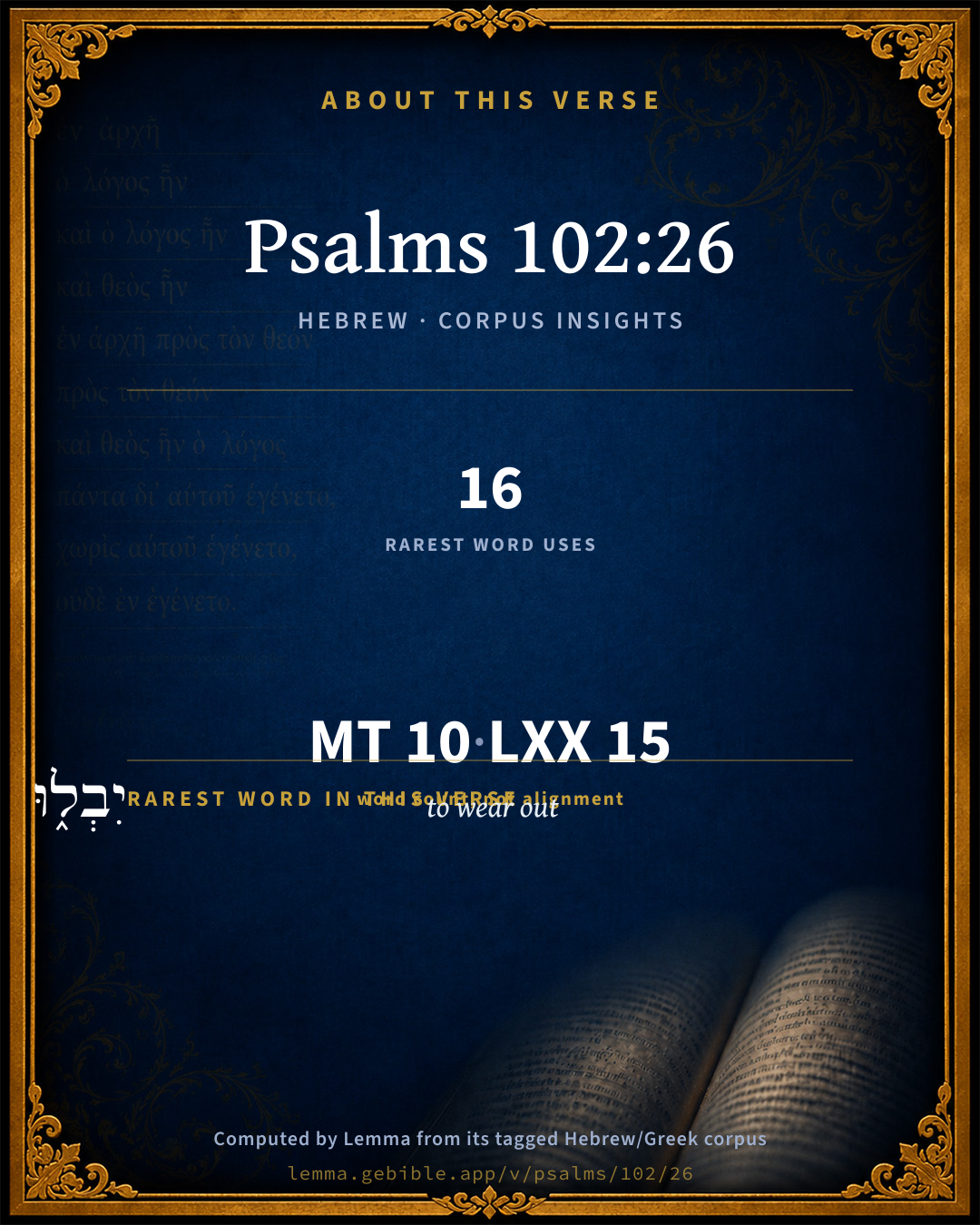
About this verse

These counts appear in no published source. They are computed here, from the morphology-tagged text and Lemma’s own curated glosses. What Lemma adds →

10
words
9
distinct lemmas
Wisdom
section

Notable vocabulary

The rarest word here is יִבְל֑וּ to wear out H1086 — appearing just 16 times in the whole Hebrew Bible.

Shared distinctive vocabulary

יִבְל֑וּ to wear out H1086 occurs in 15 verses of the Hebrew Bible. Also found in:

Grammatical profile

  • 5 verbs
  • 3 nouns
  • 2 pronouns

Verb forms

  • יֹאבֵדוּ֮ Qal · Imperfect
  • תַ֫עֲמֹ֥ד Qal · Imperfect
  • יִבְל֑וּ Qal · Imperfect
  • תַּחֲלִיפֵ֣ם Hiphil · Imperfect
  • וְֽיַחֲלֹֽפוּ Qal · Imperfect

Repetition

A word recurs within this verse — often emphatic in Hebrew:

  • תַּחֲלִיפֵ֣ם to pass through H2498 ×2

Hebrew & Septuagint length

In English translation the verse runs 29 words from the Hebrew and 28 from the Septuagint (LXX English) — closely comparable.

A rough comparison of the two English renderings, which tokenize alike — not a word-level alignment.

Word counts can differ between the Hebrew and the Greek without any difference in meaning — e.g. the Hebrew direct-object marker אֵת has no separate Greek word, and Greek often adds the article ὁ.

In the original languages it is 10 Hebrew tokens and 15 Greek tokens — but the two are counted differently (Hebrew bundles its prefixes and suffixes into one token; the Greek is in lemma form), so that isn’t a like-for-like length.

Cross-references

12

Topical passages linked to Psalms 102:26 in the Treasury of Scripture Knowledge — connected by theme and wording, ordered by reader-vote popularity; previews shown in the World English Bible.

  • Isaiah 51:6 Lift up your eyes to the heavens, and look on the earth beneath; for the heavens shall vanish away like smoke, and the earth shall wax old like a garment; and those who dwell therein shall die in like manner: but my salvation shall be forever, and my righteousness shall not be abolished.
  • Matthew 24:35 Heaven and earth will pass away, but my words will not pass away.
  • Luke 21:33 Heaven and earth will pass away, but my words will by no means pass away.
  • Isaiah 34:4 All the host of the sky shall be dissolved, and the heavens shall be rolled together as a scroll; and all their host shall fade away, as the leaf fades from off the vine, and as a fading [leaf] from the fig tree.
  • Revelation 20:11 I saw a great white throne, and him who sat on it, from whose face the earth and the heaven fled away. There was found no place for them.
  • Psalms 102:12 But you, Yahweh, will abide forever; Your renown endures to all generations.
  • Isaiah 66:22 For as the new heavens and the new earth, which I will make, shall remain before me, says Yahweh, so shall your seed and your name remain.
  • Romans 8:20 For the creation was subjected to vanity, not of its own will, but because of him who subjected it, in hope
  • Revelation 21:1 I saw a new heaven and a new earth: for the first heaven and the first earth have passed away, and the sea is no more.
  • Isaiah 65:17 For, behold, I create new heavens and a new earth; and the former things shall not be remembered, nor come into mind.
  • 2 Peter 3:7–12 But the heavens that now are, and the earth, by the same word have been stored up for fire, being reserved against the day of judgment and destruction of ungodly men.
  • Exodus 3:14 God said to Moses, "I AM WHO I AM," and he said, "You shall tell the children of Israel this: "I AM has sent me to you."

Cross-references courtesy of OpenBible.info (CC BY 4.0).

Hebrew and Greek witnesses Masoretic Hebrew ↔ Greek Septuagint

The same verse in the two great witnesses to the Old Testament, shown verse-for-verse.

You’re reading Greek Psalm 101 (Hebrew Psalm 102). The Septuagint counts the superscription, so verse numbers can differ from the Hebrew — chapter-level alignment, not verse-by-verse. Numbering follows Rahlfs.

These are two independent witnesses, not word-aligned to each other, and the Septuagint is shown in lemma (dictionary) form.

Hebrew Psalms 102:26 Masoretic · Westminster Leningrad Codex

הֵ֤מָּה יֹאבֵדוּ֮ וְאַתָּ֪ה תַ֫עֲמֹ֥ד וְ֭כֻלָּם כַּבֶּ֣גֶד יִבְל֑וּ כַּלְּב֖וּשׁ תַּחֲלִיפֵ֣ם וְֽיַחֲלֹֽפוּ

They will perish, but you will endure. Yes, all of them will wear out like a garment. You will change them like a cloak, and they will be changed.

World English Bible · Public Domain

Greek LXX Greek Psalm 101:26 Septuagint · lemma form

κατά ἀρχή σύ κύριος ὁ γῆ θεμελιόω καί ἔργον ὁ χείρ σύ εἰμί ὁ οὐρανός

They shall perish, but you remain: and they all shall wax old as a garment; and as a vesture shall you fold them, and they shall be changed.

LXX2012 (modern English Septuagint) · Public Domain

Hebrew: Westminster Leningrad Codex (CC BY 4.0). Greek: Septuagint (public domain); English from LXX2012 (modern English Septuagint) (Public Domain). How the Septuagint differs from the Hebrew →

Commentary

Notes on Psalms 102:26 from classic Christian and Jewish commentators (each source and its license shown beneath its notes). The classic Christian expositions comment on the surrounding passage and are grouped to its opening verse, so a note may address several verses; the Jewish commentaries on the Tanakh (Rashi and others) are per-verse, so they appear only where the commentator wrote on this verse.

Lemma curates 59 commentaries, every one of them public domain or Creative Commons licensed, each selected and text-cleaned for this edition rather than reprinted as found. About our sources →

Trapp's Complete Commentary

John Trapp

Psa 102:26 They shall perish, but thou shalt endure: yea, all of them shall wax old like a garment; as a vesture shalt thou change them, and they shall be changed:

Ver. 26. They shall perish] i.e. They shall change form and state, being dissolved by the last fire, 2Pe 3:7; 2Pe 3:10.

But thou shalt endure] Heb. stand, and with thee thy Church, Mat 22:32.

Yea, all of them shall wax old as a garment] Which weareth in the wearing; so do the visible heavens and the earth, whatever some write de constantia naturae. Isaiah saith it rotteth as a book (that is venerandae rubiginis), and wasteth away as smoke, Isa 65:17; Isa 66:22.

As a vesture shalt thou change them] The Greek hath roll them: confer Isa 34:4, ελιξεις αλλαξεις.

John Trapp, A Commentary or Exposition upon All the Books of the Old and New Testament (1647–1656) — public domain. Text from a community e-Sword module.

The Biblical Illustrator

Joseph S. Exell

Psa_102:26-28

They shall perish, but Thou shalt endure.

A perishing world and an immutable God

The great practical lesson which we are being daily taught is this, to withdraw our hearts from a changing and decaying world; and fix our hopes, and seek our happiness, in an unchanging and eternal God. This is the secret of real and permanent happiness to the soul of man.

I. The description which the text gives of the material world--the heavens and the earth. They are described as--

1. The effect of Divine operation. The contemplation of Gods creative wisdom and power, as displayed in the works of His hands, should deepen the feeling of awe and reverence, with which we regard His sacred majesty.

2. Mutable, perishable, and destined to destruction.

II. The contrast which it presents in the perfections of the worlds Creator and mans Redeemer. Thus the shifting scenes and dissolving frame of nature may be improved by the children of God to their own comfort, by giving the force of a most advantageous contrast to the perfections of God their Saviour.

III. The conclusion which it draws from this view of the Divine character. God our Redeemer will maintain His cause in this mutable world, as long as the world shall continue. Conclusion:--

1. How utterly unsuitable the world and the things of the world are to be the chief objects of mans solicitude and pursuit.

2. How preeminently secure and blest are they, whose dependence and hopes are fixed in the eternal God. (Essex Remembrancer.)

Things which grow not old

1. The love and mercy of God as shown in our creation, preservation, and all the blessings of this life, never grow old or wear out.

2. The salvation of Jesus has not grown old.

3. The sympathy of Jesus never grows old or worn out.

4. Heaven never changes nor wears out. And yet how old Heaven is! (H. J. Wilmot Buxton, M.A.)

The Biblical Illustrator, edited by Joseph S. Exell (c. 1880s–1900s) — public domain. Text from a community e-Sword module.

Joseph Benson's Commentary

Psa 102:26. They shall perish — Either as to the substance of them, which shall be annihilated, or as to their present form, fashion, and use, which shall be entirely changed: see the margin. The heavens and the earth, although they be the most permanent of all visible beings, and their continuance is often mentioned to signify the stability of things; yet, if compared with thee, they are as nothing, for they had a beginning, and shall have an end. All of them shall wax old — That is, shall decay and perish, like a garment — Which is worn out, and laid aside, and exchanged for another. And so shall this present frame of heaven and earth be. As a vesture shalt thou change them — Isaiah tells us, Isa 51:6, that the heaven and earth shall wax old like a garment; but the psalmist here goes one step further than the prophet; and not only acquaints us that the heavens and earth shall wax old, but, like a worn-out garment, shall be changed for new. And what can he intend but the new heavens and new earth, mentioned by St. Peter in the New Testament, and said to be the expectation of believers, according to God’s promise? 2Pe 3:13.

Joseph Benson's Commentary on the Old and New Testaments (1811–1818) — public domain. Text from a community e-Sword module.

J. A. Alexander on Psalms

Joseph Addison Alexander

27. (Psa 102:26) They shall perish and thou shalt stand, and all of them like a garment shall wear out, like a dress shalt thou change them and they shall change. The contrast is brought out as pointedly as possible in Hebrew, in by the insertion of the pronouns they and thou, neither of which is grammatically necessary to the expression of the meaning. Stand, stand fast, endure, remain, continue. All of them, without exception, even the noblest of God's works, shall at least lose their present form, and in that sense perish, a sense which may be still more readily put upon the parallel verb pass away or change. The twofold usage of the English verb, as active and neuter, or transitive and intransitive, makes it an appropriate representative of the primitive and derivative forms of the Hebrew verb. The corresponding verb, in the second member of the sentence, means not only to wax old, but, as the necessary consequence, to wear out. See above, on Psa 32:3, and compare Psa 49:14.

Joseph Addison Alexander, The Psalms Translated and Explained (1850) — public domain. Text from a community e-Sword module.

Geneva Bible (1599)

Geneva Bible translators

If heaven and earth perish, much more man shall perish: but the Church by reason of God’s promise endureth forever.

Geneva Bible (1599) marginal notes — public domain. Text via Bolls.life.

Adam Clarke's Commentary

Verse 26. They shall perish] Nothing can be eternal a parte ante, or a parte post, but thyself. Even that which thou hast created, because not necessarily eternal, must be perishable; necessary duration belongs to God only; and it is by his will and energy alone that universal nature is preserved in existence, and preserved from running into speedy disorder, decay, and ruin.

Yea, all of them shall wax old] Every thing must deteriorate, unless preserved by thy renewing and invigorating energy. Even the heavens and the earth are subject to this law; for that which is not, from the infinite perfection of its own nature, ETERNAL, must be perishable; therefore the heavens and the earth must necessarily come to an end. They contain the seeds of their own dissolution. It is true that in sublunary things, the vicissitudes of seasons is a sort of check to the principle of dissolution; but it only partially corrects this tendency. Even the productions of the earth wear out or deteriorate. Plant the same seed or grain for several years consecutively, and it degenerates so as at last not to be worth the labour of tillage, however expensively the soil may be manured in which it is planted. I may instance in wheat and in the potatoe, the two grand supporters of life in European countries. All other seeds and plants, as far as they have fallen under my observation, are subject to the same law.

Adam Clarke's Commentary on the Bible (1810–1826) — public domain. Text from a community e-Sword/MySword module.

Ellicott's Commentary for English Readers

(26) Perish.—Compared with man, the victim of incessant change and visible decay, the fixed earth and the uplifted mountains are often employed as symbols of endurance and perpetuity, but compared with God’s eternal existence, they are but like a vesture that wears out. The source of the image is Isa_51:6. (Comp. Isa_34:4.) For the use made of the passage in Heb_1:10; Heb_1:12, see New Testament Commentary. The terms employed for “garment” and “vesture” (beged, lebûsh) are synonyms for the outer cloak worn by the Jews. The imagery of the text no doubt supplied Goëthe with the thought in his fine lines

“’Tis thus at the roaring loom of time I ply,

And weave for God the garment thou seest Him by!”

which in turn suggested to Carlyle the “Philosophy of Clothes.” “Why multiply instances? It is written, the heavens and the earth shall fade away like a vesture, which, indeed they are—the time vesture of the Eternal.”—Sartor Resartus, I. 11

It is interesting to think how the science of geology confirms the image of the psalmist, showing how time has been literally changing the so solid-seeming earth, stripping off the robe that covers the hills, to fold it down at some river mouth, or at the bottom of the ocean bed.

A Bible Commentary for English Readers, edited by Charles John Ellicott (1878–1897) — public domain. Text from a community e-Sword module.

The Cambridge Bible for Schools and Colleges

gen. ed. J. J. S. Perowne

26. Compared with man’s brief span of life the natural world is an emblem of permanence; compared with God’s eternity, it is seen to be transitory. He existed from all eternity before it, and called it into being: He will exist unchanged when it has passed away.

they shall be changed] Or, pass away. The Psalmist’s thought here is rather of the transitoriness of heaven and earth contrasted with the eternity of God than of the new heavens and new earth, Isa_65:17; Isa_66:22.

The Cambridge Bible for Schools and Colleges (gen. ed. J. J. S. Perowne; Cambridge University Press, 1878–1918) — public domain. Text from a community e-Sword module.

John Gill's Exposition

But thou art the same,.... That hast created them, as the Targum adds; or "thou art he" (h), the everlasting I AM, the unchangeable Jehovah; immutable in his nature and perfections; in his love and affections to his people; in his power to protect and keep them; in his wisdom to guide and direct them; in his righteousness to clothe them, and render them acceptable to God; in his blood to cleanse them, and speak peace and pardon to them; in his fulness to supply them, and in his intercession for them,

and thy years shall have no end; See Gill on Psa 102:24, now he, that made the heavens and the earth, and will be when they will not be, especially in the present form they are, must be able to rebuild his Zion, and bring on the glory he has promised; and from his eternity and immutability may be concluded the continuance of his church and interest in the world, until all the glorious things spoken of it shall be fulfilled, as follows.

(h) "tu ipse", Pagninus, Montanus.

John Gill's Exposition of the Whole Bible (1746–1763) — public domain (CC PDM 1.0). Text via the HelloAO Bible API.

Matthew Poole's English Annotations

They shall perish; either,

1. As to the substance of them, which shall be annihilated. Or,

2. As to their present nature and use: see Isa 65:17; 66:22; 2Pe 3:7,10,11. The heavens and the earth, although they be the most permanent of all visible beings, and their continuance is oft mentioned to signify the stability and immutability of things, yet if compared with thee are as nothing; they had a beginning, and shall have an end.

Wax old, i.e. decay and perish.

Like a garment which is worn out and laid aside, and exchanged for another. And so shall this present frame of heaven and earth be.

Matthew Poole's English Annotations on the Holy Bible (1683–1685) — public domain. Text from a community e-Sword/MySword module.

The Treasury of David

Charles H. Spurgeon

Ver. 26. They shall perish, but thou shalt endure. The power which made them shall dissolve them, even as the city of thy love was destroyed at thy command; yet neither the ruined city nor the ruined earth can make a change in thee, reverse thy purpose, or diminish thy glory. Thou standest when all things fall.

Yea, all of them shall wax old like a garment; as a vesture shalt thou change them, and they shall be changed. Time impairs all things, the fashion becomes obsolete and passes away. The visible creation, which is like the garment of the invisible God, is waxing old and wearing out, and our great King is not so poor that he must always wear the same robes; he will ere long fold up the worlds and put them aside as worn out vestures, and he will array himself in new attire, making a new heaven and a new earth wherein dwelleth righteousness. How readily will all this be done. "Thou shalt change them and they shall be changed; "as in the creation so in the restoration, omnipotence shall work its way without hindrance.

Ver. 26. The shall perish. The greater the cirruption, the vaster the destruction. Some think that the fiery deluge shall ascend no higher than did the watery. It may be the earth shall be burned, that is the worst guest at the table, the common sewer of all other creatures, but shall the heavens pass away? It may be the airy heaven; but shall the starry heaven where God hath printed such figures of his glory? Yes, caelum, elementurn, terra, when ignis ubique ferox ruptis regnabit habenis. The former deluge is called the world's winter, the next the world's summer. The one was with a cold and moist element, the other shall be with an element hot and dry. But what then shall become of the saints? They shall be delivered out of all; walking like those three servants in the midst of that great furnace, the burning world, and not be scorched, because there is one among them to deliver them, "the Son of God, "Da 3:25, their Redeemer. But shall all quite perish? No, there is rather a mutation than an abolition of their substance. Thou shalt change them, and they shall be changed, not abolished. The concupiscence shall pass, not the essence; the form, not the nature. In the altering of an old garment, we destroy it not, but trim it, refresh it, and make it seem new. They pass, they do not perish; the dross is purged, the metal stays. The corrupt quality shall be renewed, and all things restored to that original beauty wherein they were created. "The end of all things is at hand, "1Pe 4:7: an end of us, an end of our days, an end of our ways, and end of our thoughts. If a man could say as Job's messenger, I alone am escaped, it were somewhat; or might find an ark with Noah. But there is no ark to defend them from that heat, but only the bosom of Jesus Christ. Thomas Adams.

Ver. 26. Like a garment. The whole creation is as a garment, wherein the Lord shows his power clothed unto men; whence in particular he is said to clothe himself with light as with a garment. And in it is the hiding of his power. Hid it is, as a man is hid with a garment; not that he should not be seen at all, but that he should not be seen perfectly and as he is. It shows the man, and he is known by it; but also it hides him, that he is not perfectly or fully seen. So are the works of creation unto God, he so far makes them his garment or clothing as in them to give out some instances of his power and wisdom; but he is also hid in them, in that by them no creature can come to the full and perfect knowledge of him. Now, when this work shall cease, and God shall unclothe or unveil all his glory to his saints, and they shall know him perfectly, see him as he is, so far as a created nature is capable of that comprehension, then will he lay them aside and fold them up, at least as to that use, as easily as a man lays aside a garment that he will wear or use no more. This lies in the metaphor. John Owen.

Ver. 26-27.

1. How far God may changeonly in his garments, or outward manifestations of creation and providence.

2. Wherein he cannot changehis nature, attributes, covenant, love, etc.

3. The comfortable truths which may be safely inferred, or which gather support from this fact.

Ver. 26-27.

1. The material universe of God. (a) No more to him than a garment to the wearer. (b) Ever waxing old, but he the same. (c) Soon to be changed and left to perish, but of his years no end.

2. Our relation to each (a) Let us never love the dress more than the wearer. (b) Nor trust more in the changeful than in the abiding. (c) Nor live for that which will die out.

Psalms 102:27*

Charles H. Spurgeon's The Treasury of David (1869–1885) — public domain. Psalms only. Text from a community e-Sword/MySword module.

Whedon's Commentary on the Bible

Daniel D. Whedon

26. They shall perish—That is, being created, they are perishable. Their existence is not necessary, but dependent; not inherent, but derived. “They continue this day according to thine ordinances,” (Psa_119:91;) but not from any self-sustaining power. Therefore, nothing in man or nature is to be trusted, but God only, the Eternal, the Creator, the Faithful.

Shalt thou change them—That is, If it be thy will so to do it will not contradict thine attributes. But the implication is, Thou wilt sooner change them than alter, or fail, in thy word of promise to thy Church. Thus the same form expressed more fully, “Heaven and earth shall pass away, but my word shall not pass away,” (Mat_24:35,) is to be explained by “until heaven and earth pass away,” etc,, or, “it is easier for heaven and earth to pass,” etc., (Mat_5:18; Luk_16:17,)—that is, it is a conditional proposition. But the Hebrews held to the doctrine that the earth and its atmosphere, and even the whole system of nature, would be destroyed, and from the ruins would spring a new and renovated state of things. The text, with many other passages, harmonizes with this view. See Job_14:12; Psa_72:5; Psa_72:7; Isa_51:16; Isa_65:17-18; Isa_66:22. The same is taught in the New Testament. 2Pe_3:10; 2Pe_3:12-13; Rev_20:11; Rev_21:1.In many other places the destruction of the heavenly bodies, and the darkening of the sun and moon, represent, symbolically, the downfall and catastrophe of nations, as in Isa_13:10-11; Isa_13:13; Isa_34:5; Eze_32:7. “These very figurative expressions presuppose the literal idea,” (Knapp,) particularly as far as this earth is concerned. The word “change,” (חלפ,) in the text, properly denotes a progressive change—a passing on to a further stage, (Isa_51:6; Isa_65:17-18; Rev_21:27; 2Pe_3:13;) and this geology itself makes probable, in the doctrine of catastrophe and renewal, and of progressive species. The text, with Zep_1:14-18, especially Psa_102:15, as rendered in the Vulgate, (Dies irae dies illa, etc.,) and 2Pe_3:10, are supposed to have suggested that incomparable poem of the ages, “Dies Irae,” (Day of Wrath,) which, for five hundred years, has been the admiration of the Christian world, having passed into eighty versions. It is used in the Romish Church as the sequence for All Souls’ Day, and in all masses for the dead.

Daniel D. Whedon (gen. ed.), Commentary on the Old and New Testaments (1874–1909) — public domain. Text from a community e-Sword module.

The Pulpit Commentary

They shall perish. The coming destruction of the world that now is, is very frequently declared in Holy Scripture. (see Isa_51:6 Mat_24:35 Mar_13:31 Luk_21:33 2Pe_3:7, 2Pe_3:10, 2Pe_3:12) But thou shalt endure. With the perishable nature of the whole material creation, the psalmist contrasts the absolute eternity of God. (comp. ver. 12; also Psa_9:7 Heb_1:11) Yea, all of them shall wax old like a garment. (comp. Isa_51:6) As a vesture shalt thou change them, and they shall be changed. Compare the prophecies of "a new heaven and a new earth". (Isa_55:1-7 Isa_66:22 2Pe_3:13 Rev_21:1)

The Pulpit Commentary (1880–1919), ed. H.D.M. Spence-Jones & Joseph S. Exell — public domain. Text from a community e-Sword module.

John Wesley's Explanatory Notes

Perish - As to their present nature and use.

John Wesley, Explanatory Notes Upon the Whole Bible (1754–1765) — public domain. Text via the GEBible commentary corpus.

Rashi

Rabbi Shlomo Yitzchaki (Rashi)

In the beginning Heb. לפנים, from the beginning.

Rashi on the Tanakh — English translations: “The Judaica Press complete Tanach with Rashi, translated by A. J. Rosenberg” (CC BY 4.0); “Pentateuch with Rashi's commentary by M. Rosenbaum and A.M. Silbermann, 1929-1934” (public domain); “The Metsudah Tanach series, Lakewood, N.J” (CC BY 4.0); and “The Book of Joshua, Metsudah Publications, 1997” (CC BY 4.0). Text via Sefaria.

Lesson kit

Teaching starters — assembled from the data on this page, not authored interpretation. Every prompt links to the verse data it draws on. Edit before teaching.

Psalms, in the Wisdom, opens this verse with 10 words (9 distinct Hebrew lemmas). Its most distinctive word is bâlâh (“to wear out”). A historical commentator’s framing appears above. Read the whole chapter for the surrounding context.

Discussion questions

  1. What does “to wear out” (bâlâh) contribute to the verse as a whole?
  2. How does Genesis 18:12, which shares the word «to wear out», read alongside this verse?
  3. What does the repetition of “to pass through” (2× in this one verse) do in this verse?
  4. These translations render this verse differently; the difference is in the English rendering, not the original. What questions does that raise?
  5. «יֹאבֵדוּ֮» is a Qal Imperfect verb. How does that grammatical form shape the action described?
  6. Compare how Trapp's Complete Commentary and The Biblical Illustrator read this verse. Where do they agree or differ?

Things to notice

Reading settings

Reading text

Shown beneath each verse's original-language words.

Old Testament
Old Testament edition

Read the OT as the Masoretic Hebrew (MT) or the Greek Septuagint (LXX).

English shown for the Greek Septuagint (in the Hebrew ↔ Greek comparison).

Comparing translations? Open the Compare panel on any verse page to stack up to four side by side.