Ezra 9:3

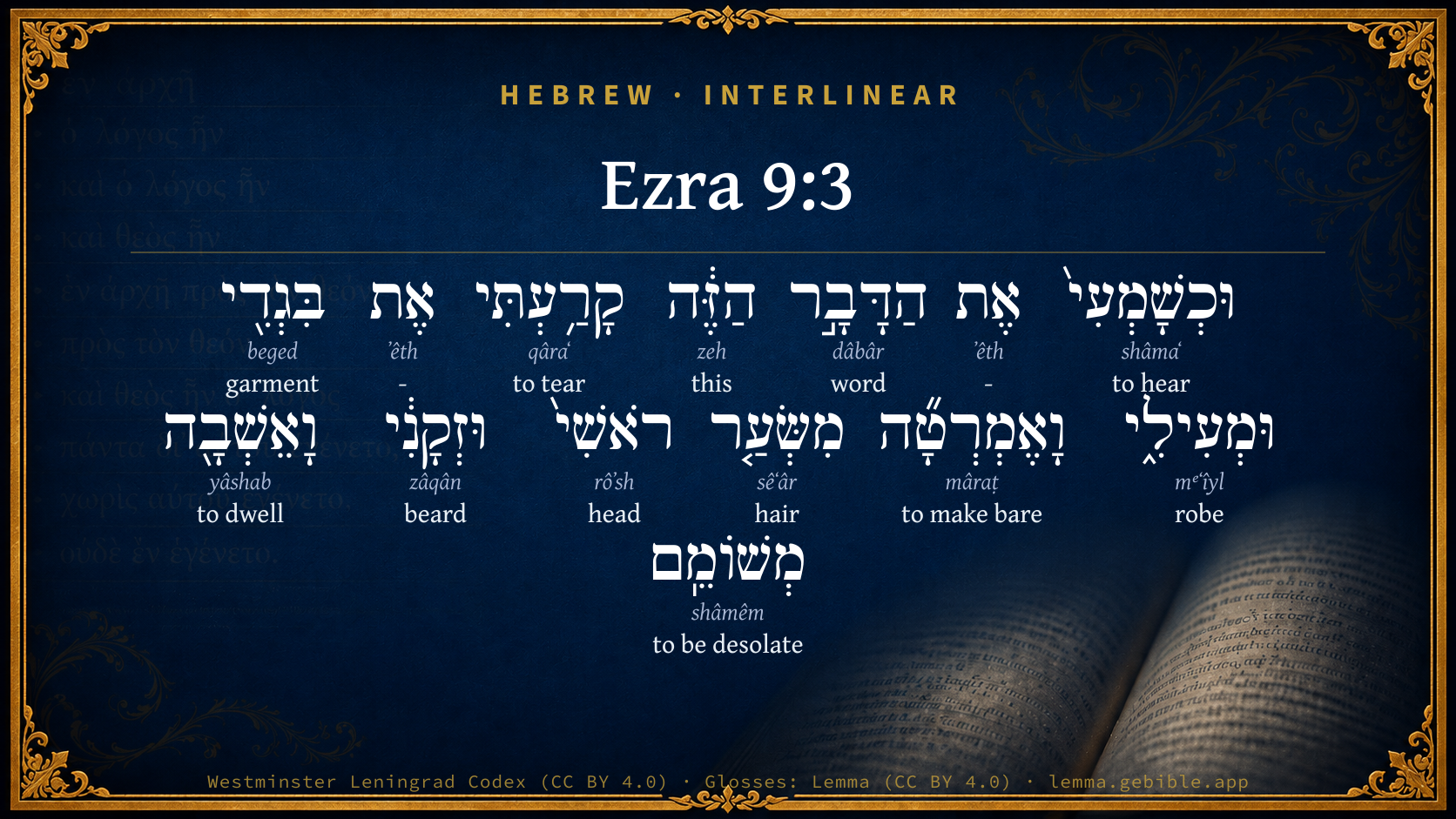
Hebrew (Westminster Leningrad Codex) Ezra 9:3 appears in the Hebrew Old Testament. The text above is from the Westminster Leningrad Codex. Each word links to its Strong’s number, a concise gloss, and parsing drawn from the Open Scriptures Hebrew Bible morphology. Click any word for its full Brown-Driver-Briggs (BDB) entry.
Download image
Cite this verse

Ezra 9:3 (World English Bible). Public Domain. Lemma interlinear Bible study tool, https://lemma.gebible.app/v/ezra/9/3.

Show BibTeX & RIS
BibTeX
RIS
English Translation
When I heard this thing, I tore my garment and my robe, and plucked off the hair of my head and of my beard, and sat down confounded.
World English Bible · Public Domain
Download a study sheet

One document with this verse’s original text, its word-by-word gloss line, the meaning frame, cross-references with their text, attributed commentary, and full source and license credits — printable, and it pastes into notes with its structure intact.

This verse Autodidact and up

Study sheet (.html) Plain text (.txt)

A passage Seminary Student

Up to 50 verses in one chapter. A passage sheet keeps up to 6 commentary sources and 12 cross-references per verse, in the order this page ranks them, and says so on the sheet whenever that leaves anything out. Ask for a single verse and you get the Autodidact verse sheet above.

Everything on this page stays free to read, with no account — the sheet is a download of what is already on screen, not access to it.

Want to remove ads? Support Godless Engineer
Compare translations 3

The same verse in 3 English versions, stacked beneath the original-language interlinear above. Click any original word for its lexicon entry.

Each is an independent rendering of the whole verse — the interlinear is not word-aligned to these translations.

Highlighted words mark where these versions differ — a whole-verse word diff, not a word-by-word alignment.

  • World English Bible Public Domain
    When I heard this thing, I tore my garment and my robe, and plucked off the hair of my head and of my beard, and sat down confounded.
  • King James Version Public Domain
    And when I heard this thing, I rent my garment and my mantle, and plucked off the hair of my head and of my beard, and sat down astonied.
  • unfoldingWord Literal Text CC BY-SA 4.0
    And as soon as I heard this matter, I tore my garment and my robe. And I pulled out some from the hair of my head and my beard, and I sat down appalled.

unfoldingWord Literal Text — © unfoldingWord, licensed CC BY-SA 4.0. Word-aligned USFM3 via Door43 (git.door43.org/unfoldingWord/en_ult).

Versions to compare (up to 4)

3 of 4 selected

Show all 18 translations

Every available English version of this verse, each an independent rendering of the whole verse.

  • World English Bible Public Domain
    When I heard this thing, I tore my garment and my robe, and plucked off the hair of my head and of my beard, and sat down confounded.
  • Berean Standard Bible Public Domain
    When I heard this report, I tore my tunic and cloak, pulled out some hair from my head and beard, and sat down in horror.
  • Majority Standard Bible Public Domain
    When I heard this report, I tore my tunic and cloak, pulled out some hair from my head and beard, and sat down in horror.
  • King James Version Public Domain
    And when I heard this thing, I rent my garment and my mantle, and plucked off the hair of my head and of my beard, and sat down astonied.
  • American Standard Version (1901) Public Domain
    And when I heard this thing, I rent my garment and my robe, and plucked off the hair of my head and of my beard, and sat down confounded.
  • Revised Version (1885) Public Domain
    And when I heard this thing, I rent my garment and my mantle, and plucked off the hair of my head and of my beard, and sat down astonied.
  • Geneva Bible (1599) Public Domain
    But when I heard this saying, I rent my clothes and my garment, and pluckt off the heare of mine head, and of my beard, and sate downe astonied.
  • Douay-Rheims (1899) Public Domain
    And when I had heard this word, I rent my mantle and my coat, and plucked off the hairs of my head and my beard, and I sat down mourning.
  • Young's Literal Translation Public Domain
    And at my hearing this word, I have rent my garment and my upper robe, and pluck out of the hair of my head, and of my beard, and sit astonished,
  • Literal Standard Version CC BY-SA 4.0
    And at my hearing this word, I have torn my garment and my upper robe, and pluck out of the hair of my head, and of my beard, and sit astonished,
  • Unlocked Literal Bible CC BY-SA 4.0
    When I heard this, I tore apart my clothing and robe and pulled out hair from my head and beard, and I sat down, devastated.
  • unfoldingWord Literal Text CC BY-SA 4.0
    And as soon as I heard this matter, I tore my garment and my robe. And I pulled out some from the hair of my head and my beard, and I sat down appalled.
  • Darby Bible Public Domain
    And when I heard this thing, I rent my mantle and my garment, and plucked off the hair of my head and of my beard, and sat down overwhelmed.
  • World Messianic Bible Public Domain
    When I heard this thing, I tore my garment and my robe, and pulled the hair out of my head and of my beard, and sat down confounded.
  • Webster's Bible Public Domain
    And when I heard this thing, I rent my garment and my mantle, and plucked off the hair of my head and of my beard, and sat down confounded.
  • Free Bible Version CC BY-SA 4.0
    When I heard about this, I tore my clothes, pulled out some hair from my head and beard, and sat down, absolutely appalled.
  • Bible in Basic English Public Domain
    And hearing this, with signs of grief and pulling out the hair of my head and my chin, I took my seat on the earth deeply troubled.
  • JPS Tanakh (1917) Public Domain
    And when I heard this thing, I rent my garment and my mantle, and plucked off the hair of my head and of my beard, and sat down appalled.

Literal Standard Version (2020), Covenant Press — licensed CC BY-SA 4.0. Text via the HelloAO Bible API (eBible.org). Unlocked Literal Bible (unfoldingWord) — licensed CC BY-SA 4.0. Text via the HelloAO Bible API (eBible.org). unfoldingWord Literal Text — © unfoldingWord, licensed CC BY-SA 4.0. Word-aligned USFM3 via Door43 (git.door43.org/unfoldingWord/en_ult). Free Bible Version, Dr. Jonathan Gallagher — licensed CC BY-SA 4.0. Text via the HelloAO Bible API (eBible.org).

Word by word

More ways to search: Search by grammar → Find every occurrence → Compare this word →

Practice this passage: Drill this verse → Learn its vocabulary →

וָאֶמְרְטָ֞ה
mâraṭ
H4803
“and · to make bare”
Conjunction + Verb, Qal, Sequential Imperfect, 1st Person, Common, Singular + Suffix, h
Part of Speech
Conjunction + Verb
Stem
Qal
Form
Sequential Imperfect
Person
1st Person
Gender
Common
Number
Singular
Full BDB Definition

Origin: a primitive root

TWOT: 1244

to bare, polish, make smooth or bald or bare - (Qal) - to make bare - to scour, polish - (Niphal) to be made bald
  1. וּכְשָׁמְעִי֙ shâmaʻ H8085 “and · like/as · to hear · me” Conjunction + Preposition + Verb, Qal, Infinitive Construct + Suffix, Personal, 1st Person, Common, Singular
  2. אֶת ʼêth H853 “-” Particle, Direct Object
  3. הַדָּבָ֣ר dâbâr H1697 “the · word” Particle, Definite Article + Noun, Common, Masculine, Singular, Absolute
  4. הַזֶּ֔ה zeh H2088 “the · this” Particle, Definite Article + Pronoun, Demonstrative, Masculine, Singular
  5. קָרַ֥עְתִּי qâraʻ H7167 “to tear” Verb, Qal, Perfect, 1st Person, Common, Singular
  6. אֶת ʼêth H853 “-” Particle, Direct Object
  7. בִּגְדִ֖י beged H899 “garment · my” Noun, Common, Masculine, Singular, Construct + Suffix, Personal, 1st Person, Common, Singular
  8. וּמְעִילִ֑י mᵉʻîyl H4598 “and · robe · my” Conjunction + Noun, Common, Masculine, Singular, Construct + Suffix, Personal, 1st Person, Common, Singular
  9. מִשְּׂעַ֤ר sêʻâr H8181 “from · hair of” Preposition + Noun, Common, Masculine, Singular, Construct
  10. רֹאשִׁי֙ rôʼsh H7218 “head · my” Noun, Common, Masculine, Singular, Construct + Suffix, Personal, 1st Person, Common, Singular
  11. וּזְקָנִ֔י zâqân H2206 “and · beard · my” Conjunction + Noun, Common, Both, Singular, Construct + Suffix, Personal, 1st Person, Common, Singular
  12. וָאֵשְׁבָ֖ה yâshab H3427 “and · to dwell” Conjunction + Verb, Qal, Sequential Imperfect, 1st Person, Common, Singular + Suffix, h
  13. מְשׁוֹמֵֽם shâmêm H8074 “desolate” Verb, Poel, Participle Passive, Masculine, Singular, Absolute

About this verse

These counts appear in no published source. They are computed here, from the morphology-tagged text and Lemma’s own curated glosses. What Lemma adds →

14
words
13
distinct lemmas
Historical
section

Notable vocabulary

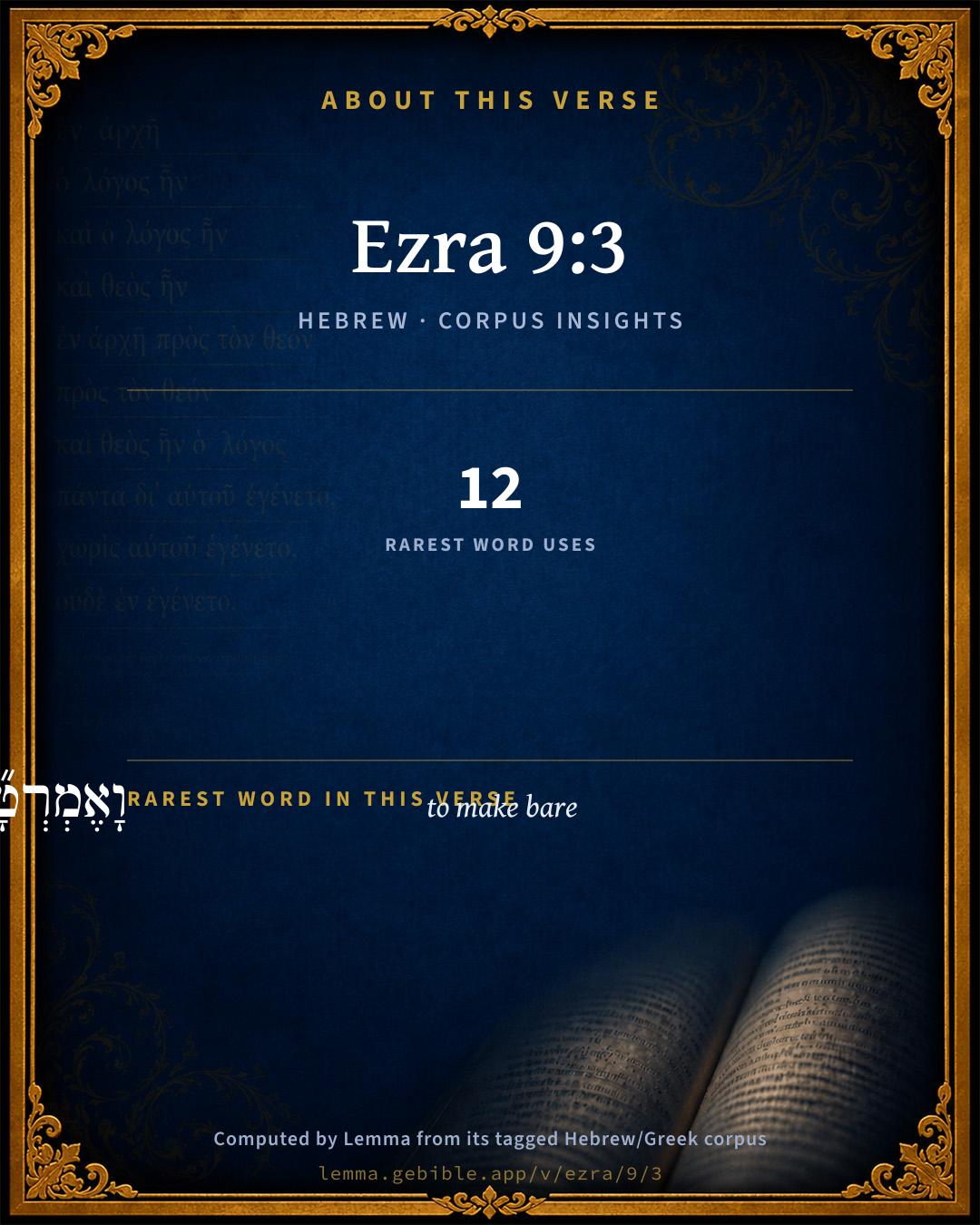
The rarest word here is וָאֶמְרְטָ֞ה to make bare H4803 — appearing just 12 times in the whole Hebrew Bible.

Shared distinctive vocabulary

וָאֶמְרְטָ֞ה to make bare H4803 occurs in 11 verses of the Hebrew Bible. Also found in:

Grammatical profile

  • 5 verbs
  • 6 nouns
  • 1 pronoun
  • 2 particles

Verb forms

  • וּכְשָׁמְעִי֙ Qal · Infinitive Construct
  • קָרַ֥עְתִּי Qal · Perfect
  • וָאֶמְרְטָ֞ה Qal · Sequential Imperfect
  • וָאֵשְׁבָ֖ה Qal · Sequential Imperfect
  • מְשׁוֹמֵֽם Poel · Participle Passive

Hebrew & Septuagint length

In English translation the verse runs 28 words from the Hebrew and 29 from the Septuagint (LXX English) — closely comparable.

A rough comparison of the two English renderings, which tokenize alike — not a word-level alignment.

Word counts can differ between the Hebrew and the Greek without any difference in meaning — e.g. the Hebrew direct-object marker אֵת has no separate Greek word, and Greek often adds the article ὁ.

Cross-references

18

Topical passages linked to Ezra 9:3 in the Treasury of Scripture Knowledge — connected by theme and wording, ordered by reader-vote popularity; previews shown in the World English Bible.

  • Nehemiah 1:4 It happened, when I heard these words, that I sat down and wept, and mourned certain days; and I fasted and prayed before the God of heaven,
  • Joshua 7:6 Joshua tore his clothes, and fell to the earth on his face before the ark of Yahweh until the evening, he and the elders of Israel; and they put dust on their heads.
  • Leviticus 21:5 "'They shall not shave their heads, neither shall they shave off the corners of their beards, nor make any cuttings in their flesh.
  • 2 Kings 18:37–19:1 Then came Eliakim the son of Hilkiah, who was over the household, and Shebna the scribe, and Joah the son of Asaph the recorder, to Hezekiah with their clothes torn, and told him the words of Rabshakeh.
  • Nehemiah 13:25 I contended with them, and cursed them, and struck certain of them, and plucked off their hair, and made them swear by God, [saying], You shall not give your daughters to their sons, nor take their daughters for your sons, or for yourselves.
  • Job 1:20 Then Job arose, and tore his robe, and shaved his head, and fell down on the ground, and worshiped.
  • Job 2:12–13 When they lifted up their eyes from a distance, and didn't recognize him, they raised their voices, and wept; and they each tore his robe, and sprinkled dust on their heads toward the sky.
  • Psalms 66:3 Tell God, "How awesome are your deeds! Through the greatness of your power, your enemies submit themselves to you.
  • Psalms 143:4 Therefore my spirit is overwhelmed within me. My heart within me is desolate.
  • Isaiah 15:2 They are gone up to Bayith, and to Dibon, to the high places, to weep: Moab wails over Nebo, and over Medeba; on all their heads is baldness, every beard is cut off.
  • Jeremiah 7:29 Cut off your hair, [Jerusalem], and cast it away, and take up a lamentation on the bare heights; for Yahweh has rejected and forsaken the generation of his wrath.
  • Jeremiah 36:24 They were not afraid, nor tore their garments, neither the king, nor any of his servants who heard all these words.
  • Jeremiah 48:37–38 For every head is bald, and every beard clipped: on all the hands are cuttings, and on the loins sackcloth.
  • Ezekiel 3:15 Then I came to them of the captivity at Tel Aviv, that lived by the river Chebar, and to where they lived; and I sat there overwhelmed among them seven days.
  • Ezekiel 7:18 They shall also gird themselves with sackcloth, and horror shall cover them; and shame shall be on all faces, and baldness on all their heads.
  • Daniel 4:19 Then Daniel, whose name was Belteshazzar, was stricken mute for a while, and his thoughts troubled him. The king answered, Belteshazzar, don't let the dream, or the interpretation, trouble you. Belteshazzar answered, My lord, the dream be to those who hate you, and the interpretation of it to your adversaries.
  • Daniel 8:27 I, Daniel, fainted, and was sick certain days; then I rose up, and did the king's business: and I wondered at the vision, but none understood it.
  • Micah 1:16 Shave your heads, And cut off your hair for the children of your delight. Enlarge your baldness like the vulture; For they have gone into captivity from you!

Cross-references courtesy of OpenBible.info (CC BY 4.0).

Hebrew and Greek witnesses Masoretic Hebrew ↔ Greek Septuagint

The same verse in the two great witnesses to the Old Testament, shown verse-for-verse.

These are two independent witnesses, not word-aligned to each other, and the Septuagint is shown in lemma (dictionary) form.

Hebrew Ezra 9:3 Masoretic · Westminster Leningrad Codex

וּכְשָׁמְעִי֙ אֶת הַדָּבָ֣ר הַזֶּ֔ה קָרַ֥עְתִּי אֶת בִּגְדִ֖י וּמְעִילִ֑י וָאֶמְרְטָ֞ה מִשְּׂעַ֤ר רֹאשִׁי֙ וּזְקָנִ֔י וָאֵשְׁבָ֖ה מְשׁוֹמֵֽם

When I heard this thing, I tore my garment and my robe, and plucked off the hair of my head and of my beard, and sat down confounded.

World English Bible · Public Domain

Greek LXX Ezra 9:3 Septuagint · lemma form

καί ὡς ἀκούω ὁ λόγος οὗτος διαῥήγνυμι ὁ ἱμάτιον ἐγώ καί πάλλομαι καί τίλλω ἀπό ὁ θρίξ ὁ κεφαλή ἐγώ καί ἀπό ὁ πώγων ἐγώ καί καταἧμαι ἠρεμάζω

And when I heard this thing, I tore my garments, and trembled, and plucked some of the hairs of my head and of my beard, and sat down mourning.

LXX2012 (modern English Septuagint) · Public Domain

In the Septuagint this is one book — Esdras B (2 Esdras): Ezra is chapters 1–10, Nehemiah 11–23.

On this verse, Haydock's Catholic Bible Commentary discusses the Septuagint’s reading. Read the note in Commentary ↓

Hebrew: Westminster Leningrad Codex (CC BY 4.0). Greek: Septuagint (public domain); English from LXX2012 (modern English Septuagint) (Public Domain). How the Septuagint differs from the Hebrew →

Commentary

Notes on Ezra 9:3 from classic Christian and Jewish commentators (each source and its license shown beneath its notes). The classic Christian expositions comment on the surrounding passage and are grouped to its opening verse, so a note may address several verses; the Jewish commentaries on the Tanakh (Rashi and others) are per-verse, so they appear only where the commentator wrote on this verse.

Lemma curates 59 commentaries, every one of them public domain or Creative Commons licensed, each selected and text-cleaned for this edition rather than reprinted as found. About our sources →

Trapp's Complete Commentary

John Trapp

Ezr 9:3 And when I heard this thing, I rent my garment and my mantle, and plucked off the hair of my head and of my beard, and sat down astonied.

Ver. 3. I rent my garment and my mantle] In token of his deep and downright humiliation, indignation, detestation of their dealing therein.

And plucked off the hair of my head and of my beard] To show how passionately grieved and offended he was. The raging Turk did the like at the last assault of Scodra; being extremely vexed at the dishonour and loss he had received there. But what followed? In his choler and frantic rage he most horribly blasphemed God; whereas holy Ezra, though he sat astonied till the evening sacrifice, yet then he poureth forth his soul in a heavenly prayer, Ezr 9:5-6.

And sat down astonied] As one that hath neither life nor soul (as we say), that can neither say nor do for himself, being wonderfully amazed, astonished, or desolate, as David had been, Psa 143:4. The true zealot, as his love is fervent, his desires eager, his delights ravishing, his hopes longing; so his hatred is deadly, his anger fierce, his grief deep, his fear terrible, &c. Zeal is an extreme heat of all the affections, Rom 12:11, boiling hot, hissing hot, as the Greek importeth (ζεοντες).

John Trapp, A Commentary or Exposition upon All the Books of the Old and New Testament (1647–1656) — public domain. Text from a community e-Sword module.

Joseph Benson's Commentary

Ezr 9:3. When I heard this thing, I rent my garment and my mantle, &c. — Both my inner and my upper garment. This was a token, not only of his very great grief and sorrow, but of his sense of God’s displeasure at their conduct. For the Jews were wont to rend their clothes, when they apprehended God to be highly offended. And plucked off the hair of my head and of my beard — This was still a higher sign of exceeding great grief. For, in ordinary sorrow, they only neglected their hair, and let it hang down scattered in a careless manner; but this was used in bitter lamentations. And sat down astonied — Through grief and shame at their sin, that they should be so ungrateful to God, who had so lately delivered them from captivity; and through an apprehension of some great and dreadful judgment befalling them, because of so open a violation of the divine law, the transgression of which had formerly proved their ruin.

Joseph Benson's Commentary on the Old and New Testaments (1811–1818) — public domain. Text from a community e-Sword module.

Whedon's Commentary on the Bible

Daniel D. Whedon

EZRA’S GRIEF AND PRAYER, Ezr_9:3-15.

3. I rent my garment and my mantle — Both the inner and the outer clothing. This was a sign of most excessive grief. Job rent only his mantle, Job_1:20. Compare Jos_7:6.

Plucked off the hair — Another sign of anguish and sorrow. Job shaved his head in his agony of grief.

Astonished — Ezra sat down, amazed at the extent and fearfulness of his people’s sin.

Daniel D. Whedon (gen. ed.), Commentary on the Old and New Testaments (1874–1909) — public domain. Text from a community e-Sword module.

The Pulpit Commentary

EZRA"S ASTONISHMENT AND HORROR. (Ezr_9:3, Ezr_9:4) In Babylonia, whence Ezra had come, the inclination to intermarry with the heathen had not, it would seem, shown itself. Exiles in a foreign land naturally cling to each other under their adverse circumstances, and, moreover, being despised by those among whom they sojourn, are not readily accepted by them into social fellowship, much less into affinity and alliance. Thus the thing was to Ezra a new thing. His familiarity with the Law, and, perhaps we may add, his insight into the grounds upon which the Law upon this point was founded, caused him to view the matter as one of the gravest kind, and to feel shocked and horror-struck at what was told him respecting it. He showed his feelings with the usual openness and abandon of an Oriental: first rending both his outer and his inner garments, then tearing his hair and his beard, and finally" sitting down astonied," motionless and speechless, until the time of the evening sacrifice. Such a manifestation of horror and amazement was well calculated to impress and affect the sympathetic and ardent people over whom Providence had placed him.

I rent my garment and my mantle. Rending the clothes was always, and still is, one of the commonest Oriental modes of showing grief. Reuben rent his clothes when his brothers sold Joseph to the Midianites, and Jacob did the same when he believed that Joseph was dead. (Gen_37:29, Gen_37:34) Job "rent his mantle" on learning the death of his sons and daughters; (Job_1:20) and his friends rent every one his mantle when they came to mourn with him and comfort him". (Job_2:11, Job_2:12) Rent clothes indicated that a messenger was a messenger of woe (1Sa_4:12; 2Sa_1:2) or that a man had heard something that had greatly shocked him, and of which he wished to express his horror (2Ki_18:37; Mat_26:65) Ezra"s action is of this last kind, expressive of horror more than of grief, but perhaps in some degree of grief also. And plucked off the hair of my head and of my beard. These are somewhat unusual signs of grief among the Orientals, who were wont to shave the head in great mourning, but seldom tore the hair out by the roots. The practice is not elsewhere mentioned in Scripture, excepting in the apocryphal books (RAPC 1Est 8:71 2Est_1:8; Apoc. (Est_4:2) And sat down astonied. Compare Dan_4:19 Dan_8:27, where the same verb is used in the same sense.

The Pulpit Commentary (1880–1919), ed. H.D.M. Spence-Jones & Joseph S. Exell — public domain. Text from a community e-Sword module.

Tyndale Open Study Notes

Tyndale Open Resources

9:3 utterly shocked: Cp. Gen 37:34; 2 Kgs 22:11; Job 1:20.

Tyndale Open Study Notes — © Tyndale Open Resources, licensed CC BY-SA 4.0. Text via the HelloAO Bible API.

Geneva Bible (1599)

Geneva Bible translators

As one doubting whether God would continue his benefits towards us, or else destroy this which he had begun.

Geneva Bible (1599) marginal notes — public domain. Text via Bolls.life.

Jamieson, Fausset & Brown

Robert Jamieson, A. R. Fausset & David Brown

when I heard this thing, I rent my garment and my mantle, &c.--the outer and inner garment, which was a token not only of great grief, but of dread at the same time of the divine wrath;

plucked off the hair of my head and of my beard--which was a still more significant sign of overpowering grief.

Jamieson, Fausset & Brown — Commentary Critical and Explanatory on the Whole Bible (1871) — public domain (CC PDM 1.0). Text via the HelloAO Bible API.

Adam Clarke's Commentary

Verse 3. I rent my garment and my mantle] The outer and inner garment, in sign of great grief. This significant act is frequently mentioned in the sacred writings, and was common among all ancient nations.

Plucked off the hair] Shaving the head and beard were signs of excessive grief; much more so the plucking off the hair, which must produce exquisite pain. All this testified his abhorrence, not merely of the act of having taken strange wives, but their having also joined them in their idolatrous abominations.

Adam Clarke's Commentary on the Bible (1810–1826) — public domain. Text from a community e-Sword/MySword module.

The Cambridge Bible for Schools and Colleges

gen. ed. J. J. S. Perowne

3. I rent my garment and my mantle] Ezra’s conduct betrays his surprise, his grief, and his indignation. The rending of the clothes is frequently mentioned in Scripture as a sign of grief: Ezra here is described as rending the under-garment or tunic (the ‘begedh’) and the long loose robe (the m‘îl) in which he was attired. Reuben rent his ‘clothes’ (plur. of ‘begedh’) on not finding Joseph (Gen_37:29): Jacob rent his ‘garments’ (plur. of ‘simlah’) on seeing Joseph’s blood-stained coat (Gen_37:34): Joseph’s brethren rent their clothers (plur. of ‘simlah’) when the cup was found in Benjamin’s sack (Gen_44:13): Joshua rent his ‘clothes’ (plur. of ‘simlah’) after the repulse at Ai (Jos_7:6): Jephthah rent his clothes (plur. of ‘begedh’) on meeting his daughter (Jdg_11:35): the messenger from the field of Ziklag came with his clothes (plur. of ‘begedh’) rent (2Sa_1:2, cf. 1Sa_4:12): Job rent his mantle (‘m‘îl’) on hearing of his children’s death (Job_1:20), and his friends rent each one his mantle (‘m‘îl’) when they came to visit him (Job_2:12). These were all signs of grief. The action also denoted ‘horror’ on receiving intelligence or hearing words, which shocked: thus Hezekiah and his ministers rent their clothes (plur. of ‘begedh’) after Rabshakeh’s speech (2Ki_18:37; 2Ki_19:1): Mordecai rent his clothes (plur. of ‘begedh’) on hearing of Haman’s determination (Est_4:1): the High-priest rent his garments on hearing the testimony of Jesus (Mat_26:65). See also Isa_36:22; Jer_41:5; 2Ch_34:27.

The ‘mantle’ was a long flowing robe; by this name is designated the High-priest’s robe (Exo_28:31; Exo_28:34; Exo_39:22-23); the ‘robe’ which Hannah made for Samuel (1Sa_2:19); Jonathan’s ‘robe’, which he presented to David (1Sa_18:4); Samuel’s robe (1Sa_15:27); Saul’s ‘robe’ (1Sa_24:4); the ‘robe’ which covered the apparition of Samuel (1Sa_28:14). Its use in metaphor (Psa_109:29; Isa_59:17) agrees with this.

and pluckt off the hair &c.] This sign of grief is not described elsewhere in the O. T. Compare Esther (additions to), Esther 14:2, ‘All the places of her joy she filled with her torn hair’.

The shaven head was a common sign of mourning, e.g. Job_1:20; Eze_7:18; Amo_8:10. Ezra’s action denotes in an exaggerated way his great grief.

Nehemiah’s indignation made him ‘pluck off’ the hair of his opponents (Neh_13:25; cf. 2Es_1:8), but is hardly a parallel case.

and sat down astonied] cf. Dan_4:19 ‘Then Daniel … was astonied or a while’. The word in the original is the same as that rendered ‘desolator’ (marg. desolate) in Dan_9:27, and ‘that maketh desolate’ Dan_11:31. Here the sense of ‘bewilderment’ is uppermost. See the use of ‘astonied’ in the R.V., Job_17:8; Job_18:20; Eze_4:17; Dan_3:24; Dan_4:19.

The Cambridge Bible for Schools and Colleges (gen. ed. J. J. S. Perowne; Cambridge University Press, 1878–1918) — public domain. Text from a community e-Sword module.

John Gill's Exposition

And when I heard this thing, I rent my garment and my mantle,.... Both inward and outward garments, that which was close to his body, and that which was thrown loose over it; and this he did in token of sorrow and mourning, as if something very dreadful and distressing, see Job 1:20

and plucked off the hair of my head and of my beard; did not shave them, and so transgressed not the law in Lev 19:27 but plucked off the hair of them, to show his extreme sorrow for what was told him: which has frequently been done by mourners on sorrowful occasions in various nations, see Isa 15:2. So in the apocryphal "addition" to Esther,"And laid away her glorious apparel, and put on the garments of anguish and mourning: and instead of precious ointments, she covered her head with ashes and dung, and she humbled her body greatly, and all the places of her joy she filled with her torn hair.'' (Esther 14:2)she is said to fill every place of joy with the tearing of her hair; and Lavinia in Virgil (k); several passages from Homer (l), and other writers, both Greek and Latin, are mentioned by Bochart (m) as instances of it:

and sat down astonished; quite amazed at the ingratitude of the people, that after such favours shown them, in returning them from captivity unto their own land, and settling them there, they should give into practices so contrary to the will of God.

(k) Aeneid. 12. prope finem. Vid. Ciceron. Tusc. Quaest. l. 3. (l) Vid. Iliad. 10. ver. 15. & Iliad. 22. ver. 77, 78, 406. & Iliad. 24. ver. 711. (m) Hierozoic. par. 1. l. 2. c. 45. col. 481.

John Gill's Exposition of the Whole Bible (1746–1763) — public domain (CC PDM 1.0). Text via the HelloAO Bible API.

Albert Barnes' Notes on the Bible

Plucking out the hair with the hands, so common among the Classical nations, is, comparatively speaking, rarely mentioned as practiced by Asiatics.

Albert Barnes' Notes on the Bible (1834–1885) — public domain. Text from a community e-Sword/MySword module.

Haydock's Catholic Bible Commentary

Coat, (tunicam) or inner garment. (Haydock) --- Mourning. Hebrew, "astonished." (Syriac) (Montanus) (Calmet) (Protestants) --- Septuagint, "alone." 3 Esdras, "pensive and in grief." (Haydock) --- Arabic, "not uttering a word." See Job i. 20., and ii. 8. This was the ordinary posture of people in sorrow, Isaias iii. 26. (Calmet)

George Leo Haydock (1774–1849), Haydock's Catholic Family Bible and Commentary, 1859 edition — public domain. Excludes Psalms (Douay-Rheims chapter numbering differs from Protestant) and Deuterocanonical books (Catholic canon only).

Matthew Poole's English Annotations

My garment and my mantle; both my inner and my upper garment.

Plucked off the hair of my head, and of my beard, in testimony of my great grief and indignation; which was usual among all these eastern and ancient people, wherein he did not transgress that law, Lev 19:27; Deu 14:1, because he did not shave off all the hair, but only plucked off some hairs.

Sat down astonied; partly for grief and shame at the sin; and partly for fear of some great and dreadful judgment which he expected and feared for it.

Matthew Poole's English Annotations on the Holy Bible (1683–1685) — public domain. Text from a community e-Sword/MySword module.

John Wesley's Explanatory Notes

I rent - Both mine inner and my upper garment.

John Wesley, Explanatory Notes Upon the Whole Bible (1754–1765) — public domain. Text via the GEBible commentary corpus.

Keil & Delitzsch

C. F. Keil & F. Delitzsch

This information threw Ezra into deep grief and moral consternation. The tearing of the upper and under garments was a sign of heartfelt and grievous affliction (Jos 8:6); see remarks on Lev 10:6. The plucking out of (a portion of) the hair was the expression of violent wrath or moral indignation, comp. Neh 13:25, and is not to be identified with the cutting off of the hair in mourning Job 1:20). "And sat down stunned;" משׁומם, desolate, rigid, stunned, without motion. While he was sitting thus, there were gathered unto him all who feared the word of God concerning the transgression of those that had been carried away. חרד, trembling, being terrified, generally construed with על or אל (e.g., Isa 66:2, Isa 66:5), but here with ב (like verbs of embracing, believing), and meaning to believe with trembling in the word which God had spoken concerning this מעל, i.e., thinking with terror of the punishments which such faithless conduct towards a covenant God involved.

Keil & Delitzsch — Biblical Commentary on the Old Testament (1861–1891) — public domain (CC PDM 1.0). Text via the HelloAO Bible API. (Old Testament only.)

unfoldingWord translationNotes

Door43 World Missions Community

When I heard this

When Ezra heard that many Israelites had married foreign women and were worshiping their gods

I tore apart my clothing and robe and pulled out hair from my head and beard

Ezra was showing everyone how unhappy he was that people were doing things that offended God. (See: Assumed Knowledge and Implicit Information)

evening offering

a sacrifice that the priests would offer around the time the sun was going down

translationWords

shame

God

sacrifice

unfoldingWord translationNotes — © Distant Shores Media and the Door43 World Missions Community, licensed CC BY-SA 4.0. Source: git.door43.org/Door43/en_tn.

Rashi

Rabbi Shlomo Yitzchaki (Rashi)

bewildered Heb. מְשּׁוֹמֵם miserable and bewildered, like (Ez. 3:15): “...seven days bewildered among them.”

Rashi on the Tanakh — English translations: “The Judaica Press complete Tanach with Rashi, translated by A. J. Rosenberg” (CC BY 4.0); “Pentateuch with Rashi's commentary by M. Rosenbaum and A.M. Silbermann, 1929-1934” (public domain); “The Metsudah Tanach series, Lakewood, N.J” (CC BY 4.0); and “The Book of Joshua, Metsudah Publications, 1997” (CC BY 4.0). Text via Sefaria.

Lesson kit

Teaching starters — assembled from the data on this page, not authored interpretation. Every prompt links to the verse data it draws on. Edit before teaching.

Ezra, in the Historical, opens this verse with 14 words (13 distinct Hebrew lemmas). Its most distinctive word is mâraṭ (“to make bare”). A historical commentator’s framing appears above. Read the whole chapter for the surrounding context.

Discussion questions

  1. How does “to make bare” (mâraṭ) shape what this verse is saying?
  2. Leviticus 13:40 shares the word «to make bare» with this verse. How do the two illuminate each other?
  3. The translations on this page render this verse differently — a whole-verse word diff, not a word-by-word alignment. What might account for the different wordings?
  4. The verb «וּכְשָׁמְעִי֙» is Qal Infinitive Construct. How does its form color the action?
  5. Reading how Trapp's Complete Commentary and Joseph Benson's Commentary read this verse, where do the two commentators agree and where do they part?

Things to notice

Reading settings

Reading text

Shown beneath each verse's original-language words.

Old Testament
Old Testament edition

Read the OT as the Masoretic Hebrew (MT) or the Greek Septuagint (LXX).

English shown for the Greek Septuagint (in the Hebrew ↔ Greek comparison).

Comparing translations? Open the Compare panel on any verse page to stack up to four side by side.