
Leviticus 13:45

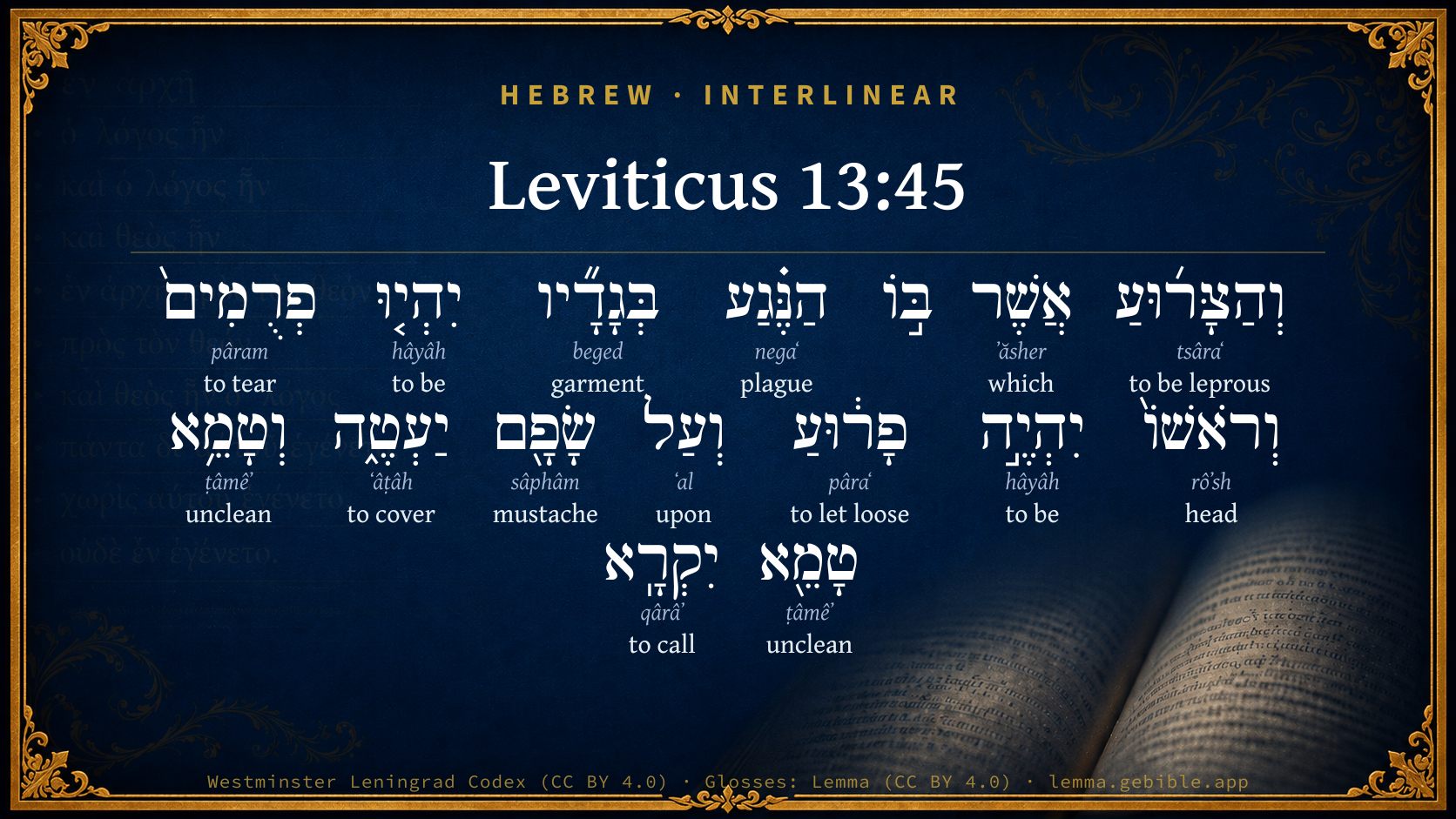
Hebrew (Westminster Leningrad Codex) Leviticus 13:45 appears in the Hebrew Old Testament. The text above is from the Westminster Leningrad Codex. Each word links to its Strong’s number, a concise gloss, and parsing drawn from the Open Scriptures Hebrew Bible morphology. Click any word for its full Brown-Driver-Briggs (BDB) entry.
Download image
Cite this verse

Leviticus 13:45 (World English Bible). Public Domain. Lemma interlinear Bible study tool, https://lemma.gebible.app/v/leviticus/13/45.

Show BibTeX & RIS
BibTeX
RIS
English Translation
"The leper in whom the plague is shall wear torn clothes, and the hair of his head shall hang loose. He shall cover his upper lip, and shall cry, 'Unclean! Unclean!'
World English Bible · Public Domain
Highlights
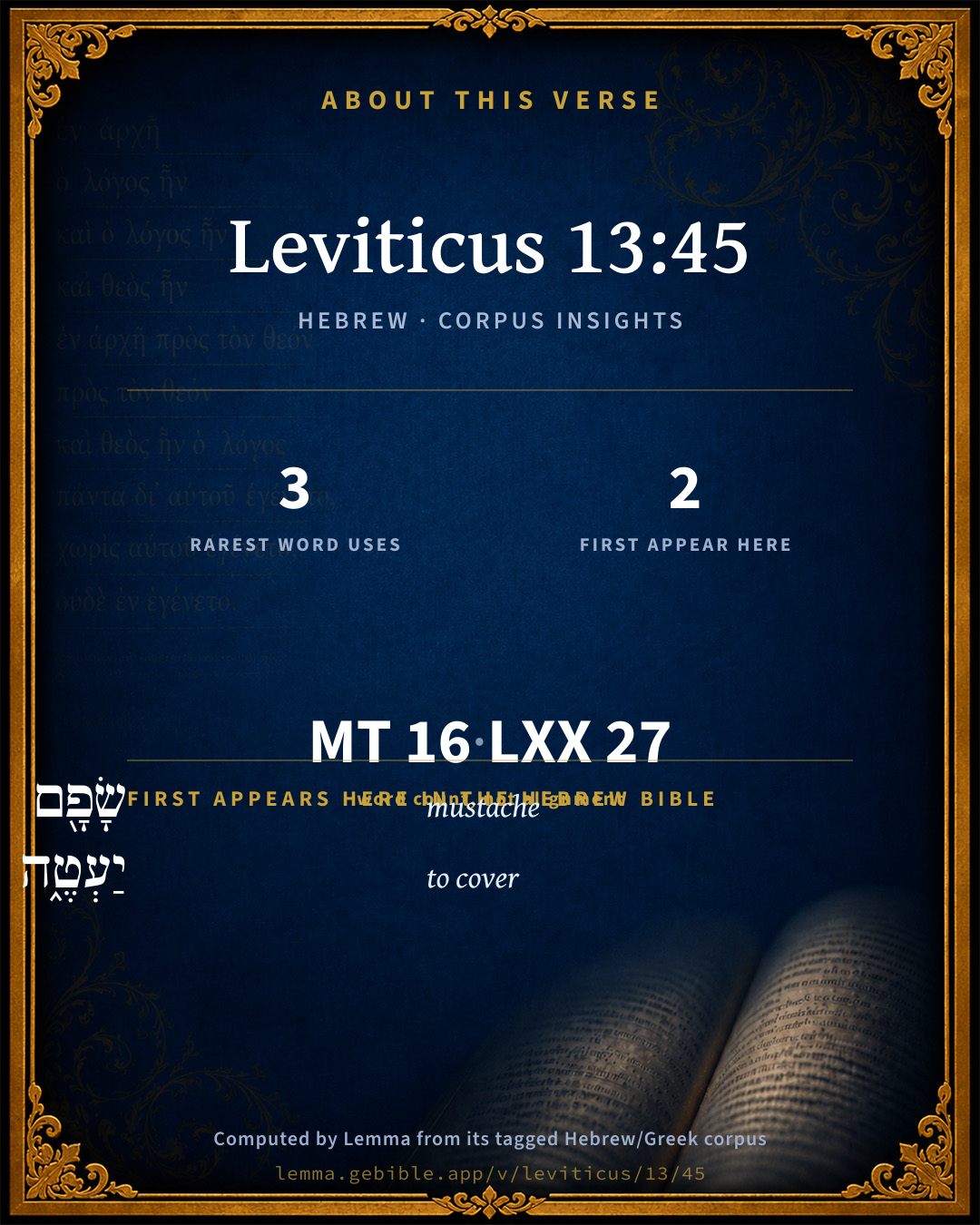
  • 2 first appearances in the Hebrew Bible
Full analysis ↓
Download a study sheet

One document with this verse’s original text, its word-by-word gloss line, the meaning frame, cross-references with their text, attributed commentary, and full source and license credits — printable, and it pastes into notes with its structure intact.

This verse Autodidact and up

Study sheet (.html) Plain text (.txt)

A passage Seminary Student

Up to 50 verses in one chapter. A passage sheet keeps up to 6 commentary sources and 12 cross-references per verse, in the order this page ranks them, and says so on the sheet whenever that leaves anything out. Ask for a single verse and you get the Autodidact verse sheet above.

Everything on this page stays free to read, with no account — the sheet is a download of what is already on screen, not access to it.

Want to remove ads? Support Godless Engineer
Compare translations 3

The same verse in 3 English versions, stacked beneath the original-language interlinear above. Click any original word for its lexicon entry.

Each is an independent rendering of the whole verse — the interlinear is not word-aligned to these translations.

Highlighted words mark where these versions differ — a whole-verse word diff, not a word-by-word alignment.

  • World English Bible Public Domain
    "The leper in whom the plague is shall wear torn clothes, and the hair of his head shall hang loose. He shall cover his upper lip, and shall cry, 'Unclean! Unclean!'
  • King James Version Public Domain
    And the leper in whom the plague is, his clothes shall be rent, and his head bare, and he shall put a covering upon his upper lip, and shall cry, Unclean, unclean.
  • unfoldingWord Literal Text CC BY-SA 4.0
    But the person with a skin disease, who on him the infection, on his clothes, they shall be torn, and his head shall be unbound, and he shall cover over the mustache, and ‘Unclean, unclean!’ he shall call out.

unfoldingWord Literal Text — © unfoldingWord, licensed CC BY-SA 4.0. Word-aligned USFM3 via Door43 (git.door43.org/unfoldingWord/en_ult).

Versions to compare (up to 4)

3 of 4 selected

Show all 18 translations

Every available English version of this verse, each an independent rendering of the whole verse.

  • World English Bible Public Domain
    "The leper in whom the plague is shall wear torn clothes, and the hair of his head shall hang loose. He shall cover his upper lip, and shall cry, 'Unclean! Unclean!'
  • Berean Standard Bible Public Domain
    A diseased person must wear torn clothes and let his hair hang loose, and he must cover his mouth and cry out, ‘Unclean, unclean!’
  • Majority Standard Bible Public Domain
    A diseased person must wear torn clothes and let his hair hang loose, and he must cover his mouth and cry out, ‘Unclean, unclean!’
  • King James Version Public Domain
    And the leper in whom the plague is, his clothes shall be rent, and his head bare, and he shall put a covering upon his upper lip, and shall cry, Unclean, unclean.
  • American Standard Version (1901) Public Domain
    And the leper in whom the plague is, his clothes shall be rent, and the hair of his head shall go loose, and he shall cover his upper lip, and shall cry, Unclean, unclean.
  • Revised Version (1885) Public Domain
    And the leper in whom the plague is, his clothes shall be rent, and the hair of his head shall go loose, and he shall cover his upper lip, and shall cry, Unclean, unclean.
  • Geneva Bible (1599) Public Domain
    The leper also in whom the plague is, shall haue his clothes rent, and his head bare, and shall put a couering vpon his lips, and shall cry, I am vncleane, I am vncleane.
  • Douay-Rheims (1899) Public Domain
    Shall have his clothes hanging loose, his head bare, his mouth covered with a cloth, and he shall cry out that he is defiled and unclean.
  • Young's Literal Translation Public Domain
    `As to the leper in whom `is' the plague, his garments are rent, and his head is uncovered, and he covereth over the upper lip, and `Unclean! unclean!' he calleth;
  • Literal Standard Version CC BY-SA 4.0
    As for the leper in whom [is] the plague, his garments are torn, and his head is uncovered, and he covers over the upper lip, and he calls, Unclean! Unclean!
  • Unlocked Literal Bible CC BY-SA 4.0
    The person who has an infectious disease must wear torn clothes, his hair must hang loosely, and he must cover his face up to his nose and call out, 'Unclean, unclean.'
  • unfoldingWord Literal Text CC BY-SA 4.0
    But the person with a skin disease, who on him the infection, on his clothes, they shall be torn, and his head shall be unbound, and he shall cover over the mustache, and ‘Unclean, unclean!’ he shall call out.
  • Darby Bible Public Domain
    And as to the leper in whom the sore is, -- his garments shall be rent, and his head shall be uncovered, and he shall put a covering on his beard, and shall cry, Unclean, unclean!
  • World Messianic Bible Public Domain
    “The leper in whom the plague is shall wear torn clothes, and the hair of his head shall hang loose. He shall cover his upper lip, and shall cry, ‘Unclean! Unclean!’
  • Webster's Bible Public Domain
    And the leper in whom the plague is, his clothes shall be rent, and his head bare, and he shall put a covering upon his upper lip, and shall cry, Unclean, unclean.
  • Free Bible Version CC BY-SA 4.0
    Anyone who has such diseases must wear clothes that are torn and let their hair remain uncombed. They must cover their faces and shout out, ‘Unclean, unclean!’
  • Bible in Basic English Public Domain
    And the leper who has the disease on him is to go about with signs of grief, with his hair loose and his mouth covered, crying, Unclean, unclean.
  • JPS Tanakh (1917) Public Domain
    And the leper in whom the plague is, his clothes shall be rent, and the hair of his head shall go loose, and he shall cover his upper lip, and shall cry: 'Unclean, unclean.'

Literal Standard Version (2020), Covenant Press — licensed CC BY-SA 4.0. Text via the HelloAO Bible API (eBible.org). Unlocked Literal Bible (unfoldingWord) — licensed CC BY-SA 4.0. Text via the HelloAO Bible API (eBible.org). unfoldingWord Literal Text — © unfoldingWord, licensed CC BY-SA 4.0. Word-aligned USFM3 via Door43 (git.door43.org/unfoldingWord/en_ult). Free Bible Version, Dr. Jonathan Gallagher — licensed CC BY-SA 4.0. Text via the HelloAO Bible API (eBible.org).

Word by word

More ways to search: Search by grammar → Find every occurrence → Compare this word →

Practice this passage: Drill this verse → Learn its vocabulary →

פְרֻמִים֙
pâram
H6533
“torn”
Verb, Qal, Participle Passive, Masculine, Plural, Absolute
Part of Speech
Verb
Stem
Qal
Form
Participle Passive
Gender
Masculine
Number
Plural
State
Absolute
Full BDB Definition

Origin: a primitive root

TWOT: 1819

(Qal) to tear, rend garment, rip
  1. וְהַצָּר֜וּעַ tsâraʻ H6879 “and · the · leprous” Conjunction + Particle, Definite Article + Verb, Qal, Participle Passive, Masculine, Singular, Absolute
  2. אֲשֶׁר ʼăsher H834 “which” Particle, Relative
  3. הַנֶּ֗גַע negaʻ H5061 “the · plague” Particle, Definite Article + Noun, Common, Masculine, Singular, Absolute
  4. בְּגָדָ֞יו beged H899 “garments · his” Noun, Common, Masculine, Plural, Construct + Suffix, Personal, 3rd Person, Masculine, Singular
  5. יִהְי֤וּ hâyâh H1961 “to be” Verb, Qal, Imperfect, 3rd Person, Masculine, Plural
  6. וְרֹאשׁוֹ֙ rôʼsh H7218 “and · head · his” Conjunction + Noun, Common, Masculine, Singular, Construct + Suffix, Personal, 3rd Person, Masculine, Singular
  7. יִהְיֶ֣ה hâyâh H1961 “to be” Verb, Qal, Imperfect, 3rd Person, Masculine, Singular
  8. פָר֔וּעַ pâraʻ H6544 “let loose” Verb, Qal, Participle Passive, Masculine, Singular, Absolute
  9. וְעַל ʻal H5921 “and · upon” Conjunction + Preposition
  10. שָׂפָ֖ם sâphâm H8222 “mustache” Noun, Common, Masculine, Singular, Absolute
  11. יַעְטֶ֑ה ʻâṭâh H5844 “to cover” Verb, Qal, Imperfect, 3rd Person, Masculine, Singular
  12. וְטָמֵ֥א ṭâmêʼ H2931 “and · unclean” Conjunction + Adjective, Adjective, Masculine, Singular, Absolute
  13. טָמֵ֖א ṭâmêʼ H2931 “unclean” Adjective, Adjective, Masculine, Singular, Absolute
  14. יִקְרָֽא qârâʼ H7121 “to call” Verb, Qal, Imperfect, 3rd Person, Masculine, Singular

About this verse

These counts appear in no published source. They are computed here, from the morphology-tagged text and Lemma’s own curated glosses. What Lemma adds →

16
words
13
distinct lemmas
Pentateuch
section

Notable vocabulary

The rarest word here is פְרֻמִים֙ to tear H6533 — appearing just 3 times in the whole Hebrew Bible.

First appearance in Scripture

These words make their first canonical appearance in the Hebrew Bible here:

  • שָׂפָ֖ם mustache H8222
  • יַעְטֶ֑ה to cover H5844

Shared distinctive vocabulary

פְרֻמִים֙ to tear H6533 occurs in 3 verses of the Hebrew Bible. Also found in:

Grammatical profile

  • 7 verbs
  • 4 nouns
  • 2 adjectives
  • 2 prepositions
  • 1 particle

Verb forms

  • וְהַצָּר֜וּעַ Qal · Participle Passive
  • יִהְי֤וּ Qal · Imperfect
  • פְרֻמִים֙ Qal · Participle Passive
  • יִהְיֶ֣ה Qal · Imperfect
  • פָר֔וּעַ Qal · Participle Passive
  • יַעְטֶ֑ה Qal · Imperfect
  • יִקְרָֽא Qal · Imperfect

Repetition

Words recur within this verse — often emphatic in Hebrew:

  • יִהְי֤וּ to be H1961 ×2
  • וְטָמֵ֥א unclean H2931 ×2

Hebrew & Septuagint length

In English translation the verse runs 31 words from the Hebrew and 33 from the Septuagint (LXX English) — closely comparable.

A rough comparison of the two English renderings, which tokenize alike — not a word-level alignment.

Word counts can differ between the Hebrew and the Greek without any difference in meaning — e.g. the Hebrew direct-object marker אֵת has no separate Greek word, and Greek often adds the article ὁ.

In the original languages it is 16 Hebrew tokens and 27 Greek tokens — but the two are counted differently (Hebrew bundles its prefixes and suffixes into one token; the Greek is in lemma form), so that isn’t a like-for-like length.

Cross-references

21

Topical passages linked to Leviticus 13:45 in the Treasury of Scripture Knowledge — connected by theme and wording, ordered by reader-vote popularity; previews shown in the World English Bible.

  • Leviticus 10:6 Moses said to Aaron, and to Eleazar and to Ithamar, his sons, "Don't let the hair of your heads go loose, neither tear your clothes; that you don't die, and that he not be angry with all the congregation: but let your brothers, the whole house of Israel, bewail the burning which Yahweh has kindled.
  • Micah 3:7 The seers shall be disappointed, And the diviners confounded. Yes, they shall all cover their lips; For there is no answer from God."
  • Lamentations 4:15 Depart you, they cried to them, Unclean! depart, depart, don't touch! When they fled away and wandered, men said among the nations, They shall no more sojourn [here].
  • Ezekiel 24:17 Sigh, but not aloud, make no mourning for the dead; bind your headdress on you, and put your shoes on your feet, and don't cover your lips, and don't eat men's bread.
  • Ezekiel 24:22 You shall do as I have done: you shall not cover your lips, nor eat the bread of men.
  • Luke 17:12 As he entered into a certain village, ten men who were lepers met him, who stood at a distance.
  • Leviticus 21:10 "'He who is the high priest among his brothers, upon whose head the anointing oil is poured, and that is consecrated to put on the garments, shall not let the hair of his head hang loose, nor tear his clothes;
  • Luke 5:8 But Simon Peter, when he saw it, fell down at Jesus' knees, saying, "Depart from me, for I am a sinful man, Lord."
  • Psalms 51:3 For I know my transgressions. My sin is constantly before me.
  • Isaiah 6:5 Then I said, "Woe is me! For I am undone, because I am a man of unclean lips, and I dwell in the midst of a people of unclean lips: for my eyes have seen the King, Yahweh of Hosts!"
  • Isaiah 64:6 For we are all become as one who is unclean, and all our righteousness are as a polluted garment: and we all do fade as a leaf; and our iniquities, like the wind, take us away.
  • Luke 7:6–7 Jesus went with them. When he was now not far from the house, the centurion sent friends to him, saying to him, "Lord, don't trouble yourself, for I am not worthy for you to come under my roof.
  • Genesis 37:29 Reuben returned to the pit; and saw that Joseph wasn't in the pit; and he tore his clothes.
  • 2 Samuel 13:19 Tamar put ashes on her head, and tore her garment of various colors that was on her; and she laid her hand on her head, and went her way, crying aloud as she went.
  • Job 1:20 Then Job arose, and tore his robe, and shaved his head, and fell down on the ground, and worshiped.
  • Job 42:6 Therefore I abhor myself, And repent in dust and ashes."
  • Psalms 51:5 Behold, I was brought forth in iniquity. In sin my mother conceived me.
  • Jeremiah 3:25 Let us lie down in our shame, and let our confusion cover us; for we have sinned against Yahweh our God, we and our fathers, from our youth even to this day; and we have not obeyed the voice of Yahweh our God.
  • Jeremiah 36:24 They were not afraid, nor tore their garments, neither the king, nor any of his servants who heard all these words.
  • Joel 2:13 Tear your heart, and not your garments, And turn to Yahweh, your God; For he is gracious and merciful, Slow to anger, and abundant in loving kindness, And relents from sending calamity.
  • Isaiah 52:11 Depart you, depart you, go you out from there, touch no unclean thing; go you out of the midst of her; cleanse yourselves, you who bear the vessels of Yahweh.

Cross-references courtesy of OpenBible.info (CC BY 4.0).

Hebrew and Greek witnesses Masoretic Hebrew ↔ Greek Septuagint

The same verse in the two great witnesses to the Old Testament, shown verse-for-verse.

These are two independent witnesses, not word-aligned to each other, and the Septuagint is shown in lemma (dictionary) form.

Hebrew Leviticus 13:45 Masoretic · Westminster Leningrad Codex

וְהַצָּר֜וּעַ אֲשֶׁר בּ֣וֹ הַנֶּ֗גַע בְּגָדָ֞יו יִהְי֤וּ פְרֻמִים֙ וְרֹאשׁוֹ֙ יִהְיֶ֣ה פָר֔וּעַ וְעַל שָׂפָ֖ם יַעְטֶ֑ה וְטָמֵ֥א טָמֵ֖א יִקְרָֽא

"The leper in whom the plague is shall wear torn clothes, and the hair of his head shall hang loose. He shall cover his upper lip, and shall cry, 'Unclean! Unclean!'

World English Bible · Public Domain

Greek LXX Leviticus 13:45 Septuagint · lemma form

καί ὁ λεπρός ἐν ὅς εἰμί ὁ ἁφή ὁ ἱμάτιον αὐτός εἰμί παραλύω καί ὁ κεφαλή αὐτός ἀκατακάλυπτος καί περί ὁ στόμα αὐτός περιβάλλω καί ἀκάθαρτος καλέω

And the leper in whom the plague is, let his garments be ungirt, and his head uncovered; and let him have a covering put upon his mouth, and he shall be called unclean.

LXX2012 (modern English Septuagint) · Public Domain

Hebrew: Westminster Leningrad Codex (CC BY 4.0). Greek: Septuagint (public domain); English from LXX2012 (modern English Septuagint) (Public Domain). How the Septuagint differs from the Hebrew →

Targum (Aramaic paraphrase)

2

The Targum is the ancient Jewish Aramaic paraphrase of the Hebrew Scriptures — an interpretive translation, not the Hebrew text itself. Onkelos (literal) and Pseudo-Jonathan (expansive) render the Torah, and Jonathan the Prophets. Coverage is partial: where no permissively-licensed English translation exists for a verse, only the Aramaic is shown. This is verse-level text, not a word-by-word alignment to the Hebrew.

  1. Targum Onkelos Torah (Genesis–Deuteronomy)
    וּסְגִירָא דִי בֵהּ מַכְתָּשָׁא לְבוּשׁוֹהִי יְהוֹן מְבַזְעִין וְרֵישֵׁהּ יְהֵי פְרִיעַ וְעַל שָׂפָם כַּאֲבֵלָא יִתְעַטָף וְלָא תִסְתַּאֲבוּן וְלָא תִסְתַּאֲבוּן יִקְרֵי

    (no public-domain English translation for this verse)

    Targum Onkelos — Aramaic: “Onkelos Genesis” (public domain); “Onkelos Exodus” (public domain); “Onkelos Leviticus” (public domain); “Onkelos Numbers” (public domain); “Onkelos Deuteronomy” (public domain). English: “Sefaria Community Translation” (CC0 1.0 (public-domain dedication)); “J.W. Etheridge. The Targums of Onkelos and Jonathan Ben Uzziel on the Pentateuch. London: Longmans, Green, 1862” (public domain). Text via Sefaria.

  2. Targum Pseudo-Jonathan Torah (Genesis–Deuteronomy)
    וּמְצוֹרָעָא דְבֵיהּ מַכְתְּשָׁא לְבוּשׁוֹי יְהוֹן מְבַזְעוּן וְרֵישֵׁיהּ יְהֵי מֵרַבֵּי פֵּרוּעַ וְעַל סַפְרַיָא יֶהֱוֵי מְהַלֵךְ וְעַל שִיפְמֵי יְהֵי מְעַטֵף וְהֵי כַאֲבֵילָא יְהֵי לְבוּשׁ וּכְרוֹזָא מַכְרִיז וַאֲמַר רְחוּקוּ רְחוּקוּ מִן מְסָאֲבָא

    And the leper in whom is the plague shall have his clothes rent, and his hair shall be taken off, going to the shearer's, and his lips shall be covered; and he shall be clothed like a mourner, and crying, as a herald, he shall say, Keep off, keep off from the unclean!

    Targum Pseudo-Jonathan — Aramaic: “Targum Jonathan on Genesis” (public domain); “Targum Jonathan on Exodus” (public domain); “Targum Jonathan on Leviticus” (public domain); “Targum Jonathan on Numbers” (public domain); “Targum Jonathan on Deuteronomy” (public domain). English: “The Targum of Jonathan ben Uzziel, trans. J. W. Etheridge, London, 1862” (public domain). Text via Sefaria.

Commentary

Notes on Leviticus 13:45 from classic Christian and Jewish commentators (each source and its license shown beneath its notes). The classic Christian expositions comment on the surrounding passage and are grouped to its opening verse, so a note may address several verses; the Jewish commentaries on the Tanakh (Rashi and others) are per-verse, so they appear only where the commentator wrote on this verse.

Lemma curates 59 commentaries, every one of them public domain or Creative Commons licensed, each selected and text-cleaned for this edition rather than reprinted as found. About our sources →

Trapp's Complete Commentary

John Trapp

Lev 13:45 And the leper in whom the plague [is], his clothes shall be rent, and his head bare, and he shall put a covering upon his upper lip, and shall cry, Unclean, unclean.

Ver. 45. His clothes shall be rent.] To show his sorrow for sin, the cause of his calamity.

And his head bare.] That men might not mistake him; and further to show his humility, whereof this also was a ceremony.

A covering upon his upper lip.] His moustaches that by his breath he might not infect others: and to show that God will not hear a good motion from an ill mouth.

Unclean, unclean.] Say we the same in our humblest acknowledgments; but withal add that of the leper in the Gospel, yet "Lord, if thou wilt, thou canst make me clean." {Mat 8:2}

John Trapp, A Commentary or Exposition upon All the Books of the Old and New Testament (1647–1656) — public domain. Text from a community e-Sword module.

Joseph Benson's Commentary

Lev 13:45. His clothes shall be rent — Whatever Israelite was found and declared by the priest to be a leper, was to be in the condition of a mourner, and in all respects to behave as such, that he might sensibly declare his afflicted state. 1st, His clothes were to be rent in the upper and fore parts, which were most visible, and this partly as a token of his sorrow, because, though his disorder was not a sin, yet it was an effect of sin, and a sore punishment whereby he was cut off, both from converse with men, and from the enjoyment of God in his ordinances; and partly as a warning to others to keep at a due distance from him wheresoever he came. 2d, His head was to be bare, which was another sign of mourning. God would have men, although not overwhelmed with, yet deeply sensible of his judgments. 3d, He was to cover his upper lip, either, perhaps, with his hand, or with the skirt of his garment, partly as a badge of his sorrow, and shame, (see Eze 24:17-22; Mic 3:7,) and partly for the preservation of others from his breath or touch. According to the Hebrew doctors, by covering the lip was implied, that the leper was not to salute any man all the days of his uncleanness. 4th, He was to cry, unclean, unclean. As begging the pity and prayers of others, and confessing his own infirmity, and cautioning those that came near him to keep at a distance from him. To this Jeremiah alludes, (Lam 4:15,) They cried unto them, Depart ye: it is unclean: depart, depart, touch not.

Joseph Benson's Commentary on the Old and New Testaments (1811–1818) — public domain. Text from a community e-Sword module.

Whedon's Commentary on the Bible

Daniel D. Whedon

RULES TO BE OBSERVED BY PRONOUNCED LEPERS, Lev_13:45-46.

Moses having minutely discussed the various phases of the leprosy, and the methods of diagnosis, now prescribes a course of conduct for the lepers while in exile from society. Simple separation from the healthy was not a sufficient security against the loathed contamination. Additional prophylactics are required for the protection of persons without the camp or walls of the city.

45. His clothes shall be rent — This is the first visible sign which the leper was required to hang out as a warning to all not to approach too near to him. The outer garment was usually rent from the neck to the girdle. While it was a warning to others, it was to the leper the symbol of deep self-abhorrence.

His head bare — The uncovered head and unkempt hair were an ancient and expressive token of sorrow. See chap. Lev_10:6, note. Rabbinical law exempts women from this and the preceding requirement.

A covering upon his upper lip — “He shall cover the beard.” By this act he expressed his unwillingness to speak, on account of shame and vexation.

As the beard was a symbol of dignity, to cover it with the hands indicated self-abasement. Yet he was required to herald his own defilement. Unclean! Unclean! The paraphrase of the Palestine Targum is very expressive, “Keep off, keep off from the unclean!” This humiliating and doleful cry, uttered as a warning to any one seen approaching, was requisite to an unmistakable announcement of his leprosy, since the three visible signs were also ordinary badges of mourning. The ground of this requirement is the fact that the touch of the leper ceremonially defiled every thing. According to the Jewish canons his very entrance into a house renders every thing in it unclean. If he stand under a tree and a clean man passes by he renders him unclean. In the synagogue there must be a separate compartment for him, ten handbreadths high and four cubits square. He must be the first to enter and the last to leave the synagogue. If the pronounced leper overstepped the prescribed boundaries he received forty stripes. We no longer wonder that the Jews abhorred this disease as worse than death, the scourge of Jehovah, (2Ki_5:7; 2Ch_26:20,) and the most awful imprecation upon their foes. 2Sa_3:29; 2Ki_5:27.

Daniel D. Whedon (gen. ed.), Commentary on the Old and New Testaments (1874–1909) — public domain. Text from a community e-Sword module.

Tyndale Open Study Notes

Tyndale Open Resources

13:45 Tearing one’s clothing, letting one’s hair go uncombed, and covering the mouth were common ways of expressing mourning (10:6). • The cry of Unclean! Unclean! denoted social unacceptability as much as a health threat. It warned others that the individual’s skin disorder could be contagious and that holy things should not touch the unclean person.

Tyndale Open Study Notes — © Tyndale Open Resources, licensed CC BY-SA 4.0. Text via the HelloAO Bible API.

Geneva Bible (1599)

Geneva Bible translators

Either in token of mourning, or for fear of infecting others.

In sign of sorrow and lamentation.

Geneva Bible (1599) marginal notes — public domain. Text via Bolls.life.

Jamieson, Fausset & Brown

Robert Jamieson, A. R. Fausset & David Brown

the leper in whom the plague is, his clothes shall be rent, &c.--The person who was declared affected with the leprosy forthwith exhibited all the tokens of suffering from a heavy calamity. Rending garments and uncovering the head were common signs of mourning. As to "the putting a covering upon the upper lip," that means either wearing a moustache, as the Hebrews used to shave the upper lip [CALMET], or simply keeping a hand over it. All these external marks of grief were intended to proclaim, in addition to his own exclamation "Unclean!" that the person was a leper, whose company every one must shun.

Jamieson, Fausset & Brown — Commentary Critical and Explanatory on the Whole Bible (1871) — public domain (CC PDM 1.0). Text via the HelloAO Bible API.

Adam Clarke's Commentary

Verse 45. His clothes shall be rent, c.] The leprous person is required to be as one that mourned for the dead, or for some great and public calamity. He was to have his clothes rent in token of extreme sorrow his head was to be made bare, the ordinary bonnet or turban being omitted; and he was to have a covering upon his upper lip, his jaws being tied up With a linen cloth, after the same manner in which the Jews bind up the dead, which custom is still observed among the Jews in Barbary on funeral occasions: a custom which, from Eze 24:17, we learn had prevailed very anciently among the Jews in Palestine. He was also to cry, Unclean, unclean, in order to prevent any person from coming near him, lest the contagion might be thus communicated and diffused through society; and hence the Targumist render it, Be not ye made unclean! Be not ye made unclean! A caution to others not to come near him.

Adam Clarke's Commentary on the Bible (1810–1826) — public domain. Text from a community e-Sword/MySword module.

Ellicott's Commentary for English Readers

(45) His clothes shall be rent.—As leprosy was regarded as a visitation from God for sin committed by the person thus afflicted, the patient is to rend his garments like one mourning for the dead. (See Lev_21:10.) During the second Temple the administrators of the law exempted leprous women from rending their clothes, which was evidently owing to a feeling of decorum.

And his head bare.—Better, and his hair be dishevelled. This was another sign of mourning. (See Lev_10:6.) The legislators during the second Temple also exempted leprous women from letting their hair fall in the disorderly and wild manner over their heads and faces which was the custom for mourners to do.

And he shall put a covering upon his upper lip.—To veil the beard, which was the pride of the Oriental, was also a sign of mourning. (Comp. Eze_24:17; Eze_24:22; Mic_3:7.) This was generally done by throwing the skirt of the garment over the lower part of the chin.

And shall cry, Unclean.—As leprosy was most defiling, and as the very entrance of a leper into a house rendered everything in it unclean, the person thus afflicted had to warn off the passers by, lest they should approach him, and by contact with him become defiled. In some instances this was done by a herald, who preceded the leper. Hence the rendering of the ancient Chaldee paraphrase of Jonathan by “a herald shall proclaim, and say, Depart, depart from the unclean !”

A Bible Commentary for English Readers, edited by Charles John Ellicott (1878–1897) — public domain. Text from a community e-Sword module.

The Cambridge Bible for Schools and Colleges

gen. ed. J. J. S. Perowne

45. his clothes shall be rent] not the usual Heb. word, but one used only here and in Lev_10:6, Lev_21:10; Jewish tradition exempted women from rending their clothes. The actions of the leper here prescribed are those of a mourner; rending the garments, and letting the hair go loose (cp. Lev_10:6, Lev_21:10; Eze_24:17), covering the upper lip (cp. Eze_24:17; Eze_24:22; Mic_3:7), crying, Unclean (Lam_4:15). The leper was regarded as one dead; Miriam is so described (Num_12:12) and Josephus refers to lepers as ‘in no way differing from the dead’ (Ant. iii. 11. 3). Cp. mediaeval rites relating to lepers in HDB. iii. 98 b.

The office from the Sarum Manual used at the seclusion of a leper may be found in R. M. Clay’s Mediaeval Hospitals, pp. 273 ff.

Rules for treatment of leprous persons (45, 46)

The Cambridge Bible for Schools and Colleges (gen. ed. J. J. S. Perowne; Cambridge University Press, 1878–1918) — public domain. Text from a community e-Sword module.

John Gill's Exposition

The garments also, that the plague of leprosy is in,.... Whether this sort of leprosy proceeded from natural causes, or was extraordinary and miraculous, and came immediately from the hand of God, and was peculiar to the Jews, and unknown to other nations, is a matter of question; the latter is generally asserted by the Hebrew writers, as Maimonides (e), Abraham Seba (f), and others (g); but others are of opinion, and Abarbinel among the Jews, that it might be by the contact or touch of a leprous person. Indeed it must be owned, as a learned man (h) observes, that the shirts and clothes of a leper must be equally infectious, and more so than any other communication with him; and the purulent matter which adheres thereunto must needs infect; such who put on their clothes; for it may be observed, that it will get between the threads of garments, and stick like glue, and fill them up, and by the acrimony of it corrode the texture itself; so that experience shows that it is very difficult to wash such a garment without a rupture, and the stains are not easily got out: and it must be allowed that garments may be scented by diseases, and become infectious, and carry a disease from place to place, as the plague oftentimes is carried in wool, cotton, silk, or any bale goods; but whether all this amounts to the case before us is still a question. Some indeed have endeavoured to account for it by observing, that wool ill scoured, stuffs kept too long, and some particular tapestries, are subject to worms and moths which eat them, and from hence think it credible, that the leprosy in clothes, and in skins here mentioned, was caused by this sort of vermin; to which, stuffs and works, wrought in wool in hot countries, and in times when arts and manufactures were not carried to the height of perfection as now, might probably be more exposed (i); but this seems not to agree with this leprosy of Moses, which lay not in the garment being eaten, but in the colour and spread of it:

whether it be a woollen garment or a linen garment: and, according to the Misnic doctors (k), only wool and linen were defiled by leprosy; Aben Ezra indeed says, that the reason why no mention is made of silk and cotton is because the Scripture speaks of what was found (then in use), as in Exo 23:5; wherefore, according to him, woollen and linen are put for all other garments; though, he adds, or it may be the leprosy does not happen to anything but wool and linen; however, it is allowed, as Ben Gersom observes, that when the greatest part of the cloth is made of wool or linen, it was defiled by it: the Jewish canon is, if the greatest part is of camels hair, it is not defiled; but if the greatest part is of sheep, it is; and if half to half (or equal) it is defiled; and so flax, and hemp mixed together (l); the same rule is to be observed concerning them.

(e) Hilchot Tumaat Tzarat, c. 16. sect. 10. (f) Tzeror Hammor, fol. 99. 3. (g) Ramban, Bechai, Isaac Arama, & alii, apud Muisium in loc. (h) Scheuchzer. Physica Sacra, vol. 2. p. 326. (i) Calmet's Dictionary, in the word "Leper". (k) Misn. Celaim, c. 9. sect, 1. (l) Ib. Negaim, c. 11. sect. 2.

John Gill's Exposition of the Whole Bible (1746–1763) — public domain (CC PDM 1.0). Text via the HelloAO Bible API.

Albert Barnes' Notes on the Bible

The leper was to carry about with him the usual signs of mourning for the dead. Compare Lev 10:6 and margin reference.

The leper was a living parable in the world of the sin of which death was the wages; not the less so because his suffering might have been in no degree due to his own personal deserts: he bore about with him at once the deadly fruit and the symbol of the sin of his race. Exo 20:5. As his body slowly perished, first the skin, then the flesh, then the bone, fell to pieces while yet the animal life survived; he was a terrible picture of the gradual corruption of the spirit worked by sin.

His head bare - Rather, “his head neglected.” See Lev 10:6 note.

Unclean, unclean - Compare the margin reference.

Albert Barnes' Notes on the Bible (1834–1885) — public domain. Text from a community e-Sword/MySword module.

Haydock's Catholic Bible Commentary

Loose, both for the benefit of the leper, and that others may beware of him. (Menochius) --- Bare, letting the hair grow, (chap. xxi. 5, 10,) in testimony of mourning. The leper behaved like one in mourning, tearing his garments, neglecting his hair and beard, or cutting them, and, through shame, covering his face, Ezechiel xxiv. 22. The Persians would not allow any lepers to enter their cities. (Herod., ii. 138.) (Calmet)

George Leo Haydock (1774–1849), Haydock's Catholic Family Bible and Commentary, 1859 edition — public domain. Excludes Psalms (Douay-Rheims chapter numbering differs from Protestant) and Deuterocanonical books (Catholic canon only).

Matthew Poole's English Annotations

His clothes shall be rent, to wit, in the upper and former parts, which were most visible. This was done, partly, as a token of sorrow, Ezr 9:3,5; Job 2:12, because though this was not a sin, yet it was an effect of sin, and a sore punishment, whereby he was cut off both from converse with men, and from the enjoyment of God in his ordinances; partly, as a warning to others to keep at a due distance from him wheresoever he came; and partly, as some add, that it might conduce to his cure, by giving the freer vent to the ill humours. But the exposing of the affected part to the cold would rather hinder than further evaporation.

His head bare; another sign of mourning, as appears from Lev 10:6. God would have men, though not overwhelmed with, yet deeply sensible of, his judgments.

A covering upon his upper lip; partly as another badge of his sorrow and shame, as Eze 24:17,22; Mic 3:7; and partly for the preservation of others from his infectious breath or touch. Unclean, unclean; as begging the pity and prayers of others, and confessing his own infirmity, and cautioning those who came near him to keep at a distance from him.

Matthew Poole's English Annotations on the Holy Bible (1683–1685) — public domain. Text from a community e-Sword/MySword module.

The Pulpit Commentary

Vers. 45, 46. The cases for examination having been discussed, the law for the treatment of the man in whom leprosy has been proved to exist is pronounced. The leper in whom the plague is to be ex-eluded from the camp, lest others should contract defilement from him. tie is for the same reason to cry, Unclean, unclean, lest any wayfarer should unwittingly come in contact with him; and his clothes shall be rent, and his head bare, and he shall put a covering upon his upper lip, these being the signs of mourning for the dead. The bared or disheveled head (see Lev_10:6) and the covered lip are incidentally mentioned as signs of mourning in Eze_24:17, and the covered upper lip as a mark of shame in Mic_3:7. By the expression, He shall dwell alone, is meant he shall dwell apart from those who were clean. Of course, lepers would naturally associate with each other, and so we find that they actually did. (Luk_17:12) As their presence was supposed to defile any place that they entered, they were punished in later times with forty stripes if they did not observe the restraints laid down for them. "They were, however, admitted to the synagogue, where a place was railed off for them, ten handbreadths high and four cubits wide, on condition of their entering the house of worship before the rest of the congregation and leaving it after them" (Edersheim, "Temple Service"). The exclusion of the leper was not for the purpose of avoiding contagion, nor to serve as a penalty for having contracted so loathsome a disease, but primarily to prevent the spread of ceremonial uncleanness communicated by his touch, and typically and mystically to teach that the fate brought upon a man by unremoved sin is separation from the people of God here and hereafter.

Vers. 45, 46. The extrusion of the leper from the camp is a type of excommunication from the Christian Church.

The right of separating from the community such as will not submit to discipline belongs to all bodies secular and ecclesiastical. Civil societies exercise this right by inflicting the penalties of death, imprisonment, or exile; the Church"s penalty is suspension of communion, or excommunication. (For an account of Jewish and Christian excommunication, as founded on scriptural authority, see article in Smith"s "Dictionary of the Bible," volume 3, appendix.)

The purpose of the exclusion of the leper was to prevent legal uncleanness being spread by his means: the purpose of the excommunication of the sinner is twofold partly for his own benefit, partly for that of the community. The power of admitting into the Church and excluding from it by the use of the proper means was promised to St. Peter, (Mat_16:19) and given to all the apostles. (Mat_18:15-18 Joh_20:23) The power of admission was exercised every time that baptism was administered, that of exclusion was exercised by St. Paul in the case of the incestuous Corinthian, (1Co_5:3-5) and in the case of Hymenaeus and Alexander. (1Ti_1:20) St. Paul incidentally states that the purpose of their excommunication was

(1) "to deliver such a one unto Satan, for the destruction of the flesh, that the spirit may he saved in the day of the Lord Jesus;" and

(2) "to purge out the old leaven, that ye may be a new lump". (1Co_5:5, 1Co_5:6) So far as the effect on others is concerned, the severance of the leper has an analogous object with that of the severance of the sinner; but the effect of the Church"s discipline on the soul of the sinner ought to have a result which the penalty inflicted on the leper could not bring about. What this result should be is shown in the case of the incestuous Corinthian. The reproof was stern and the punishment sharp, but it produced repentance, and then the continuance of the infliction of the penalty ceased. "Sufficient to such a man is this punishment, which was inflicted of many. So that contrariwise ye ought rather to forgive him, and comfort him, lest perhaps such a one should be swallowed up with overmuch sorrow. Wherefore I beseech you that ye would confirm your love toward him". (2Co_2:6-8) Church discipline is a condition of the well-being of the Church, and it must be put in practice in the case of both immorality (1Co 5) and heresy, (1Ti_1:20) but no Church discipline can have good results which has not for its first object the good of the sinner, and which is not exercised in the spirit of love. There have been periods in the history of the Church when a sincere desire to prevent contamination by supposed heterodox teaching has wrought far more harm than could have been produced by any amount of liberty or license, whether of thought, or speech, or act.

HOMILIES BY S.R. ALDRIDGE Vers. 45, 46. A picture of sin.

The stringent rules for the treatment of the leper are not sufficiently explained by sanitary considerations. The Jews saw in the leper a symbol of the sinner visited with the displeasure of God. His was a stroke of smiting ("plague of leprosy") from the hand of Jehovah, which made him "utterly unclean" (verse 44). The instructions of this chapter may convey to us important truth respecting the sinner"s condition. To behold it thus forcibly depicted may administer a wholesome warning.

I THE CORRUPTION EFFECTED BY SIN. Cannot but shudder at:

1. Its loathsomeness, destroying man"s appearance, making him offensive to the sight. How abominable is wickedness to the pure eyes of God, and if our moral sense were keener, what constant shocks should we receive from the wicked conduct of men! What want of taste to indulge in sin! what disharmony of relationship it introduces!

2. Note its tendency to spread until it becomes total. The commission of one crime often leads to another which still more impairs the soul; the inordinate gratification of appetite in one direction is provocative of intemperance in another; to lose modesty is often to lose natural affection. At last the whole constitution betrays the effects of sin, body, mind, and spirit are alike unpleasant to contemplate.

3. Its destruction of vital power. It was termed by the Jews a "living death." Of its worst form, where the limbs mortify and drop off, no special mention is made in the Law; indeed, the supposition is that, after the expiration of a certain time, the disease will have so spread as to become harmless, and the man may be termed "clean" (verse 17). The disease appears to have become more malignant in subsequent ages, and thus to typify even more accurately the waste of strength produced by evil habits.

The mental and moral faculties are enervated by sin, the sinner is led captive by the devil at his will. To understand a principle we must push its application to extreme consequences, and if we would entertain fitting conceptions of sin we must regard it not when most refined, not when in its commencement, but in its gross final results. To dread fire, think of the conflagration that visits a town with disorder and ruin!

II THE EXCLUSION IT ENTAILS FROM HOLY PRIVILEGES, The leper was separate from the people and the sanctuary.

1. Contact with the sinner defiles, except in appointed cases, where the servant of God in fulfillment of duty (as the priest in examination) seeks out the moral person. If men mingle with sinners, having Christ"s end in view, to do them good, the association is pardoned. Otherwise "one sinner destroyeth much good," "evil communications corrupt good manners." Men should naturally shun the company of the debased as they would the presence of those afflicted with an infectious disease.

2. The semblance of sin must be guarded against. All that appears like it (verses 5, 6) needs suspicious treatment. Better to err on the safe side, not pronouncing at first decidedly, but watching the operation of a plan, or society, or principle, and ere long its true character wilt be manifested by development.

3. Continuance in sin means separation from the Church and the fellowship of right-minded people. The leper must "dwell alone, without the comp." Our Lord and his apostles insisted on the maintenance of discipline in Christian bodies. The persistent sinner will find himself eventually cut off from intercourse with his former friends, for ungodliness is an effectual barrier, creating uncongeniality of sentiment and behaviour.

4. Dismission from the presence of God is the worst penalty of sin. The Psalmist might lament his enforced absence from the tabernacle where he had seen the power and glory of God; but how much more the man who was so near the hill of Zion, and yet so far off by reason of symbolical impurity! Sin kept God and man asunder, and to remove it came the Lord Jesus Christ. The awful sentence finally pronounced upon the unrighteous is "Depart from me!" What absence of joy and peace and love is contained in the words, "the outer darkness"!

III THE EXPRESSIONS OF FEELING THAT BEFIT THE SINNER"S STATE.

1. Grief. The leper wore the garb of mourning. There needs the godly sorrow that worketh repentance. Reflect not simply upon the sad consequences of sin, estrangement from God, deprivation of his favour, but upon their source, and learn to hate sin as an abomination.

2. Humiliation. The uncovered head attested the leper"s shame. "I abhor myself" is fitting language for polluted lips.

3. Acknowledgment of guilt. Listen to the cry, "Unclean!" The upper lip was shrouded in a covering that enjoined general silence, except on the approach of a stranger, who might be thereby defiled. "We are all as an unclean thing." When sin lies heavily upon the conscience, it is felt to be no time for ordinary conversation, much less for frivolous gossip, though under such a veil anxiety is often hid.

CONCLUSION. By the Law was the knowledge of sin, but by the gospel is proclaimed its remedy, forgiveness and. sanctification through Christ. The priest was not dependent upon his own judgment, but was guided by fixed rules in deciding upon leprous cases. Yet he did not heal; the sufferer was left to nature"s care, and to indulge the vague hope of recovery. The gospel bids all sinners lay aside their fears and rejoice in a panacea that never fails. The interposition of God by prophets which resulted in miraculous cures of leprosy prepared the way for the marvelous works of the Redeemer, who evinced by his restoring the body to health his power also to heal the soul. Thus what was faintly foreshadowed under the old dispensation has been brightly revealed in the new. The enumeration of the feelings appropriate to the sinner is incomplete, therefore, without adding to them hope, in the sense not of wishful longing, but of certain anticipation of salvation. S.R.A.

The Pulpit Commentary (1880–1919), ed. H.D.M. Spence-Jones & Joseph S. Exell — public domain. Text from a community e-Sword module.

John Wesley's Explanatory Notes

His clothes shall be rent - In the upper and fore parts, which were most visible. This was done partly as a token of sorrow, because though this was not a sin, yet it was an effect of sin, and a sore punishment, whereby he was cut off both from converse with men, and from the enjoyment of God in his ordinances; partly as a warning to others to keep at a due distance from him wheresoever he came. And his head bare - Another sign of mourning. God would have men though not overwhelmed with, yet deeply sensible of his judgments. A covering on his upper lip - Partly as another badge of his sorrow and shame, and partly for the preservation of others from his breath or touch. Unclean, unclean - As begging the pity and prayers of others, and confessing his own infirmity, and cautioning those who came near him, to keep at a distance from him.

John Wesley, Explanatory Notes Upon the Whole Bible (1754–1765) — public domain. Text via the GEBible commentary corpus.

Keil & Delitzsch

C. F. Keil & F. Delitzsch

With regard to the treatment of lepers, the lawgiver prescribed that they should wear mourning costume, rend their clothes, leave the hair of their head in disorder (see at Lev 10:6), keep the beard covered (Eze 24:17, Eze 24:22), and cry "Unclean, unclean," that every one might avoid them for fear of being defiled (Lam 4:15); and as long as the disease lasted they were to dwell apart outside the camp (Num 5:2., Num 12:10., cf. Kg2 15:5; Kg2 7:3),

(Note: At the present day there are pest-houses specially set apart for lepers outside the towns. In Jerusalem they are situated against the Zion-gate (see Robinson, Pal. i.p. 364).)

a rule which implies that the leper rendered others unclean by contact. From this the Rabbins taught, that by merely entering a house, a leper polluted everything within it (Mishnah, Kelim i. 4; Negaim xiii. 11).

Keil & Delitzsch — Biblical Commentary on the Old Testament (1861–1891) — public domain (CC PDM 1.0). Text via the HelloAO Bible API. (Old Testament only.)

unfoldingWord translationNotes

Door43 World Missions Community

General Information:

Yahweh continues telling Moses and Aaron what the people must do when someone has a skin disease.

outside the camp

The camp is the area where the majority of Israelites lived. The unclean person was not permitted to live among them because his disease may spread to others.

Unclean, unclean

The person whom other people must not touch is spoken of as if he were physically unclean. (See: Metaphor)

translationWords

clean

life

unfoldingWord translationNotes — © Distant Shores Media and the Door43 World Missions Community, licensed CC BY-SA 4.0. Source: git.door43.org/Door43/en_tn.

Rashi

Rabbi Shlomo Yitzchaki (Rashi)

פרומים signifies TORN.

פרוע means his head shall be over-grown with hair (Sifra, Tazria Parashat Nega'im, Chapter 13 6).

ועל שפם יעטה AND HE SHALL COVER HIS LIPS as one who mourns for the dead (Sifra, Tazria Parashat Nega'im, Chapter 13 7; cf. Onkelos).

שפם denotes the hair on the lips; grenon in old French, (English = moustache).

וטמא טמא יקרא AND HE SHALL CALL OUT, UNCLEAN, UNCLEAN — he must proclaim aloud that he is unclean, so that people may keep away from him (Sifra, Tazria Parashat Nega'im, Chapter 13 7; Moed Katan 5a).

Rashi on the Tanakh — English translations: “The Judaica Press complete Tanach with Rashi, translated by A. J. Rosenberg” (CC BY 4.0); “Pentateuch with Rashi's commentary by M. Rosenbaum and A.M. Silbermann, 1929-1934” (public domain); “The Metsudah Tanach series, Lakewood, N.J” (CC BY 4.0); and “The Book of Joshua, Metsudah Publications, 1997” (CC BY 4.0). Text via Sefaria.

Ibn Ezra

Rabbi Abraham ibn Ezra

His garments shall have a tear in them. They should be torn to make him recognizable in that he walks about in an unusual way. Alternatively, it makes him look like a mourner; his garments shall have a tear in them and his hair shall grow long because he should mourn over his bad deeds, since it was due to his deeds that this plague came upon him.

Ibn Ezra on the Tanakh — English translations: “Sefaria Community Translation” (CC0 1.0 (public-domain dedication)); “Yalkut, Sifsei Chachomim Chumash, Metsudah Publications, 2009” (CC BY 4.0); and “Commentary of Ibn Ezra on Isaiah - trans. by M. Friedlander, 1873” (public domain). Text via Sefaria.

Lesson kit

Teaching starters — assembled from the data on this page, not authored interpretation. Every prompt links to the verse data it draws on. Edit before teaching.

Leviticus, in the Pentateuch, opens this verse with 16 words (13 distinct Hebrew lemmas). Its most distinctive word is pâram (“to tear”). A historical commentator’s framing appears above. Read the whole chapter for the surrounding context.

Discussion questions

  1. What does “to tear” (pâram) contribute to the verse as a whole?
  2. 2 words make their first appearance in Scripture here. What does this debut establish?
  3. How does Leviticus 10:6, which shares the word «to tear», read alongside this verse?
  4. What does the repetition of “to be” (2× in this one verse) do in this verse?
  5. The translations on this page render this verse differently — a whole-verse word diff, not a word-by-word alignment. What might account for the different wordings?
  6. «וְהַצָּר֜וּעַ» is a Qal Participle Passive verb. How does that grammatical form shape the action described?
  7. Compare how Trapp's Complete Commentary and Joseph Benson's Commentary read this verse. Where do they agree or differ?

Things to notice

Reading settings

Reading text

Shown beneath each verse's original-language words.

Old Testament
Old Testament edition

Read the OT as the Masoretic Hebrew (MT) or the Greek Septuagint (LXX).

English shown for the Greek Septuagint (in the Hebrew ↔ Greek comparison).

Comparing translations? Open the Compare panel on any verse page to stack up to four side by side.