Ezekiel 16:18

Hebrew (Westminster Leningrad Codex) Ezekiel 16:18 appears in the Hebrew Old Testament. The text above is from the Westminster Leningrad Codex. Each word links to its Strong’s number, a concise gloss, and parsing drawn from the Open Scriptures Hebrew Bible morphology. Click any word for its full Brown-Driver-Briggs (BDB) entry.
Download image
Cite this verse

Ezekiel 16:18 (World English Bible). Public Domain. Lemma interlinear Bible study tool, https://lemma.gebible.app/v/ezekiel/16/18.

Show BibTeX & RIS
BibTeX
RIS
English Translation
and you took your embroidered garments, and covered them, and did set my oil and my incense before them.
World English Bible · Public Domain
Download a study sheet

One document with this verse’s original text, its word-by-word gloss line, the meaning frame, cross-references with their text, attributed commentary, and full source and license credits — printable, and it pastes into notes with its structure intact.

This verse Autodidact and up

Study sheet (.html) Plain text (.txt)

A passage Seminary Student

Up to 50 verses in one chapter. A passage sheet keeps up to 6 commentary sources and 12 cross-references per verse, in the order this page ranks them, and says so on the sheet whenever that leaves anything out. Ask for a single verse and you get the Autodidact verse sheet above.

Everything on this page stays free to read, with no account — the sheet is a download of what is already on screen, not access to it.

Want to remove ads? Support Godless Engineer
Compare translations 3

The same verse in 3 English versions, stacked beneath the original-language interlinear above. Click any original word for its lexicon entry.

Each is an independent rendering of the whole verse — the interlinear is not word-aligned to these translations.

Highlighted words mark where these versions differ — a whole-verse word diff, not a word-by-word alignment.

  • World English Bible Public Domain
    and you took your embroidered garments, and covered them, and did set my oil and my incense before them.
  • King James Version Public Domain
    And tookest thy broidered garments, and coveredst them: and thou hast set mine oil and mine incense before them.
  • unfoldingWord Literal Text CC BY-SA 4.0
    You took your embroidered garments and covered them, and you set my oils and perfumes before them.

unfoldingWord Literal Text — © unfoldingWord, licensed CC BY-SA 4.0. Word-aligned USFM3 via Door43 (git.door43.org/unfoldingWord/en_ult).

Versions to compare (up to 4)

3 of 4 selected

Show all 18 translations

Every available English version of this verse, each an independent rendering of the whole verse.

  • World English Bible Public Domain
    and you took your embroidered garments, and covered them, and did set my oil and my incense before them.
  • Berean Standard Bible Public Domain
    You took your embroidered garments to cover them, and you set My oil and incense before them.
  • Majority Standard Bible Public Domain
    You took your embroidered garments to cover them, and you set My oil and incense before them.
  • King James Version Public Domain
    And tookest thy broidered garments, and coveredst them: and thou hast set mine oil and mine incense before them.
  • American Standard Version (1901) Public Domain
    and thou tookest thy broidered garments, and coveredst them, and didst set mine oil and mine incense before them.
  • Revised Version (1885) Public Domain
    and thou tookest thy broidered garments, and coveredst them, and didst set mine oil and mine incense before them.
  • Geneva Bible (1599) Public Domain
    And tookest thy broydred garments, and coueredst them: and thou hast set mine oyle and my perfume before them.
  • Douay-Rheims (1899) Public Domain
    And thou tookest thy garments of divers colours, and coveredst them: and settest my oil and my sweet incense before them.
  • Young's Literal Translation Public Domain
    And dost take the garments of thy embroidery, And thou dost cover them, And My oil and My perfume thou hast set before them.
  • Literal Standard Version CC BY-SA 4.0
    And you take the garments of your embroidery, || And cover them, || And you have set My oil and My incense before them.
  • Unlocked Literal Bible CC BY-SA 4.0
    You took your embroidered garments and covered them, and you set my oils and perfumes before them.
  • unfoldingWord Literal Text CC BY-SA 4.0
    You took your embroidered garments and covered them, and you set my oils and perfumes before them.
  • Darby Bible Public Domain
    And thou tookest thine embroidered garments, and coveredst them; and thou didst set mine oil and mine incense before them.
  • World Messianic Bible Public Domain
    You took your embroidered garments, covered them, and set my oil and my incense before them.
  • Webster's Bible Public Domain
    And hast taken thy broidered garments, and covered them: and thou hast set my oil and my incense before them.
  • Free Bible Version CC BY-SA 4.0
    You used your embroidered clothes to dress them, and you placed before them my olive oil and incense.
  • Bible in Basic English Public Domain
    And you took your robes of needlework for their clothing, and put my oil and my perfume before them.
  • JPS Tanakh (1917) Public Domain
    and thou didst take thy richly woven garments and cover them, and didst set Mine oil and Mine incense before them.

Literal Standard Version (2020), Covenant Press — licensed CC BY-SA 4.0. Text via the HelloAO Bible API (eBible.org). Unlocked Literal Bible (unfoldingWord) — licensed CC BY-SA 4.0. Text via the HelloAO Bible API (eBible.org). unfoldingWord Literal Text — © unfoldingWord, licensed CC BY-SA 4.0. Word-aligned USFM3 via Door43 (git.door43.org/unfoldingWord/en_ult). Free Bible Version, Dr. Jonathan Gallagher — licensed CC BY-SA 4.0. Text via the HelloAO Bible API (eBible.org).

Word by word

More ways to search: Search by grammar → Find every occurrence → Compare this word →

Practice this passage: Drill this verse → Learn its vocabulary →

רִקְמָתֵ֖ךְ
riqmâh
H7553
“embroidered · your”
Noun, Common, Feminine, Singular, Construct + Suffix, Personal, 2nd Person, Feminine, Singular
Part of Speech
Noun
Type
Common
Gender
Feminine
Number
Singular
State
Construct
Full BDB Definition

Origin: from H7551

TWOT: 2216a

variegated stuff, embroidered
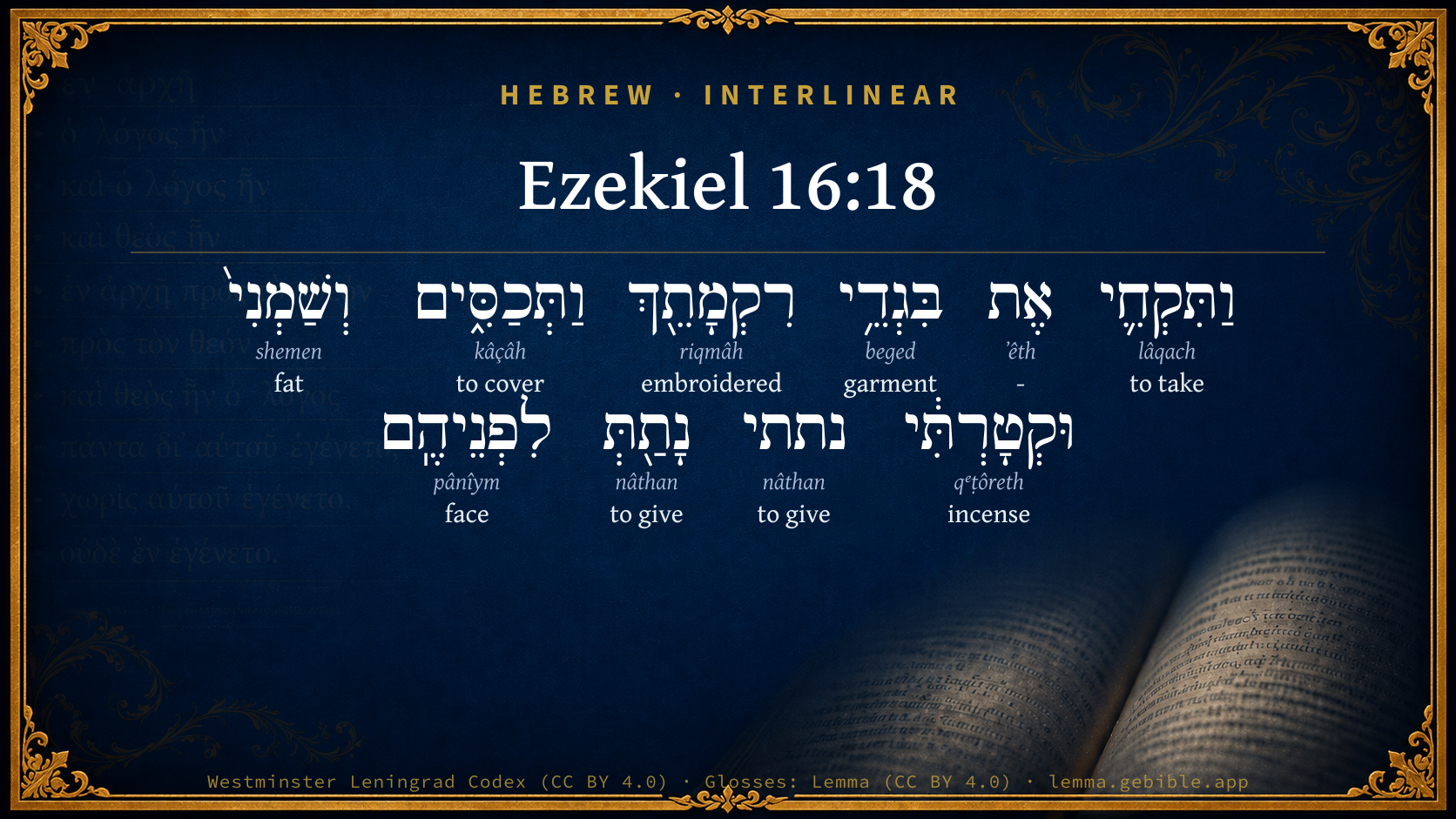
  1. וַתִּקְחִ֛י lâqach H3947 “and · to take” Conjunction + Verb, Qal, Sequential Imperfect, 2nd Person, Feminine, Singular
  2. אֶת ʼêth H853 “-” Particle, Direct Object
  3. בִּגְדֵ֥י beged H899 “garments of” Noun, Common, Masculine, Plural, Construct
  4. וַתְּכַסִּ֑ים kâçâh H3680 “and · to cover · them” Conjunction + Verb, Piel, Sequential Imperfect, 2nd Person, Feminine, Singular + Suffix, Personal, 3rd Person, Masculine, Plural
  5. וְשַׁמְנִי֙ shemen H8081 “and · fat · my” Conjunction + Noun, Common, Masculine, Singular, Construct + Suffix, Personal, 1st Person, Common, Singular
  6. וּקְטָרְתִּ֔י qᵉṭôreth H7004 “and · incense · my” Conjunction + Noun, Common, Feminine, Singular, Construct + Suffix, Personal, 1st Person, Common, Singular
  7. נתתי nâthan H5414 “to give” Verb, Qal, Perfect, 2nd Person, Feminine, Singular
  8. נָתַ֖תְּ nâthan H5414 “to give” Verb, Qal, Perfect, 2nd Person, Feminine, Singular
  9. לִפְנֵיהֶֽם pânîym H6440 “to/for · face(s) · their” Preposition + Noun, Common, Both, Plural, Construct + Suffix, Personal, 3rd Person, Masculine, Plural

About this verse

These counts appear in no published source. They are computed here, from the morphology-tagged text and Lemma’s own curated glosses. What Lemma adds →

10
words
9
distinct lemmas
Prophets
section

Notable vocabulary

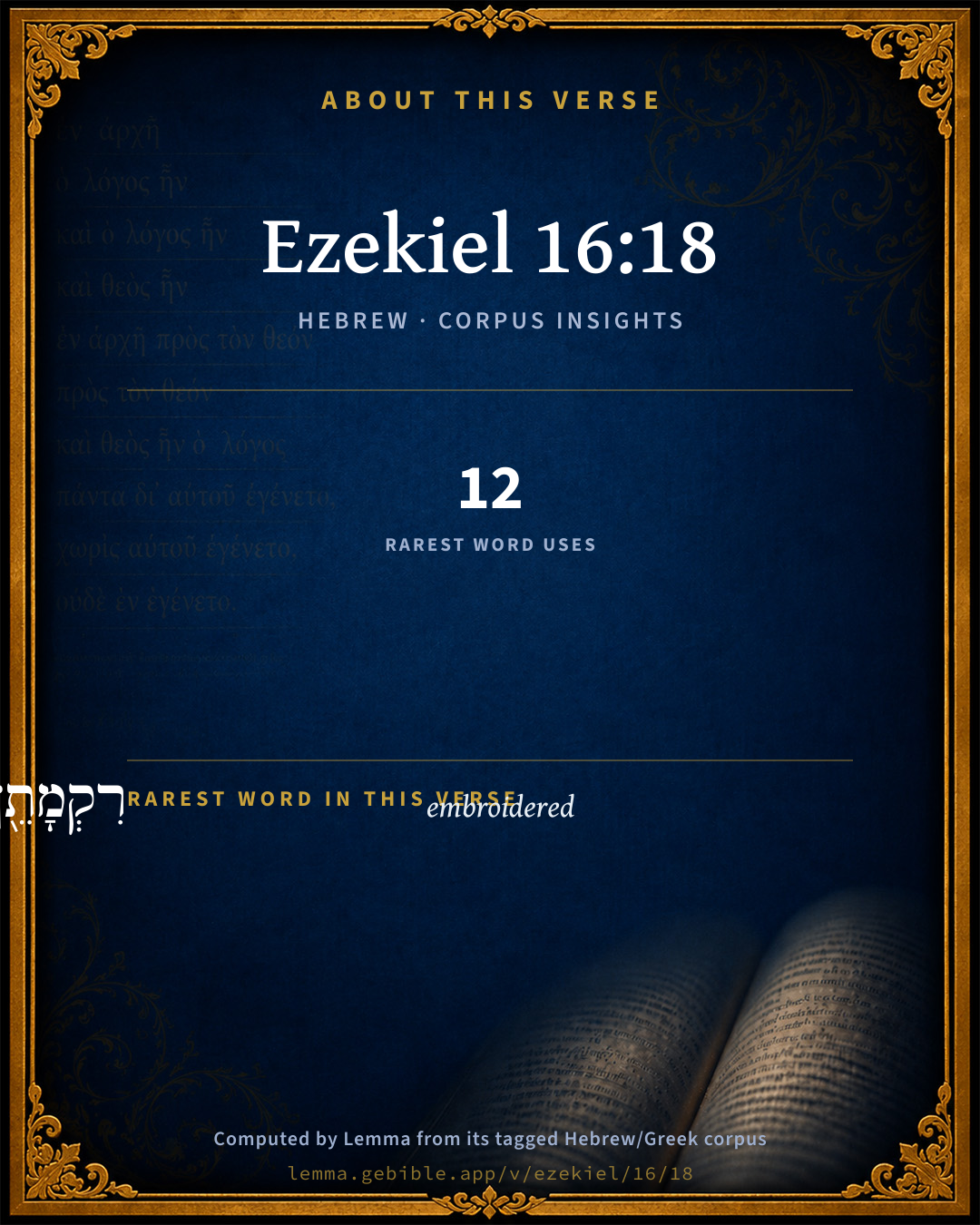
The rarest word here is רִקְמָתֵ֖ךְ embroidered H7553 — appearing just 12 times in the whole Hebrew Bible.

Shared distinctive vocabulary

רִקְמָתֵ֖ךְ embroidered H7553 occurs in 11 verses of the Hebrew Bible. Also found in:

Grammatical profile

  • 4 verbs
  • 5 nouns
  • 1 particle

Verb forms

  • וַתִּקְחִ֛י Qal · Sequential Imperfect
  • וַתְּכַסִּ֑ים Piel · Sequential Imperfect
  • נתתי Qal · Perfect
  • נָתַ֖תְּ Qal · Perfect

Repetition

A word recurs within this verse — often emphatic in Hebrew:

  • נתתי to give H5414 ×2

Hebrew & Septuagint length

In English translation the verse runs 19 words from the Hebrew and 22 from the Septuagint (LXX English) — closely comparable.

A rough comparison of the two English renderings, which tokenize alike — not a word-level alignment.

Word counts can differ between the Hebrew and the Greek without any difference in meaning — e.g. the Hebrew direct-object marker אֵת has no separate Greek word, and Greek often adds the article ὁ.

Hebrew and Greek witnesses Masoretic Hebrew ↔ Greek Septuagint

The same verse in the two great witnesses to the Old Testament, shown verse-for-verse.

These are two independent witnesses, not word-aligned to each other, and the Septuagint is shown in lemma (dictionary) form.

Hebrew Ezekiel 16:18 Masoretic · Westminster Leningrad Codex

וַתִּקְחִ֛י אֶת בִּגְדֵ֥י רִקְמָתֵ֖ךְ וַתְּכַסִּ֑ים וְשַׁמְנִי֙ וּקְטָרְתִּ֔י נתתי נָתַ֖תְּ לִפְנֵיהֶֽם

and you took your embroidered garments, and covered them, and did set my oil and my incense before them.

World English Bible · Public Domain

Greek LXX Ezekiel 16:18 Septuagint · lemma form

καί λαμβάνω ὁ ἱματισμός ὁ ποικίλος σύ καί περιβάλλω αὐτός καί ὁ ἔλαιον ἐγώ καί ὁ θυμίαμα ἐγώ τίθημι πρό πρόσωπον αὐτός

And you did take your variegated apparel and did clothe them, and you did set before them my oil and my incense.

LXX2012 (modern English Septuagint) · Public Domain

On this verse, The Pulpit Commentary discusses the Septuagint’s reading. Read the note in Commentary ↓

Hebrew: Westminster Leningrad Codex (CC BY 4.0). Greek: Septuagint (public domain); English from LXX2012 (modern English Septuagint) (Public Domain). How the Septuagint differs from the Hebrew →

Targum (Aramaic paraphrase)

1

The Targum is the ancient Jewish Aramaic paraphrase of the Hebrew Scriptures — an interpretive translation, not the Hebrew text itself. Onkelos (literal) and Pseudo-Jonathan (expansive) render the Torah, and Jonathan the Prophets. Coverage is partial: where no permissively-licensed English translation exists for a verse, only the Aramaic is shown. This is verse-level text, not a word-by-word alignment to the Hebrew.

  1. Targum Jonathan Prophets (Joshua–Malachi)
    וּנְסֵיבְתְּ יַת לְבוּשֵׁי צִיוּרַיִךְ וּכִסִיתִינוּן וּמִשְׁחִי וּקְטוֹרֶת בּוּסְמֵי שַׁוִית קֳדָמֵיהוֹן:

    (no public-domain English translation for this verse)

    Targum Jonathan — Aramaic: “Mikraot Gedolot” (public domain). English: “Sefaria Community Translation” (CC0 1.0 (public-domain dedication)); “London "Chaldee Paraphrase," 1871” (public domain). Text via Sefaria.

Commentary

Notes on Ezekiel 16:18 from classic Christian and Jewish commentators (each source and its license shown beneath its notes). The classic Christian expositions comment on the surrounding passage and are grouped to its opening verse, so a note may address several verses; the Jewish commentaries on the Tanakh (Rashi and others) are per-verse, so they appear only where the commentator wrote on this verse.

Lemma curates 59 commentaries, every one of them public domain or Creative Commons licensed, each selected and text-cleaned for this edition rather than reprinted as found. About our sources →

Trapp's Complete Commentary

John Trapp

Eze 16:18 And tookest thy broidered garments, and coveredst them: and thou hast set mine oil and mine incense before them.

Ver. 18. And tookest thy broidered, &c.] See Eze 16:16.

John Trapp, A Commentary or Exposition upon All the Books of the Old and New Testament (1647–1656) — public domain. Text from a community e-Sword module.

Jamieson, Fausset & Brown

Robert Jamieson, A. R. Fausset & David Brown

tookest thy . . . garments . . . coveredst them--that is, the idols, as if an adulteress were to cover her paramours with garments which she had received from the liberality of her husband.

my oil--the holy anointing oil sacred to God (Exo 30:22-25). Also that used in sacrifices (Lev 2:1-2).

Jamieson, Fausset & Brown — Commentary Critical and Explanatory on the Whole Bible (1871) — public domain (CC PDM 1.0). Text via the HelloAO Bible API.

Adam Clarke's Commentary

Verse 18. Hast set mine oil and mine incense before them.] It appears that they had made use of the holy vestments, and the different kinds of offerings which belonged to the Lord, to honour their idols.

Adam Clarke's Commentary on the Bible (1810–1826) — public domain. Text from a community e-Sword/MySword module.

John Calvin's Commentaries

Here God complains that the Jews turned their abundance of all things to perverse worship: for, as a husband who indulges his wife freely supplies all her wants, so a woman who is immodest was what she has received from her husband, and bestows it on adulterers; so also the Jews were prodigal in the worship of idols, and wasted upon them the blessings which God had bestowed upon them. Ezekiel, therefore, now follows up this sentiment. He says that they took those variegated garments, of which we spoke yesterday, and covered their idols; just as if an adulteress were to clothe her paramours in the very garments which she had received from her husband’s liberality: you have covered them, he says. He afterwards adds, you have offered my oil and incense. Here he speaks more clearly, although he does not depart far from the figure, for they were accustomed to use oil in sacrifices; and incense was used by all nations when they wished to propitiate their deities. There is no doubt that the unbelievers imitated the holy fathers, but sinfully, because they did not consider the right end. We know that the fathers used oil in their sacrifices, (Leviticus 2:1, and often elsewhere;) we know that incense was prescribed by God’s law, and it was used promiscuously by all the nations, but without reason and judgment. So now God complains that they made incense of his herbs, and an offering of the oil which he had bestowed upon the Jews. He then adds the same of bread, and fine flour, oil, and honey. We said yesterday that by these words ample and delicate food was intended; for by the figure, a part for the whole, fine flour comprehends the best and sweetest bread, as well as other viands. Oil and honey are added. It is then just as if the Prophet had said that the Jews overflowed with all luxuries, yet consumed them badly. But this was a mockery not. to be borne, when the Jews, after being enriched by God’s beneficence, rashly threw it all away, and not only so, but adorned their false gods to the dishonor of God himself, when they ought to have offered to him what they wasted upon idols. For this reason he calls it his own bread, and explains the passage in this sense, that the Jews could neither ascribe to themselves the abundance of their possessions, nor boast in the fruitfulness of the soil; for all these things flowed from the mere benevolence of God. This ingratitude, then, was too foul — to bestow upon idols what God had given for a far different purpose. I, says he, have fed thee He shows the legitimate use of such manifold abundance. Since they abounded in wheat, whence they obtained fine flour, and were stuffed full of other delicacies, they thought to be elevated towards God, and to exercise themselves in the duties of gratitude; but they abused that abundance in adorning false deities.

You have offered it to them, therefore, for a savor of peace. Rest no doubt signifies appeasing here, as frequently with Moses, though others translate “for an odor of sweetness;” but they do not sufficiently express the meaning of Moses; for he means that when God is appeased there is peace between himself and men. (Leviticus 3:9, 13, 17, and often.) There is no doubt that “the odor of quiet” signifies a just expiation, by which God is appeased, so that he receives men into favor. This is everywhere said of the sacrifices of the law, since there was no other means by which men could be reconciled to God, unless by offering sacrifices according to his command. Now the Prophet transfers this ironically to their impious worship, when he says that they offered to idols all the delicacies by which God nourishes his people. To what purpose? for a sweet savor; that is, that they may be propitious to you. But it was ridiculous to wish to appease gods of stone and wood and silver. We see then how Ezekiel reproves the people’s folly, when he says, that they offered both fine flour and other things to their idols to reconcile themselves to them. Now the crime is increased since the Jews did not recognize that singular blessing of being so reconciled to God, that he no longer imputed their sins to them. Woe indeed to us if we are destitute of this remedy! because we constantly commit various faults, and are thus subject to God’s judgments. Unless, then, God receives us into favor, we see that nothing can be more miserable for us. But he has prescribed a fixed and easy rule by which he will be appeased, namely, by sacrifices — I am speaking of the fathers who lived under the law: for we know that we of this day must flee to the only sacrifice of Christ, which the sacrifices of the law shadowed forth. Since, therefore, the Jews could return to God’s favor, and bury all their sins, and redeem themselves from the curse, how great was their madness in willingly depriving themselves of so inestimable a boon! Hence the Prophet now rebukes this folly, when he says that they propitiated their idols that they might appease them. He concludes at length, and it was so, says the Lord Jehovah. Here God takes away all occasion for their turning aside, when he says it was so; for we know that men always have various pretenses by which they lay the blame on some other parties, or soften it off, or cover it with some disguise. But God here says that there is no occasion for dispute, since the matter is perfectly plain. We see, then, that this word is used emphatically, when he says I am the Lord; for, if Ezekiel had announced it, they would not have listened to him; but God himself comes before them, and cuts off all excuses from the Jews. It follows —

John Calvin's Commentaries (1540-1563) — public domain. Text from the Calvin Translation Society English edition (1840s-50s) via the Christian Classics Ethereal Library (ccel.org). Calvin's coverage is partial (roughly two-thirds of the Bible); uncommented books and verses are honest gaps, never fabricated. The 19th-century editor's footnotes and remarks are omitted so the notes are faithfully Calvin's own voice.

John Gill's Exposition

My meat also which I gave thee,.... Or "my bread" (i); a general name for all eatables. The Targum renders it,

"my good things.''

The Jews apply it to the manna, which, they say, descended the same day the molten calf was made, and they set it before it. This interpretation Jarchi and Kimchi make mention of; it includes what follows:

fine flour, and oil, and honey, wherewith I fed thee; for the land of Canaan was a land of wheat, of which fine flour was made; and of olives, from whence was the best oil; and a land flowing with milk and honey; and which was given by the Lord, and so he might be said to feed them with them: and instead of glorifying him, and being thankful for them, and using them in the manner they ought,

thou hast even set it before them for a sweet savour; that is, they made a meat offering of their fine flour, oil, and honey, and set it before their idols; to gain their favour and good will; to appease them, and render them propitious; supposing it would be acceptable unto them; all these things were used in meat offerings and sacrifices unto the Lord, excepting honey, and that was forbid; but was in use among the Gentiles; see Lev 2:1;

and thus it was, saith the Lord God; all this idolatry, ingratitude, and folly, have been committed; it is most notorious, there is no denying it; I, who am the Lord God omniscient, affirm it. The Targum puts it by way of question, and even of astonishment and admiration,

"are not all these things done, saith the Lord God!''

(i) "et panem meum", V. L. Pagninus, Montanus, Starckius.

John Gill's Exposition of the Whole Bible (1746–1763) — public domain (CC PDM 1.0). Text via the HelloAO Bible API.

Albert Barnes' Notes on the Bible

Mine oil and mine incense - The oil was the produce of the land, the incense received in exchange for such produce. Both were the gifts of Yahweh and belonged to Him; yet the oil Exo 25:6; Exo 29:40 and the incense Exo 30:34, prepared for the service of God, were used in idol-worship. In nature worship the worshippers were especially lavish in vegetable products like incense.

Albert Barnes' Notes on the Bible (1834–1885) — public domain. Text from a community e-Sword/MySword module.

Haydock's Catholic Bible Commentary

Oil, or perfume. which no man was allowed to use, Exodus xxx. 9, 38.

George Leo Haydock (1774–1849), Haydock's Catholic Family Bible and Commentary, 1859 edition — public domain. Excludes Psalms (Douay-Rheims chapter numbering differs from Protestant) and Deuterocanonical books (Catholic canon only).

Matthew Poole's English Annotations

Thy broidered garments, mentioned Eze 16:10, given by him who espoused this woman. Coveredst them; didst clothe the adulterers with whom thou didst commit lewdness, or didst clothe the images which thou hadst made, as was the custom of idolaters to suit clothing to their idols.

Mine oil; either in lamps to burn before them, or used in their sacrificing to their idols; or literally, didst in thy feast with thine adulterous lovers entertain them with the oil I gave thee.

Mine incense; burnt before the idol incense, being one part of what they offered to idols; or burnt in the private house, to make it the more grateful to the adulterer, as Pro 7:16,17.

Matthew Poole's English Annotations on the Holy Bible (1683–1685) — public domain. Text from a community e-Sword/MySword module.

Whedon's Commentary on the Bible

Daniel D. Whedon

18. Tookest thy broidered garments, and coveredst them — See on Eze_16:10. “The Semites on festal occasions dressed up their sacred poles and did the same with their idols.” — W. Robertson Smith.

Daniel D. Whedon (gen. ed.), Commentary on the Old and New Testaments (1874–1909) — public domain. Text from a community e-Sword module.

The Pulpit Commentary

Vers. 18, 19. Mine oil and mine incense. This, as afterwards in Eze_23:41, was the crowning aggravation of the guilt. The very gifts of God, designed for his worship, were prostituted to that of his rivals. The "oil" is that of Exo_30:23-25, perfumed and set apart for sacred uses. The act of covering the idol was, as in ver. 8, the symbol of the marriage union. In the sweet savour we have the familiar phrase of Eze_6:13. The scene brought before us is that of a sacrificial feast, in which cakes of flour, honey, and oil were eaten whilst incense was offered. So we have the "adored liba" of Virgil, "AEneid," 7:109, or more fully in Tibullus, "Eleg.," 1:7, 53, 54, the "thuria honores," the "liba ... dulcia melle." Thus it was, etc. As in ver. 16, the description seems to rouse an instinctive abhorrence in the prophet"s mind, which finds utterance in this form: "Yes, it was even so." The words are, however, taken by the LXX, Vulgate, and Luther as opening the following verse: "And it came to pass that."

The Pulpit Commentary (1880–1919), ed. H.D.M. Spence-Jones & Joseph S. Exell — public domain. Text from a community e-Sword module.

John Wesley's Explanatory Notes

Coveredst - Didst clothe the images thou hadst made. Set mine oil - In lamps to burn before them.

John Wesley, Explanatory Notes Upon the Whole Bible (1754–1765) — public domain. Text via the GEBible commentary corpus.

Lesson kit

Teaching starters — assembled from the data on this page, not authored interpretation. Every prompt links to the verse data it draws on. Edit before teaching.

Ezekiel, in the Prophets, opens this verse with 10 words (9 distinct Hebrew lemmas). Its most distinctive word is riqmâh (“embroidered”). A historical commentator’s framing appears above. Read the whole chapter for the surrounding context.

Discussion questions

  1. The word riqmâh carries the sense “embroidered.” How does it shape the verse?
  2. How does Judges 5:30, which shares the word «embroidered», read alongside this verse?
  3. What does the repetition of “to give” (2× in this one verse) do in this verse?
  4. These translations render this verse differently. What is at stake in choosing one wording over another?
  5. «וַתִּקְחִ֛י» is a Qal Sequential Imperfect verb. How does that grammatical form shape the action described?
  6. Compare how Trapp's Complete Commentary and Jamieson, Fausset & Brown read this verse. Where do they agree or differ?

Things to notice

Reading settings

Reading text

Shown beneath each verse's original-language words.

Old Testament
Old Testament edition

Read the OT as the Masoretic Hebrew (MT) or the Greek Septuagint (LXX).

English shown for the Greek Septuagint (in the Hebrew ↔ Greek comparison).

Comparing translations? Open the Compare panel on any verse page to stack up to four side by side.