
Ezekiel 16:39

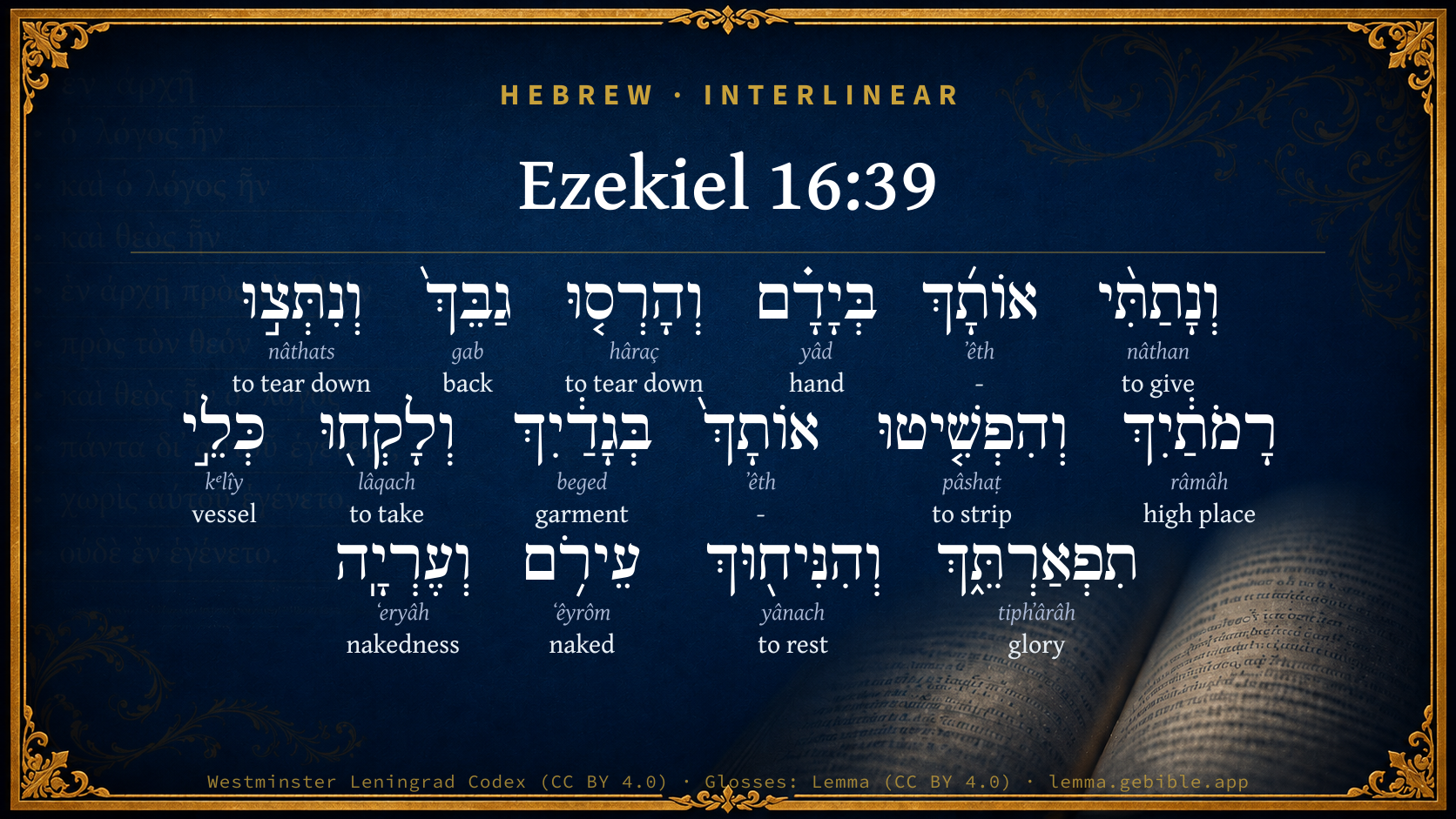
Hebrew (Westminster Leningrad Codex) Ezekiel 16:39 appears in the Hebrew Old Testament. The text above is from the Westminster Leningrad Codex. Each word links to its Strong’s number, a concise gloss, and parsing drawn from the Open Scriptures Hebrew Bible morphology. Click any word for its full Brown-Driver-Briggs (BDB) entry.
Download image
Cite this verse

Ezekiel 16:39 (World English Bible). Public Domain. Lemma interlinear Bible study tool, https://lemma.gebible.app/v/ezekiel/16/39.

Show BibTeX & RIS
BibTeX
RIS
English Translation
I will also give you into their hand, and they shall throw down your vaulted place, and break down your lofty places; and they shall strip you of your clothes, and take your beautiful jewels; and they shall leave you naked and bare.
World English Bible · Public Domain
Download a study sheet

One document with this verse’s original text, its word-by-word gloss line, the meaning frame, cross-references with their text, attributed commentary, and full source and license credits — printable, and it pastes into notes with its structure intact.

This verse Autodidact and up

Study sheet (.html) Plain text (.txt)

A passage Seminary Student

Up to 50 verses in one chapter. A passage sheet keeps up to 6 commentary sources and 12 cross-references per verse, in the order this page ranks them, and says so on the sheet whenever that leaves anything out. Ask for a single verse and you get the Autodidact verse sheet above.

Everything on this page stays free to read, with no account — the sheet is a download of what is already on screen, not access to it.

Want to remove ads? Support Godless Engineer
Compare translations 3

The same verse in 3 English versions, stacked beneath the original-language interlinear above. Click any original word for its lexicon entry.

Each is an independent rendering of the whole verse — the interlinear is not word-aligned to these translations.

Highlighted words mark where these versions differ — a whole-verse word diff, not a word-by-word alignment.

  • World English Bible Public Domain
    I will also give you into their hand, and they shall throw down your vaulted place, and break down your lofty places; and they shall strip you of your clothes, and take your beautiful jewels; and they shall leave you naked and bare.
  • King James Version Public Domain
    And I will also give thee into their hand, and they shall throw down thine eminent place, and shall break down thy high places: they shall strip thee also of thy clothes, and shall take thy fair jewels, and leave thee naked and bare.
  • unfoldingWord Literal Text CC BY-SA 4.0
    I will give you into their hands so they will throw down your vaulted chamber and break down your high places and they will strip you of your clothes and take all of your jewelry. They will leave you naked and bare.

unfoldingWord Literal Text — © unfoldingWord, licensed CC BY-SA 4.0. Word-aligned USFM3 via Door43 (git.door43.org/unfoldingWord/en_ult).

Versions to compare (up to 4)

3 of 4 selected

Show all 18 translations

Every available English version of this verse, each an independent rendering of the whole verse.

  • World English Bible Public Domain
    I will also give you into their hand, and they shall throw down your vaulted place, and break down your lofty places; and they shall strip you of your clothes, and take your beautiful jewels; and they shall leave you naked and bare.
  • Berean Standard Bible Public Domain
    Then I will deliver you into the hands of your lovers, and they will level your mounds and tear down your lofty shrines. They will strip off your clothes, take your fine jewelry, and leave you naked and bare.
  • Majority Standard Bible Public Domain
    Then I will deliver you into the hands of your lovers, and they will level your mounds and tear down your lofty shrines. They will strip off your clothes, take your fine jewelry, and leave you naked and bare.
  • King James Version Public Domain
    And I will also give thee into their hand, and they shall throw down thine eminent place, and shall break down thy high places: they shall strip thee also of thy clothes, and shall take thy fair jewels, and leave thee naked and bare.
  • American Standard Version (1901) Public Domain
    I will also give thee into their hand, and they shall throw down thy vaulted place, and break down thy lofty places; and they shall strip thee of thy clothes, and take thy fair jewels; and they shall leave thee naked and bare.
  • Revised Version (1885) Public Domain
    I will also give thee into their hand, and they shall throw down thine eminent place, and break down thy lofty places; and they shall strip thee of thy clothes, and take thy fair jewels: and they shall leave thee naked and bare.
  • Geneva Bible (1599) Public Domain
    I will also giue thee into their handes, and they shall destroy thine hie place, and shall breake downe thine hie places. they shall strippe thee also out of thy clothes, and shall take thy faire iewels, and leaue thee naked and bare.
  • Douay-Rheims (1899) Public Domain
    And I will deliver thee into their hands, and they shall destroy thy brothel house, and throw down thy stews: and they shall strip thee of thy garments, and shall take away the vessels of thy beauty: and leave thee naked, and full of disgrace.
  • Young's Literal Translation Public Domain
    And I have given thee into their hand, And they have thrown down thine arch, And they have broken down thy high places, And they have stript thee of thy garments, And they have taken thy beauteous vessels, And they have left thee naked and bare.
  • Literal Standard Version CC BY-SA 4.0
    And I have given you into their hand, || And they have thrown down your arch, || And they have broken down your high places, || And they have stripped you of your garments, || And they have taken your beautiful vessels, || And they have left you naked and bare.
  • Unlocked Literal Bible CC BY-SA 4.0
    I will give you into their hands so they will throw down your vaulted chamber and break down your high places and they will strip you of your clothes and take all of your jewelry. They will leave you naked and bare.
  • unfoldingWord Literal Text CC BY-SA 4.0
    I will give you into their hands so they will throw down your vaulted chamber and break down your high places and they will strip you of your clothes and take all of your jewelry. They will leave you naked and bare.
  • Darby Bible Public Domain
    and I will give thee into their hand, and they shall throw down thy place of debauchery, and shall break down thy high places; and they shall strip thee of thy garments, and shall take thy fair jewels, and leave thee naked and bare.
  • World Messianic Bible Public Domain
    I will also give you into their hand, and they will throw down your vaulted place, and break down your lofty places. They will strip you of your clothes and take your beautiful jewels. They will leave you naked and bare.
  • Webster's Bible Public Domain
    And I will also give thee into their hand, and they shall throw down thy eminent place, and shall break down thy high places: they shall strip thee also of thy clothes, and shall take thy fair jewels, and leave thee naked and bare.
  • Free Bible Version CC BY-SA 4.0
    Then I will hand you over to your lovers, and they will demolish your pagan shrines and destroy your high places of idol worship. They will strip you of your clothes, remove your beautiful jewelry, and leave you stark naked.
  • Bible in Basic English Public Domain
    I will give you into their hands, and your arched room will be overturned and your high places broken down; they will take your clothing off you and take away your fair jewels: and when they have done, you will be uncovered and shamed.
  • JPS Tanakh (1917) Public Domain
    I will also give thee into their hand, and they shall throw down thine eminent place, and break down thy lofty places; and they shall strip thee of thy clothes, and take thy fair jewels; and they shall leave thee naked and bare.

Literal Standard Version (2020), Covenant Press — licensed CC BY-SA 4.0. Text via the HelloAO Bible API (eBible.org). Unlocked Literal Bible (unfoldingWord) — licensed CC BY-SA 4.0. Text via the HelloAO Bible API (eBible.org). unfoldingWord Literal Text — © unfoldingWord, licensed CC BY-SA 4.0. Word-aligned USFM3 via Door43 (git.door43.org/unfoldingWord/en_ult). Free Bible Version, Dr. Jonathan Gallagher — licensed CC BY-SA 4.0. Text via the HelloAO Bible API (eBible.org).

Word by word

More ways to search: Search by grammar → Find every occurrence → Compare this word →

Practice this passage: Drill this verse → Learn its vocabulary →

רָמֹתַ֔יִךְ
râmâh
H7413
“high places · your”
Noun, Common, Feminine, Plural, Construct + Suffix, Personal, 2nd Person, Feminine, Singular
Part of Speech
Noun
Type
Common
Gender
Feminine
Number
Plural
State
Construct
Full BDB Definition

Origin: act part of H7311

TWOT: 2133d

height, high place - as place of illicit worship
  1. וְנָתַתִּ֨י nâthan H5414 “and · to give” Conjunction + Verb, Qal, Sequential Perfect, 1st Person, Common, Singular
  2. אוֹתָ֜ךְ ʼêth H853 “- · you” Particle, Direct Object + Suffix, Personal, 2nd Person, Feminine, Singular
  3. בְּיָדָ֗ם yâd H3027 “in/at · hand · their” Preposition + Noun, Common, Both, Singular, Construct + Suffix, Personal, 3rd Person, Masculine, Plural
  4. וְהָרְס֤וּ hâraç H2040 “and · to tear down” Conjunction + Verb, Qal, Sequential Perfect, 3rd Person, Common, Plural
  5. גַבֵּךְ֙ gab H1354 “back · your” Noun, Common, Both, Singular, Construct + Suffix, Personal, 2nd Person, Feminine, Singular
  6. וְנִתְּצ֣וּ nâthats H5422 “and · to tear down” Conjunction + Verb, Piel, Sequential Perfect, 3rd Person, Common, Plural
  7. וְהִפְשִׁ֤יטוּ pâshaṭ H6584 “and · to strip” Conjunction + Verb, Hiphil, Sequential Perfect, 3rd Person, Common, Plural
  8. אוֹתָךְ֙ ʼêth H853 “- · you” Particle, Direct Object + Suffix, Personal, 2nd Person, Feminine, Singular
  9. בְּגָדַ֔יִךְ beged H899 “garments · your” Noun, Common, Masculine, Plural, Construct + Suffix, Personal, 2nd Person, Feminine, Singular
  10. וְלָקְח֖וּ lâqach H3947 “and · to take” Conjunction + Verb, Qal, Sequential Perfect, 3rd Person, Common, Plural
  11. כְּלֵ֣י kᵉlîy H3627 “vessels of” Noun, Common, Masculine, Plural, Construct
  12. תִפְאַרְתֵּ֑ךְ tiphʼârâh H8597 “glory · your” Noun, Common, Feminine, Singular, Construct + Suffix, Personal, 2nd Person, Feminine, Singular
  13. וְהִנִּיח֖וּךְ yânach H3240 “and · to rest · you” Conjunction + Verb, Hiphil, Sequential Perfect, 3rd Person, Common, Plural + Suffix, Personal, 2nd Person, Feminine, Singular
  14. עֵירֹ֥ם ʻêyrôm H5903 “naked” Adjective, Adjective, Masculine, Singular, Absolute
  15. וְעֶרְיָֽה ʻeryâh H6181 “and · nakedness” Conjunction + Noun, Common, Feminine, Singular, Absolute

About this verse

These counts appear in no published source. They are computed here, from the morphology-tagged text and Lemma’s own curated glosses. What Lemma adds →

16
words
15
distinct lemmas
Prophets
section

Notable vocabulary

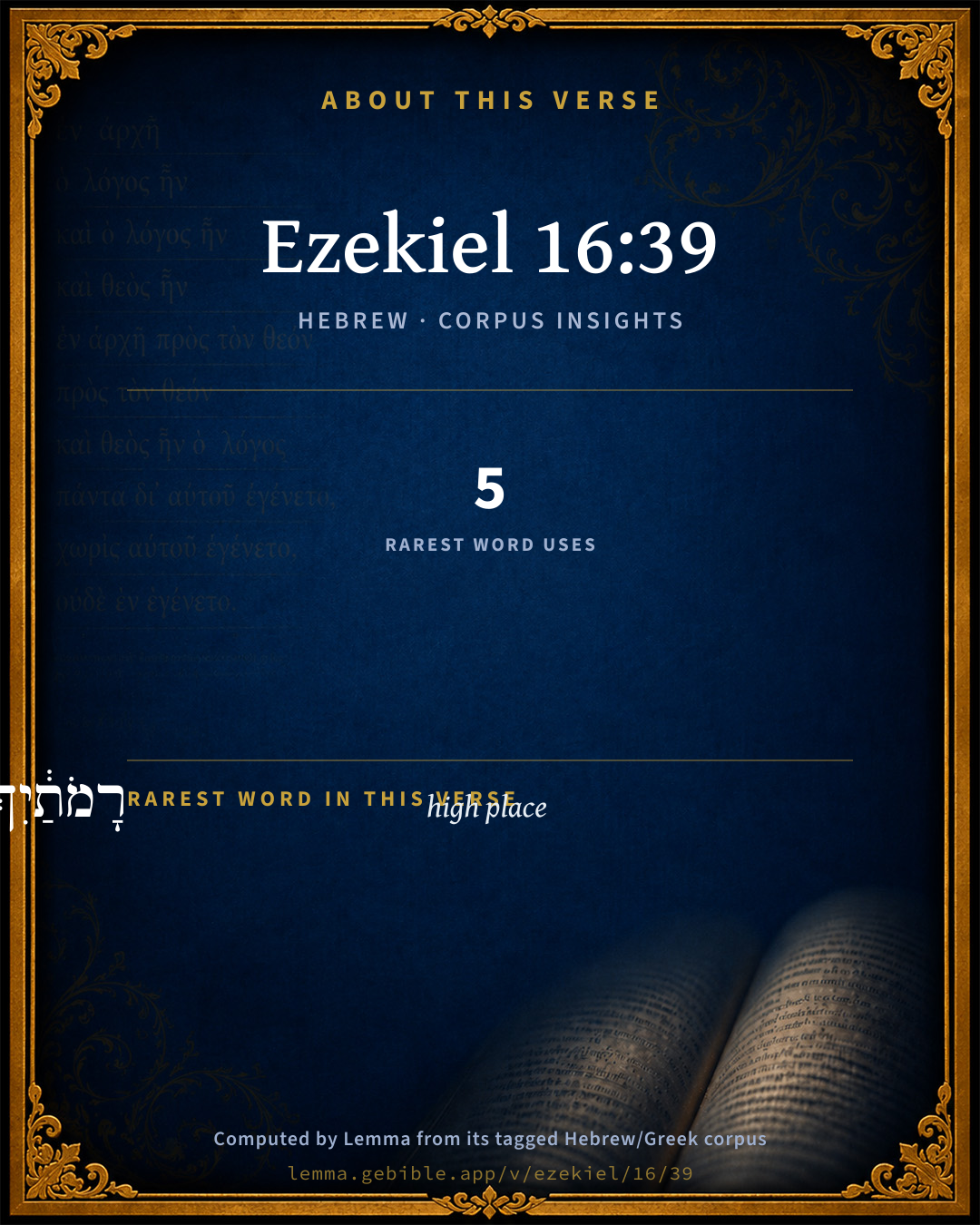
The rarest word here is רָמֹתַ֔יִךְ high place H7413 — appearing just 5 times in the whole Hebrew Bible.

Shared distinctive vocabulary

רָמֹתַ֔יִךְ high place H7413 occurs in 5 verses of the Hebrew Bible. Also found in:

Grammatical profile

  • 6 verbs
  • 7 nouns
  • 1 adjective
  • 2 particles

Verb forms

  • וְנָתַתִּ֨י Qal · Sequential Perfect
  • וְהָרְס֤וּ Qal · Sequential Perfect
  • וְנִתְּצ֣וּ Piel · Sequential Perfect
  • וְהִפְשִׁ֤יטוּ Hiphil · Sequential Perfect
  • וְלָקְח֖וּ Qal · Sequential Perfect
  • וְהִנִּיח֖וּךְ Hiphil · Sequential Perfect

Hebrew & Septuagint length

In English translation the verse runs 43 words from the Hebrew and 42 from the Septuagint (LXX English) — closely comparable.

A rough comparison of the two English renderings, which tokenize alike — not a word-level alignment.

Word counts can differ between the Hebrew and the Greek without any difference in meaning — e.g. the Hebrew direct-object marker אֵת has no separate Greek word, and Greek often adds the article ὁ.

Cross-references

10

Topical passages linked to Ezekiel 16:39 in the Treasury of Scripture Knowledge — connected by theme and wording, ordered by reader-vote popularity; previews shown in the World English Bible.

  • Ezekiel 23:26 They shall also strip you of your clothes, and take away your beautiful jewels.
  • Hosea 2:3 Lest I strip her naked, And make her bare as in the day that she was born, And make her like a wilderness, And set her like a dry land, And kill her with thirst.
  • Ezekiel 16:24–25 that you have built to you a vaulted place, and have made you a lofty place in every street.
  • Isaiah 3:16–24 Moreover Yahweh said, "Because the daughters of Zion are haughty, And walk with outstretched necks and flirting eyes, Walking to trip as they go, Jingling ornaments on their feet;
  • Isaiah 27:9 Therefore by this shall the iniquity of Jacob be forgiven, and this is all the fruit of taking away his sin: that he makes all the stones of the altar as chalk stones that are beaten in sunder, [so that] the Asherim and the sun-images shall rise no more.
  • Ezekiel 7:22–24 My face will I turn also from them, and they shall profane my secret [place]; and robbers shall enter into it, and profane it.
  • Ezekiel 16:10–20 I clothed you also with embroidered work, and shod you with sealskin, and I girded you about with fine linen, and covered you with silk.
  • Ezekiel 16:31 in that you build your vaulted place at the head of every way, and make your lofty place in every street, and have not been as a prostitute, in that you scorn pay.
  • Ezekiel 23:29 and they shall deal with you in hatred, and shall take away all your labor, and shall leave you naked and bare; and the nakedness of your prostitution shall be uncovered, both your lewdness and your prostitution.
  • Hosea 2:9–13 Therefore I will take back my grain in its time, And my new wine in its season, And will pluck away my wool and my flax which should have covered her nakedness.

Cross-references courtesy of OpenBible.info (CC BY 4.0).

Hebrew and Greek witnesses Masoretic Hebrew ↔ Greek Septuagint

The same verse in the two great witnesses to the Old Testament, shown verse-for-verse.

These are two independent witnesses, not word-aligned to each other, and the Septuagint is shown in lemma (dictionary) form.

Hebrew Ezekiel 16:39 Masoretic · Westminster Leningrad Codex

וְנָתַתִּ֨י אוֹתָ֜ךְ בְּיָדָ֗ם וְהָרְס֤וּ גַבֵּךְ֙ וְנִתְּצ֣וּ רָמֹתַ֔יִךְ וְהִפְשִׁ֤יטוּ אוֹתָךְ֙ בְּגָדַ֔יִךְ וְלָקְח֖וּ כְּלֵ֣י תִפְאַרְתֵּ֑ךְ וְהִנִּיח֖וּךְ עֵירֹ֥ם וְעֶרְיָֽה

I will also give you into their hand, and they shall throw down your vaulted place, and break down your lofty places; and they shall strip you of your clothes, and take your beautiful jewels; and they shall leave you naked and bare.

World English Bible · Public Domain

Greek LXX Ezekiel 16:39 Septuagint · lemma form

καί παραδίδωμι σύ εἰς χείρ αὐτός καί κατασκάπτω ὁ πορνεῖον σύ καί κατααἱρέω ὁ βάσις σύ καί ἐκδύω σύ ὁ ἱματισμός σύ καί λαμβάνω ὁ σκεῦος ὁ καύχησις σύ καί ἀποἵημι σύ γυμνός καί ἀσχημονέω

And I will deliver you into their hands, and they shall break down your house of harlotry, and destroy your high place; and they shall strip you of your garments, and shall take your proud ornaments, and leave you naked and bare.

LXX2012 (modern English Septuagint) · Public Domain

Hebrew: Westminster Leningrad Codex (CC BY 4.0). Greek: Septuagint (public domain); English from LXX2012 (modern English Septuagint) (Public Domain). How the Septuagint differs from the Hebrew →

Targum (Aramaic paraphrase)

1

The Targum is the ancient Jewish Aramaic paraphrase of the Hebrew Scriptures — an interpretive translation, not the Hebrew text itself. Onkelos (literal) and Pseudo-Jonathan (expansive) render the Torah, and Jonathan the Prophets. Coverage is partial: where no permissively-licensed English translation exists for a verse, only the Aramaic is shown. This is verse-level text, not a word-by-word alignment to the Hebrew.

  1. Targum Jonathan Prophets (Joshua–Malachi)
    וְאֶמְסַר יָתִיךְ בִּידֵיהוֹן וִיפַגְרוּן שׁוּרֵיךְ וְיִתַרְעוּן רָמָתַיִךְ וְיִשְׁלְחוּן יָתִיךְ לְבוּשֵׁי יְקָרִיךְ וְיִסְבּוּן מָנַי תוּשְׁבַּחְתִּיךְ וְיִשְׁבְקוּנִיךְ מְטַלְטָלָא וּשְׁבִיקָא:

    (no public-domain English translation for this verse)

    Targum Jonathan — Aramaic: “Mikraot Gedolot” (public domain). English: “Sefaria Community Translation” (CC0 1.0 (public-domain dedication)); “London "Chaldee Paraphrase," 1871” (public domain). Text via Sefaria.

Commentary

Notes on Ezekiel 16:39 from classic Christian and Jewish commentators (each source and its license shown beneath its notes). The classic Christian expositions comment on the surrounding passage and are grouped to its opening verse, so a note may address several verses; the Jewish commentaries on the Tanakh (Rashi and others) are per-verse, so they appear only where the commentator wrote on this verse.

Lemma curates 59 commentaries, every one of them public domain or Creative Commons licensed, each selected and text-cleaned for this edition rather than reprinted as found. About our sources →

Trapp's Complete Commentary

John Trapp

Eze 16:39 And I will also give thee into their hand, and they shall throw down thine eminent place, and shall break down thy high places: they shall strip thee also of thy clothes, and shall take thy fair jewels, and leave thee naked and bare.

Ver. 39. They shall throw down thine eminent place.] So did the Turks throw down many both images and churches in Christendom, when people would not be persuaded to cast images out of their churches.

They shall strip thee also of thy clothes.] So the Spaniards did the Dutch, when once they grew fond of the Spanish fashions, as Lavater here notes.

John Trapp, A Commentary or Exposition upon All the Books of the Old and New Testament (1647–1656) — public domain. Text from a community e-Sword module.

Tyndale Open Study Notes

Tyndale Open Resources

16:39-43 Ironically, Jerusalem’s lovers would turn against her and destroy her. The Lord’s fury would not be requited until the city had paid for all its former sins.

Tyndale Open Study Notes — © Tyndale Open Resources, licensed CC BY-SA 4.0. Text via the HelloAO Bible API.

Jamieson, Fausset & Brown

Robert Jamieson, A. R. Fausset & David Brown

thine eminent place--literally, "fornication-chamber" (see on Eze 16:24), the temple which Israel had converted into a place of spiritual fornication with idols, to please the Chaldeans (Eze 23:14-17).

strip thee of . . . clothes-- (Eze 23:26; Hos 2:3). They shall dismantle thy city of its walls.

fair jewels--literally, "vessels of thy fairness" or beauty; the vessels of the temple [GROTIUS]. All the gifts wherewith God hath adorned thee [CALVIN].

Jamieson, Fausset & Brown — Commentary Critical and Explanatory on the Whole Bible (1871) — public domain (CC PDM 1.0). Text via the HelloAO Bible API.

Adam Clarke's Commentary

Verse 39. They shall strip thee also of thy clothes - thy fair jewels] Alluding to a lot common enough to prostitutes, their maintainers in the end stripping them of all they had given them.

Adam Clarke's Commentary on the Bible (1810–1826) — public domain. Text from a community e-Sword/MySword module.

John Calvin's Commentaries

Here Ezekiel enlarges upon God’s judgment, when he teaches that the Jews would not only be exposed to every disgrace, as if they were brought forward into a noble and conspicuous theater, but they would suffer spoliation and rapine from those in whom they formerly trusted. I will give thee, says he, into their hands He speaks of lovers and enemies: in truth, he says all shall meet together — your ancient allies and friends as well as your enemies: and we know that they were spoiled at one time or another by the Egyptians, Assyrians, and Chaldaeans. For at the time when Jerusalem was taken and cut off, the Assyrians were reduced under the monarchy of the Chaldees. Babylon had oppressed Nineveh, as is well known, but the strength of both people were joined together. Thus the Jews were spoiled by them when they thought that they had provided for themselves very successfully by an alliance with the Assyrians against the kings of Israel and Syria: and afterwards, when they had formed an alliance with the Chaldaeans, they thought themselves beyond the reach of all danger. But now the Prophet derides there foolish confidence, and says that they should be spoiled by all their friends: so also he says that their altars should be thrown down. Those who translate it “a house of sin” do not sufficiently consider what I yesterday observed, that the Prophet uses the figure so as to mark a thing simply from any part of it. The Prophet’s language is moderate or mixed, because he speaks partially of lofty and profane altars, and at the same time follows out its own simile. There is no doubt, therefore, that by a high place and lofty things he means altars themselves: although he does allude to these sinful houses, because he said in yesterday’s lecture that the Jews stood at the top of the streets so as to entice any casual and unknown strangers to them. As also the Chaldaeans did not spare the temple, so there is no doubt that they destroyed all the altars promiscuously. and yet the Jews had wished to gratify them by destroying a part of them. But God shows how foolishly men imagine they shall succeed while they purposely fight against him: and experience teaches that the same thing happens to all unbelievers. For when any one has embraced his own superstitions, and despises what others think sacred and holy, then the conquerors destroy temples and images, and deform the region which they wish to be ruined and desolate. So also it is now said, they shall destroy your altars and high places. He now adds, and they shall spoil thee of thy garments, and take away the vessels of thy beauty. The Prophet comprehends in these words whatever benefits God had conferred on the Jews; for we know how liberally he had adorned them with his gifts, and especially in rendering the earth wonderfully fruitful by his blessing. He signifies in a word, that the Jews, when deprived of all their ornaments, would be disgraced; as it follows, and they shall send thee away naked and bare; that is, they shall cast thee off, just as a lover when satisfied rejects the companion of his iniquity.

John Calvin's Commentaries (1540-1563) — public domain. Text from the Calvin Translation Society English edition (1840s-50s) via the Christian Classics Ethereal Library (ccel.org). Calvin's coverage is partial (roughly two-thirds of the Bible); uncommented books and verses are honest gaps, never fabricated. The 19th-century editor's footnotes and remarks are omitted so the notes are faithfully Calvin's own voice.

Ellicott's Commentary for English Readers

(39) Eminent places.—See Note on Eze_16:24. The destruction of her idolatries as well as the desolation of Israel herself is foretold.

A Bible Commentary for English Readers, edited by Charles John Ellicott (1878–1897) — public domain. Text from a community e-Sword module.

The Cambridge Bible for Schools and Colleges

gen. ed. J. J. S. Perowne

39. On “eminent place” and “high places,” see Eze_16:24.

strip thee … of thy clothes] Reference is probably to a barbarous practice of publicly exposing the adulteress, Eze_16:37. Ch. Eze_23:26; Hos_2:10.

The Cambridge Bible for Schools and Colleges (gen. ed. J. J. S. Perowne; Cambridge University Press, 1878–1918) — public domain. Text from a community e-Sword module.

John Gill's Exposition

They shall also bring up a company against thee,.... An army, so the Targum; the Chaldean army:

and they shall stone thee with stones: cast out of their engines and slings, by which they battered the walls, as well as killed the inhabitants; and so the Targum renders it, with sling stones; the allusion is to the stoning of adulterous persons, Deu 22:24;

and thrust thee through with their swords; such as attempted to escape out of the city, or fell into the hands of the enemy when it was taken, were slain with the sword.

John Gill's Exposition of the Whole Bible (1746–1763) — public domain (CC PDM 1.0). Text via the HelloAO Bible API.

Haydock's Catholic Bible Commentary

House; the temple, which thou hast profaned, and the high places. The idols shall be plundered, in which thou hast trusted.

George Leo Haydock (1774–1849), Haydock's Catholic Family Bible and Commentary, 1859 edition — public domain. Excludes Psalms (Douay-Rheims chapter numbering differs from Protestant) and Deuterocanonical books (Catholic canon only).

Matthew Poole's English Annotations

This particularly describes the manner in which God will do what he threatens.

I will give thee, as a judge delivers the condemned into the hand of the executioner. Their hand; power and exasperated rage.

Throw down, undermine and utterly ruin,

thine eminent place; thy idol temples, and thy stews: see Eze 16:24,31.

Shall break down; the same in other terms.

They shall strip thee: it is opprobrium to a man to be stripped, more to a woman; this Jewish adulteress shall be stripped, that her nakedness appear. God’s undeserved love covered her nakedness, Eze 16:8, his just displeasure will now discover her nakedness.

Thy fair jewels: see Eze 16:17.

Matthew Poole's English Annotations on the Holy Bible (1683–1685) — public domain. Text from a community e-Sword/MySword module.

Whedon's Commentary on the Bible

Daniel D. Whedon

39. I will also give thee into their hand — Her former lovers shall be her executioners. She shall be stoned and thrust through with their swords.

They shall take from her all the beautiful treasures which her husband had given to her (Eze_16:10-12) and leave her once more in nakedness and penury, unable to hire new lovers (Eze_16:41).

Daniel D. Whedon (gen. ed.), Commentary on the Old and New Testaments (1874–1909) — public domain. Text from a community e-Sword module.

The Pulpit Commentary

(For eminent place and high place, see notes on ver. 24.) These the Chaldean conqueror treated as local sanctuaries, and laid them waste. The clothes and the jewels are, of course, all outward tokens of stateliness and prosperity. The (or a) holy city, the perfection of beauty, should be as "some forlorn and desperate castaway". (comp. Lam_1:1-10 for a companion picture)

The Pulpit Commentary (1880–1919), ed. H.D.M. Spence-Jones & Joseph S. Exell — public domain. Text from a community e-Sword module.

Rashi

Rabbi Shlomo Yitzchaki (Rashi)

and they will demolish your eminent place Your tall ceremonial buildings.

and your lofty places An expression used for high altars.

Rashi on the Tanakh — English translations: “The Judaica Press complete Tanach with Rashi, translated by A. J. Rosenberg” (CC BY 4.0); “Pentateuch with Rashi's commentary by M. Rosenbaum and A.M. Silbermann, 1929-1934” (public domain); “The Metsudah Tanach series, Lakewood, N.J” (CC BY 4.0); and “The Book of Joshua, Metsudah Publications, 1997” (CC BY 4.0). Text via Sefaria.

Lesson kit

Teaching starters — assembled from the data on this page, not authored interpretation. Every prompt links to the verse data it draws on. Edit before teaching.

Ezekiel, in the Prophets, opens this verse with 16 words (15 distinct Hebrew lemmas). Its most distinctive word is râmâh (“high place”). A historical commentator’s framing appears above. Read the whole chapter for the surrounding context.

Discussion questions

  1. The word râmâh carries the sense “high place.” How does it shape the verse?
  2. 1 Samuel 22:6 shares the word «high place» with this verse. How do the two illuminate each other?
  3. These translations render this verse differently; the difference is in the English rendering, not the original. What questions does that raise?
  4. The verb «וְנָתַתִּ֨י» is Qal Sequential Perfect. How does its form color the action?
  5. Reading how Trapp's Complete Commentary and Tyndale Open Study Notes read this verse, where do the two commentators agree and where do they part?

Things to notice

Reading settings

Reading text

Shown beneath each verse's original-language words.

Old Testament
Old Testament edition

Read the OT as the Masoretic Hebrew (MT) or the Greek Septuagint (LXX).

English shown for the Greek Septuagint (in the Hebrew ↔ Greek comparison).

Comparing translations? Open the Compare panel on any verse page to stack up to four side by side.