
Leviticus 16:24

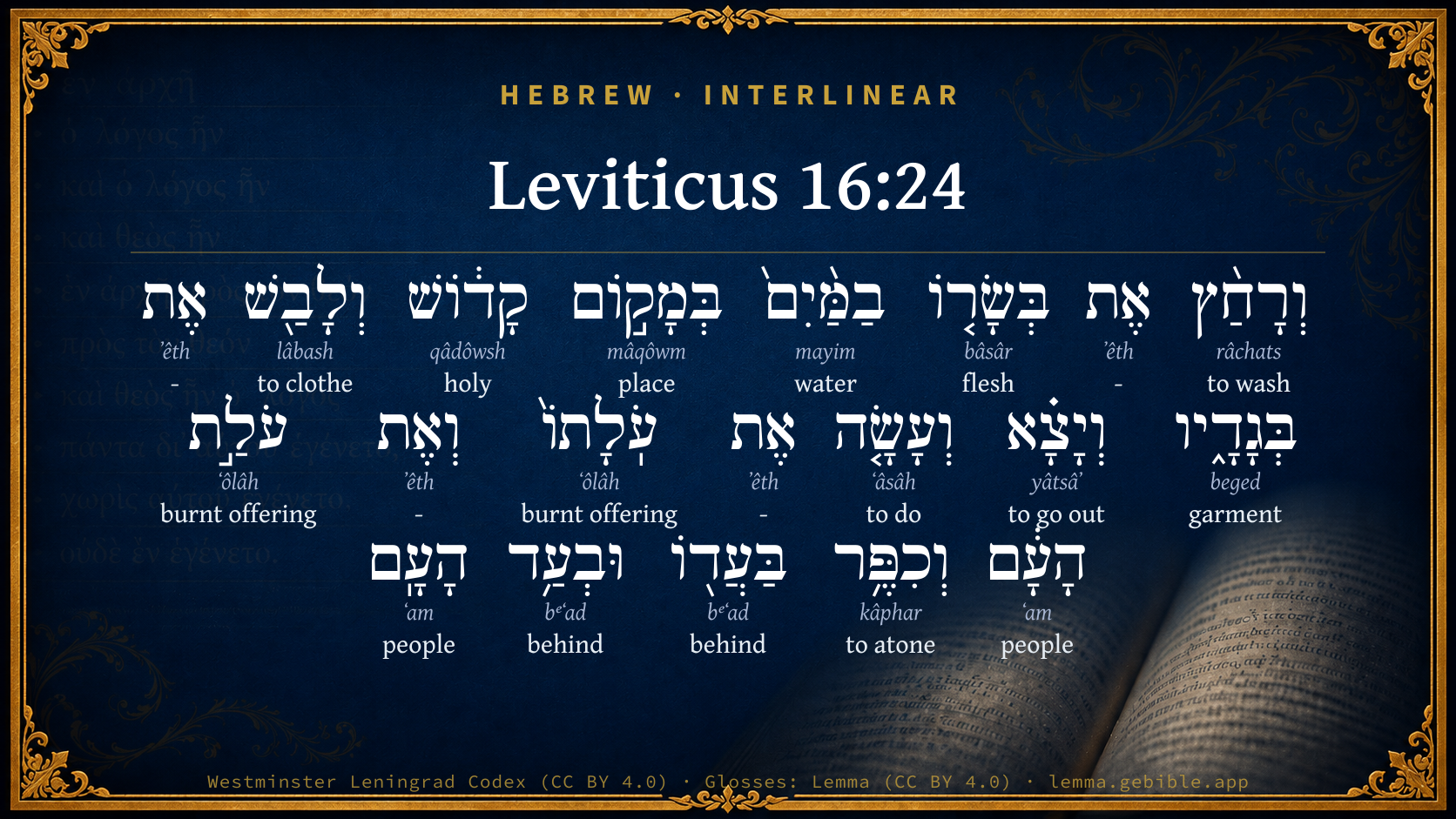
Hebrew (Westminster Leningrad Codex) Leviticus 16:24 appears in the Hebrew Old Testament. The text above is from the Westminster Leningrad Codex. Each word links to its Strong’s number, a concise gloss, and parsing drawn from the Open Scriptures Hebrew Bible morphology. Click any word for its full Brown-Driver-Briggs (BDB) entry.
Download image
Cite this verse

Leviticus 16:24 (World English Bible). Public Domain. Lemma interlinear Bible study tool, https://lemma.gebible.app/v/leviticus/16/24.

Show BibTeX & RIS
BibTeX
RIS
English Translation
Then he shall bathe himself in water in a holy place, and put on his garments, and come out and offer his burnt offering and the burnt offering of the people, and make atonement for himself and for the people.
World English Bible · Public Domain
Download a study sheet

One document with this verse’s original text, its word-by-word gloss line, the meaning frame, cross-references with their text, attributed commentary, and full source and license credits — printable, and it pastes into notes with its structure intact.

This verse Autodidact and up

Study sheet (.html) Plain text (.txt)

A passage Seminary Student

Up to 50 verses in one chapter. A passage sheet keeps up to 6 commentary sources and 12 cross-references per verse, in the order this page ranks them, and says so on the sheet whenever that leaves anything out. Ask for a single verse and you get the Autodidact verse sheet above.

Everything on this page stays free to read, with no account — the sheet is a download of what is already on screen, not access to it.

Want to remove ads? Support Godless Engineer
Compare translations 3

The same verse in 3 English versions, stacked beneath the original-language interlinear above. Click any original word for its lexicon entry.

Each is an independent rendering of the whole verse — the interlinear is not word-aligned to these translations.

Highlighted words mark where these versions differ — a whole-verse word diff, not a word-by-word alignment.

  • World English Bible Public Domain
    Then he shall bathe himself in water in a holy place, and put on his garments, and come out and offer his burnt offering and the burnt offering of the people, and make atonement for himself and for the people.
  • King James Version Public Domain
    And he shall wash his flesh with water in the holy place, and put on his garments, and come forth, and offer his burnt offering, and the burnt offering of the people, and make an atonement for himself, and for the people.
  • unfoldingWord Literal Text CC BY-SA 4.0
    And he shall bathe his flesh in the water in a holy place, and he shall wear his clothes. And he shall go out, and he shall make his burnt offering and the burnt offering of the people. And he shall make atonement on behalf of himself and on behalf of the people.

unfoldingWord Literal Text — © unfoldingWord, licensed CC BY-SA 4.0. Word-aligned USFM3 via Door43 (git.door43.org/unfoldingWord/en_ult).

Versions to compare (up to 4)

3 of 4 selected

Show all 18 translations

Every available English version of this verse, each an independent rendering of the whole verse.

  • World English Bible Public Domain
    Then he shall bathe himself in water in a holy place, and put on his garments, and come out and offer his burnt offering and the burnt offering of the people, and make atonement for himself and for the people.
  • Berean Standard Bible Public Domain
    He is to bathe himself with water in a holy place and put on his own clothes. Then he must go out and sacrifice his burnt offering and the people’s burnt offering to make atonement for himself and for the people.
  • Majority Standard Bible Public Domain
    He is to bathe himself with water in a holy place and put on his own clothes. Then he must go out and sacrifice his burnt offering and the people’s burnt offering to make atonement for himself and for the people.
  • King James Version Public Domain
    And he shall wash his flesh with water in the holy place, and put on his garments, and come forth, and offer his burnt offering, and the burnt offering of the people, and make an atonement for himself, and for the people.
  • American Standard Version (1901) Public Domain
    and he shall bathe his flesh in water in a holy place, and put on his garments, and come forth, and offer his burnt-offering and the burnt-offering of the people, and make atonement for himself and for the people.
  • Revised Version (1885) Public Domain
    and he shall bathe his flesh in water in a holy place, and put on his garments, and come forth, and offer his burnt offering and the burnt offering of the people, and make atonement for himself and for the people.
  • Geneva Bible (1599) Public Domain
    Hee shall wash also his flesh with water in the Holy place, and put on his owne rayment, and come out, and make his burnt offring, and the burnt offring of the people, and make an atonement for himselfe, and for the people.
  • Douay-Rheims (1899) Public Domain
    He shall wash his flesh in the holy place, and shall put on his own garments. And after that he has come out and hath offered his own holocaust, and that of the people, he shall pray both for himself, and for the people:
  • Young's Literal Translation Public Domain
    and he hath bathed his flesh with water in the holy place, and hath put on his garments, and hath come out, and hath made his burnt-offering, and the burnt-offering of the people, and hath made atonement for himself and for the people;
  • Literal Standard Version CC BY-SA 4.0
    and he has bathed his flesh with water in the holy place, and has put on his garments, and has come out, and has made his burnt-offering, and the burnt-offering of the people, and has made atonement for himself and for the people;
  • Unlocked Literal Bible CC BY-SA 4.0
    He must bathe his body in water in a holy place, and put on his normal garments; then he must go out and offer his burnt offering and the burnt offering for the people, and in this way make atonement for himself and for the people.
  • unfoldingWord Literal Text CC BY-SA 4.0
    And he shall bathe his flesh in the water in a holy place, and he shall wear his clothes. And he shall go out, and he shall make his burnt offering and the burnt offering of the people. And he shall make atonement on behalf of himself and on behalf of the people.
  • Darby Bible Public Domain
    and he shall bathe his flesh with water in a holy place, and put on his garments, and go forth, and offer his burnt-offering, and the burnt-offering of the people, and make atonement for himself, and for the people.
  • World Messianic Bible Public Domain
    Then he shall bathe himself in water in a holy place, put on his garments, and come out and offer his burnt offering and the burnt offering of the people, and make atonement for himself and for the people.
  • Webster's Bible Public Domain
    And he shall wash his flesh with water in the holy place, and put on his garments, and come forth, and offer his burnt-offering, and the burnt-offering of the people, and make an atonement for himself, and for the people.
  • Free Bible Version CC BY-SA 4.0
    He is to wash himself with water in the sanctuary and put on his own clothes. Then he will go out and sacrifice his burnt offering and the people's burnt offering that makes him and the people right.
  • Bible in Basic English Public Domain
    And after bathing his body in water in a holy place, he is to put on his clothing and come out and give his burned offering and the burned offering of the people, to take away his sin and the sin of the people.
  • JPS Tanakh (1917) Public Domain
    And he shall bathe his flesh in water in a holy place and put on his other vestments, and come forth, and offer his burnt-offering and the burnt-offering of the people, and make atonement for himself and for the people.

Literal Standard Version (2020), Covenant Press — licensed CC BY-SA 4.0. Text via the HelloAO Bible API (eBible.org). Unlocked Literal Bible (unfoldingWord) — licensed CC BY-SA 4.0. Text via the HelloAO Bible API (eBible.org). unfoldingWord Literal Text — © unfoldingWord, licensed CC BY-SA 4.0. Word-aligned USFM3 via Door43 (git.door43.org/unfoldingWord/en_ult). Free Bible Version, Dr. Jonathan Gallagher — licensed CC BY-SA 4.0. Text via the HelloAO Bible API (eBible.org).

Word by word

More ways to search: Search by grammar → Find every occurrence → Compare this word →

Practice this passage: Drill this verse → Learn its vocabulary →

וְרָחַ֨ץ
râchats
H7364
“and · to wash”
Conjunction + Verb, Qal, Sequential Perfect, 3rd Person, Masculine, Singular
Part of Speech
Conjunction + Verb
Stem
Qal
Form
Sequential Perfect
Person
3rd Person
Gender
Masculine
Number
Singular
Full BDB Definition

Origin: a primitive root

TWOT: 2150

to wash, wash off, wash away, bathe - (Qal) - to wash, wash off, wash away - to wash, bathe (oneself) - (Pual) to be washed - (Hithpael) to wash oneself
  1. אֶת ʼêth H853 “-” Particle, Direct Object
  2. בְּשָׂר֤וֹ bâsâr H1320 “flesh · his” Noun, Common, Masculine, Singular, Construct + Suffix, Personal, 3rd Person, Masculine, Singular
  3. בַמַּ֨יִם֙ mayim H4325 “in/at the · water(s)” Preposition, Determined + Noun, Common, Masculine, Plural, Absolute
  4. בְּמָק֣וֹם mâqôwm H4725 “in/at · place” Preposition + Noun, Common, Masculine, Singular, Absolute
  5. קָד֔וֹשׁ qâdôwsh H6918 “holy” Adjective, Adjective, Masculine, Singular, Absolute
  6. וְלָבַ֖שׁ lâbash H3847 “and · to clothe” Conjunction + Verb, Qal, Sequential Perfect, 3rd Person, Masculine, Singular
  7. אֶת ʼêth H853 “-” Particle, Direct Object
  8. בְּגָדָ֑יו beged H899 “garments · his” Noun, Common, Masculine, Plural, Construct + Suffix, Personal, 3rd Person, Masculine, Singular
  9. וְיָצָ֗א yâtsâʼ H3318 “and · to go out” Conjunction + Verb, Qal, Sequential Perfect, 3rd Person, Masculine, Singular
  10. וְעָשָׂ֤ה ʻâsâh H6213 “and · to do” Conjunction + Verb, Qal, Sequential Perfect, 3rd Person, Masculine, Singular
  11. אֶת ʼêth H853 “-” Particle, Direct Object
  12. עֹֽלָתוֹ֙ ʻôlâh H5930 “burnt offering · his” Noun, Common, Feminine, Singular, Construct + Suffix, Personal, 3rd Person, Masculine, Singular
  13. וְאֶת ʼêth H853 “and · -” Conjunction + Particle, Direct Object
  14. עֹלַ֣ת ʻôlâh H5930 “burnt offering of” Noun, Common, Feminine, Singular, Construct
  15. הָעָ֔ם ʻam H5971 “the · people” Particle, Definite Article + Noun, Common, Masculine, Singular, Absolute
  16. וְכִפֶּ֥ר kâphar H3722 “and · to atone” Conjunction + Verb, Piel, Sequential Perfect, 3rd Person, Masculine, Singular
  17. בַּעֲד֖וֹ bᵉʻad H1157 “behind · him” Preposition + Suffix, Personal, 3rd Person, Masculine, Singular
  18. וּבְעַ֥ד bᵉʻad H1157 “and · behind” Conjunction + Preposition
  19. הָעָֽם ʻam H5971 “the · people” Particle, Definite Article + Noun, Common, Masculine, Singular, Absolute

About this verse

These counts appear in no published source. They are computed here, from the morphology-tagged text and Lemma’s own curated glosses. What Lemma adds →

20
words
14
distinct lemmas
Pentateuch
section

Grammatical profile

  • 5 verbs
  • 8 nouns
  • 1 adjective
  • 2 prepositions
  • 4 particles

Verb forms

  • וְרָחַ֨ץ Qal · Sequential Perfect
  • וְלָבַ֖שׁ Qal · Sequential Perfect
  • וְיָצָ֗א Qal · Sequential Perfect
  • וְעָשָׂ֤ה Qal · Sequential Perfect
  • וְכִפֶּ֥ר Piel · Sequential Perfect

Repetition

Words recur within this verse — often emphatic in Hebrew:

  • עֹֽלָתוֹ֙ burnt offering H5930 ×2
  • הָעָ֔ם people H5971 ×2
  • בַּעֲד֖וֹ behind H1157 ×2

Hebrew & Septuagint length

In English translation the verse runs 40 words from the Hebrew and 56 from the Septuagint (LXX English) — the Septuagint runs noticeably longer here. See the side-by-side →

A rough comparison of the two English renderings, which tokenize alike — not a word-level alignment.

Word counts can differ between the Hebrew and the Greek without any difference in meaning — e.g. the Hebrew direct-object marker אֵת has no separate Greek word, and Greek often adds the article ὁ.

Cross-references

9

Topical passages linked to Leviticus 16:24 in the Treasury of Scripture Knowledge — connected by theme and wording, ordered by reader-vote popularity; previews shown in the World English Bible.

  • Leviticus 16:3–5 "Herewith shall Aaron come into the sanctuary: with a young bull for a sin offering, and a ram for a burnt offering.
  • Hebrews 10:19–22 Having therefore, brothers, boldness to enter into the holy place by the blood of Jesus,
  • Exodus 28:4–14 These are the garments which they shall make: a breastplate, and an ephod, and a robe, and a coat of checker work, a turban, and a sash: and they shall make holy garments for Aaron your brother, and his sons, that he may minister to me in the priest's office.
  • Exodus 29:4–5 You shall bring Aaron and his sons to the door of the tent of meeting, and shall wash them with water.
  • Leviticus 8:6–9 Moses brought Aaron and his sons, and washed them with water.
  • Leviticus 14:9 It shall be on the seventh day, that he shall shave all his hair off his head and his beard and his eyebrows, even all his hair he shall shave off. He shall wash his clothes, and he shall bathe his body in water, then he shall be clean.
  • Leviticus 22:6 the person that touches any such shall be unclean until the evening, and shall not eat of the holy things, unless he bathe his body in water.
  • Hebrews 9:10 being only (with meats and drinks and various washings) fleshly ordinances, imposed until a time of reformation.
  • Revelation 1:5–6 and from Jesus Christ, the faithful witness, the firstborn of the dead, and the ruler of the kings of the earth. To him who loves us, and washed us from our sins by his blood;

Cross-references courtesy of OpenBible.info (CC BY 4.0).

Hebrew and Greek witnesses Masoretic Hebrew ↔ Greek Septuagint

The same verse in the two great witnesses to the Old Testament, shown verse-for-verse.

Here the Septuagint runs noticeably longer than the Hebrew — LXX2012 (modern English Septuagint) 56 words vs World English Bible 40. A rough length comparison of the two English translations, not a word-level alignment — read both below.

These are two independent witnesses, not word-aligned to each other, and the Septuagint is shown in lemma (dictionary) form.

Hebrew Leviticus 16:24 Masoretic · Westminster Leningrad Codex

וְרָחַ֨ץ אֶת בְּשָׂר֤וֹ בַמַּ֨יִם֙ בְּמָק֣וֹם קָד֔וֹשׁ וְלָבַ֖שׁ אֶת בְּגָדָ֑יו וְיָצָ֗א וְעָשָׂ֤ה אֶת עֹֽלָתוֹ֙ וְאֶת עֹלַ֣ת הָעָ֔ם וְכִפֶּ֥ר בַּעֲד֖וֹ וּבְעַ֥ד הָעָֽם

Then he shall bathe himself in water in a holy place, and put on his garments, and come out and offer his burnt offering and the burnt offering of the people, and make atonement for himself and for the people.

World English Bible · Public Domain

Greek LXX Leviticus 16:24 Septuagint · lemma form

καί λούω ὁ σῶμα αὐτός ὕδωρ ἐν τόπος ἅγιος καί ἐνδύω ὁ στολή αὐτός καί ἐκἔρχομαι ποιέω ὁ ὁλοκάρπωμα αὐτός καί ὁ ὁλοκάρπωμα ὁ λαός καί ἐκἱλάσκομαι περί αὐτός καί περί ὁ οἶκος αὐτός καί περί ὁ λαός ὡς περί ὁ ἱερεύς

And he shall bathe his body in water in the holy place, and shall put on his raiment, and shall go out and offer the whole burnt offering for himself and the whole burnt offering for the people: and shall make atonement for himself and for his house, and for the people, as for the priests.

LXX2012 (modern English Septuagint) · Public Domain

Hebrew: Westminster Leningrad Codex (CC BY 4.0). Greek: Septuagint (public domain); English from LXX2012 (modern English Septuagint) (Public Domain). How the Septuagint differs from the Hebrew →

Targum (Aramaic paraphrase)

2

The Targum is the ancient Jewish Aramaic paraphrase of the Hebrew Scriptures — an interpretive translation, not the Hebrew text itself. Onkelos (literal) and Pseudo-Jonathan (expansive) render the Torah, and Jonathan the Prophets. Coverage is partial: where no permissively-licensed English translation exists for a verse, only the Aramaic is shown. This is verse-level text, not a word-by-word alignment to the Hebrew.

  1. Targum Onkelos Torah (Genesis–Deuteronomy)
    וְיַסְחֵי יָת בִּסְרֵהּ בְּמַיָא בַּאֲתַר קַדִישׁ וְיִלְבַּשׁ יָת לְבוּשׁוֹהִי וְיִפּוֹק וְיַעְבֵּד יָת עֲלָתֵהּ וְיָת עֲלַת עַמָא וִיכַפַּר עֲלוֹהִי וְעַל עַמָּא

    (no public-domain English translation for this verse)

    Targum Onkelos — Aramaic: “Onkelos Genesis” (public domain); “Onkelos Exodus” (public domain); “Onkelos Leviticus” (public domain); “Onkelos Numbers” (public domain); “Onkelos Deuteronomy” (public domain). English: “Sefaria Community Translation” (CC0 1.0 (public-domain dedication)); “J.W. Etheridge. The Targums of Onkelos and Jonathan Ben Uzziel on the Pentateuch. London: Longmans, Green, 1862” (public domain). Text via Sefaria.

  2. Targum Pseudo-Jonathan Torah (Genesis–Deuteronomy)
    וְיַסְחֵי יַת בִּישְרֵיהּ בְּמוֹי בַּאֲתַר קַדִישׁ וְיִלְבַּשׁ יַת לְבוּשׁוֹי וִיצַדֵד וְיִפּוֹק וְיַעֲבֵיד יַת עֲלָתֵיהּ וְיַת עוֹלַת עַמֵיהּ וִיכַפֵּר עֲלוֹי וְעַל עַמֵיהּ

    Then shall he wash his flesh in the sanctuary, and afterward attire himself, and withdraw, and come forth, and perform his burnt offering and the burnt offering of the people, and make atonement for himself and for his people.

    Targum Pseudo-Jonathan — Aramaic: “Targum Jonathan on Genesis” (public domain); “Targum Jonathan on Exodus” (public domain); “Targum Jonathan on Leviticus” (public domain); “Targum Jonathan on Numbers” (public domain); “Targum Jonathan on Deuteronomy” (public domain). English: “The Targum of Jonathan ben Uzziel, trans. J. W. Etheridge, London, 1862” (public domain). Text via Sefaria.

Commentary

Notes on Leviticus 16:24 from classic Christian and Jewish commentators (each source and its license shown beneath its notes). The classic Christian expositions comment on the surrounding passage and are grouped to its opening verse, so a note may address several verses; the Jewish commentaries on the Tanakh (Rashi and others) are per-verse, so they appear only where the commentator wrote on this verse.

Lemma curates 59 commentaries, every one of them public domain or Creative Commons licensed, each selected and text-cleaned for this edition rather than reprinted as found. About our sources →

Trapp's Complete Commentary

John Trapp

Lev 16:24 And he shall wash his flesh with water in the holy place, and put on his garments, and come forth, and offer his burnt offering, and the burnt offering of the people, and make an atonement for himself, and for the people.

Ver. 24. He shall wash his flesh.] See what this taught them and us. {Heb 10:22} That Epistle to the Hebrews is an excellent commentary upon this Book of Leviticus.

John Trapp, A Commentary or Exposition upon All the Books of the Old and New Testament (1647–1656) — public domain. Text from a community e-Sword module.

Joseph Benson's Commentary

Lev 16:24. He shall wash in the holy place — That is, in the court of the tabernacle, where stood the altar of burnt-offering, and the sacred laver. Here he was to wash or sprinkle his whole body, that he might purify himself after he had touched the goat which bare their iniquities, just as the man that carried him into the wilderness was to wash afterward. This ceremony signified that the creature was made so polluted and abominable by being a substitute for sinners, that none could touch it without contracting some pollution. And put on his garments — The garments peculiar to his office, wherein he officiated on other days. And this change of his garments was not without cause. For the common priestly garments were more proper for him in the former part of his ministration, because then he was to appear before the Lord in the most holy place, to humble himself, and make atonement for his own and for the people’s sins, and therefore his meanest attire was most fit. And the high-priestly garments were most proper for the latter part of his work, which was of another nature.

Joseph Benson's Commentary on the Old and New Testaments (1811–1818) — public domain. Text from a community e-Sword module.

Geneva Bible (1599)

Geneva Bible translators

In the court where was the Laver, Exod. 30:18.

Geneva Bible (1599) marginal notes — public domain. Text via Bolls.life.

Ellicott's Commentary for English Readers

(24) And he shall wash his flesh.—That is, immerse his whole body. The baptistery, where the high priest performed these ablutions, was on the roof of a building in the sacred precincts. According to the authorities and practice during the second Temple the act described in this verse preceded the one ordered in the foregoing verse. The burnt offering, both for himself and for the people, the high priest offered in the golden garments. These he changed for the white robes when he afterwards went into the Holy of Holies to fetch the censer and the incense cup. The sacrifice consisted first of his own ram, then the ram of the people, and lastly the bullock of the people, and their seven lambs. (Comp. Num_29:8).

A Bible Commentary for English Readers, edited by Charles John Ellicott (1878–1897) — public domain. Text from a community e-Sword module.

John Gill's Exposition

And he shall wash his flesh with water in the holy place,.... In the court of the tabernacle of the congregation, where, as Aben Ezra says, they spread fine linen for him; Jarchi says, it was a place on the roof of the house of Parvah, where all the dippings and washings were made, except the first; See Gill on Lev 16:4; and this washing was no other than the dipping of his whole body in water; and if our Lord was baptized on this day, as some have thought, before observed, whose baptism was by dipping, Mat 3:16; there will appear in this a great likeness between the type and the antitype:

and put on his garments and come forth; put on his golden garments, and come out of the place where he had washed himself, to the court, where was the altar of burnt offering: all which may be an emblem of Christ's putting off the pure and spotless garment of the flesh, in which he appeared in a low estate, and made atonement for sin; and of his burial, which the washing of the flesh may point at, being what was used of the dead, and which washing in baptism is a figure of; and of his resurrection from the dead, when God gave him glory, and he appeared in a glorious body, signified by his golden garments put on again:

and offer his burnt offering, and the burnt offering of the people; his ram, and the people's ram, and the bullock of the people, and their seven lambs, as it is written, Num 29:8; so Aben Ezra, first his own, and then the people's, which order was before observed in the sin offerings:

and make an atonement for himself, and for the people; which though properly made by the sin offerings, and the carrying the blood of them into the most holy place, yet these were the completing of it, being the last of the services peculiar to the day of atonement: the service performed by the high priest after the sending away the goat into the wilderness was this; he read this "sixteenth" chapter of Leviticus, and Lev 23:27, if he read in linen garments, he washed his hands and his feet, he stripped himself, went down and dipped himself, and came up and wiped himself; then they brought him the golden garments, and he put them on, and washed his hands and his feet, and went out and offered his ram, and the people's ram, and the seven perfect lambs of a year old; then he washed his hands and his feet, and stripped and went down and dipped, and came up and wiped himself; then they brought him the white garments, and he put them on, and washed his hands and his feet, and went into the holy of holies to fetch out the incense cup and the censer; then he washed his hands and his feet, and stripped, and went down and dipped, and came up and wiped himself; then they brought him the golden garments, and he put them on, and he washed his hands and his feet, and went in (to the holy place) to offer the evening incense, and to him the lamps; and then he washed his hands and his feet, and stripped; and they brought him his own garments (what he usually wore when out of service), and he put them on; and they accompanied him to his house, where he made a feast for his friends, because he was come out of the sanctuary in safety (o): where, it seems, sometimes some died, and others became sick by getting cold through frequent shifting of their clothes and washing, and wearing thin linen garments.

(o) Misn. Yoma, c. 7. sect. 3, 4.

John Gill's Exposition of the Whole Bible (1746–1763) — public domain (CC PDM 1.0). Text via the HelloAO Bible API.

Haydock's Catholic Bible Commentary

Flesh, which was, in some sort, defiled by touching the goat. --- Garments, belonging to his office. --- Come out of the holy of holies. (Calmet) --- The remainder of the day was spent in joy. The priest washed himself, as a sign that he had obtained pardon. (Menochius)

George Leo Haydock (1774–1849), Haydock's Catholic Family Bible and Commentary, 1859 edition — public domain. Excludes Psalms (Douay-Rheims chapter numbering differs from Protestant) and Deuterocanonical books (Catholic canon only).

Matthew Poole's English Annotations

In the holy place; either in the laver appointed for that purpose, or in some other vessel within the holy place, because after he had washed in it he is said to

come forth.

His garments; not his ordinary priestly linen garments, for he was to leave them in the tabernacle, Lev 16:23, but the high-priestly garments, called his garments properly and peculiarly, and by way of distinction from the former garments, which are called holy garments, Lev 16:4, and the linen garments, Lev 16:23, but never his garments, as these are. And this change of his garments was not without cause. For the common priestly garments were more proper and fit for him in the former part of his ministration, both because he was to appear before the Lord in the most holy place to humble himself, and make atonement for his own and for the people’s sins, and therefore his humblest and meanest attire was most fit; and because he was to lay his hands upon that goat on which all their sins were put, by which touch both he and his garments would be in some sort defiled: and therefore, as we read here that he washed himself or his flesh, so we may well presume his linen garments were laid by for the washing, as the clothes of him who carried away the scape-goat were washed, Lev 16:26. And the high-priestly garments were most proper for the latter part of his work, which was of another nature.

Matthew Poole's English Annotations on the Holy Bible (1683–1685) — public domain. Text from a community e-Sword/MySword module.

Whedon's Commentary on the Bible

Daniel D. Whedon

24. And… wash his flesh — His hands and feet were washed from the defilement of the sin offering.

In the holy place — Rather, in a holy place, probably near the laver. He then put on his golden pontifical garments and appeared in the sight of the people, symbolizing no longer the suffering Saviour, but the exalted “Mediator of the new covenant.” His duties after sending away the scapegoat were to take the fat out of the goat and bullock, whose blood he had sprinkled in the holy of holies, to cut them into pieces, and to send them without the camp to be burned; to read the sixteenth and part of the twenty-third chapters of Leviticus in the court of the women, blessing the people; then, after his change of raiment, he offered the extra goat (Num_29:11) and his own ram for his burnt offering, and the people’s ram; he burned the fat of the sin offering, the bullock and goat, offered the daily evening sacrifice as on other days, trimmed the lamps, laid aside his priestly robes and put on his common clothes, and went home, attended by the people, to celebrate a feast of gladness that he had gone safely through the important ritual of the great day of atonement. “The great lesson is, that the separation of sin from the soul is most difficult. The assayer who would separate the pure metal from the dross must carefully follow most minute directions. Some ores are so refractory that we send them ten thousand miles to be treated. Minute and definite are the directions of Him who would separate sin from the soul. There is but one way. Without the shedding of blood there is no remission.” — Bishop H.W. Warren.

Daniel D. Whedon (gen. ed.), Commentary on the Old and New Testaments (1874–1909) — public domain. Text from a community e-Sword module.

John Wesley's Explanatory Notes

He shall put on his linen garments - Not his ordinary priestly linen garments, for he was to leave them in the tabernacle, ver. 23, but the high-priestly garments, called his garments properly, and by way of distinction. And this change of his garments was not without cause. For the common priestly garments were more proper for him in the former part of his ministration, both because he was to appear before the Lord in the most holy place to humble himself and make atonement for his own and for the people's sins, and therefore his meanest attire was most fit, and because he was to lay his hands upon that goat on which all their sins were put, by which touch both he and his garments would be in some sort defiled, and therefore as he washed himself, so we may presume his linen garments were laid by for the washing, as the clothes of him who carried away the scape-goat were washed, ver. 26. And the high-priestly garments were most proper for the latter part of his work, which was of another nature.

John Wesley, Explanatory Notes Upon the Whole Bible (1754–1765) — public domain. Text via the GEBible commentary corpus.

Rashi

Rabbi Shlomo Yitzchaki (Rashi)

'ורחץ את בשרו וגו‎‎ AND HE SHALL LAVE HIS FLESH etc. — Above (v. 4) we have learned from the statement "therefore shall he lave his flesh and so put them on" that whenever he (the High-Priest) changed from the golden garments into the linen ones he had to immerse himself (for on the occasion of that immersion, mentioned v. 4, he took off his golden garments in which he performed the service connected with the continual burnt offering due in the morning and put on the linen garments for the performance of the service peculiar to that Day); here, however, we are told that whenever he changed from the linen garments into the golden ones he had also to immerse himself (Sifra, Acharei Mot, Chapter 6 3; Yoma 32).

במקום קדוש [AND HE SHALL LAVE HIS FLESH WITH WATER] IN A HOLY PLACE — i.e. in a place which has the sanctity of the fore-court. It (the immersion) took place (later on when the Temple was built) on the roof of the so-called Parva-compartment. Similarly also all the four immersions that formed a special obligation for the Day alone. The first immersion, however, (that which took place immediately before entering the עזרה to offer the תמיד של שחר) was taken in an unsanctified place (i.e. outside the fore-court) (Yoma 30a).

ולבש את בגדיו AND HE SHALL PUT ON HIS GARMENTS — i. e. the eight garments in which he officiated on every day of the year.

ויצא AND HE SHALL COME OUT from the היכל into the fore-court where was the altar of the burnt offering....

ועשה את עלתו AND HE SHALL MAKE HIS BURNT OFFERING — "the ram for a burnt offering" mentioned above (v. 3) (cf. Yoma 70b).

ואת עלת העם AND THE BURNT OFFERING OF THE PEOPLE — This is identical with "a ram for a burnt offering" mentioned above (v. 5) which begins with the words "And he shall take from the congregation of the children of Israel … [a ram for a burnt offering]".

Rashi on the Tanakh — English translations: “The Judaica Press complete Tanach with Rashi, translated by A. J. Rosenberg” (CC BY 4.0); “Pentateuch with Rashi's commentary by M. Rosenbaum and A.M. Silbermann, 1929-1934” (public domain); “The Metsudah Tanach series, Lakewood, N.J” (CC BY 4.0); and “The Book of Joshua, Metsudah Publications, 1997” (CC BY 4.0). Text via Sefaria.

Lesson kit

Teaching starters — assembled from the data on this page, not authored interpretation. Every prompt links to the verse data it draws on. Edit before teaching.

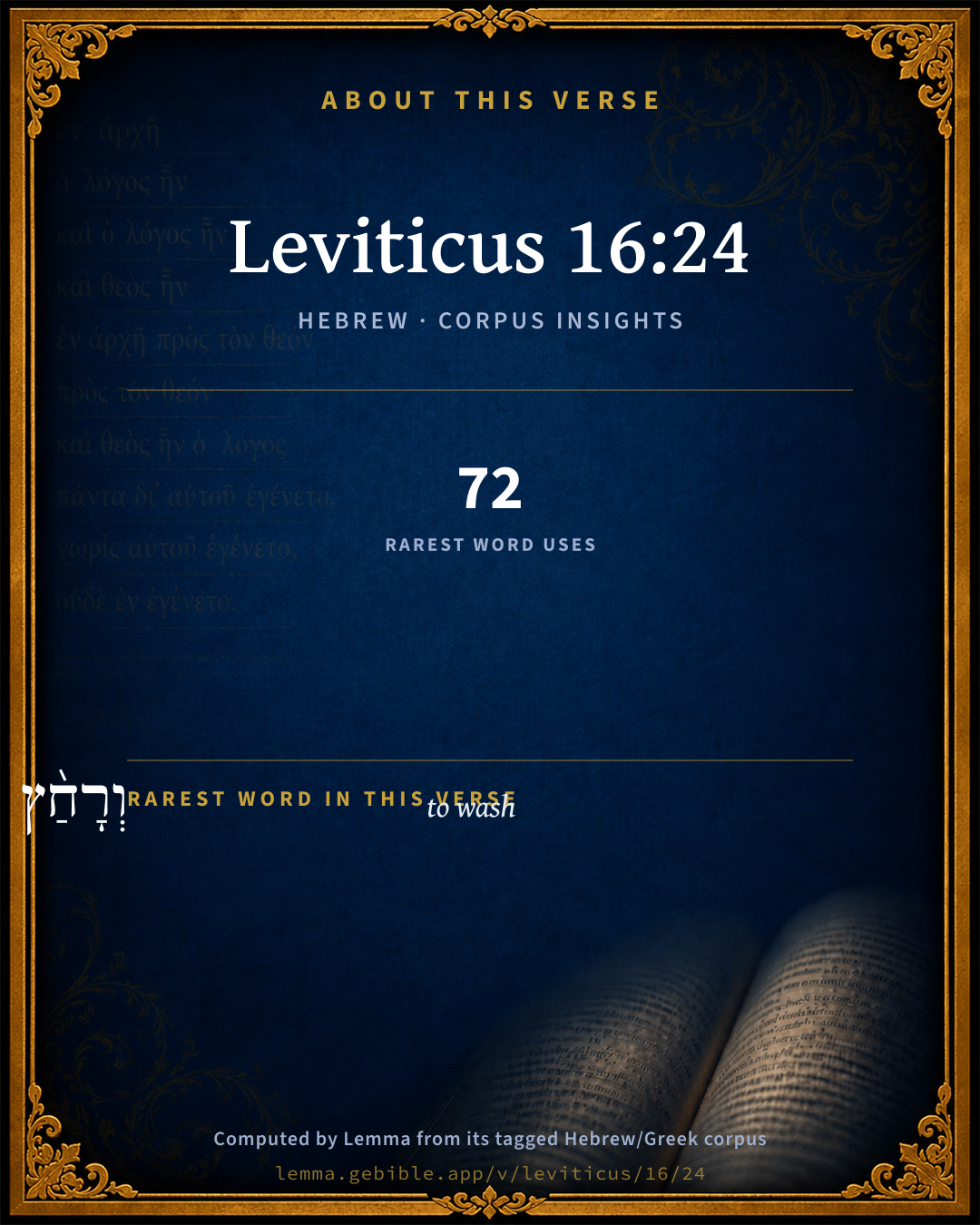
Leviticus, in the Pentateuch, opens this verse with 20 words (14 distinct Hebrew lemmas). Its most distinctive word is râchats (“to wash”). The Greek Septuagint runs longer here. A historical commentator’s framing appears above. Read the whole chapter for the surrounding context.

Discussion questions

  1. How does “to wash” (râchats) shape what this verse is saying?
  2. How does Leviticus 16:3–5, which shares this passage’s theme, read alongside this verse?
  3. What does the repetition of “burnt offering” (2× in this one verse) do in this verse?
  4. The Septuagint runs longer here than the Hebrew. What might account for the difference?
  5. The translations on this page render this verse differently — a whole-verse word diff, not a word-by-word alignment. What might account for the different wordings?
  6. «וְרָחַ֨ץ» is a Qal Sequential Perfect verb. How does that grammatical form shape the action described?
  7. Compare how Trapp's Complete Commentary and Joseph Benson's Commentary read this verse. Where do they agree or differ?

Things to notice

  • These translations choose different wording for 13 words in this verse.
  • “burnt offering” occurs 2× in this single verse.
  • 14 distinct Hebrew lemmas span 20 words in this verse.

Reading settings

Reading text

Shown beneath each verse's original-language words.

Old Testament
Old Testament edition

Read the OT as the Masoretic Hebrew (MT) or the Greek Septuagint (LXX).

English shown for the Greek Septuagint (in the Hebrew ↔ Greek comparison).

Comparing translations? Open the Compare panel on any verse page to stack up to four side by side.