
Leviticus 11:40

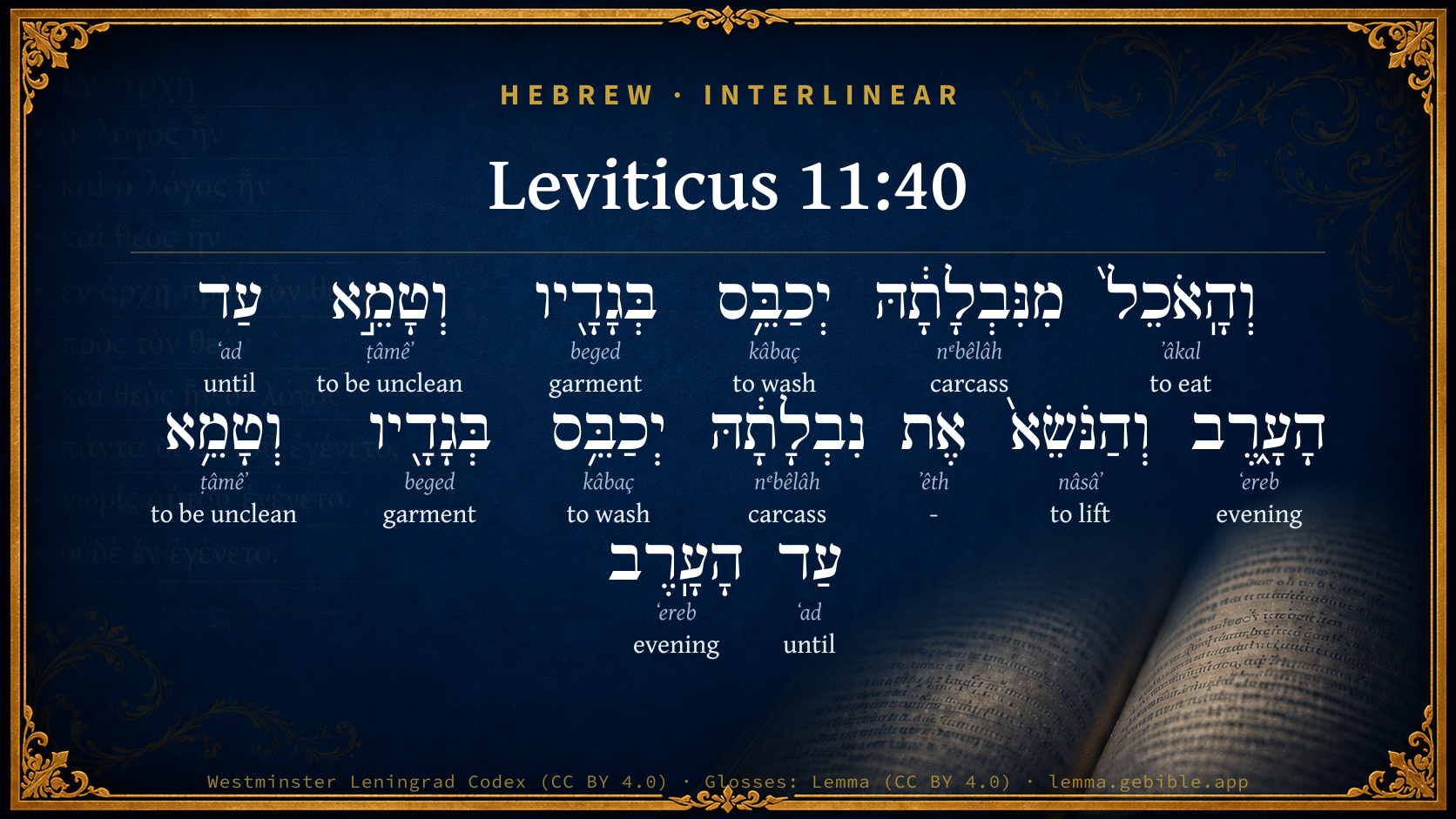
Hebrew (Westminster Leningrad Codex) Leviticus 11:40 appears in the Hebrew Old Testament. The text above is from the Westminster Leningrad Codex. Each word links to its Strong’s number, a concise gloss, and parsing drawn from the Open Scriptures Hebrew Bible morphology. Click any word for its full Brown-Driver-Briggs (BDB) entry.
Download image
Cite this verse

Leviticus 11:40 (World English Bible). Public Domain. Lemma interlinear Bible study tool, https://lemma.gebible.app/v/leviticus/11/40.

Show BibTeX & RIS
BibTeX
RIS
English Translation
He who eats of its carcass shall wash his clothes, and be unclean until the evening. He also who carries its carcass shall wash his clothes, and be unclean until the evening.
World English Bible · Public Domain
Download a study sheet

One document with this verse’s original text, its word-by-word gloss line, the meaning frame, cross-references with their text, attributed commentary, and full source and license credits — printable, and it pastes into notes with its structure intact.

This verse Autodidact and up

Study sheet (.html) Plain text (.txt)

A passage Seminary Student

Up to 50 verses in one chapter. A passage sheet keeps up to 6 commentary sources and 12 cross-references per verse, in the order this page ranks them, and says so on the sheet whenever that leaves anything out. Ask for a single verse and you get the Autodidact verse sheet above.

Everything on this page stays free to read, with no account — the sheet is a download of what is already on screen, not access to it.

Want to remove ads? Support Godless Engineer
Compare translations 3

The same verse in 3 English versions, stacked beneath the original-language interlinear above. Click any original word for its lexicon entry.

Each is an independent rendering of the whole verse — the interlinear is not word-aligned to these translations.

Highlighted words mark where these versions differ — a whole-verse word diff, not a word-by-word alignment.

  • World English Bible Public Domain
    He who eats of its carcass shall wash his clothes, and be unclean until the evening. He also who carries its carcass shall wash his clothes, and be unclean until the evening.
  • King James Version Public Domain
    And he that eateth of the carcass of it shall wash his clothes, and be unclean until the even: he also that beareth the carcass of it shall wash his clothes, and be unclean until the even.
  • unfoldingWord Literal Text CC BY-SA 4.0
    And the one eating from its carcass shall wash his clothes, and he will be unclean until the evening. And the one lifting its carcass shall wash his clothes, and he will be unclean until the evening.

unfoldingWord Literal Text — © unfoldingWord, licensed CC BY-SA 4.0. Word-aligned USFM3 via Door43 (git.door43.org/unfoldingWord/en_ult).

Versions to compare (up to 4)

3 of 4 selected

Show all 18 translations

Every available English version of this verse, each an independent rendering of the whole verse.

  • World English Bible Public Domain
    He who eats of its carcass shall wash his clothes, and be unclean until the evening. He also who carries its carcass shall wash his clothes, and be unclean until the evening.
  • Berean Standard Bible Public Domain
    Whoever eats from the carcass must wash his clothes and will be unclean until evening, and anyone who picks up the carcass must wash his clothes and will be unclean until evening.
  • Majority Standard Bible Public Domain
    Whoever eats from the carcass must wash his clothes and will be unclean until evening, and anyone who picks up the carcass must wash his clothes and will be unclean until evening.
  • King James Version Public Domain
    And he that eateth of the carcass of it shall wash his clothes, and be unclean until the even: he also that beareth the carcass of it shall wash his clothes, and be unclean until the even.
  • American Standard Version (1901) Public Domain
    And he that eateth of the carcass of it shall wash his clothes, and be unclean until the even: he also that beareth the carcass of it shall wash his clothes, and be unclean until the even.
  • Revised Version (1885) Public Domain
    And he that eateth of the carcase of it shall wash his clothes, and be unclean until the even: he also that beareth the carcase of it shall wash his clothes, and be unclean until the even.
  • Geneva Bible (1599) Public Domain
    And he that eateth of the carkeis of it, shall wash his clothes and be vncleane vntil the euen: he also that beareth the carkeis of it, shall wash his clothes, and be vncleane vntil the euen.
  • Douay-Rheims (1899) Public Domain
    And he that eateth or carrieth any thing thereof, shall wash his clothes, and shall be unclean until the evening.
  • Young's Literal Translation Public Domain
    and he who is eating of its carcase doth wash his garments, and hath been unclean till the evening; and he who is lifting up its carcase doth wash his garments, and hath been unclean till the evening.
  • Literal Standard Version CC BY-SA 4.0
    and he who is eating of its carcass washes his garments, and has been unclean until the evening; and he who is lifting up its carcass washes his garments, and has been unclean until the evening.
  • Unlocked Literal Bible CC BY-SA 4.0
    Whoever eats any of that carcass must wash his clothes and be unclean until evening. Anyone who picks up such a carcass will wash his clothes and be unclean until evening.
  • unfoldingWord Literal Text CC BY-SA 4.0
    And the one eating from its carcass shall wash his clothes, and he will be unclean until the evening. And the one lifting its carcass shall wash his clothes, and he will be unclean until the evening.
  • Darby Bible Public Domain
    And he that eateth of its carcase shall wash his garments, and be unclean until the even: he also that carrieth its carcase shall wash his garments, and be unclean until the even.
  • World Messianic Bible Public Domain
    He who eats of its carcass shall wash his clothes, and be unclean until the evening. He also who carries its carcass shall wash his clothes, and be unclean until the evening.
  • Webster's Bible Public Domain
    And he that eateth of its carcass shall wash his clothes, and be unclean until the evening; he also that beareth its carcass shall wash his clothes and be unclean until the evening.
  • Free Bible Version CC BY-SA 4.0
    If you eat anything from the dead body you must wash your clothes and you will be unclean until the evening. If you pick up the dead body you must wash your clothes and you will be unclean until the evening.
  • Bible in Basic English Public Domain
    And he who makes use of any part of its body for food is to have his clothing washed and be unclean till evening; and anyone taking away its body is to have his clothing washed and be unclean till evening.
  • JPS Tanakh (1917) Public Domain
    And he that eateth of the carcass of it shall wash his clothes, and be unclean until the even; he also that beareth the carcass of it shall wash his clothes, and be unclean until the even.

Literal Standard Version (2020), Covenant Press — licensed CC BY-SA 4.0. Text via the HelloAO Bible API (eBible.org). Unlocked Literal Bible (unfoldingWord) — licensed CC BY-SA 4.0. Text via the HelloAO Bible API (eBible.org). unfoldingWord Literal Text — © unfoldingWord, licensed CC BY-SA 4.0. Word-aligned USFM3 via Door43 (git.door43.org/unfoldingWord/en_ult). Free Bible Version, Dr. Jonathan Gallagher — licensed CC BY-SA 4.0. Text via the HelloAO Bible API (eBible.org).

Word by word

More ways to search: Search by grammar → Find every occurrence → Compare this word →

Practice this passage: Drill this verse → Learn its vocabulary →

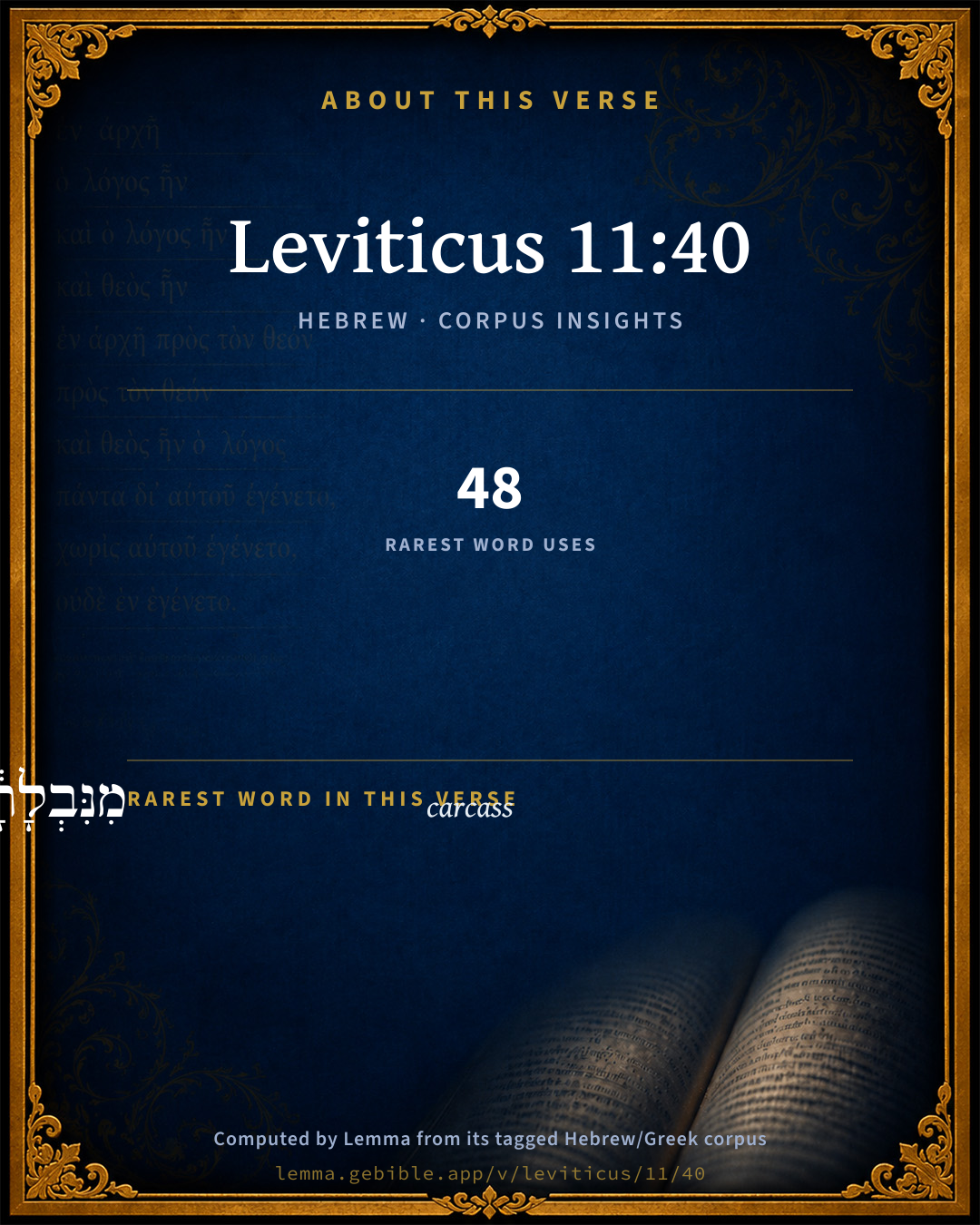
מִנִּבְלָתָ֔הּ
nᵉbêlâh
H5038
“from · carcass · her”
Preposition + Noun, Common, Feminine, Singular, Construct + Suffix, Personal, 3rd Person, Feminine, Singular
Part of Speech
Preposition + Noun
Type
Common
Gender
Feminine
Number
Singular
State
Construct
Full BDB Definition

Origin: from H5034

TWOT: 1286a

carcass, corpse - of humans, idols, animals
  1. וְהָֽאֹכֵל֙ ʼâkal H398 “and · the · eating” Conjunction + Particle, Definite Article + Verb, Qal, Participle Active, Masculine, Singular, Absolute
  2. יְכַבֵּ֥ס kâbaç H3526 “to wash” Verb, Piel, Imperfect, 3rd Person, Masculine, Singular
  3. בְּגָדָ֖יו beged H899 “garments · his” Noun, Common, Masculine, Plural, Construct + Suffix, Personal, 3rd Person, Masculine, Singular
  4. וְטָמֵ֣א ṭâmêʼ H2930 “and · to be unclean” Conjunction + Verb, Qal, Sequential Perfect, 3rd Person, Masculine, Singular
  5. עַד ʻad H5704 “until” Preposition
  6. הָעָ֑רֶב ʻereb H6153 “the · evening” Particle, Definite Article + Noun, Common, Masculine, Singular, Absolute
  7. וְהַנֹּשֵׂא֙ nâsâʼ H5375 “and · the · lifting” Conjunction + Particle, Definite Article + Verb, Qal, Participle Active, Masculine, Singular, Absolute
  8. אֶת ʼêth H853 “-” Particle, Direct Object
  9. נִבְלָתָ֔הּ nᵉbêlâh H5038 “carcass · her” Noun, Common, Feminine, Singular, Construct + Suffix, Personal, 3rd Person, Feminine, Singular
  10. יְכַבֵּ֥ס kâbaç H3526 “to wash” Verb, Piel, Imperfect, 3rd Person, Masculine, Singular
  11. בְּגָדָ֖יו beged H899 “garments · his” Noun, Common, Masculine, Plural, Construct + Suffix, Personal, 3rd Person, Masculine, Singular
  12. וְטָמֵ֥א ṭâmêʼ H2930 “and · to be unclean” Conjunction + Verb, Qal, Sequential Perfect, 3rd Person, Masculine, Singular
  13. עַד ʻad H5704 “until” Preposition
  14. הָעָֽרֶב ʻereb H6153 “the · evening” Particle, Definite Article + Noun, Common, Masculine, Singular, Absolute

About this verse

These counts appear in no published source. They are computed here, from the morphology-tagged text and Lemma’s own curated glosses. What Lemma adds →

15
words
9
distinct lemmas
Pentateuch
section

Shared distinctive vocabulary

מִנִּבְלָתָ֔הּ carcass H5038 occurs in 41 verses of the Hebrew Bible. Also found in:

Grammatical profile

  • 6 verbs
  • 6 nouns
  • 2 prepositions
  • 1 particle

Verb forms

  • וְהָֽאֹכֵל֙ Qal · Participle Active
  • יְכַבֵּ֥ס Piel · Imperfect
  • וְטָמֵ֣א Qal · Sequential Perfect
  • וְהַנֹּשֵׂא֙ Qal · Participle Active
  • יְכַבֵּ֥ס Piel · Imperfect
  • וְטָמֵ֥א Qal · Sequential Perfect

Repetition

Words recur within this verse — often emphatic in Hebrew:

  • מִנִּבְלָתָ֔הּ carcass H5038 ×2
  • יְכַבֵּ֥ס to wash H3526 ×2
  • בְּגָדָ֖יו garment H899 ×2
  • וְטָמֵ֣א to be unclean H2930 ×2
  • עַד until H5704 ×2
  • הָעָ֑רֶב evening H6153 ×2

Hebrew & Septuagint length

In English translation the verse runs 32 words from the Hebrew and 38 from the Septuagint (LXX English) — closely comparable.

A rough comparison of the two English renderings, which tokenize alike — not a word-level alignment.

Word counts can differ between the Hebrew and the Greek without any difference in meaning — e.g. the Hebrew direct-object marker אֵת has no separate Greek word, and Greek often adds the article ὁ.

Cross-references

21

Topical passages linked to Leviticus 11:40 in the Treasury of Scripture Knowledge — connected by theme and wording, ordered by reader-vote popularity; previews shown in the World English Bible.

  • Leviticus 22:8 That which dies of itself, or is torn by animals, he shall not eat, defiling himself by it. I am Yahweh.
  • Ezekiel 44:31 The priests shall not eat of anything that dies of itself, or is torn, whether it be bird or animal.
  • Deuteronomy 14:21 You shall not eat of anything that dies of itself: you may give it to the foreigner living among you who is within your gates, that he may eat it; or you may sell it to a foreigner: for you are a holy people to Yahweh your God. You shall not boil a kid in its mother's milk.
  • Exodus 22:31 "You shall be holy men to me, therefore you shall not eat any flesh that is torn by animals in the field. You shall cast it to the dogs.
  • Ezekiel 4:14 Then said I, Ah Lord Yahweh! behold, my soul has not been polluted; for from my youth up even until now have I not eaten of that which dies of itself, or is torn of animals; neither came there abominable flesh into my mouth.
  • Leviticus 11:25 Whoever carries any part of their carcass shall wash his clothes, and be unclean until the evening.
  • Leviticus 11:28 He who carries their carcass shall wash his clothes, and be unclean until the evening. They are unclean to you.
  • Leviticus 14:8–9 "He who is to be cleansed shall wash his clothes, and shave off all his hair, and bathe himself in water; and he shall be clean. After that he shall come into the camp, but shall dwell outside his tent seven days.
  • Leviticus 15:5–10 Whoever touches his bed shall wash his clothes, and bathe himself in water, and be unclean until the evening.
  • Leviticus 15:27 Whoever touches these things shall be unclean, and shall wash his clothes, and bathe himself in water, and be unclean until the evening.
  • Leviticus 16:26 "He who lets the goat go for the scapegoat shall wash his clothes, and bathe his flesh in water, and afterward he shall come into the camp.
  • Leviticus 16:28 He who burns them shall wash his clothes, and bathe his flesh in water, and afterward he shall come into the camp.
  • Leviticus 17:15–16 "'Every person that eats what dies of itself, or that which is torn by animals, whether he is native-born or a foreigner, he shall wash his clothes, and bathe himself in water, and be unclean until the evening: then he shall be clean.
  • Numbers 19:7–8 Then the priest shall wash his clothes, and he shall bathe his flesh in water, and afterward he shall come into the camp, and the priest shall be unclean until the even.
  • Numbers 19:19 and the clean person shall sprinkle on the unclean on the third day, and on the seventh day: and on the seventh day he shall purify him; and he shall wash his clothes, and bathe himself in water, and shall be clean at even.
  • Isaiah 1:16 Wash yourselves, make yourself clean. Put away the evil of your doings from before my eyes; Cease to do evil.
  • Ezekiel 36:25 I will sprinkle clean water on you, and you shall be clean: from all your filthiness, and from all your idols, will I cleanse you.
  • Zechariah 13:1 "In that day there will be a spring opened to the house of David and to the inhabitants of Jerusalem, for sin and for uncleanness.
  • 1 Corinthians 6:11 Such were some of you, but you were washed. But you were sanctified. But you were justified in the name of the Lord Jesus, and in the Spirit of our God.
  • 1 Corinthians 10:21 You can't both drink the cup of the Lord and the cup of demons. You can't both partake of the table of the Lord, and of the table of demons.
  • 1 John 1:7 But if we walk in the light, as he is in the light, we have fellowship with one another, and the blood of Jesus Christ, his Son, cleanses us from all sin.

Cross-references courtesy of OpenBible.info (CC BY 4.0).

Hebrew and Greek witnesses Masoretic Hebrew ↔ Greek Septuagint

The same verse in the two great witnesses to the Old Testament, shown verse-for-verse.

These are two independent witnesses, not word-aligned to each other, and the Septuagint is shown in lemma (dictionary) form.

Hebrew Leviticus 11:40 Masoretic · Westminster Leningrad Codex

וְהָֽאֹכֵל֙ מִנִּבְלָתָ֔הּ יְכַבֵּ֥ס בְּגָדָ֖יו וְטָמֵ֣א עַד הָעָ֑רֶב וְהַנֹּשֵׂא֙ אֶת נִבְלָתָ֔הּ יְכַבֵּ֥ס בְּגָדָ֖יו וְטָמֵ֥א עַד הָעָֽרֶב

He who eats of its carcass shall wash his clothes, and be unclean until the evening. He also who carries its carcass shall wash his clothes, and be unclean until the evening.

World English Bible · Public Domain

Greek LXX Leviticus 11:40 Septuagint · lemma form

καί ὁ ἐσθίω ἀπό ὁ θνησιμαῖος οὗτος πλύνω ὁ ἱμάτιον καί ἀκάθαρτος εἰμί ἕως ἑσπέρα καί ὁ αἴρω ἀπό θνησιμαῖος αὐτός πλύνω ὁ ἱμάτιον καί λούω ὕδωρ καί ἀκάθαρτος εἰμί ἕως ἑσπέρα

And he that eats of their carcasses shall wash his garments, and be unclean till evening; and he that carries any of their carcasses shall wash his garments, and bathe himself in water, and be unclean till evening.

LXX2012 (modern English Septuagint) · Public Domain

On this verse, The Cambridge Bible for Schools and Colleges discusses the Septuagint’s reading. Read the note in Commentary ↓

Hebrew: Westminster Leningrad Codex (CC BY 4.0). Greek: Septuagint (public domain); English from LXX2012 (modern English Septuagint) (Public Domain). How the Septuagint differs from the Hebrew →

Targum (Aramaic paraphrase)

2

The Targum is the ancient Jewish Aramaic paraphrase of the Hebrew Scriptures — an interpretive translation, not the Hebrew text itself. Onkelos (literal) and Pseudo-Jonathan (expansive) render the Torah, and Jonathan the Prophets. Coverage is partial: where no permissively-licensed English translation exists for a verse, only the Aramaic is shown. This is verse-level text, not a word-by-word alignment to the Hebrew.

  1. Targum Onkelos Torah (Genesis–Deuteronomy)
    וּדְיֵכוּל מִנְבִלְתַּהּ יְצַבַּע לְבוּשׁוֹהִי וִיהֵי מְסָאָב עַד רַמְשָׁא וּדְיִטוֹל יָת נְבִלְתַּהּ יְצַבַּע לְבוּשׁוֹהִי וִיהֵי מְסָאָב עַד רַמְשָׁא

    (no public-domain English translation for this verse)

    Targum Onkelos — Aramaic: “Onkelos Genesis” (public domain); “Onkelos Exodus” (public domain); “Onkelos Leviticus” (public domain); “Onkelos Numbers” (public domain); “Onkelos Deuteronomy” (public domain). English: “Sefaria Community Translation” (CC0 1.0 (public-domain dedication)); “J.W. Etheridge. The Targums of Onkelos and Jonathan Ben Uzziel on the Pentateuch. London: Longmans, Green, 1862” (public domain). Text via Sefaria.

  2. Targum Pseudo-Jonathan Torah (Genesis–Deuteronomy)
    וּדְיֵכוֹל מִנְבֵילְתָּהּ יְצַבַּע לְבוּשׁוֹי וִיהֵי מְסָאָב עַד רַמְשָׁא וּדְיוֹסִיט יַת נְבֵילְתָּהּ יְצַבַּע לְבוּשׁוֹי וִיהֵי מְסָאָב עַד רַמְשָׁא

    He who eateth of its carcase shall wash his clothes, and be unclean until the evening; and he who carrieth its carcase shall wash his clothes, and be unclean till evening.

    Targum Pseudo-Jonathan — Aramaic: “Targum Jonathan on Genesis” (public domain); “Targum Jonathan on Exodus” (public domain); “Targum Jonathan on Leviticus” (public domain); “Targum Jonathan on Numbers” (public domain); “Targum Jonathan on Deuteronomy” (public domain). English: “The Targum of Jonathan ben Uzziel, trans. J. W. Etheridge, London, 1862” (public domain). Text via Sefaria.

Commentary

Notes on Leviticus 11:40 from classic Christian and Jewish commentators (each source and its license shown beneath its notes). The classic Christian expositions comment on the surrounding passage and are grouped to its opening verse, so a note may address several verses; the Jewish commentaries on the Tanakh (Rashi and others) are per-verse, so they appear only where the commentator wrote on this verse.

Lemma curates 59 commentaries, every one of them public domain or Creative Commons licensed, each selected and text-cleaned for this edition rather than reprinted as found. About our sources →

Trapp's Complete Commentary

John Trapp

Lev 11:40 And he that eateth of the carcase of it shall wash his clothes, and be unclean until the even: he also that beareth the carcase of it shall wash his clothes, and be unclean until the even.

Ver. 40. Shall wash his clothes.] To teach them to "hate even the garment spotted by the flesh," {Jdg 1:23} all provocations and instruments of sin.

John Trapp, A Commentary or Exposition upon All the Books of the Old and New Testament (1647–1656) — public domain. Text from a community e-Sword module.

Ellicott's Commentary for English Readers

(40) And he that eateth.—That is, ignorantly, since for wilful transgression the transgressor incurred the penalty of excision. (See Num_15:30; Deu_14:21.)

He also that beareth the carcase.—Removing the carcase of a clean quadruped which died, defiled the person who carried it quite as much as removing the carcase of an unclean beast. Hence the law of purification for the defilement arising in either case is the same. (See Lev_11:25.)

A Bible Commentary for English Readers, edited by Charles John Ellicott (1878–1897) — public domain. Text from a community e-Sword module.

The Cambridge Bible for Schools and Colleges

gen. ed. J. J. S. Perowne

40. Eating the carcase is forbidden as in Deu_14:21. According to Lev_17:15, the eater must also bathe himself. LXX. supply this command here.

The Cambridge Bible for Schools and Colleges (gen. ed. J. J. S. Perowne; Cambridge University Press, 1878–1918) — public domain. Text from a community e-Sword module.

John Gill's Exposition

And he that eateth of the carcass of it,.... For though it might be eaten, if rightly killed, yet not if it died of itself, or was strangled, or torn to pieces by wild beasts:

shall wash his clothes; besides his body, which even he that touched it was obliged to:

and be unclean until the even; though he and his clothes were washed, and he might not go into the court of the tabernacle, or have any concern with holy things, or conversation with men:

he also that beareth the carcass of it; removes it from one place to another, carries it to the dunghill, or a ditch, and there lays it, or buries it in the earth:

shall wash his clothes, and be unclean until the even; from whence, as before observed by the Jewish writers, uncleanness by bearing is greater than uncleanness by touching, since the former obliged to washing of clothes, not so the latter; so Jarchi here; and yet still was unclean until the evening, though he had washed himself in water, as Aben Ezra notes; and so says Jarchi, though he dips himself, he has need of the evening of the sun.

John Gill's Exposition of the Whole Bible (1746–1763) — public domain (CC PDM 1.0). Text via the HelloAO Bible API.

Haydock's Catholic Bible Commentary

Clothes, and his whole body, either together or separate, as the Rabbins explain the law. (Selden, syn. i. 3.) If any one eat or touch these things, on purpose, he was liable to a more severe punishment, (Menochius) and his soul was defiled by disobedience, ver. 43. (Calmet)

George Leo Haydock (1774–1849), Haydock's Catholic Family Bible and Commentary, 1859 edition — public domain. Excludes Psalms (Douay-Rheims chapter numbering differs from Protestant) and Deuterocanonical books (Catholic canon only).

Matthew Poole's English Annotations

He that eateth, to wit, unwittingly; for if he did it knowingly, it was a presumptuous sin against an express law, Deu 14:21, and therefore punished with cutting off, Num 15:30.

Matthew Poole's English Annotations on the Holy Bible (1683–1685) — public domain. Text from a community e-Sword/MySword module.

John Wesley's Explanatory Notes

He that eateth - Unwittingly, for if he did it knowingly, it was a presumptuous sin against an express law, Deut. xiv, 21, and therefore punished with cutting off.

John Wesley, Explanatory Notes Upon the Whole Bible (1754–1765) — public domain. Text via the GEBible commentary corpus.

Rashi

Rabbi Shlomo Yitzchaki (Rashi)

והנשא את נבלתה HE ALSO THAT BEARETH THE CARRION OF IT [SHALL BE UNCLEAN] — The uncleanness resulting from bearing the carrion is more stringent than the uncleanness resulting from contact with it; for he who bears it thereby renders his garments unclean, whilst as for him who touches it his garments do not thereby become unclean, since it does not state regarding him in the preceding verse: “he shall wash his garments” (cf. Rashi on v. 25).

והאכל מנבלתה AND HE THAT EATETH OF ITS CARRION [… SHALL BE UNCLEAN] — One might think from this statement that the act of eating therefrom makes him unclean! But this is not so because when it states of the carcass of a clean fowl (Leviticus 22:8) “that which dies of itself (נבלה) or that which is torn he shall not eat to defile himself therewith”, we may learn from it: בה “therewith” — only that (the carcass of a clean fowl) makes a person’s clothes unclean by the very act of eating therefrom, but the carcass of cattle does not make a person’s clothes unclean by the very act of eating therefrom if there is no carrying involved, e. g., if another person inserts it into his gullet (for one it not regarded as carrying something which is inside his body). But if this be so, why is it here stated “he that eateth”? In order to prescribe as a minimum for making unclean him who bears or touches such carrion a quantity as much as can be called “eating” viz., a piece as large as an olive (Sifra, Shemini, Section 10 7; Niddah 42b).

עד הערב ‎‎וטמא AND HE SHALL BE UNCLEAN UNTO THE EVEN — although he may have immersed himself in water he must await sunset before he becomes clean.

Rashi on the Tanakh — English translations: “The Judaica Press complete Tanach with Rashi, translated by A. J. Rosenberg” (CC BY 4.0); “Pentateuch with Rashi's commentary by M. Rosenbaum and A.M. Silbermann, 1929-1934” (public domain); “The Metsudah Tanach series, Lakewood, N.J” (CC BY 4.0); and “The Book of Joshua, Metsudah Publications, 1997” (CC BY 4.0). Text via Sefaria.

Ramban (Nachmanides)

Rabbi Moshe ben Nachman (Ramban / Nachmanides)

AND HE THAT EATETH OF THE CARCASS OF IT SHALL WASH HIS CLOTHES, AND BE UNCLEAN UNTIL THE EVEN. In line with the plain meaning of Scripture, the verse speaks here of one who eats in the way that people usually eat, namely, that he touches and carries what he eats, and therefore becomes impure by contact and by carrying. It was necessary to mention this case so that it should not occur to anyone that because of eating, his degree of impurity should be greater [than that resulting merely from contact and carrying]. It mentioned this law in regard to an animal fit for food [as mentioned in the preceding Verse 39], because a person can [easily] err with regard to it, thinking that it was slaughtered properly [and he will therefore eat it], but such errors do not normally occur with regard to forbidden animals, and the way of the Torah is to speak of what usually happens. But according to its [Rabbinic] interpretation, the verse comes to prescribe the [minimum] size required to become impure through carrying or touching, namely an amount that can be called “eating,” which is the size of an olive and Scripture also mentioned this law in regard to carrion of an animal fit for food, whilst the same law applies to an animal not permitted as food, because He finished here the law of impurities. According to the opinion of the interpretation of the Torath Kohanim, 4:2; 10:1-4. all impurities [conveyed] by carrion [of animals fit for food and those which are unfit animals] are included here, and the section above refers to limbs of animals. I have already mentioned this., in Verse 24.

Ramban (Nachmanides) on the Tanakh — English translation: “Commentary on the Torah by Ramban (Nachmanides). Translated and annotated by Charles B. Chavel. New York, Shilo Pub. House, 1971-1976” (CC BY 4.0). Text via Sefaria.

Lesson kit

Teaching starters — assembled from the data on this page, not authored interpretation. Every prompt links to the verse data it draws on. Edit before teaching.

Leviticus, in the Pentateuch, opens this verse with 15 words (9 distinct Hebrew lemmas). Its most distinctive word is nᵉbêlâh (“carcass”). A historical commentator’s framing appears above. Read the whole chapter for the surrounding context.

Discussion questions

  1. How does “carcass” (nᵉbêlâh) shape what this verse is saying?
  2. Leviticus 5:2 shares the word «carcass» with this verse. How do the two illuminate each other?
  3. “carcass” occurs 2× in this one verse. What is the effect of the repetition?
  4. These translations render this verse differently; the difference is in the English rendering, not the original. What questions does that raise?
  5. The verb «וְהָֽאֹכֵל֙» is Qal Participle Active. How does its form color the action?
  6. Reading how Trapp's Complete Commentary and Ellicott's Commentary for English Readers read this verse, where do the two commentators agree and where do they part?

Things to notice

Reading settings

Reading text

Shown beneath each verse's original-language words.

Old Testament
Old Testament edition

Read the OT as the Masoretic Hebrew (MT) or the Greek Septuagint (LXX).

English shown for the Greek Septuagint (in the Hebrew ↔ Greek comparison).

Comparing translations? Open the Compare panel on any verse page to stack up to four side by side.