

Job 13:28

Hebrew (Westminster Leningrad Codex) Job 13:28 appears in the Hebrew Old Testament. The text above is from the Westminster Leningrad Codex. Each word links to its Strong’s number, a concise gloss, and parsing drawn from the Open Scriptures Hebrew Bible morphology. Click any word for its full Brown-Driver-Briggs (BDB) entry.
Download image
Cite this verse

Job 13:28 (World English Bible). Public Domain. Lemma interlinear Bible study tool, https://lemma.gebible.app/v/job/13/28.

Show BibTeX & RIS
BibTeX
RIS
English Translation
Though I am decaying like a rotten thing, Like a garment that is moth-eaten.
World English Bible · Public Domain
Highlights
  • 1 first appearance in the Hebrew Bible
Full analysis ↓
Download a study sheet

One document with this verse’s original text, its word-by-word gloss line, the meaning frame, cross-references with their text, attributed commentary, and full source and license credits — printable, and it pastes into notes with its structure intact.

This verse Autodidact and up

Study sheet (.html) Plain text (.txt)

A passage Seminary Student

Up to 50 verses in one chapter. A passage sheet keeps up to 6 commentary sources and 12 cross-references per verse, in the order this page ranks them, and says so on the sheet whenever that leaves anything out. Ask for a single verse and you get the Autodidact verse sheet above.

Everything on this page stays free to read, with no account — the sheet is a download of what is already on screen, not access to it.

Want to remove ads? Support Godless Engineer
Compare translations 3

The same verse in 3 English versions, stacked beneath the original-language interlinear above. Click any original word for its lexicon entry.

Each is an independent rendering of the whole verse — the interlinear is not word-aligned to these translations.

Highlighted words mark where these versions differ — a whole-verse word diff, not a word-by-word alignment.

  • World English Bible Public Domain
    Though I am decaying like a rotten thing, Like a garment that is moth-eaten.
  • King James Version Public Domain
    And he, as a rotten thing, consumeth, as a garment that is moth eaten.
  • unfoldingWord Literal Text CC BY-SA 4.0
    And he decays like a rotten thing, like a garment—a moth has eaten it.

unfoldingWord Literal Text — © unfoldingWord, licensed CC BY-SA 4.0. Word-aligned USFM3 via Door43 (git.door43.org/unfoldingWord/en_ult).

Versions to compare (up to 4)

3 of 4 selected

Show all 18 translations

Every available English version of this verse, each an independent rendering of the whole verse.

  • World English Bible Public Domain
    Though I am decaying like a rotten thing, Like a garment that is moth-eaten.
  • Berean Standard Bible Public Domain
    So man wastes away like something rotten, like a moth-eaten garment.
  • Majority Standard Bible Public Domain
    So man wastes away like something rotten, like a moth-eaten garment.
  • King James Version Public Domain
    And he, as a rotten thing, consumeth, as a garment that is moth eaten.
  • American Standard Version (1901) Public Domain
    Though I am like a rotten thing that consumeth, Like a garment that is moth-eaten.
  • Revised Version (1885) Public Domain
    Though I am like a rotten thing that consumeth, like a garment that is moth-eaten.
  • Geneva Bible (1599) Public Domain
    Such one consumeth like a rotten thing, and as a garment that is motheaten.
  • Douay-Rheims (1899) Public Domain
    Who am to be consumed as rottenness, and as a garment that is moth-eaten.
  • Young's Literal Translation Public Domain
    And he, as a rotten thing, weareth away, As a garment hath a moth consumed him.
  • Literal Standard Version CC BY-SA 4.0
    And he, as a rotten thing, wears away, || A moth has consumed him as a garment.”
  • Unlocked Literal Bible CC BY-SA 4.0
    although I am like a rotten thing that wastes away, like a garment that moths have eaten.
  • unfoldingWord Literal Text CC BY-SA 4.0
    And he decays like a rotten thing, like a garment—a moth has eaten it.
  • Darby Bible Public Domain
    One who, as a rotten thing consumeth, as a garment that the moth eateth.
  • World Messianic Bible Public Domain
    though I am decaying like a rotten thing, like a garment that is moth-eaten.
  • Webster's Bible Public Domain
    And he, as a rotten thing, consumeth, as a garment that is moth-eaten.
  • Free Bible Version CC BY-SA 4.0
    I'm falling apart like something rotten, like moth-eaten clothes.
  • Bible in Basic English Public Domain
    Though a man comes to nothing like a bit of dead wood, or like a robe which has become food for the worm.
  • JPS Tanakh (1917) Public Domain
    Though I am like a wine-skin that consumeth, like a garment that is moth-eaten.

Literal Standard Version (2020), Covenant Press — licensed CC BY-SA 4.0. Text via the HelloAO Bible API (eBible.org). Unlocked Literal Bible (unfoldingWord) — licensed CC BY-SA 4.0. Text via the HelloAO Bible API (eBible.org). unfoldingWord Literal Text — © unfoldingWord, licensed CC BY-SA 4.0. Word-aligned USFM3 via Door43 (git.door43.org/unfoldingWord/en_ult). Free Bible Version, Dr. Jonathan Gallagher — licensed CC BY-SA 4.0. Text via the HelloAO Bible API (eBible.org).

Word by word

More ways to search: Search by grammar → Find every occurrence → Compare this word →

Practice this passage: Drill this verse → Learn its vocabulary →

About this verse

These counts appear in no published source. They are computed here, from the morphology-tagged text and Lemma’s own curated glosses. What Lemma adds →

6
words
6
distinct lemmas
Wisdom
section

Notable vocabulary

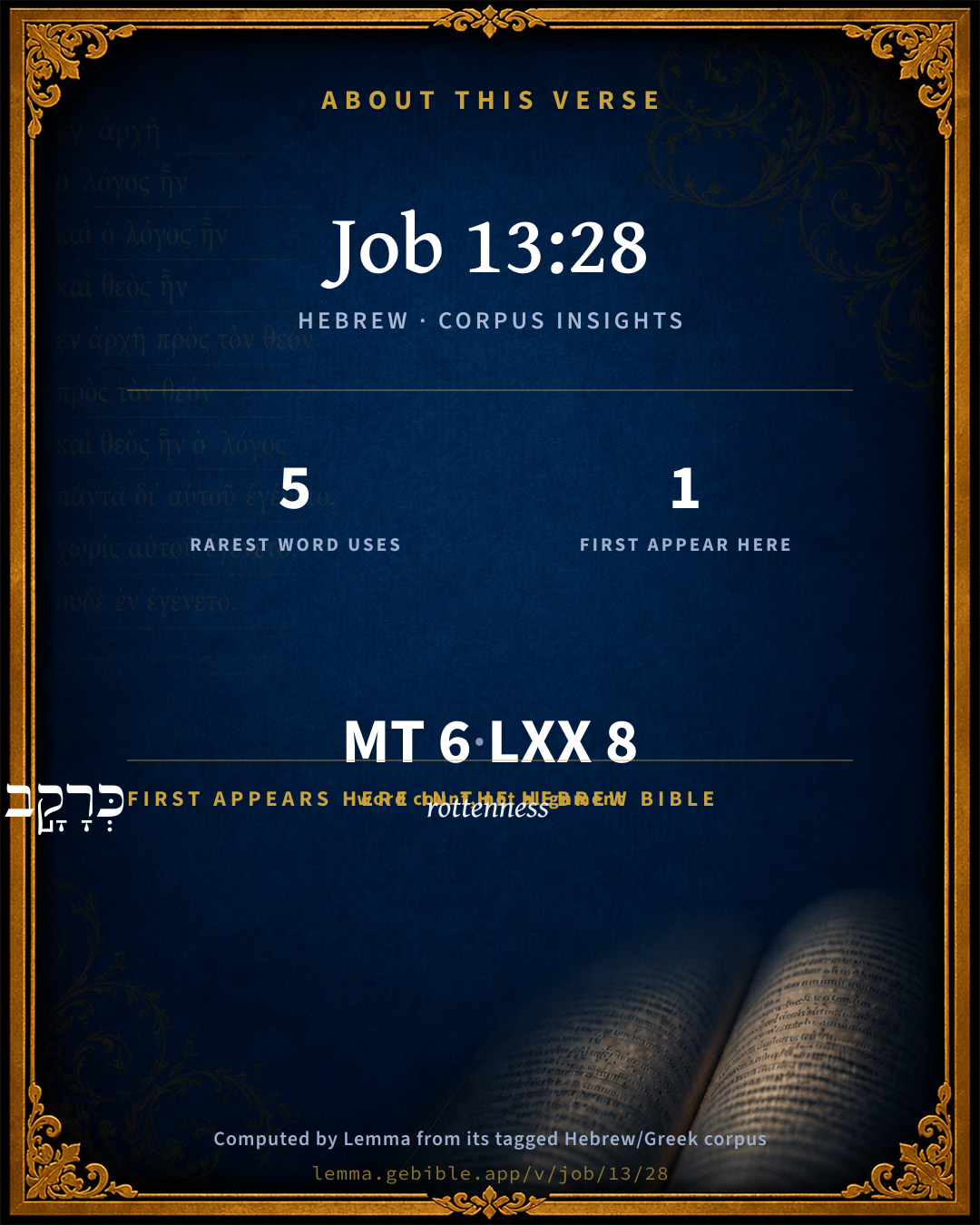
The rarest word here is כְּרָקָ֣ב rottenness H7538 — appearing just 5 times in the whole Hebrew Bible.

First appearance in Scripture

This word makes its first canonical appearance in the Hebrew Bible here:

  • כְּרָקָ֣ב rottenness H7538

Shared distinctive vocabulary

כְּרָקָ֣ב rottenness H7538 occurs in 5 verses of the Hebrew Bible. Also found in:

Grammatical profile

  • 2 verbs
  • 3 nouns
  • 1 pronoun

Verb forms

  • יִבְלֶ֑ה Qal · Imperfect
  • אֲכָ֣לוֹ Qal · Perfect

Hebrew & Septuagint length

In English translation the verse runs 14 words from the Hebrew and 15 from the Septuagint (LXX English) — closely comparable.

A rough comparison of the two English renderings, which tokenize alike — not a word-level alignment.

Word counts can differ between the Hebrew and the Greek without any difference in meaning — e.g. the Hebrew direct-object marker אֵת has no separate Greek word, and Greek often adds the article ὁ.

In the original languages it is 6 Hebrew tokens and 8 Greek tokens — but the two are counted differently (Hebrew bundles its prefixes and suffixes into one token; the Greek is in lemma form), so that isn’t a like-for-like length.

Cross-references

6

Topical passages linked to Job 13:28 in the Treasury of Scripture Knowledge — connected by theme and wording, ordered by reader-vote popularity; previews shown in the World English Bible.

  • Psalms 39:11 When you rebuke and correct man for iniquity, You consume his wealth like a moth. Surely every man is but a breath." Selah.
  • Job 4:19 How much more, those who dwell in houses of clay, Whose foundation is in the dust, Who are crushed before the moth!
  • Numbers 12:12 Let her not, I pray, be as one dead, of whom the flesh is half consumed when he comes out of his mother's womb.
  • Job 30:17–19 In the night season my bones are pierced in me, And the pains that gnaw me take no rest.
  • Job 30:29–30 I am a brother to jackals, And a companion to ostriches.
  • Hosea 5:12 Therefore I am to Ephraim like a moth, And to the house of Judah like rottenness.

Cross-references courtesy of OpenBible.info (CC BY 4.0).

Hebrew and Greek witnesses Masoretic Hebrew ↔ Greek Septuagint

The same verse in the two great witnesses to the Old Testament, shown verse-for-verse.

These are two independent witnesses, not word-aligned to each other, and the Septuagint is shown in lemma (dictionary) form.

Hebrew Job 13:28 Masoretic · Westminster Leningrad Codex

וְ֭הוּא כְּרָקָ֣ב יִבְלֶ֑ה כְּ֝בֶ֗גֶד אֲכָ֣לוֹ עָֽשׁ

Though I am decaying like a rotten thing, Like a garment that is moth-eaten.

World English Bible · Public Domain

Greek LXX Job 13:28 Septuagint · lemma form

ὅς παλαιόω ἴσος ἀσκός ἤ ὥσπερ ἱμάτιον σητόβρωτον

I am as that which waxes old like a bottle, or like a moth-eaten garment.

LXX2012 (modern English Septuagint) · Public Domain

On this verse, Adam Clarke's Commentary discusses the Septuagint’s reading. Read the note in Commentary ↓

Hebrew: Westminster Leningrad Codex (CC BY 4.0). Greek: Septuagint (public domain); English from LXX2012 (modern English Septuagint) (Public Domain). How the Septuagint differs from the Hebrew →

Commentary

Notes on Job 13:28 from classic Christian and Jewish commentators (each source and its license shown beneath its notes). The classic Christian expositions comment on the surrounding passage and are grouped to its opening verse, so a note may address several verses; the Jewish commentaries on the Tanakh (Rashi and others) are per-verse, so they appear only where the commentator wrote on this verse.

Lemma curates 59 commentaries, every one of them public domain or Creative Commons licensed, each selected and text-cleaned for this edition rather than reprinted as found. About our sources →

Trapp's Complete Commentary

John Trapp

Job 13:28 And he, as a rotten thing, consumeth, as a garment that is moth eaten.

Ver. 28. And he, as a rotten thing, consumeth] Heb. Waxeth old. He, that is, this poor man, this silly wretch, as David speaketh of himself, Psa 34:6. Or this body of mine, as Job 19:26; Job pointing to it, as it is like he did there; and Paul, 1Co 15:53-54. "As a rotten thing" (Heb. as rottenness), "consumeth." When a thing once rotteth, as an apple, flesh, &c., it soon perisheth. Such is man, under pressing afflictions especially.

And as a garment that is moth eaten] The beauty whereof is defaced, and the usefulness departed.

John Trapp, A Commentary or Exposition upon All the Books of the Old and New Testament (1647–1656) — public domain. Text from a community e-Sword module.

The Biblical Illustrator

Joseph S. Exell

Job_13:28

And he, as a rotten thing, consumeth, as a garment that is moth-eaten.

Rotten establishments

A revival of commercial confidence cannot be expected so long as rotten trading establishments continue to deceive the world. The cause of bad trade is that we have neglected personal religion, and have been almost eaten up by a selfish cancer. There would never be either a failure or a panic if all commercial men made the Lord Jesus their secret but active partner in every business transaction. We are apt to consider a defect in our character to be nothing more than as a spot of rust on a bright fender by the kitchen fire. It is really the fruit of a spiritual dry rot, which while we appear pious and respectable in outside show, is eating away the inner strength of true manhood. When love and benevolence fade it is on account of a rotten thing which consumeth the good actions of a Christian, as a moth consumes a garment. Years ago, our Christian light shone brightly--some of us were the life of religious meetings, the pioneer in saving the lost, the foremost in every good work. Once some of us felt that we had something to live for, but a stupor has come over us, and we have lost all anxiety to fulfil our destiny. Inquire into the private history of those who exhibit feebleness and decay in their Christian life, in the hope that we may discover our evils and obtain a remedy. Consider private prayer. The cause of neglect may be an indulged sin. Look at the motives of your actions. Look into the shop window of your religion. A word to those who are outwardly respectable, but are inwardly bound by a secret chain to some evil thing. It is of your own will that you are bound to your sin. You might escape, if you would. Have you chained yourself to sin? (W. Bird.)

Struggles of conscience

I. A little by way of consolation. We desire to comfort you who wish to feel more and more your sins. The best of men have prayed this prayer of the text before you. Remember that you never prayed like this years ago when you were a careless sinner. Then you did not want to know your guilt. Moreover, it is very probable that you do already feel your guilt, and what you are asking for you already have in measure realised.

II. A few words of instruction. See how God will answer such prayers. Sometimes by allowing a man to fall into more and more gross sin. Or by opening the eyes of the soul; not so much by providence, as by the mysterious agency of the Holy Spirit. How can we get to know our sins and the need of the Saviour?

1. Hear a personal ministry.

2. Study much the law of God.

3. Go to Calvary.

III. A few sentences by way of discrimination. Discriminate between the work of the Holy Spirit and the work of the devil. It is the work of the Spirit to make thee feel thyself a sinner, but it never was His work to make thee feel that Christ could forget thee. Satan always, works by trying to counterfeit the work of the Spirit. Then take care thou dost not try to make a righteousness out of thy feelings.

IV. A last point by way of exhortation. It is a very great sin not to feel your guilt, and not to mourn over it, but then it is one of the sins that Jesus Christ atoned on the tree. Come to Jesus, because it is He only who can give you that heart for which you seek; and because He can soften thy heart, and thou canst never soften it thyself. (C. H. Spurgeon.)

.

The Biblical Illustrator, edited by Joseph S. Exell (c. 1880s–1900s) — public domain. Text from a community e-Sword module.

Joseph Benson's Commentary

Job 13:28. And he, as a rotten thing — That is, man, as some commentators suppose, thinking that Job speaks of himself in the third person, and that the sense is, this poor frail creature, this carcass, or body of mine; consumeth — Or wasteth away, and is destroyed; as a garment eaten by moths — Others, however, interpret the words thus: He, that is, God, consumeth me (understanding the verb יבלה, jiblee, actively) as rottenness consumeth that in which it is, or, as a rotten thing is consumed, &c. Houbigant’s translation of the verse is, So that I am become like a thing consumed with rottenness; like a garment eaten up by the moth.

Joseph Benson's Commentary on the Old and New Testaments (1811–1818) — public domain. Text from a community e-Sword module.

Jamieson, Fausset & Brown

Robert Jamieson, A. R. Fausset & David Brown

Job speaks of himself in the third person, thus forming the transition to the general lot of man (Job 14:1; Psa 39:11; Hos 5:12).

Next: Job Chapter 14

Jamieson, Fausset & Brown — Commentary Critical and Explanatory on the Whole Bible (1871) — public domain (CC PDM 1.0). Text via the HelloAO Bible API.

Adam Clarke's Commentary

Verse 28. And he, as a rotten thing] I am like a vessel made of skin; rotten, because of old age, or like a garment corroded by the moth. So the Septuagint, Syriac, and Arabic understood it. The word he may refer to himself.

Adam Clarke's Commentary on the Bible (1810–1826) — public domain. Text from a community e-Sword/MySword module.

The Cambridge Bible for Schools and Colleges

gen. ed. J. J. S. Perowne

28. And he as a rotten thing] Or, one who as a rotten thing. Job no more speaks of himself in the first person, but in the third, because he thinks of himself as one of the human race in general, which is feeble and short-lived.

The Cambridge Bible for Schools and Colleges (gen. ed. J. J. S. Perowne; Cambridge University Press, 1878–1918) — public domain. Text from a community e-Sword module.

John Gill's Exposition

And he as a rotten thing consumeth,.... This by some Jewish writers (z) is referred to and connected with the driven leaf and dry stubble Job compares himself to, Job 13:25; and so the sense is, that his body, which, for its frailty and weakness, is compared to such things, is like any rotten thing, a rotten tree, as Ben Melech; or any thing else that is rotten, that is consuming and wasting away, as Job's body was, being clothed with worms and clods of dust:

as a garment that is moth eaten; a woollen garment, which gathers dust, out of which motifs arise; for dust, in wool and woollen garments produces moths, as Aristotle (a) and Pliny (b) observe; and a garment eaten by them, slowly, gradually, and insensibly, yet certainly, decays, falls to pieces, becomes useless, and not to be recovered; such was Job's body, labouring under the diseases it did, and was every day more and more decaying, crumbling into dust, and just ready to drop into the grave; so that there was no need, and it might seem cruel, to lay greater and heavier afflictions on it: some interpreters make this "he" to be God himself who sometimes is as rottenness and a moth to men, in their persons, families, and estates; see Hos 5:12.

(z) R. Levi, Ben Gersom, & Bar Tzemach. (a) Hist. Animal. l. 5. c. 32. (b) Nat. Hist. l. 11. c. 35.

Next: Job Chapter 14

John Gill's Exposition of the Whole Bible (1746–1763) — public domain (CC PDM 1.0). Text via the HelloAO Bible API.

Albert Barnes' Notes on the Bible

And he, as a rotten thing, consumeth - Noyes renders this, “And I, like an abandoned thing, shall waste away.” Dr. Good translates it, “Well may he dissolve as corrupttion.” Rosenmuller supposes that Job refers to himself by the word הוּא hû' - he, and that having spoken of himself in the previous verses, he now changes the mode of speech, and speaks in the third person. In illustration of this, he refers to a passage in Euripides, “Alcestes,” verse 690. The Vulgate renders it in the first person, “Qui quasi putredo consumendus sum.” The design seems to be, to represent himself as an object not worthy such consent surveillance on the part of God. God set his mark upon him; watched him with a close vigilance and a steady eye - and yet he was watching one who was turning fast to corruption, and who would soon be gone. He regarded it as unworthy of God, to be so attentive in watching over so worthless an object. This is closely connected with the following chapter, and there should have been no interruption here. The allusion to himself as feeble and decaying, leads him into the beautiful description in the following chapter of the state of man in general. The connection is something like this: - “I am afflicted and tried in various ways. My feet are in the stocks; my way is hedged up. I am weak, frail, and dying. But so it is with man universally. My condition is like that of the man at large, for

“Man, the offspring of a woman,

Is short-lived, and is full of trouble.”

As a rotten thing, - כרקב kerâqâb. The word רקב râqab means rottenness, or caries of bones; Pro 12:4; Pro 14:30; Hos 5:12. Here it means anything that is going to decay, and the comparison is that of man to anything that is thus constantly decaying, and that will soon be wholly gone.

Consumeth. - Or rather “decays,” יבלה yı̂bâlâh. The word בלה bâlâh is applied to that which falls away or decays, which is worn out and waxes old - as a garment; Deu 8:4; Isa 50:9; Isa 51:6.

As a garment that is moth-eaten - “As a garment the moth consumes it.” Hebrew On the word moth, and the sentiment here expressed, see the notes at Job 4:19.

Albert Barnes' Notes on the Bible (1834–1885) — public domain. Text from a community e-Sword/MySword module.

Haydock's Catholic Bible Commentary

Rottenness. Septuagint, "an old vessel," or skin, to contain wine, &c. (Calmet) --- My condition might excite pity. (Menochius)

George Leo Haydock (1774–1849), Haydock's Catholic Family Bible and Commentary, 1859 edition — public domain. Excludes Psalms (Douay-Rheims chapter numbering differs from Protestant) and Deuterocanonical books (Catholic canon only).

Matthew Poole's English Annotations

He; either,

1. Man, or Job, supposed to be God’s adversary in this contest. So he speaks of himself in the third person, as is usual in this and other sacred books. So the sense is, he, i.e. this poor frail creature, this carcass or body of mine, which possibly he pointed at with his finger,

consumeth or pineth away, &c. So he mentions here the effect of God’s severe proceedings against him, to wit, his consumption and utter destruction, which was making haste towards him. Or,

2. God, of whom he hitherto spoke in the second person, and now in the third person; such changes of persons being very frequent in poetical writings, such as this is. So he continueth the former discourse; and as before he mentioned God’s severe inquiry into his ways, and sentence against him, so here he describes the consequence and dreadful execution of it upon him; he, i.e. God, consumeth (for the verb is active) me as rottenness consumeth that in which it is, or as a rotten thing is consumed, and as a moth which eateth a garment.

Matthew Poole's English Annotations on the Holy Bible (1683–1685) — public domain. Text from a community e-Sword/MySword module.

Whedon's Commentary on the Bible

Daniel D. Whedon

28. Rotten thing — Rottenness. Such as caries, or decay, in wood. The most destructive agencies work in silence. “A moth does mischief, and makes no sound; so the minds of the wicked, in that they neglect to take account of their losses, lose their soundness, as it were, without knowing it. For they lose innocency from the heart, truth from the lips, continency from the flesh, and, as time holds on, life from their age.” — ST. GREGORY, Moralia.

And he — Thus speaking of himself in the third person, Job paves the way to the sad estate of man as man, which forms the subject of the next chapter.

Daniel D. Whedon (gen. ed.), Commentary on the Old and New Testaments (1874–1909) — public domain. Text from a community e-Sword module.

The Pulpit Commentary

And he. The change of person is very strange, but not unknown to the Hebrew idiom. It is impossible that any one but Job himself can be meant. As a rotten thing consumeth, as a garment that is moth-eaten. An allusion to the character of the disease from which he is suffering.

The Pulpit Commentary (1880–1919), ed. H.D.M. Spence-Jones & Joseph S. Exell — public domain. Text from a community e-Sword module.

John Wesley's Explanatory Notes

He - He speaks of himself in the third person, as is usual in this and other sacred books. So the sense is, he, this poor frail creature, this body of mine; which possibly he pointed at with his finger, consumeth or pineth away.

John Wesley, Explanatory Notes Upon the Whole Bible (1754–1765) — public domain. Text via the GEBible commentary corpus.

Rashi

Rabbi Shlomo Yitzchaki (Rashi)

And it is like rot that decays The body You pursue will decay like rot, and it is beneath Your dignity to pursue it.

Rashi on the Tanakh — English translations: “The Judaica Press complete Tanach with Rashi, translated by A. J. Rosenberg” (CC BY 4.0); “Pentateuch with Rashi's commentary by M. Rosenbaum and A.M. Silbermann, 1929-1934” (public domain); “The Metsudah Tanach series, Lakewood, N.J” (CC BY 4.0); and “The Book of Joshua, Metsudah Publications, 1997” (CC BY 4.0). Text via Sefaria.

Lesson kit

Teaching starters — assembled from the data on this page, not authored interpretation. Every prompt links to the verse data it draws on. Edit before teaching.

Job, in the Wisdom, opens this verse with 6 words (6 distinct Hebrew lemmas). Its most distinctive word is râqâb (“rottenness”). A historical commentator’s framing appears above. Read the whole chapter for the surrounding context.

Discussion questions

  1. How does “rottenness” (râqâb) shape what this verse is saying?
  2. This is the first place “rottenness” appears in Scripture (first appears here). What does its debut here establish?
  3. How does Proverbs 12:4, which shares the word «rottenness», read alongside this verse?
  4. These translations render this verse differently; the difference is in the English rendering, not the original. What questions does that raise?
  5. «יִבְלֶ֑ה» is a Qal Imperfect verb. How does that grammatical form shape the action described?
  6. Compare how Trapp's Complete Commentary and The Biblical Illustrator read this verse. Where do they agree or differ?

Things to notice

Reading settings

Reading text

Shown beneath each verse's original-language words.

Old Testament
Old Testament edition

Read the OT as the Masoretic Hebrew (MT) or the Greek Septuagint (LXX).

English shown for the Greek Septuagint (in the Hebrew ↔ Greek comparison).

Comparing translations? Open the Compare panel on any verse page to stack up to four side by side.