
Isaiah 51:6

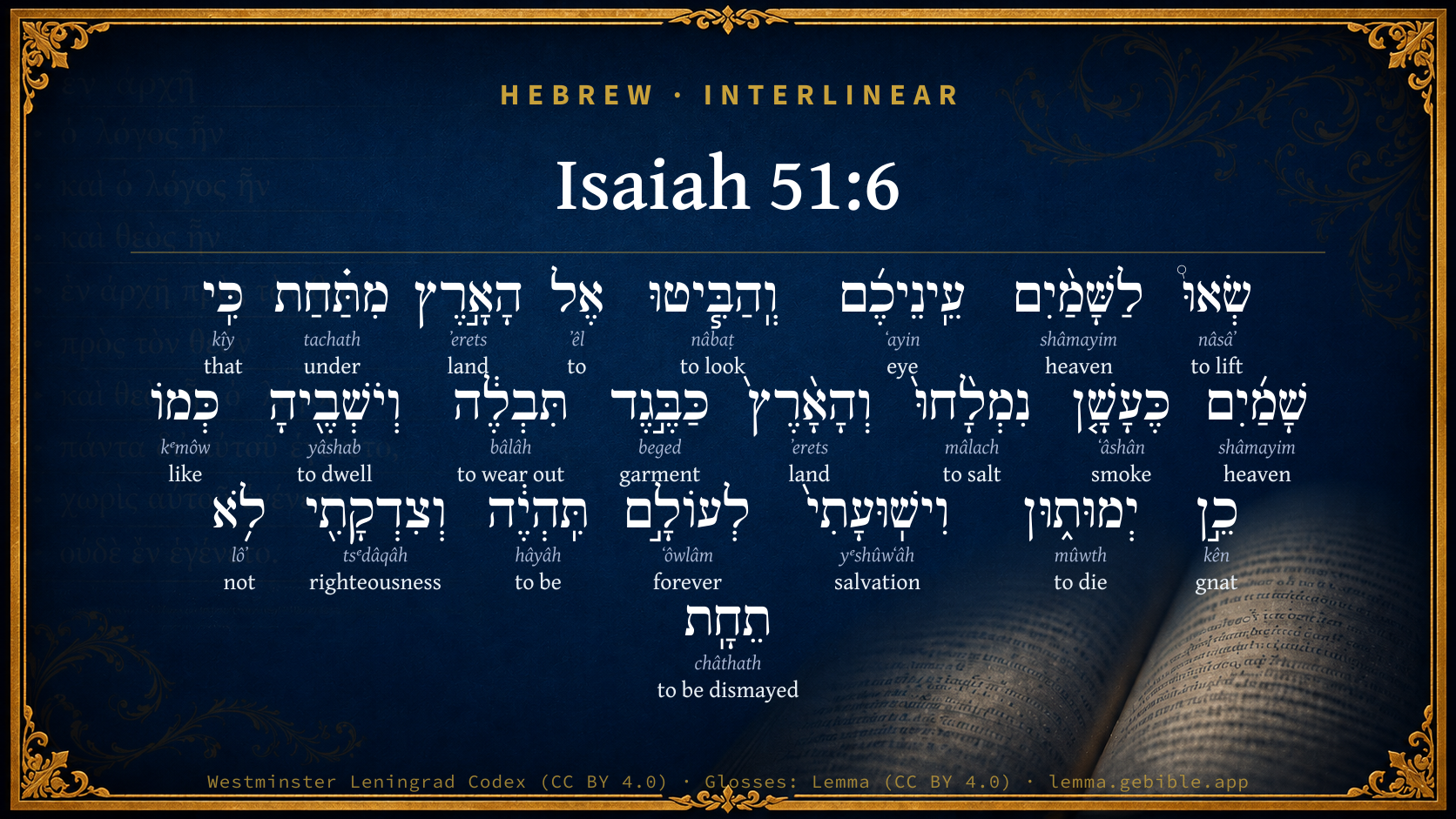
Hebrew (Westminster Leningrad Codex) Isaiah 51:6 appears in the Hebrew Old Testament. The text above is from the Westminster Leningrad Codex. Each word links to its Strong’s number, a concise gloss, and parsing drawn from the Open Scriptures Hebrew Bible morphology. Click any word for its full Brown-Driver-Briggs (BDB) entry.
Download image
Cite this verse

Isaiah 51:6 (World English Bible). Public Domain. Lemma interlinear Bible study tool, https://lemma.gebible.app/v/isaiah/51/6.

Show BibTeX & RIS
BibTeX
RIS
English Translation
Lift up your eyes to the heavens, and look on the earth beneath; for the heavens shall vanish away like smoke, and the earth shall wax old like a garment; and those who dwell therein shall die in like manner: but my salvation shall be forever, and my righteousness shall not be abolished.
World English Bible · Public Domain
Download a study sheet

One document with this verse’s original text, its word-by-word gloss line, the meaning frame, cross-references with their text, attributed commentary, and full source and license credits — printable, and it pastes into notes with its structure intact.

This verse Autodidact and up

Study sheet (.html) Plain text (.txt)

A passage Seminary Student

Up to 50 verses in one chapter. A passage sheet keeps up to 6 commentary sources and 12 cross-references per verse, in the order this page ranks them, and says so on the sheet whenever that leaves anything out. Ask for a single verse and you get the Autodidact verse sheet above.

Everything on this page stays free to read, with no account — the sheet is a download of what is already on screen, not access to it.

Want to remove ads? Support Godless Engineer
Compare translations 3

The same verse in 3 English versions, stacked beneath the original-language interlinear above. Click any original word for its lexicon entry.

Each is an independent rendering of the whole verse — the interlinear is not word-aligned to these translations.

Highlighted words mark where these versions differ — a whole-verse word diff, not a word-by-word alignment.

  • World English Bible Public Domain
    Lift up your eyes to the heavens, and look on the earth beneath; for the heavens shall vanish away like smoke, and the earth shall wax old like a garment; and those who dwell therein shall die in like manner: but my salvation shall be forever, and my righteousness shall not be abolished.
  • King James Version Public Domain
    Lift up your eyes to the heavens, and look upon the earth beneath: for the heavens shall vanish away like smoke, and the earth shall wax old like a garment, and they that dwell therein shall die in like manner: but my salvation shall be for ever, and my righteousness shall not be abolished.
  • unfoldingWord Literal Text CC BY-SA 4.0
    Lift up your eyes to the heavens and look to the earth beneath, for the heavens will be dissipated like smoke, and the earth will wear out like a garment, and its dwellers will die like thus. But my salvation will be forever, and my righteousness will not be dismayed.

unfoldingWord Literal Text — © unfoldingWord, licensed CC BY-SA 4.0. Word-aligned USFM3 via Door43 (git.door43.org/unfoldingWord/en_ult).

Versions to compare (up to 4)

3 of 4 selected

Show all 18 translations

Every available English version of this verse, each an independent rendering of the whole verse.

  • World English Bible Public Domain
    Lift up your eyes to the heavens, and look on the earth beneath; for the heavens shall vanish away like smoke, and the earth shall wax old like a garment; and those who dwell therein shall die in like manner: but my salvation shall be forever, and my righteousness shall not be abolished.
  • Berean Standard Bible Public Domain
    Lift up your eyes to the heavens, and look at the earth below; for the heavens will vanish like smoke, the earth will wear out like a garment, and its people will die like gnats. But My salvation will last forever, and My righteousness will never fail.
  • Majority Standard Bible Public Domain
    Lift up your eyes to the heavens, and look at the earth below; for the heavens will vanish like smoke, the earth will wear out like a garment, and its people will die like gnats. But My salvation will last forever, and My righteousness will never fail.
  • King James Version Public Domain
    Lift up your eyes to the heavens, and look upon the earth beneath: for the heavens shall vanish away like smoke, and the earth shall wax old like a garment, and they that dwell therein shall die in like manner: but my salvation shall be for ever, and my righteousness shall not be abolished.
  • American Standard Version (1901) Public Domain
    Lift up your eyes to the heavens, and look upon the earth beneath; for the heavens shall vanish away like smoke, and the earth shall wax old like a garment; and they that dwell therein shall die in like manner: but my salvation shall be for ever, and my righteousness shall not be abolished.
  • Revised Version (1885) Public Domain
    Lift up your eyes to the heavens, and look upon the earth beneath: for the heavens shall vanish away like smoke, and the earth shall wax old like a garment, and they that dwell therein shall die in like manner: but my salvation shall be for ever, and my righteousness shall not be abolished.
  • Geneva Bible (1599) Public Domain
    Lift vp your eyes to the heauens, and looke vpon the earth beneath: for the heauens shall vanish away like smoke, and the earth shall waxe olde like a garment, and they that dwell therein, shall perish in like maner: but my saluation shall be for euer, and my righteousnesse shall not bee abolished.
  • Douay-Rheims (1899) Public Domain
    Lift up your eyes to heaven, and look down to the earth beneath: for the heavens shall vanish like smoke, and the earth shall be worn away like a garment, and the inhabitants thereof shall perish in like manner: but my salvation shall be for ever, and my justice shall not fail.
  • Young's Literal Translation Public Domain
    Lift ye up to the heavens your eyes, And look attentively unto the earth beneath, For the heavens as smoke have vanished, And the earth as a garment weareth out, And its inhabitants as gnats do die, And My salvation is to the age, And My righteousness is not broken.
  • Literal Standard Version CC BY-SA 4.0
    Lift up your eyes to the heavens, || And look attentively to the earth beneath, || For the heavens have vanished as smoke, || And the earth wears out as a garment, || And its inhabitants die as gnats, || And My salvation is for all time, || And My righteousness is not broken.
  • Unlocked Literal Bible CC BY-SA 4.0
    Lift up your eyes to the sky, and look at the earth beneath, for the heavens will vanish away like smoke, the earth will wear out like a garment, and its inhabitants will die like flies. But my salvation will continue forever, and my righteousness will never stop working.
  • unfoldingWord Literal Text CC BY-SA 4.0
    Lift up your eyes to the heavens and look to the earth beneath, for the heavens will be dissipated like smoke, and the earth will wear out like a garment, and its dwellers will die like thus. But my salvation will be forever, and my righteousness will not be dismayed.
  • Darby Bible Public Domain
    Lift up your eyes to the heavens, and look on the earth beneath: for the heavens shall vanish away like smoke, and the earth shall grow old like a garment, and they that dwell therein shall die in like manner; but my salvation shall be for ever, and my righteousness shall not be abolished.
  • World Messianic Bible Public Domain
    Lift up your eyes to the heavens, and look at the earth beneath; for the heavens will vanish away like smoke, and the earth will wear out like a garment. Its inhabitants will die in the same way, but my salvation will be forever, and my righteousness will not be abolished.
  • Webster's Bible Public Domain
    Lift up your eyes to the heavens, and look upon the earth beneath: for the heavens shall vanish away like smoke, and the earth shall become old like a garment, and its inhabitants shall die in like manner: but my salvation shall be for ever, and my righteousness shall not be abolished.
  • Free Bible Version CC BY-SA 4.0
    Look up at the heavens, and look down at the earth beneath. The heavens will disappear like smoke, the earth will wear out like old clothes. The people living there will die like flies, but my salvation will last forever, and my way of goodness and right will never be destroyed.
  • Bible in Basic English Public Domain
    Let your eyes be lifted up to the heavens, and turned to the earth which is under them: for the heavens will go in flight like smoke, and the earth will become old like a coat, and its people will come to destruction like insects: but my salvation will be for ever, and my righteousness will not come to an end.
  • JPS Tanakh (1917) Public Domain
    Lift up your eyes to the heavens, and look upon the earth beneath; for the heavens shall vanish away like smoke, and the earth shall wax old like a garment, and they that dwell therein shall die in like manner; but My salvation shall be for ever, and My favour shall not be abolished.

Literal Standard Version (2020), Covenant Press — licensed CC BY-SA 4.0. Text via the HelloAO Bible API (eBible.org). Unlocked Literal Bible (unfoldingWord) — licensed CC BY-SA 4.0. Text via the HelloAO Bible API (eBible.org). unfoldingWord Literal Text — © unfoldingWord, licensed CC BY-SA 4.0. Word-aligned USFM3 via Door43 (git.door43.org/unfoldingWord/en_ult). Free Bible Version, Dr. Jonathan Gallagher — licensed CC BY-SA 4.0. Text via the HelloAO Bible API (eBible.org).

Word by word

More ways to search: Search by grammar → Find every occurrence → Compare this word →

Practice this passage: Drill this verse → Learn its vocabulary →

נִמְלָ֨חוּ֙
mâlach
H4414
“to salt”
Verb, Niphal, Perfect, 3rd Person, Common, Plural
Part of Speech
Verb
Stem
Niphal
Form
Perfect
Person
3rd Person
Gender
Common
Number
Plural
Full BDB Definition

Origin: a primitive root

TWOT: 1196 , 1197

to tear away, dissipate - (Niphal) to be dispersed, be dissipated - to salt, season - (Qal) to salt, season - (Pual) to be salted - (Hophal) to be rubbed or washed with salt
  1. שְׂאוּ֩ nâsâʼ H5375 “lift” Verb, Qal, Imperative, 2nd Person, Masculine, Plural
  2. לַשָּׁמַ֨יִם shâmayim H8064 “to/for the · heaven(s)” Preposition, Determined + Noun, Common, Masculine, Plural, Absolute
  3. עֵֽינֵיכֶ֜ם ʻayin H5869 “eyes · your” Noun, Common, Both, Dual, Construct + Suffix, Personal, 2nd Person, Masculine, Plural
  4. וְֽהַבִּ֧יטוּ nâbaṭ H5027 “and · look” Conjunction + Verb, Hiphil, Imperative, 2nd Person, Masculine, Plural
  5. אֶל ʼêl H413 “to” Preposition
  6. הָאָ֣רֶץ ʼerets H776 “the · land” Particle, Definite Article + Noun, Common, Both, Singular, Absolute
  7. מִתַּ֗חַת tachath H8478 “from · under” Preposition + Preposition
  8. כִּֽי kîy H3588 “that” Conjunction
  9. שָׁמַ֜יִם shâmayim H8064 “heaven(s)” Noun, Common, Masculine, Plural, Absolute
  10. כֶּעָשָׁ֤ן ʻâshân H6227 “like/as the · smoke” Preposition, Determined + Noun, Common, Masculine, Singular, Absolute
  11. וְהָאָ֨רֶץ֙ ʼerets H776 “and · the · land” Conjunction + Particle, Definite Article + Noun, Common, Both, Singular, Absolute
  12. כַּבֶּ֣גֶד beged H899 “like/as the · garment” Preposition, Determined + Noun, Common, Masculine, Singular, Absolute
  13. תִּבְלֶ֔ה bâlâh H1086 “to wear out” Verb, Qal, Imperfect, 3rd Person, Feminine, Singular
  14. וְיֹשְׁבֶ֖יהָ yâshab H3427 “and · dwelling · her” Conjunction + Verb, Qal, Participle Active, Masculine, Plural, Construct + Suffix, Personal, 3rd Person, Feminine, Singular
  15. כְּמוֹ kᵉmôw H3644 “like” Preposition
  16. כֵ֣ן kên H3654 “gnat” Adverb
  17. יְמוּת֑וּן mûwth H4191 “to die” Verb, Qal, Imperfect, 3rd Person, Masculine, Plural + Suffix, n
  18. וִישֽׁוּעָתִי֙ yᵉshûwʻâh H3444 “and · salvation · my” Conjunction + Noun, Common, Feminine, Singular, Construct + Suffix, Personal, 1st Person, Common, Singular
  19. לְעוֹלָ֣ם ʻôwlâm H5769 “to/for · forever” Preposition + Noun, Common, Masculine, Singular, Absolute
  20. תִּֽהְיֶ֔ה hâyâh H1961 “to be” Verb, Qal, Imperfect, 3rd Person, Feminine, Singular
  21. וְצִדְקָתִ֖י tsᵉdâqâh H6666 “and · righteousness · my” Conjunction + Noun, Common, Feminine, Singular, Construct + Suffix, Personal, 1st Person, Common, Singular
  22. לֹ֥א lôʼ H3808 “not” Particle, Negative
  23. תֵחָֽת châthath H2865 “to be dismayed” Verb, Niphal, Imperfect, 3rd Person, Feminine, Singular

About this verse

These counts appear in no published source. They are computed here, from the morphology-tagged text and Lemma’s own curated glosses. What Lemma adds →

24
words
22
distinct lemmas
Prophets
section

Notable vocabulary

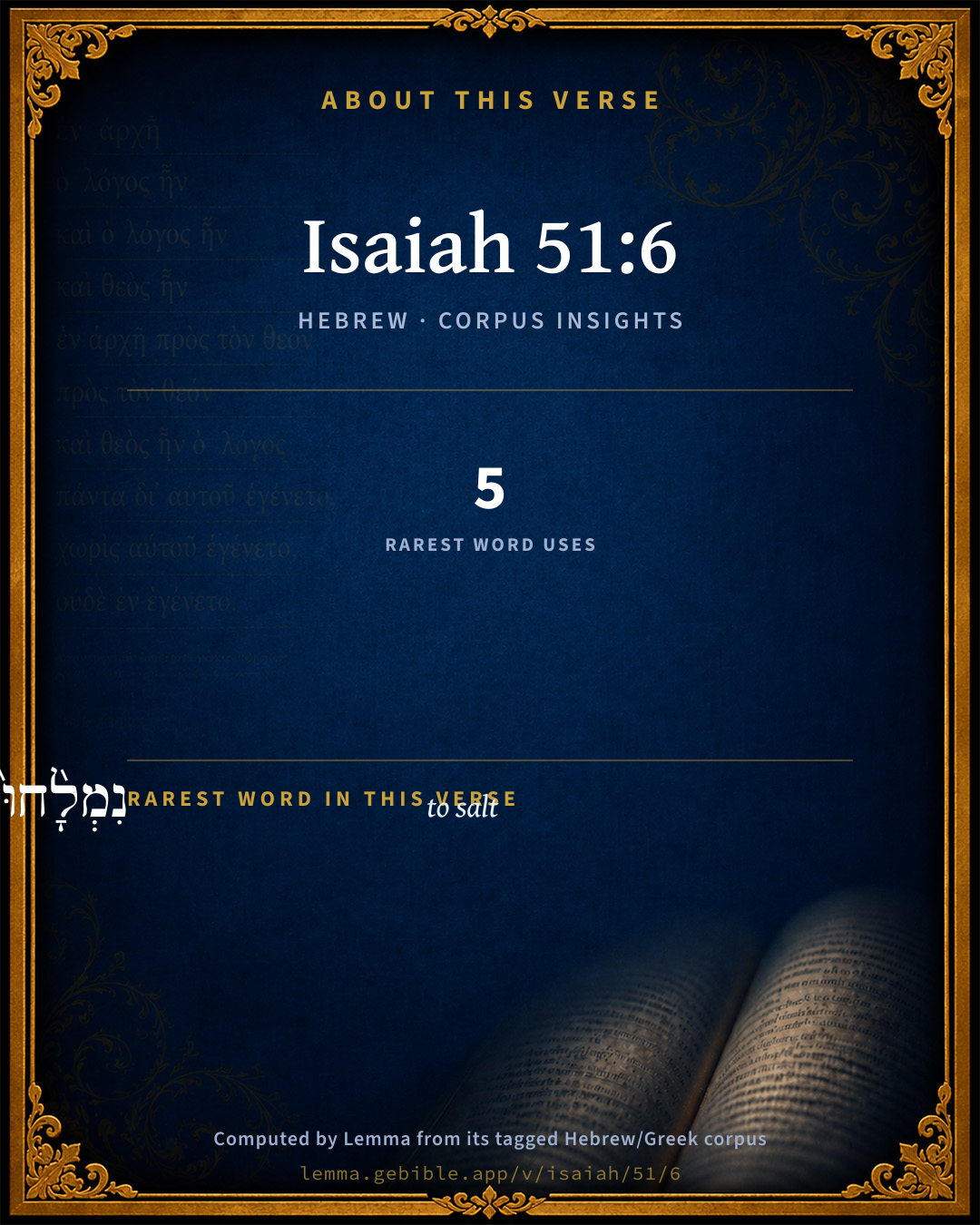
The rarest word here is נִמְלָ֨חוּ֙ to salt H4414 — appearing just 5 times in the whole Hebrew Bible.

Shared distinctive vocabulary

נִמְלָ֨חוּ֙ to salt H4414 occurs in 4 verses of the Hebrew Bible. Also found in:

Grammatical profile

  • 8 verbs
  • 10 nouns
  • 3 prepositions
  • 1 conjunction
  • 1 adverb
  • 1 particle

Verb forms

  • שְׂאוּ֩ Qal · Imperative
  • וְֽהַבִּ֧יטוּ Hiphil · Imperative
  • נִמְלָ֨חוּ֙ Niphal · Perfect
  • תִּבְלֶ֔ה Qal · Imperfect
  • וְיֹשְׁבֶ֖יהָ Qal · Participle Active
  • יְמוּת֑וּן Qal · Imperfect
  • תִּֽהְיֶ֔ה Qal · Imperfect
  • תֵחָֽת Niphal · Imperfect

Repetition

Words recur within this verse — often emphatic in Hebrew:

  • לַשָּׁמַ֨יִם heaven H8064 ×2
  • הָאָ֣רֶץ land H776 ×2

Hebrew & Septuagint length

In English translation the verse runs 53 words from the Hebrew and 43 from the Septuagint (LXX English) — closely comparable.

A rough comparison of the two English renderings, which tokenize alike — not a word-level alignment.

Word counts can differ between the Hebrew and the Greek without any difference in meaning — e.g. the Hebrew direct-object marker אֵת has no separate Greek word, and Greek often adds the article ὁ.

Cross-references

23

Topical passages linked to Isaiah 51:6 in the Treasury of Scripture Knowledge — connected by theme and wording, ordered by reader-vote popularity; previews shown in the World English Bible.

  • Matthew 24:35 Heaven and earth will pass away, but my words will not pass away.
  • Psalms 102:25–26 Of old, you laid the foundation of the earth. The heavens are the work of your hands.
  • Isaiah 34:4 All the host of the sky shall be dissolved, and the heavens shall be rolled together as a scroll; and all their host shall fade away, as the leaf fades from off the vine, and as a fading [leaf] from the fig tree.
  • Hebrews 1:10–12 And, "You, Lord, in the beginning, laid the foundation of the earth. The heavens are the works of your hands.
  • Revelation 6:12–14 I saw when he opened the sixth seal, and there was a great earthquake. The sun became black as sackcloth made of hair, and the whole moon became as blood.
  • John 3:15–16 that whoever believes in him should not perish, but have eternal life.
  • John 10:27–29 My sheep hear my voice, and I know them, and they follow me.
  • 2 Peter 3:10–12 But the day of the Lord will come as a thief in the night; in which the heavens will pass away with a great noise, and the elements will be dissolved with fervent heat, and the earth and the works that are in it will be burned up.
  • Isaiah 51:8 For the moth shall eat them up like a garment, and the worm shall eat them like wool; but my righteousness shall be forever, and my salvation to all generations.
  • Isaiah 13:13 Therefore I will make the heavens to tremble, and the earth shall be shaken out of its place, in the wrath of Yahweh of hosts, and in the day of his fierce anger.
  • Revelation 20:11 I saw a great white throne, and him who sat on it, from whose face the earth and the heaven fled away. There was found no place for them.
  • Psalms 8:3–4 When I consider your heavens, the work of your fingers, The moon and the stars, which you have ordained;
  • Isaiah 40:26 Lift up your eyes on high, and see who has created these, who brings out their host by number; he calls them all by name; by the greatness of his might, and because he is strong in power, not one is lacking.
  • Deuteronomy 4:19 and lest you lift up your eyes to the sky, and when you see the sun and the moon and the stars, even all the host of the sky, you are drawn away and worship them, and serve them, which Yahweh your God has allotted to all the peoples under the whole sky.
  • Daniel 9:24 Seventy weeks are decreed on your people and on your holy city, to finish disobedience, and to make an end of sins, and to make reconciliation for iniquity, and to bring in everlasting righteousness, and to seal up vision and prophecy, and to anoint the most holy.
  • Hebrews 9:15 For this reason he is the mediator of a new covenant, since a death has occurred for the redemption of the transgressions that were under the first covenant, that those who have been called may receive the promise of the eternal inheritance.
  • Isaiah 45:17 [But] Israel shall be saved by Yahweh with an everlasting salvation: you shall not be disappointed nor confounded world without end.
  • Isaiah 50:9 Behold, the Lord Yahweh will help me; who is he who shall condemn me? Behold, all they shall wax old as a garment, the moth shall eat them up.
  • John 5:24 "Most assuredly I tell you, he who hears my word, and believes him who sent me, has eternal life, and doesn't come into judgment, but has passed out of death into life.
  • 2 Thessalonians 2:16 Now our Lord Jesus Christ himself, and God our Father, who loved us and gave us eternal comfort and good hope through grace,
  • Hebrews 9:12 nor yet through the blood of goats and calves, but through his own blood, entered in once for all into the Holy Place, having obtained eternal redemption.
  • Psalms 103:17 But Yahweh's loving kindness is from everlasting to everlasting with those who fear him, His righteousness to children's children;
  • Hebrews 5:9 Having been made perfect, he became to all of those who obey him the author of eternal salvation,

Cross-references courtesy of OpenBible.info (CC BY 4.0).

Hebrew and Greek witnesses Masoretic Hebrew ↔ Greek Septuagint

The same verse in the two great witnesses to the Old Testament, shown verse-for-verse.

These are two independent witnesses, not word-aligned to each other, and the Septuagint is shown in lemma (dictionary) form.

Hebrew Isaiah 51:6 Masoretic · Westminster Leningrad Codex

שְׂאוּ֩ לַשָּׁמַ֨יִם עֵֽינֵיכֶ֜ם וְֽהַבִּ֧יטוּ אֶל הָאָ֣רֶץ מִתַּ֗חַת כִּֽי שָׁמַ֜יִם כֶּעָשָׁ֤ן נִמְלָ֨חוּ֙ וְהָאָ֨רֶץ֙ כַּבֶּ֣גֶד תִּבְלֶ֔ה וְיֹשְׁבֶ֖יהָ כְּמוֹ כֵ֣ן יְמוּת֑וּן וִישֽׁוּעָתִי֙ לְעוֹלָ֣ם תִּֽהְיֶ֔ה וְצִדְקָתִ֖י לֹ֥א תֵחָֽת

Lift up your eyes to the heavens, and look on the earth beneath; for the heavens shall vanish away like smoke, and the earth shall wax old like a garment; and those who dwell therein shall die in like manner: but my salvation shall be forever, and my righteousness shall not be abolished.

World English Bible · Public Domain

Greek LXX Isaiah 51:6 Septuagint · lemma form

αἴρω εἰς ὁ οὐρανός ὁ ὀφθαλμός σύ καί ἐνβλέπω εἰς ὁ γῆ κάτω ὅτι ὁ οὐρανός ὡς καπνός στερεόω ὁ δέ γῆ ὡς ἱμάτιον παλαιόω ὁ δέ καταοἰκέω ὁ γῆ ὥσπερ οὗτος ἀποθνήσκω ὁ δέ σωτήριον ἐγώ εἰς ὁ αἰών εἰμί ὁ δέ δικαιοσύνη ἐγώ οὐ μή ἐκλείπω

Lift up your eyes to the sky, and look on the earth beneath: for the sky was darkened like smoke, and the earth shall wax old like a garment, and the inhabitants shall die in like manner: but my righteousness shall not fail.

LXX2012 (modern English Septuagint) · Public Domain

On this verse, John Gill's Exposition discusses the Septuagint’s reading. Read the note in Commentary ↓

Hebrew: Westminster Leningrad Codex (CC BY 4.0). Greek: Septuagint (public domain); English from LXX2012 (modern English Septuagint) (Public Domain). How the Septuagint differs from the Hebrew →

Targum (Aramaic paraphrase)

1

The Targum is the ancient Jewish Aramaic paraphrase of the Hebrew Scriptures — an interpretive translation, not the Hebrew text itself. Onkelos (literal) and Pseudo-Jonathan (expansive) render the Torah, and Jonathan the Prophets. Coverage is partial: where no permissively-licensed English translation exists for a verse, only the Aramaic is shown. This is verse-level text, not a word-by-word alignment to the Hebrew.

  1. Targum Jonathan Prophets (Joshua–Malachi)
    זְקִיפוּ לִשְׁמַיָא עֵינֵיכוֹן וְאִסְתַּכָּלוּ בְאַרְעָא מִלְרַע אֲרֵי שְׁמַיָא כִּתְנָנָא דְעָדִי כֵן יֶעְדוּ וְאַרְעָא כִּכְסוּתָא דְבָלְיָא כֵּן תִּבְלֵי וְיָתְבָהָא אַף אִינוּן הָכֵן יְמוּתוּן וּפוּרְקָנִי לַעֲלַם יְהֵי וְזָכוּתִי לָא תִתְעַכָּב:

    Lift up your eyes to the heavens, and consider the earth beneath: for the heavens shall vanish away like smoke, and the earth that waxeth old like a garment, so shall it wax old, and its inhabitants, also, they shall die; but my salvation shall be for ever, and my righteousness shall not tarry.

    Targum Jonathan — Aramaic: “Mikraot Gedolot” (public domain). English: “Sefaria Community Translation” (CC0 1.0 (public-domain dedication)); “London "Chaldee Paraphrase," 1871” (public domain). Text via Sefaria.

Commentary

Notes on Isaiah 51:6 from classic Christian and Jewish commentators (each source and its license shown beneath its notes). The classic Christian expositions comment on the surrounding passage and are grouped to its opening verse, so a note may address several verses; the Jewish commentaries on the Tanakh (Rashi and others) are per-verse, so they appear only where the commentator wrote on this verse.

Lemma curates 59 commentaries, every one of them public domain or Creative Commons licensed, each selected and text-cleaned for this edition rather than reprinted as found. About our sources →

Trapp's Complete Commentary

John Trapp

Isa 51:6 Lift up your eyes to the heavens, and look upon the earth beneath: for the heavens shall vanish away like smoke, and the earth shall wax old like a garment, and they that dwell therein shall die in like manner: but my salvation shall be for ever, and my righteousness shall not be abolished.

Ver. 6. Lift up your eyes to the heavens.] Man hath a muscle more than ordinary to draw up his eyes heavenward.

And look upon the earth beneath.] How fast and firm it standeth. {Ecc 1:4} Yet the whole engine shall be changed. {2Pe 3:10}

Shall die in like manner.] Or, Like a louse, as some render it.

But my salvation shall be for ever.] The gospel, together with the spiritual benefits thereby, shall outlast heaven and earth.

John Trapp, A Commentary or Exposition upon All the Books of the Old and New Testament (1647–1656) — public domain. Text from a community e-Sword module.

The Biblical Illustrator

Joseph S. Exell

Isa_51:6

Lift up your eyes to the heavens.

The eternity of religion

From the thought of the universality of religion the prophet rises to that of its eternity, which is here expressed by a contrast of surprising boldness between the things which are seen and the things which are not seen. (Prof. J. Skinner, D.D.)

The present and the future

I. We have to speak to you of CREATED THINGS--the heavens above and the earth beneath--as temporal either in themselves, or in regard to us who must die in like manner. There may be much room for questioning whether there will be the actual annihilation of matter; whether even this earth is to be so destroyed that no vestige of it shall remain. We know that our bodies at least are not to be annihilated; but that having gone through certain processes, they are to be united to the soul, and remain in that re-union for ever. Without, however, supposing the actual annihilation of matter, we may speak of the universe as destined to be destroyed, seeing that the systems which are to succeed to the present will be wholly different, and wear all the traces of a new creation. Our text marks out a second way in which our connection with visible things--the heavens and the earth--may be brought to a close--they that dwell therein shall die in like manner.

II. A CONTRAST is drawn between God--His salvation and His righteousness--and the heavens and the earth. It seems the design of the passage to affix a general character to the objects of faith as distinguished from the objects of sense--the character of permanence and distinguished from that of decline. (H. Melvill, B.D.)

Looking heavenward

Man hath a muscle more than ordinary to draw up his eyes heavenward. (J. Trapp.)

The pershing and the stable

I. THE PERISHING NATURE OF ALL WORLDLY OBJECTS, PURSUITS, AND COMFORTS.

II. THE STABILITY OF THOSE WHICH THE GOSPEL PROPOSES. (W. Richardson.)

An eternal salvation

We must never expect any other way of salvation, any other covenant of peace, or rule of righteousness, but what we have in the Gospel, and what we have there shall continue to the end. (M. Henry.)

Gods everlasting salvation

There are brought before us in the text, three great varieties of existence, viz those of man, the earth, and the starry heavens; and contrasted with Gods salvation and righteousness.

I. GODS SALVATION IS INDEPENDENT OF, AND WILL OUTLIVE, EVERYTHING HUMAN. When they that dwell therein shall die in like manner, i.e., like the old earth itself. My salvation shall be for ever. Not only is the power of God unto salvation independent of its friends, but unconquerable by its foes.

II. THE GRASS WITHERETH, THE FLOWER FADETH; AND SO, TOO, WILL THE EARTH OUT OF WHICH THEY SPRING. It shall wax old like a garment. To the same intent speaks science. Will religion wax old too? When the aged planets voice is low and indistinct, will the truth of God also be less clear and defined? I trow not. The world, in its youth and beauty, was but a great symbol. The symbol is gone; the truth remains. The time may come when the resources of earth may be dried up; not so the resources of Heaven. There may be no sunshine to cheer the earth; there will be sunshine for the hearts of men;--no dew to refresh a thirsty earth; there will be life-giving dew for the soul of man.

III. OVER THE WHOLE EARTH BROODS THE MIGHTY LAW OF CHANGE. Everywhere there are births and dissolutions. Almost everything yields to its power. From the tiny flower, to the huge mountain; from the life of the insect that is born and dies in a day, to the life of men, of nations, of the whole world. The dominion of the changeable, however, is not confined to this world; it extends to all worlds. And why should it remain any longer when a grander universe has begun? The work of the old one is done. It came into being only to speak the great truths of God. It has done so; let it pass. Its bright suns, the centres of life and light, all spoke of one Eternal Sun from whom comes all life and all light. Let the changing, decaying systems of the old universe now disappear; their existence would be but a mockery beside the one everlasting system of righteousness. Let all that must pass away now pass. The watchword is, For ever and ever, for ever one system, one will, one obedience, one atmosphere of love. (D. Johnson, M.A.)

The eternity of Gods salvation

This is evidently one of those predictions having special reference to the introduction of the Gospel dispensation, with which this book is so thickly studded. We may regard Isa_51:4; Isa_5:1-30 as forming a kind of preface to Isa_51:6; and in that preface the clue is given m four ruling words, viz law, judgment, righteousness, and salvation.

1. The Gospel is a law--not written upon tables of stone, but upon the fleshly tables of the heart by the Spirit of the living God; it is a law of faith, and love, and obedience; it is the law by which God Will henceforth govern men. As the prophet in another place says The Lord is our judge, the Lord is our lawgiver, the Lord is our king; He will save us. His law is in order to His rule; and His rule is in order to the salvation of men.

2. The word judgment is here used in the sense of a body or code of laws, such as form the basis of the constitution of a kingdom. It must point to the body of Gospel truth which God is about to reveal to the world. The doctrines, precepts, promises, which centre upon the person and work, which together are bound up in the New Testament of our Lord and Saviour Jesus Christ, these form the basis, the foundation which God will make settled for a light to the people.

3. My righteousness is near. It is about, to be signally manifested, and in an unheard-of way, by the death of My only begotten Son. Therein am I about to be seen, just, and yet the Justifier of him that believeth in Jesus.

4. My salvation is gone forth, etc. The good news that men are to be saved by the free grace of God, is already published, and it shall awaken loving trust in Me wherever it is known. Then comes the climax upon this preface; the eternal endurance which is the destiny of this saving rule of the Almighty--Lift up your eyes to the heavens, etc. Three things here present themselves for our consideration--

I. THE DESTINY OF THE HEAVENS AND THE EARTH.

1. Let us think of their nature. They are an emanation from the mind of God.

2. The design of the creation.

(1) This is its immediate design--to subserve the well-being of man.

(2) But what is the ultimate design of the heavens and the earth? Like all else, to declare the glory of God. But upon this two remarks must be made--This declaration is by itself alone imperfect, as all material signs of truthmust be. The printed page may tell us many truths, but there are truths which the printed page of itself can never tell. Creation cannot declare to us all that we ought to know of God. There are apparent contradictions in nature: there is the genial sun, the gentle dew, the balmy wind; but there is also the fiery volcano, the awful earthquake, the furious hurricane. Creation cannot reconcile its own phenomena; its testimony is imperfect without some higher and concurrent light. The testimony of creation is too often rendered void or perverted through human sinfulness. Either men do not see God at all in nature, or they view Him with vision all awry.

(3) Carry your thoughts forward to the revealed destiny of the heavens and earth. They are to pass away utterly. Seeing, then, that all these things shall be dissolved, etc.

II. THE DESTINY OF THE MORTAL RACE OF MAN. They that dwell therein shall die in like manner. Man and the world date from the same origin, and are formed of the same material.

1. Let us consider the nature of the mortal race of man. It is simply a part of the visible material creation.

2. Think again of the design of our mortal race. It is pre-eminently to declare the glory of God. I have created him for my glory, I have formed him; yea, I have made him. But this glory that excelleth God is to derive not so much from our bodily nature, for this is but the kind of glory that all His other works render to Him, an unconscious glory; as from our spiritual nature, from renovated wills, from purified affections, from a redeemed and sanctified nature.

3. We shall gain further light upon the purpose of God with regard to our earthly race, if we glance at the analogy between the individual life and that of the whole race. Each man among us is the miniature, the epitome of the history of the world. He is the microcosm; you trace in yourself imperfections of bodily and mental powers; you are conscious of the seeds of death within you; all connected with your present condition speaks plainly the lesson that you are in dissolving, uncertain, precarious, transitory condition. It is fitly described in the emblems of Scripture, a tent, not a fixed habitation, a lodging, not a final rest. Now, I say you may trace a close analogy to all this in the history of the whole race. The world grows old; there are wrinkles on its brow.

4. Then remember that this is the predicted destiny of our mortal race. All living men and all their sensuous surroundings shall be utterly swept away.

III. THE DESTINY OF GODS SAVING RULE.--My salvation, etc. By the saving rule of God we mean that rule which God has revealed in the Gospel, in conforming to which man enjoy salvation; the rule which demands repentance, implicit faith in the Mediator and obedience to the Holy Ghost. It is God s plan, or rule, or way of salvation, and it is founded upon the immutable attribute of His righteousness.

1. Look at its nature. The Gospel is the hill and perfect exhibition of the mind of God.

2. Look at its design. It is in order to the complete blessedness of our immortal spirits in earth and heaven--here and hereafter, and for ever and ever.

3. God s saving rule shall endure for ever and ever. Conclusion: The rule of God must either save and bless, and eternally exalt you, or it must crush and destroy you. (E. Johnson, B.A.)

The contrast

I. A CHANGING, PASSING WORLD. Lift up your eyes, etc. God calls on us to interrupt for a short season our busy occupations, and to meditate on things seen and unseen, things temporal and things eternal.

1. The framework of creation is changing,--passing.

2. The riches, the comforts, the enjoyments of life are passing.

3. The cares, and anxieties, and sorrows of life are passing.

4. Life itself is passing.

II. AN UNCHANGING, ETERNAL SALVATION.

1. The blessing itself is salvation.

2. It has God for its author.

3. Eternity is its duration.

4. Sinners are the partakers of this blessing.

Which has your heart--your hopes? The love of both cannot dwell in the same breast, If any man love the world, the love of the Father is not in him. (F. Storr, M.A.)

The Biblical Illustrator, edited by Joseph S. Exell (c. 1880s–1900s) — public domain. Text from a community e-Sword module.

Joseph Benson's Commentary

Isa 51:6. Lift up your eyes to the heavens — Look up to the visible heavens above, which have continued hitherto, and seem likely to continue; and look upon the earth beneath — Which seems as firmly established as if it would endure for ever. The heavens shall vanish away like smoke — Which soon spends itself and disappears; and the earth shall wax old, &c. — Shall decay and perish, like a worn-out garment. And they that dwell therein shall die in like manner — Shall be dissolved, as the heaven and earth shall be, 2Pe 3:11. But my salvation shall be for ever, &c. — As it shall spread through all the nations of the earth, so it shall last through all the ages of the world, and, in its consequences, to all eternity.

Joseph Benson's Commentary on the Old and New Testaments (1811–1818) — public domain. Text from a community e-Sword module.

The Preacher's Complete Homiletical Commentary

Joseph S. Exell (gen. ed.)

THE IMMUTABILITY OF THE SALVATION AND RIGHTEOUSNESS OF GOD

Isa_51:6. Lift up your eyes to the heavens, &c.

There is no reason why we should not read these words in their positive and natural signification. Similar predictions (Isa_34:4; Psa_102:26; 2Pe_3:10). These predictions are confirmed by the reasoning of the latest science; also by the analogy of everyday experience, which go to show that, though the laws of the universe may be uniform, the material existences are in constant flux.

The description is not given to excite feelings of dismay, but to enhance our confidence in the immutability of the salvation and righteousness of God. We must first consider the one fact, that we may the better trust and enjoy the other.

I. THE WORLD PASSES.

We are called “to lift up our eyes” and to “look.” The heavens and the earth have great lessons to teach us. Nature is God’s prophetess. The spiritual man will see not only interesting geological facts, but also “Sermons in Stones.” Nature is speaking to us by its progress towards dissolution.

1. Astronomy points towards dissolution. The earth is slowly cooling, and if the present process continues, it must be ultimately reduced to the lifeless condition of the moon. Meanwhile, the moon is gradually approaching the earth, and must ultimately fall into it. The same cause—the check given to centrifugal motion by friction with the universal ether—must fling the earth into the sun, and possibly bring all the stars together.

2. Geology points towards dissolution. It shows that successive orders of life have risen and spread and perished. And there is every reason to believe that, as it was in the beginning, so it will be to the end.

3. History points towards dissolution. Kingdoms have their day—and then their night. “Assyria, Greece, Rome, Carthage, where are they?” Institutions perish. Fashions change.

4. Common observation points towards dissolution. Science may prolong life, and ameliorate its conditions; but it has done nothing towards stopping the natural “funeral marches to the grave.” As life’s shadows lengthen, and old comrades drop out of the ranks, men feel more sadly the unutterable changefulness of earthly things. Facts of such personal importance speak loudly to us to look for better, more enduring grounds of confidence.

II. THE SALVATION AND RIGHTEOUSNESS OF GOD ENDURE FOR EVER.

1. They endure in Him. The immutable laws of nature are just reflections of the eternal constancy of God. He must be changeless because He is perfect; “He is not a man that He should err.” Immaculate and passionless, He can have no need to repent.

(1.) His salvation endures for ever. Much that we love and trust passes away. We are ready to despair of all light and hope. But no! one thing endures. To the poor, dark, sin-stained, fallen soul, beggared of all earthly joy, and buried in grief and shame, one grand hope is left. Christ is still standing knocking at the door of the heart: salvation is still possible; for “He is able to save to the uttermost them that come unto God by Him.”

(2.) God’s righteousness will not be abolished. He can never connive at sin. There would be no hope for us if it were not that here the righteousness and sacrifice of Christ meet our need.

2. The salvation and righteousness of God endure in us.

(1.) The salvation shall be for ever. Christ gives to us no temporary deliverance, but eternal salvation. There is one “friend that sticketh closer than a brother,” and one haven that is safe in the wildest tempest. But the salvation endures on condition that we remain faithful.

(2.) The righteousness shall not be abolished. That is the one permanent possession to be sought for. Wealth, health, pleasure, friends, knowledge, the earth itself, and the very heavens pass away; he who has any of them for his heritage will be finally bankrupt; he who lives righteously in God’s righteousness, shares the immortality of that righteousness.

TWO PRACTICAL LESSONS:

1. Trust in God alone.

“Change and decay in all around I see,

O Thou that changest not, abide with me.”

2. Fear no earthly evil.

(1.) Fear not the power of present foes. This power is doomed; with the glory of the world, its cruelty, its injustice, its wrong will perish.

(2.) Fear not the loss of present blessings. To part with them will be a pain. But if we have God, and His salvation and righteousness, the best treasures are left.—W. F. Adeney, M.A.: Clerical World, vol. i. pp. 254–255.

The design of this chapter is to comfort the people of God under the persecution of their enemies, and the various evils of their present warfare. The ground of consolation insisted on in the text, is the perpetuity of God’s mercy and faithfulness towards His people, which shall be manifested in accomplishing their salvation, protecting them from the assaults of their enemies, carrying them safely through all the chances and changes of this mortal life, and crowning them at length with victory and honour. And while they are led to expect this glorious end of their troubles and fears, they are assured that everything else that now appears so splendid and desirable shall perish like a vain shadow. “Lift up your eyes.”

In treating upon these words, I shall endeavour to show the perishing nature of all worldly objects, pursuits, and comforts, and the stability of those which the Gospel proposes, and to which the attention of all true Christians is directed.—W. Richardson, Sermons, vol. i. pp. 377, 378.

We are here called to contrast the fading and short-lived glory of all things earthly, with the enduring character of those hopes and consolations revealed in the Gospel.

I. “All flesh is grass”—not like the oak, the cedar, the enduring tree of the forest, but “grass,” which flourishes and dies within the compass of a season. As it is with man, so is it with his works. In vain the laborious master painted for eternity; in vain the skilful statuary inscribed his name, or inwrought his own image, with that of some divinity which he carved into stone; the colours of the picture are long since faded, the stone is mouldered or dashed into pieces. In vain the Egyptian tyrants raised a monument to their power and greatness, which might last as long as earth; the pile indeed stands, but the name of the builder is forgotten; and as for all the rest of all the boasted wonders of the world, the very ruins of them are lost and forgotten. [1566] Nay, the sure and firm-set earth itself partakes of this character of mutability. The sun shines but for a season; the earth crumbles with the foot that treads upon it. “They that dwell therein shall die in like manner.” You stand a ruin amid ruin. “Where are your fathers?” our friends? your brethren? Plainly, if you have not something better than time, you have nothing.

[1566] “Mark the glory of collective man. United he puts on the appearance of strength. He founds empires, builds cities; he guards by his armies, he cements all by his policy. But trace the track of civilised man through the world, and you find it covered with the wreck of his hopes; and the monuments of his power have been converted into the mockery of his weakness. His eternal cities moulder in their ruins. The serpent hisses in the cabinet where he planned his empire. Echo itself is startled by the foot which breaks the silence which has reigned for ages in his hall of feast and song. Columns stand in the untrodden desert; and the but of the shepherd or the den of the robber shelters the only residents of his palaces. And the glory which now exists is crumbling everywhere, where it has not the cement of Christianity, and where it takes not something of perpetuity from the everlasting Word. All heathen glory and Mahommedan pride creak in the blast and nod to their fall. The withering wind or the raging tempest shall pass over them in turn; and men shall sit upon the ruins of their proudest grandeur, and be reminded that all flesh is grass.”—Watson.

II. Contrast with all this the undecaying character of the blessings of salvation. “My salvation shall be for ever.” The Gospel comes not under this law of mutability. It partakes of the unchangeableness and immortality of its Author, and addresses itself to the changeless and incorruptible part of man.

1. It exhibits a permanent standard of truth—truth of doctrine, truth of morals. Truth is everlasting. Therefore, if we have evidence of the truth of the Gospel, we have evidence of its everlasting character. Errors are nothing. They are deceptions, and must pass away. They are the clouds of the mind, and however gilded and painted they may be by chance rays of truth, they change while we gaze upon them, and shall be swept away by the wind of heaven. But truth is the steady light of heaven. This truth survived the test of experiment. It has been found suited to men of all sorts and in all conditions. It is bound up essentially with the moral condition of man; and, therefore, it can never become obsolete. While man is man, he must know that he is a sinner—that he needs a Saviour—that he cannot secure his own happiness, but must find it in communion with higher beings in higher worlds. What the Gospel has been, it is. Had it failed to reveal pardon, to secure peace, to reconcile to God, to point the way to heaven, it would have been a vanity, and it would have died out like other vanities long ago. But it answers these ends. It is the only system that does so. It abides the test of experiment. It is felt and acknowledged to be Divine (H. E. I. 1138, 1139, 1142–1148, 2421–2427).

2. It presents a perpetual source of comfort. Comfort under the changes and the frowns of the world—under the sense of guilt—under the temptations of Satan—under the loss of friends—under the fear of death.

3. It reveals and communicates an undecaying principle of life. By it life and immortality are brought to light. It conveys life; it is regenerative; it gives the life of grace, as well as reveals and leads to the life of glory.

Consequently,

1. The Gospel demands your most serious attention. This is demanded by the subject of its message; and by the majesty of its Author, who here says, “Hearken to me!”

2. It solicits your cordial acceptance. “The isles shall wait for Me, and on Mine arm shall they trust.”

3. It leaves no alternative between obedience and ruin (Isa_51:8).—Samuel Thodey.

God’s unchangeable purposes cannot fail. Such is the thought with which Isaiah animates the people of God, discouraged by the taunts of those who thought that the promises of Jehovah would not be fulfilled. All changes but the Eternal God.

I. The majestic heavens over our heads are subject to the law of change. True, these great changes baffle our powers. The life of man is too short to mark great changes in that which seems the least subject to this law, the heavens above us. Yet science teaches us that vast changes are going on in the very life of our system, the sun. And one day the heavens will pass away with a great noise and be rolled up as a scroll.

II. The earth is subject to the law of change. The scientific facts by which this is proved are most abundant—

“There rolls the deep where grew the tree;

O earth! what changes hast thou seen!

There, where the long street rolls, hath been

The stillness of the central sea.”

III. Man, made in the image of God, is not exempt from the operation of this law. The highest and noblest work of God, the most perfect of nature’s works, passes away, dissolved into a few gases and a small amount of earthy substances. “One generation passeth away and another cometh.” But amid this universal change one thing abides; it is the purpose of the everlasting God.

IV. The salvation and the righteousness of God abide unchanged. The kingdom of God waxes not old. It is subject to no decay.

1. The salvation that God has provided for man is available throughout all generations.

2. The righteousness which led to its provision is the guarantee of its continuance. When the character of God changes and is subject to decay, then His salvation shall not be for ever. The salvation and the righteousness of God are manifested in Christ. The Epiphany will be everlasting because He is an everlasting Saviour—eternally “the Lamb slain from the foundation of the world.”—The Homiletical Library, vol. ii. p. 71.

I. The destiny of the heavens and the earth. II. The destiny of man. III. The destiny of God’s saving rule.—E. Johnson, B.A.

The Preacher's Complete Homiletical Commentary (gen. ed. Joseph S. Exell; Funk & Wagnalls, c. 1892) — public domain (pre-1929). A full-Bible homiletical/sermon-outline anthology covering 65 of 66 books (2 John is absent from the source module). Text from a community e-Sword module.

Tyndale Open Study Notes

Tyndale Open Resources

51:6 die like flies: The wicked will die in great multitudes on the day of God’s judgment.

Tyndale Open Study Notes — © Tyndale Open Resources, licensed CC BY-SA 4.0. Text via the HelloAO Bible API.

Geneva Bible (1599)

Geneva Bible translators

He forewarneth them of the horrible changes and mutations of all things, and how he will preserve his church in the midst of all these dangers.

Geneva Bible (1599) marginal notes — public domain. Text via Bolls.life.

Jamieson, Fausset & Brown

Robert Jamieson, A. R. Fausset & David Brown

(Isa 40:6, Isa 40:8; Psa 102:26; Heb 1:11-12).

vanish away--literally, "shall be torn asunder," as a garment [MAURER]; which accords with the context.

in like manner--But GESENIUS, "Like a gnat"; like the smallest and vilest insect. JEROME translates, as English Version, and infers that "in like manner" as man, the heavens (that is, the sky) and earth are not to be annihilated, but changed for the better (Isa 65:17).

righteousness--My faithfully fulfilled promise (see on Isa 51:5).

Jamieson, Fausset & Brown — Commentary Critical and Explanatory on the Whole Bible (1871) — public domain (CC PDM 1.0). Text via the HelloAO Bible API.

Adam Clarke's Commentary

Verse 6. My salvation shall be for ever] Aben Ezra says, From this verse divines have learnt the immortality of the soul. Men shall perish as the earth does, because they are formed from it; but they who are filled with the salvation of God shall remain for ever. See Kimchi.

Adam Clarke's Commentary on the Bible (1810–1826) — public domain. Text from a community e-Sword/MySword module.

Ellicott's Commentary for English Readers

(6) Shall die in like manner—i.e., shall vanish into nothingness. Many commentators, however, render, shall die like gnats; shall live their little day and pass away; thus supplying a third similitude, in addition to the “smoke” and the “garment.” We are reminded once again of Psa_102:26; and we may add, Mat_24:35; 2Pe_3:10.

A Bible Commentary for English Readers, edited by Charles John Ellicott (1878–1897) — public domain. Text from a community e-Sword module.

The Cambridge Bible for Schools and Colleges

gen. ed. J. J. S. Perowne

6. From the thought of the universality of religion the prophet rises to that of its eternity, which is here expressed by a contrast of surprising boldness between the “things which are seen” and the “things which are not seen.” The whole visible creation, the heavens above and the earth beneath, are transitory, but Jehovah’s salvation endures for ever.

the heavens shall vanish away (or “be dissolved”) like smoke] To feel the force of the metaphor we must bear in mind the ancient conception of the “firmament” as a solid vault overarching the earth. The word for “vanish away” is connected with noun rendered “rotten rags” in Jer_38:11 f.

wax old like a garment] see on ch. Isa_50:9, from which the expression is taken. Cf. also Psa_102:26.

shall die in like manner] Rather, as R.V. marg., shall die like gnats. The word kçn does not occur elsewhere in this sense, unless Num_13:33 be an instance, which is doubtful. It might be a collective noun corresponding to the fem. kinnâh (noun of unity = a single gnat), found in Talmudic Hebrew. Several commentators, however, think it necessary to read kinnîm (also a collective), a word used in Exo_8:16-18 of the “lice” of Egypt. The Ancient Versions and the Jewish interpreters explain as E.V., taking kçn to be the common particle “so.”

salvation and righteousness are practically synonymous, as often. see Appendix, Note II.

The Cambridge Bible for Schools and Colleges (gen. ed. J. J. S. Perowne; Cambridge University Press, 1878–1918) — public domain. Text from a community e-Sword module.

John Gill's Exposition

Lift up your eyes to the heavens,.... And observe their beauty and order, the constant and regular motion of the heavenly bodies, the firmness and solidity of them:

and look upon the earth beneath; how stable and well founded it is:

for the heavens shall vanish away like smoke; though they are so firm, and have lasted so long, and have kept their constant situation and course, yet they shall melt away like salt, as the word (k) signifies, and disappear in an instant like smoke. Reference seems to be had to the general conflagration, when the heavens being on fire shall be dissolved, and the elements shall melt with fervent heat, Pe2 3:12,

and the earth shall wax old like a garment; and be folded up, and laid aside, as useless; see Psa 102:26. This seems to design not a substantial destruction of the earth, but of its qualities, when waxing old it shall be renewed and changed. Jarchi interprets these clauses of the princes of the hosts of people in heaven, and the governors of the earth; but the inhabitants thereof are mentioned next:

and they that dwell therein shall die in like manner; as the heavens and the earth; be dissolved as they, and in like manner; vanish as smoke, and be seen no more; wax old as a garment, and become useless and unprofitable. De Dieu renders it, "as a louse" (l), and so this word sometimes signifies; and this sense is approved of by many learned men (m), and seems best to agree with the text; since neither the heavens and the earth are said to die, nor smoke, or a garment: and it may denote how loathsome and nauseous wicked men are in life, like vermin; and how mean and contemptible in death, their bodies are vile and despicable, and how easily they are destroyed:

but my salvation shall be for ever; that salvation which Christ has wrought out for his people is an everlasting salvation, Isa 14:17, Heb 5:9 and they that are interested in it will be always safe and happy; and though they shall die as other men, they shall rise again, and enjoy glory, immortality, and eternal life:

and my righteousness shall not be abolished: the righteousness which Christ has brought in for his people, and by which they are justified, is also everlasting, Dan 9:24 or, "shall not be broken" (n); it answers all the demands of law and justice, and stands firm against all the accusations and charges of men and devils: or, "shall not fail" (o), as the Septuagint; its virtue to justify will always continue; it will answer for the saints in a time to come, even at the last judgment. The Targum is, it

"shall not tarry;''

being near to be wrought out and revealed, Isa 51:5.

(k) "Symmachus". It is expressive of corruption and consumption, as Ben Melech observes; which is the sense of salt land, not inhabited Jer xvii 6. It denotes, as Gussetius (Ebr. Comment. p. 469.) thinks, the fluctuating and confused agitation of the heavens, like those of the salt sea, and as smoke over the head. (l) "tanquam pediculus", De Dieu; so the word is used in Exod. viii. 16, 17, 18. "instar vermiculi", Vitringa. (m) Calvinus, Gataker, Gussetius. (n) "conteretur", Pagninus, Montanus; "atteretur", Junius & Tremellius, Piscator. So Ben Melech interprets it, "shall not be broken". (o) , Sept. "non deficiet", V. L.

John Gill's Exposition of the Whole Bible (1746–1763) — public domain (CC PDM 1.0). Text via the HelloAO Bible API.

Albert Barnes' Notes on the Bible

Lift up your eyes to the heavens - The design of directing their attention to the heavens and the earth is, probably, to impress them more deeply with a conviction of the certainty of his salvation in this manner, namely, the heavens and the earth appear firm and fixed; there is in them no apparent tendency to dissolution and decay. Yet though apparently thus fixed and determined, they will all vanish away, but the promise of God will be unfailing.

For the heavens shall vanish away - The word which is rendered here ‘shall vanish away’ (מלח mâlach), occurs nowhere else in the Bible. The primary idea, according to Gesenius, is that of smoothness and softness. Then it means to glide away, to disappear. The idea here is, that the heavens would disappear, as smoke is dissipated and disappears in the air. The idea of the vanishing, or the disappearing of the heavens and the earth, is one that often occurs in the Scriptures (see the notes at Isa 34:4; compare Psa 102:26; Heb 1:11-12; 2Pe 3:10-12).

The earth shall wax old ... - Shall decay, and be destroyed (see Psa 102:26).

And they that dwell therein shall die in like manner - Lowth renders this, ‘Like the vilest insect.’ Noyes, ‘Like flies.’ The Vulgate, and the Septuagint, however, render it as it is in our version. Rosenmuller renders it, ‘As flies.’ Gesenius renders it, ‘Like a gnat.’ This variety of interpretation arises from the different explanation of the word כן kên, which usually means, ‘as, so, thus, in like manner, etc.’ The plural form, however, (כנים kiniym), occurs in Psa 105:31, and is rendered by the Septuagint, σκνῖφες skniphes, and by the Vulgate, sciniphes, a species of small gnats, very troublesome from their sting, which abounds in the marshy regions of Egypt; and according to this the idea is, that the most mighty inhabitants of the earth would die like gnats, or the smallest and vilest insects. This interpretation gives a more impressive sense than our version, but it is doubtful whether it can be justified. The word occurs nowhere else in this sense, and the authority of the ancient versions is against it. The idea as given in the common translation is not feeble, as Gesenius supposes, but is a deeply impressive one, that the heavens, the earth, and all the inhabitants should vanish away together, and alike disappear.

But my salvation shall be for ever - It is a glorious truth that the redemption which God shall give his people shall survive the revolutions of kingdoms, and the consummation of all earthly things. It is not improbable that the Saviour had this passage in his eye when he said, ‘heaven and earth shall pass away, but my word shall not pass away’ Mat 24:35.

Albert Barnes' Notes on the Bible (1834–1885) — public domain. Text from a community e-Sword/MySword module.

Haydock's Catholic Bible Commentary

Fail. Matthew xxiv. 35. The prosperity of the Jews was not of long duration. But the Church will remain till the end of time.

George Leo Haydock (1774–1849), Haydock's Catholic Family Bible and Commentary, 1859 edition — public domain. Excludes Psalms (Douay-Rheims chapter numbering differs from Protestant) and Deuterocanonical books (Catholic canon only).

Matthew Poole's English Annotations

The heavens shall vanish away like smoke, and the earth shall wax old like a garment; the heavens and earth shall pass away, either,

1. Simply, and by a substantial corruption or annihilation, which is yet to be understood comparatively or conditionally, that these should sooner vanish into nothing than God’s promised salvation should not be accomplished; as when it is said, Heaven and earth shall pass away, but my words shall not pass away, Mat 24:35. It is thus expounded, It is easier for heaven and earth to pass, than (for) one tittle of the law to fail. Or,

2. In regard of their present state, and properties, and use, as smoke is here said to vanish, although the substance of it be not destroyed. They that dwell therein shall die in like manner; as they shall be dissolved, as we read, 2Pe 3:11, and death is nothing else but a dissolution.

Matthew Poole's English Annotations on the Holy Bible (1683–1685) — public domain. Text from a community e-Sword/MySword module.

The Pulpit Commentary

Lift up your eyes to the heavens. Look to that which seems to you most stable and most certain to endure the vast firmament of the heavens, and the solid earth beneath it, of which God "bears up the pillars". (Psa_125:3) Both these, and man too, are in their nature perishable, and will (or may) vanish away and cease to be. But God, and his power to save, and his eternal law of right, can never pass away, but must endure for evermore. Let Israel be sure that the righteous purposes of God with respect to their own deliverance from Babylon, and to the conversion of the Gentiles, stand firm, and that they will most certainly be accomplished. The heavens shall vanish away like smoke. (comp. Psa_102:26 Mat_24:35 2Pe_3:10-12) And the earth shall wax old like a garment. So also in Psa_102:26 and Heb_1:11. The new heaven and new earth promised by Isaiah, (Isa_65:17 Isa_66:22) St.Peter, (2Pe_3:13) and St. John (Rev_21:1) are created in the last times, because "the first heaven and the first earth have passed away." They that dwell therein shall die in like manner. Dr. Kay observes that the Hebrew text does not say, "in like manner," but "as in like manner." Man is not subject to the same law of perishableness as the external world, but to a different law. External things simply "pass away" and are no more. Man disappears from the earth, but continues to exist somewhere. He has, by God"s gift, a life that is to be unceasing.

Things earthly and things spiritual.

"They that dwell therein shall die in like manner; but my salvation shall be for ever." Some render, "Shall die like gnats;" that is, shall live their little day, and then pass away. (comp. Psa_102:26 Mat_24:35 2Pe_3:10-13) We get one of our chief impressions of the value of a thing out of the length of time that it will last. Permanence is one of the principal notes of value. The insect that hums through the air of one summer"s evening is. comparatively worthless; the elephant that lives through a hundred years is valuable The wayside weed that lives its brief months is worthless; the giant oak that outlives the storms of generations is valuable. And so our idea of extreme value, of absolutely priceless worth, is put into the figure of permanence eternal, abiding, and continuing. The highest conceivable good is eternal life; the worst conceivable woe is eternal death. This note of value tests things earthly; they are short-lived, and comparatively worthless. It tests things spiritual; they are long-lived, good, cannot die, and they alone are truly worthy of the pursuit of those in whom God has breathed the breath of life.

1. The material heavens and material earth are the types of all material things. They are the "treasure on earth," which moth or rust are always corrupting, which thieves are constantly breaking through to steal. "Here we have no continuing city" (see the force of this in view of the ruins of great ancient cities which abound in the East). The fashion of this world passeth away." The world is a moving panorama. The generations go by like the ships that sail to the West. "The place that knows us now must soon know us no more for ever." Everything on which the earthly stamp rests is in its very nature fading. There is no safe holding of what we only get, only become possessed of.

2. But "salvation" and "righteousness" are the types of spiritual things. They bear relation to the man himself, and not to his mere circumstances or surroundings. We can keep for ever only that which we are. Character is our "treasure in heaven, which neither moth nor rust doth corrupt, and which no thieves can break through and steal." But the yet higher truth the one concerning which we need to gain ever new impressions is that we can only hope to hold on for ever that which we are through Divine grace; that which we are through the Divine redeemings and sanctifyings. God"s "salvation shall be for ever; and his righteousness shall not be abolished," as the salvation is wrought in us, and the righteousness shines from us. R.T.

The Pulpit Commentary (1880–1919), ed. H.D.M. Spence-Jones & Joseph S. Exell — public domain. Text from a community e-Sword module.

John Wesley's Explanatory Notes

The heavens - The heavens and earth shall pass away, in regard of their present state, and properties, and use, as smoak is said to vanish, tho' the substance of it be not destroyed.

John Wesley, Explanatory Notes Upon the Whole Bible (1754–1765) — public domain. Text via the GEBible commentary corpus.

Keil & Delitzsch

C. F. Keil & F. Delitzsch

The people of God are now summoned to turn their eyes upwards and downwards: the old world above their heads and under their feet is destined to destruction. "Lift up your eyes to the heavens, and look upon the earth beneath: for the heavens will pass away like smoke, and the earth fall to pieces like a garment, and its inhabitants die out like a nonentity; and my salvation will last for ever, and my righteousness does not go to ruin." The reason for the summons follows with kı̄. The heavens will be resolved into atoms, like smoke: nimlâchū from mâlach, related to mârach, root mal, from which comes mâlal (see at Job 14:2), to rub to pieces, to crumble to pieces, or mangle; Aquila, ἠλοήθησαν, from ἀλοᾶν, to thresh. As melâchı̄m signifies rags, the figure of a garment that has fallen to pieces, which was then quite ready to hand (Isa 50:9), presented itself from the natural association of ideas. כּמו־כן, however, cannot mean "in like manner" (lxx, Targ., Jerome); for if we keep to the figure of a garment falling to pieces, the figure is a very insipid one; and if we refer it to the fate of the earth generally, the thought which it offers is a very tame one. The older expositors were not even acquainted with what is now the favourite explanation, viz., "as gnats perish" (Hitzig, Ewald, Umbreit, Knobel, Stier, etc.); since the singular of kinnı̄m is no more kēn than the singular of בּיצים is בּיץ. The gnat (viz., a species of stinging gnat, probably the diminutive but yet very troublesome species which is called akol uskut, "eat and be silent," in Egyptian) is called kinnâh, as the talmudic usage shows, where the singular, which does not happen to be met with in the Old Testament, is found in the case of kinnı̄m as well as in that of bētsı̄m.

(Note: Kinnâm, in Exo 8:13-14, whether it be a collective plural or a singular, also proves nothing in support of kēn, any more than middâh in Job 11:9 (which see) in favour of mad, in the sense of measure. It does not follow, that because a certain form lies at the foundation of a derivative, it must have been current in ordinary usage.)

We must explain the word in the same manner as in Sa2 23:5; Num 13:33; Job 9:35. In all these passages kēn merely signifies "so" (ita, sic); but just as in the classical languages, these words often derive their meaning from the gesture with which they are accompanied (e.g., in Terence's Eunuch: Cape hoc flabellum et ventulum sic facito). This is probably Rckert's opinion, when he adopts the rendering: and its inhabitants "like so" (so wie so) do they die. But "like so" is here equivalent to "like nothing." That the heavens and the earth do not perish without rising again in a renewed form, is a thought which may naturally be supplied, and which is distinctly expressed in Isa 51:16; Isa 65:17; Isa 66:22. Righteousness (tsedâqâh) and salvation (yeshū‛âh) are the heavenly powers, which acquire dominion through the overthrow of the ancient world, and become the foundations of the new (Pe2 3:13). That the tsedâqâh will endure for ever, and the yeshū‛âh will not be broken (yēchath, as in Isa 7:8, confringetur, whereas in Isa 51:7 the meaning is consternemini), is a prospect that opens after the restoration of the new world, and which indirectly applies to men who survive the catastrophe, having become partakers of righteousness and salvation. For righteousness and salvation require beings in whom to exert their power.

Keil & Delitzsch — Biblical Commentary on the Old Testament (1861–1891) — public domain (CC PDM 1.0). Text via the HelloAO Bible API. (Old Testament only.)

J. A. Alexander on Isaiah

Joseph Addison Alexander

“Raise to the heavens your eyes, and look unto the earth beneath.” A similar form of address occurs above, in Isa 40:26. (Compare Gen 15:5). Heaven and earth are here put, as in many other places, for the whole frame of nature. The next clause explains why they are called upon to look. “For the heavens like smoke are dissolved or driven away.” Most writers give this verb a future sense (or a present one as an evasive substitute), because the real future follows; but for this very reason it may be presumed that the writer used distinct forms to express distinct ideas, and that he first gives a vivid description of the dissolution as already past, and then foretells its consummation as still future. “And the earth like the garment (which grows old) shall grow old” (or wear out). The same comparison occurs above in Isa 50:9, and serves to identify the passages as parts of one continued composition. “And their inhabitants shall die.” The translation recommended by analogy and usage as well as by the testimony of the ancient versions is, ‘they shall likewise perish,’ to which there may possibly be an allusion in our Savior’s words recorded in Luk 13:3; Luk 13:5. The contrast to this general destruction is contained in the last clause. “And my salvation to eternity shall be, and my righteousness shall not be broken,” (i.e., shall not cease from being what it is), in which sense the same verb is evidently used by Isaiah elsewhere (Isa 7:8). In this as in many other cases, salvation and righteousness are not synonymous but merely correlative as cause and effect. (See above, on Isa 42:6). The only question as to this clause is whether it is a hypothetical or absolute proposition. If the former, then the sense is that ‘until (or even if) the frame of nature be dissolved, the justice and salvation of Jehovah shall remain unshaken.’ The other interpretation understands the first clause as a positive and independent declaration that the heavens and earth shall be dissolved. All these hypotheses are reconcilable by making the first clause mean, as similar expressions do mean elsewhere, that the most extraordinary changes shall be witnessed, moral and physical; but that amidst them all this one thing shall remain unchangeable, the righteousness of God as displayed in the salvation of His people. (See Isa 40:8; Isa 65:17; Mat 5:18; 1Jn 2:17).

Joseph Addison Alexander, The Prophecies of Isaiah (1846–1847; New York: Scribner, 1870–1878) — public domain. Text from a community e-Sword module.

unfoldingWord translationNotes

Door43 World Missions Community

General Information:

Yahweh continues speaking to the people of Israel.

Lift up your eyes to the sky

Lifting the eyes represents looking at something above. AT: "Look up at the sky" (See: Metaphor)

like smoke ... like a garment ... like flies

All of these refer to things that quickly and easily disappear or become useless. (See: Simile)

my salvation will continue forever

God's "salvation" here represents the result of his salvation, which is freedom. AT: "I will save you, you will be free forever" (See: Metonymy)

my righteousness will never stop working

God's "righteousness" here represents him ruling righteously. AT: "my righteous rule will never end" or "I will rule righteously forever" (See: Metonymy)

translationWords

heaven

earth

save

eternity

righteous

unfoldingWord translationNotes — © Distant Shores Media and the Door43 World Missions Community, licensed CC BY-SA 4.0. Source: git.door43.org/Door43/en_tn.

Rashi

Rabbi Shlomo Yitzchaki (Rashi)

the heavens shall vanish like smoke The princes of the hosts of the heathens who are in heaven.

shall vanish Heb. נִמְלָחוּ, shall rot away. Comp. (Jer. 38:12) “Rags and decayed clothing (בְּלוֹאֵי הַסְּחָבוֹת),” a decayed garment. Another explanation of נִמְלָחוּ is: shall be stirred. This is an expression similar to “the sailors of (מַלָּחֵי) the sea,” who stir the water with the oars that guide the ship. Comp. also (Ex. 30:35) “Stirred (מְמֻלָּח), pure, and holy.”

and the earth the rulers of the earth.

and its inhabitants the rest of the people.

and My salvation for My people shall be forever. Another explanation is: [It refers] actually [to] the heavens and the earth, and this is its explanation: Raise your eyes and look at the heaven and at the earth, and see how strong and sturdy they are, yet they shall rot away, but My righteousness and My salvation shall be forever. Hence, My righteousness is sturdier and stronger than they.

Rashi on the Tanakh — English translations: “The Judaica Press complete Tanach with Rashi, translated by A. J. Rosenberg” (CC BY 4.0); “Pentateuch with Rashi's commentary by M. Rosenbaum and A.M. Silbermann, 1929-1934” (public domain); “The Metsudah Tanach series, Lakewood, N.J” (CC BY 4.0); and “The Book of Joshua, Metsudah Publications, 1997” (CC BY 4.0). Text via Sefaria.

Ibn Ezra

Rabbi Abraham ibn Ezra

Lift up your eyes, etc. Philosophers derive from this verse the doctrine of the immortality of the soul of man; their doctrine is right; but this verse certainly does not contain it. השמים The sky. הארץ The inhabited part of the earth. Both may perish, but the salvation of the Lord, His faithfulness, His righteousness remains for ever.

Ibn Ezra on the Tanakh — English translations: “Sefaria Community Translation” (CC0 1.0 (public-domain dedication)); “Yalkut, Sifsei Chachomim Chumash, Metsudah Publications, 2009” (CC BY 4.0); and “Commentary of Ibn Ezra on Isaiah - trans. by M. Friedlander, 1873” (public domain). Text via Sefaria.

Lesson kit

Teaching starters — assembled from the data on this page, not authored interpretation. Every prompt links to the verse data it draws on. Edit before teaching.

Isaiah, in the Prophets, opens this verse with 24 words (22 distinct Hebrew lemmas). Its most distinctive word is mâlach (“to salt”). A historical commentator’s framing appears above. Read the whole chapter for the surrounding context.

Discussion questions

  1. The word mâlach carries the sense “to salt.” How does it shape the verse?
  2. How does Exodus 30:35, which shares the word «to salt», read alongside this verse?
  3. What does the repetition of “heaven” (2× in this one verse) do in this verse?
  4. These translations render this verse differently; the difference is in the English rendering, not the original. What questions does that raise?
  5. «שְׂאוּ֩» is a Qal Imperative verb. How does that grammatical form shape the action described?
  6. Compare how Trapp's Complete Commentary and The Biblical Illustrator read this verse. Where do they agree or differ?

Things to notice

Reading settings

Reading text

Shown beneath each verse's original-language words.

Old Testament
Old Testament edition

Read the OT as the Masoretic Hebrew (MT) or the Greek Septuagint (LXX).

English shown for the Greek Septuagint (in the Hebrew ↔ Greek comparison).

Comparing translations? Open the Compare panel on any verse page to stack up to four side by side.