
Job 22:6

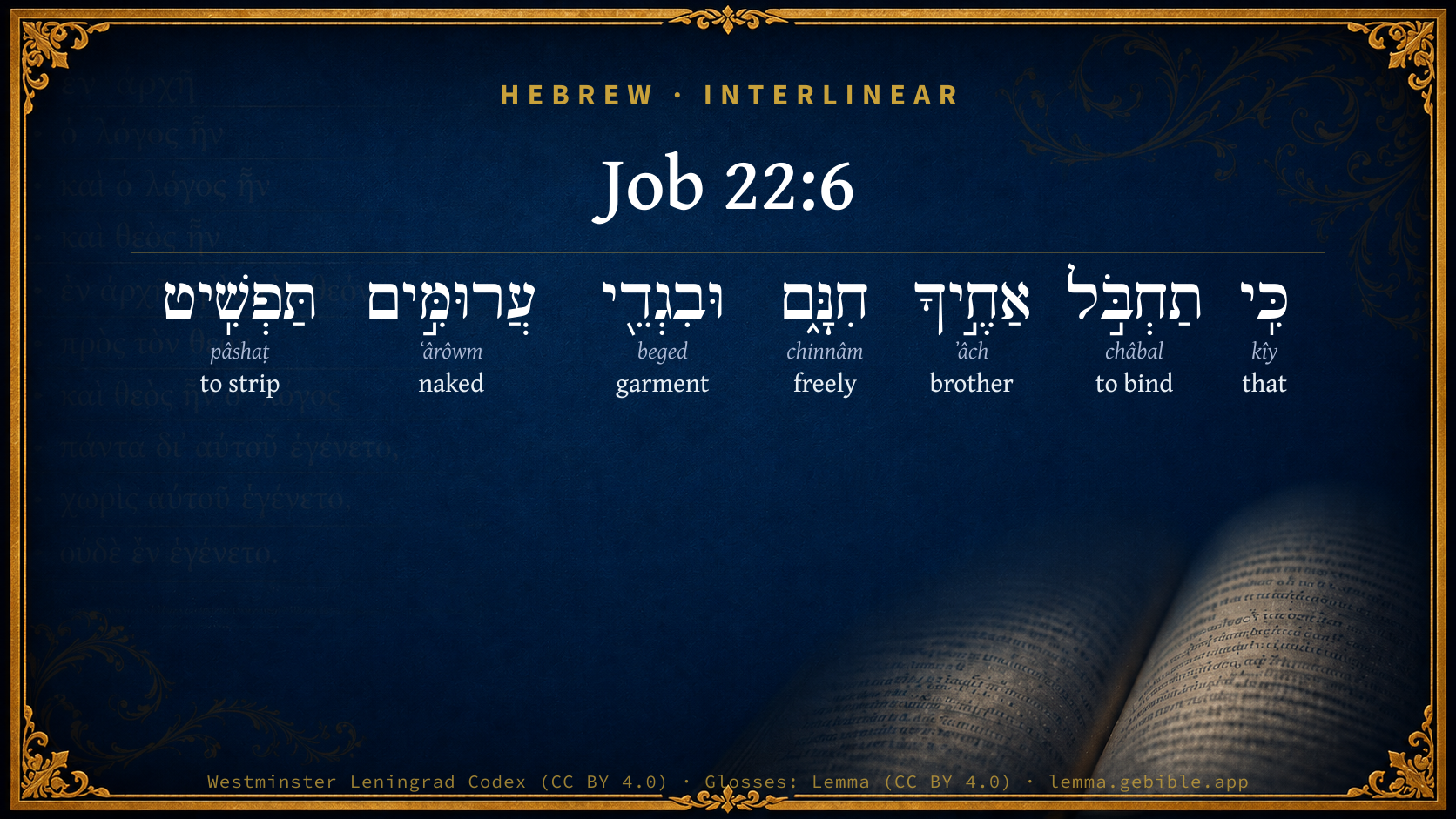
Hebrew (Westminster Leningrad Codex) Job 22:6 appears in the Hebrew Old Testament. The text above is from the Westminster Leningrad Codex. Each word links to its Strong’s number, a concise gloss, and parsing drawn from the Open Scriptures Hebrew Bible morphology. Click any word for its full Brown-Driver-Briggs (BDB) entry.
Download image
Cite this verse

Job 22:6 (World English Bible). Public Domain. Lemma interlinear Bible study tool, https://lemma.gebible.app/v/job/22/6.

Show BibTeX & RIS
BibTeX
RIS
English Translation
For you have taken pledges from your brother for nothing, And stripped the naked of their clothing.
World English Bible · Public Domain
Download a study sheet

One document with this verse’s original text, its word-by-word gloss line, the meaning frame, cross-references with their text, attributed commentary, and full source and license credits — printable, and it pastes into notes with its structure intact.

This verse Autodidact and up

Study sheet (.html) Plain text (.txt)

A passage Seminary Student

Up to 50 verses in one chapter. A passage sheet keeps up to 6 commentary sources and 12 cross-references per verse, in the order this page ranks them, and says so on the sheet whenever that leaves anything out. Ask for a single verse and you get the Autodidact verse sheet above.

Everything on this page stays free to read, with no account — the sheet is a download of what is already on screen, not access to it.

Want to remove ads? Support Godless Engineer
Compare translations 3

The same verse in 3 English versions, stacked beneath the original-language interlinear above. Click any original word for its lexicon entry.

Each is an independent rendering of the whole verse — the interlinear is not word-aligned to these translations.

Highlighted words mark where these versions differ — a whole-verse word diff, not a word-by-word alignment.

  • World English Bible Public Domain
    For you have taken pledges from your brother for nothing, And stripped the naked of their clothing.
  • King James Version Public Domain
    For thou hast taken a pledge from thy brother for nought, and stripped the naked of their clothing.
  • unfoldingWord Literal Text CC BY-SA 4.0
    For you have bound your brother without cause, and you have stripped off the clothing of the naked.

unfoldingWord Literal Text — © unfoldingWord, licensed CC BY-SA 4.0. Word-aligned USFM3 via Door43 (git.door43.org/unfoldingWord/en_ult).

Versions to compare (up to 4)

3 of 4 selected

Show all 18 translations

Every available English version of this verse, each an independent rendering of the whole verse.

  • World English Bible Public Domain
    For you have taken pledges from your brother for nothing, And stripped the naked of their clothing.
  • Berean Standard Bible Public Domain
    For you needlessly demanded security from your brothers and deprived the naked of their clothing.
  • Majority Standard Bible Public Domain
    For you needlessly demanded security from your brothers and deprived the naked of their clothing.
  • King James Version Public Domain
    For thou hast taken a pledge from thy brother for nought, and stripped the naked of their clothing.
  • American Standard Version (1901) Public Domain
    For thou hast taken pledges of thy brother for nought, And stripped the naked of their clothing.
  • Revised Version (1885) Public Domain
    For thou hast taken pledges of thy brother for nought, and stripped the naked of their clothing.
  • Geneva Bible (1599) Public Domain
    For thou hast taken the pledge from thy brother for nought, and spoyled the clothes of the naked.
  • Douay-Rheims (1899) Public Domain
    For thou hast taken away the pledge of thy brethren without cause, and stripped the naked of their clothing.
  • Young's Literal Translation Public Domain
    For thou takest a pledge of thy brother for nought, And the garments of the naked Thou dost strip off.
  • Literal Standard Version CC BY-SA 4.0
    For you take a pledge of your brother for nothing, || And you strip off the garments of the naked.
  • Unlocked Literal Bible CC BY-SA 4.0
    For you have demanded guarantee of a loan from your brother for no reason, and you have stripped away clothing from the naked.
  • unfoldingWord Literal Text CC BY-SA 4.0
    For you have bound your brother without cause, and you have stripped off the clothing of the naked.
  • Darby Bible Public Domain
    For thou hast taken a pledge of thy brother for nought, and stripped off the clothing of the naked.
  • World Messianic Bible Public Domain
    For you have taken pledges from your brother for nothing, and stripped the naked of their clothing.
  • Webster's Bible Public Domain
    For thou hast taken a pledge from thy brother for naught, and stripped the naked of their clothing.
  • Free Bible Version CC BY-SA 4.0
    For no reason at all you took your brother's clothing as a security for a debt, and left them stripped naked.
  • Bible in Basic English Public Domain
    For you have taken your brother's goods when he was not in your debt, and have taken away the clothing of those who have need of it.
  • JPS Tanakh (1917) Public Domain
    For thou hast taken pledges of thy brother for nought, and stripped the naked of their clothing.

Literal Standard Version (2020), Covenant Press — licensed CC BY-SA 4.0. Text via the HelloAO Bible API (eBible.org). Unlocked Literal Bible (unfoldingWord) — licensed CC BY-SA 4.0. Text via the HelloAO Bible API (eBible.org). unfoldingWord Literal Text — © unfoldingWord, licensed CC BY-SA 4.0. Word-aligned USFM3 via Door43 (git.door43.org/unfoldingWord/en_ult). Free Bible Version, Dr. Jonathan Gallagher — licensed CC BY-SA 4.0. Text via the HelloAO Bible API (eBible.org).

Word by word

More ways to search: Search by grammar → Find every occurrence → Compare this word →

Practice this passage: Drill this verse → Learn its vocabulary →

About this verse

These counts appear in no published source. They are computed here, from the morphology-tagged text and Lemma’s own curated glosses. What Lemma adds →

7
words
7
distinct lemmas
Wisdom
section

Notable vocabulary

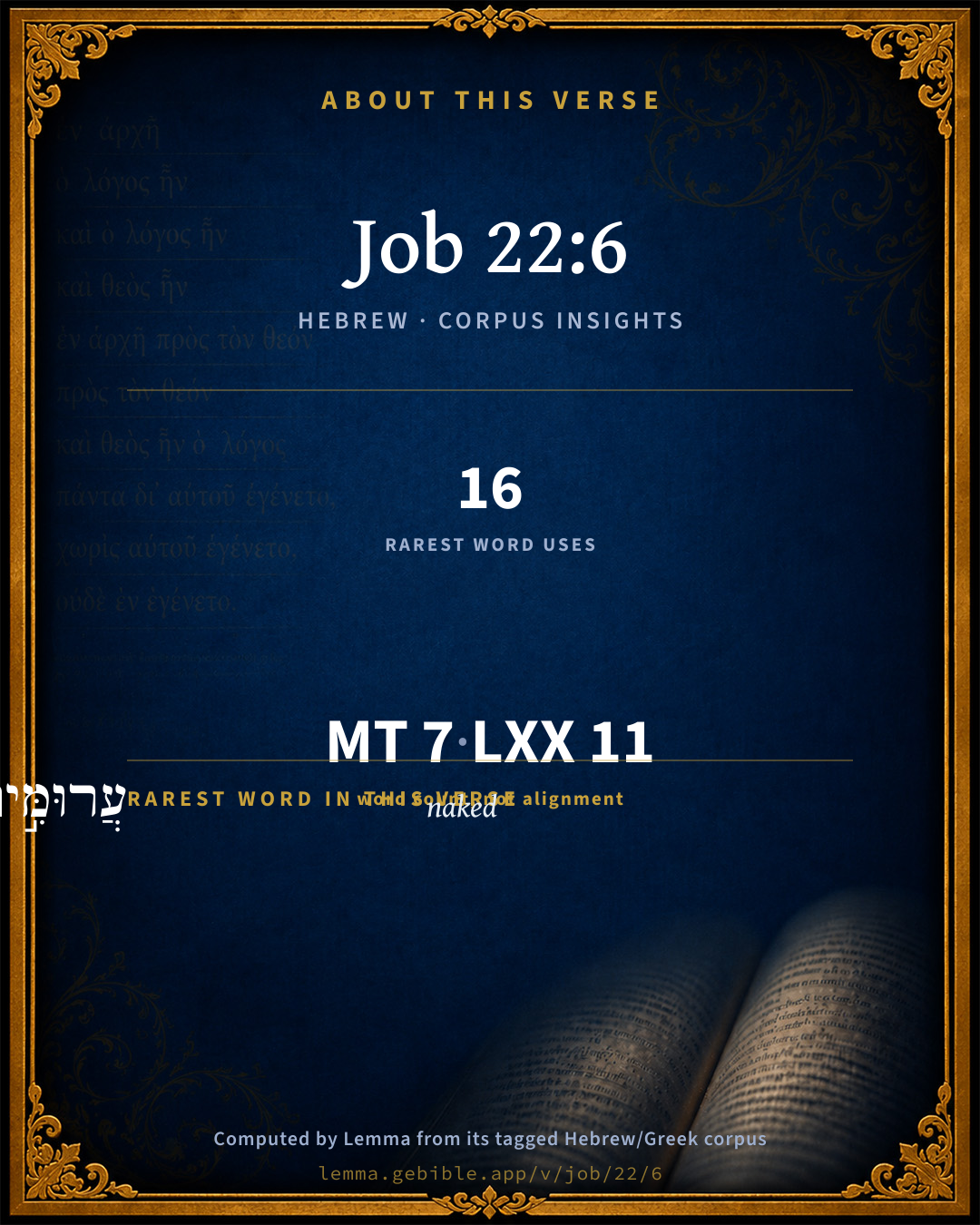
The rarest word here is עֲרוּמִּ֣ים naked H6174 — appearing just 16 times in the whole Hebrew Bible.

Shared distinctive vocabulary

עֲרוּמִּ֣ים naked H6174 occurs in 15 verses of the Hebrew Bible. Also found in:

Grammatical profile

  • 2 verbs
  • 2 nouns
  • 1 adjective
  • 1 conjunction
  • 1 adverb

Verb forms

  • תַחְבֹּ֣ל Qal · Imperfect
  • תַּפְשִֽׁיט Hiphil · Imperfect

Hebrew & Septuagint length

In English translation the verse runs 17 words from the Hebrew and 19 from the Septuagint (LXX English) — closely comparable.

A rough comparison of the two English renderings, which tokenize alike — not a word-level alignment.

Word counts can differ between the Hebrew and the Greek without any difference in meaning — e.g. the Hebrew direct-object marker אֵת has no separate Greek word, and Greek often adds the article ὁ.

In the original languages it is 7 Hebrew tokens and 11 Greek tokens — but the two are counted differently (Hebrew bundles its prefixes and suffixes into one token; the Greek is in lemma form), so that isn’t a like-for-like length.

Cross-references

10

Topical passages linked to Job 22:6 in the Treasury of Scripture Knowledge — connected by theme and wording, ordered by reader-vote popularity; previews shown in the World English Bible.

  • Exodus 22:26 If you take your neighbor's garment as collateral, you shall restore it to him before the sun goes down,
  • Ezekiel 18:12 has wronged the poor and needy, has taken by robbery, has not restored the pledge, and has lifted up his eyes to the idols, has committed abomination,
  • Ezekiel 18:16 neither has wronged any, has not taken anything to pledge, neither has taken by robbery, but has given his bread to the hungry, and has covered the naked with a garment;
  • Deuteronomy 24:10–18 When you do lend your neighbor any manner of loan, you shall not go into his house to get his pledge.
  • Job 24:3 They drive away the donkey of the fatherless, And they take the widow's ox for a pledge.
  • Deuteronomy 24:6 No man shall take the mill or the upper millstone to pledge; for he takes [a man's] life to pledge.
  • Job 24:9–10 There are those who pluck the fatherless from the breast, And take a pledge of the poor,
  • Job 31:19–20 If I have seen any perish for want of clothing, Or that the needy had no covering;
  • Ezekiel 18:7 and has not wronged any, but has restored to the debtor his pledge, has taken nothing by robbery, has given his bread to the hungry, and has covered the naked with a garment;
  • Amos 2:8 And they lay themselves down beside every altar on clothes taken in pledge; And in the house of their God they drink the wine of those who have been fined.

Cross-references courtesy of OpenBible.info (CC BY 4.0).

Hebrew and Greek witnesses Masoretic Hebrew ↔ Greek Septuagint

The same verse in the two great witnesses to the Old Testament, shown verse-for-verse.

These are two independent witnesses, not word-aligned to each other, and the Septuagint is shown in lemma (dictionary) form.

Hebrew Job 22:6 Masoretic · Westminster Leningrad Codex

כִּֽי תַחְבֹּ֣ל אַחֶ֣יךָ חִנָּ֑ם וּבִגְדֵ֖י עֲרוּמִּ֣ים תַּפְשִֽׁיט

For you have taken pledges from your brother for nothing, And stripped the naked of their clothing.

World English Bible · Public Domain

Greek LXX Job 22:6 Septuagint · lemma form

ἐνεχυράζω δέ ὁ ἀδελφός σύ διά κενός ἀμφίασις δέ γυμνός ἀποαἱρέω

And you have taken security of your brethren for nothing, and have taken away the clothing of the naked.

LXX2012 (modern English Septuagint) · Public Domain

On this verse, Keil & Delitzsch discusses the Septuagint’s reading. Read the note in Commentary ↓

Hebrew: Westminster Leningrad Codex (CC BY 4.0). Greek: Septuagint (public domain); English from LXX2012 (modern English Septuagint) (Public Domain). How the Septuagint differs from the Hebrew →

Commentary

Notes on Job 22:6 from classic Christian and Jewish commentators (each source and its license shown beneath its notes). The classic Christian expositions comment on the surrounding passage and are grouped to its opening verse, so a note may address several verses; the Jewish commentaries on the Tanakh (Rashi and others) are per-verse, so they appear only where the commentator wrote on this verse.

Lemma curates 59 commentaries, every one of them public domain or Creative Commons licensed, each selected and text-cleaned for this edition rather than reprinted as found. About our sources →

Trapp's Complete Commentary

John Trapp

Job 22:6 For thou hast taken a pledge from thy brother for nought, and stripped the naked of their clothing.

Ver. 6. For thou hast taken a pledge, &c.] Bona verba, quaeso, I seek good words, Eliphaz. How well might Job have cried out, as David afterwards did, Psa 35:11, "False witnesses rose up; they laid to my charge things that I knew not." Here he stands accused, 1. Of inhumanity and cruelty; 2. Of irreligion and impiety. But he fully cleareth himself of both, Job 30:1-31; Job 31:1-40 Athanasius in like sort was falsely accused of adultery in the Council of Tyre, A. D. 343; Eustathius, bishop of Antioch, was injuriously deprived for the same cause, about the latter end of Constantine the Great; adultery, heresy, and treason were objected to Archbishop Cranmer; parricide to Mr Philpot; sedition to father Latimer; to which he answereth, As for sedition, for aught that I know, methinks I should not need Christ, if I might so say.

For nought] Or unconscionably, as one rendereth it; and herein lay the fault. See Deu 24:6; Deu 24:10.

And stripped the naked of their clothing] If naked, how could he strip them, skin them, as the word signifieth? Chrysostom useth this proverb, Nudus nec a centum viris spoliatur, He that is naked cannot be stripped by a hundred men. We also have a proverb, Where nothing can be had the king must lose his right. And again,

He is like to get little

Who robbeth a spital.

In the late German wars, the Crabats, at Altroff, a university, plundered the scholars, and put poor genus and species to their ransom (Life of the King of Sweden). Micah inveigheth against such cannibal princes, as plucked the skin from the flesh, and the flesh from the bones of the poor oppressed, Mic 3:2-3. {See Trapp on "Mic 3:2"}{see Trapp on "Mic 3:3"} That which Eliphaz here chargeth Job with, but without truth, is, that he stripped off the clothing of the naked; that is, that, finding them poor enough, he left them yet poorer, hardly having a rag to hang on their backs, through his extortion.

John Trapp, A Commentary or Exposition upon All the Books of the Old and New Testament (1647–1656) — public domain. Text from a community e-Sword module.

Joseph Benson's Commentary

Job 22:6. For thou hast taken a pledge — Or, surely thou hast taken. He speaks thus, by way of conjecture, or strong presumption: as if he had said, When I consider thy grievous and unusual calamities, I justly conclude thou art guilty of some, or all, of these following crimes; and do thou search thy own conscience whether it be not so with thee. From thy brother — Of thy neighbour, or of thy kinsman; for naught — Without a sufficient and justifiable cause. And stripped the naked of their clothing — By taking their garments for a pledge, and thereby rendering them naked; or, by robbing them of their rights, all other injuries being comprehended under this.

Joseph Benson's Commentary on the Old and New Testaments (1811–1818) — public domain. Text from a community e-Sword module.

Whedon's Commentary on the Bible

Daniel D. Whedon

b. Since it must be that Job has committed sin, it naturally occurs to Eliphaz to charge upon him those sins which the best of the rich men of his day were guilty of committing. His own logical conclusions he coins into proofs positive of Job’s guilt, Job_22:6-11.

6. In his portraiture of the wicked, Zophar had insinuated (Job_20:19) what Eliphaz, to our surprise, now boldly charges against Job. The sins he attributes to Job are those generally ascribed to wicked men of wealth — hard-heartedness, covetousness, and extortion. Eliphaz infers from the punishment the character of crimes Job must have committed. Personal abuse, the last resort of a failing cause, is the first public sign the friends display of their approaching discomfiture. (See Job’s noble reply, Job_29:11-16.) The mantle of charity that we may throw over Eliphaz is, that he had long brooded over his suspicions until they assumed shape and at last substance.

Pledge… naught — There was a twofold aggravation of his guilt; that he should require a pledge from a brother, and that without cause. Job “is represented as extorting pledges without having lent.” — Michaelis.

The naked of their clothing — Literally, And strippedst off the clothes of the naked. Seneca tells us that one poorly clad and in rags was said to be naked. (Jas_2:15.) Michaelis says, (“Laws of Moses,” 2:303,) “From the analogy of his (Moses’s) law of pledge, it is probable that the necessary pieces of clothing were not permitted to be seized and stripped from off the person of the debtor, as might be done by merciless creditors among the neighbouring nations, for he even commands the creditor (Exo_22:26-27) who had taken in pledge his poor neighbour’s upper garment (which was a large square piece of cloth that was wrapped about the body by day, and served as a coverlet by night) to restore it again before sunset.” Origen remarks that he is a robber who does not clothe the naked. See Freeman’s “Hand-Book,” 261.

Daniel D. Whedon (gen. ed.), Commentary on the Old and New Testaments (1874–1909) — public domain. Text from a community e-Sword module.

Tyndale Open Study Notes

Tyndale Open Resources

22:6 Demanding clothing as security for lent money was forbidden by the law and condemned by the prophets (Exod 22:26-27; Deut 24:10-13; Ezek 18:7-8; Amos 2:8). In contrast, Job had provided clothing for the poor (Job 31:19-20).

Tyndale Open Study Notes — © Tyndale Open Resources, licensed CC BY-SA 4.0. Text via the HelloAO Bible API.

Geneva Bible (1599)

Geneva Bible translators

Thou hast been cruel and without charity, and wouldest do nothing for the poor, but for thine own advantage.

Geneva Bible (1599) marginal notes — public domain. Text via Bolls.life.

Jamieson, Fausset & Brown

Robert Jamieson, A. R. Fausset & David Brown

The crimes alleged, on a harsh inference, by Eliphaz against Job are such as he would think likely to be committed by a rich man. The Mosaic law (Exo 22:26; Deu 24:10) subsequently embodied the feeling that existed among the godly in Job's time against oppression of debtors as to their pledges. Here the case is not quite the same; Job is charged with taking a pledge where he had no just claim to it; and in the second clause, that pledge (the outer garment which served the poor as a covering by day and a bed by night) is represented as taken from one who had not "changes of raiment" (a common constituent of wealth in the East), but was poorly clad--"naked" (Mat 25:36; Jam 2:15); a sin the more heinous in a rich man like Job.

Jamieson, Fausset & Brown — Commentary Critical and Explanatory on the Whole Bible (1871) — public domain (CC PDM 1.0). Text via the HelloAO Bible API.

Adam Clarke's Commentary

Verse 6. Thou hast taken a pledge] Thou hast been vexatious in all thy doings, and hast exacted where nothing was due, so that through thee the poor have been unable to procure their necessary clothing.

Adam Clarke's Commentary on the Bible (1810–1826) — public domain. Text from a community e-Sword/MySword module.

Ellicott's Commentary for English Readers

(6) Thou hast taken a pledge from thy brother.—These specific charges, false as they were, show the depth to which Eliphaz had sunk.

A Bible Commentary for English Readers, edited by Charles John Ellicott (1878–1897) — public domain. Text from a community e-Sword module.

The Cambridge Bible for Schools and Colleges

gen. ed. J. J. S. Perowne

6. Compare the laws, Exo_22:26; Deu_24:10. The “naked” are those poorly clad. See Job’s reply to this, ch. Job_31:19.

The Cambridge Bible for Schools and Colleges (gen. ed. J. J. S. Perowne; Cambridge University Press, 1878–1918) — public domain. Text from a community e-Sword module.

John Gill's Exposition

Thou hast not given water to the weary to drink,.... To a weary thirsty traveller, to whom in those hot countries cold water was very refreshing, and which in desert places was not to be had in common, or any where; rich men were possessed of their wells and fountains, and were kept for their own use, and it was a kindness and favour to obtain water of them; and yet a cup of cold water is one of the least favours to be given to a poor man, and to deny it him in distress was very inhuman, and was very far from Job's character:

and thou hast withholden bread from the hungry: bread, which strengthens man's heart, and is the staff of life, without which he cannot support; and this is not to be withheld from, but given even to an enemy when hungry; and to deny it to a poor neighbour in such circumstances is very cruel; the charge is, that Job would not give a poor hungry man a morsel of bread to eat; which must be false, being directly contrary to what he strongly asserts, Job 31:17.

John Gill's Exposition of the Whole Bible (1746–1763) — public domain (CC PDM 1.0). Text via the HelloAO Bible API.

Albert Barnes' Notes on the Bible

For thou hast taken a pledge from thy brother for nought - The only evidence which Eliphaz seems to have had of this was, that this was a heinous sin, and that as Job seemed to be severely punished, it was to be “inferred” that he must have committed some such sin as this. No way of treating an unfortunate and a suffering man could be more unkind. A “pledge” is that which is given by a debtor to a creditor, for security for the payment of a debt, and would be, of course, that which was regardcd as of value. Garments, which constituted a considerable part of the wealth of the Orientals, would usually be the pledge which would be given. With us, in such cases, watches, jewelry, notes, mortgages, are given as collateral security, or as pledges. The law of Moses required, that when a man took the garment of his neighbor for a pledge, it should be restored by the time the sun went down, Exo 22:26-27. The crime here charged on Job was, that he had exacted a pledge from another where there was no just claim to it; that is, where no debt had been contracted, where a debt; had been paid, or where the security was far beyond the value of the debt. The injustice of such a course would be obvious. It would deprive the man of the use of the property which was pledged, and it gave him to whom it was pledged an opportunity of doing wrong, as he might retain it, or dispose of it, and the real owner see it no more.

And stripped the naked of their clothing - Margin, “clothes of the naked.” That is, of those who were poorly clad, or who were nearly destitute of clothes. The word naked is often used in this sense in the Scriptures; see the notes at Joh 21:7. The meaning here is, that Job had taken away by oppression even the garments of the poor in order to enrich himself.

Albert Barnes' Notes on the Bible (1834–1885) — public domain. Text from a community e-Sword/MySword module.

Haydock's Catholic Bible Commentary

Pledge. Hebrew, "person." Debtors might be sold, Matthew xviii. 30.

George Leo Haydock (1774–1849), Haydock's Catholic Family Bible and Commentary, 1859 edition — public domain. Excludes Psalms (Douay-Rheims chapter numbering differs from Protestant) and Deuterocanonical books (Catholic canon only).

Matthew Poole's English Annotations

For thou hast taken, or, surely thou hast taken. He speaks thus by way of conjecture, or strong presumption. When I consider thy grievous and unusual calamities, I justly conclude thou art guilty of all or some of these following crimes; and do thou search thine own conscience, whether it be not so with thee.

From thy brother, i.e. either of thy neighbour, or of thy kinsman; which are both called by the name of brother. This is added to aggravate the offence.

For nought, i.e. without sufficient and justifiable cause; which he might do many ways; either by taking what he ought not to take, Deu 24:6; or from whom he ought not, to wit, the poor, to whom he should give Pro 3:27 or when and in such manner as he ought not, of which See Poole "Deu 24:10", See Poole "Deu 24:11"; or by keeping it longer than he should, as when the poor man’s necessity requires it, or when the debt is satisfied, Eze 18:16.

Stripped the naked of their clothing; either by taking their garment for a pledge, against the law, Exo 22:26; or otherwise by robbing them of their rights, all other injuries being synecdochically comprehended under this.

Quest. How could he strip the naked?

Answ. He calls them naked, either,

1. Because they had but very few and mean clothes, such being oft called naked, as Deu 28:48; 1Co 14:11; Jam 2:15. Or,

2. From the effect, because though he did not find them naked, yet he made them so. The like phrases we have Isa 47:2, grind meal, i.e. by grinding corn make it meal; Amo 8:5, falsifying the deceitful balances, i.e. by falsifying making true balances deceitful. And so here, to strip the naked, is by stripping them to make them naked.

Matthew Poole's English Annotations on the Holy Bible (1683–1685) — public domain. Text from a community e-Sword/MySword module.

The Pulpit Commentary

For thou hast taken a pledge from thy brother for nought; i.e. thou hast lent to thy brother on pledge, without reasonable cause, when thou weft rich enough to need no security. (comp. Neh_5:2-11) And stripped the naked of their clothing. When thy brother, on borrowing from thee, pledged his raiment, thou didst retain it, and so didst leave him to shiver all night without covering. (see Exo_22:26, Exo_22:27) We may, perhaps, gather from this that the Mosaic Law on the subject was founded on an anterior custom widely prevalent in South Western Asia.

The Pulpit Commentary (1880–1919), ed. H.D.M. Spence-Jones & Joseph S. Exell — public domain. Text from a community e-Sword module.

John Wesley's Explanatory Notes

Surely - He speaks thus by way of strong presumption, when I consider thy unusual calamities, I conclude thou art guilty of all, or some of these crimes. Brother - Of thy neighbour. Nought - Without sufficient and justifiable cause. Stripped - By taking their garment for a pledge, or by robbing them of their rights, all other injuries being comprehended under this.

John Wesley, Explanatory Notes Upon the Whole Bible (1754–1765) — public domain. Text via the GEBible commentary corpus.

Keil & Delitzsch

C. F. Keil & F. Delitzsch

6 For thou distrainedst thy brother without cause,

And the clothes of the naked thou strippedst off.

7 Thou gavest no water to the languishing,

And thou refusedst bread to the hungry.

8 And the man of the arm-the land was his,

And the honourable man dwelt therein.

9 Thou sentest widows away empty,

And the arms of the orphan are broken.

The reason of exceeding great suffering most be exceeding great sins. Job must have committed such sins as are here cited; therefore Eliphaz directly attributes guilt to him, since he thinks thus to tear down the disguise of the hypocrite. The strophe contains no reference to the Mosaic law: the compassionate Mosaic laws respecting duties towards widows and orphans, and the poor who pledge their few and indispensable goods, may have passed before the poet's mind; but it is not safe to infer it from the expression. As specific Mohammedan commandments among the wandering tribes even in the present day have no sound, so the poet dare not assume, in connection with the characters of his drama, any knowledge, of the Sinaitic law; and of this he remains conscious throughout: their standpoint is and remains that of the Abrahamic faith, the primary commands (later called the ten commands of piety, el-felâhh) of which were amply sufficient for stigmatizing that to which this strophe gives prominence as sin. It is only the force of the connection of the matter here which gives the futt. which follow כי a retrospective meaning. חבל is connected either with the accusative of the thing for which the pledge is taken, as in the law, which meets a response in the heart, Exo 22:25.; or with the accus. of the person who is seized, as here אחיך; or, if this is really (as Br asserts) a mistake that has gained a footing, which has Codd. and old printed editions against it, rather אחיך. lxx, Targ., Syr., and Jer. read the word as plural. ערוּמים (from ערום), like γυμνοί, Jam 2:15, nudi (comp. Seneca, de beneficiis, v. 13: si quis male vestitum et pannosum videt, nudum se vidisse dicit), are, according to our mode of expression, the half-naked, only scantily (vid., Isa 20:2) clothed.

Job 22:8

The man of the arm, זרוע, is in Eliphaz' mind Job himself. He has by degrees acquired the territory far and wide for himself, by having brought down the rightful possessors by open violence (Job 20:19), or even by cunning and unfeeling practices, and is not deterred by any threat of a curse (Job 15:28): לו הארץ, he looked upon it as his, and his it must become; and since with his possessions his authority increased, he planted himself firmly in it, filled it out alone, like a stout fellow who takes the room of all others away. Umbr., Hahn, and others think Job's partiality for power and rank is described in Job 22:8; but both assertions read straightforward, without any intimation of co-operation. The address is here only suspended, in order to describe the man as he was and is. The all-absorbing love of self regulated his dealings. In possession of the highest power and highest rank, he was not easy of access. Widows and orphans, that they might not perish, were obliged to turn suppliantly to him. But the widows he chased away with empty hands, and the arms of the orphans were crushed. From the address a turn is also here taken to an objective utterance turned from the person addressed, intended however for him; the construction is like מצות יעכל, unleavened bread is eaten, Exo 13:7, according to Ew. 295, b. The arms are not conceived of as stretched out for help (which would rather be ידי), nor as demanding back their perverted right, but the crushing of the arms, as Psa 37:17; Eze 30:22, and frequently implies a total destruction of every power, support, and help, after the analogy of the Arabic phrase compared by Ges. in his Thes. pp. 268b, 433b. The arm, זרוע (Arab. ḏirâ‛, oftener ‛aḍud or sâ‛id), signifies power, Job 40:9, Psa 57:1-11 :16; force and violence, Job 22:8, Job 35:9; self-help, and help from without, Psa 83:9 (comp. Psa 44:4). Whatever the orphans possessed of goods, honour, and help still available, is not merely broken, it is beaten into fragments.

Keil & Delitzsch — Biblical Commentary on the Old Testament (1861–1891) — public domain (CC PDM 1.0). Text via the HelloAO Bible API. (Old Testament only.)

unfoldingWord translationNotes

Door43 World Missions Community

Connecting Statement:

Eliphaz continues speaking to Job.

you have demanded guarantee of a loan

This refers to a lender taking something from the borrower to ensure that the borrower pays him back.

you have stripped away clothing from the naked

Eliphaz is accusing Job of taking clothes as security from poor people who borrowed from him.

withheld bread

Here "bread" refers to food in general. AT: "withheld food" (See: Synecdoche)

possessed the earth ... lived in it

Eliphaz is accusing Job of taking land from poor people and not allowing them to live on it. He is emphasizing this point by restating it twice. (See: Parallelism)

possessed the earth

Eliphaz is exaggerating the amount of land that Job owned in order to portray Job as greedy. AT: "possessed a great amount of land" (See: Hyperbole and Generalization)

translationWords

brother

bread

might

possess

earth

honor

life

unfoldingWord translationNotes — © Distant Shores Media and the Door43 World Missions Community, licensed CC BY-SA 4.0. Source: git.door43.org/Door43/en_tn.

Lesson kit

Teaching starters — assembled from the data on this page, not authored interpretation. Every prompt links to the verse data it draws on. Edit before teaching.

Job, in the Wisdom, opens this verse with 7 words (7 distinct Hebrew lemmas). Its most distinctive word is ʻârôwm (“naked”). A historical commentator’s framing appears above. Read the whole chapter for the surrounding context.

Discussion questions

  1. How does “naked” (ʻârôwm) shape what this verse is saying?
  2. How does Genesis 2:25, which shares the word «naked», read alongside this verse?
  3. These translations render this verse differently; the difference is in the English rendering, not the original. What questions does that raise?
  4. «תַחְבֹּ֣ל» is a Qal Imperfect verb. How does that grammatical form shape the action described?
  5. Compare how Trapp's Complete Commentary and Joseph Benson's Commentary read this verse. Where do they agree or differ?

Things to notice

Reading settings

Reading text

Shown beneath each verse's original-language words.

Old Testament
Old Testament edition

Read the OT as the Masoretic Hebrew (MT) or the Greek Septuagint (LXX).

English shown for the Greek Septuagint (in the Hebrew ↔ Greek comparison).

Comparing translations? Open the Compare panel on any verse page to stack up to four side by side.