
Numbers 19:21

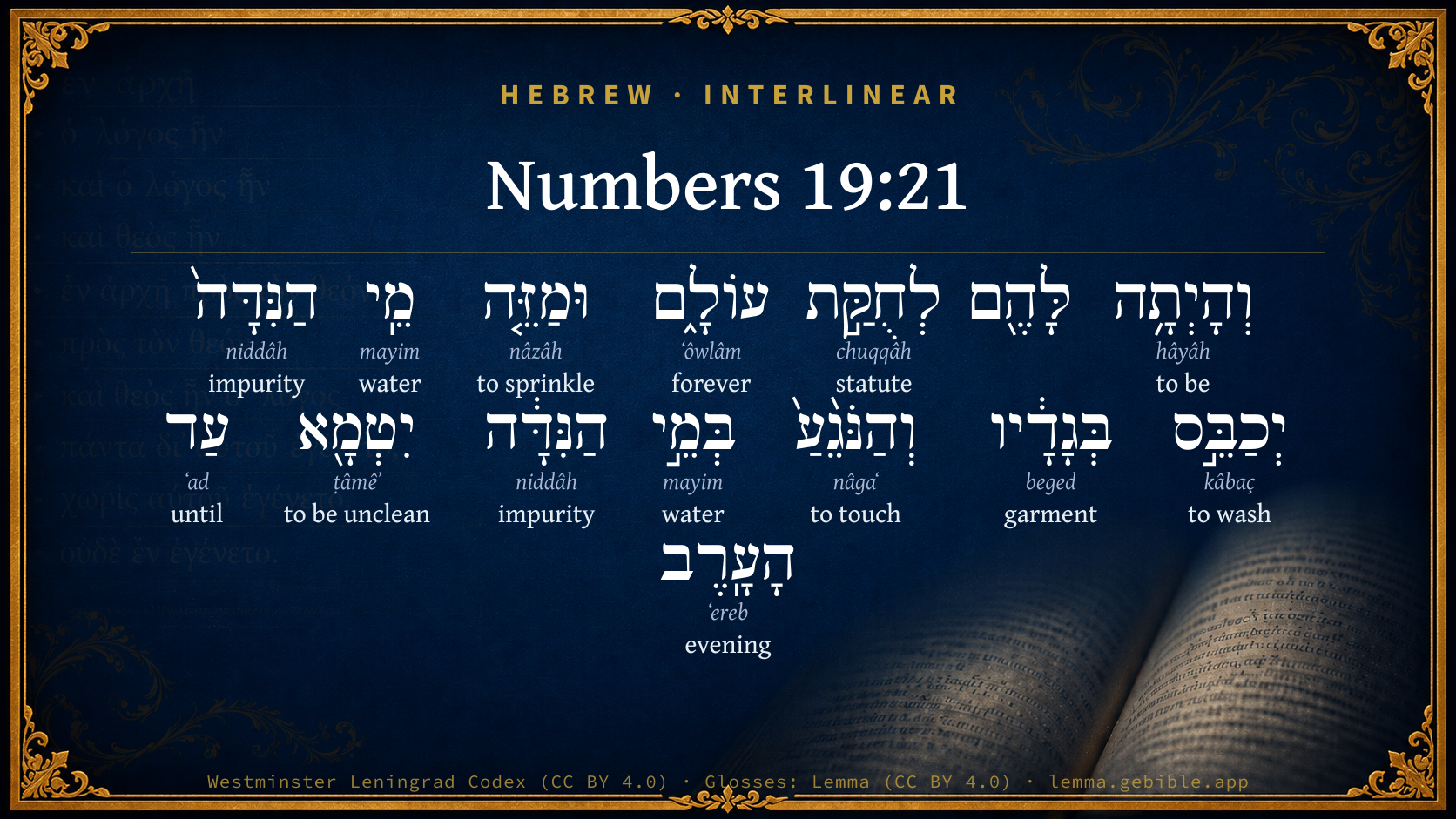
Hebrew (Westminster Leningrad Codex) Numbers 19:21 appears in the Hebrew Old Testament. The text above is from the Westminster Leningrad Codex. Each word links to its Strong’s number, a concise gloss, and parsing drawn from the Open Scriptures Hebrew Bible morphology. Click any word for its full Brown-Driver-Briggs (BDB) entry.
Download image
Cite this verse

Numbers 19:21 (World English Bible). Public Domain. Lemma interlinear Bible study tool, https://lemma.gebible.app/v/numbers/19/21.

Show BibTeX & RIS
BibTeX
RIS
English Translation
It shall be a perpetual statute to them: and he who sprinkles the water for impurity shall wash his clothes, and he who touches the water for impurity shall be unclean until even.
World English Bible · Public Domain
Download a study sheet

One document with this verse’s original text, its word-by-word gloss line, the meaning frame, cross-references with their text, attributed commentary, and full source and license credits — printable, and it pastes into notes with its structure intact.

This verse Autodidact and up

Study sheet (.html) Plain text (.txt)

A passage Seminary Student

Up to 50 verses in one chapter. A passage sheet keeps up to 6 commentary sources and 12 cross-references per verse, in the order this page ranks them, and says so on the sheet whenever that leaves anything out. Ask for a single verse and you get the Autodidact verse sheet above.

Everything on this page stays free to read, with no account — the sheet is a download of what is already on screen, not access to it.

Want to remove ads? Support Godless Engineer
Compare translations 3

The same verse in 3 English versions, stacked beneath the original-language interlinear above. Click any original word for its lexicon entry.

Each is an independent rendering of the whole verse — the interlinear is not word-aligned to these translations.

Highlighted words mark where these versions differ — a whole-verse word diff, not a word-by-word alignment.

  • World English Bible Public Domain
    It shall be a perpetual statute to them: and he who sprinkles the water for impurity shall wash his clothes, and he who touches the water for impurity shall be unclean until even.
  • King James Version Public Domain
    And it shall be a perpetual statute unto them, that he that sprinkleth the water of separation shall wash his clothes; and he that toucheth the water of separation shall be unclean until even.
  • unfoldingWord Literal Text CC BY-SA 4.0
    And it shall be for them as a statute of eternity. And the one sprinkling the water of impurity shall wash his garments, and the one touching the water of impurity shall be unclean until the evening.

unfoldingWord Literal Text — © unfoldingWord, licensed CC BY-SA 4.0. Word-aligned USFM3 via Door43 (git.door43.org/unfoldingWord/en_ult).

Versions to compare (up to 4)

3 of 4 selected

Show all 18 translations

Every available English version of this verse, each an independent rendering of the whole verse.

  • World English Bible Public Domain
    It shall be a perpetual statute to them: and he who sprinkles the water for impurity shall wash his clothes, and he who touches the water for impurity shall be unclean until even.
  • Berean Standard Bible Public Domain
    This is a permanent statute for the people: The one who sprinkles the water of purification must wash his clothes, and whoever touches the water of purification will be unclean until evening.
  • Majority Standard Bible Public Domain
    This is a permanent statute for the people: The one who sprinkles the water of purification must wash his clothes, and whoever touches the water of purification will be unclean until evening.
  • King James Version Public Domain
    And it shall be a perpetual statute unto them, that he that sprinkleth the water of separation shall wash his clothes; and he that toucheth the water of separation shall be unclean until even.
  • American Standard Version (1901) Public Domain
    And it shall be a perpetual statute unto them: and he that sprinkleth the water for impurity shall wash his clothes, and he that toucheth the water for impurity shall be unclean until even.
  • Revised Version (1885) Public Domain
    And it shall be a perpetual statute unto them: and he that sprinkleth the water of separation shall wash his clothes; and he that toucheth the water of separation shall be unclean until even.
  • Geneva Bible (1599) Public Domain
    And it shalbe a perpetual lawe vnto them, that he that sprinkleth the sprinkling water, shall wash his clothes: also hee that toucheth the sprinkling water, shalbe vncleane vntill euen.
  • Douay-Rheims (1899) Public Domain
    This precept shall be an ordinance for ever. He also that sprinkled the water, shall wash his garments. Every one that shall touch the waters of expiation, shall be unclean until the evening.
  • Young's Literal Translation Public Domain
    `And it hath been to them for a statute age-during, that he who is sprinkling the water of separation doth wash his garments, and he who is coming against the water of separation is unclean till the evening,
  • Literal Standard Version CC BY-SA 4.0
    And it has been for a continuous statute to them, that he who is sprinkling the water of separation washes his garments, and he who is coming against the water of separation is unclean until the evening,
  • Unlocked Literal Bible CC BY-SA 4.0
    This will be an ongoing law concerning these situations. The one who sprinkles the water for impurity must wash his clothes. The one who touches the water for impurity will become unclean until evening.
  • unfoldingWord Literal Text CC BY-SA 4.0
    And it shall be for them as a statute of eternity. And the one sprinkling the water of impurity shall wash his garments, and the one touching the water of impurity shall be unclean until the evening.
  • Darby Bible Public Domain
    And it shall be an everlasting statute unto them. And he that sprinkleth the water of separation shall wash his garments, and he that toucheth the water of separation shall be unclean until even.
  • World Messianic Bible Public Domain
    It shall be a perpetual statute to them. He who sprinkles the water for impurity shall wash his clothes, and he who touches the water for impurity shall be unclean until evening.
  • Webster's Bible Public Domain
    And it shall be a perpetual statute to them, that he that sprinkleth the water of separation shall wash his clothes; and he that toucheth the water of separation shall be unclean until the evening.
  • Free Bible Version CC BY-SA 4.0
    This is a permanent rule for everyone. The man who sprinkles the water of purification must wash his clothes, and anyone who touches the water of purification will be unclean until the evening.
  • Bible in Basic English Public Domain
    This is to be a law for them for ever: he who puts the water on the unclean person is to have his clothing washed; and anyone touching the water will be unclean till evening.
  • JPS Tanakh (1917) Public Domain
    And it shall be a perpetual statute unto them; and he that sprinkleth the water of sprinkling shall wash his clothes; and he that toucheth the water of sprinkling shall be unclean until even.

Literal Standard Version (2020), Covenant Press — licensed CC BY-SA 4.0. Text via the HelloAO Bible API (eBible.org). Unlocked Literal Bible (unfoldingWord) — licensed CC BY-SA 4.0. Text via the HelloAO Bible API (eBible.org). unfoldingWord Literal Text — © unfoldingWord, licensed CC BY-SA 4.0. Word-aligned USFM3 via Door43 (git.door43.org/unfoldingWord/en_ult). Free Bible Version, Dr. Jonathan Gallagher — licensed CC BY-SA 4.0. Text via the HelloAO Bible API (eBible.org).

Word by word

More ways to search: Search by grammar → Find every occurrence → Compare this word →

Practice this passage: Drill this verse → Learn its vocabulary →

וּמַזֵּ֤ה
nâzâh
H5137
“and · sprinkling”
Conjunction + Verb, Hiphil, Participle Active, Masculine, Singular, Construct
Part of Speech
Conjunction + Verb
Stem
Hiphil
Form
Participle Active
Gender
Masculine
Number
Singular
State
Construct
Full BDB Definition

Origin: a primitive root

TWOT: 1335 , 1336

to spurt, spatter, sprinkle - (Qal) to spurt, spatter - (Hiphil) to cause to spurt, sprinkle upon - to spring, leap - (Hiphil) to cause to leap, startle
  1. וְהָיְתָ֥ה hâyâh H1961 “and · to be” Conjunction + Verb, Qal, Sequential Perfect, 3rd Person, Feminine, Singular
  2. לְחֻקַּ֣ת chuqqâh H2708 “to/for · statute of” Preposition + Noun, Common, Both, Singular, Construct
  3. עוֹלָ֑ם ʻôwlâm H5769 “forever” Noun, Common, Masculine, Singular, Absolute
  4. מֵֽי mayim H4325 “water(s) of” Noun, Common, Masculine, Plural, Construct
  5. הַנִּדָּה֙ niddâh H5079 “the · impurity” Particle, Definite Article + Noun, Common, Feminine, Singular, Absolute
  6. יְכַבֵּ֣ס kâbaç H3526 “to wash” Verb, Piel, Imperfect, 3rd Person, Masculine, Singular
  7. בְּגָדָ֔יו beged H899 “garments · his” Noun, Common, Masculine, Plural, Construct + Suffix, Personal, 3rd Person, Masculine, Singular
  8. וְהַנֹּגֵ֨עַ֙ nâgaʻ H5060 “and · the · touching” Conjunction + Particle, Definite Article + Verb, Qal, Participle Active, Masculine, Singular, Absolute
  9. בְּמֵ֣י mayim H4325 “in/at · water(s) of” Preposition + Noun, Common, Masculine, Plural, Construct
  10. הַנִּדָּ֔ה niddâh H5079 “the · impurity” Particle, Definite Article + Noun, Common, Feminine, Singular, Absolute
  11. יִטְמָ֖א ṭâmêʼ H2930 “to be unclean” Verb, Qal, Imperfect, 3rd Person, Masculine, Singular
  12. עַד ʻad H5704 “until” Preposition
  13. הָעָֽרֶב ʻereb H6153 “the · evening” Particle, Definite Article + Noun, Common, Masculine, Singular, Absolute

About this verse

These counts appear in no published source. They are computed here, from the morphology-tagged text and Lemma’s own curated glosses. What Lemma adds →

15
words
12
distinct lemmas
Pentateuch
section

Notable vocabulary

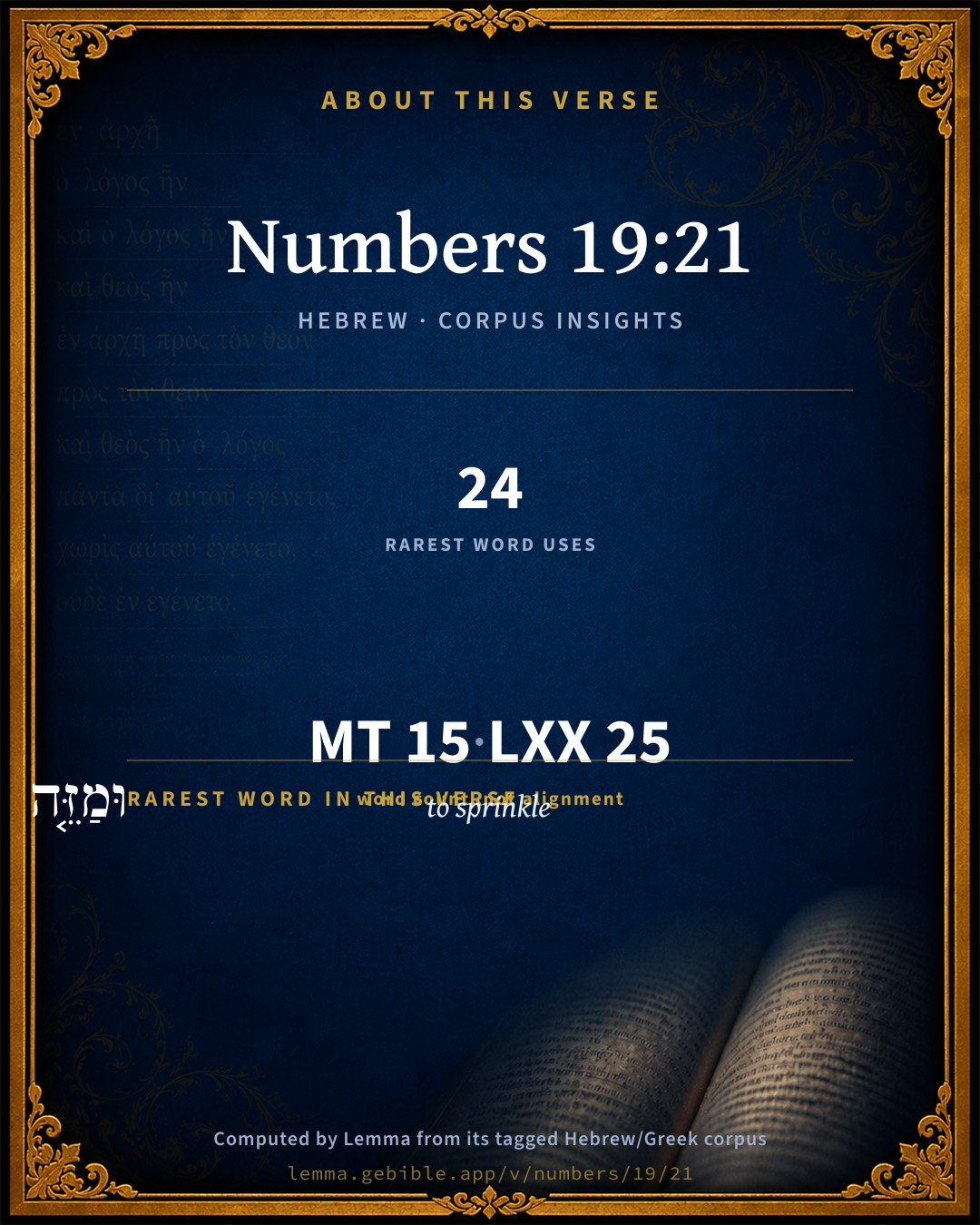
The rarest word here is וּמַזֵּ֤ה to sprinkle H5137 — appearing just 24 times in the whole Hebrew Bible.

Shared distinctive vocabulary

וּמַזֵּ֤ה to sprinkle H5137 occurs in 22 verses of the Hebrew Bible. Also found in:

Grammatical profile

  • 5 verbs
  • 8 nouns
  • 2 prepositions

Verb forms

  • וְהָיְתָ֥ה Qal · Sequential Perfect
  • וּמַזֵּ֤ה Hiphil · Participle Active
  • יְכַבֵּ֣ס Piel · Imperfect
  • וְהַנֹּגֵ֨עַ֙ Qal · Participle Active
  • יִטְמָ֖א Qal · Imperfect

Repetition

Words recur within this verse — often emphatic in Hebrew:

  • מֵֽי water H4325 ×2
  • הַנִּדָּה֙ impurity H5079 ×2

Hebrew & Septuagint length

In English translation the verse runs 33 words from the Hebrew and 34 from the Septuagint (LXX English) — closely comparable.

A rough comparison of the two English renderings, which tokenize alike — not a word-level alignment.

Word counts can differ between the Hebrew and the Greek without any difference in meaning — e.g. the Hebrew direct-object marker אֵת has no separate Greek word, and Greek often adds the article ὁ.

In the original languages it is 15 Hebrew tokens and 25 Greek tokens — but the two are counted differently (Hebrew bundles its prefixes and suffixes into one token; the Greek is in lemma form), so that isn’t a like-for-like length.

Cross-references

7

Topical passages linked to Numbers 19:21 in the Treasury of Scripture Knowledge — connected by theme and wording, ordered by reader-vote popularity; previews shown in the World English Bible.

  • Hebrews 9:13–14 For if the blood of goats and bulls, and the ashes of a heifer sprinkling those who have been defiled, sanctify to the cleanness of the flesh:
  • Hebrews 10:4 For it is impossible that the blood of bulls and goats should take away sins.
  • Leviticus 11:25 Whoever carries any part of their carcass shall wash his clothes, and be unclean until the evening.
  • Leviticus 11:40 He who eats of its carcass shall wash his clothes, and be unclean until the evening. He also who carries its carcass shall wash his clothes, and be unclean until the evening.
  • Leviticus 16:26–28 "He who lets the goat go for the scapegoat shall wash his clothes, and bathe his flesh in water, and afterward he shall come into the camp.
  • Hebrews 7:19 (for the law made nothing perfect), and a bringing in thereupon of a better hope, through which we draw near to God.
  • Hebrews 9:10 being only (with meats and drinks and various washings) fleshly ordinances, imposed until a time of reformation.

Cross-references courtesy of OpenBible.info (CC BY 4.0).

Hebrew and Greek witnesses Masoretic Hebrew ↔ Greek Septuagint

The same verse in the two great witnesses to the Old Testament, shown verse-for-verse.

These are two independent witnesses, not word-aligned to each other, and the Septuagint is shown in lemma (dictionary) form.

Hebrew Numbers 19:21 Masoretic · Westminster Leningrad Codex

וְהָיְתָ֥ה לָּהֶ֖ם לְחֻקַּ֣ת עוֹלָ֑ם וּמַזֵּ֤ה מֵֽי הַנִּדָּה֙ יְכַבֵּ֣ס בְּגָדָ֔יו וְהַנֹּגֵ֨עַ֙ בְּמֵ֣י הַנִּדָּ֔ה יִטְמָ֖א עַד הָעָֽרֶב

It shall be a perpetual statute to them: and he who sprinkles the water for impurity shall wash his clothes, and he who touches the water for impurity shall be unclean until even.

World English Bible · Public Domain

Greek LXX Numbers 19:21 Septuagint · lemma form

καί εἰμί σύ νόμιμος αἰώνιος καί ὁ περιῥαίνω ὕδωρ ῥαντισμός πλύνω ὁ ἱμάτιον αὐτός καί ὁ ἅπτομαι ὁ ὕδωρ ὁ ῥαντισμός ἀκάθαρτος εἰμί ἕως ἑσπέρα

And it shall be to you a perpetual statute; and he that sprinkles the water of sprinkling shall wash his garments; and he that touches the water of sprinkling shall be unclean until evening.

LXX2012 (modern English Septuagint) · Public Domain

Hebrew: Westminster Leningrad Codex (CC BY 4.0). Greek: Septuagint (public domain); English from LXX2012 (modern English Septuagint) (Public Domain). How the Septuagint differs from the Hebrew →

Targum (Aramaic paraphrase)

2

The Targum is the ancient Jewish Aramaic paraphrase of the Hebrew Scriptures — an interpretive translation, not the Hebrew text itself. Onkelos (literal) and Pseudo-Jonathan (expansive) render the Torah, and Jonathan the Prophets. Coverage is partial: where no permissively-licensed English translation exists for a verse, only the Aramaic is shown. This is verse-level text, not a word-by-word alignment to the Hebrew.

  1. Targum Onkelos Torah (Genesis–Deuteronomy)
    וּתְהֵי לְהוֹן לִקְיַם עֲלָם וּדְיַדֵי מֵי אַדָיוּתָא יְצַבַּע לְבוּשׁוֹהִי וּדְיִקְרַב בְּמֵי אַדָיוּתָא יְהֵי מְסָאָב עַד רַמְשָׁא

    (no public-domain English translation for this verse)

    Targum Onkelos — Aramaic: “Onkelos Genesis” (public domain); “Onkelos Exodus” (public domain); “Onkelos Leviticus” (public domain); “Onkelos Numbers” (public domain); “Onkelos Deuteronomy” (public domain). English: “Sefaria Community Translation” (CC0 1.0 (public-domain dedication)); “J.W. Etheridge. The Targums of Onkelos and Jonathan Ben Uzziel on the Pentateuch. London: Longmans, Green, 1862” (public domain). Text via Sefaria.

  2. Targum Pseudo-Jonathan Torah (Genesis–Deuteronomy)
    וּתְהֵי לְכוֹן לִקְיַים עֲלָם וּלְחוֹד כַּהֲנָא דְמַדֵי מֵי אַדְיוּתָא יְצַבַּע לְבוּשׁוֹי וּדְיִקְרַב בְּמֵי אַדְיוּתָא יְהֵי מְסָאָב עַד רַמְשָׁא

    And it shall be unto you an everlasting statute. The priest, also, who sprinkleth the water of sprinkling shall sprinkle his clothes, and he who toucheth the water of sprinkling shall be unclean until evening.

    Targum Pseudo-Jonathan — Aramaic: “Targum Jonathan on Genesis” (public domain); “Targum Jonathan on Exodus” (public domain); “Targum Jonathan on Leviticus” (public domain); “Targum Jonathan on Numbers” (public domain); “Targum Jonathan on Deuteronomy” (public domain). English: “The Targum of Jonathan ben Uzziel, trans. J. W. Etheridge, London, 1862” (public domain). Text via Sefaria.

Commentary

Notes on Numbers 19:21 from classic Christian and Jewish commentators (each source and its license shown beneath its notes). The classic Christian expositions comment on the surrounding passage and are grouped to its opening verse, so a note may address several verses; the Jewish commentaries on the Tanakh (Rashi and others) are per-verse, so they appear only where the commentator wrote on this verse.

Lemma curates 59 commentaries, every one of them public domain or Creative Commons licensed, each selected and text-cleaned for this edition rather than reprinted as found. About our sources →

Jamieson, Fausset & Brown

Robert Jamieson, A. R. Fausset & David Brown

he that sprinkleth . . . ; and he that toucheth the water of separation shall be unclean until even--The opposite effects ascribed to the water of separation--of cleansing one person and defiling another--are very singular, and not capable of very satisfactory explanation. One important lesson, however, was thus taught, that its purifying efficacy was not inherent in itself, but arose from the divine appointment, as in other ordinances of religion, which are effectual means of salvation, not from any virtue in them, or in him that administers them, but solely through the grace of God communicated thereby.

Next: Numbers Chapter 20

Jamieson, Fausset & Brown — Commentary Critical and Explanatory on the Whole Bible (1871) — public domain (CC PDM 1.0). Text via the HelloAO Bible API.

The Cambridge Bible for Schools and Colleges

gen. ed. J. J. S. Perowne

21. The man who sprinkles the sacred water becomes ‘unclean’; and in the next clause it is stated more generally that the man who touches it becomes unclean. The uncleanness in this case is slight; it lasts until the evening and can be removed by simply washing the clothes. Gray cites a Buddhist parallel from Max Müller, Sacred Books of the East, ii. 250. A close connexion existed in the Semitic mind between ‘uncleanness’ and ‘holiness.’ ‘Holiness’ or ‘sacredness’ was a contagious quality which debarred its possessor from ordinary intercourse with others until the contagion had been removed. Inanimate objects could also receive the contagion: see on Num_16:37.

The Cambridge Bible for Schools and Colleges (gen. ed. J. J. S. Perowne; Cambridge University Press, 1878–1918) — public domain. Text from a community e-Sword module.

John Gill's Exposition

And it shall be a perpetual statute unto them,.... To the children of Israel, throughout their generations, unto the coming of the Messiah, when the ceremonial law, which stood in divers washings and purifications, was abolished:

that he that sprinkleth the water of separation shall wash his clothes; the priest that sprinkled, according to the Targum of Jonathan, or any other person that did it; so that the same purifying water, which made an unclean person clean, defiled a clean one; for though it was purifying, it had uncleanness in it; having the ashes not only of the cow itself, but of its skin, blood, and dung; and so a lye made of ashes is impure in itself, and yet serves to scour cloth: Ainsworth thinks this signifies the imperfection and insufficiency of legal rites, which, in their greatest virtue, only sanctified to the purifying of the flesh, and left the purifier himself in uncleanness he had not before; by consideration of which, the people might be led to Christ, and his Spirit, for cleansing, Heb 9:13 but it rather signifies, that the blood of Christ, which cleanses from all sin, and answers to this purifying water, that its cleansing virtue is owing to Christ being made sin for his people; and that some may be instruments of directing souls to the blood of Christ for cleansing, and yet be defiled themselves: it does not appear that this man, thus unclean, was to have the water of purification sprinkled on him, but was only to wash his clothes; see Rev 7:14.

and he that toucheth the water of separation shall be unclean until even: but was not clean until he had washed, as Aben Ezra observes, though not expressed; for if one that only sprinkled it had need to be washed, much more one that touched it, and which was unavoidable, if, when he mixed the water and ashes together, he stirred them with his finger; see Gill on Num 19:17, though Maimonides (t) understands this of sprinkling and touching the water when there was no necessity for it, when a person was not employed in doing the duty of this law.

(t) Hilchot Parah Adumah, c. 15. sect. 1.

John Gill's Exposition of the Whole Bible (1746–1763) — public domain (CC PDM 1.0). Text via the HelloAO Bible API.

Haydock's Catholic Bible Commentary

Evening. The victims which were appointed for the expiation of sin, communicated a legal uncleanness to those who were employed about them. They were looked upon as so holy, that the most pure were guilty of a sort of irreverence by touching them. (Calmet)

George Leo Haydock (1774–1849), Haydock's Catholic Family Bible and Commentary, 1859 edition — public domain. Excludes Psalms (Douay-Rheims chapter numbering differs from Protestant) and Deuterocanonical books (Catholic canon only).

Matthew Poole's English Annotations

Shall wash his clothes, because he is unclean, as it here follows. It is strange that the same water should cleanse one person, and defile another; but God would have it so, partly, to teach us that it did not cleanse by any virtue in itself, or in the work done, but only by virtue of God’s appointment; partly, to mind the Jews of the imperfection of their priesthood, and their ritual purifications and expiations, and consequently of the necessity of a better priest and sacrifice and way of purifying, which these outward rites did point at; and partly, to show that the efficacy of God’s ordinances doth not depend upon the person or quality of his ministers, because the same person who was polluted himself could and did cleanse others.

He that toucheth the water of separation; either by sprinkling of it, or by being sprinkled with it; for even he that was cleansed by it, was not fully cleansed as soon as he was sprinkled, but only at the even of that day, as is said here and above, Num 19:19.

Matthew Poole's English Annotations on the Holy Bible (1683–1685) — public domain. Text from a community e-Sword/MySword module.

Whedon's Commentary on the Bible

Daniel D. Whedon

21, 22. It was to be a perpetual statute that he who sprinkled the water of separation, or even touched it, and the person defiled by the corpse-defiled person and the one polluted by his touch, should be unclean till evening. This rule applied to other forms of uncleanness. See Leviticus 15.

Daniel D. Whedon (gen. ed.), Commentary on the Old and New Testaments (1874–1909) — public domain. Text from a community e-Sword module.

The Pulpit Commentary

It shall be a perpetual statute. This formula usually emphasizes something of solemn importance. In this case, as apparently above in verse 10, the regulations thus enforced might seem of trifling moment. But the whole design of this ordinance, down to its minutest detail, was to stamp upon physical death a far-reaching power of defiling and separating from God, which extended even to the very means Divinely appointed as a remedy. The Jew, whose religious feelings were modeled upon this law, must have felt himself entangled in the meshes of a net so widely cast about him that he could hardly quite escape it by extreme caution and multiplied observances; he might indeed exclaim, unless habit hardened him to it, "Who shall deliver me from the body of this death?"

The Pulpit Commentary (1880–1919), ed. H.D.M. Spence-Jones & Joseph S. Exell — public domain. Text from a community e-Sword module.

John Wesley's Explanatory Notes

Shall wash his clothes - Because he is unclean. It is strange, that the same water should cleanse one person, and defile another. But God would have it so, to teach us that it did not cleanse by any virtue in itself, or in the work done, but only by virtue of God's appointment: to mind the laws of the imperfection of their priesthood, and their ritual purifications and expiations, and consequently of the necessity of a better priest and sacrifice and way of purifying; and to shew that the efficacy of God's ordinances doth not depend upon the person or quality of his ministers, because the same person who, was polluted himself could and did cleanse others. He that toucheth the water - Either by sprinkling of it, or by being sprinkled with it; for even he that was cleansed by it, was not fully cleansed as soon as he was sprinkled, but only at the even of that day.

John Wesley, Explanatory Notes Upon the Whole Bible (1754–1765) — public domain. Text via the GEBible commentary corpus.

Rashi

Rabbi Shlomo Yitzchaki (Rashi)

ומזה מי הנדה AND HE THAT SPRINKLED THE WATER OF SPRINKLING [SHALL WASH HIS GARMENTS] — Our Rabbis said that the one who sprinkles remains clean, and this statement is intended to intimate that one who bears the waters of purification becomes unclean with a more stringent uncleanness, in that he renders unclean the garments that are upon him (for it states here that he shall wash his garments), which is not so in the case of one who only touches these waters. And this fact that it here expresses it (the idea of “bearing the waters”) by the term “he that sprinkles” is only to tell you that they (the waters) do not render a person who bears them unclean unless they contain a quantity capable of being sprinkled (Yoma 14a).

והנגע…יטמא AND HE THAT TOUCHETH … SHALL BE UNCLEAN, but does not require washing of his garments.

Rashi on the Tanakh — English translations: “The Judaica Press complete Tanach with Rashi, translated by A. J. Rosenberg” (CC BY 4.0); “Pentateuch with Rashi's commentary by M. Rosenbaum and A.M. Silbermann, 1929-1934” (public domain); “The Metsudah Tanach series, Lakewood, N.J” (CC BY 4.0); and “The Book of Joshua, Metsudah Publications, 1997” (CC BY 4.0). Text via Sefaria.

Lesson kit

Teaching starters — assembled from the data on this page, not authored interpretation. Every prompt links to the verse data it draws on. Edit before teaching.

Numbers, in the Pentateuch, opens this verse with 15 words (12 distinct Hebrew lemmas). Its most distinctive word is nâzâh (“to sprinkle”). A historical commentator’s framing appears above. Read the whole chapter for the surrounding context.

Discussion questions

  1. What does “to sprinkle” (nâzâh) contribute to the verse as a whole?
  2. How does Exodus 29:21, which shares the word «to sprinkle», read alongside this verse?
  3. What does the repetition of “water” (2× in this one verse) do in this verse?
  4. These translations render this verse differently. What is at stake in choosing one wording over another?
  5. «וְהָיְתָ֥ה» is a Qal Sequential Perfect verb. How does that grammatical form shape the action described?
  6. Compare how Jamieson, Fausset & Brown and The Cambridge Bible for Schools and Colleges read this verse. Where do they agree or differ?

Things to notice

Reading settings

Reading text

Shown beneath each verse's original-language words.

Old Testament
Old Testament edition

Read the OT as the Masoretic Hebrew (MT) or the Greek Septuagint (LXX).

English shown for the Greek Septuagint (in the Hebrew ↔ Greek comparison).

Comparing translations? Open the Compare panel on any verse page to stack up to four side by side.