
Exodus 29:5

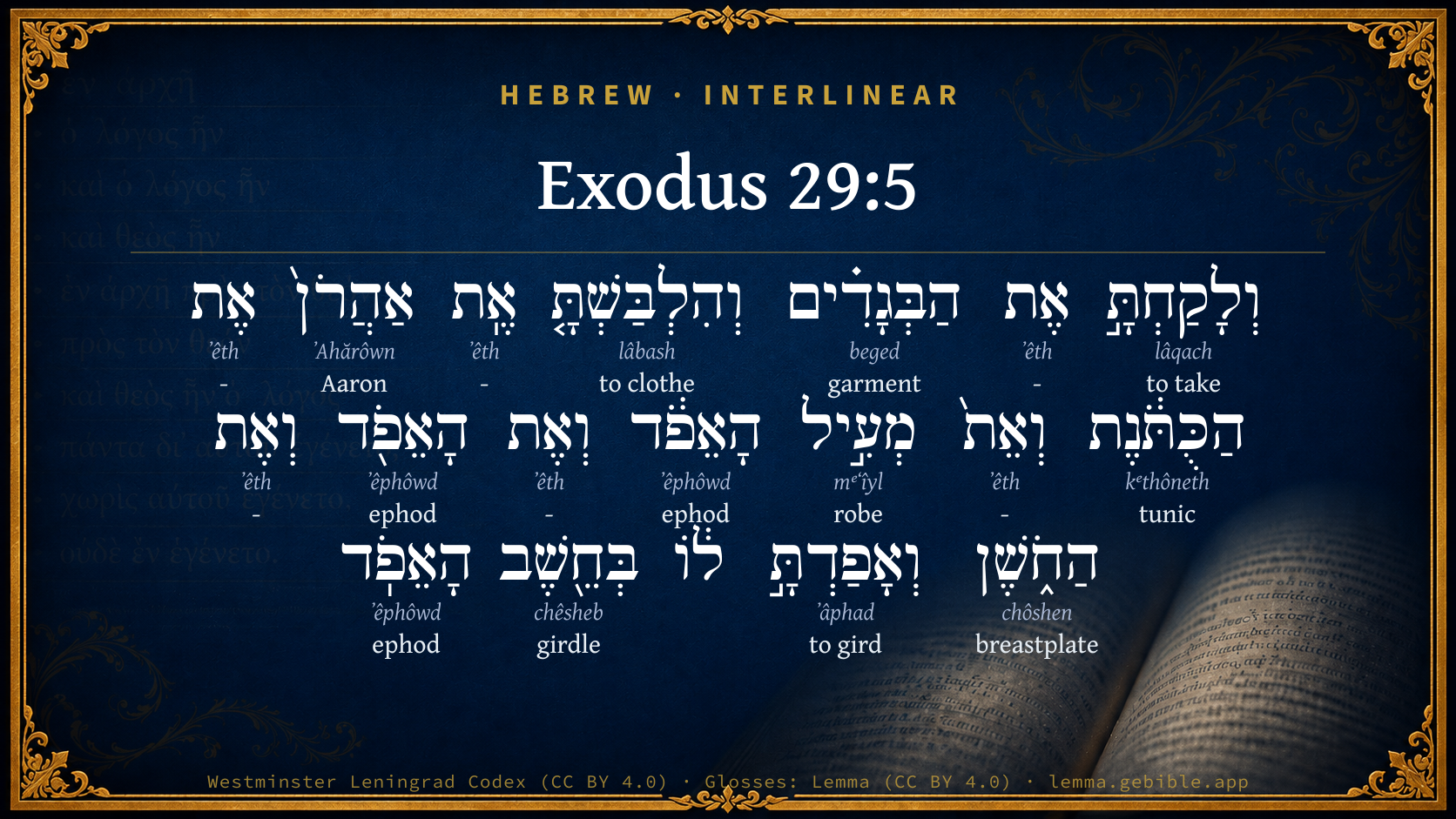
Hebrew (Westminster Leningrad Codex) Exodus 29:5 appears in the Hebrew Old Testament. The text above is from the Westminster Leningrad Codex. Each word links to its Strong’s number, a concise gloss, and parsing drawn from the Open Scriptures Hebrew Bible morphology. Click any word for its full Brown-Driver-Briggs (BDB) entry.
Download image
Cite this verse

Exodus 29:5 (World English Bible). Public Domain. Lemma interlinear Bible study tool, https://lemma.gebible.app/v/exodus/29/5.

Show BibTeX & RIS
BibTeX
RIS
English Translation
You shall take the garments, and put on Aaron the coat, the robe of the ephod, the ephod, and the breastplate, and dress him with the skillfully woven band of the ephod;
World English Bible · Public Domain
Highlights
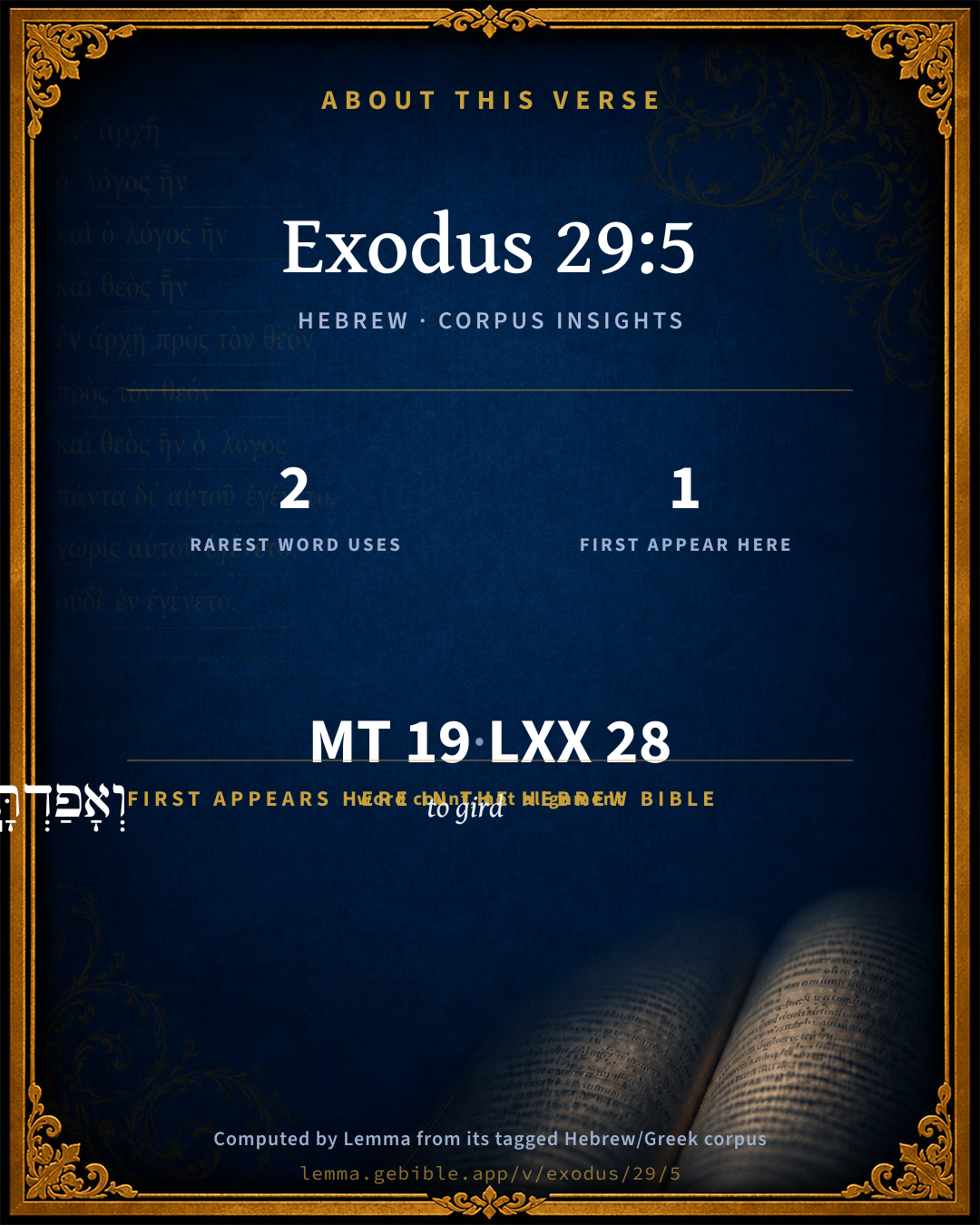
  • 1 first appearance in the Hebrew Bible
Full analysis ↓
Download a study sheet

One document with this verse’s original text, its word-by-word gloss line, the meaning frame, cross-references with their text, attributed commentary, and full source and license credits — printable, and it pastes into notes with its structure intact.

This verse Autodidact and up

Study sheet (.html) Plain text (.txt)

A passage Seminary Student

Up to 50 verses in one chapter. A passage sheet keeps up to 6 commentary sources and 12 cross-references per verse, in the order this page ranks them, and says so on the sheet whenever that leaves anything out. Ask for a single verse and you get the Autodidact verse sheet above.

Everything on this page stays free to read, with no account — the sheet is a download of what is already on screen, not access to it.

Want to remove ads? Support Godless Engineer
Compare translations 3

The same verse in 3 English versions, stacked beneath the original-language interlinear above. Click any original word for its lexicon entry.

Each is an independent rendering of the whole verse — the interlinear is not word-aligned to these translations.

Highlighted words mark where these versions differ — a whole-verse word diff, not a word-by-word alignment.

  • World English Bible Public Domain
    You shall take the garments, and put on Aaron the coat, the robe of the ephod, the ephod, and the breastplate, and dress him with the skillfully woven band of the ephod;
  • King James Version Public Domain
    And thou shalt take the garments, and put upon Aaron the coat, and the robe of the ephod, and the ephod, and the breastplate, and gird him with the curious girdle of the ephod:
  • unfoldingWord Literal Text CC BY-SA 4.0
    And you shall take the garments, and you shall clothe Aaron with the tunic and the robe of the ephod and the ephod and the breastpiece, and you shall fasten the ephod to him with the finely woven waistband of the ephod.

unfoldingWord Literal Text — © unfoldingWord, licensed CC BY-SA 4.0. Word-aligned USFM3 via Door43 (git.door43.org/unfoldingWord/en_ult).

Versions to compare (up to 4)

3 of 4 selected

Show all 18 translations

Every available English version of this verse, each an independent rendering of the whole verse.

  • World English Bible Public Domain
    You shall take the garments, and put on Aaron the coat, the robe of the ephod, the ephod, and the breastplate, and dress him with the skillfully woven band of the ephod;
  • Berean Standard Bible Public Domain
    Take the garments and clothe Aaron with the tunic, the robe of the ephod, the ephod itself, and the breastplate. Fasten the ephod on him with its woven waistband.
  • Majority Standard Bible Public Domain
    Take the garments and clothe Aaron with the tunic, the robe of the ephod, the ephod itself, and the breastplate. Fasten the ephod on him with its woven waistband.
  • King James Version Public Domain
    And thou shalt take the garments, and put upon Aaron the coat, and the robe of the ephod, and the ephod, and the breastplate, and gird him with the curious girdle of the ephod:
  • American Standard Version (1901) Public Domain
    And thou shalt take the garments, and put upon Aaron the coat, and the robe of the ephod, and the ephod, and the breastplate, and gird him with the skilfully woven band of the ephod;
  • Revised Version (1885) Public Domain
    And thou shalt take the garments, and put upon Aaron the coat, and the robe of the ephod, and the ephod, and the breastplate, and gird him with the cunningly woven band of the ephod:
  • Geneva Bible (1599) Public Domain
    Also thou shalt take the garments, and put vpon Aaron the tunicle, and the robe of the Ephod, and the Ephod, and the brest plate, and shalt close them to him with the broidred garde of the Ephod.
  • Douay-Rheims (1899) Public Domain
    Thou shalt clothe Aaron with his vestments, that is, with the linen garment and the tunick, and the ephod and the rational, which thou shalt gird with the girdle.
  • Young's Literal Translation Public Domain
    and thou hast taken the garments, and hast clothed Aaron with the coat, and the upper robe of the ephod, and the ephod, and the breastplate, and hast girded him with the girdle of the ephod,
  • Literal Standard Version CC BY-SA 4.0
    and you have taken the garments, and have clothed Aaron with the coat, and the upper robe of the ephod, and the ephod, and the breastplate, and have girded him with the girdle of the ephod,
  • Unlocked Literal Bible CC BY-SA 4.0
    You must take the garments and clothe Aaron with the coat, the robe of the ephod, the ephod, and the breastpiece, fastening the finely-woven waistband of the ephod around him.
  • unfoldingWord Literal Text CC BY-SA 4.0
    And you shall take the garments, and you shall clothe Aaron with the tunic and the robe of the ephod and the ephod and the breastpiece, and you shall fasten the ephod to him with the finely woven waistband of the ephod.
  • Darby Bible Public Domain
    And thou shalt take the garments, and clothe Aaron with the vest, and the cloak of the ephod, and the ephod, and the breastplate, and shalt gird him with the girdle of the ephod.
  • World Messianic Bible Public Domain
    You shall take the garments, and put on Aaron the tunic, the robe of the ephod, the ephod, and the breastplate, and clothe him with the skillfully woven band of the ephod.
  • Webster's Bible Public Domain
    And thou shalt take the garments, and put upon Aaron, the coat, and the robe of the ephod, and the ephod, and the breast-plate, and gird him with the curious girdle of the ephod:
  • Free Bible Version CC BY-SA 4.0
    Take the clothes and put them on Aaron: the tunic, the robe of the ephod, the ephod itself, and the breastpiece. Tie the ephod on him with its waistband.
  • Bible in Basic English Public Domain
    Take the robes, and put the coat and the dress and the ephod and the priest's bag on Aaron; put the band of needlework round him,
  • JPS Tanakh (1917) Public Domain
    And thou shalt take the garments, and put upon Aaron the tunic, and the robe of the ephod, and the ephod, and the breastplate, and gird him with the skilfully woven band of the ephod.

Literal Standard Version (2020), Covenant Press — licensed CC BY-SA 4.0. Text via the HelloAO Bible API (eBible.org). Unlocked Literal Bible (unfoldingWord) — licensed CC BY-SA 4.0. Text via the HelloAO Bible API (eBible.org). unfoldingWord Literal Text — © unfoldingWord, licensed CC BY-SA 4.0. Word-aligned USFM3 via Door43 (git.door43.org/unfoldingWord/en_ult). Free Bible Version, Dr. Jonathan Gallagher — licensed CC BY-SA 4.0. Text via the HelloAO Bible API (eBible.org).

Word by word

More ways to search: Search by grammar → Find every occurrence → Compare this word →

Practice this passage: Drill this verse → Learn its vocabulary →

וְאָפַדְתָּ֣
ʼâphad
H640
“and · to gird”
Conjunction + Verb, Qal, Sequential Perfect, 2nd Person, Masculine, Singular
Part of Speech
Conjunction + Verb
Stem
Qal
Form
Sequential Perfect
Person
2nd Person
Gender
Masculine
Number
Singular
Full BDB Definition

Origin: a primitive root [rather a denominative from H646 ]

TWOT: 142 . 1

(Qal) bind, gird - to gird on (ephod) - (TWOT) ephod
  1. וְלָקַחְתָּ֣ lâqach H3947 “and · to take” Conjunction + Verb, Qal, Sequential Perfect, 2nd Person, Masculine, Singular
  2. אֶת ʼêth H853 “-” Particle, Direct Object
  3. הַבְּגָדִ֗ים beged H899 “the · garments” Particle, Definite Article + Noun, Common, Masculine, Plural, Absolute
  4. וְהִלְבַּשְׁתָּ֤ lâbash H3847 “and · to clothe” Conjunction + Verb, Hiphil, Sequential Perfect, 2nd Person, Masculine, Singular
  5. אֶֽת ʼêth H853 “-” Particle, Direct Object
  6. אַהֲרֹן֙ ʼAhărôwn H175 “Aaron” Noun, Proper
  7. אֶת ʼêth H853 “-” Particle, Direct Object
  8. הַכֻּתֹּ֔נֶת kᵉthôneth H3801 “the · tunic” Particle, Definite Article + Noun, Common, Feminine, Singular, Absolute
  9. וְאֵת֙ ʼêth H853 “and · -” Conjunction + Particle, Direct Object
  10. מְעִ֣יל mᵉʻîyl H4598 “robe of” Noun, Common, Masculine, Singular, Construct
  11. הָאֵפֹ֔ד ʼêphôwd H646 “the · ephod” Particle, Definite Article + Noun, Common, Masculine, Singular, Absolute
  12. וְאֶת ʼêth H853 “and · -” Conjunction + Particle, Direct Object
  13. הָאֵפֹ֖ד ʼêphôwd H646 “the · ephod” Particle, Definite Article + Noun, Common, Masculine, Singular, Absolute
  14. וְאֶת ʼêth H853 “and · -” Conjunction + Particle, Direct Object
  15. הַחֹ֑שֶׁן chôshen H2833 “the · breastplate” Particle, Definite Article + Noun, Common, Masculine, Singular, Absolute
  16. בְּחֵ֖שֶׁב chêsheb H2805 “in/at · girdle of” Preposition + Noun, Common, Masculine, Singular, Construct
  17. הָאֵפֹֽד ʼêphôwd H646 “the · ephod” Particle, Definite Article + Noun, Common, Masculine, Singular, Absolute

About this verse

These counts appear in no published source. They are computed here, from the morphology-tagged text and Lemma’s own curated glosses. What Lemma adds →

19
words
11
distinct lemmas
Pentateuch
section

Notable vocabulary

The rarest word here is וְאָפַדְתָּ֣ to gird H640 — appearing just 2 times in the whole Hebrew Bible.

First appearance in Scripture

This word makes its first canonical appearance in the Hebrew Bible here:

  • וְאָפַדְתָּ֣ to gird H640

Shared distinctive vocabulary

וְאָפַדְתָּ֣ to gird H640 occurs in 2 verses of the Hebrew Bible. Also found in:

Grammatical profile

  • 3 verbs
  • 9 nouns
  • 1 preposition
  • 6 particles

Verb forms

  • וְלָקַחְתָּ֣ Qal · Sequential Perfect
  • וְהִלְבַּשְׁתָּ֤ Hiphil · Sequential Perfect
  • וְאָפַדְתָּ֣ Qal · Sequential Perfect

Repetition

A word recurs within this verse — often emphatic in Hebrew:

  • הָאֵפֹ֔ד ephod H646 ×3

Hebrew & Septuagint length

In English translation the verse runs 32 words from the Hebrew and 33 from the Septuagint (LXX English) — closely comparable.

A rough comparison of the two English renderings, which tokenize alike — not a word-level alignment.

Word counts can differ between the Hebrew and the Greek without any difference in meaning — e.g. the Hebrew direct-object marker אֵת has no separate Greek word, and Greek often adds the article ὁ.

In the original languages it is 19 Hebrew tokens and 28 Greek tokens — but the two are counted differently (Hebrew bundles its prefixes and suffixes into one token; the Greek is in lemma form), so that isn’t a like-for-like length.

Cross-references

2

Topical passages linked to Exodus 29:5 in the Treasury of Scripture Knowledge — connected by theme and wording, ordered by reader-vote popularity; previews shown in the World English Bible.

  • Exodus 28:2–8 You shall make holy garments for Aaron your brother, for glory and for beauty.
  • Leviticus 8:7–8 He put the coat on him, tied the sash on him, clothed him with the robe, put the ephod on him, and he tied the skillfully woven band of the ephod on him, and fastened it to him with it.

Cross-references courtesy of OpenBible.info (CC BY 4.0).

Hebrew and Greek witnesses Masoretic Hebrew ↔ Greek Septuagint

The same verse in the two great witnesses to the Old Testament, shown verse-for-verse.

These are two independent witnesses, not word-aligned to each other, and the Septuagint is shown in lemma (dictionary) form.

Hebrew Exodus 29:5 Masoretic · Westminster Leningrad Codex

וְלָקַחְתָּ֣ אֶת הַבְּגָדִ֗ים וְהִלְבַּשְׁתָּ֤ אֶֽת אַהֲרֹן֙ אֶת הַכֻּתֹּ֔נֶת וְאֵת֙ מְעִ֣יל הָאֵפֹ֔ד וְאֶת הָאֵפֹ֖ד וְאֶת הַחֹ֑שֶׁן וְאָפַדְתָּ֣ ל֔וֹ בְּחֵ֖שֶׁב הָאֵפֹֽד

You shall take the garments, and put on Aaron the coat, the robe of the ephod, the ephod, and the breastplate, and dress him with the skillfully woven band of the ephod;

World English Bible · Public Domain

Greek LXX Exodus 29:5 Septuagint · lemma form

καί λαμβάνω ὁ στολή ἐνδύω ααρων ὁ ἀδελφός σύ καί ὁ χιτών ὁ ποδήρης καί ὁ ἐπωμίς καί ὁ λογεῖον καί συνἅπτω αὐτός ὁ λογεῖον πρός ὁ ἐπωμίς

And having taken the garments, you shall put on Aaron your brother both the full-length robe and the ephod and the oracle; and you shall join for him the oracle to the ephod.

LXX2012 (modern English Septuagint) · Public Domain

On this verse, Haydock's Catholic Bible Commentary discusses the Septuagint’s reading. Read the note in Commentary ↓

Hebrew: Westminster Leningrad Codex (CC BY 4.0). Greek: Septuagint (public domain); English from LXX2012 (modern English Septuagint) (Public Domain). How the Septuagint differs from the Hebrew →

Targum (Aramaic paraphrase)

2

The Targum is the ancient Jewish Aramaic paraphrase of the Hebrew Scriptures — an interpretive translation, not the Hebrew text itself. Onkelos (literal) and Pseudo-Jonathan (expansive) render the Torah, and Jonathan the Prophets. Coverage is partial: where no permissively-licensed English translation exists for a verse, only the Aramaic is shown. This is verse-level text, not a word-by-word alignment to the Hebrew.

  1. Targum Onkelos Torah (Genesis–Deuteronomy)
    וְתִסַב יָת לְבוּשַׁיָא וְתַלְבֵּשׁ יָת אַהֲרֹן יָת כִּתּוּנָא וְיָת מְעִיל אֵפוֹדָא וְיָת אֵפוֹדָא וְיָת חוּשְׁנָא וְתַתְקֵן לֵהּ בְּהֶמְיַן אֵפוֹדָא:

    (no public-domain English translation for this verse)

    Targum Onkelos — Aramaic: “Onkelos Genesis” (public domain); “Onkelos Exodus” (public domain); “Onkelos Leviticus” (public domain); “Onkelos Numbers” (public domain); “Onkelos Deuteronomy” (public domain). English: “Sefaria Community Translation” (CC0 1.0 (public-domain dedication)); “J.W. Etheridge. The Targums of Onkelos and Jonathan Ben Uzziel on the Pentateuch. London: Longmans, Green, 1862” (public domain). Text via Sefaria.

  2. Targum Pseudo-Jonathan Torah (Genesis–Deuteronomy)
    וְתִסַב יַת לְבוּשַׁיָא וְתַלְבֵּישׁ יַת אַהֲרן יַת כִּיתּוּנָא וְיַת מִנְטַר מְעִיל אֵפוֹדָא וְיַת אֵפוֹדָא וְיַת חוּשְׁנָא וּתְטַכֵּס יָתֵיהּ בְּהֶמְיַין אֵפוֹדָא

    And thou shalt take the vestments, and clothe Aharon with the tunic, and the robe of the ephod, and the ephod, and the breastplate, and gird him (or ordain him) with the girdle of the ephod.

    Targum Pseudo-Jonathan — Aramaic: “Targum Jonathan on Genesis” (public domain); “Targum Jonathan on Exodus” (public domain); “Targum Jonathan on Leviticus” (public domain); “Targum Jonathan on Numbers” (public domain); “Targum Jonathan on Deuteronomy” (public domain). English: “The Targum of Jonathan ben Uzziel, trans. J. W. Etheridge, London, 1862” (public domain). Text via Sefaria.

Commentary

Notes on Exodus 29:5 from classic Christian and Jewish commentators (each source and its license shown beneath its notes). The classic Christian expositions comment on the surrounding passage and are grouped to its opening verse, so a note may address several verses; the Jewish commentaries on the Tanakh (Rashi and others) are per-verse, so they appear only where the commentator wrote on this verse.

Lemma curates 59 commentaries, every one of them public domain or Creative Commons licensed, each selected and text-cleaned for this edition rather than reprinted as found. About our sources →

Joseph Benson's Commentary

Exo 29:5. They shalt take the garments, &c. — This was to signify that it was not sufficient for them to put away the pollutions of sin, but that they must put on divine graces, and be clothed with righteousness, Psa 132:10. They must also be girded, as men prepared and strengthened for their work, and they must be robed and crowned, as men that counted their work and office their true honour.

Joseph Benson's Commentary on the Old and New Testaments (1811–1818) — public domain. Text from a community e-Sword module.

Geneva Bible (1599)

Geneva Bible translators

Which was next under the Ephod.

Geneva Bible (1599) marginal notes — public domain. Text via Bolls.life.

Adam Clarke's Commentary

Verse 5. Thou shalt take the garments] As most offices of spiritual and secular dignity had appropriate habits and insignia, hence, when a person was appointed to an office and habited for the purpose, he was said to be invested with that office, from in, used intensively, and vestio, I clothe, because he was then clothed with the vestments peculiar to that office.

Adam Clarke's Commentary on the Bible (1810–1826) — public domain. Text from a community e-Sword/MySword module.

Ellicott's Commentary for English Readers

(5) Thou shalt take the garments—i.e., those described in the preceding chapter.

The coat—i.e., the linen tunic (Exo_28:39). As the inner garment, this had to be put on first. Comp. Lev_8:7-9, where the investiture is more fully described, and is seen to have comprised nine acts:—(1) The putting on of the tunic; (2) The girding of the tunic with the under-girdle; (3) The putting on of the robe of the ephod; (4) The putting on of the ephod; (5) Girding with the curious girdle of the ephod; (6) The putting on of the breastplate; (7) The putting of the Urim and Thummim into the bag of the breastplate; (8) The putting on of the mitre; and (9) The attachment of the golden plate to the front of the mitre. These minute directions may well be regarded as justifying those given in our own Ordinal with respect to the vesting of bishops at the time of their consecration.

A Bible Commentary for English Readers, edited by Charles John Ellicott (1878–1897) — public domain. Text from a community e-Sword module.

The Cambridge Bible for Schools and Colleges

gen. ed. J. J. S. Perowne

5. the coat] the tunic (Exo_28:39). After the tunic, the sash seems to have been accidentally omitted: see Lev_8:7 (EVV. ‘girdle’).

the breastplate] the pouch: Exo_28:15 ff.

and fasten (it) to him with the band of the ephod] see on Exo_28:8. The verb rendered ‘fasten’ is formed from ‘ephod,’ and means only to fit or fasten as an ephod. In Lev_8:7 rendered bound, which, however, connects it incorrectly with the preceding ‘band.’

5–7. The investiture and anointing of the high priest. The high priest is to be arrayed in the garments described in ch. 28, and then to have his head anointed. Cf. Lev_8:7-10 a, 12 (vv. 10b–11, relating to the anointing of the Dwelling, altar, &c., have no parallel in Exodus 29, and seem out of place).

The Cambridge Bible for Schools and Colleges (gen. ed. J. J. S. Perowne; Cambridge University Press, 1878–1918) — public domain. Text from a community e-Sword module.

John Gill's Exposition

And thou shall take the garments,.... The priestly garments before ordered to be made, and when made:

and put upon Aaron the coat: the broidered coat, the coat of fine linen, which was put on first and was next to his flesh, for all these garments were put on in the order in which they are here placed:

and the robe of the ephod: which was all of blue, and had pomegranates and golden bells at the hem of it; this was put over the broidered coat:

and the ephod; which was made of gold, blue, purple, scarlet, and fine twined linen: this was a short garment put over the robe of the ephod:

and the breastplate; with the Urim and Thummim in it, or the twelve precious stones on which were engraven the names of the twelve tribes of Israel, which hung down over the breast by wreathen chains of gold, from the shoulder pieces of the ephod:

and gird him with the curious girdle of the ephod; which was made of the same material and after the same manner as the ephod itself, and which girt all his garments tight and close to him; the significance of these has been observed already; and unless thus clothed he could not minister in his office, and these he had only on while ministering in it: no mention is made of the breeches, because these were doubtless to be put on by the high priest himself in a private manner before he came there; whereas all these garments were put on him publicly at the door of the tabernacle of the congregation, where it would not have been so seemly and decent to put on the other.

John Gill's Exposition of the Whole Bible (1746–1763) — public domain (CC PDM 1.0). Text via the HelloAO Bible API.

Haydock's Catholic Bible Commentary

Vestments. No mention is made of breeches, because they had them on, while they were washing. (Ven. Bede) --- Belt. Septuagint have read esson, instead of chesheb. "Thou shalt tie the rational to the ephod." (Calmet)

George Leo Haydock (1774–1849), Haydock's Catholic Family Bible and Commentary, 1859 edition — public domain. Excludes Psalms (Douay-Rheims chapter numbering differs from Protestant) and Deuterocanonical books (Catholic canon only).

Matthew Poole's English Annotations

Not about the loins, but about the paps, or breast, as Christ and his ministers are represented, Rev 1:13. The linen breeches are here omitted, because they were put on privately before they came to the door of the tabernacle, where the other things were put on.

Matthew Poole's English Annotations on the Holy Bible (1683–1685) — public domain. Text from a community e-Sword/MySword module.

Whedon's Commentary on the Bible

Daniel D. Whedon

5, 6. The garments — These, so fully described in the foregoing chapter, were to be formally placed upon the priest’s person as a part of the ceremony of consecration. Comp. Lev_8:7-9.

The holy crown — The graven plate of gold described in Exo_28:36-38; Exo_39:30-31.

Daniel D. Whedon (gen. ed.), Commentary on the Old and New Testaments (1874–1909) — public domain. Text from a community e-Sword module.

The Pulpit Commentary

Vers. 5, 6. The Investiture of Aaron.

Thou shalt take the garments. The directions, as here given, are incomplete, and not quite in the right order. In the LXX they are still more incomplete. For the full process of investiture, we mast look to Lev_8:7-9. There we find that the process included nine acts.

1. The putting on of the linen tunic.

2. The girding with the under-girdle.

3. The putting on of the robe of the ephod.

4. The putting on of the ephod.

5. The girding with the curious girdle of the ephod.

6. The putting on of the breast-plate.

7. The putting into the breast-plate of the Urim and Thummim.

8. The putting on of the mitre.

9. The affixing to the mitre of the golden plate.

The second and seventh are omitted here; and the order of the fifth and sixth is inverted.

The Pulpit Commentary (1880–1919), ed. H.D.M. Spence-Jones & Joseph S. Exell — public domain. Text from a community e-Sword module.

Scofield Reference Notes

C. I. Scofield

garments

The priest’s garments were put on in reverse order of the instructions for making them:

(1) The "coat" Exo 28:39 the oriental long garment worn next to the person, made of fine linen. Exo 27:9.

(2) The "robe of the ephod" Exo 28:31-35 a long seamless garment of blue linen with an opening for the head, worn over the "coat." Pomegranates, symbol of fruitfulness, were embroidered on the skirt of the robe in blue, purple, and scarlet, alternated with golden bells, symbol of testimony, which gave a sound as the high priest went in and out of the sanctuary. The robe was secured by a golden girdle.

(3) The ephod Exo 28:5-12 was next put on. A short garment made of linen, embroidered with gold, blue, purple, and scarlet, it consisted of two pieces, front and back, united by two shoulder-pieces and by a band about the bottom. Two onyx stones, set in gold and fastened upon the shoulder-pieces of the ephod, were engraved with the names of the twelve tribes: "and Aaron shall bear their names before Jehovah upon his two shoulders (the place of strength) for a memorial." Cf.; Isa 9:6; Luk 15:4; Luk 15:5.

(4) The breastplate was a square pouch Exo 28:16 of linen to contain the Urim and Thummim. (See Scofield "Exo 28:30").

To the linen pouch was attached the oblong gold setting containing four rows of precious stones, on each stone a tribal name. The breastplate with the jewel work was attached at the upper corners to the shoulder-pieces of the ephod by golden chains. Golden rings were sewn on ephod and breastplate, and the latter was further secured to the ephod by laces of blue through the rings. Altogether, it was called "the breastplate of judgment" because worn by the high priest when judging the causes of the people. (See Scofield "Exo 28:30").

(5) A mitre (or "turban") of fine line was made Exo 28:37 to cover the head, bearing upon the front a gold plate engraved, "Holiness to the Lord" Exo 29:36.

(6) To these were added linen breeches, "from the loins even to the thighs" Exo 28:42. The "coat" and linen breeches were made for the priests, also, and were the ordinary garments of high priest and priests as distinguished from the other garments, which were "for glory and beauty."

The Scofield Reference Bible (1917 edition), notes by C. I. Scofield — public domain. Text from a community e-Sword module.

unfoldingWord translationNotes

Door43 World Missions Community

General Information:

Yahweh continues speaking to Moses.

coat

This was a coat with a design woven into it. See how you translated this in Exodus 28:4.

finely-woven waistband

This was a cloth belt made from narrow linen threads that someone twisted together to make a stronger thread. See how you translated this in Exodus 28:8.

turban

This was a tall head covering made from cloth wrapped around the head several times. See how you translated this in Exodus 28:4.

holy crown

This crown is described in Exodus 29:6 as being engraved with the words "dedicated to Yahweh" and made of pure gold.

translationWords

clothe

Aaron

robe

ephod

breastplate

holy

crown

anoint

oil

unfoldingWord translationNotes — © Distant Shores Media and the Door43 World Missions Community, licensed CC BY-SA 4.0. Source: git.door43.org/Door43/en_tn.

Rashi

Rabbi Shlomo Yitzchaki (Rashi)

ואפדת AND THOU SHALT FASTEN [THE EPHOD ON] — adorn and arrange the girdle and the apron around him.

Rashi on the Tanakh — English translations: “The Judaica Press complete Tanach with Rashi, translated by A. J. Rosenberg” (CC BY 4.0); “Pentateuch with Rashi's commentary by M. Rosenbaum and A.M. Silbermann, 1929-1934” (public domain); “The Metsudah Tanach series, Lakewood, N.J” (CC BY 4.0); and “The Book of Joshua, Metsudah Publications, 1997” (CC BY 4.0). Text via Sefaria.

Lesson kit

Teaching starters — assembled from the data on this page, not authored interpretation. Every prompt links to the verse data it draws on. Edit before teaching.

Exodus, in the Pentateuch, opens this verse with 19 words (11 distinct Hebrew lemmas). Its most distinctive word is ʼâphad (“to gird”). A historical commentator’s framing appears above. Read the whole chapter for the surrounding context.

Discussion questions

  1. What does “to gird” (ʼâphad) contribute to the verse as a whole?
  2. The word “to gird” first appears here in Scripture. What is being introduced at this debut?
  3. Leviticus 8:7 shares the word «to gird» with this verse. How do the two illuminate each other?
  4. “ephod” occurs 3× in this one verse. What is the effect of the repetition?
  5. These translations render this verse differently; the difference is in the English rendering, not the original. What questions does that raise?
  6. The verb «וְלָקַחְתָּ֣» is Qal Sequential Perfect. How does its form color the action?
  7. Reading how Joseph Benson's Commentary and Geneva Bible (1599) read this verse, where do the two commentators agree and where do they part?

Things to notice

Reading settings

Reading text

Shown beneath each verse's original-language words.

Old Testament
Old Testament edition

Read the OT as the Masoretic Hebrew (MT) or the Greek Septuagint (LXX).

English shown for the Greek Septuagint (in the Hebrew ↔ Greek comparison).

Comparing translations? Open the Compare panel on any verse page to stack up to four side by side.