
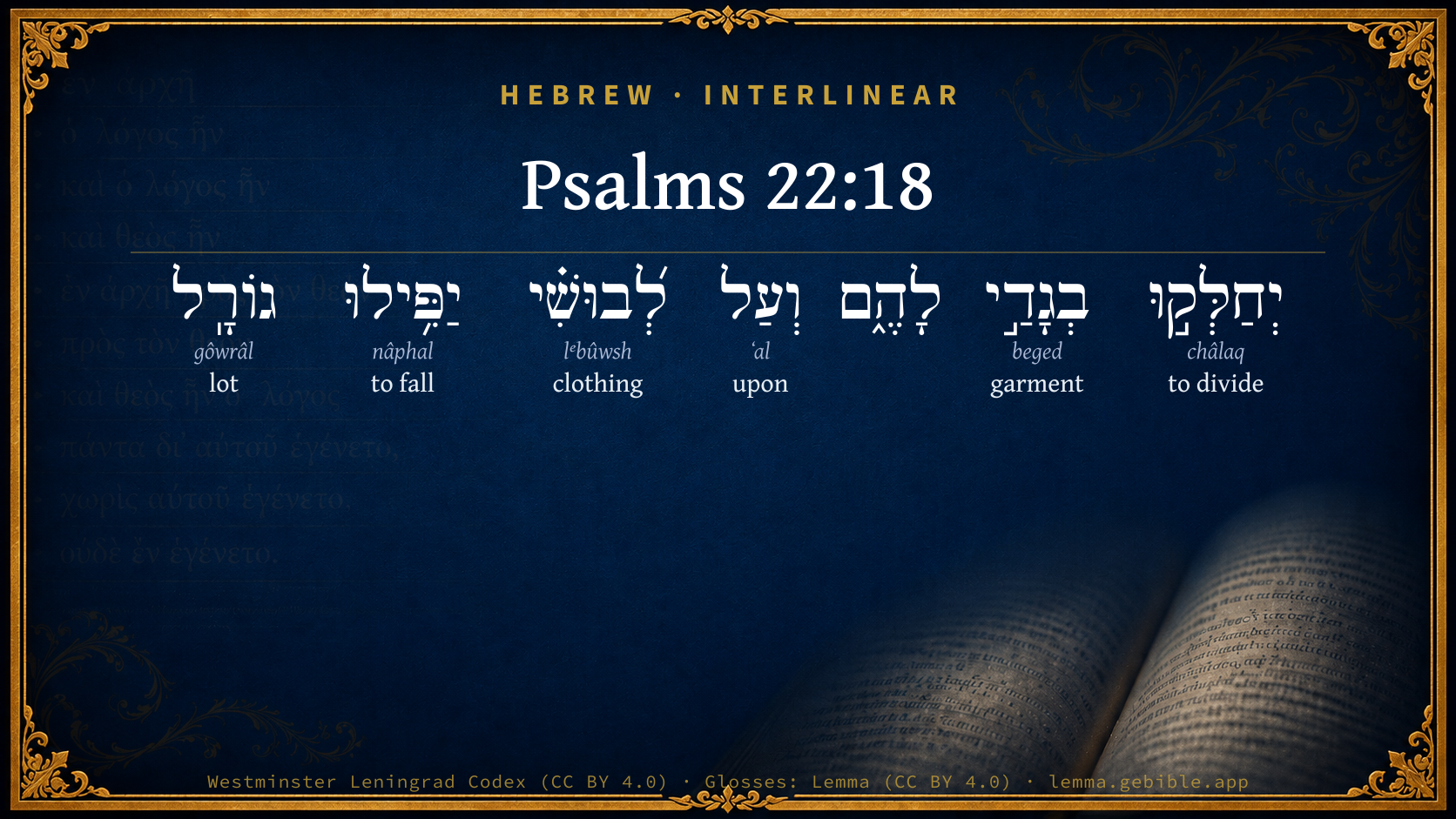
Psalms 22:18

Hebrew (Westminster Leningrad Codex) Psalms 22:18 appears in the Hebrew Old Testament. The text above is from the Westminster Leningrad Codex. Each word links to its Strong’s number, a concise gloss, and parsing drawn from the Open Scriptures Hebrew Bible morphology. Click any word for its full Brown-Driver-Briggs (BDB) entry.
Download image
Cite this verse

Psalms 22:18 (World English Bible). Public Domain. Lemma interlinear Bible study tool, https://lemma.gebible.app/v/psalms/22/18.

Show BibTeX & RIS
BibTeX
RIS
English Translation
They divide my garments among them. They cast lots for my clothing.
World English Bible · Public Domain
Download a study sheet

One document with this verse’s original text, its word-by-word gloss line, the meaning frame, cross-references with their text, attributed commentary, and full source and license credits — printable, and it pastes into notes with its structure intact.

This verse Autodidact and up

Study sheet (.html) Plain text (.txt)

A passage Seminary Student

Up to 50 verses in one chapter. A passage sheet keeps up to 6 commentary sources and 12 cross-references per verse, in the order this page ranks them, and says so on the sheet whenever that leaves anything out. Ask for a single verse and you get the Autodidact verse sheet above.

Everything on this page stays free to read, with no account — the sheet is a download of what is already on screen, not access to it.

Want to remove ads? Support Godless Engineer
Compare translations 3

The same verse in 3 English versions, stacked beneath the original-language interlinear above. Click any original word for its lexicon entry.

Each is an independent rendering of the whole verse — the interlinear is not word-aligned to these translations.

Highlighted words mark where these versions differ — a whole-verse word diff, not a word-by-word alignment.

  • World English Bible Public Domain
    They divide my garments among them. They cast lots for my clothing.
  • King James Version Public Domain
    They part my garments among them, and cast lots upon my vesture.
  • unfoldingWord Literal Text CC BY-SA 4.0
    They divide my garments among them, and they cast lots for my clothing.

unfoldingWord Literal Text — © unfoldingWord, licensed CC BY-SA 4.0. Word-aligned USFM3 via Door43 (git.door43.org/unfoldingWord/en_ult).

Versions to compare (up to 4)

3 of 4 selected

Show all 18 translations

Every available English version of this verse, each an independent rendering of the whole verse.

  • World English Bible Public Domain
    They divide my garments among them. They cast lots for my clothing.
  • Berean Standard Bible Public Domain
    They divide my garments among them and cast lots for my clothing.
  • Majority Standard Bible Public Domain
    They divide my garments among them and cast lots for my clothing.
  • King James Version Public Domain
    They part my garments among them, and cast lots upon my vesture.
  • American Standard Version (1901) Public Domain
    They part my garments among them, And upon my vesture do they cast lots.
  • Revised Version (1885) Public Domain
    They part my garments among them, and upon my vesture do they cast lots.
  • Geneva Bible (1599) Public Domain
    They part my garments among them, and cast lottes vpon my vesture.
  • Douay-Rheims (1899) Public Domain
    They have numbered all my bones. And they have looked and stared upon me.
  • Young's Literal Translation Public Domain
    They apportion my garments to themselves, And for my clothing they cause a lot to fall.
  • Literal Standard Version CC BY-SA 4.0
    They apportion My garments to themselves, || And they cause a lot to fall for My clothing.
  • Unlocked Literal Bible CC BY-SA 4.0
    They divide my garments among themselves, they cast lots for my clothes.
  • unfoldingWord Literal Text CC BY-SA 4.0
    They divide my garments among them, and they cast lots for my clothing.
  • Darby Bible Public Domain
    They part my garments among them, and cast lots upon my vesture.
  • World Messianic Bible Public Domain
    They divide my garments among them. They cast lots for my clothing.
  • Webster's Bible Public Domain
    \\22:17\\I may number all my bones: they look and stare upon me.
  • Free Bible Version CC BY-SA 4.0
    They divide my clothing among them; they roll dice for my clothes.
  • Bible in Basic English Public Domain
    They make a division of my robes among them, by the decision of chance they take my clothing.
  • JPS Tanakh (1917) Public Domain
    (22-19) They part my garments among them, and for my vesture do they cast lots.

Literal Standard Version (2020), Covenant Press — licensed CC BY-SA 4.0. Text via the HelloAO Bible API (eBible.org). Unlocked Literal Bible (unfoldingWord) — licensed CC BY-SA 4.0. Text via the HelloAO Bible API (eBible.org). unfoldingWord Literal Text — © unfoldingWord, licensed CC BY-SA 4.0. Word-aligned USFM3 via Door43 (git.door43.org/unfoldingWord/en_ult). Free Bible Version, Dr. Jonathan Gallagher — licensed CC BY-SA 4.0. Text via the HelloAO Bible API (eBible.org).

Word by word

More ways to search: Search by grammar → Find every occurrence → Compare this word →

Practice this passage: Drill this verse → Learn its vocabulary →

About this verse

These counts appear in no published source. They are computed here, from the morphology-tagged text and Lemma’s own curated glosses. What Lemma adds →

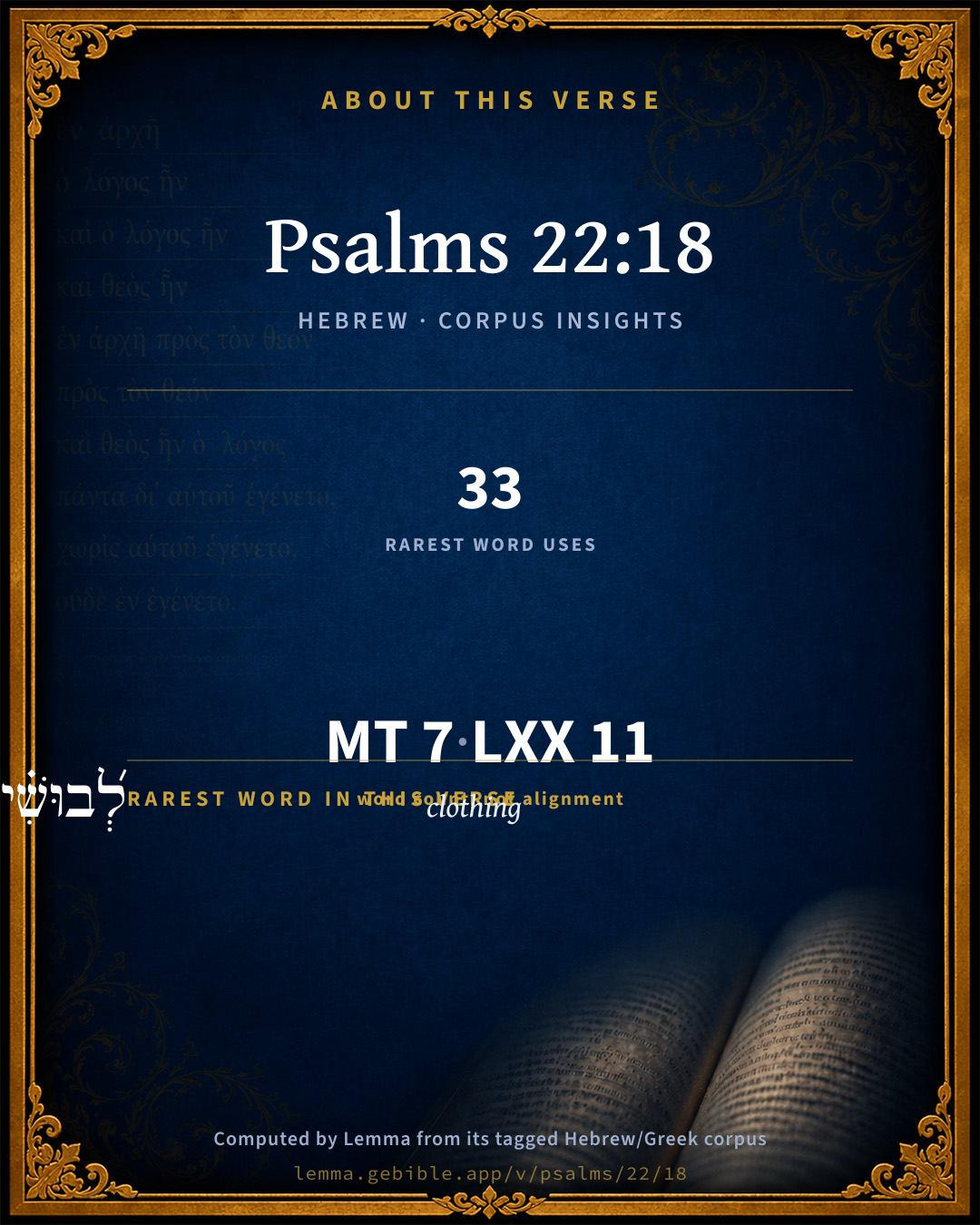
7
words
6
distinct lemmas
Wisdom
section

Shared distinctive vocabulary

לְ֝בוּשִׁ֗י clothing H3830 occurs in 33 verses of the Hebrew Bible. Also found in:

Grammatical profile

  • 2 verbs
  • 3 nouns
  • 2 prepositions

Verb forms

  • יְחַלְּק֣וּ Piel · Imperfect
  • יַפִּ֥ילוּ Hiphil · Imperfect

Hebrew & Septuagint length

In English translation the verse runs 12 words from the Hebrew and 12 from the Septuagint (LXX English) — the same length.

A rough comparison of the two English renderings, which tokenize alike — not a word-level alignment.

Word counts can differ between the Hebrew and the Greek without any difference in meaning — e.g. the Hebrew direct-object marker אֵת has no separate Greek word, and Greek often adds the article ὁ.

In the original languages it is 7 Hebrew tokens and 11 Greek tokens — but the two are counted differently (Hebrew bundles its prefixes and suffixes into one token; the Greek is in lemma form), so that isn’t a like-for-like length.

Cross-references

4

Topical passages linked to Psalms 22:18 in the Treasury of Scripture Knowledge — connected by theme and wording, ordered by reader-vote popularity; previews shown in the World English Bible.

  • Matthew 27:35 When they had crucified him, they divided his clothing among them, casting lots,
  • Luke 23:34 Jesus said, "Father, forgive them, for they don't know what they are doing." Dividing his garments among them, they cast lots.
  • Mark 15:24 Crucifying him, they parted his garments among them, casting lots on them, what each should take.
  • John 19:23–24 Then the soldiers, when they had crucified Jesus, took his garments and made four parts, to every soldier a part; and also the coat. Now the coat was without seam, woven from the top throughout.

Cross-references courtesy of OpenBible.info (CC BY 4.0).

Hebrew and Greek witnesses Masoretic Hebrew ↔ Greek Septuagint

The same verse in the two great witnesses to the Old Testament, shown verse-for-verse.

You’re reading Greek Psalm 21 (Hebrew Psalm 22). The Septuagint counts the superscription, so verse numbers can differ from the Hebrew — chapter-level alignment, not verse-by-verse. Numbering follows Rahlfs.

These are two independent witnesses, not word-aligned to each other, and the Septuagint is shown in lemma (dictionary) form.

Hebrew Psalms 22:18 Masoretic · Westminster Leningrad Codex

יְחַלְּק֣וּ בְגָדַ֣י לָהֶ֑ם וְעַל לְ֝בוּשִׁ֗י יַפִּ֥ילוּ גוֹרָֽל

They divide my garments among them. They cast lots for my clothing.

World English Bible · Public Domain

Greek LXX Greek Psalm 21:18 Septuagint · lemma form

ἐκἀριθμέω πᾶς ὁ ὀστέον ἐγώ αὐτός δέ κατανοέω καί ἐπιὁράω ἐγώ

They parted my garments among themselves, and cast lots upon my raiment.

LXX2012 (modern English Septuagint) · Public Domain

Hebrew: Westminster Leningrad Codex (CC BY 4.0). Greek: Septuagint (public domain); English from LXX2012 (modern English Septuagint) (Public Domain). How the Septuagint differs from the Hebrew →

Commentary

Notes on Psalms 22:18 from classic Christian and Jewish commentators (each source and its license shown beneath its notes). The classic Christian expositions comment on the surrounding passage and are grouped to its opening verse, so a note may address several verses; the Jewish commentaries on the Tanakh (Rashi and others) are per-verse, so they appear only where the commentator wrote on this verse.

Lemma curates 59 commentaries, every one of them public domain or Creative Commons licensed, each selected and text-cleaned for this edition rather than reprinted as found. About our sources →

Trapp's Complete Commentary

John Trapp

Psa 22:18 They part my garments among them, and cast lots upon my vesture.

Ver. 18. They part my garments among them, and cast lots] A very clear testimony to us that our crucified God (as they scornfully term him) was the true Messiah, so long since fore prophesied of, and accordingly accomplished, Luk 23:34 Job 20:24. Such texts as this we should make much of, as the best and surest evidences of our Christian faith, 2Pe 1:19.

John Trapp, A Commentary or Exposition upon All the Books of the Old and New Testament (1647–1656) — public domain. Text from a community e-Sword module.

J. A. Alexander on Psalms

Joseph Addison Alexander

19. (Psa 22:18). They (are about to) divide my garments for themselves, and on my clothing they (are ready to) cast lots. This is the last stroke necessary to complete the picture. Having stripped him, nothing more is left but to appropriate his garments, whether from cupidity or in derision. The futures intimate that things can go no further without actual loss of life, and that the case is therefore an extreme one. The providential realisation of this ideal scene in our Lord's history is expressly mentioned by all the four evangelists (Mat 27:35, Mar 15:24, Luk 23:34, Joh 19:23-24). This makes their silence as to Psa 22:17 (16) the more remarkable.

Joseph Addison Alexander, The Psalms Translated and Explained (1850) — public domain. Text from a community e-Sword module.

Jamieson, Fausset & Brown

Robert Jamieson, A. R. Fausset & David Brown

This literally fulfilled prediction closes the sad picture of the exposed and deserted sufferer.

Jamieson, Fausset & Brown — Commentary Critical and Explanatory on the Whole Bible (1871) — public domain (CC PDM 1.0). Text via the HelloAO Bible API.

Adam Clarke's Commentary

Verse 18. They part my garments] This could be true in no sense of David. The fact took place at the crucifixion of our Lord. The soldiers divided his upper garment into four parts, each soldier taking a part; but his tunic or inward vestment being without seam, woven in one entire piece, they agreed not to divide, but to cast lots whose the whole should be. Of this scripture the Roman soldiers knew nothing; but they fulfilled it to the letter. This was foreseen by the Spirit of God; and this is a direct revelation concerning Jesus Christ, which impresses the whole account with the broad seal of eternal truth.

Adam Clarke's Commentary on the Bible (1810–1826) — public domain. Text from a community e-Sword/MySword module.

John Calvin's Commentaries

What follows in the next verse concerning his garments is metaphorical. It is as if he had said, that all his goods were become a prey to his enemies, even as conquerors are accustomed to plunder the vanquished, or to divide the spoil among themselves, by casting lots to determine the share which belongs to each. Comparing his ornaments, riches, and all that he possessed, to his garments, he complains that, after he had been despoiled of them, his enemies divided them among themselves, as so much booty, accompanied with mockery of him; and by this mockery the villany of their conduct was aggravated, inasmuch as they triumphed over him, as if he had been a dead man. The Evangelists quote this place to the letter, as we say, and without figure; and there is no absurdity in their doing so. To teach us the more certainly that in this psalm Christ is described to us by the Spirit of prophecy, the heavenly Father intended that in the person of his Son those things should be visibly accomplished which were shadowed forth in David. Matthew, (Matthew 8:16, 17,) in narrating that the paralytic, the blind, and the lame, were healed of their diseases, says, that this was done “that it might be fulfilled which was spoken by Esaias the prophet, saying, Himself took our infirmities, and bear our sicknesses;” although the prophet, in that place, sets before us the Son of God in the character of a spiritual physician. We are extremely slow and backward to believe; and it is not wonderful, that, on account of our dullness of apprehension, a demonstration of the character of Christ, palpable to our senses, has been given us, “Il nous a este faite une demonstration si grossiere, qu’on la pouvoit taster, au doigt.” — Fr. “There has been given us a demonstration so palpable, that it might be touched with the finger.

John Calvin's Commentaries (1540-1563) — public domain. Text from the Calvin Translation Society English edition (1840s-50s) via the Christian Classics Ethereal Library (ccel.org). Calvin's coverage is partial (roughly two-thirds of the Bible); uncommented books and verses are honest gaps, never fabricated. The 19th-century editor's footnotes and remarks are omitted so the notes are faithfully Calvin's own voice.

Ellicott's Commentary for English Readers

(18) They part my garments . . .—i.e., as of one already dead. The word “garment” (beged) and “vesture” (lebûsh) are synonymous terms for the same article of dress—the modern abba, or plaid, the usual outer garment of the Bedouin. The latter is a more poetic term. (See Bib. Diet, art. “Dress.”) The application of the verse in Joh_19:24, &c, adds a refinement not present in the psalm.

A Bible Commentary for English Readers, edited by Charles John Ellicott (1878–1897) — public domain. Text from a community e-Sword module.

The Cambridge Bible for Schools and Colleges

gen. ed. J. J. S. Perowne

18. His brutal enemies are only waiting for his death that they may strip his body, and divide his clothes between them. Already they are settling their respective shares. This is a simpler explanation than to suppose that the Psalmist represents himself as a prisoner stripped and led out to execution, or as waylaid and plundered by robbers (Job_24:7-10; Mic_2:8). It need not be supposed that this actually happened to the Psalmist. The language is perhaps proverbial. But it was literally fulfilled in the circumstances of the Crucifixion (Joh_19:23-24; cp. Mat_27:35, where, however, the reference to the prophecy in the Received Text is an interpolation).

and cast lots &c.] R.V., and upon my vesture do they cast lots. The inner garment, the “seamless tunic,” which would be spoilt by rending.

The Cambridge Bible for Schools and Colleges (gen. ed. J. J. S. Perowne; Cambridge University Press, 1878–1918) — public domain. Text from a community e-Sword module.

John Gill's Exposition

They part my garments among them,.... Such as died the death of the cross were crucified naked (h), and their clothes were the perquisites of the executioners; there were four soldiers concerned in the crucifixion of Christ, and these parted his garments into four parts, and everyone took his part;

and cast lots on my vesture; which was a seamless coat, wove from the top to the bottom; and therefore, not willing to rend it, they cast lots upon it who should have it; all this was exactly fulfilled in Christ, Joh 19:23.

(h) Vid Lipsium de Cruce, l. 2. c. 7. p. 81.

John Gill's Exposition of the Whole Bible (1746–1763) — public domain (CC PDM 1.0). Text via the HelloAO Bible API.

Albert Barnes' Notes on the Bible

They part my garments among them - They divide; they apportion. This refers merely to the fact that they made such a division or distribution of his garments; the manner in which it was done, is specified in the other part of the verse. The word “garments” is a general term, and would be applicable to any part of the raiment.

And cast lots upon my vesture - That is, upon the part here represented by the word “vesture,” “they cast lots.” There was a general division of his garments by agreement, or in some other mode not involving the use of the lot; on some particular portion, here indicated by the word vesture, the lot was cast to determine whose it should be. The word thus rendered vesture - לבושׁ lebûsh - does not necessarily denote any particular article of raiment, as distinguished from what is meant by the word rendered “garments.” Both are general terms denoting clothing, raiment, vestment; and either of the terms might be applied to any article of apparel. The original words used here would not necessarily designate one article of raiment as disposed of without the lot and another specified portion by the lot. But although it could not be argued beforehand from the mere use of the language that such would be the case, yet if that should occur, it would be natural and not improper to apply the language in that sense, and as therein completely fulfilled.

As a matter of fact this was literally fulfilled in the crucifixion of the Saviour. By remarkable circumstances which no human sagacity could have foreseen or anticipated, there occurred a general division of a portion of his raiment, without an appeal to the lot, among the soldiers who were engaged in crucifying him, and a specific disposal of one article of his raiment by the lot, Mat 27:35; Luk 23:34; Joh 19:23-24. It never occurred in the life of David, as far as we know, or have reason to believe, that his enemies stripped him, and divided his garments among themselves; and the description here, therefore, could be applicable only to some one else. It was completely fulfilled in the Saviour; and this verse, therefore, furnishes the fullest proof that the psalm refers to him. At the same time it should be observed that these circumstances are such that an impostor could not have secured the correspondence of the events with the prediction. The events referred to were not under the control of him whose garments were thus divided. They depended wholly on others; and by no art or plan could an impostor have so arranged matters that all these things should have appeared to be fulfilled in himself.

Albert Barnes' Notes on the Bible (1834–1885) — public domain. Text from a community e-Sword/MySword module.

Matthew Poole's English Annotations

This also cannot be applied to David without an uncouth and strained metaphor, but was literally fulfilled in Christ, Mat 27:35; Joh 19:24.

Matthew Poole's English Annotations on the Holy Bible (1683–1685) — public domain. Text from a community e-Sword/MySword module.

The Treasury of David

Charles H. Spurgeon

Ver. 18. They part my garments among them, and cast lots upon my vesture. The garments of the executed were the perquisites of the executioners in most cases, but it was not often that they cast lots at the division of the spoil; this incident shows how clearly David in vision saw the day of Christ, and how surely the Man of Nazareth is he of whom the prophets spake: "these things, therefore, the soldiers did." He who gave his blood to cleanse us gave his garments to clothe us. As Ness says, "this precious Lamb of God gave up his golden fleece for us." How every incident of Jesus' griefs is here stored up in the treasury of inspiration, and embalmed in the amber of sacred song; we must learn hence to be very mindful of all that concerns our Beloved, and to think much more of everything which has a connection with him. It may be noted that the habit of gambling is of all others the most hardening, for men could practise it even at the cross foot while besprinkled with the blood of the Crucified. No Christian will endure the rattle of the dice when he thinks of this.

Ver. 18. They part my garments, etc. Perfectly naked did the cruciarii hang upon the cross, and the executioners received their clothes. There is nothing to show that there was a cloth even round the loins. The clothes became the property of the soldiers, after Roman usage. The outer garment was divided probably into four, by ripping up the seams. Four soldiers were counted off as a guard, by the Roman code. The under garment could not be divided being woven; and this led the soldiers to the dice throwing. J. P. Lange, D.D., on Mt 27:35.

Ver. 18. They part my garments, etc. Instruments will not be wanting to crucify Christ, if it were but for his old clothes, and those but little worth; for these soldiers crucify him, though they got but his garments for their reward. Christ did submit to suffer naked, hereby to teach us: 1. That all flesh are really naked before God by reason of sin (Ex 32:25 2Ch 28:19), and therefore our Surety behoved to suffer naked. 2. That he offered himself a real captive in his sufferings, that so he might fully satisfy justice by being under the power of his enemies, till he redeemed himself by the strong hand, having fully paid the price; for therefore did he submit to be stripped naked, as conquerors use to do with prisoners.

3. That by thus suffering naked he would expiate our abuse of apparel, and purchase to us a liberty to make use of suitable raiment, and such as becometh us in our station. 4. That by this suffering naked he would purchase unto them who flee to him, to be covered with righteousness and glory, and to walk with him in white for ever, and would point out the nakedness of those, who, not being found clothed with his righteousness, shall not be clothed upon with immortality and glory. 2Co 5:2-3. 5. He would also by this, teach all his followers to resolve on nakedness in their following of him, as a part of their conformity with their Head (1Jo 4:17 Ro 8:35 Heb 11:37), and that therefore they should not dote much on their apparel when they have it. George Hutcheson, 1657.

Ver. 18. And cast lots upon my vesture. Trifling as this act of casting the lot for our Lord's vesture may appear, it is most significant. It contains a double lesson. It teaches us how greatly that seamless shirt was valued; how little he to whom it had belonged. It seemed to say, this garment is more valuable than its owner. As it was said of the thirty pieces of silver, "A goodly price at which I was prized at of them; "so may we say regarding the casting of the lot, "How cheaply Christ was held!" John Stevenson.

Charles H. Spurgeon's The Treasury of David (1869–1885) — public domain. Psalms only. Text from a community e-Sword/MySword module.

Whedon's Commentary on the Bible

Daniel D. Whedon

18. They part my garments—The finishing touch in the description of cold brutality. Under the eye of Jesus the soldiers fulfilled this prediction, Joh_19:23-24, where see the note.

Vesture—The oriental robe, or mantle, worn loosely upon the person, which served as a covering by night.

Exo_22:26-27. The word is not decisive of the particular part of the raiment, but the casting lots for it determines, as it could not be divided without destroying it.

Daniel D. Whedon (gen. ed.), Commentary on the Old and New Testaments (1874–1909) — public domain. Text from a community e-Sword module.

The Pulpit Commentary

They part my garments among them, and cast lots upon my vesture. It has been well observed that "the act here described is not applicable either to David or to any personage whose history is recorded in the Bible, save to Jesus" ("Speaker"s Commentary," vol. 4. p. 221). Two evangelists (Mat_27:35 Joh_19:24) note the fulfilment of the prophecy in the conduct of the soldiers at the crucifixion of Christ. The circumstance is reserved for the final touch in the picture, since it marked that all was over; the Victim was on the point of expiring; he would never need his clothes again.

The Pulpit Commentary (1880–1919), ed. H.D.M. Spence-Jones & Joseph S. Exell — public domain. Text from a community e-Sword module.

John Wesley's Explanatory Notes

They part - This also cannot be applied to David, but was literally fulfilled in Christ, Matt. xxvii, 35 John xix, 24.

John Wesley, Explanatory Notes Upon the Whole Bible (1754–1765) — public domain. Text via the GEBible commentary corpus.

unfoldingWord translationNotes

Door43 World Missions Community

my garments

"my clothes"

Do not be far away

This can be stated in positive form. AT: "Be very close" (See: Litotes)

my strength

Here "strength" represents Yahweh who gives him strength. AT: "you who give me strength" (See: Metonymy)

translationWords

lots

strength

unfoldingWord translationNotes — © Distant Shores Media and the Door43 World Missions Community, licensed CC BY-SA 4.0. Source: git.door43.org/Door43/en_tn.

Rashi

Rabbi Shlomo Yitzchaki (Rashi)

I tell about all my bones The pain of my bones.

They look They rejoice at my misfortune.

Rashi on the Tanakh — English translations: “The Judaica Press complete Tanach with Rashi, translated by A. J. Rosenberg” (CC BY 4.0); “Pentateuch with Rashi's commentary by M. Rosenbaum and A.M. Silbermann, 1929-1934” (public domain); “The Metsudah Tanach series, Lakewood, N.J” (CC BY 4.0); and “The Book of Joshua, Metsudah Publications, 1997” (CC BY 4.0). Text via Sefaria.

Radak

Rabbi David Kimhi (Radak)

(If) I declare all my strong reasons (of complaint) They look and gaze upon me: – Then if I come to declare my troubles before their great ones, arising from the way their underlings oppress me, they, the great ones, look at me and they gaze upon me with the eye of scorn and hatred. They look (upon me) is here used like “Look not upon me because I am swarthy” (Song of Songs 1:6); “that they may look at thee” (Ezek. 28:17), where the expression (ראוה) has the sense of looking at with contempt and mockery. עצמתי (my strong reasons) is used here as in “Produce your cause, saith the Lord, bring forth your strong reasons (עצמותיכם)” (Is. 41:21). There are, however, those who interpret עצמותי (here) quite literally as from עצם (bone), and explain אספר from the sense of מספר (number); and then its interpretation will be: Because of my great weakness I can count all my bones and they look and gaze upon me, meaning upon my flesh and woeful appearance, and they mock me.

Radak on the Tanakh — English translations: “Sefaria Community Translation” (CC0 1.0 (public-domain dedication)); “Eliyahu Munk, HaChut Hameshulash” (CC BY 4.0); “Rabbi Mike Feuer, Jerusalem Anthology” (CC BY 4.0); and “R. David Kimhi on the first book of Psalms, Translated by R.G. Finch, London, 1919” (public domain). Text via Sefaria.

Lesson kit

Teaching starters — assembled from the data on this page, not authored interpretation. Every prompt links to the verse data it draws on. Edit before teaching.

Psalms, in the Wisdom, opens this verse with 7 words (6 distinct Hebrew lemmas). Its most distinctive word is lᵉbûwsh (“clothing”). A historical commentator’s framing appears above. Read the whole chapter for the surrounding context.

Discussion questions

  1. How does “clothing” (lᵉbûwsh) shape what this verse is saying?
  2. How does Genesis 49:11, which shares the word «clothing», read alongside this verse?
  3. The translations on this page render this verse differently — a whole-verse word diff, not a word-by-word alignment. What might account for the different wordings?
  4. «יְחַלְּק֣וּ» is a Piel Imperfect verb. How does that grammatical form shape the action described?
  5. Compare how Trapp's Complete Commentary and J. A. Alexander on Psalms read this verse. Where do they agree or differ?

Things to notice

Reading settings

Reading text

Shown beneath each verse's original-language words.

Old Testament
Old Testament edition

Read the OT as the Masoretic Hebrew (MT) or the Greek Septuagint (LXX).

English shown for the Greek Septuagint (in the Hebrew ↔ Greek comparison).

Comparing translations? Open the Compare panel on any verse page to stack up to four side by side.