Ezekiel 18:16

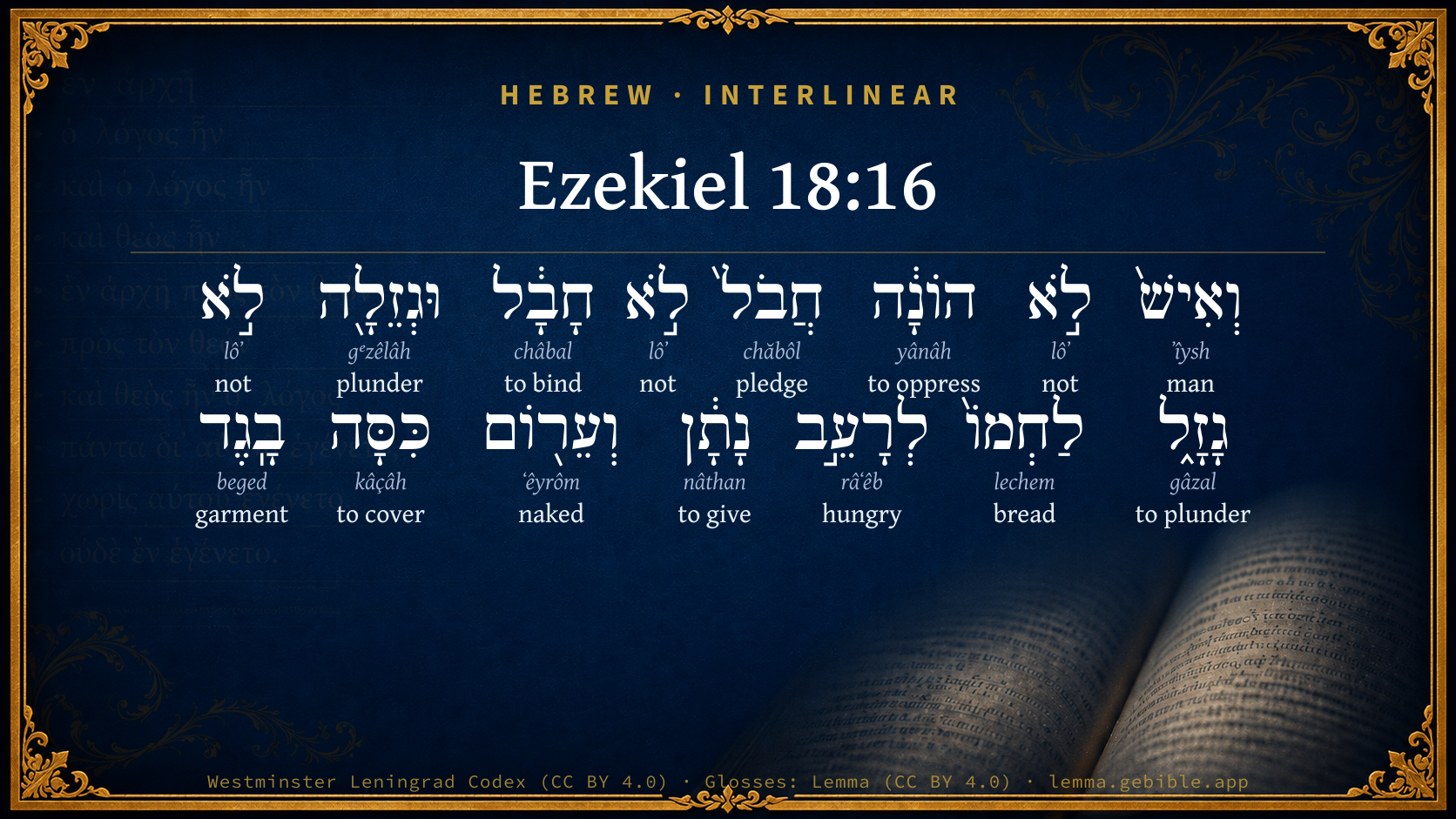
Hebrew (Westminster Leningrad Codex) Ezekiel 18:16 appears in the Hebrew Old Testament. The text above is from the Westminster Leningrad Codex. Each word links to its Strong’s number, a concise gloss, and parsing drawn from the Open Scriptures Hebrew Bible morphology. Click any word for its full Brown-Driver-Briggs (BDB) entry.
Download image
Cite this verse

Ezekiel 18:16 (World English Bible). Public Domain. Lemma interlinear Bible study tool, https://lemma.gebible.app/v/ezekiel/18/16.

Show BibTeX & RIS
BibTeX
RIS
English Translation
neither has wronged any, has not taken anything to pledge, neither has taken by robbery, but has given his bread to the hungry, and has covered the naked with a garment;
World English Bible · Public Domain
Download a study sheet

One document with this verse’s original text, its word-by-word gloss line, the meaning frame, cross-references with their text, attributed commentary, and full source and license credits — printable, and it pastes into notes with its structure intact.

This verse Autodidact and up

Study sheet (.html) Plain text (.txt)

A passage Seminary Student

Up to 50 verses in one chapter. A passage sheet keeps up to 6 commentary sources and 12 cross-references per verse, in the order this page ranks them, and says so on the sheet whenever that leaves anything out. Ask for a single verse and you get the Autodidact verse sheet above.

Everything on this page stays free to read, with no account — the sheet is a download of what is already on screen, not access to it.

Want to remove ads? Support Godless Engineer
Compare translations 3

The same verse in 3 English versions, stacked beneath the original-language interlinear above. Click any original word for its lexicon entry.

Each is an independent rendering of the whole verse — the interlinear is not word-aligned to these translations.

Highlighted words mark where these versions differ — a whole-verse word diff, not a word-by-word alignment.

  • World English Bible Public Domain
    neither has wronged any, has not taken anything to pledge, neither has taken by robbery, but has given his bread to the hungry, and has covered the naked with a garment;
  • King James Version Public Domain
    Neither hath oppressed any, hath not withholden the pledge, neither hath spoiled by violence, but hath given his bread to the hungry, and hath covered the naked with a garment,
  • unfoldingWord Literal Text CC BY-SA 4.0
    That son does not oppress anyone, or seize a pledge, or take stolen things, but instead gives his food to the hungry and covers up the naked with clothes.

unfoldingWord Literal Text — © unfoldingWord, licensed CC BY-SA 4.0. Word-aligned USFM3 via Door43 (git.door43.org/unfoldingWord/en_ult).

Versions to compare (up to 4)

3 of 4 selected

Show all 18 translations

Every available English version of this verse, each an independent rendering of the whole verse.

  • World English Bible Public Domain
    neither has wronged any, has not taken anything to pledge, neither has taken by robbery, but has given his bread to the hungry, and has covered the naked with a garment;
  • Berean Standard Bible Public Domain
    He does not oppress another, or retain a pledge, or commit robbery. He gives his bread to the hungry and covers the naked with clothing.
  • Majority Standard Bible Public Domain
    He does not oppress another, or retain a pledge, or commit robbery. He gives his bread to the hungry and covers the naked with clothing.
  • King James Version Public Domain
    Neither hath oppressed any, hath not withholden the pledge, neither hath spoiled by violence, but hath given his bread to the hungry, and hath covered the naked with a garment,
  • American Standard Version (1901) Public Domain
    neither hath wronged any, hath not taken aught to pledge, neither hath taken by robbery, but hath given his bread to the hungry, and hath covered the naked with a garment;
  • Revised Version (1885) Public Domain
    neither hath wronged any, hath not taken aught to pledge, neither hath spoiled by violence, but hath given his bread to the hungry, and hath covered the naked with a garment,
  • Geneva Bible (1599) Public Domain
    Neither hath oppressed any, nor hath withholden the pledge, neither hath spoyled by violence, but hath giuen his bread to the hungry, and hath couered the naked with a garment,
  • Douay-Rheims (1899) Public Domain
    And hath not grieved any man, nor withholden the pledge, nor taken away with violence, but hath given his bread to the hungry, and covered the naked with a garment:
  • Young's Literal Translation Public Domain
    A man -- he hath not oppressed, A pledge he hath not bound, And plunder he hath not taken away, His bread to the hungry he hath given, And the naked he covered with a garment,
  • Literal Standard Version CC BY-SA 4.0
    He has not oppressed a man, || He has not bound a pledge, || And he has not taken away plunder, || He has given his bread to the hungry, || And he covered the naked with a garment,
  • Unlocked Literal Bible CC BY-SA 4.0
    That son does not oppress anyone, or seize a pledge, or take stolen things, but instead gives his food to the hungry and covers up the naked with clothes.
  • unfoldingWord Literal Text CC BY-SA 4.0
    That son does not oppress anyone, or seize a pledge, or take stolen things, but instead gives his food to the hungry and covers up the naked with clothes.
  • Darby Bible Public Domain
    and hath not oppressed any, nor withholden the pledge, neither hath exercised robbery; he hath given his bread to the hungry, and covered the naked with a garment;
  • World Messianic Bible Public Domain
    hasn’t wronged any, hasn’t taken anything to pledge, hasn’t taken by robbery, but has given his bread to the hungry, and has covered the naked with a garment;
  • Webster's Bible Public Domain
    Neither hath oppressed any, hath not withheld the pledge, neither hath stripped by violence, but hath given his bread to the hungry, and hath covered the naked with a garment,
  • Free Bible Version CC BY-SA 4.0
    He doesn't exploit anyone. He doesn't demand security for a loan. He doesn't rob others. He feeds the hungry and clothes the naked.
  • Bible in Basic English Public Domain
    Or done wrong to any, or taken anything from one in his debt, or taken goods by force, but has given food to him who was in need of it, and clothing to him who was without it;
  • JPS Tanakh (1917) Public Domain
    neither hath wronged any, hath not taken aught to pledge, neither hath taken by robbery, but hath given his bread to the hungry, and hath covered the naked with a garment,

Literal Standard Version (2020), Covenant Press — licensed CC BY-SA 4.0. Text via the HelloAO Bible API (eBible.org). Unlocked Literal Bible (unfoldingWord) — licensed CC BY-SA 4.0. Text via the HelloAO Bible API (eBible.org). unfoldingWord Literal Text — © unfoldingWord, licensed CC BY-SA 4.0. Word-aligned USFM3 via Door43 (git.door43.org/unfoldingWord/en_ult). Free Bible Version, Dr. Jonathan Gallagher — licensed CC BY-SA 4.0. Text via the HelloAO Bible API (eBible.org).

Word by word

More ways to search: Search by grammar → Find every occurrence → Compare this word →

Practice this passage: Drill this verse → Learn its vocabulary →

חֲבֹל֙
chăbôl
H2258
“pledge”
Noun, Common, Masculine, Singular, Absolute
Part of Speech
Noun
Type
Common
Gender
Masculine
Number
Singular
State
Absolute
Full BDB Definition

Origin: from H2254

TWOT: 593a

pledge
  1. וְאִישׁ֙ ʼîysh H376 “and · man” Conjunction + Noun, Common, Masculine, Singular, Absolute
  2. לֹ֣א lôʼ H3808 “not” Particle, Negative
  3. הוֹנָ֔ה yânâh H3238 “to oppress” Verb, Hiphil, Perfect, 3rd Person, Masculine, Singular
  4. לֹ֣א lôʼ H3808 “not” Particle, Negative
  5. חָבָ֔ל châbal H2254 “to bind” Verb, Qal, Perfect, 3rd Person, Masculine, Singular
  6. וּגְזֵלָ֖ה gᵉzêlâh H1500 “and · plunder” Conjunction + Noun, Common, Feminine, Singular, Absolute
  7. לֹ֣א lôʼ H3808 “not” Particle, Negative
  8. גָזָ֑ל gâzal H1497 “to plunder” Verb, Qal, Perfect, 3rd Person, Masculine, Singular
  9. לַחְמוֹ֙ lechem H3899 “bread · his” Noun, Common, Both, Singular, Construct + Suffix, Personal, 3rd Person, Masculine, Singular
  10. לְרָעֵ֣ב râʻêb H7457 “to/for · hungry” Preposition + Adjective, Adjective, Masculine, Singular, Absolute
  11. נָתָ֔ן nâthan H5414 “to give” Verb, Qal, Perfect, 3rd Person, Masculine, Singular
  12. וְעֵר֖וֹם ʻêyrôm H5903 “and · naked” Conjunction + Adjective, Adjective, Masculine, Singular, Absolute
  13. כִּסָּה kâçâh H3680 “to cover” Verb, Piel, Perfect, 3rd Person, Masculine, Singular
  14. בָֽגֶד beged H899 “garment” Noun, Common, Masculine, Singular, Absolute

About this verse

These counts appear in no published source. They are computed here, from the morphology-tagged text and Lemma’s own curated glosses. What Lemma adds →

15
words
13
distinct lemmas
Prophets
section

Notable vocabulary

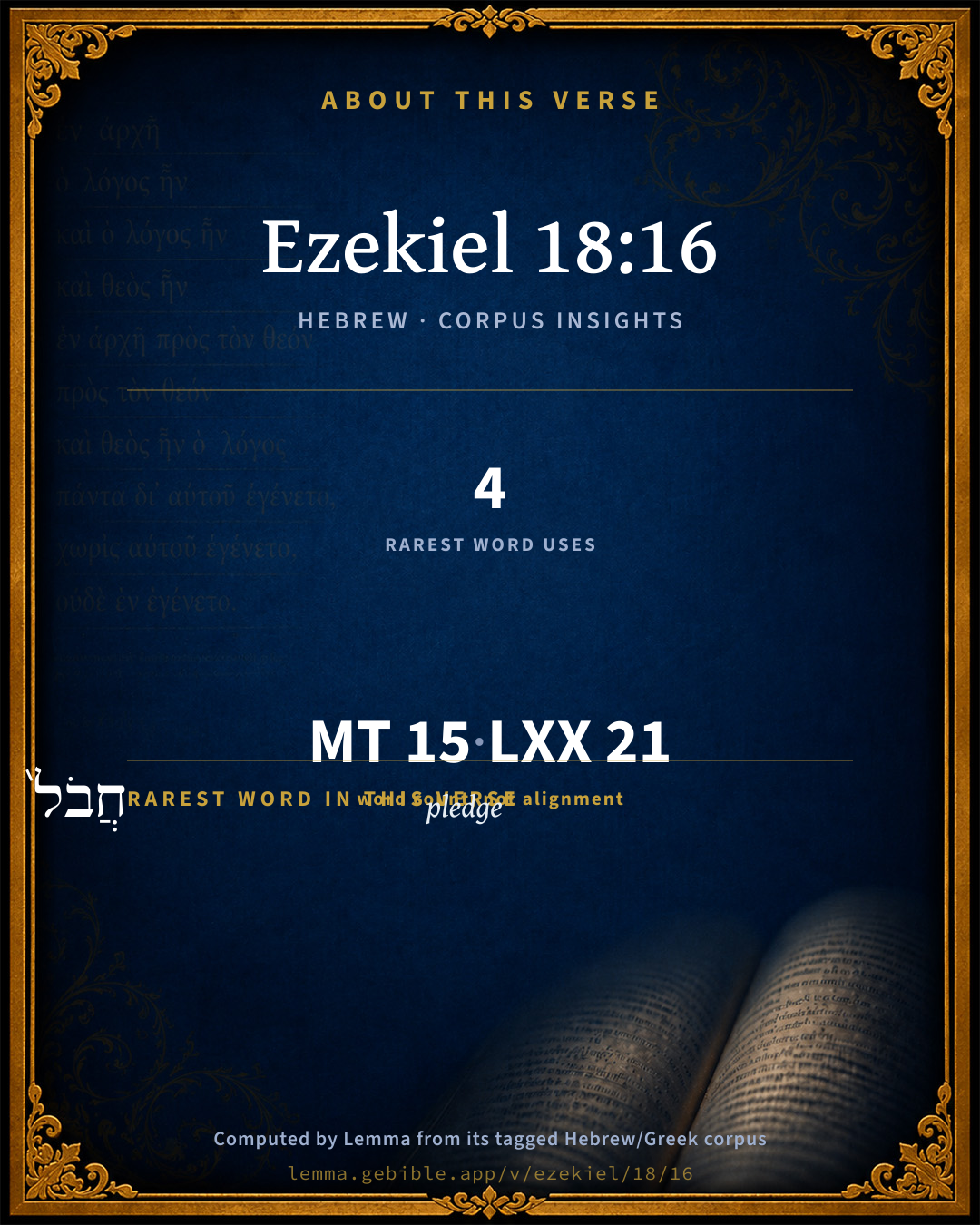
The rarest word here is חֲבֹל֙ pledge H2258 — appearing just 4 times in the whole Hebrew Bible.

Shared distinctive vocabulary

חֲבֹל֙ pledge H2258 occurs in 4 verses of the Hebrew Bible. Also found in:

Grammatical profile

  • 5 verbs
  • 5 nouns
  • 2 adjectives
  • 3 particles

Verb forms

  • הוֹנָ֔ה Hiphil · Perfect
  • חָבָ֔ל Qal · Perfect
  • גָזָ֑ל Qal · Perfect
  • נָתָ֔ן Qal · Perfect
  • כִּסָּה Piel · Perfect

Repetition

A word recurs within this verse — often emphatic in Hebrew:

Hebrew & Septuagint length

In English translation the verse runs 31 words from the Hebrew and 27 from the Septuagint (LXX English) — closely comparable.

A rough comparison of the two English renderings, which tokenize alike — not a word-level alignment.

Word counts can differ between the Hebrew and the Greek without any difference in meaning — e.g. the Hebrew direct-object marker אֵת has no separate Greek word, and Greek often adds the article ὁ.

In the original languages it is 15 Hebrew tokens and 21 Greek tokens — but the two are counted differently (Hebrew bundles its prefixes and suffixes into one token; the Greek is in lemma form), so that isn’t a like-for-like length.

Cross-references

11

Topical passages linked to Ezekiel 18:16 in the Treasury of Scripture Knowledge — connected by theme and wording, ordered by reader-vote popularity; previews shown in the World English Bible.

  • Ezekiel 18:7 and has not wronged any, but has restored to the debtor his pledge, has taken nothing by robbery, has given his bread to the hungry, and has covered the naked with a garment;
  • Job 22:7 You haven't given water to the weary to drink, And you have withheld bread from the hungry.
  • Job 31:19 If I have seen any perish for want of clothing, Or that the needy had no covering;
  • Psalms 41:1 Blessed is he who considers the poor: Yahweh will deliver him in the day of evil.
  • Proverbs 22:9 He who has a generous eye will be blessed; For he shares his food with the poor.
  • Proverbs 25:21 If your enemy is hungry, give him food to eat; If he is thirsty, give him water to drink:
  • Proverbs 31:20 She opens her arms to the poor; Yes, she extends her hands to the needy.
  • Ecclesiastes 11:1–2 Cast your bread on the waters; For you shall find it after many days.
  • Isaiah 58:7–10 Isn't it to deal your bread to the hungry, and that you bring the poor who are cast out to your house? when you see the naked, that you cover him; and that you not hide yourself from your own flesh?
  • Luke 11:41 But give for gifts to the needy those things which are within, and behold, all things will be clean to you.
  • Luke 14:13 But when you make a feast, ask the poor, the maimed, the lame, or the blind;

Cross-references courtesy of OpenBible.info (CC BY 4.0).

Hebrew and Greek witnesses Masoretic Hebrew ↔ Greek Septuagint

The same verse in the two great witnesses to the Old Testament, shown verse-for-verse.

These are two independent witnesses, not word-aligned to each other, and the Septuagint is shown in lemma (dictionary) form.

Hebrew Ezekiel 18:16 Masoretic · Westminster Leningrad Codex

וְאִישׁ֙ לֹ֣א הוֹנָ֔ה חֲבֹל֙ לֹ֣א חָבָ֔ל וּגְזֵלָ֖ה לֹ֣א גָזָ֑ל לַחְמוֹ֙ לְרָעֵ֣ב נָתָ֔ן וְעֵר֖וֹם כִּסָּה בָֽגֶד

neither has wronged any, has not taken anything to pledge, neither has taken by robbery, but has given his bread to the hungry, and has covered the naked with a garment;

World English Bible · Public Domain

Greek LXX Ezekiel 18:16 Septuagint · lemma form

καί ἄνθρωπος οὐ καταδυναστεύω καί ἐνεχυρασμός οὐ ἐνεχυράζω καί ἅρπαγμα οὐ ἁρπάζω ὁ ἄρτος αὐτός ὁ πεινάω δίδωμι καί γυμνός περιβάλλω

and has not oppressed a man, and has not retained the pledge, nor committed robbery, has given his bread to the hungry, and has clothed the naked,

LXX2012 (modern English Septuagint) · Public Domain

Hebrew: Westminster Leningrad Codex (CC BY 4.0). Greek: Septuagint (public domain); English from LXX2012 (modern English Septuagint) (Public Domain). How the Septuagint differs from the Hebrew →

Targum (Aramaic paraphrase)

1

The Targum is the ancient Jewish Aramaic paraphrase of the Hebrew Scriptures — an interpretive translation, not the Hebrew text itself. Onkelos (literal) and Pseudo-Jonathan (expansive) render the Torah, and Jonathan the Prophets. Coverage is partial: where no permissively-licensed English translation exists for a verse, only the Aramaic is shown. This is verse-level text, not a word-by-word alignment to the Hebrew.

  1. Targum Jonathan Prophets (Joshua–Malachi)
    וֶאֱנַשׁ לָא אוֹנִי מַשְׁכּוֹנָא לָא נְסִיב וּגְזֵלָה לָא גְזַל מִלַחְמֵיהּ לְכָפְנָא יְהַב וְעַרְטִילָאָה כַסֵי מִכְּסוּתֵהּ:

    (no public-domain English translation for this verse)

    Targum Jonathan — Aramaic: “Mikraot Gedolot” (public domain). English: “Sefaria Community Translation” (CC0 1.0 (public-domain dedication)); “London "Chaldee Paraphrase," 1871” (public domain). Text via Sefaria.

Commentary

Notes on Ezekiel 18:16 from classic Christian and Jewish commentators (each source and its license shown beneath its notes). The classic Christian expositions comment on the surrounding passage and are grouped to its opening verse, so a note may address several verses; the Jewish commentaries on the Tanakh (Rashi and others) are per-verse, so they appear only where the commentator wrote on this verse.

Lemma curates 59 commentaries, every one of them public domain or Creative Commons licensed, each selected and text-cleaned for this edition rather than reprinted as found. About our sources →

Trapp's Complete Commentary

John Trapp

Eze 18:16 Neither hath oppressed any, hath not withholden the pledge, neither hath spoiled by violence, [but] hath given his bread to the hungry, and hath covered the naked with a garment,

Ver. 16. See on Eze 18:7.

John Trapp, A Commentary or Exposition upon All the Books of the Old and New Testament (1647–1656) — public domain. Text from a community e-Sword module.

The Cambridge Bible for Schools and Colleges

gen. ed. J. J. S. Perowne

16. withholden the pledge] taken aught to pledge, as R.V.

The Cambridge Bible for Schools and Colleges (gen. ed. J. J. S. Perowne; Cambridge University Press, 1878–1918) — public domain. Text from a community e-Sword module.

John Gill's Exposition

That hath taken off his hand from the poor,.... When he perceived it lay heavy upon him, withdrew it from hurting him, and forbore to do it when it was in his power, and perhaps eased him of the hardships his father had laid upon him; which was very kind and humane:

that hath not received usury nor increase; See Gill on Eze 18:8;

hath executed my judgments, hath walked in my statutes; had not only negative, but positive holiness: not only abstained from things sinful, but did that which was just and right, both with respect to God and man; observed the worship of God, and did justice to mankind:

he shall not die for the iniquity of his father; or be punished for his father's sins, with sword, famine, pestilence, or captivity; shall not die a corporeal death, and much less eternal death, on that account:

he shall surely live; in his own land, and in the enjoyment of the good things of life; and having the grace and fear of God, and acting from gracious principles, with a view to the glory of God, he shall live eternally, though the son of a wicked man.

John Gill's Exposition of the Whole Bible (1746–1763) — public domain (CC PDM 1.0). Text via the HelloAO Bible API.

Matthew Poole's English Annotations

These two verses are explained already in the same words: see Eze 18:6,7.

Matthew Poole's English Annotations on the Holy Bible (1683–1685) — public domain. Text from a community e-Sword/MySword module.

Whedon's Commentary on the Bible

Daniel D. Whedon

16. Withholden the pledge — Rather, taken in pledge. (Compare Eze_18:7.)

Daniel D. Whedon (gen. ed.), Commentary on the Old and New Testaments (1874–1909) — public domain. Text from a community e-Sword module.

unfoldingWord translationNotes

Door43 World Missions Community

General Information:

Yahweh continues to speak about the son who does not commit the same sins as his father.

interest

This word refers to the money paid by a person to use borrowed money. However, some modern versions interpret "interest" in this passage as "too much interest."

walks according to my statutes

Yahweh speaks of obeying his statutes as if his statutes were a path in which the person walks. AT: "obeys my statutes" (See: Metaphor)

translationWords

oppress

seize

pledge

just

profit

decree

walk

statute

die

ancestor

sin

life

unfoldingWord translationNotes — © Distant Shores Media and the Door43 World Missions Community, licensed CC BY-SA 4.0. Source: git.door43.org/Door43/en_tn.

Lesson kit

Teaching starters — assembled from the data on this page, not authored interpretation. Every prompt links to the verse data it draws on. Edit before teaching.

Ezekiel, in the Prophets, opens this verse with 15 words (13 distinct Hebrew lemmas). Its most distinctive word is chăbôl (“pledge”). A historical commentator’s framing appears above. Read the whole chapter for the surrounding context.

Discussion questions

  1. What does “pledge” (chăbôl) contribute to the verse as a whole?
  2. How does Ezekiel 18:7, which shares the word «pledge», read alongside this verse?
  3. What does the repetition of “not” (3× in this one verse) do in this verse?
  4. These translations render this verse differently. What is at stake in choosing one wording over another?
  5. «הוֹנָ֔ה» is a Hiphil Perfect verb. How does that grammatical form shape the action described?
  6. Compare how Trapp's Complete Commentary and The Cambridge Bible for Schools and Colleges read this verse. Where do they agree or differ?

Things to notice

Reading settings

Reading text

Shown beneath each verse's original-language words.

Old Testament
Old Testament edition

Read the OT as the Masoretic Hebrew (MT) or the Greek Septuagint (LXX).

English shown for the Greek Septuagint (in the Hebrew ↔ Greek comparison).

Comparing translations? Open the Compare panel on any verse page to stack up to four side by side.