
Leviticus 13:51

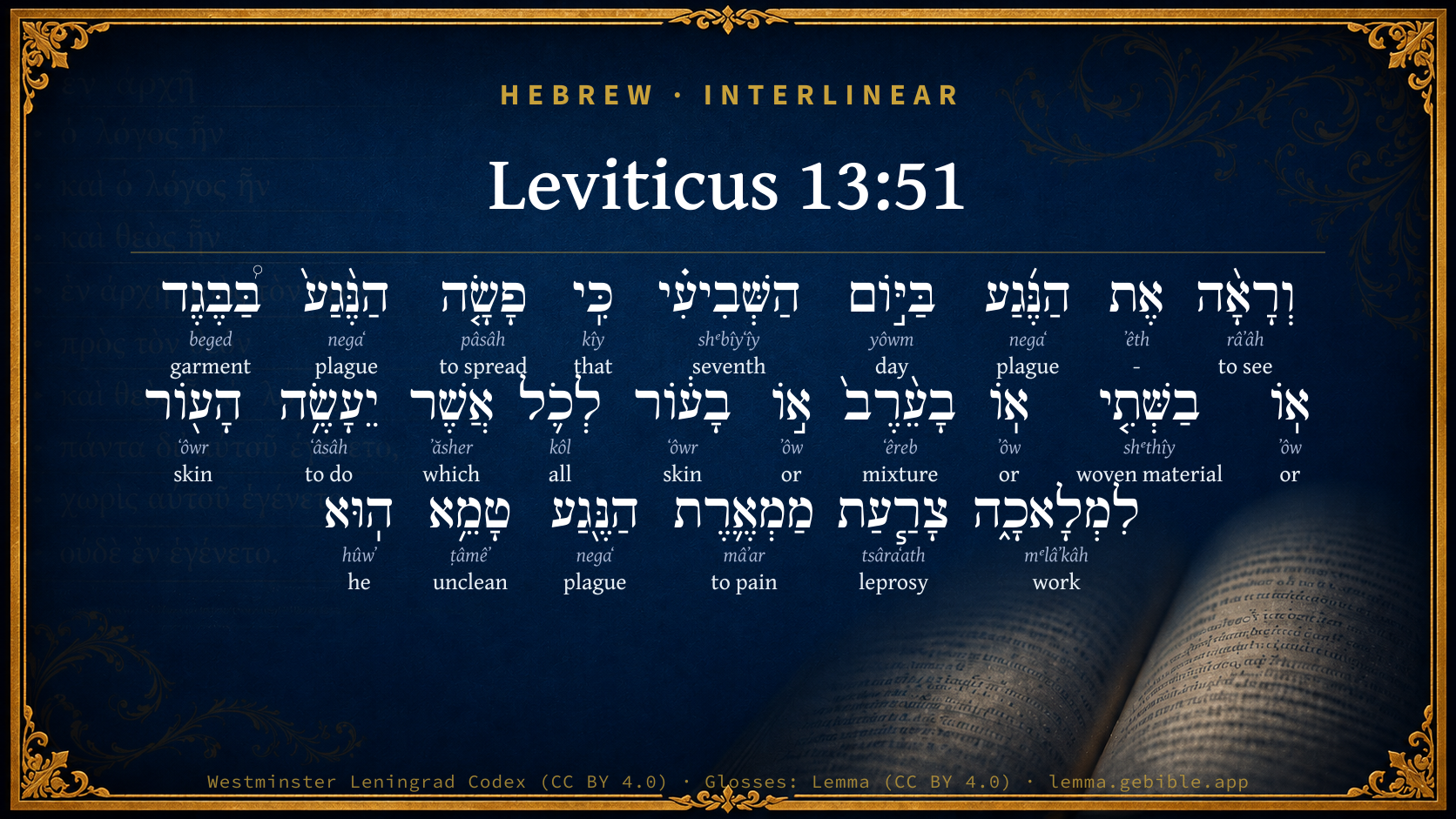
Hebrew (Westminster Leningrad Codex) Leviticus 13:51 appears in the Hebrew Old Testament. The text above is from the Westminster Leningrad Codex. Each word links to its Strong’s number, a concise gloss, and parsing drawn from the Open Scriptures Hebrew Bible morphology. Click any word for its full Brown-Driver-Briggs (BDB) entry.
Download image
Cite this verse

Leviticus 13:51 (World English Bible). Public Domain. Lemma interlinear Bible study tool, https://lemma.gebible.app/v/leviticus/13/51.

Show BibTeX & RIS
BibTeX
RIS
English Translation
He shall examine the plague on the seventh day. If the plague has spread in the garment, either in the warp, or in the woof, or in the skin, whatever use the skin is used for, the plague is a destructive mildew. It is unclean.
World English Bible · Public Domain
Highlights
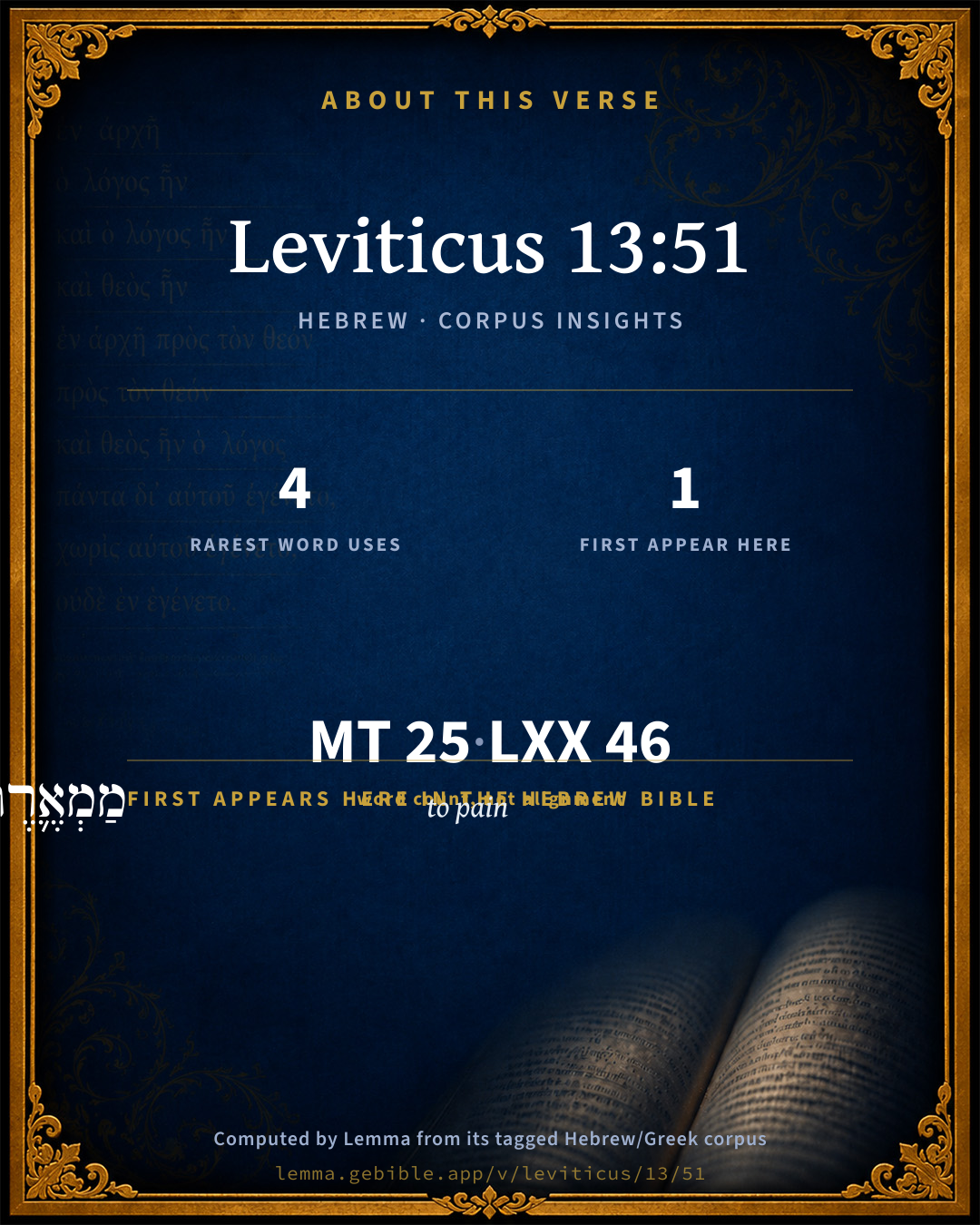
  • 1 first appearance in the Hebrew Bible
Full analysis ↓
Download a study sheet

One document with this verse’s original text, its word-by-word gloss line, the meaning frame, cross-references with their text, attributed commentary, and full source and license credits — printable, and it pastes into notes with its structure intact.

This verse Autodidact and up

Study sheet (.html) Plain text (.txt)

A passage Seminary Student

Up to 50 verses in one chapter. A passage sheet keeps up to 6 commentary sources and 12 cross-references per verse, in the order this page ranks them, and says so on the sheet whenever that leaves anything out. Ask for a single verse and you get the Autodidact verse sheet above.

Everything on this page stays free to read, with no account — the sheet is a download of what is already on screen, not access to it.

Want to remove ads? Support Godless Engineer
Compare translations 3

The same verse in 3 English versions, stacked beneath the original-language interlinear above. Click any original word for its lexicon entry.

Each is an independent rendering of the whole verse — the interlinear is not word-aligned to these translations.

Highlighted words mark where these versions differ — a whole-verse word diff, not a word-by-word alignment.

  • World English Bible Public Domain
    He shall examine the plague on the seventh day. If the plague has spread in the garment, either in the warp, or in the woof, or in the skin, whatever use the skin is used for, the plague is a destructive mildew. It is unclean.
  • King James Version Public Domain
    And he shall look on the plague on the seventh day: if the plague be spread in the garment, either in the warp, or in the woof, or in a skin, or in any work that is made of skin; the plague is a fretting leprosy; it is unclean.
  • unfoldingWord Literal Text CC BY-SA 4.0
    And he shall see the infection on the seventh day. If the infection has spread on the clothing or in the warp or in the woof or on the leather—of any equipment into which the leather was made—the infection a malignant disease. It unclean.

unfoldingWord Literal Text — © unfoldingWord, licensed CC BY-SA 4.0. Word-aligned USFM3 via Door43 (git.door43.org/unfoldingWord/en_ult).

Versions to compare (up to 4)

3 of 4 selected

Show all 18 translations

Every available English version of this verse, each an independent rendering of the whole verse.

  • World English Bible Public Domain
    He shall examine the plague on the seventh day. If the plague has spread in the garment, either in the warp, or in the woof, or in the skin, whatever use the skin is used for, the plague is a destructive mildew. It is unclean.
  • Berean Standard Bible Public Domain
    On the seventh day the priest shall reexamine it, and if the mildew has spread in the fabric, weave, knit, or leather, then regardless of how it is used, it is a harmful mildew; the article is unclean.
  • Majority Standard Bible Public Domain
    On the seventh day the priest shall reexamine it, and if the mildew has spread in the fabric, weave, knit, or leather, then regardless of how it is used, it is a harmful mildew; the article is unclean.
  • King James Version Public Domain
    And he shall look on the plague on the seventh day: if the plague be spread in the garment, either in the warp, or in the woof, or in a skin, or in any work that is made of skin; the plague is a fretting leprosy; it is unclean.
  • American Standard Version (1901) Public Domain
    and he shall look on the plague on the seventh day: if the plague be spread in the garment, either in the warp, or in the woof, or in the skin, whatever service skin is used for; the plague is a fretting leprosy; it is unclean.
  • Revised Version (1885) Public Domain
    and he shall look on the plague on the seventh day: if the plague be spread in the garment, either in the warp, or in the woof, or in the skin, whatever service skin is used for; the plague is a fretting leprosy; it is unclean.
  • Geneva Bible (1599) Public Domain
    And shall looke on the plague the seuenth day: if the plague growe in the garment or in the warpe, or in the woofe, or in the skinne, or in any thing that is made of skin, that plague is a fretting leprosie and vncleane.
  • Douay-Rheims (1899) Public Domain
    And on the seventh day when he looketh on it again, if he find that it if grown, it is a Axed leprosy: he shall judge the garment unclean, and every thing wherein it shall be found:
  • Young's Literal Translation Public Domain
    and he hath seen the plague on the seventh day, and the plague hath spread in the garment, or in the warp, or in the woof, or in the skin, of all that is made of skin for work; the plague `is' a fretting leprosy, it `is' unclean.
  • Literal Standard Version CC BY-SA 4.0
    and he has seen the plague on the seventh day, and the plague has spread in the garment, or in the warp, or in the woof, or in the skin, of all that is made of skin for work, the plague [is] a fretting leprosy; it [is] unclean.
  • Unlocked Literal Bible CC BY-SA 4.0
    He must examine the mildew again on the seventh day. If it has spread in the garment or anything woven or knitted from wool or linen material, or leather or anything in which leather is used, then it is harmful mildew, and the item is unclean.
  • unfoldingWord Literal Text CC BY-SA 4.0
    And he shall see the infection on the seventh day. If the infection has spread on the clothing or in the warp or in the woof or on the leather—of any equipment into which the leather was made—the infection a malignant disease. It unclean.
  • Darby Bible Public Domain
    And he shall see the sore on the seventh day: if the sore have spread in the garment, either in the warp or in the woof, or in a skin, in any work that may be made of skin, the sore is a corroding leprosy: it is unclean.
  • World Messianic Bible Public Domain
    He shall examine the plague on the seventh day. If the plague has spread in the garment, either in the warp, or in the woof, or in the skin, whatever use the skin is used for, the plague is a destructive mildew. It is unclean.
  • Webster's Bible Public Domain
    And he shall look on the plague on the seventh day: if the plague is spread in the garment, either in the warp, or in the woof, or in a skin, or in any work that is made of skin: the plague is a fretting leprosy; it is unclean.
  • Free Bible Version CC BY-SA 4.0
    On the seventh day the priest shall inspect it again, and if the patch of mold has spread in the material, whether it's leather, woven, or knitted or some other leather item, then it is a harmful mold; the article is unclean, whatever it is being used for.
  • Bible in Basic English Public Domain
    And he is to see the mark on the seventh day; if the mark is increased in the clothing, or in the threads of the material, or in the leather, whatever the leather is used for, it is the disease biting into it: it is unclean.
  • JPS Tanakh (1917) Public Domain
    And he shall look on the plague on the seventh day: if the plague be spread in the garment, or in the warp, or in the woof, or in the skin, whatever service skin is used for, the plague is a malignant leprosy: it is unclean.

Literal Standard Version (2020), Covenant Press — licensed CC BY-SA 4.0. Text via the HelloAO Bible API (eBible.org). Unlocked Literal Bible (unfoldingWord) — licensed CC BY-SA 4.0. Text via the HelloAO Bible API (eBible.org). unfoldingWord Literal Text — © unfoldingWord, licensed CC BY-SA 4.0. Word-aligned USFM3 via Door43 (git.door43.org/unfoldingWord/en_ult). Free Bible Version, Dr. Jonathan Gallagher — licensed CC BY-SA 4.0. Text via the HelloAO Bible API (eBible.org).

Word by word

More ways to search: Search by grammar → Find every occurrence → Compare this word →

Practice this passage: Drill this verse → Learn its vocabulary →

מַמְאֶ֛רֶת
mâʼar
H3992
“paining”
Verb, Hiphil, Participle Active, Feminine, Singular, Absolute
Part of Speech
Verb
Stem
Hiphil
Form
Participle Active
Gender
Feminine
Number
Singular
State
Absolute
Full BDB Definition

Origin: a primitive root

TWOT: 1141

(Hiphil) to pain, prick, irritate, be in pain
  1. וְרָאָ֨ה râʼâh H7200 “and · to see” Conjunction + Verb, Qal, Sequential Perfect, 3rd Person, Masculine, Singular
  2. אֶת ʼêth H853 “-” Particle, Direct Object
  3. הַנֶּ֜גַע negaʻ H5061 “the · plague” Particle, Definite Article + Noun, Common, Masculine, Singular, Absolute
  4. בַּיּ֣וֹם yôwm H3117 “in/at the · day” Preposition, Determined + Noun, Common, Masculine, Singular, Absolute
  5. הַשְּׁבִיעִ֗י shᵉbîyʻîy H7637 “the · seventh” Particle, Definite Article + Adjective, Ordinal number, Masculine, Singular, Absolute
  6. כִּֽי kîy H3588 “that” Conjunction
  7. פָשָׂ֤ה pâsâh H6581 “to spread” Verb, Qal, Perfect, 3rd Person, Masculine, Singular
  8. הַנֶּ֨גַע֙ negaʻ H5061 “the · plague” Particle, Definite Article + Noun, Common, Masculine, Singular, Absolute
  9. בַּ֠בֶּגֶד beged H899 “in/at the · garment” Preposition, Determined + Noun, Common, Masculine, Singular, Absolute
  10. אֽוֹ ʼôw H176 “or” Conjunction
  11. בַשְּׁתִ֤י shᵉthîy H8359 “in/at the · woven material” Preposition, Determined + Noun, Common, Masculine, Singular, Absolute
  12. אֽוֹ ʼôw H176 “or” Conjunction
  13. בָעֵ֨רֶב֙ ʻêreb H6154 “in/at the · mixture” Preposition, Determined + Noun, Common, Masculine, Singular, Absolute
  14. א֣וֹ ʼôw H176 “or” Conjunction
  15. בָע֔וֹר ʻôwr H5785 “in/at the · skin” Preposition, Determined + Noun, Common, Masculine, Singular, Absolute
  16. לְכֹ֛ל kôl H3605 “to/for · all” Preposition + Noun, Common, Masculine, Singular, Absolute
  17. אֲשֶׁר ʼăsher H834 “which” Particle, Relative
  18. יֵעָשֶׂ֥ה ʻâsâh H6213 “to do” Verb, Niphal, Imperfect, 3rd Person, Masculine, Singular
  19. הָע֖וֹר ʻôwr H5785 “the · skin” Particle, Definite Article + Noun, Common, Masculine, Singular, Absolute
  20. לִמְלָאכָ֑ה mᵉlâʼkâh H4399 “to/for · work” Preposition + Noun, Common, Feminine, Singular, Absolute
  21. צָרַ֧עַת tsâraʻath H6883 “leprosy” Noun, Common, Feminine, Singular, Absolute
  22. הַנֶּ֖גַע negaʻ H5061 “the · plague” Particle, Definite Article + Noun, Common, Masculine, Singular, Absolute
  23. טָמֵ֥א ṭâmêʼ H2931 “unclean” Adjective, Adjective, Masculine, Singular, Absolute
  24. הֽוּא hûwʼ H1931 “he” Pronoun, Personal, 3rd Person, Masculine, Singular

About this verse

These counts appear in no published source. They are computed here, from the morphology-tagged text and Lemma’s own curated glosses. What Lemma adds →

25
words
20
distinct lemmas
Pentateuch
section

Notable vocabulary

The rarest word here is מַמְאֶ֛רֶת to pain H3992 — appearing just 4 times in the whole Hebrew Bible.

First appearance in Scripture

This word makes its first canonical appearance in the Hebrew Bible here:

  • מַמְאֶ֛רֶת to pain H3992

Shared distinctive vocabulary

מַמְאֶ֛רֶת to pain H3992 occurs in 4 verses of the Hebrew Bible. Also found in:

Grammatical profile

  • 4 verbs
  • 12 nouns
  • 2 adjectives
  • 1 pronoun
  • 4 conjunctions
  • 2 particles

Verb forms

  • וְרָאָ֨ה Qal · Sequential Perfect
  • פָשָׂ֤ה Qal · Perfect
  • יֵעָשֶׂ֥ה Niphal · Imperfect
  • מַמְאֶ֛רֶת Hiphil · Participle Active

Repetition

Words recur within this verse — often emphatic in Hebrew:

  • הַנֶּ֜גַע plague H5061 ×3
  • בָע֔וֹר skin H5785 ×2
  • אֽוֹ or H176 ×3

Hebrew & Septuagint length

In English translation the verse runs 45 words from the Hebrew and 52 from the Septuagint (LXX English) — closely comparable.

A rough comparison of the two English renderings, which tokenize alike — not a word-level alignment.

Word counts can differ between the Hebrew and the Greek without any difference in meaning — e.g. the Hebrew direct-object marker אֵת has no separate Greek word, and Greek often adds the article ὁ.

In the original languages it is 25 Hebrew tokens and 46 Greek tokens — but the two are counted differently (Hebrew bundles its prefixes and suffixes into one token; the Greek is in lemma form), so that isn’t a like-for-like length.

Cross-references

1

Topical passages linked to Leviticus 13:51 in the Treasury of Scripture Knowledge — connected by theme and wording, ordered by reader-vote popularity; previews shown in the World English Bible.

  • Leviticus 14:44 then the priest shall come in and look; and, behold, if the plague has spread in the house, it is a destructive mildew in the house. It is unclean.

Cross-references courtesy of OpenBible.info (CC BY 4.0).

Hebrew and Greek witnesses Masoretic Hebrew ↔ Greek Septuagint

The same verse in the two great witnesses to the Old Testament, shown verse-for-verse.

These are two independent witnesses, not word-aligned to each other, and the Septuagint is shown in lemma (dictionary) form.

Hebrew Leviticus 13:51 Masoretic · Westminster Leningrad Codex

וְרָאָ֨ה אֶת הַנֶּ֜גַע בַּיּ֣וֹם הַשְּׁבִיעִ֗י כִּֽי פָשָׂ֤ה הַנֶּ֨גַע֙ בַּ֠בֶּגֶד אֽוֹ בַשְּׁתִ֤י אֽוֹ בָעֵ֨רֶב֙ א֣וֹ בָע֔וֹר לְכֹ֛ל אֲשֶׁר יֵעָשֶׂ֥ה הָע֖וֹר לִמְלָאכָ֑ה צָרַ֧עַת מַמְאֶ֛רֶת הַנֶּ֖גַע טָמֵ֥א הֽוּא

He shall examine the plague on the seventh day. If the plague has spread in the garment, either in the warp, or in the woof, or in the skin, whatever use the skin is used for, the plague is a destructive mildew. It is unclean.

World English Bible · Public Domain

Greek LXX Leviticus 13:51 Septuagint · lemma form

καί ὁράω ὁ ἱερεύς ὁ ἁφή ὁ ἡμέρα ὁ ἕβδομος ἐάν δέ διαχέω ὁ ἁφή ἐν ὁ ἱμάτιον ἤ ἐν ὁ στήμων ἤ ἐν ὁ κρόκη ἤ ἐν ὁ δέρμα κατά πᾶς ὅσος ἄν ποιέω δέρμα ἐν ὁ ἐργασία λέπρα ἔμμονος εἰμί ὁ ἁφή ἀκάθαρτος εἰμί

And the priest shall look upon the plague on the seventh day; and if the plague be spread in the garment, either in the warp or in the woof, or in the skin, in whatever things skins may be used in their workmanship, the plague is a confirmed leprosy; it is unclean.

LXX2012 (modern English Septuagint) · Public Domain

Hebrew: Westminster Leningrad Codex (CC BY 4.0). Greek: Septuagint (public domain); English from LXX2012 (modern English Septuagint) (Public Domain). How the Septuagint differs from the Hebrew →

Targum (Aramaic paraphrase)

2

The Targum is the ancient Jewish Aramaic paraphrase of the Hebrew Scriptures — an interpretive translation, not the Hebrew text itself. Onkelos (literal) and Pseudo-Jonathan (expansive) render the Torah, and Jonathan the Prophets. Coverage is partial: where no permissively-licensed English translation exists for a verse, only the Aramaic is shown. This is verse-level text, not a word-by-word alignment to the Hebrew.

  1. Targum Onkelos Torah (Genesis–Deuteronomy)
    וְיֶחֱזֵי יָת מַכְתָּשָׁא בְּיוֹמָא שְׁבִיעָאָה אֲרֵי אוֹסֵף מַכְתָּשָּׁא בִּלְבוּשָׁא אוֹ בְשִׁתְיָא אוֹ בְעַרְבָא אוֹ בְמַשְׁכָּא לְכֹל דִי יִתְעֲבֵד מַשְׁכָּא לְעִבִידָא סְגִירוּת מְחַסְרָא מַכְתָּשָׁא מְסָאָב הוּא

    (no public-domain English translation for this verse)

    Targum Onkelos — Aramaic: “Onkelos Genesis” (public domain); “Onkelos Exodus” (public domain); “Onkelos Leviticus” (public domain); “Onkelos Numbers” (public domain); “Onkelos Deuteronomy” (public domain). English: “Sefaria Community Translation” (CC0 1.0 (public-domain dedication)); “J.W. Etheridge. The Targums of Onkelos and Jonathan Ben Uzziel on the Pentateuch. London: Longmans, Green, 1862” (public domain). Text via Sefaria.

  2. Targum Pseudo-Jonathan Torah (Genesis–Deuteronomy)
    וְיֶחֱמֵי יַת מַכְתְּשָׁא בְּיוֹמָא שְׁבִיעָאָה אֲרוּם הֲלִיךְ פִּסְיוֹן מַכְתְּשָׁא בִּלְבוּשָׁא אוֹ בְּשִׁיתְיָא אוֹ בְעַרְבָא אוֹ בִצְלָא לְכָל דְיִתְעֲבֵיד צְלָא לְעִיבִידְתָּא צוּרְעָא מֵחַלְטָא מַכְתְּשָׁא מְסָאָב הוּא

    and he shall look upon the plague on the seventh day, and if the plague hath become wider in the garment, whether in the warp or woof, or in the skin, or anything made of skin, it is a manifest plague of leprosy, it is unclean.

    Targum Pseudo-Jonathan — Aramaic: “Targum Jonathan on Genesis” (public domain); “Targum Jonathan on Exodus” (public domain); “Targum Jonathan on Leviticus” (public domain); “Targum Jonathan on Numbers” (public domain); “Targum Jonathan on Deuteronomy” (public domain). English: “The Targum of Jonathan ben Uzziel, trans. J. W. Etheridge, London, 1862” (public domain). Text via Sefaria.

Commentary

Notes on Leviticus 13:51 from classic Christian and Jewish commentators (each source and its license shown beneath its notes). The classic Christian expositions comment on the surrounding passage and are grouped to its opening verse, so a note may address several verses; the Jewish commentaries on the Tanakh (Rashi and others) are per-verse, so they appear only where the commentator wrote on this verse.

Lemma curates 59 commentaries, every one of them public domain or Creative Commons licensed, each selected and text-cleaned for this edition rather than reprinted as found. About our sources →

Ellicott's Commentary for English Readers

(51) And he shall look on the plague.—If at the end of the week, when the priest examines it again, he finds that the distemper has spread, it undoubtedly indicates malignant leprosy. Here, again, the symptom of spreading is the same in the garment as in the human being. (See Lev_13:5-6; Lev_13:8, &c.) The leprous garment, like a human leper, makes everything and everybody unclean by contact with it, or by coming into the house where it remains.

A Bible Commentary for English Readers, edited by Charles John Ellicott (1878–1897) — public domain. Text from a community e-Sword module.

The Cambridge Bible for Schools and Colleges

gen. ed. J. J. S. Perowne

51. a fretting leprosy] i.e. malignant.

The Cambridge Bible for Schools and Colleges (gen. ed. J. J. S. Perowne; Cambridge University Press, 1878–1918) — public domain. Text from a community e-Sword module.

John Gill's Exposition

And if the priest shall look,.... On the seventh day as before, after shutting up:

and, behold, the plague be not spread in the garment, either in the warp, or in the woof, or in anything of skin; but is at an entire stay, that it may be hoped it is not a fretting leprosy: so when men do not proceed to more ungodliness, as wicked men commonly do, but there is a stop put to their vicious life and conversation, it is an hopeful sign of future good.

John Gill's Exposition of the Whole Bible (1746–1763) — public domain (CC PDM 1.0). Text via the HelloAO Bible API.

Albert Barnes' Notes on the Bible

A fretting leprosy - i. e. a malignant or corroding leprosy. What was the nature of the leprosy in clothing, which produced greenish or reddish spots, cannot be precisely determined. It was most likely destructive mildew, perhaps of more than one kind.

Albert Barnes' Notes on the Bible (1834–1885) — public domain. Text from a community e-Sword/MySword module.

Haydock's Catholic Bible Commentary

Grown. Hebrew adds here, (and ver. 53, 56, 57, 59,) "in the garment, either in the warp, or in the woof, or in a skin, or in any work that is made of a skin."

George Leo Haydock (1774–1849), Haydock's Catholic Family Bible and Commentary, 1859 edition — public domain. Excludes Psalms (Douay-Rheims chapter numbering differs from Protestant) and Deuterocanonical books (Catholic canon only).

Rashi

Rabbi Shlomo Yitzchaki (Rashi)

צרעת ממארת A FRETTING LEPROSY — The word ממארת has the same meaning as. (Ezekiel 28:24) “a pricking (ממאיר) brier”; point (poignant) in old French The Midrashic explanation is: Attach a curse (מארה) to it, — that you will make no use of it (and therefore it must be burnt) (Sifra, Tazria Parashat Nega'im, Chapter 14 11).

Rashi on the Tanakh — English translations: “The Judaica Press complete Tanach with Rashi, translated by A. J. Rosenberg” (CC BY 4.0); “Pentateuch with Rashi's commentary by M. Rosenbaum and A.M. Silbermann, 1929-1934” (public domain); “The Metsudah Tanach series, Lakewood, N.J” (CC BY 4.0); and “The Book of Joshua, Metsudah Publications, 1997” (CC BY 4.0). Text via Sefaria.

Lesson kit

Teaching starters — assembled from the data on this page, not authored interpretation. Every prompt links to the verse data it draws on. Edit before teaching.

Leviticus, in the Pentateuch, opens this verse with 25 words (20 distinct Hebrew lemmas). Its most distinctive word is mâʼar (“to pain”). A historical commentator’s framing appears above. Read the whole chapter for the surrounding context.

Discussion questions

  1. What does “to pain” (mâʼar) contribute to the verse as a whole?
  2. The word “to pain” first appears here in Scripture. What is being introduced at this debut?
  3. Leviticus 13:52 shares the word «to pain» with this verse. How do the two illuminate each other?
  4. “plague” occurs 3× in this one verse. What is the effect of the repetition?
  5. These translations render this verse differently; the difference is in the English rendering, not the original. What questions does that raise?
  6. The verb «וְרָאָ֨ה» is Qal Sequential Perfect. How does its form color the action?
  7. Reading how Ellicott's Commentary for English Readers and The Cambridge Bible for Schools and Colleges read this verse, where do the two commentators agree and where do they part?

Things to notice

Reading settings

Reading text

Shown beneath each verse's original-language words.

Old Testament
Old Testament edition

Read the OT as the Masoretic Hebrew (MT) or the Greek Septuagint (LXX).

English shown for the Greek Septuagint (in the Hebrew ↔ Greek comparison).

Comparing translations? Open the Compare panel on any verse page to stack up to four side by side.