Leviticus 15:8

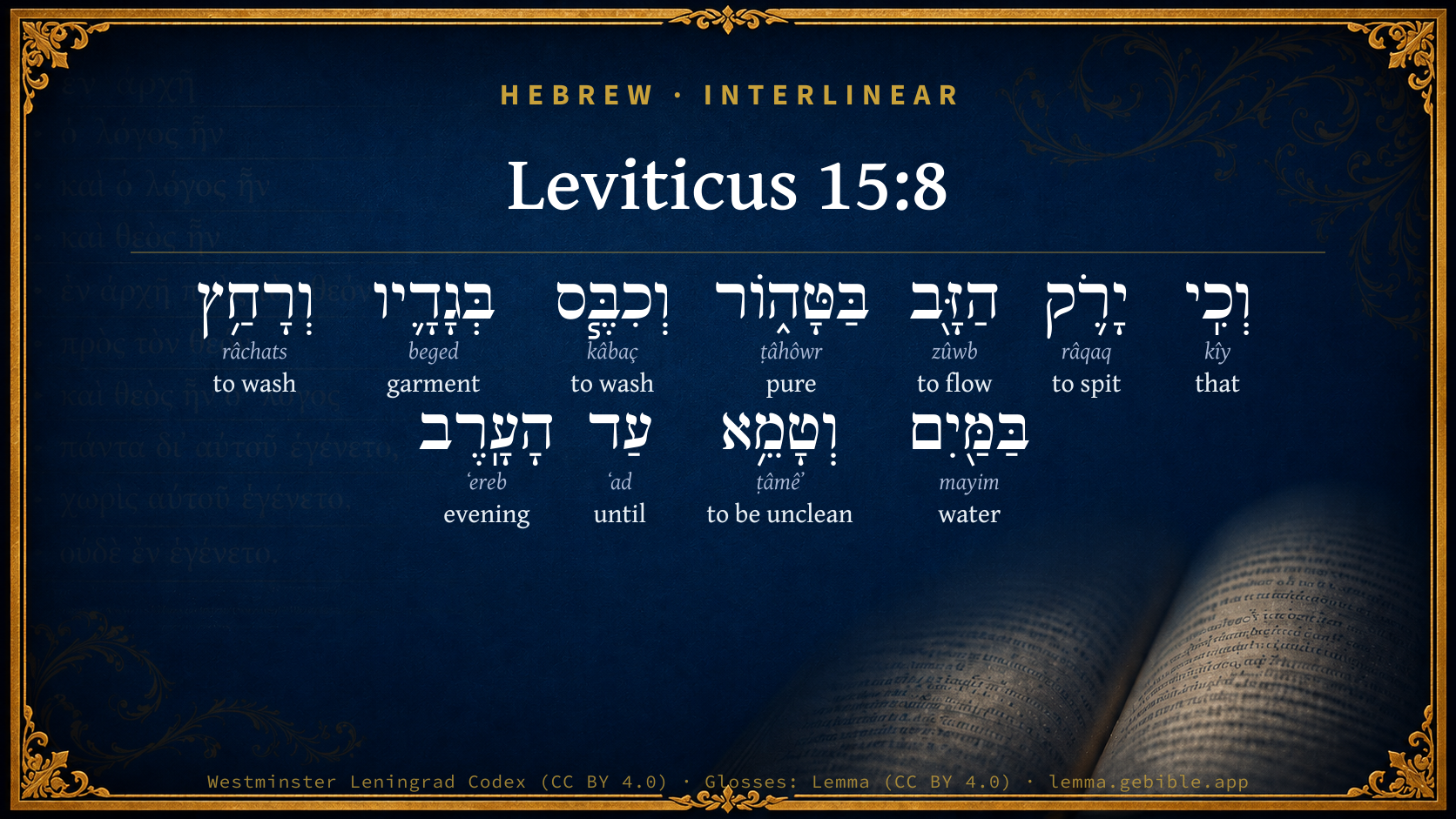
Hebrew (Westminster Leningrad Codex) Leviticus 15:8 appears in the Hebrew Old Testament. The text above is from the Westminster Leningrad Codex. Each word links to its Strong’s number, a concise gloss, and parsing drawn from the Open Scriptures Hebrew Bible morphology. Click any word for its full Brown-Driver-Briggs (BDB) entry.
Download image
Cite this verse

Leviticus 15:8 (World English Bible). Public Domain. Lemma interlinear Bible study tool, https://lemma.gebible.app/v/leviticus/15/8.

Show BibTeX & RIS
BibTeX
RIS
English Translation
"'If he who has the discharge spits on him who is clean, then he shall wash his clothes, and bathe himself in water, and be unclean until the evening.
World English Bible · Public Domain
Highlights
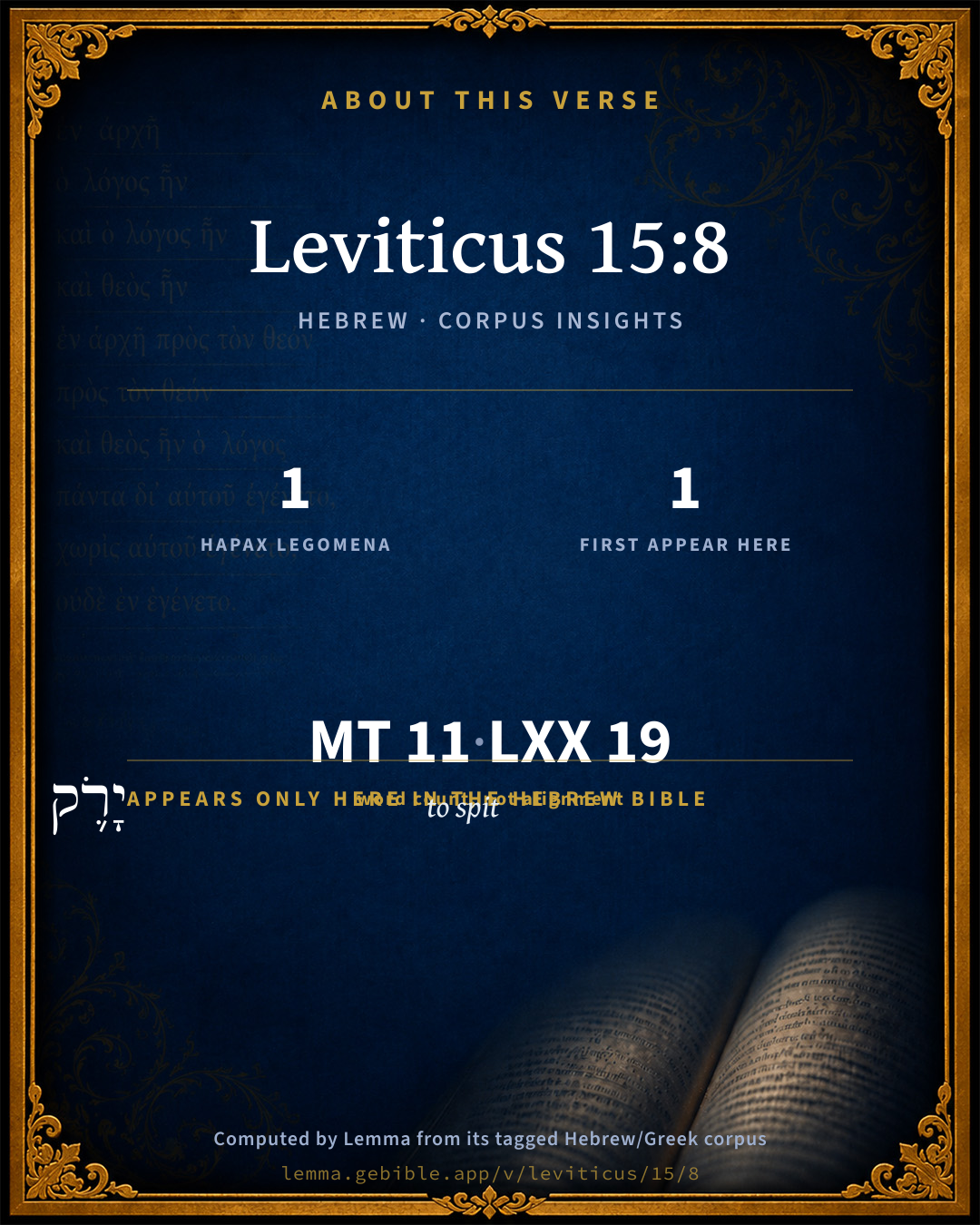
  • 1 hapax legomenon — only here in the Hebrew Bible
  • 1 first appearance in the Hebrew Bible
Full analysis ↓
Download a study sheet

One document with this verse’s original text, its word-by-word gloss line, the meaning frame, cross-references with their text, attributed commentary, and full source and license credits — printable, and it pastes into notes with its structure intact.

This verse Autodidact and up

Study sheet (.html) Plain text (.txt)

A passage Seminary Student

Up to 50 verses in one chapter. A passage sheet keeps up to 6 commentary sources and 12 cross-references per verse, in the order this page ranks them, and says so on the sheet whenever that leaves anything out. Ask for a single verse and you get the Autodidact verse sheet above.

Everything on this page stays free to read, with no account — the sheet is a download of what is already on screen, not access to it.

Want to remove ads? Support Godless Engineer
Compare translations 3

The same verse in 3 English versions, stacked beneath the original-language interlinear above. Click any original word for its lexicon entry.

Each is an independent rendering of the whole verse — the interlinear is not word-aligned to these translations.

Highlighted words mark where these versions differ — a whole-verse word diff, not a word-by-word alignment.

  • World English Bible Public Domain
    "'If he who has the discharge spits on him who is clean, then he shall wash his clothes, and bathe himself in water, and be unclean until the evening.
  • King James Version Public Domain
    And if he that hath the issue spit upon him that is clean; then he shall wash his clothes, and bathe himself in water, and be unclean until the even.
  • unfoldingWord Literal Text CC BY-SA 4.0
    And when the flowing spits on a person who is clean, then he shall wash his clothes and he shall bathe with water, and he shall be unclean until the evening.

unfoldingWord Literal Text — © unfoldingWord, licensed CC BY-SA 4.0. Word-aligned USFM3 via Door43 (git.door43.org/unfoldingWord/en_ult).

Versions to compare (up to 4)

3 of 4 selected

Show all 18 translations

Every available English version of this verse, each an independent rendering of the whole verse.

  • World English Bible Public Domain
    "'If he who has the discharge spits on him who is clean, then he shall wash his clothes, and bathe himself in water, and be unclean until the evening.
  • Berean Standard Bible Public Domain
    If the man with the discharge spits on one who is clean, that person must wash his clothes and bathe with water, and he will be unclean until evening.
  • Majority Standard Bible Public Domain
    If the man with the discharge spits on one who is clean, that person must wash his clothes and bathe with water, and he will be unclean until evening.
  • King James Version Public Domain
    And if he that hath the issue spit upon him that is clean; then he shall wash his clothes, and bathe himself in water, and be unclean until the even.
  • American Standard Version (1901) Public Domain
    And if he that hath the issue spit upon him that is clean, then he shall wash his clothes, and bathe himself in water, and be unclean until the even.
  • Revised Version (1885) Public Domain
    And if he that hath the issue spit upon him that is clean; then he shall wash his clothes, and bathe himself in water, and be unclean until the even.
  • Geneva Bible (1599) Public Domain
    If he also, that hath the issue, spit vpon him that is cleane, he shall wash his clothes, and wash himselfe in water, and shalbe vncleane vntill the euen.
  • Douay-Rheims (1899) Public Domain
    If such a man cast his spittle upon him that is clean, he shall wash his clothes: and being washed with water, he shall be unclean until the evening.
  • Young's Literal Translation Public Domain
    `And when he who hath the issue spitteth on him who is clean, then he hath washed his garments, and hath bathed with water, and been unclean till the evening.
  • Literal Standard Version CC BY-SA 4.0
    And when he who has the discharging spits on him who is clean, then he has washed his garments, and has bathed with water, and been unclean until the evening.
  • Unlocked Literal Bible CC BY-SA 4.0
    If the person who has such a flow of fluid spits on someone who is clean, then that person must wash his clothes and bathe himself in water, and he will be unclean until evening.
  • unfoldingWord Literal Text CC BY-SA 4.0
    And when the flowing spits on a person who is clean, then he shall wash his clothes and he shall bathe with water, and he shall be unclean until the evening.
  • Darby Bible Public Domain
    And if he that hath the flux spit upon him that is clean, then he shall wash his garments, and bathe in water, and be unclean until the even.
  • World Messianic Bible Public Domain
    “‘If he who has the discharge spits on him who is clean, then he shall wash his clothes, and bathe himself in water, and be unclean until the evening.
  • Webster's Bible Public Domain
    And if he that hath the issue shall spit upon him that is clean; then he shall wash his clothes, and bathe himself in water, and be unclean until the evening.
  • Free Bible Version CC BY-SA 4.0
    If the man with the discharge spits on anyone who is clean, they have to wash their clothes, and wash themselves with water, and they will be unclean until the evening.
  • Bible in Basic English Public Domain
    And if liquid from the mouth of the unclean man comes on to him who is clean, then he is to have his clothing washed and his body bathed in water and be unclean till evening.
  • JPS Tanakh (1917) Public Domain
    And if he that hath the issue spit upon him that is clean, then he shall wash his clothes, and bathe himself in water, and be unclean until the even.

Literal Standard Version (2020), Covenant Press — licensed CC BY-SA 4.0. Text via the HelloAO Bible API (eBible.org). Unlocked Literal Bible (unfoldingWord) — licensed CC BY-SA 4.0. Text via the HelloAO Bible API (eBible.org). unfoldingWord Literal Text — © unfoldingWord, licensed CC BY-SA 4.0. Word-aligned USFM3 via Door43 (git.door43.org/unfoldingWord/en_ult). Free Bible Version, Dr. Jonathan Gallagher — licensed CC BY-SA 4.0. Text via the HelloAO Bible API (eBible.org).

Word by word

More ways to search: Search by grammar → Find every occurrence → Compare this word →

Practice this passage: Drill this verse → Learn its vocabulary →

יָרֹ֛ק
râqaq
H7556
“to spit”
Verb, Qal, Imperfect, 3rd Person, Masculine, Singular
Part of Speech
Verb
Stem
Qal
Form
Imperfect
Person
3rd Person
Gender
Masculine
Number
Singular
Full BDB Definition

Origin: a primitive root

TWOT: 2219

(Qal) to spit
  1. וְכִֽי kîy H3588 “and · that” Conjunction + Conjunction
  2. הַזָּ֖ב zûwb H2100 “the · flowing” Particle, Definite Article + Verb, Qal, Participle Active, Masculine, Singular, Absolute
  3. בַּטָּה֑וֹר ṭâhôwr H2889 “in/at the · pure” Preposition, Determined + Adjective, Adjective, Masculine, Singular, Absolute
  4. וְכִבֶּ֧ס kâbaç H3526 “and · to wash” Conjunction + Verb, Piel, Sequential Perfect, 3rd Person, Masculine, Singular
  5. בְּגָדָ֛יו beged H899 “garments · his” Noun, Common, Masculine, Plural, Construct + Suffix, Personal, 3rd Person, Masculine, Singular
  6. וְרָחַ֥ץ râchats H7364 “and · to wash” Conjunction + Verb, Qal, Sequential Perfect, 3rd Person, Masculine, Singular
  7. בַּמַּ֖יִם mayim H4325 “in/at the · water(s)” Preposition, Determined + Noun, Common, Masculine, Plural, Absolute
  8. וְטָמֵ֥א ṭâmêʼ H2930 “and · to be unclean” Conjunction + Verb, Qal, Sequential Perfect, 3rd Person, Masculine, Singular
  9. עַד ʻad H5704 “until” Preposition
  10. הָעָֽרֶב ʻereb H6153 “the · evening” Particle, Definite Article + Noun, Common, Masculine, Singular, Absolute

About this verse

These counts appear in no published source. They are computed here, from the morphology-tagged text and Lemma’s own curated glosses. What Lemma adds →

11
words
11
distinct lemmas
Pentateuch
section

Notable vocabulary

1 hapax legomenon — a word that appears only here in the entire Hebrew Bible:

  • יָרֹ֛ק to spit H7556

First appearance in Scripture

This word makes its first canonical appearance in the Hebrew Bible here:

  • יָרֹ֛ק to spit H7556

Shared distinctive vocabulary

הַזָּ֖ב to flow H2100 occurs in 41 verses of the Hebrew Bible. Also found in:

Grammatical profile

  • 5 verbs
  • 3 nouns
  • 1 adjective
  • 1 preposition
  • 1 conjunction

Verb forms

  • יָרֹ֛ק Qal · Imperfect
  • הַזָּ֖ב Qal · Participle Active
  • וְכִבֶּ֧ס Piel · Sequential Perfect
  • וְרָחַ֥ץ Qal · Sequential Perfect
  • וְטָמֵ֥א Qal · Sequential Perfect

Hebrew & Septuagint length

In English translation the verse runs 29 words from the Hebrew and 30 from the Septuagint (LXX English) — closely comparable.

A rough comparison of the two English renderings, which tokenize alike — not a word-level alignment.

Word counts can differ between the Hebrew and the Greek without any difference in meaning — e.g. the Hebrew direct-object marker אֵת has no separate Greek word, and Greek often adds the article ὁ.

In the original languages it is 11 Hebrew tokens and 19 Greek tokens — but the two are counted differently (Hebrew bundles its prefixes and suffixes into one token; the Greek is in lemma form), so that isn’t a like-for-like length.

Cross-references

7

Topical passages linked to Leviticus 15:8 in the Treasury of Scripture Knowledge — connected by theme and wording, ordered by reader-vote popularity; previews shown in the World English Bible.

  • Jude 1:4 For there are certain men who crept in secretly, even those who were long ago written about for this condemnation: ungodly men, turning the grace of our God into lasciviousness, and denying our only Master, God, and Lord, Jesus Christ.
  • Isaiah 1:16 Wash yourselves, make yourself clean. Put away the evil of your doings from before my eyes; Cease to do evil.
  • Galatians 1:8–9 But even though we, or an angel from heaven, should preach to you any gospel other than that which we preached to you, let him be cursed.
  • 1 Timothy 4:1–3 But the Spirit says expressly that in later times some will fall away from the faith, paying attention to seducing spirits and doctrines of demons,
  • Titus 1:9–10 holding to the faithful word which is according to the teaching, that he may be able to exhort in the sound doctrine, and to convict those who contradict him.
  • 2 Peter 2:1–3 But there also arose false prophets among the people, as among you also there will be false teachers, who will secretly bring in destructive heresies, denying even the Master who bought them, bringing on themselves swift destruction.
  • James 4:8 Draw near to God, and he will draw near to you. Cleanse your hands, you sinners; and purify your hearts, you double-minded.

Cross-references courtesy of OpenBible.info (CC BY 4.0).

Hebrew and Greek witnesses Masoretic Hebrew ↔ Greek Septuagint

The same verse in the two great witnesses to the Old Testament, shown verse-for-verse.

These are two independent witnesses, not word-aligned to each other, and the Septuagint is shown in lemma (dictionary) form.

Hebrew Leviticus 15:8 Masoretic · Westminster Leningrad Codex

וְכִֽי יָרֹ֛ק הַזָּ֖ב בַּטָּה֑וֹר וְכִבֶּ֧ס בְּגָדָ֛יו וְרָחַ֥ץ בַּמַּ֖יִם וְטָמֵ֥א עַד הָעָֽרֶב

"'If he who has the discharge spits on him who is clean, then he shall wash his clothes, and bathe himself in water, and be unclean until the evening.

World English Bible · Public Domain

Greek LXX Leviticus 15:8 Septuagint · lemma form

ἐάν δέ προςσιελίζω ὁ γονορρυής ἐπί ὁ καθαρός πλύνω ὁ ἱμάτιον καί λούω ὕδωρ καί ἀκάθαρτος εἰμί ἕως ἑσπέρα

And if he that has the issue should spit upon one that is clean, that person shall wash his garments, and bathe himself in water, and be unclean until evening.

LXX2012 (modern English Septuagint) · Public Domain

Hebrew: Westminster Leningrad Codex (CC BY 4.0). Greek: Septuagint (public domain); English from LXX2012 (modern English Septuagint) (Public Domain). How the Septuagint differs from the Hebrew →

Targum (Aramaic paraphrase)

2

The Targum is the ancient Jewish Aramaic paraphrase of the Hebrew Scriptures — an interpretive translation, not the Hebrew text itself. Onkelos (literal) and Pseudo-Jonathan (expansive) render the Torah, and Jonathan the Prophets. Coverage is partial: where no permissively-licensed English translation exists for a verse, only the Aramaic is shown. This is verse-level text, not a word-by-word alignment to the Hebrew.

  1. Targum Onkelos Torah (Genesis–Deuteronomy)
    וַאֲרֵי יֵרוֹק דוֹבָנָא בְּדַכְיָא וִיצַבַּע לְבוּשׁוֹהִי וְיַסְחֵי בְמַיָא וִיהֵי מְסָאָב עַד רַמְשָּׁא

    (no public-domain English translation for this verse)

    Targum Onkelos — Aramaic: “Onkelos Genesis” (public domain); “Onkelos Exodus” (public domain); “Onkelos Leviticus” (public domain); “Onkelos Numbers” (public domain); “Onkelos Deuteronomy” (public domain). English: “Sefaria Community Translation” (CC0 1.0 (public-domain dedication)); “J.W. Etheridge. The Targums of Onkelos and Jonathan Ben Uzziel on the Pentateuch. London: Longmans, Green, 1862” (public domain). Text via Sefaria.

  2. Targum Pseudo-Jonathan Torah (Genesis–Deuteronomy)
    וַאֲרוּם אִין יָרִיק דוֹבָנָא בְּדַכְיָא וִיצַבַּע לְבוּשׁוֹי וְיַסְחֵי בְּאַרְבְּעִין סָאוִוין דְמוֹי וִיהֵי מְסָאָב עַד רַמְשָׁא

    And if he who hath an issue spit upon any one who is clean, let him wash his clothes, and bathe in forty seahs of water, and be unclean until evening.

    Targum Pseudo-Jonathan — Aramaic: “Targum Jonathan on Genesis” (public domain); “Targum Jonathan on Exodus” (public domain); “Targum Jonathan on Leviticus” (public domain); “Targum Jonathan on Numbers” (public domain); “Targum Jonathan on Deuteronomy” (public domain). English: “The Targum of Jonathan ben Uzziel, trans. J. W. Etheridge, London, 1862” (public domain). Text via Sefaria.

Commentary

Notes on Leviticus 15:8 from classic Christian and Jewish commentators (each source and its license shown beneath its notes). The classic Christian expositions comment on the surrounding passage and are grouped to its opening verse, so a note may address several verses; the Jewish commentaries on the Tanakh (Rashi and others) are per-verse, so they appear only where the commentator wrote on this verse.

Lemma curates 59 commentaries, every one of them public domain or Creative Commons licensed, each selected and text-cleaned for this edition rather than reprinted as found. About our sources →

Trapp's Complete Commentary

John Trapp

Lev 15:8 And if he that hath the issue spit upon him that is clean; then he shall wash his clothes, and bathe [himself] in water, and be unclean until the even.

Ver. 8. Spit upon him.] Noting the pollution that comes to men’s souls by those that spit heresies and belch out blasphemies.

John Trapp, A Commentary or Exposition upon All the Books of the Old and New Testament (1647–1656) — public domain. Text from a community e-Sword module.

Geneva Bible (1599)

Geneva Bible translators

Of whom the unclean man did spit.

Geneva Bible (1599) marginal notes — public domain. Text via Bolls.life.

Ellicott's Commentary for English Readers

(8) If he . . . spit upon him.—Spitting in the face of a person was, and still is, commonly resorted to among Oriental nations as an expression of insult and contempt (Num_12:14; Deu_25:9; Isa_1:6; Job_30:10; Mat_26:67, &c.). Suffering from the disease here discussed, the patient would naturally be more irritable, and hence be liable to give vent more frequently to this mode of expressing his wrath. Now, any person upon whom he happened to heap this indignity became defiled by the spittle in the same manner, and had to go through the same purification, as he who chanced to touch his garments, or as the physician who had to examine him.

A Bible Commentary for English Readers, edited by Charles John Ellicott (1878–1897) — public domain. Text from a community e-Sword module.

John Gill's Exposition

And if he that hath the issue spit upon him that is clean,.... Not purposely, which is not usual for a man to do, and whenever it is done, nothing is more affronting; but accidentally, when, as Aben Ezra expresses it, he spreads his spittle, and it falls upon a clean person; and under this, as Gersom observes, is comprehended whatever is brought up by coughing, as phlegm, or flows from the nose, or is pressed out of it; and so Maimonides (z): and this may denote all corrupt communication which proceeds out of the mouth of evil men, whether immoral or heretical, which not only defiles the man himself, but those he converses with; for evil communication corrupts good manners:

then he shall wash his clothes, &c. as in the foregoing instances. See Gill on Lev 15:5.

(z) Hilchot Metame Mishcab, c. 1. sect. 16.

John Gill's Exposition of the Whole Bible (1746–1763) — public domain (CC PDM 1.0). Text via the HelloAO Bible API.

unfoldingWord translationNotes

Door43 World Missions Community

someone who is clean

The person whom other people may touch is spoken of as if he were physically clean. (See: Metaphor)

he will be unclean

The person whom other people may not touch is spoken of as if he were physically unclean. (See: Metaphor)

saddle

A saddle is a leather seat that a person puts on the back of a horse in order to ride it.

Any saddle ... will be unclean

Something that Yahweh has stated is unfit to touch is spoken of as if it were physically unclean. (See: Metaphor)

translationWords

clean

unfoldingWord translationNotes — © Distant Shores Media and the Door43 World Missions Community, licensed CC BY-SA 4.0. Source: git.door43.org/Door43/en_tn.

Rashi

Rabbi Shlomo Yitzchaki (Rashi)

וכי ירק הזב בטהור AND IF HE THAT HATH THE ISSUE SPIT UPON ONE WHO IS CLEAN — and he (the clean person) comes in contact with it (the spittle; i. e. it actually falls upon him) or even if he only bears it (i. e. it has, for instance, fallen upon a stick which he is carrying) then HE SHALL BE UNCLEAN UNTIL THE EVEN, for the spittle communicates uncleanness through carrying it (cf. Niddah 55b).

Rashi on the Tanakh — English translations: “The Judaica Press complete Tanach with Rashi, translated by A. J. Rosenberg” (CC BY 4.0); “Pentateuch with Rashi's commentary by M. Rosenbaum and A.M. Silbermann, 1929-1934” (public domain); “The Metsudah Tanach series, Lakewood, N.J” (CC BY 4.0); and “The Book of Joshua, Metsudah Publications, 1997” (CC BY 4.0). Text via Sefaria.

Lesson kit

Teaching starters — assembled from the data on this page, not authored interpretation. Every prompt links to the verse data it draws on. Edit before teaching.

Leviticus, in the Pentateuch, opens this verse with 11 words (11 distinct Hebrew lemmas). Its most distinctive word is râqaq (“to spit”). A historical commentator’s framing appears above. Read the whole chapter for the surrounding context.

Discussion questions

  1. How does “to spit” (râqaq) shape what this verse is saying?
  2. This verse holds 1 word here found nowhere else in the Hebrew Bible. What might the rare word draw attention to?
  3. The word “to spit” first appears here in Scripture. What is being introduced at this debut?
  4. Exodus 3:8 shares the word «to flow» with this verse. How do the two illuminate each other?
  5. These translations render this verse differently. What is at stake in choosing one wording over another?
  6. The verb «יָרֹ֛ק» is Qal Imperfect. How does its form color the action?
  7. Reading how Trapp's Complete Commentary and Geneva Bible (1599) read this verse, where do the two commentators agree and where do they part?

Things to notice

Reading settings

Reading text

Shown beneath each verse's original-language words.

Old Testament
Old Testament edition

Read the OT as the Masoretic Hebrew (MT) or the Greek Septuagint (LXX).

English shown for the Greek Septuagint (in the Hebrew ↔ Greek comparison).

Comparing translations? Open the Compare panel on any verse page to stack up to four side by side.