
2 Kings 6:30

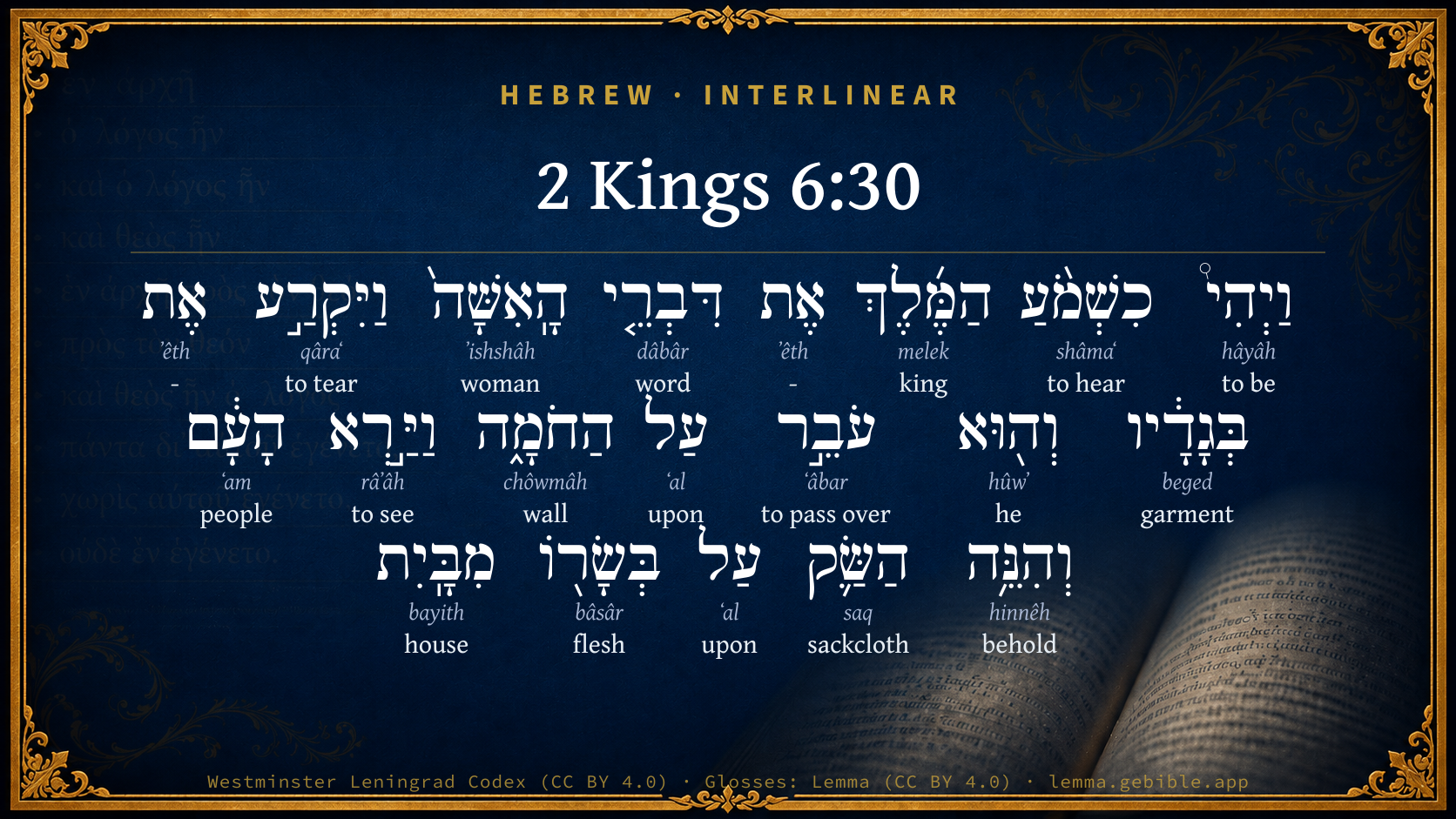
Hebrew (Westminster Leningrad Codex) 2 Kings 6:30 appears in the Hebrew Old Testament. The text above is from the Westminster Leningrad Codex. Each word links to its Strong’s number, a concise gloss, and parsing drawn from the Open Scriptures Hebrew Bible morphology. Click any word for its full Brown-Driver-Briggs (BDB) entry.
Download image
Cite this verse

2 Kings 6:30 (World English Bible). Public Domain. Lemma interlinear Bible study tool, https://lemma.gebible.app/v/2-kings/6/30.

Show BibTeX & RIS
BibTeX
RIS
English Translation
It happened, when the king heard the words of the woman, that he tore his clothes (now he was passing by on the wall); and the people looked, and, behold, he had sackcloth within on his flesh.
World English Bible · Public Domain
Download a study sheet

One document with this verse’s original text, its word-by-word gloss line, the meaning frame, cross-references with their text, attributed commentary, and full source and license credits — printable, and it pastes into notes with its structure intact.

This verse Autodidact and up

Study sheet (.html) Plain text (.txt)

A passage Seminary Student

Up to 50 verses in one chapter. A passage sheet keeps up to 6 commentary sources and 12 cross-references per verse, in the order this page ranks them, and says so on the sheet whenever that leaves anything out. Ask for a single verse and you get the Autodidact verse sheet above.

Everything on this page stays free to read, with no account — the sheet is a download of what is already on screen, not access to it.

Want to remove ads? Support Godless Engineer
Compare translations 3

The same verse in 3 English versions, stacked beneath the original-language interlinear above. Click any original word for its lexicon entry.

Each is an independent rendering of the whole verse — the interlinear is not word-aligned to these translations.

Highlighted words mark where these versions differ — a whole-verse word diff, not a word-by-word alignment.

  • World English Bible Public Domain
    It happened, when the king heard the words of the woman, that he tore his clothes (now he was passing by on the wall); and the people looked, and, behold, he had sackcloth within on his flesh.
  • King James Version Public Domain
    And it came to pass, when the king heard the words of the woman, that he rent his clothes; and he passed by upon the wall, and the people looked, and, behold, he had sackcloth within upon his flesh.
  • unfoldingWord Literal Text CC BY-SA 4.0
    And it happened when the king heard the words of the woman that he tore his clothes. And he was passing by on the wall, and the people saw, and behold, sackcloth on his flesh, from beneath.

unfoldingWord Literal Text — © unfoldingWord, licensed CC BY-SA 4.0. Word-aligned USFM3 via Door43 (git.door43.org/unfoldingWord/en_ult).

Versions to compare (up to 4)

3 of 4 selected

Show all 18 translations

Every available English version of this verse, each an independent rendering of the whole verse.

  • World English Bible Public Domain
    It happened, when the king heard the words of the woman, that he tore his clothes (now he was passing by on the wall); and the people looked, and, behold, he had sackcloth within on his flesh.
  • Berean Standard Bible Public Domain
    When the king heard the words of the woman, he tore his clothes. And as he passed by on the wall, the people saw the sackcloth under his clothes next to his skin.
  • Majority Standard Bible Public Domain
    When the king heard the words of the woman, he tore his clothes. And as he passed by on the wall, the people saw the sackcloth under his clothes next to his skin.
  • King James Version Public Domain
    And it came to pass, when the king heard the words of the woman, that he rent his clothes; and he passed by upon the wall, and the people looked, and, behold, he had sackcloth within upon his flesh.
  • American Standard Version (1901) Public Domain
    And it came to pass, when the king heard the words of the woman, that he rent his clothes (now he was passing by upon the wall); and the people looked, and, behold, he had sackcloth within upon his flesh.
  • Revised Version (1885) Public Domain
    And it came to pass, when the king heard the words of the woman, that he rent his clothes; (now he was passing by upon the wall;) and the people looked, and, behold, he had sackcloth within upon his flesh.
  • Geneva Bible (1599) Public Domain
    And when the King had heard the wordes of the woman, he rent his clothes, (and as he went vpon the wall, the people looked, and behold, he had sackecloth within vpon his flesh)
  • Douay-Rheims (1899) Public Domain
    When the king heard this, he rent his garments, and passed by upon the wall. And all the people saw the haircloth which he wore within next to his flesh.
  • Young's Literal Translation Public Domain
    And it cometh to pass, at the king's hearing the words of the woman, that he rendeth his garments, and he is passing by on the wall, and the people see, and lo, the sackcloth `is' on his flesh within.
  • Literal Standard Version CC BY-SA 4.0
    And it comes to pass, at the king’s hearing the words of the woman, that he tears his garments, and he is passing by on the wall, and the people see, and behold, the sackcloth [is] within on his flesh.
  • Unlocked Literal Bible CC BY-SA 4.0
    So when the king heard the words of the woman, he tore his clothes (now he was passing by on the wall), and the people looked and saw that he had sackcloth underneath, against his skin.
  • unfoldingWord Literal Text CC BY-SA 4.0
    And it happened when the king heard the words of the woman that he tore his clothes. And he was passing by on the wall, and the people saw, and behold, sackcloth on his flesh, from beneath.
  • Darby Bible Public Domain
    And it came to pass when the king heard the words of the woman, that he rent his garments; and he was passing by upon the wall, and the people looked, and behold, he had sackcloth within upon his flesh.
  • World Messianic Bible Public Domain
    When the king heard the words of the woman, he tore his clothes. Now he was passing by on the wall, and the people looked, and behold, he had sackcloth underneath on his body.
  • Webster's Bible Public Domain
    And it came to pass, when the king heard the words of the woman, that he rent his clothes; and he passed by upon the wall, and the people looked, and behold, he had sackcloth within upon his flesh.
  • Free Bible Version CC BY-SA 4.0
    When the king heard what the woman said he ripped his clothes. As he walked by on the wall, the people saw that he was wearing sackcloth under his clothes next to his skin.
  • Bible in Basic English Public Domain
    Then the king, hearing what the woman said, took his robes in his hands, violently parting them; and, while he was walking on the wall, the people, looking, saw that under his robe he had haircloth on his flesh.
  • JPS Tanakh (1917) Public Domain
    And it came to pass, when the king heard the words of the woman, that he rent his clothes — now he was passing by upon the wall — and the people looked, and, behold, he had sackcloth within upon his flesh.

Literal Standard Version (2020), Covenant Press — licensed CC BY-SA 4.0. Text via the HelloAO Bible API (eBible.org). Unlocked Literal Bible (unfoldingWord) — licensed CC BY-SA 4.0. Text via the HelloAO Bible API (eBible.org). unfoldingWord Literal Text — © unfoldingWord, licensed CC BY-SA 4.0. Word-aligned USFM3 via Door43 (git.door43.org/unfoldingWord/en_ult). Free Bible Version, Dr. Jonathan Gallagher — licensed CC BY-SA 4.0. Text via the HelloAO Bible API (eBible.org).

Word by word

More ways to search: Search by grammar → Find every occurrence → Compare this word →

Practice this passage: Drill this verse → Learn its vocabulary →

הַשַּׂ֛ק
saq
H8242
“the · sackcloth”
Particle, Definite Article + Noun, Common, Masculine, Singular, Absolute
Part of Speech
Particle + Noun
Type
Common
Gender
Masculine
Number
Singular
State
Absolute
Full BDB Definition

Origin: from H8264

TWOT: 2282a

mesh, sackcloth, sack, sacking - sack (for grain) - sackcloth - worn in mourning or humiliation - same material spread out to lie on
  1. וַיְהִי֩ hâyâh H1961 “and · to be” Conjunction + Verb, Qal, Sequential Imperfect, 3rd Person, Masculine, Singular
  2. כִשְׁמֹ֨עַ shâmaʻ H8085 “like/as · to hear” Preposition + Verb, Qal, Infinitive Construct
  3. הַמֶּ֜לֶךְ melek H4428 “the · king” Particle, Definite Article + Noun, Common, Masculine, Singular, Absolute
  4. אֶת ʼêth H853 “-” Particle, Direct Object
  5. דִּבְרֵ֤י dâbâr H1697 “words of” Noun, Common, Masculine, Plural, Construct
  6. הָֽאִשָּׁה֙ ʼishshâh H802 “the · woman” Particle, Definite Article + Noun, Common, Feminine, Singular, Absolute
  7. וַיִּקְרַ֣ע qâraʻ H7167 “and · to tear” Conjunction + Verb, Qal, Sequential Imperfect, 3rd Person, Masculine, Singular
  8. אֶת ʼêth H853 “-” Particle, Direct Object
  9. בְּגָדָ֔יו beged H899 “garments · his” Noun, Common, Masculine, Plural, Construct + Suffix, Personal, 3rd Person, Masculine, Singular
  10. וְה֖וּא hûwʼ H1931 “and · he” Conjunction + Pronoun, Personal, 3rd Person, Masculine, Singular
  11. עֹבֵ֣ר ʻâbar H5674 “passing over” Verb, Qal, Participle Active, Masculine, Singular, Absolute
  12. עַל ʻal H5921 “upon” Preposition
  13. הַחֹמָ֑ה chôwmâh H2346 “the · wall” Particle, Definite Article + Noun, Common, Feminine, Singular, Absolute
  14. וַיַּ֣רְא râʼâh H7200 “and · to see” Conjunction + Verb, Qal, Sequential Imperfect, 3rd Person, Masculine, Singular
  15. הָעָ֔ם ʻam H5971 “the · people” Particle, Definite Article + Noun, Common, Masculine, Singular, Absolute
  16. וְהִנֵּ֥ה hinnêh H2009 “and · behold” Conjunction + Particle, Demonstrative
  17. עַל ʻal H5921 “upon” Preposition
  18. בְּשָׂר֖וֹ bâsâr H1320 “flesh · his” Noun, Common, Masculine, Singular, Construct + Suffix, Personal, 3rd Person, Masculine, Singular
  19. מִבָּֽיִת bayith H1004 “from · house” Preposition + Noun, Common, Masculine, Singular, Absolute

About this verse

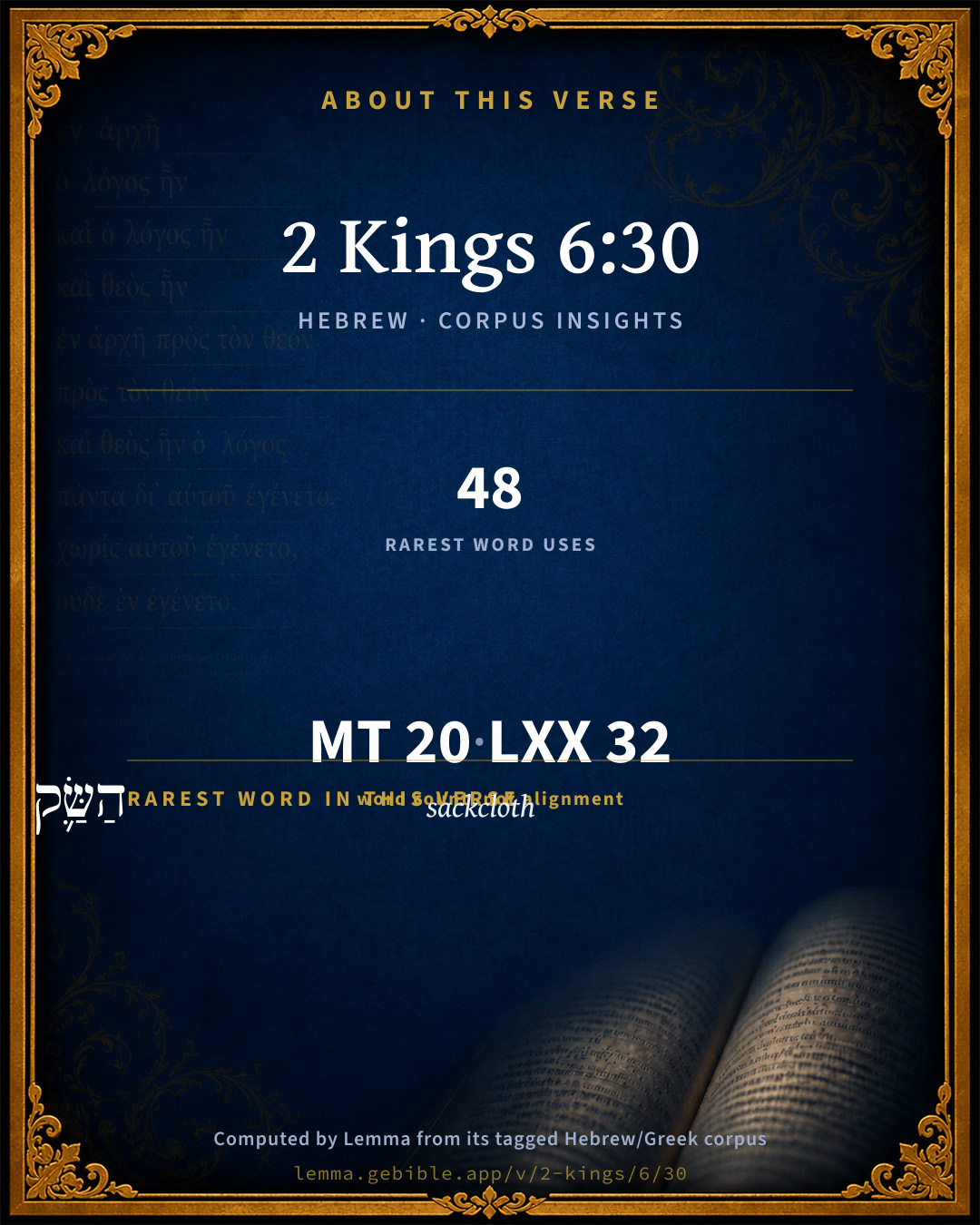
These counts appear in no published source. They are computed here, from the morphology-tagged text and Lemma’s own curated glosses. What Lemma adds →

20
words
18
distinct lemmas
Historical
section

Shared distinctive vocabulary

הַשַּׂ֛ק sackcloth H8242 occurs in 46 verses of the Hebrew Bible. Also found in:

Grammatical profile

  • 5 verbs
  • 9 nouns
  • 1 pronoun
  • 2 prepositions
  • 3 particles

Verb forms

  • וַיְהִי֩ Qal · Sequential Imperfect
  • כִשְׁמֹ֨עַ Qal · Infinitive Construct
  • וַיִּקְרַ֣ע Qal · Sequential Imperfect
  • עֹבֵ֣ר Qal · Participle Active
  • וַיַּ֣רְא Qal · Sequential Imperfect

Repetition

A word recurs within this verse — often emphatic in Hebrew:

Hebrew & Septuagint length

In English translation the verse runs 37 words from the Hebrew and 37 from the Septuagint (LXX English) — the same length.

A rough comparison of the two English renderings, which tokenize alike — not a word-level alignment.

Word counts can differ between the Hebrew and the Greek without any difference in meaning — e.g. the Hebrew direct-object marker אֵת has no separate Greek word, and Greek often adds the article ὁ.

In the original languages it is 20 Hebrew tokens and 32 Greek tokens — but the two are counted differently (Hebrew bundles its prefixes and suffixes into one token; the Greek is in lemma form), so that isn’t a like-for-like length.

Cross-references

4

Topical passages linked to 2 Kings 6:30 in the Treasury of Scripture Knowledge — connected by theme and wording, ordered by reader-vote popularity; previews shown in the World English Bible.

  • 1 Kings 21:27 It happened, when Ahab heard those words, that he tore his clothes, and put sackcloth on his flesh, and fasted, and lay in sackcloth, and went softly.
  • 2 Kings 5:7 It happened, when the king of Israel had read the letter, that he tore his clothes, and said, Am I God, to kill and to make alive, that this man does send to me to recover a man of his leprosy? but consider, I pray you, and see how he seeks a quarrel against me.
  • 2 Kings 19:1 It happened, when king Hezekiah heard it, that he tore his clothes, and covered himself with sackcloth, and went into the house of Yahweh.
  • Isaiah 58:5–7 Is such the fast that I have chosen? the day for a man to afflict his soul? Is it to bow down his head as a rush, and to spread sackcloth and ashes under him? will you call this a fast, and an acceptable day to Yahweh?

Cross-references courtesy of OpenBible.info (CC BY 4.0).

Hebrew and Greek witnesses Masoretic Hebrew ↔ Greek Septuagint

The same verse in the two great witnesses to the Old Testament, shown verse-for-verse.

These are two independent witnesses, not word-aligned to each other, and the Septuagint is shown in lemma (dictionary) form.

Hebrew 2 Kings 6:30 Masoretic · Westminster Leningrad Codex

וַיְהִי֩ כִשְׁמֹ֨עַ הַמֶּ֜לֶךְ אֶת דִּבְרֵ֤י הָֽאִשָּׁה֙ וַיִּקְרַ֣ע אֶת בְּגָדָ֔יו וְה֖וּא עֹבֵ֣ר עַל הַחֹמָ֑ה וַיַּ֣רְא הָעָ֔ם וְהִנֵּ֥ה הַשַּׂ֛ק עַל בְּשָׂר֖וֹ מִבָּֽיִת

It happened, when the king heard the words of the woman, that he tore his clothes (now he was passing by on the wall); and the people looked, and, behold, he had sackcloth within on his flesh.

World English Bible · Public Domain

Greek LXX 2 Kings 6:30 Septuagint · lemma form

καί γίγνομαι ὡς ἀκούω ὁ βασιλεύς ἰσραήλ ὁ λόγος ὁ γυνή διαῥήγνυμι ὁ ἱμάτιον αὐτός καί αὐτός διαπορεύομαι ἐπί ὁ τεῖχος καί ὁράω ὁ λαός ὁ σάκκος ἐπί ὁ σάρξ αὐτός ἔσωθεν

And it came to pass, when the king of Israel heard the words of the woman, that he tore his garments; and he passed by on the wall, and the people saw sackcloth within upon his flesh.

LXX2012 (modern English Septuagint) · Public Domain

Hebrew: Westminster Leningrad Codex (CC BY 4.0). Greek: Septuagint (public domain); English from LXX2012 (modern English Septuagint) (Public Domain). How the Septuagint differs from the Hebrew →

Targum (Aramaic paraphrase)

1

The Targum is the ancient Jewish Aramaic paraphrase of the Hebrew Scriptures — an interpretive translation, not the Hebrew text itself. Onkelos (literal) and Pseudo-Jonathan (expansive) render the Torah, and Jonathan the Prophets. Coverage is partial: where no permissively-licensed English translation exists for a verse, only the Aramaic is shown. This is verse-level text, not a word-by-word alignment to the Hebrew.

  1. Targum Jonathan Prophets (Joshua–Malachi)
    וַהֲוָה כַד שְׁמַע מַלְכָּא יַת פִּתְגָמֵי אִתְּתָא וּבְזַע יַת לְבוּשׁוֹהִי וְהוּא עֲבַר עַל שׁוּרָא וַחֲזָא עַמָא וְהָא סַקָא אֲסִיר עַל בִסְרֵיהּ מִלְגָיו:

    (no public-domain English translation for this verse)

    Targum Jonathan — Aramaic: “Mikraot Gedolot” (public domain). English: “Sefaria Community Translation” (CC0 1.0 (public-domain dedication)); “London "Chaldee Paraphrase," 1871” (public domain). Text via Sefaria.

Commentary

Notes on 2 Kings 6:30 from classic Christian and Jewish commentators (each source and its license shown beneath its notes). The classic Christian expositions comment on the surrounding passage and are grouped to its opening verse, so a note may address several verses; the Jewish commentaries on the Tanakh (Rashi and others) are per-verse, so they appear only where the commentator wrote on this verse.

Lemma curates 59 commentaries, every one of them public domain or Creative Commons licensed, each selected and text-cleaned for this edition rather than reprinted as found. About our sources →

Trapp's Complete Commentary

John Trapp

2Ki 6:30 And it came to pass, when the king heard the words of the woman, that he rent his clothes; and he passed by upon the wall, and the people looked, and, behold, [he had] sackcloth within upon his flesh.

Ver. 30. He rent his clothes.] He said nothing to the case propounded, because it was horrid and hard to be judged. But this cruel mother should have died for a murderess.

John Trapp, A Commentary or Exposition upon All the Books of the Old and New Testament (1647–1656) — public domain. Text from a community e-Sword module.

Joseph Benson's Commentary

2Ki 6:30. When the king heard the words of the woman, he rent his clothes — Partly through grief for such a horrid fact, and partly through indignation at the prophet. And the people looked — Who were in great numbers upon the wall, chiefly for the defence of the city. And behold, he had sackcloth upon his flesh — Under his inner garments, in token of his sorrow for the miseries of his people, and lamenting that it was not in his power to help them.

Joseph Benson's Commentary on the Old and New Testaments (1811–1818) — public domain. Text from a community e-Sword module.

Tyndale Open Study Notes

Tyndale Open Resources

6:30 When Joram learned of cannibalism in the city, he tore his clothes in despair. • wearing burlap under his robe next to his skin: Doing this was an outward sign of mourning.

Tyndale Open Study Notes — © Tyndale Open Resources, licensed CC BY-SA 4.0. Text via the HelloAO Bible API.

Geneva Bible (1599)

Geneva Bible translators

Or, under his clothes.

Thus hypocrites when they feel God’s judgments, think to please him with outward ceremonies, whom in prosperity they will not know.

Geneva Bible (1599) marginal notes — public domain. Text via Bolls.life.

Jamieson, Fausset & Brown

Robert Jamieson, A. R. Fausset & David Brown

had sackcloth within upon his flesh--The horrid recital of this domestic tragedy led the king soon after to rend his garment, in consequence of which it was discovered that he wore a penitential shirt of haircloth. It is more than doubtful, however, if he was truly humbled on account of his own and the nation's sins; otherwise he would not have vowed vengeance on the prophet's life. The true explanation seems to be, that Elisha having counselled him not to surrender, with the promise, on condition of deep humiliation, of being delivered, and he having assumed the signs of contrition without receiving the expected relief, regarded Elisha who had proved false and faithless as the cause of all the protracted distress.

Jamieson, Fausset & Brown — Commentary Critical and Explanatory on the Whole Bible (1871) — public domain (CC PDM 1.0). Text via the HelloAO Bible API.

Adam Clarke's Commentary

Verse 30. He had sackcloth within upon his flesh.] The king was in deep mourning for the distresses of the people.

Adam Clarke's Commentary on the Bible (1810–1826) — public domain. Text from a community e-Sword/MySword module.

Ellicott's Commentary for English Readers

(30) And he passed.—Now he was passing. The people in the streets below would see him well as he passed along the rampart.

Looked.—Saw.

He had sackcloth.—Rather, the sackcloth was. “The sackcloth”—i.e., the well-known garb of penitence and woe (1Ki_21:27). Jehoram had secretly assumed this ascetic garment in order to appease the wrath of Jehovah. That the king should wear sackcloth was a portent in the eyes of his subjects. The prophets wore it over the tunic as an official dress.

Within.—Under his royal robes, “upon his flesh”—i.e., next the skin. (Comp. Isa_20:2-3.)

A Bible Commentary for English Readers, edited by Charles John Ellicott (1878–1897) — public domain. Text from a community e-Sword module.

The Cambridge Bible for Schools and Colleges

gen. ed. J. J. S. Perowne

30. and he passed by upon the wall] The R.V. places these words in a parenthesis rendering (Now he was passing by upon the wall).

the people looked] At such an appeal many would congregate beside the two persons concerned in the matter.

he had sackcloth within upon his flesh] Cf. the action of his father Ahab (1Ki_21:27) when God threatened him with punishment after the murder of Naboth. But neither in one case nor the other does the sorrow appear to have worked any good result. ‘I find his sorrow, I find not his repentance. The worst man may grieve for his smart, only the good heart grieves for his offence’ (Bp Hall). The result of Jehoram’s anguish seems to have been only rage against Elisha.

The Cambridge Bible for Schools and Colleges (gen. ed. J. J. S. Perowne; Cambridge University Press, 1878–1918) — public domain. Text from a community e-Sword module.

John Gill's Exposition

And Elisha sat in his house,.... In Samaria:

and the elders sat with him; not the elders of the city, or the magistrates thereof, but his disciples, as Josephus says (p), the eldest of them, whom he admitted to greater familiarity and converse with him:

and the king sent a man from before him; to execute what he had sworn should be done that day to the prophet:

but ere the messenger came to him, he said to the elders, see ye how this son of a murderer hath sent to take away mine head? which he knew by a spirit of prophecy, and spoke of it before the executioner came; he calls Joram the son of a murderer, because of his mother Jezebel, who killed Naboth, and the prophets of the Lord, and to which his father Ahab also consented, and therefore might be so called too; and he intimates hereby that he was of the same temper and disposition, and as the above oath, and his orders, showed:

look when the messenger cometh, shut the door, and hold him fast at the door; and not suffer him to come in:

is not the sound of his master's feet behind him? that is, of Joram king of Israel, who followed the messenger, either to listen and hear what the prophet would say unto him; or repenting of his order, as Josephus (q) thinks, he followed him to prevent the execution.

(p) Ut supra. (Antiqu. l. 9. c. 4. sect. 4.) (q) Ibid.

John Gill's Exposition of the Whole Bible (1746–1763) — public domain (CC PDM 1.0). Text via the HelloAO Bible API.

Albert Barnes' Notes on the Bible

Sackcloth - Jehoram hoped perhaps to avert Yahweh’s anger, as his father had done 1Ki 21:29. But there was no spirit of self-humiliation, or of true pentitence in his heart 2Ki 5:7. See the next verse.

Albert Barnes' Notes on the Bible (1834–1885) — public domain. Text from a community e-Sword/MySword module.

Haydock's Catholic Bible Commentary

Passed by, without punishing such a horrid crime, as he esteemed his own sins the occasion of it. (Menochius) --- Flesh. Behold the advantage to be derived from afflictions! They make the most hardened enter into sentiments of humility and penance. (Calmet) --- Abulensis thinks that God was pleased to cause the siege to be raised, to reward this act; as a similar one of Joram’s father had merited a delay and mitigation of punishment, (Haydock) 3 Kings xxi. 27. (Salien)

George Leo Haydock (1774–1849), Haydock's Catholic Family Bible and Commentary, 1859 edition — public domain. Excludes Psalms (Douay-Rheims chapter numbering differs from Protestant) and Deuterocanonical books (Catholic canon only).

Matthew Poole's English Annotations

If I do not this day take his head and life. This wretched and partial prince overlooks his own great and various sins, and, amongst others, his obstinate cleaving to the idolatry of the calves, and the whoredoms and witchcrafts of his mother Jezebel, 2Ki 9:22, and the wickedness of his people, which was the true and proper cause of this and all their calamities; and lays the blame of all upon Elisha; either supposing that he who had the spirit of Elijah resting upon him, had brought this famine by his prayers, as Elijah had formerly done, 1Ki 17:1; or because he had encouraged them to withstand the Syrians, by promising them help from God in due time; or because he would not, by his intercession to God and the working of a miracle, deliver them from these calamities, as he easily could have done. But he did not consider that the prophets could not work what miracles and when they pleased, but only as far as God saw fit, whose time was not yet come; otherwise it was Elisha’s interest as well as theirs to be freed from this distress.

Matthew Poole's English Annotations on the Holy Bible (1683–1685) — public domain. Text from a community e-Sword/MySword module.

Whedon's Commentary on the Bible

Daniel D. Whedon

30. He rent his clothes — The king was shocked and horror-stricken at the woman’s story of her grief.

Behold,… sackcloth — He had already put sackcloth on his flesh, but had hitherto kept this sign of humiliation concealed under his outer garment.

Daniel D. Whedon (gen. ed.), Commentary on the Old and New Testaments (1874–1909) — public domain. Text from a community e-Sword module.

The Pulpit Commentary

And it came to pass, when the king heard the words of the woman, that he rent his clothes. In horror and consternation at the terrible state of things revealed by the woman"s story. (comp. 2Ki_5:7) And he passed by upon the wall, and the people looked. It is better to translate, with our Revisers, (Now he yeas passing by upon the wall;) and the people looked; or, and, as he was passing by upon the wall, the people looked. And, behold, he had sackcloth within upon his flesh. Jehoram had secretly assumed the penitential garment, not a mere sign of woe, but a constant chastisement of the flesh. He wore sackcloth next his skin, no one suspecting it, until, in the exasperation of his feelings at the woman"s tale, he rent his robe, and exposed to view the sackcloth which underlay it. We are scarcely entitled to deny him any true penitential feeling, though no doubt he was far from possessing a chastened or humble spirit. Poor weak humanity has at one and the same time good and evil impulses, praiseworthy and culpable feelings, thoughts which come from the Holy Spirit of God, and thoughts which are inspired by the evil one.

The Pulpit Commentary (1880–1919), ed. H.D.M. Spence-Jones & Joseph S. Exell — public domain. Text from a community e-Sword module.

unfoldingWord translationNotes

Door43 World Missions Community

heard the words of the woman

The words "the words" are a metonym for what the woman said. AT: "heard the woman tell what she and the other woman had done" (See: Metonymy)

he tore his clothes

The king ripped his outer garment to show his distress. AT: "he tore his clothes in grief" (See: Symbolic Action)

now he was passing by on the wall

He had been walking on the city wall when the woman called out to him in 2 Kings 6:24. Now he continued walking along it.

he had sackcloth underneath, against his skin

By wearing sackcloth even for his undergarments, the king showed that he was very sad and upset. AT: "he had sackcloth underneath his outer garment, against his skin" or "he was wearing sackcloth underneath his robe because he was very upset" (See: Symbolic Action)

May God do so to me, and more also

The king is saying he hopes God will punish him and even kill him if Elisha the prophet does not die because of the things that have happened in the city of Samaria. AT: "May God punish me and kill me" (See: Euphemism)

if the head of Elisha son of Shaphat remains on him today

This refers to Elisha dying, specifically be being beheaded. AT: "if Elisha son of Shaphat is not beheaded today" or "if my soldiers do not behead Elisha son of Shaphat today" (See: Assumed Knowledge and Implicit Information)

translationWords

sackcloth

God

unfoldingWord translationNotes — © Distant Shores Media and the Door43 World Missions Community, licensed CC BY-SA 4.0. Source: git.door43.org/Door43/en_tn.

Rashi

Rabbi Shlomo Yitzchaki (Rashi)

The people saw. Through the tear [they saw] the sackcloth under his garments.

Rashi on the Tanakh — English translations: “The Judaica Press complete Tanach with Rashi, translated by A. J. Rosenberg” (CC BY 4.0); “Pentateuch with Rashi's commentary by M. Rosenbaum and A.M. Silbermann, 1929-1934” (public domain); “The Metsudah Tanach series, Lakewood, N.J” (CC BY 4.0); and “The Book of Joshua, Metsudah Publications, 1997” (CC BY 4.0). Text via Sefaria.

Lesson kit

Teaching starters — assembled from the data on this page, not authored interpretation. Every prompt links to the verse data it draws on. Edit before teaching.

2 Kings, in the Historical, opens this verse with 20 words (18 distinct Hebrew lemmas). Its most distinctive word is saq (“sackcloth”). A historical commentator’s framing appears above. Read the whole chapter for the surrounding context.

Discussion questions

  1. What does “sackcloth” (saq) contribute to the verse as a whole?
  2. How does Genesis 37:34, which shares the word «sackcloth», read alongside this verse?
  3. What does the repetition of “upon” (2× in this one verse) do in this verse?
  4. These translations render this verse differently; the difference is in the English rendering, not the original. What questions does that raise?
  5. «וַיְהִי֩» is a Qal Sequential Imperfect verb. How does that grammatical form shape the action described?
  6. Compare how Trapp's Complete Commentary and Joseph Benson's Commentary read this verse. Where do they agree or differ?

Things to notice

Reading settings

Reading text

Shown beneath each verse's original-language words.

Old Testament
Old Testament edition

Read the OT as the Masoretic Hebrew (MT) or the Greek Septuagint (LXX).

English shown for the Greek Septuagint (in the Hebrew ↔ Greek comparison).

Comparing translations? Open the Compare panel on any verse page to stack up to four side by side.