
1 Kings 22:30

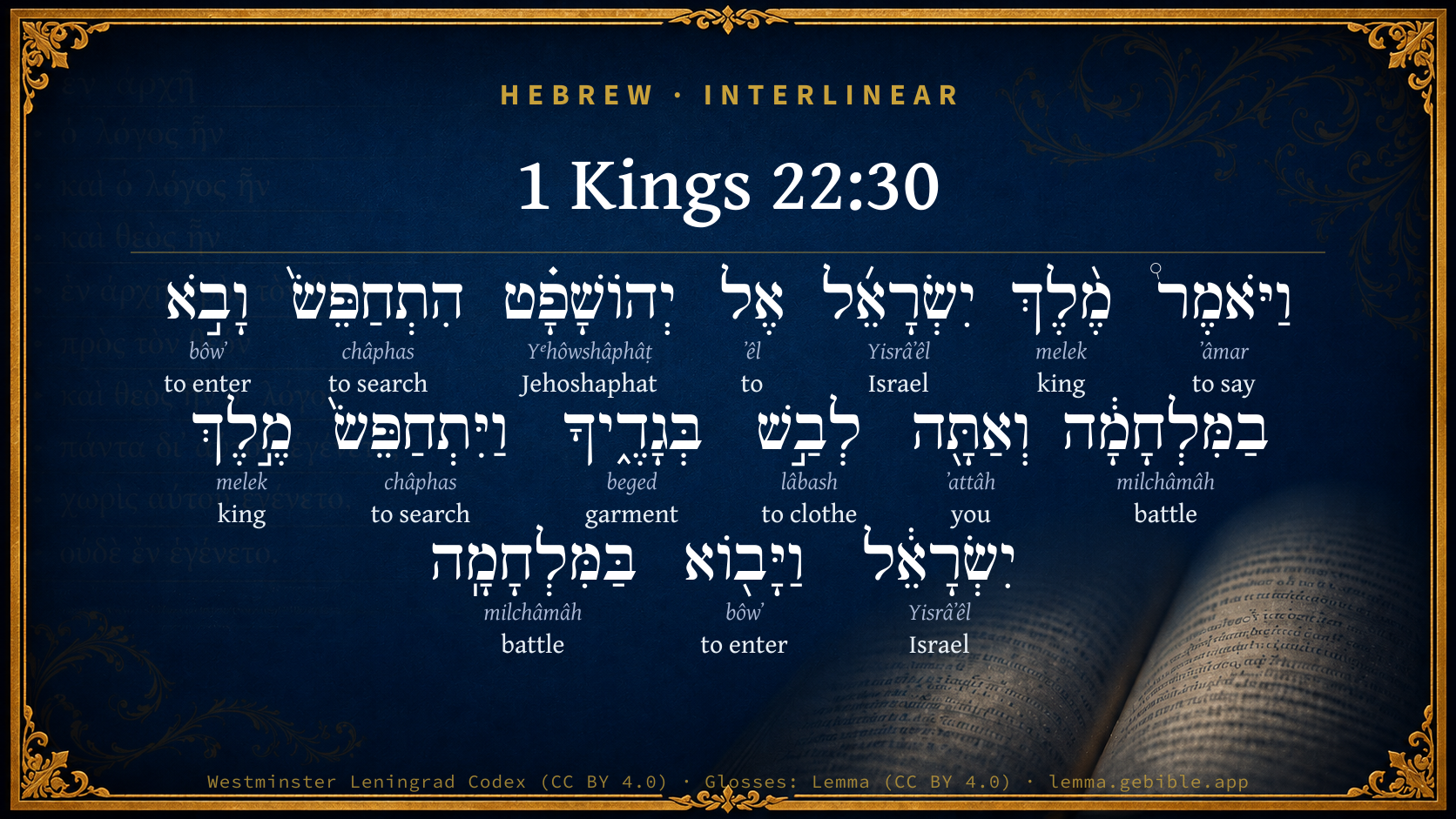
Hebrew (Westminster Leningrad Codex) 1 Kings 22:30 appears in the Hebrew Old Testament. The text above is from the Westminster Leningrad Codex. Each word links to its Strong’s number, a concise gloss, and parsing drawn from the Open Scriptures Hebrew Bible morphology. Click any word for its full Brown-Driver-Briggs (BDB) entry.
Download image
Cite this verse

1 Kings 22:30 (World English Bible). Public Domain. Lemma interlinear Bible study tool, https://lemma.gebible.app/v/1-kings/22/30.

Show BibTeX & RIS
BibTeX
RIS
English Translation
The king of Israel said to Jehoshaphat, I will disguise myself, and go into the battle; but put you on your robes. The king of Israel disguised himself, and went into the battle.
World English Bible · Public Domain
Download a study sheet

One document with this verse’s original text, its word-by-word gloss line, the meaning frame, cross-references with their text, attributed commentary, and full source and license credits — printable, and it pastes into notes with its structure intact.

This verse Autodidact and up

Study sheet (.html) Plain text (.txt)

A passage Seminary Student

Up to 50 verses in one chapter. A passage sheet keeps up to 6 commentary sources and 12 cross-references per verse, in the order this page ranks them, and says so on the sheet whenever that leaves anything out. Ask for a single verse and you get the Autodidact verse sheet above.

Everything on this page stays free to read, with no account — the sheet is a download of what is already on screen, not access to it.

Want to remove ads? Support Godless Engineer
Compare translations 3

The same verse in 3 English versions, stacked beneath the original-language interlinear above. Click any original word for its lexicon entry.

Each is an independent rendering of the whole verse — the interlinear is not word-aligned to these translations.

Highlighted words mark where these versions differ — a whole-verse word diff, not a word-by-word alignment.

  • World English Bible Public Domain
    The king of Israel said to Jehoshaphat, I will disguise myself, and go into the battle; but put you on your robes. The king of Israel disguised himself, and went into the battle.
  • King James Version Public Domain
    And the king of Israel said unto Jehoshaphat, I will disguise myself, and enter into the battle; but put thou on thy robes. And the king of Israel disguised himself, and went into the battle.
  • unfoldingWord Literal Text CC BY-SA 4.0
    And the king of Israel said to Jehoshaphat, “I will disguise myself and come into the battle, but you, wear your robes.” And the king of Israel disguised himself, and he came into the battle.

unfoldingWord Literal Text — © unfoldingWord, licensed CC BY-SA 4.0. Word-aligned USFM3 via Door43 (git.door43.org/unfoldingWord/en_ult).

Versions to compare (up to 4)

3 of 4 selected

Show all 18 translations

Every available English version of this verse, each an independent rendering of the whole verse.

  • World English Bible Public Domain
    The king of Israel said to Jehoshaphat, I will disguise myself, and go into the battle; but put you on your robes. The king of Israel disguised himself, and went into the battle.
  • Berean Standard Bible Public Domain
    And the king of Israel said to Jehoshaphat, “I will disguise myself and go into battle, but you wear your royal robes.” So the king of Israel disguised himself and went into battle.
  • Majority Standard Bible Public Domain
    And the king of Israel said to Jehoshaphat, “I will disguise myself and go into battle, but you wear your royal robes.” So the king of Israel disguised himself and went into battle.
  • King James Version Public Domain
    And the king of Israel said unto Jehoshaphat, I will disguise myself, and enter into the battle; but put thou on thy robes. And the king of Israel disguised himself, and went into the battle.
  • American Standard Version (1901) Public Domain
    And the king of Israel said unto Jehoshaphat, I will disguise myself, and go into the battle; but put thou on thy robes. And the king of Israel disguised himself, and went into the battle.
  • Revised Version (1885) Public Domain
    And the king of Israel said unto Jehoshaphat, I will disguise myself, and go into the battle; but put thou on thy robes. And the king of Israel disguised himself, and went into the battle.
  • Geneva Bible (1599) Public Domain
    And the King of Israel sayde to Iehoshaphat, I will change mine apparell, and will enter into the battell, but put thou on thine apparell. And the King of Israel changed himselfe, and went into the battel.
  • Douay-Rheims (1899) Public Domain
    And the king of Israel said to Josaphat: Take armour, and go into the battle, and put on thy own garments. But the king of Israel changed his dress, and went into the battle.
  • Young's Literal Translation Public Domain
    And the king of Israel saith unto Jehoshaphat to disguise himself, and to go into battle, `And thou, put on thy garments.' And the king of Israel disguiseth himself, and goeth into battle.
  • Literal Standard Version CC BY-SA 4.0
    And the king of Israel says to Jehoshaphat to disguise himself, and to go into battle, “And you, put on your garments.” And the king of Israel disguises himself, and goes into battle.
  • Unlocked Literal Bible CC BY-SA 4.0
    The king of Israel said to Jehoshaphat, “I will disguise myself and go into the battle, but you put on your royal robes.” So the king of Israel disguised himself and went into the battle.
  • unfoldingWord Literal Text CC BY-SA 4.0
    And the king of Israel said to Jehoshaphat, “I will disguise myself and come into the battle, but you, wear your robes.” And the king of Israel disguised himself, and he came into the battle.
  • Darby Bible Public Domain
    And the king of Israel said to Jehoshaphat, I will disguise myself, and will enter into the battle; but put thou on thy robes. And the king of Israel disguised himself, and went into the battle.
  • World Messianic Bible Public Domain
    The king of Israel said to Jehoshaphat, “I will disguise myself and go into the battle, but you put on your robes.” The king of Israel disguised himself and went into the battle.
  • Webster's Bible Public Domain
    And the king of Israel said to Jehoshaphat, I will disguise myself, and enter into the battle; but put thou on thy robes. And the king of Israel disguised himself, and went into the battle.
  • Free Bible Version CC BY-SA 4.0
    The king of Israel told Jehoshaphat, “When I go into battle I will be in disguise, but you should wear your royal robes.” So the king of Israel disguised himself and went into battle.
  • Bible in Basic English Public Domain
    And the king of Israel said to Jehoshaphat, I will make a change in my clothing, so that I do not seem to be the king, and will go into the fight; but do you put on your robes. So the king of Israel made a change in his dress and went into the fight.
  • JPS Tanakh (1917) Public Domain
    And the king of Israel said unto Jehoshaphat: 'I will disguise myself, and go into the battle; but put thou on thy robes.' And the king of Israel disguised himself, and went into the battle.

Literal Standard Version (2020), Covenant Press — licensed CC BY-SA 4.0. Text via the HelloAO Bible API (eBible.org). Unlocked Literal Bible (unfoldingWord) — licensed CC BY-SA 4.0. Text via the HelloAO Bible API (eBible.org). unfoldingWord Literal Text — © unfoldingWord, licensed CC BY-SA 4.0. Word-aligned USFM3 via Door43 (git.door43.org/unfoldingWord/en_ult). Free Bible Version, Dr. Jonathan Gallagher — licensed CC BY-SA 4.0. Text via the HelloAO Bible API (eBible.org).

Word by word

More ways to search: Search by grammar → Find every occurrence → Compare this word →

Practice this passage: Drill this verse → Learn its vocabulary →

הִתְחַפֵּשׂ֙
châphas
H2664
“to search”
Verb, Hithpael, Infinitive Absolute
Part of Speech
Verb
Stem
Hithpael
Form
Infinitive Absolute
Full BDB Definition

Origin: a primitive root

TWOT: 716

to search, search for, to search out, disguise oneself - (Qal) - to search for - to think out, devise - to search, test - (Niphal) to be searched out, be exposed - (Piel) to search, search through, search for - (Pual) to be searched for, be sought out - (Hithpael) - to disguise oneself - to let oneself be searched for
  1. וַיֹּאמֶר֩ ʼâmar H559 “and · to say” Conjunction + Verb, Qal, Sequential Imperfect, 3rd Person, Masculine, Singular
  2. מֶ֨לֶךְ melek H4428 “king of” Noun, Common, Masculine, Singular, Construct
  3. יִשְׂרָאֵ֜ל Yisrâʼêl H3478 “Israel” Noun, Proper
  4. אֶל ʼêl H413 “to” Preposition
  5. יְהוֹשָׁפָ֗ט Yᵉhôwshâphâṭ H3092 “Jehoshaphat” Noun, Proper
  6. וָבֹ֣א bôwʼ H935 “and · to enter” Conjunction + Verb, Qal, Infinitive Absolute
  7. בַמִּלְחָמָ֔ה milchâmâh H4421 “in/at the · battle” Preposition, Determined + Noun, Common, Feminine, Singular, Absolute
  8. וְאַתָּ֖ה ʼattâh H859 “and · you” Conjunction + Pronoun, Personal, 2nd Person, Masculine, Singular
  9. לְבַ֣שׁ lâbash H3847 “clothe” Verb, Qal, Imperative, 2nd Person, Masculine, Singular
  10. בְּגָדֶ֑יךָ beged H899 “garments · your” Noun, Common, Masculine, Plural, Construct + Suffix, Personal, 2nd Person, Masculine, Singular
  11. וַיִּתְחַפֵּשׂ֙ châphas H2664 “and · to search” Conjunction + Verb, Hithpael, Sequential Imperfect, 3rd Person, Masculine, Singular
  12. מֶ֣לֶךְ melek H4428 “king of” Noun, Common, Masculine, Singular, Construct
  13. יִשְׂרָאֵ֔ל Yisrâʼêl H3478 “Israel” Noun, Proper
  14. וַיָּב֖וֹא bôwʼ H935 “and · to enter” Conjunction + Verb, Qal, Sequential Imperfect, 3rd Person, Masculine, Singular
  15. בַּמִּלְחָמָֽה milchâmâh H4421 “in/at the · battle” Preposition, Determined + Noun, Common, Feminine, Singular, Absolute

About this verse

These counts appear in no published source. They are computed here, from the morphology-tagged text and Lemma’s own curated glosses. What Lemma adds →

16
words
11
distinct lemmas
Historical
section

Notable vocabulary

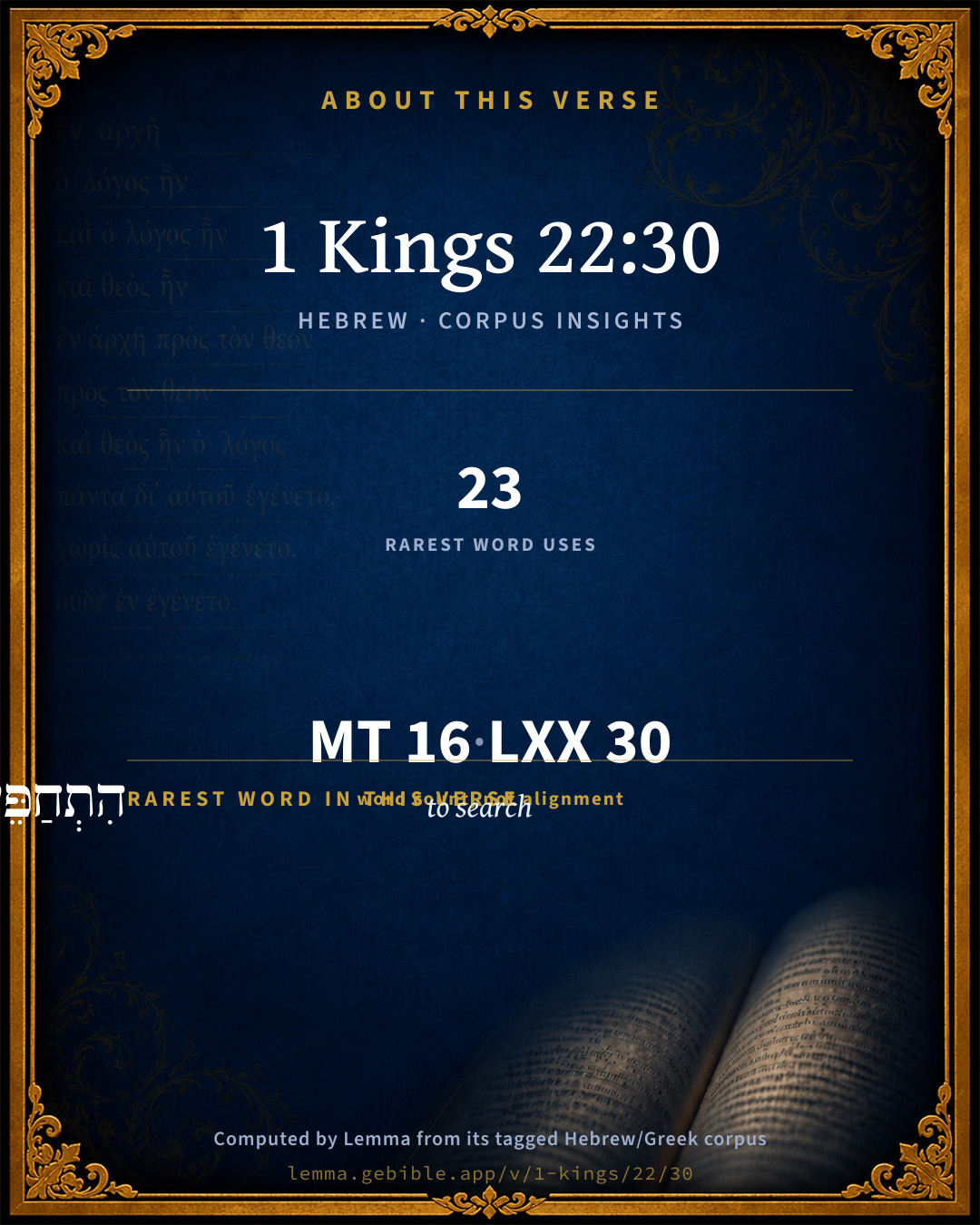
The rarest word here is הִתְחַפֵּשׂ֙ to search H2664 — appearing just 23 times in the whole Hebrew Bible.

Shared distinctive vocabulary

הִתְחַפֵּשׂ֙ to search H2664 occurs in 20 verses of the Hebrew Bible. Also found in:

Grammatical profile

  • 6 verbs
  • 8 nouns
  • 1 pronoun
  • 1 preposition

Verb forms

  • וַיֹּאמֶר֩ Qal · Sequential Imperfect
  • הִתְחַפֵּשׂ֙ Hithpael · Infinitive Absolute
  • וָבֹ֣א Qal · Infinitive Absolute
  • לְבַ֣שׁ Qal · Imperative
  • וַיִּתְחַפֵּשׂ֙ Hithpael · Sequential Imperfect
  • וַיָּב֖וֹא Qal · Sequential Imperfect

Repetition

Words recur within this verse — often emphatic in Hebrew:

  • מֶ֨לֶךְ king H4428 ×2
  • יִשְׂרָאֵ֜ל Israel H3478 ×2
  • הִתְחַפֵּשׂ֙ to search H2664 ×2
  • וָבֹ֣א to enter H935 ×2
  • בַמִּלְחָמָ֔ה battle H4421 ×2

Hebrew & Septuagint length

In English translation the verse runs 33 words from the Hebrew and 39 from the Septuagint (LXX English) — closely comparable.

A rough comparison of the two English renderings, which tokenize alike — not a word-level alignment.

Word counts can differ between the Hebrew and the Greek without any difference in meaning — e.g. the Hebrew direct-object marker אֵת has no separate Greek word, and Greek often adds the article ὁ.

In the original languages it is 16 Hebrew tokens and 30 Greek tokens — but the two are counted differently (Hebrew bundles its prefixes and suffixes into one token; the Greek is in lemma form), so that isn’t a like-for-like length.

Cross-references

10

Topical passages linked to 1 Kings 22:30 in the Treasury of Scripture Knowledge — connected by theme and wording, ordered by reader-vote popularity; previews shown in the World English Bible.

  • 2 Chronicles 35:22 Nevertheless Josiah would not turn his face from him, but disguised himself, that he might fight with him, and didn't listen to the words of Neco from the mouth of God, and came to fight in the valley of Megiddo.
  • 1 Samuel 28:8 Saul disguised himself, and put on other clothing, and went, he and two men with him, and they came to the woman by night: and he said, Please divine to me by the familiar spirit, and bring me up whoever I shall name to you.
  • Jeremiah 23:24 Can any hide himself in secret places so that I shall not see him? says Yahweh. Don't I fill heaven and earth? says Yahweh.
  • 2 Samuel 14:2 Joab sent to Tekoa, and fetched there a wise woman, and said to her, please act like a mourner, and put on mourning clothing, Please, and don't anoint yourself with oil, but be as a woman who has a long time mourned for the dead:
  • 1 Kings 14:2 Jeroboam said to his wife, Please get up and disguise yourself, that you not be known to be the wife of Jeroboam; and get you to Shiloh: behold, there is Ahijah the prophet, who spoke concerning me that I should be king over this people.
  • 1 Kings 20:38 So the prophet departed, and waited for the king by the way, and disguised himself with his headband over his eyes.
  • 1 Kings 22:10 Now the king of Israel and Jehoshaphat the king of Judah were sitting each on his throne, arrayed in their robes, in an open place at the entrance of the gate of Samaria; and all the prophets were prophesying before them.
  • 2 Chronicles 18:29 The king of Israel said to Jehoshaphat, I will disguise myself, and go into the battle; but put you on your robes. So the king of Israel disguised himself; and they went into the battle.
  • Psalms 12:2 Everyone lies to his neighbor. They speak with flattering lips, and with a double heart.
  • Proverbs 21:30 There is no wisdom nor understanding Nor counsel against Yahweh.

Cross-references courtesy of OpenBible.info (CC BY 4.0).

Hebrew and Greek witnesses Masoretic Hebrew ↔ Greek Septuagint

The same verse in the two great witnesses to the Old Testament, shown verse-for-verse.

These are two independent witnesses, not word-aligned to each other, and the Septuagint is shown in lemma (dictionary) form.

Hebrew 1 Kings 22:30 Masoretic · Westminster Leningrad Codex

וַיֹּאמֶר֩ מֶ֨לֶךְ יִשְׂרָאֵ֜ל אֶל יְהוֹשָׁפָ֗ט הִתְחַפֵּשׂ֙ וָבֹ֣א בַמִּלְחָמָ֔ה וְאַתָּ֖ה לְבַ֣שׁ בְּגָדֶ֑יךָ וַיִּתְחַפֵּשׂ֙ מֶ֣לֶךְ יִשְׂרָאֵ֔ל וַיָּב֖וֹא בַּמִּלְחָמָֽה

The king of Israel said to Jehoshaphat, I will disguise myself, and go into the battle; but put you on your robes. The king of Israel disguised himself, and went into the battle.

World English Bible · Public Domain

Greek LXX 1 Kings 22:30 Septuagint · lemma form

καί εἶπον βασιλεύς ἰσραήλ πρός ιωσαφατ βασιλεύς ιουδα συνκαλύπτω καί εἰςἔρχομαι εἰς ὁ πόλεμος καί σύ ἐνδύω ὁ ἱματισμός ἐγώ καί συνκαλύπτω ὁ βασιλεύς ἰσραήλ καί εἰςἔρχομαι εἰς ὁ πόλεμος

And the king of Israel said to Josaphat king of Juda, I will disguise myself, and enter into the battle, and do you put on my raiment. So the king of Israel disguised himself, and went into the battle.

LXX2012 (modern English Septuagint) · Public Domain

On this verse, Adam Clarke's Commentary discusses the Septuagint’s reading. Read the note in Commentary ↓

Hebrew: Westminster Leningrad Codex (CC BY 4.0). Greek: Septuagint (public domain); English from LXX2012 (modern English Septuagint) (Public Domain). How the Septuagint differs from the Hebrew →

Targum (Aramaic paraphrase)

1

The Targum is the ancient Jewish Aramaic paraphrase of the Hebrew Scriptures — an interpretive translation, not the Hebrew text itself. Onkelos (literal) and Pseudo-Jonathan (expansive) render the Torah, and Jonathan the Prophets. Coverage is partial: where no permissively-licensed English translation exists for a verse, only the Aramaic is shown. This is verse-level text, not a word-by-word alignment to the Hebrew.

  1. Targum Jonathan Prophets (Joshua–Malachi)
    וַאֲמַר מַלְכָּא דְיִשְׂרָאֵל לִיהוֹשָׁפָט אֲנָא אֶשְׁתַּנֵי וְאֵיעוֹל בִּקְרָבָא וְאַתְּ לְבַשׁ לְבוּשָׁךְ וְאִשְׁתַּנֵי מַלְכָּא דְיִשְׂרָאֵל וְעַל בִּקְרָבָא:

    (no public-domain English translation for this verse)

    Targum Jonathan — Aramaic: “Mikraot Gedolot” (public domain). English: “Sefaria Community Translation” (CC0 1.0 (public-domain dedication)); “London "Chaldee Paraphrase," 1871” (public domain). Text via Sefaria.

Commentary

Notes on 1 Kings 22:30 from classic Christian and Jewish commentators (each source and its license shown beneath its notes). The classic Christian expositions comment on the surrounding passage and are grouped to its opening verse, so a note may address several verses; the Jewish commentaries on the Tanakh (Rashi and others) are per-verse, so they appear only where the commentator wrote on this verse.

Lemma curates 59 commentaries, every one of them public domain or Creative Commons licensed, each selected and text-cleaned for this edition rather than reprinted as found. About our sources →

Trapp's Complete Commentary

John Trapp

1Ki 22:30 And the king of Israel said unto Jehoshaphat, I will disguise myself, and enter into the battle; but put thou on thy robes. And the king of Israel disguised himself, and went into the battle.

Ver. 30. I will disguise myself] This he did, saith Josephus, that he might the more easily and surely elude the prophecy of Micaiah concerning his death, wherewith he was scared doubtless, though he seemed to slight it.

John Trapp, A Commentary or Exposition upon All the Books of the Old and New Testament (1647–1656) — public domain. Text from a community e-Sword module.

Joseph Benson's Commentary

1Ki 22:30. The king of Israel said, I will disguise myself — Put off my imperial habit, and appear as a private man, that the Syrians may not know me, and direct their main force against me. This he judged they would do, as knowing him to be the principal author of this war, and that it was likely to die with him. But put thou on thy robes — Thy royal robes, which thou mayest do without danger, because thou art not the object of the rage of the Syrians, nor of this false prophecy. Thus, while he pretended to do honour to Jehoshaphat, and compliment him with the sole command of the army in this action, he hoped to elude the danger, and so defeat the threatening, as if by disguising himself he could escape the divine cognizance, and the judgments that pursued him.

Joseph Benson's Commentary on the Old and New Testaments (1811–1818) — public domain. Text from a community e-Sword module.

Adam Clarke's Commentary

Verse 30. I will disguise myself] Probably he had heard of the orders given by Ben-hadad to his thirty-two captains, to fight with the king of Israel only; that is, to make their most powerful attack where he commanded, in order to take him prisoner, that he might lead him captive whose captive he formerly was; and therefore he disguised himself that he might not be known.

But put thou on thy robes.] What is meant by this? He could not mean, "Appear as the king of Judah, for they will not molest thee, as the matter of contention lies between them and me;" this is Jarchi's turn. For if Jehoshaphat aided Ahab, is it to be supposed that the Syrians would spare him in battle? A general in the civil wars of England, when he had brought his army in sight of their foes, thus addressed them: "Yonder are your enemies; if you do not kill them, they will kill you." So it might be said in the case of Jehoshaphat and the Syrians.

The Septuagint gives the clause a different and more intelligible turn: "I will cover (conceal) myself, and enter into the battle; και συ ενδυσαι τον ἱματισμον μου, but put thou on MY robes." And does it not appear that he did put on Ahab's robes? And was it not this that caused the Syrians to mistake him for the king of Israel? 1Kg 22:32.

Adam Clarke's Commentary on the Bible (1810–1826) — public domain. Text from a community e-Sword/MySword module.

Ellicott's Commentary for English Readers

(30) I will disguise myself.—The precaution of Ahab is almost ludicrously characteristic of his temper of half-belief and half-unbelief. In itself it is, of course, plainly absurd to believe that God’s judgment has in all probability been pronounced, and yet to suppose that it can be averted by so puerile a precaution. But, as experience shows, it is not the less on that account true to human nature, especially such a nature as his, always “halting between two opinions.”

A Bible Commentary for English Readers, edited by Charles John Ellicott (1878–1897) — public domain. Text from a community e-Sword module.

The Cambridge Bible for Schools and Colleges

gen. ed. J. J. S. Perowne

29–40. Battle of Ramoth-gilead. Defeat and death of Ahab (2Ch_18:28-34)

30. I will disguise myself, and enter [R.V. go] into the battle] Another tense of the same verb is translated ‘went’ in this verse, and ‘go’ is the rendering in 2Ch_18:29.

There must have been some mark by which the king of Judah could be distinguished from the king of Israel; something answering to modern blazonry or a coat of arms, or else the action of Ahab would have been one designed to put his brother-king into the greatest possible peril. This we can hardly think he would have wished to do, nor would Jehoshaphat alone have gone to the post of greatest danger. Ahab seems to have been alarmed lest after all there should be some truth in Micaiah’s words. He will therefore clothe himself like an ordinary soldier and let the king of Judah alone appear in kingly robes, for against him the attack would not be particularly directed.

put thou on thy robes] The LXX. has ‘my’ (τὸν ἱματισμὸν μοῦ). But this would have been to expose Jehoshaphat to all the peril which he himself desired to avoid. Josephus says, Ahab meant to falsify (κατασοφίζεσθαι) the predictions of Micaiah.

The Cambridge Bible for Schools and Colleges (gen. ed. J. J. S. Perowne; Cambridge University Press, 1878–1918) — public domain. Text from a community e-Sword module.

John Gill's Exposition

And a certain man drew a bow at a venture,.... Not aiming at the king of Israel, or knowing whereabout he was. In the Targum on Ch2 18:33, this man is said to be Naaman, the general of the army of the king of Syria, and so Jarchi here; but though he did this in his simplicity, as the word signifies, without any intention to smite any particular person; yet God directed the arrow to the man he had marked for destruction, and neither his disguise, nor coat of mail, could secure from that:

and smote the king of Israel between the joints of the harness: of which the pieces of armour on him were joined together, the higher and lower parts of it, the breastplate, and what covered the belly; and though these were joined as close as they were capable of joining them in those times, yet the arrow, guided by divine Providence, found its way into his body:

wherefore he said unto the driver of his chariot, turn thine hand; or hands, with which he held the reins, and turn the horses on one side:

and carry me out of the host; where the battle was hottest, to a place more remote and private, that he might have the wound examined, and the blood stopped, and return again, as it seems he did:

for I am wounded; or rather "I am sick" (s), or ill, as the Targum; somewhat out of order, and therefore chose to retire a little while; not caring it should be known that he was smitten and wounded, lest his soldiers should be disheartened.

(s) "aegrotare factus sum", Vatablus; "aegrotus factus sum", Junius & Tremellius.

John Gill's Exposition of the Whole Bible (1746–1763) — public domain (CC PDM 1.0). Text via the HelloAO Bible API.

Albert Barnes' Notes on the Bible

I will disguise myself - Ahab had probably heard of Ben-hadad’s order to his captains 1Ki 22:31.

Albert Barnes' Notes on the Bible (1834–1885) — public domain. Text from a community e-Sword/MySword module.

Haydock's Catholic Bible Commentary

Thy own. Septuagint, "I will disguise myself, and go into the battle; and do thou put on my garment." Hence the Syrians mistook Josaphat for Achab, (ver. 32.; Calmet) as "it had been agreed between them, that he should wear the robes of Achab, to elude more easily the prediction of Micheas." (Josephus, [Antiquities?] viii. 15.) --- Vain and impious attempt! Providence found him out, though unadorned. (Haydock) --- Achab might pretend thus to honour the king of Juda! (Menochius) and perhaps he had been apprized of the order given to the Syrians, to single him out, ver. 31. What could prompt such an order, cannot be easily ascertained. Benadad might with to revenge himself, for being brought out as a prisoner to Achab; or he might be informed of the prediction of Micheas.

George Leo Haydock (1774–1849), Haydock's Catholic Family Bible and Commentary, 1859 edition — public domain. Excludes Psalms (Douay-Rheims chapter numbering differs from Protestant) and Deuterocanonical books (Catholic canon only).

Matthew Poole's English Annotations

I will disguise myself, i.e. put off my imperial habit, that the Syrians may not know me, and direct their main force against me; which they will assuredly endeavour, as knowing that this war proceedeth from me, and is likely to die with me; and then thou shalt see that this man is a false prophet, and I shall have the success which I desire and expect, notwithstanding all his presages.

Thy robes; thy royal robes; which thou mayest do without any danger, because thou art not the object either of the Syrians’ rage, or of this false prophecy.

Matthew Poole's English Annotations on the Holy Bible (1683–1685) — public domain. Text from a community e-Sword/MySword module.

Whedon's Commentary on the Bible

Daniel D. Whedon

30. I will disguise myself — This rendering, which follows the Septuagint, gives the true sense. The Hebrew is literally, to disguise myself and go into battle, as if the words were an exclamation, and thrown in without proper grammatical connexion. Ahab feared the issue of this battle, for Micaiah’s warning words had been to him an evil omen, and he thought by disguising himself to escape personal injury. Possibly, also, spies had informed him of the order of the king of Syria for his men to fight only with the king of Israel.

Put thou on thy robes — Some have imagined that Ahab would have been pleased to have had Jehoshaphat killed in this war that he might seize upon his kingdom and unite it with his own, and therefore counseled him to array himself in his royal robes. As if to favour this thought, the Septuagint has, Put on my apparel. But this is hardly likely, and the sense of the passage more naturally is: Evil is predicted of me, and I will therefore disguise; but this precaution is not necessary for thee, and thou mayest put on thy royal apparel.

Daniel D. Whedon (gen. ed.), Commentary on the Old and New Testaments (1874–1909) — public domain. Text from a community e-Sword module.

The Pulpit Commentary

And the king of Israel said unto Jehoahaphat At Ramoth-Gilead, on the eve of the battle, I will disguise himself. same word (1Ki_20:38) and enter The margin," when he was to disguise himself," etc., is quite mistaken. The Hebrew has two infinitives; lit., to disguise oneself and enter; a construction which is frequently employed to indicate an absolute command. Cf. Gen_17:10; Exo_20:8; Isa_14:31; and see Ewald, 828 c. "The infinitive absolute is theplainest and simplest form of the voluntative for exclamations" (Bahr) It agrees well with the excitement under which Ahab was doubtless labouring into the battle. It is not necessary to suppose with Ewald, Rawlinson, el., that he had heard of Ben-hadad"s command to his captain, (ver. 81). It is hardly likely that such intelligence could be brought by spies, and there would be no deserters from the Syrian army to that of the Jews. It is enough to remember that Micaiah"s words, "these have no master," could not fail to awaken come alarm in his bosom, especially when connected with the prophecy of 1Ki_20:42. He will not betray his fear by keeping out of the fray which, indeed, he could not do without abdicating one of the principal functions of the king, (1Sa_8:20) and without exposing himself to the charge of cowardice; but under the circumstances he thinks it imprudent to take the lead of the army, as kings were wont to do, (2Sa_1:10) in his royal robes. He hopes by his disguise to escape all clanger: but put thou on thy robes LXX ton mou. My robed" "We can neither imagine Ahab"s asking nor Jehoshaphat"s consenting to such a procedure. Jehoshaphat had his own royal robes with him, as appears from ver. 10" (Rawlinson). If this LXX interpretation could be maintained it would lend some colour to the supposition, otherwise destitute of basis, that Ahab by this arrangement was plotting the death of Jehoshaphat in order that he might incorporate Judah into his own kingdom. It is clear, however, that Ahab then had other work on his hands, and it is doubtful whether even he was capable of such a pitch of villainy. What he means is, either

(1) that the Syrians have a personal enmity against himself (ver. 81), whereas they could have none against the king of Judah; or

(2) that Jehoshaphat"s life had not been threatened as his own had. "These words vbL hT; a"w are not to be taken as a command, but simply in this sense: Thou canst put on thy royal dress, since there is no necessity for thee to take any such precautions as I have to take" (Keil). Do they not rather mean that Jehoshaphat should be the recognized leader of the army in which Ahab would serve in a more private capacity? And the king of Israel disguised himself and went into the battle.

Vers. 30-38.

Lessons of the Battle.

After disposing of Micaiah by sending him to prison with hard fare as the reward of his faithfulness, Ahab and Jehoshaphat gathered their forces and set out together to fight for the recovery of Ramoth-Gilead. The events of the day show

I THAT PROPHECY MAY TEND TO ITS OWN FULFILMENT.

1. Micaiahs words influenced Ahabs conduct.

(1) Though Ahab had imprisoned the prophet he could not shake off the influence of his prophecy. So with a view to obviating its effect he proposed to disguise himself. He speaks of himself in the third person (ver. 30), thus ( "He will strip disguise himself a form of speech, perhaps, considered suitable to an action in which he was to appear as a third person. To complete the deception, if we follow the LXX, he induced Jehoshaphat to put on his (Ahab"s) robes.

(a) Note the subtlety of the wicked. Ahab"s proposal to Jehoshaphat was ostensibly to give him the post of honour in commanding the army. This, too, may have suggested the use of the third person in speaking of himself. Ahab"s real purpose was to divert from himself the fury of the battle; and probably he hoped Jehoshaphat might be slain. In that case his son-in-law would succeed to the throne of Judah, and he might be able so to manage him as to serve his own purposes.

(b) In all this we see the danger of bad company. We see it likewise in the sad fact that Jehoshaphat should become a party to a contrivance to falsify the word of God!

(2) But how useless are disguises when the providence of Omniscience is concerned! Ahab might hide himself from the Syrians, but he could not hide himself from God. Neither could he hide himself from angels and devils, who are instruments of Divine Providence, ever influencing men, and even natural laws, or forces of nature. Note: No disguise will avail to evade the scrutiny and retributions of the judgment day.

(3) Yet by his disguise Ahab, unwittingly, helped the prophecy. "The king of Syria commanded his thirty and two captains that had rule over his chariots, saying, Fight neither with small nor great, save only with the king of Israel." Suppose Ahab had been in Jehoshaphat"s place, and had fallen into the hands of the captains, what would have become of the words of Elijah? (See 1Ki_21:19) But as things worked out these words became literally true.

2. They also influenced the conduct of the Syrians.

(1) The Syrians would be aware of the prophecy of Micaiah dooming Ahab to fall at Ramoth-Gilead. For in a country about the size of North Wales, Samaria being distant from Ramoth-Gilead only thirty miles, the news of this public meeting of kings and contest of prophets could not be a secret. Ahab would facilitate the publication of the encouragement he had from the four hundred, to strike terror into the Syrians; but where the news of his encouragement went the words of Micaiah also would travel.

(2) Probably this intelligence determined the Syrians to "fight only against the king of Israel," in which they would have the God of Israel with them, the formidableness of whose hostility they had experienced in the last two battles. (compare 2Ch_35:21, 2Ch_35:22) To this Jehoshaphat probably was indebted for the sparing of his life, for "God moved the Syrians to depart from him". (see 2Ch_18:31) And probably they were influenced by it to agree to the proclamation to disband, when the death of Ahab became known (cf. vers. 17, 36).

3. Note a remarkable illustration of this principle in the zeal of Jehu inexterminating the house of Ahab. (see 2Ki_9:25, 26 10:10, 11, 16, 17) Those who are "looking for," are thereby "hastening the coming of the day of God". (see 2Pe_3:12)

II THAT NEVERTHELESS THE HAND OF GOD IS IN IT.

1. This was evident in the case of Ahab. The purpose of Ben-hadad, should Ahab have fallen into his hands, is not recorded. Would he return Ahab"s compliment of releasing him with a covenant? Would he show Ahab how he ought to have treated him?

(2) But God had other means than the captains of Ben-hadad to accomplish His purpose. A man drew a bow at a venture (marg. "in his simplicity") and smote the king of Israel between the joints and harness." A simpleton brings clown a king! (See Pro_1:32) God guided the arrow to the opening in the joints of the armour, as He guided the pebble from the sling of David into the frontals of Goliath. No armour is proof against the shafts of Divine vengeance.

(3) The hand of God also was seen in the sequel. The prophecies of Elijah and Micaiah seem to be in conflict. The one speaks of the dogs licking the blood of Ahab at" Samaria;" the other of Ahab falling at "Ramoth-Gilead." Who but God could so order events that there should be no conflict here? "The blood ran out of the wound into the midst (Heb. bosom) of the chariot;" perhaps more correctly, "into the bosom of the charioteer," on which the king leaned. "And one washed the chariot;" or rather, "And the driver washed himself in the pool of Samaria, and the dogs licked his blood" i.e., the blood of Ahab which fell from the bosom of the driver. "And the things they washed." For twnz denotes the several kinds of things, being derived from z, a kind or species. Before the person and things defiled with blood were permitted to enter the city, they were to be washed; and the dogs licked up the blood that fell from the driver"s bosom, and off the things, as they lay to be washed. (see Psa_68:28)

(4) But were not the words of Elijah "In the place where the dogs licked the blood of Naboth" (viz., Jezreel) "shall dogs lick thy blood, even thine? But in the context there, the vineyard of Naboth is said to be in Samaria, (1Ki_21:18, 1Ki_21:19) because Jezreel, like Bethel, was one of the "cities of Samaria". (see 1Ki_13:32) In the very vineyard of Naboth did the blood of Ahab flow from the veins of his son. (see 2Ki_9:25, 2Ki_9:26) The providence that accomplished is no less admirable than the omniscience that predicted.

2. This was also evident in the case of Jehoshaphat.

(1) Micaiah did not say that the king of Judah should fall at Ramoth-Gilead; but his prophecy did intimate that he would be of little use to the army. The word ( in ver. 17 rendered "master" is plural, and evidently associates Jehoshaphat with Ahab. When Ahab was wounded to death and Jehoshaphat had fled for his life, the people had "no masters," so the proclamation soon followed which determined "every man to his house in peace.

(2) Jehoshaphat"s danger lay in his being assimilated to Ahab. He should never have said, "I am as thou art" (ver. 4), then would he not have been persuaded to don Ahab"s robes. By the influence of his company Jehoshaphat was becoming morally like him, and therefore was in danger of sharing his miserable fate. (see Pro_13:20)

(3) To avoid this danger he had to become himself again. "He cried out" to Jehovah; (see 2Ch_18:31) and thus was discovered to the captains, who would expect to hear Ahab cry rather to Baal. The hand of God was evident in his deliverance; and this he might read as a parable assuring him that his future safety must lie in his renouncing evil companions and returning to the piety of his earlier years. J.A.M.

The Pulpit Commentary (1880–1919), ed. H.D.M. Spence-Jones & Joseph S. Exell — public domain. Text from a community e-Sword module.

Rashi

Rabbi Shlomo Yitzchaki (Rashi)

The king of Yisroel said to Yehoshofot, I will disguise myself and go into battle. To disguise himself and go [into battle]. I will disguise myself, [i.e.,] I will change my royal garments, so that they will not recognize me, for if they recognize me, they will turn toward me to attack.

But you wear your own [royal] garments. That you are wearing, for you are not the king of Yisroel, but the king of Yehudah, and they have no conflict with you.

Rashi on the Tanakh — English translations: “The Judaica Press complete Tanach with Rashi, translated by A. J. Rosenberg” (CC BY 4.0); “Pentateuch with Rashi's commentary by M. Rosenbaum and A.M. Silbermann, 1929-1934” (public domain); “The Metsudah Tanach series, Lakewood, N.J” (CC BY 4.0); and “The Book of Joshua, Metsudah Publications, 1997” (CC BY 4.0). Text via Sefaria.

Lesson kit

Teaching starters — assembled from the data on this page, not authored interpretation. Every prompt links to the verse data it draws on. Edit before teaching.

1 Kings, in the Historical, opens this verse with 16 words (11 distinct Hebrew lemmas). Its most distinctive word is châphas (“to search”). A historical commentator’s framing appears above. Read the whole chapter for the surrounding context.

Discussion questions

  1. The word châphas carries the sense “to search.” How does it shape the verse?
  2. Genesis 31:35 shares the word «to search» with this verse. How do the two illuminate each other?
  3. “king” occurs 2× in this one verse. What is the effect of the repetition?
  4. The translations on this page render this verse differently — a whole-verse word diff, not a word-by-word alignment. What might account for the different wordings?
  5. The verb «וַיֹּאמֶר֩» is Qal Sequential Imperfect. How does its form color the action?
  6. Reading how Trapp's Complete Commentary and Joseph Benson's Commentary read this verse, where do the two commentators agree and where do they part?

Things to notice

Reading settings

Reading text

Shown beneath each verse's original-language words.

Old Testament
Old Testament edition

Read the OT as the Masoretic Hebrew (MT) or the Greek Septuagint (LXX).

English shown for the Greek Septuagint (in the Hebrew ↔ Greek comparison).

Comparing translations? Open the Compare panel on any verse page to stack up to four side by side.