Numbers 14:6

Hebrew (Westminster Leningrad Codex) Numbers 14:6 appears in the Hebrew Old Testament. The text above is from the Westminster Leningrad Codex. Each word links to its Strong’s number, a concise gloss, and parsing drawn from the Open Scriptures Hebrew Bible morphology. Click any word for its full Brown-Driver-Briggs (BDB) entry.
Download image
Cite this verse

Numbers 14:6 (World English Bible). Public Domain. Lemma interlinear Bible study tool, https://lemma.gebible.app/v/numbers/14/6.

Show BibTeX & RIS
BibTeX
RIS
English Translation
Joshua the son of Nun and Caleb the son of Jephunneh, who were of those who spied out the land, tore their clothes:
World English Bible · Public Domain
Download a study sheet

One document with this verse’s original text, its word-by-word gloss line, the meaning frame, cross-references with their text, attributed commentary, and full source and license credits — printable, and it pastes into notes with its structure intact.

This verse Autodidact and up

Study sheet (.html) Plain text (.txt)

A passage Seminary Student

Up to 50 verses in one chapter. A passage sheet keeps up to 6 commentary sources and 12 cross-references per verse, in the order this page ranks them, and says so on the sheet whenever that leaves anything out. Ask for a single verse and you get the Autodidact verse sheet above.

Everything on this page stays free to read, with no account — the sheet is a download of what is already on screen, not access to it.

Want to remove ads? Support Godless Engineer
Compare translations 3

The same verse in 3 English versions, stacked beneath the original-language interlinear above. Click any original word for its lexicon entry.

Each is an independent rendering of the whole verse — the interlinear is not word-aligned to these translations.

Highlighted words mark where these versions differ — a whole-verse word diff, not a word-by-word alignment.

  • World English Bible Public Domain
    Joshua the son of Nun and Caleb the son of Jephunneh, who were of those who spied out the land, tore their clothes:
  • King James Version Public Domain
    And Joshua the son of Nun, and Caleb the son of Jephunneh, which were of them that searched the land, rent their clothes:
  • unfoldingWord Literal Text CC BY-SA 4.0
    and Joshua, the son of Nun, and Caleb, the son of Jephunneh, from the ones exploring the land, tore their clothes,

unfoldingWord Literal Text — © unfoldingWord, licensed CC BY-SA 4.0. Word-aligned USFM3 via Door43 (git.door43.org/unfoldingWord/en_ult).

Versions to compare (up to 4)

3 of 4 selected

Show all 18 translations

Every available English version of this verse, each an independent rendering of the whole verse.

  • World English Bible Public Domain
    Joshua the son of Nun and Caleb the son of Jephunneh, who were of those who spied out the land, tore their clothes:
  • Berean Standard Bible Public Domain
    Joshua son of Nun and Caleb son of Jephunneh, who were among those who had spied out the land, tore their clothes
  • Majority Standard Bible Public Domain
    Joshua son of Nun and Caleb son of Jephunneh, who were among those who had spied out the land, tore their clothes
  • King James Version Public Domain
    And Joshua the son of Nun, and Caleb the son of Jephunneh, which were of them that searched the land, rent their clothes:
  • American Standard Version (1901) Public Domain
    And Joshua the son of Nun and Caleb the son of Jephunneh, who were of them that spied out the land, rent their clothes:
  • Revised Version (1885) Public Domain
    And Joshua the son of Nun and Caleb the son of Jephunneh, which were of them that spied out the land, rent their clothes:
  • Geneva Bible (1599) Public Domain
    And Ioshua the sonne of Nun, and Caleb the sonne of Iephunneh two of them that searched the lande, rent their clothes,
  • Douay-Rheims (1899) Public Domain
    But Josue the son of Nun, and Caleb the son of Jephone, who themselves also had viewed the land, rent their garments,
  • Young's Literal Translation Public Domain
    And Joshua son of Nun, and Caleb son of Jephunneh, of those spying the land, have rent their garments,
  • Literal Standard Version CC BY-SA 4.0
    And Joshua son of Nun and Caleb son of Jephunneh, of those spying out the land, have torn their garments,
  • Unlocked Literal Bible CC BY-SA 4.0
    Joshua son of Nun and Caleb son of Jephunneh, who were some of those sent to examine the land, tore their clothes.
  • unfoldingWord Literal Text CC BY-SA 4.0
    and Joshua, the son of Nun, and Caleb, the son of Jephunneh, from the ones exploring the land, tore their clothes,
  • Darby Bible Public Domain
    And Joshua the son of Nun, and Caleb the son of Jephunneh, of them that searched out the land, rent their garments.
  • World Messianic Bible Public Domain
    Joshua the son of Nun and Caleb the son of Jephunneh, who were of those who spied out the land, tore their clothes.
  • Webster's Bible Public Domain
    And Joshua the son of Nun, and Caleb the son of Jephunneh, who were of them that searched the land, rent their clothes:
  • Free Bible Version CC BY-SA 4.0
    Joshua, son of Nun, and Caleb, son of Jephunneh, were there. They had been part of the group who had gone to spy out the land. They ripped their clothes,
  • Bible in Basic English Public Domain
    And Joshua, the son of Nun, and Caleb, the son of Jephunneh, two of those who had been to see the land, giving signs of grief,
  • JPS Tanakh (1917) Public Domain
    And Joshua the son of Nun and Caleb the son of Jephunneh, who were of them that spied out the land, rent their clothes.

Literal Standard Version (2020), Covenant Press — licensed CC BY-SA 4.0. Text via the HelloAO Bible API (eBible.org). Unlocked Literal Bible (unfoldingWord) — licensed CC BY-SA 4.0. Text via the HelloAO Bible API (eBible.org). unfoldingWord Literal Text — © unfoldingWord, licensed CC BY-SA 4.0. Word-aligned USFM3 via Door43 (git.door43.org/unfoldingWord/en_ult). Free Bible Version, Dr. Jonathan Gallagher — licensed CC BY-SA 4.0. Text via the HelloAO Bible API (eBible.org).

Word by word

More ways to search: Search by grammar → Find every occurrence → Compare this word →

Practice this passage: Drill this verse → Learn its vocabulary →

יְפֻנֶּ֔ה
Yᵉphunneh
H3312
“Jephunneh”
Noun, Proper
Part of Speech
Noun
Type
Proper
Full BDB Definition

Origin: from H6437

TWOT: None

Jephunneh = "He will be facing" - a Kenezite and father of Caleb the spy from the tribe of Judah - son of Jether and descendant of Asher
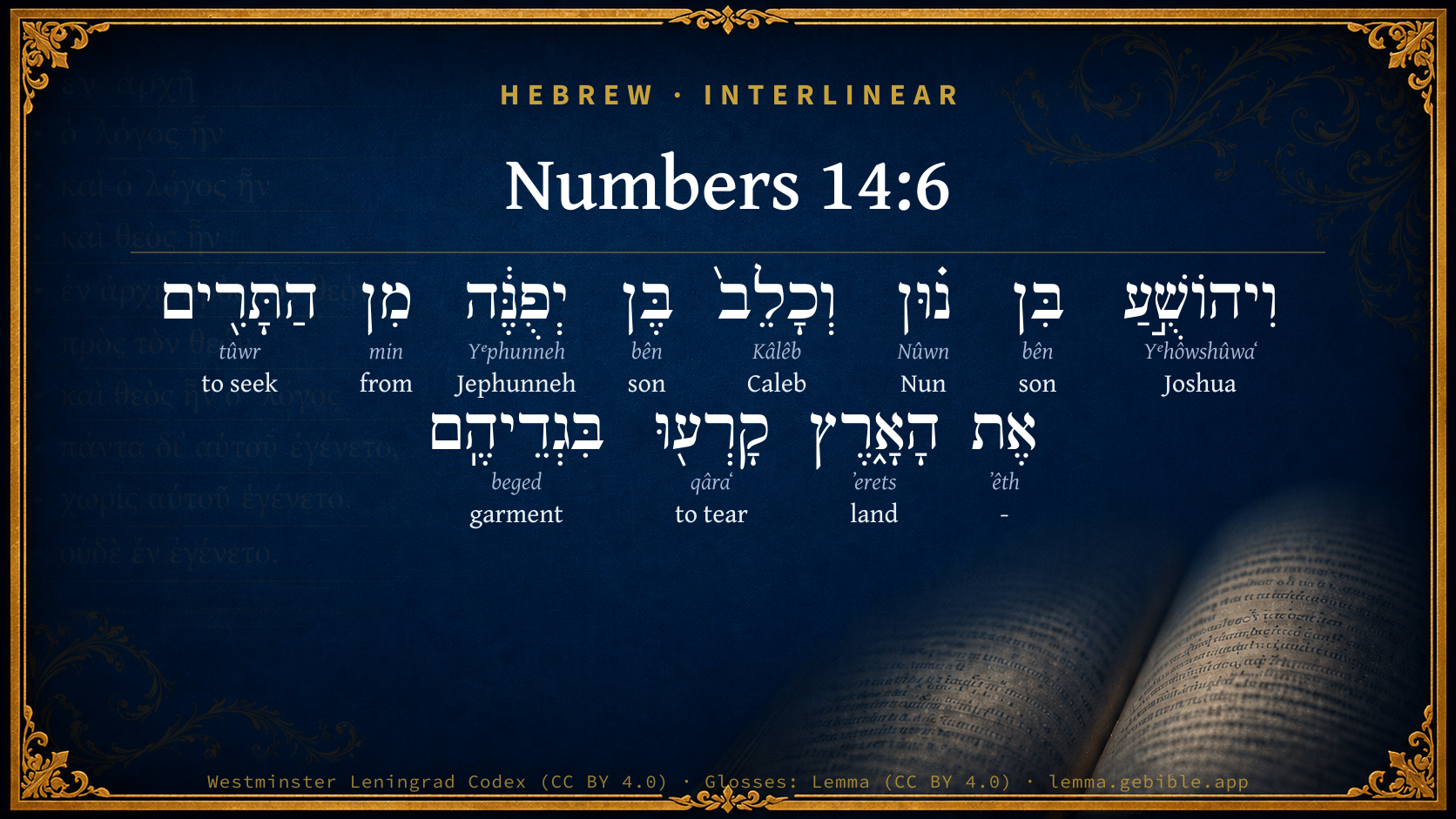
  1. וִיהוֹשֻׁ֣עַ Yᵉhôwshûwaʻ H3091 “and · Joshua” Conjunction + Noun, Proper
  2. בִּן bên H1121 “son of” Noun, Common, Masculine, Singular, Construct
  3. נ֗וּן Nûwn H5126 “Nun” Noun, Proper
  4. וְכָלֵב֙ Kâlêb H3612 “and · Caleb” Conjunction + Noun, Proper
  5. בֶּן bên H1121 “son of” Noun, Common, Masculine, Singular, Construct
  6. מִן min H4480 “from” Preposition
  7. הַתָּרִ֖ים tûwr H8446 “the · seeking” Particle, Definite Article + Verb, Qal, Participle Active, Masculine, Plural, Absolute
  8. אֶת ʼêth H853 “-” Particle, Direct Object
  9. הָאָ֑רֶץ ʼerets H776 “the · land” Particle, Definite Article + Noun, Common, Both, Singular, Absolute
  10. קָרְע֖וּ qâraʻ H7167 “to tear” Verb, Qal, Perfect, 3rd Person, Common, Plural
  11. בִּגְדֵיהֶֽם beged H899 “garments · their” Noun, Common, Masculine, Plural, Construct + Suffix, Personal, 3rd Person, Masculine, Plural

About this verse

These counts appear in no published source. They are computed here, from the morphology-tagged text and Lemma’s own curated glosses. What Lemma adds →

12
words
11
distinct lemmas
Pentateuch
section

Notable vocabulary

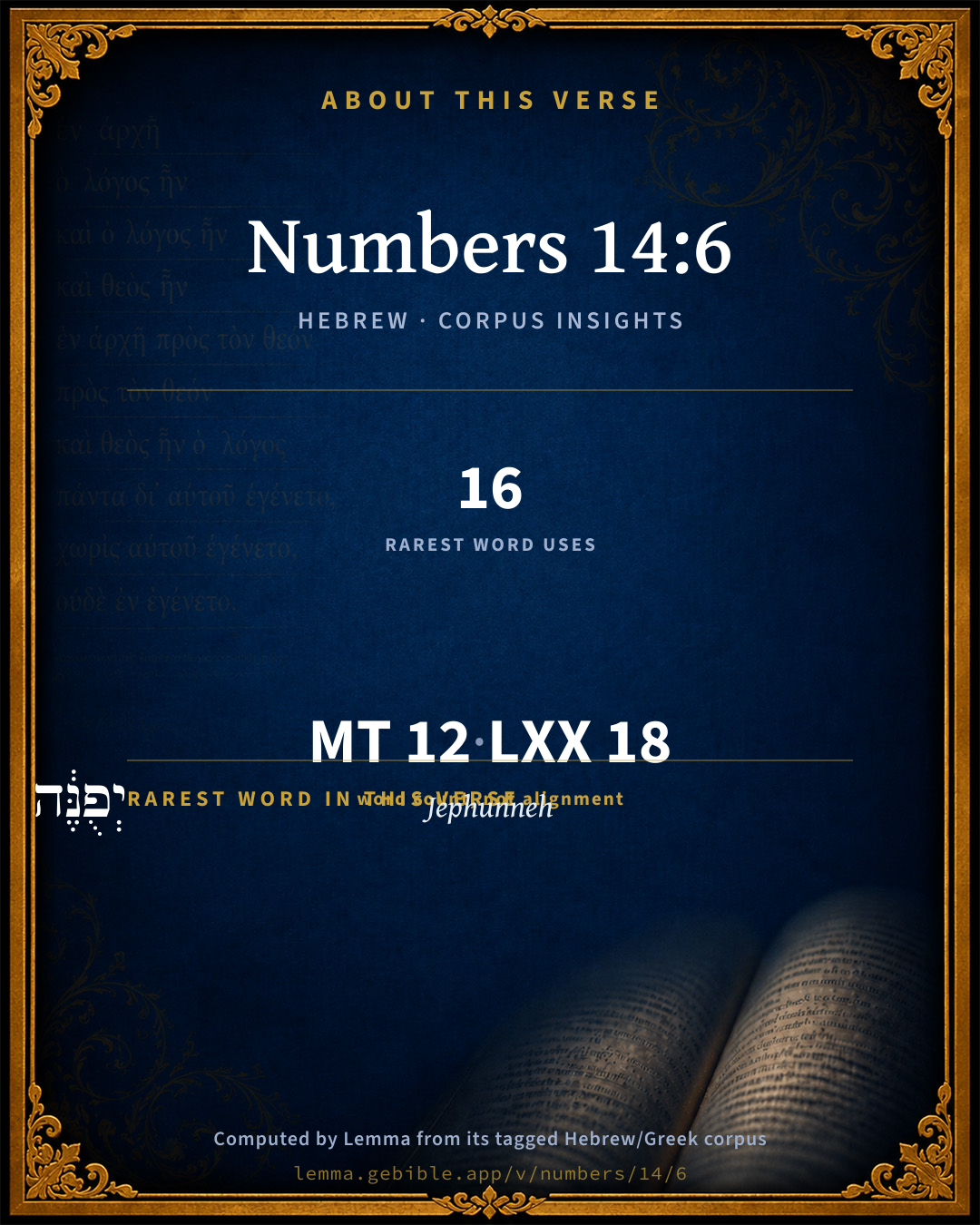
The rarest word here is יְפֻנֶּ֔ה Jephunneh H3312 — appearing just 16 times in the whole Hebrew Bible.

Shared distinctive vocabulary

יְפֻנֶּ֔ה Jephunneh H3312 occurs in 16 verses of the Hebrew Bible. Also found in:

Grammatical profile

  • 2 verbs
  • 8 nouns
  • 1 preposition
  • 1 particle

Verb forms

  • הַתָּרִ֖ים Qal · Participle Active
  • קָרְע֖וּ Qal · Perfect

Repetition

A word recurs within this verse — often emphatic in Hebrew:

Hebrew & Septuagint length

In English translation the verse runs 23 words from the Hebrew and 25 from the Septuagint (LXX English) — closely comparable.

A rough comparison of the two English renderings, which tokenize alike — not a word-level alignment.

Word counts can differ between the Hebrew and the Greek without any difference in meaning — e.g. the Hebrew direct-object marker אֵת has no separate Greek word, and Greek often adds the article ὁ.

In the original languages it is 12 Hebrew tokens and 18 Greek tokens — but the two are counted differently (Hebrew bundles its prefixes and suffixes into one token; the Greek is in lemma form), so that isn’t a like-for-like length.

Cross-references

16

Topical passages linked to Numbers 14:6 in the Treasury of Scripture Knowledge — connected by theme and wording, ordered by reader-vote popularity; previews shown in the World English Bible.

  • Numbers 13:30 Caleb stilled the people before Moses, and said, Let us go up at once, and possess it; for we are well able to overcome it.
  • Numbers 14:30 surely you shall not come into the land, concerning which I swore that I would make you dwell therein, save Caleb the son of Jephunneh, and Joshua the son of Nun.
  • Genesis 37:29 Reuben returned to the pit; and saw that Joseph wasn't in the pit; and he tore his clothes.
  • Genesis 37:34 Jacob tore his clothes, and put sackcloth on his loins, and mourned for his son many days.
  • Numbers 13:6 Of the tribe of Judah, Caleb the son of Jephunneh.
  • Numbers 13:8 Of the tribe of Ephraim, Hoshea the son of Nun.
  • Numbers 14:38 But Joshua the son of Nun, and Caleb the son of Jephunneh, remained alive of those men who went to spy out the land.
  • Genesis 44:13 Then they tore their clothes, and loaded every man his donkey, and returned to the city.
  • Numbers 14:24 but my servant Caleb, because he had another spirit with him, and has followed me fully, him will I bring into the land into which he went; and his seed shall possess it.
  • Joshua 7:6 Joshua tore his clothes, and fell to the earth on his face before the ark of Yahweh until the evening, he and the elders of Israel; and they put dust on their heads.
  • Judges 11:35 It happened, when he saw her, that he tore his clothes, and said, Alas, my daughter! you have brought me very low, and you are one of those who trouble me; for I have opened my mouth to Yahweh, and I can't go back.
  • 2 Samuel 3:31 David said to Joab, and to all the people who were with him, Tear your clothes, and gird you with sackcloth, and mourn before Abner. King David followed the bier.
  • 2 Kings 18:37 Then came Eliakim the son of Hilkiah, who was over the household, and Shebna the scribe, and Joah the son of Asaph the recorder, to Hezekiah with their clothes torn, and told him the words of Rabshakeh.
  • Job 1:20 Then Job arose, and tore his robe, and shaved his head, and fell down on the ground, and worshiped.
  • Joel 2:12–13 "Yet even now," says Yahweh, "turn to me with all your heart, And with fasting, and with weeping, and with mourning."
  • Matthew 26:65 Then the high priest tore his clothing, saying, "He has spoken blasphemy! Why do we need any more witnesses? Behold, now you have heard his blasphemy.

Cross-references courtesy of OpenBible.info (CC BY 4.0).

Hebrew and Greek witnesses Masoretic Hebrew ↔ Greek Septuagint

The same verse in the two great witnesses to the Old Testament, shown verse-for-verse.

These are two independent witnesses, not word-aligned to each other, and the Septuagint is shown in lemma (dictionary) form.

Hebrew Numbers 14:6 Masoretic · Westminster Leningrad Codex

וִיהוֹשֻׁ֣עַ בִּן נ֗וּן וְכָלֵב֙ בֶּן יְפֻנֶּ֔ה מִן הַתָּרִ֖ים אֶת הָאָ֑רֶץ קָרְע֖וּ בִּגְדֵיהֶֽם

Joshua the son of Nun and Caleb the son of Jephunneh, who were of those who spied out the land, tore their clothes:

World English Bible · Public Domain

Greek LXX Numbers 14:6 Septuagint · lemma form

ἰησοῦς δέ ὁ ὁ ναυη καί χαλεβ ὁ ὁ ιεφοννη ὁ κατασκέπτομαι ὁ γῆ διαῥήγνυμι ὁ ἱμάτιον αὐτός

But Joshua the son of Naue, and Chaleb the son of Jephonne, of the number of them that spied out the land, tore their garments,

LXX2012 (modern English Septuagint) · Public Domain

Hebrew: Westminster Leningrad Codex (CC BY 4.0). Greek: Septuagint (public domain); English from LXX2012 (modern English Septuagint) (Public Domain). How the Septuagint differs from the Hebrew →

Targum (Aramaic paraphrase)

2

The Targum is the ancient Jewish Aramaic paraphrase of the Hebrew Scriptures — an interpretive translation, not the Hebrew text itself. Onkelos (literal) and Pseudo-Jonathan (expansive) render the Torah, and Jonathan the Prophets. Coverage is partial: where no permissively-licensed English translation exists for a verse, only the Aramaic is shown. This is verse-level text, not a word-by-word alignment to the Hebrew.

  1. Targum Onkelos Torah (Genesis–Deuteronomy)
    וִיהוֹשֻׁעַ בַּר נוּן וְכָלֵב בַּר יְפֻנֶה מִן מְאַלְלֵי יָת אַרְעָא בְּזָעוּ לְבוּשֵׁיהוֹן

    (no public-domain English translation for this verse)

    Targum Onkelos — Aramaic: “Onkelos Genesis” (public domain); “Onkelos Exodus” (public domain); “Onkelos Leviticus” (public domain); “Onkelos Numbers” (public domain); “Onkelos Deuteronomy” (public domain). English: “Sefaria Community Translation” (CC0 1.0 (public-domain dedication)); “J.W. Etheridge. The Targums of Onkelos and Jonathan Ben Uzziel on the Pentateuch. London: Longmans, Green, 1862” (public domain). Text via Sefaria.

  2. Targum Pseudo-Jonathan Torah (Genesis–Deuteronomy)
    וִיהוֹשֻׁעַ בַּר נוּן וְכָלֵב בַּר יְפֻנֶה מִן מְאַלְלֵי יַת אַרְעָא בְּזָעוּ לְבוּשֵׁיהוֹן

    and Jehoshua bar Nun and Kaleb bar Jephunneh of the explorers of the land rent their clothes,

    Targum Pseudo-Jonathan — Aramaic: “Targum Jonathan on Genesis” (public domain); “Targum Jonathan on Exodus” (public domain); “Targum Jonathan on Leviticus” (public domain); “Targum Jonathan on Numbers” (public domain); “Targum Jonathan on Deuteronomy” (public domain). English: “The Targum of Jonathan ben Uzziel, trans. J. W. Etheridge, London, 1862” (public domain). Text via Sefaria.

Commentary

Notes on Numbers 14:6 from classic Christian and Jewish commentators (each source and its license shown beneath its notes). The classic Christian expositions comment on the surrounding passage and are grouped to its opening verse, so a note may address several verses; the Jewish commentaries on the Tanakh (Rashi and others) are per-verse, so they appear only where the commentator wrote on this verse.

Lemma curates 59 commentaries, every one of them public domain or Creative Commons licensed, each selected and text-cleaned for this edition rather than reprinted as found. About our sources →

Trapp's Complete Commentary

John Trapp

Num 14:6 And Joshua the son of Nun, and Caleb the son of Jephunneh, [which were] of them that searched the land, rent their clothes:

Ver. 6. Rent their clothes.] And wept, saith Sulpitius.

John Trapp, A Commentary or Exposition upon All the Books of the Old and New Testament (1647–1656) — public domain. Text from a community e-Sword module.

The Biblical Illustrator

Joseph S. Exell

Num_14:6-9

The Lord is with us: fear them not.

A noble effort to arrest a nations rebellion

I. Joshua and Caleb were deeply grieved by reason of the rebellion of the nation.

II. Joshua and Caleb nobly endeavoured to arrest the rebellion of the nation.

1. They reassert the excellence of the land.

2. They declare the attainableness of the land.

3. They exhort the people not to violate the conditions of its attainment.

(1) By rebelling against the Lord.

(2) By dreading the people of the land.

III. Joshua and Caleb were in danger by reason of their effort to arrest the rebellion of the nation. All the congregation bade stone them with stones. See here--

1. The tactics of an excited mob when defeated in argument.

2. The folly of an excited mob. This proposal to stone Joshua and Caleb was insane.

(1) Stoning would not disprove the testimony, or take away the wisdom from the counsel of the two brave explorers.

(2) Stoning would involve the nation in deeper guilt and disgrace.

3. The perils of faithfulness.

IV. Joshua and Caleb rescued from danger by the interposition of God. (W. Jones.)

An encouraging declaration

I. A supposition. If the Lord delight in us (Pro_8:30). God delights in His Son, &c. He delights in His holy angels, &c. But have we reason to suppose that He delights in His saints?

1. We might conclude, indeed, that He could not delight in them, when we reflect--

(1) On their nothingness and vanity. Man at His best estate, &c.

(2) On their guilt and rebellion. Not one but is a sinner.

(3) On their pollution and want of conformity to His likeness.

(4) And more especially when we reflect on His greatness, independence and purity.

2. But there are the most satisfactory evidences that He does delight in His people.

(1) Observe the names by which He distinguishes them. His jewels--inheritance--treasure--diadem--crown and portion. See the very term in the text. And Pro_11:20.

(2) Observe the declarations He has made respecting them. He that toucheth you, toucheth the apple of Mine eye.

(3) Observe what He has done for them. Favoured--sustained--redeemed them--given His Son--Spirit--promises.

(4) What He has provided for them. The Lord God is a sun, &c. My God shall supply, &c. Eye hath not seen, &c.

(5) Eternal life and unceasing glory.

II. An inference. Then He will bring us into this land, &c. Observe here--

1. The land specified. It is the land afar off. The good land. The heavenly Canaan. Tile region of immortality.

2. This land is Gods gift. Not the result of merit. It is given in promise--given in Christ.

3. To this land God must bring His saints. Difficulties, enemies, and dangers intervene. He will guide to it. Keep--safely conduct, and at length put people into it, as He did Israel. Fear not, little flock, &c. Let not your hearts be troubled, &c. (Rev_2:10; Rev_2:26; Rev_3:5; Rev_3:12). (J. Burns, D. D.)

The boldness and fidelity of Joshua and Caleb

I. How sound was their reasoning!

1. They drew a strong argument from the assurance that the Lord was with them, bat that the defence of the Canaanites had departed from them. They spoke of the country itself as worthy of the contest.

2. They reminded the people of the danger of disobedience, as appeared from their past history; and from the character of God. Sin was the only giant that they had reason to fear. Happy would it have been for the people, had they listened to these arguments.

II. How resolute was their spirit! Personally, no doubt, it would have been much more pleasant to remain in the tent; but viewing this as an opportunity of doing good, and glorifying God, they encountered the shame of uttering sentiments which were reprobated; and the danger of advising measures which were disliked. Thus numbers in the present day say, Religion is all very well in its place; but they have no idea of glorifying God, and endeavouring to save souls, by acting with the decision that Caleb and Joshua did. We, too, may mourn over sin, but we must do something more; we must use all our influence to put it down, and to lead forward the Israel of God.

III. How undivided was their aim! Their one desire was to get the land; and therefore if popular opinion coincided with them, well; but if not, they would not be guided by it. They could do without riches, or honour, or life itself; but they could not do without Canaan. (George Breay, B. A.)

The Biblical Illustrator, edited by Joseph S. Exell (c. 1880s–1900s) — public domain. Text from a community e-Sword module.

Joseph Benson's Commentary

Num 14:6. Rent their clothes — To testify their hearty grief for the people’s blasphemy against God and sedition against Moses, and that dreadful judgment which they easily foresaw this must bring upon the congregation.

Joseph Benson's Commentary on the Old and New Testaments (1811–1818) — public domain. Text from a community e-Sword module.

Whedon's Commentary on the Bible

Daniel D. Whedon

JOSHUA AND CALEB’S MINORITY REPORT, Num_14:6-10.

The two believing spies, having been rudely interrupted in their report by the cowardly ten, (Num_13:30-31,) now come forward, evincing the deepest emotion, and attempt to continue their narration of their view of the situation. They succeed in uttering a few cheering words, when their voices are drowned in the hoarse clamour of the mob, now excited to a frenzy which imperils the lives of the speakers, “faithful among the faithless found.”

6. Rent their clothes — The flowing robes of the Orientals admit of various symbolical actions. Rending expresses grief, indignation, despair, or fear. The outer garment only was torn. See Gen_39:12, (Hebrew.)

Daniel D. Whedon (gen. ed.), Commentary on the Old and New Testaments (1874–1909) — public domain. Text from a community e-Sword module.

Tyndale Open Study Notes

Tyndale Open Resources

14:6 Joshua and Caleb joined in the effort to reverse the rebellion and avert God’s wrath; they tore their clothing in a gesture of grief.

Tyndale Open Study Notes — © Tyndale Open Resources, licensed CC BY-SA 4.0. Text via the HelloAO Bible API.

Geneva Bible (1599)

Geneva Bible translators

For sorrow, hearing their blasphemy.

Geneva Bible (1599) marginal notes — public domain. Text via Bolls.life.

Jamieson, Fausset & Brown

Robert Jamieson, A. R. Fausset & David Brown

Joshua . . . and Caleb, which were of them that searched the land, rent their clothes--The two honest spies testified their grief and horror, in the strongest manner, at the mutiny against Moses and the blasphemy against God; while at the same time they endeavored, by a truthful statement, to persuade the people of the ease with which they might obtain possession of so desirable a country, provided they did not, by their rebellion and ingratitude, provoke God to abandon them.

Jamieson, Fausset & Brown — Commentary Critical and Explanatory on the Whole Bible (1871) — public domain (CC PDM 1.0). Text via the HelloAO Bible API.

Adam Clarke's Commentary

Verse 6. And Joshua, &c.] See on the preceding chapter, See Clarke on Nu 13:33.

Adam Clarke's Commentary on the Bible (1810–1826) — public domain. Text from a community e-Sword/MySword module.

Ellicott's Commentary for English Readers

(6) Rent their clothes.—Comp. Lev_10:6 and Note.

A Bible Commentary for English Readers, edited by Charles John Ellicott (1878–1897) — public domain. Text from a community e-Sword module.

John Gill's Exposition

And Joshua the son of Nun, and Caleb the son of Jephunneh,.... Rose up and interposed in this affair, looking upon themselves under a special obligation so to do, as they were capable of confronting the other spies, and contradicting what they had said:

which were of them that searched the land; they were two of that number, and were the more concerned to hear such a false account given, and distressed to observe the mutiny of the people, and therefore judged themselves in duty bound to do all they could to stop it:

rent their clothes; in token of sorrow for the sins of the people; and at their blasphemy and ingratitude against God, and in dread of his wrath and fury breaking forth upon them.

John Gill's Exposition of the Whole Bible (1746–1763) — public domain (CC PDM 1.0). Text via the HelloAO Bible API.

Haydock's Catholic Bible Commentary

Garments, in testimony of their disapprobation and zeal; to make these insolent people reflect upon the evils into which they are throwing themselves. (Calmet)

George Leo Haydock (1774–1849), Haydock's Catholic Family Bible and Commentary, 1859 edition — public domain. Excludes Psalms (Douay-Rheims chapter numbering differs from Protestant) and Deuterocanonical books (Catholic canon only).

Matthew Poole's English Annotations

To testify their hearty grief for the people’s blasphemy against God and sedition against Moses, and that dreadful judgment which they easily foresaw this must bring upon the congregation and people of God.

Matthew Poole's English Annotations on the Holy Bible (1683–1685) — public domain. Text from a community e-Sword/MySword module.

The Pulpit Commentary

And Joshua. In a last hopeless effort to bring the people to a better mind, or at least to deliver their own souls, there was no reason why Joshua should hold back any more. Rent their clothes. Another token of grief and hinter practiced from patriarchal times. (cf. Gen_37:29, 34 Job_1:20)

Vers. 6-10. Speaking out: a last appeal.

Moses is silent from necessity, his power with men in abeyance, and he waiting humbly upon God. Joshua and Caleb, who were not only men of a different spirit, but also very imperfectly acquainted with Moses" peculiar burden, spoke out. As it was well for Moses and Aaron to be silent, it was also well for Caleb and Joshua to speak out. Moses and Aaron were for the time separated, forsaken, and as it were condemned; but Caleb and Joshua are still in the multitude Caleb indeed partly declared, and only waiting further opportunity to speak his mind fully on the subject. Now Joshua and he take their stand without any hesitation or chance of being mistaken. They had something to say which Moses could not say, for they had been through the land. Thus, when God"s servant is compelled to be silent, friends arise to say what is right and just. Consider

I THE MANNER OF THE SPEAKERS. "They rent their clothes." This was the symbol of hearts rent with grief and astonishment because of impending disaster. To the Israelites their only hope appeared in retracing their steps. To Caleb and Joshua this was the summary and utter extinction of a great opportunity. The multitude looked on Canaan as worse than the grave, a scene of vain struggles and harassing privations. Caleb and Joshua looked on the multitude as threatening the unutterable folly of drawing back from certain and inestimable blessings when they lay within their reach. Therefore they accompanied their speech with an action that indicated the distress and laceration of their hearts. Truth may do such things naturally in the very vehemence and consistency of its onset. We do not read that the spies who brought up a slander on the land rent their clothes while they were telling their story. Hypocrisy must always be careful in its histrionics not to overdo the thing.

II THE MATTER OF THEIR SPEECH. They give the testimony of experience. They had passed through the land to search it. Although they were only two against ten who told a different story, yet, strong in the consciousness of sincerity and competency, they declared what they had seen with their eyes, looked upon, and handled. Though their testimony would not have been enough for some purposes, yet it was quite enough to throw as a check in the way of revolted Israel. They emphatically assert the goodness of the land. It was a land to be desired, corresponding to all the promises made and the hopes cherished, worth all the struggling and self-denial that might be needed in order to attain it. They show a devout recognition of Jehovah. This alone might make their word, though only two, outweigh the exaggerations of the other ten. The recognition shows itself in two ways.

1. They avow the necessity of his favour. "If the Lord delight in us;" that means, surely, "If we believe in the Lord." That which delights the Lord is to see men walking by faith, and not by sight, stepping forward into the darkness upon his clear command. Caleb and Joshua felt sure, from what they had seen of the fatness and beauty of Canaan, that God wished to delight in his people, if only they would allow it.

2. They avow the necessity of submission to God. Unbelief is not only separation, it is rebellion. This was the real danger of Israel rebellion against God"s appointments and restrictions. By their present conduct they were strengthening the nations of Canaan with more than all their walled cities, giants, and strong men could give them. They show that the Canaanites are really very weak. There is nothing more fallacious than outside show and casual inspection. The spies had brought some fruit, and doubtless tasted much more; but how could they report adequately on defenses which they could not examine in any accurate way? They did not know how all these people were undermined and enervated by their wickedness. The very wealth of the hind became a curse and corrupting influence to the idolaters who dwelt in it. Wicked nations in the midst of all their boasting and revelry are preparing their own destruction.

III THE RESULTS OF THEIR SPEECH.

1. The exasperation, of the people reaches its highest pitch. "All the congregation bade stone them with stones, This was the punishment which God had appointed for serious transgressions. (Lev_20:2, 27 24:14 Num_15:35 Deu_13:10, &c.); And now the people adopt it, numbering Caleb and Joshua with transgressors against their sovereign will. If we speak the truth, all of it, and at the time when it should be spoken, we must be ready for the consequences. The two faithful witnesses would certainly have been stoned, as Zechariah long after, (2Ch_24:21) but

2. God himself interfered. "The glory of the Lord appeared," &c. In a moment, in the twinkling of an eye, the rebels were reduced to impotence. One can imagine the uplifted stone dropped, as if it had turned to a blazing coal. Israel may still be sullen and rebellious in ;heart, but its hand is in the power of God. He can rescue his servants from the power of their enemies, if that be most expedient. Caleb and Joshua still had much work to do. Or, as happened to Stephen, he can turn the unchecked fury of men into the agent, of, a quick, and glorious dismission from the toils and perils of earthly service. In God s house the more manifest the faithfulness of the servant, the more manifest also the faithfulness of the Master. Y.

The Pulpit Commentary (1880–1919), ed. H.D.M. Spence-Jones & Joseph S. Exell — public domain. Text from a community e-Sword module.

John Wesley's Explanatory Notes

Rent their clothes - To testify their hearty grief for the peoples blasphemy against God and sedition against Moses, and that dreadful judgment which they easily foresaw this must bring upon the congregation.

John Wesley, Explanatory Notes Upon the Whole Bible (1754–1765) — public domain. Text via the GEBible commentary corpus.

unfoldingWord translationNotes

Door43 World Missions Community

Nun ... Jephunneh

These are names of men. (See: How to Translate Names)

who were some of those sent

This can be stated in active form. AT: "who were some of those whom Moses sent" (See: Active or Passive)

tore their clothes

Tearing one's clothes was a gesture indicating the person is very troubled and is mourning. (See: Symbolic Action)

The land flows with milk and honey

They spoke of the land being good for animals and plants as if the milk and honey from those animals and plants flowed through it. See how you translated this in Numbers 13:27. AT: "It is excellent for raising livestock and growing crops" or "It is very fertile land" (See: Metaphor)

translationWords

Joshua

Caleb

send

unfoldingWord translationNotes — © Distant Shores Media and the Door43 World Missions Community, licensed CC BY-SA 4.0. Source: git.door43.org/Door43/en_tn.

Lesson kit

Teaching starters — assembled from the data on this page, not authored interpretation. Every prompt links to the verse data it draws on. Edit before teaching.

Numbers, in the Pentateuch, opens this verse with 12 words (11 distinct Hebrew lemmas). Its most distinctive word is Yᵉphunneh (“Jephunneh”). A historical commentator’s framing appears above. Read the whole chapter for the surrounding context.

Discussion questions

  1. How does “Jephunneh” (Yᵉphunneh) shape what this verse is saying?
  2. How does Numbers 13:6, which shares the word «Jephunneh», read alongside this verse?
  3. What does the repetition of “son” (2× in this one verse) do in this verse?
  4. These translations render this verse differently; the difference is in the English rendering, not the original. What questions does that raise?
  5. «הַתָּרִ֖ים» is a Qal Participle Active verb. How does that grammatical form shape the action described?
  6. Compare how Trapp's Complete Commentary and The Biblical Illustrator read this verse. Where do they agree or differ?

Things to notice

Reading settings

Reading text

Shown beneath each verse's original-language words.

Old Testament
Old Testament edition

Read the OT as the Masoretic Hebrew (MT) or the Greek Septuagint (LXX).

English shown for the Greek Septuagint (in the Hebrew ↔ Greek comparison).

Comparing translations? Open the Compare panel on any verse page to stack up to four side by side.